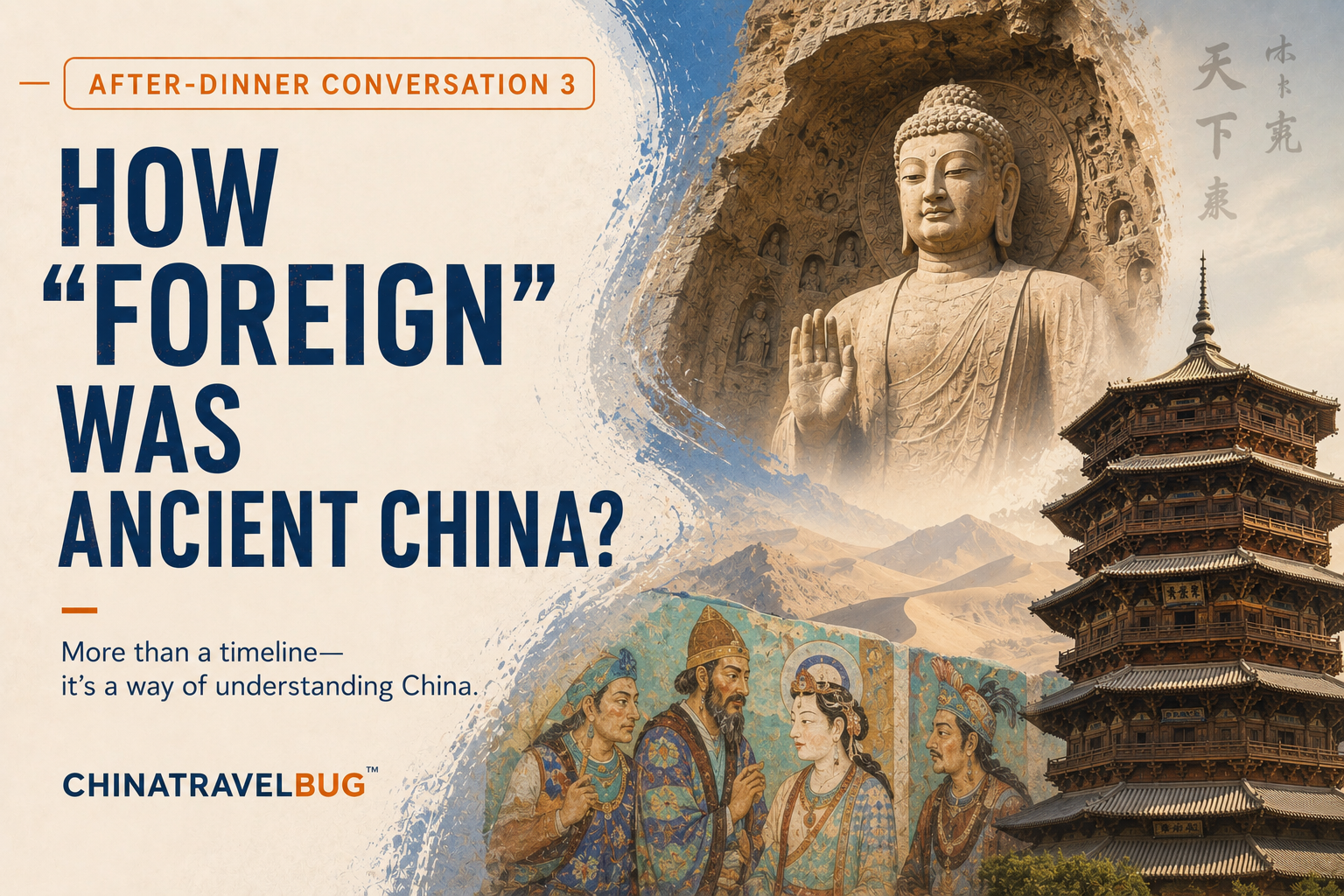
Section 1 — You’re in Xi’an, “Starting Point of the Silk Road.” But What Does That Actually Mean?
For many first-time travelers to:
Xi’an (西安, Xī’ān)
the phrase appears almost immediately:
Silk Road (丝绸之路, Sīchóu Zhī Lù).
You’ll see:
Silk Road museums.
Silk Road exhibitions.
Silk Road performances.
Silk Road souvenirs.
Silk Road everything.
😂
And you’ll probably hear that ancient:
Chang’an (长安, Cháng’ān)
— today’s Xi’an —
was the eastern end or a major eastern starting point of the Silk Roads.
Excellent.
But Deep China has another annoying question:
What did being connected to the Silk Roads actually DO to China?
Did some Chinese silk simply travel west?
Or did:
people
religions
music
art
foods
fashion
technology
and:
ideas
travel in BOTH directions?
🔥
Because once we ask that question…
ancient China starts looking much less isolated than many first-time Western travelers expect.
First: There Wasn’t One “Silk Road”
This is our first correction.
The Chinese:
Silk Road (丝绸之路, Sīchóu Zhī Lù)
sounds singular.
One road.
Perhaps:
Xi’an → Central Asia → Rome.
😂
Ancient motorway.
Marco Polo service station halfway.
No.
A better picture is:
Silk Roads
— plural.
Networks of:
overland routes (陆路, lùlù),
oasis routes,
mountain passes (关口, guānkǒu),
caravan routes,
and:
maritime routes (海路, hǎilù).
Different routes became important in different periods.
Goods often changed hands many times.
Most travelers did NOT:
leave Chang’an carrying silk and personally walk all the way to Rome.
😂
Think:
NETWORK.
Not:
HIGHWAY.
🌏 And UNESCO Treats It as a Network Too
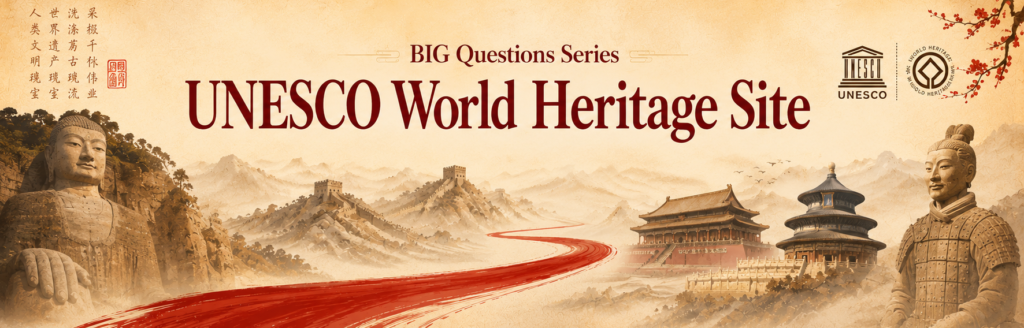
The UNESCO-listed:
Silk Roads: Chang’an–Tianshan Corridor
extends roughly:
5,000 kilometers
from the Chang’an/Luoyang region toward:
Central Asia (中亚, Zhōngyà).
Its surviving sites include:
capital cities,
trading settlements,
Buddhist cave temples,
ancient paths,
posthouses,
passes,
beacon towers,
fortifications
and even:
sections of the Great Wall.
🔥
Wait.
Great Wall + Silk Roads?
Yes.
Again.
😂
Defense and exchange could exist in the same historical landscape.
🐇 So What Actually Traveled?
Let’s start with:
goods (货物, huòwù).
China exported famous products including:
silk (丝绸, sīchóu).
But things also moved:
INTO China.
Among the wider streams of exchange were:
horses (马, mǎ),
metalware,
glassware,
precious objects,
foods,
plants,
textiles,
and:
luxury goods.
🔥
And during Tang times, imported objects and foreign designs influenced Chinese:
crafts (工艺, gōngyì)
fashion (服饰, fúshì)
and:
art (艺术, yìshù).
So the Silk Roads weren’t simply:
China sells silk to foreigners.
China was also:
receiving.
🐎 The Horse Appears AGAIN
😂
Dad warned you.
Chinese frontier history:
horse (马, mǎ).
Silk Road history:
horse.
Military history:
horse.
Tang elite culture:
horse.
Western and Central Asian horses were highly valued in imperial China.
Why?
Because good horses mattered for:
cavalry (骑兵, qíbīng)
warfare (战争, zhànzhēng)
transport (交通, jiāotōng)
and:
prestige.
🔥
So the exchange wasn’t:
China has everything → foreigners want Chinese stuff.
Different regions had:
different things each side wanted.
That’s how exchange works.
🐇 Then Meet the Sogdians
Here’s one group first-time travelers probably haven’t heard of:
Sogdians (粟特人, Sùtèrén).
The Sogdians came from:
Central Asia (中亚)
especially regions around places such as:
Samarkand (撒马尔罕, Sāmǎ’ěrhǎn).
They became some of the most important merchants and intermediaries along parts of the Silk Roads.
🔥
Sogdian communities could be found far east into China.
So when you imagine the Silk Roads, don’t imagine only:
Chinese merchant
meeting:
Roman merchant.
😂
Between them were many:
peoples,
languages,
states
and:
merchant networks.
The:
Sogdians
were among the great connectors.
🍚 Western Handrail: The Silk Roads Were a Relay Race
This is useful.
Imagine:
a relay race.
One merchant moves goods from:
A → B.
Another:
B → C.
Another:
C → D.
Goods can travel enormous distances…
even if the original merchant:
doesn’t.
🔥
The same can happen with:
ideas,
artistic styles,
stories
and:
technologies.
They move through:
intermediaries.
That’s one reason the Silk Roads were so powerful.
🌶️ Then We Reach Tang Chang’an
Now move to:
Tang dynasty (唐朝, Táng Cháo)
618–907.
And:
Chang’an (长安).
This is where the first-time Xi’an traveler should really pay attention.
Tang Chang’an was one of the great:
cosmopolitan cities (国际化都市, guójìhuà dūshì)
of the medieval world.
🔥
Merchants.
Envoys.
Monks.
Musicians.
Artisans.
Travelers.
People from different parts of:
Central Asia,
India,
Persia,
Korea,
Japan
and elsewhere moved through the Tang world.
The Met describes merchants, clerics and envoys from India, Persia, Arabia, Syria, Korea and Japan as part of Chang’an’s cosmopolitan environment. :contentReference[oaicite:1]{index=1}
Now:
“Xi’an was the starting point of the Silk Road”
finally starts meaning something.
🐇 Walk Through a Tang Museum Differently
Next time you’re in a Xi’an museum looking at:
Tang dynasty artifacts (唐代文物, Tángdài Wénwù)
don’t look only for:
“beautiful Chinese objects.”
Look for:
foreign influence (外来影响, wàilái yǐngxiǎng).
You may encounter figures depicting:
foreign merchants,
Central Asian horsemen,
musicians,
dancers
and:
camels (骆驼, luòtuo).
🔥
You may see artistic forms and decorative motifs connected with:
Central Asia
or:
Persia (波斯, Bōsī).
Suddenly museum objects become evidence of:
movement.
🐫 Why So Many Camels?
😂
Another museum animal.
camel (骆驼, luòtuo).
Especially:
Bactrian camel (双峰骆驼, shuāngfēng luòtuo)
with:
two humps.
These animals were well adapted to difficult environments along parts of the overland trade networks.
So when you see Tang:
camel figurines
don’t simply think:
“Cute camel.”
🐫
Think:
long-distance movement.
🔥
Object → question → Silk Roads.
Another rabbit.
🎵 And Music Traveled Too
This is where exchange becomes much more human.
Not only goods traveled.
So did:
music (音乐, yīnyuè)
dance (舞蹈, wǔdǎo)
and:
musical instruments (乐器, yuèqì).
Central Asian musical and dance traditions became fashionable in Tang elite culture.
One famous example is the:
Sogdian Whirl (胡旋舞, Húxuánwǔ)
— a whirling dance associated with Central Asian performers.
🔥
Imagine Tang Chang’an.
Foreign musicians.
Different clothes.
Different instruments.
Different languages.
Different dances.
This is no longer:
“isolated ancient China.”
😂 Even Fashion Could Be Foreign
Tang elites could adopt:
riding clothes,
boots,
foreign-style garments
and:
Central Asian fashions.
So somewhere in eighth-century Chang’an there was probably an ancient equivalent of:
“OMG everyone is wearing that now.”
😭😂
Humans remain humans.
Fashion travels.
🌶️ But the Biggest Import Wasn’t an Object
Not:
horse.
Not:
camel.
Not:
glass.
Not:
fashion.
The biggest historical transformation came through:
ideas.
And one of the most important was:
Buddhism (佛教, Fójiào).
🔥🔥🔥
Buddhism originated in:
India (印度, Yìndù).
It entered China over centuries through complex routes involving:
Central Asia,
monks (僧人, sēngrén),
merchants,
translators (翻译者, fānyìzhě)
and:
texts (经书, jīngshū).
Think about what that means.
One of the great religious traditions of Chinese civilization:
came from outside China.
🐇 Yet Buddhism Became Deeply Chinese
And this is the really important part.
Buddhism didn’t arrive in China and remain:
a permanently foreign object.
It was:
translated,
debated,
adapted,
patronized,
reinterpreted
and:
developed
within Chinese society.
🔥
Chinese Buddhist traditions emerged.
Chinese Buddhist art developed.
Chinese Buddhist temples developed.
Chinese schools of Buddhist thought developed.
Then Chinese forms of Buddhism traveled onward to:
Korea (韩国 / 朝鲜半岛)
and:
Japan (日本, Rìběn).
Now cultural movement is:
IN
and:
OUT.
🐇 Xuanzang Makes This Physical
First-time Xi’an travelers already have a perfect doorway:
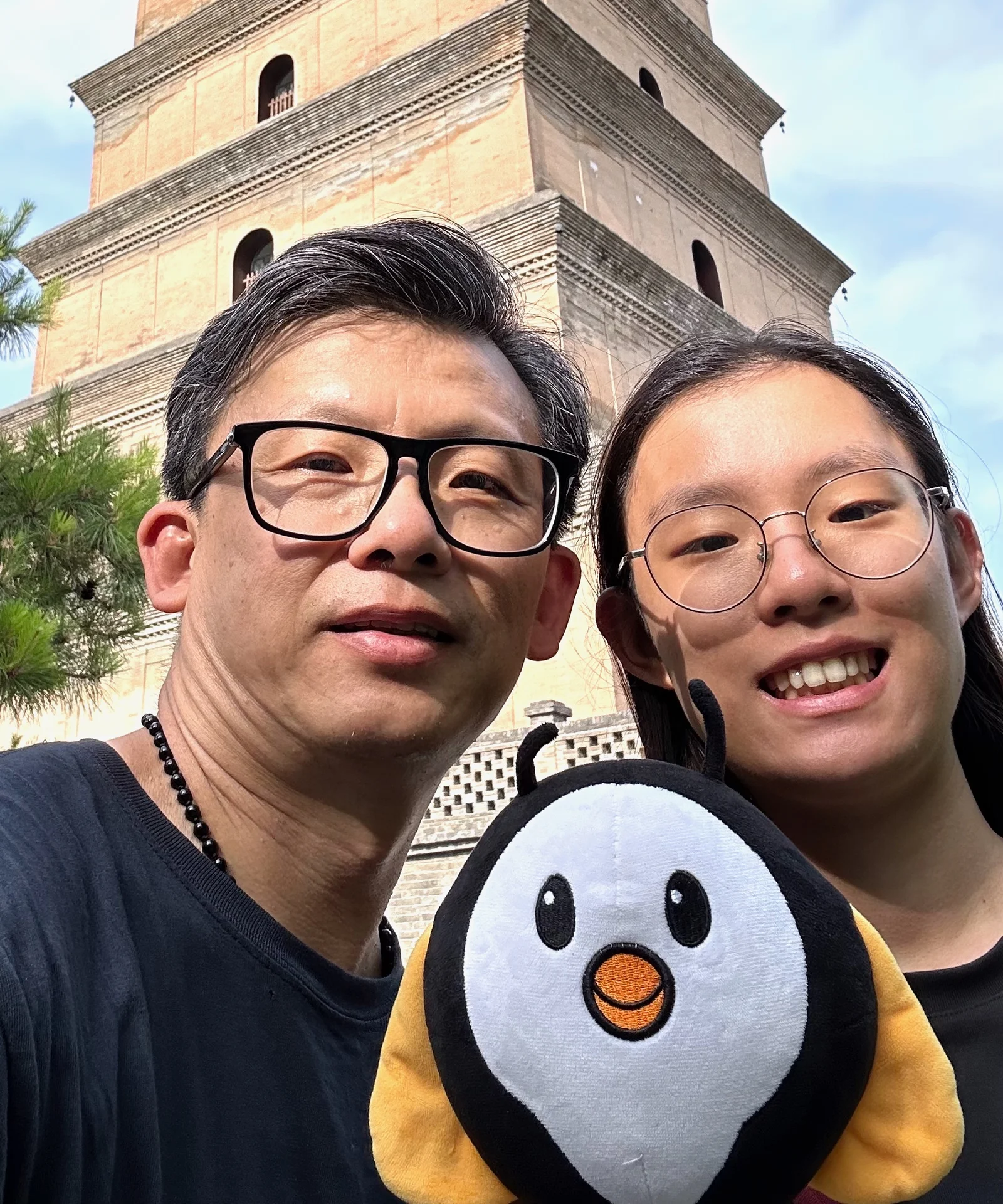
Big Wild Goose Pagoda (大雁塔, Dàyàn Tǎ).
And:
Xuanzang (玄奘, Xuánzàng).
The historical Xuanzang was a Tang Buddhist monk who traveled through Central Asia to:
India
in search of Buddhist learning and texts.
Then he returned to:
Chang’an.
🔥
Think:
CHINA
↓
CENTRAL ASIA
↓
INDIA
↓
Buddhist learning
↓
BACK TO CHANG’AN
↓
translation (翻译)
↓
Chinese Buddhism.
That’s cultural exchange you can physically attach to:
a famous Xi’an landmark.
🍚 Don’t Reduce Xuanzang to Journey to the West
Western and Chinese popular culture often remembers Xuanzang through:
Journey to the West (西游记, Xīyóu Jì).
Monkey King!
😂
Different layer.
The historical:
Xuanzang
was a real monk and scholar.
His journey belongs to the history of:
Buddhist exchange across Asia.
The later novel transformed that journey into one of the great works of Chinese literature.
Both are fascinating.
Don’t confuse them.
🌶️ And Buddhism Wasn’t the Only Foreign Religion
Here’s where Tang Chang’an becomes genuinely surprising.
The wider Silk Roads brought religious traditions including:
Zoroastrianism (祆教, Xiānjiào)
Manichaeism (摩尼教, Móníjiào)
and:
Church of the East Christianity (景教, Jǐngjiào).
😳
Yes.
Christianity.
In Tang China.
More than:
1,200 years ago.
UNESCO’s Silk Roads documentation specifically records Buddhism, Zoroastrianism, Manichaeism and Church of the East Christianity along the Chang’an–Tianshan networks. :contentReference[oaicite:2]{index=2}
🐇 Xi’an Has the Evidence
One of the most famous monuments is the:
Xi’an Stele / Nestorian Stele
(大秦景教流行中国碑, Dàqín Jǐngjiào Liúxíng Zhōngguó Bēi)
erected in:
781 CE
during the:
Tang dynasty.
Its inscription records the history of:
Jingjiao (景教)
— the Church of the East tradition in Tang China.
🔥
So when somebody imagines ancient China as:
one religion + one people + one culture behind a wall
the Tang evidence starts causing serious trouble.
😂
🐇 And Look at the Chinese Name
大秦景教流行中国碑
Even beginner Chinese readers can spot:
中国 — Zhōngguó.
And:
教 — jiào
teaching / religion.
Then:
景教 — Jǐngjiào
the Chinese name used for this Christian tradition.
🔥
Historical Chinese vocabulary itself preserves traces of:
encounter.
🌶️ But Don’t Turn Tang China Into Modern New York
Important Michelin guardrail.
😂
Tang Chang’an was:
cosmopolitan.
That does NOT mean:
“Tang China had modern multiculturalism.”
Different laws.
Different social structures.
Different political hierarchy.
Different concepts of identity.
Different treatment of communities at different times.
And Tang attitudes toward foreign religions:
changed.
In the ninth century, major religious persecutions affected Buddhism and foreign religions.
🔥
So:
cosmopolitan ≠ permanently tolerant modern society.
Historical context matters.
🐞 Sting Check
You began Section 1 hearing:
“Xi’an was the starting point of the Silk Road.”
Now you’ve acquired:
Silk Roads (丝绸之路)
↓
trade (贸易)
↓
horses (马)
↓
Sogdians (粟特人)
↓
Chang’an (长安)
↓
camels (骆驼)
↓
Central Asian music
↓
Sogdian Whirl (胡旋舞)
↓
foreign fashion
↓
Buddhism (佛教)
↓
India (印度)
↓
Xuanzang (玄奘)
↓
Big Wild Goose Pagoda (大雁塔)
↓
Zoroastrianism (祆教)
↓
Manichaeism (摩尼教)
↓
Christianity / Jingjiao (景教)
↓
Xi’an Stele (大秦景教流行中国碑).
😬
That’s quite a lot hiding behind:
“Silk Road.”
😂
The Bigger Lesson
Ancient China wasn’t simply:
sending Chinese culture outward.
It was also:
receiving
borrowing
translating
adapting
and:
transforming
things arriving from elsewhere.
🔥
And nowhere is that easier for a first-time traveler to understand than:
Xi’an / Chang’an.
Because beneath modern Xi’an lies the memory of a city connected to:
a much wider Eurasian world.
So the next time somebody tells you:
“Xi’an was the starting point of the Silk Road.”
don’t just nod.
Ask:
“Who came the OTHER way?”
🐇🔥🐞
Section 2 — From Xi’an to Yungang and Wutai: What Arrived From Abroad Didn’t Stay “Foreign”
Section 1 left us in:
Chang’an (长安, Cháng’ān)
— today’s:
Xi’an (西安, Xī’ān).
We discovered:
Sogdian merchants (粟特商人, Sùtè shāngrén),
horses (马, mǎ),
camels (骆驼, luòtuo),
music (音乐, yīnyuè),
dance (舞蹈, wǔdǎo),
Buddhism (佛教, Fójiào),
and even:
Christianity / Jingjiao (景教, Jǐngjiào).
So ancient China clearly wasn’t:
a civilization developing alone behind the Great Wall.
But there’s a more interesting question.
What happened AFTER foreign ideas arrived?
Did China simply:
copy them?
No.
Did they remain permanently:
foreign?
Also no.
🔥
Something much more interesting happened.
They were:
translated (翻译, fānyì),
adapted (适应, shìyìng),
transformed (转化, zhuǎnhuà),
and sometimes became:
deeply embedded in Chinese culture.
And Buddhism gives us perhaps the clearest example.
🐇 Buddhism Came From India — But Chinese Buddhism Became Chinese
Start with the basic fact:
Buddhism (佛教, Fójiào)
originated in:
India (印度, Yìndù).
It entered China gradually over centuries through complex networks involving:
Central Asia (中亚, Zhōngyà),
monks (僧人, sēngrén),
merchants (商人, shāngrén),
travelers,
texts (佛经, fójīng)
and:
translators (译经僧, yìjīngsēng).
🔥
But Buddhism arriving in China wasn’t the end of the journey.
It was the beginning of another one.
📖 Translation Is Not Copy-and-Paste
Imagine receiving a Buddhist text written in:
Sanskrit (梵文, Fànwén)
or another language used in Buddhist transmission.
Now translate concepts developed in Indian philosophical and religious traditions into:
Chinese (汉语, Hànyǔ).
Problem:
What if Chinese doesn’t have an exact equivalent?
😬
The translator has to make choices.
Use an existing Chinese term?
Create a new expression?
Transliterate the foreign sound?
Explain the idea differently?
🔥
Translation isn’t merely:
changing words.
It can change:
how ideas are understood.
🍚 Western Handrail: Translation Changes the Recipe
Suppose Dad gives you a recipe.
But several ingredients don’t exist where you live.
😂
You substitute.
Adapt.
Change cooking methods.
Eventually:
the dish is related to the original…
but:
it has developed a life of its own.
Ideas can travel like that too.
Buddhism entered China.
Then Chinese thinkers, monks and communities spent centuries:
making sense of it in Chinese cultural and intellectual worlds.
🔥
🐇 Chinese Buddhist Schools Develop
Over time, distinctive Buddhist traditions developed in China.
Among them were:
Tiantai Buddhism (天台宗, Tiāntái Zōng)
Huayan Buddhism (华严宗, Huáyán Zōng)
Pure Land Buddhism (净土宗, Jìngtǔ Zōng)
and:
Chan Buddhism (禅宗, Chán Zōng).
🔥
You may recognize the last one differently.
Chan (禅)
travels to Japan…
where its Japanese pronunciation gives us:
Zen.
😳
So:
India
↓
Buddhism
↓
China
↓
Chan (禅)
↓
Japan
↓
Zen
↓
Western traveler attends Zen retreat.
😭😂
Rabbit hole complete.
🌶️ Cultural Exchange Doesn’t Have One Direction
This is the important lesson.
We often imagine:
FOREIGN THING → CHINA.
But cultural exchange can continue:
CHINA → KOREA
CHINA → JAPAN
CHINA → VIETNAM
and elsewhere.
🔥
Ideas change as they move.
China receives.
China transforms.
Then China becomes:
a source of transmission to others.
That’s much more interesting than:
“Chinese culture versus foreign culture.”
🐇 And Dad & Elaine Followed This Story to Yungang
Now leave Xi’an.
Travel north to:
Yungang Grottoes (云冈石窟, Yúngāng Shíkū)
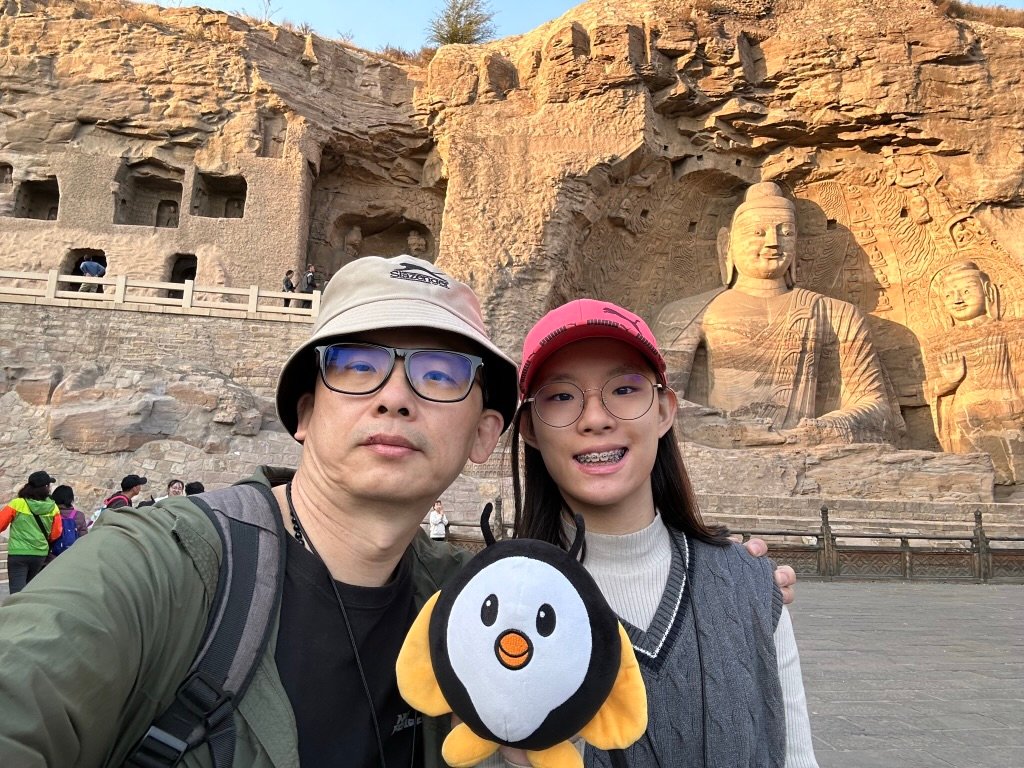
near:
Datong (大同, Dàtóng).
Dad & Elaine visited.
[INSERT DAD & ELAINE YUNGANG PHOTO]
And suddenly Buddhism becomes:
STONE.
🔥
Yungang’s monumental cave temples were created mainly during the:
Northern Wei dynasty (北魏, Běi Wèi).
Remember the rulers?
Tuoba Xianbei (拓跋鲜卑, Tuòbá Xiānbēi).
So now we have:
Indian religious origins
↓
Central Asian transmission
↓
Xianbei imperial patronage
↓
Buddhist cave art in northern China.
😳
How “foreign” is Yungang?
Wrong question again.
😂
🎨 Art Travels Too
Look carefully at early Buddhist art in China and scholars can trace connections with wider artistic traditions extending through:
India
and:
Central Asia.
But Chinese Buddhist art did not remain a frozen copy of something imported.
Over time:
styles changed,
iconography developed,
patronage changed,
and:
Chinese artistic traditions interacted with Buddhist forms.
🔥
Again:
receive → adapt → transform.
That’s the pattern.
🐇 Then Northern Wei Moves to Luoyang
Remember Course 10?
In:
494 CE
Northern Wei moved its capital from:
Pingcheng (平城, Píngchéng)
— today’s Datong —
to:
Luoyang (洛阳, Luòyáng).
And near Luoyang:
Longmen Grottoes (龙门石窟, Lóngmén Shíkū)
continue this great Buddhist-art story.
🔥
So eventually Dad & Elaine’s journey can become:
Yungang (云冈)
↓
Northern Wei (北魏)
↓
capital moves
↓
Luoyang (洛阳)
↓
Longmen (龙门).
🐇🐇🐇
One imported religion has created another China itinerary.
🏔️ Then We Reach Mount Wutai
Now travel to another place Dad & Elaine visited:
Mount Wutai (五台山, Wǔtái Shān)
in:
Shanxi (山西, Shānxī).
A:
UNESCO World Heritage Site.
Mount Wutai became one of China’s great:
Buddhist sacred mountains (佛教圣地, Fójiào Shèngdì)
and is particularly associated with:
Manjushri Bodhisattva (文殊菩萨, Wénshū Púsà).
🔥
Beginner Chinese:
菩萨 — púsà
bodhisattva
Another word you’ll see constantly in Chinese Buddhist temples.
🐇 Wait — Bodhisattva Is a Translated Word Too
Even:
菩萨 — púsà
has a travel story.
The Chinese term ultimately derives through transliteration and abbreviation from the Buddhist concept:
bodhisattva.
🔥
So every time a Chinese traveler says:
菩萨
they’re using a word whose history itself reflects:
cross-cultural transmission.
Language contains archaeology too.
🐇
🌶️ Mount Wutai Wasn’t Only Important to Han Chinese Buddhists
This is where Wutai becomes especially interesting.
Across its long history, Mount Wutai attracted Buddhist pilgrims and patrons from different parts of Asia.
Its religious connections reached toward:
Tibet (西藏, Xīzàng),
Mongolia (蒙古, Měnggǔ),
Korea (朝鲜半岛)
and:
Japan (日本, Rìběn).
🔥
At Wutai today you can encounter traditions associated with:
Han Chinese Buddhism (汉传佛教, Hànchuán Fójiào)
and:
Tibetan Buddhism (藏传佛教, Zàngchuán Fójiào).
One mountain.
Several Buddhist worlds.
🐇 And Then a Japanese Monk Appears
During the:
Tang dynasty (唐朝, Táng Cháo)
a Japanese Buddhist monk named:
Ennin (圆仁 / 円仁, Yuánrén / Ennin)
traveled in China.
He visited:
Mount Wutai
and later left an important written account of his travels in Tang China.
🔥
Think about the direction again:
Japan
↓
China
↓
Wutai
↓
Buddhist learning
↓
Japan.
So China wasn’t merely:
receiving Buddhism.
By this point, China itself had become:
a major center of Buddhist learning for foreign pilgrims.
That’s an enormous transformation.
🍚 Western Handrail: Student Becomes Teacher
Very rough analogy.
😂
Buddhism travels:
TO China.
China studies it.
Translates it.
Develops it.
Builds institutions around it.
Then travelers from elsewhere come:
TO China
to learn Buddhism.
🔥
The receiver has become:
a transmitter.
That’s how cultural exchange compounds over centuries.
🌶️ And Tang Chang’an Was Part of That Same Network
Now connect:
Xi’an / Chang’an
with:
Mount Wutai.
At Chang’an:
foreign monks,
translations,
temples,
religious communities
and:
international travelers.
At Wutai:
pilgrimage,
Buddhist scholarship,
sacred geography
and:
international religious connections.
🔥
These aren’t separate stories.
They’re part of a wider:
Asian Buddhist network.
🐇 But Foreign Religions Didn’t All Become Equally “Chinese”
Important.
Buddhism became extraordinarily deeply rooted.
But:
Zoroastrianism (祆教)
Manichaeism (摩尼教)
and:
Jingjiao Christianity (景教)
followed different historical paths.
Some communities declined.
Some disappeared.
Some traditions survived in transformed forms.
Some faced state restrictions or persecution.
🔥
Cultural exchange does NOT mean:
everything foreign gets absorbed successfully forever.
Different ideas encounter:
different historical outcomes.
That’s another reason not to reduce Silk Road history to:
“everyone exchanged culture happily.”
😂
🌶️ Exchange Can Be Selective
A society can:
adopt one thing
and:
reject another.
It can:
love foreign music
while:
restricting foreign religion.
It can:
want foreign horses
while:
fighting the people supplying them.
😂
It can:
borrow technology
without:
adopting the worldview attached to it.
That’s how real cultural interaction works.
Messily.
🔥
🥢 And Food Gives Us the Fun Version
Now something easier.
😂
Chinese food vocabulary preserves many histories of movement.
One useful clue is the character:
胡 — Hú
which appeared in names for various things historically associated with northern or western origins.
Examples include:
胡萝卜 (húluóbo)
carrot
胡椒 (hújiāo)
pepper
and historically other terms using:
胡
for products associated with worlds beyond the traditional Central Plains.
🔥
But careful:
the history of individual foods can be complicated.
Don’t assume:
“胡 in the name = definitely imported during the Han from one specific ethnic group.”
😂
Use it as:
a linguistic clue
not:
a complete archaeological report.
🐇 And 葡萄 Has a Journey Too
Another famous word:
grape (葡萄, pútao).
Grapes and grape wine became strongly associated with China’s contacts with:
Central Asia.
Tang poetry famously celebrates:
grape wine (葡萄酒, pútáojiǔ).
🔥
So even a Chinese word on a restaurant menu can point toward:
Eurasian exchange.
Dad warned you.
The rabbit holes are everywhere.
😂
🌶️ So What Makes Something “Chinese”?
Now we reach the deeper question.
If Buddhism originated in India…
but generations of Chinese monks:
translated it,
debated it,
developed new schools,
built temples,
created art
and:
passed those traditions onward…
is Chinese Buddhism:
foreign?
Of course that’s inadequate.
🔥
Its:
origin
and:
later identity
are different questions.
Something can:
originate elsewhere
and:
become deeply Chinese.
That is one of the most important ideas for understanding Chinese civilization.
🍚 Pizza Returns
😭😂
Dad promised himself he wouldn’t.
But it’s useful.
Tomatoes originated in the Americas.
Does that make tomato-based Italian cuisine:
“not Italian”?
No.
A culture isn’t made only from things invented entirely inside its borders.
Cultures:
absorb
adapt
combine
and:
transform.
China is no exception.
🌶️ Chinese Civilization Was Strong Enough to Change What It Received
This is the point.
Cultural borrowing doesn’t necessarily mean:
cultural weakness.
Sometimes the opposite.
A civilization can encounter something new…
then:
translate it into its own intellectual language,
adapt it to local institutions,
create new forms from it,
and:
send those forms onward.
🔥🔥🔥
Buddhism is perhaps the clearest example.
India gave China Buddhism.
China didn’t merely:
copy Buddhism.
China helped create:
Chinese Buddhism.
That’s a much richer historical story.
🐞 Sting Check
You began Section 2 asking:
“What happened after foreign ideas arrived?”
Now you’ve acquired:
translation (翻译)
↓
Chinese Buddhism (中国佛教)
↓
Chan (禅)
↓
Zen
↓
Yungang (云冈石窟)
↓
Northern Wei (北魏)
↓
Luoyang (洛阳)
↓
Longmen (龙门石窟)
↓
Mount Wutai (五台山)
↓
Manjushri (文殊菩萨)
↓
Tibetan Buddhism (藏传佛教)
↓
Japan (日本)
↓
Ennin (圆仁 / 円仁)
↓
grapes (葡萄)
↓
and somehow:
pizza.
😭😂
Dad has lost control of the kitchen.
The Bigger Lesson
Ancient China was neither:
completely isolated
nor:
a passive sponge absorbing everything foreign.
🔥
It was an active participant in enormous networks of:
exchange (交流, jiāoliú).
Things came in.
Some were rejected.
Some disappeared.
Some survived.
Some were transformed.
And some became so deeply embedded in Chinese civilization that today their foreign origins can be easy to forget.
That’s the important distinction:
ORIGIN ≠ DESTINATION.
Buddhism began outside China.
Chinese Buddhism became:
part of China.
And in Section 3, we’ll return to:
Xi’an / Chang’an
and ask what a first-time traveler should actually look for—on the streets, in museums, at Big Wild Goose Pagoda and eventually in the Deep China rabbit holes beyond Xi’an.
🐇🐞🔥
Section 3 — Go Back to Xi’an. Now Look for the World Inside Ancient Chang’an.
So what should a first-time traveler remember from all this?
Not:
“I need to memorize every Sogdian merchant and Silk Road religion before visiting Xi’an.”
😭😂
Absolutely not.
Remember one simple idea:
Ancient China was distinctive — but it did not develop in isolation.
People moved.
Goods moved.
Religions moved.
Music moved.
Art moved.
Ideas moved.
And when things arrived in China, they could be:
translated (翻译, fānyì),
adapted (适应, shìyìng),
and:
transformed (转化, zhuǎnhuà).
🔥
Once you understand that, Xi’an becomes a very different city.
1. In Xi’an, Don’t Just Hear “Silk Road”
When somebody tells you:
Chang’an (长安, Cháng’ān)
was a great center of the:
Silk Roads (丝绸之路, Sīchóu Zhī Lù),
don’t simply imagine:
Chinese silk going west.
😂
Imagine movement in:
BOTH DIRECTIONS.
Into Tang China came:
merchants (商人, shāngrén),
monks (僧人, sēngrén),
envoys (使者, shǐzhě),
horses (马, mǎ),
music (音乐, yīnyuè),
dance (舞蹈, wǔdǎo),
religions (宗教, zōngjiào),
and:
ideas (思想, sīxiǎng).
🔥
That’s what:
connection (交流, jiāoliú)
actually looked like.
2. At Big Wild Goose Pagoda: Think India
When you visit:
Big Wild Goose Pagoda (大雁塔, Dàyàn Tǎ),
don’t see only:
“famous old Xi’an pagoda.”
Think:
Xuanzang (玄奘, Xuánzàng)
↓
Central Asia (中亚)
↓
India (印度)
↓
Buddhist texts (佛经, fójīng)
↓
Chang’an (长安)
↓
translation (翻译)
↓
Chinese Buddhism (中国佛教).
🔥
One famous Xi’an attraction gives you a physical doorway into:
a trans-Asian intellectual network.
Same pagoda.
Different eyes.
🐇 And Remember: Xuanzang Traveled OUT Too
This is important.
China wasn’t simply sitting at the end of the Silk Roads waiting for:
foreign things to arrive.
Chinese travelers went outward too.
Xuanzang traveled enormous distances in search of:
knowledge (知识, zhīshi).
Then brought texts and learning back.
🔥
So the Silk Roads weren’t merely:
trade routes.
They were also:
knowledge routes.
That’s a much more interesting way to understand them.
3. In the Museum: Look at the PEOPLE
This may be the easiest practical trick.
When you visit a Xi’an museum and reach the:
Tang dynasty (唐朝, Táng Cháo)
galleries, don’t look only at:
gold (金, jīn),
silver (银, yín),
pottery (陶器, táoqì)
and:
beautiful horses.
Look at:
faces.
Look at:
clothing (服饰, fúshì).
Look at:
musicians (乐师, yuèshī).
Look at:
dancers (舞者, wǔzhě).
Look at:
camels (骆驼, luòtuo).
Look for people represented as:
Hu people (胡人, Húrén)
or other figures associated with Central and Western Asian connections.
🔥
Then ask:
“Why are they here?”
That one question can open the whole Tang world.
🐫 The Camel Is Now a Historical Clue
Before this article:
Cute Tang camel.
🐫
After this article:
camel (骆驼)
↓
caravan
↓
Central Asia
↓
merchant
↓
Sogdian (粟特人)
↓
Chang’an
↓
Silk Roads.
🐇
Now the museum object isn’t merely:
something old.
It becomes:
evidence of connection.
That’s exactly what we want.
4. Look for Religions You Didn’t Expect
At:
Xi’an (西安),
remember that Tang China encountered religious traditions including:
Buddhism (佛教, Fójiào)
Zoroastrianism (祆教, Xiānjiào)
Manichaeism (摩尼教, Móníjiào)
and:
Jingjiao Christianity (景教, Jǐngjiào).
🔥
For many first-time Western travelers, the last one produces:
WAIT. WHAT?
😂
Christianity in Tang China?
Yes.
And the famous:
Xi’an Stele (大秦景教流行中国碑)
was erected in:
781 CE.
That’s the sort of fact that should make you stop thinking of ancient China as:
a sealed cultural box.
🌶️ But Don’t Swing Too Far the Other Way
This is important.
After discovering cosmopolitan Tang Chang’an, don’t replace:
“Ancient China was isolated.”
with:
“Ancient China was basically one giant multicultural Silk Road party.”
😭😂
Also wrong.
China was enormous.
Most people weren’t international merchants living in Chang’an.
Foreign communities could face restrictions.
Political attitudes changed.
Religions could be suppressed.
War repeatedly disrupted connections.
And the degree of outside interaction varied enormously by:
period (时期, shíqī)
and:
place (地方, dìfāng).
🔥
The Michelin answer is:
CONNECTED ≠ BORDERLESS.
Just as:
DISTINCTIVE ≠ ISOLATED.
That’s the coat rack.
5. Then Follow Buddhism Beyond Xi’an
This is where the first trip starts creating another trip.
You saw:
Big Wild Goose Pagoda (大雁塔).
Buddhism has stung you.
🐞
Now:
Yungang Grottoes (云冈石窟)
appear.
🐇
There you encounter:
Northern Wei (北魏)
Xianbei (鲜卑)
and Buddhist art shaped by wider Asian connections.
Then:
Mount Wutai (五台山)
appears.
🐇🐇
There you encounter:
Manjushri Bodhisattva (文殊菩萨)
Han Chinese Buddhism (汉传佛教)
Tibetan Buddhism (藏传佛教)
and connections with:
Mongolia,
Tibet,
Japan
and other Buddhist worlds.
🔥
One pagoda in Xi’an has just created:
several future China journeys.
Exactly.
🐇 And Luoyang Is Waiting Again
Remember:
Luoyang (洛阳, Luòyáng).
Another great ancient capital.
Another major center in Silk Roads history.
And nearby:
Longmen Grottoes (龙门石窟, Lóngmén Shíkū).
🔥
So eventually the traveler can follow:
Xi’an / Chang’an
↓
Buddhism
↓
Yungang
↓
Northern Wei
↓
Luoyang
↓
Longmen
↓
another question…
🐇🐇🐇
This is why Deep China never really finishes.
😂
🌶️ The Bigger Historical Lesson: Chinese Culture Has Never Been “Pure”
And neither has any major civilization.
🔥
Cultures are built over long periods through:
inheritance (传承, chuánchéng),
innovation (创新, chuàngxīn),
contact (接触, jiēchù),
borrowing (借鉴, jièjiàn),
adaptation (适应, shìyìng)
and:
transformation (转化, zhuǎnhuà).
China had enormously powerful indigenous traditions.
It also encountered:
the wider world.
The two statements don’t contradict each other.
🔑 The Better Word Is Transformation
This is what we want the reader to leave with.
Not:
FOREIGN → CHINESE
as though somebody changes labels overnight.
And not:
CHINESE → FOREIGN.
Instead:
CONTACT
↓
EXCHANGE
↓
TRANSLATION
↓
ADAPTATION
↓
TRANSFORMATION.
🔥
Buddhism may be the greatest example.
Origin:
India.
↓
Transmission:
across Asia.
↓
Development:
China.
↓
Further transmission:
Korea + Japan + elsewhere.
↓
New traditions.
New art.
New texts.
New institutions.
That’s civilization moving.
🐞 Final Sting
You began this article in Xi’an hearing:
“This was the starting point of the Silk Road.”
Now:
Silk Roads (丝绸之路)
↓
Sogdians (粟特人)
↓
horses (马)
↓
camels (骆驼)
↓
music (音乐)
↓
dance (舞蹈)
↓
Buddhism (佛教)
↓
India (印度)
↓
Xuanzang (玄奘)
↓
Big Wild Goose Pagoda (大雁塔)
↓
Jingjiao Christianity (景教)
↓
Xi’an Stele (大秦景教流行中国碑)
↓
Yungang (云冈石窟)
↓
Mount Wutai (五台山)
↓
Luoyang (洛阳)
↓
Longmen (龙门石窟).
😬
That’s a much bigger world than:
“China exported silk.”
😂🔥
ChinaTravelBUG’s Take
So:
How “foreign” was ancient China?
That’s probably the wrong question.
A better one is:
How did China interact with, absorb and transform things that came from beyond its political and cultural frontiers?
🔥
Sometimes China resisted outside influences.
Sometimes it borrowed them.
Sometimes it transformed them.
Sometimes things arrived and eventually disappeared.
And sometimes something that began far away became so deeply rooted that generations later we simply think of it as:
Chinese culture.
That’s why:
Buddhism (佛教)
is such an important historical handrail.
🐞 One Last Look at Xi’an
Perhaps you’re on your first China trip.
You walk past:
Big Wild Goose Pagoda.
You see Tang artifacts.
You eat dinner.
You hear:
“Silk Road.”
This time, don’t imagine only:
silk going OUT.
Think about everything that came:
IN.
Then ask:
Who brought it?
What did China do with it?
How did it change?
And where can I go next to follow the story?
🐇
That’s the dangerous question.
Because suddenly:
Xi’an isn’t the end of the Silk Road story.
It’s:
the beginning of your rabbit hole.
🐞🐇🔥
See the place. Ask the bigger question. Understand China better.
🐇 Go Deeper: The Next Big Question
Ancient China was connected to a much wider world—and those connections helped different cities rise in importance at different times.
Which brings us to something travelers notice very quickly:
Why wasn’t China’s capital always Beijing?
Read next: Michelin after-dinner Conversation 4: Why Did China’s Capital Keep Moving? →