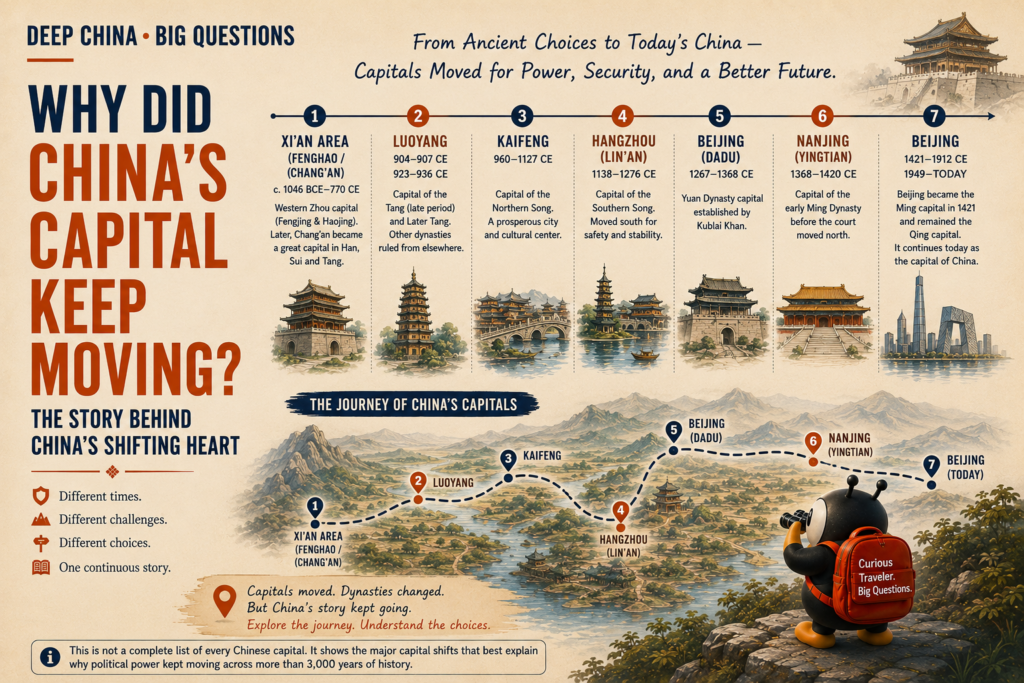
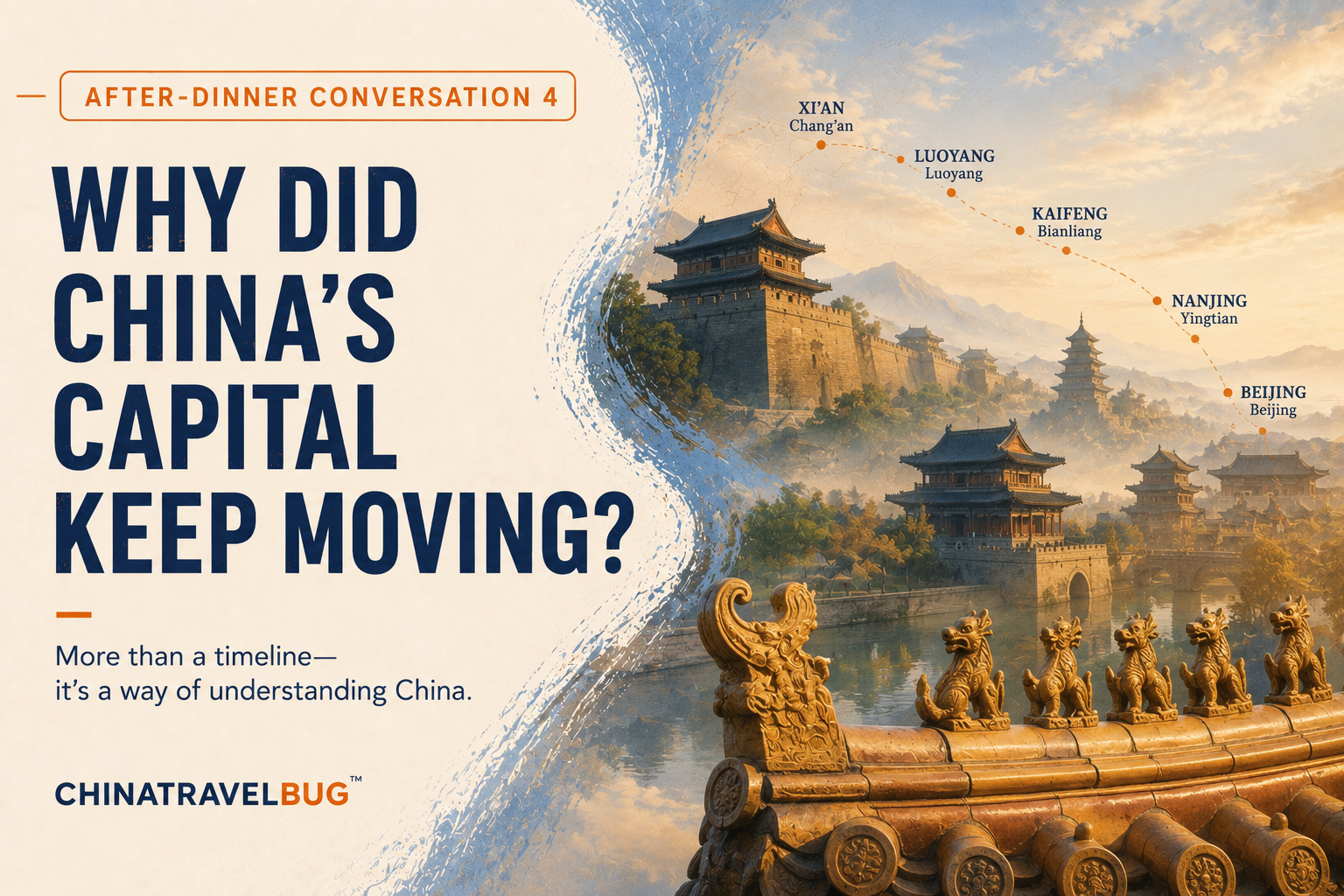
Section 1 — Xi’an Was the Capital. So Why Did China Leave?
For many first-time international travelers, China’s capital is obvious:
Beijing (北京, Běijīng).
Forbidden City.
Temple of Heaven.
Tiananmen.
Imperial palaces.
Political center.
Capital.
Easy.
Then you travel to:
Xi’an (西安, Xī’ān).
And suddenly every guide starts telling you:
“Xi’an was an ancient capital of China.”
Then:
“Chang’an was one of the greatest capitals in Chinese history.”
Then:
“The Han ruled from here.”
Then:
“The Tang ruled from here.”
🔥
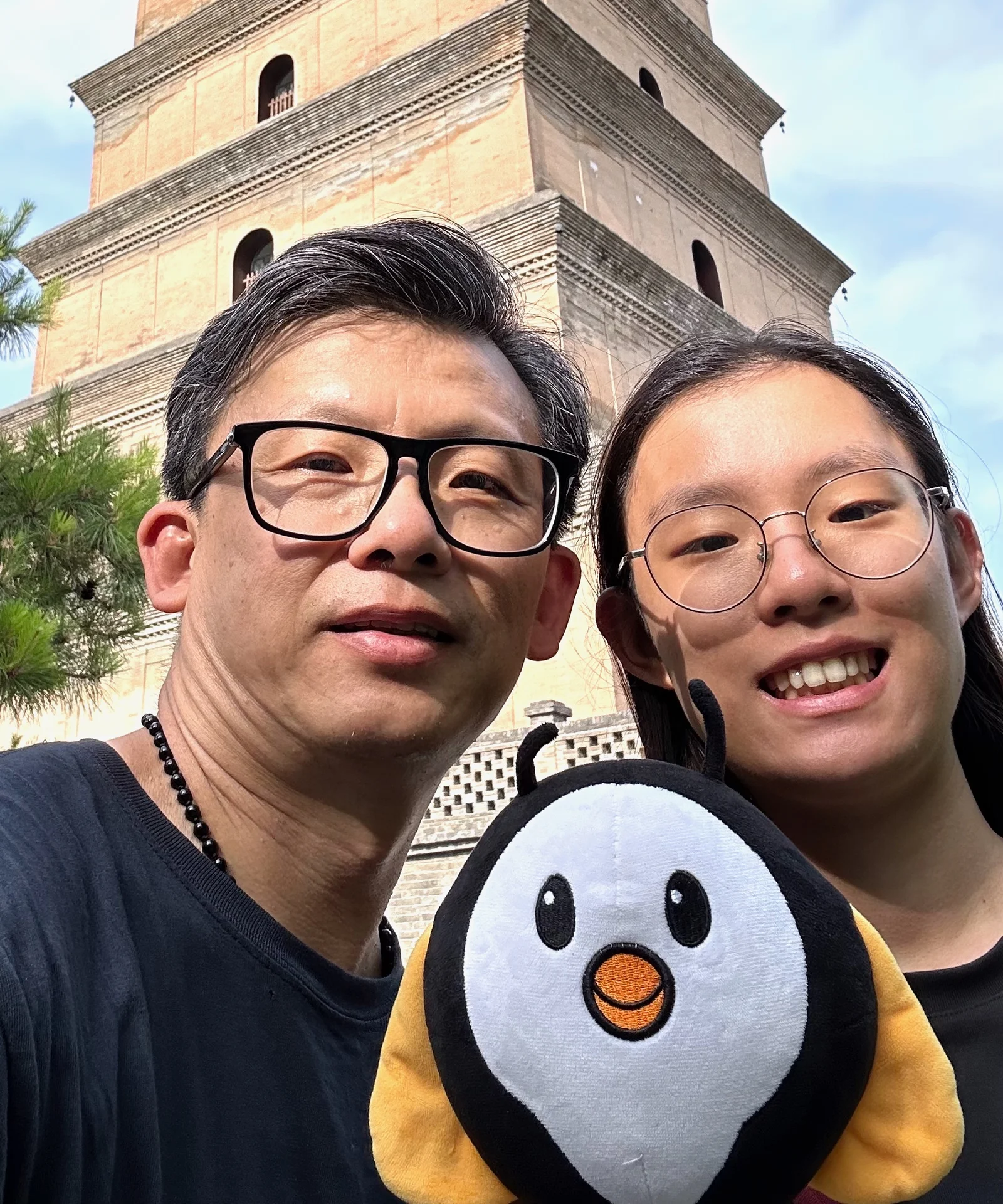
Dad has a very simple question:
If Xi’an was such a great capital… why isn’t it the capital anymore?
😂
Why did China’s political center move from:
Chang’an (长安, Cháng’ān)
toward places such as:
Luoyang (洛阳, Luòyáng),
Kaifeng (开封, Kāifēng),
Nanjing (南京, Nánjīng)
and eventually:
Beijing (北京)?
🐇
Once you ask that question, Chinese history turns into:
GEOGRAPHY.
First: China Never Had One Eternal Capital
This is the first misconception to remove.
There was never one city called:
“the capital of China”
for all of Chinese history.
Different:
dynasties (朝代, cháodài)
established capitals in different places.
Some dynasties even had:
more than one important capital.
And sometimes a dynasty:
moved its capital.
🔥
So instead of asking:
“What was the ancient capital of China?”
a much better question is:
“Which dynasty, and when?”
That’s our first coat rack.
🕰️ Put the Famous Capitals on a Simple Timeline
Don’t memorize this.
We’re only installing hooks.
WESTERN ZHOU (西周, Xī Zhōu)
Major royal centers in the:
Wei River Valley (渭河流域, Wèi Hé Liúyù)
including the Haojing area near modern Xi’an.
↓
QIN (秦)
Capital at:
Xianyang (咸阳, Xiányáng)
northwest of modern Xi’an.
↓
HAN (汉)
Capital at:
Chang’an (长安, Cháng’ān).
↓
EASTERN HAN (东汉, Dōng Hàn)
Capital at:
Luoyang (洛阳, Luòyáng).
↓
SUI / TANG (隋唐, Suí–Táng)
Chang’an again becomes one of the great imperial capitals of the world.
Luoyang also remains enormously important.
↓
NORTHERN SONG (北宋, Běi Sòng)
Capital at:
Kaifeng (开封, Kāifēng).
↓
MING (明)
Early capital:
Nanjing (南京, Nánjīng).
Later main capital:
Beijing (北京).
↓
QING (清)
Capital:
Beijing.
↓
TODAY
Capital:
Beijing.
🔥
Now the question becomes irresistible:
WHY DOES THE CAPITAL KEEP MOVING?
🍚 Western Handrail: A Capital Is a Tool
We often think of a capital as:
the most important city.
But historically, a capital also has to:
WORK.
A ruler needs to ask:
Can I:
defend it (防御, fángyù)?
Can I:
feed it (供粮, gōngliáng)?
Can I:
move armies from it (调兵, diàobīng)?
Can I:
communicate with the empire?
Can officials:
reach it?
Can taxes and grain:
reach it?
And perhaps most importantly:
Does this city make sense for the political problems MY dynasty faces?
🔥
Different dynasty.
Different problems.
Different answer.
🐇 Why Was the Xi’an Region So Important in the First Place?
Look at:
Xi’an (西安)
on a map.
It sits in the:
Wei River Valley (渭河流域, Wèi Hé Liúyù)
within the broader:
Guanzhong region (关中, Guānzhōng).
Beginner Chinese:
关 — guān
pass
中 — zhōng
inside / middle
So:
关中 — Guānzhōng
historically carries the idea of the region:
“within the passes.”
🔥
And suddenly geography starts explaining history.
🏔️ Mountains + Passes = Protection
Guanzhong is surrounded by significant:
mountains (山, shān)
and historically important:
passes (关, guān).
That gave rulers a useful combination:
agricultural heartland
+
natural defensive geography.
🔥
Remember:
Hangu Pass (函谷关, Hángǔ Guān)
from our Qin course?
And:
Yanmenguan Pass (雁门关, Yànménguān)
from our Great Wall course?
Same character:
关 — guān.
A pass isn’t merely:
a scenic mountain gate.
It can shape:
military geography.
🌾 And the Wei River Valley Could Feed People
A capital needs:
food (粮食, liángshi).
Lots of it.
😂
Palace officials eat.
Soldiers eat.
Artisans eat.
Merchants eat.
The emperor definitely eats.
So access to productive:
agricultural land (农田, nóngtián)
matters enormously.
The Guanzhong region supported major political centers for:
Zhou, Qin and Han
and later:
Sui and Tang.
🔥
This wasn’t historical coincidence.
Geography helped make the region politically powerful.
🐇 Dad & Elaine Already Followed the Capital Story West of Xi’an
Our Deep China journey has already taken us beyond Xi’an toward:
Baoji (宝鸡, Bǎojī)
and:
Zhouyuan (周原, Zhōuyuán).
There we encountered:
Western Zhou (西周)
Duke of Zhou (周公, Zhōugōng)
and:
He Zun (何尊, Hé Zūn).
🔥
Then move east toward the Xi’an region and we encounter:
Qin (秦)
↓
Xianyang (咸阳)
↓
Qin Shi Huang (秦始皇).
Then:
Han (汉)
↓
Chang’an (长安).
Then:
Tang (唐)
↓
Chang’an again.
One relatively compact region gives us:
several enormous chapters of Chinese political history.
No wonder Xi’an feels historical.
😂
👑 But Be Careful: “Xi’an Was Capital for 13 Dynasties”
You’ll often encounter claims that Xi’an was the capital of:
13 dynasties (十三朝古都, shísān cháo gǔdū).
It’s a famous and useful tourism shorthand.
But the exact count can vary depending on:
which regimes are counted,
which historical capitals are treated as part of the modern Xi’an area,
and:
how “dynasty” and “capital” are defined.
🔥
So don’t get trapped arguing:
“Was it exactly 13?”
😂
The historically important point is much simpler:
The Xi’an region served repeatedly as one of the great political centers of early imperial and pre-imperial China.
That’s enough.
🌶️ Then Why Leave Such a Good Location?
Excellent.
Now we reach the actual course.
If Guanzhong offered:
defense,
agriculture,
historical prestige
and:
strategic geography,
why did major political centers repeatedly move east?
🐇
One major reason is that:
the geography of power changed.
Economic centers changed.
Population distribution changed.
Transport networks changed.
Military threats changed.
Dynasties changed.
And the territories rulers needed to govern:
changed.
🔥
A capital perfect for one historical world may be less perfect for another.
🐇 Enter Luoyang
East of Xi’an lies:
Luoyang (洛阳, Luòyáng)
in:
Henan (河南, Hénán).
Luoyang sits in the:
Central Plains (中原, Zhōngyuán)
world that repeatedly mattered enormously in Chinese history.
It served as a capital or major political center under multiple dynasties and regimes.
🔥
Remember Course 10?
Northern Wei (北魏)
moved its capital from:
Pingcheng (平城)
— modern Datong —
to:
Luoyang
in:
494 CE.
And near Luoyang:
Longmen Grottoes (龙门石窟, Lóngmén Shíkū)
continue the Northern Wei Buddhist story.
🐇
One capital move.
One enormous cultural consequence.
📍 On Our Deep China List
Dad & Elaine have:
not yet visited Luoyang.
It’s on our future Deep China journey.
🔥
And that’s exactly how CTB should say it.
We’ve followed Chinese history far enough to understand:
why Luoyang matters.
Now we want to go there and see:
the city,
Longmen Grottoes,
the ancient capital landscape
and:
the historical connections
for ourselves.
🐇
The question creates:
the trip.
🐇 And Then Another Capital Appears: Kaifeng
Continue east and we reach:
Kaifeng (开封, Kāifēng).
Another city on our future Deep China travel list.
Kaifeng became the great capital of:
Northern Song dynasty (北宋, Běi Sòng).
🔥
And here the capital question changes again.
Now we need to think not only about:
defense
but also:
transport (交通, jiāotōng)
commerce (商业, shāngyè)
and:
grain supply (粮食供应, liángshi gōngyìng).
Because by the Song period, the economic geography of China looked very different from the world of early Zhou or Qin.
🌾 China’s Economic Center Was Moving South
Over many centuries, the:
Yangtze River region (长江流域, Cháng Jiāng Liúyù)
and southern China became increasingly important economically and demographically.
🔥
That creates a giant political problem.
Suppose your political capital is in the:
north.
But enormous quantities of:
grain (粮食)
tax revenue (税收, shuìshōu)
and:
economic wealth (经济财富, jīngjì cáifù)
are increasingly concentrated farther south.
How do you connect them?
🐇
Now one of China’s greatest pieces of infrastructure walks into the article.
🚤 The Grand Canal
Grand Canal (大运河, Dàyùnhé).
Beginner Chinese:
大 — dà
big / great
运 — yùn
transport
河 — hé
river
🔥
The Grand Canal linked major river systems and economic regions across eastern China.
Its development across different periods helped connect:
southern economic resources
with:
northern political centers.
Now capital geography is no longer only:
WHERE IS THE EMPEROR?
It’s also:
HOW DOES THE EMPEROR EAT?
😭😂
🍚 Dad’s Capital Test
From now on, when you encounter an ancient Chinese capital, ask four questions:
1. Can you DEFEND it?
防御
2. Can you FEED it?
粮食
3. Can you CONNECT it?
交通
4. Can you RULE from it?
统治
🔥
That’s our Michelin capital test.
You don’t need a PhD.
Just remember:
DEFEND — FEED — CONNECT — RULE.
And suddenly:
capital location
becomes understandable.

🐞 Sting Check
You started Section 1 asking:
“If Xi’an was such a great capital, why isn’t it China’s capital today?”
Now you’ve acquired:
capital (首都)
↓
Chang’an (长安)
↓
Guanzhong (关中)
↓
mountains (山)
↓
passes (关)
↓
agriculture (农业)
↓
Xianyang (咸阳)
↓
Zhou + Qin + Han + Tang
↓
Luoyang (洛阳)
↓
Central Plains (中原)
↓
Kaifeng (开封)
↓
Northern Song (北宋)
↓
economic shift south
↓
Grand Canal (大运河).
😬
And now the answer is beginning to appear:
Capitals move because the geography of power moves.
🔥
Different dynasty.
Different military threats.
Different economic center.
Different transport network.
Different political priorities.
Different capital.
That’s enough for Section 1.
In Section 2, we’ll follow the capital trail farther east, south and north:
Luoyang → Kaifeng → Nanjing → Beijing
and finally ask:
Why did Beijing eventually win?
🐇🐞🔥
Deep China: Why Did China’s Capital Keep Moving?
See the place. Ask the bigger question. Understand China better.
Section 2 — Luoyang, Kaifeng, Nanjing… Why Did Beijing Eventually Win?
Section 1 gave us Dad’s simple capital test:
DEFEND — FEED — CONNECT — RULE
A capital city:
capital (首都, shǒudū)
has to work.
And what works changes with:
geography (地理, dìlǐ),
population (人口, rénkǒu),
economy (经济, jīngjì),
transport (交通, jiāotōng),
military threats (军事威胁, jūnshì wēixié)
and:
political priorities.
🔥
That’s why Chinese political history doesn’t give us one eternal capital.
The geography of power changed.
So:
the capitals changed too.
Let’s follow them.
🐇 First Stop: Luoyang
Travel east from:
Chang’an (长安, Cháng’ān)
and eventually you reach:
Luoyang (洛阳, Luòyáng)
in:
Henan (河南, Hénán).
Luoyang sits within the broader historical world of the:
Central Plains (中原, Zhōngyuán).
And it repeatedly became one of China’s great political centers.
🔥
Different dynasties and regimes used Luoyang as a capital or major political center.
Think:
Eastern Han (东汉, Dōng Hàn)
Northern Wei (北魏, Běi Wèi)
and:
Tang dynasty (唐朝, Táng Cháo),
when Luoyang was enormously important alongside Chang’an.
So don’t think:
Xi’an = ancient capital.
Luoyang = another old city.
😂
A better coat rack is:
Chang’an + Luoyang
as two enormously important centers in China’s historical political geography.
🐇 Remember Northern Wei?
Course 10 introduced:
Northern Wei (北魏)
founded by rulers of:
Tuoba Xianbei (拓跋鲜卑, Tuòbá Xiānbēi)
origin.
Their earlier capital was:
Pingcheng (平城, Píngchéng)
— today’s:
Datong (大同, Dàtóng).
Dad & Elaine visited:
Yungang Grottoes (云冈石窟, Yúngāng Shíkū)
there.
Then in:
494 CE
Northern Wei moved its main capital to:
Luoyang.
🔥
And near Luoyang:
Longmen Grottoes (龙门石窟, Lóngmén Shíkū)
became another great center of Buddhist cave art.
So:
CAPITAL MOVE
↓
people move
↓
court moves
↓
political power moves
↓
patronage moves
↓
art changes.
😳
A capital move can transform much more than:
where the emperor sleeps.
📍 On Our Future Deep China List
Dad & Elaine haven’t visited:
Luoyang (洛阳)
yet.
It’s on our planned future Deep China journey.
🔥
When we eventually go, we won’t simply ask:
“What attractions should we visit?”
We’ll arrive already asking:
Why did so many rulers choose Luoyang?
Why did Northern Wei move here?
How does Yungang connect with Longmen?
That’s the whole Deep China idea.
The question makes the place more interesting before you even arrive.
🐇
🐇 Then Move East Again: Kaifeng
Continue east and we reach:
Kaifeng (开封, Kāifēng).
Another city Dad & Elaine plan to visit.
Kaifeng became the great capital of the:
Northern Song dynasty (北宋, Běi Sòng)
960–1127.
🔥
And Kaifeng presents a very different capital geography from:
Chang’an.
Chang’an sat within the defensible:
Guanzhong region (关中).
Kaifeng sits on the much more open:
North China Plain (华北平原, Huáběi Píngyuán).
So why choose Kaifeng?
Now two parts of Dad’s capital test become especially important:
FEED
and:
CONNECT.
🚤 The Grand Canal Changes the Capital Equation
Enter:
Grand Canal (大运河, Dàyùnhé).
This enormous water-transport system developed over many centuries.
It connected major river systems and helped move:
grain (粮食, liángshi),
goods (货物, huòwù),
tax resources
and:
people
between different regions.
🔥
This became increasingly important because China’s economic geography was changing.
Over the centuries:
southern China (南方, nánfāng)
and particularly regions around the:
Yangtze River (长江, Cháng Jiāng)
became increasingly important economically and demographically.
So northern political centers increasingly depended upon resources coming from:
farther south.
🍚 Capitals Eat
😂
Dad’s favorite political theory.
A capital can contain:
the imperial household,
officials (官员, guānyuán),
soldiers (士兵, shìbīng),
artisans (工匠, gōngjiàng),
merchants (商人, shāngrén)
and:
ordinary residents (百姓, bǎixìng).
Everybody needs:
food (粮食).
Every day.
🔥
So grain supply isn’t:
boring logistics.
It is:
political geography.
A capital that cannot be reliably supplied has a serious problem.
🏙️ And Kaifeng Became Enormous
Under the Northern Song:
Kaifeng
developed into one of the great urban and commercial centers of its age.
One famous visual doorway into this world is:
Along the River During the Qingming Festival
(清明上河图, Qīngmíng Shànghé Tú)
traditionally attributed to:
Zhang Zeduan (张择端, Zhāng Zéduān).
🔥
The scroll evokes a bustling world of:
shops,
boats,
bridges,
merchants,
transport
and:
urban life.
When Dad & Elaine eventually visit Kaifeng…
we already know what rabbit we’re chasing.
🐇
🌶️ But Kaifeng Had a Problem: DEFEND
Remember the test:
DEFEND — FEED — CONNECT — RULE.
Kaifeng was well connected.
But compared with the protected Guanzhong basin:
Kaifeng was exposed on an open plain.
And northern military pressure mattered.
In:
1127
Jurchen forces of the:
Jin dynasty (金朝, Jīn Cháo)
captured Kaifeng during the:
Jingkang Incident (靖康之变, Jìngkāng Zhī Biàn).
🔥
The:
Northern Song
collapsed.
The surviving Song court moved south.
Sometimes a capital moves because:
the emperor chooses another city.
Sometimes:
the enemy chooses for him.
😭😂
🐇 The Capital Moves South
The surviving dynasty became:
Southern Song (南宋, Nán Sòng).
Its capital was established at:
Lin’an (临安, Lín’ān)
— today’s:
Hangzhou (杭州, Hángzhōu).
Look how far our capital journey has moved:
Chang’an
↓
Luoyang
↓
Kaifeng
↓
Hangzhou.
😳
That tells us something enormous.
China’s economic and demographic geography had changed dramatically over the centuries.
The:
south (南方)
was no longer some peripheral afterthought.
It had become central to China’s economic life.
🔥
🐇 And That Helps Explain Nanjing
Now another great capital enters:
Nanjing (南京, Nánjīng).
Beginner Chinese makes this wonderfully easy:
南 — nán
south
京 — jīng
capital
Therefore:
南京 — Nánjīng
Southern Capital
🔥
Nanjing served as a capital under several regimes.
And in:
1368
the founder of the:
Ming dynasty (明朝, Míng Cháo)
established his capital there.
That ruler was:
Zhu Yuanzhang (朱元璋, Zhū Yuánzhāng)
the:
Hongwu Emperor (洪武帝, Hóngwǔ Dì).
So at the beginning of Ming:
NANJING
not Beijing
was the principal imperial capital.
😂 And Beijing’s Name Gives Away the Rest
Beginner Chinese:
北 — běi
north
京 — jīng
capital
Therefore:
北京 — Běijīng
Northern Capital
So now you’ve learned:
南京 = Southern Capital
and:
北京 = Northern Capital.
😂🔥
Chinese history is occasionally kind to beginners.
🐇 So Why Did Ming Move North?
The key figure is:
Yongle Emperor (永乐帝, Yǒnglè Dì).
Before becoming emperor, he had been:
Prince of Yan (燕王, Yān Wáng)
with a strong political and military base in the north.
Beijing mattered personally and strategically to his power.
But there was a much bigger geopolitical issue:
the northern frontier.
🔥
Remember our Great Wall courses?
Remember:
Mongols (蒙古, Měnggǔ)?
They’re back.
For Ming rulers, northern frontier security remained a major strategic problem.
A capital at Beijing placed the imperial court much closer to:
northern military affairs (北方军务, běifāng jūnwù).
🌶️ Beijing Solved One Problem and Created Another
Move the capital north and you get:
strategic advantage.
But then Dad’s capital test attacks you again.
😂
FEED.
Beijing sits far north of many of the increasingly productive and wealthy regions of:
southern China.
How do you support:
the emperor,
palace,
bureaucracy,
army
and:
huge urban population
so far north?
Answer:
infrastructure (基础设施, jīchǔ shèshī).
And especially:
Grand Canal (大运河).
🔥🔥🔥
🚤 Southern Grain Feeds Northern Power
Under Ming and Qing rule, canal transport played a crucial role in moving:
tribute grain (漕粮, cáoliáng)
north toward:
Beijing.
Beginner Chinese:
漕 — cáo
waterborne grain transport in this historical context
粮 — liáng
grain
So:
漕粮 — cáoliáng
means grain transported through the state supply system.
🔥
Now we can say something wonderfully simple:
The Forbidden City ate southern grain.
😂
Remember that.
🍚 The Forbidden City Was Connected to the Whole Empire
When you stand inside:
Forbidden City (故宫, Gùgōng)
it feels like:
the center.
And politically:
it was.
But that center depended upon:
networks.
Grain.
Taxes.
Officials.
Roads.
Canals.
Messengers.
Military supply.
🔥
So imperial Beijing wasn’t:
a self-sufficient northern fortress.
It depended heavily upon connections with:
the wider empire.
That’s why:
Grand Canal
belongs in the same historical story as:
Forbidden City.
🐇 But Beijing Was Important Before Ming
Important correction.
The Ming didn’t suddenly discover Beijing.
😂
Earlier:
Jurchen Jin dynasty (金朝)
made the city a major capital.
Then:
Mongol Yuan dynasty (元朝)
developed:
Dadu (大都, Dàdū)
as its imperial capital.
Remember:
Kublai Khan (忽必烈, Hūbìliè).
So Beijing’s deeper capital sequence includes:
JIN
↓
YUAN DADU
↓
MING BEIJING
↓
QING BEIJING
↓
MODERN BEIJING.
🔥
The rise of Beijing was:
a long historical process
not:
one Ming emperor suddenly pointing at a map.
😂
🐇 Then the Manchus Arrive
In:
1644
the Ming regime in Beijing falls.
The:
Qing dynasty (清朝, Qīng Cháo)
founded by:
Manchus (满洲人, Mǎnzhōurén)
takes control of Beijing.
Do the Qing emperors move the capital elsewhere?
No.
🔥
They continue ruling from:
Forbidden City
and continue major imperial rituals at:
Temple of Heaven (天坛, Tiāntán).
Different dynasty.
Different ruling people.
Same capital.
Why?
Because Beijing still made strategic and political sense for the Qing imperial world.
🌶️ So Why Did Beijing Eventually “Win”?
Now we can answer the first-time traveler’s question.
Not because:
Beijing was always destined to be China’s capital.
It wasn’t.
🔥
Beijing offered an increasingly powerful combination of:
NORTHERN STRATEGIC POSITION
closer to important northern and northeastern frontier worlds
+
IMPERIAL POLITICAL CENTER
developed across Jin, Yuan, Ming and Qing
+
TRANSPORT CONNECTIONS
especially through the Grand Canal system
+
ACCESS TO SOUTHERN RESOURCES
needed to sustain the northern capital.
So Beijing wasn’t:
perfect.
It was:
strategically workable.
And infrastructure helped make it possible.
🍚 Dad’s Capital Test Again
Now test Beijing:
DEFEND
Strategically positioned toward the north.
FEED
Connect it with southern grain.
CONNECT
Roads + canals + imperial communication networks.
RULE
Build the institutions of imperial government around it.
🔥
Now:
Beijing
makes much more sense.
📍 And Our Journey Isn’t Finished
Dad & Elaine have already explored:
Xi’an (西安)
and:
Beijing (北京).
But:
Luoyang (洛阳)
and:
Kaifeng (开封)
are still on our planned Deep China journey.
🔥
When we eventually visit them, we’ll come back to these questions with:
our own photographs
our own routes
our own observations
and inevitably:
more rabbit holes.
😂🐇
That’s part of the fun.
ChinaTravelBUG isn’t pretending the journey is finished.
We’re still following the questions too.
🐞 Sting Check
You started Section 2 at:
Luoyang (洛阳).
Then:
Central Plains (中原)
↓
Northern Wei (北魏)
↓
Longmen (龙门石窟)
↓
Kaifeng (开封)
↓
Northern Song (北宋)
↓
Grand Canal (大运河)
↓
Jingkang Incident (靖康之变)
↓
Southern Song (南宋)
↓
Hangzhou (杭州)
↓
Nanjing (南京)
↓
Ming (明)
↓
Yongle Emperor (永乐帝)
↓
Beijing (北京)
↓
northern frontier
↓
tribute grain (漕粮)
↓
Forbidden City (故宫)
↓
Yuan (元)
↓
Qing (清).
😬
And suddenly:
“Why did China’s capital keep moving?”
has a much better answer than:
“Different emperors preferred different cities.”
😂
The Bigger Lesson
A capital sits where:
POLITICS
meets:
GEOGRAPHY
meets:
ECONOMICS
meets:
TRANSPORT
meets:
WAR.
🔥
That’s why Chinese capitals moved.
Different dynasties faced different:
territories,
military threats,
economic centers,
transport networks
and:
political priorities.
So:
Chang’an
made sense for some historical worlds.
Luoyang
for others.
Kaifeng
for another.
Nanjing
for another.
And eventually:
Beijing
became the enduring political center.
Not because the map told China’s rulers:
“Capital goes here.”
😂
But because:
the geography of power had changed.
🔥
Section 3 — Go Back to Xi’an and Beijing. Now Ask: Why HERE?
So what should a first-time traveler remember from all this?
Not:
“I need to memorize every Chinese capital.”
😂
Absolutely not.
Remember four words:
DEFEND — FEED — CONNECT — RULE
🔥
Then when you visit:
Xi’an (西安, Xī’ān)
or:
Beijing (北京, Běijīng),
don’t see only:
“old capital”
and:
“current capital.”
Ask:
Why did THIS city make sense as a capital in THIS historical world?
That’s the Michelin question.
1. Go Back to Xi’an
When you’re standing in:
Xi’an (西安)
remember that the modern city sits within a much older political landscape.
Around this region we encounter:
Western Zhou (西周, Xī Zhōu)
↓
Qin (秦)
↓
Han (汉)
↓
Sui (隋)
↓
Tang (唐).
🔥
Different dynasties.
Different capitals and urban forms.
But the broader:
Guanzhong region (关中, Guānzhōng)
repeatedly mattered.
Why?
Remember:
DEFEND
Mountains and strategic passes.
FEED
Productive agricultural land in the Wei River Valley.
CONNECT
Routes eastward and westward.
RULE
A powerful political heartland from which major states and empires could operate.
🔥
Suddenly Xi’an’s historical importance isn’t:
“because lots of emperors liked Xi’an.”
😂
Geography helped make political power possible here.
🐇 And Xi’an Was Connected to a Much Bigger World
Course 11 taught us something else about:
Chang’an (长安, Cháng’ān).
It wasn’t merely:
an imperial capital.
During the Tang period it was also deeply connected to:
Silk Roads (丝绸之路, Sīchóu Zhī Lù)
and wider Asian networks.
🔥
So a successful capital isn’t merely:
defensible.
It can also become:
a node in enormous networks.
People.
Goods.
Officials.
Armies.
Religions.
Information.
Ideas.
Now our capital story and Silk Road story connect.
🐇
2. Then Go Back to Beijing
Now stand inside:
Forbidden City (故宫, Gùgōng).
Look around.
This feels like the obvious place for China’s emperor.
😂
But Course 12 should have destroyed that illusion.
Beijing became the center only after a very long historical process.
Think:
Jurchen Jin (女真金朝)
↓
Mongol Yuan (蒙古元朝)
↓
Dadu (大都, Dàdū)
↓
Ming Beijing (明代北京)
↓
Qing Beijing (清代北京).
🔥
Different rulers repeatedly found this northern region strategically important.
And eventually:
Beijing became one of the great enduring centers of Chinese political power.
🧱 Now Look at the Great Wall Differently Too
Here’s another beautiful connection.
Why does Beijing sit relatively close to:
the Great Wall (长城, Chángchéng)?
Because northern frontier politics mattered enormously.
🔥
Remember Course 1?
The Great Wall wasn’t simply:
China keeping foreigners out.
It belonged to a much larger world of:
defense,
trade,
migration,
diplomacy
and:
frontier politics (边疆政治, biānjiāng zhèngzhì).
Now Beijing’s northern location makes more sense.
The capital wasn’t sitting:
far away from the frontier problem.
It was relatively close to it.
🌶️
🐇 And Course 10 Makes Beijing Even More Interesting
Remember who eventually ruled from Beijing?
Mongols (蒙古, Měnggǔ)
under:
Yuan dynasty (元朝).
Then:
Ming (明).
Then:
Manchus (满洲, Mǎnzhōu)
under:
Qing dynasty (清朝).
🔥
So Beijing sits at a fascinating geographic meeting point between:
the agricultural worlds farther south
and:
the northern and northeastern frontier worlds.
That helped make it strategically important to very different ruling houses.
Course 10 and Course 12 have just joined together.
3. Then Find the Invisible Grand Canal
This may be the most important practical insight.
You’re standing at:
Forbidden City.
You can’t see:
Grand Canal (大运河, Dàyùnhé)
running through the palace.
Obviously.
😂
But historically:
imagine it anyway.
Because the northern imperial capital depended heavily upon resources transported from elsewhere.
Especially:
grain (粮食, liángshi).
🔥
So behind the magnificent:
red walls (红墙),
yellow roofs (黄瓦),
dragons (龙)
and:
imperial halls (宫殿)
was something much less glamorous:
LOGISTICS.
😭😂
🍚 Empires Run on Grain
If you remember only one Dad sentence from this entire course:
Capitals eat.
😂
An imperial capital needs to feed:
court,
bureaucracy,
army,
artisans,
workers
and:
population.
So:
grain transport (粮食运输, liángshi yùnshū)
can be as historically important as:
palaces.
🔥
The emperor may sit at the center.
But the center survives because:
the network works.
That’s a useful way to understand imperial China generally.
🌶️ So Which Was China’s “Best” Capital?
Wrong question.
😂
There was no universally perfect capital.
Instead:
Chang’an
worked brilliantly within certain western and early imperial political geographies.
Luoyang
occupied an enormously important position in the Central Plains and repeatedly served different regimes.
Kaifeng
benefited from the transport and commercial geography of its age.
Nanjing
connected rulers with the increasingly important lower Yangtze world.
Beijing
combined northern strategic importance with transport links capable of connecting it to resources farther south.
🔥
Different historical problem.
Different capital solution.
🐇 And That’s Why We Still Want to Visit Luoyang and Kaifeng
Dad & Elaine have already explored:
Xi’an
and:
Beijing.
But our capital journey is:
not finished.
Still waiting are:
Luoyang (洛阳)
and:
Kaifeng (开封).
🐇
When we eventually go, we’ll arrive with questions already in our heads.
At Luoyang:
Why did so many dynasties and regimes keep returning here?
At Kaifeng:
How did transport, commerce and the Grand Canal help sustain this enormous Song capital?
And:
What did Kaifeng feel like before 1127 changed everything?
🔥
Then we’ll bring back:
the photographs
the practical travel details
and:
the next Deep China rabbit holes.
That’s part of the journey.

🐞 Final Sting
You started this course asking:
“Xi’an used to be China’s capital. Why did the capital move to Beijing?”
Now:
Xi’an (西安)
↓
Chang’an (长安)
↓
Guanzhong (关中)
↓
DEFEND + FEED
↓
Luoyang (洛阳)
↓
Central Plains (中原)
↓
Kaifeng (开封)
↓
Grand Canal (大运河)
↓
economic shift south
↓
Hangzhou (杭州)
↓
Nanjing (南京)
↓
Beijing (北京)
↓
northern frontier
↓
southern grain
↓
Forbidden City (故宫).
😬
Suddenly the map of China is no longer:
background.
The map is:
part of the history.
🔥
ChinaTravelBUG’s Take
When you travel between:
Xi’an
and:
Beijing,
you’re not simply traveling between:
two famous Chinese cities.
You’re traveling between:
two different answers to the problem of how to rule China.
🔥🔥🔥
Xi’an points us toward an older political geography centered on:
Guanzhong + the Wei River Valley.
Beijing points us toward a later political geography connecting:
northern strategic power
with:
southern economic resources.
Between them lie:
Luoyang
Kaifeng
Nanjing
and many other political centers that helped reshape the map.
So the next time somebody says:
“This city was once China’s capital.”
don’t simply ask:
“Which dynasty?”
Ask one more question:
“Why HERE?”
🐇
Because once you ask that…
mountains matter.
Rivers matter.
Grain matters.
Canals matter.
Frontiers matter.
Trade matters.
War matters.
And suddenly:
geography starts explaining Chinese history.
🔥
🐞 The Michelin Kitchen Is Finally Closed
For now.
😂
We began with famous places first-time travelers already visit:
Great Wall (长城)
Forbidden City (故宫)
Temple of Heaven (天坛)
Terracotta Warriors (兵马俑).
And somehow we ended up asking about:
Heaven,
dynasties,
Qin unification,
Xianbei,
Khitan,
Mongols,
Manchus,
Silk Roads,
Buddhism,
ancient capitals
and:
why the emperor’s dinner depended on a canal.
😭😂
Excellent.
You’ve been stung.
🐞
Now go see the places.
And when one place creates another question…
follow the rabbit.
🐇🔥
See the place. Ask the bigger question. Understand China better.
🍰 Finishing your Dessert now ..
Xi’an. Luoyang. Nanjing. Beijing.
By now you’ve traveled through walls, emperors, Heaven, Qin, dynasties, frontiers, Silk Road connections and moving capitals.
Want to see where all those pieces fit?
Finish with: The Only Chinese History Timeline a First-Time Traveler Really Needs →