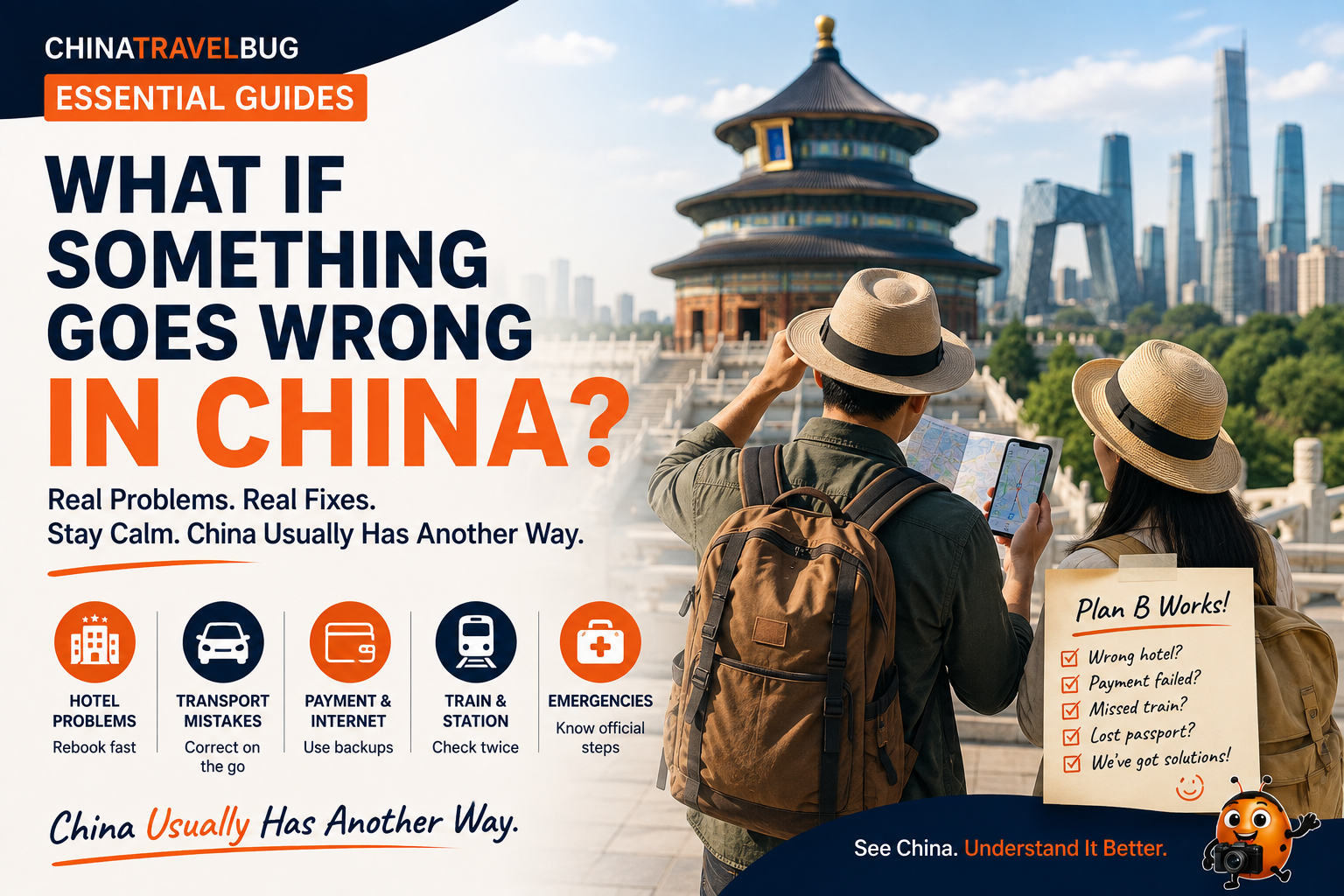
Dad & Elaine’s First-Time Traveler Troubleshooting Guide
Last verified: 28 August 2026
Dad plans.
Dad likes planning.
And sometimes Dad books a DiDi to the correct international hotel brand…
…but the wrong hotel property. 😂
After years of traveling China, we’ve learned something useful:
A good traveler doesn’t need a perfect Plan A. A good traveler needs a Plan B.
Most problems we’ve encountered in China were fixable.
Wrong hotel? Rebook.
Wrong DiDi destination? Change it.
Payment fails? Use the backup.
Missed train? Find the next workable option.
That’s why one of our favorite ChinaTravelBUG sayings is:
China Usually Has Another Way.
⚡ Quick Answer: Build Backups Before You Need Them
| If this goes wrong… | Our Plan B |
|---|---|
| 🏨 Hotel | Rebook / contact booking platform |
| 🚕 DiDi destination | Change destination during ride |
| 💳 Mobile payment | Second payment method/person |
| 📶 Internet | Different network, roaming or eSIM |
| 🚄 Train | Another train/class/date |
| 🚉 Railway station | Check exact station name |
| 🎟️ Attraction ticket | Change the day’s plan |
| 🗣️ Communication | Translation app |
| 🔋 Battery | Shared power-bank rental |
The important word is:
backup.
🏨 1. Dad Booked the Wrong Beijing Hotel
Near the end of one Beijing guided tour, our guide asked:
“Where are you two staying tonight? We can drop you somewhere convenient.”
Dad proudly showed her the hotel booking.
She looked at it.
“That’s very far outside the city.”
Oops. 😂
Dad immediately checked the hotel’s cancellation conditions, cancelled the reservation through the booking app and booked another hotel in a location that made more sense.
What we learned
Don’t check only:
hotel name + price + photographs.
Check the hotel’s actual location against your itinerary.
A hotel can technically be “in Beijing” and still be nowhere near where you want to spend your time.
We eventually developed a whole system for this.
Related:
Why We Stayed Outside Beijing City Centre — One of Beijing’s Best Budget Hotel Finds
How to Choose the Best Hotel in Beijing — My 6-Step Trip.com Strategy
And for our complete hotel checklist:
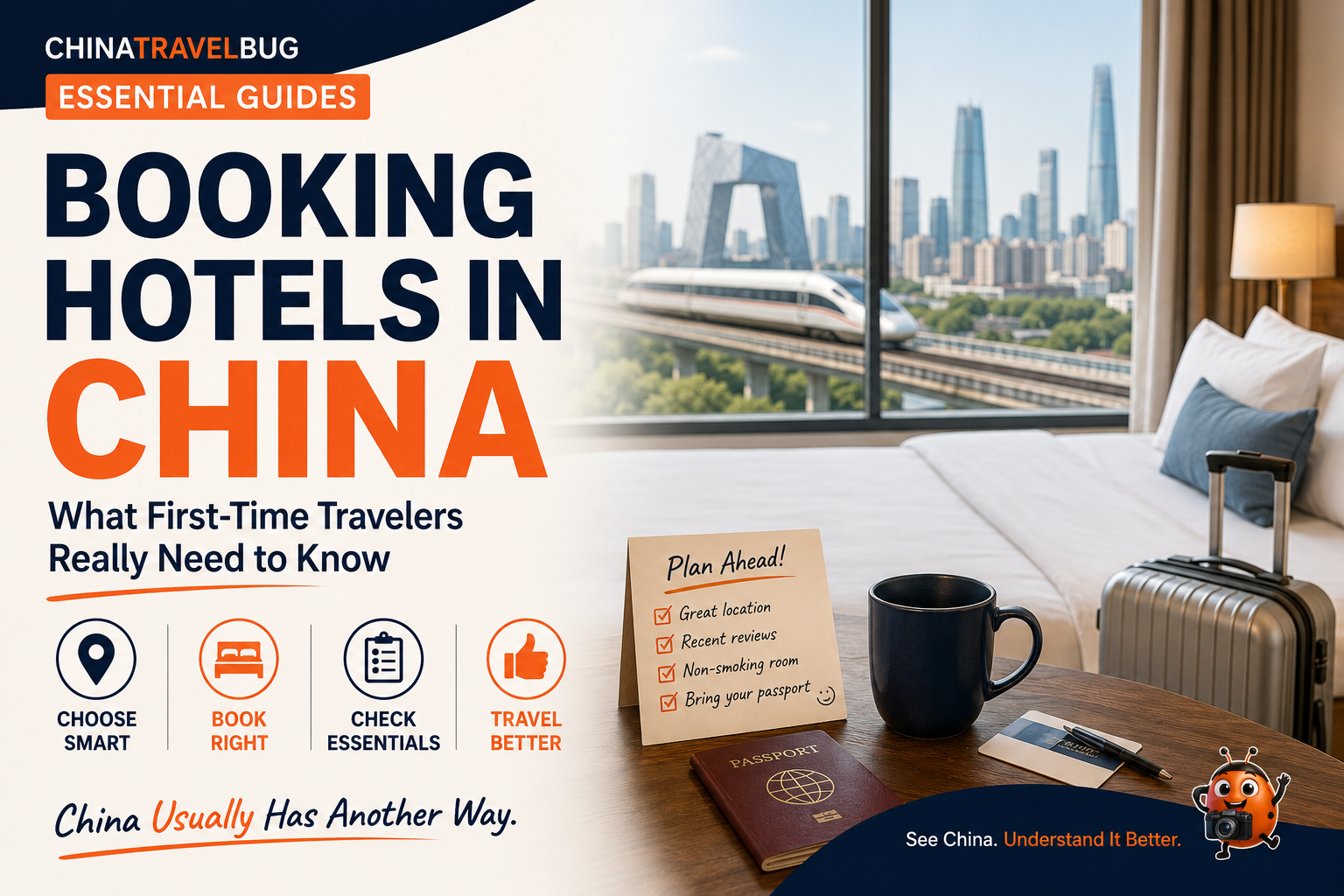
Booking Hotels in China as a Foreigner:
Dad’s 10 Rules for Choosing a Hotel That Actually Works
🚕 2. Right Hotel Brand. Wrong Hotel.
This one was Dad’s fault too. 😂
Dad needed to attend a Rotary Club meeting at an international hotel in the city center.
He searched the hotel brand in DiDi, selected it and got into the car.
Dad has a habit when traveling: he opens the digital map during a journey to understand the main roads and geography of a city.
After a while…
Why are we driving OUT of the city? 😳
Dad looked outside.
Highway.
We checked with the driver.
Same international hotel brand.
Different property.
Fortunately, DiDi allowed us to change the destination during the ride. We corrected it and continued to the right hotel.
The driver wasn’t taking us somewhere strange.
He was taking Dad exactly where Dad had told him to go. 😂
What we learned
Check the exact hotel branch AND address before confirming your DiDi.
Hotel names alone aren’t enough.
💳 3. Dad’s Payment Failed. Elaine Became the Bank.
Mobile payments in China are incredibly convenient.
Until yours doesn’t work. 😂
Dad’s payment app has occasionally failed.
Our sophisticated backup system?
“Elaine, you pay.”
Elaine has her own Alipay setup.
We also deliberately don’t depend on exactly the same internet connection:
Dad: international roaming through his home-country telco.
Elaine: often prefers an eSIM.
We even use different home-country mobile operators.
If Dad’s payment or internet fails, Elaine’s setup may still work—and vice versa.
What we learned
Two travelers shouldn’t share one single point of failure.
If you’re traveling solo, keep another payment option and another way of getting online where practical.
For payment setup and backup methods, continue to our Payments in China Essential Guide.
And for internet, roaming and eSIM planning, see our Internet, eSIMs & Phones Essential Guide.
China Travel Troubleshooting: What to Do When Payments, Apps, Tickets or Transport Don’t Work
🚉 4. Check the EXACT Railway Station
Chinese cities often have more than one railway station.
For example:
Xi’an Railway Station (西安站, Xī’ān Zhàn)
and
Xi’an North Railway Station (西安北站, Xī’ān Běizhàn)
are completely different stations.
Beijing has several major passenger railway stations too.
So don’t merely read:
Beijing
or
Xi’an
on your itinerary.
Read the complete station name.
⚠️ Connecting trains need extra care
If your journey requires a connection, don’t check only:
arrival time → departure time.
Also check:
Does the second train leave from the SAME station where the first train arrives?
A connection that looks comfortable on the booking screen can become much less comfortable if you have to cross a huge Chinese city between stations.
For our complete train and reservation advice:
Booking Tickets & Reservations in China — The Essential Guide for Foreign Travelers
🚄 5. We Missed Our Train Just Before Labour Day
Dad actually tried to be clever.
We knew Xi’an (西安, Xī’ān) would become extremely busy around the May 1 Labour Day holiday.
So Dad planned to leave on April 30 for smaller Yuncheng (运城, Yùnchéng).
Excellent planning.
Then…
We missed the train. 😂
Dad went to the railway counter looking for another way out.
There wasn’t a suitable train for us until May 2.
Result?
Two unexpected extra nights in Xi’an.
Hotels were available, but the prices we found were higher than normal.
In our particular case, we were also able to change the train date with a relatively small additional charge.
What we learned
Immediately before a major Chinese holiday, don’t assume missing one train simply means catching the next one.
The real problem may not be price.
It may be availability.
Read the full lesson here:
Chinese Public Holidays:
When Should You Avoid Traveling in China?
🎟️ 6. Sometimes There Is No Fix — So Change the Plan
At Beijing’s Forbidden City (故宫, Gùgōng), we’d deliberately booked a local guided tour partly to improve our chances of securing entrance tickets.
Our tickets were successfully arranged.
Some other travelers joined the tour later.
By then, the guide couldn’t obtain entrance tickets for them.
They had booked the tour.
They had the guide.
They still couldn’t enter the Forbidden City.
There wasn’t necessarily another clever trick to perform.
Sometimes Plan B means:
Go somewhere else.
That’s an underrated travel skill.
China has thousands of things worth seeing.
Don’t destroy an entire day fighting for the one thing that has become impossible.
For attraction-ticket planning:
Booking Tickets & Reservations in China — The Essential Guide for Foreign Travelers
🗣️ 7. Nobody Speaks English? Use the Phone
At smaller local hotels, we’ve occasionally encountered reception staff who spoke little or no English.
Sometimes they also seemed less familiar with processing foreign passports—probably because they didn’t receive many international guests.
Usually:
passport + translation app + patience
gets us through.
“No English” doesn’t necessarily mean “no solution.”
It often simply means:
communicate differently.
That’s one reason your phone is one of the most important things you carry in China.
🔋 8. Phone Battery Dying? Elaine Has Another Way
Dad doesn’t like carrying a power bank around all day.
Elaine?
She rents one. 😂
Shared power-bank kiosks are common in many Chinese cities, particularly around malls, restaurants and other busy commercial areas.
That’s another lesson we’ve learned repeatedly:
You don’t necessarily need to carry the solution to every possible problem from home.
Sometimes China already has one waiting for you.
For more on what we actually bring—and what Dad deliberately leaves at home:
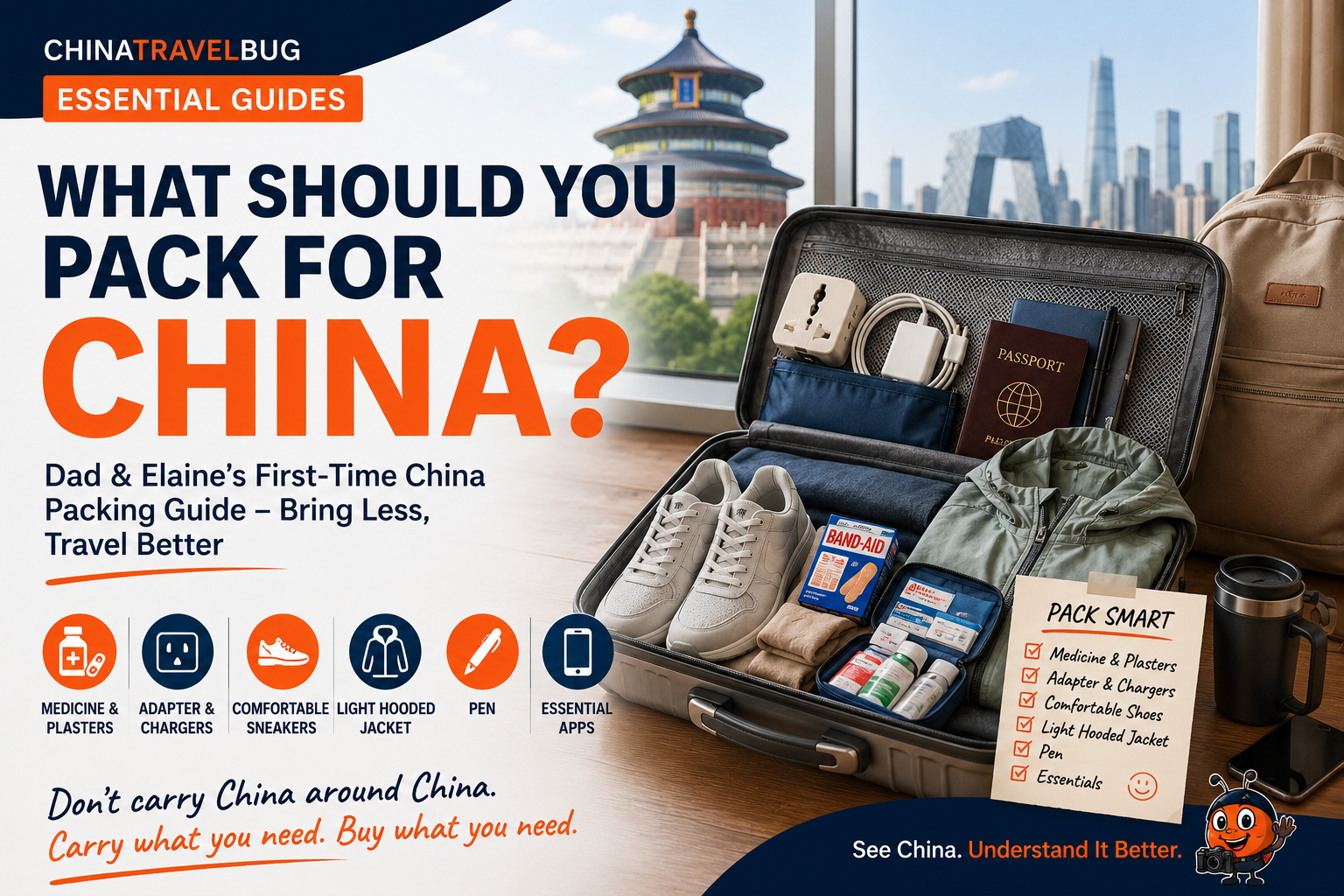
What Should You Pack for China?
Dad & Elaine’s First-Time China Packing Guide
🚨 What If It Is a REAL Emergency?
A wrong hotel or missed train is inconvenient.
A lost passport, serious illness, accident or police matter is different.
Thankfully, Dad & Elaine haven’t personally experienced those situations.
For serious emergencies, use official procedures rather than relying on another traveler’s anecdote.
Useful emergency numbers in mainland China include:
Police — 110
Ambulance — 120
Fire — 119
Also keep accessible backups of:
passport details · travel insurance · embassy/consulate contacts · emergency contacts
If something serious happens, contact the appropriate Chinese authorities and your embassy or consulate where necessary.
🐞 Dad’s Plan B Checklist
Before traveling, Dad increasingly asks:
If this fails, what do we do next?
Payment fails?
Another payment method.
Internet fails?
Another connection.
Hotel wrong?
Check cancellation/rebooking options.
DiDi wrong?
Correct the destination.
Train unavailable?
Different service, class or date.
Wrong station risk?
Check the full station name before leaving.
Language problem?
Translation app.
Battery dying?
Shared power bank.
Attraction sold out?
Go somewhere else. 😂
Continue Planning Your First China Trip
A few related ChinaTravelBUG guides can prevent many of these problems before they happen:
🏨 Hotels
Booking Hotels in China as a Foreigner: Dad’s 10 Rules
💰 Budget
How Much Does a Trip to China Cost? Dad’s Guide to Traveling China Well Without Wasting Money
📅 Crowds & holidays
Chinese Public Holidays: When Should You Avoid Traveling in China?
🎒 Packing
What Should You Pack for China? Dad & Elaine’s First-Time China Packing Guide
🎟️ Trains & reservations
Booking Tickets & Reservations in China — The Essential Guide for Foreign Travelers
🏨 Beijing hotel strategy
Dad’s 6-Step Trip.com Hotel Strategy
ChinaTravelBUG’s Take
We’ve booked the wrong hotel.
Dad has sent a DiDi toward the wrong branch of the right hotel.
His payment has failed.
We’ve missed a train immediately before Labour Day.
And we’ve watched other travelers discover that even a guide couldn’t produce sold-out Forbidden City tickets.
None of those ruined our China journeys.
They taught us something more valuable:
Don’t build a trip that depends on everything going perfectly.
Have a backup.
Stay flexible.
And when Plan A falls apart…
China Usually Has Another Way.
See China. Understand It Better. 🐞
Dad plans.