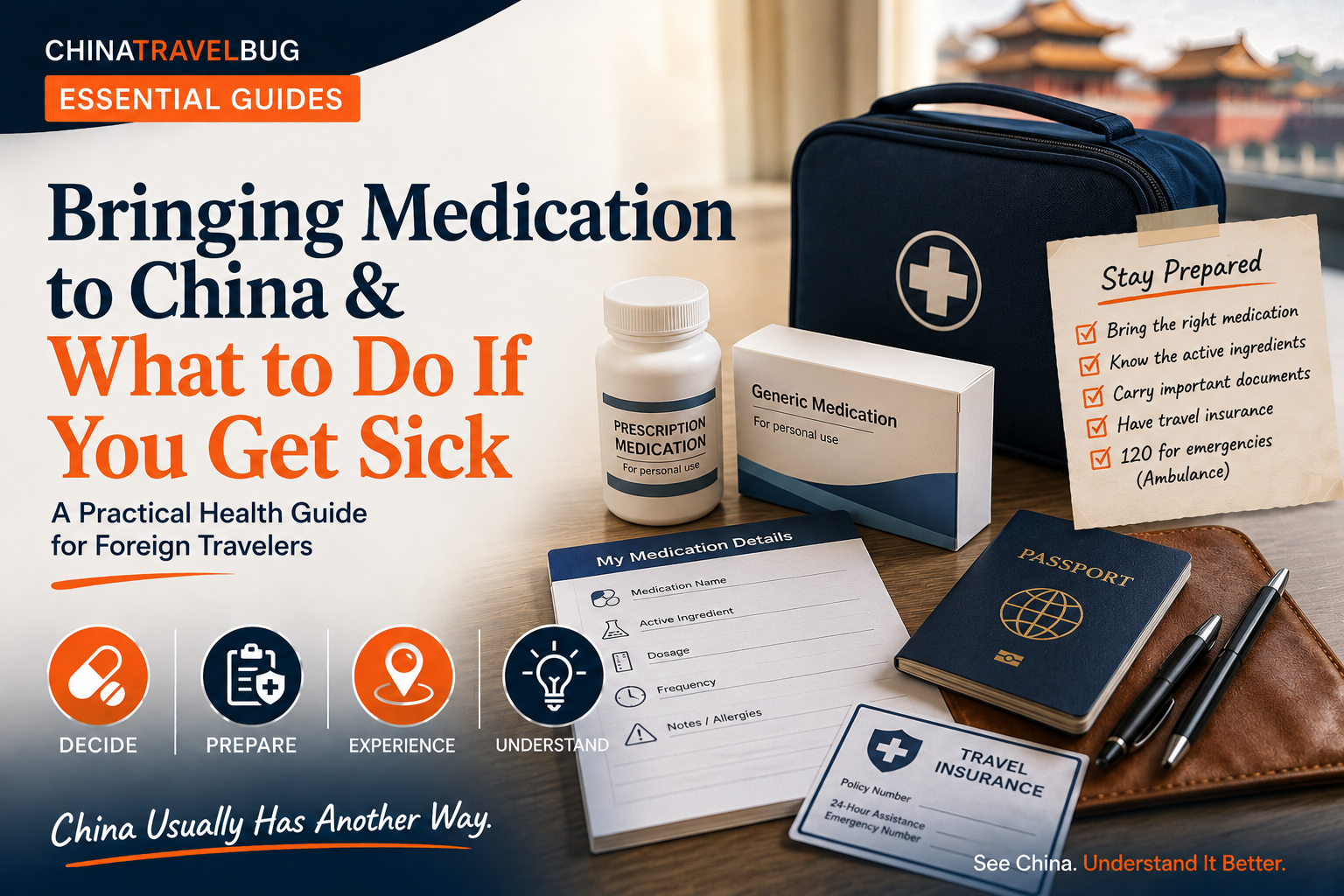
A Practical Health Guide for Foreign Travelers
Nobody wants to think about getting sick on holiday.
But if you take regular medication—or you’re simply wondering what would happen if you needed a doctor in China—a little preparation can remove a lot of anxiety.
The good news is that travelers can generally bring reasonable quantities of ordinary medication for their own personal use into China, subject to Customs supervision.
The important exception is medication containing narcotic or psychotropic substances, which is much more tightly controlled.
And if you do become seriously ill while traveling?
China has hospitals throughout the country, and the national medical emergency number is:
🚑 120 — Medical Emergency / Ambulance
⚡ Quick Answer
If you take regular medication, bring enough for your trip in a reasonable quantity for personal use and carry supporting documentation such as your prescription or medical records.
For prescription medication, I would also keep it in its original labelled packaging where practical. It makes identifying the medicine much easier if anyone needs to check it.
If your medicine contains a narcotic or psychotropic substance, don’t assume your normal prescription is enough. China applies additional controls, and the permitted quantity can depend on the drug’s classification. Check your specific medication before traveling.
Before you fly, save:
✓ Medication details
✓ Prescription / doctor’s documentation
✓ Travel-insurance information
✓ Your insurer’s emergency number
✓ 120 for medical emergencies
🐞 ChinaTravelBUG Tip: Don’t ask the internet, “Can I bring medicine to China?” Ask: “Can I bring this exact medicine and active ingredient into China?”
That’s the question that matters.
1. Can I Bring My Medication Into China?
For ordinary medication that does not contain narcotic or psychotropic substances, China’s rules allow travelers to carry small quantities for personal use, limited to a reasonable quantity for personal use and subject to Customs supervision.
Notice what that rule doesn’t say.
It doesn’t give every traveler a universal:
“You can bring exactly 30 days of medication.”
That’s a common type of travel advice online, but China’s official guidance is framed around personal use and reasonable quantity.
For a normal trip, bring what you reasonably need rather than packing unusually large quantities.
What I Would Carry
Keep together:
- your medication;
- the original labelled packaging where practical;
- a copy of your prescription;
- a doctor’s letter or medical record if appropriate;
- the generic/active ingredient name of the medication.
The active ingredient is particularly useful because brand names can differ between countries.
🐞 ChinaTravelBUG Tip: Take photos of your prescription and medication labels and keep them on your phone as a backup—but bring the actual supporting documents you may need too.
2. Controlled Medication Needs More Care
This is where you should not guess.
China separately regulates narcotic drugs and psychotropic substances.
Travelers who medically require certain controlled medicines may need to present a medical diagnosis certificate and identification. The quantity permitted also depends on the drug’s classification and applicable prescription limits.
For example, Shanghai Customs specifically addresses methylphenidate—the active ingredient in some ADHD medications—as a Category I psychotropic substance in China.
That illustrates an important point:
A medicine routinely prescribed in your home country may be regulated differently in China.
So before traveling with medication for conditions such as ADHD, severe pain, anxiety, sleep disorders or other treatments that may involve controlled substances, check the specific active ingredient against China’s current rules.
Don’t rely on another traveler’s experience with a different medicine.
3. What Documents Should I Bring?
For ordinary medication, China’s official guidance advises travelers to carry supporting material such as prescriptions, medical records or diagnostic certificates.
For medication subject to stricter controls, documentation becomes more important.
I would prepare a small medication folder containing:
📄 Prescription
📄 Doctor’s letter or diagnosis documentation where appropriate
💊 Medication in clearly identifiable packaging
🧪 Generic/active ingredient name
📱 Digital copies on your phone
If your medication is controlled, verify the requirements before departure, rather than discovering the issue at Customs.
One more sensible precaution
Split important information—not the medication itself unless medically appropriate—between physical and digital copies.
If your phone disappears, you still have the paperwork.
If your paperwork disappears, you still have the photographs.
4. Buying Medicine in China
If you develop a headache, cold, stomach upset or another minor problem while traveling, you don’t necessarily need to find a hospital.
China has pharmacies throughout its cities, and some larger pharmacies operate 24 hours.
Licensed pharmacies sell over-the-counter medicines such as some cold and allergy remedies. Prescription medicines require a valid prescription reviewed by a pharmacist.
Look for:
药店 — yàodiàn
Pharmacy / drugstore
or:
药房 — yàofáng
Pharmacy
If you need a particular medicine, show the pharmacist the generic or active ingredient name, rather than relying only on the brand name you use at home.
Brand names and formulations may differ in China.
🐞 ChinaTravelBUG Tip: Don’t buy an unfamiliar medicine simply because the packaging looks similar to something you use at home. Ask the pharmacist and check the active ingredient and dosage.
For anything more serious—or if you’re unsure what’s wrong—skip the pharmacy and see a doctor.
5. What If You Get Sick in China?
First, don’t panic.
Foreign travelers can use China’s public and private hospitals. Major cities also have international medical departments and private facilities where English-speaking services may be easier to find.
For a non-emergency illness, contact your travel insurer first if practical. They may recommend a hospital, explain your coverage or arrange direct billing.
If you’re going to a Chinese public hospital, the basic process is usually:
Register → Wait → See the doctor → Tests if needed → Pay → Collect medicine
Bring your passport. Official guidance for foreign patients says it may be needed for registration.
Many hospitals have their own pharmacy, so if the doctor prescribes medication, you can often collect it there after paying.
Don’t Speak Chinese?
Save this on your phone:
医院 — yīyuàn
Hospital
我需要看医生。
Wǒ xūyào kàn yīshēng.
I need to see a doctor.
Write down or translate your:
- symptoms;
- existing medical conditions;
- medications;
- drug allergies.
If possible, your hotel can also be extremely useful.
Ask reception to help identify an appropriate hospital, write down what you need in Chinese, or help arrange transport.
6. If It Is an Emergency
For a medical emergency in mainland China:
🚑 Call 120
China’s official health guidance identifies 120 as the ambulance/emergency medical number.
If possible, have someone who speaks Chinese help with the call, particularly when explaining your location.
Also contact your travel insurer as soon as reasonably possible.
🐞 ChinaTravelBUG Tip: Save 120 and your travel insurer’s emergency number on your phone before you need either of them.
For a genuine emergency, however, don’t waste time trying to find the “best hospital in China” on Google.
Get medical help first.
7. Travel Insurance — Don’t Skip This One
Medical treatment in China is not free for foreign travelers, and you may need to pay medical expenses yourself before claiming them back from your insurer. Some hospitals have direct-billing arrangements with particular insurers, but you shouldn’t assume yours does.
Before traveling, check that your insurance covers:
- medical treatment in China;
- hospitalization;
- emergency medical evacuation or repatriation;
- the activities you plan to do;
- any pre-existing conditions relevant to your policy.
Medical evacuation can be particularly expensive, so this isn’t the place to choose insurance based only on the cheapest premium.
Save your insurer’s 24-hour assistance number somewhere you can access offline.
If you receive treatment, keep your:
receipts + invoices + medical records + diagnosis + test reports
because your insurer may require them for reimbursement. Chinese official guidance specifically recommends obtaining formal receipts for insurance claims.
🐞 ChinaTravelBUG Tip: If you’re admitted to hospital and the situation allows, contact your insurer early. They may help identify an appropriate hospital and explain whether direct billing is available.
8. Save This Before You Fly
Take five minutes before leaving home and put this information somewhere accessible offline:
💊 Medication
Medication name:
Active ingredient:
Dosage:
Drug allergies:
🩺 Medical
Important medical conditions:
Doctor’s contact:
Travel insurance policy number:
Insurer’s 24-hour emergency number:
🚨 China Emergency
120 — Ambulance / Medical Emergency
And keep digital copies of your:
prescription → doctor’s documentation → insurance policy → passport information page
🐞 ChinaTravelBUG’s Bottom Line
You don’t need to travel China carrying a miniature pharmacy. 😂
For most travelers, the sensible approach is simple:
Bring the medication you reasonably need.
Know the active ingredients.
Carry supporting documents.
Check controlled medicines before flying.
Have travel insurance.
Know that 120 means medical emergency.
And if you become sick?
Get help rather than trying to solve everything yourself.
China Usually Has Another Way. 🐞
Last verified: 29 August 2026