From Yandi Mausoleum 炎帝陵 in Baoji 宝鸡 to 炎黄子孙 — and Why Winning the Battle Didn’t Mean Erasing the Loser
Travel China. Let the places teach you Chinese history.
See the place. Ask the bigger question. Understand China better.
Section 1 — We Came to Visit One Ancestor. Then the Family Story Got Complicated.
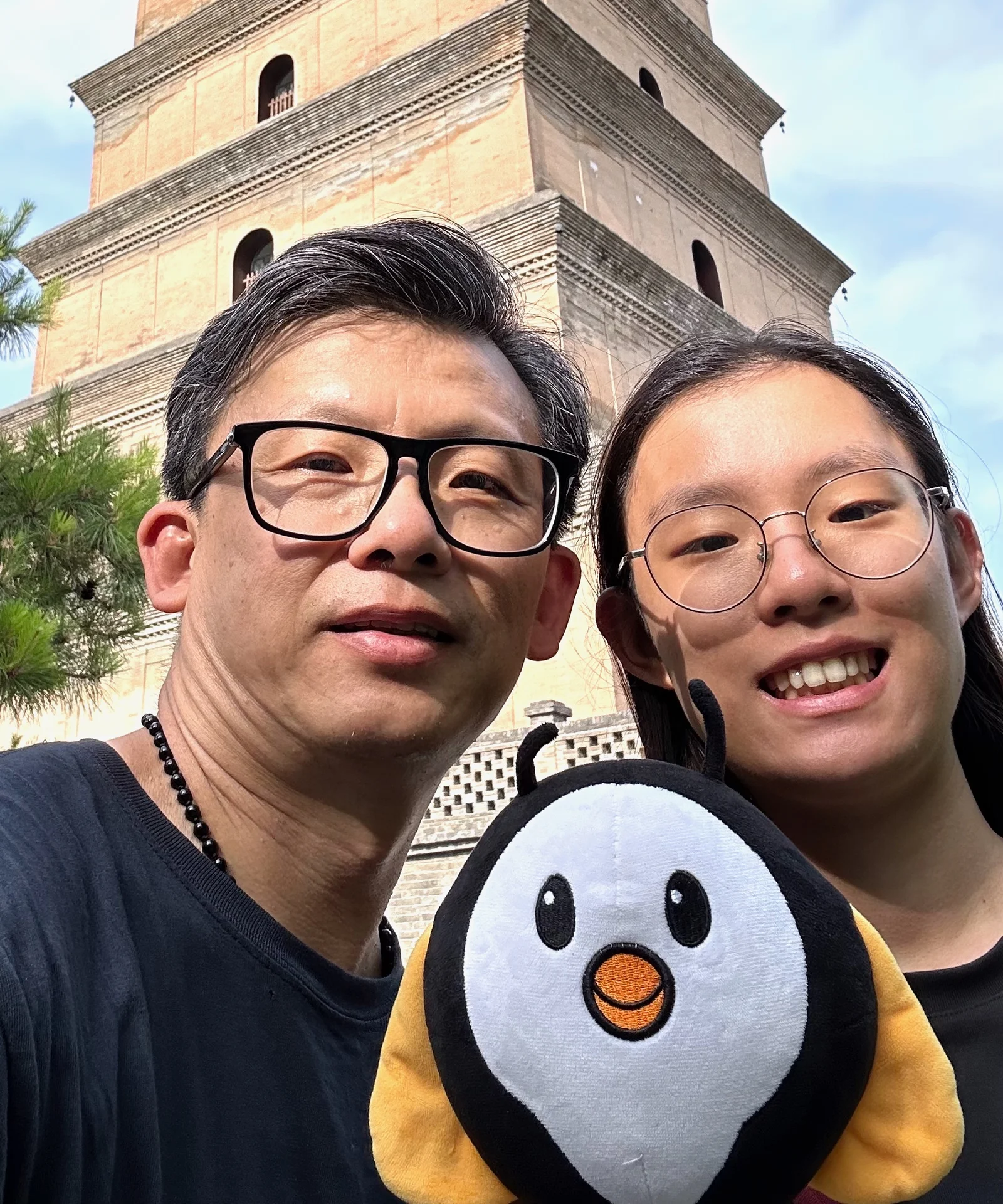
Dad & Elaine came to:
Yandi Mausoleum (炎帝陵, Yándì Líng)
near:
Baoji (宝鸡, Bǎojī)
in:
Shaanxi Province (陕西省, Shǎnxī Shěng).
At first, this looked straightforward.
Three Chinese characters:
炎帝陵
Break them apart:
炎帝 — Yándì
Yan Emperor
陵 — líng
mausoleum / important tomb
Easy.
😂
[INSERT DAD & ELAINE AT 炎帝陵 PHOTO]
We had apparently come to learn about:
one legendary ancestor.
Then Dad started reading the displays.
😬
Suddenly we had:
Shennong (神农, Shénnóng)
Huangdi (黄帝, Huángdì)
Chiyou (蚩尤, Chīyóu)
two legendary battles,
ancestor commemoration (祭祖),
surname culture (姓氏文化),
and eventually:
炎黄子孙
— “Descendants of Yan and Huang.”
Apparently we’d walked into:
China’s legendary family story.
And like many family stories…
there had been arguments.
😂🔥
🧥 Dad’s Coat Rack — Meet THREE Characters First
Before anybody gets lost among China’s legendary ancestors, remember only three names.
🌾 Yandi 炎帝
Associated in later tradition with:
Shennong (神农)
and therefore with:
agriculture (农业),
farming (农耕),
medicinal knowledge (医药)
and:
the beginnings of settled civilized life.
Remember:
YANDI 炎帝 = FARMING + ANCESTRAL MEMORY
👑 Huangdi 黄帝
Huangdi (黄帝)
Yellow Emperor
also:
Xuanyuan Huangdi (轩辕黄帝)
Another great ancestral figure of Chinese legendary antiquity.
Dad & Elaine followed his story separately to:
Huangdi Mausoleum (黄帝陵)
in northern Shaanxi Province.
Remember:
HUANGDI 黄帝 = FOUNDING-ANCESTOR MEMORY
⚔️ Chiyou 蚩尤
Chiyou (蚩尤)
A formidable legendary opponent associated particularly with:
warfare (战争 / 兵事).
Remember:
CHIYOU 蚩尤 = WARRIOR + DEFEATED RIVAL + LATER CULTURAL MEMORY
That’s enough.
Three characters.
Keep them on Dad’s coat rack.
😂
⏳ Where Are We in Chinese History?
This is important.
Yandi (炎帝), Huangdi (黄帝) and Chiyou (蚩尤) belong to China’s:
legendary antiquity (上古传说, shànggǔ chuánshuō).
They are traditionally placed long BEFORE China’s securely documented dynastic history.
For a first-time international traveler, here’s the only timeline you need:
LEGENDARY ANTIQUITY 上古传说
Yandi 炎帝 · Huangdi 黄帝 · Chiyou 蚩尤
traditionally placed in the remote third millennium BCE
↓
NEOLITHIC CHINA 新石器时代
archaeology reveals real farming communities, settlements, pottery and increasingly complex societies
↓
SHANG DYNASTY 商朝
c. 1600–1046 BCE
late Shang gives us oracle-bone writing 甲骨文
↓
ZHOU DYNASTY 周朝
begins c. 1046 BCE
King Wen 周文王 · King Wu 周武王 · Duke of Zhou 周公
↓
QIN UNIFICATION 秦统一
221 BCE
Qin Shi Huang 秦始皇
🔥
So when we talk about:
Yandi 炎帝
and:
Huangdi 黄帝,
we are going much farther back than:
Confucius (孔子)
or:
Qin Shi Huang (秦始皇).
But here’s the crucial distinction:
TRADITIONAL CHRONOLOGY ≠ SECURE HISTORICAL DATING.
Don’t imagine Dad has found Yandi’s passport showing:
Date of Birth: 28 April 2737 BCE.
😭😂
We haven’t.
🌶️ Deep China Evidence Rule
For this article, keep THREE boxes in your head.
传说 — chuánshuō
legend / transmitted tradition
Yandi (炎帝).
Huangdi (黄帝).
Chiyou (蚩尤).
Battle of Banquan (阪泉之战).
Battle of Zhuolu (涿鹿之战).
考古 — kǎogǔ
archaeology
Actual prehistoric:
settlements (聚落),
farming (农业),
pottery (陶器),
burials (墓葬)
and:
material remains (遗物).
文化记忆 — wénhuà jìyì
cultural memory
How later generations remembered these figures.
Expressions such as:
炎黄子孙
Rituals such as:
祭祖 — ancestor commemoration
and physical places such as:
炎帝陵
and:
黄帝陵.
🔥
These three boxes can:
TALK TO EACH OTHER.
But they are:
NOT THE SAME THING.
That’s our Michelin guardrail.
🌾 Now Meet Yandi 炎帝 Properly
At Yandi Mausoleum (炎帝陵), the displays repeatedly connect Yandi (炎帝) with:
Shennong (神农).
The two figures were not necessarily identical in the earliest layers of Chinese tradition, but later traditions increasingly connected and identified them as:
Shennong Yandi (神农炎帝).
And the name:
神农
is wonderfully revealing.
神 — shén
divine / wondrous
农 — nóng
agriculture / farming
So:
神农
“Divine Farmer”
🔥
Now the stories attached to him make more sense.
🌱 The Very Busy Ancestor
The displays Dad photographed associate Yandi/Shennong (炎帝/神农) with:
agriculture (农业),
agricultural tools (农具),
medicinal knowledge (医药),
markets (市场),
pottery (陶器),
textiles (纺织)
and other beginnings of civilized life.
😳
Dad looked at the list and thought:
One guy did ALL this?
😂
Good question.
🍚 Western Handrail: Don’t Imagine One Ancient Steve Jobs
😂
Yandi/Shennong (炎帝/神农) isn’t best understood as:
one prehistoric inventor filing patents for agriculture, medicine, pottery and markets.
Archaeology shows these developments emerging through:
communities
over:
long periods of time.
Agriculture developed.
Pottery developed.
Medicinal knowledge accumulated.
Exchange developed.
🔥
So perhaps the traditional stories are doing something different.
They gather enormous transformations in human life around:
a memorable ancestral figure.
That’s much easier for cultural memory to carry.
🌿 神农尝百草 — Shennong Tastes the Hundred Herbs
One of the most famous traditions is:
神农尝百草
Shennong tastes the hundred herbs
尝 — cháng
taste / try
百 — bǎi
hundred
草 — cǎo
grasses / herbs
This tradition connects Shennong (神农) with:
medicinal knowledge (医药).
Again:
TRADITION
not:
a clinical trial report.
😂
But look at what the tradition considers important:
FOOD 食
FARMING 农
MEDICINE 医
EXCHANGE 市
POTTERY 陶
These are foundations of:
settled human life.
🔥
Maybe the real question isn’t:
Did one man invent them?
Maybe it’s:
Why did later generations gather these particular foundations of civilization around Yandi/Shennong (炎帝/神农)?
🐇
That’s a much better question.
👑 Then Huangdi 黄帝 Appears
And now the family story becomes complicated.
Dad & Elaine had also visited:
Huangdi Mausoleum (黄帝陵)
where Huangdi (黄帝) is remembered as a:
founding / primordial ancestor (初祖).
There we encountered the famous phrase:
炎黄子孙
Let’s read it.
炎 — Yán
Yandi 炎帝
黄 — Huáng
Huangdi 黄帝
子孙 — zǐsūn
descendants
So:
炎黄子孙
Descendants of Yan and Huang
Easy.
Except…
Yandi and Huangdi fought each other.
😬
⚔️ Battle #1 — Banquan 阪泉之战
Ancient transmitted texts preserve traditions of conflict between:
Huangdi (黄帝)
and:
Yandi (炎帝).
The famous battle is:
Battle of Banquan (阪泉之战, Bǎnquán Zhī Zhàn).
In the influential account associated with Sima Qian’s (司马迁):
Records of the Grand Historian (《史记》),
Huangdi (黄帝) ultimately prevails.
🔥
So:
HUANGDI 黄帝 = WINNER
and:
YANDI 炎帝 = LOSER.
Simple.
Except later generations remember:
BOTH
as ancestors.
😳
🍚 Western Handrail: China’s Legendary Hostile Takeover?
Put on your corporate hat for a moment.
😂
Two competing groups.
One conflict.
Huangdi (黄帝) wins.
Yandi (炎帝) loses.
In modern corporate language, Dad might jokingly call the legendary Battle of Banquan (阪泉之战):
A HOSTILE TAKEOVER.
🔥
Normally after a hostile takeover you might expect:
Winner survives.
Loser’s management disappears.
Old brand gets retired.
But look at what later Chinese cultural memory does.
炎帝 IS NOT DELETED.
Yandi’s ancestral identity survives.
His association with Shennong (神农) survives.
His contributions to agriculture (农业) and civilized life survive in the tradition.
And eventually:
炎帝 + 黄帝
become:
炎黄.
😳
So Dad’s corporate analogy needs another stage:
HOSTILE TAKEOVER
↓
POST-MERGER INTEGRATION
↓
BOTH LEGACY BRANDS SURVIVE
↓
NEW SHARED ANCESTRAL IDENTITY
😂🔥
Hence:
炎黄子孙
not simply:
黄帝子孙.
🚧 Corporate Analogy Warning
Obviously:
Yandi (炎帝)
and:
Huangdi (黄帝)
were not CEOs.
😂
And the Battle of Banquan (阪泉之战) isn’t a documented prehistoric M&A transaction.
The analogy simply gives Western beginners a handrail for one important feature of the later tradition:
MILITARY DEFEAT DID NOT REQUIRE CULTURAL ERASURE.
The loser could remain inside:
the larger ancestral story.
🔥
😳 But Wait — Why 炎黄 and Not 黄炎?
Now Dad notices something else.
If Huangdi (黄帝):
won,
why isn’t the phrase:
黄炎子孙?
Why does:
炎
come first?
🐇🐇🐇
This isn’t merely Dad playing with word order.
Early Chinese texts actually more often used:
黄炎 — Huáng-Yán
with Huangdi (黄帝) first.
The now-familiar order:
炎黄 — Yán-Huáng
developed later.
Research on early Chinese textual traditions argues that this changing order reflects the historical development of Yandi’s (炎帝) image and the increasing construction of a joined Yan-Huang ancestral tradition. :contentReference[oaicite:0]{index=0}
😳
So even:
the WORD ORDER has history.
🐞 That Changes How We Read 炎黄子孙
The expression:
炎黄子孙
didn’t drop unchanged from the sky 5,000 years ago.
Indeed, the exact modern expression became widely used much later, particularly around the late Qing period, although older expressions connecting descendants with Huangdi (黄帝) and Yandi (炎帝) existed long before. :contentReference[oaicite:1]{index=1}
🔥
So:
CULTURAL MEMORY ITSELF CHANGES.
Later generations don’t merely:
remember the past.
They also:
reorganize
reinterpret
and:
reconnect
the past.
That’s a very Deep China lesson.
⚔️ And Then a THIRD Competitor Walks Into the Boardroom
😂
Just when Dad has finally understood:
Yandi (炎帝)
+
Huangdi (黄帝),
another legendary figure appears:
Chiyou (蚩尤).
And if you thought the first hostile takeover was complicated…
wait until you meet:
Battle of Zhuolu (涿鹿之战).
🐇🔥
Because Chiyou (蚩尤) loses too.
And somehow…
HE DOESN’T DISAPPEAR EITHER.
😬
That’s where Section 2 begins.
Section 2 — The Loser Who Wouldn’t Disappear: Chiyou 蚩尤
At the end of Section 1, Dad’s corporate handrail gave us:
Huangdi (黄帝)
versus:
Yandi (炎帝)
at the legendary:
Battle of Banquan (阪泉之战).
Huangdi (黄帝) wins.
Yandi (炎帝) loses.
But the losing “brand” isn’t deleted.
😂
Later cultural memory brings the two ancestral traditions together:
炎帝 + 黄帝
↓
炎黄
↓
炎黄子孙
Descendants of Yan and Huang
So Dad learned his first lesson:
MILITARY DEFEAT ≠ CULTURAL ERASURE.
🔥
Then another legendary character walks into the story:
Chiyou (蚩尤, Chīyóu).
And things become even more complicated.
🧥 Put Chiyou 蚩尤 on Dad’s Coat Rack
For now, remember only:
Chiyou (蚩尤)
↓
formidable warrior
↓
legendary opponent of Huangdi (黄帝)
↓
Battle of Zhuolu (涿鹿之战)
↓
defeated
↓
BUT NOT FORGOTTEN.
That’s enough.
😂
We’ll add the spicy bits slowly.
⚔️ Battle #2 — Zhuolu 涿鹿之战
Another famous conflict from China’s:
legendary antiquity (上古传说)
is:
Battle of Zhuolu (涿鹿之战, Zhuōlù Zhī Zhàn).
In the influential account recorded by:
Sima Qian (司马迁)
in:
Records of the Grand Historian (《史记》),
Huangdi (黄帝) fights:
Chiyou (蚩尤).
Huangdi eventually prevails.
Chiyou is:
defeated and killed.
🔥
Now our legendary scoreboard looks straightforward:
HUANGDI 黄帝
Winner
YANDI 炎帝
Defeated
CHIYOU 蚩尤
Defeated and killed
Surely this time the losing competitor disappears.
😂
Nope.
🚧 Deep China Guardrail — Don’t Draw the Battle Map Yet
This is important.
Different ancient texts preserve:
different versions
of the relationships among:
Yandi (炎帝),
Huangdi (黄帝)
and:
Chiyou (蚩尤).
Some transmitted traditions connect Yandi (炎帝) and Huangdi (黄帝) against Chiyou (蚩尤).
Others arrange the conflicts differently.
🔥
So Dad is NOT going to draw:
Yandi Tribe + Huangdi Tribe
↓
Joint Military Command
↓
Attack Chiyou Tribe at 0800 hours
😂😂😂
We simply don’t have evidence that precise.
These are:
transmitted traditions (传说 / 文献传统)
about:
remote antiquity (上古).
They aren’t modern battlefield reports.
And the differences among the stories tell us something important:
the stories themselves changed over time.
🐂 Chiyou 蚩尤 Wasn’t Remembered as Some Useless Loser
This is where the story becomes interesting.
Chiyou (蚩尤) develops an extraordinary reputation in later Chinese tradition.
He becomes associated with:
warfare (战争)
weapons (兵器)
and:
martial power (武力).
🔥
Eventually he is remembered in connection with:
兵主 — Bīngzhǔ
Lord / Master of Warfare
Think about that.
He lost.
Yet his reputation became so formidable that later traditions could:
honor the defeated enemy for the very thing he was good at.
😳
🍚 Western Handrail: The Competitor You Beat — Then Respect
Corporate hat back on.
😂
Imagine:
Huangdi Corp. 黄帝
defeats:
Chiyou Inc. 蚩尤
The competitor is gone.
Surely the brand disappears.
But years later everybody in the industry keeps saying:
“You know, Chiyou was VERY good at warfare.”
😂
The company lost.
But:
THE REPUTATION SURVIVED.
So this isn’t quite the Yandi (炎帝) story.
With Yandi we had:
HOSTILE TAKEOVER
↓
POST-MERGER INTEGRATION
↓
BOTH LEGACY BRANDS SURVIVE
With Chiyou (蚩尤), the handrail looks more like:
DEFEAT
↓
REPUTATION SURVIVES
↓
FORMER ENEMY BECOMES CULTURAL SYMBOL
↓
LATER GENERATIONS REINTERPRET HIM.
🔥
Different process.
Same important lesson:
LOSING ≠ DISAPPEARING.
👑 Even Later Emperors Remembered Chiyou 蚩尤
This is one of the strangest parts.
By the time of:
Qin Shi Huang (秦始皇)
— more than two thousand years ago and already far removed from the legendary world of Huangdi (黄帝) —
Chiyou (蚩尤) still hadn’t disappeared from cultural memory.
Sima Qian’s (司马迁) account of Qin imperial ritual records Qin Shi Huang (秦始皇) sacrificing to:
八神 — Bā Shén
Eight Spirits / Deities
including Chiyou (蚩尤) in his martial role as:
兵主 — Master of Warfare.
😳
Think about the irony.
In the legendary story:
Chiyou loses.
Much later:
China’s First Emperor performs rites connected with him.
🔥
The defeated rival has become part of the ritual vocabulary of power.
🐇 And Then the Miao 苗族 Rabbit Appears
Chiyou’s (蚩尤) cultural afterlife doesn’t stop there.
He also became important within some traditions associated with:
Miao communities (苗族, Miáozú).
Beginner Chinese:
苗 — Miáo
Miao
族 — zú
people / ethnic group
So:
苗族
Miao ethnic group
Some Miao cultural and identity traditions remember:
Chiyou (蚩尤)
as an:
ancestral figure (祖先人物).
🔥
And naturally…
Dad immediately sees another rabbit.
😬 So Were Today’s Miao 苗族 Literally Chiyou’s Tribe?
Careful.
We cannot say that as established history.
😂
You’ll sometimes encounter a beautifully simple chain:
Chiyou 蚩尤
↓
Jiuli 九黎
↓
Sanmiao 三苗
↓
Miao 苗族
It looks wonderfully neat.
Which should immediately make Dad suspicious.
😂
The relationships among ancient names such as:
Jiuli (九黎)
and:
Sanmiao (三苗),
and peoples identified much later as:
Miao (苗族),
are historically complicated.
We don’t possess a continuous 5,000-year genealogical register proving:
Chiyou’s defeated soldiers became today’s Miao people.
So don’t write that.
🍚 Western Handrail: Cultural Ancestor ≠ DNA Grandfather
This distinction matters.
Suppose a community remembers someone as:
“our ancestor.”
That can express:
shared identity,
cultural memory,
historical belonging
and:
a story about origins.
It doesn’t necessarily mean every person in that community can draw an uninterrupted biological family tree back to:
one individual.
🔥
So:
文化祖先 — wénhuà zǔxiān
cultural ancestor
isn’t automatically the same thing as:
血缘祖先 — xuèyuán zǔxiān
biological / blood-line ancestor
That’s the safer handrail for understanding Chiyou (蚩尤) and Miao (苗族) ancestral memory.
🌶️ Then the Story Gets Even Spicier
Much later — especially in some modern cultural narratives — something remarkable happens.
Three names begin appearing together:
Yandi (炎帝)
Huangdi (黄帝)
and:
Chiyou (蚩尤).
They can be described as:
中华三祖 — Zhōnghuá Sān Zǔ
Three Ancestral Figures of Chinese Civilization / the Chinese nation
😳😳😳
Now look at our legendary scoreboard again.
Huangdi 黄帝
Winner.
Yandi 炎帝
Loser.
Chiyou 蚩尤
Loser.
And yet later cultural memory can put:
ALL THREE
into:
the ancestral family portrait.
🔥🔥🔥
🧠 Dad’s Political Science Handrail: Who Gets Into the Family Photo?
This is the question.
A civilization doesn’t merely inherit:
a past.
Later generations also decide:
which stories matter,
which ancestors matter,
which former enemies are remembered,
and:
how old conflicts fit into a larger identity.
🔥
So the family photograph can:
CHANGE.
Someone remembered as:
an enemy
in one period
can be remembered as:
a warrior
in another,
an ancestral figure
in another,
and:
part of a larger shared civilization
in yet another.
That’s:
cultural memory (文化记忆)
at work.
🌶️ And This Is Where We Must Be VERY Careful
Don’t read:
中华三祖
and conclude:
“Excellent. Archaeology has now proven Yandi, Huangdi and Chiyou jointly founded China.”
😂
No.
The phrase itself belongs to:
later cultural interpretation.
And its changing popularity tells us something about:
how later generations wanted to understand their shared past.
That’s historically interesting in its own right.
🐞 The Real Sting: Winning Isn’t the Same as Belonging
Now put Yandi (炎帝) and Chiyou (蚩尤) beside each other.
Yandi 炎帝
Defeated by Huangdi (黄帝) in the Banquan (阪泉) tradition.
Yet becomes:
炎
in:
炎黄.
Chiyou 蚩尤
Defeated by Huangdi (黄帝) in the Zhuolu (涿鹿) tradition.
Yet survives as:
a formidable warrior,
兵主 — Master of Warfare,
an ancestral figure in some Miao (苗族) traditions
and later:
one of the Three Ancestors (中华三祖) in some modern narratives.
🔥
So:
WINNING A BATTLE
and:
BELONGING TO THE CIVILIZATION’S STORY
are:
NOT THE SAME THING.
😳
That’s the chili.
🐇 Now the Rabbit Jumps Thousands of Years
And this is where Dad has to resist cooking another entire article.
😂
Because much later Chinese history gives us:
Xianbei (鲜卑)
Khitan (契丹)
Mongols (蒙古)
and:
Manchus (满洲).
Different peoples.
Different periods.
Different evidence.
Different historical processes.
They are NOT simply:
“Yandi and Chiyou all over again.”
But they force the Western traveler to ask a strangely familiar question:
Does everybody who eventually becomes part of China’s story have to begin on the same side?
🔥
And that question takes us straight to our Michelin Big Question:
Who Is “Chinese”? — When People Beyond the Frontier Became China’s Rulers
There we’ll meet:
Northern Wei (北魏),
Liao dynasty (辽朝),
Yuan dynasty (元朝)
and:
Qing dynasty (清朝)
properly.
Not here.
😂
Keep the fried rice focused.
🐞 Section 2 Sting
We began with:
Chiyou (蚩尤)
↓
Battle of Zhuolu (涿鹿之战)
↓
DEFEAT
↓
兵主 — Master of Warfare
↓
Miao cultural memory (苗族文化记忆)
↓
中华三祖 — Three Ancestors
↓
CULTURAL MEMORY (文化记忆).
😬
And now our question has changed again.
We started with:
Why wasn’t a defeated enemy forgotten?
Now we’re asking:
How does a civilization decide who belongs inside its ancestral story?
🔥🔥🔥
And that question leads us somewhere unexpectedly personal.
Because inside the Yandi memorial complex (炎帝陵纪念区域), Dad & Elaine found displays about:
Chinese surnames (姓氏).
Not just legendary ancestors.
OUR OWN FAMILY NAMES.
🐇
And Dad happened to see one character he knows extremely well:
李.
😂
That’s Section 3.
Deep China: Yandi 炎帝, Huangdi 黄帝 and Chiyou 蚩尤 — When China’s Legendary Rivals Became Ancestors
Section 3 — From Legendary Ancestors to Your Own Surname 姓氏
After Yandi (炎帝), Huangdi (黄帝), Chiyou (蚩尤), Banquan (阪泉) and Zhuolu (涿鹿), Dad thought the rabbit hole had probably gone deep enough.
😂
Then inside the:
Yandi Mausoleum complex (炎帝陵景区)
Dad & Elaine encountered something surprisingly familiar:
Chinese surnames (姓氏, xìngshì).
Not just:
Yandi’s surname.
Not just:
one clan.
There were displays introducing:
surname origins (姓氏起源),
migration and distribution (迁徙分布),
clan traditions (宗族传统),
ancestral halls (宗祠)
and:
famous people sharing particular surnames (姓氏名人).
🔥
Suddenly our enormous question:
“Who are China’s legendary ancestors?”
had become something much smaller and more personal:
“What’s YOUR surname?”
🐇
🇨🇳 First: Learn One Very Useful Word — 姓氏
姓氏 — xìngshì
surname / family name
Today:
姓 — xìng
surname
and:
姓氏
surname / family name
are everyday Chinese.
You might ask:
你姓什么?
Nǐ xìng shénme?
What is your surname?
🔥
But there’s a historical rabbit hiding inside:
姓氏.
Because:
姓
and:
氏
didn’t always mean exactly the same thing.
🐇 Wait — 姓 and 氏 Were Different?
In early Chinese society:
姓 — xìng
and:
氏 — shì
could refer to different aspects of:
ancestry,
lineage,
clan identity
and:
social organization.
Their meanings changed considerably over Chinese history.
Eventually the distinction weakened, and today:
姓氏
is the normal general term for:
surname.
🔥
For a first-time traveler, that’s enough.
We don’t need to turn Yandi Mausoleum into:
Introduction to Chinese Kinship Systems, Semester 1.
😂
The important point is:
Chinese surnames have history.
🧥 Dad’s Surname Coat Rack
Keep these five words.
祖先 — zǔxiān
ancestor
↓
姓氏 — xìngshì
surname
↓
宗族 — zōngzú
lineage / clan
↓
宗祠 — zōngcí
clan ancestral hall
↓
家谱 — jiāpǔ
genealogy / family genealogy
🔥
And one more:
祭祖 — jìzǔ
commemorate / venerate ancestors
Now look at the connection:
ANCESTOR 祖先
↓
LINEAGE 宗族
↓
SURNAME 姓氏
↓
GENEALOGY 家谱
↓
ANCESTRAL HALL 宗祠
↓
ANCESTOR COMMEMORATION 祭祖
😳
Suddenly those surname displays inside an ancestral-mausoleum complex don’t feel quite so random.
🧧 From Legendary Ancestor to Family Ancestor
This is where Dad thinks the site becomes interesting.
At one level, Yandi Mausoleum (炎帝陵) is talking about:
a civilizational ancestor.
Yandi (炎帝).
Thousands of years of cultural memory.
Huge ideas such as:
炎黄子孙.
But:
祖 — zǔ
ancestor
also belongs to:
family life.
Your grandfather.
His grandfather.
Earlier generations.
Your:
家族 — jiāzú
family / extended family
and:
宗族 — zōngzú
lineage / clan.
🔥
So the enormous civilizational idea:
“Who are our ancestors?”
eventually becomes the intimate family question:
“Who are MY ancestors?”
🐞 Dad Had Seen This Rabbit Somewhere Else
This wasn’t the first time Dad & Elaine had encountered surname culture at a legendary-ancestor site.
At:
Shundi Mausoleum (舜帝陵, Shùndì Líng)
near:
Yuncheng (运城, Yùnchéng)
in:
Shanxi Province (山西省, Shānxī Shěng),
we encountered similar explanations connecting:
ancient ancestral traditions
with:
Chinese surnames (姓氏).
😳
Two different legendary-ancestor sites.
Both eventually lead toward:
family names.
Dad started wondering:
Why do China’s legendary ancestors keep leading us back to our surnames?
🐇
That’s another Deep China plate waiting in the fridge.
😂
🧬 But DON’T Treat a Surname Display Like a DNA Test
Very important.
A surname tradition might connect a family name with:
an ancient ruler,
an ancestral clan,
a place,
an official title,
a historical migration
or:
a legendary ancestor.
🔥
But that does NOT automatically prove:
every living person with that surname descends biologically from one single ancient man.
Chinese surnames have changed through:
migration (迁徙),
surname changes (改姓),
adoption of surnames,
political change,
intermarriage
and:
population integration (人口融合).
So:
姓氏传统 — surname tradition
isn’t automatically:
DNA genealogy.
Same evidence rule again.
😂 Then Dad Sees 李
Among the surname displays was:
李 — Lǐ.
Now Dad suddenly became much more interested.
😂
Because Dad’s Chinese surname is:
李.
And Elaine’s Chinese surname is:
李.
But Dad’s English surname is written:
Lee.
Same family.
Same Chinese surname:
李.
Different writing system.
🔥
For Dad, a Southeast Asian descendant of Chinese migrants, that made this abstract discussion of:
姓氏
feel unexpectedly personal.
🍚 Western Handrail: Jet Li, Dad Lee… and Lee Majors
Here’s an easy way for Western readers to understand why the:
Chinese character matters.
You probably know:
Jet Li (李连杰).
His surname:
Li
is:
李.
Dad’s English surname:
Lee
is also written:
李
in Chinese.
So:
LI
and:
LEE
can sometimes represent the same Chinese surname:
李.
🔥
Then we have:
Lee Majors.
😂😂😂
Also:
Lee.
But not:
李.
Completely different surname history.
And there is our lesson:
SAME ENGLISH SPELLING ≠ SAME SURNAME.
And conversely:
DIFFERENT ENGLISH SPELLINGS CAN SOMETIMES REPRESENT THE SAME CHINESE CHARACTER.
🌶️ Why Does This Happen?
Because Chinese surnames traveled.
And when people moved into different linguistic worlds, their names were written according to different:
Chinese languages and regional pronunciations (方言 / 汉语方言),
romanization conventions (罗马字拼写),
colonial administrative systems,
and:
local languages.
🔥
So one Chinese character could acquire different spellings outside China.
And sometimes one English spelling could represent:
completely different surnames.
That’s why Dad’s Deep China rule is:
SHOW ME THE CHINESE CHARACTER.
😂
For Chinese-reading travelers, that single character can tell you something the Romanized spelling cannot.
🌏 The Character That Traveled
And here’s where this becomes more than a surname lesson.
Dad’s family left China generations ago.
The family became part of:
the Southeast Asian Chinese diaspora (东南亚华人).
Dad grew up far from:
Baoji (宝鸡).
Far from:
Yandi Mausoleum (炎帝陵).
Far from the places we’re writing about in Deep China.
Yet one small Chinese character traveled through the generations:
李.
🔥
Then Dad brought Elaine back into China…
and found himself looking at:
李
inside an exhibition about Chinese surname culture (姓氏文化).
That’s a strange little circle.
🐇🌏 The Rabbit Escaped China
This is one of our:
THE RABBIT ESCAPED CHINA
moments.
😂
People migrated.
And when people migrate, they carry more than:
baggage.
They carry:
language (语言),
food (饮食),
customs (习俗),
family memories (家族记忆),
religious traditions (宗教传统),
and:
names (姓名).
🔥
A surname can cross:
oceans,
borders,
languages
and:
generations.
Dad’s:
李
did.
🧠 Western Handrail: Your Surname Is a Tiny Historical Suitcase
Think of a surname as:
a tiny suitcase.
😂
It can carry traces of:
language,
migration,
family stories,
places
and:
identity.
But be careful.
Opening the suitcase doesn’t automatically reveal:
a perfectly documented family tree.
Sometimes the suitcase contains:
facts,
traditions,
family stories
and:
missing pages.
🔥
That’s exactly why:
家谱 — genealogy
and:
historical proof
aren’t automatically the same thing.
But the surname still tells us:
where to start asking questions.
🐞 And This Connects Back to Yandi 炎帝
Now zoom out again.
We started this entire article with:
Yandi (炎帝).
Then:
Huangdi (黄帝).
Then:
Chiyou (蚩尤).
Huge legendary ancestral figures.
Then the site takes us toward:
姓氏 — surnames.
And suddenly:
ANCESTRY
isn’t only:
“Who founded Chinese civilization?”
It’s also:
“Who came before me?”
😳
That’s why ancestor culture can operate on multiple levels.
CIVILIZATIONAL ANCESTORS
such as Yandi (炎帝) and Huangdi (黄帝)
and:
FAMILY ANCESTORS
remembered through:
surname (姓氏),
lineage (宗族),
genealogy (家谱)
and:
ancestor commemoration (祭祖).
Different scales.
Related idea.
🌶️ But Don’t Collapse Them Together
Dad’s surname is:
李.
That does NOT mean:
Dad has proven he is biologically descended from Yandi (炎帝).
😂
Likewise:
炎黄子孙
shouldn’t be read as a modern genetic statement claiming every Chinese person literally descends from two identifiable individuals called:
Yandi (炎帝)
and:
Huangdi (黄帝).
It’s better understood here as:
a language of cultural ancestry (文化祖源 / 文化认同).
🔥
That’s a much more useful distinction.
🐇 And Now Something Bigger Is Happening
Look at the article so far.
Section 1
Yandi 炎帝
↓
Huangdi 黄帝
↓
炎黄
↓
shared ancestral memory
Section 2
Chiyou 蚩尤
↓
Miao 苗族 cultural memory
↓
中华三祖
↓
ancestral memory can change
Section 3
姓氏
↓
宗族
↓
家谱
↓
migration 迁徙
↓
Dad’s 李
↓
Southeast Asia 东南亚
😳
The same question keeps appearing at different scales:
WHO DO WE SAY WE CAME FROM?
🔥🔥🔥
🐞 Section 3 Sting
Dad & Elaine started inside Yandi Mausoleum (炎帝陵) looking at:
legendary ancestors.
Then:
姓氏 — surname
↓
祖先 — ancestor
↓
宗族 — lineage
↓
宗祠 — ancestral hall
↓
家谱 — genealogy
↓
迁徙 — migration
↓
李 — Dad’s surname
↓
Lee
↓
Southeast Asian Chinese diaspora (东南亚华人).
🐇🌏
And now Dad has another question:
How much of an ancestral story is history — and how much is memory?
🔥
That’s where we have to become much more careful.
Because Yandi Mausoleum (炎帝陵) tells us powerful stories about:
5,000 years of ancestry.
But archaeology (考古学) asks a different question:
What can we actually demonstrate about the people living around Baoji (宝鸡) thousands of years ago?
😳
That’s Section 4.
And that’s where:
legend (传说)
meets:
archaeology (考古)
without Dad forcing one to prove the other.
🐞🐇🔥
Deep China: Yandi 炎帝, Huangdi 黄帝 and Chiyou 蚩尤 — When China’s Legendary Rivals Became Ancestors
Section 3 — From Legendary Ancestors to Your Own Surname 姓氏
After Yandi (炎帝), Huangdi (黄帝), Chiyou (蚩尤), Banquan (阪泉) and Zhuolu (涿鹿), Dad thought the rabbit hole had probably gone deep enough.
😂
Then inside the:
Yandi Mausoleum complex (炎帝陵景区)
Dad & Elaine encountered something surprisingly familiar:
Chinese surnames (姓氏, xìngshì).
Not just:
Yandi’s surname.
Not just:
one clan.
There were displays introducing:
surname origins (姓氏起源),
migration and distribution (迁徙分布),
clan traditions (宗族传统),
ancestral halls (宗祠)
and:
famous people sharing particular surnames (姓氏名人).
🔥
Suddenly our enormous question:
“Who are China’s legendary ancestors?”
had become something much smaller and more personal:
“What’s YOUR surname?”
🐇
🇨🇳 First: Learn One Very Useful Word — 姓氏
姓氏 — xìngshì
surname / family name
Today:
姓 — xìng
surname
and:
姓氏
surname / family name
are everyday Chinese.
You might ask:
你姓什么?
Nǐ xìng shénme?
What is your surname?
🔥
But there’s a historical rabbit hiding inside:
姓氏.
Because:
姓
and:
氏
didn’t always mean exactly the same thing.
🐇 Wait — 姓 and 氏 Were Different?
In early Chinese society:
姓 — xìng
and:
氏 — shì
could refer to different aspects of:
ancestry,
lineage,
clan identity
and:
social organization.
Their meanings changed considerably over Chinese history.
Eventually the distinction weakened, and today:
姓氏
is the normal general term for:
surname.
🔥
For a first-time traveler, that’s enough.
We don’t need to turn Yandi Mausoleum into:
Introduction to Chinese Kinship Systems, Semester 1.
😂
The important point is:
Chinese surnames have history.
🧥 Dad’s Surname Coat Rack
Keep these five words.
祖先 — zǔxiān
ancestor
↓
姓氏 — xìngshì
surname
↓
宗族 — zōngzú
lineage / clan
↓
宗祠 — zōngcí
clan ancestral hall
↓
家谱 — jiāpǔ
genealogy / family genealogy
🔥
And one more:
祭祖 — jìzǔ
commemorate / venerate ancestors
Now look at the connection:
ANCESTOR 祖先
↓
LINEAGE 宗族
↓
SURNAME 姓氏
↓
GENEALOGY 家谱
↓
ANCESTRAL HALL 宗祠
↓
ANCESTOR COMMEMORATION 祭祖
😳
Suddenly those surname displays inside an ancestral-mausoleum complex don’t feel quite so random.
🧧 From Legendary Ancestor to Family Ancestor
This is where Dad thinks the site becomes interesting.
At one level, Yandi Mausoleum (炎帝陵) is talking about:
a civilizational ancestor.
Yandi (炎帝).
Thousands of years of cultural memory.
Huge ideas such as:
炎黄子孙.
But:
祖 — zǔ
ancestor
also belongs to:
family life.
Your grandfather.
His grandfather.
Earlier generations.
Your:
家族 — jiāzú
family / extended family
and:
宗族 — zōngzú
lineage / clan.
🔥
So the enormous civilizational idea:
“Who are our ancestors?”
eventually becomes the intimate family question:
“Who are MY ancestors?”
🐞 Dad Had Seen This Rabbit Somewhere Else
This wasn’t the first time Dad & Elaine had encountered surname culture at a legendary-ancestor site.
At:
Shundi Mausoleum (舜帝陵, Shùndì Líng)
near:
Yuncheng (运城, Yùnchéng)
in:
Shanxi Province (山西省, Shānxī Shěng),
we encountered similar explanations connecting:
ancient ancestral traditions
with:
Chinese surnames (姓氏).
😳
Two different legendary-ancestor sites.
Both eventually lead toward:
family names.
Dad started wondering:
Why do China’s legendary ancestors keep leading us back to our surnames?
🐇
That’s another Deep China plate waiting in the fridge.
😂
🧬 But DON’T Treat a Surname Display Like a DNA Test
Very important.
A surname tradition might connect a family name with:
an ancient ruler,
an ancestral clan,
a place,
an official title,
a historical migration
or:
a legendary ancestor.
🔥
But that does NOT automatically prove:
every living person with that surname descends biologically from one single ancient man.
Chinese surnames have changed through:
migration (迁徙),
surname changes (改姓),
adoption of surnames,
political change,
intermarriage
and:
population integration (人口融合).
So:
姓氏传统 — surname tradition
isn’t automatically:
DNA genealogy.
Same evidence rule again.
😂 Then Dad Sees 李
Among the surname displays was:
李 — Lǐ.
Now Dad suddenly became much more interested.
😂
Because Dad’s Chinese surname is:
李.
And Elaine’s Chinese surname is:
李.
But Dad’s English surname is written:
Lee.
Same family.
Same Chinese surname:
李.
Different writing system.
🔥
For Dad, a Southeast Asian descendant of Chinese migrants, that made this abstract discussion of:
姓氏
feel unexpectedly personal.
🍚 Western Handrail: Jet Li, Dad Lee… and Lee Majors
Here’s an easy way for Western readers to understand why the:
Chinese character matters.
You probably know:
Jet Li (李连杰).
His surname:
Li
is:
李.
Dad’s English surname:
Lee
is also written:
李
in Chinese.
So:
LI
and:
LEE
can sometimes represent the same Chinese surname:
李.
🔥
Then we have:
Lee Majors.
😂😂😂
Also:
Lee.
But not:
李.
Completely different surname history.
And there is our lesson:
SAME ENGLISH SPELLING ≠ SAME SURNAME.
And conversely:
DIFFERENT ENGLISH SPELLINGS CAN SOMETIMES REPRESENT THE SAME CHINESE CHARACTER.
🌶️ Why Does This Happen?
Because Chinese surnames traveled.
And when people moved into different linguistic worlds, their names were written according to different:
Chinese languages and regional pronunciations (方言 / 汉语方言),
romanization conventions (罗马字拼写),
colonial administrative systems,
and:
local languages.
🔥
So one Chinese character could acquire different spellings outside China.
And sometimes one English spelling could represent:
completely different surnames.
That’s why Dad’s Deep China rule is:
SHOW ME THE CHINESE CHARACTER.
😂
For Chinese-reading travelers, that single character can tell you something the Romanized spelling cannot.
🌏 The Character That Traveled
And here’s where this becomes more than a surname lesson.
Dad’s family left China generations ago.
The family became part of:
the Southeast Asian Chinese diaspora (东南亚华人).
Dad grew up far from:
Baoji (宝鸡).
Far from:
Yandi Mausoleum (炎帝陵).
Far from the places we’re writing about in Deep China.
Yet one small Chinese character traveled through the generations:
李.
🔥
Then Dad brought Elaine back into China…
and found himself looking at:
李
inside an exhibition about Chinese surname culture (姓氏文化).
That’s a strange little circle.
🐇🌏 The Rabbit Escaped China
This is one of our:
THE RABBIT ESCAPED CHINA
moments.
😂
People migrated.
And when people migrate, they carry more than:
baggage.
They carry:
language (语言),
food (饮食),
customs (习俗),
family memories (家族记忆),
religious traditions (宗教传统),
and:
names (姓名).
🔥
A surname can cross:
oceans,
borders,
languages
and:
generations.
Dad’s:
李
did.
🧠 Western Handrail: Your Surname Is a Tiny Historical Suitcase
Think of a surname as:
a tiny suitcase.
😂
It can carry traces of:
language,
migration,
family stories,
places
and:
identity.
But be careful.
Opening the suitcase doesn’t automatically reveal:
a perfectly documented family tree.
Sometimes the suitcase contains:
facts,
traditions,
family stories
and:
missing pages.
🔥
That’s exactly why:
家谱 — genealogy
and:
historical proof
aren’t automatically the same thing.
But the surname still tells us:
where to start asking questions.
🐞 And This Connects Back to Yandi 炎帝
Now zoom out again.
We started this entire article with:
Yandi (炎帝).
Then:
Huangdi (黄帝).
Then:
Chiyou (蚩尤).
Huge legendary ancestral figures.
Then the site takes us toward:
姓氏 — surnames.
And suddenly:
ANCESTRY
isn’t only:
“Who founded Chinese civilization?”
It’s also:
“Who came before me?”
😳
That’s why ancestor culture can operate on multiple levels.
CIVILIZATIONAL ANCESTORS
such as Yandi (炎帝) and Huangdi (黄帝)
and:
FAMILY ANCESTORS
remembered through:
surname (姓氏),
lineage (宗族),
genealogy (家谱)
and:
ancestor commemoration (祭祖).
Different scales.
Related idea.
🌶️ But Don’t Collapse Them Together
Dad’s surname is:
李.
That does NOT mean:
Dad has proven he is biologically descended from Yandi (炎帝).
😂
Likewise:
炎黄子孙
shouldn’t be read as a modern genetic statement claiming every Chinese person literally descends from two identifiable individuals called:
Yandi (炎帝)
and:
Huangdi (黄帝).
It’s better understood here as:
a language of cultural ancestry (文化祖源 / 文化认同).
🔥
That’s a much more useful distinction.
🐇 And Now Something Bigger Is Happening
Look at the article so far.
Section 1
Yandi 炎帝
↓
Huangdi 黄帝
↓
炎黄
↓
shared ancestral memory
Section 2
Chiyou 蚩尤
↓
Miao 苗族 cultural memory
↓
中华三祖
↓
ancestral memory can change
Section 3
姓氏
↓
宗族
↓
家谱
↓
migration 迁徙
↓
Dad’s 李
↓
Southeast Asia 东南亚
😳
The same question keeps appearing at different scales:
WHO DO WE SAY WE CAME FROM?
🔥🔥🔥
🐞 Section 3 Sting
Dad & Elaine started inside Yandi Mausoleum (炎帝陵) looking at:
legendary ancestors.
Then:
姓氏 — surname
↓
祖先 — ancestor
↓
宗族 — lineage
↓
宗祠 — ancestral hall
↓
家谱 — genealogy
↓
迁徙 — migration
↓
李 — Dad’s surname
↓
Lee
↓
Southeast Asian Chinese diaspora (东南亚华人).
🐇🌏
And now Dad has another question:
How much of an ancestral story is history — and how much is memory?
🔥
That’s where we have to become much more careful.
Because Yandi Mausoleum (炎帝陵) tells us powerful stories about:
5,000 years of ancestry.
But archaeology (考古学) asks a different question:
What can we actually demonstrate about the people living around Baoji (宝鸡) thousands of years ago?
😳
That’s Section 4.
And that’s where:
legend (传说)
meets:
archaeology (考古)
without Dad forcing one to prove the other.
🐞🐇🔥
Deep China: Yandi 炎帝, Huangdi 黄帝 and Chiyou 蚩尤 — When China’s Legendary Rivals Became Ancestors
Section 4 — Legend 传说, Archaeology 考古 and Cultural Memory 文化记忆: What Can We Actually Know?
By now our visit to:
Yandi Mausoleum (炎帝陵)
near:
Baoji (宝鸡)
has become rather crowded.
😂
We started with:
Yandi (炎帝)
then met:
Shennong (神农),
Huangdi (黄帝),
Chiyou (蚩尤),
the legendary:
Battle of Banquan (阪泉之战)
and:
Battle of Zhuolu (涿鹿之战).
Then came:
炎黄子孙
ancestor commemoration:
祭祖
surname culture:
姓氏文化
and somehow Dad’s own:
李.
😬
So before we go any further, Dad needs to clean the wok.
Because three very different kinds of evidence have been mixed together.
🧥 Dad’s Three-Box Rule
Whenever Deep China takes you back into remote antiquity, keep three boxes separate.
BOX 1 — 传说
chuánshuō
Legend / transmitted tradition
↓
BOX 2 — 考古
kǎogǔ
Archaeology
↓
BOX 3 — 文化记忆
wénhuà jìyì
Cultural memory
🔥
They can:
CONNECT.
But they cannot simply be:
COLLAPSED INTO ONE ANOTHER.
That’s the rule.
📖 BOX 1 — Legend 传说
This is where we put:
Yandi (炎帝)
Shennong (神农)
Huangdi (黄帝)
Chiyou (蚩尤)
and stories such as:
Battle of Banquan (阪泉之战)
and:
Battle of Zhuolu (涿鹿之战).
These traditions were recorded and developed in texts produced:
much later
than the remote period they describe.
🔥
That doesn’t make them:
useless.
But it does mean we shouldn’t read them like:
a newspaper report written the morning after the battle.
😂
📚 Even Sima Qian 司马迁 Was Looking Back
We’ve repeatedly mentioned:
Sima Qian (司马迁, Sīmǎ Qiān)
and his:
Records of the Grand Historian (《史记》, Shǐjì).
Sima Qian lived during the:
Han dynasty (汉朝)
roughly in the:
2nd–1st centuries BCE.
😳
Now go back to Dad’s timeline.
The traditions surrounding:
Yandi (炎帝), Huangdi (黄帝) and Chiyou (蚩尤)
were placed in:
remote legendary antiquity.
So even Sima Qian was writing about traditions concerning a world believed to lie:
thousands of years before his own time.
🔥
That’s an important Western-reader handrail.
🍚 Western Handrail: Ancient Doesn’t Always Mean Contemporary
Imagine somebody in:
2026
writing about:
Julius Caesar.
That’s already about 2,000 years of distance.
Now imagine writing about events believed to have happened even farther back…
using:
older texts,
oral traditions,
ritual memory
and:
stories inherited across generations.
😬
That’s closer to the kind of evidentiary problem we’re dealing with.
So:
ANCIENT SOURCE
doesn’t automatically mean:
EYEWITNESS SOURCE.
🔥
That’s a very useful rule for reading early Chinese history.
🏺 BOX 2 — Archaeology 考古
Now change evidence completely.
考古 — kǎogǔ
archaeology
Archaeologists don’t begin by asking:
“Where is Yandi’s office?”
😂
They examine:
settlement remains (聚落遗址),
pottery (陶器),
stone tools (石器),
burials (墓葬),
plant remains (植物遗存),
animal remains (动物遗存)
and:
patterns of human occupation.
🔥
These can tell us about:
real prehistoric communities.
🏺 And Baoji 宝鸡 Has Real Prehistory
This is where the story gets particularly interesting.
The broader Baoji (宝鸡) region has important:
Neolithic archaeological remains (新石器时代遗址).
One especially relevant site is:
Beishouling (北首岭, Běishǒulǐng).
Beishouling (北首岭) preserves evidence of prehistoric communities in the Baoji area dating back several thousand years before the historically documented dynasties.
🔥
That gives us:
settlement,
pottery,
tools,
burials
and:
evidence of prehistoric ways of life.
Those are:
archaeological facts.
😬 So Did Archaeology Find Yandi 炎帝?
No.
That’s exactly where Dad must stop the rabbit.
😂
We cannot say:
“Archaeologists found Neolithic farmers around Baoji, therefore one of them was Yandi.”
That’s not how evidence works.
Nor can we say:
“Agriculture existed here, therefore Shennong personally invented it here.”
Again:
NO.
🔥
What archaeology can show is that:
real prehistoric communities
lived in this broader landscape.
They farmed.
They made things.
They buried their dead.
They developed increasingly complex ways of life.
But:
ARCHAEOLOGY HAS NOT HANDED US YANDI’S ID CARD.
😂
🌶️ And That’s Actually MORE Interesting
Because now we can put two pictures beside each other.
Traditional memory 传说
Shennong Yandi (神农炎帝)
teaches:
agriculture (农业),
tools (农具),
medicine (医药)
and other foundations of civilized life.
Archaeology 考古
Actual prehistoric communities gradually develop:
agriculture,
settlements,
pottery,
tools
and:
complex social life.
🔥
They are:
NOT THE SAME EVIDENCE.
But they’re asking questions about:
the same enormous human transformation.
How did people move toward:
settled agricultural societies?
😳
That’s where legend and archaeology can:
TALK
without Dad forcing them to:
MARRY.
😂
🍚 Western Handrail: Two Departments Studying the Same Company
Corporate hat again.
😂
Imagine two departments looking at an old company.
Department A: Company Stories
They preserve:
founder stories,
legends,
famous personalities
and:
corporate traditions.
Department B: Auditors
They examine:
documents,
buildings,
accounts
and:
physical evidence.
🔥
They may both help you understand the company.
But you wouldn’t say:
“The founder story proves the accounts.”
or:
“The accounts make the founder story meaningless.”
Different evidence.
Different questions.
Same past.
That’s our handrail for:
传说 + 考古.
🧠 BOX 3 — Cultural Memory 文化记忆
Now we come to the third box.
文化记忆 — wénhuà jìyì
cultural memory
This asks:
How do later generations remember the past?
🔥
And suddenly everything Dad & Elaine physically saw at:
Yandi Mausoleum (炎帝陵)
becomes evidence again.
Not necessarily evidence that:
Yandi personally stood on this exact spot 5,000 years ago.
But evidence of:
HOW YANDI IS REMEMBERED.
That’s different.
And valuable.
📸 Read the Memory
At Yandi Mausoleum (炎帝陵), Dad photographed displays about:
Shennong Yandi (神农炎帝),
agriculture (农业),
ancestral origins (祖源),
ancestor commemoration (祭祖),
surname culture (姓氏文化)
and:
Yandi traditions (炎帝传说).
🔥
Those displays tell us what the site wants modern visitors to understand about Yandi (炎帝).
That is:
cultural memory (文化记忆).
🐞 No Ancient Stele? That’s Fine.
At some Deep China sites, Dad goes hunting for:
steles (碑, bēi).
😂
At:
Huangdi Mausoleum (黄帝陵),
historical steles helped us trace later imperial commemoration.
At:
Yandi Mausoleum (炎帝陵),
Dad didn’t find an equivalent historical stele that suddenly proved:
“Yandi was definitely buried here.”
So we don’t pretend there was one.
🔥
Instead:
READ THE MEMORY.
Read:
the displays,
the rituals,
the ancestral language,
the surname exhibits
and:
the way the site presents Yandi today.
Different place.
Different evidence.
🙏 Why Does 祭祖 Matter?
One of Dad’s photographs explains:
祭祖 — jìzǔ
ancestor commemoration / ancestral rites
Break it apart:
祭 — jì
sacrifice / ritually commemorate
祖 — zǔ
ancestor
So:
祭祖
commemorate ancestors
🔥
The site describes continuing commemorative traditions connected with Yandi (炎帝).
That tells us something important.
Yandi isn’t simply:
a character in an ancient book.
He remains part of:
living cultural memory.
🐇 And Huangdi 黄帝 Gives Us the Comparison
Dad & Elaine saw something similar — but historically different — at:
Huangdi Mausoleum (黄帝陵).
There:
初祖 — chūzǔ
primordial / founding ancestor
was an important concept.
And historical records and inscriptions allow us to trace later imperial commemorations.
At Yandi Mausoleum (炎帝陵):
祭祖
and modern ancestral interpretation are especially visible.
🔥
So:
黄帝陵
and:
炎帝陵
aren’t duplicates.
They complement each other.
One helps us ask:
How did rulers and later generations commemorate Huangdi (黄帝)?
The other helps us ask:
How does Yandi (炎帝) remain connected with agriculture, ancestry, surnames and living cultural memory?
Together:
炎 + 黄
becomes much richer.
🌶️ Now We Can Answer the “Was Yandi Real?” Question Properly
Western travelers may understandably ask:
“So… was Yandi real?”
Dad’s answer:
We don’t know in the modern biographical sense.
🔥
We cannot reconstruct Yandi (炎帝) as though we were writing:
date of birth,
passport number,
home address
and:
employment history.
😂
The textual traditions are too late and layered.
Archaeology hasn’t identified an individual and announced:
“Ladies and gentlemen: Yandi.”
But that doesn’t make Yandi historically irrelevant.
Because there are actually:
TWO DIFFERENT QUESTIONS.
🐇 Question 1
Can we prove the biography of Yandi 炎帝 as a single prehistoric individual?
Very difficult.
The evidence doesn’t allow that level of certainty.
🐇 Question 2
Has belief in and memory of Yandi 炎帝 influenced Chinese culture and ideas about ancestry and civilization?
Absolutely.
🔥
And THAT is why Dad came.
🍚 Western Handrail: King Arthur
Western readers already know how to do this.
Think of:
King Arthur.
Historians can debate:
whether there was a historical individual behind the traditions,
which elements developed later,
and:
how the stories changed.
Yet Arthurian tradition can still tell us enormously important things about:
British cultural memory,
kingship,
literature
and:
identity.
🔥
You don’t have to choose between:
“Every Arthur story happened literally.”
and:
“Arthur therefore means nothing.”
Likewise with:
Yandi (炎帝)
and:
Huangdi (黄帝).
That’s the handrail.
🧠 This Is Why Cultural Memory 文化记忆 Matters
Human societies don’t remember the past like:
computer hard drives.
😂
They:
select,
retell,
reinterpret,
combine
and:
give new meaning
to older stories.
🔥
That’s exactly what we’ve watched happen in this article.
Yandi (炎帝)
becomes closely connected with:
Shennong (神农).
Yandi (炎帝) and Huangdi (黄帝) become:
炎黄.
The order itself changes historically from earlier:
黄炎
toward familiar:
炎黄.
Chiyou (蚩尤) moves from:
defeated enemy
toward:
martial figure,
Miao (苗族) ancestral memory
and, in some modern narratives:
中华三祖.
🔥🔥🔥
The changing story:
IS PART OF THE HISTORY.
🌶️ And Now the Three Boxes Work Together
Let’s put everything back on Dad’s table.
📖 Legend 传说
Tells us stories about:
Yandi 炎帝
Huangdi 黄帝
Chiyou 蚩尤
Banquan 阪泉
Zhuolu 涿鹿.
🏺 Archaeology 考古
Shows us:
real prehistoric communities
living in regions such as:
Baoji 宝鸡
through:
settlements (聚落),
pottery (陶器),
tools (工具),
burials (墓葬)
and:
agricultural evidence (农业遗存).
🧠 Cultural Memory 文化记忆
Shows us how later people:
remembered Yandi (炎帝),
remembered Huangdi (黄帝),
reinterpreted Chiyou (蚩尤),
performed ancestor commemoration (祭祖),
connected ancestry with surnames (姓氏),
and:
built places such as Yandi Mausoleum (炎帝陵).
🔥
Three boxes.
One enormous question:
How did later Chinese generations imagine where their civilization came from?
🐞 Section 4 Sting
We started this section asking:
“Did all these legendary stories really happen?”
Now Dad thinks that’s:
the wrong first question.
😂
Better questions are:
What does the tradition say?
传说
What can physical evidence demonstrate?
考古
How did later generations remember and reinterpret it?
文化记忆
🔥🔥🔥
Once you keep those three questions separate, something wonderful happens.
You don’t have to:
BELIEVE EVERYTHING
or:
DISMISS EVERYTHING.
You can:
UNDERSTAND IT.
🐞
And now we’re finally ready to return from the rabbit hole to:
Yandi Mausoleum (炎帝陵)
as travelers.
Where exactly is it?
What should you look for?
How does it fit into a trip to:
Baoji (宝鸡)?
And which rabbit should you follow next:
Huangdi Mausoleum (黄帝陵),
Shundi Mausoleum (舜帝陵),
Before China — When Does Chinese Civilization Actually Begin?
or:
Who Is “Chinese”?
That’s Section 5.
Deep China: Yandi 炎帝, Huangdi 黄帝 and Chiyou 蚩尤 — When China’s Legendary Rivals Became Ancestors
Section 5 — Now Go to Yandi Mausoleum 炎帝陵 — and Read the Memory
After all those rabbits…
😂
let’s remember where this article actually started.
Dad & Elaine were visiting:
Yandi Mausoleum (炎帝陵, Yándì Líng)
near:
Baoji (宝鸡, Bǎojī)
in:
Shaanxi Province (陕西省, Shǎnxī Shěng).
We came to see a place.
The place gave us:
Yandi (炎帝)
↓
Shennong (神农)
↓
Huangdi (黄帝)
↓
Battle of Banquan (阪泉之战)
↓
炎黄
↓
Chiyou (蚩尤)
↓
Battle of Zhuolu (涿鹿之战)
↓
Miao cultural memory (苗族文化记忆)
↓
Three Ancestors (中华三祖)
↓
ancestor commemoration (祭祖)
↓
surname culture (姓氏文化)
↓
Dad’s 李
↓
legend (传说) vs archaeology (考古) vs cultural memory (文化记忆).
😬
Not bad for one sightseeing stop.
🔥
Now let’s return to the traveler.
📍 Where Is Yandi Mausoleum 炎帝陵?
Yandi Mausoleum (炎帝陵) is in the Baoji (宝鸡) area, associated with:
Changyang Mountain (常羊山, Chángyáng Shān)
and local traditions surrounding:
Yandi (炎帝)
and:
Shennong (神农).
The site is south of central Baoji.
So if you’re already traveling:
Beyond Xi’an (西安)
into Baoji…
this isn’t another journey across China.
It’s another historical layer:
inside the Baoji journey.
🔥
🚄 First Get to Baoji 宝鸡
From:
Xi’an (西安, Xī’ān),
Baoji (宝鸡) is easily reached by:
high-speed rail (高铁, gāotiě).
For most international travelers, this makes Baoji a very manageable extension west of Xi’an.
But Dad’s advice remains:
DON’T COME TO BAOJI FOR ONLY ONE ATTRACTION.
😂
Baoji works much better when you understand the historical layers surrounding it.
🧥 Dad’s Baoji Coat Rack
Baoji (宝鸡) can take you through several different layers of China’s past.
PREHISTORIC BAOJI 史前宝鸡
↓
YANDI TRADITIONS 炎帝传说
↓
SHANG–ZHOU WORLD 商周
↓
ZHOUYUAN 周原
↓
BRONZES 青铜器
↓
HE ZUN 何尊
↓
“ZHONGGUO” 中国
↓
RISING QIN 秦
↓
QIN SHI HUANG 秦始皇.
🔥🔥🔥
That’s why Dad & Elaine went to Baoji.
Not because:
“Baoji has Attraction A, Attraction B and Attraction C.”
But because:
Baoji lets you keep rewinding Chinese history.
🚗 How to Reach Yandi Mausoleum 炎帝陵
For international travelers, Dad would keep this simple.
Once you’re in:
Baoji (宝鸡),
consider:
DiDi (滴滴)
or:
private car (包车, bāochē)
to reach Yandi Mausoleum (炎帝陵).
If you’re combining several historical sites around Baoji, a:
private car + knowledgeable guide
can be much more efficient.
🔥
Especially because Baoji’s deeper value lies in:
CONNECTING THE PLACES.
🧑🏫 Dad Would Recommend a History Guide for the Wider Baoji Journey
Could you visit Yandi Mausoleum (炎帝陵) independently?
YES.
But there’s a problem.
Many of the displays Dad photographed are:
Chinese-heavy.
😬
And the interesting questions aren’t simply:
“Where is the tomb?”
They’re:
What is tradition (传说)?
What comes from later historical texts (历史文献)?
What can archaeology (考古) actually support?
Why is Yandi (炎帝) associated with Shennong (神农)?
Why do Yandi (炎帝) and Huangdi (黄帝) become 炎黄?
Why does the site discuss surnames (姓氏)?
🔥
A good guide can help enormously.
But Dad would request something more specific than:
English-speaking Baoji guide.
Ask for:
An experienced English-speaking licensed guide with a strong interest in early Chinese history, archaeology, Shang–Zhou history, Baoji’s Yandi traditions, Zhouyuan and bronze culture.
That tells the company what kind of traveler you are.
😂
🐞 What Should You Actually Look For at 炎帝陵?
Don’t visit Yandi Mausoleum (炎帝陵) expecting:
Terracotta Warriors 兵马俑.
There’s no giant archaeological spectacle waiting to knock you over.
The value here is:
INTERPRETATION.
🔥
Dad would look for five things.
1. Look for 神农炎帝
Watch for:
神农炎帝 — Shénnóng Yándì
Shennong Yandi
Then ask:
Why have these two traditions become joined?
Look for references to:
agriculture (农业)
farming (农耕)
medicinal knowledge (医药)
markets (市场)
and:
pottery (陶器).
But remember Section 4:
SITE TRADITION ≠ ARCHAEOLOGICAL PROOF.
You’re reading:
how Yandi is remembered.
2. Look for 祭祖
Watch for:
祭祖 — jìzǔ
ancestor commemoration / ancestral rites
and:
祭祀 — jìsì
ritual sacrifice / ritual commemoration
🔥
This is one of the most important things the site can teach you.
Yandi (炎帝) isn’t merely:
an old legendary character.
The ancestral tradition continues to be:
commemorated.
That’s cultural memory (文化记忆) made visible.
3. Look for 姓氏
Then enter the surname rabbit.
😂
Watch for:
姓氏 — xìngshì
surname
宗族 — zōngzú
lineage / clan
宗祠 — zōngcí
clan ancestral hall
家谱 — jiāpǔ
genealogy
迁徙 — qiānxǐ
migration
🔥
The surname displays aren’t proving that every visitor descends biologically from Yandi (炎帝).
They’re showing how ideas of:
ancestry
connect with:
family identity.
And if your own Chinese surname appears…
Dad understands why you’ll stop.
😂
4. Read the Displays Carefully
This is particularly important at this site.
At:
Qufu (曲阜),
Dad says:
READ THE STONES.
At:
Mount Tai (泰山),
Dad says:
READ THE MOUNTAIN.
At:
Huangdi Mausoleum (黄帝陵),
Dad says:
READ THE LAYERS OF COMMEMORATION.
But at:
Yandi Mausoleum (炎帝陵),
Dad’s rule is:
READ THE MEMORY.
🔥🔥🔥
The explanatory displays themselves tell you:
how the site presents Yandi today.
That doesn’t make every sentence archaeological fact.
It makes the displays evidence of:
cultural memory (文化记忆).
That’s the distinction.
5. Look at the Landscape
Don’t spend the entire visit photographing:
information boards.
😂
Remember:
Changyang Mountain (常羊山)
and the broader Baoji landscape.
Traditional Yandi stories connect the ancestor with:
Jiangshui (姜水)
and the Baoji region.
Whether those traditions can be verified as literal biography is another question.
But geography matters because:
stories attach themselves to places.
🔥
And once stories attach themselves to places…
people build:
mausoleums,
temples,
rituals
and:
memory landscapes.
📸 Dad’s Five-Photo Challenge
If you’re visiting Yandi Mausoleum (炎帝陵), come home with five different stories.
PHOTO 1 — THE PLACE
炎帝陵
A photograph showing:
where you actually went.
Dad & Elaine’s photo beside the large 炎帝陵 stone does this perfectly.
PHOTO 2 — THE CULTURE HERO
Something explaining:
神农炎帝
and his traditional associations with:
agriculture (农业)
and:
medicinal knowledge (医药).
PHOTO 3 — THE ANCESTOR
Something explaining:
祭祖
or:
祭祀.
This tells the reader:
the story didn’t end in legendary antiquity.
PHOTO 4 — THE SURNAME
Something from:
姓氏文化
showing:
surname origins (姓氏起源),
migration (迁徙),
lineage (宗族)
or:
ancestral halls (宗祠).
🔥
This brings the enormous civilizational story down to:
the family level.
PHOTO 5 — THE QUESTION
Take something that makes YOU stop.
For Dad it happened to be:
李.
😂
Not because it proves:
“Dad’s ancestor came from here.”
It doesn’t.
But because it turned:
Chinese surname culture
from an abstract subject into:
a personal question.
That’s what a good travel photograph should do.
🇨🇳 Chinese Words Worth Bringing Home
This article contains a lot of Chinese.
Good.
😂
That’s deliberate.
For travelers who read Chinese — including older overseas Chinese who may not use Hanyu Pinyin — the characters themselves are useful.
For HSK learners, they become travel vocabulary.
Keep these:
炎帝
Yandi / Yan Emperor
黄帝
Huangdi / Yellow Emperor
蚩尤
Chiyou
神农
Shennong / Divine Farmer
炎黄
Yan and Huang
炎黄子孙
Descendants of Yan and Huang
祖先
ancestor
祭祖
ancestor commemoration
祭祀
ritual commemoration / sacrifice
姓氏
surname
宗族
lineage / clan
宗祠
clan ancestral hall
家谱
genealogy
传说
legend / transmitted tradition
考古
archaeology
文化记忆
cultural memory
🔥
You don’t need to memorize them.
Just start:
recognizing them.
🐇 Now Follow the FIRST Rabbit — Huangdi Mausoleum 黄帝陵
If Yandi Mausoleum (炎帝陵) gives you:
炎,
then the obvious next rabbit is:
黄.
Go to:
Huangdi Mausoleum (黄帝陵)
in northern:
Shaanxi Province (陕西省, Shǎnxī Shěng).
There Dad & Elaine encountered:
初祖
founding / primordial ancestor
ancient-tree traditions,
historical commemorations,
and:
炎黄子孙
from the other side of the ancestral pair.
🔥
Visit both places mentally together:
炎帝陵
+
黄帝陵
=
炎黄.
Now the four characters:
炎黄子孙
will never look quite as simple again.
🐇 Follow the SECOND Rabbit — Shundi Mausoleum 舜帝陵
Then there’s:
Shundi Mausoleum (舜帝陵)
in:
Yuncheng (运城)
in:
Shanxi Province (山西省, Shānxī Shěng).
Dad & Elaine encountered surname traditions there too.
🔥
Now ask:
Why do China’s legendary-ancestor sites keep leading toward 姓氏 — surnames?
That’s another fried-rice plate.
Not today.
😂
Rabbit saved.
🐇 Follow the THIRD Rabbit — Before China
Eventually the biggest question arrives.
Yandi (炎帝).
Huangdi (黄帝).
Chiyou (蚩尤).
Shennong (神农).
Neolithic archaeology (新石器时代考古).
Early farming communities.
Legend.
Material evidence.
Cultural memory.
😬
So:
When does Chinese civilization actually begin?
That’s where we leave fried rice and:
GO MICHELIN.
🍽️🔥
Continue to:
Before China — When Does Chinese Civilization Actually Begin?
Because that article asks the question this mausoleum cannot answer by itself.
🐇 Follow the FOURTH Rabbit — Who Is “Chinese”?
Then remember:
Yandi (炎帝)
lost.
Yet remained an ancestor.
Chiyou (蚩尤)
lost.
Yet remained inside cultural memory and later became part of some broader ancestral narratives.
Much later:
Xianbei (鲜卑),
Khitan (契丹),
Mongols (蒙古)
and:
Manchus (满洲)
enter Chinese history through completely different historical processes.
🔥
Different evidence.
Different centuries.
Different stories.
But the conceptual question returns:
Who begins outside — and who eventually becomes part of China’s story?
That’s another Michelin course:
Who Is “Chinese”? — When People Beyond the Frontier Became China’s Rulers
🐇🔥
🐇🌏 And Save the Surname Rabbit
Finally:
姓氏.
Dad isn’t finished with that one.
😂
Because Dad’s:
李
eventually became:
Lee
in Southeast Asia.
Other Chinese surnames traveled through:
different Chinese languages,
different ports,
different colonial systems,
different countries
and:
different romanizations.
Yet the Chinese character could survive.
🔥
That deserves its own future Deep China article:
What’s in a Chinese Surname 姓氏? — How Family Names Carry China’s History Around the World
Yandi Mausoleum (炎帝陵).
Shundi Mausoleum (舜帝陵).
Clan halls (宗祠).
Genealogies (家谱).
Migration (迁徙).
Overseas Chinese (华人 / 华侨).
Dad’s 李.
🐇🌏
The rabbit has escaped China again.
🐞 Now You’re Ready for the Final Sting
Dad & Elaine came to:
Yandi Mausoleum (炎帝陵)
thinking we were visiting:
one ancestor.
Instead we discovered:
Yandi 炎帝
↓
Shennong 神农
↓
Huangdi 黄帝
↓
Banquan 阪泉之战
↓
HOSTILE TAKEOVER?
😂
↓
炎黄
↓
Chiyou 蚩尤
↓
Zhuolu 涿鹿之战
↓
defeat without disappearance
↓
中华三祖
↓
祭祖
↓
姓氏
↓
Dad’s 李
↓
migration 迁徙
↓
Southeast Asia 东南亚
↓
legend 传说
↓
archaeology 考古
↓
cultural memory 文化记忆.
😬😬😬
One mausoleum.
A ridiculous number of rabbits.
😂🔥
But perhaps the biggest lesson is simple.
Civilizations don’t remember only their winners.
They remember:
rivals,
defeated enemies,
culture heroes,
ancestors
and:
stories about how different people eventually belonged together.
And those memories:
CHANGE.
Later generations reinterpret them.
Expand them.
Connect them.
Sometimes even bring yesterday’s enemy:
into tomorrow’s family portrait.
🔥
So when a traveler sees:
炎黄子孙
don’t translate it and move on.
Stop.
Ask:
Why THESE ancestors?
Then:
Why this order — 炎黄?
Then:
What happened to the losers?
And finally:
Who gets to belong to the family story?
🐞🐇🔥
That’s when:
three Chinese characters on a mausoleum
stop being:
a sightseeing label
and become:
a doorway into understanding China.
Travel China. Let the places teach you Chinese history.
See the place. Ask the bigger question. Understand China better.