Section 1 — You Came to Huangdi Mausoleum. But Who Exactly Is Buried Here?
Travel into northern:
Shaanxi (陕西, Shǎnxī)
toward:
Huangling County (黄陵县, Huánglíng Xiàn)
and you’ll encounter a name that takes us much farther back than:
Qin Shi Huang (秦始皇),
Confucius (孔子),
or even:
Shang dynasty (商朝).
The place is:
Huangdi Mausoleum (黄帝陵, Huángdì Líng).
Dad & Elaine visited.
🎥 Walk With Elaine to Huangdi Mausoleum
Elaine walks along the lakeside approach toward Huangdi Mausoleum (黄帝陵, Huángdì Líng) in northern Shaanxi.
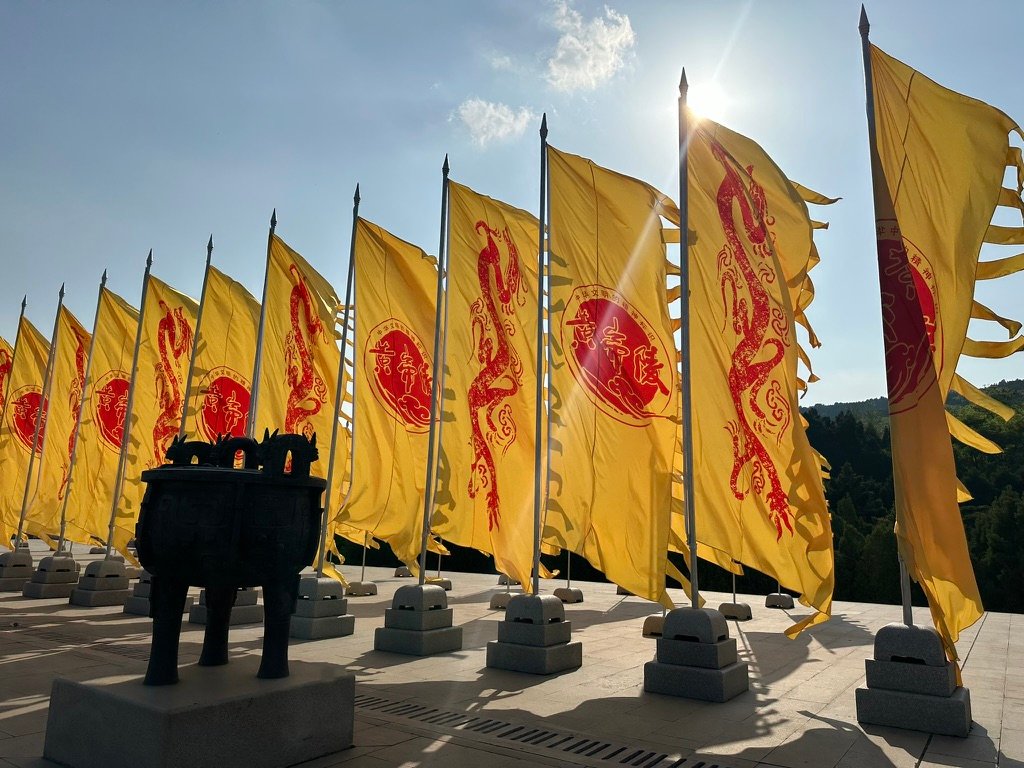
Yellow dragon banners line the water.
Willow trees shade the path.
Then ahead appears:
Xuanyuan Bridge
轩辕桥 — Xuānyuán Qiáo
leading across the lake toward the ceremonial complex associated with:
Xuanyuan Huangdi
轩辕黄帝 — Xuānyuán Huángdì.
It feels like we are approaching the burial place of someone from China’s very distant past.
Which immediately creates a problem.
😂
Because a first-time international traveler sees:
陵 — líng
mausoleum / imperial tomb
and naturally thinks:
“Okay. So the Yellow Emperor is buried here.”
Simple.
Except this is:
DEEP CHINA.
😂🐇
So Dad has to ask:
HOW DO WE KNOW?
🐇
👑 First: Meet Huangdi
黄帝 — Huángdì
Yellow Emperor
Beginner Chinese:
黄 — huáng
yellow / Huang
帝 — dì
sovereign / emperor-like ruler
You’ll also encounter:
轩辕黄帝 — Xuānyuán Huángdì
Xuanyuan Huangdi
because:
轩辕 — Xuānyuán
is a traditional name associated with Huangdi.
🔥
But here’s the first important correction:
Huangdi was NOT an:
皇帝 — huángdì
emperor
in the later Qin imperial sense.
Notice the characters:
黄帝 — Huangdi
versus:
皇帝 — huángdì.
They sound the same in modern Mandarin.
They are:
NOT the same word.
😳
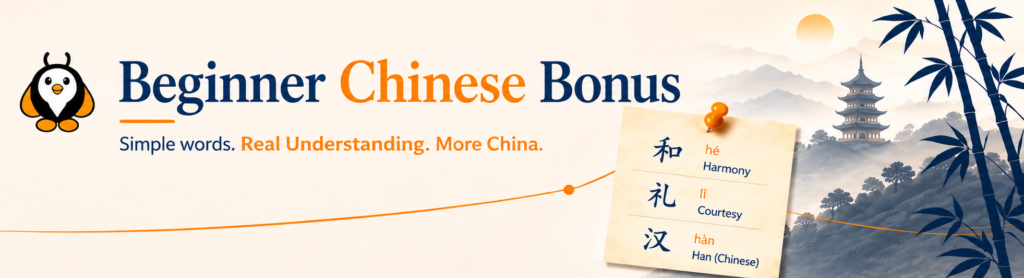
Beginner Chinese Bonus: 黄帝 ≠ 皇帝
This is too good to waste.
黄帝
Huángdì — the Yellow Emperor / Huangdi
黄 = yellow / Huang
帝 = sovereign
But:
皇帝
huángdì — emperor
皇 = august / imperial
帝 = emperor / sovereign
🔥
Qin Shi Huang adopted:
皇帝
as the new imperial title after unification in:
221 BCE.
Huangdi belongs to a much older legendary and cultural world.
Same pronunciation today.
Different first character.
Different historical concept.
HSK beginners:
circle this one.
😂
🐇 So When Did Huangdi Supposedly Live?
Traditional chronologies place Huangdi in China’s remote antiquity, usually in the:
third millennium BCE.
You’ll often encounter very precise-looking dates.
Be careful.
🔥
We don’t possess contemporary records written by Huangdi saying:
“Dear diary, today is 2697 BCE.”
😂
The major surviving written traditions about Huangdi come from:
much later periods.
So dates assigned to his reign belong to:
traditional chronology
rather than:
a securely documented reign calendar comparable with later historical emperors.
That’s our first Michelin guardrail.
📖 Then Why Do We Know So Much About Him?
Because later Chinese traditions tell us a great deal.
Huangdi became associated with stories about:
political order,
warfare,
ritual,
medicine,
calendrical knowledge,
technology
and:
the beginnings of civilized life.
🔥
Over time, more and more civilizational achievements became associated with:
Huangdi and his age.
That’s precisely why we need to distinguish:
historical memory
from:
contemporary historical evidence.
A culture hero can become larger over centuries.


🌳 Wait — Is This Tree Really 5,000 Years Old?
At the Huangdi Mausoleum stands an extraordinary ancient cypress known as:
黄帝手植柏 — Huángdì Shǒuzhí Bǎi
“The Cypress Planted by the Yellow Emperor”
The sign beside it gives its age as approximately:
5,000 years.
And according to tradition:
相传 — xiāngchuán
“it is traditionally said…”
to have been planted personally by:
Xuanyuan Huangdi (轩辕黄帝).
😳
So naturally Elaine’s first question was:
Can’t somebody just count the tree rings?
😂🌳
Unfortunately, with a living tree that may be thousands of years old, it isn’t quite that easy.
Ancient trees can become:
中空 — zhōngkōng
hollow inside
meaning some of the oldest central wood — and therefore the earliest tree rings — may no longer survive.
And drilling deeply into an exceptionally precious living tree merely to satisfy Dad’s curiosity would not be a particularly good conservation strategy.
😂
🔬 So How Are Trees This Old Dated?
China’s forestry authorities acknowledge that determining the exact age of extremely ancient living trees is technically difficult.
For the country’s oldest trees, researchers may combine different kinds of evidence, including scientific assessment with:
文献资料 — wénxiàn zīliào
historical documents
地方志 — dìfāngzhì
local gazetteers
and longstanding historical and local traditions.
So we should be careful about what the sign is telling us.
树龄约5000年
shùlíng yuē wǔqiān nián
tree age: approximately 5,000 years
is one claim.
And:
相传为轩辕黄帝亲手所植
traditionally said to have been personally planted by Xuanyuan Huangdi
is another.
The second belongs to:
TRADITION AND CULTURAL MEMORY.
It is not archaeological proof that Huangdi personally planted the tree.
😳 But This Isn’t Just ONE Very Old Tree
This was the part that surprised Dad.
According to China’s national ancient-tree survey, only:
FIVE
trees nationwide are classified as more than 5,000 years old.
And remarkably:
ALL FIVE ARE IN SHAANXI.
🔥
They include:
黄帝手植柏 — the Huangdi Cypress
保生柏 — Baosheng Cypress
老君柏 — Laojun Cypress
仓颉手植柏 — the Cangjie Cypress
and:
洛南古柏 — the Luonan Ancient Cypress.
Even more remarkably, three of the five are in Huangling County (黄陵县) — the area around Huangdi Mausoleum.
So this isn’t simply:
ONE OLD TREE BESIDE A FAMOUS TOMB.
🌲 Huangdi Mausoleum Is Surrounded by an Ancient Forest
The wider:
黄帝陵古柏群
Huángdì Líng Gǔbǎi Qún
Huangdi Mausoleum Ancient Cypress Grove
contains more than:
80,000 ancient cypresses.
And Chinese forestry authorities say more than:
30,000
are over:
1,000 years old.
😳🌲🌲🌲
The grove covers more than 3,000 mu and is described by China’s forestry authorities as the country’s largest and best-preserved artificially planted ancient-cypress forest.
So when you visit Huangdi Mausoleum:
LOOK BEYOND THE ONE FAMOUS TREE.
The forest itself is part of the story.
People came here across generations.
They commemorated.
They planted.
They protected.
And the landscape accumulated:
TREE AFTER TREE AFTER TREE.
🐇 And Shaanxi Suddenly Looks Even Older
Across Shaanxi today, forestry authorities record more than:
727,000 ancient and famous trees
including 271 ancient-tree groups. All five of China’s officially recorded 5,000+ year-old trees are found in the province.
Of course, that does NOT mean:
“Shaanxi has 727,000 trees from the time of Huangdi.”
😂
But it does tell us something interesting about the landscape we’re traveling through.
Again and again in Shaanxi, Dad & Elaine encounter places connected with China’s deepest layers of historical memory:
黄帝 — Huangdi
仓颉 — Cangjie
周原 — Zhouyuan
周 — Zhou
秦 — Qin
汉 — Han
唐 — Tang
And sometimes the historical landscape isn’t preserved only in:
ruins, tombs and museums.
Sometimes…
IT’S STILL ALIVE.
🌳🔥
That may be the most interesting way to look at the Huangdi Cypress.
Not simply:
“Did Huangdi personally plant this exact tree?”
But:
“Why have people protected trees around this place for generation after generation?”
Now we’re studying more than botany.
We’re studying:
CULTURAL MEMORY — still growing.
🐇🌳
🐇 Wait… We’ve Been Collecting Ancient Trees Without Realizing It
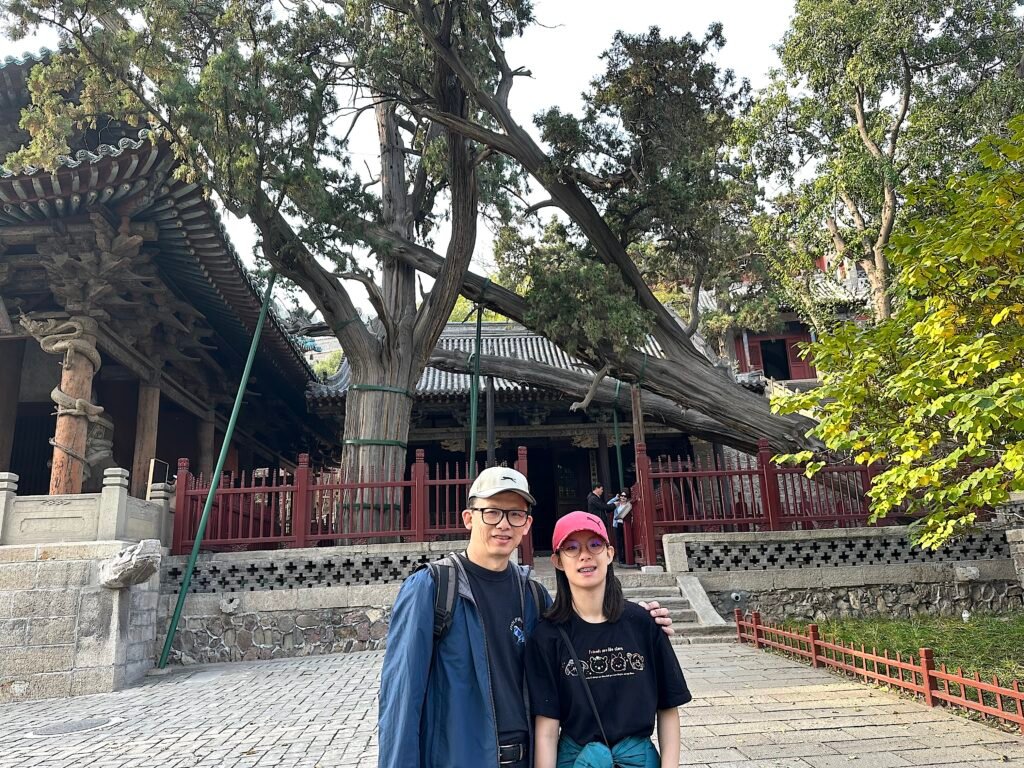
📍 Jinci 晋祠, Taiyuan 太原, Shanxi 山西 Province— Zhou Cypress 周柏, ~3,000 years
Dad only noticed this connection later.
Back in 2023, Dad & Elaine visited Jinci (晋祠, Jìncí) near Taiyuan and stood beneath the famous 周柏 (Zhōu Bǎi) — the Zhou Cypress, estimated at around 3,000 years old.
We took the photo.
Admired the tree.
And moved on.
😂

📍 Shundi Mausoleum 舜帝陵, Yuncheng 运城, Shanxi 山西 Province— ancient cypress, ~4,000 years
During our 2024 travel beyong Xi’an, another ancient-tree enounter appeared at at Shundi Mausoleum (舜帝陵, Shùndì Líng), Yuncheng (运城, Yùnchéng) in southern Shanxi, we found ancient cypresses officially labelled at approximately:
4,000 YEARS OLD
On the same journey, Huangdi Mausoleum (黄帝陵, Huángdì Líng) in Shaanxi gave us the biggest surprise as we encountered the extraordinary 黄帝手植柏 (Huángdì Shǒuzhí Bǎi), classified at approximately:
5,000 YEARS OLD.
😳
Only afterward did Dad realize what our photographs had accidentally recorded:
2023 — Jinci 晋祠 → ~3,000 years
2024 — Shundi Mausoleum 舜帝陵 → ~4,000 years
2024 — Huangdi Mausoleum 黄帝陵 → ~5,000 years
We weren’t collecting ancient trees.
The trees were quietly joining our Chinese-history journey.
😂🌳🐇
🏺 And Dad Saw This Problem Inside the Museum
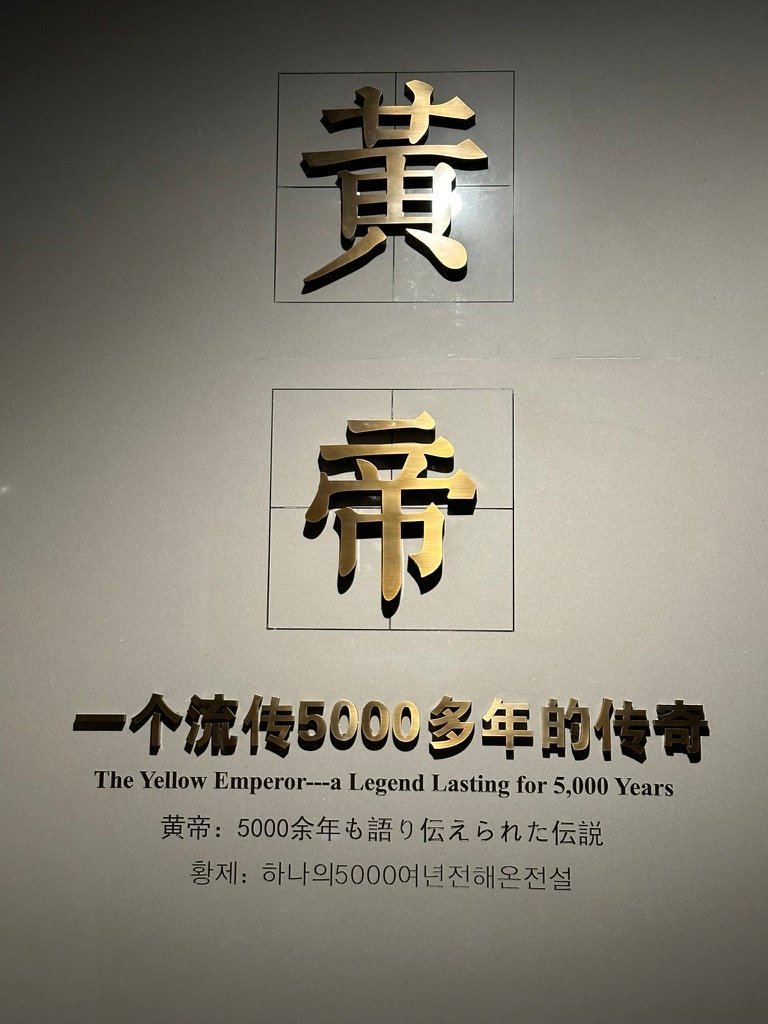
At Huangdi Mausoleum, Dad photographed an exhibition panel titled:
黄帝时代 — Huángdì Shídài
The Era of the Yellow Emperor
Beginner Chinese:
时代 — shídài
age / era
The panel connects archaeological discoveries from the Neolithic world with the age traditionally associated with Huangdi.
🔥
This is fascinating.
But Deep China needs to make an important distinction.
Archaeology can demonstrate that:
complex prehistoric societies existed.
It can uncover:
settlements (聚落, jùluò),
burials (墓葬, mùzàng),
pottery (陶器, táoqì),
social hierarchy,
craft production
and:
large-scale organization.
But that does NOT automatically mean archaeology has identified:
one particular man called Huangdi.
🌶️ Archaeology Can Find a Society. Finding a Named Ancestor Is Harder.
Remember our earlier examples:
Taosi (陶寺)
and:
Yao (尧).
Or:
Erlitou (二里头)
and:
Xia dynasty (夏朝).
Same problem.
🔥
Approximate:
time
place
complex society
doesn’t automatically equal:
proof of a particular person remembered in later texts.
So our Huangdi rule is:
考古证据 ≠ 黄帝本人被证实
Archaeological evidence ≠ Huangdi himself archaeologically proven.
That’s not disrespecting Chinese tradition.
It’s simply keeping:
different kinds of evidence
in their proper boxes.
🏔️ Then Why Is His Mausoleum HERE?
Now return outside.
Huangdi Mausoleum stands at:
Qiaoshan (桥山, Qiáoshān)
in Huangling County.
And here we have something important:
textual tradition (文献传统, wénxiàn chuántǒng).
The famous historian:
Sima Qian (司马迁, Sīmǎ Qiān)
wrote in:
Records of the Grand Historian (史记, Shǐjì)
that Huangdi died and was buried at:
Qiaoshan (桥山).
🔥
That gives the association of:
Huangdi + Qiaoshan
deep historical roots in the written tradition.
But again:
a historical text saying Huangdi was buried at Qiaoshan
is not the same thing as:
modern archaeological identification of human remains as Huangdi.
Two different claims.

🍚 Western Handrail: A Traditional Tomb Can Have Real History
This distinction matters.
A visitor may ask:
“But if you can’t prove Huangdi is physically buried there, does the site matter?”
Absolutely.
🔥
Because a traditional burial place can acquire:
centuries of remembrance,
pilgrimage,
ritual,
imperial patronage
and:
cultural meaning.
That history is:
real
even when the archaeological identity of the original burial remains uncertain.
And at Huangdi Mausoleum…
that later history becomes enormous.
🎥 This Is More Than a Tomb
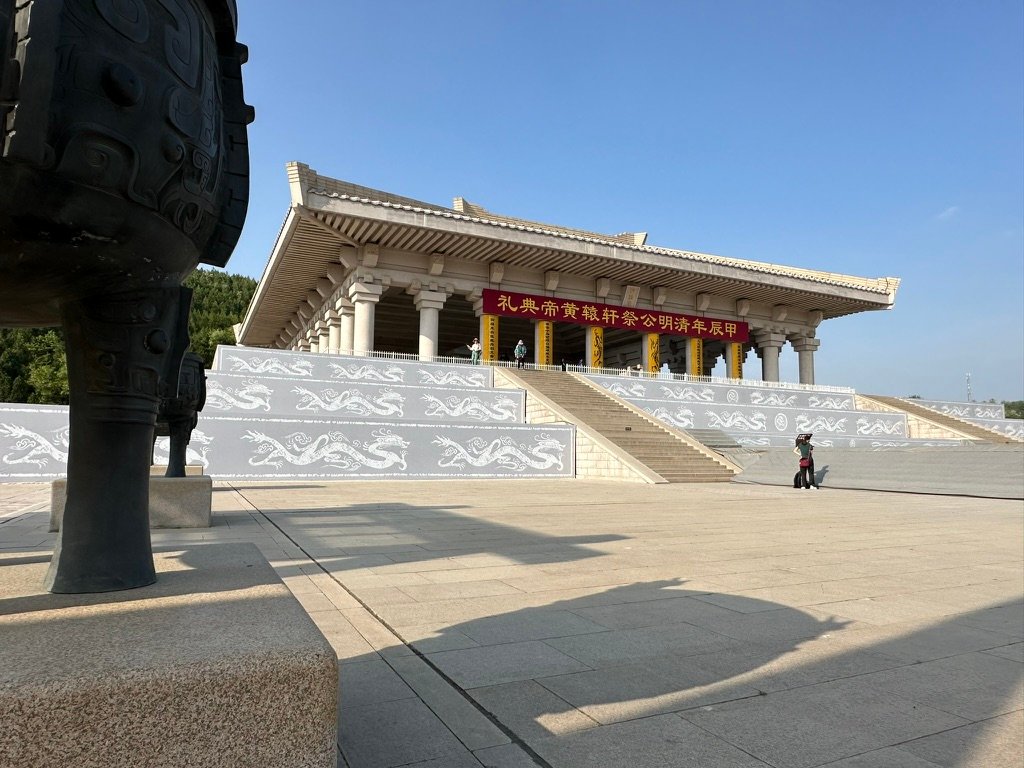
Dad & Elaine had now reached the great ceremonial space of the Huangdi Mausoleum complex.
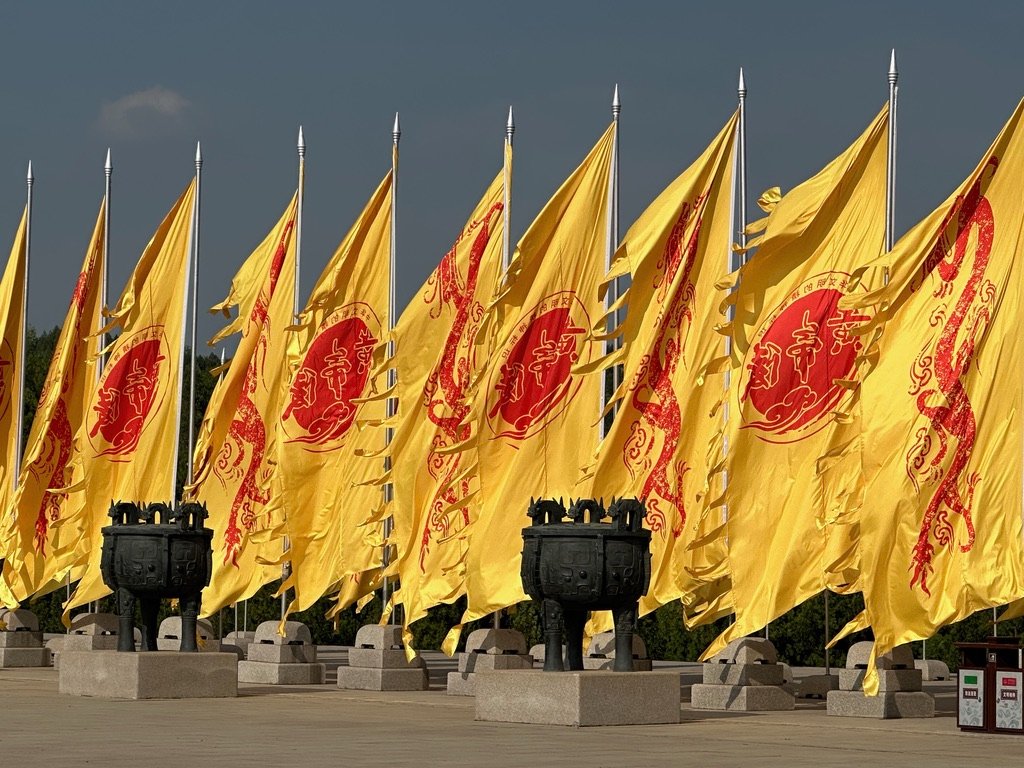
Yellow banners line the plaza.
Bronze incense vessels stand before the ceremonial area.
And ahead rises:
Xuanyuan Hall
轩辕殿 — Xuānyuán Diàn
named for Xuanyuan (轩辕), the traditional personal name associated with Huangdi.
Elaine walks across the enormous ceremonial square toward the hall.
And suddenly Dad’s question changes.
This isn’t only:
“Is Huangdi really buried here?”
There is another question:
WHY HAVE GENERATIONS OF CHINESE PEOPLE COME HERE TO REMEMBER HIM?
🔥
That’s the more interesting reason this place matters.
🌲 Look at the Trees
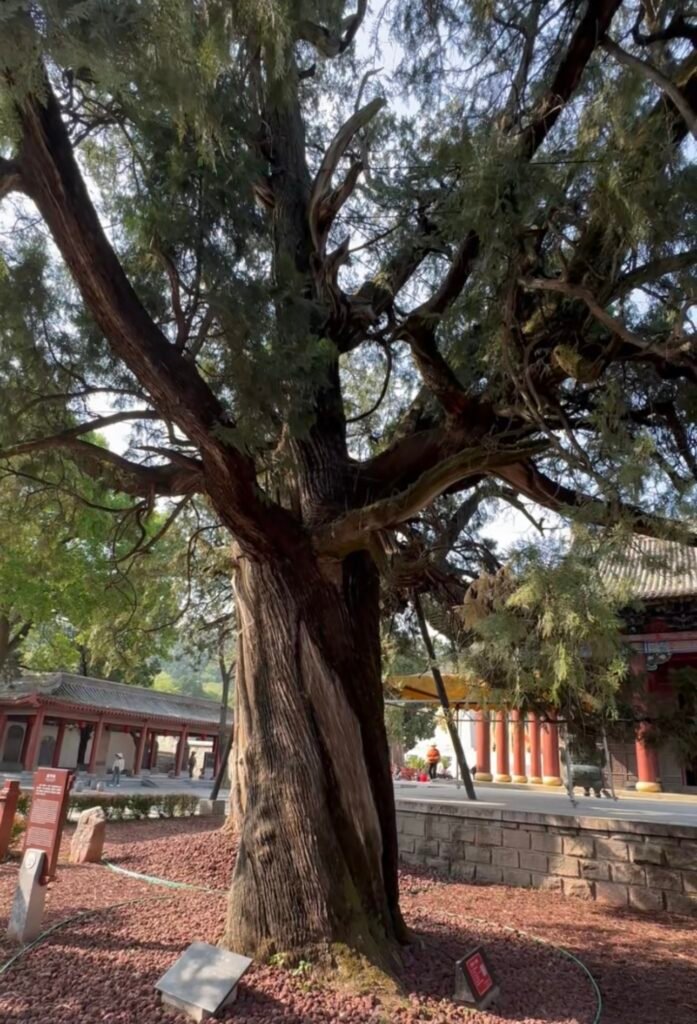
One of the things you’ll notice around:
Xuanyuan Temple (轩辕庙, Xuānyuán Miào)
is the presence of ancient:
cypress trees (柏树, bǎishù).
Beginner Chinese:
柏 — bǎi
cypress
树 — shù
tree
Among the trees Dad photographed is:
挂甲柏 — Guàjiǎ Bǎi.
Break it down:
挂 — guà
hang
甲 — jiǎ
armor
柏 — bǎi
cypress
So:
挂甲柏
“Armor-Hanging Cypress”
🔥
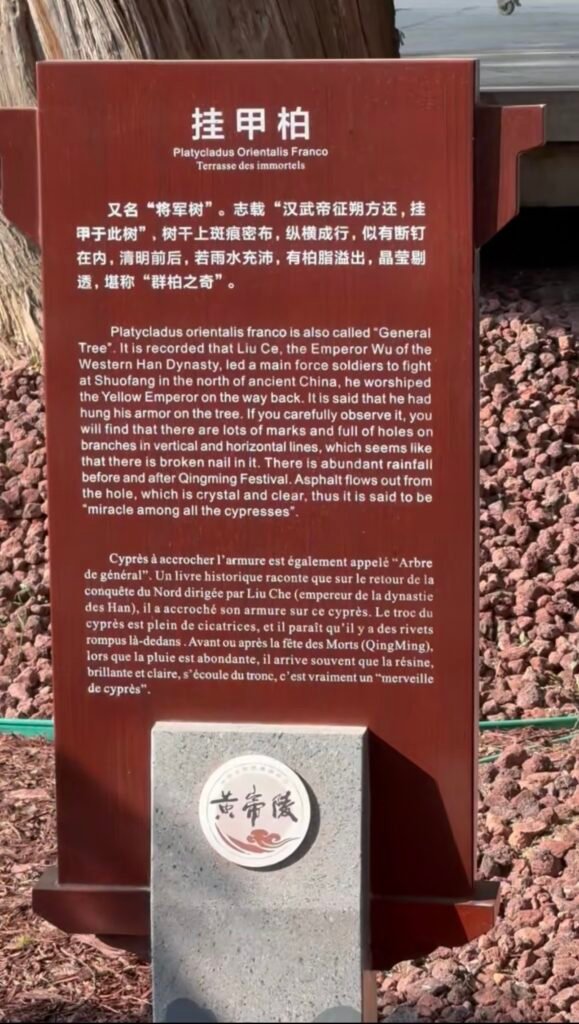
The site associates the tree with a traditional story involving:
Emperor Wu of Han (汉武帝, Hàn Wǔdì)
hanging armor there after a northern campaign.
Do we need to declare:
“Han Wudi definitely hung his armor on this exact branch”?
😂
No.
Treat it as:
site tradition (地方传说 / 遗址传统).
But the story itself tells us something important.
Generations kept attaching:
memory
to this place.
🏛️ Then Walk Into Xuanyuan Temple 轩辕庙
The site isn’t simply:
a burial mound.
There is also:
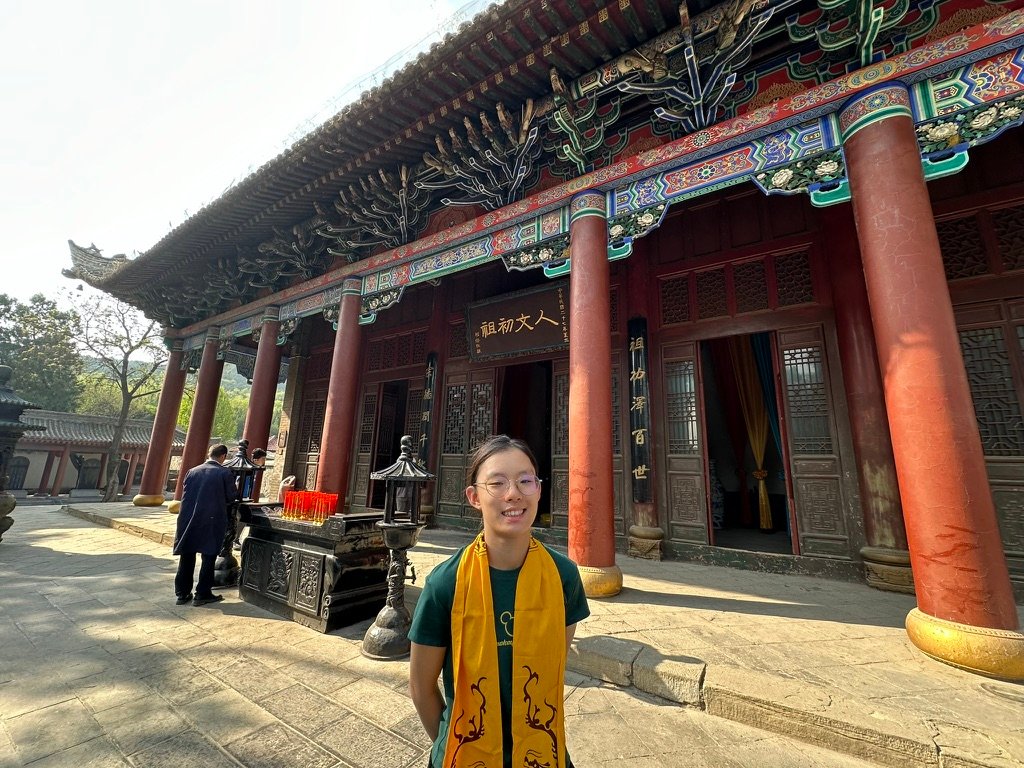
Xuanyuan Temple (轩辕庙, Xuānyuán Miào).
Beginner Chinese:
庙 — miào
temple / shrine
This is a place of:
commemoration (纪念, jìniàn)
and:
ritual (祭祀, jìsì).
🔥
And now our question begins changing.
We arrived asking:
“Is Huangdi really buried here?”
But the site starts asking us something else:
“Why have people continued coming here to honor him?”
That may ultimately be the more interesting question.
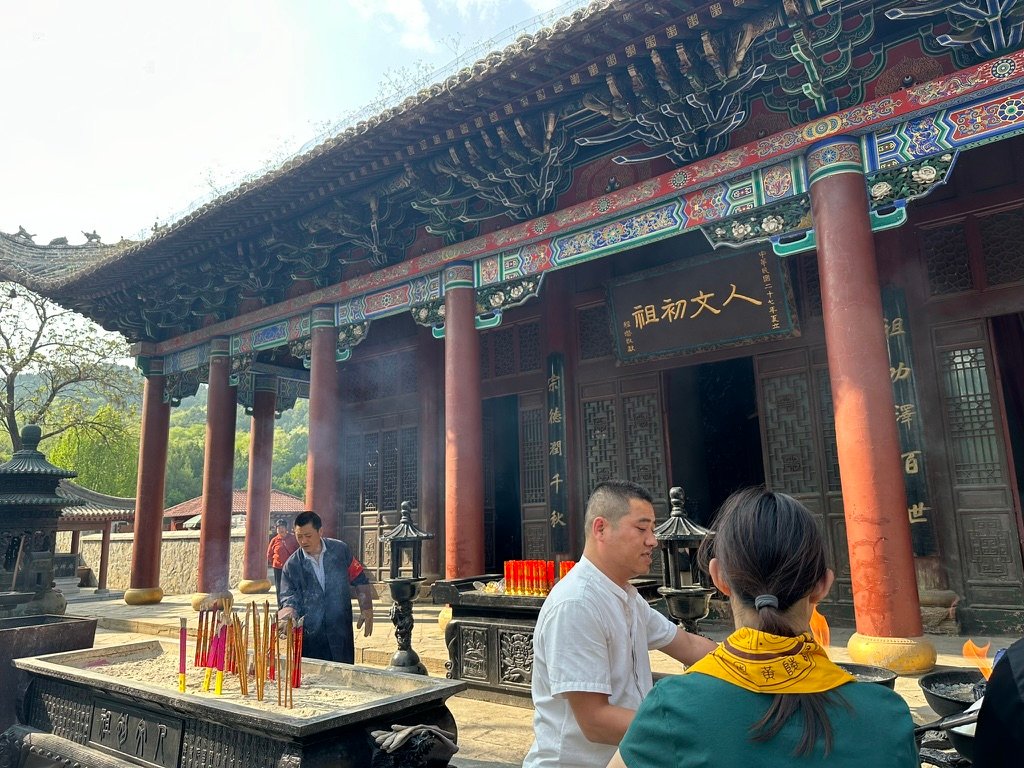
📸 Then Dad Found the Word That Unlocks the Article
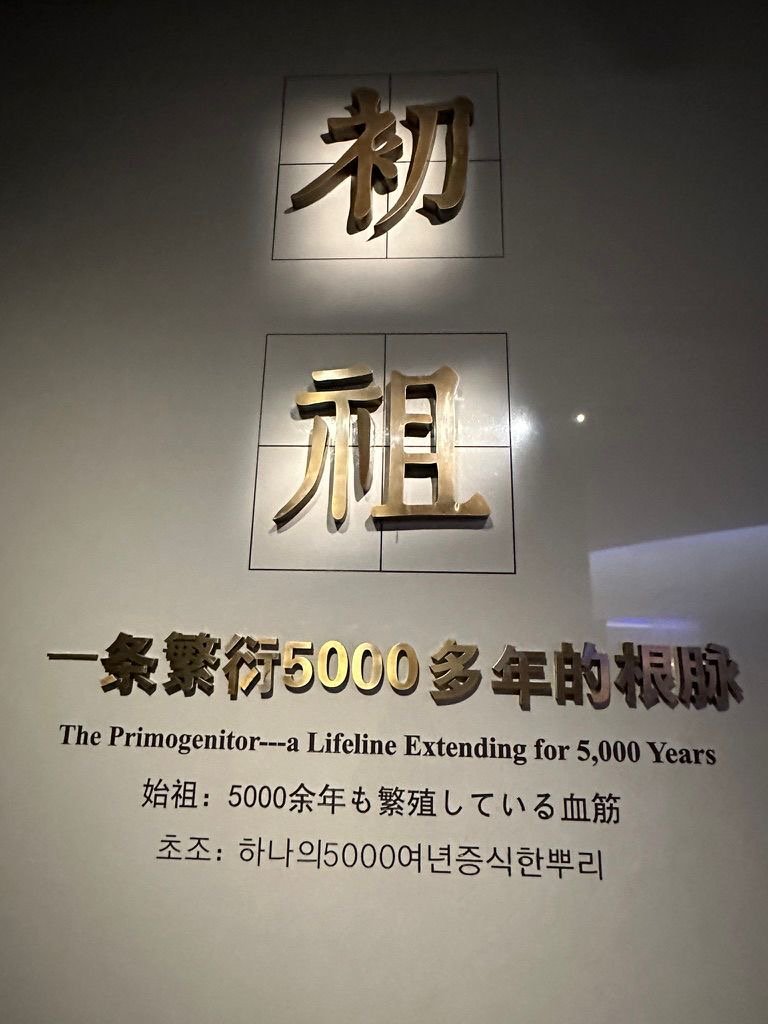
Inside the exhibition appears:
初祖 — Chūzǔ.
Beginner Chinese:
初 — chū
beginning / first
祖 — zǔ
ancestor
Together:
初祖
primordial / founding ancestor
🔥🔥🔥
There.
That’s the real story.
Huangdi‘s historical importance isn’t limited to:
“Was there once exactly one man matching every later story?”
Over centuries Huangdi became remembered as:
a foundational ancestor of Chinese civilization.
That is a different historical phenomenon.
And one we can actually investigate.
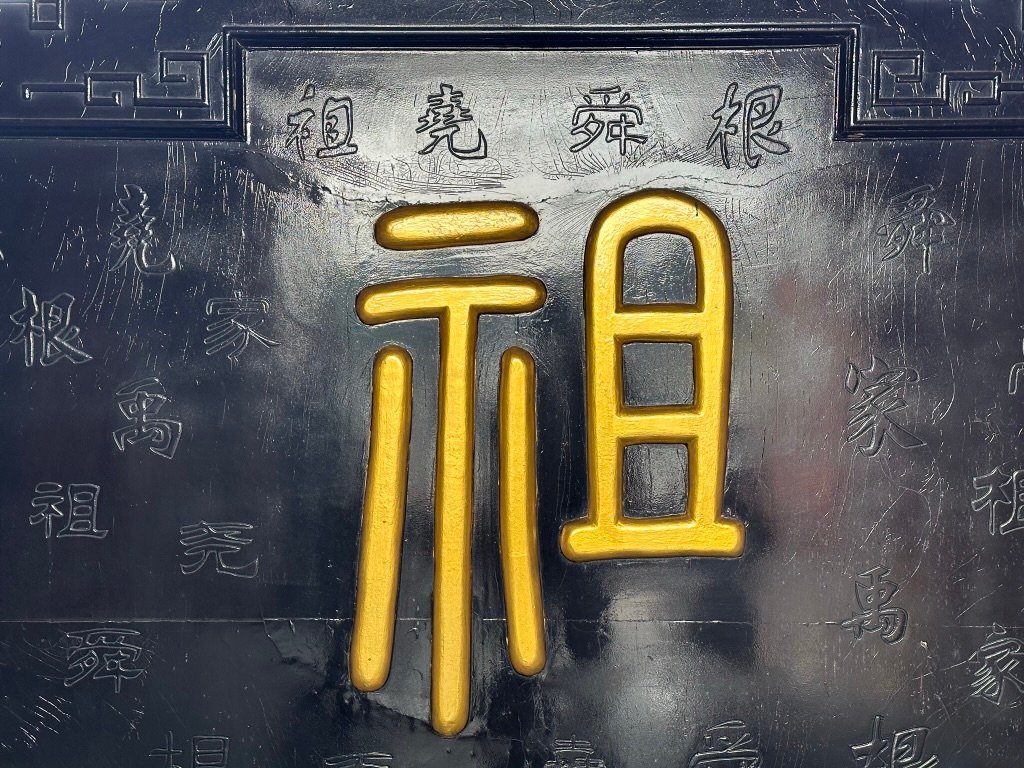
📍 Yao Temple 尧庙 in Linfen 临汾, Shanxi 山西 Province
The character 祖 (zǔ, “ancestor”) at the Yao Temple (尧庙, Yáo Miào) in Linfen, Shanxi. Emperor Yao (尧) belongs to China’s legendary age of sage rulers, alongside the Yellow Emperor (黄帝, Huángdì). Neither should be treated as a securely documented historical individual, but both became powerful ancestral figures in later Chinese ideas about the origins of civilization and cultural identity. Photo by ChinaTravelBUG Dad.
One Character You Will Keep Seeing: 祖
Learn:
祖 — zǔ
ancestor
Then:
祖先 — zǔxiān
ancestors
始祖 — shǐzǔ
founding / earliest ancestor
祭祖 — jìzǔ
honor / make ritual offerings to ancestors
🔥
Suddenly the language starts helping you understand the site.
This is exactly why Deep China uses Chinese words.
The vocabulary isn’t decoration.
It carries the idea.
🐇 And Then We Reach 炎黄子孙
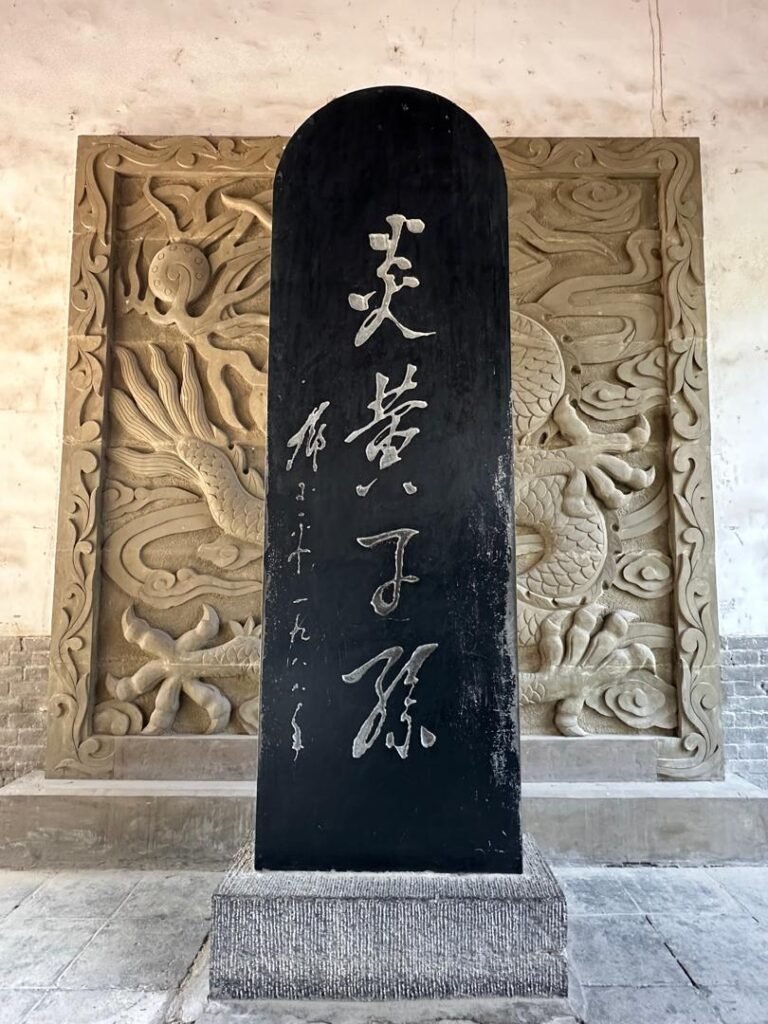
Another phrase Dad photographed:
炎黄子孙 — Yán-Huáng Zǐsūn.
Break it down:
炎 — Yán
Yan, referring to the Yan Emperor (炎帝)
黄 — Huáng
Huang, referring to Huangdi (黄帝)
子孙 — zǐsūn
descendants
So:
炎黄子孙
“Descendants of Yan and Huang”
🔥
Now Huangdi has moved far beyond:
one ancient ruler.
He has become part of a language of:
shared cultural ancestry.
🌶️ But Don’t Turn Cultural Ancestry Into DNA
Another important guardrail.
Calling people:
炎黄子孙
does NOT mean historians or geneticists have demonstrated that:
every Chinese person literally descends biologically from two identifiable men called Yan and Huang.
😂
That’s not what we need the phrase to mean.
It works as:
cultural-historical language
expressing:
shared ancestry,
civilizational belonging
and:
historical memory.
🔥
Think:
symbolic ancestry
rather than:
DNA test.
Much better.

🐞 That’s the First Sting
You arrived at:
Huangdi Mausoleum (黄帝陵)
asking:
“Is Huangdi really buried here?”
Fair question.
But then:
Huangdi (黄帝)
↓
Xuanyuan (轩辕)
↓
Qiaoshan (桥山)
↓
Sima Qian (司马迁)
↓
Xuanyuan Temple (轩辕庙)
↓
ancient cypresses (古柏)
↓
ritual (祭祀)
↓
初祖
↓
炎黄子孙.
😬
And now a much more interesting question has appeared:
How did a figure from China’s remote antiquity become a founding ancestor remembered across thousands of years of later Chinese history?
🔥🔥🔥
That’s where Section 2 goes.
Because Dad found something at Huangdi Mausoleum that makes the question even spicier:
a Qing imperial sacrificial stele.
🐇
A:
Manchu Qing emperor
participating in honoring:
Huangdi.
😳
Wait.
If Huangdi is the ancestral figure of:
炎黄子孙…
what exactly is a:
Manchu emperor
doing here?
🌶️🌶️🌶️🌶️🌶️
Now the Huangdi rabbit hole has collided with:
Who Is “Chinese”?
Time to turn up the fire.
Section 2 — When Emperors Came to Honor an Ancestor: Huangdi Becomes Bigger Than One Man
At the end of Section 1, our question had changed.
We arrived at:
Huangdi Mausoleum (黄帝陵, Huángdì Líng)
asking:
“Is Huangdi really buried here?”
But the site gave us two much more interesting Chinese expressions:
初祖 — chūzǔ
founding / primordial ancestor
and:
炎黄子孙 — Yán-Huáng Zǐsūn
descendants of Yan and Huang
🔥
Now Huangdi is no longer merely:
a mysterious ruler from remote antiquity.
He has become:
an ancestor remembered by later generations.
And once that happens, something extraordinary becomes possible.
Kings change.
Dynasties change.
Peoples change.
China divides.
China reunifies.
Yet later rulers continue returning to:
Huangdi (黄帝).
🐇
Dad found that story:
carved in stone.
🪨 Look Carefully at This Stele
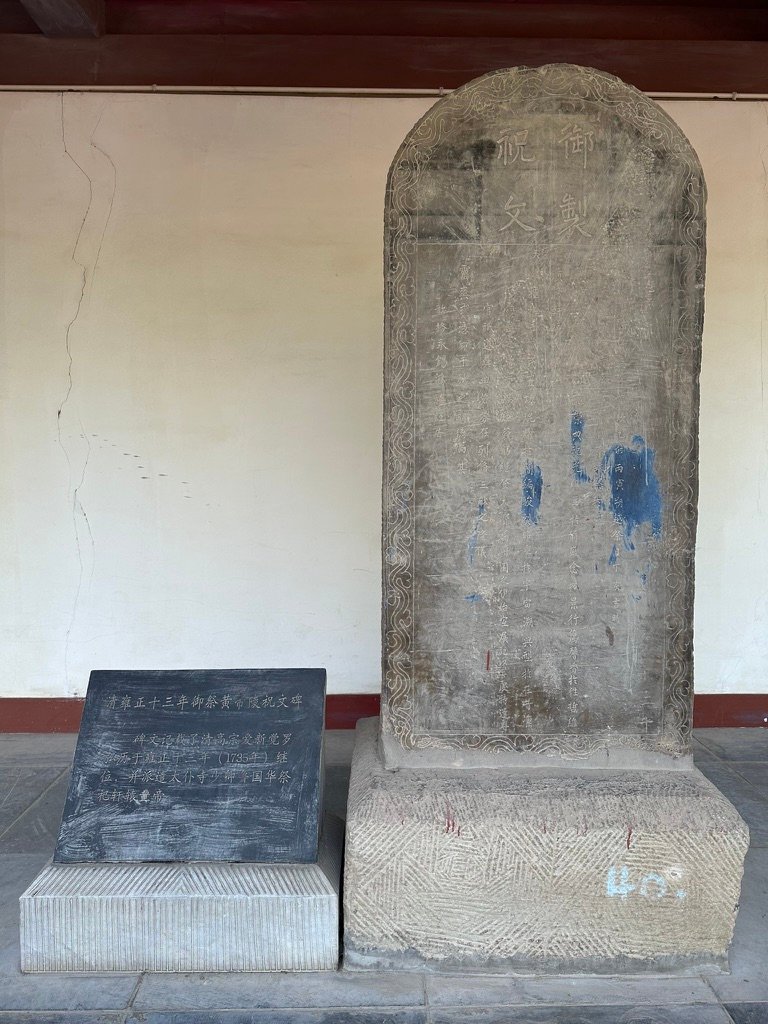
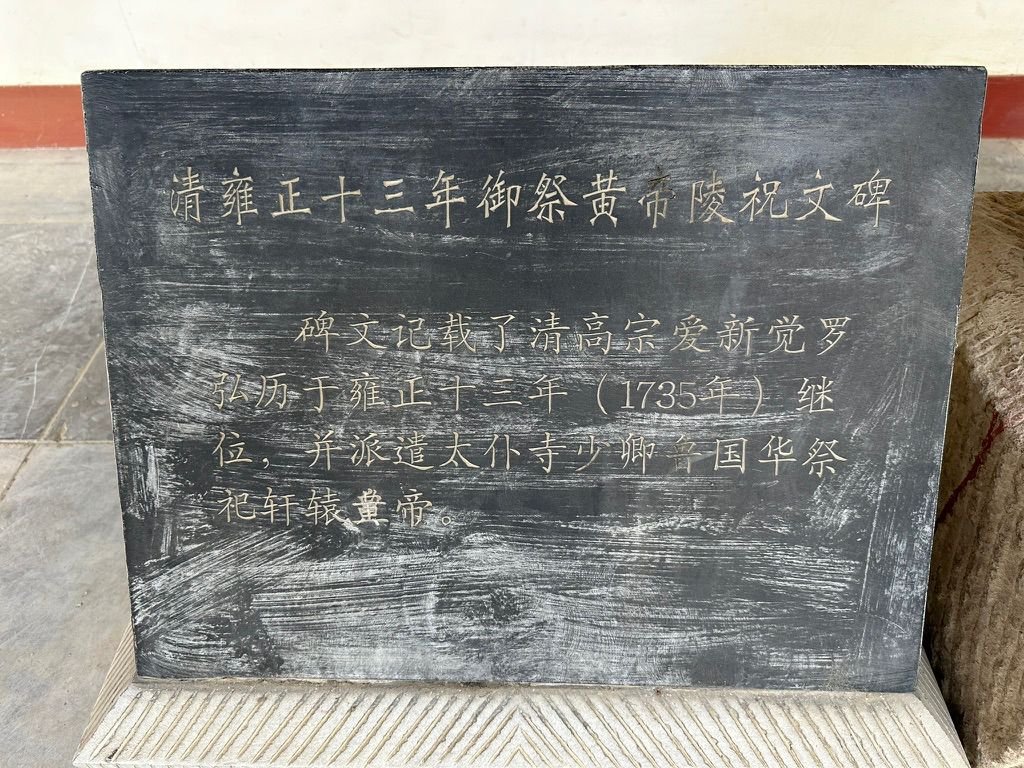
Stele of the Imperial Sacrificial Prayer at the Mausoleum of the Yellow Emperor, 13th year of the Yongzheng reign (1735), Qing dynasty.
The explanatory panel identifies it as:
清雍正十三年御祭黄帝陵祝文碑
Qīng Yōngzhèng Shísān Nián Yùjì Huángdì Líng Zhùwén Bēi
That’s quite a mouthful.
😂
Let’s make it useful Chinese.
清 — Qīng
Qing dynasty
雍正 — Yōngzhèng
Yongzheng reign
十三年 — shísān nián
thirteenth year
御祭 — yùjì
imperial sacrifice / sacrifice conducted under imperial authority
黄帝陵 — Huángdì Líng
Huangdi Mausoleum
祝文 — zhùwén
ritual / sacrificial text
碑 — bēi
stele / inscribed stone
🔥
Suddenly an intimidating museum label becomes readable.
And what it records is even more interesting.
👑 1735: A New Emperor Takes the Throne
According to the plaque Dad photographed, in:
1735
—the thirteenth year of the:
Yongzheng reign (雍正十三年)—
the emperor died and his son:
Aisin Gioro Hongli (爱新觉罗·弘历, Àixīnjuéluó Hónglì)
succeeded to the throne.
You probably know Hongli by another name:
Qianlong Emperor (乾隆帝, Qiánlóng Dì).
🔥
And the plaque records that an imperial official was dispatched to conduct sacrifice at:
Huangdi Mausoleum (黄帝陵).
Stop there.
Because Michelin after-dinner Conversation 2 has just walked back into the kitchen.
😂
🌶️ Wait. A MANCHU Emperor Is Honoring Huangdi?
Remember who established the:
Qing dynasty (清朝, Qīng Cháo).
Manchus (满洲人, Mǎnzhōurén).
And the Qing imperial house was:
Aisin Gioro (爱新觉罗, Àixīnjuéluó).
Yet here we have a Qing imperial ritual connected with:
Huangdi (黄帝)
— the figure later remembered as a foundational ancestor within Chinese civilizational tradition.
😳
Now ask:
Why would a Manchu ruling house honor Huangdi?
That is a much more interesting question than:
“Was Huangdi’s birthday really on this date?”
🔥🔥🔥
🍚 Western Handrail: Conquest Is Not the End of the Story
Imagine a ruling house conquers an older political and cultural world.
At first, you might describe them simply as:
conquerors.
But if they intend to rule for generations, they face another problem:
LEGITIMACY.
Beginner Chinese:
正统 — zhèngtǒng
legitimate / orthodox succession in a dynastic-political context
合法性 — héfǎxìng
legitimacy in a broader modern sense
🔥
A successful dynasty needs more than:
an army.
It needs ways to explain:
Why should WE rule?
How do WE fit into the political order we inherited?
What traditions do WE now uphold?
Ritual can help answer those questions.
🐇 Remember the Mandate of Heaven?
Our Big Questions dish introduced:
Mandate of Heaven (天命, Tiānmìng).
Dynasties rise.
Dynasties fall.
A new ruling house can claim:
legitimate rule.
🔥
Now add:
ritual (礼, lǐ)
and:
sacrifice (祭祀, jìsì).
A new dynasty doesn’t necessarily throw away every tradition associated with previous rulers.
It can:
inherit
adapt
and:
participate in
older political and ritual traditions.
That’s exactly why the Huangdi stele is so interesting.
🌶️ The Qing Did NOT Simply Become “Han”
Important.
Don’t turn this into:
“The Manchus conquered China, then became Han Chinese.”
Too simple.
😂
Qing rulers maintained important:
Manchu identity (满洲认同, Mǎnzhōu rèntóng),
Manchu language (满语, Mǎnyǔ),
Eight Banners (八旗, Bāqí)
and:
Manchu political traditions.
At the same time, Qing emperors ruled within institutions and ritual traditions inherited from earlier Chinese imperial history.
🔥
So the better model is:
NOT REPLACEMENT.
It’s:
LAYERING.
🐇 One Emperor Can Operate in Several Worlds
Remember what we learned about Qing rulers.
A Qing emperor could participate in:
Confucian imperial ritual
while also maintaining:
Manchu institutions
and interacting with:
Mongol political traditions
and:
Tibetan Buddhist traditions.
🔥
One emperor.
Several political languages.
Several historical traditions.
That’s why:
“Was the Qing Chinese or Manchu?”
is often too crude a question.
It was:
a Manchu-founded dynasty
and:
part of Chinese imperial history
and:
a large multiethnic empire.
These descriptions can coexist.
🪨 And the Huangdi Stele Makes That Visible
This is what Dad loves about traveling to the actual place.
😂
A history book can tell you:
“Qing emperors participated in Chinese imperial ritual traditions.”
Okay.
Then Dad stands at:
Huangdi Mausoleum
and sees:
清
雍正
御祭
黄帝陵
on an actual historical stele.
😳
Suddenly the abstract argument becomes:
STONE.
🔥
That’s why Deep China keeps sending us to places.
The “General Tree” (挂甲柏, Guàjiǎ Bǎi) at the Mausoleum of the Yellow Emperor (黄帝陵). Photo by Dad.
🌲 And the Trees Tell the Same Story Differently
Remember:
挂甲柏 (Guàjiǎ Bǎi)
the “Armor-Hanging Cypress.”
The site associates it with a tradition involving:
Emperor Wu of Han (汉武帝, Hàn Wǔdì).
Now compare:
HAN
↓
Huangdi remembrance
↓
centuries pass
↓
QING
↓
imperial sacrifice to Huangdi
↓
centuries pass
↓
TODAY
↓
public ceremonies continue.
🔥
Whether every individual site tradition can be archaeologically verified is a separate question.
The important historical pattern is:
Huangdi keeps being remembered.
Dynasties disappear.
The ancestor survives.
🕯️ This Is Where 祭祀 Matters
Useful Chinese:
祭 — jì
sacrifice / ritual offering
祀 — sì
sacrifice / worship in ritual context
Together:
祭祀 — jìsì
ritual sacrifice / ceremonial offering
And:
祭祖 — jìzǔ
honor / make ritual offerings to ancestors
🔥
This helps us understand why calling Huangdi:
祖 — ancestor
matters.
An ancestor isn’t simply:
someone in the past.
An ancestor can become someone:
remembered through ritual.

🐇 1912: A New Republic Looks Back 5,000 Years
Dad photographed this inscription at Huangdi Mausoleum, attributed to Sun Yat-sen (孙中山, Sūn Zhōngshān; signed 孙文, Sūn Wén) and dated 民国元年春 — “Spring of the First Year of the Republic,” or 1912.
Look at the opening words:
中华开国五千年
Zhōnghuá kāiguó wǔqiān nián
“China’s founding stretches back five thousand years.”
Then:
神州轩辕自古传
Shénzhōu Xuānyuán zìgǔ chuán
roughly: “Throughout the Chinese realm, Xuanyuan has been remembered since ancient times.”
轩辕 (Xuānyuán) refers to Xuanyuan Huangdi (轩辕黄帝) — the Yellow Emperor.
The inscription then invokes traditional achievements associated with Huangdi:
创造指南车
chuàngzào zhǐnán chē
“created the south-pointing chariot”
and:
平定蚩尤乱
píngdìng Chīyóu luàn
“put down the disorder of Chiyou.”
These belong to the traditional Huangdi narrative, rather than claims we should treat as archaeologically demonstrated biography.
But for international travelers, perhaps the most interesting thing is the date:
1912.
China had just undergone the 1911 Revolution, the Qing dynasty had fallen, and a republic was being created.
Yet at this moment of enormous political change, the inscription attributed to one of the central figures of China’s republican revolution reaches not only forward toward a modern China—
but thousands of years backward toward:
黄帝 — Huangdi.
🔥
That gives us a wonderful Deep China question:
Why would people creating a new, modern republic still reach back to an ancient founding ancestor?
Keep that question in mind.
Because 25 years later, in 1937, another famous figure appears at Huangdi Mausoleum.
And this time his name is:
Mao Zedong 毛泽东.
🐇🔥
Photo by Dad.

🐇 Wait… Why Were Nationalists AND Communists Honoring Huangdi in 1937?
Dad stopped at this enormous stone inscription at Huangdi Mausoleum.
At first glance, it looks like another historical stele.
Then we read the information board.
The text is:
《祭黄帝陵文》
Jì Huángdì Líng Wén
An Address for the Ceremony at Huangdi Mausoleum
It was drafted by Mao Zedong (毛泽东), issued in the names of Mao and Zhu De (朱德), and read here by Communist representative Lin Boqu (林伯渠).
The date?
April 5, 1937.
And that date matters enormously.
It was:
清明节 — Qīngmíng Jié
Qingming Festival
Traditionally, Qingming is when Chinese families remember their ancestors, visit graves and pay their respects to those who came before them.
But this wasn’t simply one family remembering its ancestors.
Something much bigger was happening.
👴 First, Understand One Chinese Idea: 始祖
Huangdi was being commemorated as:
中华民族始祖
Zhōnghuá mínzú shǐzǔ
a founding ancestor of the Chinese nation
The important word is:
始祖 — shǐzǔ
始 (shǐ) = beginning
祖 (zǔ) = ancestor
So think:
FOUNDING ANCESTOR.
Huangdi wasn’t important here merely because he was regarded as an extremely ancient ruler.
He represented something more powerful:
a shared origin story.
Different families could have different ancestors.
Different provinces could have different histories.
Different political parties could have radically different ideas about China’s future.
But Huangdi could symbolically stand much further back:
before those divisions.
And in 1937, that mattered.
A lot.
China Had a Very Serious Problem
The Nationalists (国民党, Guómíndǎng) and Communists (共产党, Gòngchǎndǎng) had spent years fighting each other.
This wasn’t a polite parliamentary disagreement.
China had experienced violent political conflict and civil war.
But meanwhile, Japanese expansion was creating an increasingly grave external threat.
The Xi’an Incident (西安事变) in December 1936 had helped push the Nationalists and Communists toward cooperation against Japan.
Then, only a few months later, came Qingming 1937.
Representatives of the rival political camps gathered at:
黄帝陵 — Huangdi Mausoleum.
The symbolism is difficult to miss.
At a place associated with the founding ancestor, on a day associated with remembering ancestors, political rivals were being asked to think about something larger than their rivalry:
the survival of the country.
🔥
📜 Now Read Mao’s Words
The address opens:
赫赫始祖,吾华肇造
Hèhè shǐzǔ, wú Huá zhàozào
A useful sense for an international reader is:
Illustrious founding ancestor, from whom our Chinese civilization traces its beginnings.
Again:
始祖 — founding ancestor.
The message begins with ancient origins.
But then it moves very quickly into the crisis of 1937.
One particularly revealing phrase is:
各党各界,团结坚固
gè dǎng gè jiè, tuánjié jiāngù
Roughly:
All parties and all sectors — unite firmly.
Look carefully at:
各党 — ALL PARTIES.
Not:
Communists unite.
Not:
Nationalists unite.
But:
ALL PARTIES.
Then:
民族阵线,救国良方
mínzú zhènxiàn, jiùguó liángfāng
roughly:
A national united front is the way to save the country.
And:
四万万众,坚决抵抗
sì wànwàn zhòng, jiānjué dǐkàng
In the numerical language of the period, 四万万 refers to roughly 400 million people.
The sense is:
Four hundred million people — resolutely resist.
Then comes another powerful line:
亿兆一心,战则必胜
roughly:
With the people united as one, victory in war will follow.
This is no longer simply an ancient-ancestor ceremony.
It has become a message about:
UNITY
RESISTANCE
and ultimately:
NATIONAL SURVIVAL.
🪜 Dad’s Western Handrail: Think Gettysburg — But Don’t Push It Too Far
International readers might find a useful handrail in Abraham Lincoln’s Gettysburg Address.
The historical situations were very different.
But there is a recognizable political instinct.
In 1863, during the American Civil War, Lincoln famously began by reaching backward:
“Four score and seven years ago…”
Why begin there?
Because in the middle of a terrible national crisis, Lincoln reached toward America’s founding story to explain what was at stake in the present.
China in 1937 reached much further back.
Not 87 years.
But thousands of years toward:
黄帝 — HUANGDI.
The handrail is therefore:
Gettysburg:
→ remember the nation’s founding and founding ideals
Huangdi Mausoleum, 1937:
→ remember the nation’s symbolic founding ancestor and common origins
Different histories.
Different political traditions.
Same fascinating question:
When the present threatens to tear people apart, what story from the past is big enough to remind them that they still belong together?
🔥
At Huangdi Mausoleum, one answer was:
始祖 — THE FOUNDING ANCESTOR.
🧹 And Then History Got Even Worse
Only about three months later:
July 7, 1937
came the:
卢沟桥事变
Lúgōuqiáo Shìbiàn
Marco Polo Bridge Incident
The fighting around Lugou Bridge (卢沟桥) near Beijing escalated into the full-scale Sino-Japanese War.
And at this point Elaine interrupted Dad:
“Wait. What has Marco Polo got to do with this?”
😂😂😂
Excellent question.
Basically nothing.
The bridge’s Chinese name is:
卢沟桥 — Lúgōu Qiáo.
Westerners commonly call it the Marco Polo Bridge because Marco Polo famously praised an impressive bridge near the Yuan capital in his travel account, and the name became attached to Lugou Bridge in Western usage.
Marco Polo did not, obviously, turn up in 1937 and start the incident.
😂
For Chinese travelers, this is:
七七事变 — Qīqī Shìbiàn
“July 7 Incident”
or:
卢沟桥事变 — Lúgōuqiáo Shìbiàn
“Lugou Bridge Incident.”
For many Western history books:
Marco Polo Bridge Incident.
Same event.
No Italian traveler involved.
😂
🔥 Now Go Back to the Words on the Stone
Remember:
各党各界,团结坚固
All parties and sectors — unite firmly.
When those words were read at Huangdi Mausoleum on April 5, 1937, the full-scale war that followed the July incident had not yet begun.
Three months later, the urgency behind them became dramatically clearer.
Nationalists and Communists still had enormous political differences.
Their conflict did not magically disappear.
But there was now an even bigger question:
If the country cannot survive, what exactly are we fighting each other to control?
That is why this 1937 Huangdi ceremony is so revealing.
🐇 And Remember What Dad Found Just Before This…
Only a short walk away, another inscription had already taken us to:
1912.
There we found:
Sun Yat-sen (孙中山)
invoking Huangdi around the birth of the Republic.
Now:
1937
and:
Mao Zedong (毛泽东)
also reaches backward toward Huangdi during a national crisis.
Put them together:
黄帝 — Huangdi
ancient founding-ancestor tradition
↓
1912 — Sun Yat-sen
building a new Republic
↓
1937 — Mao Zedong / Zhu De
unity and resistance amid national crisis
😳
Very different political actors.
Very different moments.
But both could reach toward:
黄帝.
🐞 The Bigger Deep China Question
Perhaps we started with the wrong question.
We originally wanted to know:
Was Huangdi one historical person exactly as later traditions describe him?
That’s still an interesting historical question.
But standing among these stones gives us another:
Why did modern Chinese leaders keep returning to Huangdi?
And perhaps part of the answer lies in those two characters:
始祖.
Founding ancestor.
A figure imagined as standing before:
dynasties,
political parties,
republics,
civil wars
and:
modern ideological divisions.
Someone who could represent:
“Before all these disagreements, there was an us.”
And notice the date again:
清明 — Qingming.
A day when families remember their ancestors.
Here at Huangdi Mausoleum, the idea scales upward:
family remembers ancestor
↓
lineage remembers ancestor
↓
nation remembers founding ancestor.
🐇
And that leads us toward yet another question:
Does China still commemorate Huangdi at Qingming today?
Oh yes.
🔥
We’ll come back to that annual ritual later.
🐇 And That Ritual Is Still Alive
Huangdi Mausoleum isn’t merely:
“an ancient site where people USED to perform ceremonies.”
Major commemorative ceremonies continue today.
One of the most important is held around:
Qingming Festival (清明节, Qīngmíng Jié).
The ceremony is commonly described as:
清明公祭轩辕黄帝
Qīngmíng Gōngjì Xuānyuán Huángdì
Break it down:
清明 — Qīngmíng
Qingming
公祭 — gōngjì
public ceremonial commemoration / public sacrifice
轩辕黄帝
Xuanyuan Huangdi
🔥
So thousands of years after the age traditionally associated with Huangdi:
the ritual memory continues.
That is historically important whether or not archaeology can identify Huangdi‘s bones.
🎂 But What About Huangdi’s “Birthday”?
You’ll also encounter traditions associated with:
三月初三 — sānyuè chūsān
third day of the third lunar month
and the saying:
三月三,拜轩辕
Sānyuè sān, bài Xuānyuán
“On the third day of the third month, pay respects to Xuanyuan.”
🔥
This is sometimes described in popular language as Huangdi‘s:
birthday (诞辰, dànchén).
But keep our Michelin guardrail.
This is:
traditional commemorative dating.
It isn’t:
a historically documented birth date from the third millennium BCE.
😂
No Huangdi birth certificate has survived.
📍 And Don’t Mix Up the Ceremonies
This distinction is useful for travelers.
The major:
Qingming public ceremony
takes place at:
Huangdi Mausoleum (黄帝陵)
in:
Huangling County, Shaanxi.
Meanwhile, prominent ceremonies connected with:
三月三
and Huangdi‘s traditional birthday/birthplace are particularly associated with:
Xinzheng (新郑, Xīnzhèng)
in:
Henan (河南, Hénán).
🔥
Different place.
Different commemorative tradition.
Same Huangdi cultural universe.
Don’t merge them into one event.
🐇 And Look Who Comes to Huangling
Modern Huangdi commemorations often emphasize connections among Chinese communities from:
mainland China (中国大陆),
Hong Kong (香港),
Macao (澳门),
Taiwan (台湾)
and:
overseas Chinese communities (海外华人, hǎiwài Huárén).
🔥
Now:
炎黄子孙
starts making sense.
Huangdi functions as:
a symbol of shared civilizational ancestry
across communities with very different modern histories and experiences.
Again:
symbolic cultural ancestry
not:
literal DNA genealogy.
🌶️ This Is Why “Was Huangdi Real?” Is Too Small a Question
Don’t misunderstand.
It’s a legitimate historical question.
Of course we want to know:
Did the traditions surrounding Huangdi preserve memories of an actual ancient ruler or rulers?
Archaeologists and historians can investigate that.
🔥
But even if we cannot identify:
one archaeologically verified Huangdi
the historical importance of Huangdi doesn’t disappear.
Because another question remains:
Why did generations of Chinese people continue remembering him?
That question has:
evidence everywhere.
Texts.
Temples.
Steles.
Rituals.
Expressions such as:
炎黄子孙.
And:
Huangdi Mausoleum itself.
🧠 Two Histories at Huangdi Mausoleum
This is the coat rack.
HISTORY A
The remote past
Was there a historical Huangdi?
What kind of society existed during the period later traditions associated with him?
What can:
archaeology (考古学)
actually demonstrate?
↓
Uncertain.
Debated.
Fascinating.
HISTORY B
The history of remembering Huangdi
When did texts describe him?
How did his status change?
Why did emperors honor him?
Why did:
Han
Qing
and later generations connect themselves to his memory?
Why do ceremonies continue?
↓
This history is:
documentable.
🔥🔥🔥
And that’s the key to the whole article.
🍚 The Tomb May Be Uncertain. The Memory Is Not.
That’s the sentence.
The tomb’s archaeological identification may be uncertain.
But:
the centuries of cultural memory attached to Huangdi are historically real.
🔥
Temples are real.
Steles are real.
Recorded ceremonies are real.
The language:
初祖
is real.
The expression:
炎黄子孙
is real.
The modern ceremonies are real.
So we don’t need to exaggerate the archaeology.
The later historical story is already extraordinary.
🐇 And Now Our Two Yellow Dishes Connect
Remember our previous fried-rice plate?
Yellow River (黄河, Huáng Hé).
That article asked:
How did geography help shape the development of early Chinese civilization?
Now:
Yellow Emperor (黄帝, Huángdì)
asks:
How did later Chinese communities remember and explain their civilizational beginnings?
🔥
One gives us:
GEOGRAPHY.
One gives us:
CULTURAL MEMORY.
And archaeology sits between them asking:
WHAT CAN WE ACTUALLY PROVE?
😬
That’s our secret yellow sauce.
🐞 Section 2 Sting
You began Section 2 looking at:
a Qing stele.
Then:
Qing (清)
↓
Yongzheng (雍正)
↓
Aisin Gioro Hongli (爱新觉罗·弘历)
↓
Qianlong Emperor (乾隆帝)
↓
Manchu (满洲)
↓
imperial sacrifice (御祭)
↓
Huangdi (黄帝)
↓
ancestor (祖)
↓
ritual (祭祀)
↓
Qingming (清明)
↓
炎黄子孙
↓
shared cultural memory.
😳
And now Dad’s innocent photograph has created:
TWO Michelin questions.
🐇
First:
If a Manchu emperor could participate in honoring Huangdi, who exactly is “Chinese”?
And second:
If Huangdi belongs to China’s remembered beginnings, when does Chinese civilization actually begin according to archaeology?
🔥🔥🔥
That’s precisely where we wanted the fried rice to lead.
In Section 3, we’ll return to the traveler:
How to visit Huangdi Mausoleum, what to look for, which Chinese words to recognize — and how to leave without confusing cultural memory with archaeological proof.
🐞🐇
Section 3 — How to Visit Huangdi Mausoleum — and Why Dad Recommends an English-Speaking Private Guide
By now, our visit to:
Huangdi Mausoleum (黄帝陵, Huángdì Líng)
has become considerably more complicated than:
“Go see the tomb of the Yellow Emperor.”
😂
We’ve encountered:
Huangdi (黄帝, Huángdì),
Xuanyuan Huangdi (轩辕黄帝, Xuānyuán Huángdì),
Qiaoshan (桥山, Qiáoshān),
founding ancestor (初祖, chūzǔ),
Descendants of Yan and Huang (炎黄子孙, Yán-Huáng Zǐsūn),
ritual sacrifice (祭祀, jìsì),
and even:
a Manchu Qing emperor honoring Huangdi.
😳
So let’s return to the traveler.
How do you actually visit Huangdi Mausoleum?
And more importantly:
How do you visit it without losing half the story?

📍 Where Is Huangdi Mausoleum?
Huangdi Mausoleum is at:
Qiaoshan (桥山, Qiáoshān)
in:
Huangling County (黄陵县, Huánglíng Xiàn)
under:
Yan’an (延安, Yán’ān)
in northern:
Shaanxi (陕西, Shǎnxī).
This is NOT:
Xi’an (西安, Xī’ān).
😂
And it isn’t a quick city-center attraction that you casually squeeze between the:
Bell Tower (钟楼)
and dinner.
You’re traveling into:
northern Shaanxi (陕北, Shǎnběi).
Beginner Chinese:
陕 — Shǎn
abbreviation for Shaanxi
北 — běi
north
So:
陕北 — Shǎnběi
northern Shaanxi
🔥
Another useful piece of Chinese geography.
🚗 Dad’s Recommendation: Private Car + English-Speaking Guide
For most first-time international travelers, Dad would NOT make this trip unnecessarily complicated.
Our preference:
private tour (私人团, sīrén tuán)
with:
English-speaking guide (英语导游, Yīngyǔ dǎoyóu)
+
private driver / vehicle (包车, bāochē).
🔥
Why?
Because Huangdi Mausoleum isn’t primarily a:
“Look! Pretty building!”
destination.
The value is in understanding:
the inscriptions,
the historical traditions,
the ritual spaces,
the steles,
the ancient cypresses
and:
what Huangdi means in Chinese cultural memory.
Without context, a Western traveler can walk past some of the most interesting things on the site without realizing what they’re looking at.
🧑🏫 This Is One Place Where English Matters
A good:
English-speaking guide (英语导游)
shouldn’t simply translate:
“This tree is very old.”
😂
You want someone who can explain:
Why is Huangdi called 初祖?
What does 炎黄子孙 mean?
What does Sima Qian actually say about Qiaoshan?
Which stories are historical traditions rather than archaeological facts?
Why did later emperors perform sacrifices here?
What does the Qing imperial stele tell us?
🔥
That last distinction is especially important.
A guide should be able to tell you:
传说 — chuánshuō
tradition / legend
versus:
文献 — wénxiàn
textual records
versus:
考古证据 — kǎogǔ zhèngjù
archaeological evidence.
If everything is presented as:
“This definitely happened exactly like this 5,000 years ago.”
Dad would start asking questions.
😂
🌶️ Ask for a HISTORY Guide — Not Just an English Speaker
This is an important distinction.
Someone can speak excellent English and still give you:
a memorized tourism script.
For Huangdi Mausoleum, Dad would specifically request:
“An English-speaking licensed guide who is strong in Chinese history and can explain Huangdi, the imperial sacrifices and the archaeological caveats.”
🔥
That’s much more specific than:
“English guide please.”
If you’re booking through a company, send that request beforehand.
It gives the company a much better chance of assigning:
the right guide.
🚙 An Easy Combination: Huangdi Mausoleum + Hukou Waterfall
And here comes our secret yellow sauce again.
😂
Huangdi Mausoleum combines naturally with:
Hukou Waterfall (壶口瀑布, Húkǒu Pùbù).
In fact, current private-tour operators offer exactly this combination from Xi’an:
黄帝陵 + 壶口瀑布
with private vehicle and English-speaking guide.
That’s a very logical pairing.
Why?
Because one gives you:
黄河 — Huáng Hé
Yellow River
and the other:
黄帝 — Huángdì
Yellow Emperor.
😬
Same:
黄.
Two completely different doors into China’s beginnings.
🟨 Dad’s “Yellow Day”
If you’re prepared for a long day:
XI’AN (西安)
↓
HUANGDI MAUSOLEUM (黄帝陵)
cultural memory
↓
HUKOU WATERFALL (壶口瀑布)
Yellow River geography
↓
XI’AN
🔥
This isn’t merely:
tomb + waterfall.
Do it properly and the intellectual journey becomes:
黄帝
Who did later Chinese generations remember as their founding ancestor?
↓
黄河
What geographical environments helped early complex societies develop?
↓
文明 — wénmíng
What do we actually mean by:
Chinese civilization?
🐇
That’s a fantastic Deep China day.
⚠️ But It IS a Long Day
Don’t underestimate the:
road time (车程, chēchéng).
Current private itineraries combining Xi’an, Huangdi Mausoleum and Hukou describe several hours of driving in each direction and a full-day excursion. One current English-guided itinerary estimates roughly 3–4 hours from Xi’an toward the Hukou area, with substantial driving again on the return.
So don’t plan:
Huangdi Mausoleum
- Hukou
- Terracotta Warriors
- Xi’an City Wall
- dumpling dinner
- Tang show
in one day.
😭😂
China is big.
Dad keeps saying this for a reason.
🧳 Better Option for Slow Travelers
If you’re already traveling through:
northern Shaanxi (陕北)
or:
Yan’an (延安),
you don’t necessarily need to treat Huangdi Mausoleum as an out-and-back excursion from Xi’an.
🔥
Build it into your wider route.
For example:
Xi’an (西安)
↓
Huangling / Huangdi Mausoleum (黄陵 / 黄帝陵)
↓
Hukou Waterfall (壶口瀑布)
↓
continue through northern Shaanxi or toward southern Shanxi depending on your itinerary.
That’s much more:
Deep China
than racing back to Xi’an merely because your hotel is there.
🏛️ What Should You Actually Look For?
Don’t visit Huangdi Mausoleum with only:
“Where’s the tomb?”
in your head.
Dad’s checklist is different.
1. Look for 黄帝
Recognize:
黄帝 — Huángdì
Yellow Emperor
and:
轩辕黄帝 — Xuānyuán Huángdì
Xuanyuan Huangdi
You’ll see these repeatedly.
🔥
2. Look for 祖
Remember:
祖 — zǔ
ancestor
Then:
初祖 — chūzǔ
founding / primordial ancestor
祖先 — zǔxiān
ancestors
祭祖 — jìzǔ
honor one’s ancestors
When you see:
初祖
don’t simply translate it.
Ask:
Why is Huangdi being presented as an ancestor?
🐇
That’s the article you’re standing inside.
3. Look for 炎黄子孙
炎黄子孙 — Yán-Huáng Zǐsūn
descendants of Yan and Huang
🔥
Take a photograph.
Then remember:
This is:
cultural ancestry
not:
a literal DNA claim.
That one phrase unlocks an enormous amount of Chinese cultural vocabulary.
4. Look at the Ancient Cypresses
Don’t rush past:
ancient cypresses (古柏, gǔbǎi).
Dad photographed:
挂甲柏 — Guàjiǎ Bǎi
Armor-Hanging Cypress
with its traditional association with:
Emperor Wu of Han (汉武帝).
🔥
You don’t need to prove every tree story.
Ask instead:
Why did generations attach stories to THIS place?
The tree becomes evidence of:
memory.
5. READ THE STELES
This may be Dad’s strongest recommendation.
😂
Everybody photographs the dramatic buildings.
Dad photographs:
stones with writing.
Because sometimes that’s where the rabbit is hiding.
🐇
Look for:
碑 — bēi
stele
碑文 — bēiwén
stele inscription
御祭 — yùjì
imperial sacrifice
祭祀 — jìsì
ritual sacrifice / ceremonial offering
🔥
Then find the Qing imperial material.
That’s where Huangdi stops being:
remote legend
and enters:
documented imperial history.
📸 Dad’s Three-Photo Challenge
Come home with three different Huangdi stories.
PHOTO 1 — THE ANCESTOR
Something showing:
黄帝 / 初祖 / 炎黄子孙.
PHOTO 2 — THE MEMORY
Ancient cypress.
Temple.
Ritual space.
PHOTO 3 — THE DOCUMENT
A:
stele (碑)
or inscription showing later generations honoring Huangdi.
🔥
Then your photographs themselves tell the argument:
ANCESTOR → MEMORY → HISTORY.
Much better than:
27 photographs of the same gate.
😂
Seven Chinese Words Worth Bringing Home
If you’re learning Mandarin, take these:
黄帝 — Huángdì
Yellow Emperor
轩辕 — Xuānyuán
Xuanyuan
陵 — líng
mausoleum
祖 — zǔ
ancestor
祭祀 — jìsì
ritual sacrifice / ceremonial offering
碑 — bēi
stele
传说 — chuánshuō
legend / traditional story
🔥
And one bonus:
考古 — kǎogǔ
archaeology
Now you have enough Chinese to start asking:
better questions.
🐞 Now You’re Ready for the Sting
Before leaving Huangdi Mausoleum, don’t try to decide:
“REAL or FAKE?”
That’s too crude.
😂
Carry away three better questions.
🐇 QUESTION 1 — Was Huangdi a Historical Person?
Possible memories of ancient people or events may lie behind later traditions.
But:
what can archaeology actually demonstrate?
That takes us toward:
Taosi (陶寺)
Erlitou (二里头)
Yinxu (殷墟)
and the enormous problem of separating:
legend (传说)
from:
archaeological evidence (考古证据).
🐇
🐇 QUESTION 2 — Why Did Later Chinese People Call Themselves 炎黄子孙?
Now we’re asking about:
identity (认同, rèntóng)
and:
cultural memory (文化记忆, wénhuà jìyì).
How does an ancient figure become:
a shared ancestor?
How does that idea change across:
2,000+ years of later history?
🐇🐇
🐇 QUESTION 3 — Why Is a Manchu Emperor Honoring Huangdi?
😬
There it is.
The Qing stele has opened:
the dangerous rabbit hole.
A:
Manchu (满洲)
Aisin Gioro emperor
↓
participates in:
imperial sacrifice (御祭)
↓
to:
Huangdi (黄帝).
So:
Who exactly is “Chinese”?
🔥🔥🔥
Luckily…
Dad has already cooked that Michelin course.
😂
🌶️ Ready for the Rabbit Hole?
READ NEXT — Who Is “Chinese”?
Start with:
Xianbei (鲜卑)
↓
Khitan (契丹)
↓
Mongols (蒙古)
↓
Manchus (满洲)
↓
and discover why Chinese history is much more complicated than:
“Chinese inside the Great Wall; foreigners outside.”
THEN — Before China: When Does Chinese Civilization Actually Begin?
If Huangdi belongs to China’s:
remembered beginnings,
what do:
archaeology
and:
contemporary writing
tell us about the actual development of early Chinese civilization?
That’s where:
Taosi
Erlitou
Shang
and:
Yinxu
enter.
🐇🐇🐇
AND — Hukou Waterfall: Why Does the Yellow River Matter So Much to China?
Our sister yellow dish.
😂
黄帝
memory of origins
meets:
黄河
geography of origins.
And together they lead toward:
中华文明起源
Zhōnghuá Wénmíng Qǐyuán
origins of Chinese civilization.
🔥
🐞 ChinaTravelBUG’s Take
Go to:
Huangdi Mausoleum
with an:
English-speaking history guide
if you can.
Not because the site is impossible to visit independently.
It’s because:
the most interesting things here need interpretation.
A tree is:
a tree
until somebody explains the tradition attached to it.
A stone is:
a stone
until you read:
御祭黄帝陵.
And Huangdi is:
a legendary ancient ruler
until you begin seeing how:
Han emperors,
Qing emperors,
modern communities
and:
overseas Chinese
continued remembering him.
🔥
Then the site becomes something much bigger than:
“Is this really Huangdi’s grave?”
It becomes a place where you can watch:
Chinese cultural memory being built across centuries.
And THAT is worth the long drive.
🐞🐇🔥
See the place. Ask the bigger question. Understand China better.