You order dinner on your phone in a Chinese city.
The restaurant isn’t next door.
You settle down expecting a wait.
Then your phone updates.
The rider is already moving.
And before long:
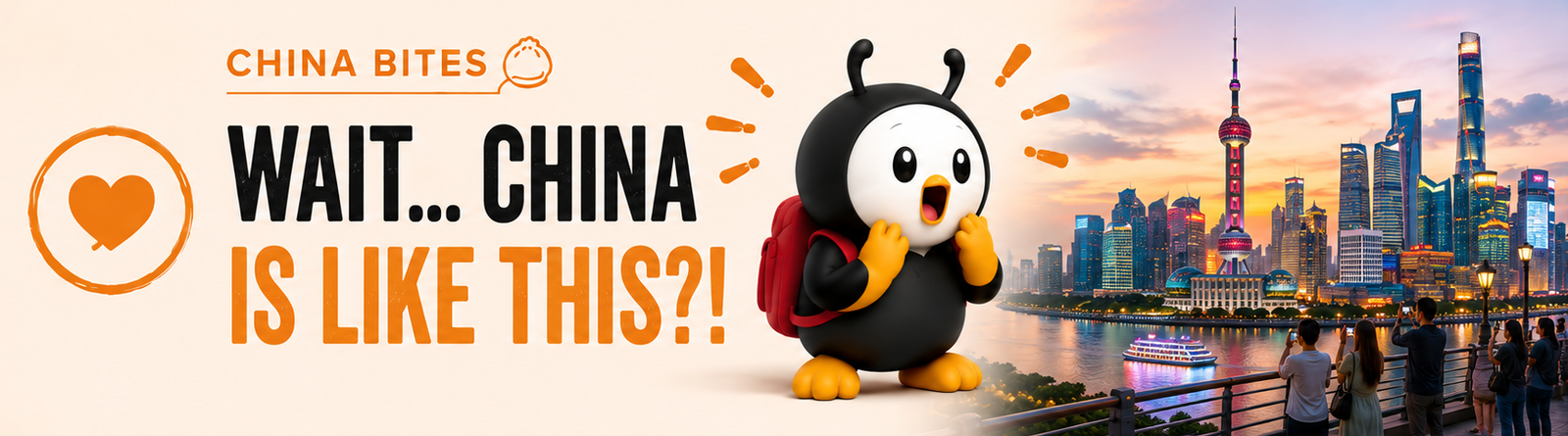
“Wait… my food is HERE already? 😳”
🥟 The Quick Bite
In many Chinese cities, food delivery — 外卖 (wàimài) — has become part of a highly developed everyday system connecting:
restaurants + mobile apps + digital payment + huge numbers of riders + dense urban neighborhoods.
Put those ingredients together and delivering a meal across a relatively short urban distance can be remarkably efficient.
🌍 If You’re Trying to Place It…
Think of GrabFood, Uber Eats, Deliveroo or DoorDash.
The basic idea isn’t unusual.
What’s striking to some international visitors in China is the scale and density of the system.
There can be many restaurants, many customers and many delivery riders operating within the same relatively compact urban area.
🏙️ Density Changes the Equation
Remember those Chinese neighborhoods filled with high-rise apartment buildings?
One residential community (小区, xiǎoqū) can contain a lot of potential customers.
Around it may be:
restaurants + shops + office buildings + other residential compounds.
That means a rider may be making relatively short trips between places where lots of people live, work and eat.
Urban density can help make delivery efficient.
📱 The Phone Connects Everything
Useful Chinese:
外卖 (wàimài) — food delivery / takeaway
骑手 (qíshǒu) — rider
送餐 (sòngcān) — deliver food
配送 (pèisòng) — delivery / distribution
Once an order is placed, the digital platform helps coordinate the customer, restaurant and rider.
The customer can often watch the order progress on the phone.
So instead of:
call restaurant → explain address → ask when food is coming
much of the coordination happens digitally.
🛵 Then Add the E-Bike
Those electric two-wheelers you’ve been seeing everywhere suddenly become another piece of the puzzle.
For repeated short trips through dense neighborhoods, an electric bicycle (电动自行车, diàndòng zìxíngchē) can be much more practical than trying to park a car every few minutes.
So several things you’ve noticed in China connect:
dense cities + smartphones + mobile payments + e-bikes + delivery riders.
The surprisingly fast meal at your door is the result you see at the end.
👀 But Don’t Turn “Fast” Into a Promise
Not every order arrives amazingly quickly.
Traffic, weather, distance, restaurant preparation and demand all matter.
And the pressure for speed can create difficult working conditions and road-safety concerns for delivery riders.
So the remarkable convenience experienced by the customer has real people working behind it.
That’s worth remembering when your dinner appears almost magically at the door.
🥟 One Last Bite
At first, China’s food delivery can feel like:
“Wow — that was FAST.”
Look a little closer and the magic disappears.
In its place is something more interesting:
restaurant → app → rider → e-bike → neighborhood → you.
A whole urban system just moved one bowl of noodles across the city.
And Dad hasn’t even put his shoes on. 😂
See China. Understand It Better.