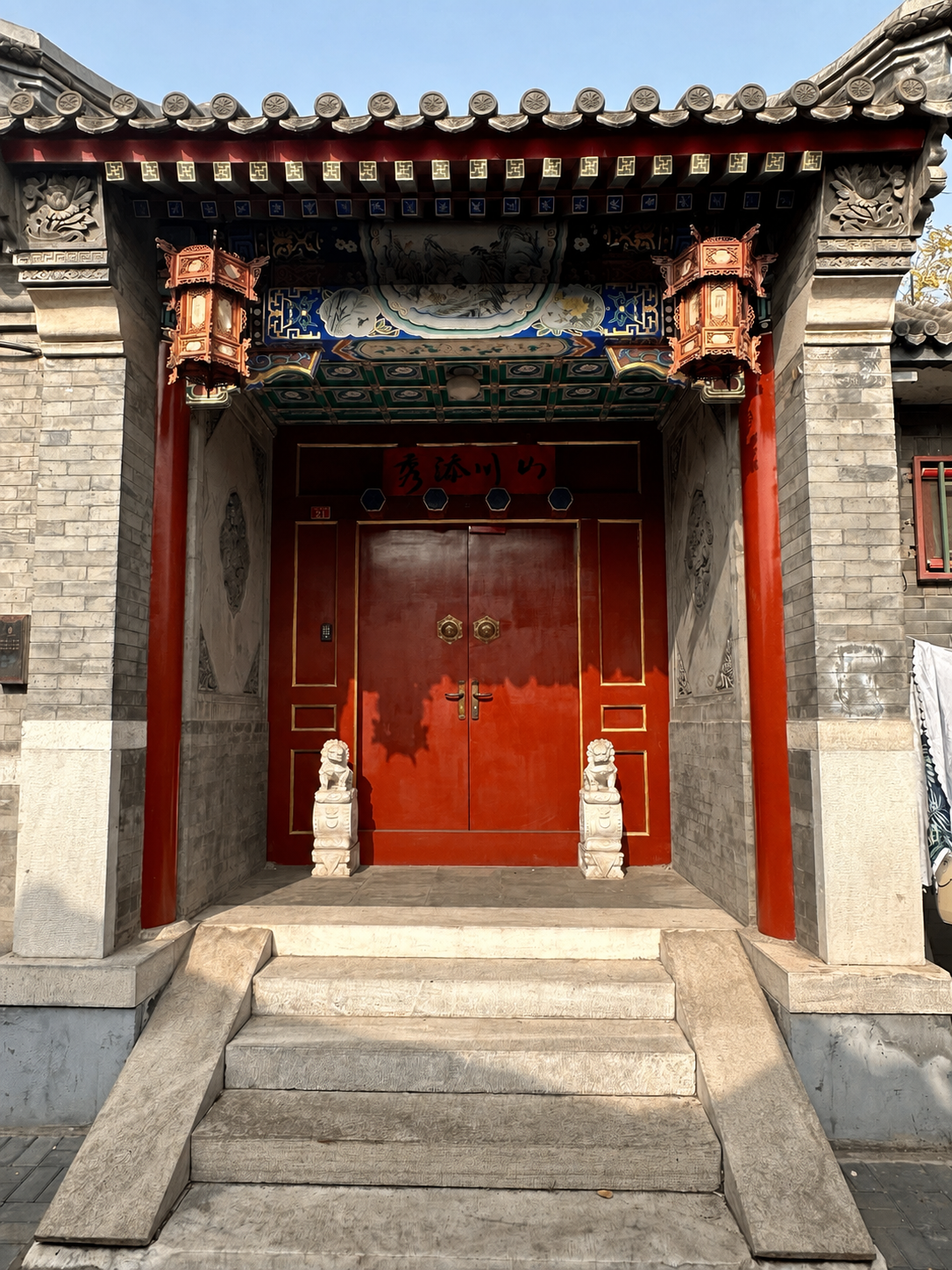
Traditional Beijing hutong doors: A repairman working outside a courtyard house made Dad stop and look more closely at the stone carvings, door knockers and lucky symbols around these old entrances.
We were walking through one of Beijing’s hutongs (胡同, hútòng) when something very ordinary made Dad stop.
A repairman was working at the front of a house.
There was no famous attraction here.
No entrance ticket.
No tour guide explaining what we were looking at.
Just someone doing a job outside his door.
Dad stopped to watch.
And that was when we started looking at the door itself.
It Started With This Repairman
This is what Dad saw.
It wasn’t the sort of thing we would normally put on a Beijing itinerary.
But that’s exactly why we enjoy walking through the hutongs.
When you’re not rushing from one attraction to another, ordinary things have a chance to catch your attention.
And this one did.
Because once Dad looked beyond the repairman, there seemed to be an awful lot happening around that front door.
👀 Look at the Door Again
At first glance:
Beautiful old Beijing door.
But stay for another few seconds.
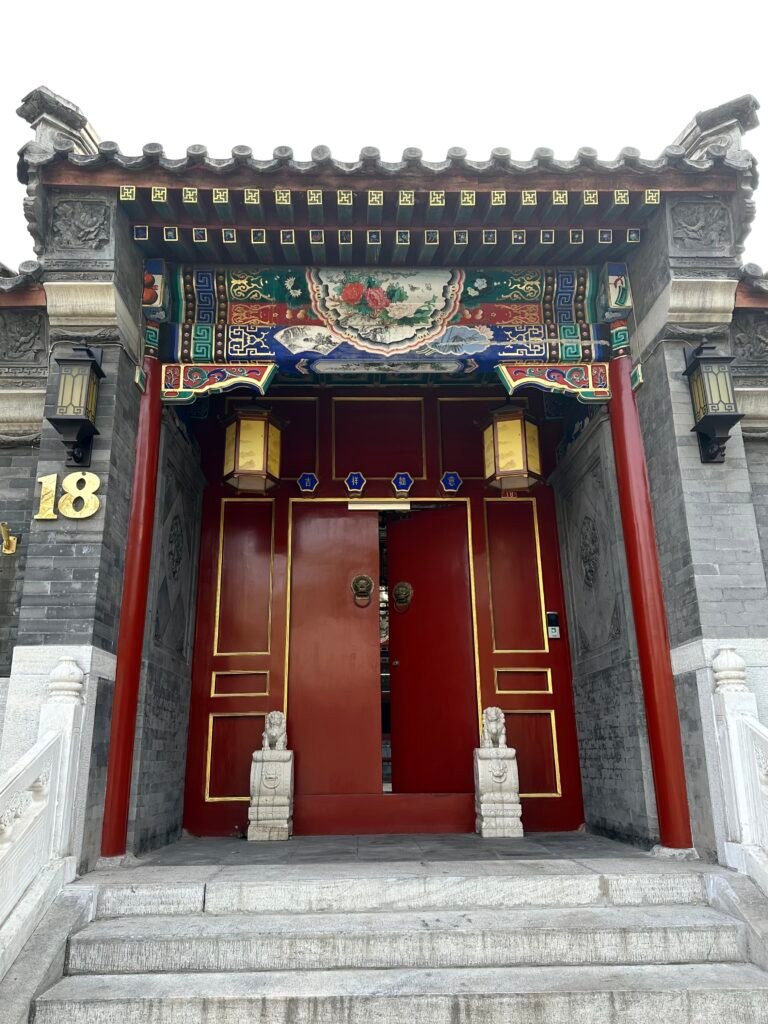
There are the large red wooden doors.
Two metal ring knockers.
Stonework at the bottom.
Small stone animals guarding the entrance.
Carvings around the doorway.
And beautifully painted architectural details overhead.
This wasn’t simply a door in a wall.
It was the entrance to a traditional Beijing courtyard residence (四合院, sìhéyuàn).
And suddenly we had a question:
Why are there so many things around a traditional Beijing front door?
That’s where curiosity took us.
What Are Those Stones Beside the Door?
One of the easiest details to miss is sitting right at the bottom.
Traditional Beijing courtyard entrances can have stone elements known as mendun (门墩, méndūn).
They weren’t originally placed there simply as decoration.
They had a practical architectural connection to the gateway and its heavy wooden doors.
But look more closely and they can also be decorated with carvings and auspicious designs.
Animals.
Flowers.
Patterns.
Symbols carrying hopes for things such as good fortune and protection.
So when you’re walking through a Beijing hutong, don’t look only at the doors.
Look down.
Those old stones beside them may be telling part of the story too.
🦁 And What Are Those Little Animals?
Now look at Dad’s photograph again.
There are two small stone creatures beside the entrance.
Guardian animals and auspicious creatures have a long presence in traditional Chinese architecture.
You’ll see the most spectacular examples outside palaces, temples and important buildings.
But residential entrances can contain their own smaller carved animals and symbolic designs.
We shouldn’t look at every animal outside every Beijing house and assume it has exactly the same meaning.
That’s where it’s easy to turn a fascinating subject into an oversimplified one.
For us, the important discovery was simpler:
they weren’t necessarily there just because somebody thought they looked nice.
There could be meaning behind what we were seeing.
And that made us look at the next door differently.
Then We Found Another Door
Very different.
Less elaborate.
More obviously lived-in.
But now that we’d started looking, Dad’s camera picked up the details immediately.
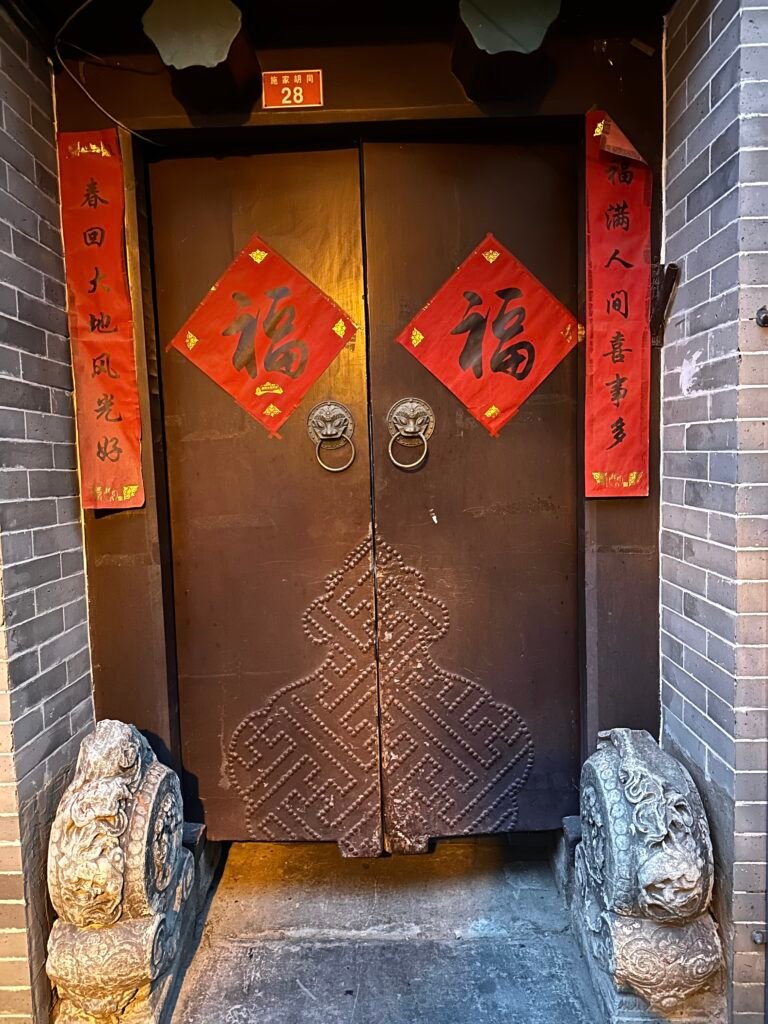
Two wooden doors.
Two metal door rings (门环, ménhuán).
Stonework beside the entrance.
Red decorations.
And right in the middle of each door:
福
福 (fú) means good fortune, blessing or happiness.
It’s one of the Chinese characters international travelers are most likely to encounter on doors, particularly around Chinese New Year.
Once you recognize 福, you’ll probably start spotting it all over China.
What Are Those Red Strips Around the Door?
Look at the red strips running down the sides of the entrance.
These are Spring Festival couplets (春联, chūnlián).
They traditionally carry auspicious words and wishes for the coming year.
And this is where the second photograph becomes particularly interesting.
The stonework and wooden doorway belong to the architecture.
The red couplets and 福 characters were added by the people using the home.
One is part of the physical house.
The other tells us something about the traditions still being practiced by the people living behind that door.
This isn’t simply an exhibit of “old Beijing.”
It’s somebody’s front door.
Even the Door Knockers Deserve Another Look
There was one more detail Dad’s photographs kept capturing.
Those metal rings.
In Chinese they’re called 门环 (ménhuán) — door rings.
They’re practical, of course.
But on traditional Chinese doors, even practical objects can become decorative features.
Look at the metalwork surrounding the rings.
Then compare the knockers on one doorway with another.
It’s another tiny detail that’s very easy to walk past.
Until somebody makes you notice it.
Then you start seeing them everywhere. 😂
The Door Hadn’t Changed. The Way We Looked at It Had.
That’s the part of this little walk we remember.
We hadn’t suddenly become experts on traditional Chinese architecture.
Nor could we look at every carving and confidently explain exactly what it meant.
But after stopping at that first doorway, something had changed.
At the beginning:
Nice old Beijing door.
Photo.
Keep walking.
Afterwards:
What’s carved into that stone?
Why are there animals there?
What does that 福 mean?
What’s written on those red couplets?
Why do the door knockers look like that?
The doors hadn’t changed.
We had simply started looking more closely.
ChinaTravelBUG’s Take
When international travelers hear Beijing hutongs, it’s natural to think about the narrow lanes and traditional siheyuan (四合院) courtyard houses.
Those are the big things.
But travel gets more interesting when the small things start interrupting you.
For Dad, it was a repairman working outside a house.
He made us stop.
Stopping made us look at the door.
The door made us notice the stones.
Then the animals.
Then the knockers.
Then the Chinese characters.
One completely ordinary moment had opened another little window into Beijing.
That’s exactly what Where Curiosity Took Us is about.
SEE → ASK → CONNECT → UNDERSTAND
We didn’t set out that day looking for a lesson about traditional Beijing hutong doors.
We just happened to stop in front of one.
Sometimes curiosity doesn’t need a famous attraction.
Sometimes it only needs somebody repairing a front door. 🚪🐇🐞