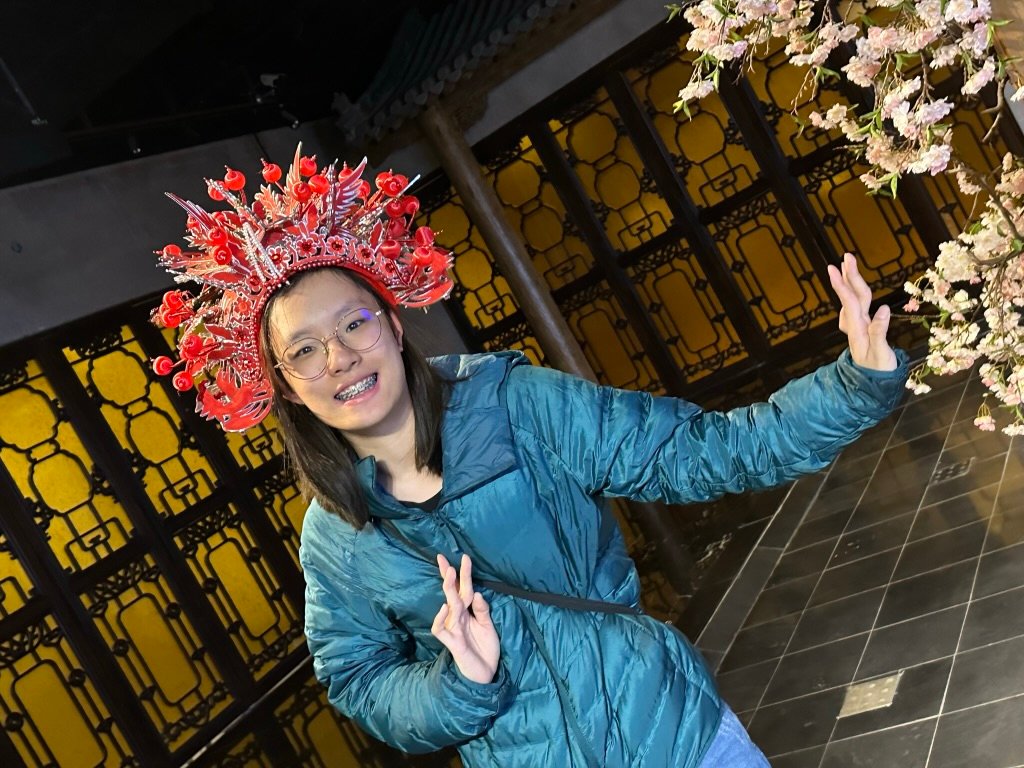
What We Experienced in Beijing: At Tianleyuan Grand Theatre near Qianmen, Elaine went from seeing Beijing Opera in books and videos to wearing the headdress, learning the gestures and experiencing one of China’s great performing traditions for herself.
Some travel stories actually begin years before the trip.
This one began in Shenzhen in 2018.
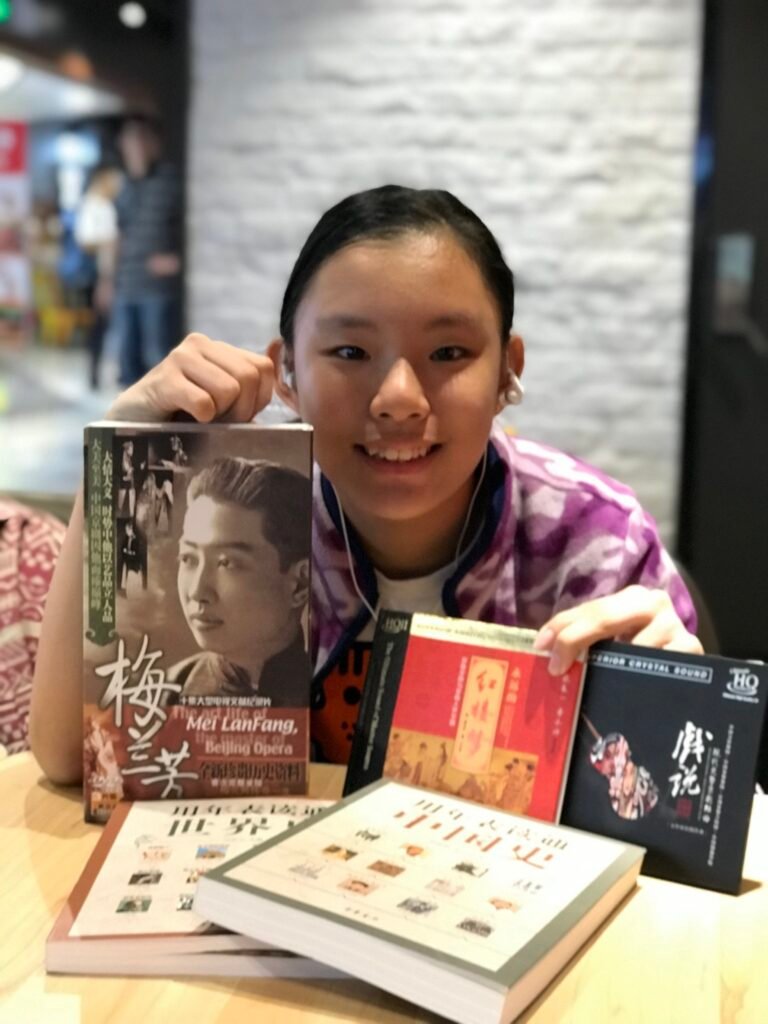
Dad and Elaine were at Shenzhen Book City (深圳书城, Shēnzhèn Shūchéng) — a place Elaine would grow particularly fond of and eventually return to again in 2026.
Dad bought her books.
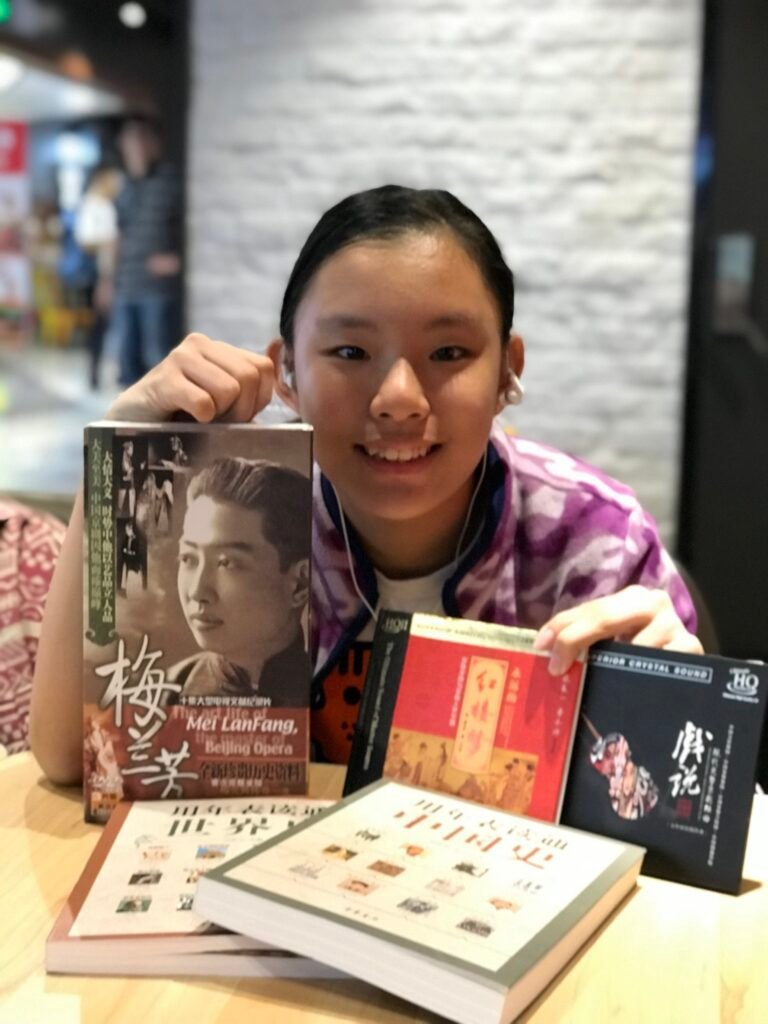
Among them were books about Mei Lanfang (梅兰芳, Méi Lánfāng) and Beijing Opera (京剧, Jīngjù), together with a Beijing Opera video album.
Elaine posed for a photograph with them.
At the time, Beijing Opera was something she could read about.
Something she could watch.
Years later, Dad and Elaine were walking through Old Beijing.
And suddenly…
it wasn’t in a book anymore.
We Found Beijing Opera Near Qianmen
We were in the historic Qianmen (前门, Qiánmén) area when we came to Tianleyuan Grand Theatre (天乐园大戏楼).
This was already the sort of Beijing Dad wanted Elaine to experience.
Not only the Forbidden City.
Not only museums.
Not only the big attractions where you stand in front of something famous and take a photograph.
Dad wanted Elaine to encounter the culture that grew out of those centuries of Chinese history.
And Beijing Opera was waiting for us.
🎥 Come Inside Tianleyuan With Us
The first thing you’ll notice is that there is plenty to explore even before the performance begins.
Costumes.
Opera characters.
Historic photographs.
Stage props.
Elaborate headdresses.
Souvenirs.
Displays explaining the theater’s history.
And on the wall…
a timeline.
Then We Saw Mei Lanfang 梅兰芳 Again
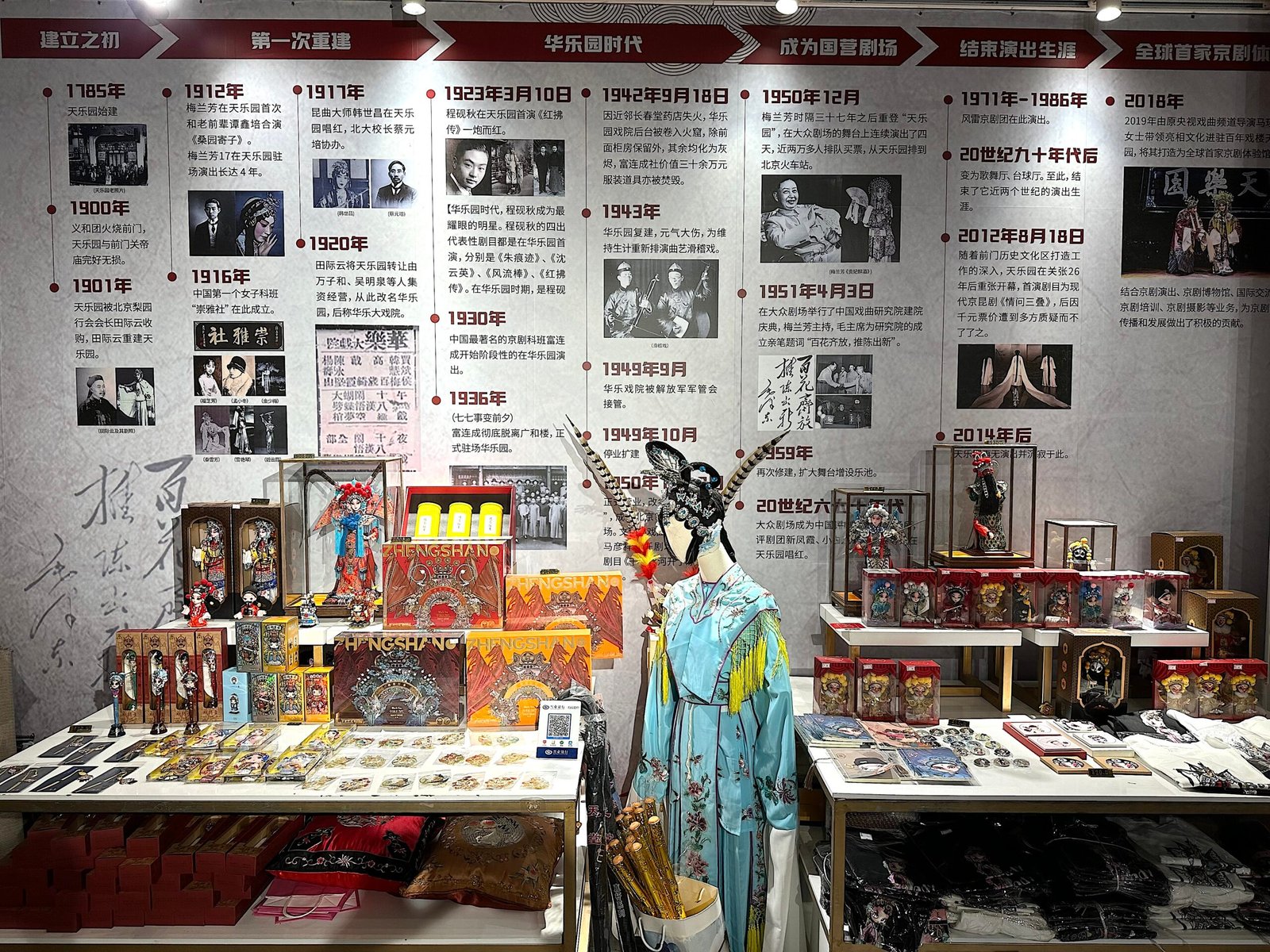
Look carefully at the history displayed behind the opera souvenirs.
There is a name international visitors interested in Beijing Opera will encounter again and again:
Mei Lanfang (梅兰芳, Méi Lánfāng)
Mei Lanfang became one of the most celebrated performers in the history of Beijing Opera, particularly famous for performing dan (旦, dàn) — female roles traditionally performed on the opera stage.
And according to the theater’s own historical display, Mei Lanfang performed here when he was still young.
For Dad, that created a lovely connection.
Remember that photograph from Shenzhen?
One of the books Dad bought Elaine years earlier was about Mei Lanfang and Beijing Opera.
Now Elaine was standing inside a Beijing theater connected with the history she’d previously encountered through those books.
This is why Dad likes educational travel.
Sometimes you don’t need to say:
“Elaine, today we are going to study Chinese culture.”
😂
You simply put the earlier pieces in place.
Then one day…
the connections appear by themselves.
But We Didn’t Come Just to Look at a Museum
Tianleyuan 天乐园大戏楼 wasn’t only telling us what Beijing Opera used to be.
There was a performance.
The screen showed the program:
《亮相》 — Liàngxiàng
with classic Beijing Opera highlights.
The advertised excerpts included familiar pieces such as:
《贵妃醉酒》 — The Drunken Concubine
《霸王别姬》 — Farewell My Concubine
《三岔口》 — At the Crossroads
and other famous scenes.
There were several ticket categories.
Dad chose the most affordable one.
¥180.

There’s something useful for first-time China travelers hidden in this very ordinary screenshot too.
Dad paid using Alipay (支付宝, Zhīfùbǎo), with a linked international Visa card.
No cash.
No complicated ticket counter negotiation.
Payment successful.
¥180.
Sometimes our travel photographs aren’t glamorous.
But they’re useful. 😂
Then Someone Put This on Elaine’s Head
And this is where the story became much more fun.
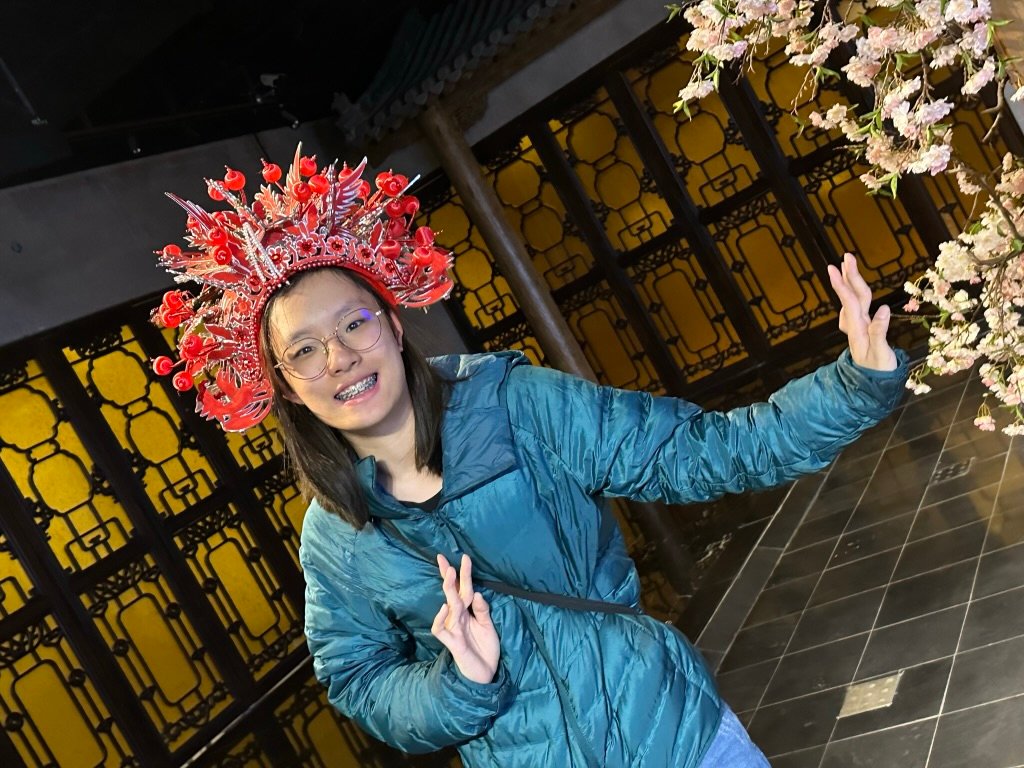
Elaine wasn’t sitting quietly reading about Beijing Opera anymore.
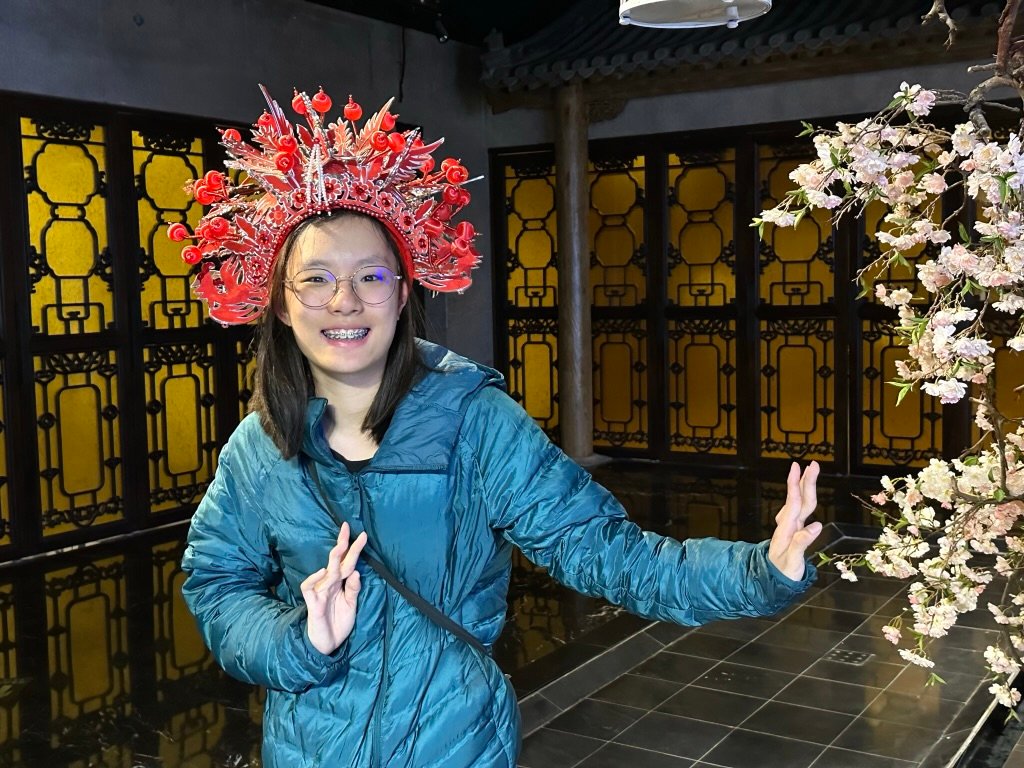
She was wearing an elaborate opera-style headdress.
Then someone started showing her what to do with her hands.
🎥 Elaine Tries Beijing Opera
Watch her hands.
The instructor demonstrates the stylized position.
Elaine watches.
Tries it.
Adjusts.
Then tries again.
And at the end…
that smile. 😂❤️
Even the Hands Have a Language
One of the things that can surprise a first-time international audience is how stylized Beijing Opera is.
The performer doesn’t simply walk, turn, point or gesture in the same way we might in everyday life.
Movement itself becomes part of the performance language.
Elaine was being shown the graceful hand positioning often associated with orchid fingers (兰花指, lánhuāzhǐ).
A tiny movement of the fingers may look simple when an experienced performer does it.
Then you try.
😂
Suddenly it isn’t quite so simple.
And that’s why Dad liked this little hands-on experience.
Elaine could have watched a performer make the gesture from her seat.
Instead, for a few moments, she had to think about:
Where does my hand go?
What do I do with my fingers?
How do I hold my arm?
Watching had become doing.
Dad Paid ¥180. Was It Worth It?
For us?
Yes.
Not because Dad suddenly became a Beijing Opera expert.
And not because Elaine left Tianleyuan ready to perform professionally. 😂
It was worth it because the experience gave something we had previously encountered through books and videos a physical memory.
Years earlier:
Mei Lanfang 梅兰芳 was a face on Elaine’s book.
Now:
she was standing inside a theater associated with Beijing Opera history.
Years earlier:
opera costumes were pictures.
Now:
she could stand beside them.
Years earlier:
Beijing Opera was something to watch.
Now:
someone was correcting the position of her fingers.
That’s a very different kind of learning.
And Then Dad Started Looking at the History
This is where ChinaTravelBUG usually gets into trouble.
😂🐇
Because once you look past the costumes and colorful faces, Beijing Opera starts opening doors into much bigger questions.
Why are the faces painted different colors?
Why were male performers famous for playing female roles?
Who was Mei Lanfang 梅兰芳?
Why do certain gestures mean particular things?
Why does a character sometimes seem to travel enormous distances on a nearly empty stage?
And how did 京剧 (Jīngjù) become so closely associated with Beijing?
We won’t answer all of those here.
This is Follow Our Stories, not Dad’s 5,000-word Beijing Opera thesis. 😂
For now, it’s enough to do what we did:
see it.
hear it.
try it.
Then let curiosity decide where to go next.
📍 Want to Try This in Beijing?
Look for:
Tianleyuan Grand Theatre (天乐园大戏楼)
in the historic Qianmen (前门) area of central Beijing.
If you’re already exploring Qianmen and the surrounding Old Beijing neighborhoods, this is the kind of cultural experience that can fit naturally into the same day.
🎟️ What Dad Paid
Our ticket:
¥180 (2023 Price)
Dad paid through Alipay (支付宝) using a linked Visa card.
Ticket prices and performance schedules can change, so check the current program rather than relying on what we paid during our visit.
⏰ Give Yourself Time Before the Show
Don’t arrive at the last second.
Part of our enjoyment came from looking around first.
The historical displays.
Costumes.
Photographs.
Souvenirs.
Opera characters.
And, of course…
letting Elaine try that headdress. 😂
For Families Visiting Beijing
This is one experience Dad would particularly consider for families with older children or teenagers.
Not because every child will suddenly fall in love with traditional opera.
They probably won’t.
The trick is not to make it homework.
Let them look at the costumes.
Take silly photographs.
Try the gestures if the experience allows it.
Notice the painted faces.
Ask why something looks strange.
That’s often how Elaine’s own curiosity works best.
First:
experience it.
Then:
ask about it.
The history can come afterward.
❤️ Eight Years Apart
This is the photograph Dad keeps coming back to.
[INSERT 2018 PHOTO AGAIN OR SIDE-BY-SIDE WITH 2026 ELAINE OPERA PHOTO]
On one side:
Elaine in Shenzhen in 2018, sitting behind books Dad had bought her about Beijing Opera and Mei Lanfang.
On the other:
Elaine years later in Beijing, wearing an opera headdress and trying the gestures herself.
Dad couldn’t have planned that photograph eight years earlier.
There was no grand educational master plan connecting those two moments.
We simply kept traveling.
Kept reading.
Kept showing Elaine things.
And occasionally, years later, one experience unexpectedly connects with another.
Those are some of Dad’s favorite moments.
ChinaTravelBUG’s Take
There are many ways to learn about China.
You can read a book.
Watch a documentary.
Visit a museum.
Stand in front of an information board.
Dad believes in all of them.
But sometimes you need one more step.
Try it.
Put on the headdress.
Hold your hand the way the performer shows you.
Listen to the music.
Watch the stage.
Laugh when you don’t quite get the gesture right.
Then perhaps go back to the book.
Because now the words have something they didn’t have before:
a memory.
In 2018, Dad bought Elaine a book about Mei Lanfang and Beijing Opera.
Years later, in Old Beijing…
Elaine stepped into the book.
🎭❤️🐞