Daily Life in Old Beijing: Dad went for a morning walk and found cats on rooftops, a little dog, a caged songbird, potted plants — and a reminder that Beijing’s hutongs are still people’s homes.
Not every travel story needs a famous attraction.
Sometimes you just need a fat cat.
😂
Dad was walking through a Beijing hutong (胡同, hútòng) one morning when a fluffy white cat wandered past.
Nothing unusual about that.
Then Dad looked up.
Sitting above the lane, comfortably occupying the roof ledge of a traditional courtyard residence, was another cat.
A considerably larger cat.
A very well-fed cat.
And suddenly Dad wasn’t going anywhere.
Meet the Hutong Cat
🎥 Come Meet Him With Dad
Watch what happens.
The big tabby sits above the street as though the hutong belongs to him.
A local woman comes outside and talks to Dad.
She calls to the cat.
Dad talks with her.
The cat walks along the roof tiles.
Eventually it leans down far enough for Dad to give it a little pat.
And somewhere in the middle of all this…
a small dog appears.
😂
No ticket.
No attraction.
No itinerary.
Just an ordinary morning encounter in Beijing.
And we loved it.
Dad Started Noticing Something About Hutong Pets
Dad had already noticed cats elsewhere during our stay.
Even one of the hutong lodgings we stayed in had three resident cats around the lobby.
Then there was this enormous tabby.
A little dog coming out from the courtyard.
Another white cat wandering down the lane.
These weren’t animals put there for tourists.
They were simply part of the neighborhood.
And that’s one reason we like this video so much.
It doesn’t show you how Beijing’s hutongs look.
For a couple of minutes, it shows you something about how they feel.
Quiet enough to hear the birds.
A neighbor chatting outside.
Someone calling her cat.
A dog barking.
Dad having a conversation with somebody he’d never met before.
This is the sort of thing that disappears if your entire Beijing itinerary is:
car → attraction → car → attraction → hotel.
Then Look at This Door
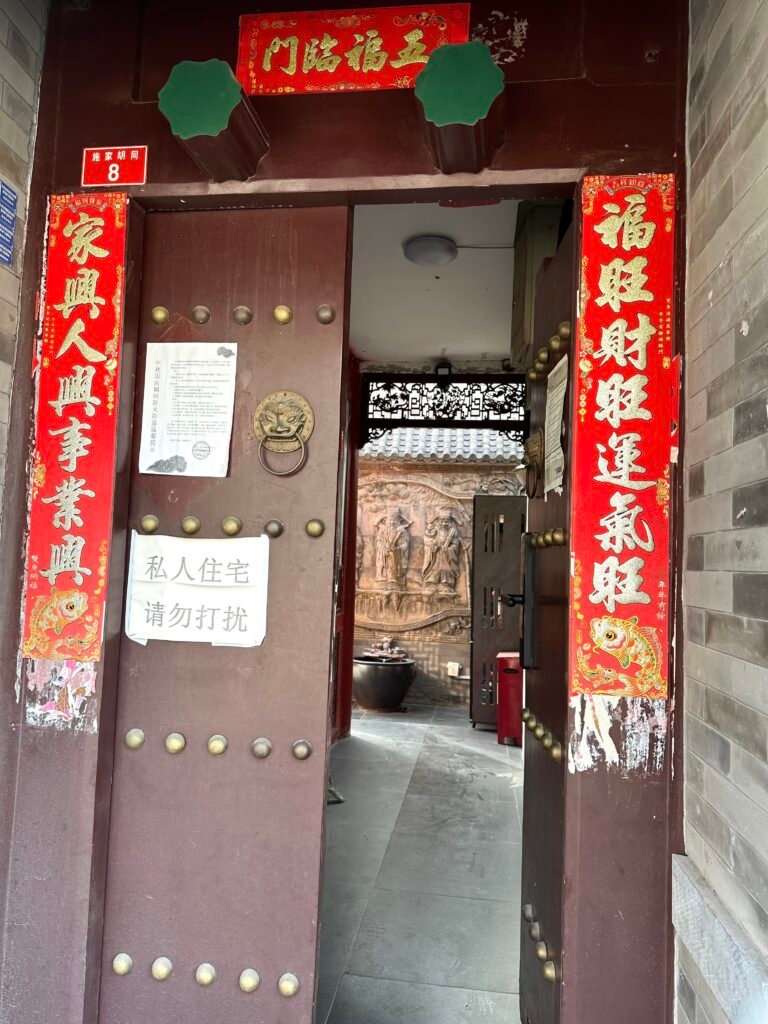
There’s plenty in this photograph that might attract an international traveler’s camera.
The old wooden door.
The traditional metal ring knocker.
The red Spring Festival couplets (春联, chūnlián).
The large gold Chinese characters.
The courtyard visible through the open doorway.
But Dad’s photograph contains something much more important.
Look at the white piece of paper attached to the door.
It says:
私人住宅
请勿打扰
Sīrén zhùzhái — private residence.
Qǐng wù dǎrǎo — please do not disturb.
That may be one of the most useful pieces of Chinese an international traveler can encounter while exploring Beijing’s hutongs.
Because this isn’t a museum entrance.
Somebody lives here.
An Open Door Isn’t an Invitation
This is worth remembering when you explore Beijing’s hutongs.
Some courtyard entrances are beautiful.
A door may even be standing open.
And through it you may glimpse plants, carvings, traditional architecture or an interesting courtyard.
It’s tempting to step inside for a photograph.
Don’t assume you can.
A siheyuan (四合院, sìhéyuàn) may be historic and beautiful…
but it can also be someone’s home.
The sign Dad photographed couldn’t make that clearer:
私人住宅,请勿打扰。
Private residence. Please do not disturb.
Enjoy the doorway.
Take a photograph from the public lane where appropriate.
Then keep walking.
Respecting the people who live in the hutong is part of experiencing it properly.
Then Dad Heard a Bird
On another quiet stretch of the hutong, Dad noticed something else outside a residence.
Not a cat this time.
Listen.
🎥 A Songbird Outside a Hutong Home
Behind the red window grille hangs a traditional round birdcage.
Inside:
a little songbird.
And beneath it are potted plants.
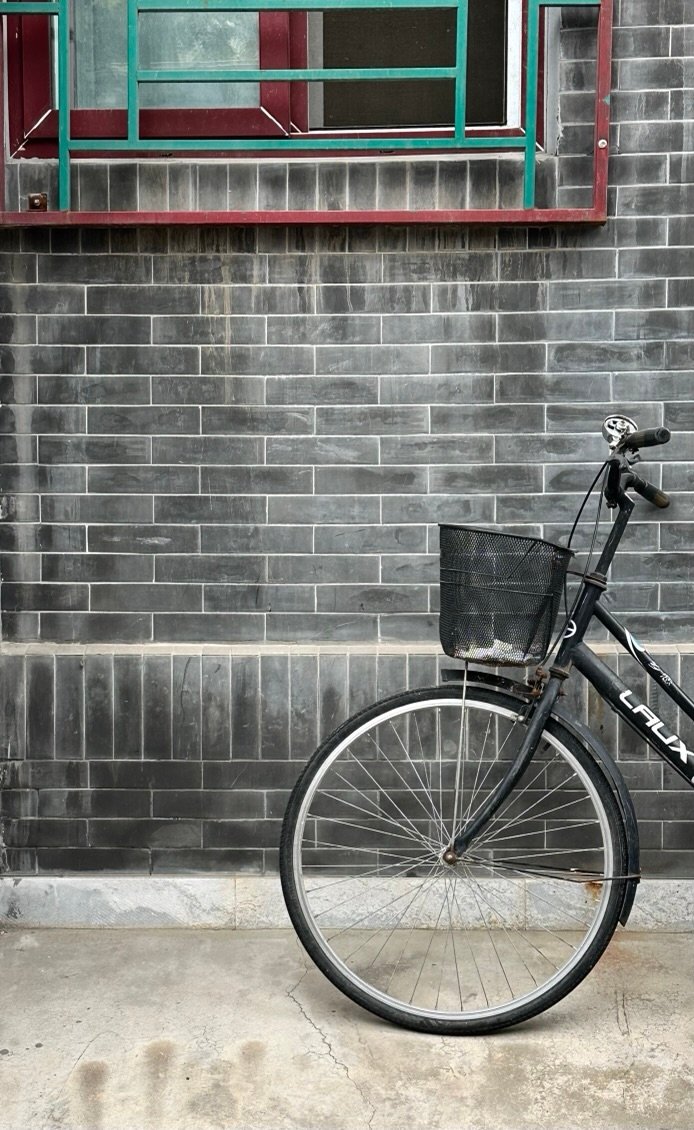
Then, while Dad’s camera is looking at all this, somebody rides past on a bicycle.
That’s it.
😂
Again, absolutely nothing worthy of a “Top 10 Things to See in Beijing” list.
And yet it’s one of those tiny scenes that tells us why walking through a living hutong is different from visiting a monument.
Birds, Plants, Cats… and a Front Window
Keeping songbirds has a long tradition in China, and you’ll still occasionally encounter birdcages around parks, neighborhoods and homes.
Potted plants are another little piece of the scene.
Neither needs a huge cultural explanation here.
That’s not what Dad was doing that morning.
He simply noticed how people had personalized the small spaces around their homes.
A birdcage here.
Plants there.
A cat occupying the roof as though he had paid for it.
😂
These little details turn a row of gray-brick buildings into a neighborhood.
A School, a Potsticker Shop and an Ordinary Morning in a Beijing Hutong
Daily Life in Old Beijing: Dad’s morning walk through the Dashilan hutong area showed us something simple but important — schools, homes and small businesses all share the same neighborhood.
Sometimes a short walk explains a place better than a long guidebook.
Dad was walking through the Dashilan (大栅栏, Dàshílàn) area of Old Beijing one morning.
Nothing dramatic was happening.
And that was exactly the point.
🎥 Walk Through the Hutong With Dad
At the beginning of the video, Dad points toward a primary school:
Kangleli Primary School (康乐里小学).
Then the camera moves.
A cyclist passes.
Someone walks by.
Traditional gray-brick courtyard homes line the street.
Old vines twist over the walls and roofs.
And a little farther along…
a small potsticker shop appears.
All within the same few seconds.
This Is What Made Dad Stop and Think
For international travelers, Beijing’s hutongs are often introduced as:
historic lanes
or
traditional courtyard neighborhoods.
That’s true.
But Dad’s video shows something more useful.
This wasn’t simply a street of preserved old houses.
There was a school.
There were homes.
There were small businesses.
People were walking and cycling through the neighborhood.
In other words:
this was a functioning community.
A School Inside the Hutong
The Kangleli Primary School (康乐里小学) sits right inside the neighborhood.
That detail matters.
Children don’t only visit hutongs on school trips.
Some families live in these communities.
Schools serve them.
Shops serve them.
The lanes aren’t just places tourists pass through.
They’re part of everyday Beijing.
🥟 Then Dad Saw the Potsticker Shop
A little farther along was a small local eatery:
门框锅贴店
selling guōtiē (锅贴) — pan-fried dumplings or potstickers.
Again, nothing spectacular.
But that’s exactly what we liked.
A school.
A courtyard home.
A small restaurant.
All sharing the same street.
Old Beijing wasn’t sitting behind glass.
It was being used.
🌿 Look at the Houses Too
The traditional gray-brick homes were still there.
Some had thick vines growing across the walls and roofs.
These weren’t pristine museum exhibits.
They looked lived-in.
And that’s another reason we enjoy walking through hutong neighborhoods in the morning.
You start noticing the relationship between:
old architecture
and
modern daily life.
Not one replacing the other.
Both happening at the same time.
This video is only a short morning stroll.
But look at how much Beijing fits inside it:
a primary school
traditional homes
local residents
bicycles
small shops
a potsticker restaurant
and a quiet lane waking up for the day.
That’s why we keep coming back to the same point:
A Beijing hutong isn’t just somewhere to see Old Beijing.
It’s somewhere people are still living Beijing today.
And sometimes the best way to notice that…
is simply to walk slowly enough in the morning.
This Is Why We Like Walking in the Morning
There’s another reason Dad’s videos feel different from the busy commercial parts of Old Beijing.
It’s morning.
The hutong hasn’t yet become somewhere we’re trying to “experience.”
It’s simply waking up.
People leave home.
Bicycles pass.
Pets appear.
Birds chirp.
Someone tends to something outside the house.
You can hear the neighborhood.
For first-time Beijing travelers, we’d recommend giving yourself at least one morning like this.
Not necessarily this exact lane.
Not hunting for Dad’s fat cat. 😂
Just:
walk.
📍 Where Can You Experience This Side of Beijing?
The broader historic areas around Shichahai (什刹海, Shíchàhǎi), the Drum Tower (鼓楼, Gǔlóu) and surrounding hutongs are good places for first-time visitors to explore on foot.
Another accessible area is around Nanluoguxiang (南锣鼓巷, Nánluógǔxiàng).
But here’s Dad’s tip:
Don’t stay only on the famous commercial street.
The main tourist streets can be busy, lively and fun.
But turn into the quieter surrounding hutongs and the atmosphere can change remarkably quickly.
That’s where you may start noticing the things Dad did.
Not necessarily cats.
Not necessarily songbirds.
But ordinary life.
🚕 What Should I Put Into DiDi?
Rather than asking a driver to take you to “a hutong,” choose a recognizable starting point.
For the Shichahai area, you can search in DiDi for:
什刹海 — Shichahai
or:
北京鼓楼 — Beijing Drum Tower
Once you arrive, explore the surrounding hutongs on foot.
That’s important.
A car can deliver you to the neighborhood.
It can’t give you the experience Dad had.
You need to walk slowly enough to notice it.
ChinaTravelBUG’s Take
There are days in Beijing when you’ll stand in front of things you’ve dreamed about seeing.
The Forbidden City.
The Great Wall.
The Temple of Heaven.
Those memories matter.
But years later, you may be surprised by the other things you remember.
Dad remembers a fat cat sitting above a hutong lane.
The woman calling him down.
A skinny little dog appearing from the courtyard.
A songbird chirping behind a window grille.
Potted plants.
A bicycle passing.
And a handwritten sign on someone’s front door:
私人住宅,请勿打扰。
Private residence. Please do not disturb.
None of these things is an attraction.
Together, however, they showed us something the attractions couldn’t.
People don’t just preserve Old Beijing here.
People live in it.
So when you visit a hutong, don’t spend the whole time looking for something famous.
Walk slowly.
Listen.
Look up occasionally.
You never know.
There may be a very fat cat looking back at you. 🐈😂🐞