What We Ate in Baoji: After arriving by green train, Dad and Elaine stopped at a busy local noodle shop for our first meal in Baoji. This time Dad stepped aside: Elaine had to read the choices, speak to the staff and order lunch herself.
We had made it.
After Elaine’s first journey on a Chinese green train (绿皮车, lǜpíchē) from Xianyang (咸阳, Xiányáng) — including the little surprise that we didn’t have seats — Dad and Elaine finally arrived in:
Baoji (宝鸡, Bǎojī).
We were here because Elaine had insisted she wanted to see the city’s famous bronze collection.
But first…
Lunch.
😂
And Dad decided this was a good opportunity for another little travel lesson.
This time:
“Elaine, you order.”
A Little Lesson We’ve Learned From Homestays
One advantage of staying somewhere with a local owner is that you have someone you can ask:
“Where should we eat around here?”
Not:
Where do tourists eat?
Not:
What’s famous on social media?
Just:
Where would you recommend nearby?
That’s how we ended up eating 扯面 (chěmiàn) at this little neighborhood shop.
And for Dad, recommendations like that are often more interesting than arriving with every meal already planned.
The homestay owner gave us the recommendation.
Elaine did the ordering.
Dad?
Dad ate.
That’s a pretty good division of labor. 😂🍜
🎥 Watch Elaine Order Our First Lunch in Baoji
She spoke to the man at the counter.
Worked through what we wanted.
He wrote down the order.
She confirmed it.
Paid.
Collected the order slip.
Done.
Dad’s contribution?
Filming.
😂
So What Were We Eating?

This shop specialized in:
扯面 — chěmiàn
扯 (chě) means to pull or stretch.
面 (miàn) means noodles.
These are hand-pulled or hand-stretched wheat noodles, strongly associated with the food culture of Shaanxi.
And the menu let customers choose different noodle widths.
宽扯 (kuān chě) — wide pulled noodles
细扯 (xì chě) — thinner pulled noodles
韭叶扯 (jiǔyè chě) — “chive-leaf” width noodles
That last description doesn’t mean the noodles are made from chives.
It describes their shape — long and relatively flat, resembling a chive leaf.
😋 Dad’s Bowl Arrived
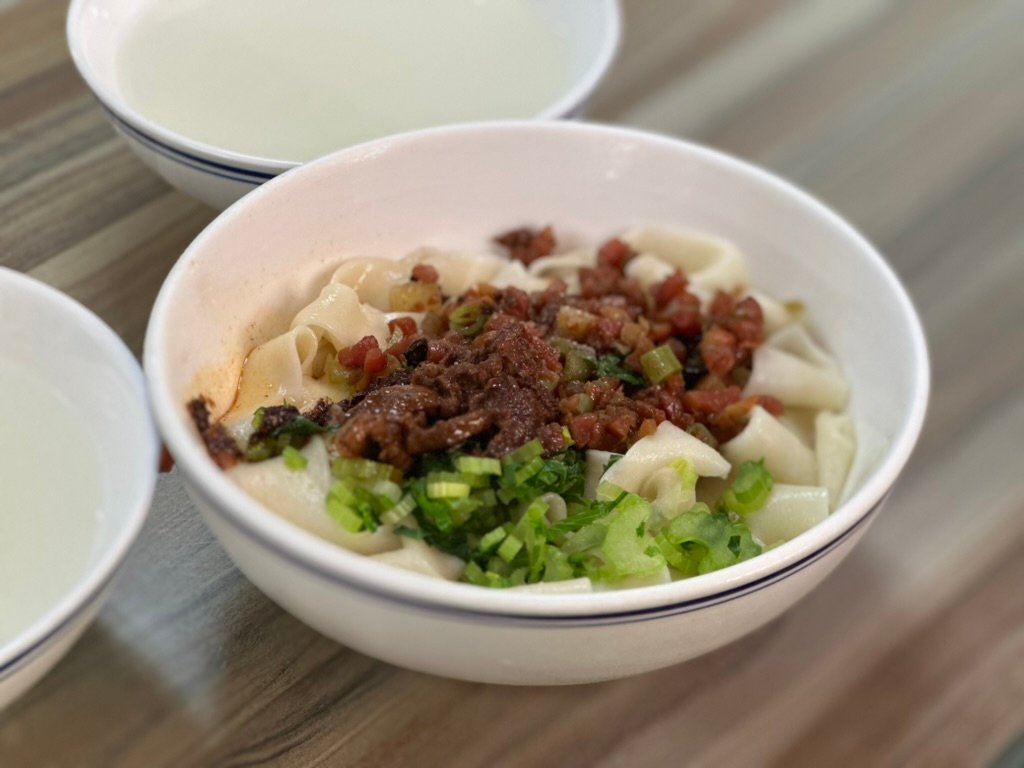
This is the kind of noodle Dad loves.
Wide.
Thick enough to have some bite.
And very different from the perfectly uniform noodles that come out of a factory.
🧄 Wait… Why Is There Raw Garlic on Every Table?
Then Dad noticed something.
On the tables were containers filled with:
fresh raw garlic — 生蒜 (shēngsuàn).
Not chopped into the noodles.
Not cooked into the sauce.
Whole cloves of raw garlic.
Dad kept seeing them and became curious.
Why does every table have garlic?
Then we watched the local diners.
The answer became obvious.
They were eating it raw with their noodles.
A bite of garlic.
A slurp of noodles.
Another bite.
Another mouthful of noodles.
😳🧄🍜
😂 When in Rome…
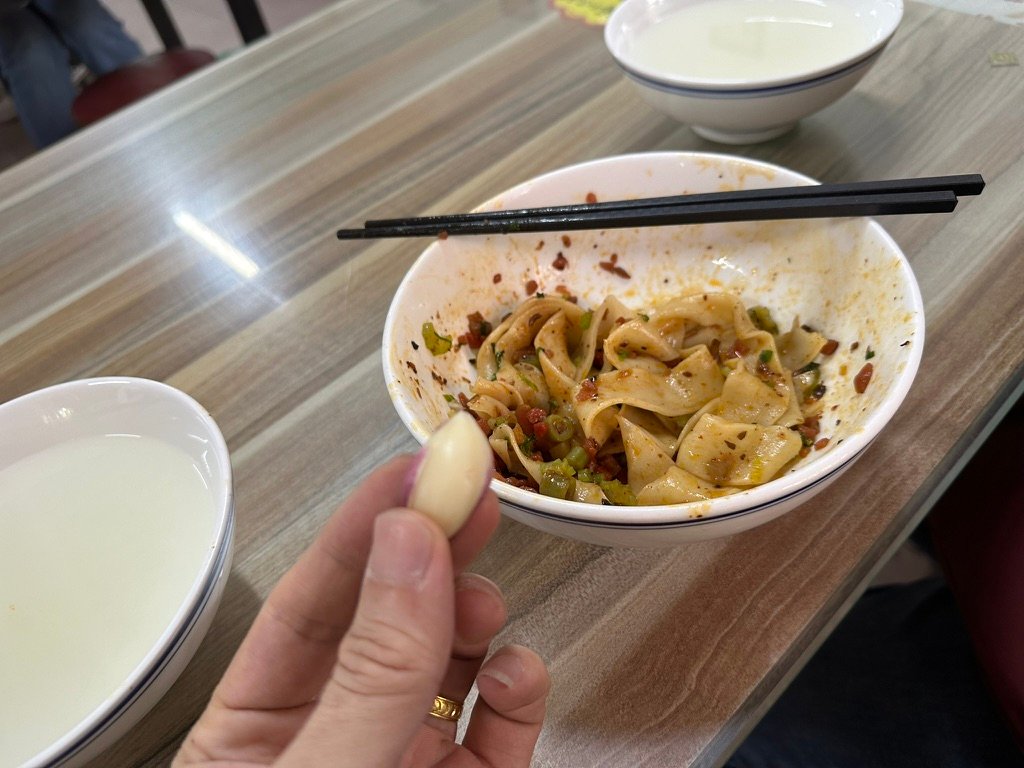
Dad decided there was only one proper way to investigate this.
Eat as the locals eat.
So Dad picked up a fresh clove.
Took a bite.
Then ate some 扯面 (chěmiàn).
Okay…
Now Dad understood the system.
😂
The garlic was very fresh.
Crunchy.
Juicy.
But also…
spicy.
pungent.
Very pungent. 😂
Raw garlic has a sharpness that disappears when it’s cooked, and taking a bite directly from a fresh clove certainly wakes up your mouth.
But followed immediately by those thick, savory noodles?
It worked.
The strong garlic cut through the rich sauce, while the noodles softened the punch of the raw garlic.
Suddenly the container sitting on every table made sense.
A Little Shaanxi Eating Habit We Would Have Missed
This is exactly why Dad likes eating in ordinary local restaurants.
Nobody handed us an instruction sheet saying:
HOW TO EAT YOUR BAOJI NOODLES
😂
You simply look around.
What are the people at the next table doing?
Why is that garlic there?
Are we supposed to eat it?
And sometimes the easiest way to understand something is just to try it.
In Shaanxi, eating noodles with raw garlic is a familiar local combination.
There’s even a wonderfully direct saying:
吃面不吃蒜,香味少一半
Chī miàn bù chī suàn, xiāngwèi shǎo yíbàn.
Loosely:
“Eat noodles without garlic, and you’re missing half the flavor.”
Dad wouldn’t go quite that far yet.
😂
But after one bite of raw garlic followed by one slurp of 扯面…
he understood why the garlic was on the table.
And yes.
Dad had another bite.
💰 And Look at the Prices
One of the things Dad continually noticed once we traveled beyond China’s biggest tourist cities was how inexpensive everyday meals could be.
At this shop, the menu included options such as:
西红柿鸡蛋扯面 (xīhóngshì jīdàn chěmiàn)
Tomato-and-egg pulled noodles
炸酱扯面 (zhájiàng chěmiàn)
Pulled noodles with savory fried sauce
and even:
肠子扯面 (chángzi chěmiàn)
Intestine pulled noodles
Small bowls on the menu started at around:
¥9
Larger bowls were only a few yuan more.
Extra vegetables:
¥2
That’s a useful reminder for first-time travelers.
You do not have to spend a lot of money to eat well in China.
Especially once you leave the most tourist-oriented areas.
And That Pale Bowl? It’s 面汤
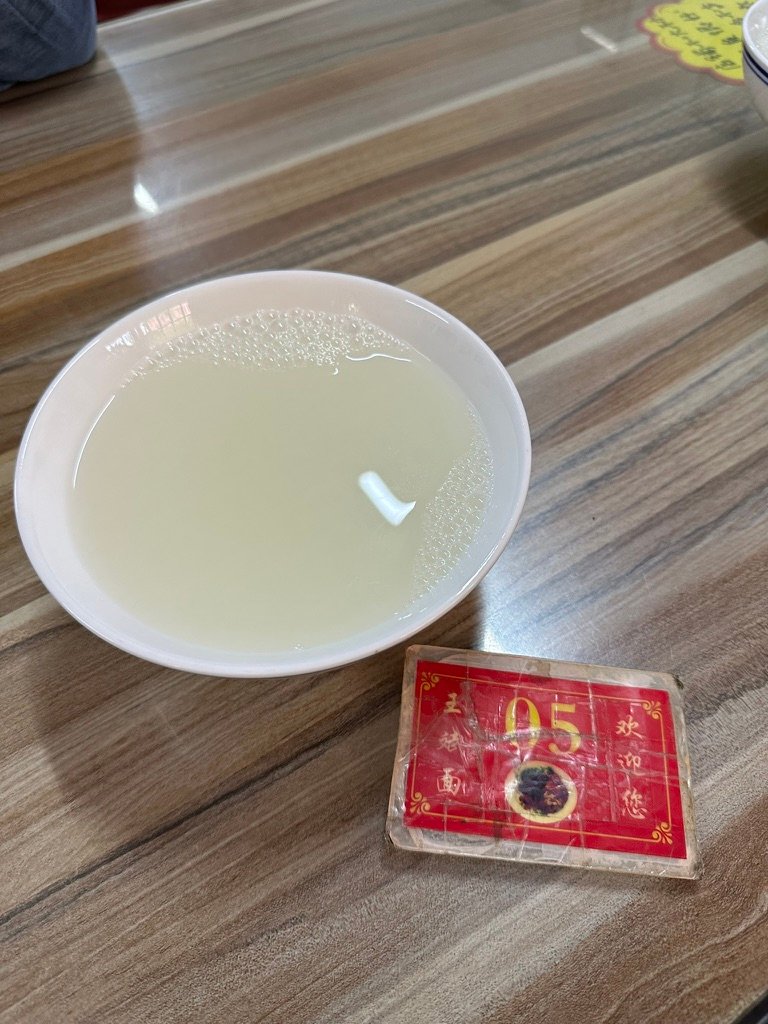
That pale liquid beside our noodles wasn’t a drink Dad had ordered.
It was:
面汤 (miàntāng) — noodle water / noodle soup
This is the water used to cook the noodles, served warm alongside the meal.
It looks incredibly plain.
Because it is. 😂
No sugar.
No ice.
No fancy flavoring.
Just the cloudy, starchy water left from cooking the noodles.
And again, Dad noticed something useful:
the locals were drinking it.
So we did too.
After a mouthful of strongly seasoned 扯面 (chěmiàn) — and especially after Dad’s bite of pungent raw garlic — that mild, warm 面汤 suddenly made perfect sense.
Rich noodles.
A bite of 生蒜 (shēngsuàn).
Then a sip of warm 面汤.
Another tiny part of lunch that nobody needed to explain to us.
We simply watched…
and ate the way the locals were eating.
But Dad Actually Remembered the Ordering More Than the Noodles
The noodles were good.
But Dad remembers something else from this lunch.
Elaine walking to that counter by herself.
Traveling independently isn’t one enormous skill that suddenly appears.
It’s lots of tiny ones.
Ordering food.
Reading signs.
Asking a question.
Paying.
Finding the station.
Calling a DiDi.
Solving a problem when Dad hasn’t planned properly.
😂
Dad could easily have ordered lunch.
But then Elaine wouldn’t have had to.
So Dad stepped aside.
And she managed perfectly well.
🐇 Why Had We Come All the Way to Baoji?
Not for noodles.
Although they were a very good start. 😂
Elaine wanted to visit:
Baoji Bronze Ware Museum
宝鸡青铜器博物院
Bǎojī Qīngtóngqì Bówùyuàn
Baoji takes us into the story of the Western Zhou (西周, Xī Zhōu) and into a China that existed centuries before Qin Shi Huang (秦始皇, Qín Shǐhuáng) unified the empire.
That’s why Baoji had made it onto our journey.
🐇 Beyond Xi’an: Why We Went to Baoji — Into the China Before Qin Shi Huang →
And if you’re wondering how an international traveler can actually make this journey:
Travel Tips: How to Visit Baoji (宝鸡) From Xi’an (西安) for Foreign Travelers →
But first…
Dad needed feeding.
😂
ChinaTravelBUG’s Take
Our first Baoji meal wasn’t planned.
There was no famous restaurant reservation.
Dad hadn’t spent three hours researching where Instagram said we should eat.
We arrived.
We were hungry.
We found a busy noodle shop.
Then Dad handed the responsibility to Elaine:
“You order.”
She did.
A few minutes later we had bowls of 扯面 (chěmiàn) in front of us.
Dad discovered the raw garlic.
We ate.
Called a DiDi.
And continued exploring Baoji.
That’s one reason Dad enjoys eating in China’s smaller cities.
Sometimes the best meal isn’t about finding something famous.
It’s simply sitting down somewhere local and seeing what arrives.
And if Dad has Elaine with him…
apparently he doesn’t even have to order anymore.