Where We Stayed in Beijing: Dad chose a traditional Chinese-style lodging near Qianmen so Elaine could experience Old Beijing beyond the famous sights.
There are plenty of modern hotels in Beijing.
We could have stayed in one.
Instead, Dad chose something rather different for Elaine.
A traditional Chinese-themed lodging tucked into the hutong (胡同, hútòng) area near Qianmen (前门, Qiánmén), right in the historic center of Beijing.
Why?
Because this Beijing trip wasn’t only a holiday for us.
For Elaine, it was also an opportunity to experience China’s history and culture outside a textbook.
Dad didn’t want her simply to visit Old Beijing for two hours.
We wanted to know what it felt like to stay there.
We’d Just Arrived in Beijing
This was Dad shortly after we checked in.
🎥 Dad Shows You Where We Stayed
Our lodging was in the old-city area close to Qianmen Street (前门大街, Qiánmén Dàjiē), one of the best-known historic commercial streets in central Beijing.
Dad described the place in the video as something between a small hotel, lodging house and homestay-style property.
And that’s probably a better way of thinking about it than imagining a conventional international hotel.
The attraction wasn’t a swimming pool.
It wasn’t a huge breakfast buffet.
It certainly wasn’t a marble hotel lobby.
😂
The attraction was the experience.
Then We Walked Inside
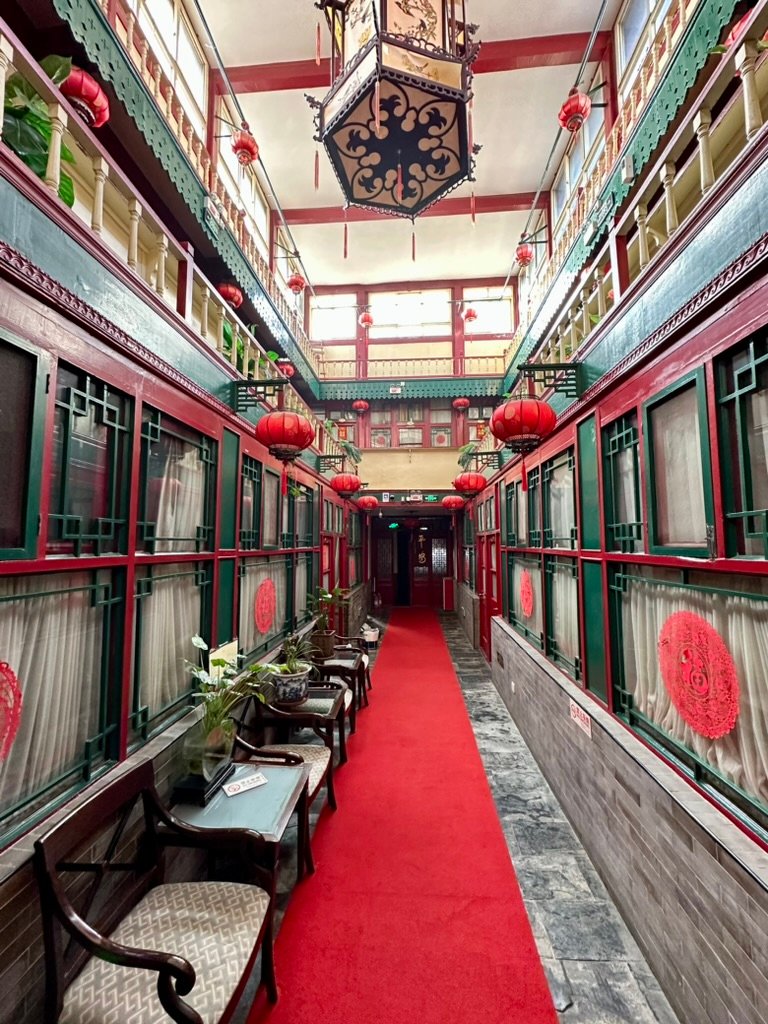
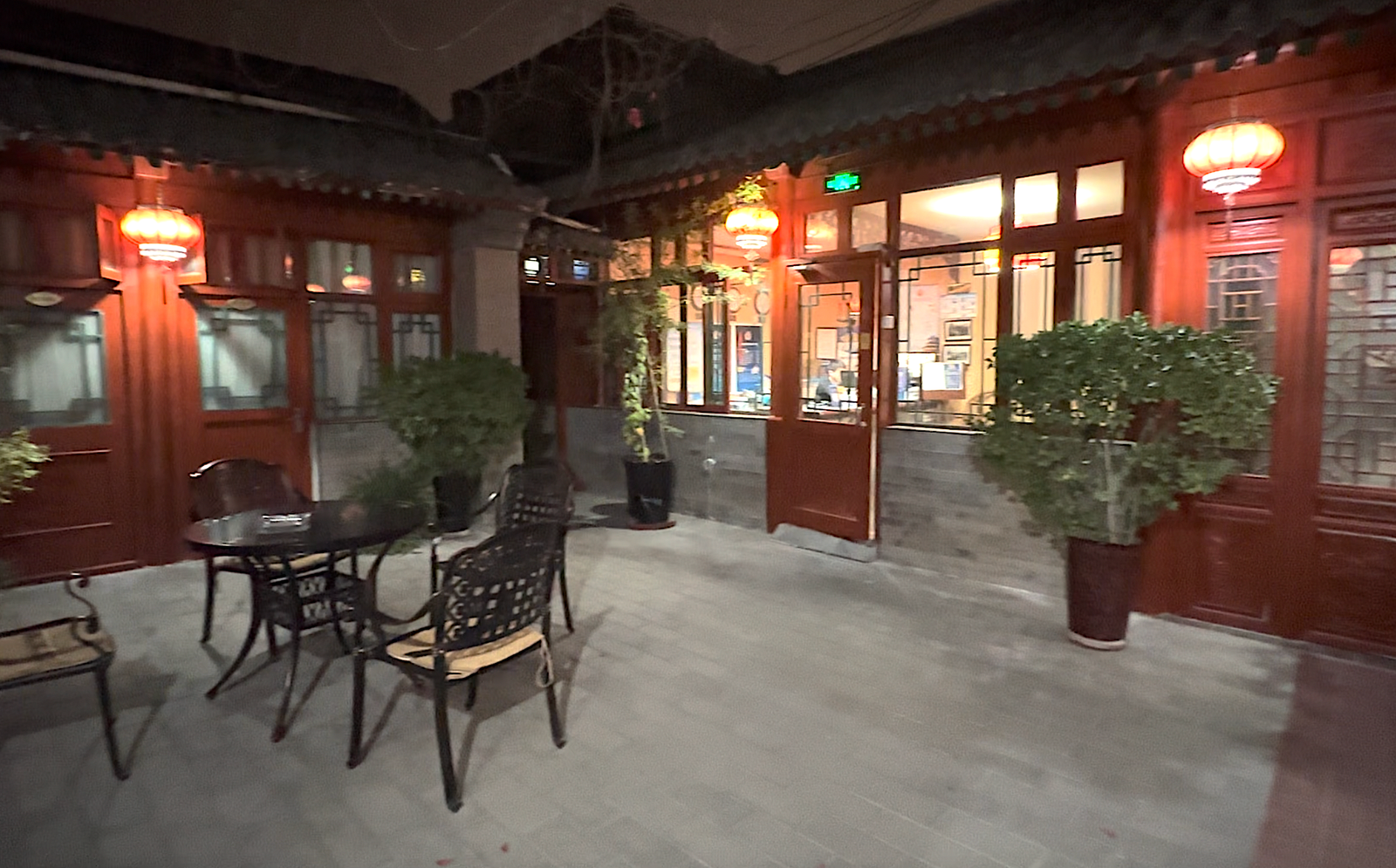
This is what greeted us.
Red.
Green.
Lanterns hanging overhead.
Traditional-style wooden windows.
Chinese decorative details.
A long red carpet running through the middle.
And rooms facing inward toward the central space.
For a first-time international traveler, it certainly doesn’t feel like walking into another anonymous chain hotel.
And that was precisely why Dad had chosen it.
Look Up
One of our favorite things about this place was that there was always something to look at.
Red lanterns hung from the upper levels.
Decorative woodwork ran along the balconies.
A large traditional-style lantern dominated the space overhead.
Even walking from the entrance to our room felt different from walking down the corridor of an ordinary hotel.
🎥 Going Upstairs
This wasn’t a historical courtyard residence preserved exactly as it would have appeared centuries ago.
Nor were we pretending that sleeping here meant we were experiencing precisely how Beijing families traditionally lived.
It was accommodation designed with a strong traditional Chinese and courtyard-style atmosphere.
But for Elaine, that distinction didn’t make the experience meaningless.
Quite the opposite.
It gave us questions to ask.
What Is a Siheyuan 四合院?
One Chinese word is particularly useful when exploring Old Beijing:
四合院 — sìhéyuàn
A siheyuan (四合院) is a traditional Chinese courtyard residence, especially associated with historic Beijing.
四 (sì) means four.
合 (hé) carries the idea of joining or enclosing.
院 (yuàn) means courtyard.
Traditionally, buildings were arranged around a central courtyard, creating an inward-facing residential space.
And many of Beijing’s famous hutongs (胡同) developed as lanes running between these courtyard compounds.
So there’s a useful distinction for first-time visitors:
胡同 (hútòng) → the lane or alley
四合院 (sìhéyuàn) → the courtyard residence behind the walls
Our lodging gave Elaine a much more tangible sense of this courtyard idea than simply reading those words in a guidebook.
The Lobby Had Another Surprise
Then we explored the common area.
🎥 Look Around the Lobby With Us
Again, don’t rush through the video.
Look around.
The red lanterns.
Wooden furniture.
Chinese decorative elements.
Plants.
The courtyard-like arrangement.
And toward one side…
Guan Yu 关羽
Wait… Why Is Guan Yu 关羽 in Our Hotel?
While looking around the common area, Dad noticed something else.
A shrine dedicated to:
Guan Yu (关羽, Guān Yǔ)
International travelers may know Guan Yu as a famous general from the turbulent years at the end of the Han Dynasty and the beginning of the Three Kingdoms (三国, Sānguó) period.
But in China, Guan Yu became much more than a historical military figure.
Over the centuries, he became particularly associated with:
忠 (zhōng) — loyalty
and
义 (yì) — righteousness
That’s one reason you may encounter Guan Yu shrines in Chinese businesses, restaurants, hotels and other places.
And there was another connection that made Dad smile.
We had actually traveled to Yuncheng (运城, Yùnchéng) in Shanxi — the region where Guan Yu was born.
So there we were in a hutong hotel in Beijing…
and another place from our travels through China had suddenly followed us into the lobby. 😂
🐇 Curious about Guan Yu? His story takes us far beyond this little shrine in Beijing — back to Yuncheng, where we followed Guan Yu, the legendary Emperor Shun, and China’s much older ideas about what makes a “good man.”
Follow our journey to Yuncheng: Shun, Guan Yu and China’s Ideas of the Good Man →
And Then We Stepped Outside
This was perhaps the most important part.
Our experience didn’t stop at the front door.
We were staying close to Qianmen Street, in the historic heart of Beijing.
That meant when we went outside, we could continue exploring on foot.
Old commercial streets.
Hutong lanes.
Traditional doors.
Local shops.
Restaurants.
Everyday neighborhood life.
And that made the accommodation part of the journey rather than simply somewhere we returned to at night.
That’s something Dad increasingly appreciates when choosing where we stay in China.
Sometimes the best hotel isn’t necessarily the most luxurious one.
It’s the one that puts you inside the story you’re trying to experience.
👧 Why Dad Chose This for Elaine
This is probably the most important part of this story.
Dad mentioned it briefly in the video.
This trip was also part of Elaine’s own educational journey through Beijing.
We could take her to the Forbidden City.
We could take her to museums.
We could explain emperors, dynasties and traditional architecture.
All useful.
But Dad also wanted Elaine to experience China by being inside it.
Walk through a hutong.
Notice how people live.
Look at the doors.
Eat the local food.
Hear the street in the morning.
And for a few nights…
sleep in the middle of Old Beijing.
That doesn’t replace learning history.
It gives the history somewhere to live.
📍 Why We Liked the Qianmen Location
For a first-time Beijing traveler, the broader Qianmen (前门) area has a major advantage:
you’re already in historic central Beijing.
Qianmen Street itself is a famous historic commercial street, and the surrounding area contains hutongs, shops, restaurants and traditional-style architecture.
That makes it particularly attractive if you want to spend part of your Beijing trip walking rather than constantly commuting between your hotel and the old city.
🚇 Useful Destination to Know
If you’re trying to reach the general area, the Chinese name to keep on your phone is:
前门 — Qianmen
And the main commercial street is:
前门大街 — Qianmen Dajie / Qianmen Street
🚕 Using DiDi
If your accommodation is inside a hutong, don’t assume the car can stop directly outside your door.
Some lanes are narrow or have vehicle restrictions.
Always enter the exact Chinese name and pin of your hotel into DiDi, rather than simply typing “Qianmen.”
If necessary, ask the hotel beforehand:
请问打车在哪里下车最方便?
Meaning:
Where is the most convenient place to get out of a taxi?
That can save you and your luggage from an unnecessarily confusing arrival.
Dad’s Tips Before Booking a Hutong Hotel
A traditional-style hutong stay can be wonderful.
But don’t book one simply because the photographs look romantic.
Check a few practical things first.
Location matters.
Look at the actual map position, not just “Qianmen” or “hutong” in the property description.
Check whether the property accepts international guests.
We always recommend confirming this when booking accommodation in China.
Look at recent traveler photographs.
Especially the bathroom.
Yes, Dad checks toilets. 😂
Check for elevators.
Older or traditional-style properties may involve stairs, which matters if you’re carrying large luggage.
Ask where a DiDi can actually drop you.
Your hotel may be inside a lane where cars cannot conveniently reach the entrance.
Don’t expect international-chain facilities.
The reason to choose this kind of place is usually character and location rather than resort-style amenities.
And remember:
traditional-looking doesn’t necessarily mean historically original.
Enjoy the atmosphere without assuming every lantern, carving or piece of furniture has been sitting there since the Qing Dynasty. 😂
ChinaTravelBUG’s Take
Looking back, Dad doesn’t remember this stay because it was Beijing’s fanciest hotel.
It wasn’t.
We remember it because it belonged to the trip.
We weren’t sleeping in an anonymous room and then traveling to Old Beijing every morning.
We’d come back from exploring…
walk through the entrance…
pass beneath the red lanterns…
climb the stairs…
and we were still inside the atmosphere of the journey.
For Elaine especially, that’s what Dad wanted.
Not:
Today we studied Old Beijing. Now let’s return to the hotel.
But:
For a few days, this is where we’re living.
Of course, we were still visitors.
We weren’t pretending to be hutong residents.
But staying here gave Elaine another way to see, ask and understand the city around her.
And years later, that’s the part Dad values most.
Sometimes choosing where you stay isn’t just about finding a bed.
Sometimes the hotel itself becomes part of the education.
And part of the story. ❤️🐞