From Our Beijing Guides
Authentic local advice from the licensed Beijing guides we work with.
Quick Answer
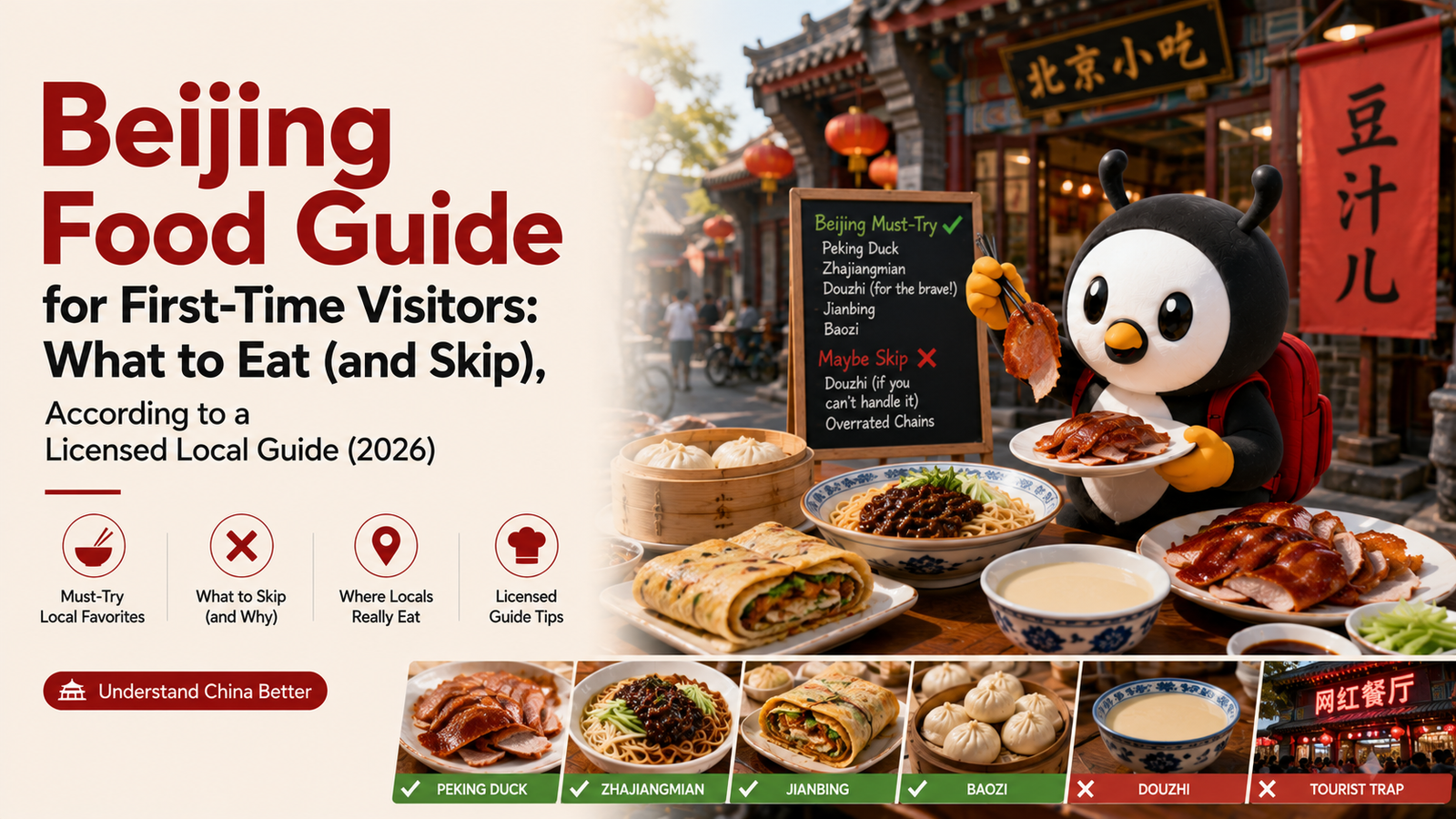
Peking Duck (北京烤鸭 Běijīng Kǎoyā) deserves its reputation—but don’t make the mistake of thinking it’s the only food Beijing is famous for.
According to the licensed Beijing guides we work with, many first-time visitors leave Beijing having tried only roast duck.
That’s a shame.
Beijing’s food culture includes hearty noodles, traditional breakfasts, Muslim cuisine, imperial desserts, street snacks and dishes that local families have enjoyed for generations.
If you only have three or four days in Beijing, here’s what our guide recommends eating—and a few tourist traps worth avoiding.
Why This Question Matters
Ask ten people what food you should eat in Beijing.
Nine will answer:
“Peking duck.”
They’re right.
But they’re also only scratching the surface.
Beijing’s cuisine has been shaped by more than 800 years as China’s imperial capital.
Emperors, merchants, soldiers, scholars and migrants from across China all left their mark on the city’s food.
According to our guide:
“If visitors only eat Peking duck, they’ve experienced one famous dish—not Beijing cuisine.”
What Is the One Dish You Tell Every Visitor to Try?
Without hesitation:
北京烤鸭 (Běijīng Kǎoyā) — Peking Duck
No surprises here.
But our guide encourages visitors to think beyond simply choosing a famous restaurant.
Instead, focus on the overall experience.
His favourite recommendations include:
- 四季民福 (Sìjì Mínfú)
- 大董 (Dà Dǒng)
- 便宜坊 (Biànyífāng)
Each offers a different interpretation of Beijing’s most famous dish.
(For a detailed comparison, see our guide: Is Quanjude Worth Visiting?)
What’s the Best Beijing Breakfast?
Our guide smiled.
“This is where visitors become adventurous.”
Some classic local breakfasts include:
包子 (Bāozi)
Steamed buns filled with pork, vegetables or mushrooms.
Simple.
Cheap.
Delicious.
煎饼 (Jiānbing)
Often called China’s favourite breakfast.
A thin savoury pancake cooked fresh with egg, crispy wonton crackers, herbs and sauces.
Perfect for eating on the go.
豆浆 (Dòujiāng)
Fresh soy milk.
Usually served with breakfast.
Often enjoyed alongside steamed buns or fried dough sticks.
油条 (Yóutiáo)
Long, golden fried dough.
Crispy outside.
Soft inside.
A traditional breakfast favourite.
Should You Try Douzhi?
Our guide laughed before answering.
豆汁 (Dòuzhī)
Probably Beijing’s most controversial drink.
Made from fermented mung beans, it has a strong sour aroma that divides opinion—even among Beijingers.
Some locals love it.
Others avoid it completely.
Our advice?
Try one small cup.
Even if you don’t enjoy it, you’ll have experienced one of Beijing’s oldest culinary traditions.
What’s the Most Underrated Beijing Dish?
Without hesitation:
炸酱面 (Zhájiàngmiàn)
Thick wheat noodles topped with minced pork cooked in savoury soybean paste.
Mixed together with cucumber and vegetables before eating.
It’s comfort food for many Beijing families.
Simple.
Filling.
Authentically local.
What Desserts Should Visitors Try?
Many travellers don’t realise Beijing has a rich tradition of snacks and desserts.
Our guide recommends:
驴打滚 (Lǘdǎgǔn)
Sticky rice rolls coated in soybean flour.
One of Beijing’s best-known traditional sweets.
豌豆黄 (Wāndòuhuáng)
A smooth pea-flour dessert once enjoyed by the Qing imperial court.
Light, refreshing and not overly sweet.
艾窝窝 (Àiwōwo)
Soft glutinous rice balls filled with sweet ingredients such as sesame, nuts or bean paste.
Where Do Local Families Eat?
Visitors often search for famous restaurants.
Local families often choose neighbourhood restaurants close to home.
Our guide’s advice is simple.
“If you see several generations eating together, it’s usually a good sign.”
Don’t be afraid to walk a few streets away from the biggest attractions.
You’ll often discover better value and a more relaxed atmosphere.
Which Foods Surprise Foreign Visitors Most?
Our guide listed several.
- 涮羊肉 (Shuàn Yángròu) — Beijing-style hotpot.
- 爆肚 (Bàodǔ) — Quickly cooked beef or lamb tripe.
- 卤煮火烧 (Lǔzhǔ Huǒshāo) — A traditional stew with pork offal and bread.
- 炒肝 (Chǎogān) — Thick liver stew.
Not everyone enjoys them.
But they’re undeniably part of traditional Beijing cuisine.
What Food Mistakes Do Tourists Often Make?
According to our guide:
Eating only at famous restaurants
Some of Beijing’s best meals come from ordinary neighbourhood restaurants.
Ordering too much
Chinese meals are designed for sharing.
Start with fewer dishes.
You can always order more.
Ignoring breakfast
Beijing’s breakfast culture is one of the city’s hidden delights.
Don’t sleep through it every day.
Being afraid to try unfamiliar food
You don’t need to love everything.
But trying something new is part of travelling.
Dad & Elaine’s Experience
One thing we’ve learned during our trips to Beijing is that our favourite meals are rarely the most expensive ones.
Sometimes it’s a bowl of 炸酱面 (Zhájiàngmiàn) after a long day exploring.
Sometimes it’s sharing 北京烤鸭 (Běijīng Kǎoyā) with new friends.
Sometimes it’s laughing together after bravely tasting 豆汁 (Dòuzhī) for the first time.
Food has a wonderful way of turning ordinary moments into lasting memories.
Travel Tips at a Glance
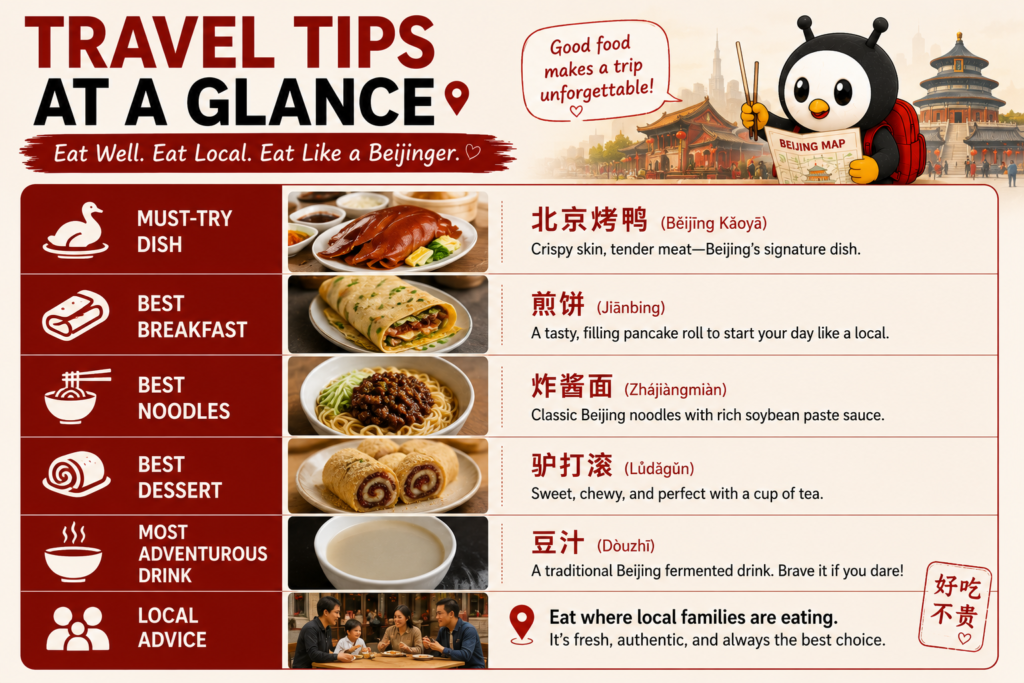
Must-try dish: 北京烤鸭 (Běijīng Kǎoyā)
Best breakfast: 煎饼 (Jiānbing)
Best noodles: 炸酱面 (Zhájiàngmiàn)
Best dessert: 驴打滚 (Lǘdǎgǔn)
Most adventurous drink: 豆汁 (Dòuzhī)
Local advice: Eat where local families are eating.
Understanding China Better
Why Do Chinese Meals Have So Many Shared Dishes?
In traditional Chinese culture, meals are about more than satisfying hunger.
Sharing dishes encourages conversation, hospitality and togetherness.
Rather than everyone ordering separately, friends and families usually place several dishes in the centre of the table and help themselves.
That’s why ordering one plate of food each often feels less “Chinese” than sharing a variety of dishes.
Understanding this custom makes dining in Beijing feel much more natural—and much more enjoyable.
Final Verdict
The best meals in Beijing aren’t always the ones listed in every guidebook.
Sometimes they’re found in a tiny noodle shop tucked inside a 胡同 (Hútòng).
Sometimes they’re shared around a busy family table.
And sometimes they’re discovered only because a local guide quietly says,
“Let’s eat here instead.”
If you’re willing to look beyond the city’s most famous dishes, you’ll discover that Beijing isn’t just a city with great food.
It’s a city that tells its history one meal at a time.
Continue Reading
This article is part of our From Our Beijing Guides series, where licensed local guides answer the questions foreign travellers ask most often while sharing authentic local knowledge that helps visitors experience 北京 (Běijīng) beyond the guidebooks.