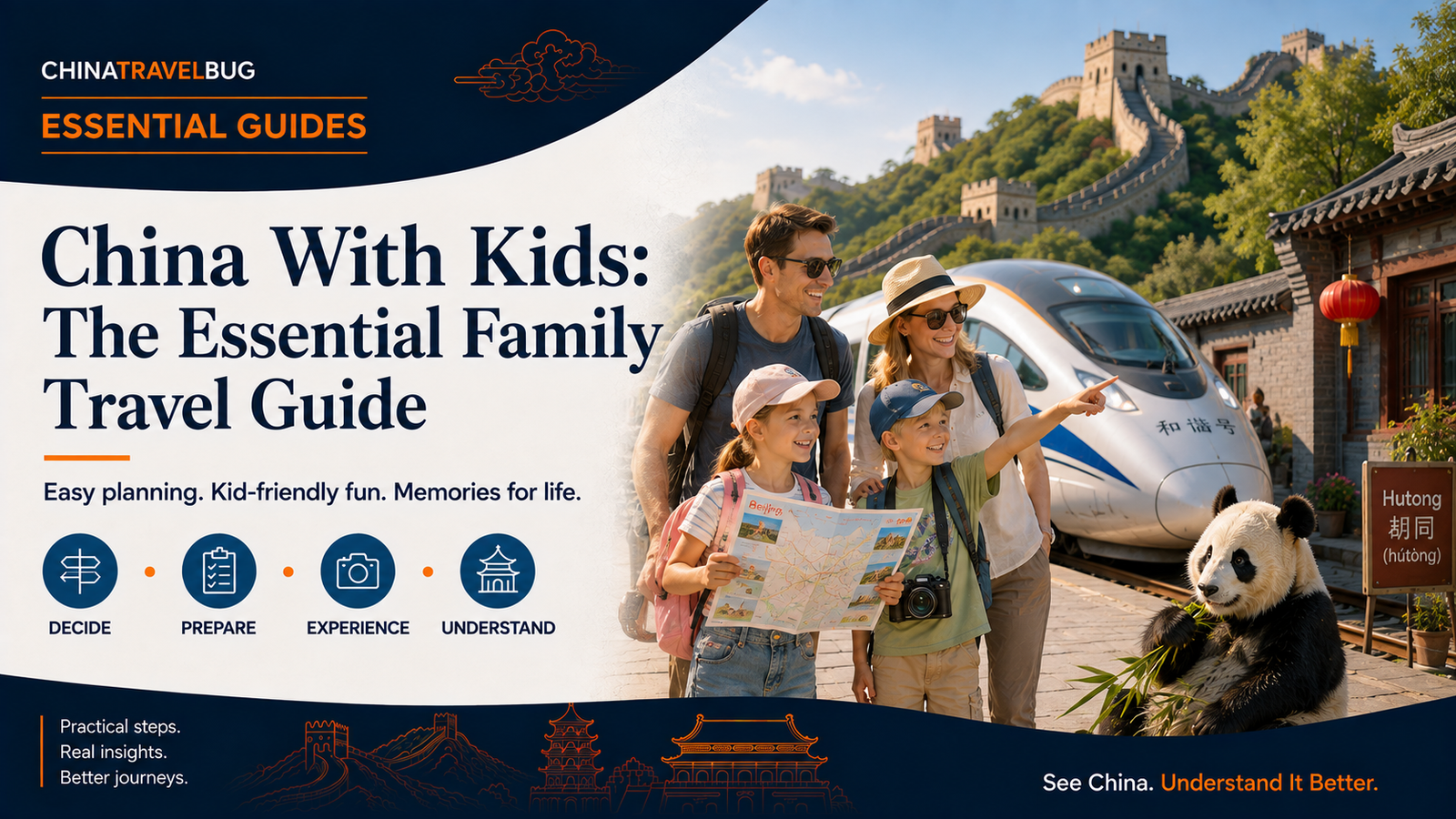
Is China a good destination for families?
Yes. China can be an excellent family destination, including for first-time visitors, if you keep the itinerary realistic.
High-speed trains make intercity travel comfortable, metros and DiDi simplify local transportation, family-friendly attractions range from pandas and the Great Wall to futuristic skylines and theme parks, and children can experience a culture very different from home.
The biggest challenge usually isn’t whether children can travel in China.
It’s whether the adults plan too much China.
ChinaTravelBUG family rule: Fewer hotel changes. Fewer exhausting days. More experiences everyone actually enjoys.
Quick Answer: Is China Easy to Travel With Children?
For many families, yes.
| Family concern | What to expect |
|---|---|
| Getting between cities | High-speed rail is extremely useful |
| Getting around cities | Metro + DiDi works well |
| Food | Huge variety, but picky eaters need some planning |
| Hotels | Choose location and room configuration carefully |
| Strollers | Useful in some places, awkward in others |
| Payments | Parents should prepare mobile payments and backups |
| Internet | Set up before arrival |
| Language | Translation apps + Chinese addresses help |
| Attractions | Excellent mix of history, animals, nature and modern China |
| Biggest risk | Trying to visit too many cities |
China is not automatically a difficult destination because you have children.
It becomes difficult when the itinerary is too ambitious.
Where Should Families Go on Their First Trip to China?
The best family destinations depend on your children’s ages and interests.
China Destinations for Families
| Destination | Particularly good for |
|---|---|
| Beijing 北京 (Běijīng) | Great Wall, imperial history, first-trip landmarks |
| Xi’an 西安 (Xī’ān) | Terracotta Warriors, history |
| Chengdu 成都 (Chéngdū) | Pandas, Sichuan culture, relaxed pace |
| Shanghai 上海 (Shànghǎi) | Modern China, skyline, family attractions |
| Guilin/Yangshuo 桂林/阳朔 | Landscapes and outdoor experiences |
| Zhangjiajie 张家界 | Dramatic scenery, older children who enjoy nature |
For many first-time families, you do not need all six.
A route such as:
Beijing → Xi’an → Chengdu
or:
Beijing → Xi’an → Shanghai
can already show children very different sides of China.
For the bigger destination decision, use Where Should You Go in China for Your First Trip? Best Places by Travel Style.
How Many Cities Should You Visit in China With Kids?
Usually fewer than you would attempt on an adult-only trip.
A sensible starting point is:
| Trip length | Family starting point |
|---|---|
| 7 days | 1–2 main bases |
| 10 days | 2–3 bases |
| 14 days | Around 3 bases |
| 21 days | Around 4 bases |
These aren’t rules.
A family with teenagers may move faster than one traveling with a two-year-old.
But every additional city means:
pack → check out → station/airport → travel → transfer → check in → unpack
That is the hidden cost of an ambitious family itinerary.
Our broader guide explains the principle: How Many Cities Should You Visit in China? A Realistic First-Trip Guide.
For a real family scenario, see What’s the Best 3-Week China Route With Two Kids Under 5? How to Reduce Long Travel Days — AI Travel Planner Answers.
The family pacing test
Ask:
Would we still choose this destination if changing cities took half a day?
Because sometimes it will.
Is China’s High-Speed Rail Good for Families?
Yes. High-speed rail — 高铁 (gāotiě) — can be one of the best ways for families to travel between Chinese cities.
Children can move more naturally than on a flight, families avoid part of the airport process, and China’s rail network connects many popular destinations.
Current railway rules base children’s discounted tickets on age rather than height:
- Children under 6 may travel free with a ticketed adult if they do not occupy a separate seat, subject to the applicable rules and declaration requirement.
- Children aged 6 to under 14 traveling with an adult require a child-discount ticket.
- Travelers aged 14 or above require a full-fare ticket.
Each ticketed adult may bring one eligible child under 6 free without a separate seat; additional eligible children require child tickets.
Children using discounted tickets and children declared for free travel must have the appropriate valid identity documentation under railway rules. A foreign passport is among the recognized documents for foreign children.
For the complete rail process, see China High-Speed Rail for Foreign Tourists: 2026 Guide.
Metro or DiDi: What’s Better With Children?
Use both.
Metro systems are excellent for crossing large Chinese cities without sitting in traffic.
DiDi 滴滴 (Dīdī) becomes especially useful when:
- children are tired;
- you have a stroller;
- you’re carrying luggage;
- the metro requires several transfers;
- or the destination isn’t near a station.
Family Transport Decision
| Situation | Start with |
|---|---|
| Cross-city trip in heavy traffic | Metro |
| Attraction beside station | Metro |
| Airport/station + luggage | DiDi / larger vehicle |
| Tired child after sightseeing | DiDi |
| Several metro transfers | Compare DiDi |
| Remote attraction | Driver/private transport may help |
For larger families, remember:
Vehicle seats ≠ vehicle luggage capacity.
Six people plus six large suitcases may require a larger vehicle or more than one car.
Should You Bring a Stroller to China?
For babies and younger children, a lightweight foldable stroller can be very useful—but don’t expect every attraction to be stroller-friendly.
A stroller can help in:
- airports;
- railway stations;
- shopping areas;
- modern city districts;
- and long urban sightseeing days.
It can be less convenient around:
- stairs;
- historic sites;
- uneven surfaces;
- mountain attractions;
- crowded areas;
- and routes involving repeated metro transfers.
Think about your actual itinerary, not simply your child’s age.
A compact stroller you can fold and carry is generally more versatile on a multi-city trip than something enormous.
How Should Families Choose Hotels in China?
Prioritize location before luxury.
A beautiful hotel that requires:
15-minute walk → metro → transfer → another walk
every morning may be less family-friendly than a simpler hotel five minutes from a useful metro station.
Check:
- room configuration;
- whether the setup genuinely fits your family;
- useful metro access;
- restaurants nearby;
- attraction travel time;
- railway/airport connections;
- and whether breakfast is useful for your children.
Foreign guest registration
Foreign travelers staying in Chinese hotels have their accommodation registration handled by the hotel under China’s entry-exit rules. If foreigners stay somewhere other than a hotel, accommodation registration requirements apply separately.
Since March 20, 2026, China has also been piloting online registration for foreigners staying outside hotels in Hebei, Liaoning, Zhejiang, Hubei, Guangxi, Chongqing and Sichuan, with broader rollout planned based on the pilot.
Looking for Affordable Hotels in China?
Dad & Elaine have personally used Trip.com many times when travelling across China and elsewhere — for hotels, flights, attractions and tours. We’ve had good experiences with it, so it’s one of the booking platforms we use ourselves.
🏨 Check hotels & current prices across China on Trip.com →
Affiliate link — ChinaTravelBUG may earn a small commission at no extra cost to you.
What If Your Children Are Picky Eaters?
Don’t panic.
“Chinese food” isn’t one cuisine.
China has enormous regional variety, and many children can find simple foods they enjoy.
Useful possibilities may include:
- rice;
- noodles;
- dumplings;
- buns;
- eggs;
- grilled meats;
- fruit;
- simple vegetable dishes;
- and familiar international options in larger cities.
But don’t make every meal a cultural test.
If your child needs something familiar occasionally, that’s fine.
A hungry, exhausted six-year-old is unlikely to become more culturally adventurous because Dad has declared dinner an educational experience. 😂
Use translation tools, photos and restaurant apps where useful.
And carry a few familiar snacks on long sightseeing and travel days.
What Should Parents Set Up on Their Phones?
At least one adult should have a reliable China travel setup before arrival.
That means:
- mobile payment;
- internet/eSIM/roaming;
- DiDi;
- maps/navigation;
- translation;
- railway information;
- hotel addresses;
- attraction reservations;
- and important confirmations.
Our 15 Essential Apps Every First-Time Visitor Should Install Before Flying to China is the practical starting point.
For connectivity, use Internet in China Made Easy.
For payments, see How to Use Alipay & WeChat Pay in China.
Don’t put everything on one parent’s phone
Where practical, give another adult access to essential information too.
If Dad’s phone dies, the entire family should not suddenly lose:
payments + hotel address + train details + DiDi + attraction tickets.
Redundancy is family travel insurance.
What Makes a China Attraction Good for Children?
Not every famous attraction needs to be on a family itinerary.
Think about experience, not prestige.
Children may remember:
- riding a cable car;
- seeing pandas;
- climbing the Great Wall;
- taking a 300 km/h train;
- eating dumplings;
- seeing Shanghai’s skyline;
- watching people dance in a park;
- or learning a few Chinese words
more vividly than the seventh historic building adults insist is “important.”
Mix:
history + animals + transport + food + nature + modern China + free time
rather than scheduling one monument after another.
That produces a much richer first encounter with China.
What Are the Biggest Mistakes Families Make in China?
| Mistake | Better approach |
|---|---|
| Too many cities | Fewer bases, longer stays |
| Adult-speed sightseeing | Reduce major activities |
| Ignoring transfer days | Count hotel-to-hotel time |
| Too much luggage | Pack for trains and hotel changes |
| Metro for every journey | Use DiDi strategically |
| No familiar food options | Mix adventure with easy meals |
| No downtime | Leave free evenings/slower mornings |
| Everything on one phone | Build digital backups |
The biggest is still:
too much itinerary.
China’s excellent transportation makes fast travel possible.
Children’s energy does not automatically upgrade at the same speed as the railway network.
A Simple 7-, 14- and 21-Day Family Framework
7 Days
Choose one region or two well-connected bases.
Don’t spend a seven-day trip crossing the country.
14 Days
Around three bases works beautifully for many families.
For example:
Beijing → Xi’an → Chengdu
21 Days
Around four bases can give families more variety without turning every few days into another transfer.
These are frameworks—not mandatory routes.
Choose destinations around your children and your interests, not someone else’s checklist.
Frequently Asked Questions About China With Kids
Is China suitable for young children?
Yes. Families travel successfully in China with babies, toddlers and young children. The younger the child, the more important realistic pacing, convenient hotels and fewer transfers become.
Is China good for teenagers?
Yes. High-speed rail, major cities, food, history, technology, landscapes and modern attractions can make China particularly interesting for teenagers.
Is high-speed rail easy with kids?
Generally, yes. China’s high-speed rail is a practical family transport option. Children’s ticket rules are age-based under current regulations.
Should families use trains or flights in China?
High-speed rail is often excellent for short and medium intercity journeys. Flights become more useful across very long distances. Compare the whole door-to-door journey.
Do children need passports for train travel?
Foreign children should have the appropriate valid identity document required for their ticket/travel status; foreign passports are recognized railway identity documents.
How many cities should a family visit in two weeks?
For many first-time families, around three main bases is a good starting point.
Is Beijing good with kids?
Yes. Beijing combines the Great Wall, imperial landmarks, parks, food and modern city experiences. But distances and attraction sizes mean families should avoid overloading each day.
Do we need a private guide?
Not necessarily. Families can travel independently, but a guide or driver can be valuable for selected experiences where logistics, historical interpretation or reduced walking/transfers make the day significantly easier.
The ChinaTravelBUG Family Rule
You don’t need to make China “child-friendly.”
You need to make your itinerary family-friendly.
Take the high-speed train.
See the pandas.
Climb part of the Great Wall.
Try something unfamiliar for lunch.
Let the children watch China through the train window.
But leave enough time to stop.
Enough time to eat.
Enough time to be tired.
Enough time to discover something that wasn’t on the itinerary.
The goal isn’t to show your children as much of China as possible.
It’s to give them a China trip they’ll actually remember.
Do less. Experience more.
ChinaTravelBUG Verification Note
Last verified: August 16, 2026
The time-sensitive family-travel information in this Essential Guide was checked against current official Chinese railway, government and National Immigration Administration information on August 16, 2026.
At the time of verification:
- China’s current railway rules use age rather than height for child discounts under real-name ticketing. Children aged 6 to under 14 traveling with an adult require child-discount tickets; travelers aged 14 or above require full-fare tickets.
- Each ticketed adult may bring one child under 6 free if that child does not occupy a separate seat; additional eligible children require child tickets. Free-travel children must be declared according to the applicable railway procedure.
- Under real-name railway ticketing, children using child tickets and declared free-travel children require applicable valid identity documentation. Official railway guidance recognizes foreign passports among valid documents for foreign children.
- Except for specified exceptions, children under 14 are required to travel with an adult under current railway passenger rules.
- Hotels in China handle accommodation registration for foreign guests. Foreigners staying outside hotels must comply with separate accommodation-registration requirements.
- From March 20, 2026, the National Immigration Administration began piloting online non-hotel accommodation registration in Hebei, Liaoning, Zhejiang, Hubei, Guangxi, Chongqing and Sichuan, while retaining offline registration channels.
Railway ticket rules, attraction reservation systems, transport arrangements and accommodation procedures can change. Families should verify time-sensitive information with the relevant official operator before travel.
One of the Travel Tools Dad & Elaine Actually Use
When Elaine and I travel around China, Trip.com is one of the platforms we genuinely use ourselves. Over our journeys together, we’ve used it to book hotels, flights, trains, attractions and tours — in China and elsewhere.
It has helped us many times while planning our trips, and we’ve had good experiences with it. So when friends or ChinaTravelBUG readers ask us “Where do you actually book?”, Trip.com is one of the places we’re comfortable recommending because we use it too.
✈️ 🏨 🚄 🎟️ Explore and plan your China trip on Trip.com →
Affiliate link — ChinaTravelBUG may earn a small commission at no extra cost to you.
Plan Your Family Trip to China
Not sure whether your family itinerary is too rushed, which cities fit your children’s ages, or whether another destination is worth the extra travel day?
The ChinaTravelBUG AI Travel Planner can help you build a route around your family’s actual number of days, interests and preferred pace.
Instead of asking:
“How much China can we fit in?”
ask:
“What kind of China trip will our family actually enjoy?”
Plan Your Perfect China Trip with the ChinaTravelBUG AI Travel Planner.