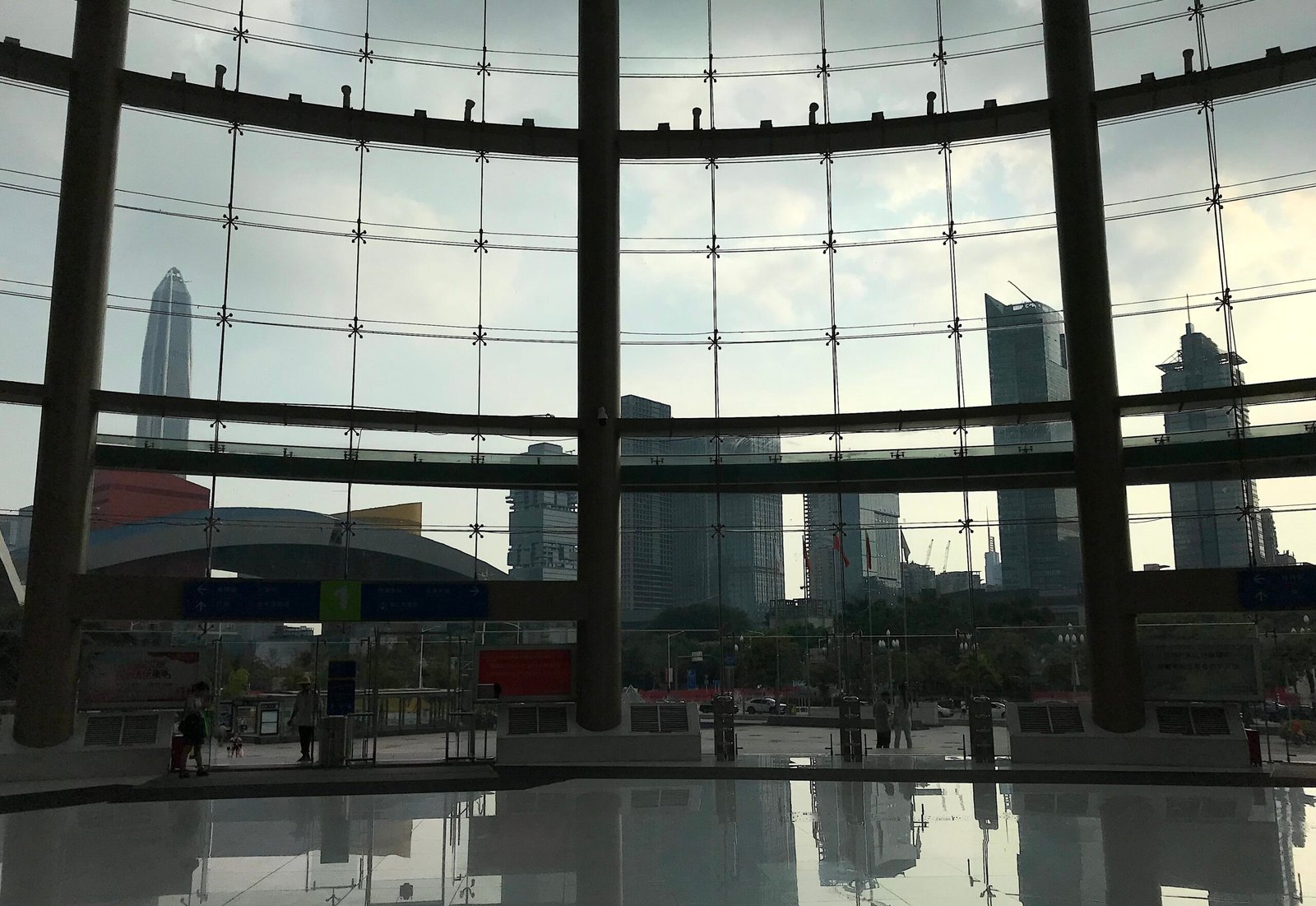
Shenzhen (深圳, Shēnzhèn) has been sitting inside Dad’s head for a long time.
Long before Dad and Elaine crossed over from Hong Kong for our recent half-day Shenzhen adventure…
Dad had already been trying to understand this city.
And, more importantly, Dad had already brought Elaine here to understand it too.
🐇
Because if you only look at Shenzhen today, you see the result:
Skyscrapers.
Metro lines.
Technology.
Shopping malls.
Bookstores.
Coffee shops.
Millions of people.
But Dad wanted to understand the question underneath all of that:
HOW DID SHENZHEN BECOME SHENZHEN?
And why did this extraordinary transformation happen right beside Hong Kong?
🐞 2013: DAD FIRST WENT LOOKING FOR THE ANSWER
In 2013, Dad visited the Shenzhen Reform and Opening-up History exhibition (深圳改革开放史) at Shenzhen Museum.
This wasn’t just another museum stop.
Dad photographed almost everything that made him stop and think.
Deng Xiaoping (邓小平).
Documents concerning the creation of Shenzhen.
The establishment of the Shenzhen Special Economic Zone.
Exhibits about foreign trade.
Quotations about markets.
Experimentation.
Opening to the outside world.
And a bull climbing upward beneath one wonderfully appropriate word:
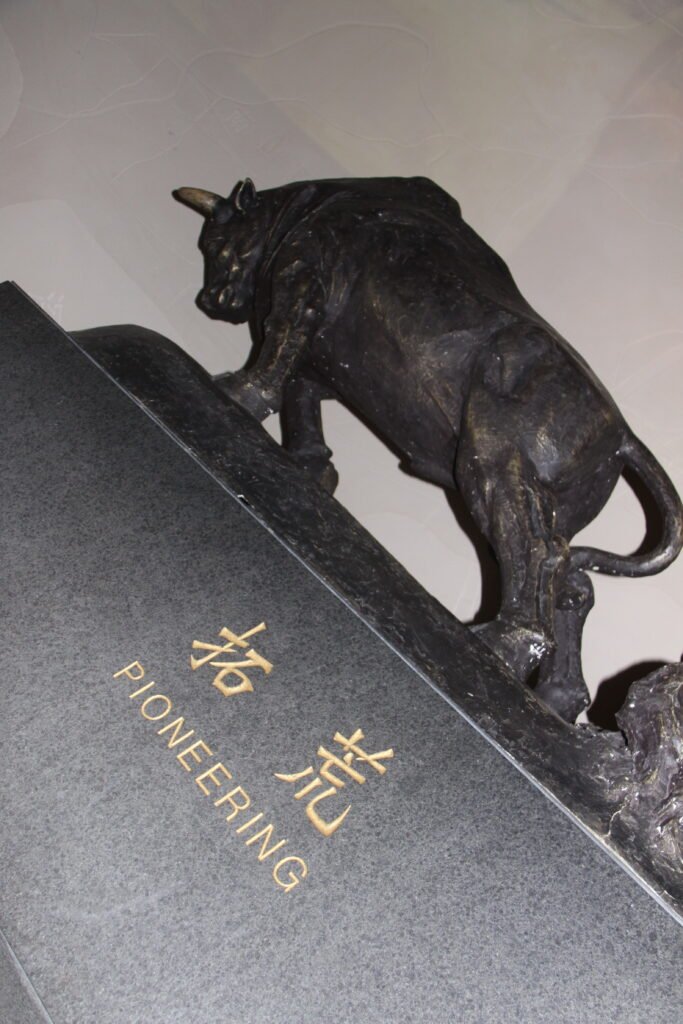
拓荒
PIONEERING
Dad was fascinated.
Because this wasn’t really a story about skyscrapers.
It was a story about an idea.
An experiment.
And what happened after China decided to try it.
📸 DAD MEETS DENG XIAOPING 😂
One of Dad’s photographs shows a huge image of Deng Xiaoping (邓小平) against the Shenzhen skyline.
Dad couldn’t resist.
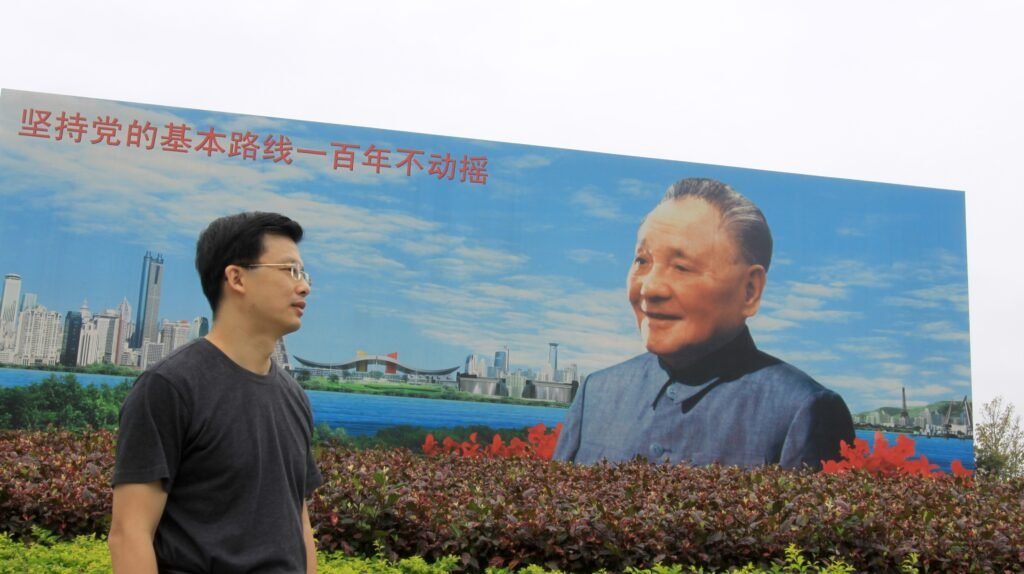
The Chinese words across the top read:
坚持党的基本路线一百年不动摇
A political slogan associated with Deng’s reform-era thinking about maintaining China’s basic policy direction.
But Dad wasn’t standing there because he wanted a photograph with a political slogan.
He was trying to understand something much more practical:
WHY IS DENG XIAOPING SO IMPORTANT TO THE STORY OF SHENZHEN?
That question would lead us all the way back to 1978.
👧 2018: THEN DAD BROUGHT 13-YEAR-OLD ELAINE BACK
Five years later, Dad returned to the same exhibition.
But this time…
Dad brought Elaine.
She was 13 years old.
And Dad deliberately brought her here because he wanted her to begin understanding the modern China she was seeing around her.
Not simply:
Look how modern Shenzhen is.
But:
HOW DID SHENZHEN BECOME THIS?
There is a big difference between those two questions.
Dad has always believed travel becomes much more interesting once you start asking the second one.
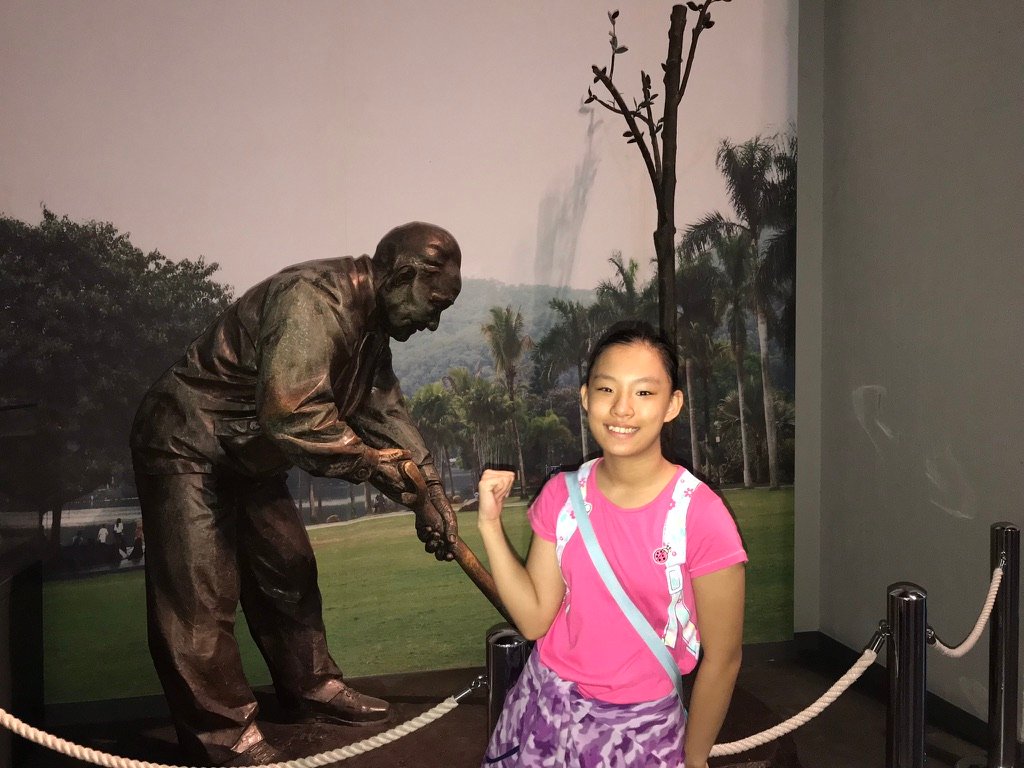
Look at that photograph.
Elaine is smiling beside a sculpture representing one of Shenzhen’s early builders.
At 13, she probably wasn’t standing there thinking about Special Economic Zones, foreign investment and economic experimentation quite as enthusiastically as Dad was.
😂
But that wasn’t really the point.
Dad was planting a seed.
SEE.
Someday…
ASK.
🏛️ DAD HIGHLY RECOMMENDS THIS EXHIBITION — BUT YOU CAN’T VISIT IT RIGHT NOW
There’s an important update for travelers.
The museum photographs throughout this article come from the Shenzhen Reform and Opening-up History (深圳改革开放史) exhibition that Dad visited in 2013 and then revisited with Elaine in 2018.
It opened in 2008 and spent 18 years telling Shenzhen’s Reform and Opening-up story through historical documents, photographs, objects, videos and reconstructed scenes.
It was an excellent place to begin understanding modern Shenzhen.
But as of 2026, the exhibition is temporarily closed.
Shenzhen Museum closed it from June 1, 2026 for a major upgrade of the exhibition and its facilities.
So:
DON’T GO EXPECTING TO SEE DAD’S EXACT EXHIBITION RIGHT NOW.
The museum has said the exhibition is being upgraded and is expected to return in a new form.
When it does…
DAD HIGHLY RECOMMENDS VISITING IT.
Especially if you’re the kind of traveler who wants to understand Shenzhen rather than simply photograph its skyline.
Because Shenzhen is one of those cities where learning the history changes what you see outside the museum afterward.
Walk through the story first.
Then step outside.
Look at the skyscrapers.
Ride the Metro.
Walk through Futian (福田, Fútián).
Watch people heading to work.
Visit Shenzhen Book City.
Look south toward Hong Kong.
Suddenly…
THE CITY MAKES MORE SENSE.
Check Shenzhen Museum’s current exhibition information before planning your visit.
2026: THEN DAD AND ELAINE CROSSED FROM HONG KONG INTO SHENZHEN AGAIN
Eight years after that museum visit together, Dad and Elaine returned to Shenzhen.
But this time the journey was completely different.
We were staying in Mong Kok (旺角), Kowloon (九龍).
Then one morning…
we crossed from Hong Kong into Mainland China for the day.
👉 Follow our actual Hong Kong-to-Shenzhen day crossover
Our Hong Kong base for this journey was Mong Kok:
👉 See why we stayed in Mong Kok (旺角), Kowloon (九龍)
And suddenly Dad realized something.
In 2013, Dad had studied Shenzhen’s transformation.
In 2018, Dad brought 13-year-old Elaine to learn the story.
In 2026…
WE WERE WALKING THROUGH THE RESULT.
Metro stations.
Restaurants.
Coffee shops.
Shopping.
Technology.
Young people.
Shenzhen Book City.
And, completely by accident, a packed literary event featuring a French author discussing artificial intelligence and creative writing.
😂
Three visits.
Three moments.
But really…
ONE CONTINUING SHENZHEN STORY.
NOW REWIND TO 1978
To understand what Dad was trying to show Elaine inside that museum, we have to rewind.
Not to 2013.
Not to 2000.
But to:
1978.
In December 1978, the Third Plenary Session of the 11th Central Committee marked a major change in China’s economic direction and the beginning of the period associated with Reform and Opening-up (改革开放, Gǎigé Kāifàng).
But announcing reform is one thing.
Actually implementing new ideas is another.
That creates a fascinating question:
WHERE DO YOU EXPERIMENT?
One answer would become Shenzhen.
📜 THEN CAME THE DOCUMENTS
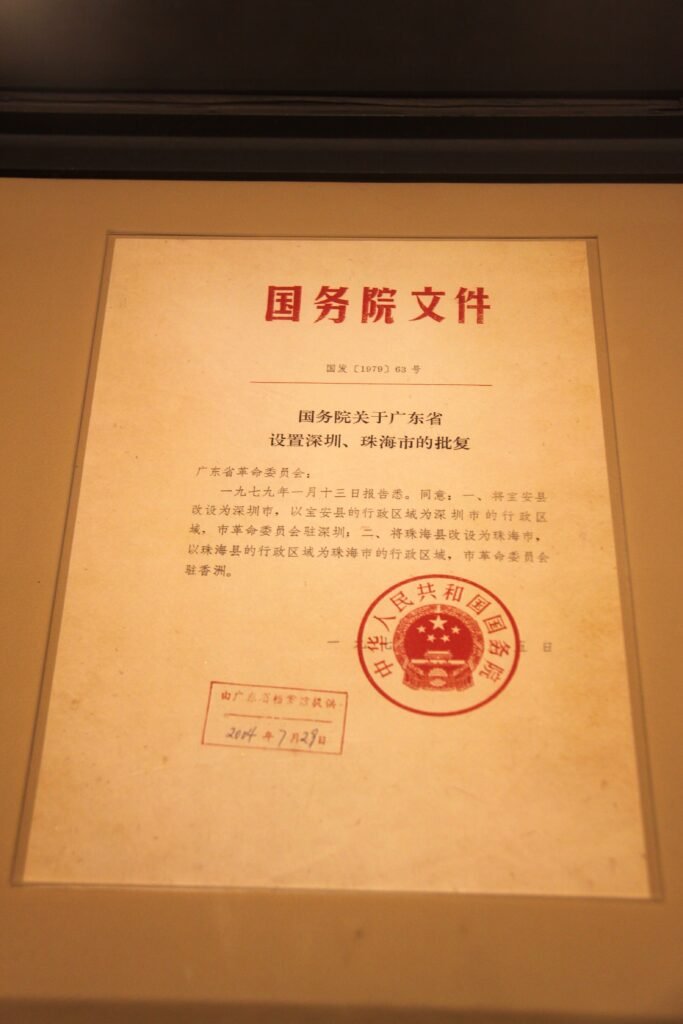
Among Dad’s museum photographs is a display of a 1979 State Council document concerning the establishment of Shenzhen and Zhuhai as cities.
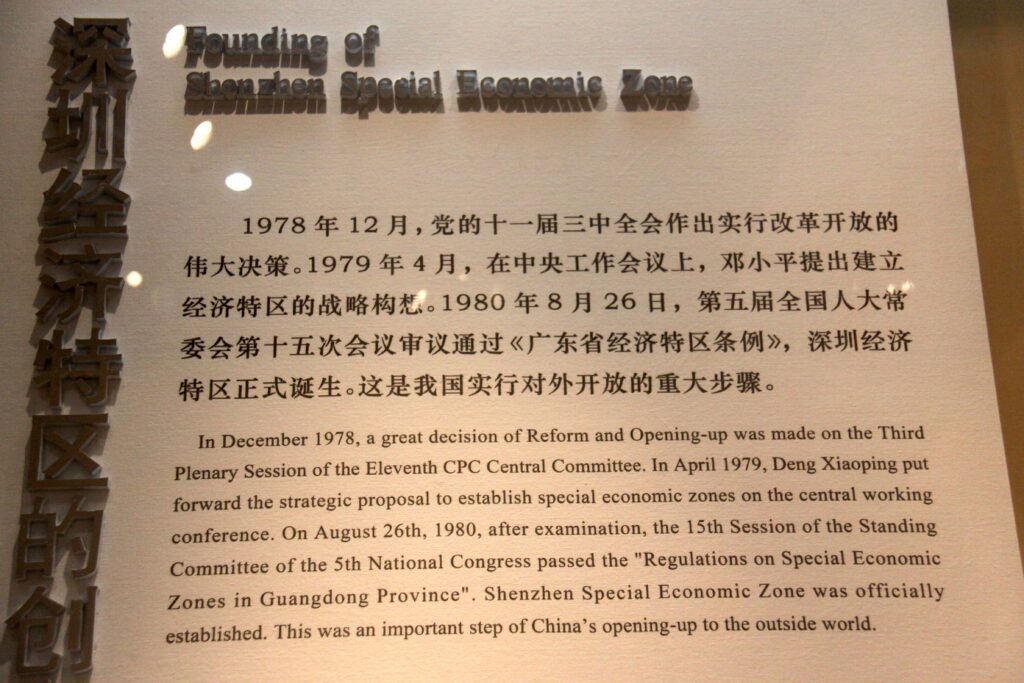
Another museum panel lays out the sequence that followed.
In 1979, proposals emerged for establishing special economic zones.
Then came the crucial date:
AUGUST 26, 1980.
China’s national legislature approved the establishment of Special Economic Zones in Shenzhen, Zhuhai, Shantou and Xiamen.
Shenzhen’s Special Economic Zone was born.
That date matters.
But Dad thinks the much more interesting question is:
WHAT EXACTLY WAS “SPECIAL”?
🧪 SHENZHEN BECAME AN EXPERIMENT
This is where Dad’s Political Science CPU switched on.
😂
The idea wasn’t simply:
Let’s build a new city.
The more interesting idea was:
LET’S TRY THINGS HERE.
Different approaches to investment.
Trade.
Enterprise.
Management.
Markets.
Foreign economic relationships.
Shenzhen became one of the places where new economic policies and institutional arrangements could be tested in practice.
And Dad’s museum photographs contain one quotation that captures this experimental mentality beautifully:
看准了的,就大胆地试,大胆地闯。深圳的重要经验就是敢闯。
In simple English:
Once you’ve decided something is right, try it boldly. Dare to venture. Shenzhen’s important experience was daring to experiment.
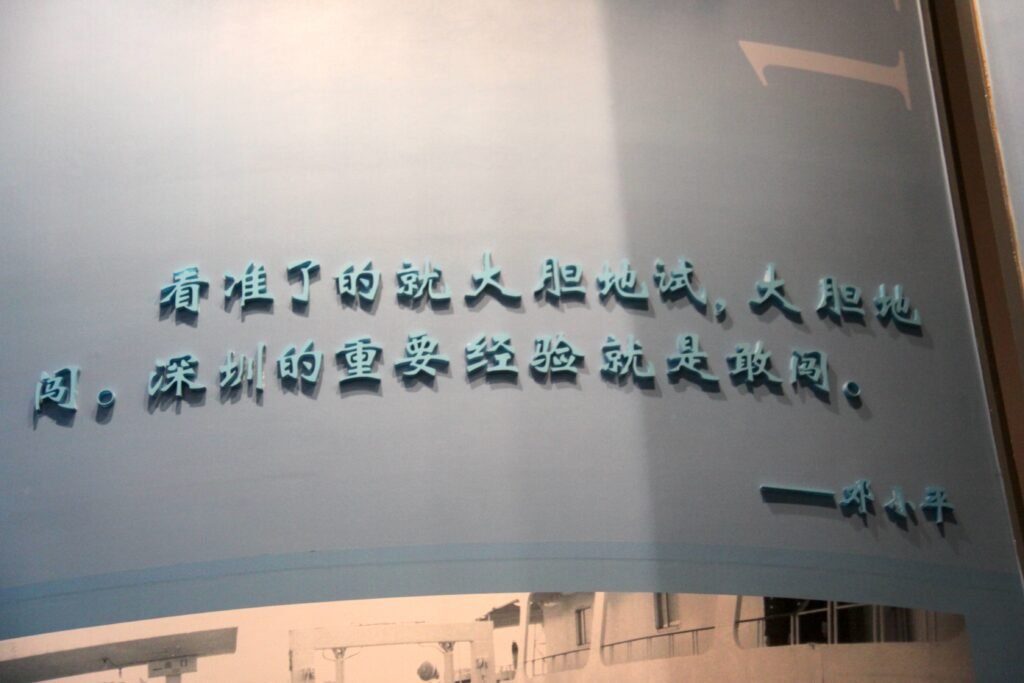
That may be one of the most useful sentences in this entire article.
Because:
SHENZHEN WASN’T ONLY A CITY.
SHENZHEN WAS AN EXPERIMENT.
🐂 THE PIONEERING BULL
Now Dad’s photograph of the bull starts making more sense.
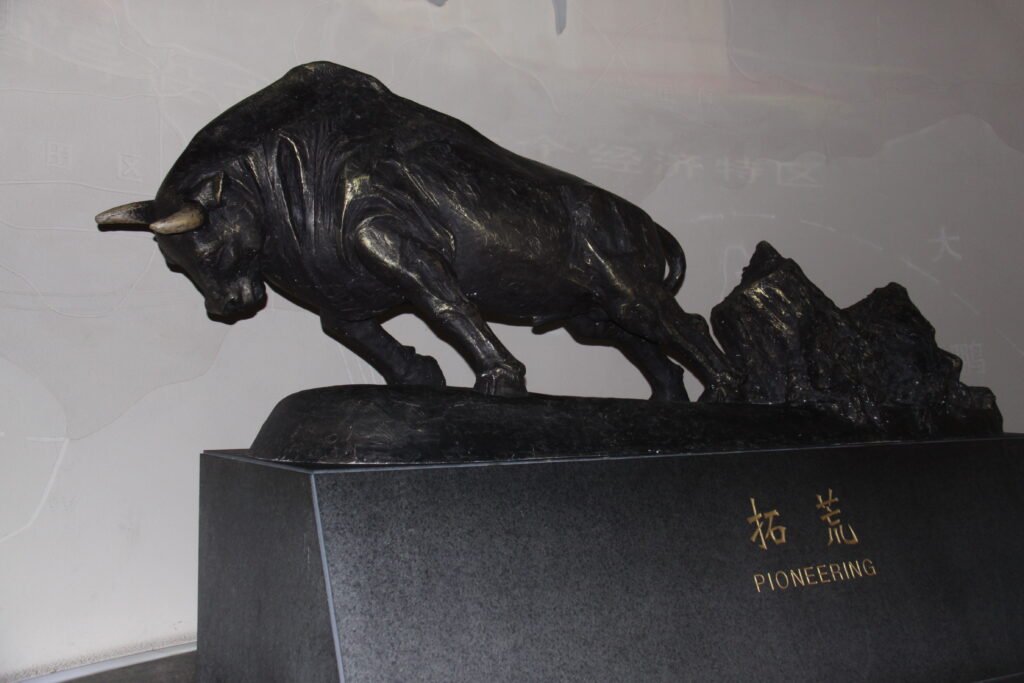
The word is:
拓荒 — PIONEERING
Trying.
Building.
Experimenting.
Opening.
Moving before everything was completely certain.
But this raises another question.
China is enormous.
There were countless places where an experiment could have been attempted.
So…
WHY SHENZHEN?
🪟 LOOK SOUTH.
There’s a giant clue immediately beside Shenzhen.
HONG KONG.
Shenzhen’s geography matters enormously.
Immediately across the boundary was Hong Kong — already a major international trading and financial center.
That meant proximity to:
capital,
international markets,
business networks,
manufacturing relationships,
management experience,
technology,
and people with connections to the wider world.
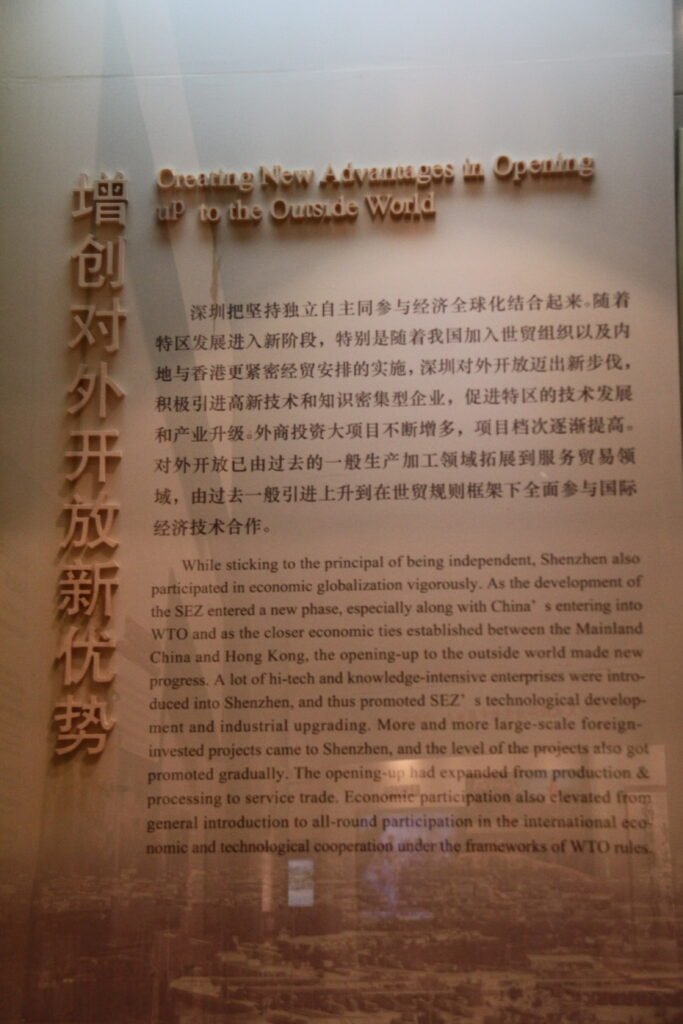
Guangdong also had deep historical links with overseas Chinese communities.
Put those pieces together and Shenzhen occupied an unusually interesting location for experimenting with greater economic openness.
Suddenly Dad and Elaine’s simple 2026 crossover from Hong Kong looks different.
We crossed in a few hours a boundary that had been hugely important to Shenzhen’s economic story.
🪟 “THE SPECIAL ZONE IS A WINDOW”
One of Dad’s photographs captures another Deng Xiaoping quotation:
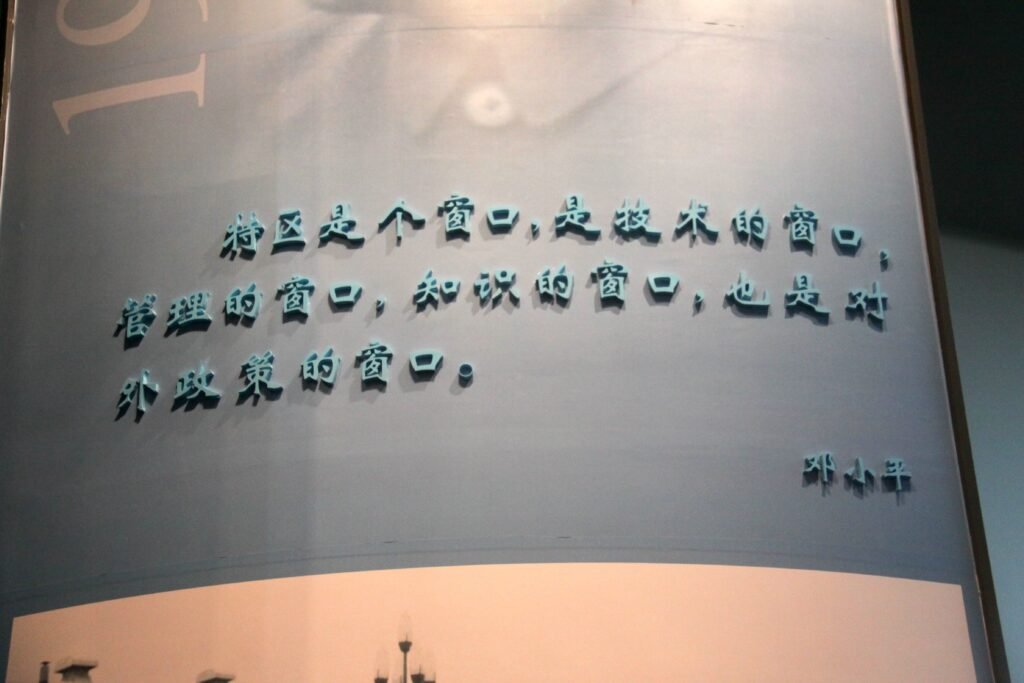
The Special Economic Zone was described as a window:
a window for technology,
a window for management,
a window for knowledge,
and a window for external policy.
That’s a wonderful metaphor for Shenzhen.
THE WINDOW ALLOWED CHINA TO LOOK OUT.
But it also allowed ideas, capital, technology and experience to come in.
And sitting immediately outside that window was…
Hong Kong.
🐇
🏗️ SO WHAT DID THE SHENZHEN EXPERIMENT ACTUALLY CHANGE?
This is where Dad’s old museum photographs become especially useful.
Because saying:
Shenzhen became a Special Economic Zone.
is easy.
But it doesn’t really explain what happened next.
The more interesting question is:
WHAT CHANGED ON THE GROUND?
Shenzhen became a place where China could test new approaches to economic development, foreign investment, trade, enterprise and urban construction.
Not everything happened at once.
Not every experiment succeeded.
And Shenzhen’s transformation wasn’t produced by one person, one policy or one year.
But something important had begun:
THE EXPERIMENT STARTED PRODUCING A CITY.
📸 FROM POLICY DOCUMENTS TO REAL CONSTRUCTION
Dad’s museum photographs show this transition beautifully.
First come the documents.
Policies.
Decisions.
Plans.
Then…
the photographs begin changing.
Construction sites appear.
Roads appear.
Factories appear.
Ports expand.
Buildings rise.
People arrive.
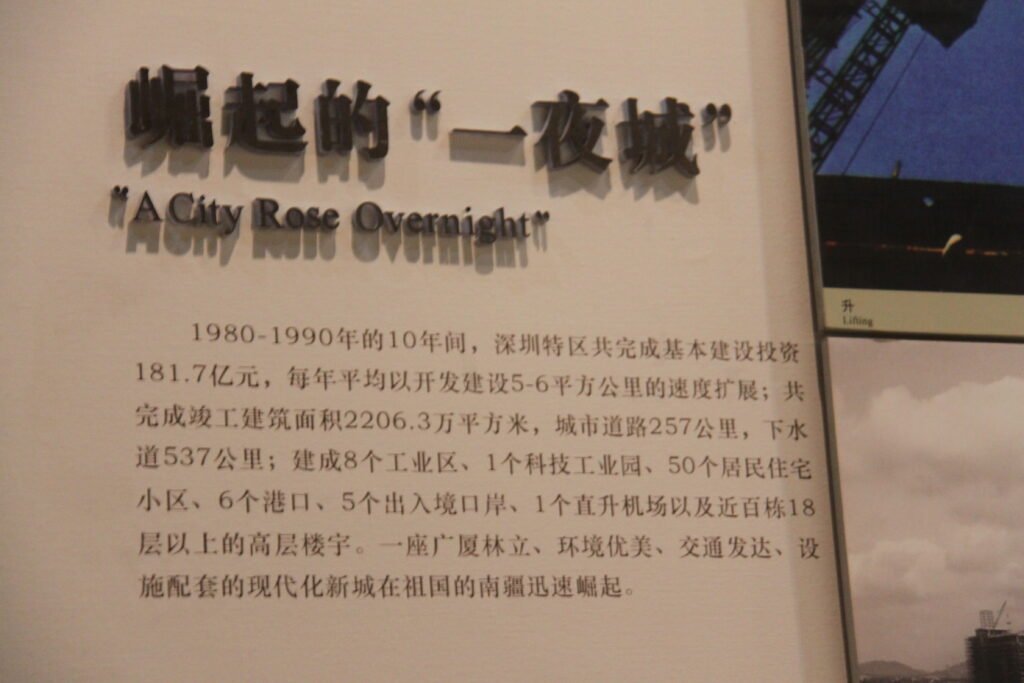
This is one reason Dad likes history museums.
A government document can look terribly boring.
😂
Until you realize that the next photograph shows what happened because of it.
PAPER → POLICY → PEOPLE → CITY.
👷 PEOPLE MAY BE THE MOST IMPORTANT PART OF THE STORY
Skyscrapers don’t build themselves.
Factories don’t operate themselves.
Technology companies don’t appear because somebody draws them on a master plan.
Shenzhen needed people.
Lots of them.
Workers.
Engineers.
Entrepreneurs.
Managers.
Technicians.
Students.
Researchers.
People from Guangdong.
And people arriving from across China.
Shenzhen’s rapid development became inseparable from migration.
The city increasingly attracted people who came looking for work, opportunity and the possibility of building something new.
That changed Shenzhen itself.
This wasn’t simply an old city becoming larger.
A huge part of modern Shenzhen was being created by people who had come from somewhere else.
And that helps explain something travelers may feel even today:
SHENZHEN FEELS YOUNG.
Not because the land has no history.
It does.
But because so much of the modern city’s identity was created during an extraordinary period of migration and economic transformation.
🐂 NOW DAD’S “PIONEERING” BULL MAKES EVEN MORE SENSE
Remember this?
Dad photographed it because he liked the symbolism.
But after walking through the rest of the exhibition, 拓荒 — pioneering starts to mean something more.
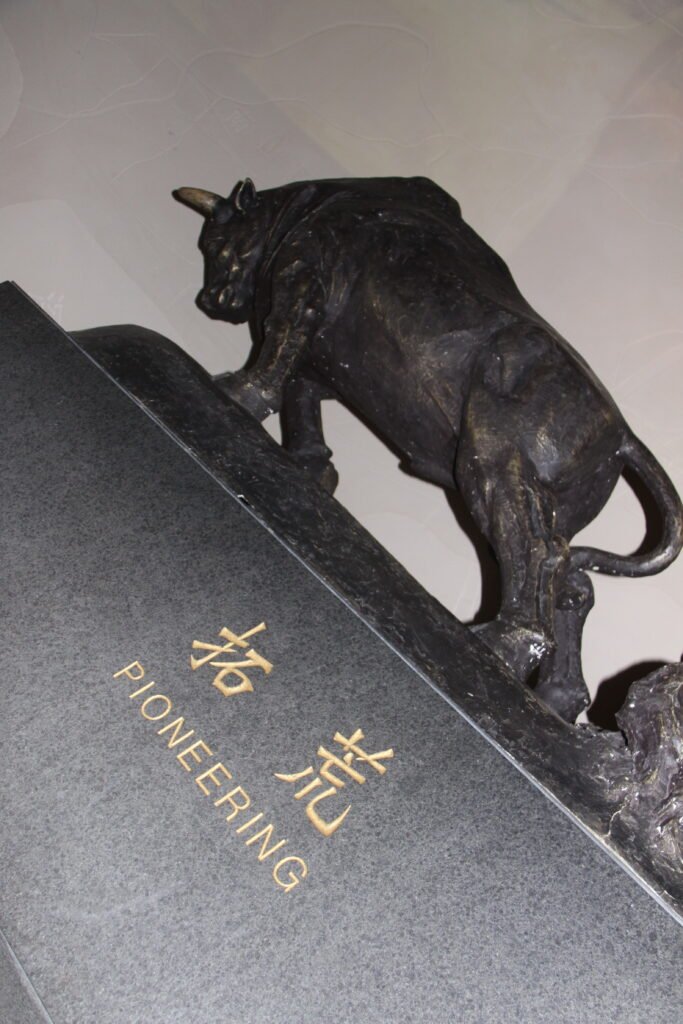
The pioneers weren’t only policymakers.
They were also the people who came.
The people who built.
The people who worked.
The people who started businesses.
The people who tried something.
The people who failed.
And the people who tried again.
Shenzhen’s story isn’t simply:
China decided to create a Special Economic Zone.
It is also:
MILLIONS OF INDIVIDUAL HUMAN DECISIONS FOLLOWED.
That is how policy becomes a city.
💰 THEN MONEY STARTED MOVING DIFFERENTLY
One of the fascinating themes running through Dad’s museum photographs is the changing role of markets.
Remember the Deng Xiaoping quotation Dad photographed:
市场经济不等于资本主义,社会主义也有市场。
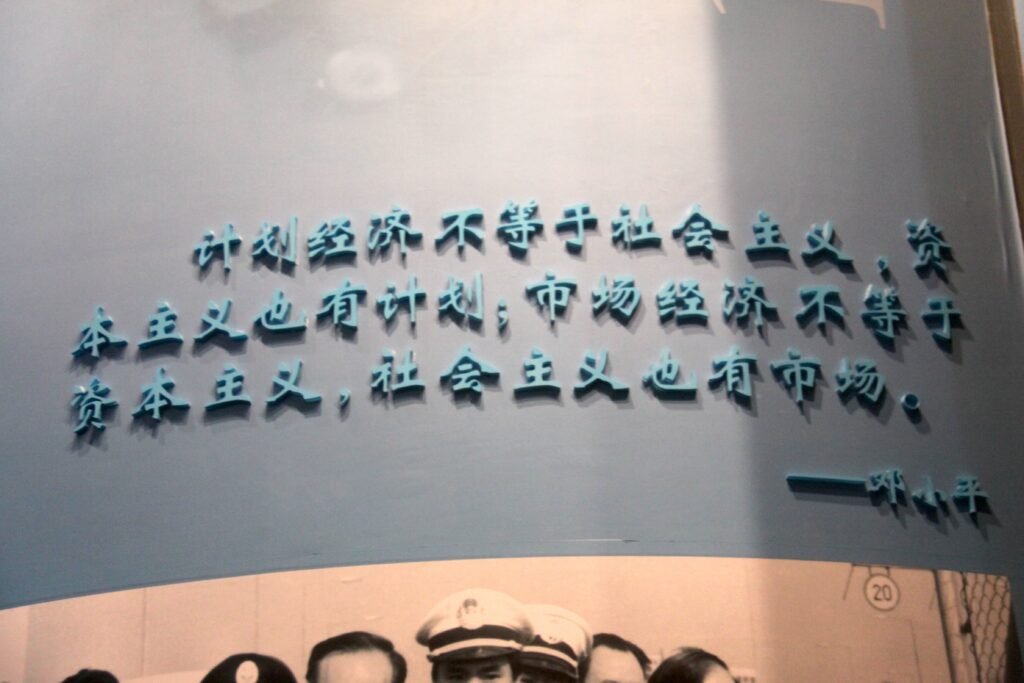
The important historical point isn’t to turn this article into an ideological debate.
😂
It’s to understand what Shenzhen was being used to test.
Could market mechanisms play a larger role?
Could foreign capital participate?
Could enterprises operate differently?
Could international trade expand?
Could new incentives encourage investment and production?
Shenzhen became one of the places where China explored those questions in practice.
And that meant something travelers sometimes miss when looking at Shenzhen today:
THE SKYSCRAPERS ARE THE VISIBLE PART.
The deeper transformation was happening in the rules, incentives, institutions and economic relationships underneath them.
🌍 HONG KONG WAS RIGHT THERE
And once again…
look south.
HONG KONG.
This geographic relationship keeps returning because it mattered.
Hong Kong was already deeply connected to international trade, finance and manufacturing networks.
Shenzhen was immediately across the boundary.
As China’s opening accelerated, economic connections between Hong Kong and the Pearl River Delta expanded substantially.
Capital moved.
Manufacturing relationships developed.
Business networks crossed the boundary.
Knowledge and management practices circulated.
Goods moved outward toward international markets.
And Shenzhen’s location gave it an enormous geographical advantage.
😂 THEN DAD AND ELAINE DID THE JOURNEY IN REVERSE
This is the part Dad loves.
Decades ago, Shenzhen’s proximity to Hong Kong helped shape the city’s development.
Then in 2026…
Dad and Elaine were sitting in Mong Kok (旺角), Kowloon (九龍) thinking:
Why don’t we cross over to Shenzhen today?
😂
So we did.
👉 From Hong Kong to Shenzhen: Dad and Elaine Crossed Into Mainland China for the Day
Our Hong Kong base was here:
👉 We Stayed in Hong Kong’s Mong Kok (旺角) So Elaine Could Wake Up to Everyday Kowloon (九龍)
We weren’t moving factories.
We weren’t carrying investment capital.
😂
We were two travelers crossing for half a day.
But physically making that journey gave Dad a much better sense of the geography he had been reading about for years.
Hong Kong and Shenzhen aren’t abstract dots on a map.
You can actually move between them.
And when you do…
the historical relationship suddenly becomes easier to visualize.
🏭 SHENZHEN BECAME A MANUFACTURING CITY
This was another major stage.
Factories multiplied.
Export-oriented production expanded.
Supply chains developed across the Pearl River Delta.
Shenzhen became associated with manufacturing on a scale that helped connect southern China much more deeply with the global economy.
For many outsiders, this became one of the dominant images of Shenzhen:
FACTORIES.
But stopping there creates another problem.
Because Shenzhen didn’t stop there either.
🐇
💻 FACTORY → TECHNOLOGY?
Now we reach another Shenzhen question.
How does a city associated with manufacturing become a city increasingly associated with:
technology,
electronics,
telecommunications,
research,
innovation,
software,
electric vehicles,
drones,
and some of China’s most internationally recognizable technology companies?
That’s not an overnight transformation either.
Manufacturing itself helped create capabilities.
Factories needed suppliers.
Suppliers needed engineers.
Engineers needed components.
Companies needed logistics.
Production required technical knowledge.
Supply chains became denser.
Skills accumulated.
Markets expanded.
And over time, parts of Shenzhen’s economy moved further into research, design, advanced manufacturing and technology.
So perhaps the Shenzhen story is better imagined as layers:
OPENING
↓
MANUFACTURING
↓
SUPPLY CHAINS
↓
SKILLS
↓
TECHNOLOGY
↓
INNOVATION
Not one replacing the other neatly.
But one layer helping create conditions for the next.
📱 THEN LOOK AT SHENZHEN TODAY
For many international travelers, modern Shenzhen is now associated with companies such as:
Huawei
Tencent
BYD
DJI
And with the enormous electronics ecosystem around places such as Huaqiangbei (华强北, Huáqiángběi).
But Dad doesn’t want this article to become:
10 BIG COMPANIES FROM SHENZHEN 😂
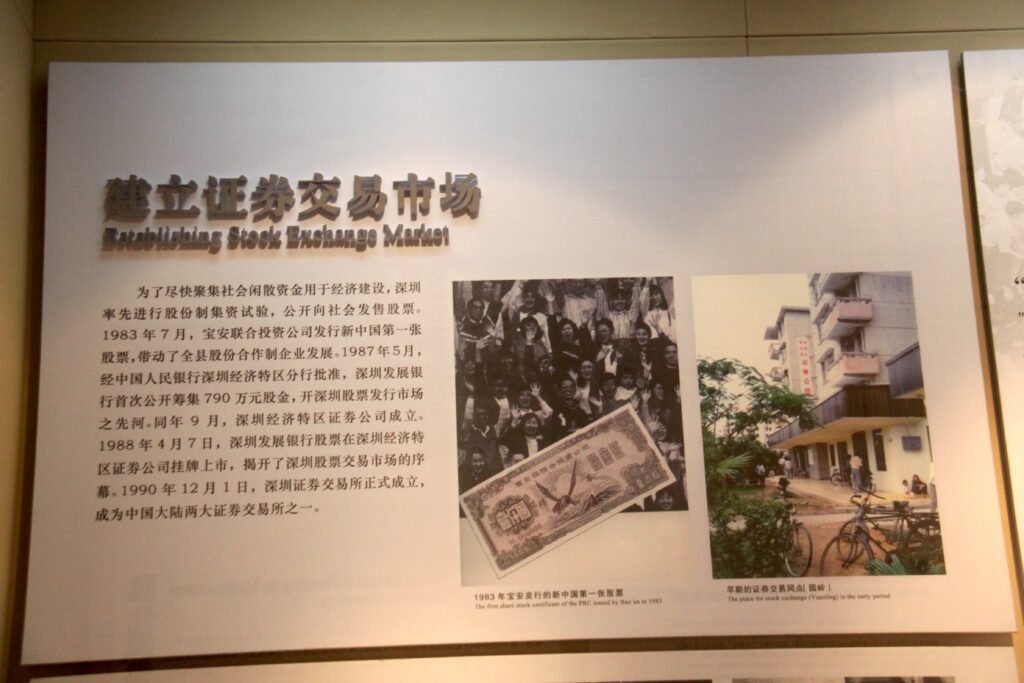
The more interesting question is:
WHY COULD COMPANIES LIKE THESE EMERGE HERE?
And now we can begin connecting the dots.
An experimental economic zone.
Proximity to Hong Kong.
Foreign trade.
Manufacturing.
Migration.
Supply chains.
Technical skills.
Capital.
Infrastructure.
Entrepreneurship.
Universities and research.
Decades of accumulated knowledge.
Suddenly today’s technology skyline doesn’t look quite so mysterious.
📚 AND THEN ELAINE TOOK DAD TO A BOOKSTORE
This is perhaps the funniest part of our Shenzhen story.
Dad had spent years thinking about:
Reform and Opening-up.
Special Economic Zones.
Deng Xiaoping.
Manufacturing.
Foreign investment.
Technology.
Elaine?
She wanted to go back to:
SHENZHEN BOOK CITY · CENTRAL CITY
深圳书城·中心城
😂
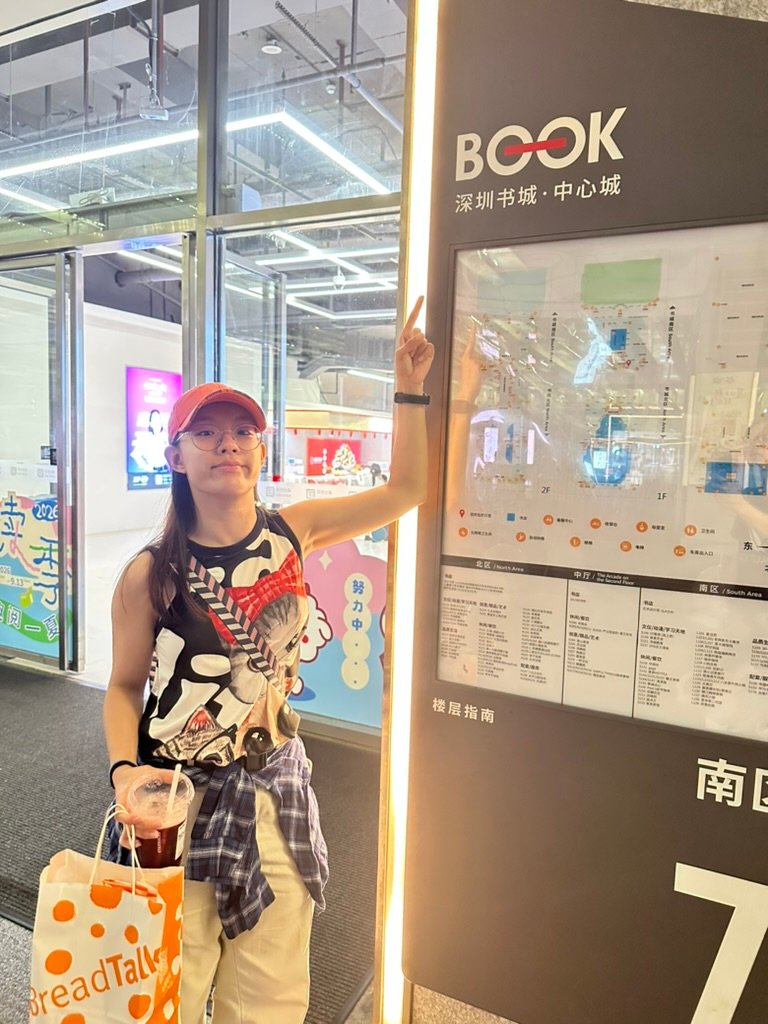
And perhaps Elaine accidentally gave Dad the perfect ending to the economic-history part of this story.
Because cities aren’t ultimately built just so GDP can increase.
People have to live in them.
☕ BOOKS. COFFEE. FOOD. PEOPLE.
Inside and around Shenzhen Book City we found more than shelves of books.
There were F&B outlets.
Coffee.
Places to sit.
People meeting.
People browsing.
People spending time.
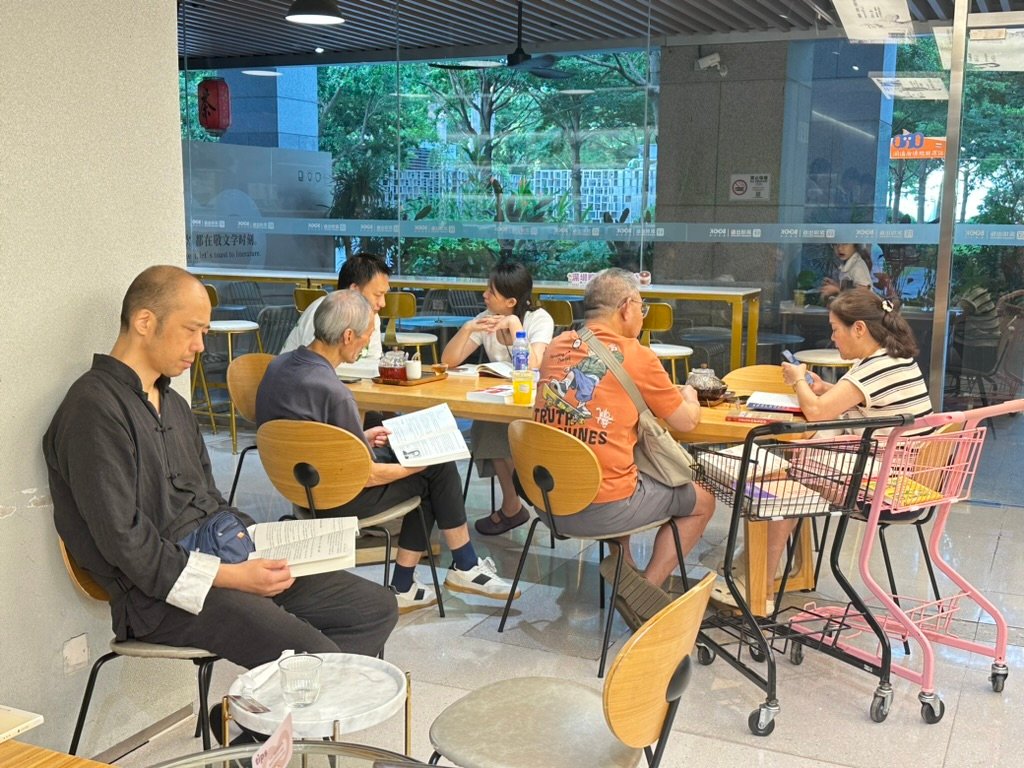
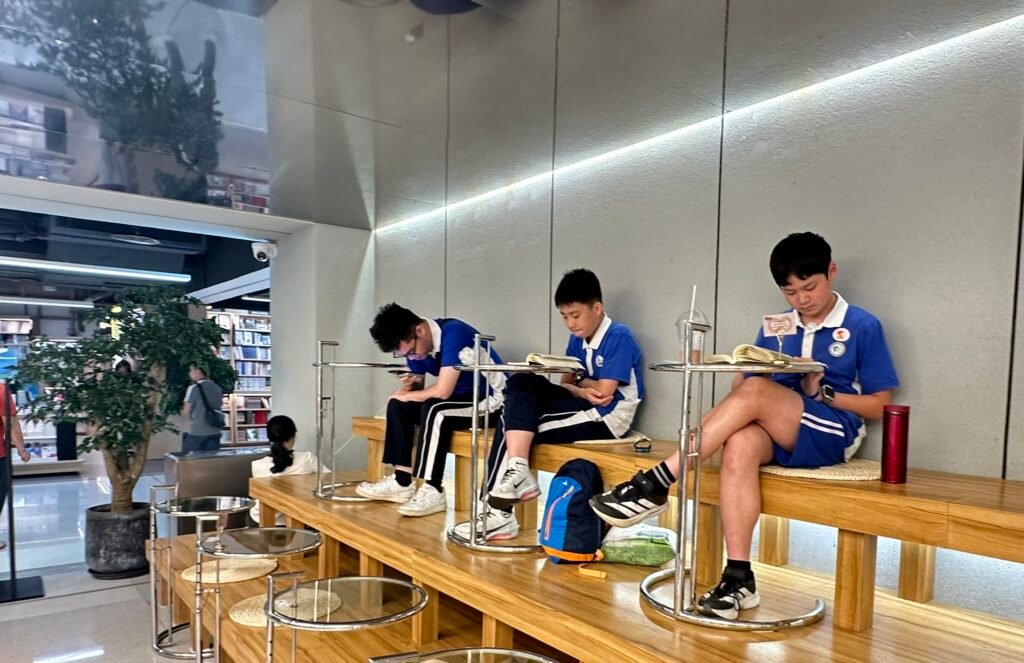
Then something unexpected happened.
We stumbled into a literary event.
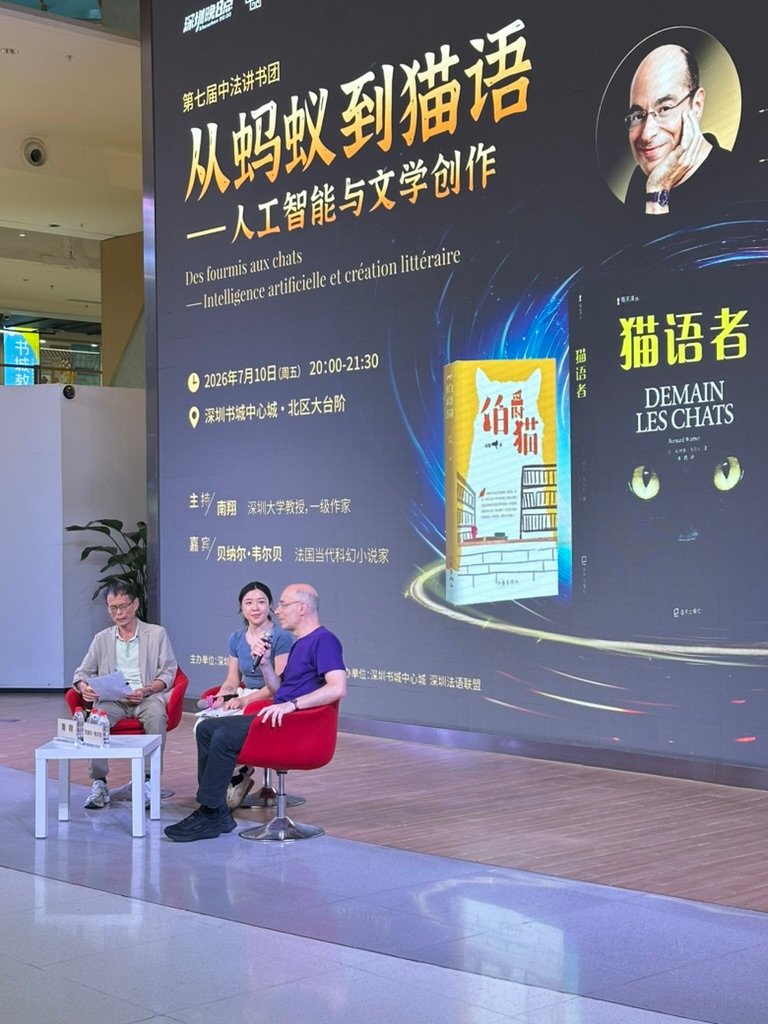
The event was part of the 7th Sino-French book-talk series.
The topic:
FROM ANTS TO CATS — ARTIFICIAL INTELLIGENCE AND LITERARY CREATION
The guest was French science-fiction writer Bernard Werber.
The host was writer and Shenzhen University professor Nan Xiang (南翔).
And the stepped seating area was packed.
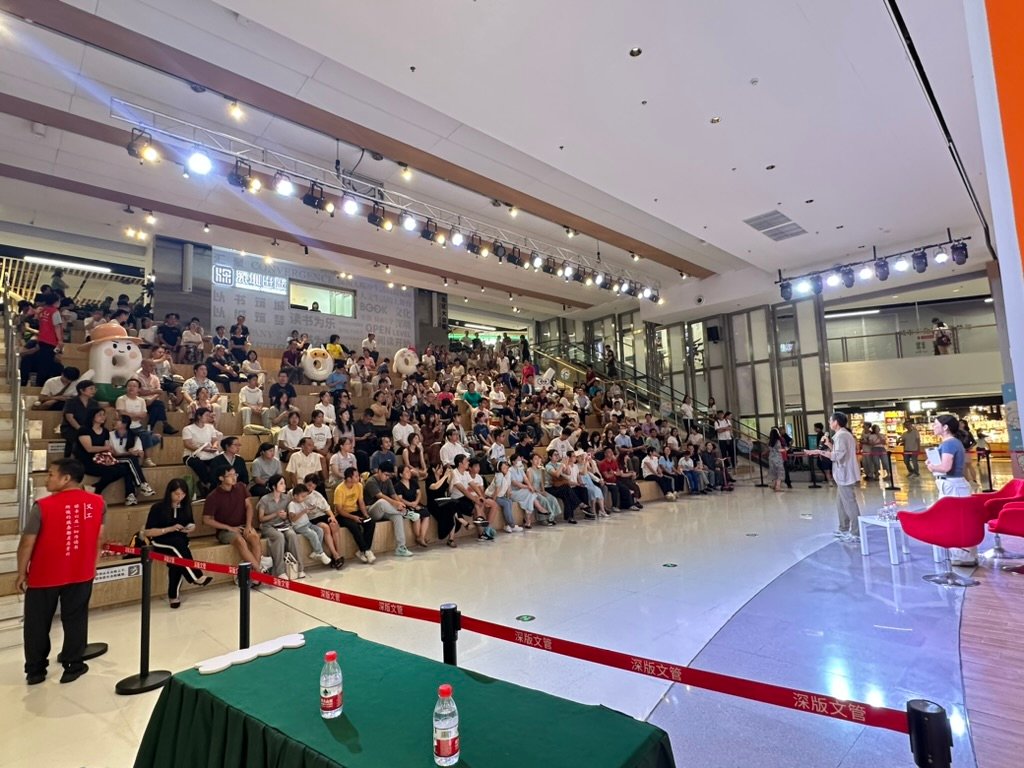
Dad stood there thinking…
Wait.
We came to Shenzhen to walk around for half a day.
Elaine wanted to visit a bookstore.
And somehow Dad had landed in a public discussion involving:
FRANCE + CHINA + SCIENCE FICTION + ARTIFICIAL INTELLIGENCE + LITERATURE.
😂🔥
Shenzhen had just opened another rabbit hole.
🐞 MAYBE THIS IS THE PART OF SHENZHEN STATISTICS DON’T SHOW
GDP can tell us the size of an economy.
Population figures can tell us how many people live there.
Company names can tell us something about industry.
Skyscrapers can show us physical development.
But none of those things completely tells us:
WHAT DOES THE CITY FEEL LIKE TO PEOPLE LIVING IN IT?
Dad’s museum photographs showed Shenzhen being built.
Elaine’s Book City visit showed people using the city that was built.
Reading.
Eating.
Drinking coffee.
Listening.
Discussing AI.
Spending an evening together.
That isn’t proof of some sweeping theory about Shenzhen.
It was simply what we encountered.
And that’s exactly why Dad remembers it.
🌃 THEN WE WALKED OUT INTO SHENZHEN AT NIGHT
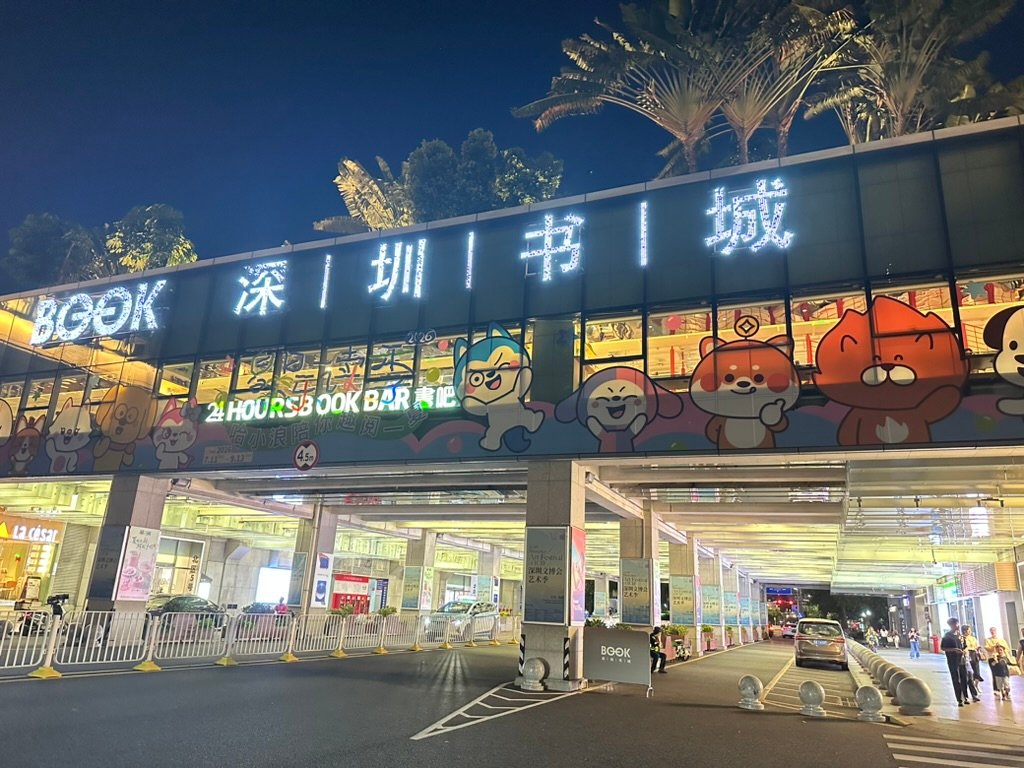
The illuminated sign said:
深圳书城
Shenzhen Book City.
Nearby:
24 HOURS BOOK BAR.
And Dad suddenly had a strange timeline sitting inside his head.
2013
Dad inside the museum, trying to understand how Shenzhen had changed.
↓
2018
Dad brings 13-year-old Elaine to the same exhibition.
↓
2026
Elaine brings Dad back to Shenzhen Book City.
😂
The teacher-student relationship may have become slightly confused.
And Dad rather likes it that way.
🌉 BUT SHENZHEN ISN’T AN ISLAND
By the time Dad and Elaine walked out of Shenzhen Book City · Central City (深圳书城·中心城, Shēnzhèn Shūchéng · Zhōngxīnchéng), another question had started bothering Dad.
😂
We had been looking at Shenzhen as a city.
But perhaps that was becoming too small a frame.
Because Shenzhen sits inside something much bigger.
THE GUANGDONG–HONG KONG–MACAO GREATER BAY AREA.
Or simply:
THE GBA.
⏱️ THE 30-SECOND GBA EXPLANATION
Here’s Dad’s traveler-friendly version.
The Guangdong–Hong Kong–Macao Greater Bay Area (粤港澳大湾区) brings together:
Hong Kong (香港)
Macao (澳门)
and nine Guangdong cities:
Guangzhou (广州, Guǎngzhōu)
Shenzhen (深圳, Shēnzhèn)
Zhuhai (珠海, Zhūhǎi)
Foshan (佛山, Fóshān)
Dongguan (东莞, Dōngguǎn)
Huizhou (惠州, Huìzhōu)
Zhongshan (中山, Zhōngshān)
Jiangmen (江门, Jiāngmén)
Zhaoqing (肇庆, Zhàoqìng)
11 CITIES.
But this does not mean they have somehow become one giant city.
Hong Kong and Macao remain Special Administrative Regions, while the other nine are cities in Guangdong Province.
The 2019 Outline Development Plan identifies Hong Kong, Macao, Guangzhou and Shenzhen as four core cities intended to serve as engines of regional development, while the other Guangdong cities are expected to develop complementary strengths.
The plan covers much more than transportation: innovation and technology, industry, logistics, finance, infrastructure, tourism and making it easier for people and economic activity to move around the region are all part of the larger picture.
That’s enough GBA for 30 seconds.
😂
Because this article is still about Shenzhen.
But once you understand the GBA…
SHENZHEN’S LOCATION STARTS LOOKING EVEN MORE IMPORTANT.
🗺️ AND DAD HAD ALREADY PHOTOGRAPHED A CLUE
Inside the old Shenzhen modern-history exhibition, Dad photographed this:
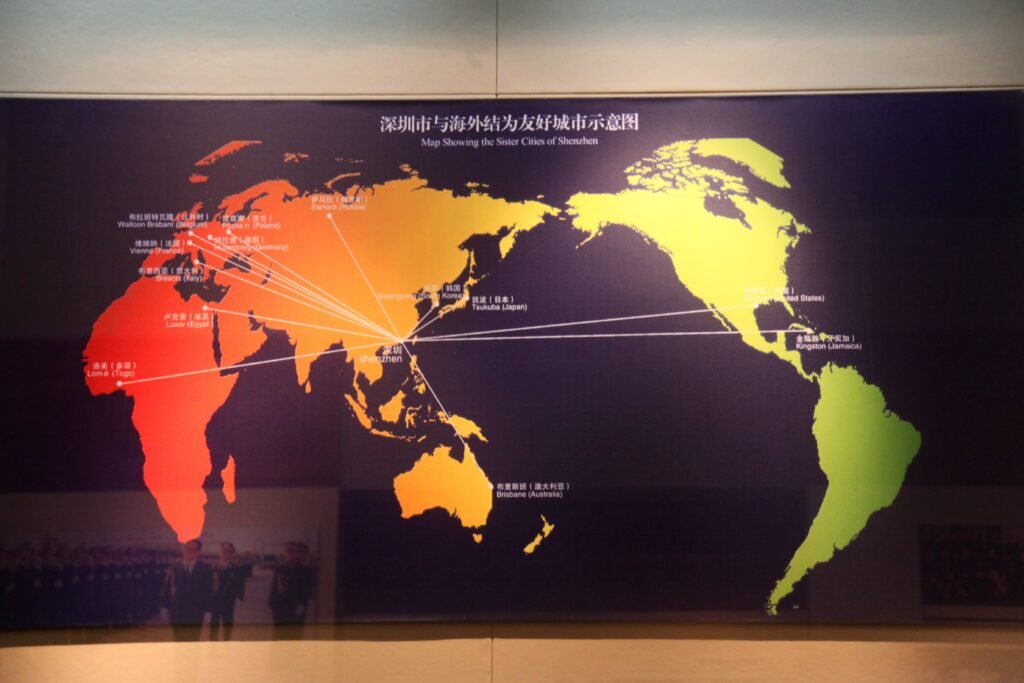
At first glance, it’s simply a museum display showing Shenzhen’s international sister-city connections.
But in the context of everything else in the exhibition, Dad now sees another theme running through it:
CONNECTION.
Shenzhen’s story wasn’t simply about building a city.
It was also about connecting that city outward.
To Hong Kong.
To international trade.
To foreign investment.
To manufacturers.
To markets.
And eventually to a much more interconnected Pearl River Delta.
One of Dad’s other museum photographs even carries the heading:
“EXPANDING FOREIGN TRADE”
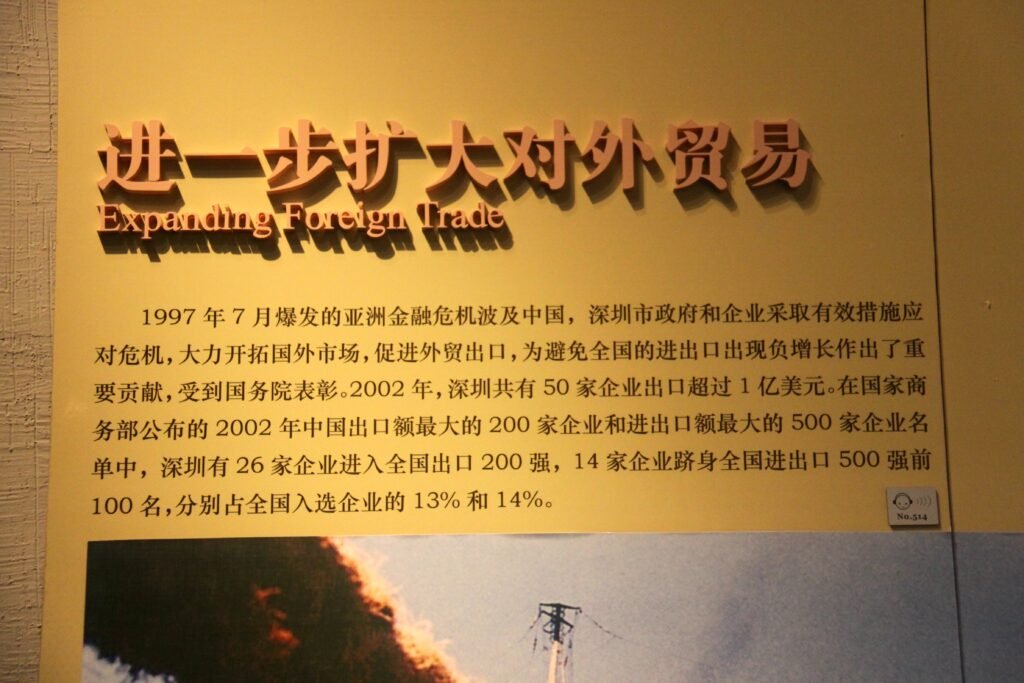
The panel describes Shenzhen’s efforts to expand exports and overseas markets around the period of the Asian Financial Crisis and afterward.
Again, the museum’s framing is its own.
But the historical direction Dad was seeing was unmistakable:
SHENZHEN WAS LOOKING OUTWARD.
🐇 THEN THE MAP GETS BIGGER
This is where Shenzhen becomes another CTB rabbit hole.
Look west from Shenzhen and you encounter Dongguan (东莞, Dōngguǎn) and eventually Guangzhou (广州, Guǎngzhōu).
Look across the Pearl River estuary and the wider regional picture brings in Zhongshan (中山, Zhōngshān), Zhuhai (珠海, Zhūhǎi) and Macao (澳门).
Then there are Foshan (佛山, Fóshān), Huizhou (惠州, Huìzhōu), Jiangmen (江门, Jiāngmén) and Zhaoqing (肇庆, Zhàoqìng).
The official GBA framework now puts all eleven cities into one regional development strategy.
And suddenly Dad’s little Hong Kong–Shenzhen day trip begins to look rather different.
😂 WAIT.
We had been staying in Mong Kok (旺角), Kowloon (九龍).
Then we crossed into Shenzhen.
Later Elaine suggested that instead of simply retracing our route…
WHY NOT TRY ANOTHER BORDER CROSSING?
So we eventually headed toward Huanggang Port (皇岗口岸, Huánggǎng Kǒu’àn).
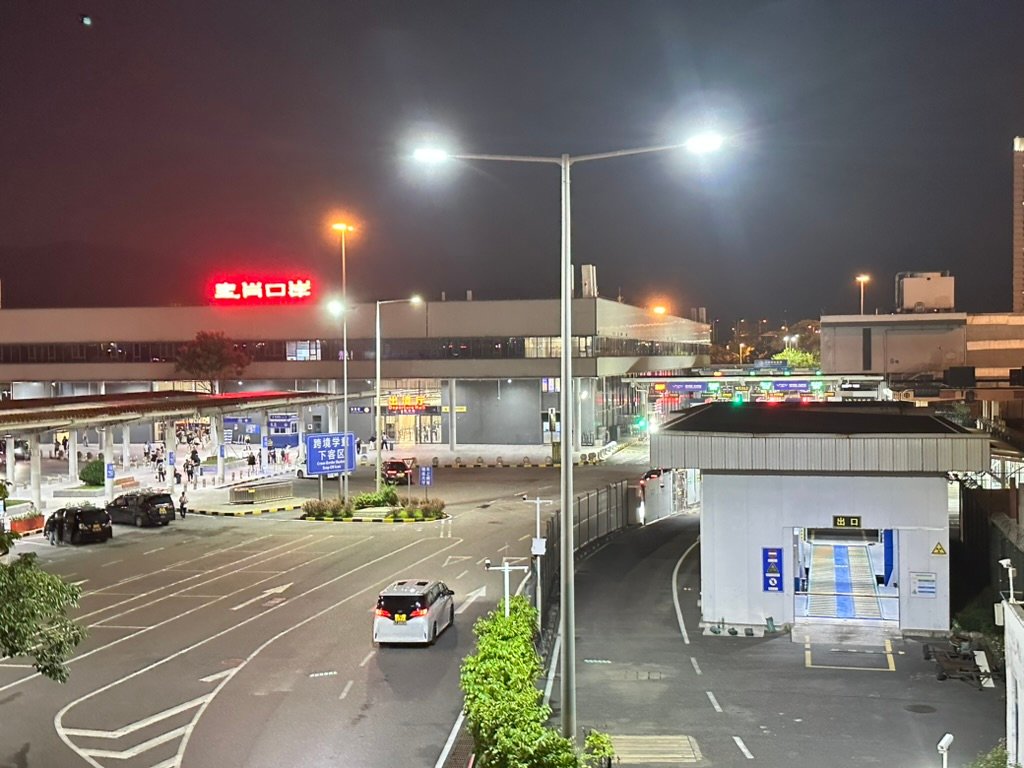
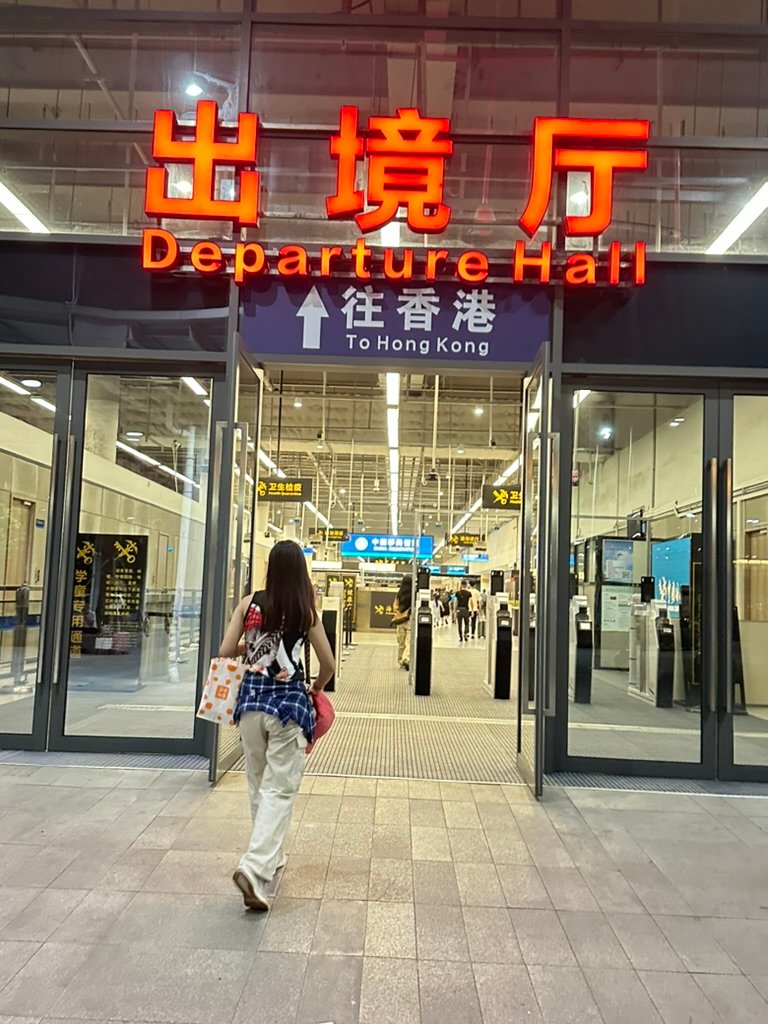
We completed the departure and border procedures…
then continued toward Hong Kong.
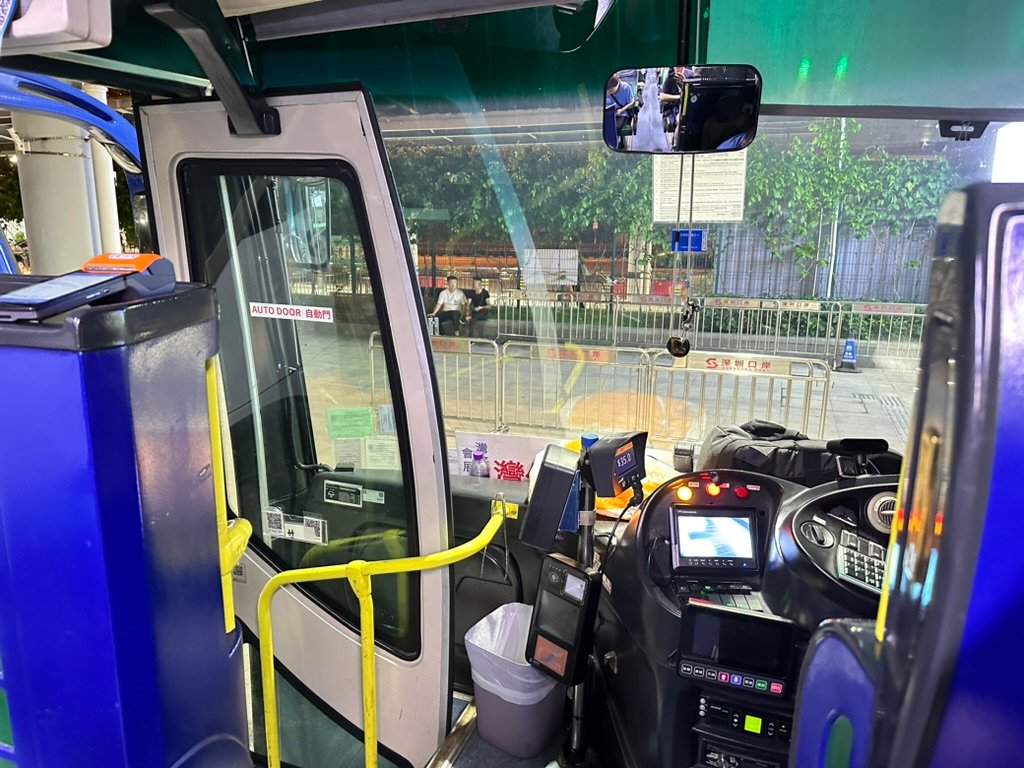
For us, it was simply another little travel experiment.
But Dad’s Political Science CPU had started overheating.
😂🔥
Because the day’s geography was becoming part of the story.
🧠 THE OLD SHENZHEN STORY WAS:
“HOW DID SHENZHEN DEVELOP SO FAST?”
But the newer question may be:
“WHAT HAPPENS WHEN SHENZHEN BECOMES MORE CONNECTED TO THE CITIES AROUND IT?”
That question is much bigger.
And Dad doesn’t want to pretend the answer is simple.
Different cities have different economic strengths.
Hong Kong and Macao have different institutional arrangements from mainland Guangdong.
Crossing between Hong Kong and Shenzhen is still a real boundary-crossing journey — as Dad and Elaine experienced ourselves.
So:
GBA ≠ ONE GIANT CITY.
That distinction matters.
The official development plan itself describes a network in which different cities retain different functions while becoming more connected through transport, economic cooperation and other forms of regional coordination.
Perhaps the better mental picture is:
A NETWORK OF CITIES.
🚄 AND THAT CHANGES THE TRAVELER’S MAP TOO
This is where DEEP China reconnects with ordinary travel.
A first-time visitor may think:
Hong Kong trip.
Then:
Maybe Shenzhen for a day.
Then someone says:
Guangzhou isn’t that far away either.
Then you notice:
Dongguan.
Foshan.
Zhuhai.
Macao.
Zhongshan.
🐇
Welcome back to the rabbit hole.
😂
The GBA doesn’t mean a traveler should try to collect eleven cities like Pokémon.
Please don’t.
But it does suggest a different way of imagining southern China:
NOT AS ISOLATED DESTINATIONS.
BUT AS A REGION YOU CAN BEGIN TO CONNECT.
🌉 AND DAD HAD ALREADY EXPERIENCED ANOTHER PIECE OF THIS
On another journey, Dad and Elaine traveled between Hong Kong (香港) and Macao (澳门).
Then we returned toward Hong Kong using the Hong Kong–Zhuhai–Macao Bridge (港珠澳大橋).
At one point Dad even managed to follow the wrong color toward Zhuhai (珠海, Zhūhǎi).
😂
That was funny at the time.
But there is actually a deeper idea hiding inside experiences like these.
INFRASTRUCTURE CHANGES WHAT PEOPLE CONSIDER “NEARBY.”
A bridge doesn’t physically move two cities closer together.
A railway doesn’t move them either.
But reduce the friction and travel time between places…
and the mental map changes.
Suddenly:
“That’s another city.”
can become:
“Could we go there tomorrow?”
🔥
That deserves its own DEEP China story.
SHENZHEN WAS OUR DOOR INTO THE BIGGER QUESTION
And perhaps that’s why this Shenzhen journey stayed with Dad.
We started with a simple day trip.
Hong Kong.
Border.
Shenzhen.
Museum memories.
Book City.
Coffee.
A French science-fiction author.
AI and literature.
Another border crossing.
Back to Mong Kok.
😂
But underneath that little journey were much bigger historical layers:
Reform and Opening-up.
↓
Special Economic Zone.
↓
Foreign investment and trade.
↓
Migration.
↓
Manufacturing.
↓
Technology and innovation.
↓
A city increasingly connected with a wider regional network.
Shenzhen isn’t the whole Greater Bay Area story.
But it is one very good place to begin understanding it.
🐇 AND NOW DAD HAS ANOTHER QUESTION
Remember the museum photograph?
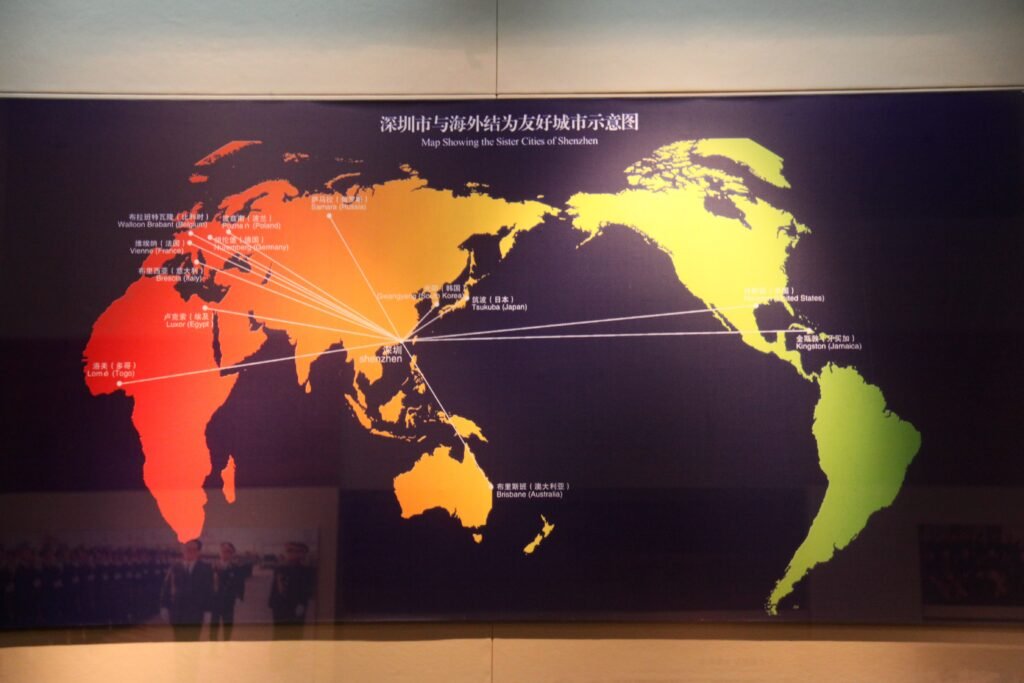
Dad originally photographed it because Shenzhen was showing how the city connected with the world.
But today Dad would ask another question:
WHAT HAPPENS WHEN THE CONNECTIONS BETWEEN THE CITIES RIGHT AROUND SHENZHEN BECOME JUST AS IMPORTANT?
Hong Kong.
Macao.
Guangzhou.
Zhuhai.
Foshan.
Dongguan.
Huizhou.
Zhongshan.
Jiangmen.
Zhaoqing.
And Shenzhen itself.
ONE REGION.
ELEVEN VERY DIFFERENT CITIES.
A LOT OF CONNECTIONS.
AND DEFINITELY NOT ONE CITY.
😂🐇
That rabbit hole deserves another article.
For now…
let’s return to Shenzhen.
Because after all the policies, documents, slogans, construction photographs, factories, trade and technology…
Dad eventually realized that the most interesting question wasn’t simply:
HOW DID SHENZHEN BECOME SO BIG?
It was:
HOW DID AN ECONOMIC EXPERIMENT BECOME A CITY WHERE PEOPLE ACTUALLY WANTED TO BUILD THEIR LIVES?
And perhaps the answer was standing beside Dad all along.
Elaine.
First at age 13 inside Shenzhen’s modern-history exhibition.
Then years later…
walking around Shenzhen again with Dad.
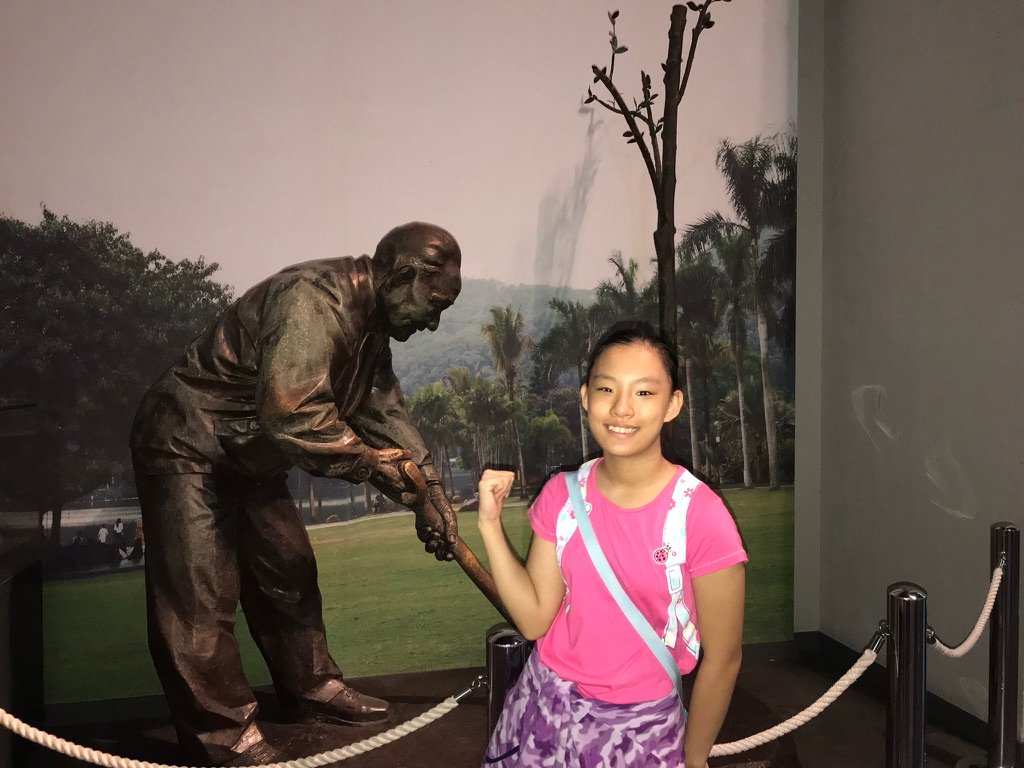
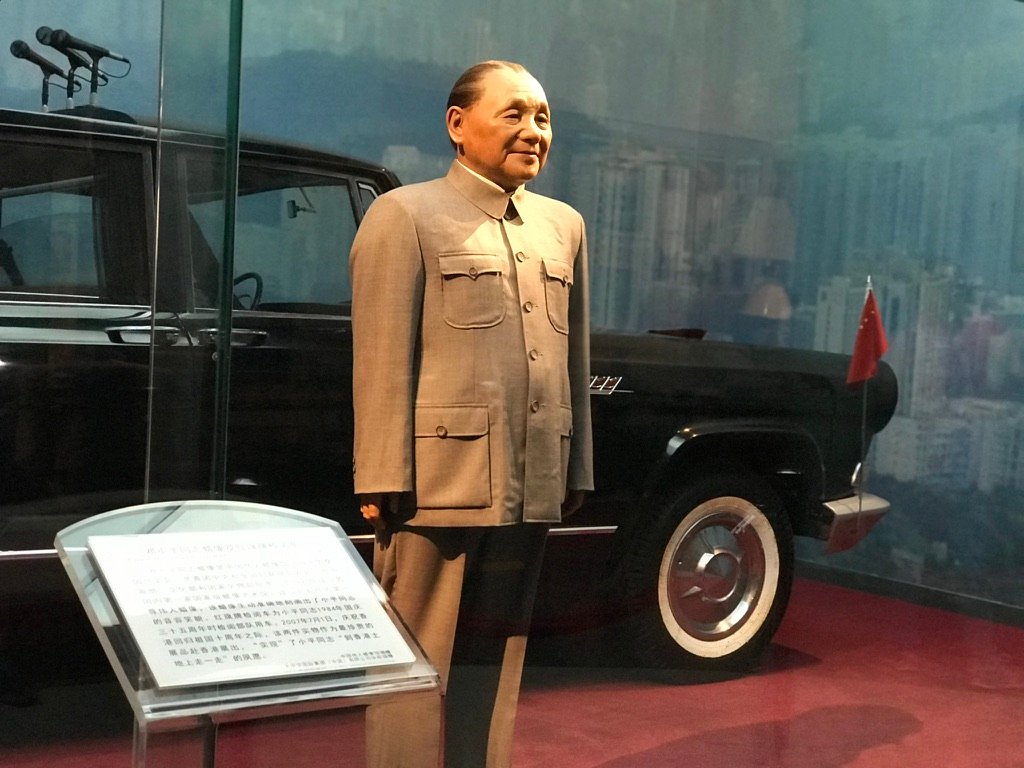
Sometimes the best way to understand a city’s transformation isn’t to stare at its skyline.
COME BACK YEARS LATER.
And see what changed.
🌃 SO… WAS HALF A DAY IN SHENZHEN ENOUGH?
No.
😂
But that doesn’t mean our half-day crossover was a mistake.
Quite the opposite.
It was enough to give Elaine and Dad another taste of Shenzhen.
Enough to revisit a city we had known at different moments in our lives.
Enough to eat.
Browse.
Drink coffee.
Return to Shenzhen Book City.
Stumble upon a literary event.
Walk through the city after dark.
And ask more questions than we arrived with.
That’s usually a good sign.
Because ChinaTravelBUG doesn’t believe you have to “finish” a city for the journey to be worthwhile.
Sometimes a few hours are enough to open the door.
YOU DON’T HAVE TO “DO SHENZHEN” TO START EXPERIENCING SHENZHEN.
💡 ELAINE HAD ONE MORE IDEA
By evening, Dad thought our Shenzhen experiment was basically finished.
Time to head back to Hong Kong.
Except…
Elaine had another idea.
😂
Instead of simply retracing our earlier route, she suggested:
WHY DON’T WE TRY ANOTHER BORDER CROSSING?
Dad liked that.
One more little experiment before the day ended.
So we headed toward Huanggang Port (皇岗口岸, Huánggǎng Kǒu’àn).
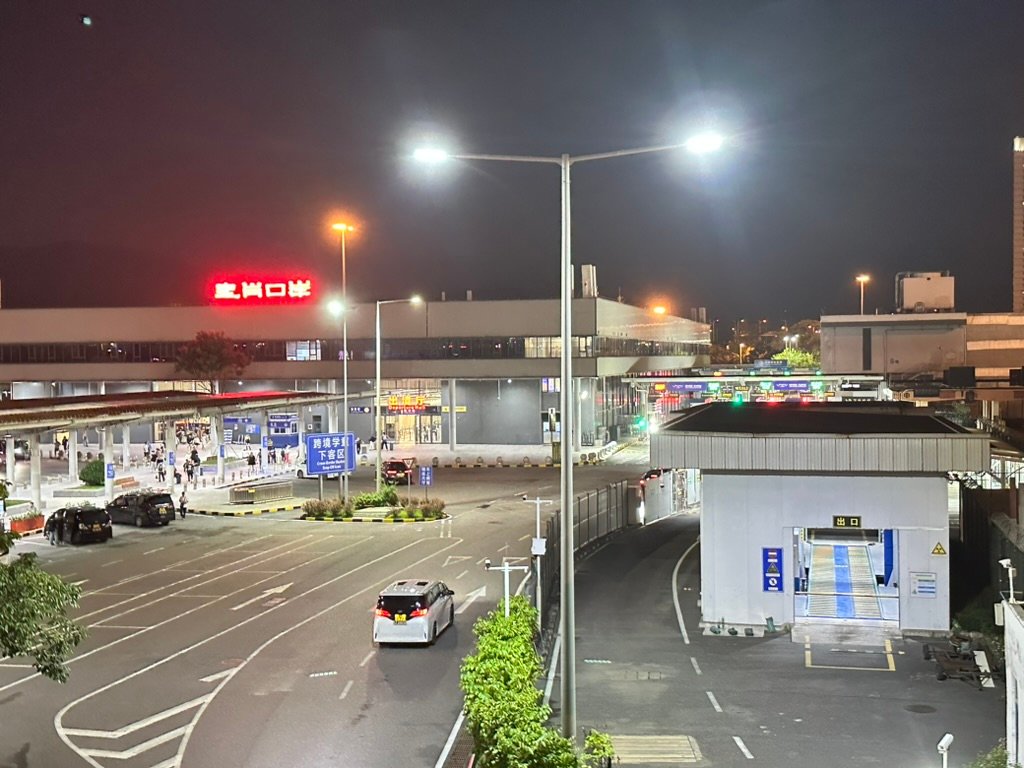
It was already dark.
The giant border complex looked completely different from the Shenzhen we had been wandering through earlier.
Then Elaine headed inside.
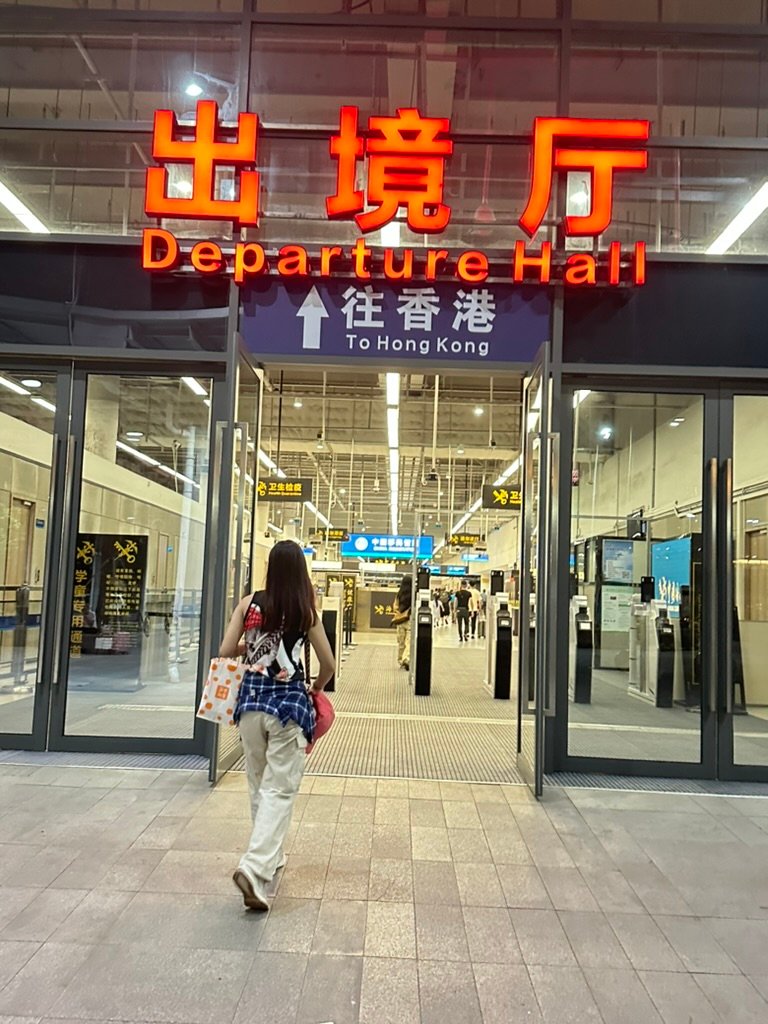
Above her:
出境厅 — Departure Hall
And underneath:
往香港 — To Hong Kong
There wasn’t much philosophy required at this point.
😂
Follow the signs.
Complete the border procedures.
Get ourselves back to Hong Kong.
🚌 ONE MORE RIDE
After completing the departure procedures, we continued our journey toward Hong Kong by cross-border bus.
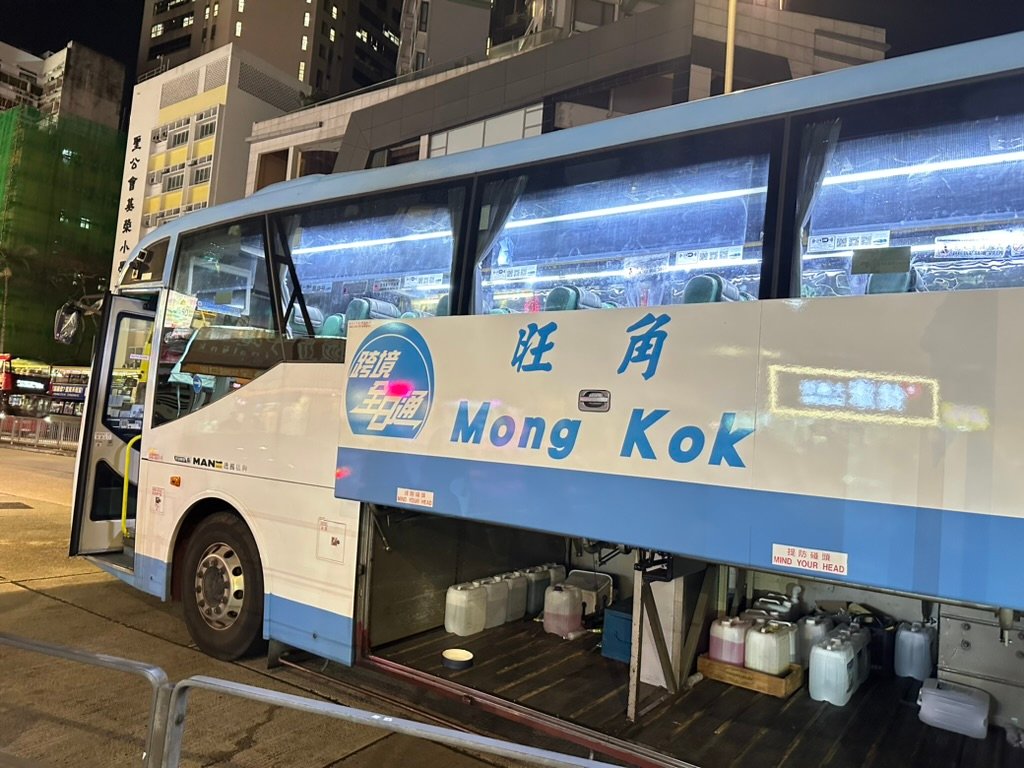
And somewhere during that ride, Dad’s mind was doing what Dad’s mind tends to do.
Connecting things.
2013.
2018.
2026.
Shenzhen Museum.
Deng Xiaoping.
The Special Economic Zone.
Hong Kong.
Shenzhen Book City.
Huanggang.
And now…
the Greater Bay Area.
🐇
A half-day trip had become another history lesson.
Except this time…
we had traveled through part of the lesson ourselves.
🌃 OR… MAYBE DON’T GO BACK YET
Looking back, there’s another perfectly sensible ending to this journey.
Stay in Shenzhen.
If the city has started pulling you in, an overnight stay gives you something our half-day crossover couldn’t:
TIME.
Time for dinner without checking the clock.
Time to experience Shenzhen at night.
Time to explore another neighborhood.
Time for another morning.
Time to follow whichever rabbit hole you discovered during the day.
Our Shenzhen trip worked as a crossover from Hong Kong.
But Dad certainly wouldn’t tell everyone to copy us.
If you have the time…
give Shenzhen more of it.
👉 Check Shenzhen hotels and current prices on Trip.com
ChinaTravelBUG may earn a commission if you book through our Trip.com links, at no extra cost to you.
🐞 THEN WE RETURNED TO OUR HONG KONG BASE
For us, however, the journey continued back to:
Mong Kok (旺角), Kowloon (九龍).
And our base:
iclub Mong Kok Hotel.
That was one reason Dad liked using Mong Kok as our Hong Kong base.
We could wake up surrounded by everyday Kowloon life…
and still use Hong Kong as a springboard for journeys beyond it.
Shenzhen was one of them.
👉 Read why we stayed in Mong Kok (旺角), Kowloon (九龍)
And if you’re considering the same hotel:
👉 Check iclub Mong Kok Hotel and current prices on Trip.com
ChinaTravelBUG may earn a commission if you book through our Trip.com links, at no extra cost to you.
✍️ BUT DAD’S SHENZHEN STORY DIDN’T BEGIN IN 2026
Before finishing this story, Dad wants to go back one more time.
To 2013.
Among Dad’s old Shenzhen museum photographs is one that now feels particularly meaningful.
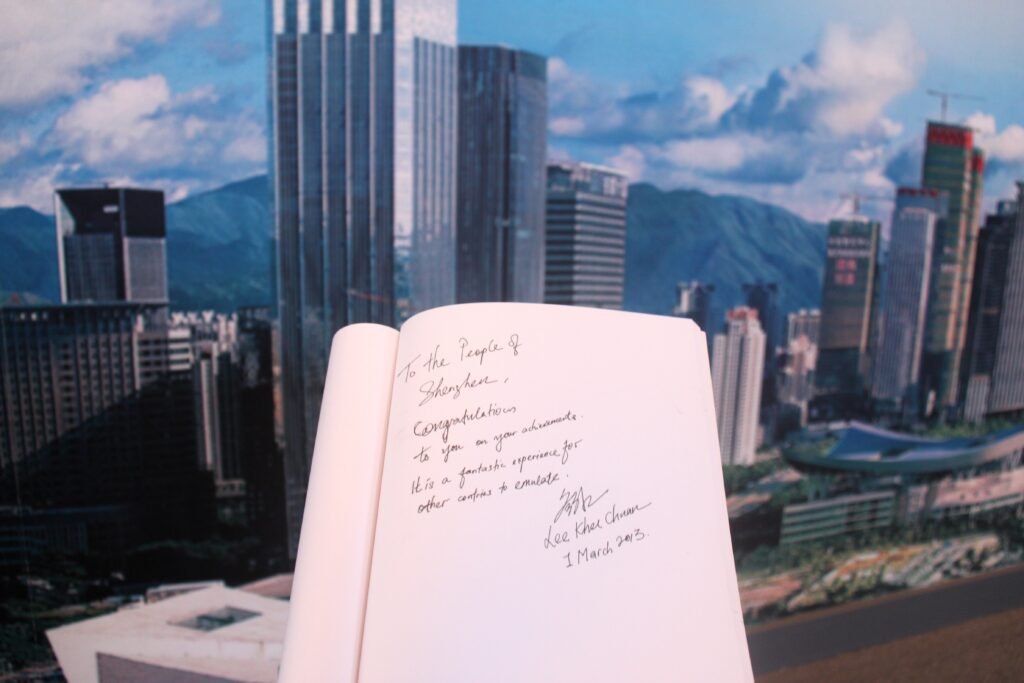
Dad had written:
To the People of Shenzhen, Congratulations to you on your achievements. It is a fantastic experience for other countries to emulate.
Signed:
Lee
17 March 2013
At the time, Dad had just walked through an exhibition trying to understand what had happened to Shenzhen.
Five years later…
DAD BROUGHT ELAINE.
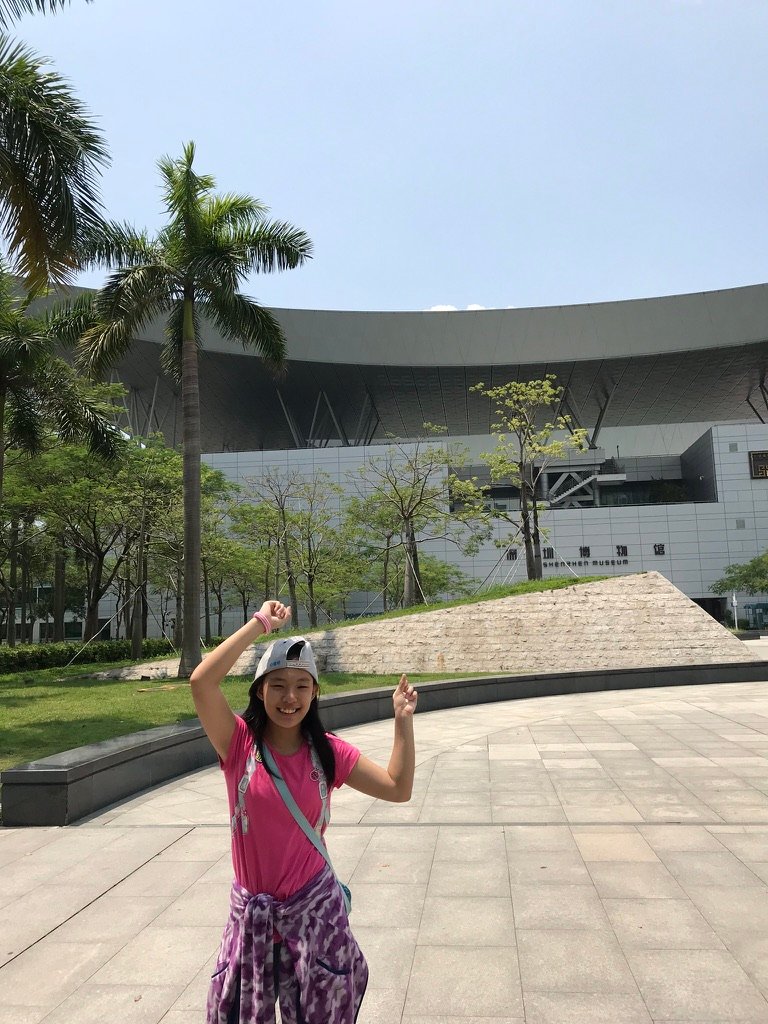
Dad wanted his 13-year-old daughter to see that story too.
Not simply:
Look at these skyscrapers.
But:
ASK HOW THEY GOT HERE.
And then, eight years after that…
Dad and Elaine came back again.
Not primarily to study Shenzhen inside a museum.
This time…
WE EXPERIENCED THE CITY TOGETHER.
🏛️ AND WHEN THE HISTORY EXHIBITION REOPENS…
Dad has one recommendation.
GO.
The Shenzhen Reform and Opening-up History (深圳改革开放史) exhibition that Dad visited in 2013 and brought Elaine to in 2018 closed in 2026 for upgrading.
So don’t expect to find Dad’s exact old exhibition displays today.
But if and when the renewed exhibition reopens, Dad would highly recommend putting it near the beginning of a Shenzhen visit.
Not because everyone needs a political or economic history lesson on holiday.
😂
But because Shenzhen is unusual.
THE HISTORY CHANGES HOW YOU SEE THE CITY.
Learn about the Special Economic Zone.
Learn about Reform and Opening-up.
Learn why Hong Kong mattered.
Learn about migration.
Manufacturing.
Trade.
Technology.
Experimentation.
Then…
walk outside.
Ride the Metro.
Look at Futian.
Walk through Shenzhen Book City.
Watch the crowds.
Look toward Hong Kong.
And ask yourself:
HOW DID ALL THIS HAPPEN?
Suddenly Shenzhen becomes much more than another modern skyline.
WHAT THIS STORY SHOWS
Dad could summarize Shenzhen with a photograph of skyscrapers.
But that would miss almost everything that fascinated him.
The Shenzhen story Dad encountered looks more like this:
REFORM
↓
EXPERIMENT
↓
SPECIAL ECONOMIC ZONE
↓
OPENING
↓
MIGRATION
↓
MANUFACTURING
↓
TRADE
↓
SKILLS + SUPPLY CHAINS
↓
TECHNOLOGY + INNOVATION
↓
MODERN SHENZHEN
And running alongside almost the entire story:
CONNECTION.
Connection with Hong Kong.
Connection with Guangdong.
Connection with international markets.
Connection with the wider world.
And increasingly…
connection with the other cities of the Guangdong–Hong Kong–Macao Greater Bay Area (粤港澳大湾区).
🧠 BUT THERE’S SOMETHING EVEN MORE PERSONAL HERE
Dad first encountered this story largely through:
documents,
museum panels,
historical photographs,
economic policies,
and political history.
That’s Dad.
😂
Then he brought Elaine.
She was 13.
Years later, Elaine brought something else to the journey.
Book City.
Food.
Coffee.
A literary event.
Another border crossing.
And:
Why don’t we stay in Shenzhen?
😂
Maybe that’s the real evolution of this ChinaTravelBUG journey.
Dad taught Elaine to look behind the place.
Elaine taught Dad to experience the place too.
And somewhere between the two…
WE UNDERSTOOD SHENZHEN A LITTLE BETTER.
🐇 AND OF COURSE… THERE’S ANOTHER RABBIT HOLE
Because Shenzhen has now created a much bigger question.
Hong Kong.
Shenzhen.
Guangzhou.
Dongguan.
Huizhou.
Foshan.
Zhongshan.
Zhuhai.
Jiangmen.
Zhaoqing.
Macao.
Dad and Elaine had already traveled through pieces of this region before Dad really began thinking about the whole thing.
So the next question is obvious:
WHAT EXACTLY IS CHINA’S GREATER BAY AREA — AND WHY DOES IT MATTER?
Not:
“Is it one giant megacity?”
It isn’t.
But:
HOW DO 11 DIFFERENT CITIES BECOME MORE CONNECTED WHILE REMAINING DIFFERENT?
And what do all those bridges, trains, ports, airports and border crossings actually change?
Dad has already crossed some of them.
😂
So…
that’s another DEEP China rabbit hole.
🐇🐇🐇
🐞 CONTINUE THE JOURNEY
If you want the practical travel story behind this DEEP China article:
👉 From Hong Kong to Shenzhen: Dad and Elaine Crossed Into Mainland China for the Day
And if you’re wondering why we based ourselves in Mong Kok:
👉 We Stayed in Hong Kong’s Mong Kok (旺角) So Elaine Could Wake Up to Everyday Kowloon (九龍)
SEE → ASK → CONNECT → UNDERSTAND → FOLLOW.
2013
Dad SAW Shenzhen’s modern-history story.
2018
Dad brought 13-year-old Elaine to SEE it too.
2026
Dad and Elaine returned.
This time we ASKED different questions.
We CONNECTED the museum story with the city outside.
We began to UNDERSTAND why Shenzhen looks the way it does today.
And then Shenzhen pointed toward Hong Kong, Guangzhou, Dongguan, Zhuhai, Macao and the rest of the Greater Bay Area.
Which gives us something else to…
FOLLOW.
🐇
TWO CROSSINGS. HALF A DAY. DECADES OF HISTORY.
And a lot more questions.
That’s okay.
Because sometimes understanding China doesn’t begin with finding the answer.
It begins with learning to ask:
WHY IS THIS PLACE LIKE THIS?
Shenzhen gave Dad that question in 2013.
Dad gave it to Elaine in 2018.
And in 2026…
Shenzhen gave it back to both of us.
ChinaTravelBUG — See China. Understand It Better.
Real Journeys. Real Stories. Real China.