Dad and Elaine had already traveled through parts of China’s Greater Bay Area before Dad really understood what it was.
😂
First:
Hong Kong (香港) → Shenzhen (深圳, Shēnzhèn).
Then:
Hong Kong → Macau (澳門).
Then:
Macau → Hong Kong across the Hong Kong–Zhuhai–Macao Bridge (港珠澳大橋).
And somewhere during that last journey…
Dad nearly followed the route toward Zhuhai (珠海, Zhūhǎi) instead of Hong Kong.
Elaine caught him.
😂
At the time, these felt like separate journeys.
Hong Kong was Hong Kong.
Shenzhen was Shenzhen.
Macau was Macau.
And Zhuhai was somewhere Dad was apparently capable of accidentally heading toward.
Then Dad started connecting the dots.
🐇
These weren’t simply neighboring destinations.
They were part of a much bigger regional idea:
THE GUANGDONG–HONG KONG–MACAO GREATER BAY AREA
粤港澳大湾区
And that opened exactly the kind of question Dad loves:
WHAT EXACTLY ARE THEY TRYING TO BUILD HERE?
🐞 FIRST: DON’T IMAGINE ONE GIANT CITY
The Greater Bay Area — usually shortened to GBA — brings together 11 cities.
Two Special Administrative Regions
Hong Kong (香港)
Macao (澳門)
Nine cities in Guangdong Province
Guangzhou (广州, Guǎngzhōu)
Shenzhen (深圳, Shēnzhèn)
Zhuhai (珠海, Zhūhǎi)
Foshan (佛山, Fóshān)
Huizhou (惠州, Huìzhōu)
Dongguan (东莞, Dōngguǎn)
Zhongshan (中山, Zhōngshān)
Jiangmen (江门, Jiāngmén)
Zhaoqing (肇庆, Zhàoqìng)
Eleven cities.
One regional development framework.
But:
NOT ONE CITY.
And definitely not eleven interchangeable cities.
That distinction is important.
🧠 DAD’S SIMPLE WAY OF UNDERSTANDING THE GBA
Forget the giant planning documents for a moment.
😂
Think of neighboring cities with very different strengths.
Hong Kong — international finance, trade, transport and professional services.
Shenzhen — Special Economic Zone, manufacturing, technology and innovation.
Guangzhou — an old commercial giant and major transport center.
Macao — tourism, leisure and a distinctive Chinese-Portuguese historical legacy.
Around them are cities with major manufacturing, technology, commercial and logistics roles.
The idea isn’t:
MAKE THEM ALL THE SAME.
It’s closer to:
MAKE DIFFERENT PLACES WORK TOGETHER MORE EFFECTIVELY.
That’s the Coat Rack.
🐇
📜 THEN CAME THE 2019 MASTER PLAN
The Outline Development Plan for the Guangdong-Hong Kong-Macao Greater Bay Area was released in February 2019.
It identified four cities as core engines:
HONG KONG
MACAO
GUANGZHOU
SHENZHEN
Seven other Guangdong cities — Zhuhai, Foshan, Huizhou, Dongguan, Zhongshan, Jiangmen and Zhaoqing — were identified as important node cities.
But Dad isn’t going to make you memorize eleven job descriptions.
😂
For a traveler, four cities give us a useful starting point.
🇭🇰 HONG KONG — OUR GATEWAY
For Dad and Elaine, Hong Kong wasn’t just another destination.
IT BECAME OUR BASE.
We stayed in Mong Kok (旺角), Kowloon (九龍).
From there:
Shenzhen became possible.
Macau became possible.
And suddenly Hong Kong wasn’t sitting alone on Dad’s mental travel map anymore.
👉 See why we stayed in Mong Kok (旺角), Kowloon (九龍)
💻 SHENZHEN — THE EXPERIMENT BESIDE HONG KONG
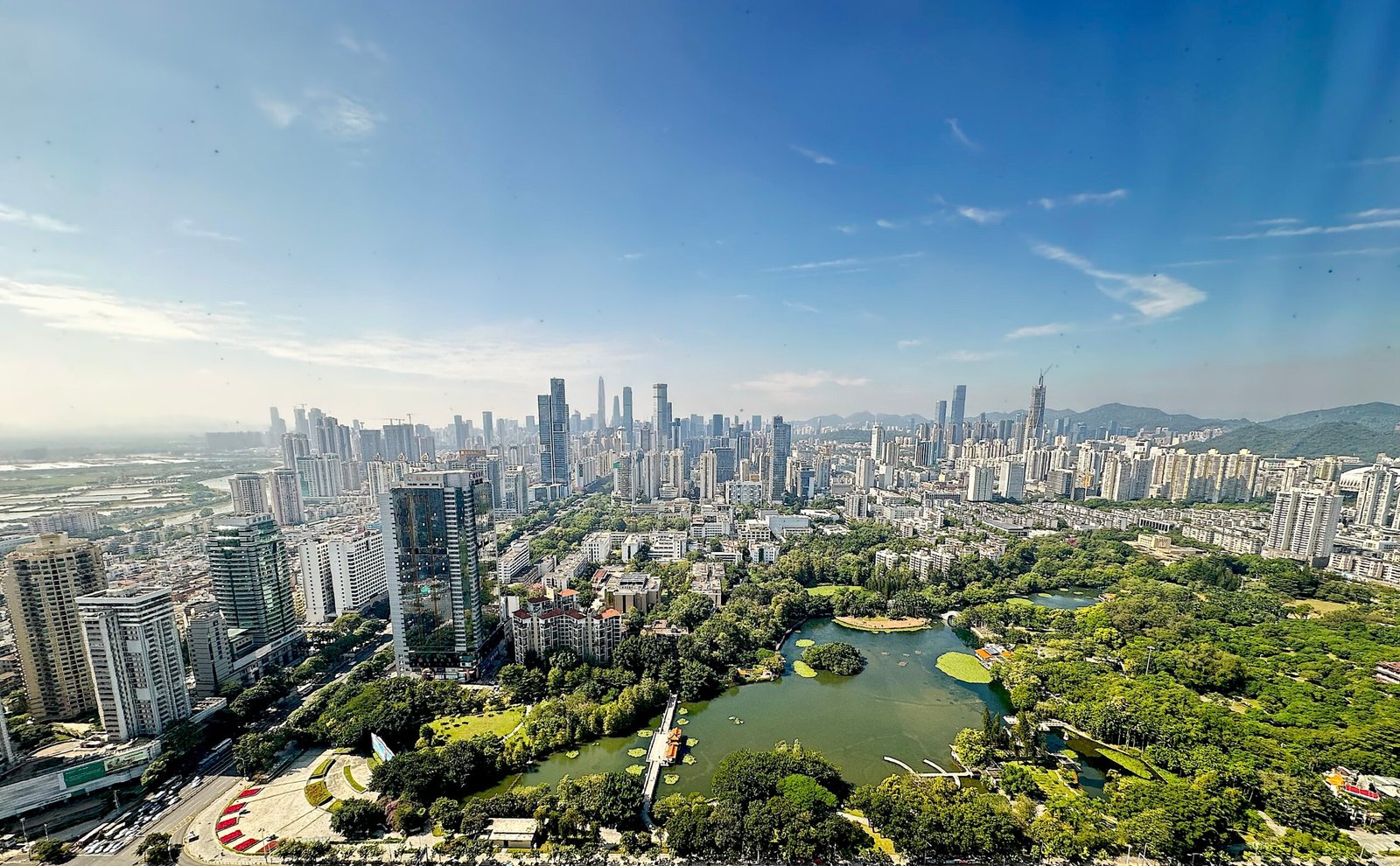
Immediately across the boundary is Shenzhen (深圳, Shēnzhèn).
Dad first explored Shenzhen’s modern transformation through its museum in 2013.
In 2018, he brought 13-year-old Elaine to the same exhibition.
And in 2026?
Dad and Elaine crossed from Hong Kong into Shenzhen together again.
Border crossing.
Metro.
Noodles. 😂
Coffee.
Book City.
Then another border crossing back toward Hong Kong.
👉 From Hong Kong to Shenzhen: Dad and Elaine Crossed Into Mainland China for the Day
Shenzhen taught Dad something important:
GEOGRAPHY CAN BECOME ECONOMIC STRATEGY.
🏙️ GUANGZHOU — THE OLDER GIANT
Then there is Guangzhou (广州, Guǎngzhōu).
Shenzhen may represent much of southern China’s dramatic modern transformation.
But Guangzhou reminds us that this region’s commercial story is much older.
Long before modern Shenzhen existed, Guangzhou was already one of China’s great commercial gateways.
Today it remains one of the GBA’s core cities.
Dad hasn’t followed this rabbit hole properly yet.
🐇
He will.
🎭 MACAO — SOMETHING DIFFERENT AGAIN
Then cross to the western side.
Macao.
Portuguese influence.
Chinese traditions.
Churches.
Temples.
Casinos.
Pork chop buns.
Portuguese egg tarts.
😂
It doesn’t feel like Shenzhen.
It doesn’t feel like Hong Kong.
And that’s precisely what makes the GBA interesting.
Dad’s first question there was considerably simpler:
WAIT… WHAT EXACTLY IS MACAU?
👉 Follow Dad and Elaine’s first-timer journey beyond the casinos
And it was while returning from Macau that the GBA really started making sense.
🌉 A BRIDGE CHANGED DAD’S MENTAL MAP
Before our Macau journey, Dad’s mental map was basically:
Hong Kong
and somewhere over there…
Macau.
😂
Then we crossed the Hong Kong–Zhuhai–Macao Bridge (港珠澳大橋).
And another city suddenly appeared:
ZHUHAI.
At the transport complex, there were different directions.
Hong Kong.
Zhuhai.
Dad nearly followed the wrong one.
Elaine noticed.
Travel mistake avoided.
Rabbit hole opened.
🐇
Because suddenly Dad could see the geography:
Hong Kong ↔ Shenzhen
and across the Pearl River:
Macao ↔ Zhuhai
with huge transport links increasingly connecting the wider region.
A BRIDGE CAN CHANGE THE MENTAL MAP.
The cities haven’t physically moved.
But when the time and friction involved in moving between places change, our perception of distance changes too.
What once feels like:
That’s another destination.
can start feeling like:
Could we go there tomorrow?
THE REAL PRODUCT OF INFRASTRUCTURE ISN’T ONLY CONCRETE.
IT’S TIME.
🛂 BUT THE BORDERS DIDN’T DISAPPEAR
This is where Dad initially misunderstood the GBA.
More connection does not mean everything has merged into one system.
Dad and Elaine experienced that personally.
Going from Hong Kong to Shenzhen wasn’t like riding the MTR (港鐵) from one Hong Kong neighborhood to another.
We crossed a boundary.
Travel documents.
Immigration.
Then Shenzhen.
Later that night, we went through formalities again before returning toward Hong Kong.
Suddenly the institutional differences weren’t abstract.
DAD’S PASSPORT WAS EXPLAINING THE GBA.
😂
Within this one regional framework are:
ONE COUNTRY.
TWO SYSTEMS.
THREE CUSTOMS TERRITORIES.
THREE CURRENCIES.
On the Mainland: Renminbi (RMB).
In Hong Kong: Hong Kong dollars (HKD).
In Macao: Macao patacas (MOP).
Physical infrastructure can connect places.
But rules, institutions, immigration and customs arrangements still matter.
Which gives Dad his real GBA question:
HOW DO YOU CREATE MORE CONNECTION ACROSS A REGION WHILE IMPORTANT DIFFERENCES REMAIN?
🔥
Now Dad’s Political Science CPU is awake.
😂
😂 THEN DAD SAW A CAR WITH THREE NUMBER PLATES
And suddenly Dad didn’t need another diagram.
While in Macau, he noticed something strange.
Some cars weren’t carrying one registration plate.
They appeared to be carrying…
THREE.
[PHOTO — Macau vehicle displaying three registration plates]
Look carefully.
On the vehicle Dad photographed were registrations associated with:
Macau.
Hong Kong.
Guangdong / Mainland China.
🐇
Wait.
What?
🚗 ONE CAR. THREE PLATES. ONE GBA STORY.
Eligible Macau vehicles authorized to travel to Hong Kong can be allocated a Hong Kong vehicle registration number.
Dad’s photographs captured examples using the ZM and ZN Hong Kong registration prefixes.
[PHOTO — close view of ZM / Macau / 粤Z 澳 plates]
Macau’s Transport Bureau confirms that ZM and ZN have been used for Hong Kong registration numbers allocated to approved Macau private vehicles traveling to Hong Kong. In 2026, the authority announced that those sequences were nearing exhaustion and the ZL prefix would follow.
Then look at the black plate:
粤Z ··· 澳
粤 identifies Guangdong.
澳 identifies Macau.
The vehicle therefore gives Dad something far more memorable than another regional-development chart:
MACAU.
HONG KONG.
GUANGDONG.
ON ONE CAR.
😂
[PHOTO — second vehicle displaying ZN / Macau / 粤Z 澳 plates]
Of course, the plates don’t mean the boundaries have disappeared.
Quite the opposite.
The vehicle needs the relevant permissions, registrations and documentation to move through these different jurisdictions.
And THAT is what makes the photograph so useful.
CONNECTION DOESN’T REQUIRE SAMENESS.
Sometimes you don’t need a government PowerPoint to understand the Greater Bay Area.
Sometimes…
YOU JUST NEED TO LOOK AT THE FRONT OF A CAR.
😂🐞
🐞 WHAT ABOUT THE OTHER GBA CITIES?
This is where the old article became a little fried rice.
😂
Dad doesn’t think a first-time reader needs nine mini economic essays.
Just remember this:
The GBA extends far beyond Hong Kong, Shenzhen, Guangzhou and Macau.
Cities such as Dongguan (东莞, Dōngguǎn) and Foshan (佛山, Fóshān) are important parts of the region’s manufacturing and industrial networks.
Zhuhai (珠海, Zhūhǎi) sits immediately beside Macau.
Then there are Huizhou (惠州, Huìzhōu), Zhongshan (中山, Zhōngshān), Jiangmen (江门, Jiāngmén) and Zhaoqing (肇庆, Zhàoqìng) — each with its own economy, history and identity.
Dad hasn’t visited all of them.
And ChinaTravelBUG isn’t going to pretend he has.
🐞
What matters for this article is the Coat Rack:
Hong Kong → international connection
Shenzhen → innovation and technology
Guangzhou → commerce and transport
Macao → tourism and Portuguese-speaking-world connections
Other Guangdong cities → manufacturing, industry and complementary strengths
Rail + bridges + highways + ports + airports → connectivity
↓
THE GREATER BAY AREA
Not a perfect description.
But enough to stop eleven city names becoming fried rice.
😂
🧳 SO WHY SHOULD A TRAVELER CARE?
Because understanding the GBA changes your travel map.
But please don’t read this article and immediately create:
THE ULTIMATE 11-CITY GBA ITINERARY!!!
😂😂😂
Wrong lesson.
THE GBA IS NOT AN ITINERARY.
IT’S A WAY OF SEEING THE REGION.
Dad and Elaine discovered that almost accidentally.
🇭🇰 HONG KONG CAN BE A GATEWAY
We based ourselves in Hong Kong.
Then Shenzhen became possible.
Then Macau became possible.
Hong Kong stopped looking like the end of the journey.
It became another beginning.
🚇 SHENZHEN CAN OPEN THE MAINLAND DOOR
Dad and Elaine only gave Shenzhen part of a day on this trip.
But imagine continuing:
Hong Kong
↓
Shenzhen
↓
Dongguan
↓
Guangzhou
Now you’re no longer taking a Hong Kong excursion.
You’re beginning a journey through southern China.
🌉 MACAU OPENS ANOTHER SIDE OF THE MAP
Go west instead:
Hong Kong
↓
Macau
↓
Zhuhai
And suddenly another corridor starts appearing.
Dad discovered Zhuhai by nearly going there accidentally.
😂
China Usually Has Another Way.
Apparently Dad does too.
🐞 DON’T CONFUSE CONNECTION WITH SAMENESS
This may be the most important takeaway.
Hong Kong should still feel like Hong Kong.
Macao should still feel like Macao.
Shenzhen has its own story.
Guangzhou has another.
Jiangmen has another.
Foshan has another.
Different histories.
Different economies.
Different identities.
And important institutional differences remain between the Mainland, Hong Kong and Macao.
The GBA isn’t interesting because:
EVERYTHING IS BECOMING THE SAME.
It’s interesting because:
VERY DIFFERENT PLACES ARE BECOMING MORE CONNECTED.
🔥
👧 ELAINE MAY HAVE EXPLAINED THE GBA BETTER THAN DAD
Dad approached the GBA through:
political economy,
Reform and Opening-up,
Special Economic Zones,
regional development,
infrastructure,
institutions.
Elaine?
😂
She wanted to go to Shenzhen.
She wanted to revisit Book City.
Then she suggested we return through a different border crossing.
Dad had the theory.
ELAINE KEPT MOVING.
And perhaps that’s the simplest way to understand connectivity.
A connection matters when people actually use it.
To work.
Study.
Trade.
Visit family.
Explore.
Eat.
Travel.
Or cross into Shenzhen because your daughter wants to revisit a bookstore.
😂
🧠 AND NOW DAD SEES OUR JOURNEYS DIFFERENTLY
At the time, Dad thought we’d taken:
a Hong Kong trip,
plus a Shenzhen excursion,
plus a Macau excursion.
Now he sees another layer.
We had started moving through parts of a connected southern China region.
Not seamlessly.
Not without borders.
Not as one giant city.
But connected enough to change Dad’s mental map.
And once that happens…
it’s difficult to put the map back the way it was before.
🐞 WHAT THIS STORY SHOWS
Forget trying to memorize eleven cities.
Remember four things:
DIFFERENT PLACES.
DIFFERENT STRENGTHS.
DIFFERENT SYSTEMS.
MORE CONNECTIONS.
That’s the Greater Bay Area Coat Rack.
And Dad’s favorite illustration isn’t a planning document anymore.
😂
It’s that car in Macau.
ONE CAR.
THREE NUMBER PLATES.
ONE VERY BIG RABBIT HOLE.
🐇
SEE → ASK → CONNECT → UNDERSTAND → FOLLOW
Dad and Elaine traveled through parts of the Greater Bay Area before Dad really understood what it was.
Now that he understands the map a little better…
he wants to travel through it again.
This time deliberately.
🐞
ChinaTravelBUG — See China. Understand It Better.
📚 Official Sources
For readers who want to go deeper:
Macao SAR Government Transport Bureau — Hong Kong ZM / ZN / ZL Registration Number Information
https://www.dsat.gov.mo/dsat/news_detail.aspx?a_id=44CE8452CB90809B6EA6DA5404A3E6EA
Hong Kong SAR Government — Guangdong–Hong Kong–Macao Greater Bay Area: Outline Development Plan
https://www.bayarea.gov.hk/en/outline/plan.html
Hong Kong SAR Government — Greater Bay Area Cities and Development Focus
https://www.bayarea.gov.hk/en/focus/bayarea-cities.html
Macao SAR Government Transport Bureau — Cross-Boundary Vehicle Information
https://www.dsat.gov.mo/hzmb/car_cross_2026.aspx