Dessert After Our Eight Big Questions
You’ve survived:
eight Michelin courses.
😂
We stood on the:
Great Wall (长城, Chángchéng)
and asked why China built so many walls.
We walked through:
Forbidden City (故宫, Gùgōng)
and asked how one emperor governed such an enormous country—and why his palace looks the way it does.
We visited:
Temple of Heaven (天坛, Tiāntán)
and discovered:
Mandate of Heaven (天命, Tiānmìng).
Then we traveled to:
Xi’an (西安, Xī’ān)
and the:
Terracotta Warriors (兵马俑, Bīngmǎyǒng)
to ask what:
Qin Shi Huang (秦始皇, Qín Shǐhuáng)
actually unified.
Finally, we went backward so far that:
China hadn’t appeared yet.
😭😂
So before you leave the table…
here’s dessert.
Not another history lesson.
Just:
the coat rack.
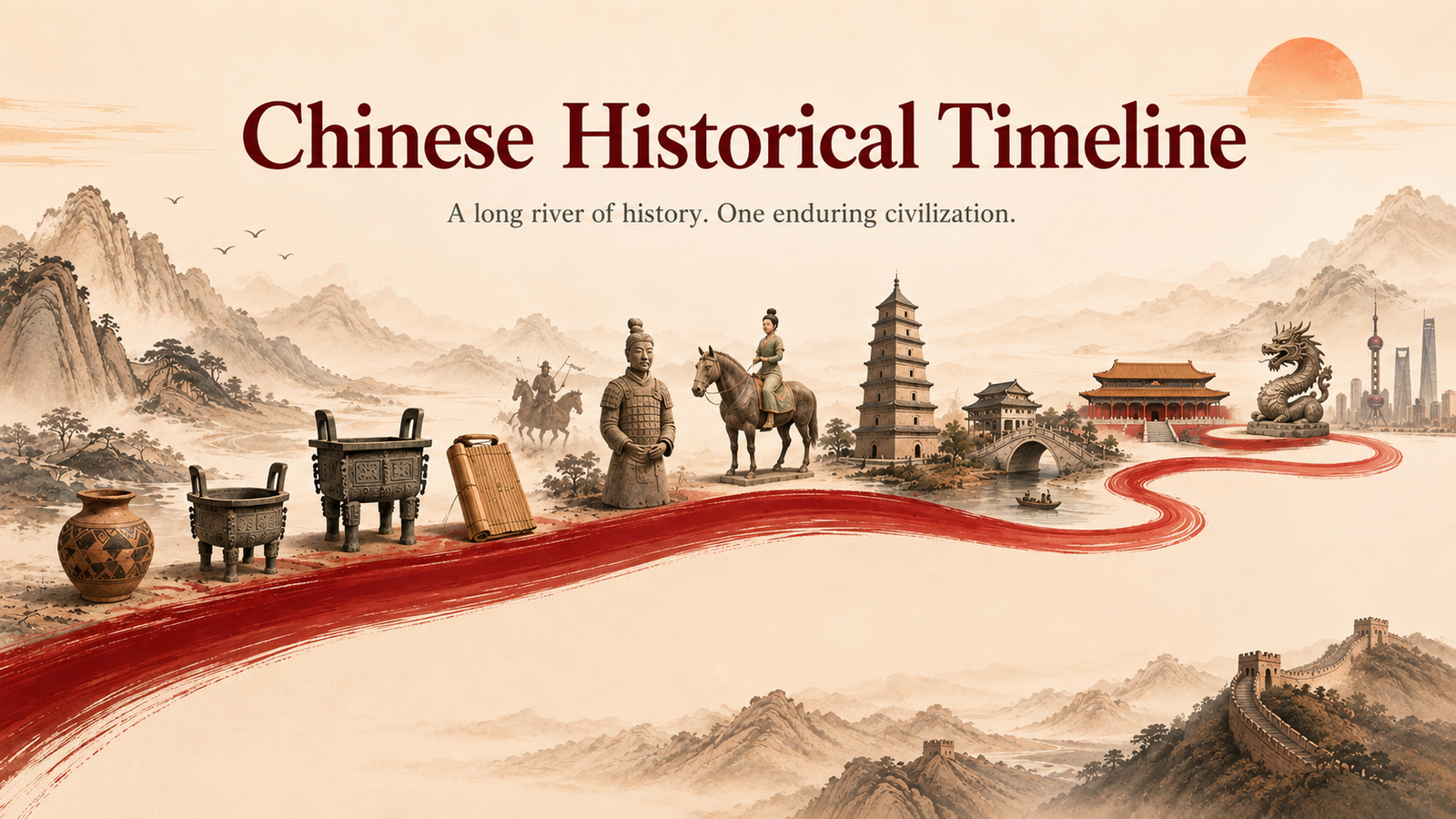
🕰️ The Chinese History Timeline You Actually Need
You do NOT need to memorize every emperor.
You do NOT need to memorize every war.
And you definitely don’t need to memorize 4,000 years of dates before your first China trip.
Remember the shape.
🏺 SHANG DYNASTY (商朝, Shāng Cháo)
Think: Anyang + writing + bronzes
Dad & Elaine’s doorway:
Anyang (安阳, Ānyáng)
↓
Yinxu (殷墟, Yīnxū)
↓
oracle-bone inscriptions (甲骨文, jiǎgǔwén).
🔥
This is where late Shang rulers begin speaking to us through substantial contemporary written evidence.
Remember:
SHANG = EARLY WRITTEN ROYAL HISTORY
🐇 Want to go deeper?
Go to:
Anyang / Yinxu.
👑 ZHOU DYNASTY (周朝, Zhōu Cháo)
Think: Heaven + ritual + political order
Dad & Elaine’s doorway:
Baoji (宝鸡, Bǎojī)
↓
Zhouyuan (周原, Zhōuyuán)
↓
Duke of Zhou (周公, Zhōugōng)
↓
He Zun (何尊, Hé Zūn).
🔥
Remember:
Mandate of Heaven (天命)
Son of Heaven (天子)
ritual (礼, lǐ).
And eventually:
Western Zhou
↓
Eastern Zhou
↓
Spring and Autumn
↓
Warring States.
Remember:
ZHOU = MANY IDEAS THAT LATER CHINA KEPT RETURNING TO
🐇 Want to go deeper?
Go beyond Xi’an toward:
Baoji + Zhouyuan.
⚔️ QIN DYNASTY (秦朝, Qín Cháo)
221–206 BCE
Think: unification
Now we’re back somewhere almost every first-time traveler recognizes:
Xi’an / Xianyang (西安 / 咸阳)
↓
Qin Shi Huang (秦始皇)
↓
Terracotta Warriors (兵马俑).
🔥
Remember:
221 BCE
and:
unification (统一, tǒngyī).
Qin conquered the competing Warring States and created a new unified imperial political order.
It also gave later Chinese history the title:
emperor (皇帝, huángdì).
Remember:
QIN = IMPERIAL BREAKTHROUGH
And the enormous joke of history?
Qin lasted about 15 years.
😭😂
🏯 HAN DYNASTY (汉朝, Hàn Cháo)
Think: make the empire durable
Qin created the breakthrough.
Han:
made imperial rule much more durable.
🔥
Han rulers inherited important elements of the Qin political framework, modified them and developed them further.
And one dynasty name became so culturally important that today we still have terms such as:
Han Chinese (汉族, Hànzú)
Chinese language (汉语, Hànyǔ)
and:
Chinese characters (汉字, Hànzì).
Remember:
HAN = CONSOLIDATION
So together:
Qin–Han (秦汉, Qín–Hàn)
is one of the great transformations of Chinese history.
😵 THEN CHINA DIVIDES
This is important.
Don’t imagine:
Qin unified China
↓
China stayed unified forever.
❌
No.
After Han collapsed, long periods of political:
division (分裂, fēnliè)
followed.
Different states.
Different ruling houses.
North.
South.
War.
Migration.
Cultural mixing.
And this gives Dad & Elaine another rabbit hole.
🐘 NORTHERN WEI (北魏, Běi Wèi)
Think: Xianbei + Buddhism + Yungang
Dad & Elaine’s doorway:
Yungang Grottoes (云冈石窟, Yúngāng Shíkū)
near:
Datong (大同, Dàtóng).
🔥
The Northern Wei was founded by rulers of:
Tuoba Xianbei (拓跋鲜卑, Tuòbá Xiānbēi)
origin.
And they became major rulers of northern China.
Remember:
NORTHERN WEI = CHINESE HISTORY IS ALREADY MORE ETHNICALLY AND CULTURALLY COMPLICATED THAN YOUR DYNASTY CHART SUGGESTS
🐇 Want to go deeper?
Go to:
Yungang.
🐫 SUI + TANG (隋唐, Suí–Táng)
Think: reunification + Chang’an + connected China
After centuries of division:
reunification (统一)
returns.
Then the:
Tang dynasty (唐朝, Táng Cháo)
gives us one of the great eras of:
Chang’an (长安, Cháng’ān)
— today’s Xi’an.
🔥
Think:
Silk Roads (丝绸之路)
Buddhism (佛教)
Xuanzang (玄奘)
Big Wild Goose Pagoda (大雁塔)
and connections stretching across:
Central Asia and beyond.
Remember:
TANG = POWERFUL CHINA + CONNECTED CHINA
🐇 Want to go deeper?
Start looking at where all those people, religions and ideas came from.
Good luck.
😂
🏙️ SONG DYNASTY (宋朝, Sòng Cháo)
Think: sophisticated—but not alone
The Song period saw extraordinary developments in:
cities,
commerce,
technology,
printing,
education
and:
government.
🔥
But here’s the beginner’s correction:
Song did NOT simply rule everything while everyone else waited for the next dynasty.
At different times, powerful neighboring states existed alongside it.
Including:
Liao dynasty (辽朝, Liáo Cháo)
established by the:
Khitan (契丹, Qìdān).
🪵 LIAO DYNASTY (辽朝, Liáo Cháo)
Think: Khitan + Yingxian Wooden Pagoda
Dad & Elaine’s doorway:
Yingxian Wooden Pagoda (应县木塔, Yìngxiàn Mùtǎ).
Built in:
1056
during the Liao dynasty.
🔥
Remember our rabbit hole:
Khitan (契丹)
↓
forms of their name travel west
↓
Cathay.
😳
Remember:
LIAO = CHINESE HISTORY DOESN’T ALWAYS FIT INTO ONE-DYNASTY-AT-A-TIME BOXES
🐎 YUAN DYNASTY (元朝, Yuán Cháo)
Think: Mongols rule China
Now:
Mongols (蒙古人, Měnggǔrén)
establish the:
Yuan dynasty.
And:
Kublai Khan (忽必烈, Hūbìliè)
becomes emperor.
🔥
This should trigger one of your Michelin questions:
Wait. A Mongol ruler can become a Chinese emperor?
Exactly.
🐇
Remember:
YUAN = WHO IS “CHINESE” IS NOT A SIMPLE QUESTION
🧱 MING DYNASTY (明朝, Míng Cháo)
Think: Beijing + Forbidden City + Great Wall
Now the first-time traveler is back on familiar ground.
Forbidden City (故宫)
construction begins in the early 15th century.
And much of the spectacular masonry:
Great Wall (长城)
that travelers visit around Beijing today is associated with Ming construction and rebuilding.
🔥
Remember:
MING = MUCH OF THE IMPERIAL BEIJING / GREAT WALL WORLD YOU PHYSICALLY SEE TODAY
So:
Badaling.
Mutianyu.
Forbidden City.
Suddenly they have a dynasty attached.
👑 QING DYNASTY (清朝, Qīng Cháo)
Think: Manchu rulers + imperial Beijing
The:
Manchus (满洲人, Mǎnzhōurén)
establish the Qing dynasty.
They rule from:
Forbidden City (故宫)
and Qing emperors continue major imperial ritual traditions at places including:
Temple of Heaven (天坛).
🔥
Remember:
QING = ANOTHER NON-HAN RULING HOUSE BECOMES CENTRAL TO CHINESE IMPERIAL HISTORY
Again:
Who is Chinese?
🐇
Still not a simple question.
🛑 1912 — THE IMPERIAL SYSTEM ENDS
In:
1912
the imperial system ends.
No more:
emperor (皇帝).
No more:
dynastic succession as the political system.
More than two thousand years after Qin Shi Huang adopted the title:
皇帝
the age of Chinese emperors was over.
🔥
That doesn’t mean:
Chinese history ended.
Obviously.
😂
It means:
a political system ended.
And modern Chinese history begins another enormous set of questions.
Different dinner.
Dad has already eaten enough.
😭😂
🍨 That’s the Coat Rack
If you remember nothing else, remember:
SHANG (商)
writing + Anyang
↓
ZHOU (周)
Heaven + ritual + political ideas
↓
QIN (秦)
unification + emperor
↓
HAN (汉)
imperial consolidation
↓
DIVISION
different states + peoples + cultures
↓
SUI / TANG (隋唐)
reunification + Chang’an + connected China
↓
SONG / LIAO
multiple sophisticated states sharing the historical landscape
↓
YUAN (元)
Mongol rulers
↓
MING (明)
Forbidden City + much of today’s famous Great Wall
↓
QING (清)
Manchu rulers + imperial Beijing
↓
1912
imperial system ends.
🔥
That’s enough.
Seriously.
😂
🐞 Have You Been Stung?
You do NOT need to remember every dynasty.
You do NOT need to become:
a Chinese historian.
Remember the coat rack.
Then something interesting happens.
Someone says:
Northern Wei (北魏).
Instead of:
“Huh?”
you think:
“Ah. Xianbei. Yungang.”
🐇
Someone says:
Liao (辽).
You think:
“Khitan. Yingxian. Cathay!”
🐇🐇
Someone says:
Western Zhou (西周).
You think:
“Baoji. Zhouyuan. Mandate of Heaven.”
🐇🐇🐇
Someone says:
Shang (商).
You think:
“Anyang. Yinxu. Oracle bones.”
And suddenly Chinese history isn’t:
a wall of unfamiliar dynasty names.
It’s:
places.
Places you’ve visited.
Places you understand.
And places you now want to visit.
🔥
🐇 Your First China Trip Was Only the Beginning
Perhaps your first trip was:
Beijing + Xi’an.
You saw:
Great Wall (长城),
Forbidden City (故宫),
Temple of Heaven (天坛),
and:
Terracotta Warriors (兵马俑).
Excellent.
That’s the famous China.
But now those places have opened doors.
Great Wall
↓
Yanmenguan (雁门关)
↓
Northern frontier
↓
Yungang (云冈石窟)
↓
Northern Wei
↓
Luoyang (洛阳).
🐇
Terracotta Warriors
↓
Qin
↓
Zhou
↓
Baoji (宝鸡)
↓
Zhouyuan (周原)
↓
Shang
↓
Anyang (安阳)
↓
before Shang?
↓
Erlitou (二里头)
↓
Taosi (陶寺).
🐇🐇🐇🐇🐇
And now you have a problem.
😂
China isn’t finished.
ChinaTravelBUG’s Take
Your first trip showed you:
the famous places.
The Big Questions gave you:
the coat rack.
Now the rabbit holes can begin.
You don’t have to visit them all.
You don’t have to understand everything.
Just keep asking:
“Why?”
Why this wall?
Why this emperor?
Why Heaven?
Why this dynasty?
Why this city?
Why did the capital move?
Who built this temple?
Who were the Xianbei?
What happened before Qin?
🐇
One answer creates another question.
One question creates another place.
And sometimes…
one China trip creates:
the next ten years of China trips.
🐞🔥
That’s not a bad dessert.
See the place. Ask the bigger question. Understand China better.