
China’s internet restrictions are one of the biggest concerns for first-time international travelers. But many travelers now see China eSIMs advertised as providing access to Google, Facebook, WhatsApp, Instagram and other services that are normally restricted in mainland China.
So has something changed?
Here is what one traveler asked.
The Traveler’s Question
eSIM
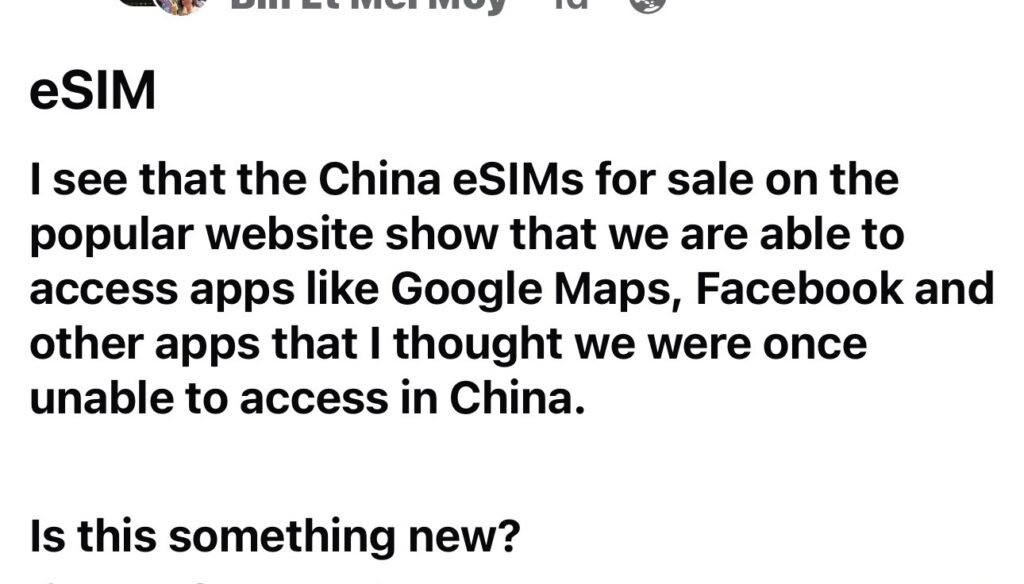
I see that the China eSIMs for sale on the popular website show that we are able to access apps like Google Maps, Facebook and other apps that I thought we were once unable to access in China.
Is this something new?

AI Travel Planner Answer
Yes — what you’re seeing is real, but it doesn’t mean China has suddenly unblocked Google or Facebook. The important change is how many international travel eSIMs route your data.
On an ordinary mainland Chinese internet connection — such as local mobile data or hotel Wi-Fi — services including Google and Facebook remain restricted. Current UK travel advice still notes that Chinese authorities control internet access and that some services are permanently blocked.
So why can a travel eSIM access them?
Many travel eSIMs operate using international roaming. Your phone may connect to a Chinese mobile network physically, but the eSIM provider can route your internet traffic through a network outside mainland China, for example Hong Kong or another overseas location.
The practical result can be:
Phone → Chinese mobile tower → overseas roaming network → internet
rather than:
Phone → mainland Chinese internet → internet restrictions
That means Google, Gmail, Facebook, WhatsApp, Instagram and similar services can often work over the eSIM’s mobile data without you switching on a separate VPN.
This isn’t entirely new. International roaming has long behaved differently from ordinary domestic internet access. What’s changed is that travel eSIMs have made this much cheaper, simpler and more visible to ordinary tourists.
The important catch
Don’t assume that every product advertised as a “China eSIM” does this.
Before buying, I would check that the specific plan:
- covers mainland China, not merely Hong Kong;
- uses international/overseas data routing;
- explicitly confirms access to the international services you need;
- supports your particular phone.
Also remember that the effect applies while you’re using that eSIM’s mobile data. If you return to your hotel and your phone automatically switches to ordinary Chinese Wi-Fi, Google or Facebook may stop working again.
So the old advice that “Google doesn’t work in China” isn’t exactly wrong. A better 2026 explanation is:
Google generally isn’t accessible through an ordinary mainland connection, but an internationally routed travel eSIM can give a visitor a very different internet experience.
ChinaTravelBUG Verification Note
Last verified: 15 August 2026
ChinaTravelBUG checked the central claim in this answer against current information.
Google and Facebook remain among the services blocked on ordinary mainland Chinese internet connections. UK government travel advice continues to state that Chinese authorities control internet access and specifically identifies Google and Facebook among permanently blocked services. (GOV.UK)
The important distinction is that eSIM technology itself does not bypass China’s internet restrictions. The determining factor is how the particular eSIM provider routes the user’s mobile data. Some international travel eSIMs use roaming arrangements that route traffic through gateways outside mainland China, allowing services such as Google, WhatsApp, Instagram and Facebook to remain accessible without a separate VPN. Other eSIMs may use mainland routing and remain subject to mainland restrictions. (北極星 eSIM)
Travelers should therefore verify the specifications of the specific eSIM plan rather than assuming that every “China eSIM” provides unrestricted international internet access.
There is another practical trap worth remembering: hotel, café and other ordinary mainland Wi-Fi connections are separate from your travel eSIM connection. If your phone automatically switches from internationally routed eSIM data to local Wi-Fi, restricted services may stop working. (MyChinaGuide)
Internet access, roaming arrangements, eSIM compatibility and provider policies can change. Check your chosen provider’s current China information before purchasing and again shortly before departure.
About This Traveler Question
This question was adapted from a real traveler discussion. Personal identifying details have been omitted.
The AI Travel Planner answer above is shown as originally generated, without editorial rewriting.
AI can help compare travel options and explain how services generally work, but connectivity rules, eSIM specifications, mobile-network arrangements and internet access can change. Always verify important details with your chosen provider before travel.
Further Reading
This explains the different ways international visitors can stay connected in China, including international roaming, eSIMs, local connections and the practical implications of China’s internet restrictions.
15 Essential Apps Every First-Time Visitor Should Install Before Flying to China (2026)
Once your internet connection is sorted, this guide covers the apps that can make payments, transportation, navigation and everyday travel around China considerably easier.
The simplest takeaway is this:
A travel eSIM doesn’t mean China’s internet restrictions have disappeared. The right internationally routed travel eSIM can simply give your phone a different route to the internet.

Planning Your Own China Trip?
Internet access is only one of the practical questions worth sorting out before arriving in China. Payments, navigation, transportation apps, train tickets and attraction reservations can all feel unfamiliar on a first trip.
Tell the ChinaTravelBUG AI Travel Planner where you’re going, how long you’ll be in China and what you’re unsure about, and it can help you work through the practical details before departure.
Try the FREE ChinaTravelBUG AI Travel Planner.