
ChinaTravelBUG AI Travel Planner Answers
Traveling in China for several weeks with insulin means thinking about something most travel guides never mention: what do you do with used syringes, pen needles, lancets and blood-contaminated glucose test strips?
China does not appear to have one simple nationwide public sharps-drop-box system designed for travelers. But there is a sensible way to manage your supplies safely while you travel.
The Traveler’s Question
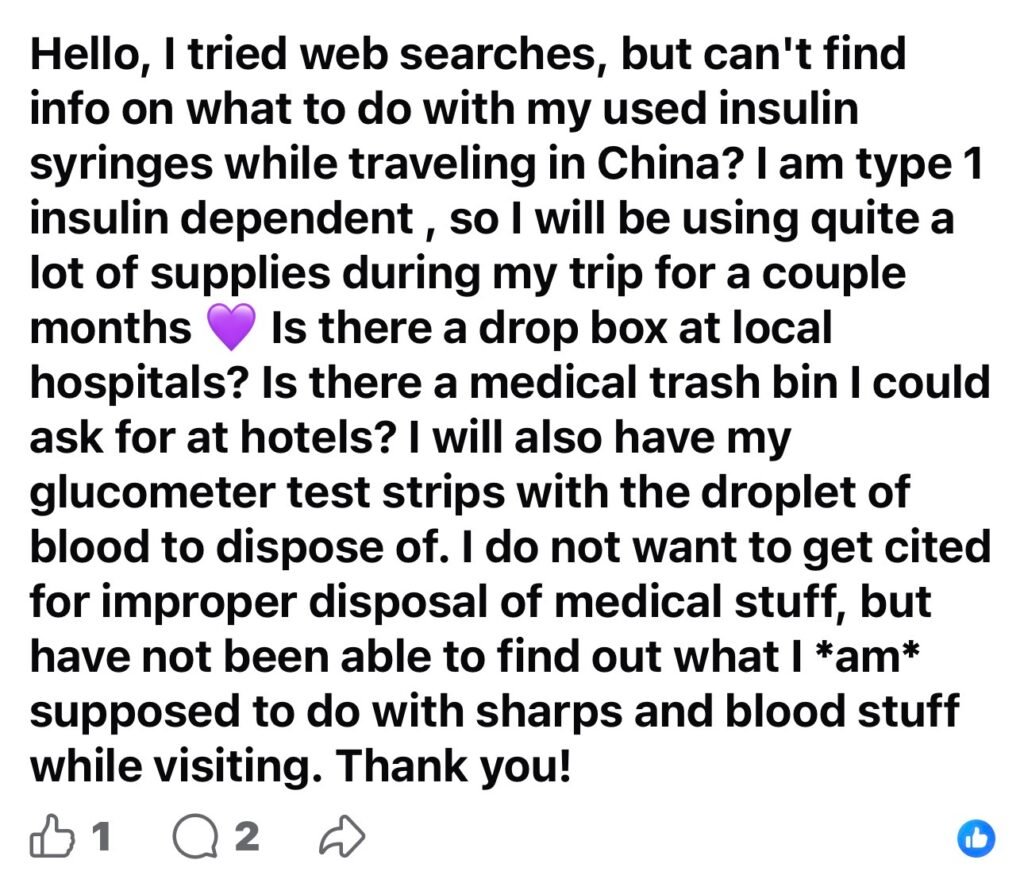
Hello, I tried web searches, but can’t find info on what to do with my used insulin syringes while traveling in China?
I am type 1 insulin dependent, so I will be using quite a lot of supplies during my trip for a couple months. Is there a drop box at local hospitals? Is there a medical trash bin I could ask for at hotels?
I will also have my glucometer test strips with the droplet of blood to dispose of. I do not want to get cited for improper disposal of medical stuff, but have not been able to find out what I am supposed to do with sharps and blood stuff while visiting.

AI Travel Planner Answer
Yes — there is a sensible way to handle this in China, but I would not rely on hotels having a medical-waste bin or on every hospital having a public sharps drop box. Arrangements for people using insulin at home appear to vary locally.
For a trip of a couple of months, I’d recommend bringing a proper portable sharps container (and ideally a spare). Put used syringes, pen needles and lancets straight into it. Chinese health guidance specifically describes used insulin needles as contaminated medical sharps and advises keeping them in a puncture-resistant container rather than putting them loose into ordinary rubbish.
What to do when the container fills
Ask a hospital diabetes/endocrinology department (内分泌科) or a community health service center (社区卫生服务中心) whether they will accept it for disposal.
There is official evidence of exactly this approach in China: some hospitals provide sharps containers to diabetes patients and accept the sealed containers back for centralized medical-waste disposal. Wuhan authorities have also encouraged medical institutions to establish collection points for household insulin needles.
China’s medical-waste rules require medical sharps such as needles to be collected in designated sharps containers, and current standards say those containers should be sealed when roughly three-quarters full.
I wouldn’t put loose syringes or lancets in a hotel-room wastebasket, and I wouldn’t hand them directly to housekeeping. A hotel may be willing to help locate an appropriate medical facility, but I couldn’t verify any nationwide rule requiring Chinese hotels to provide sharps disposal.
For blood glucose test strips, the national rules I found don’t give me enough confidence to tell an international traveler that every used home test strip should be handled in one particular way. I’d therefore keep the blood-contaminated strips separately in a small sealed bag/container and ask the same medical facility how they want them disposed of locally rather than guessing.
A useful sentence to show hospital staff is:
我是糖尿病患者。这些是我自己使用过的胰岛素针头。请问在哪里可以安全处理这些医疗锐器?
Wǒ shì tángniàobìng huànzhě. Zhèxiē shì wǒ zìjǐ shǐyòng guò de yídǎosù zhēntóu. Qǐngwèn zài nǎlǐ kěyǐ ānquán chǔlǐ zhèxiē yīliáo ruìqì?
“I have diabetes. These are my used insulin needles. Where can I safely dispose of these medical sharps?”
One important point: I couldn’t find evidence of a single nationwide public sharps-drop-box system for travelers in China. So for a two-month trip, the safest practical strategy is container first, then arrange disposal through a hospital/community health center in whichever city you’re staying in, rather than expecting public drop boxes.
A note about this AI Travel Planner answer: This answer is shown as originally generated, without editorial rewriting. Travel information can change, especially transport schedules, border procedures, opening hours, ticketing rules and holiday arrangements. Before making bookings or travel decisions, always verify time-sensitive details with current official sources.
ChinaTravelBUG Planning Note: Bring Your Sharps Container With You
This is one situation where I would prepare before arriving in China rather than assume you’ll easily find exactly what you need after arrival.
Bring a purpose-made portable sharps container large enough for the first part of your trip.
If you’re staying for a couple of months and expect to use many needles or syringes, bringing a second container may also be sensible.
The principle is simple:
Use → immediately contain → securely store → arrange appropriate disposal.
Don’t leave loose needles sitting around your hotel room while waiting to work out what to do with them.
What Should Go Into the Sharps Container?
The most obvious items are:
- Used insulin syringes
- Used pen needles
- Lancets
- Other used sharp diabetes equipment capable of puncturing skin or a rubbish bag
Put the sharp directly into the container after use rather than leaving it on a table or putting it temporarily into ordinary rubbish.
And don’t deliberately overfill the container. Once it reaches its recommended fill level, close it securely.
Don’t Put Loose Needles in Your Hotel Bin
This is probably the most important practical rule for travelers.
A hotel wastebasket is emptied by another person.
A loose needle concealed among tissues, packaging or other rubbish creates an obvious needlestick risk for housekeeping staff handling the bag.
Likewise, don’t simply hand a collection of loose needles to a hotel employee.
Instead, keep them securely inside your sharps container and ask reception for assistance finding somewhere that can advise on disposal.
A useful phrase at the hotel is:
附近哪里可以处理用过的胰岛素针头?
Fùjìn nǎlǐ kěyǐ chǔlǐ yòng guò de yídǎosù zhēntóu?
“Where nearby can I dispose of used insulin needles?”
Where Should You Ask?
The most practical places to try are medical facilities rather than ordinary hotels.
Look for:
内分泌科 — Nèifēnmì kē
Endocrinology department
or
社区卫生服务中心 — Shèqū Wèishēng Fúwù Zhōngxīn
Community Health Service Center
If you’re staying in a major city, your hotel can help locate one nearby.
However, ask before assuming the facility will accept your container. Procedures for sharps generated by patients outside the facility can vary locally.
That distinction matters. China’s medical institutions have regulated procedures for medical waste, but that does not automatically mean every hospital operates a public drop-off service for travelers carrying household-generated sharps.
What About Used Glucose Test Strips?
This is less straightforward.
Used glucose test strips can contain a small amount of blood, but I did not find sufficiently clear nationwide guidance for travelers to confidently say that every home-used test strip throughout China must be disposed of in one specific way.
So I would take the conservative approach.
Keep used blood-contaminated test strips in a small sealed bag or suitable separate container, then ask the medical facility handling your sharps how they want the strips handled locally.
That’s better than assuming they belong either in the sharps container or ordinary hotel rubbish.
What If a Hospital Won’t Take My Sharps?
Don’t panic and don’t start moving loose needles between containers.
Keep the sharps container closed and secure, then ask the facility where they recommend taking household-generated insulin needles.
You can also ask your hotel to help call another hospital or community health center.
For someone traveling around China for two months, it may be easier to arrange disposal while spending several days in a large city, rather than waiting until you’re staying somewhere remote.
Related Traveler Questions
Long-term travel in China requires a little more preparation than an ordinary one- or two-week holiday, particularly when you depend on medical supplies.
Before leaving home, think through the entire chain:
How much medication and equipment do I need? → How will I carry it? → How will I use it safely? → How will I dispose of used supplies?
For travelers who may need medical assistance during their trip, our guide Healthcare in Beijing: What Foreign Travelers Should Know About Hospitals, Emergency Care and Medical Help can also help explain how to approach medical care as an international visitor.
Verification Note – 16 August 2026
This article concerns safe handling of medical sharps and should not be treated as a substitute for individual medical advice or instructions from local health authorities.
Chinese health guidance recognizes used insulin needles as contaminated sharps and advises puncture-resistant containment. Chinese medical facilities also operate regulated medical-waste systems, and there is documented official support in some localities for hospitals or healthcare facilities collecting household-generated insulin needles.
However, China does not appear to have one nationwide public sharps-return system specifically designed for international travelers, and local arrangements can differ.
Importantly, rules governing medical waste generated by hospitals and other healthcare institutions should not automatically be interpreted as identical legal requirements for medical waste generated personally by a traveler in a hotel.
For that reason, ChinaTravelBUG’s practical recommendation is deliberately conservative:
Use a proper sharps container, never place loose sharps in ordinary hotel rubbish, and ask a hospital, endocrinology department or community health service center for the locally appropriate disposal method.
About This Answer
This article is based on a real traveler question submitted to the ChinaTravelBUG AI Travel Planner.
The original planning answer is preserved above, with additional editorial context added to make the practical steps clearer for international travelers staying in China for an extended period.
Health-service arrangements and local waste-disposal procedures can vary between Chinese cities and facilities, so travelers should confirm local procedures during their trip.

Planning Your Own China Trip?
China travel planning isn’t only about deciding which cities to visit.
If you have specific practical requirements — accessibility, dietary needs, traveling with children, medication, transport questions or a complicated itinerary — ask the ChinaTravelBUG AI Travel Planner.
It can help you identify the questions worth solving before they become problems during your trip.
See China. Understand It Better.