
China can be surprisingly affordable once your flights and hotels are paid for—but how much should a family actually budget for eating and getting around each day?
A traveler planning 14 days in China with two adults and two children, split evenly between Shanghai (上海, Shànghǎi) and Beijing (北京, Běijīng), asked exactly that.
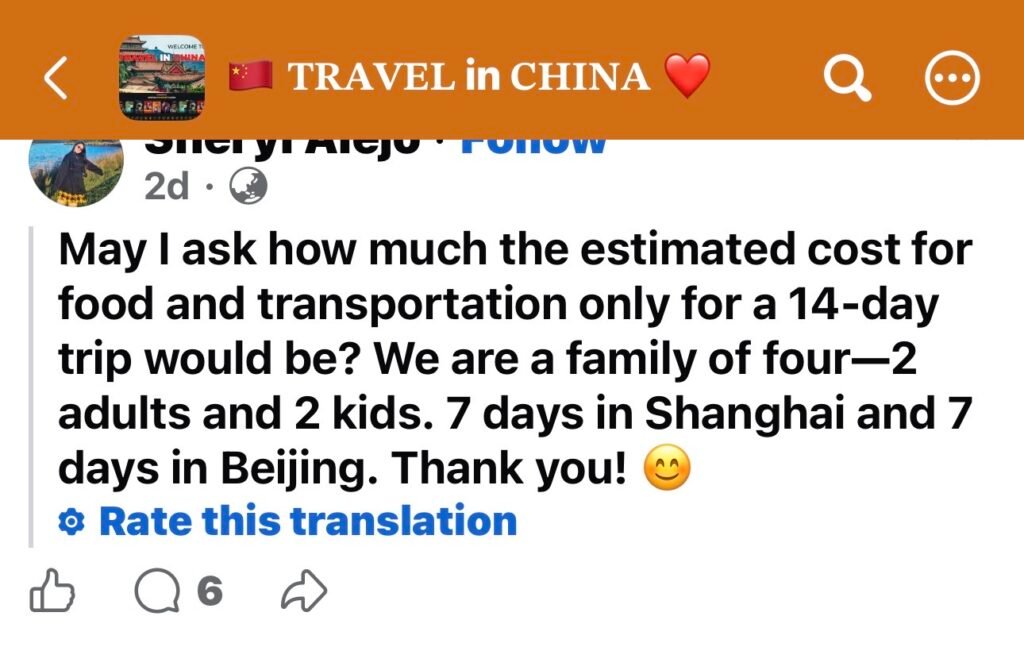
We put the question to the ChinaTravelBUG AI Travel Planner.
The Traveler’s Question
“May I ask how much the estimated cost for food and transportation only for a 14-day trip would be?
We are a family of four—2 adults and 2 kids. 7 days in Shanghai and 7 days in Beijing. Thank you! 😊”

AI Travel Planner Answers
For the family in the screenshot—2 adults + 2 children, 14 days split between Shanghai and Beijing—I’d suggest budgeting roughly ¥7,000–¥11,000 total (about US$975–$1,530) for food + local transportation, excluding hotels, attraction tickets, and the Beijing–Shanghai intercity journey.
A practical family budget would look like this:
- Food: ¥350–¥550 per day for the family → about ¥4,900–¥7,700 for 14 days. That allows for local breakfasts, casual restaurants, shared Chinese meals, snacks and drinks, without relying on expensive Western or hotel restaurants.
- Local transportation: ¥100–¥180 per day → about ¥1,400–¥2,500. Beijing and Shanghai both have excellent, inexpensive metro systems. Using the metro for most journeys and occasional taxis/ride-hailing should comfortably fit this range.
- Comfortable target: I’d personally plan around ¥9,000 for the family, then keep another ¥1,500–¥2,000 as a cushion.
The biggest variable is food. Eating as locals often do—ordering several dishes to share—can be surprisingly economical for four people. Western restaurants, cafés, hotel breakfasts and frequent delivery will push the budget noticeably higher.
One planning point: seven days in each city is actually quite a nice pace for a family. Rather than filling every day with major attractions, leave some time for Beijing’s parks and hutong neighborhoods and Shanghai’s neighborhood walks. Children often remember those ordinary moments as much as the monuments.
I’d treat the Beijing–Shanghai high-speed train separately from the local-transport budget because the cost depends on the train/class chosen and the children’s eligibility for discounted tickets.
ChinaTravelBUG’s Take: ¥ 9,000 Is a Sensible Planning Number
For this particular family, we think the Planner’s ¥ 9,000 working budget is a useful starting point.
Here’s the estimate at a glance:
| 14 Days — Family of Four | Estimated Cost |
|---|---|
| Food | ¥4,900–¥7,700 |
| Local transportation | ¥1,400–¥2,500 |
| Estimated total | About ¥7,000–¥11,000 |
| Comfortable planning target | Around ¥9,000 + cushion |
These are planning estimates, not fixed prices.
A family eating mainly at neighborhood Chinese restaurants and using the metro frequently could spend toward the lower end. Add Western restaurants, specialty cafés, frequent DiDi rides or more expensive meals and the total can rise quickly.
What Is Not Included?
This estimate covers food and everyday local transportation only.
It does not include:
- Hotels
- Attraction admission
- Great Wall transportation/tours
- Shopping
- Beijing–Shanghai high-speed rail
- Airport transfers beyond normal local transport assumptions
That distinction matters.
For example, traveling between Beijing (北京, Běijīng) and Shanghai (上海, Shànghǎi) by high-speed rail is an intercity journey and should have its own budget.
Where Families Can Save Without Trying Very Hard
Food is probably where international visitors have the most control.
A Chinese family meal often involves ordering several dishes for everyone to share rather than buying four separate mains. Neighborhood restaurants, noodle shops and local breakfasts can therefore be excellent value.
Transportation is another area where you don’t necessarily need to spend heavily.
Both Beijing and Shanghai have extensive metro networks. For many sightseeing days, a combination of metro + walking + occasional DiDi/taxi works perfectly well.
And with children, don’t feel obliged to use the cheapest option every time.
After a long day walking around the Forbidden City (故宫, Gùgōng) or exploring Shanghai, spending a little more on a ride back to the hotel can be money very well spent.
Ready to Check Trains from Shanghai to Beijing?
High-speed rail (HSR) is Dad & Elaine’s preferred way of travelling between Chinese cities. We’ve taken many HSR journeys during our travels around China and genuinely enjoy the experience — comfortable, convenient, and a great way to see the country as we move from one city to another.
We’ve also personally used Trip.com many times for our travel bookings in China and elsewhere.
🚄 Check Shanghai → Beijing HSR train times & fares on Trip.com →
Affiliate link — ChinaTravelBUG may earn a small commission at no extra cost to you.
Ready to Check Shanghai Hotels?
Dad & Elaine have personally used Trip.com many times when travelling in China and elsewhere — for hotels, flights, attractions and tours. We’ve had good experiences with it, so it’s one of the booking platforms we use ourselves.
🏨 Check Shanghai hotels & current prices on Trip.com →
Affiliate link — ChinaTravelBUG may earn a small commission at no extra cost to you.
Ready to Check Beijing Hotels?
Dad & Elaine have personally used Trip.com many times when travelling in China and elsewhere — for hotels, flights, attractions and tours. We’ve had good experiences with it, so it’s one of the booking platforms we use ourselves.
🏨 Check Beijing hotels & current prices on Trip.com →
Looking for Else Where Hotels in China?
Dad & Elaine have personally used Trip.com many times when travelling across China and elsewhere — for hotels, flights, attractions and tours. We’ve had good experiences with it, so it’s one of the booking platforms we use ourselves.
🏨 Check hotels & current prices across China on Trip.com →
Ready to Check Trains from Shanghai to Beijing?
High-speed rail (HSR) is Dad & Elaine’s preferred way of travelling between Chinese cities. We’ve taken many HSR journeys during our travels around China and genuinely enjoy the experience — comfortable, convenient, and a great way to see the country as we move from one city to another.
We’ve also personally used Trip.com many times for our travel bookings in China and elsewhere.
🚄 Check Shanghai → Beijing HSR train times & fares on Trip.com →
ChinaTravelBUG Verification Note
Last reviewed: August 14, 2026
The food figures above are travel-planning estimates, not official prices. Actual spending varies substantially according to restaurant choice, children’s ages, eating habits and exchange rates.
Beijing and Shanghai both operate extensive public transportation systems with fares that vary according to journey and mode. Travelers should check current fares when traveling.
The Beijing–Shanghai high-speed railway is deliberately excluded from this estimate because fares vary according to train, seat class and applicable child-ticket rules.
About This Traveler Question
This question was adapted from a real traveler discussion shared in a China travel community online.
Personal identifying details have been omitted.
Questions like this are particularly useful because they reveal something generic “China trip cost” articles often don’t answer:
What does an ordinary family actually need for everyday expenses once the flights and hotels are already paid for?
For this particular two-week trip, we’d start with around ¥9,000 for food and local transportation, keep a cushion available, and enjoy the trip rather than trying to account for every bowl of noodles.

Planning Your Own China Trip?
Your budget will change depending on how many people are traveling, which cities you’re visiting, how you like to eat, and how quickly you’re moving around China.
Tell the ChinaTravelBUG AI Travel Planner your route, trip length and number of travelers, and ask it to help estimate a realistic budget for your particular trip.
Try the FREE ChinaTravelBUG AI Travel Planner.
Looking for Affordable Hotels in China?
Dad & Elaine have personally used Trip.com many times when travelling across China and elsewhere — for hotels, flights, attractions and tours. We’ve had good experiences with it, so it’s one of the booking platforms we use ourselves.