Finding a hotel in Beijing can be surprisingly intimidating for first-time visitors.
Unlike many European cities where the historic centre is relatively compact, Beijing is enormous. It is one of the world’s largest capital cities, with an extensive Metro network, multiple high-speed railway stations, several ring roads, and attractions spread across different districts.
Choosing the wrong hotel may not ruin your trip—but it could easily mean spending an extra one or two hours every day travelling across the city.
Over the years, Elaine and I have gradually developed a simple hotel selection process that has worked remarkably well throughout our travels in China.
It isn’t about booking the cheapest hotel.
Neither is it about booking the most luxurious one.
Instead, we look for the best overall value—a hotel that offers comfortable accommodation, convenient transport, nearby food options, useful facilities, and fits perfectly into our overall travel itinerary.
Almost every time, I begin my research using the Trip.com app.
Besides being available entirely in English, it is extremely easy to use, and the hotels listed are suitable for international travellers. That removes one of the common worries many first-time visitors have when planning a China trip.
Here is exactly how I choose our hotels.
Step 1 — Shortlist Hotels That Immediately Look Promising
When searching for hotels, I don’t immediately open every listing.
Instead, I quickly scan each hotel’s summary page.
Within a few seconds, I can already eliminate many unsuitable options.
My checklist usually includes:
- Excellent guest rating (preferably above 9.2)
- A healthy number of reviews
- Walking distance to a Metro station
- Laundry room or washing machine
- Buffet breakfast if available
- Free cancellation
- Reasonable nightly room rate
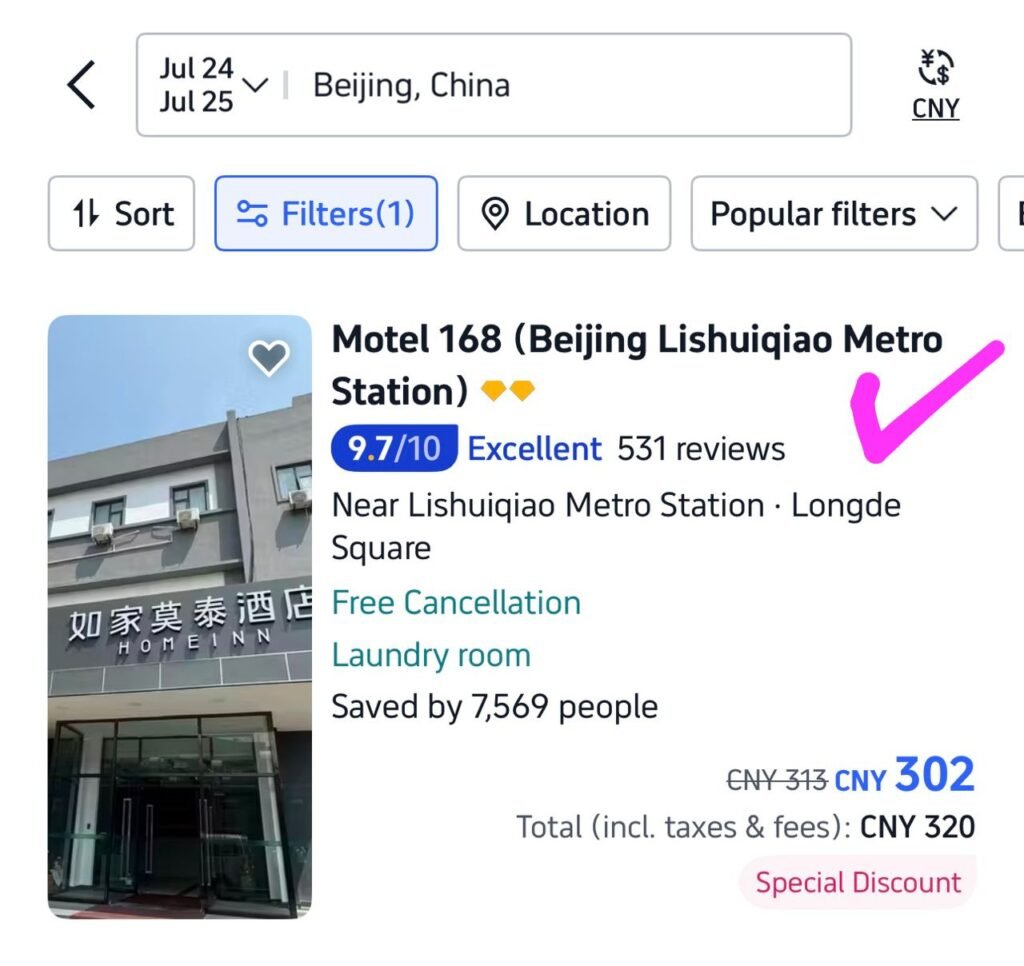
One hotel immediately caught my attention.
Motel 168 (Beijing Lishuiqiao Metro Station).
For approximately CNY302 per night, it offered:
- an outstanding 9.7/10 rating,
- more than 530 guest reviews,
- a Metro station within walking distance,
- a laundry room,
- buffet breakfast,
- and free cancellation.
Already, it deserved a closer look.
Notice that I don’t simply book the cheapest hotel available.
Sometimes paying another RMB30 or RMB50 per night can save hours of travelling over several days.
That is almost always money well spent.
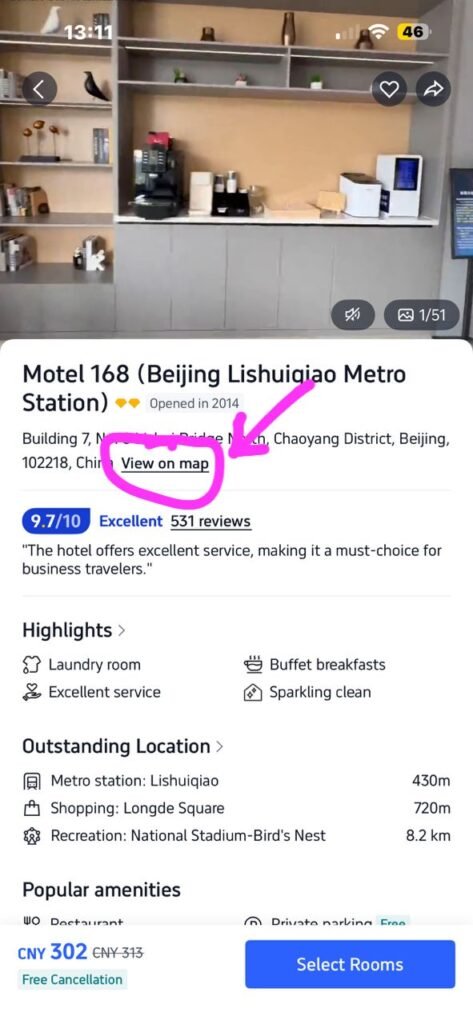
Step 2 — Tap “View on Map”
This is probably the single most important button on the entire hotel page.
After opening the hotel listing, I immediately tap “View on Map.”
Many travellers focus on the written address.
I almost never do.
A map tells a much better story.
Within seconds, I can visualise where the hotel sits in relation to Beijing’s attractions, railway stations, commercial districts and Metro lines.
Never skip this step.
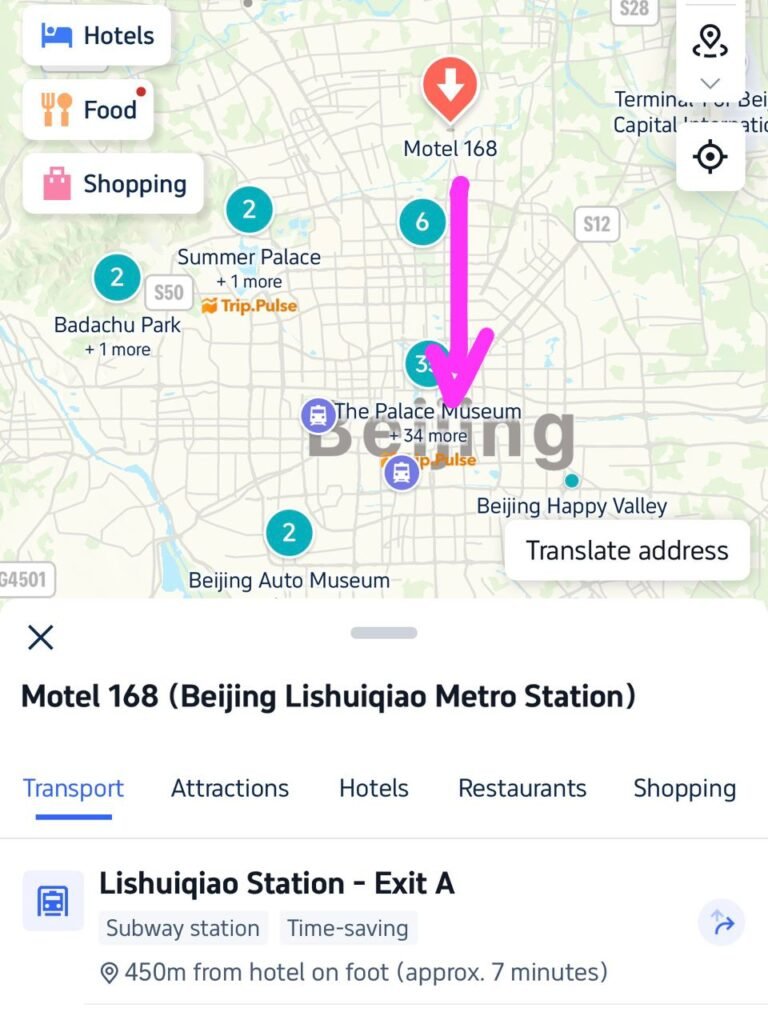
Step 3 — Study the Location Like a Strategist
At first glance, Motel 168 appears to be located well north of Beijing’s city centre.
Some travellers might immediately reject it.
I don’t.
Instead, I ask myself a different question.
Is it well connected?
That is far more important.
Beijing’s Metro system is fast, extensive and inexpensive.
This hotel sits only around 450 metres from Lishuiqiao Metro Station, meaning reaching central Beijing is straightforward, even if the journey takes around 45 minutes.
For our travel style, that is perfectly acceptable.
In fact, staying slightly outside the city centre often provides significantly better value than staying within the expensive central districts.
Another factor I always consider is the next stage of our journey.
Many of our China trips continue by high-speed rail.
Therefore, I also think ahead.
How convenient will it be to reach the railway station when we leave Beijing?
Saving thirty or forty minutes on departure day may not sound like much, but it makes travelling far less stressful—especially when catching an early morning train.
A good hotel should fit not only today’s sightseeing plans but tomorrow’s travel plans as well.
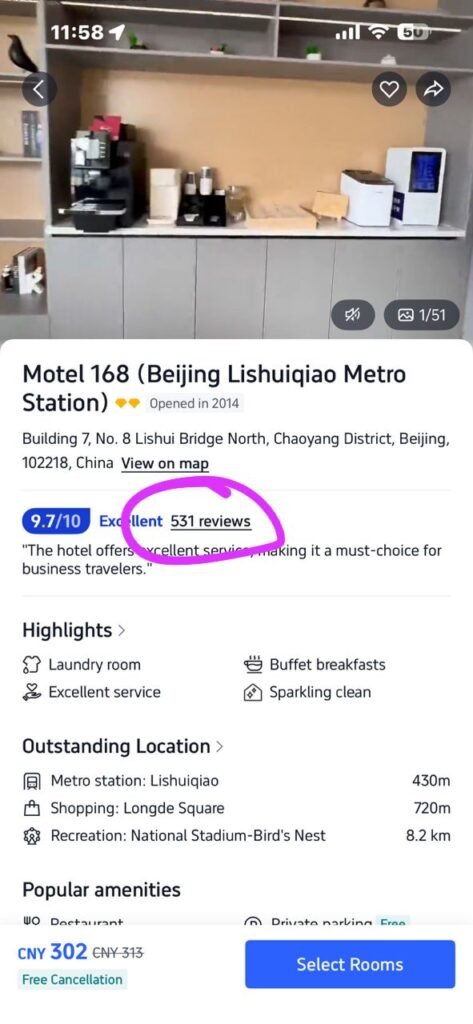
Step 4 — Read Reviews Like a Detective
Only after I am satisfied with the hotel’s location do I start reading guest reviews.
I never rely solely on the numerical rating.
Instead, I look for patterns.
Questions I ask include:
- Is the room consistently described as clean? (This is always my highest priority.)
- Is the Metro genuinely an easy walk away?
- Are there plenty of eateries nearby?
- Is the neighbourhood safe at night?
- Is the staff friendly and helpful?
- Are there recurring complaints about noise, cigarette smells or poor soundproofing?
One isolated negative review among hundreds of positive ones rarely worries me.
Every hotel occasionally encounters an unreasonable guest—or even the odd malicious review.
What matters is the overall consensus.
If dozens or even hundreds of guests independently praise the same strengths—clean rooms, convenient location and good service—I can book with much greater confidence.
Dad’s Tip
I don’t look for perfection.
I look for consistency.
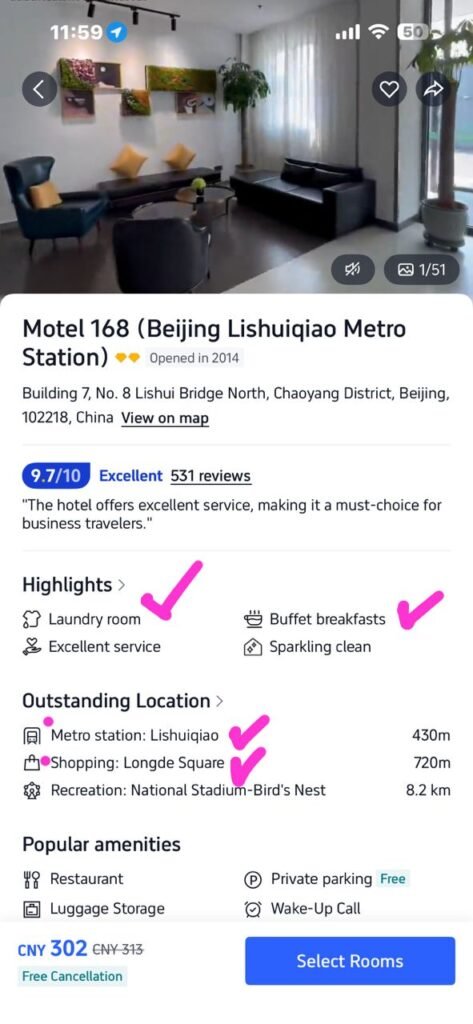
Step 5 — Laundry Room? This Is My Secret Weapon
This may surprise many travellers.
One of the first facilities I look for is not a swimming pool or gym.
It is the laundry room.
If you have already read our article on completing an 18-day China trip with only 7kg hand carry luggage, you’ll understand why.
Being able to wash our clothes every few days completely changes how we travel.
Instead of packing enough clothing for nearly three weeks, we simply pack for several days and wash our clothes during the trip.
Whenever I check a hotel listing, I immediately look for:
- Laundry room
- Washing machine
- Buffet breakfast
- Metro station nearby
- Shopping nearby
This Motel 168 ticked every single box.
For roughly CNY302 per night, we enjoyed:
- a clean private room,
- free use of the laundry room,
- simple buffet breakfast,
- walking distance to the Metro,
- and nearby shopping facilities.
Considering Beijing’s generally higher hotel prices compared with cities such as Xi’an, this represented exceptional value.
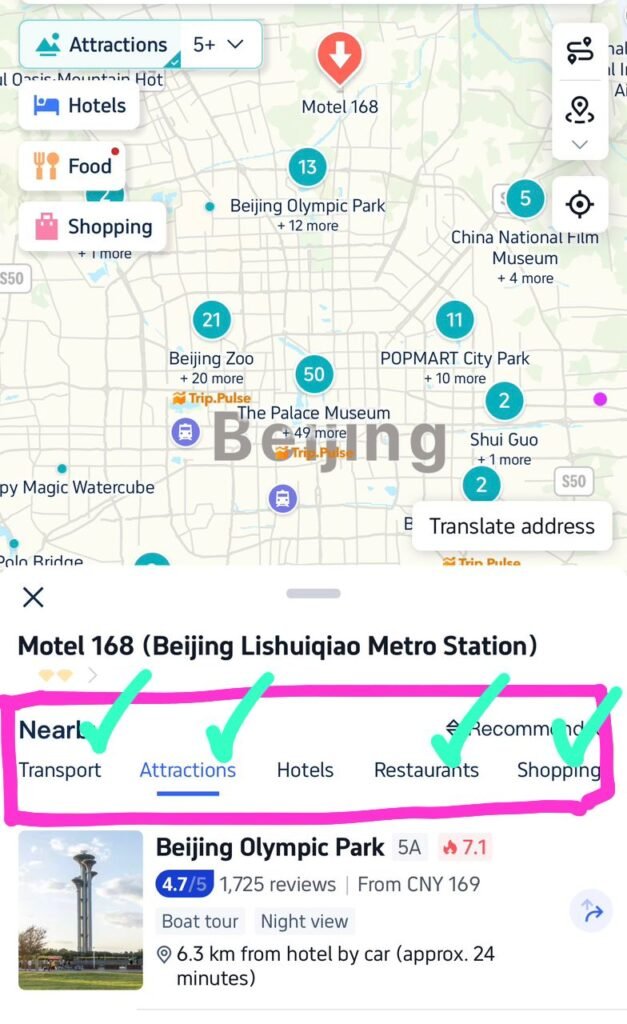
Step 6 — Explore the Neighbourhood Before Booking
This is another Trip.com feature that many travellers overlook.
Below the map, tap the different categories:
- Transport
- Attractions
- Restaurants
- Shopping
Each tells you something important about the surrounding neighbourhood.
Transport
The first thing I check is the nearest Metro station.
Trip.com conveniently shows both the walking distance and estimated walking time.
For Motel 168, Lishuiqiao Station Exit A was only around 450 metres away, roughly a seven-minute walk.
That immediately gave me confidence that exploring Beijing would be convenient.
Attractions
The attractions tab helps me understand the hotel’s overall position within Beijing.
I’m not expecting the Forbidden City to be next door.
Instead, I want to visualise where the hotel sits relative to major sightseeing areas.
Combined with the Metro map, it becomes much easier to estimate daily travelling times.
Remember, Beijing is a huge city.
A hotel doesn’t need to be central.
It simply needs to be well connected.
Restaurants
This is one of my favourite sections.
If I see many restaurants around the hotel, it usually indicates an active local neighbourhood rather than an isolated business district.
That often means:
- breakfast shops,
- noodle restaurants,
- cafés,
- bakeries,
- convenience stores,
- late-night supper options,
- and plenty of local food choices.
Exactly the kind of neighbourhood we enjoy staying in.
Shopping
Finally, I check the Shopping tab.
This may sound like a small detail, but during a two- or three-week China trip, it becomes incredibly useful.
A nearby shopping mall usually means easy access to:
- supermarkets,
- pharmacies (大药房),
- cafés,
- bakeries,
- Uniqlo,
- convenience stores,
- and all those small items you suddenly realise you’ve forgotten to pack.
For Motel 168, Longde Square was only around 720 metres away.
That turned out to be one of the biggest advantages of staying there.
After returning from sightseeing, everything we needed—from dinner and coffee to groceries and daily necessities—was just a short walk away.
Why We Finally Chose Motel 168
After completing my six-step evaluation, I was convinced we had found one of Beijing’s best value-for-money hotels.
For about the price of a youth hostel bed in central Beijing, we enjoyed:
- an excellent 9.7 guest rating,
- over 530 reviews,
- a clean private room,
- buffet breakfast,
- free laundry facilities,
- a Metro station within easy walking distance,
- nearby eateries,
- a shopping mall,
- and a neighbourhood where ordinary Beijingers actually live.
Better still, staying slightly outside the city centre allowed us to experience another side of Beijing beyond the major tourist attractions.
Sometimes the best travel experiences begin the moment you step outside your hotel.
Dad’s Beijing Hotel Checklist
Today, whenever I research accommodation in China, I simply ask six questions.
✓ Does it have consistently good reviews?
✓ Are guests saying the rooms are clean?
✓ Is it close to a Metro station?
✓ Does it provide a laundry room?
✓ Are restaurants and supermarkets nearby?
✓ Does the location fit the rest of my travel itinerary?
If the answer is “yes” to all six, I’ve usually found a hotel that will make the entire journey smoother—not just a place to sleep.
For us, that simple framework has worked across Beijing, Xi’an and many other Chinese cities.
Hopefully, it will help you find your own perfect base for discovering Beijing.
Continue Exploring Beijing
If this is your first time visiting China’s capital, you might also enjoy our guides to:
- Beijing Travel Guide: Discover China’s Ancient Capital, Local Life and Future China
- Returning to Qianmen Street (前门大街): Beijing’s Historic Walking Street
- Wangfujing (王府井): Beyond Beijing’s Famous Shopping Street
- Beijing Hutongs (胡同): Discovering Everyday Life in the Capital
- Visiting Great Wall of China from Beijing: