FOLLOW OUR STORIES → WHAT WE ATE
Our flight out of Beijing wasn’t until midnight.
That gave Dad & Elaine almost another full day in the city.
But by lunchtime, we didn’t feel like hunting for another famous Beijing restaurant.
We didn’t need to.
We simply walked outside our hotel.
And this is one reason Dad came to appreciate where we were staying.
🏨 What Was Outside Our Budget Hotel?
We were staying at Motel 168, outside Beijing’s city center.
Dad has already written about why this rather unglamorous budget hotel turned out to be one of our surprisingly good Beijing finds:
👉 Why We Stayed Outside Beijing City Centre — One of Beijing’s Best Budget Hotel Finds
But there was another advantage that doesn’t necessarily appear when you’re comparing hotels online.
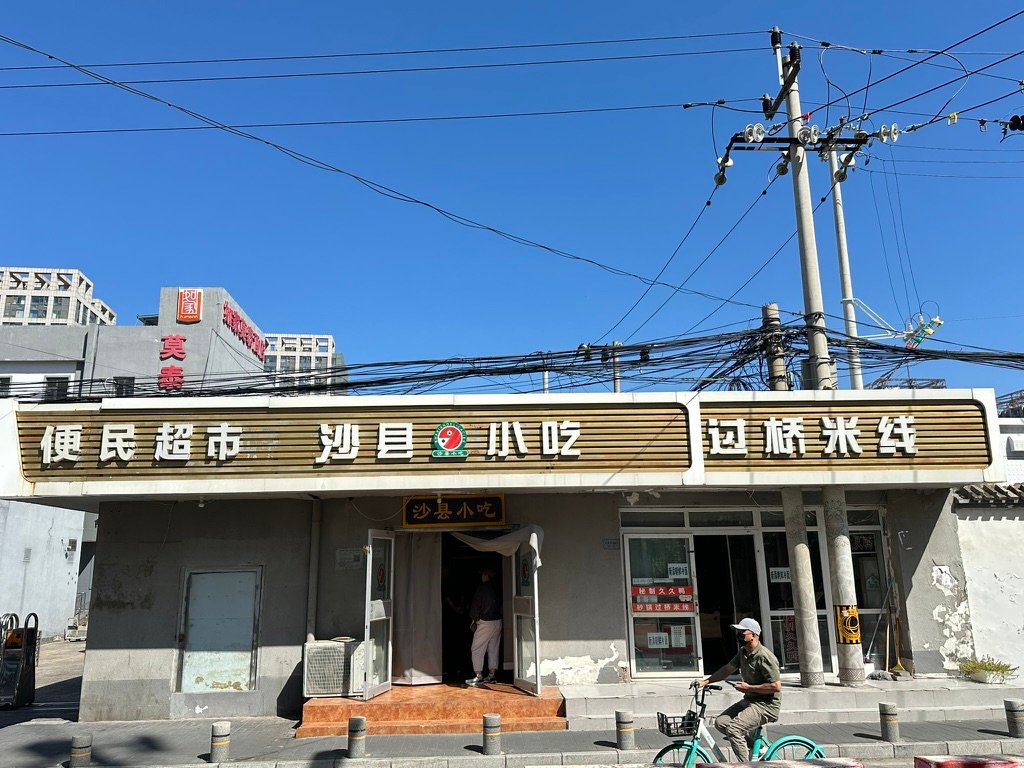
Look at what was outside.
Along the street were ordinary neighborhood businesses:
便利超市 (biànlì chāoshì) — convenience store
小吃 (xiǎochī) — snacks / small eats
烧烤 (shāokǎo) — barbecue
米线 (mǐxiàn) — rice noodles
Restaurants.
Small eating shops.
Places where people living and working nearby could simply walk in and eat.
Nothing particularly glamorous.
Which was exactly what Dad liked about it.
🍜 We Had Already Eaten Around Here More Than Once
This wasn’t our first meal along this little row of shops.
During our stay, Dad & Elaine had eaten nearby several times.
That’s something that happens when you stay in one neighborhood for a while.
At first, everything is unfamiliar.
You walk past a restaurant and wonder:
What’s that?
A few days later, it becomes:
Shall we eat there again? 😂
By our departure day, this little part of Beijing no longer felt completely unfamiliar.
So with a midnight flight ahead of us, we went back for one more easy lunch.
🍲 Our Last Beijing Lunch: 砂锅
We chose 武陟古法砂锅 (Wǔzhì Gǔfǎ Shāguō).
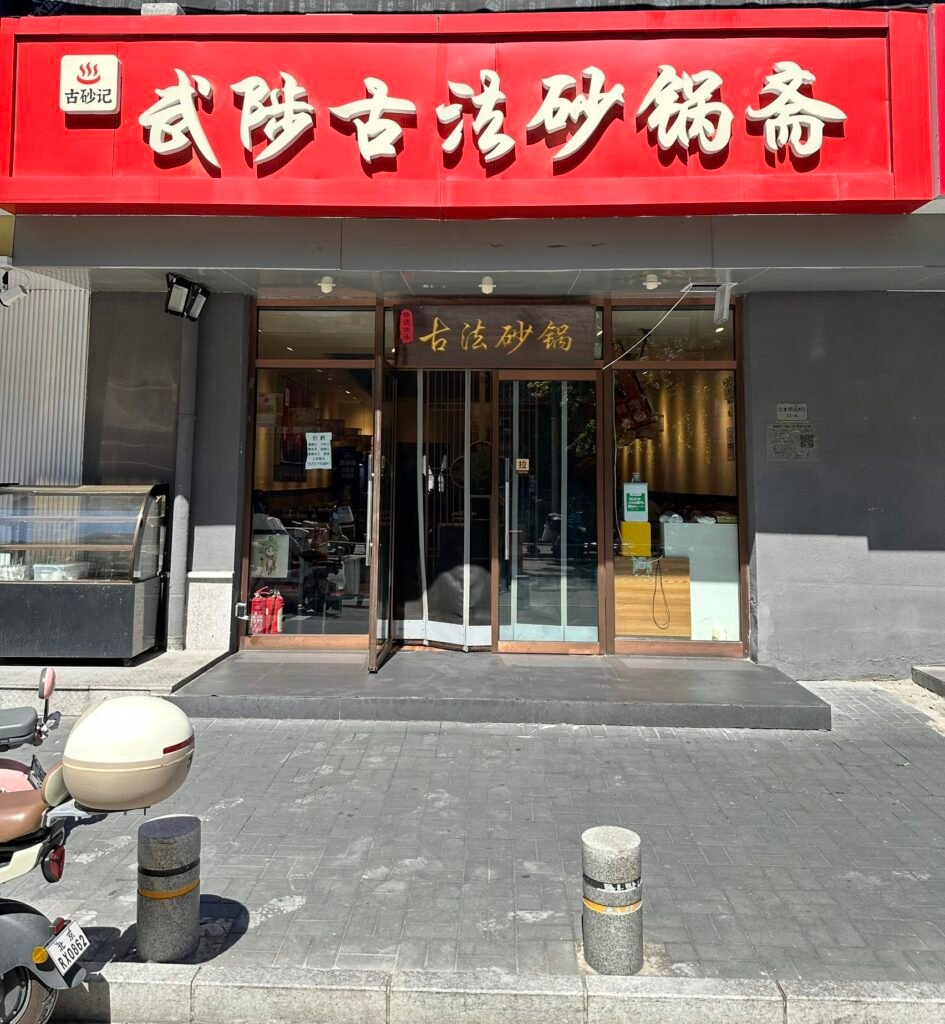
The useful word here is:
砂锅 (shāguō)
砂 (shā) — sand
锅 (guō) — pot
In everyday food language, 砂锅 refers to the earthenware or clay-style cooking pot — and also to the hot dishes prepared and served in it.
These are exactly the sort of Chinese characters Dad likes learning while traveling.
Once you recognize 砂锅, you’ll start noticing the word on restaurant signs and menus elsewhere in China too.
🔥 Then This Arrived
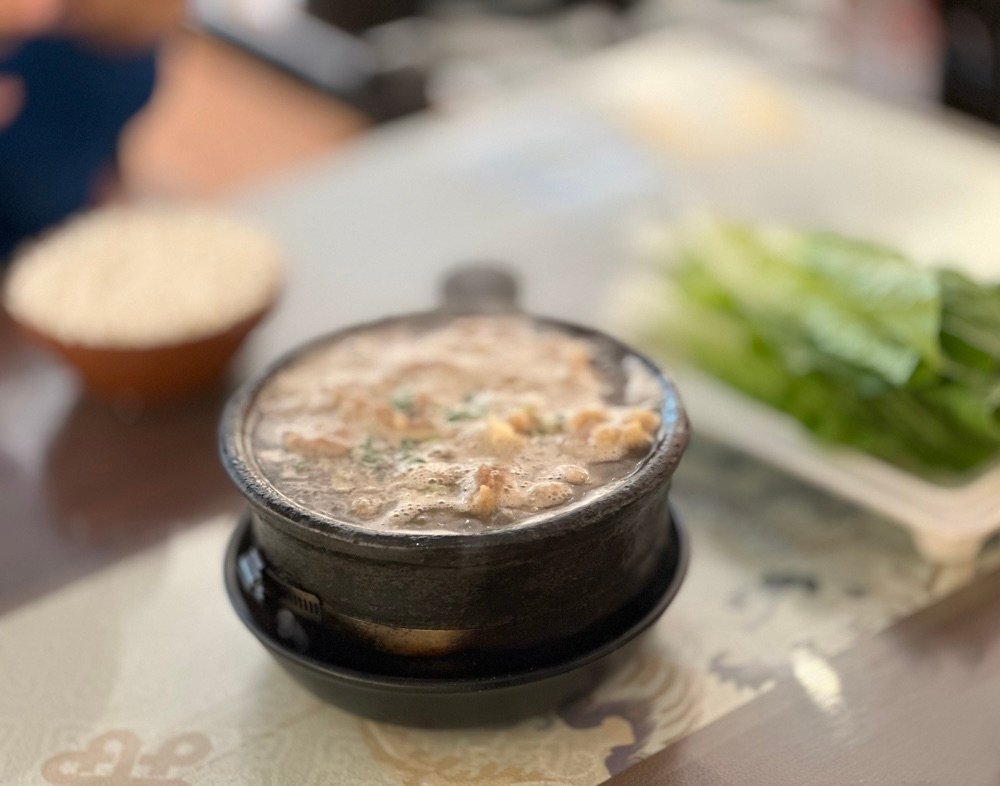
This was lunch.
Still bubbling.
Still steaming.
Served right in the 砂锅 (shāguō).
Beside it:
米饭 (mǐfàn) — cooked rice
and
青菜 (qīngcài) — green vegetables.
Nothing elaborate.
Nothing designed for tourists.
Just a hot, satisfying local meal before a long journey to the airport later that evening.
And Dad did what Dad increasingly does on our China journeys.
He photographed the menu. 😂
💰 What Did It Cost in September 2025?
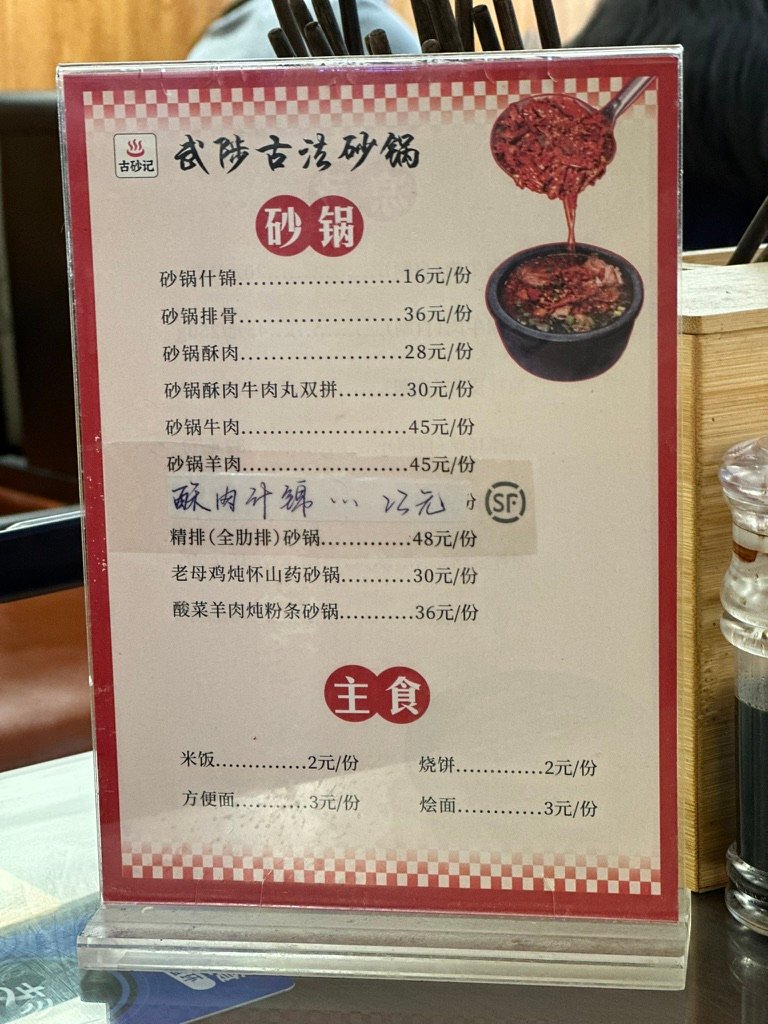
This photograph is useful because we don’t have to guess.
Dad took it during our visit in September 2025.
The menu listed:
砂锅什锦 (shāguō shíjǐn)
Assorted claypot — RMB 16
砂锅排骨 (shāguō páigǔ)
Pork-rib claypot — RMB 36
砂锅酥肉 (shāguō sūròu)
Crispy-pork claypot — RMB 28
砂锅酥肉牛肉丸双拼 (shāguō sūròu niúròuwán shuāngpīn)
Crispy pork and beef-ball combination claypot — RMB 30
砂锅牛肉 (shāguō niúròu)
Beef claypot — RMB 45
砂锅羊肉 (shāguō yángròu)
Lamb claypot — RMB 45
The menu also showed:
精排(全肋排)砂锅 (jīngpái [quán lèipái] shāguō)
Pork-rib claypot — RMB 48
老母鸡炖怀山药砂锅 (lǎomǔjī dùn huáishānyào shāguō)
Old-hen and Chinese-yam claypot — RMB 30
酸菜羊肉炖粉条砂锅 (suāncài yángròu dùn fěntiáo shāguō)
Lamb, pickled cabbage and glass-noodle claypot — RMB 36
And the basics were remarkably inexpensive:
米饭 (mǐfàn) — rice — RMB 2
烧饼 (shāobǐng) — baked flatbread — RMB 2
方便面 (fāngbiànmiàn) — instant noodles — RMB 3
烩面 (huìmiàn) — braised-style noodles — RMB 3
Price note: These are the prices shown on the menu Dad photographed in September 2025. They are a snapshot of what we found during our visit, not guaranteed current prices.
😂 Dad Couldn’t Help Comparing It With Our Train Lunch
The comparison was rather funny.
On another journey, Dad remembers paying more than RMB 50 for a fairly ordinary boxed meal on China’s high-speed rail.
Here, in a little neighborhood restaurant outside our hotel:
beef claypot — RMB 45
lamb claypot — RMB 45
rice — RMB 2
And the food arrived bubbling at the table.
So was the train meal a rip-off?
Dad wouldn’t put it that way.
We were paying for something else on the train:
convenience.
Elaine scanned the QR code on the train-seat armrest, ordered lunch on her phone and had it delivered to us while we traveled across China.
Here?
We had to do something considerably more difficult.
Walk out of our hotel. 😂
🏨 A Hotel Isn’t Only About the Hotel
This little lunch reminded Dad of something useful for travelers.
When choosing a hotel, we naturally compare:
room price
reviews
distance from attractions
metro access
breakfast
and perhaps:
how nice the room looks in the photographs.
But there’s another question worth asking:
What’s outside the hotel?
A hotel surrounded by ordinary restaurants, convenience stores and neighborhood businesses can make traveling much easier.
Especially after a long sightseeing day.
Especially when you’re tired.
Especially when nobody wants to spend another 45 minutes researching:
“BEST RESTAURANTS NEAR ME.” 😂
Our Motel 168 wasn’t in Beijing’s glamorous tourist center.
But we could walk downstairs and eat.
That mattered.
🥢 This Is Also Part of Eating in China
International visitors naturally hear about Beijing’s famous foods.
北京烤鸭 (Běijīng kǎoyā) — Peking duck.
炸酱面 (zhájiàngmiàn) — noodles with fermented soybean sauce.
涮羊肉 (shuàn yángròu) — Beijing-style mutton hotpot.
All worth knowing about.
But Dad & Elaine’s actual meals in China aren’t a continuous parade of famous regional specialties.
Sometimes we eat because we’re hungry.
Sometimes we walk into somewhere because it looks busy.
Sometimes Elaine spots something interesting.
Sometimes Dad sees Chinese characters on a menu and starts asking questions.
And sometimes we return to the same little restaurant simply because:
we liked it the first time.
That is part of traveling China too.
✈️ One Last Ordinary Meal Before Leaving Beijing
Our flight wasn’t until midnight.
Later would come:
the journey to the airport,
luggage,
check-in,
security,
waiting,
and finally the flight home.
But not yet.
For a little while longer, Dad & Elaine were still in Beijing.
[PHOTO — bubbling shaguo again OR Dad & Elaine eating, if available]
Sitting in a small restaurant outside our hotel.
A 砂锅 (shāguō) bubbling on the table.
Rice beside it.
Vegetables beside that.
People coming and going outside.
Nothing famous.
Nothing Dad had planned months beforehand.
Just lunch.
And looking back, Dad rather likes that.
🐞 ChinaTravelBUG’s Take
Some of our favorite food discoveries in China weren’t really destinations at all.
They happened because we were:
hungry + curious + nearby. 😂
This row of ordinary shops outside our Beijing hotel became part of our daily life for a few days.
We ate here more than once.
And on our final day in Beijing, before a midnight flight home, we came back for one last lunch.
It wasn’t Peking duck.
It wasn’t fine dining.
It probably won’t appear on anyone’s list of:
“10 Beijing Restaurants You Must Visit.”
But it became part of our Beijing.
And perhaps that’s the bigger lesson.
When choosing where to stay in China, don’t look only at the hotel.
Look at the metro.
Look at the neighborhood.
Look at the convenience stores.
And look at the little restaurants downstairs.
Because sometimes one of the best hotel amenities…
isn’t inside the hotel at all.
Real Journeys. Real Stories. Real China.
See China. Understand It Better.