

You’ve downloaded Alipay (支付宝, Zhīfùbǎo) and WeChat (微信, Wēixìn).
You’ve started thinking about an eSIM or VPN.
Your China trip is suddenly only a week away.
What else should you actually get sorted before boarding the plane?
This is one of the most useful questions a first-time traveler can ask, because the preparations that make the biggest difference in China aren’t necessarily what you put in your suitcase.
We put the question to the ChinaTravelBUG AI Travel Planner.
The Traveler’s Question
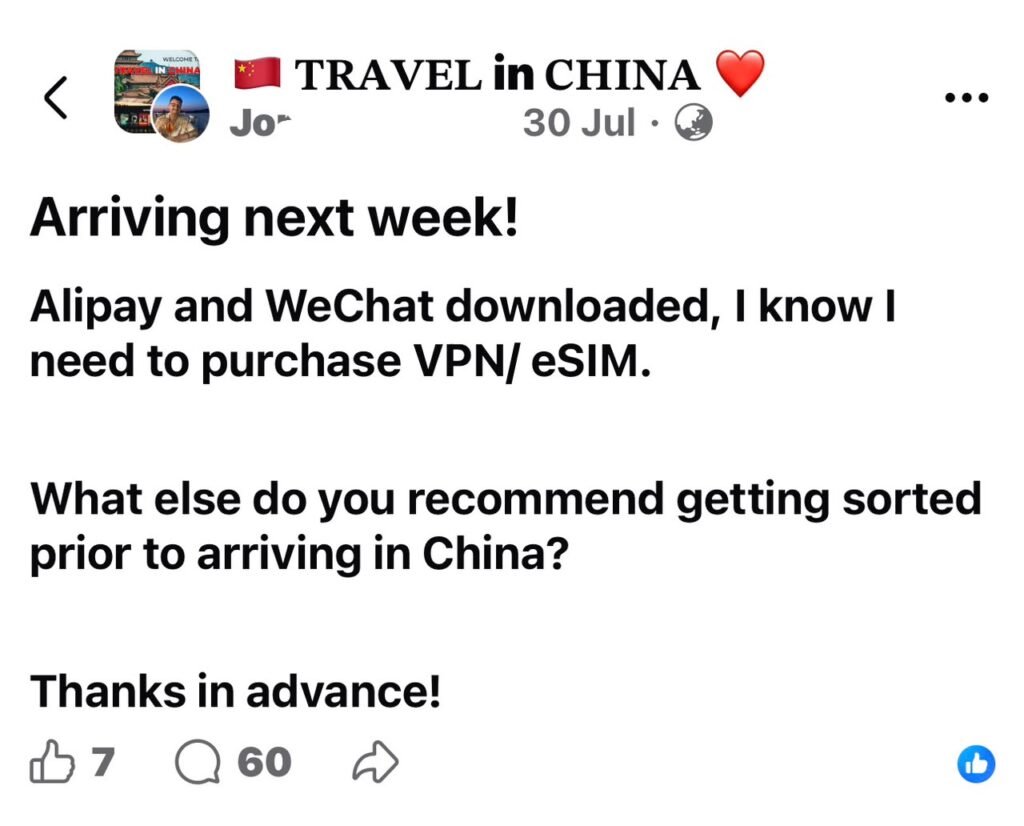
“Arriving next week!
Alipay and WeChat downloaded, I know I need to purchase VPN/eSIM.
What else do you recommend getting sorted prior to arriving in China?
Thanks in advance!”

AI Travel Planner Answers
Yes — they’ve already done two of the most important things. Before flying, I’d focus on making the phone/payment setup actually work, then sorting transport and reservations. China is very manageable independently once those basics are in place.
Before you leave
- Finish setting up Alipay and WeChat Pay. Don’t just download them: create the accounts, link your international card(s), complete any requested identity verification, and ideally add a second card as backup. Chinese government guidance confirms that foreign visitors can register using foreign phone numbers and link major international cards.
- Sort internet access. An international roaming plan or suitable travel eSIM may already give you access to the services you normally use. I wouldn’t automatically assume you need both an eSIM and a VPN; check exactly what your chosen eSIM provides before paying for two solutions.
- Install your practical apps while still at home. I’d want a translation app with offline Chinese downloaded, a reliable map/navigation option, DiDi for ride-hailing, and 12306 if travelling by train.
- Set up trains before arrival if using them. China Railway’s official English 12306 service accepts foreign-passport registration, so creating the account and entering passport details beforehand removes one job after landing.
- Check attraction reservations. For major sights—particularly in Beijing—don’t assume you can simply arrive and buy admission. Check the specific attractions on your itinerary now.
- Keep offline copies of essentials: passport photo page, visa/entry documentation if applicable, travel insurance, hotel names/addresses in Chinese, flight details and important bookings. Your passport is also the key identity document for hotel registration and much of your transport.
- Bring payment backup. Take at least two bank cards plus a modest amount of RMB or a way to obtain cash. Mobile payment is extremely convenient, but I wouldn’t make your entire trip dependent on one phone and one card.
One useful distinction: if you’re staying in hotels, the hotel handles your accommodation registration. If you’re staying in a private home, different registration requirements apply; since March 2026, online registration is being piloted in several regions.
And before departure, verify your entry/visa status for your particular passport rather than relying on Facebook advice—the rules have changed considerably in recent years and differ by nationality.
If I were arriving next week, my priority tonight would be: payments working → internet sorted → transport apps/accounts → attraction bookings → offline backups. After that, you’re in pretty good shape.
Further Reading
First Time Travelling to China? Start Here: The Complete 2026 Planning Guide
Read the article:
https://chinatravelbug.com/first-time-travelling-to-china-start-here-the-complete-2026-planning-guide/
A useful final pre-departure check for a first visit.
Can Foreign Tourists Use Alipay in China?
Read the article:
https://chinatravelbug.com/can-foreign-tourists-use-alipay-in-china/
Worth reading before departure so you can get your payment setup tested while you’re still at home.
ChinaTravelBUG Note
There is an important difference between downloading the apps and actually being ready to use them in China.
Seeing Alipay and WeChat sitting on your phone’s home screen doesn’t mean your payment setup is finished.
Before leaving home, we’d try to remove as many potential points of failure as possible:
Payments → Internet → Transport → Reservations → Documents
Get those five things sorted and the first couple of days in China usually become much easier.
1. Get Alipay and WeChat Pay Ready Before You Fly
For most international visitors, Alipay (支付宝, Zhīfùbǎo) and WeChat Pay / Weixin Pay (微信支付, Wēixìn Zhīfù)are among the most useful things to prepare.
China’s State Council guidance confirms that overseas visitors can register using foreign or Chinese mobile numbers and bind eligible international bank cards to the payment apps.
Don’t stop at downloading them.
Before departure:
- register your account
- add your international card
- complete any identity verification requested
- check that your passport details are correct
- consider adding a second eligible card as backup
- make sure you remember any passwords/PINs you may need
If one foreign card doesn’t cooperate, having another already available is much easier than troubleshooting your banking setup after landing.
And still carry a backup.
We’d bring at least two bank cards and access to some RMB (人民币, Rénmínbì) cash.
China may be highly digital, but your entire holiday shouldn’t depend upon one phone + one payment app + one bank card.
2. Decide How You’re Getting Online
This is probably the next most important decision.
You’ll potentially use your phone in China for:
- payments
- maps
- translation
- DiDi (滴滴, Dīdī)
- train information
- attraction bookings
- hotel communication
- messaging
- searching for information
So reliable mobile data isn’t really an optional luxury anymore.
But don’t automatically buy:
eSIM + roaming + VPN
just because you’ve seen all three recommended online.
Some international roaming services and travel eSIMs route data outside mainland China’s ordinary internet environment, which can mean services such as Google, Gmail and WhatsApp remain accessible over that mobile connection.
The important question to ask your eSIM provider is:
Will this specific plan give me access to the international services I normally use while I’m in mainland China?
Understand what you’re buying first.
Then decide whether you need anything else.
3. Install the Useful China Apps at Home
You don’t need 30 China apps.
For a first trip, concentrate on the ones that solve actual travel problems.
We’d want:
Alipay (支付宝, Zhīfùbǎo) — payments and useful mini-programs.
WeChat (微信, Wēixìn) — communication, Weixin Pay and mini-programs.
DiDi (滴滴, Dīdī) — ride-hailing.
Railway 12306 (铁路12306, Tiělù Yāo-Èr-Sān-Líng-Liù) — China’s official railway booking platform if you’re traveling by train.
A translation app — preferably with offline Chinese downloaded.
A suitable map/navigation app — make sure whatever you intend to use actually works satisfactorily in mainland China.
Download and sign into these before leaving home.
Airport arrival day isn’t the ideal moment to discover that an app needs a verification code sent to a phone number you can’t access.
4. Set Up China Railway 12306 Before Arrival
If your itinerary includes high-speed rail, this is worth doing early.
China Railway’s official English-language 12306 platform supports registration for foreign travelers using passport information.
China Railway 12306 — English registration
Even if you ultimately prefer booking trains through another platform, understanding China’s official railway system is useful.
And make absolutely sure your name and passport information match your travel document.
Your passport isn’t merely identification you leave in the hotel safe. In China, it is closely connected with long-distance transportation and other travel services.
5. Check Your Attractions Before You Arrive
This is particularly important if your itinerary includes Beijing (北京, Běijīng).
Some of China’s most famous attractions use advance reservation systems.
For example, you don’t want to arrive in Beijing and only then discover that your planned Forbidden City (故宫, Gùgōng) day requires advance ticket planning.
The same principle applies elsewhere.
Go through your itinerary attraction by attraction and ask:
Do I need a ticket?
When does booking open?
Can foreign passport holders book online?
Do I need to bring the original passport used for the reservation?
Don’t assume every attraction works like a museum where you simply walk to the entrance and buy a ticket.
6. Save Your Hotel Name and Address in Chinese
This takes two minutes and can be remarkably useful.
Don’t only save:
Beijing Dongfang Hotel, 11 Somewhere Street, Beijing.
Also save the hotel’s Chinese name and Chinese address.
For example:
Beijing Hotel (北京饭店, Běijīng Fàndiàn)
Save a screenshot on your phone.
Then, even if your mobile data isn’t working, you have something you can show a taxi driver, station employee or anyone helping you.
We’d do this for every hotel on the trip.
7. Make an Offline Travel Folder
Phones fail.
Mobile data disappears.
Batteries die.
Apps occasionally decide that today is the day they want you to log in again.
So create one offline folder containing:
- passport photo page
- visa or entry documents where applicable
- travel insurance
- flight information
- train bookings
- hotel confirmations
- hotel names and addresses in Chinese
- major attraction reservations
- emergency contact information
Don’t rely entirely on searching your email every time you need something.
And keep your original passport secure and accessible when traveling.
8. Know Who Registers Your Accommodation
For ordinary tourists staying at hotels, this is generally straightforward.
The hotel handles the required accommodation registration when you check in.
The situation is different if you’re staying somewhere other than a hotel—for example, with friends or relatives.
China’s National Immigration Administration introduced a pilot online accommodation-registration system for foreigners staying in non-hotel accommodation in selected regions from March 2026.
So don’t assume the hotel process and private-accommodation process are identical.
If you’re staying entirely in regular hotels, this is unlikely to require much attention from you.
9. Check Your Entry Rules One Last Time
China’s visa and visa-free entry arrangements have changed substantially in recent years.
And the answer depends on your passport nationality, reason for travel and length of stay.
This is not something we’d verify through a random social-media comment.
Before departure, confirm:
- whether you need a visa
- whether your nationality currently qualifies for visa-free entry
- permitted length of stay
- passport validity requirements
- any conditions attached to the entry arrangement you’re using
Do this through current official information applicable to your nationality.
The ChinaTravelBUG “Night Before China” Checklist
If you’re leaving tomorrow and your suitcase is already packed, we’d spend the final hour checking this:
✓ Alipay registered and card linked
✓ WeChat registered and payment setup checked
✓ Second bank card packed
✓ Internet/eSIM/roaming plan understood
✓ Essential China apps installed
✓ Translation available offline
✓ 12306 account ready if using trains
✓ Major attraction reservations checked
✓ Hotel names + addresses saved in Chinese
✓ Passport and bookings available offline
✓ Entry/visa eligibility reconfirmed
If those boxes are ticked, you’re already much better prepared than many first-time visitors.
ChinaTravelBUG Verification Note
Last verified: August 14, 2026
Because payment, immigration and railway arrangements can change, ChinaTravelBUG checked current official information before publication.
Chinese government guidance confirms that overseas visitors can use foreign mobile numbers to register for Alipay and WeChat and can link eligible international bank cards.
China Railway’s official English-language 12306 platform supports registration using foreign passport information.
China’s National Immigration Administration began piloting online accommodation registration in selected regions in March 2026 for foreigners staying in residences other than hotels. Hotel guests continue to have their accommodation information registered through their hotel.
Payment-app requirements, entry arrangements, attraction reservation procedures and connectivity services can change. Travelers should recheck consequential requirements shortly before departure.
Further Reading
First Time Travelling to China? Start Here: The Complete 2026 Planning Guide
A useful final pre-departure check for a first visit.
Can Foreign Tourists Use Alipay in China?
Read the ChinaTravelBUG Alipay guide
Worth reading before departure so you can get your payment setup tested while you’re still at home.
About This Traveler Question
This question was adapted from a real traveler discussion shared in a China travel community online.
Personal identifying details have been omitted.
What makes the question valuable is that the traveler had already started preparing.
They had downloaded Alipay and WeChat and were thinking about internet access.
But that’s exactly where many first-time visitors stop.
The better question isn’t:
“Which China apps should I download?”
It’s:
“What needs to actually WORK when I land?”
An app icon on your phone isn’t preparation if the account isn’t registered.
An eSIM isn’t useful if you don’t understand what it connects to.
A train itinerary isn’t secure if the tickets haven’t been booked.
And knowing your hotel’s English name isn’t as useful as having its Chinese address available when someone needs to help you get there.
Before your first trip to China: don’t download everything. Make the essentials work.

Arriving in China Soon?
Still wondering whether you’ve forgotten something—Alipay (支付宝, Zhīfùbǎo), WeChat Pay (微信支付, Wēixìn Zhīfù), eSIMs, trains, attraction tickets, apps or airport transfers?
Tell the ChinaTravelBUG AI Travel Planner where you’re going, when you’re arriving and what you’ve already prepared.
It can help you identify the practical gaps before you board the plane.
Try the FREE ChinaTravelBUG AI Travel Planner.