
Xi’an (西安, Xī’ān) → Baoji (宝鸡, Bǎojī) → Qishan (岐山, Qíshān) → Zhouyuan (周原, Zhōuyuán) → Wuzhangyuan (五丈原, Wǔzhàngyuán) → Xi’an (西安, Xī’ān) Bronzes. 中国. The Zhou homeland. Duke of Zhou. Heaven’s Mandate. A bowl of noodles. Then Zhuge Liang crashes the dinner 1,200 years later. Welcome back to the: Michelin History Tasting JOURNEY No white tablecloth required. No dress code. And Dad cannot promise Michelin-starred food. 😂 What we’re serving is: Chinese history — one place, one idea and one question at a time. You don’t need to memorise every dynasty. You don’t need to remember 200 bronze vessels. And there will be no examination at the end. Our rule is simpler: 🍽️ TASTESee the place. Take away one idea. 🐇 GO DEEPERWhen something catches your curiosity, follow the rabbit hole. ⭐ GO MICHELINStop sightseeing for a moment and ask the bigger question behind the place. And this menu begins somewhere most international travelers already know. Xi’an (西安, Xī’ān) 🥂 APÉRITIF — XI’AN (西安, Xī’ān) THE DISH: The China You Think You Know FLAVOR: Qin (秦, Qín) · Qin Shi Huang (秦始皇, Qín Shǐhuáng) · Unification (统一, Tǒngyī) ⭐ THE BIG QUESTION What came before Qin (秦, Qín)? Most first-time travelers arrive in Xi’an (西安, Xī’ān) with one historical date waiting for them: 221 BCE Qin Shi Huang (秦始皇, Qín Shǐhuáng) defeated the remaining rival states and created China’s first unified imperial dynasty: Qin dynasty (秦朝, Qíncháo). Then you see the: Terracotta Warriors (兵马俑, Bīngmǎyǒng). Thousands of soldiers. An emperor. An empire. Unification. It feels like a beginning. But Dad has a problem with beginnings. He always wants to know: What happened before that? If Qin Shi Huang (秦始皇, Qín Shǐhuáng) unified something… what exactly was he unifying? Who ruled before Qin (秦, Qín)? What political ideas already existed? Where did those ideas come from? And was anyone already using the two characters: 中国 Zhōngguó centuries before Qin Shi Huang (秦始皇, Qín Shǐhuáng)? 😳 Now we’ve been stung. 🐇 And this time, we’re not taking you east. We’re not going north. We’re going: WEST. 🚄 Xi’an (西安, Xī’ān) → Baoji (宝鸡, Bǎojī) Baoji (宝鸡, Bǎojī) sits west of Xi’an (西安, Xī’ān) along the Wei River (渭河, Wèi Hé) corridor. Today, fast trains can make the journey remarkably easy. But Dad and Elaine didn’t begin this particular story with an elegant high-speed arrival. Elaine had her first experience on a Chinese: green train (绿皮车, Lǜpíchē). And then we discovered… we didn’t have seats. 😂 By the time we reached Baoji (宝鸡, Bǎojī), Elaine had already received her first course in practical Chinese travel. But before Dad could start talking about: Western Zhou dynasty (西周, Xī Zhōu), bronze inscriptions (青铜器铭文, Qīngtóngqì Míngwén), or: He Zun (何尊, Hé Zūn)… there was a more urgent matter. Lunch. 🍜 AMUSE-BOUCHE — BAOJI (宝鸡, Bǎojī) THE DISH: Elaine, You Order. FLAVOR: Pulled noodles (扯面, Chěmiàn) · Raw garlic (生蒜, Shēngsuàn) · Noodle water (面汤, Miàntāng) · Dad doing absolutely nothing useful 😂 Dad and Elaine had arrived in Baoji (宝鸡, Bǎojī). We asked our homestay owner where locals nearby actually ate. Then Dad handed the difficult job to Elaine. “You order.” → Our First Lunch in Baoji (宝鸡, Bǎojī) — Dad Made Elaine Do the Ordering She ordered. Dad ate. Excellent division of labour. 😂 We had: pulled noodles (扯面, Chěmiàn) with: raw garlic (生蒜, Shēngsuàn) and warm: noodle water (面汤, Miàntāng). Nothing here was 3,000 years old. Nothing required an archaeological explanation. And that’s exactly why it belongs on the menu. Before we ask travelers to swallow the entire Western Zhou dynasty (西周, Xī Zhōu)… feed them. 😂 Because after lunch, Dad was taking Elaine somewhere that would completely change the flavor of this journey: Baoji Bronze Ware Museum 宝鸡青铜器博物院 Bǎojī Qīngtóngqì Bówùyuàn And inside was one bronze vessel. One inscription. And two characters every traveler in modern China already knows: 中国 Zhōngguó 🐇 🍽️ COURSE I — He Zun (何尊, Hé Zūn) THE DISH: One Bronze. Two Characters. 3,000 Years. FLAVOR: Western Zhou dynasty (西周, Xī Zhōu) · Bronze inscriptions (青铜器铭文, Qīngtóngqì Míngwén) · King Cheng of Zhou (周成王, Zhōu Chéngwáng) · China (中国, Zhōngguó) ⭐ THE BIG QUESTION What did 中国 (Zhōngguó) mean before “China”? After lunch, Dad and Elaine went to the: Baoji Bronze Ware Museum (宝鸡青铜器博物院, Bǎojī Qīngtóngqì Bówùyuàn). Baoji (宝鸡, Bǎojī) is famous for its extraordinary Zhou dynasty (周朝, Zhōucháo) bronzes. You could spend hours trying to remember them all. Don’t. Dad has a simpler tasting rule: One object. Meet: He Zun (何尊, Hé Zūn) → He Zun (何尊, Hé Zūn) — The 3,000-Year-Old Bronze That Bears the Characters 中国 (Zhōngguó) 🍴 TASTING NOTE — Look Inside The He Zun (何尊, Hé Zūn) is a ritual bronze vessel from the early Western Zhou dynasty (西周, Xī Zhōu). But the really interesting part isn’t only its shape. It’s the inscription inside. Among the ancient characters appears a phrase containing: 中国 Zhōngguó Those are the same two characters used for China (中国, Zhōngguó) today. 😳 But don’t jump to: “Aha! They called the modern country China 3,000 years ago.” History is rarely that convenient. The meaning of China (中国, Zhōngguó) developed over a very long time. In the He Zun inscription (何尊铭文, Hé Zūn Míngwén), the term is understood in the context of a political and geographical central region, connected with the early Zhou dynasty (周朝, Zhōucháo) royal project. Same characters. Different historical world. And that’s exactly why this bronze is such a wonderful rabbit hole. From One Bronze to an Entire Landscape Now Dad started asking the next question. Who were these Zhou people (周人, Zhōurén)? Where did they come from? Before the Zhou dynasty (周朝, Zhōucháo) defeated the Shang dynasty (商朝, Shāngcháo)… where was Zhou? That’s when the museum case stopped being enough. Because west of Xi’an (西安, Xī’ān), around Qishan (岐山, Qíshān) and Zhouyuan (周原, Zhōuyuán), we could actually travel through the landscape traditionally and archaeologically associated with the early Zhou world. The Michelin technique here is
The China Before China – Michelin History Tasting Journey (Southern Shanxi) — Beyond Xi’an (西安, Xī’ān)
Xi’an (西安, Xī’ān) → Hancheng (韩城, Hánchéng) → Yuncheng (运城, Yùnchéng) → Linfen (临汾, Línfén) → Xi’an (西安, Xī’ān) Qin (秦, Qín). Sima Qian (司马迁, Sīmǎ Qiān). Yu (禹, Yǔ). Shun (舜, Shùn). Yao (尧, Yáo). Taosi (陶寺, Táosì). Two green trains. One unexpected lunch. Then back to Xi’an. Most first-time travelers come to Xi’an (西安, Xī’ān) for a very good reason. The Terracotta Warriors (兵马俑, Bīngmǎyǒng). You stand in front of thousands of soldiers created for Qin Shi Huang (秦始皇, Qín Shǐhuáng), the ruler who unified the competing states in 221 BCE. It’s one of the great moments in Chinese history. And for many travelers, that’s enough. See the warriors. Walk the Xi’an City Wall (西安城墙, Xī’ān Chéngqiáng). Eat your way through the Muslim Quarter (回民街, Huímín Jiē). Then move on. Dad had a problem. Xi’an made him hungry. Not for noodles. Well… not only for noodles. 😂 It made him hungry for the story behind the story. The Question Xi’an Gave Us Standing in the world of Qin (秦, Qín), Dad kept wondering: What came before this? If Qin Shi Huang (秦始皇, Qín Shǐhuáng) unified China in 221 BCE… what exactly was he unifying? Who lived here before the Qin dynasty (秦朝, Qíncháo)? What did people believe? Who ruled them? How did they understand where they lived? And how far backwards could Dad and Elaine actually follow that story? That’s when we stopped planning another Xi’an sightseeing day. We started planning a journey. Not to China’s next famous destination. But into places many international travelers have probably never considered. Our Menu Think of this journey as a tasting menu. You don’t need to become a Chinese historian. And you definitely don’t need to memorise 4,000 years of dates before boarding the train. Each place serves one COURSE. Each course gives you one IDEA. And each idea makes the next place taste different. 🥂 APÉRITIF — Xi’an (西安, Xī’ān) THE FLAVOR: Qin (秦, Qín) · Unification · Empire THE QUESTION: What came before Qin (秦, Qín)? ↓ 🍽️ COURSE 1 — Hancheng (韩城, Hánchéng) THE FLAVOR: Sima Qian (司马迁, Sīmǎ Qiān) · Records of the Grand Historian (史记, Shǐjì) · Yu the Great (大禹, Dà Yǔ) THE QUESTION: How did China remember what came before? ↓ 🍜 PALATE CLEANSER — Houma (侯马, Hóumǎ) THE FLAVOR: Green train (绿皮车, Lǜpíchē) · Three-hour stopover · Lunch THE QUESTION: Where should we eat? 😂 ↓ 🍽️ COURSE 2 — Yuncheng (运城, Yùnchéng) THE FLAVOR: Shun (舜, Shùn) · Yu the Great (大禹, Dà Yǔ) · Southern Shanxi (山西, Shānxī) THE QUESTION: Where does history meet cultural memory? ↓ 🍽️ COURSE 3 — Linfen (临汾, Línfén) THE FLAVOR: Yao (尧, Yáo) · Taosi (陶寺, Táosì) · Archaeology (考古, Kǎogǔ) · Astronomy (天文, Tiānwén) THE QUESTION: When does “China” begin? ↓ 🍰 DESSERT — Back to Xi’an (西安, Xī’ān) THE FLAVOR: Qin (秦, Qín) — again. But now the question is different. Does Qin still feel like the beginning? This Isn’t a Perfect Tourist Route Good. We didn’t travel it perfectly. There were fast trains. There were slow trains. There were green trains (绿皮车, Lǜpíchē). At one point, getting from one place to another meant changing trains in Houma (侯马, Hóumǎ) with several hours to spare. So Dad and Elaine did what travelers should occasionally do. We went outside and looked for lunch. That unexpected stop became one of our stories. → No Direct Train to Hancheng (韩城, Hánchéng) — So We Got Off in Houma (侯马, Hóumǎ) for Lunch That’s why this isn’t simply a list of historical attractions. Dad and Elaine actually traveled this journey. We carried bags. Waited for trains. Found food. Got tired. Stayed overnight. And occasionally discovered that the inconvenient way was the more interesting way. How to Use This Journey You don’t have to copy every stop. Think of it as a menu. 🍽️ TASTEVisit the place and take away one big idea. 🐇 GO DEEPEROpen the related ChinaTravelBUG story or guide when something catches your curiosity. ⭐ GO MICHELINStop sightseeing for a moment and ask the bigger question behind the place. And we’re going to begin with the easiest question of all. We’re standing in Xi’an (西安, Xī’ān). We’ve met Qin Shi Huang (秦始皇, Qín Shǐhuáng). We’ve seen the Terracotta Warriors (兵马俑, Bīngmǎyǒng). Now: What came before Qin? To answer that, Dad and Elaine got on a train. First course: Hancheng (韩城, Hánchéng). And waiting there was an old friend we hadn’t properly met yet: Sima Qian (司马迁, Sīmǎ Qiān). 🐇 🍽️ COURSE 1 — Hancheng (韩城, Hánchéng) THE DISH: How China Remembered FLAVOR: Ancient City · Yu the Great (大禹, Dà Yǔ) · Sima Qian (司马迁, Sīmǎ Qiān) · Records of the Grand Historian (史记, Shǐjì) ⭐ THE BIG QUESTION If nobody records the past, how does a civilisation remember? From Xi’an (西安, Xī’ān), Dad and Elaine headed for Hancheng (韩城, Hánchéng). Hancheng isn’t a name most international travelers know. That’s exactly why this journey gets interesting. We weren’t coming for another blockbuster attraction. We were coming because one of the most important people in the entire story we were about to follow came from here: Sima Qian (司马迁, Sīmǎ Qiān). But Dad didn’t want Elaine to start with the historian. First, we needed to meet his city. → Hancheng (韩城, Hánchéng) From Xi’an (西安, Xī’ān) — The Overnight Stop That Helped Us Understand 3,000 Years of Chinese Civilisation 🍴 TASTING 1 — Hancheng Ancient City (韩城古城, Hánchéng Gǔchéng) Taste the place before studying it. Old streets. Courtyards. Temples. Traditional buildings. Local people still going about everyday life. Compared with some of China’s famous ancient towns, Hancheng Ancient City (韩城古城, Hánchéng Gǔchéng) felt quieter to us. Less like Dad and Elaine had arrived to inspect an attraction. More like we’d stumbled into somewhere and needed to start looking around. That’s an important part of this tasting journey. We’re not going to spend every hour discussing emperors. Sometimes: walk first. look around. eat something. let the
Shanxi Linfen (山西临汾, Línfén): Why Travel Beyond Xi’an for a City Most Foreign Travelers Have Never Heard Of?
Most international travelers going to Xi’an (西安, Xī’ān) know exactly why they’re there. The Terracotta Warriors (兵马俑, Bīngmǎyǒng). Qin Shi Huang (秦始皇, Qín Shǐhuáng). The ancient city walls. The Muslim Quarter (回民街, Huímín Jiē). But Dad had another question. What if we kept going? Not to another blockbuster attraction. Not to another city everybody already knows. But farther into the history that Xi’an had started opening for us. That’s how Dad and Elaine ended up in: Linfen (临汾, Línfén) in southern Shanxi (山西, Shānxī). And here’s the surprise. Linfen isn’t actually very far from Xi’an. A direct train can take roughly 1 hour 40 minutes from Xi’an North Railway Station (西安北站, Xī’ān Běizhàn) to Linfen West Railway Station (临汾西站, Línfén Xīzhàn). The example Dad checked was: Xi’an North (西安北站, Xī’ān Běizhàn)10:27↓Linfen West (临汾西站, Línfén Xīzhàn)12:07 1 hour 40 minutes CNY 106 Train schedules and fares change, of course — check your actual travel date. But look at the geography of the decision. You can leave Xi’an after breakfast… and be in Linfen around lunchtime. So Why Bother? Because Xi’an introduces you to one of the biggest turning points in Chinese history: 221 BCE. Qin Shi Huang (秦始皇, Qín Shǐhuáng) unifies China. Linfen asks a completely different question: What came before that? And then it keeps going backwards. Before Qin (秦, Qín). ↓ the Warring States period (战国时期, Zhànguó Shíqī) ↓ the State of Jin (晋国, Jìn Guó) ↓ the Zhou dynasty (周朝, Zhōucháo) ↓ Shang (商, Shāng) ↓ and eventually more than 4,000 years back to: Taosi (陶寺, Táosì). An enormous archaeological settlement. Elite burials. Jade. Ritual music. Astronomical observation. And a tantalising connection with the ancient traditions surrounding: Yao (尧, Yáo). That’s why Dad came. Xi’an showed us the China that became unified. Linfen made us ask what existed before it. But Elaine had a more immediate concern. Breakfast. Good Morning from Linfen (临汾, Línfén) Forget 4,000 years of history for a minute. Come outside with us. 🎥 Follow Elaine to Breakfast Elaine crosses a normal Linfen street. Cars pass. Electric scooters weave through the traffic. People are already sitting outside at little tables. There’s porridge. Eggs. Freshly fried dough. This isn’t a tourist food street. It’s just breakfast in Linfen. And that’s exactly why we want you to see it before we take you into the museum. Linfen isn’t an archaeological site. It’s a living Chinese city sitting on top of layer after layer of history. Wait… Those Are Youtiao (油条, Yóutiáo)? Elaine walks toward a shop selling: 油条Yóutiáo — fried dough. Except these didn’t look quite like the youtiao (油条, Yóutiáo) Dad was used to seeing. They were shorter. single than double. Very tempting. Elaine asks: 现在有油条吗?Xiànzài yǒu yóutiáo ma? “Do you have youtiao now?” Then: 可以带走吗?Kěyǐ dàizǒu ma? “Can we take it away?” This is another reason Dad likes traveling beyond China’s headline destinations. You don’t necessarily get another Terracotta Army. You get something else. Ordinary China. And then, sometimes only a few kilometres away… extraordinary China. 🐇 After breakfast, Dad and Elaine went to Linfen Museum (临汾博物馆, Línfén Bówùguǎn). That’s when we discovered just how deep the rabbit hole went. Linfen Museum (临汾博物馆, Línfén Bówùguǎn) — Our Coat Rack for 4,000 Years of Chinese History After breakfast, Dad and Elaine went to Linfen Museum (临汾博物馆, Línfén Bówùguǎn). [PHOTO — Dad & Elaine outside Linfen Museum] If you’re coming to Linfen (临汾, Línfén) for the first time, we’d strongly recommend doing the same. Not because you need to become an expert in Chinese history. Quite the opposite. The museum makes everything else easier to understand. Because Linfen has a problem. It has too much history. Yao (尧, Yáo). Taosi (陶寺, Táosì). Pingyang (平阳, Píngyáng). The State of Jin (晋国, Jìn Guó). The State of Han (韩国, Hán Guó). Different names. Different periods. Sometimes separated by thousands of years. So before we go any deeper, here’s Dad’s coat rack. The Only Timeline You Need If you’ve just come from Xi’an (西安, Xī’ān), use Qin Shi Huang (秦始皇, Qín Shǐhuáng) as your anchor. You already know: 221 BCE — Qin Shi Huang (秦始皇, Qín Shǐhuáng) unifies the competing states. Now walk backwards: Qin unification (秦统一, Qín Tǒngyī) — 221 BCE↑Warring States period (战国时期, Zhànguó Shíqī) — 475–221 BCE↑Spring and Autumn period (春秋时期, Chūnqiū Shíqī) — 770–476 BCE↑Western Zhou dynasty (西周, Xī Zhōu) — 1046–771 BCE↑Shang dynasty (商朝, Shāngcháo) — c. 1600–1046 BCE↑Xia dynasty (夏朝, Xiàcháo) — traditionally before Shang↑Taosi (陶寺, Táosì) — c. 2300–1900 BCE Don’t memorise it. Just remember: Qin is our handrail. Most of what we’re about to discover in Linfen happened before Qin. Wait — Where Did “Pingyang” (平阳, Píngyáng) Come From? One of the first museum panels Dad photographed was titled: PINGYANG AND ITS LONG HISTORY [PHOTO — Pingyang and Its Long History panel] An international traveler could reasonably ask: “What’s Pingyang? I thought we were in Linfen.” We are. Pingyang (平阳, Píngyáng) is an important historical name associated with this area. Chinese cities, counties, prefectures and administrative boundaries changed names repeatedly over the centuries. So the place written in an ancient history book doesn’t necessarily have the same name you’ll type into a railway app today. For our journey, keep it simple: Modern map → Linfen (临汾, Línfén) Ancient history → watch for Pingyang (平阳, Píngyáng) And Pingyang immediately led Dad to another character: 晋 Jìn Why Does Shanxi (山西, Shānxī) Still Use 晋 (Jìn)? Today, 晋 (Jìn) is the common one-character abbreviation for Shanxi (山西, Shānxī). You’ll even see it on vehicle licence plates. But the name goes back more than 2,500 years to the: State of Jin (晋国, Jìn Guó). During the Zhou dynasty (周朝, Zhōucháo), don’t imagine China as today’s single country divided into provinces. Think instead of a wider Zhou political order containing numerous hereditary states. They had rulers. Armies. Territories. Alliances. And plenty of wars. One of the most powerful became the State of Jin (晋国, Jìn Guó). By the Spring and Autumn period (春秋时期, Chūnqiū Shíqī),
Who Was Emperor Yao (尧帝, Yáodì)? We Went to Yao Temple (尧庙, Yáomiào) in Linfen (临汾, Línfén) to Find Out
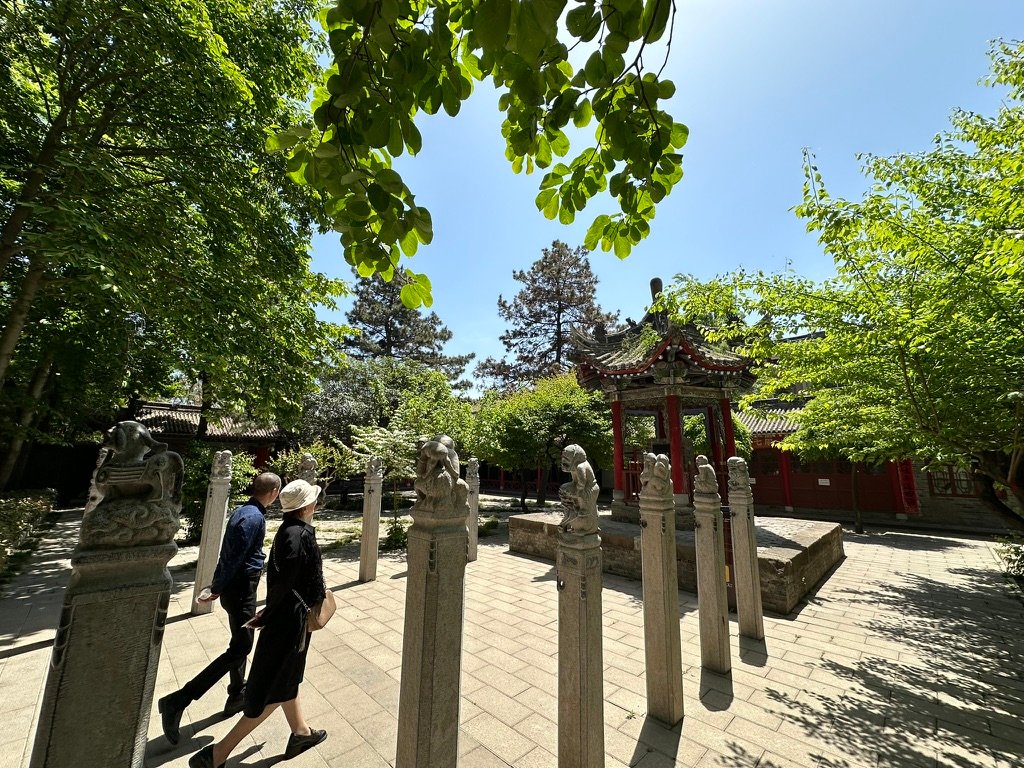
We came to Linfen (临汾, Línfén) following a question. What was China like before Qin? That question had already taken Dad and Elaine more than 4,000 years back at Taosi (陶寺, Táosì). But in Linfen (临汾, Línfén), another name kept appearing. Yao (尧, Yáo). So we went to the place where Linfen has remembered him for generations: Yao Temple (尧庙, Yáomiào). But before we explain who Yao was, come inside with us. 🎥 Walk Into Yao Temple (尧庙, Yáomiào) With Elaine Elaine went ahead. Follow her. The first thing that struck us was the scale of the approach. A long ceremonial pathway stretched ahead. Stone carvings ran along the central axis. Red banners and ribbons added flashes of colour. Old trees rose around the temple grounds. And farther ahead, traditional roofs and gateways appeared one behind another. You don’t need to know anything about Yao (尧, Yáo) yet. Just look. This is how we first experienced the place. And as we walked farther in, something else became clear. Yao (尧, Yáo) isn’t just the name of somebody commemorated inside an old temple. His name is still embedded in the identity of the city around it. Linfen (临汾, Línfén) Is Yaodu (尧都, Yáodū) The central urban district of modern Linfen (临汾, Línfén) is called: Yaodu District (尧都区, Yáodū Qū). Break that name apart: 尧 (Yáo) = Yao都 (dū) = capital So Yaodu (尧都, Yáodū) literally means: “Yao’s Capital.” For an international traveler, that’s an easy detail to miss. But once you notice it, Linfen begins to look different. The city isn’t simply preserving a temple dedicated to an ancient ruler. It still carries the memory of that ruler in its own modern geography. And outside Linfen, at Taosi (陶寺, Táosì), we had already encountered archaeological discoveries from roughly the same distant world traditionally associated with Yao (尧, Yáo). Archaeology on one side. Cultural memory on the other. And Dad and Elaine were now walking right into the middle of them. The temple introduction connects Yao (尧, Yáo) with ancient Pingyang (平阳, Píngyáng), the historical name associated with this area. But Dad still wasn’t ready to give Elaine the history lesson. There was more to see first. Ahead of us was the monumental heart of the temple complex. So we kept walking. → Next: Deeper Into Yao Temple (尧庙, Yáomiào) — and the building that stopped us in our tracks. Deeper Into Yao Temple (尧庙, Yáomiào) — Then Wufeng Tower Appeared We kept following the central path. Elaine walked ahead while Dad followed with the camera. The deeper we went, the more ceremonial the approach became. The pathway pulled us forward between old trees and red banners, toward a much larger building rising ahead. This was Wufeng Tower (五凤楼, Wǔfèng Lóu) — the Five Phoenixes Tower. 🎥 Keep Walking With Elaine This time, watch what happens as we get closer. The building gradually takes over the view. [PHOTO — full frontal view of Wufeng Tower] This was one of those places where photographs don’t quite prepare you for the approach. The tower sits elevated above the courtyard, with layers of traditional tiled roofs, red columns, painted wooden brackets and a dark upper gallery stretching across the façade. But Dad’s eyes were also drawn downward. Right beneath our feet was another story. “China’s First Dragon” Running up the centre of the stone approach was a long carved dragon. At its base were five characters: 中华第一龙Zhōnghuá Dìyī Lóng “China’s First Dragon.” [PHOTO — 中华第一龙 stone dragon approach] That name immediately caught Dad’s attention. Because we had just encountered something remarkably similar elsewhere in Linfen. At Linfen Museum (临汾博物馆, Línfén Bówùguǎn), Dad had seen a painted dragon on pottery excavated from Taosi (陶寺, Táosì) — an archaeological culture dating back more than 4,000 years. Here at Yao Temple (尧庙, Yáomiào), the dragon had become part of the ceremonial landscape. Two very different places. One archaeological. One commemorative. But once again, Taosi (陶寺, Táosì) and the world of Yao (尧, Yáo) seemed to be following us around Linfen (临汾, Línfén). Don’t Rush Through Wufeng Tower (五凤楼, Wǔfèng Lóu) At the top of the steps stood a large incense burner. Stone guardian lions flanked the approach. Above us were painted beams, brackets and calligraphy. Red ribbons appeared everywhere — tied by modern visitors inside a place devoted to memories from China’s distant past. [PHOTO — closer architectural/detail view] This is why we’d give Yao Temple (尧庙, Yáomiào) some time. Don’t just photograph the main building and move on. Look down. Look up. Read the characters. Watch what local visitors are doing. The interesting part isn’t only the architecture. It’s seeing how an ancient story is still being remembered in a living place. And we still haven’t properly explained who Yao (尧, Yáo) was. That was deliberate. We wanted you to see what Dad and Elaine saw first. Now that you’ve walked in with us, it’s time for Dad to explain why he brought Elaine here. Dad Explains Why Yao Temple (尧庙, Yáomiào) Matters After walking through the temple with Elaine, Dad stopped to explain why we’d come. 🎥 Dad’s Explanation — Right Here at Yao Temple Yao (尧, Yáo) belongs to the distant world of the Three Sovereigns and Five Emperors (三皇五帝, Sānhuáng Wǔdì) — the legendary sage-rulers placed before China’s traditional dynastic history. But what interested Dad wasn’t simply how old the story was. It was why Yao was still being remembered. Yao (尧, Yáo) became an ideal of good rulership — associated with virtue, concern for the people, ordering the calendar and choosing the worthy Shun (舜, Shùn) as his successor. That makes him very different from the ruler we’d encountered in Xi’an (西安, Xī’ān). Qin Shi Huang (秦始皇, Qín Shǐhuáng) asks us to think about power and unification. Yao (尧, Yáo) asks us to think about what Chinese tradition believed a good ruler should be. The Temple Is Ancient — But Not 4,000 Years Old Dad also points out an important distinction. The