We came to Linfen (临汾, Línfén) following a question:
What was China like before Qin (秦, Qín)?
That question had already taken Dad and Elaine more than 4,000 years back at Taosi (陶寺, Táosì).
But in Linfen (临汾, Línfén), another name kept appearing:
Yao (尧, Yáo).
So we went to the place where Linfen has remembered him for generations:
Yao Temple (尧庙, Yáomiào).
But before we explain who Yao was…
come inside with us.
🎥 Walk Into Yao Temple (尧庙, Yáomiào) With Elaine
Elaine went ahead.
Follow her.
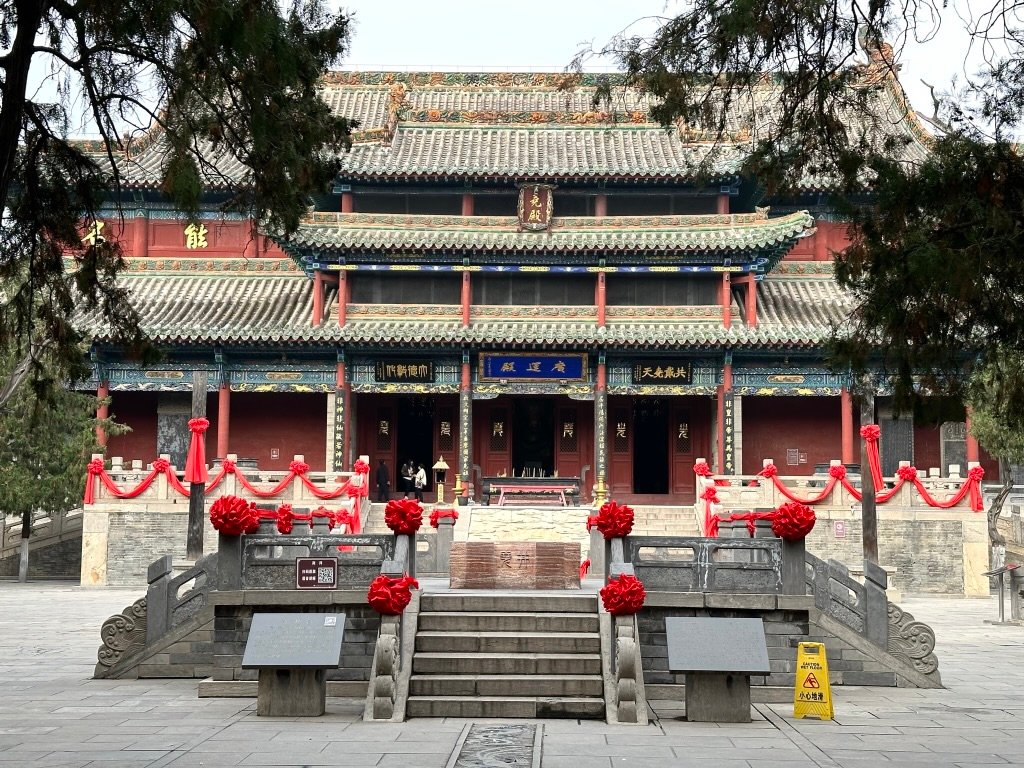
The first thing that struck us was the scale of the approach.
A long ceremonial pathway stretched ahead.
Stone carvings ran along the central axis.
Red banners and ribbons added flashes of colour.
Old trees rose around the temple grounds.
And farther ahead, traditional roofs and gateways appeared one after another.
You don’t need to know anything about Yao (尧, Yáo) yet.
Just look.
This is how Dad and Elaine first experienced the place.
Linfen (临汾, Línfén) Is Yaodu (尧都, Yáodū)
As we walked farther in, something else became clear.
Yao (尧, Yáo) isn’t simply the name of somebody commemorated inside an old temple.
His name is still embedded in the identity of modern Linfen.
The central urban district is:
Yaodu District (尧都区, Yáodū Qū)
Break that name apart:
尧 (Yáo)
→ Yao
都 (Dū)
→ capital
So:
尧都 — Yáodū
“Yao’s Capital”
For an international traveler, that’s an easy detail to miss.
But once you notice it, Linfen (临汾, Línfén) begins to look different.
The city isn’t simply preserving a temple dedicated to an ancient ruler.
It still carries the memory of that ruler in its modern geography.
Archaeology on One Side. Memory on the Other.
Outside Linfen, at Taosi (陶寺, Táosì), Dad and Elaine had already encountered archaeological discoveries from roughly the same distant world traditionally associated with Yao (尧, Yáo).
But these are two different things:
TAOSI (陶寺, Táosì)
Archaeology (考古, Kǎogǔ)
and:
YAO TEMPLE (尧庙, Yáomiào)
Cultural memory
That distinction matters.
At Taosi (陶寺, Táosì), ask:
What can archaeology recover?
At Yao Temple (尧庙, Yáomiào), ask:
Why did later generations keep remembering Yao?
Dad and Elaine were now walking right into the space between those two questions.
🐇
→ GO DEEPER: Taosi (陶寺, Táosì) — We Went to Linfen Looking for the China Before China
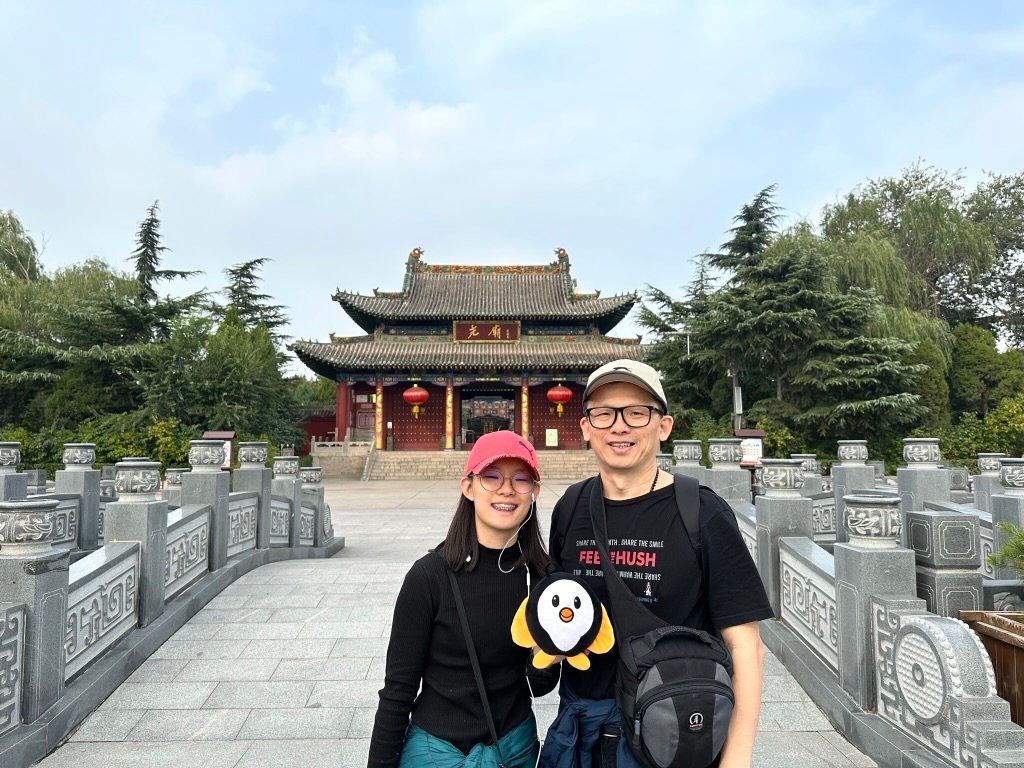
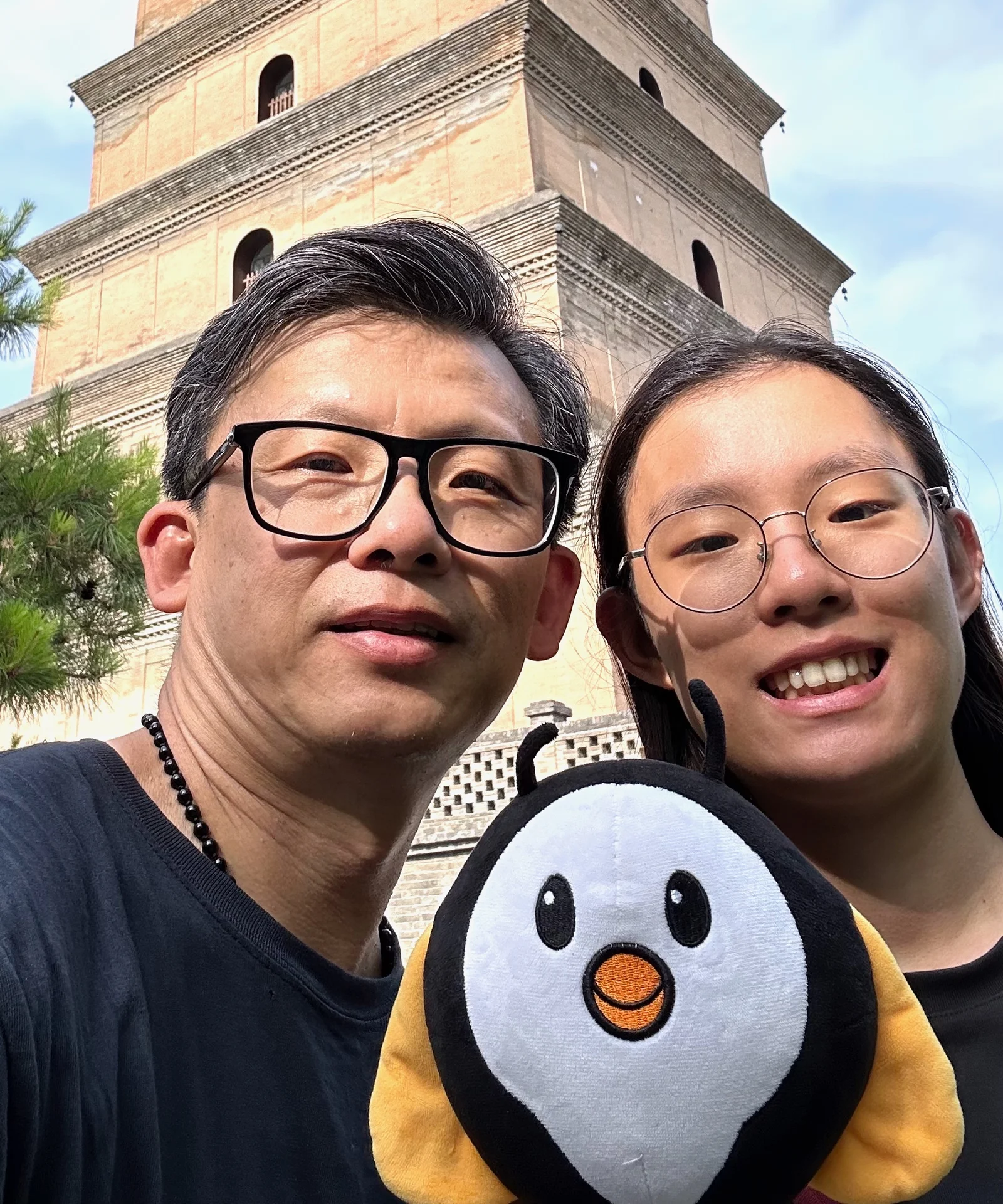
Dad and Elaine at Yao Temple (尧庙, Yáomiào) in modern Yaodu (尧都, Yáodū) — where the memory of Yao remains embedded in the identity of Linfen.
One More Name: Pingyang (平阳, Píngyáng)
The temple introduction also connects Yao (尧, Yáo) with:
Pingyang (平阳, Píngyáng)
— an ancient name associated with this area.
But Dad still wasn’t ready to give Elaine the history lesson.
There was more to see first.
Ahead of us was the monumental heart of the temple complex.
So we kept walking.
And then:
Wufeng Tower (五凤楼, Wǔfèng Lóu)
appeared.
🏯 Deeper Into Yao Temple (尧庙, Yáomiào)
🎥 VIDEO 2 — Walking Toward Wufeng Tower (五凤楼, Wǔfèng Lóu)
Now keep walking with Elaine.
The pathway leads toward one of the most striking buildings in the complex:
Wufeng Tower (五凤楼, Wǔfèng Lóu)
Five Phoenixes Tower
As we approached, the scale became clearer.
Sweeping tiled roofs.
Red columns.
Traditional dougong (斗拱, Dǒugǒng) brackets.
Stone guardian lions.
And a large incense burner standing before the entrance.
This wasn’t simply a monument to one ancient ruler.
It was a physical reminder of how later generations continued to honor the memory of Yao (尧, Yáo).
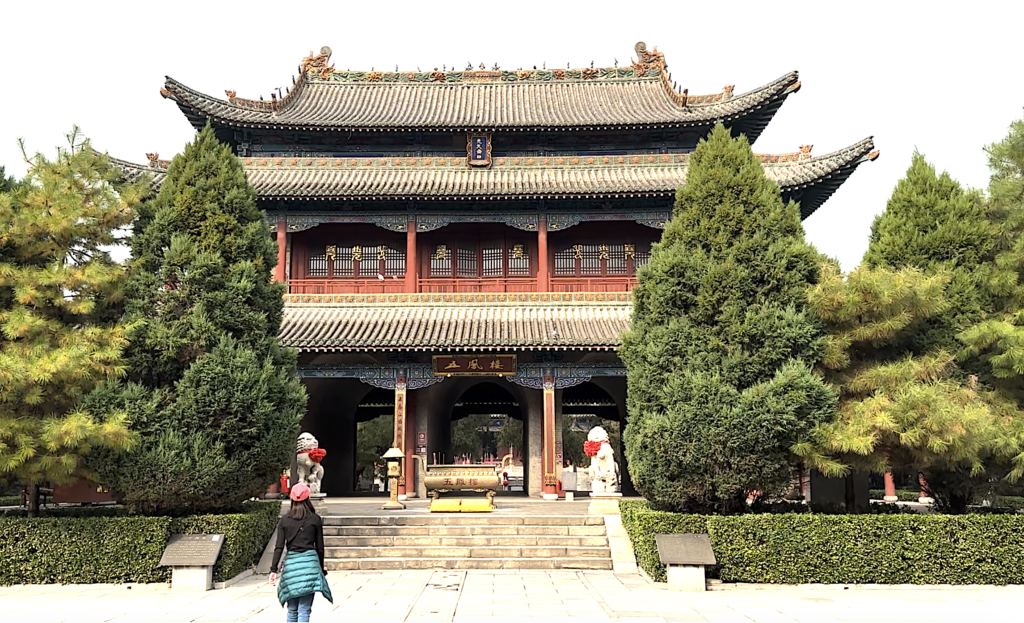
Wufeng Tower (五凤楼, Wǔfèng Lóu) — one of the monumental gateways within Yao Temple (尧庙, Yáomiào).
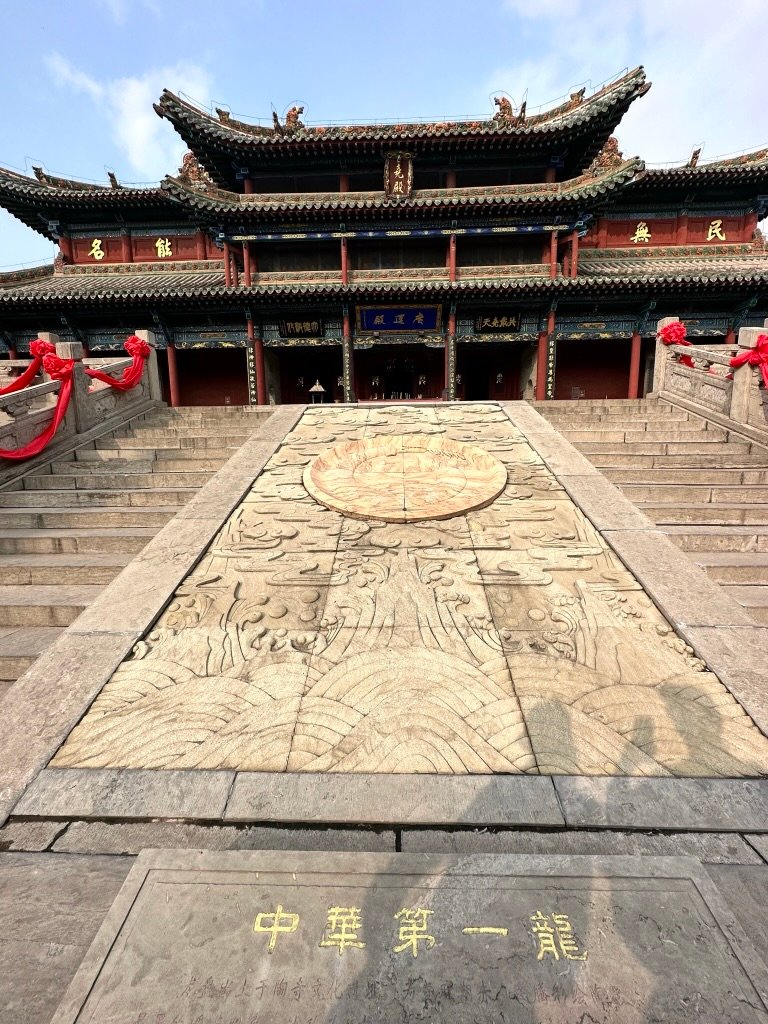
🐉 Look Down — China’s First Dragon?
As we walked through the complex, another symbol pulled Dad much further backwards.
The temple displays imagery connected with the idea of:
中华第一龙
Zhōnghuá Dìyī Lóng
“China’s First Dragon”
That opens another rabbit hole.
The dragon (龙, Lóng) didn’t suddenly appear as the familiar imperial symbol international travelers recognize from later Chinese palaces.
Its imagery has much deeper archaeological roots.
So even inside a temple dedicated to Yao (尧, Yáo), different layers of Chinese cultural memory begin overlapping.
Yao (尧, Yáo)
↓
ancient civilisation
↓
dragon imagery (龙, Lóng)
↓
later ideas of Chinese identity
🐇
But Who Was Yao (尧, Yáo)?
We’ve walked in.
We’ve seen the temple.
We’ve reached Wufeng Tower (五凤楼, Wǔfèng Lóu).
Now Dad can finally give Elaine the history lesson.
😂
And this time…
Dad appears on camera.
🎥 VIDEO 3 — Dad Explains Emperor Yao (尧帝, Yáodì)
👑 Who Was Emperor Yao (尧帝, Yáodì)?
Dad’s Video 3 gives us the handrail.
Yao (尧, Yáo) belongs to China’s ancient tradition of the:
Three Sovereigns and Five Emperors
(三皇五帝, Sānhuáng Wǔdì)
— rulers remembered from the distant period before China’s historical dynasties.
Yao is traditionally placed more than 4,000 years ago.
But for international travelers, the important thing isn’t memorizing an exact date.
It’s understanding:
why later China kept remembering him.
What Made Yao (尧, Yáo) an Ideal Ruler?
Yao wasn’t remembered primarily as a great conqueror.
Later tradition celebrated him as a:
virtuous ruler
protector of the people
model of good government
and a ruler concerned with:
the calendar (历法, Lìfǎ)
the seasons
agriculture
and the ordering of society.
That makes Yao very different from the kind of ruler international travelers often meet first in China:
Qin Shi Huang (秦始皇, Qín Shǐhuáng).
Qin Shi Huang is remembered for:
conquest → unification → centralization → empire.
Yao represents another political ideal:
virtue → responsibility → good government.
Two very different ideas of rulership.
Dad’s Political Science Handrail
Strip away the ancient names for a moment.
The question is surprisingly modern:
What makes a good ruler?
Military strength?
Law?
Administrative ability?
Moral character?
Concern for ordinary people?
Chinese thinkers kept returning to versions of that question for thousands of years.
Yao (尧, Yáo) became one of their earliest models of:
the ruler who governs through virtue.
🐇
And that matters because the next part of Yao’s story isn’t really about Yao alone.
It’s about:
SUCCESSION.
Who should rule after a good ruler dies?
His son?
Or the person considered most capable?
That question leads us to two more names Dad wants you to remember:
Yao (尧, Yáo)
↓
Shun (舜, Shùn)
↓
Yu the Great (大禹, Dà Yǔ)
And with those three names, we’re about to enter one of the most enduring political ideals in early Chinese tradition.
禅让 — Shànràng
yielding the rulership to the worthy
🐇
Yao (尧, Yáo) → Shun (舜, Shùn) → Yu the Great (大禹, Dà Yǔ)
THE QUESTION: Who Should Rule Next?
Around Yao Temple (尧庙, Yáomiào), Dad and Elaine kept encountering three ancient names:
Yao (尧, Yáo)
↓
Shun (舜, Shùn)
↓
Yu the Great (大禹, Dà Yǔ)
They belong to China’s traditional stories about the sage-rulers of deep antiquity. :contentReference[oaicite:0]{index=0}
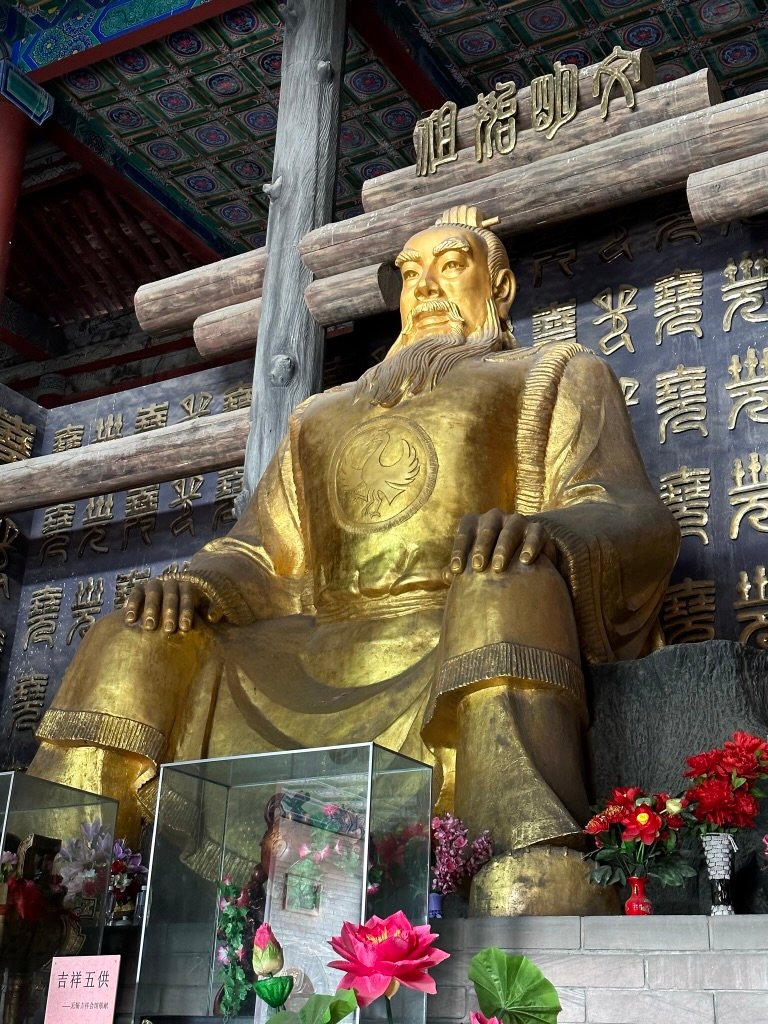
Yao (尧, Yáo) was remembered as an ideal ruler.
Shun (舜, Shùn) was remembered as the worthy man chosen to succeed him.
And Yu the Great (大禹, Dà Yǔ) became famous for controlling the great floods and was traditionally associated with the beginning of the:
Xia dynasty (夏朝, Xiàcháo).
But look carefully at the succession.
禅让 (Shànràng) — Yielding to the Worthy
The traditional sequence goes:
Yao (尧, Yáo)
↓
chooses Shun (舜, Shùn)
↓
Shun (舜, Shùn)
↓
chooses Yu (禹, Yǔ)
This idealised transfer of rulership became known as:
禅让 — Shànràng
Rather than automatically passing power from father to son, the ruler was remembered as choosing someone considered:
virtuous
capable
and:
worthy to rule.
That’s why Yao → Shun → Yu became much more than three ancient names.
They represented an ideal.
What if the realm mattered more than the ruler’s own family?
Then the Story Changes
After Yu the Great (大禹, Dà Yǔ) comes:
Qi (启, Qǐ)
— Yu’s son.
Now compare:
Yao → Shun
worthy successor
Shun → Yu
worthy successor
Yu → Qi
father → son
In traditional Chinese historiography, this marks a profound conceptual change:
禅让 (Shànràng)
succession by worthiness
↓
世袭 (Shìxí)
hereditary succession
↓
DYNASTY
And Yu (禹, Yǔ) becomes traditionally associated with the beginning of the:
Xia dynasty (夏朝, Xiàcháo). :contentReference[oaicite:1]{index=1}

A Western Handrail
Imagine a civilisation remembering its ideal beginning not as:
“The king died, so his son became king.”
but as:
“The ruler searched for the most virtuous and capable person to succeed him.”
Whether events happened exactly this way more than four millennia ago is a different historical question.
But the fact that later generations wanted to remember rulership this way tells us something important.
The story itself became a political ideal.
🐇 Dad & Elaine Followed the Three Sages
These names didn’t stay inside Yao Temple.
They became part of our journey through southern Shanxi (山西, Shānxī).
Yao (尧, Yáo)
→ Linfen (临汾, Línfén)
Shun (舜, Shùn)
→ Yuncheng (运城, Yùnchéng)
Yu the Great (大禹, Dà Yǔ)
→ flood-control traditions and the remembered beginning of dynastic China
That’s why they became one of the central threads of our:
→ The China Before China — Michelin History Tasting Journey
There, Dad and Elaine physically followed these names through Hancheng (韩城, Hánchéng), Yuncheng (运城, Yùnchéng) and Linfen (临汾, Línfén).
⭐ Why This Matters
We came to Yao Temple asking:
Who was Yao?
But the temple gives us a more interesting question:
Who deserves to rule?
And then an even harder one:
Who should rule next?
The most worthy person?
Or the ruler’s son?
That tension between:
virtue
family
succession
and:
power
would echo through Chinese political history long after the remembered age of Yao (尧, Yáo), Shun (舜, Shùn) and Yu (禹, Yǔ).
But before we treat these ancient stories as straightforward history, Dad wants to make one distinction very clear.
Archaeology is archaeology.
Memory is memory.
And at Linfen (临汾, Línfén), we have both.
🐇
🏺 Archaeology Is Archaeology. Memory Is Memory.
By now, Dad and Elaine had encountered Yao (尧, Yáo) in two very different ways.
At:
Taosi (陶寺, Táosì)
we encountered:
archaeology (考古, Kǎogǔ).
At:
Yao Temple (尧庙, Yáomiào)
we encountered:
cultural memory.
These are not the same kind of evidence.
And understanding the difference may be one of the most important things Linfen (临汾, Línfén) can teach us.
→ GO DEEPER: Taosi (陶寺, Táosì) — We Went to Linfen Looking for the China Before China
At Taosi (陶寺, Táosì), We Can Dig
Archaeologists can uncover:
walls
burials
pottery
jade
building foundations
and evidence of:
ritual · hierarchy · astronomical observation.
Taosi culture (陶寺文化, Táosì Wénhuà) dates broadly to around:
2300–1900 BCE.
That gives us physical evidence of a complex society more than 4,000 years ago. :contentReference[oaicite:1]{index=1}
But archaeology cannot simply point at an excavated building and say:
“Yao lived here.”
Possible connection:
≠ archaeological proof.
🐇 Then Our Old Friend Sima Qian (司马迁, Sīmǎ Qiān) Appears
Dad and Elaine had already followed Sima Qian (司马迁, Sīmǎ Qiān) to Hancheng (韩城, Hánchéng).
Writing during the:
Han dynasty (汉朝, Hàncháo),
Sima Qian’s:
Records of the Grand Historian
(史记, Shǐjì)
carried traditions about China’s distant past into one of its great historical works.
And remarkably, his Basic Annals (本纪, Běnjì) begin not with Qin (秦, Qín).
Not with Zhou (周, Zhōu).
But with the:
Five Emperors (五帝, Wǔdì).
And there we meet:
Yao (尧, Yáo).
But Sima Qian lived roughly two millennia after the period traditionally associated with Yao.
He wasn’t standing beside Yao taking notes.
😂
He inherited earlier texts and traditions and incorporated them into a much larger account of China’s past.
Three Different Windows Into the Past
So in Linfen (临汾, Línfén), put three things beside one another:
TAOSI (陶寺, Táosì)
What can archaeology recover?
↓
SIMA QIAN (司马迁, Sīmǎ Qiān)
What did ancient historical tradition record and transmit?
↓
YAO TEMPLE (尧庙, Yáomiào)
What did later generations continue to remember?
That’s much more interesting than forcing all three into one simple story.
→ FOLLOW THE FULL JOURNEY: The China Before China — Michelin History Tasting JOURNEY
⭐ So Was Taosi (陶寺, Táosì) Yao’s Capital?
Dad puts on the brakes here.
The:
dates are intriguing.
The:
geography is intriguing.
The:
later traditions are intriguing.
And Taosi’s archaeological discoveries are extraordinary.
But:
intriguing ≠ proven.
That’s precisely why Linfen is fascinating.
At Taosi, ask:
What can we dig up?
With Sima Qian, ask:
What was recorded?
At Yao Temple, ask:
What did people continue to remember?
Put those three questions together…
and you begin to understand why Yao (尧, Yáo) could remain important for thousands of years.
🐇
Why Yao (尧, Yáo) Still Feels Personal
Yao Temple (尧庙, Yáomiào) isn’t only about an ancient ruler.
Walking through the complex, Dad and Elaine found another layer:
ancestry.
An ancient cypress — traditionally associated with the Jin period (晋代, Jìn Dài) — still stands inside the temple grounds.
Visitors tie red ribbons around it today.
Old memory.
Living practice.
Same place.
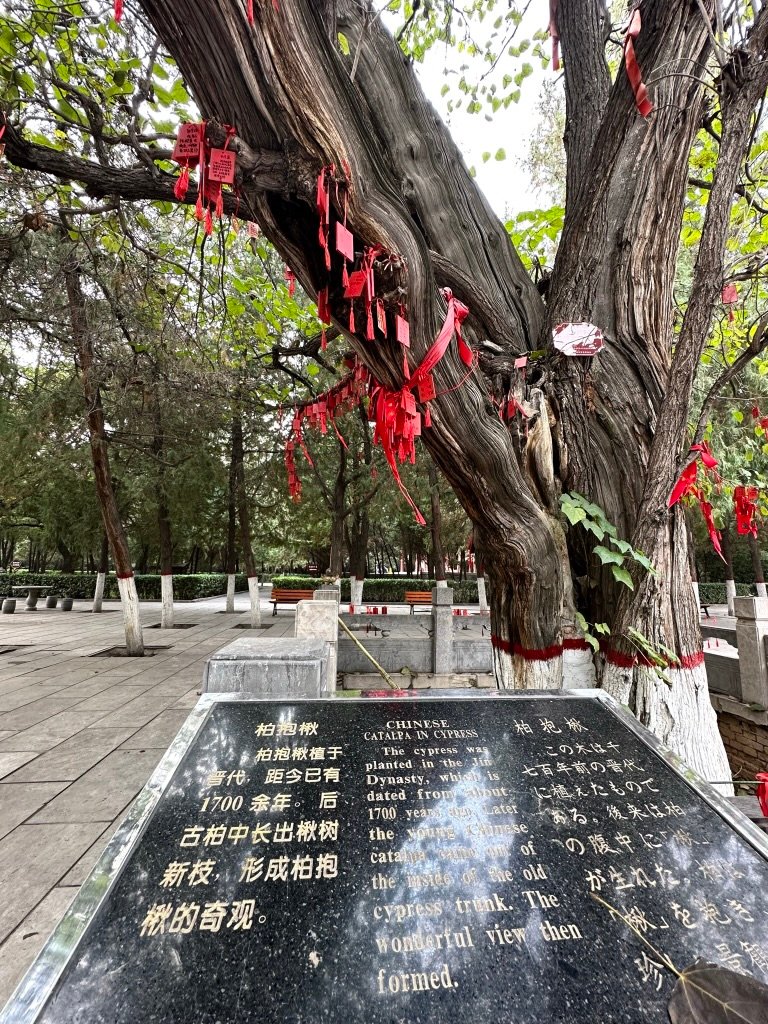
An ancient cypress inside Yao Temple (尧庙, Yáomiào) — old history surrounded by living acts of remembrance.
Then Dad Found the Surnames
Displays around Yao Temple invite visitors to explore:
姓氏文化寻根
Xìngshì Wénhuà Xúngēn
“Tracing the roots of surname culture”
Suddenly the question wasn’t only:
Who was Yao?
It became:
Could this ancient story somehow be part of my family’s story too?
The displays connect surname traditions and genealogical memory with ancient figures such as Yao (尧, Yáo), Shun (舜, Shùn) and Yu the Great (大禹, Dà Yǔ).
But Dad puts on the brakes again.
A genealogy stretching back thousands of years is:
not archaeological proof.
What’s interesting is that people are still using these ancient figures to think about:
ancestry (祖先, Zǔxiān)
surname (姓氏, Xìngshì)
lineage (宗族, Zōngzú)
and:
cultural identity (文化认同, Wénhuà Rèntóng).
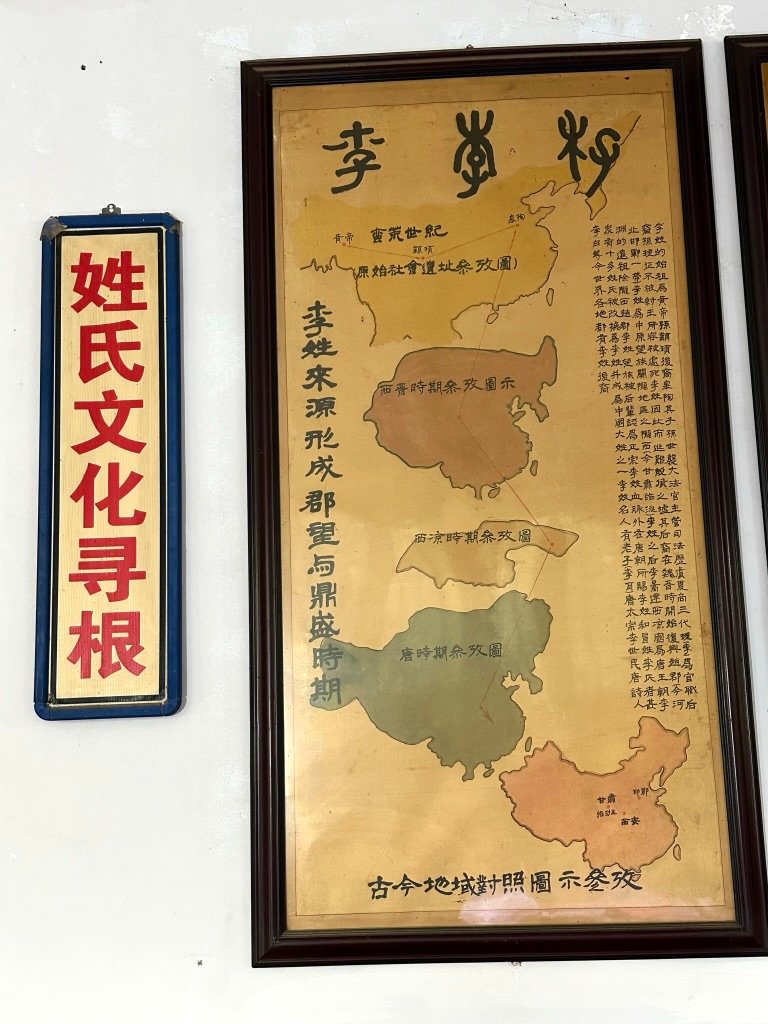
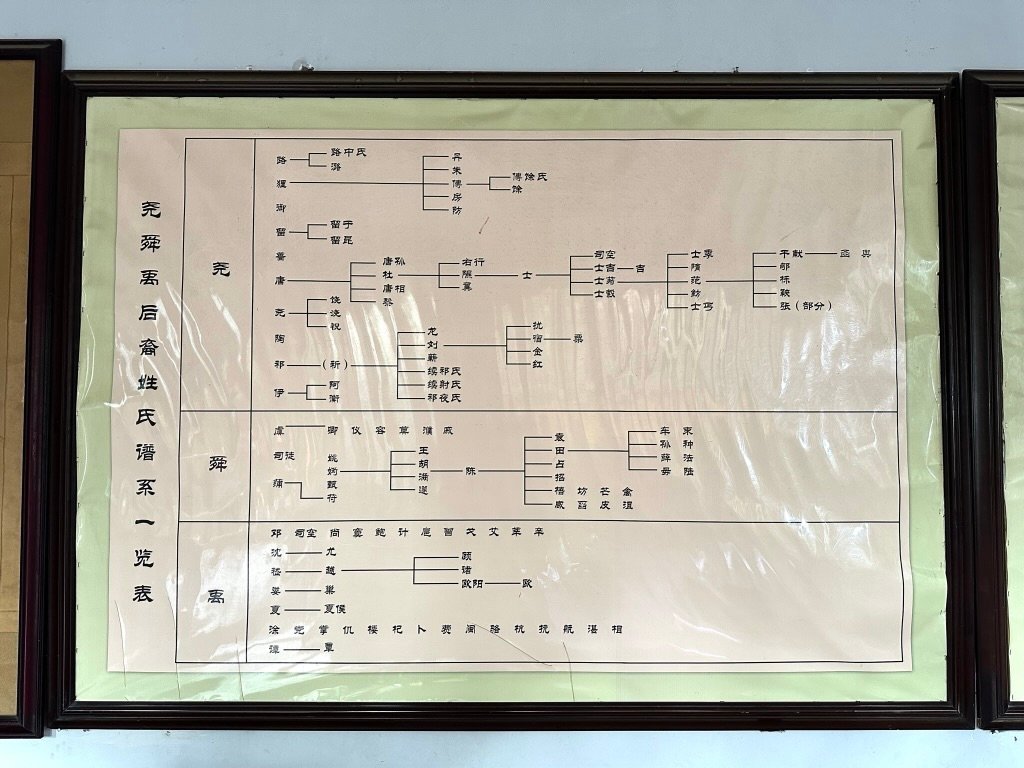
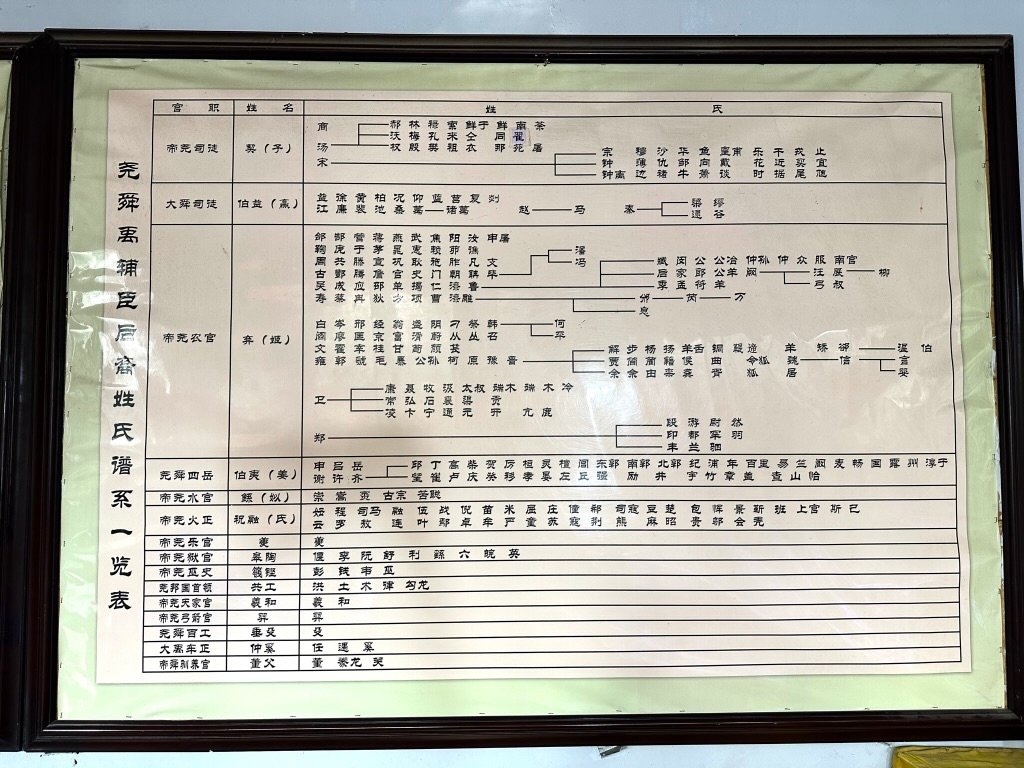
Surname-root displays at Yao Temple (尧庙, Yáomiào) connect ancient cultural memory with questions of family, lineage and identity.
🐇 We’ve Seen This Somewhere Else
Dad and Elaine encountered the same broad idea — although through different legendary ancestors — at Yandi Mausoleum (炎帝陵, Yándì Líng) near Baoji (宝鸡, Bǎojī).
There, Yandi (炎帝, Yándì), Huangdi (黄帝, Huángdì), surnames and ancestor commemoration opened exactly this bigger question:
Who do we say we came from?
Different place.
Different ancient figures.
Same human instinct:
connect the present with the distant past.
That’s why Yao Temple (尧庙, Yáomiào) still matters.
Not because a temple can prove a 4,000-year-old family tree.
It can’t.
But because it shows us how ancient memory can remain:
political
cultural
and surprisingly:
personal.
🐇
👑 Yao (尧, Yáo) and Qin Shi Huang (秦始皇, Qín Shǐhuáng)
Two Very Different Ideas of Rulership
By now, Dad kept thinking about another ruler travelers know much better:
Qin Shi Huang (秦始皇, Qín Shǐhuáng).
Put him beside Yao (尧, Yáo).
The contrast is fascinating.
YAO (尧, Yáo)
Remembered for:
virtue (德, Dé)
good government
care for the people
choosing a worthy successor
↓
QIN SHI HUANG (秦始皇, Qín Shǐhuáng)
Remembered for:
conquest
unification (统一, Tǒngyī)
centralization
imperial power
Two rulers.
Two very different political memories.
Dad’s Political Science Handrail
Yao asks:
What makes someone worthy to rule?
Qin Shi Huang asks:
How do you build and control a unified state?
China would wrestle with versions of both questions for the next two thousand years.
And Qin’s achievement becomes more interesting once you realize what existed before him:
different states
different rulers
different institutions
and:
different political traditions.
→ GO MICHELIN: What Did Qin Shi Huang Actually “Unify”?
That question also takes Dad & Elaine west of Xi’an (西安, Xī’ān), toward the much older world of the Zhou dynasty (周朝, Zhōucháo).
⭐ Don’t Turn Yao Into Qin
That’s the important point.
Yao Temple (尧庙, Yáomiào) isn’t interesting because Yao was an early version of an all-powerful Chinese emperor.
The tradition remembers him differently.
Yao (尧, Yáo)
→ virtue + worthy succession
Qin Shi Huang (秦始皇, Qín Shǐhuáng)
→ conquest + unification + empire
And somewhere between those two worlds lies an enormous part of the story of how Chinese political civilisation developed.
🐇
So after walking through Yao Temple, Dad’s question had changed.
Not simply:
Was Yao real?
But:
Why did later generations want to remember a ruler like Yao?
That may tell us something archaeology alone cannot.
ChinaTravelBUG’s Take
Dad and Elaine came to Yao Temple (尧庙, Yáomiào) looking for one ancient ruler.
We left with a much bigger question:
Why did China keep remembering Yao (尧, Yáo)?
Not because Yao left us a Terracotta Army.
Not because we can point to an excavated palace and say:
“Yao definitely lived here.”
We can’t.
What survived was something different:
an ideal of virtuous rulership
the story of Yao → Shun → Yu
the idea of choosing the worthy
ancestral and surname memory
and a cultural tradition that still gives modern Yaodu (尧都, Yáodū) its name.
Three Ways to Read Linfen (临汾, Línfén)
Dad would keep these three windows separate:
TAOSI (陶寺, Táosì)
→ What can archaeology (考古, Kǎogǔ) show us?
SIMA QIAN (司马迁, Sīmǎ Qiān)
→ What did later historical tradition record?
YAO TEMPLE (尧庙, Yáomiào)
→ What did generations continue to remember?
Don’t force them into one answer.
Put them beside one another.
That’s where Linfen becomes fascinating.
→ GO DEEPER: Taosi (陶寺, Táosì) — We Went to Linfen Looking for the China Before China
⭐ The Question Dad Would Carry Home
We started with:
Was Yao real?
But Dad thinks the better travel question is:
Why did the idea of Yao matter for so long?
That question takes us beyond one temple.
It leads toward:
Shun (舜, Shùn)
Yu the Great (大禹, Dà Yǔ)
Taosi (陶寺, Táosì)
early Chinese civilisation
and eventually:
When does “China” begin?
That’s exactly the journey Dad and Elaine followed through southern Shanxi.
→ FOLLOW THE JOURNEY: The China Before China — Michelin History Tasting JOURNEY
One temple.
One ancient ruler.
Several thousand years of questions.
🐇
And that’s usually when Dad knows we’ve found a good place to travel.
SEE → ASK → CONNECT → UNDERSTAND → FOLLOW
See China. Understand It Better.
🧭 How to Visit Yao Temple (尧庙, Yáomiào)
If you’re already traveling through Linfen (临汾, Línfén), Yao Temple (尧庙, Yáomiào) is an easy place to add.
But Dad wouldn’t visit it as an isolated temple.
Pair it with:
Linfen Museum (临汾博物馆, Línfén Bówùguǎn)
→ build your historical coat rack
Yao Temple (尧庙, Yáomiào)
→ experience the cultural memory of Yao (尧, Yáo)
Taosi (陶寺, Táosì)
→ encounter the archaeology of a complex society more than 4,000 years ago
That combination is much more powerful than any one site by itself.
→ GO DEEPER: Taosi (陶寺, Táosì) — We Went to Linfen Looking for the China Before China
Dad’s Suggested Order
If you have enough time in Linfen (临汾, Línfén):
1. Linfen Museum (临汾博物馆, Línfén Bówùguǎn)
Get the timeline first.
2. Yao Temple (尧庙, Yáomiào)
Now the names Yao (尧, Yáo), Shun (舜, Shùn) and Yu (禹, Yǔ) have some context.
3. Taosi (陶寺, Táosì)
Then finish with the hardest question:
What can archaeology actually prove?
That’s a very good DEEP China day.
🐇
🍵 One Last Thought
Dad came to Yao Temple wanting to show Elaine:
one of China’s earliest remembered rulers.
But Yao Temple taught us something more interesting.
The deeper you travel into Chinese history, the less useful it becomes to ask only:
“Did this happen exactly like the story says?”
Sometimes you need several questions:
What can archaeology show us?
What did historians record?
What did later generations remember?
And why did they choose to remember it?
At Yao Temple (尧庙, Yáomiào), those questions all meet.
Perhaps that’s why Dad enjoyed bringing Elaine here.
We weren’t simply visiting:
an old temple.
We were watching China remember its own beginnings.
🐇
And if that question makes you curious enough to keep traveling…
follow Dad & Elaine through Hancheng (韩城, Hánchéng), Yuncheng (运城, Yùnchéng) and Linfen (临汾, Línfén):
→ The China Before China — Michelin History Tasting JOURNEY
SEE → ASK → CONNECT → UNDERSTAND → FOLLOW
See China. Understand It Better.
China Usually Has Another Way.