
How should you divide two weeks between Beijing, Xi’an, Chongqing and Shanghai?
That was the dilemma facing one traveler planning a first China trip. They had already narrowed the journey to four cities—but were unsure whether the extra night would be better spent in Xi’an or Shanghai.
We asked the ChinaTravelBUG AI Travel Planner. Below is the traveler’s original question followed by the Planner’s unedited answer.
The Traveler’s Question
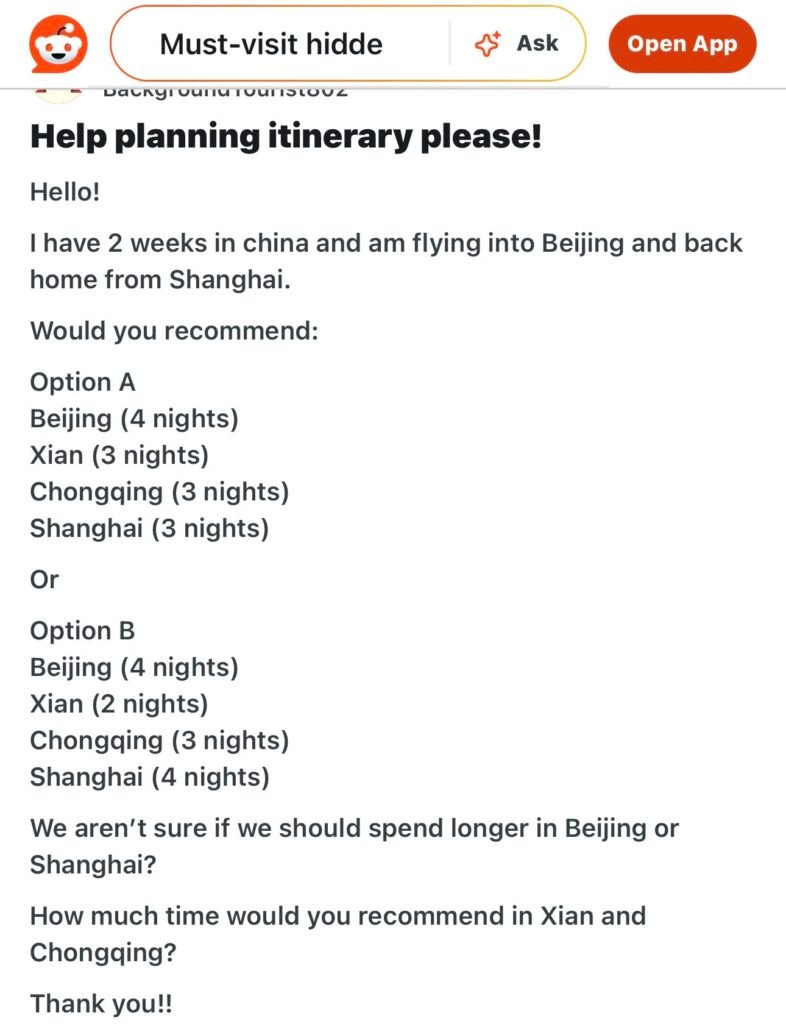
Help planning itinerary please!
Hello!
I have 2 weeks in china and am flying into Beijing and back home from Shanghai.
Would you recommend:
Option A
Beijing (4 nights)
Xian (3 nights)
Chongqing (3 nights)
Shanghai (3 nights)Or
Option B
Beijing (4 nights)
Xian (2 nights)
Chongqing (3 nights)
Shanghai (4 nights)We aren’t sure if we should spend longer in Beijing or Shanghai?
How much time would you recommend in Xian and Chongqing?
Thank you!!

ChinaTravelBUG AI Travel Planner Answer
I’d choose Option A, with one small caveat: 4 nights Beijing, 3 nights Xi’an, 3 nights Chongqing, 3 nights Shanghaiis the better-balanced first trip.
I wouldn’t take a night away from Xi’an just to give Shanghai four. Xi’an deserves more than a quick Terracotta Army stop. With three nights, you have room for the Terracotta Army, City Wall, Shaanxi History Museum and some time simply exploring the old city and its food culture. It gives you the ancient-China chapter of the trip rather than just one famous sight.
Beijing — 4 nights: Keep this. Beijing is enormous, sightseeing days involve more time and walking than people expect, and the Great Wall effectively consumes a substantial part of a day. Four nights is already fairly efficient rather than generous.
Xi’an — 3 nights: Definitely my preference. Two nights is possible, but it starts turning Xi’an into a transit-and-Terracotta-Army visit. Three nights gives the city room to breathe.
Chongqing — 3 nights: This feels right. Chongqing provides a completely different experience: dramatic geography, spicy food, dense neighborhoods and a fascinating glimpse of contemporary inland China. I wouldn’t add another night unless Chongqing itself is one of the main reasons for the trip.
Shanghai — 3 nights: Enough for a first visit. You can experience the Bund, historic neighborhoods, modern Pudong and everyday Shanghai without rushing badly. Shanghai is worth four nights, but on this particular itinerary, I think the extra night produces more value in Xi’an.
The route also tells a nice story: imperial Beijing → ancient Xi’an → contemporary inland Chongqing → international, modern Shanghai. That contrast is one of the things that makes a first journey through China memorable.
One practical point: both options total 13 nights, which is about right for a two-week trip depending on your international flight times. Four cities in 13 nights is about as fast as I’d recommend; I definitely wouldn’t add a fifth.
Ready to Check Shanghai Hotels?
Dad & Elaine have personally used Trip.com many times when travelling in China and elsewhere — for hotels, flights, attractions and tours. We’ve had good experiences with it, so it’s one of the booking platforms we use ourselves.
🏨 Check Shanghai hotels & current prices on Trip.com →
Affiliate link — ChinaTravelBUG may earn a small commission at no extra cost to you.
Ready to Check Beijing Hotels?
Dad & Elaine have personally used Trip.com many times when travelling in China and elsewhere — for hotels, flights, attractions and tours. We’ve had good experiences with it, so it’s one of the booking platforms we use ourselves.
🏨 Check Beijing hotels & current prices on Trip.com →
Looking for Else Where Hotels in China?
Dad & Elaine have personally used Trip.com many times when travelling across China and elsewhere — for hotels, flights, attractions and tours. We’ve had good experiences with it, so it’s one of the booking platforms we use ourselves.
🏨 Check hotels & current prices across China on Trip.com →
Further Reading
Beijing Itinerary: How Many Days Do You Really Need? A Licensed Beijing Guide’s Advice (2026)
Read the article: https://chinatravelbug.com/beijing-itinerary-how-many-days-do-you-really-need-a-licensed-beijing-guides-advice-2026/
Useful for deciding whether those four Beijing nights will give you the experience you want.
How to Visit Beijing Without Feeling Rushed: A Smarter Way to Experience China’s Capital
Read the article: https://chinatravelbug.com/5-how-to-visit-beijing-without-feeling-rushed-a-smarter-way-to-experience-chinas-capital/
Helpful because Beijing is the city where first-time visitors most easily underestimate distances and sightseeing time.
If you tell me what month you’re going and what interests you most—history, food, modern cities, photography, or local life—I can tell you whether I’d keep Chongqing or make one change to this route.
ChinaTravelBUG’s Take
We agree with the Planner: Option A is the stronger itinerary.
The important decision isn’t really whether Shanghai deserves three or four nights—it certainly can justify four. The question is where that extra night makes the biggest difference.
In this itinerary, we think that place is Xi’an.
Two nights can easily reduce Xi’an to arrival, Terracotta Army, a quick look around the old city and departure. Three nights gives you more opportunity to experience Xi’an itself—not merely its most famous attraction.
And there is another reason we like this itinerary.
Beijing → Xi’an → Chongqing → Shanghai isn’t just geographically convenient. Each stop reveals a distinctly different China:
Beijing — imperial power and the national capital
Xi’an — ancient China and the Silk Road
Chongqing — the extraordinary scale and energy of inland urban China
Shanghai — China’s international and highly modern face
That makes the journey more interesting than simply collecting four famous cities.
Our recommendation
Beijing — 4 nights
Xi’an — 3 nights
Chongqing — 3 nights
Shanghai — 3 nights
And then stop.
Don’t add another city just because you can.
One of the easiest ways to improve a first China itinerary is to give yourself enough time to experience the places you’ve already chosen.
A Note About AI Travel Advice
The ChinaTravelBUG AI Travel Planner answer above is published unedited.
We believe that’s important. These articles show how the Planner responds to real traveler questions rather than presenting a polished answer rewritten afterward by an editor.
AI is useful for comparing routes, questioning an itinerary and helping you make better travel decisions. However, details that can change—such as train schedules, attraction reservations, opening hours, ticketing procedures, visa rules and transport information—should always be checked against current reliable or official sources before you travel.

Try the Free ChinaTravelBUG AI Travel Planner
Still wondering whether your China itinerary has too many cities, too few nights, or the wrong route?
Try the free ChinaTravelBUG AI Travel Planner.
Tell it how many days you have, where you’re thinking of going and what kind of traveler you are. You can ask it to compare two itineraries just like the traveler above—or start with nothing more than:
“I have two weeks in China. Help me figure out where I should go.”
The goal isn’t to produce the longest itinerary possible.
It’s to help you build a China trip that actually works for you.