Planning your first trip to China can feel overwhelming.
Which cities should you visit? How many days do you need? Can foreign tourists use Alipay? Will Google work? Should you travel by high-speed rail or fly? Do attractions need advance reservations? Is China difficult to travel independently?
The short answer is:
China is much easier to travel around than many first-time visitors expect — provided you prepare the few systems that work differently.
For most travelers, a successful first China trip comes down to six decisions:
| Planning decision | What you need to decide |
|---|---|
| Where to go | Choose destinations that match your interests |
| How many places | Avoid building an itinerary that is too rushed |
| Entry | Check the current rules for your passport and route |
| Payments & internet | Set up your phone before arriving |
| Transportation | Plan trains and flights together with your route |
| Reservations | Identify attractions and transport that need advance booking |
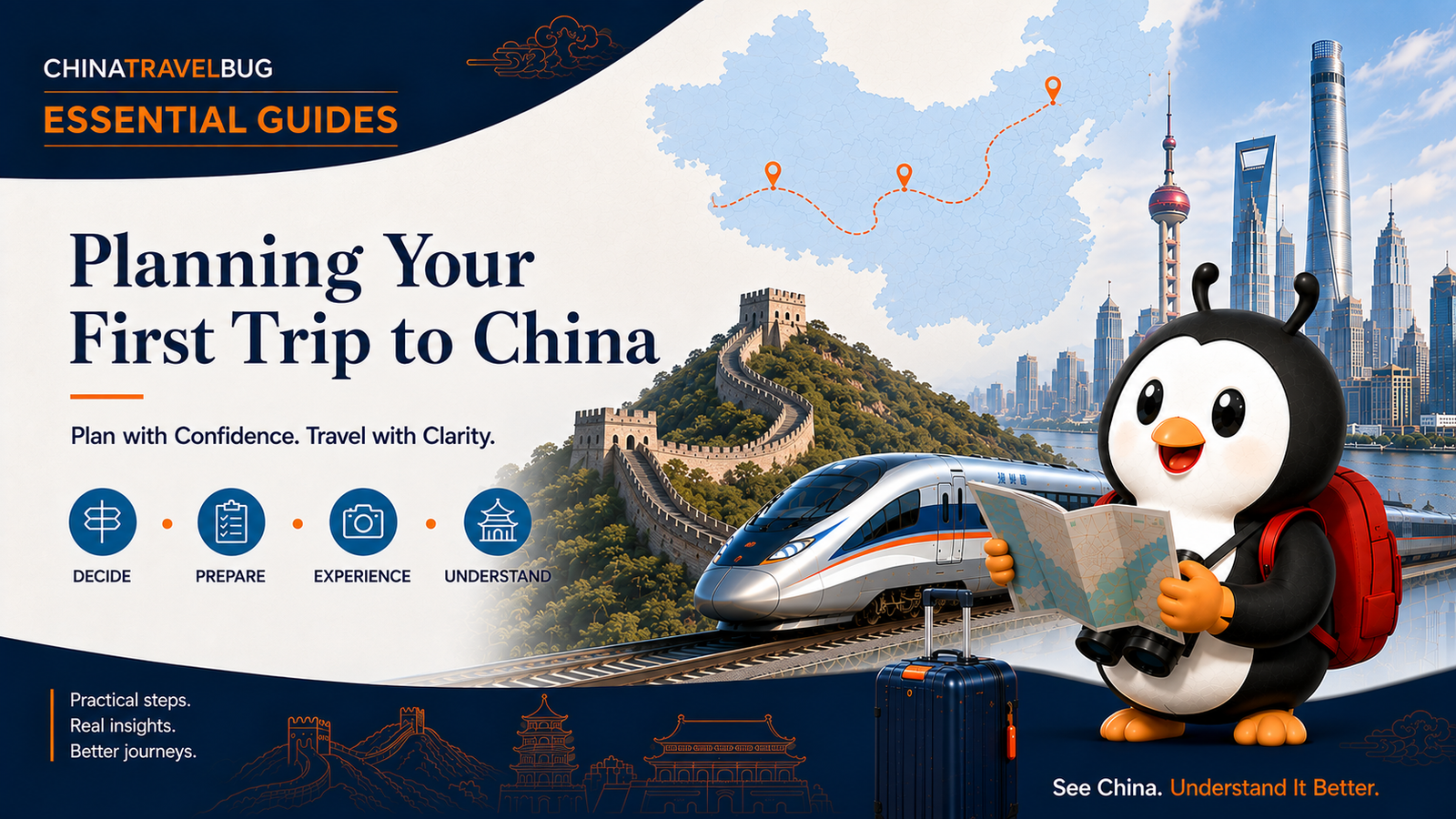
At ChinaTravelBUG, we organize first-trip planning around four stages:
Decide → Prepare → Experience → Understand
And there is one rule we recommend above all others:
Do less. Experience more.
China is enormous. Your first trip does not need to cover the whole country.
It should make you want to return.
Quick Answer: What Should You Know Before Your First Trip to China?
If you are planning your first trip to China, focus on these ten things first:
- Check the current entry requirements for your passport.
- Choose fewer destinations than you initially think you need.
- Build your itinerary around usable nights, not calendar days.
- Check transportation before finalizing hotels.
- Set up Alipay and/or WeChat Pay before arrival.
- Decide how you will access the internet in mainland China.
- Install and test your essential travel apps.
- Learn the basics of China’s high-speed rail system.
- Reserve difficult-to-replace attractions and transport when appropriate.
- Leave enough unscheduled time to actually experience China.
For a shorter overview, see First Trip to China: What Are the Top 10 Things You Need to Know? — AI Travel Planner Answers.
Part 1 — DECIDE
Where Should You Go on Your First Trip to China?
The best destinations for your first China trip depend on what you actually want to experience.
There is no single “perfect” China itinerary.
A history-focused traveler may prioritize Beijing and Xi’an.
A food lover may want Chengdu or Chongqing.
A first-time visitor interested in modern China may want Shanghai.
A scenery-focused traveler may prefer Zhangjiajie, Guilin, Yunnan or another landscape destination.
The right route depends on your:
- interests;
- travel pace;
- number of days;
- energy level;
- budget;
- travel companions;
- and tolerance for changing hotels.
Best China Destinations by Travel Style
| Travel interest | Destinations to consider |
|---|---|
| History & imperial China | Beijing, Xi’an |
| Modern urban China | Shanghai, Shenzhen |
| Food & regional culture | Chengdu, Chongqing |
| Mountain scenery | Zhangjiajie, Huangshan |
| Karst landscapes | Guilin, Yangshuo |
| First-trip classics | Beijing, Xi’an, Shanghai |
| Slower cultural travel | Suzhou, Hangzhou, Pingyao |
| Family-friendly highlights | Beijing, Chengdu, Shanghai |
Start with Where Should You Go in China for Your First Trip?.
For a deeper comparison by traveler type, see Where Should You Go in China for Your First Trip? Best Places by Travel Style.
A Better Question Than “What Are China’s Must-See Places?”
Instead of asking:
What are all the places I should see in China?
ask:
Which three or four experiences would make this trip worthwhile for me?
That question creates much better itineraries.
How Many Cities Should You Visit in China?
For most first-time travelers, fewer cities create a better trip.
China is geographically huge, and every destination change creates hidden travel time.
A two-hour high-speed train ride does not consume only two hours.
You also need to:
check out → reach the station → enter the station → wait → travel → arrive → transfer → check in → orient yourself again.
That is why fast-moving itineraries can look reasonable on paper but feel exhausting in reality.
A Realistic First-Trip Pace
| Time in China | Recommended starting point | Typical pace |
|---|---|---|
| 5–7 days | 1–2 bases | Focused |
| 8–10 days | 2–3 bases | Moderate |
| 11–14 days | Around 3 bases | Comfortable |
| 15–18 days | 3–4 bases | Comfortable |
| 19–21 days | 4–5 bases | Moderate |
| 3+ weeks | 4–6+ bases | Depends heavily on distance |
These are guidelines, not rules.
Families with young children, older travelers and people who enjoy slower travel may want fewer destinations.
Fast, experienced travelers may prefer more.
Before adding another stop, read How Many Cities Should You Visit in China? A Realistic First-Trip Guide.
And once you have a draft route, test it against Is Your China Itinerary Too Rushed? 7 Signs You’re Trying to Do Too Much.
How Many Days Do You Need for a First Trip to China?
There is no universal minimum, but 10–14 days is an excellent first-trip length for many travelers.
It gives you enough time to experience several contrasting parts of China without spending the entire trip in transit.
China Itinerary Ideas by Trip Length
| Trip length | Good planning approach |
|---|---|
| 7 days | One region or two well-connected cities |
| 10 days | Two or three main destinations |
| 14 days | Around three major bases |
| 21 days | Four or five main bases with more depth |
For many first-time visitors, a route such as:
Beijing → Xi’an → one contrasting third destination
works extremely well.
That third destination could be:
- Shanghai for modern urban China;
- Chengdu for Sichuan food, culture and pandas;
- Guilin/Yangshuo for scenery;
- or another destination that matches your interests.
For concrete route examples, see Perfect First Trip to China Itinerary: Beijing, Xi’an and Beyond — 7, 14 & 21 Days.
Should You Plan China by Days or Nights?
Plan primarily by nights and usable travel days.
A “14-day trip” may not give you 14 full sightseeing days.
International arrivals, jet lag, intercity transfers and early departures all reduce usable time.
For example:
| Calendar day | What may actually happen |
|---|---|
| Day 1 | International arrival |
| Day 2 | First full day, possibly with jet lag |
| Day 5 | Intercity transfer |
| Day 9 | Another transfer |
| Day 14 | International departure |
That can leave far fewer uninterrupted sightseeing days than the trip length suggests.
The better question is:
How many times do I want to pack, check out and start again?
Read Build a Realistic Itinerary for the full planning method.
Part 2 — PREPARE
What Should You Prepare Before Traveling to China?
Once your route is realistic, focus on six systems:
| System | Why it matters |
|---|---|
| Entry | Determines whether and how you can enter |
| Payments | China is highly mobile-payment oriented |
| Internet | Your phone supports almost every part of the trip |
| Apps | Maps, transport, payments and translation may require different tools |
| Transport | High-speed rail can shape your entire route |
| Reservations | Some attractions and transport require advance action |
You do not need to become an expert in China before arriving.
You simply need these systems to be functional.
What Entry Requirements Should You Check Before Visiting China?
Check China’s current visa, visa-free and transit rules before making major non-refundable bookings.
Requirements can depend on:
- nationality;
- passport;
- route;
- length of stay;
- purpose of travel;
- and current policy.
Do not assume advice written for another traveler applies to you.
Start with China Visa and Entry Requirements: A Simple 2026 Guide.
Then verify the rules applicable to your passport and itinerary with the relevant official Chinese authority.
Do You Need Your Passport While Traveling Around China?
Foreign visitors may need passport information for:
- hotel registration;
- high-speed rail;
- domestic transportation;
- attraction reservations;
- identity checks;
- and other ticketing systems.
Read Can You Travel Around China With Just Your Passport? for more detail.
Can Foreign Tourists Use Alipay and WeChat Pay in China?
Yes, foreign travelers can use mobile-payment services in China, although setup and supported payment methods can vary.
The two systems most first-time visitors should understand are:
Alipay (支付宝, Zhīfùbǎo)
and
WeChat Pay (微信支付, Wēixìn Zhīfù)
The easiest approach is to set them up and test what you can before leaving home.
Start with How to Use Alipay & WeChat Pay in China.
For Alipay specifically, read Can Foreign Tourists Use Alipay in China?.
What Is the Best Payment Setup for China?
A layered approach is safest:
| Payment layer | Purpose |
|---|---|
| Primary mobile payment | Everyday transactions |
| Secondary payment option | Backup if the first method fails |
| Physical bank card | Additional redundancy |
| Some cash | Emergency fallback |
Do not build your entire China trip around a single payment method.
Will Your Phone and Internet Work in China?
Your phone can become one of your most important China travel tools.
You may depend on it for:
- Alipay and WeChat Pay;
- maps;
- translation;
- DiDi;
- railway information;
- attraction bookings;
- hotel addresses;
- messaging;
- restaurant searches;
- and navigation.
The internet environment in mainland China differs from many other countries, so choose your connectivity solution before arrival.
Your main options may include:
| Connection method | Typical advantage | Main consideration |
|---|---|---|
| International roaming | Simple setup | Can be expensive |
| Travel eSIM | Convenient for compatible phones | Plans and routing vary |
| Mainland SIM | Local connectivity | Setup can be less convenient for short trips |
| Hotel/public Wi-Fi | Useful backup | Should not be your only plan |
Start with Internet in China Made Easy.
Which Apps Should You Download Before Visiting China?
Do not install dozens of apps simply because somebody included them in a checklist.
Focus on what you will actually use.
Most first-time travelers need apps covering:
- payments;
- maps/navigation;
- translation;
- ride-hailing;
- transportation;
- communication;
- attraction bookings;
- and possibly food or restaurant discovery.
Our 15 Essential Apps Every First-Time Visitor Should Install Before Flying to China explains the main options.
Before Departure
For each essential app:
- Download it.
- Open it.
- Create your account if required.
- Complete verification where practical.
- Test basic functions.
- Put your most important China apps together on your home screen.
Do not make your first app test the moment you need to catch a train.
Is China’s High-Speed Rail Easy for Foreign Tourists?
For most first-time visitors, yes.
China’s high-speed railway — 高铁 (gāotiě) — is fast, extensive and often one of the easiest ways to travel between major cities.
It can also change how you design your itinerary.
Start with How to Use China’s High-Speed Rail.
For deeper planning, read China High-Speed Rail for Foreign Tourists: 2026 Guide.
Train or Plane in China?
| Situation | Often worth considering |
|---|---|
| Cities connected by fast direct rail | High-speed train |
| Short/medium intercity journey | High-speed train |
| Very long cross-country distance | Flight may save time |
| Airport far outside city | Train may be more convenient door-to-door |
| Heavy holiday demand | Compare availability early |
Do not compare only scheduled travel time.
Compare hotel-to-hotel travel time.
A four-hour train can sometimes be easier than a two-hour flight once airport transfers and procedures are included.
How Big Are Chinese Cities?
Very big.
This sounds obvious, but underestimating urban distances is one of the easiest ways to create an unrealistic itinerary.
Beijing is the classic example.
Two attractions may look relatively close on a map, yet your day can involve:
- long metro journeys;
- large station transfers;
- security procedures;
- extensive walking inside attractions;
- entrance gates far from where you expect;
- and considerable travel between districts.
When planning a sightseeing day, ask:
How much moving around does this day require?
not:
How many attraction names can I fit into it?
What Should You Book in Advance in China?
Reserve the things that would be difficult to replace if they sold out or became unavailable.
That may include:
- important hotels;
- must-see attractions;
- key train journeys when booking becomes available;
- popular experiences;
- and time-sensitive transportation.
Not everything needs to be booked weeks in advance.
The goal is to protect high-value, hard-to-replace parts of the trip while preserving flexibility elsewhere.
What Should You Book First?
| Priority | Booking type |
|---|---|
| Highest | International travel and essential accommodation |
| High | Must-see limited-capacity attractions |
| High | Critical intercity transport |
| Medium | Important tours or experiences |
| Lower | Flexible restaurants and casual activities |
Chinese Public Holidays Matter
Domestic travel demand can rise dramatically around major Chinese public holidays.
If your itinerary overlaps a major holiday, review transportation, hotel and attraction availability earlier than usual.
One of the Travel Tools Dad & Elaine Actually Use
When Elaine and I travel around China, Trip.com is one of the platforms we genuinely use ourselves. Over our journeys together, we’ve used it to book hotels, flights, trains, attractions and tours — in China and elsewhere.
It has helped us many times while planning our trips, and we’ve had good experiences with it. So when friends or ChinaTravelBUG readers ask us “Where do you actually book?”, Trip.com is one of the places we’re comfortable recommending because we use it too.
✈️ 🏨 🚄 🎟️ Explore and plan your China trip on Trip.com →
Affiliate link — ChinaTravelBUG may earn a small commission at no extra cost to you.
Part 3 — EXPERIENCE
Is China Easy to Travel Independently?
Yes, many travelers can explore China independently.
Large-city metro systems, high-speed rail, mobile payments, translation tools and ride-hailing make independent travel easier than many people expect.
However, independent travel does not need to mean doing everything alone.
Independent Travel vs Private Guide
| Travel style | Best for | Main advantage |
|---|---|---|
| Independent | Confident travelers | Flexibility |
| Private guide | Travelers wanting context/logistical help | Expertise and convenience |
| Group tour | Travelers wanting everything arranged | Simplicity |
| Hybrid | Many first-time visitors | Freedom + help where valuable |
A hybrid approach often works particularly well.
For example:
- explore Shanghai independently;
- use high-speed rail yourself;
- navigate local restaurants on your own;
- hire a licensed guide for the Forbidden City or Great Wall.
Read First Trip to China: Should You Book a Tour or Travel Independently? — AI Travel Planner Answers.
There is no prize for making your vacation harder than necessary.
How Much Should You Plan Each Day?
Leave breathing room.
A China itinerary filled from early morning to late evening may look efficient, but efficiency and enjoyment are not the same thing.
Good empty space might mean:
- one slow morning;
- a free evening;
- two major sights instead of four;
- an extra night in a favorite destination;
- time for a neighborhood walk;
- or simply not having a reservation every hour.
You may remember the Great Wall.
You may also remember:
- breakfast in a neighborhood restaurant;
- people dancing in a public square;
- an unexpected conversation;
- a high-speed train journey;
- getting wonderfully lost for half an hour;
- or discovering a place that never appeared in your original itinerary.
Efficiency gets you through an itinerary.
Space lets you experience it.
What If Something Goes Wrong While Traveling in China?
Expect small moments of friction.
An app may request another verification.
A train station may have several entrances.
A restaurant may not have an English menu.
You may arrive at the wrong gate.
Your translation app may produce something astonishingly useless.
Most of these are inconveniences, not disasters.
China Travel Backup Checklist
| Potential problem | Useful backup |
|---|---|
| Phone battery dies | Charged power bank |
| Mobile payment fails | Secondary payment + cash |
| Internet fails | Saved hotel details/screenshots |
| Language barrier | Chinese hotel/address text |
| Train confusion | Extra station-arrival time |
| Navigation problem | Multiple map/navigation options |
| Booking uncertainty | Saved confirmation details |
Preparation does not eliminate every problem.
It makes problems smaller.
Part 4 — UNDERSTAND
How Can You Experience More Than China’s Tourist Attractions?
Do not treat China as a checklist.
The Forbidden City matters.
The Great Wall matters.
The Terracotta Warriors matter.
But some of the most revealing parts of China happen between major sights.
Pay attention to:
- public parks;
- neighborhood restaurants;
- local breakfast culture;
- domestic travelers;
- evening street life;
- supermarkets;
- residential neighborhoods;
- public transportation;
- and the contrast between old and new.
China can feel simultaneously ancient and futuristic.
Highly digital and deeply traditional.
National in scale, yet intensely regional in culture, food and identity.
You do not need to “understand China” after one trip.
But you can leave understanding it better than when you arrived.
That is the idea behind ChinaTravelBUG:
See China. Understand It Better.
First Trip to China Planning Checklist
Use this as your planning sequence.
| Step | What to do |
|---|---|
| 1 | Check entry requirements |
| 2 | Decide what experiences matter most |
| 3 | Choose a realistic number of destinations |
| 4 | Check transport connections |
| 5 | Book the hardest-to-replace parts |
| 6 | Set up mobile payments |
| 7 | Choose your internet solution |
| 8 | Install and test essential apps |
| 9 | Review reservations and transport |
| 10 | Leave breathing room in the itinerary |
One Week Before Your China Trip
By the final week, avoid redesigning your entire itinerary.
Instead, verify the practical details.
Final China Pre-Departure Checklist
- Passport and entry requirements checked
- Flights confirmed
- Hotels confirmed
- Intercity transport understood
- Important attractions reviewed
- Alipay/WeChat Pay prepared
- Backup payment method ready
- Internet/eSIM/roaming plan ready
- Essential apps installed
- Hotel names and addresses saved
- Important confirmations saved
- Phone charging setup ready
- Enough itinerary buffer built in
For the detailed version, see First-Timer’s Pre-Departure Checklist: What Should You Set Up Before Traveling to China? — AI Travel Planner Answers.
Before you close the suitcase, also read 15 Mistakes First-Time Visitors Make in China.
Frequently Asked Questions About Planning a First Trip to China
Is China difficult for first-time travelers?
China can feel unfamiliar, but many parts of traveling there are highly organized. High-speed rail, extensive metro systems, mobile payments and ride-hailing make travel relatively efficient once you understand the basic systems. Most first-time difficulties come from unfamiliarity rather than from China being inherently difficult to travel.
How many days should I spend in China on my first trip?
Around 10–14 days is a very useful first-trip length for many travelers. It usually allows two or three major destinations without excessive rushing. Seven days can still work well if you focus on one region or two well-connected cities.
How many cities should I visit in two weeks?
For many first-time travelers, around three main bases in two weeks creates a comfortable balance between variety and depth. Faster travelers may visit more, while families and slow travelers may prefer fewer.
What are the best cities for a first trip to China?
Beijing and Xi’an are strong choices for history and China’s major cultural landmarks. Shanghai provides a very different modern-city experience. Chengdu is excellent for Sichuan culture and food, while Guilin/Yangshuo and Zhangjiajie appeal to travelers prioritizing scenery. The best combination depends on your interests.
Can I travel around China without a tour?
Yes. Many foreign visitors travel independently using China’s metro systems, high-speed rail, ride-hailing apps and mobile-payment platforms. A private guide can still be useful for specific historically complex attractions or difficult logistics.
Do I need Alipay or WeChat Pay in China?
Mobile payments are extremely common in China, so most travelers benefit from preparing Alipay and/or WeChat Pay before arrival. You should still have backup payment options.
Does Google work normally in mainland China?
Internet access in mainland China differs from many other countries. Some international services may not function in the same way depending on your connection method. Decide whether you will use roaming, an eSIM, another connectivity solution or a combination before traveling.
Is high-speed rail better than flying in China?
It depends on the route. High-speed rail is often excellent for short and medium intercity journeys because railway stations may be more centrally located and the journey can be simpler door to door. Flying can make more sense for very long distances.
Should I book Chinese attractions in advance?
Some high-demand attractions, transportation and experiences may require or strongly benefit from advance booking. Requirements vary by destination and can change, so check important attractions before your travel dates.
Is 7 days enough for China?
Yes, if you keep the itinerary focused. A seven-day trip is better spent exploring one region or one to two major cities than attempting to cross large parts of the country.
Is 14 days enough for a first trip to China?
Yes. Two weeks is an excellent first-trip length for many visitors and can comfortably support approximately three major bases when transport is planned sensibly.
What is the biggest mistake first-time visitors make in China?
Trying to visit too many destinations is one of the most common planning mistakes. Too many hotel changes and long transfer days can turn an exciting itinerary into an exhausting one.
Looking for Affordable Hotels in China?
Dad & Elaine have personally used Trip.com many times when travelling across China and elsewhere — for hotels, flights, attractions and tours. We’ve had good experiences with it, so it’s one of the booking platforms we use ourselves.
🏨 Check hotels & current prices across China on Trip.com →
The ChinaTravelBUG First-Trip Rule
If you remember only one thing from this Essential Guide, remember this:
Do less. Experience more.
You do not need seven cities to have an extraordinary first trip.
You do not need every famous attraction.
You do not need to master every Chinese app before you arrive.
Choose the parts of China that genuinely interest you.
Give them enough time.
Prepare the systems that make travel easier.
Then leave enough space for China itself to surprise you.
The best outcome of your first trip is not coming home saying:
“I finished China.”
It is coming home thinking:
“There is so much more of China I want to understand.”
Plan Your First Trip to China
Still deciding between Beijing, Xi’an, Chengdu, Shanghai, Zhangjiajie, Guilin or somewhere completely different?
The ChinaTravelBUG AI Travel Planner can help you build a route around your available days, interests and preferred pace.
Instead of trying to squeeze more destinations into your itinerary, it is designed to help you build a trip that is more realistic.
Plan Your Perfect China Trip with the ChinaTravelBUG AI Travel Planner.