Section 1 — From Xi’an to Yuncheng: Another Rabbit Hole Across the Yellow River
Travel northeast from Xi’an into Yuncheng and Chinese history does something slightly strange. Instead of asking you to remember another emperor or another battle, it asks a much older question: what makes someone a good ruler — or even a good person?
After traveling through Hancheng (韩城), Elaine and I continued into another historically extraordinary part of northern China:
Yuncheng — 运城 (Yùnchéng)
in southern Shanxi.
And once again…
we didn’t manage to see everything we’d planned.
😂
Our Yuncheng journey gave us one important historical experience:
舜帝陵 — Shùndì Líng
the Mausoleum of Emperor Shun
We also intended to visit one of Yuncheng’s most famous historical sites:
解州关帝祖庙
Xiezhou Guandi Ancestral Temple
associated with:
关羽 — Guān Yǔ
But then:
RAIN.
🌧️🌧️🌧️
Heavy enough to derail our plan.
So we didn’t make it.
And we’re not going to pretend we did.
That’s part of traveling.
Sometimes the rabbit hole wins.
Sometimes the weather does.
😂
But interestingly, the place we did visit and the place we missed create a wonderful DEEP China story together.
Because Shun and Guan Yu belong to completely different historical worlds.
Yet both became powerful Chinese symbols of:
moral character.
🎬 WALK WITH DAD & ELAINE — Eight Steps of Blessings at Emperor Shun’s Mausoleum (舜帝陵)
At the Mausoleum of Emperor Shun (舜帝陵, Shùn Dì Líng) in Yuncheng (运城, Yùnchéng), we discovered something rather unexpected.
A staircase where every step carries a blessing!
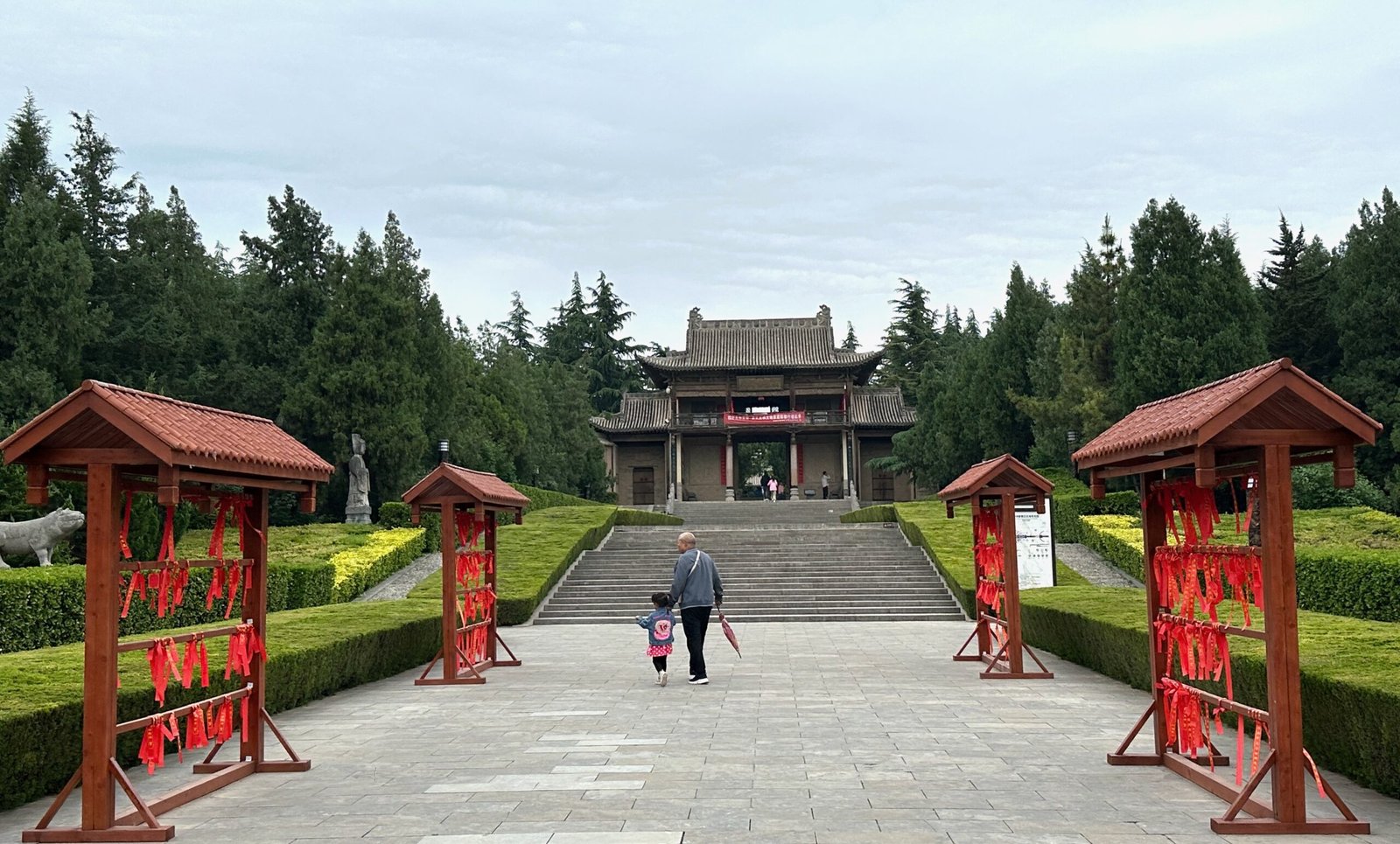
As we climb the wooden staircase inside the gate tower, each step displays a traditional Chinese wish.
Wealth. Longevity. Health. Peace. Good fortune. Success.
Not bad for climbing a flight of stairs! 😂
But the surprise doesn’t end there.
At the top, we find a large ceremonial drum decorated with red ribbons.
A nearby sign reads:
登楼击鼓,全家平安
Climb the tower and strike the drum — may your whole family enjoy peace and safety.
🎥 WATCH — Climbing the Blessing Staircase and Exploring Shun Emperor Mausoleum
Then the camera turns outward.
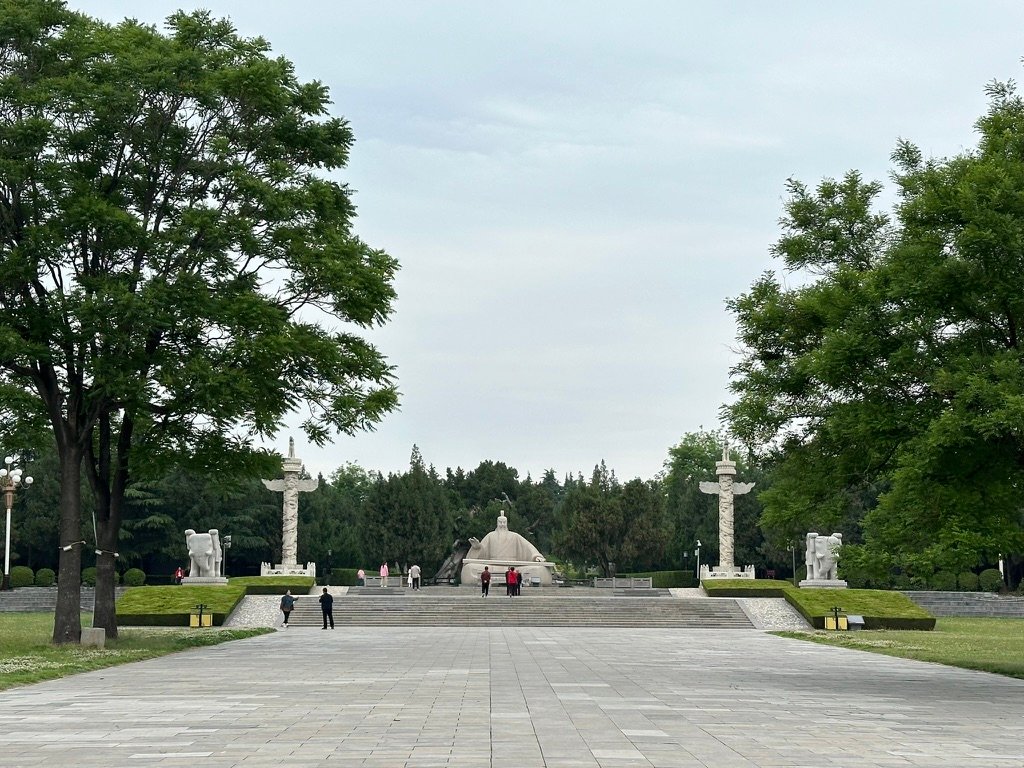
Below us stretches the mausoleum’s broad ceremonial avenue, lined with trees and surrounded by greenery.
For a moment, we can appreciate the scale and atmosphere of this place dedicated to one of China’s legendary sage-kings.
And Dad begins to wonder…
Why do people still come here to seek blessings from a ruler remembered in traditions dating back thousands of years?
The answer is not simply that Shun was an emperor.
It is that Chinese tradition remembers him as a model of filial piety (孝, xiào), moral character and virtuous leadership.
The mausoleum we visit today reflects centuries of commemoration and later construction, rather than a securely verified tomb from Shun’s lifetime.
But the reverence is real.
And to understand where that reverence comes from, let’s listen to our local guide explain the stories of Emperor Shun’s extraordinary life.
🕰️ Where Are We in Chinese History?
This time, our timeline is going to stretch.
A lot.
SHUN — 舜
📍 remote antiquity / traditional sage-ruler era
↓
Traditional Xia-associated world
↓
SHANG
c. 1600–1046 BCE
↓
ZHOU
c. 1046–256 BCE
↓
QIN
221–206 BCE
↓
HAN
206 BCE–220 CE
↓
THREE KINGDOMS ERA
220–280 CE
📍 GUAN YU — 关羽
died 220 CE
↓
SUI → TANG → SONG → YUAN → MING → QING
↓
GUAN YU’S CULT GROWS
general → revered hero → increasingly elevated titles → 关帝
↓
TODAY
Dad and Elaine arrive.
One historical figure takes us toward China’s deepest cultural memory.
The other lived more than two thousand years later.
Yet generations of Chinese people continued honoring both.
That’s our clue.
Western Readers: These Aren’t Simply Two “Famous Chinese Men”
If you’re new to Chinese history, the names may initially mean very little.
So here’s the familiar doorway.
Cultures often preserve people who become models of particular virtues.
Some are remembered for wisdom.
Some for courage.
Some for justice.
Some for loyalty.
Over generations, the historical person and the cultural ideal associated with that person can become intertwined.
That’s a useful way to begin thinking about:
Shun 舜帝
and:
Guan Yu
But their stories are very different.
Shun 舜帝: What Makes a Good Ruler?
Shun belongs to China’s ancient tradition of:
sage rulers
from a time before the historically documented imperial dynasties.
He is traditionally grouped among the:
三皇五帝 — Three Sovereigns and Five Emperors
And later Chinese tradition remembered Shun particularly for:
德 — dé
virtue / moral character
and:
孝 — xiào
filial devotion
The Yuncheng government describes Shun as a figure honored as both “德圣” — Sage of Virtue and “孝祖” — an ancestral model of filial devotion.
So when Elaine and I visited Shun’s mausoleum…
we weren’t simply visiting:
“the tomb of another emperor.”
In fact, even calling Shun an “emperor” can mislead Western readers if they imagine a Qin- or Han-style imperial monarch.
We were entering China’s cultural memory of ideal rulership.
That’s much more interesting.
🐇 And Hancheng Has Already Prepared Us for This
Remember where we just came from?
Hancheng
where we met:
Sima Qian — 司马迁
and his:
《史记》 — Shiji
Sima Qian’s great historical narrative reaches backward into China’s legendary and ancient past.
And Shun appears within that inherited historical tradition.
The official Yuncheng account of Shun’s mausoleum itself cites the Shiji when discussing Shun’s moral reputation.
💡
Suddenly:
HANCHENG 韩城
→ historian who recorded China’s ancient traditions
↓
YUNCHENG 运城
→ one of the ancient sage rulers appearing in that tradition
The destinations are talking to each other again.
🔥
Then Yuncheng 运城 Gives Us a Completely Different Moral Hero
Jump forward more than two thousand years.
Now we meet:
关羽 — Guan Yu
A military figure from the turbulent end of the Han dynasty and the beginning of the Three Kingdoms era.
Western readers who know:
Romance of the Three Kingdoms
or:
Dynasty Warriors
or other games, novels, films and television adaptations may already recognize him.
🍚 Familiar ingredient added.
But Guan Yu’s story didn’t stop when he died in 220 CE.
Quite the opposite.
Over centuries, his reputation grew.
He became increasingly associated with:
忠 — zhōng
loyalty
and:
义 — yì
righteousness / moral obligation
Later rulers granted him increasingly exalted titles.
Eventually the general became widely revered as:
关帝 — Guāndì
Emperor Guan
And Yuncheng is his home region.
Shun + Guan Yu: Now We Have a Theme
This is where our Yuncheng fried rice starts getting interesting.
Shun:
德 + 孝
virtue + filial devotion
↓
Guan Yu:
忠 + 义
loyalty + righteousness
These aren’t merely four Chinese vocabulary words.
They’re ideas that recur again and again in Chinese stories, family ethics, political culture, literature and historical memory.
And suddenly Yuncheng gives an international traveler a different way into Chinese history.
Not:
Which dynasty came next?
But:
What qualities did generations of Chinese people admire enough to turn historical or traditional figures into moral models?
🔥🔥🔥
That’s a wonderful DEEP China question.
But There’s a Catch 😂
Elaine and I visited:
舜帝陵
We have the photographs.
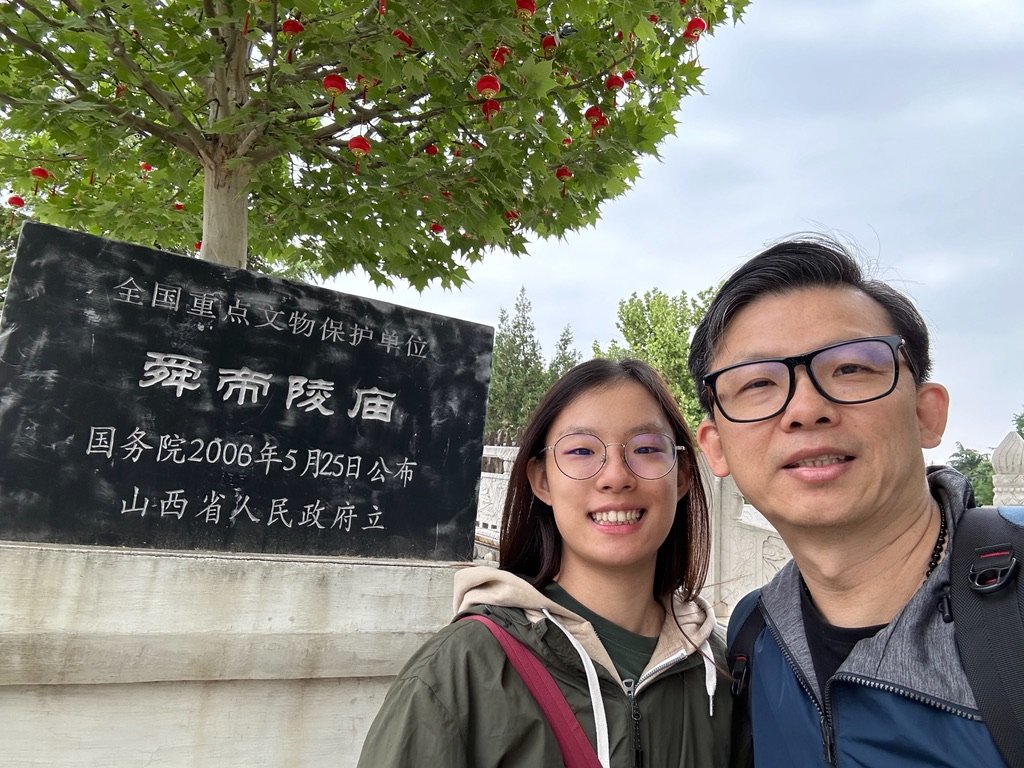
But when it came time for:
解州关帝祖庙
the weather had other ideas.
🌧️
Heavy rain disrupted our plans.
We didn’t make it.
So this article isn’t going to say:
“When Elaine and I walked through the magnificent Guandi Temple…”
because we didn’t.
😂
Instead we’ll do something more useful.
We’ll tell you:
why we wanted to go,
why Guan Yu matters,
what we missed,
and:
why we’d put it back on the itinerary next time.
That’s DEEP China too.
The trip doesn’t need to be perfect.
Sometimes what you miss becomes the next rabbit hole.
And the Guandi Temple Is No Small Rabbit Hole
The Xiezhou Guandi Ancestral Temple (解州关帝祖庙) isn’t simply one of many Guan Yu temples.
Yuncheng’s official tourism authority describes it as the earliest-founded, largest, highest-ranking and most completely preserved Guandi temple complex in China, traditionally regarded as the ancestral temple of Guan Yu worship. Its origins are dated to 589 CE, with much of the surviving architecture reflecting later rebuilding.
😬
Dad:
“And we missed it because of rain?!”
😂😭
Yes.
Which means we have unfinished business in Yuncheng.
🐇
First, Though, We Need to Understand Shun 舜帝
Because Shun opens another enormous question.
Was he a historical ruler?
Where does he belong relative to archaeology?
Why did later Chinese culture remember him as a model of virtue?
Why was 孝 — filial devotion so important?
And what does the famous story of:
尧 → 舜
Yao passing authority to Shun
tell us about Chinese ideas of ideal rulership?
🌶️
That’s where we’re going next.
Because Yuncheng isn’t merely another destination after Xi’an.
It takes us into something deeper:
How China imagined the qualities a good ruler — and a good person — should possess.
Section 2 — Shun: Virtue, Filial Devotion and China’s Ancient Ideal of the Good Ruler
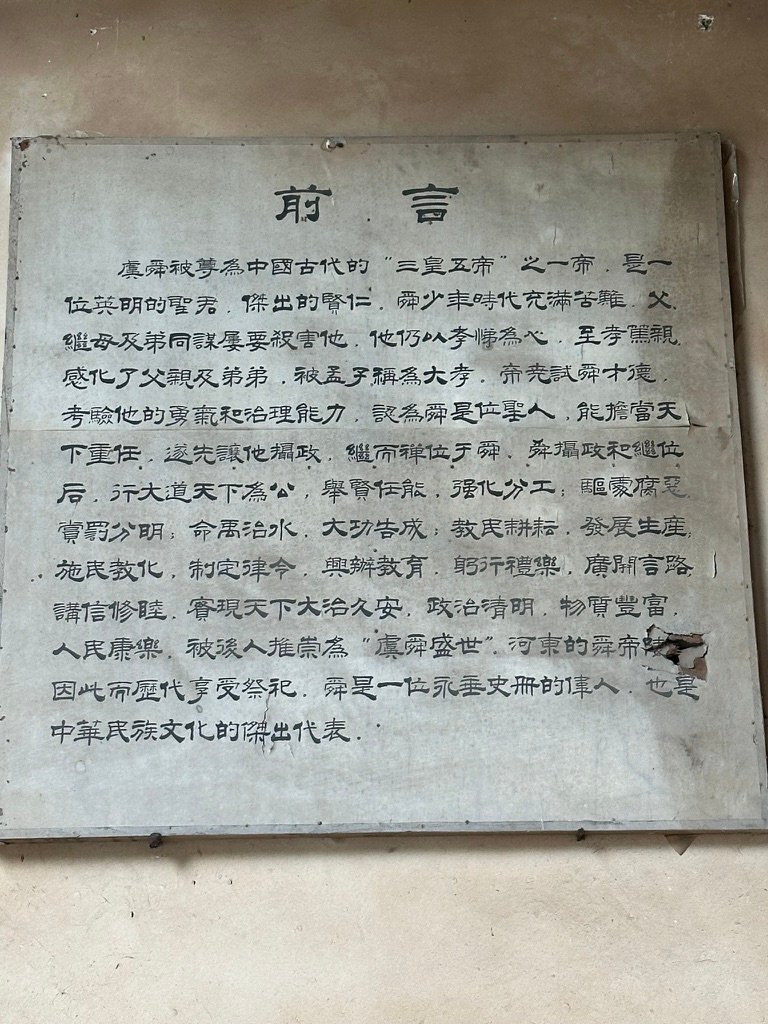
📷 PHOTO NOTE — Why China Still Remembers Emperor Shun (舜帝)
This Chinese-language Foreword (前言) at the Mausoleum of Emperor Shun (舜帝陵) in Yuncheng introduces Shun as one of China’s legendary Five Emperors (五帝).
It recounts how Shun remained devoted to his family despite mistreatment, earning him the reputation of 大孝 (dà xiào) — great filial piety.
The inscription also celebrates his courage, wisdom and ability to govern, describing how Emperor Yao (尧帝) recognized his virtues and entrusted him with leadership.
But look at what the inscription emphasizes about Shun’s rule: promoting agriculture, managing waterways, establishing laws, developing education and bringing stability to society.
Dad’s takeaway: In China’s traditional understanding of good leadership, governing well was not simply about holding power. A worthy ruler was expected to possess moral character and use his authority for the people’s benefit.
These are the virtues celebrated in the traditional accounts of Shun, rather than independently verified events from his lifetime.
That is why a legendary ruler from China’s distant past still has something to teach us today.
At Yuncheng, Elaine and I visited:
舜帝陵 — Shùndì Líng
the Mausoleum of Emperor Shun
But before we call this simply:
“the tomb of an ancient Chinese emperor”
we need to slow down.
Because Shun (舜) belongs to a very different historical world from Qin Shi Huang, Emperor Wu of Han or the emperors of the Tang.
We’re moving into China’s deep cultural memory — a world where history, transmitted tradition and later ideals of good government become intertwined.
And Shun gives us one of the most important questions in Chinese political thought:
What makes someone worthy to rule?
🌶️
🕰️ Where Are We Now?
This time we’re going very far backward.
YAO 尧
↓
SHUN 舜
📍 WE ARE HERE
↓
YU THE GREAT 大禹
↓
TRADITIONAL XIA 夏
↓
SHANG
c. 1600–1046 BCE
↓
ZHOU
c. 1046–256 BCE
↓
QIN UNIFICATION
221 BCE
The first thing to notice is:
Shun belongs to the traditional world before China’s securely documented historical dynasties.
So don’t put him mentally beside Qin Shi Huang and imagine two emperors separated merely by time.
The nature of our evidence is different.
And that’s an important DEEP China lesson.
A Familiar Ingredient: The Ideal King
Many civilizations tell stories about rulers who embody what good kingship should look like.
Sometimes the person is historically well documented.
Sometimes history and legend become intertwined.
Sometimes later generations transform a ruler into a moral model.
Shun belongs to this broader human phenomenon.
In Chinese tradition, he became one of the great:
圣王 — shèngwáng
sage kings
His importance isn’t simply:
“Shun ruled before Yu.”
It is:
Later generations used Shun to think about what a ruler ought to be.
Now the mausoleum becomes much more interesting.
Before Shun Came Yao
We’ve already met:
尧 — Yáo
in our Deep China journey to Linfen.
🐇
Remember?
Linfen gave us:
Taosi archaeology
and:
Yao cultural tradition.
Now Yuncheng gives us:
Shun.
And Chinese tradition connects them through one of its most famous stories of ideal rulership.
Yao Didn’t Simply Give the Throne to His Son
This is the important part.
In the traditional account, Yao needed a worthy successor.
And instead of simply saying:
“Obviously my son gets the job.”
the story presents something much more morally attractive.
Yao searches for:
the most worthy person.
That person becomes:
Shun.
Shun wasn’t chosen because he was Yao’s son.
He was remembered as being chosen because of:
virtue.
🔥
For later Chinese thinkers, that was a powerful image.
Political authority should ideally belong to someone morally worthy of exercising it.
Then Shun Does the Same Thing
And here’s where the story becomes even more interesting.
Shun eventually chooses:
大禹 — Yu the Great
as his successor.
Why Yu?
Because of his extraordinary achievement in controlling the great floods.
So the traditional sequence becomes:
YAO
virtue
↓
SHUN
virtue
↓
YU
merit / flood control
This is remembered through the idea of:
禅让 — shànràng
abdication in favor of a worthy successor
rather than straightforward hereditary succession.
Now we’re getting into serious chilli.
🌶️🌶️
Western Reader: “An Ancient Meritocracy?”
Careful.
😂
It is tempting to say:
“Ah! Yao and Shun invented meritocracy!”
That’s much too simple.
We’re dealing with traditions about remote antiquity that were transmitted and interpreted by people living much later.
But the ideal contained in the story matters enormously:
The best ruler is not necessarily the ruler’s biological heir. The best ruler should be the person most worthy and capable of ruling well.
That’s a powerful political idea.
And later Chinese thinkers could look backward toward Yao and Shun as models of an idealized moral age.
Then Something Changes After Yu 禹
🐇
This is where the story gets particularly interesting.
Yu the Great 大禹 becomes traditionally associated with the founding of:
夏 — Xia
And after Yu?
The traditional narrative changes.
Rather than continuing the idealized pattern:
worthy ruler → choose another worthy ruler
political authority becomes associated with:
hereditary succession.
Yu’s son:
启 — Qǐ
becomes the next ruler in the traditional Xia account.
So Chinese historical memory contains an interesting contrast:
YAO 尧 → SHUN 舜 → YU 禹
idealized transfer according to virtue and merit
versus:
YU → QI
hereditary dynastic rule.
😳
Now we’re not merely learning who came after whom.
We’re encountering an ancient Chinese debate about:
what gives someone the right to rule.
And Wait… Didn’t we just learn about Mandate of Heaven 天命?
Exactly.
🔥
Remember Anyang?
Shang falls.
Zhou replaces it.
And Zhou articulates:
天命 — Tiānmìng
the Mandate of Heaven
Political authority is morally conditional.
A ruling house that fails profoundly can lose Heaven’s mandate.
Now compare:
YAO → SHUN
The worthy should rule.
↓
SHUN → YU
The worthy should rule.
↓
ZHOU’S MANDATE OF HEAVEN
The ruler’s moral legitimacy is conditional.
💡💡💡
These aren’t identical ideas.
Don’t collapse them into one.
But there is a recurring Chinese political question underneath them:
What makes political authority morally legitimate?
THAT is a key that will help an international reader understand Chinese history far beyond Yuncheng.
🌶️🔥
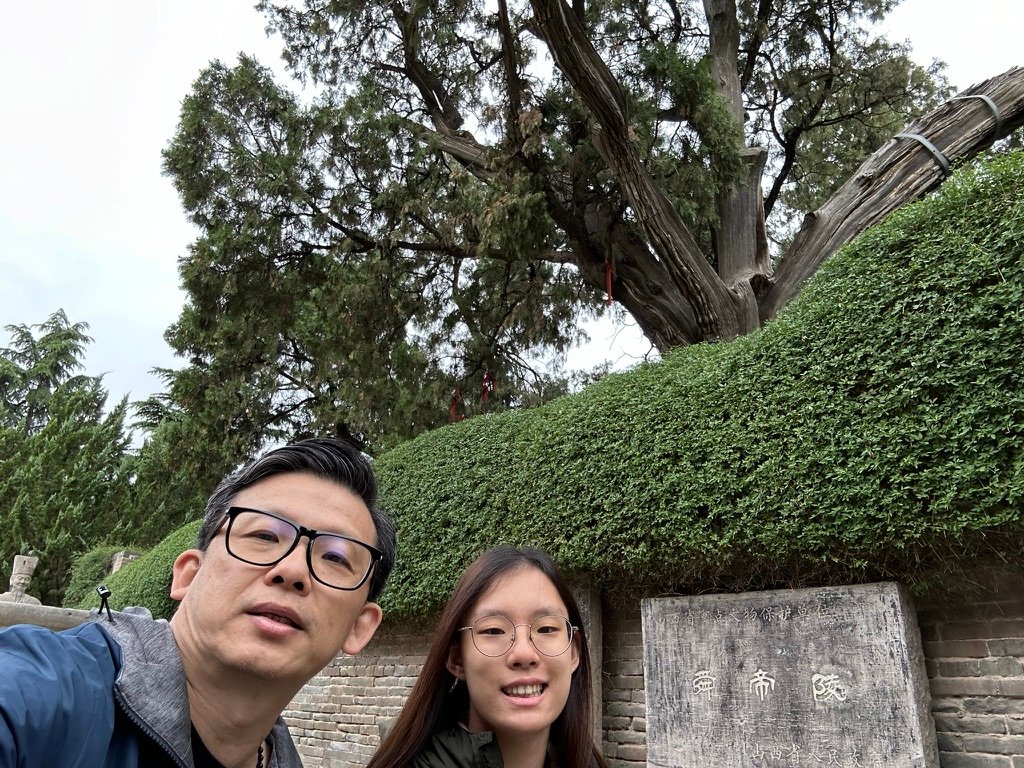
Why Was Shun Considered So Virtuous?
One of the qualities most strongly associated with Shun is:
孝 — xiào
filial devotion / filial piety
And his traditional family story is not exactly:
“Shun had wonderful parents and therefore loved them.”
😂
Quite the opposite.
Shun’s Family Was Supposedly Terrible to Him
Traditional accounts describe Shun’s family life as extraordinarily difficult.
His father was portrayed as lacking judgment.
His stepmother disliked him.
His half-brother:
象 — Xiàng
was also hostile toward him.
Some traditional stories even describe attempts to kill Shun.
😳
Yet Shun continued to behave with filial devotion and moral restraint.
Whether we read every dramatic detail as literal historical biography is not the main point here.
The story became an extreme moral example:
Can you maintain your character even when other people treat you badly?
That’s the Shun story later generations remembered.
🎬 WALK WITH DAD — The Eight Stories of Emperor Shun (舜帝): What Made a Good Ruler?
At the Mausoleum of Emperor Shun (舜帝陵, Shùn Dì Líng) in Yuncheng (运城, Yùnchéng), our Chinese-speaking guide took us through a series of colourful murals depicting the legendary life of Emperor Shun.
And Dad discovered something fascinating.
These weren’t simply stories about an ancient ruler. They were lessons about what Chinese civilization considered a good person — and ultimately, a good leader.
🎥 WATCH — Our Guide Explains Emperor Shun’s Life (Mandarin Commentary)
Don’t understand Mandarin? Here’s what our guide explains:
- 孝闻天下 (Xiào Wén Tiānxià) — Filial Piety: Despite mistreatment by his family, Shun continued to show respect toward his parents.
- 耕于历山 (Gēng Yú Lìshān) — Farming at Mount Lishan: According to legend, Shun’s goodness moved Heaven so deeply that elephants helped him plough and birds helped him cultivate the fields!
- 渔于雷泽 (Yú Yú Léizé) — Fishing at Lake Leize: Shun willingly gave the best fishing grounds to others, teaching people generosity through his actions.
- 陶于河滨 (Táo Yú Hébīn) — Making Pottery by the River: Shun helped people develop pottery-making skills, showing that leadership also meant improving everyday life.
- 尧帝考验舜 (Yáo Dì Kǎoyàn Shùn) — Emperor Yao Tests Shun: Yao tested Shun’s character and abilities before entrusting him with greater responsibility.
- 纳麓 (Nà Lù) — The Wilderness Test: According to tradition, even dangerous wild animals did not harm Shun.
- 舜即帝位 (Shùn Jí Dìwèi) — Shun Becomes Ruler: Shun eventually succeeded Yao, becoming one of China’s legendary sage-kings.
Notice something?
Shun wasn’t remembered primarily for conquering enemies or building an empire.
He was remembered for his character.
His filial piety. His generosity. His courage. His concern for ordinary people.
Of course, many of these accounts belong to China’s ancient legendary traditions rather than independently verified history.
But that is precisely why they matter.
They reveal the moral qualities later generations of Chinese thinkers wanted their rulers to possess.
And here comes Dad’s BIG question:
If a ruler should be chosen for virtue rather than family bloodline, why did China eventually become a civilization ruled by hereditary dynasties?
That question takes us from the legendary age of Yao and Shun toward the beginnings of China’s dynastic history.
And it also helps explain why, thousands of years later, people still visit Shun’s mausoleum in Yuncheng.
Shun Eventually Became One of the Famous Models of 孝
Shun’s story later became associated with the tradition of:
二十四孝 — Èrshísì Xiào
The Twenty-Four Filial Exemplars
His example became one of the most famous illustrations of filial devotion in Chinese moral culture.
Now we’re touching something Western travelers may actually notice in China today.
Family obligation.
Respect toward parents and elders.
Ancestral memory.
Filial responsibility.
These ideas have changed enormously across different periods and modern social circumstances.
But:
孝
has a very long history in Chinese ethical thought.
And Shun gives us one doorway into it.
How Do We Explain 孝 to Western Readers?
“Filial piety” is the traditional English translation.
But that phrase can sound rather stiff.
😂
Think more broadly about:
responsibility toward parents,
respect for elders,
family obligation,
and the idea that moral character begins partly in how we conduct ourselves within the family.
That still doesn’t capture every historical meaning of 孝.
But it gives international beginners somewhere to start.
And suddenly Shun isn’t simply:
“Ancient guy with a tomb in Yuncheng.”
His story connects with something international travelers may observe in Chinese society even today.
🔥
But Be Careful: Shun’s World Is Not Qin Shi Huang’s World
This is where DEEP China needs to maintain historical discipline.
We visited:
舜帝陵
But should an international traveler conclude:
“Excellent. Archaeologists therefore know Shun was buried exactly here.”
No.
That’s too strong.
Shun belongs to a layer of Chinese antiquity where transmitted tradition, later historical writing, ritual commemoration and archaeological evidence need to be distinguished carefully.
The Yuncheng mausoleum is important as a place where generations commemorated Shun.
That is historically and culturally meaningful even if it does not provide straightforward archaeological proof of every detail of Shun’s traditional biography.
This Is the Same Skill We’ve Already Learned
Remember:
TAOSI
Archaeological culture.
↓
YAO
Traditional sage-ruler association.
Not automatically identical.
Remember:
YOULI
Real place.
↓
KING WEN / I CHING
Powerful transmitted tradition.
Not every later detail independently archaeologically proven.
Now:
SHUNDI MAUSOLEUM
Real historical site of commemoration.
↓
SHUN
Figure from China’s ancient transmitted tradition.
Same lesson.
🔥
Once international readers learn to distinguish:
archaeology
historical texts
tradition
and:
cultural memory
they become much better equipped to understand early Chinese history.
That’s another DEEP China key. 🔑
🐇 And Then Sima Qian Reappears
This is where our Hancheng → Yuncheng journey becomes beautiful.
We just visited:
司马迁 — Sima Qian
Then we come to a figure such as:
Shun
whom the Chinese historical tradition preserved through works including Sima Qian’s:
《史记》 — Shiji
💡
Now the historian isn’t merely someone we learned about in the previous city.
His work is helping carry the story into this city.
Hancheng and Yuncheng have connected.
Again.
But There’s an Even Bigger Question
Yao chooses Shun.
Shun chooses Yu.
These stories celebrate:
virtue
and:
worthiness
Then Chinese political history becomes overwhelmingly dynastic and hereditary.
Yet later generations continue looking back admiringly toward Yao and Shun.
Why?
Perhaps because ideal stories don’t need to describe ordinary political reality to remain powerful.
Sometimes they exist to ask:
What SHOULD good government look like?
That’s a much more interesting question than:
“Did Shun reign from Year X to Year Y?”
And it’s one reason visiting Shun’s mausoleum gave us something to think about long after we left.
Then Yuncheng Was Supposed to Give Us Guan Yu
After Shun:
德 — virtue
孝 — filial devotion
our journey was supposed to jump forward more than two thousand years to:
关羽 — Guan Yu
and:
忠 — loyalty
义 — righteousness
at:
解州关帝祖庙
Xiezhou Guandi Ancestral Temple
That would have made a beautiful pairing.
Shun:
What makes a good ruler and good son?
Guan Yu:
What makes a loyal and righteous man?
🔥
Dad had the historical fried rice ready.
Then Shanxi supplied:
🌧️🌧️🌧️
😂😭
Heavy rain derailed our plan.
We never made it to the temple.
And honestly?
That makes Section 3 more interesting.
Because we’ll explain why Guan Yu matters, why this particular temple matters, what we missed — and why Yuncheng is one of the places Dad and Elaine genuinely need to return to.
🐇
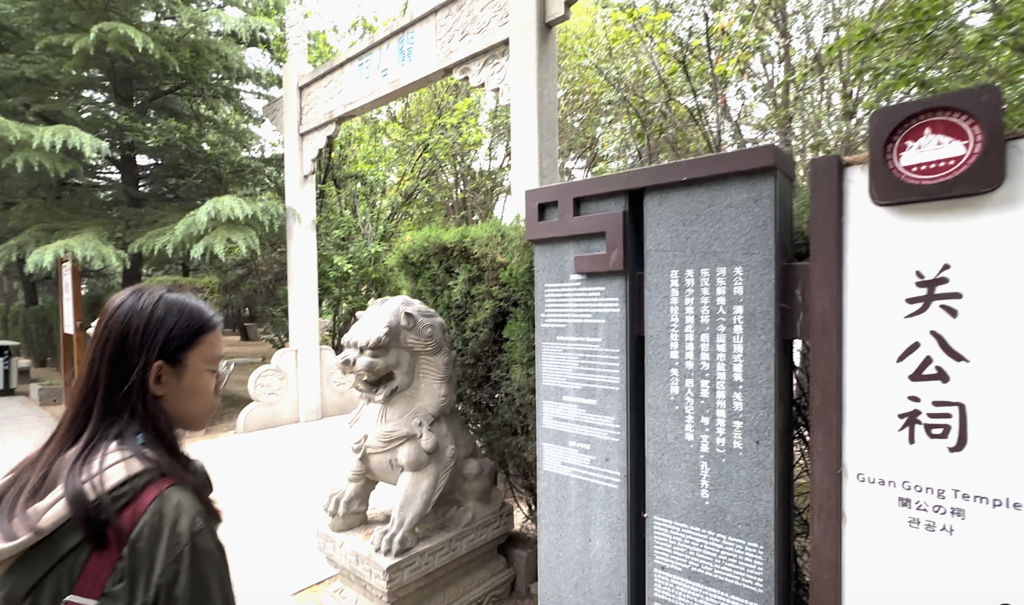
🎬 WALK WITH DAD & ELAINE — Finding Guan Gong Inside Emperor Shun’s Mausoleum!
We came to Yuncheng to understand Emperor Shun (舜帝, Shùn Dì), the legendary ruler remembered for filial piety and virtuous leadership.
But while exploring the Shun Emperor Mausoleum complex, Dad and Elaine discovered something unexpected.
A shrine dedicated to Guan Gong (关公, Guān Gōng)!
Yes, right here within the mausoleum grounds.
At Guan Gong Temple (关公祠, Guān Gōng Cí), Elaine stopped to examine a series of illustrated murals recounting the extraordinary life of Guan Yu (关羽, Guān Yǔ).
Come along and see what we discovered.
Don’t read Chinese? Here’s what the murals are telling us.
They depict famous stories associated with Guan Yu, including:
- 桃园三结义 — The Peach Garden Oath: The legendary brotherhood of Liu Bei, Guan Yu and Zhang Fei.
- 过五关斩六将 — Crossing Five Passes and Slaying Six Generals: A celebrated literary story of Guan Yu’s loyalty.
- 水淹七军 — Flooding the Seven Armies: Guan Yu’s famous military campaign against Cao Cao’s forces.
- 刮骨疗毒 — Scraping the Bone to Treat Poison: The famous story illustrating Guan Yu’s extraordinary courage.
Some episodes are rooted in historical accounts; others were developed or popularised through Romance of the Three Kingdoms (三国演义) and later storytelling.
But why are these stories still remembered?
Because Guan Yu eventually became much more than a military general.
He became a symbol of 忠 (zhōng) — loyalty and 义 (yì) — righteousness.
And that brings us to a fascinating connection.
Shun was remembered for filial piety and virtuous leadership. Guan Yu was revered for loyalty and righteousness.
Two very different figures, separated by thousands of years in Chinese tradition.
Yet both became enduring models of moral character.
Perhaps that is the most interesting discovery at this little shrine.
We came looking for Emperor Shun — and found another chapter in China’s long conversation about what makes a good man.
Section 3 — Guan Yu: From Three Kingdoms General to God of Loyalty — and the Temple the Rain Stopped Us From Seeing
Our Yuncheng plan was supposed to have a beautiful historical rhythm.
First:
舜 — Shun
德 — virtue
孝 — filial devotion
Then jump forward more than two thousand years to:
关羽 — Guān Yǔ
忠 — loyalty
义 — righteousness
Two completely different figures.
Two completely different periods.
But both became powerful moral symbols in Chinese cultural memory.
Dad had the fried rice planned perfectly.
Then came:
🌧️🌧️🌧️
😂😭
Heavy rain disrupted our Yuncheng itinerary.
So Elaine and I did not visit:
解州关帝祖庙 — Xièzhōu Guāndì Zǔmiào
Xiezhou Guandi Ancestral Temple
And we’re not going to pretend otherwise.
In fact, this is one of the places I would most want to visit if we return to Yuncheng.
Because once you understand who Guan Yu became in Chinese culture, you realize this isn’t simply:
“another old temple we missed because of bad weather.”
It’s one of Yuncheng’s biggest historical rabbit holes.
🐇
🕰️ Where Is Guan Yu on Our Timeline?
First, let’s put him somewhere.
QIN
221–206 BCE
↓
HAN
206 BCE–220 CE
↓
LATE HAN
📍 GUAN YU — ?–220 CE
↓
THREE KINGDOMS
220–280 CE
↓
JIN → SUI → TANG → SONG
↓
YUAN → MING → QING
↓
GUAN YU’S CULT KEEPS GROWING
↓
TODAY
Temples dedicated to Guan Yu can be found not only across China but in Chinese communities around the world.
That’s the first thing international readers need to understand.
Guan Yu the historical man died around the beginning of the Three Kingdoms period.
Guan Yu the cultural figure kept growing for centuries afterward.
🔥
And that difference is fascinating.
Western Readers May Already Know Him Without Knowing It
If you’ve played:
Dynasty Warriors
or:
Total War: Three Kingdoms
or encountered:
Romance of the Three Kingdoms
through novels, television, films, manga, games or other East Asian popular culture…
there’s a good chance you’ve already met:
Guan Yu.
The enormous warrior.
Long beard.
Red face in many later artistic traditions.
Often carrying the famous:
青龙偃月刀
Green Dragon Crescent Blade
Instantly recognizable.
There’s just one problem.
😂
The Guan Yu of popular culture, later literature and religious worship is not identical to the historical Guan Yu we can reconstruct from early sources.
And THAT is where things get interesting.
The Historical Guan Yu
Guan Yu came from the region around today’s:
Yuncheng
which is why this city matters so much to his story.
He became a follower of:
刘备 — Liú Bèi
and is famously associated with:
张飞 — Zhāng Fēi
The three men became inseparable in later Three Kingdoms storytelling.
Guan Yu fought during the violent collapse of the Han political order.
He became known as a formidable military figure.
In 219 CE, after military reversals involving the struggle over Jing Province, Guan Yu was captured and executed by forces associated with:
孙权 — Sūn Quán
He died in 220 CE.
Historically, that could have been the end of the story.
It wasn’t.
Not even close.
How Does a General Become a God?
This is the real Yuncheng question.
Guan Yu died as a military man.
Centuries later, people were worshipping him.
Rulers granted him increasingly impressive titles.
Temples multiplied.
Merchants honored him.
Soldiers honored him.
Officials honored him.
Ordinary people honored him.
Eventually he became widely known as:
关帝 — Guāndì
Emperor Guan
So how did we get from:
General Guan Yu
to:
divine Guan Di?
🐇
That transformation didn’t happen overnight.
It developed gradually across centuries through:
historical memory,
local worship,
religious traditions,
imperial recognition,
popular storytelling,
and literature.
This is one of the most fascinating examples of how a historical person can acquire an enormous afterlife in cultural memory.
A Familiar Handrail: Historical Person → Cultural Symbol
Western readers already understand the basic phenomenon.
A real historical figure can gradually become larger than his or her documented biography.
Stories accumulate.
Later generations emphasize certain qualities.
Literature reshapes memory.
Art creates recognizable imagery.
Different communities claim the person for different purposes.
Eventually:
the cultural figure becomes much larger than the original historical individual.
We shouldn’t force Guan Yu into an exact Western equivalent.
There really isn’t one.
But the process itself is familiar.
And with Guan Yu, the scale is extraordinary.
Then 《三国演义》 Turns Up the Heat
Centuries after Guan Yu’s death came one of China’s most famous novels:
《三国演义》 — Sānguó Yǎnyì
Romance of the Three Kingdoms
Usually associated with Luo Guanzhong (罗贯中) and taking shape in the late Yuan/early Ming literary world.
The novel is based on historical people and events…
but it is:
a novel.
😂
This distinction matters enormously.
Because for millions of readers, viewers and gamers, the Guan Yu they know is shaped heavily by the Romance, later drama and popular tradition.
🐇 The Peach Garden Oath
One of the most famous stories is:
桃园结义 — Táoyuán Jiéyì
the Oath of the Peach Garden
Liu Bei.
Guan Yu.
Zhang Fei.
Three men traditionally portrayed as swearing brotherhood and pledging themselves to a common cause.
It’s one of the defining stories of Romance of the Three Kingdoms.
And it’s enormously influential culturally.
But:
the famous Peach Garden Oath isn’t securely documented as a literal historical event in the earliest historical record.
The historical sources do describe the three men as having an exceptionally close relationship.
Later literature transforms that relationship into one of Chinese culture’s great stories of brotherhood and loyalty.
That distinction is exactly the kind of thing Deep China readers should learn to recognize:
history
versus:
literature
versus:
cultural memory.
All three matter.
They’re just not the same thing.
The Two Characters That Explain Guan Yu: 忠 and 义
If Shun gives us:
孝 — xiào
filial devotion
then Guan Yu gives us two more powerful Chinese moral concepts:
忠 — zhōng
loyalty
and:
义 — yì
righteousness / moral obligation
These became central to how later generations imagined Guan Yu.
He became the man who:
keeps faith,
remembers obligations,
doesn’t casually betray relationships,
and:
acts according to a moral code even when doing so is difficult.
Now Guan Yu becomes much more understandable.
What Does 义 Actually Mean?
This is another dangerous rabbit hole.
😂
Translating:
义
simply as:
“righteousness”
doesn’t always make the idea immediately accessible.
Think of it as involving questions such as:
What is the morally right thing to do?
What do I owe to people with whom I have a relationship?
What obligations should I honor even when breaking them would be easier?
Different Chinese thinkers and historical periods understood 义 in different ways.
But as a doorway into Guan Yu:
loyalty + moral obligation + keeping faith
gets us somewhere.
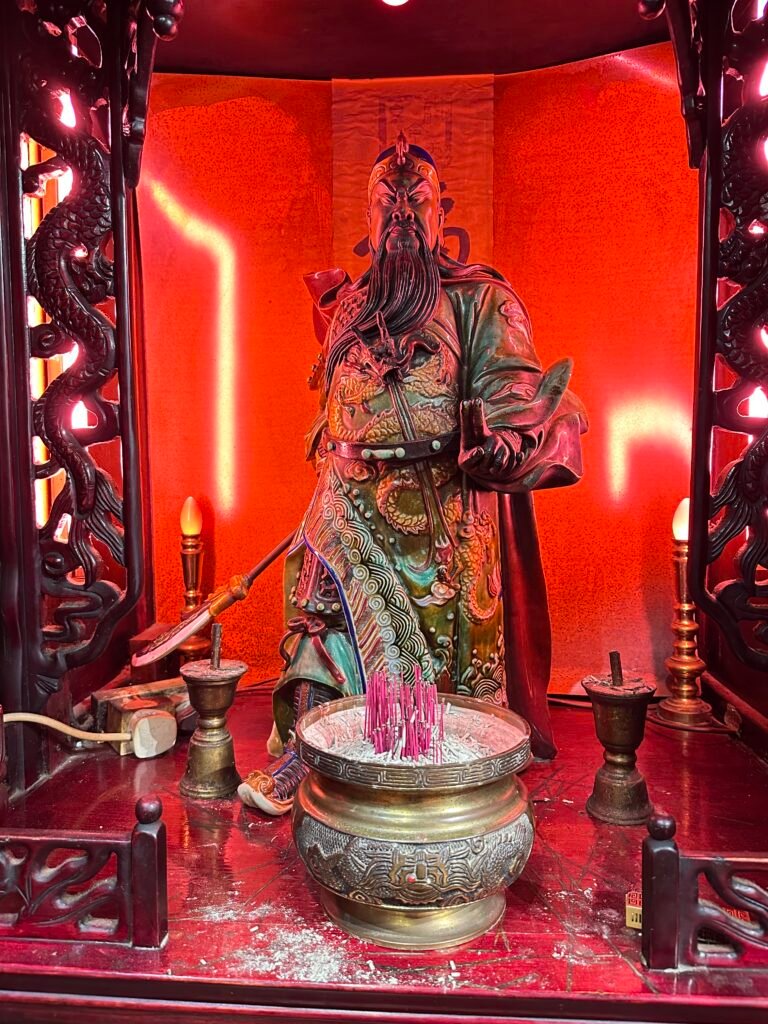
Why Do Businesspeople Worship Guan Yu?
This is where international travelers sometimes become confused.
You walk into:
a restaurant,
a shop,
an office,
perhaps a business in Hong Kong or Southeast Asia…
and there’s:
Guan Yu.
Red face.
Long beard.
Very serious expression.
😂
Why is a Three Kingdoms general standing near the cash register?
Because Guan Yu’s later symbolism expanded beyond warfare.
His reputation for:
信义
trustworthiness and keeping faith
made him attractive as a symbol of honesty and reliability in relationships and business.
Different communities worship or honor him in different ways.
But this is one reason Guan Yu traveled far beyond military history.
And This Is Where Southeast Asian Readers May Recognize Him
Now our Yuncheng story becomes international.
Across Chinese communities in Southeast Asia, temples and shrines dedicated to Guan Yu — often known through names such as Guan Di or Kuan Ti in older romanizations and dialect traditions — are widespread.
Many Southeast Asian readers may have seen him long before ever visiting China.
Perhaps in:
a temple,
a family shrine,
a business,
or during a religious festival.
🍚
That’s our familiar ingredient.
Then come to Yuncheng and discover:
This is the region where the historical Guan Yu came from.
Suddenly a figure encountered thousands of kilometers away has geography.
🔥
That’s exactly the kind of connection DEEP China loves.
So Why Is Xiezhou Guandi Temple So Important?
The temple we missed because of rain is:
解州关帝祖庙
Xiezhou Guandi Ancestral Temple
The crucial word is:
祖庙 — zǔmiào
ancestral temple
This isn’t simply one more Guan Yu temple among thousands.
It stands in Guan Yu’s home region and became one of the most important centers associated with his worship.
The complex has a long history stretching back many centuries, although surviving structures reflect repeated rebuilding and restoration across later dynasties.
For someone trying to understand:
How did Guan Yu the man become Guan Di the cultural and religious figure?
this is exactly the kind of place we should have visited.
🌧️
Thanks, weather.
😂
And Emperors Had Reasons to Like Guan Yu Too
Here’s another layer.
As Guan Yu’s reputation expanded, successive imperial governments bestowed titles upon him.
Why might rulers encourage the veneration of a figure associated with:
loyalty,
righteousness,
courage,
and keeping one’s obligations?
🤔
Exactly.
Moral symbols can have political usefulness too.
A figure who embodies loyalty isn’t merely attractive to ordinary people.
He can also be attractive to governments that value:
loyal subjects.
🐇
Again, cultural memory, religion and politics begin overlapping.
From General → Lord → Emperor Guan
Over the centuries, Guan Yu accumulated increasingly exalted posthumous honors.
His status expanded dramatically particularly during later imperial periods.
By the Ming and Qing eras, Guan Yu’s cult had become deeply embedded in official and popular religious life.
So when we call him:
关帝
we’re looking at the result of centuries of historical transformation.
The man died in 220 CE.
The symbol kept evolving.
That’s the timeline lesson.
🕰️ One Man, Two Timelines
This is a useful way to think about Guan Yu.
HISTORICAL GUAN YU
Late Han
↓
Military career
↓
Dies 220 CE
END
But then:
CULTURAL GUAN YU
Historical memory
↓
Local worship
↓
Religious development
↓
Literature
↓
Imperial titles
↓
Romance of the Three Kingdoms
↓
Temples across China
↓
Chinese communities overseas
↓
TODAY
🔥
The second timeline lasts far longer than the first.
And that’s why Guan Yu matters.
Shun and Guan Yu Suddenly Make Sense Together
Now return to the beginning of our Yuncheng journey.
At:
舜帝陵
we encountered Shun as a model of:
德 — virtue
and:
孝 — filial devotion
Then the place we missed would have introduced Guan Yu as a model associated with:
忠 — loyalty
and:
义 — righteousness
Different periods.
Different evidence.
Different kinds of historical figures.
But later Chinese culture kept returning to both.
Why?
Because civilizations don’t remember people only for:
what happened.
They also remember them for:
what they came to represent.
🌶️🔥
That’s the real Yuncheng story.
And This Is Why I’m Glad We’re Honest About Missing the Temple
It would be easy for ChinaTravelBUG to research Xiezhou Guandi Temple and write:
“Visit this magnificent complex…”
Fine.
But our story is:
We planned to go.
It rained heavily.
Our plan collapsed.
We missed it.
😂
And then, afterward, Dad learned even more about what we’d missed.
Sound familiar?
Handan 邯郸
🐇
Travel gives you the experience.
Missing something gives you another question.
Research gives the place new meaning afterward.
And sometimes:
the rabbit hole becomes the reason to return.
Would We Go Back?
Yes.
This time:
Xiezhou Guandi Ancestral Temple
would be high on the list.
Not because Dad needs another photograph.
😂
Because now we understand the question we’d be taking there:
How did one military man from the end of the Han dynasty become a moral and religious figure recognized across the Chinese world?
That’s a fantastic DEEP China question.

Sting Check
You arrived in Yuncheng knowing perhaps:
“Guan Yu = famous Three Kingdoms warrior.”
Now you’ve acquired:
historical Guan Yu
↓
Romance of the Three Kingdoms
↓
Peach Garden Oath
↓
忠
↓
义
↓
Guan Di
↓
imperial titles
↓
business worship
↓
Southeast Asian temples
and:
“Wait… why exactly did merchants choose a military general as a symbol of trust?”
😬
There it is.
🐇
You’ve been stung again.
Next: How to Go — Xi’an → Hancheng → Yuncheng → Xi’an
Now we have the two halves of Yuncheng:
SHUN
ancient virtue and ideal rulership
and:
GUAN YU
loyalty, righteousness and cultural memory.
One we visited.
One the rain stole from us.
😂
So Section 4 will do something practical:
help you make the journey better than ours.
We’ll cover:
Xi’an → Yuncheng
and the more interesting Deep China route:
Xi’an → Hancheng → Yuncheng → Xi’an
including:
- train/transport logic;
- realistic journey times;
- how many nights;
- getting to Shun’s Mausoleum;
- getting to Xiezhou Guandi Ancestral Temple;
- what to do when Yuncheng weather behaves badly;
- and why you should build enough flexibility into the itinerary that one Shanxi rainstorm doesn’t defeat Guan Yu twice.
😂🌧️
Section 4 — How to Go: Xi’an → Hancheng → Yuncheng → Xi’an
After Shun, Guan Yu, filial devotion, righteousness, Three Kingdoms and one rainstorm that defeated Dad’s itinerary…
😂🌧️
we finally arrive at the practical question:
How should YOU visit Yuncheng?
There are actually two good ways to do it.
The simple route
Xi’an → Yuncheng → Xi’an
Fast.
Easy.
Excellent rail connections.
Or, if ChinaTravelBUG has already got you:
The Deep China route
Xi’an → Hancheng → Yuncheng → Xi’an
This combines two very different historical destinations.
Hancheng
→ Sima Qian
→ Shiji
→ Da Yu
→ ancient city
then:
Yuncheng
→ Shun
→ Guan Yu
→ virtue, filial devotion, loyalty and righteousness
and finally:
Yuncheng → Xi’an
by fast train.
That makes a beautiful historical loop.
But there’s one transport wrinkle you need to understand.
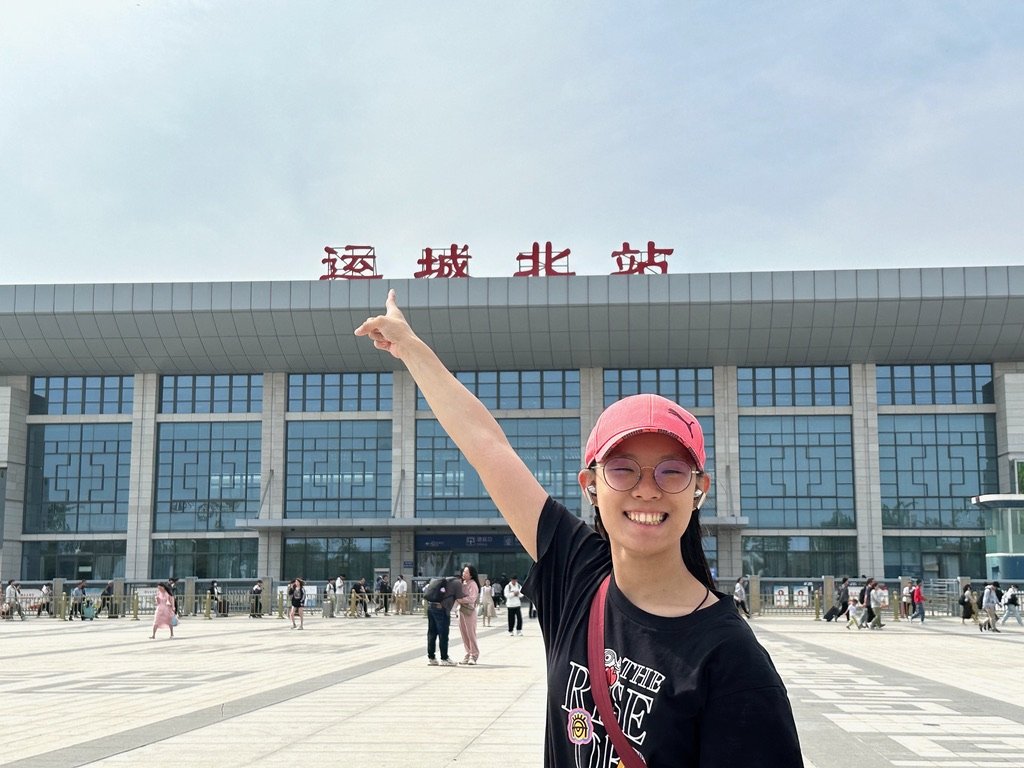
🚄 Xi’an → Yuncheng Is VERY Easy
If Yuncheng is your only Deep China destination, this is straightforward.
Frequent D-category fast trains connect:
Xi’an North — 西安北站
with:
Yuncheng North — 运城北站
Current schedules show many direct services taking only around:
1 hour–1 hour 15 minutes
with second-class fares commonly around:
RMB 60–72 one way
depending on the train.
That’s almost dangerously convenient.
😂
Leave Xi’an after breakfast.
A little over an hour later:
Shanxi.
Shun.
Guan Yu.
🐇
And return services are similarly convenient, with many Yuncheng North → Xi’an North trains taking roughly 1 hour–1 hour 20 minutes.
🚉 Important: Yuncheng Has More Than One Station
For the fast services from Xi’an, you’re generally looking for:
运城北站 — Yuncheng North
Don’t confuse this with:
运城站 — Yuncheng Railway Station
The latter is the older conventional railway station.
As always in China:
Read the last Chinese character on your station name.
北 means North.
One little character can decide whether Dad is calmly drinking coffee…
or shouting:
“ELAINE! WRONG STATION!”
😂、
Option 1 — The Easy 2–3 Night Yuncheng Trip
If you’re starting and finishing in Xi’an, I’d suggest:
Day 1
🚄 Xi’an North → Yuncheng North
↓
🏨 Check in
↓
舜帝陵 — Shun’s Mausoleum
Give yourself time to understand the site rather than simply photographing the mound and leaving.
The Shundi Mausoleum scenic area lies about 10 km north of Yuncheng’s urban area, according to Yuncheng’s official tourism information.
For international travelers, the simplest option is usually:
DiDi / taxi
Save:
舜帝陵景区
on your phone.
Day 2 — Do What Dad Failed to Do 😂
Your major destination:
解州关帝祖庙
Xiezhou Guandi Ancestral Temple
This time…
CHECK THE WEATHER.
🌧️😂
We intended to visit.
Heavy rain derailed our plan.
So don’t copy our itinerary too tightly.
Give yourself enough flexibility that one afternoon of bad weather doesn’t eliminate one of Yuncheng’s most important historical sites.
And remember why you’re going.
Not simply:
“Old Guan Yu temple.”
You’re following:
historical Guan Yu
↓
Three Kingdoms
↓
忠 — loyalty
↓
义 — righteousness
↓
popular storytelling
↓
imperial recognition
↓
关帝 — Guan Di
That’s a fantastic historical transformation to explore in the place regarded as the ancestral center of Guan Yu worship.
🌧️ Dad’s Yuncheng Weather Rule
Here’s something our trip taught us.
When your itinerary contains one attraction you particularly care about, don’t automatically leave it until your final afternoon.
😂
Weather happens.
Transport happens.
People get tired.
Museums unexpectedly close.
So if Xiezhou Guandi Temple is important to you:
build some flexibility into your Yuncheng stay.
That’s another reason I’d choose:
2 nights minimum
rather than arriving one morning and leaving the next.
If you’re particularly interested in the history:
3 nights is perfectly reasonable.
Getting Around Yuncheng
Yuncheng’s historical attractions are spread across a wider area.
This isn’t:
Qufu Temple → Mansion → next-door attraction.
For the sites in this article, we’d generally favor:
DiDi / taxi
or:
a pre-arranged driver
depending on your itinerary.
Save the Chinese names:
舜帝陵景区
Shun’s Mausoleum
解州关帝祖庙
Xiezhou Guandi Ancestral Temple
This becomes particularly useful once you’re outside the central urban area.
And if you’re traveling as a family or small group, a driver for a historical sightseeing day may be worth considering.
Deep China should be about following historical rabbit holes…
not arguing with a rural bus timetable. 😂
Now the More Interesting Route: Xi’an → Hancheng → Yuncheng → Xi’an
This is the one I particularly like.
🔥
Because it creates a surprisingly coherent historical journey.
Start:
XI’AN
Qin.
Terracotta Warriors.
Imperial China.
↓
Take the ordinary railway north to:
HANCHENG
Sima Qian.
The historian who helped preserve China’s ancient stories.
Da Yu.
Ancient city.
↓
Continue toward:
YUNCHENG
Shun.
Guan Yu.
Moral models and cultural memory.
↓
Then fast train:
YUNCHENG → XI’AN
Loop closed.
But Hancheng → Yuncheng Is NOT a Simple Direct Fast Train
This is important.
There is currently no direct Hancheng → Yuncheng high-speed train.
In fact, current railway searches show no direct train between the two cities; rail itineraries require a transfer.
One current option is:
Hancheng → Houma 侯马
by conventional train
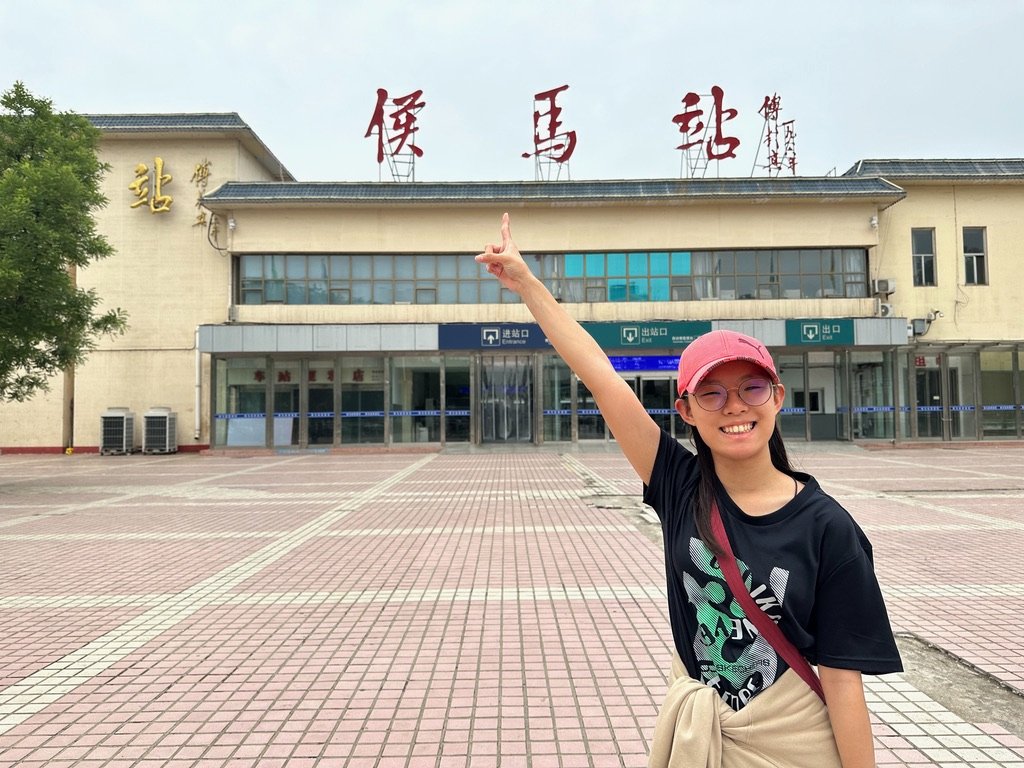
then:
Houma West 侯马西 → Yuncheng North 运城北
by D-train.
Current examples take roughly:
3½–4 hours total
depending heavily on the connection.
The railway portions themselves can be inexpensive — for example, current listings show Hancheng → Houma hard-seat fares around RMB 16.50, followed by Houma West → Yuncheng North second-class fares around RMB 20–22.
But notice the problem:
Houma and Houma West are different stations.
😬
That can make a seemingly cheap rail connection less convenient for an international traveler.
Hancheng → Yuncheng: Consider Going by Road
For the full DEEP China route, I’d seriously compare:
rail with transfer
versus:
a direct car/driver
for Hancheng → Yuncheng.
Why?
Because geographically the two destinations fit our route nicely.
But the railway network doesn’t connect them as elegantly as:
Xi’an → Yuncheng
or:
Tai’an → Qufu.
A private transfer can therefore be worth considering for a family or small group.
Before traveling, compare:
current rail schedules
road travel time
driver cost
and your luggage situation.
Don’t choose rail simply because Dad likes trains.
😂
A Comfortable DEEP China Loop
If we were designing this journey today, I’d suggest approximately:
Day 1
Xi’an → Hancheng by conventional/intercity train
Hancheng Ancient City
Day 2
Sima Qian Temple & Tomb
Da Yu Temple
Day 3
Hancheng → Yuncheng
Treat this primarily as a transfer day, especially if using public transport.
Day 4
Shun’s Mausoleum
Explore Yuncheng
Day 5
Xiezhou Guandi Ancestral Temple
Day 6
Yuncheng → Xi’an by fast train
That’s a comfortable:
5–6 day Deep China extension from Xi’an
without turning the journey into an endurance event.
🕰️ Look at the Historical Journey You’ve Just Made
This is what I love about the route.
You aren’t moving chronologically.
But because we keep returning to the timeline, your brain can organize the jumps.
SHUN
remote sage-ruler tradition
↓
DA YU
traditional early civilization / Xia-associated world
↓
QIN
Xi’an
↓
HAN
Sima Qian
↓
GUAN YU
late Han / Three Kingdoms transition
↓
LATER DYNASTIES
remember, reinterpret and honor all these figures
🔥
The geography gives you the experience.
The timeline keeps you from getting lost.
Which Route Should You Choose?
If You Mainly Want Yuncheng
Xi’an → Yuncheng → Xi’an
Easy.
Fast.
Around 1–1¼ hours each way by D-train.
Excellent first DEEP China extension.
If Sima Qian Has Already Got You
Xi’an → Hancheng → Yuncheng → Xi’an
Allow around 5–6 days.
Slower.
More complicated.
Much deeper.
🐇
If You Only Have One Extra Day
Honestly?
I’d probably choose Yuncheng over trying to force Hancheng into a same-day trip.
The fast rail makes Yuncheng dramatically easier from Xi’an.
But if your heart says:
Sima Qian…
then don’t rush Hancheng.
Stay overnight.
And Please Don’t Repeat Our Guan Yu Mistake 😂
Dad and Elaine:
“Tomorrow: Guandi Temple!”
Shanxi weather:
“No.”
🌧️🌧️🌧️
So:
check the forecast,
keep your itinerary flexible,
and if one site matters enormously to you, visit it earlier rather than leaving it until the last possible window.
Travel isn’t a spreadsheet.
Sometimes history survives for two thousand years…
and you still miss it because it rains on Tuesday.
😂

Final Sting Check
You began this journey at Xi’an thinking:
“Maybe we’ll go somewhere nearby for a few days.”
Now you’ve encountered:
Sima Qian
↓
Da Yu
↓
Shun
↓
filial devotion
↓
Guan Yu
↓
loyalty and righteousness
↓
Three Kingdoms
↓
and perhaps you’re now wondering:
“Wait… where exactly was Yu the Great supposed to control the floods?”
😬
There it is.
🐇
Another rabbit hole.

ChinaTravelBUG’s Take
Yuncheng works beautifully as a Deep China extension from Xi’an because it is both:
easy to reach
and:
historically much deeper than most international travelers realize.
The fast train gets you from Xi’an to Yuncheng in roughly an hour.
But once you arrive, the timeline stretches across thousands of years.
Shun takes you into China’s ancient ideas about:
virtue,
filial devotion
and worthy rulership.
Guan Yu takes you into:
loyalty,
righteousness,
Three Kingdoms
and the extraordinary transformation of a historical general into a cultural and religious figure recognized across the Chinese world.
And if you connect Yuncheng with Hancheng?
Then Sima Qian joins the journey.
The historian who helped preserve China’s stories leads you toward some of the very figures later generations continued remembering.
That’s a beautiful rabbit hole.
Just remember:
leave some room for the rain. 🌧️😂
Sometimes DEEP China teaches you through what you see.
Sometimes through what you miss.
And sometimes what you miss…