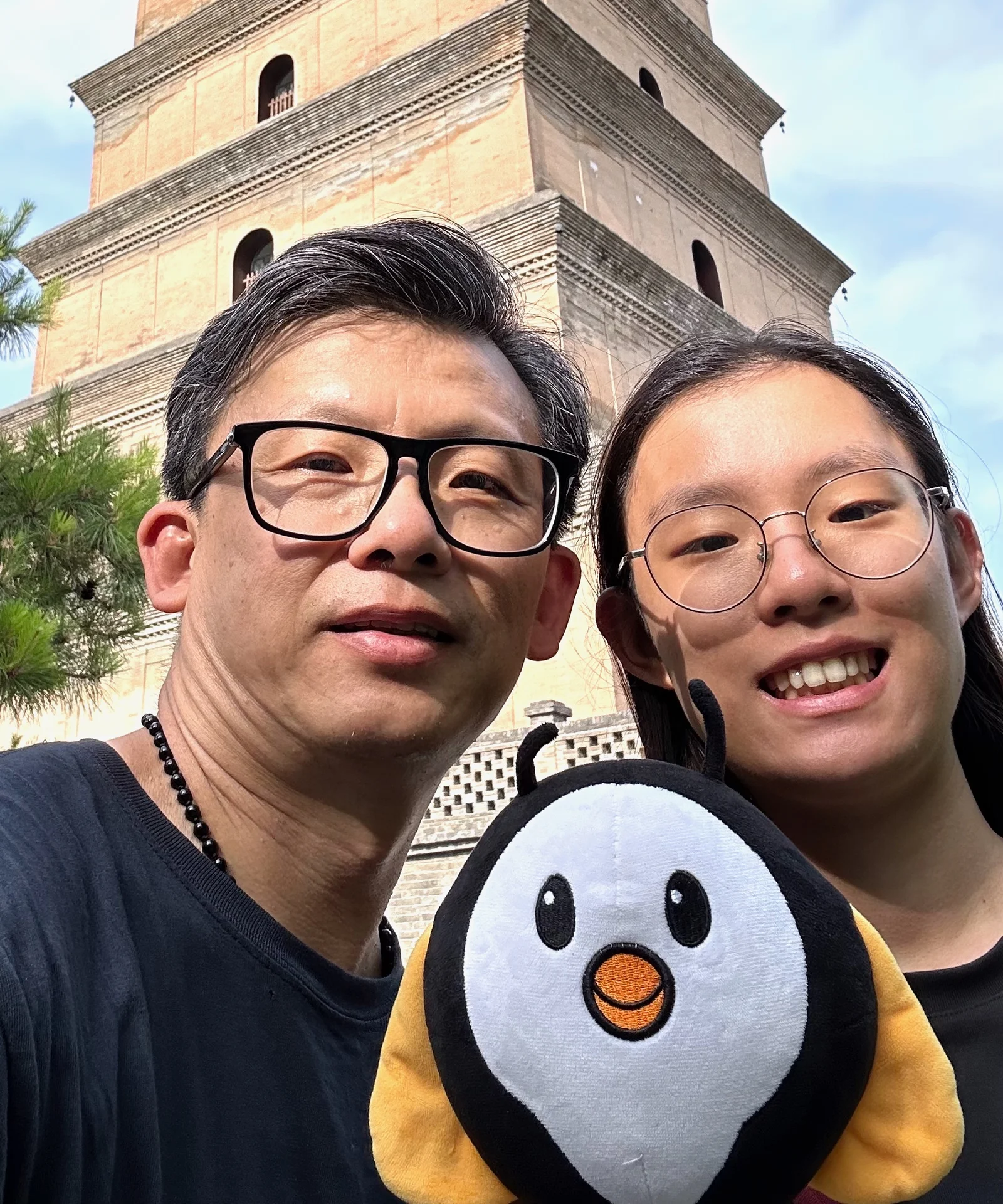
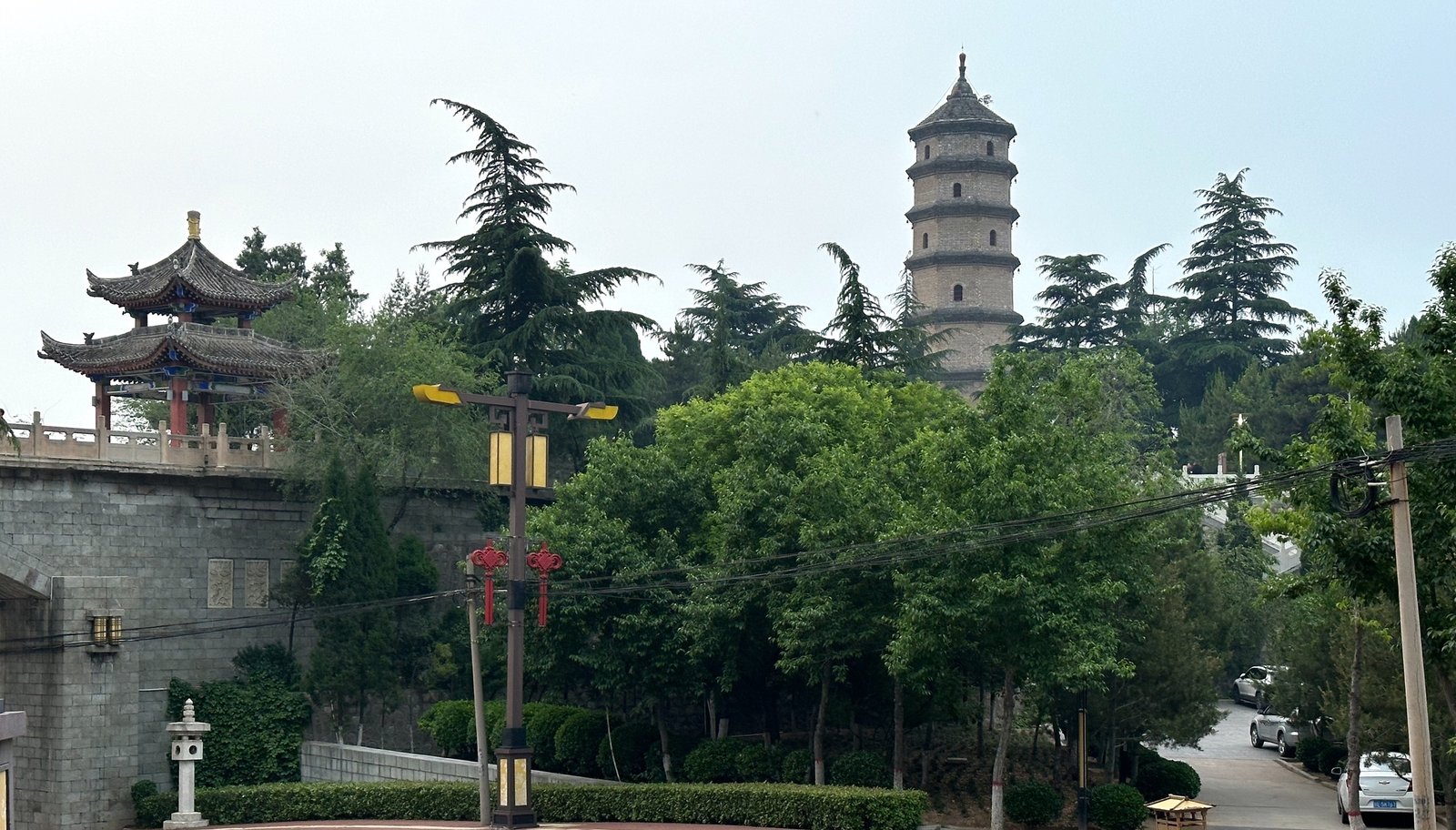
An overlooked city beyond Xi’an. China’s great historian. A legendary flood-controller. Remarkable ancient temples. And a city that surprised Dad and Elaine long after sunset.
QUICK ANSWER — WHY SHOULD YOU VISIT HANCHENG?
Most international travelers visiting Xi’an (西安, Xī’ān) head for the Terracotta Army.
Of course!
But what if you want to go:
BEYOND XI’AN?
Not simply to see another famous attraction.
But to discover a place that helps explain how Chinese civilization developed.
Welcome to Hancheng (韩城, Hánchéng), in Shaanxi Province (陕西, Shǎnxī).
A historic city that many international travelers have never heard of.
And one of Dad’s favourite discoveries in China.
We originally came for one man.
SIMA QIAN (司马迁, Sīmǎ Qiān).
The historian whose writings helped preserve China’s ancient past.
But Hancheng had other surprises waiting for us.
A legendary flood-controller.
A remarkably preserved Confucian temple.
Old streets, traditional shrines and a City God Temple.
And an ancient city that feels completely different after dark.
One small city. So many layers of China.
Come along with Dad and Elaine.
Let’s show you what we found.
🎬 WALK WITH DAD & ELAINE — OUR FIRST STEPS INTO SIMA QIAN’S MEMORIAL
Our journey begins at the Sima Qian Temple and Tomb (司马迁祠墓, Sīmǎ Qiān Címù) near Hancheng.
Through the red wooden gates, we enter a peaceful courtyard.
Old trees.
Stone-paved walkways.
A traditional memorial hall.
And an incense burner standing before the steps.
Nearby, a sign points toward:
司马迁墓 — Tomb of Sima Qian.
🎥 WATCH — Entering Sima Qian’s Memorial with Dad & Elaine
Now here’s a question.
Why would people continue to honour a historian who lived more than 2,000 years ago?
Not an emperor.
Not a great military commander.
But a man who wrote about them.
That is why Dad wanted to come here.
And we haven’t even reached his tomb yet.
🎬 WALK WITH DAD & ELAINE — THE CLIMB TO SIMA QIAN’S TOMB
We continue uphill.
Along brick-lined paths.
Up the stone steps.
And finally reach the tomb.
A rounded, brick-encased mound.
A cypress tree growing from its top.
Red ribbons tied around the protective fence.
Visitors quietly exploring the terrace.
Then Dad turns the camera outward.
Below us stretches the memorial complex, with its statue of Sima Qian and the surrounding green countryside.
🎥 WATCH — Reaching Sima Qian’s Tomb and the Hilltop View
Standing there, Dad couldn’t help thinking:
Emperors ruled China. But historians helped China remember them.
And that is where our Hancheng story really begins.
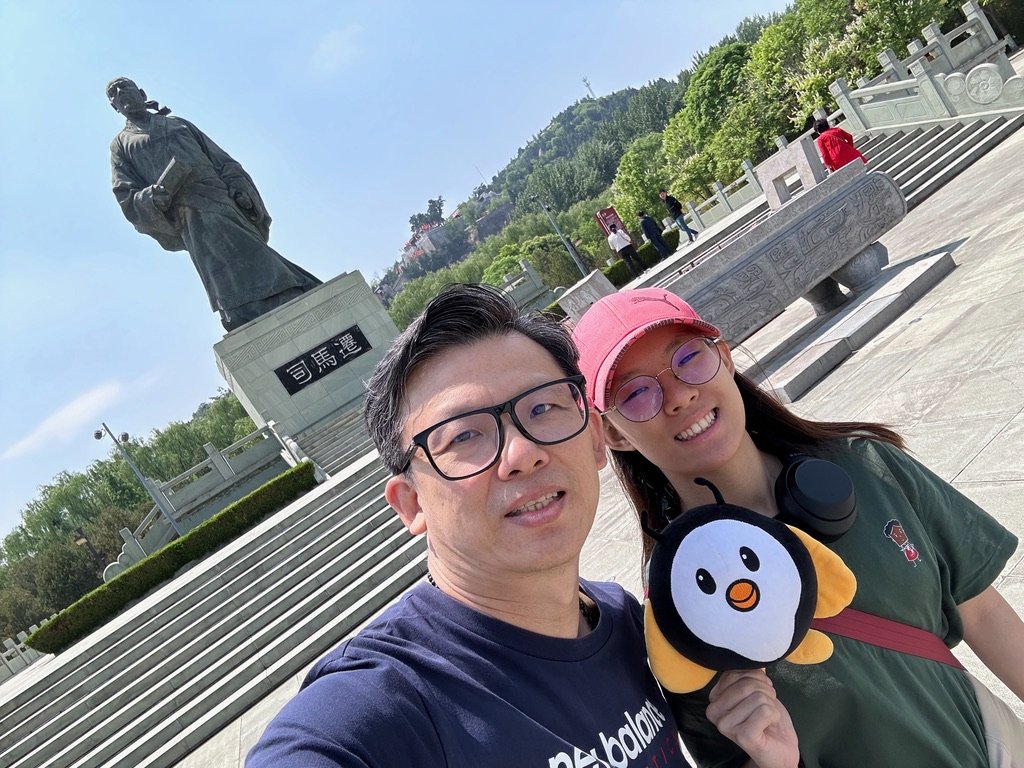
SIMA QIAN — THE HISTORIAN WHO KEPT FOLLOWING DAD
If you’ve been following our DEEP China journeys, you may already know why Dad wanted to visit Sima Qian.
This man keeps appearing!
Qin Shi Huang?
Sima Qian.
Xiang Yu and Liu Bang?
Sima Qian.
Emperor Wu of Han?
Our old friend again.
Even when Dad and Elaine explored Mount Tai and the ancient imperial rituals, his writings were never far away.
Eventually Dad thought:
If this man keeps following us through Chinese history, perhaps we should go and visit him!
So here we are.

First, Where Are We in Chinese History?
Sima Qian lived during the Western Han dynasty (西汉, Xī Hàn), around the second and first centuries BCE.
That means he came:
After the early Zhou.
After Confucius.
After the Warring States.
And after Qin Shi Huang united China in 221 BCE.
Yet he wrote about all of them.
His great work was:
《史记》 (Shǐjì) — Records of the Grand Historian.
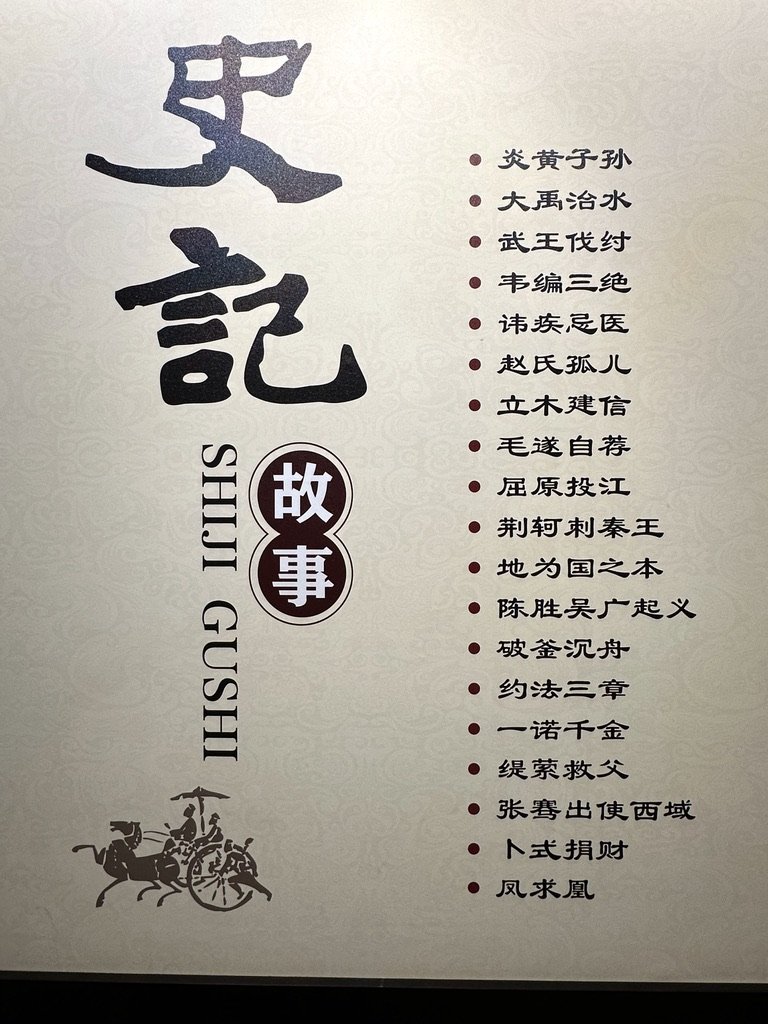
One of the foundational works of Chinese historical writing.
And Sima Qian didn’t simply write:
King A → King B → King C.
He wrote about:
PEOPLE.
Emperors.
Generals.
Officials.
Strategists.
Rebels.
Victors.
Failures.
People making brilliant decisions.
And people making catastrophically bad ones.
He helped turn:
THE PAST
into:
HUMAN STORIES.
And many of the ancient Chinese characters Dad and Elaine keep encountering throughout our travels are people we know partly through his writings.
Wait… Is This Really a 2,000-Year-Old Tomb?
Ah.
Here comes another historical rabbit!
Sima Qian lived more than 2,000 years ago.
But the memorial complex we visited isn’t frozen in the Han dynasty.
Later generations built, rebuilt, restored and honoured this place.
The tomb’s distinctive rounded structure and parts of the memorial’s architectural history reflect later periods, including the Yuan dynasty (元朝, Yuán Cháo).
So we must distinguish:
THE HISTORICAL SIMA QIAN
from:
THE MEMORIAL LATER GENERATIONS CREATED TO REMEMBER HIM.
The site is traditionally associated with his tomb, but its surviving structures should not be mistaken for an untouched Western Han burial.
And that makes it more interesting.
Because this place tells us not only about Sima Qian.
It tells us how China continued to remember him.

WESTERN HANDRAIL — HOW OLD IS A HISTORICAL SITE, REALLY?
When visiting China, we often ask:
“How old is this building?”
Fair question.
But sometimes the better question is:
“Why did later generations keep preserving this place?”
Sima Qian belongs to the Han dynasty.
Parts of his memorial belong to much later centuries.
And today’s visitors belong to modern China.
Different historical periods.
Connected by one man’s legacy.
That is one of the fascinating things about exploring DEEP China.
History doesn’t always survive as one untouched ancient building.
Sometimes it survives because generations of people keep remembering.
But Can We Trust Everything Sima Qian Wrote?
Now Dad’s rabbit is trying to escape again. 😂
Because Sima Qian wrote about people who lived long before him.
So historians still have to ask:
What sources did he use?
What came from inherited traditions?
What can archaeology confirm?
And where might storytelling have influenced the accounts?
These questions are important.
But we’re NOT going to answer them all here.
Otherwise…
SIMA QIAN EATS THE HANCHENG ARTICLE AGAIN!
He already has his own DEEP China discussion:
DEEP China: Sima Qian — How Do We Know So Much About Ancient China?
There we explore his father Sima Tan 司马谈, his travels, the Shiji, Emperor Wu, the Li Ling affair, his devastating punishment and his determination to finish the book.
For now:
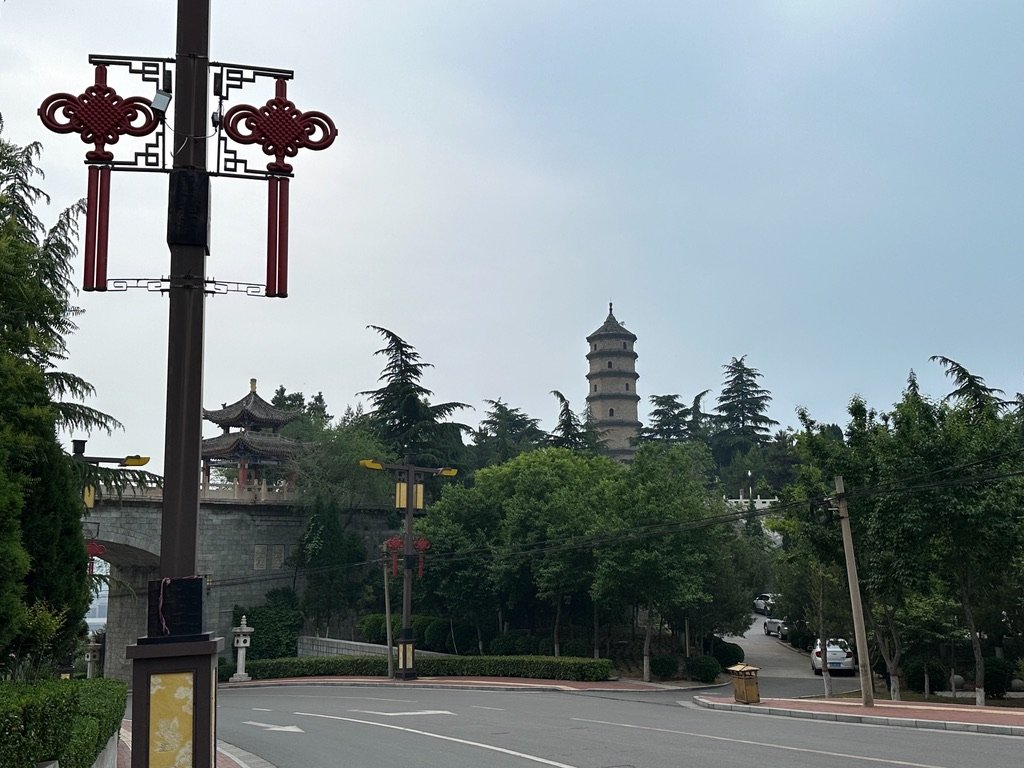
BACK TO HANCHENG.
Because our next discovery connects directly to the question of how China remembers its distant past.
And this time, we’re going back much further than the Han dynasty.
To a legendary hero associated with China’s ancient floods.
YU THE GREAT (大禹, Dà Yǔ).
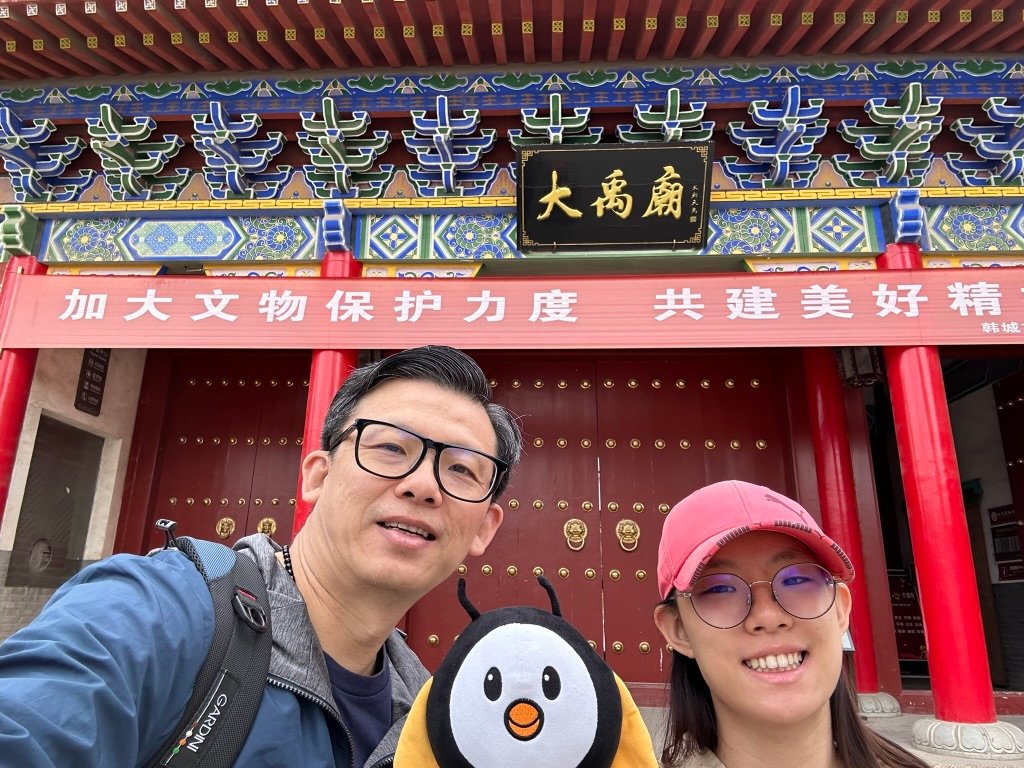
2. DA YU TEMPLE (大禹庙) — BEFORE CHINESE HISTORY, THERE WERE GREAT STORIES
We came to Hancheng because of Sima Qian.
But Hancheng introduced Dad and Elaine to someone from a much more distant past.
Yu the Great (大禹, Dà Yǔ).
A legendary figure remembered for controlling the great floods of ancient China.
And here’s what makes this discovery interesting.
Sima Qian lived around 2,000 years ago.
But the stories about Yu describe a world supposedly much older than that.
A world before the Qin empire.
Before the Zhou dynasty.
Even before the earliest securely documented Chinese dynasties.
So why does Hancheng have a temple dedicated to him?
Let’s find out.
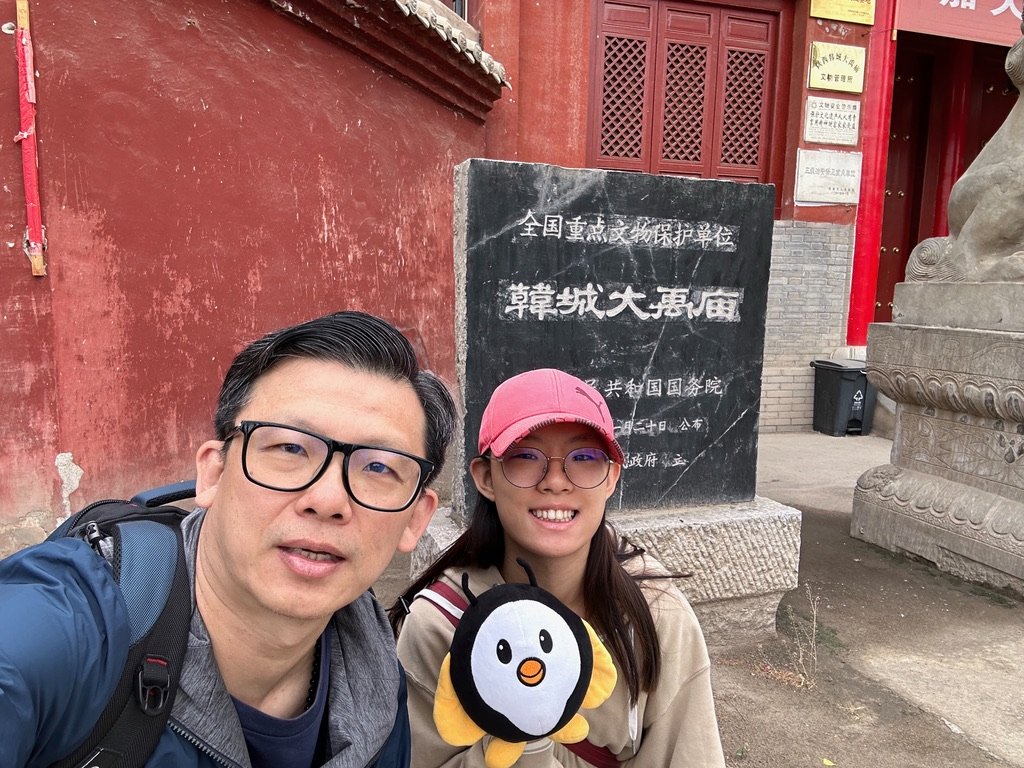
🎬 WALK WITH DAD & ELAINE — DISCOVERING DA YU TEMPLE (大禹庙)
We came to Hancheng looking for Sima Qian.
But now we’re visiting a temple dedicated to someone whose story takes us much further back into China’s legendary past.
YU THE GREAT (大禹, Dà Yǔ).
Come along with Elaine as we explore Hancheng Da Yu Temple (韩城大禹庙, Hánchéng Dà Yǔ Miào).
Our walk begins in a peaceful stone-paved courtyard.
Ahead stands a magnificent ritual incense burner beneath an ornate pavilion roof, decorated with red ribbons.
Then Elaine approaches the temple entrance.
Above the doorway are three Chinese characters:
大禹庙 — DA YU TEMPLE.
Stone lions guard the steps.
Beyond the red wooden doors, ancient cypress trees shade the inner courtyard.
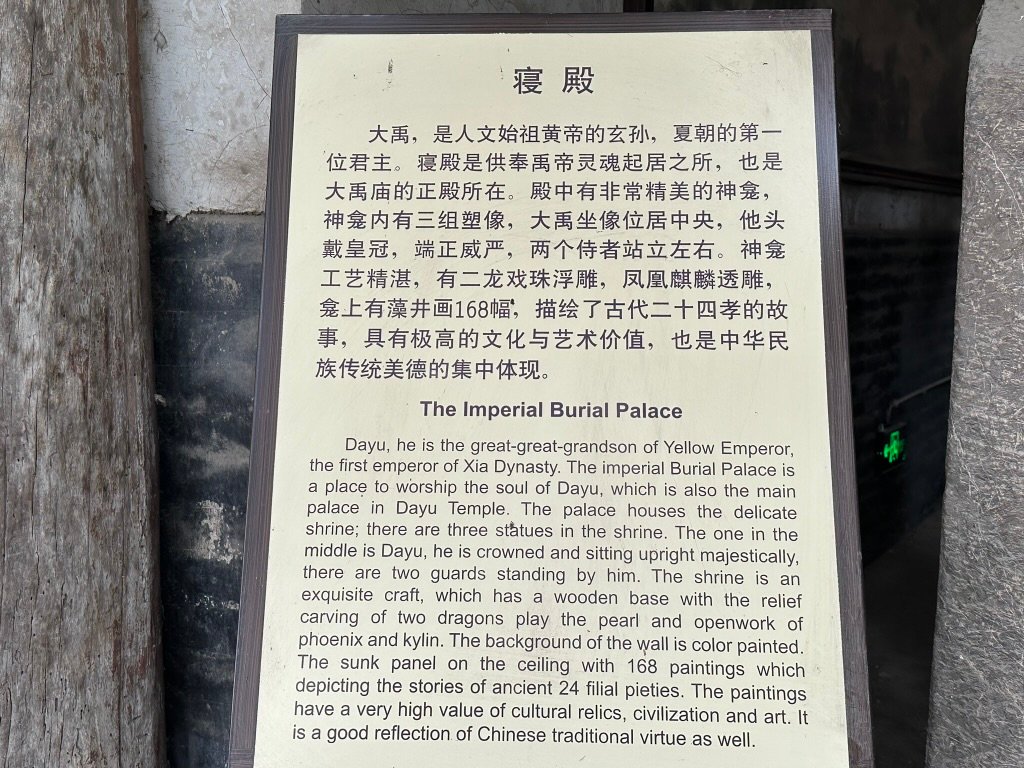
We continue toward the main shrine hall, 寝殿 (Qǐndiàn).
And here comes a fascinating discovery!
The temple’s heritage information board describes elaborate wood carvings, dragons, phoenixes and 168 painted ceiling panels depicting traditional stories, including the Twenty-Four Filial Exemplars (二十四孝, Èrshísì Xiào).
Think about that.
We’re visiting a temple dedicated to a legendary flood controller.
Yet its architecture also preserves stories about family duties, moral conduct and traditional Chinese values.
ONE TEMPLE. MANY LAYERS OF CHINESE CULTURE!
🎥 WATCH — Dad & Elaine Explore Hancheng Da Yu Temple
WAIT… WHO EXACTLY WAS YU THE GREAT?
Now that you’ve seen the temple, here’s the question.
Why did generations of Chinese people honour a man remembered for controlling floods?
Not for conquering an enemy.
Not for building an enormous palace.
But for managing water.
And here’s something Western readers might find familiar.
HAVE YOU HEARD OF NOAH AND THE GREAT FLOOD?
Well, ancient China has its own famous flood story.
But with a very different hero.
Let’s meet Yu the Great (大禹).
But here’s the question Dad wants you to keep in mind:
Why would generations of Chinese people build temples to honour someone remembered for controlling floods?
Not for conquering an enemy.
Not for building a palace.
But for managing water.
To understand that, we need to travel back into China’s legendary past.

WESTERN HANDRAIL — Is Yu the Great China’s Noah?
For Western readers, the story of Yu the Great may sound vaguely familiar.
A devastating flood.
Human communities struggling to survive.
And a remarkable figure remembered for overcoming the disaster.
Sounds a little like:
NOAH?
Well, yes.
But there is an important difference.
In the biblical account, Noah survives the flood by building an ark.
In Chinese tradition, Yu the Great becomes famous for controlling floodwaters.
The traditional story tells us that Yu’s father, Gun (鲧, Gǔn), tried to contain the waters by building barriers.
But his efforts failed.
Yu adopted a different approach.
Instead of simply blocking the water, he worked to guide it through channels and waterways.
The idea was to let the water flow where it could do less harm.
DON’T JUST BLOCK THE WATER.
FIND A WAY TO GUIDE IT.
Whether these events happened exactly as later stories describe is another question.
But the contrast between the two approaches became an enduring part of Yu’s legend.
Three Times Passing Home Without Entering
Now comes one of the most famous stories about Yu.
三过家门而不入 (sān guò jiāmén ér bù rù)
Passing his home three times without entering.
According to tradition, Yu was so devoted to controlling the floods that he passed his own home three times without stopping to see his family.
Imagine that.
Dad travels with Elaine.
Yu supposedly couldn’t even stop to visit his family!
But the story was meant to teach something important.
PUBLIC DUTY BEFORE PERSONAL COMFORT.
Yu became an example of perseverance, self-sacrifice and responsibility toward the people.
And that helps explain why later generations honoured him.
Not simply because he was said to have controlled the floods.
But because he represented an ideal of leadership.
From Flood Controller to Founder of the Xia Dynasty
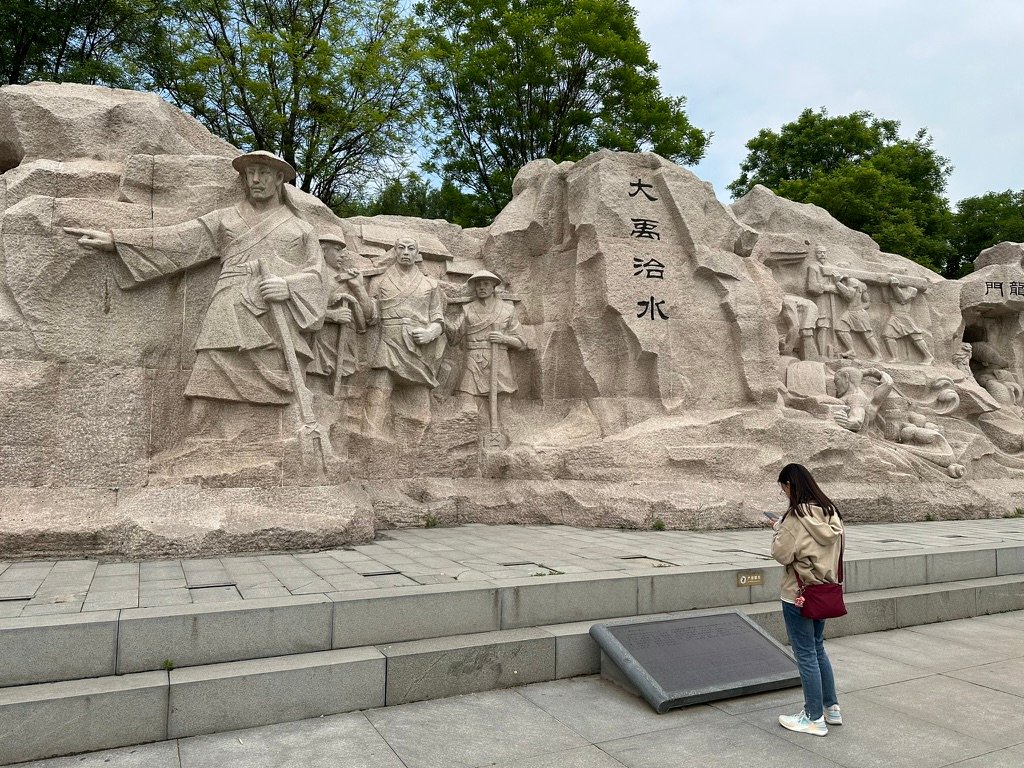
Here comes the next historical rabbit.
Chinese tradition also remembers Yu as the founder of the Xia dynasty (夏朝, Xià Cháo).
The Xia is traditionally described as China’s earliest dynasty.
And this is where we must distinguish:
TRADITION
from:
ARCHAEOLOGICAL EVIDENCE.
Ancient Chinese texts preserve accounts of Yu, the floods and the establishment of the Xia.
Archaeologists have also uncovered complex Bronze Age societies, including the Erlitou culture (二里头文化, Èrlǐtóu Wénhuà), in the period often associated with the traditional Xia chronology.
But archaeology has not conclusively established that Yu personally existed or that the Erlitou culture can be securely identified with the Xia dynasty described in later texts.
So when Dad and Elaine visit Da Yu Temple, we’re not claiming to stand at a place where every legendary event has been historically verified.
We are visiting a place where generations of Chinese people preserved and honoured an ancient tradition.
And that distinction matters.
Why the Yellow River Matters
To understand why stories about flood control became so important, we need to look at the landscape.
The Yellow River (黄河, Huáng Hé) has played an enormous role in northern Chinese history.
Its waters supported agriculture and settlements.
But the river also brought destructive floods.
Its heavy sediment load, changing channels and flood risks shaped the lives of communities over many centuries.
So it is hardly surprising that flood control became associated with one of China’s greatest legendary heroes.
The story of Yu reflects a fundamental challenge faced by early societies:
How do people live with powerful rivers that provide life but can also destroy it?
For ancient communities, managing water wasn’t simply an engineering problem.
It was connected to survival, agriculture, political authority and the responsibilities of rulers.
And that brings us to an important Chinese idea.
A good ruler should protect the people.
Not merely command them.
AND NOW… LOOK WHO WE JUST MET IN HANCHENG!
Remember the man who brought Dad here?
SIMA QIAN (司马迁).
His Records of the Grand Historian (史记, Shǐjì) includes an account of Yu the Great.
And suddenly, our two Hancheng visits connect.
At Da Yu Temple, we encounter:
THE ANCIENT STORY.
At Sima Qian’s memorial, we encounter:
THE HISTORIAN WHO HELPED TRANSMIT THAT STORY.
But Sima Qian lived long after the era traditionally associated with Yu.
So his account is valuable evidence of how the story was remembered and recorded, not independent proof that every event happened exactly as described.
This is what makes Hancheng so rewarding for Dad.
We’re not simply collecting photographs of historic attractions.
We’re beginning to connect the dots.
WHO WERE CHINA’S ANCIENT HEROES?
And:
HOW DID LATER GENERATIONS COME TO KNOW THEIR STORIES?
Two different questions.
Two different historical sites.
One remarkable city.
DAD’S TAKEAWAY — WHY DA YU STILL MATTERS
Yu the Great is remembered not merely as a legendary flood controller.
He represents an enduring Chinese ideal:
A WORTHY LEADER SHOULD WORK FOR THE WELL-BEING OF THE PEOPLE.
That idea continued to influence how later generations understood good government.
And here in Hancheng, the temple reminds us that China’s distant past survives not only through archaeology and written records.
It also survives through stories, rituals and places of remembrance.
But Hancheng still has another surprise.
We’ve met a legendary hero.
We’ve visited the memorial of a Han dynasty historian.
Now let’s enter the old city itself.
Because inside Hancheng Ancient City (韩城古城, Hánchéng Gǔchéng), Dad and Elaine discovered something equally fascinating.
HOW DID ORDINARY CHINESE CITIES FUNCTION UNDER IMPERIAL RULE?
And why does Hancheng preserve some of the most remarkable traditional buildings in Shaanxi?
That’s where we’re going next.
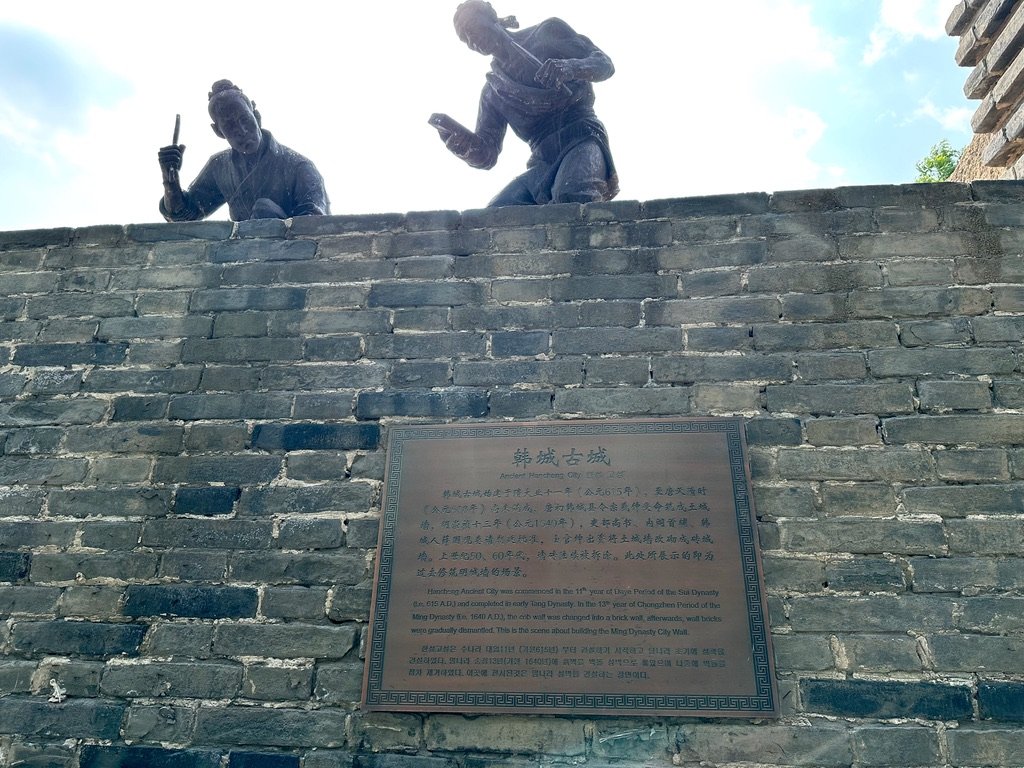
3. HANCHENG ANCIENT CITY (韩城古城) — ONE OF DAD’S FAVOURITE HIDDEN GEMS!
After visiting Sima Qian and Yu the Great, Dad and Elaine headed into Hancheng Ancient City (韩城古城, Hánchéng Gǔchéng).
And here came another surprise.
We weren’t expecting another Terracotta Army.
Or another Forbidden City.
We simply wanted to explore an old Chinese town.
But Hancheng turned out to be something rather special.
An ancient city with some of Shaanxi’s most remarkable surviving traditional architecture.
Old streets.
Historic temples.
Traditional courtyards.
And buildings that reveal how Chinese communities lived, learned, worshipped and governed themselves across the centuries.
Unlike Xi’an, Hancheng is still relatively unfamiliar to most international travellers.
And that’s precisely why Dad wants to introduce you to it.
Because sometimes the most rewarding discoveries are found beyond the famous tourist circuit.
🎬 WALK WITH DAD & ELAINE — HANCHENG WENMIAO: A HIDDEN ARCHITECTURAL TREASURE!
Here’s something that surprised Dad.
Would you believe that one of China’s great Confucian temple complexes is tucked away inside Hancheng Old City?
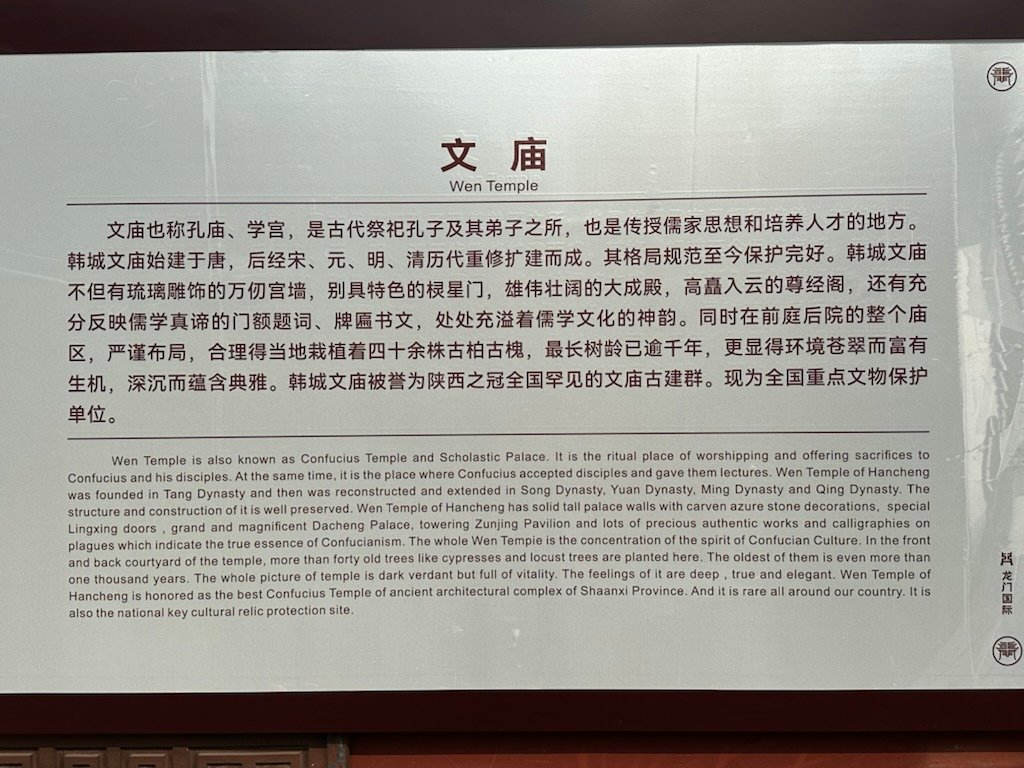
Welcome to Hancheng Confucian Temple (韩城文庙, Hánchéng Wénmiào).
It is recognised as one of Shaanxi’s most complete surviving Confucian temple complexes.
Some descriptions even rank it as China’s third-largest Confucian temple, after Qufu and Beijing, although that ranking is not consistently documented.
But here’s what we can appreciate without worrying about rankings.
The complex preserves 22 historic buildings arranged around four courtyards, with architectural features reflecting the Yuan, Ming and Qing dynasties.
And what an extraordinary place to explore!
Our walk begins at the magnificent Five-Dragon Glazed Wall (五龙琉璃照壁, Wǔlóng Liúlí Zhàobì).
Look at those colourful dragons! And the carp among the waves.
They remind us of the famous Chinese expression:
鲤鱼跃龙门 (lǐ yú yuè lóngmén)
The Carp Leaps Over the Dragon Gate.
A traditional symbol of perseverance, achievement and success.
How appropriate for a place associated with learning!
Elaine walks toward the entrance.
We pass through Lingxing Gate (棂星门, Língxīng Mén) and cross the stone bridge over the ritual pool, Panchi (泮池, Pànchí).
Then Dad notices the trees.
One cypress is identified on its heritage plaque as approximately 1,200 years old.
Another is marked as approximately 800 years old.
Imagine how many generations have walked past these trees!
We continue through Ji Gate (戟门, Jǐ Mén) before reaching Dacheng Hall (大成殿, Dàchéng Diàn) — the Hall of Great Achievement, dedicated to Confucius.
Come along and explore this remarkable place with us.
🎥 WATCH — Dad & Elaine Explore Hancheng’s Historic Confucian Temple
WHY IS HANCHENG WENMIAO SO IMPORTANT?
Now here’s the historical connection.
A Wenmiao (文庙) was not simply a beautiful temple dedicated to Confucius (孔子, Kǒngzǐ).
Across imperial China, Confucian temples were often associated with government schools and the education of future scholars and officials.
Hancheng Wenmiao preserves a traditional arrangement described as:
前庙后学 (qián miào hòu xué)
Temple in Front, School Behind.
The temple honoured Confucius.
The associated educational spaces represented the transmission of classical learning.
And why did that matter?
Because for centuries, China’s imperial examination system (科举, kējǔ) made mastery of classical learning an important pathway into government service.
The ideal was that officials should possess more than authority.
They should have:
LEARNING.
MORAL CHARACTER.
A SENSE OF PUBLIC RESPONSIBILITY.
Of course, the examination system was imperfect, and passing an examination didn’t guarantee good government.
But the ideal became deeply embedded in imperial Chinese society.
And here in Hancheng, we can still walk through an architectural expression of that tradition.
🎬 WALK WITH DAD & ELAINE — DONGYING TEMPLE (东营庙): ANOTHER HIDDEN GEM!
Just when Dad thought Hancheng Old City couldn’t surprise us anymore…
We discovered another historic temple.
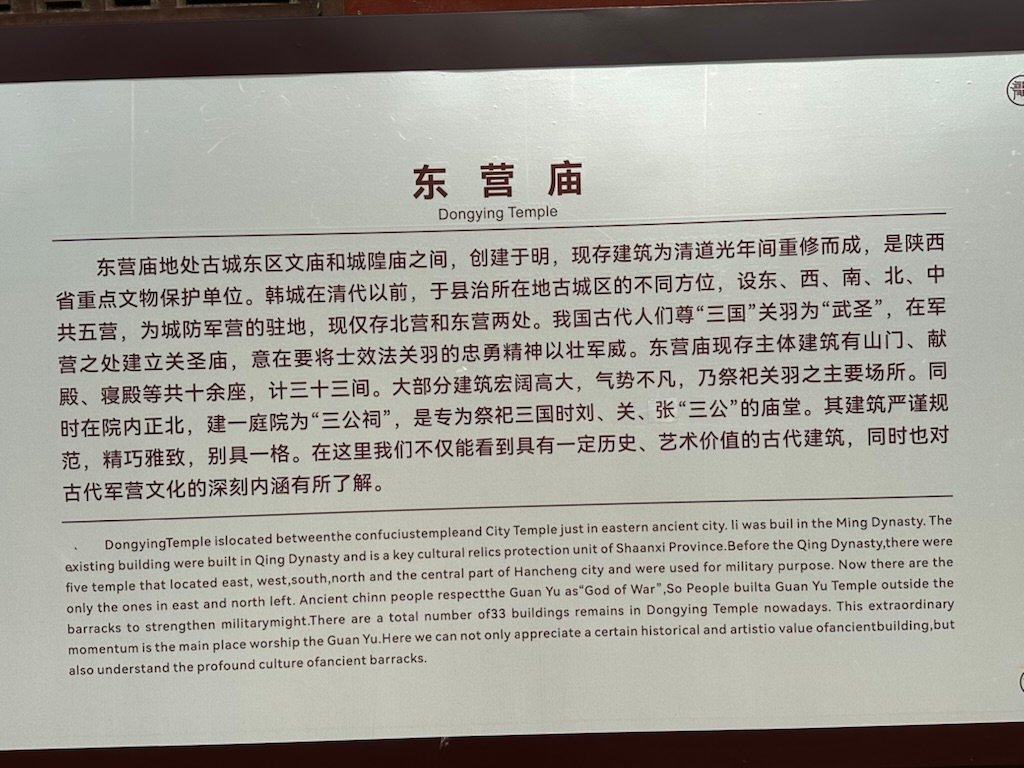
Dongying Temple (东营庙, Dōngyíng Miào).
This Qing-era temple is associated with a military encampment and the worship of Guan Yu (关羽, Guān Yǔ), the famous general of the late Eastern Han and Three Kingdoms period.
Our walk begins at a colourful glazed screen wall.
Dragon designs decorate the ceramic tiles.
Then we approach the entrance.
And two enormous Chinese characters catch Dad’s attention.
忠 (zhōng) — LOYALTY.
義 (yì) — RIGHTEOUSNESS.
Above the entrance, an inscription reads:
關聖廟 (Guān Shèng Miào)
Temple of the Sage Guan.
Beyond the gate lies a peaceful courtyard with traditional timber buildings, decorative plants and a historic shrine.
🎥 WATCH — Discover Dongying Temple in Hancheng Old City
WHY DID CHINESE PEOPLE BUILD TEMPLES TO GUAN YU?
Now think about the contrast.
At Hancheng Wenmiao, we encountered Confucius, the teacher whose ideas influenced education and government.
At Dongying Temple, we encountered Guan Yu, the general remembered for loyalty and righteousness.
Two very different historical figures.
But both became important moral examples in Chinese culture.
Guan Yu was a real historical general who died in 220 CE.
Over the centuries, historical memory, popular storytelling and religious traditions transformed him into Guan Gong (关公, Guān Gōng), a widely revered figure associated with loyalty, righteousness and protection.
His worship spread among soldiers, officials, merchants and ordinary families.
So Dongying Temple offers another window into traditional Chinese society.
The Wenmiao represented learning and moral cultivation.
Dongying Temple celebrated loyalty and righteousness.
Different institutions.
Different traditions.
But both reveal values that generations of Chinese people considered important.
And we discovered them within the same old city!
ANOTHER LAYER — HOW DID IMPERIAL CHINA GOVERN AN ORDINARY CITY?
Now Dad has another question.
We’ve seen where Confucius was honoured.
We’ve seen where Guan Yu was worshipped.
But who actually governed a city like Hancheng?
Not the emperor personally.
The emperor might be hundreds or thousands of kilometres away.
Imperial China relied on a network of local officials to administer counties and communities.
One important institution was the county government office (县衙, xiànyá).
The county magistrate (知县, zhīxiàn) was responsible for duties that could include:
Collecting taxes.
Handling legal disputes.
Maintaining local order.
Carrying out government instructions.
And responding to certain local emergencies.
Think of the county magistrate as one of the most important points of contact between the imperial state and ordinary people.
WESTERN HANDRAIL — THE LAST MILE OF EMPIRE
When Western travellers think of imperial China, they often picture:
THE EMPEROR.
The Forbidden City.
Imperial palaces.
Grand ceremonies.
But how did decisions made in the capital affect people living in smaller towns?
Through local government.
The county magistrate and his office formed part of the administrative machinery that connected imperial authority with everyday life.
And that helps explain why historic county cities like Hancheng matter.
They remind us that China wasn’t governed only from magnificent palaces.
It was also governed through local institutions spread across an enormous territory.
A word of caution: the historical role of the county yamen does not mean every surviving building in Hancheng dates from the same period or served the same function. We need to distinguish the general institution from the specific structures preserved today.
But the larger historical lesson remains.
TO UNDERSTAND IMPERIAL CHINA, WE NEED TO LOOK BEYOND ITS EMPERORS.
We need to understand its local communities too.
DAD’S DISCOVERY — ONE OLD CITY, SEVERAL DIFFERENT CHINAS
Think about what Dad and Elaine have discovered.
At Hancheng Wenmiao (韩城文庙):
How China honoured learning and cultivated future scholars.
At Dongying Temple (东营庙):
How loyalty and righteousness became powerful cultural ideals.
Through the history of the county yamen (县衙):
How imperial government reached local communities.
And through the old streets and courtyards:
How these institutions existed alongside everyday urban life.
This is why Hancheng Ancient City is so much more interesting than simply another collection of old buildings.
It allows us to connect:
EDUCATION.
MORAL VALUES.
GOVERNMENT.
EVERYDAY LIFE.
All within one historic urban setting.
And Dad has another reason to love this city.
Because our visit didn’t end when the temples closed.
As daylight faded, Hancheng began to change.
Red lanterns appeared.
Historic buildings glowed under evening lights.
And Elaine discovered a lively food street.
THE ANCIENT CITY HAD ANOTHER PERSONALITY AFTER DARK!
And that’s where we’re heading next.
4. HANCHENG AFTER DARK (夜游韩城) — WHEN THE ANCIENT CITY COMES ALIVE!
Dad thought we had already discovered quite a lot about Hancheng.
Sima Qian.
Yu the Great.
A magnificent Confucian temple.
A temple honouring Guan Yu.
Old streets filled with traces of imperial China.
Not bad for a city that rarely appears on the itineraries of first-time international travellers!
But we weren’t finished.
Because as the sun went down…
HANCHENG CHANGED ITS PERSONALITY!
And this is one reason Dad is so glad we didn’t treat Hancheng as a quick day trip from Xi’an.
We stayed to see what happened after dark.
🎬 WALK WITH DAD & ELAINE — THE CITY GOD TEMPLE AT NIGHT
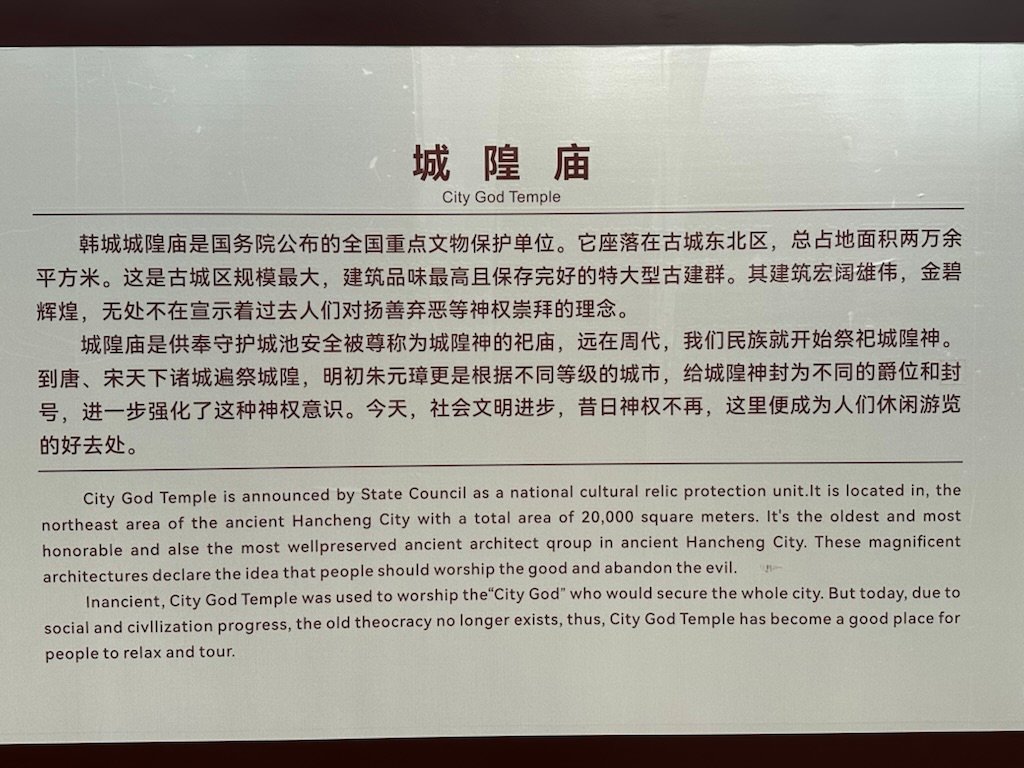
Our first evening discovery was Hancheng City God Temple (韩城城隍庙, Hánchéng Chénghuáng Miào).
During the day, Hancheng’s historic temples reveal the city’s architecture and cultural traditions.
But at night?
Something quite different.
The entrance to the City God Temple glows under warm illumination.
Traditional rooflines stand out against the dark sky.
Stone lions guard the gateway.
Above the entrance are the Chinese characters:
城隍庙 (Chénghuáng Miào)
City God Temple.
And on the entrance, two inscriptions catch Dad’s attention:
彰善 (zhāng shàn) — To commend goodness.
瘅恶 (dàn è) — To condemn evil.
Now those are interesting words to find on a temple gate!
In our video, Elaine and Dad explore the illuminated exterior and take a closer look at the historic entrance.
The temple itself was closed, so this is an evening exterior visit, not a tour of the interior.
But even from outside, there is plenty to discover.
🎥 WATCH — Dad & Elaine Discover Hancheng City God Temple After Dark
WAIT… WHAT IS A CITY GOD (城隍)?
Here’s something international travelers may not realise.
Traditional Chinese cities didn’t only have government officials.
Many also had a City God (城隍, Chénghuáng).
In Chinese folk religion, the City God was understood as a spiritual guardian of a city and its people.
City God temples were places where communities honoured that protective deity and expressed concerns about justice, morality and the well-being of the local population.
Think about what we’ve already discovered in Hancheng.
At Wenmiao (文庙), we encountered the Confucian ideals of learning and moral cultivation.
At Dongying Temple (东营庙), we encountered loyalty and righteousness through the worship of Guan Yu.
And now, at City God Temple (城隍庙), we encounter another aspect of traditional Chinese life:
SPIRITUAL PROTECTION AND MORAL ACCOUNTABILITY.
Different temples.
Different traditions.
But all part of the cultural world of an imperial Chinese city.
WESTERN HANDRAIL — WHO WATCHED OVER THE CITY?
Imagine living in an old Chinese county town.
You have a magistrate responsible for local administration.
You have Confucian teachings about proper conduct.
You have temples honouring historical figures associated with particular virtues.
And you have a City God believed to watch over the community.
Of course, a City God was not a government official in the ordinary administrative sense.
The distinction matters.
One belonged to the institutions of imperial government.
The other belonged to the religious and spiritual life of the community.
But together, they help us understand how traditional Chinese people imagined order, justice and responsibility.
And those two inscriptions on the temple gate suddenly make more sense.
彰善 — COMMEND GOODNESS.
瘅恶 — CONDEMN EVIL.
Even before entering the temple, visitors encounter a moral message.
Not bad for a discovery during an evening stroll!
🎬 FOLLOW ELAINE — THE FOOD STREET THAT BROUGHT HANCHENG TO LIFE!
Now, Dad enjoys history.
You know that already!
But after a day of temples, ancient buildings and historical rabbit holes…
Elaine had another priority.
FOOD! 😂
And Hancheng had just the place.
Welcome to Longmen Xinxangli (龙门新巷里, Lóngmén Xīnxiànglǐ).
As we approached the entrance, we found a brightly illuminated archway.
Red lanterns.
Colourful signs.
Visitors strolling beneath the lights.
And the unmistakable atmosphere of a Chinese evening food street.
Look at the entrance decorations.
You’ll notice the dragon-gate and carp imagery.
That connects with the familiar Chinese expression:
鲤鱼跃龙门 (lǐ yú yuè lóngmén)
The Carp Leaps Over the Dragon Gate.
A symbol of overcoming obstacles and achieving success.
But tonight, Elaine wasn’t studying Chinese symbolism.
She was looking at the food stalls!
🎥 WATCH — Elaine Explores Hancheng’s Lively Night Food Street
WHAT CAN YOU EAT IN HANCHENG?
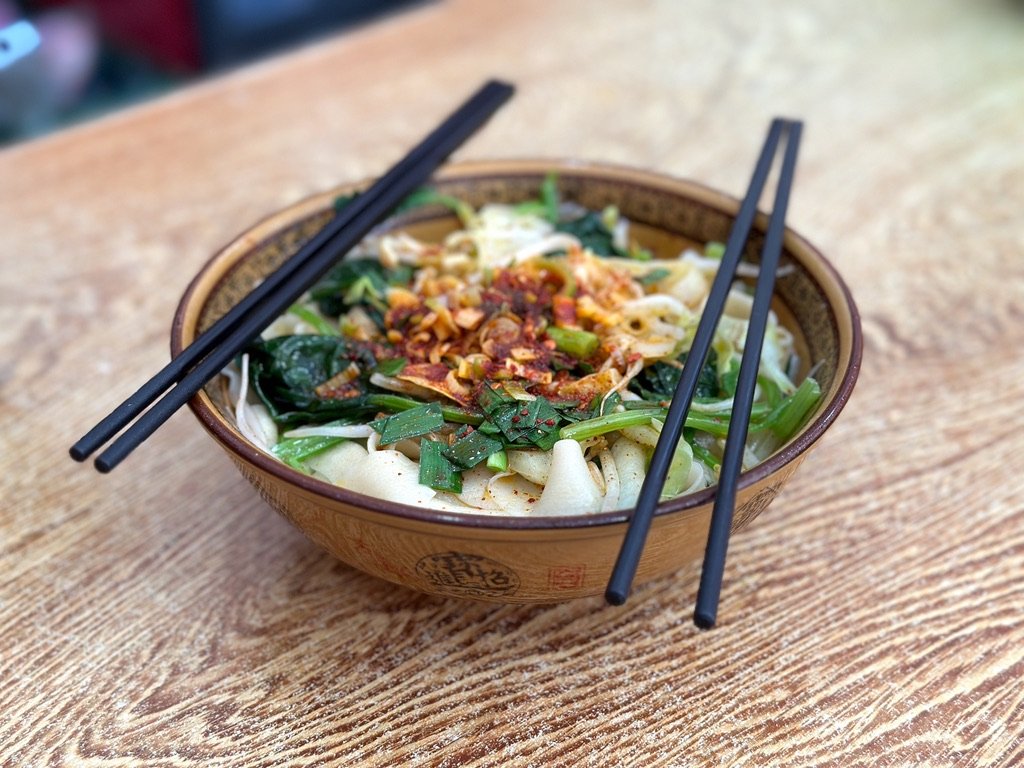
As we walked along the food street, we encountered stalls offering local snacks, noodles and drinks.
Among the foods associated with this part of Shaanxi are:
饸饹面 (hélè miàn) — Noodles traditionally made by pressing dough through a special noodle-making tool.
辣子蒜羊血 (làzi suàn yángxuè) — A strongly flavoured local dish made with sheep’s blood, chilli and garlic.
凉皮 (liángpí) — Cold, slippery noodle-like sheets, commonly served with seasonings and sauce.
酸梅汤 (suānméi tāng) — A sweet-and-sour plum drink, often enjoyed chilled.
Not everything will be familiar to first-time Western travellers.
And that’s part of the fun.
You don’t have to try every dish.
But you can walk around, see what people are eating, and discover how different local food can be from the Chinese dishes you know back home.
A useful phrase when looking at a stall is:
这是什么?(Zhè shì shénme?)
What is this?
And if something looks tempting:
我要这个。(Wǒ yào zhège.)
I’d like this one.
Simple Chinese.
Very useful when exploring a food street!
TWO VERY DIFFERENT HANCHENGS — IN ONE EVENING
Now think about our evening.
First, we stood outside the illuminated City God Temple (城隍庙).
A historic place connected with traditional beliefs about morality and spiritual protection.
Then, not long afterward, we were exploring a lively modern food street.
Bright signs.
Red lanterns.
People chatting.
Vendors preparing food.
Families and friends enjoying their evening.
And Elaine discovering another side of China.
This is something Dad loves about travelling beyond the famous tourist attractions.
You can encounter different layers of Chinese life within a short walk.
THE HISTORIC CITY.
THE LIVING CITY.
Not separated into two different destinations.
But existing side by side.
DAD’S QUESTION — WHY RUSH BACK TO XI’AN?
Imagine visiting Hancheng only as a day trip.
You arrive.
Visit Sima Qian’s memorial.
Explore one or two temples.
And hurry back to the railway station.
You might have a perfectly enjoyable day.
But what would you miss?
The old buildings under evening lights.
The City God Temple after dark.
The atmosphere of the streets.
The food stalls.
The chance to wander without constantly checking the time.
And perhaps most importantly:
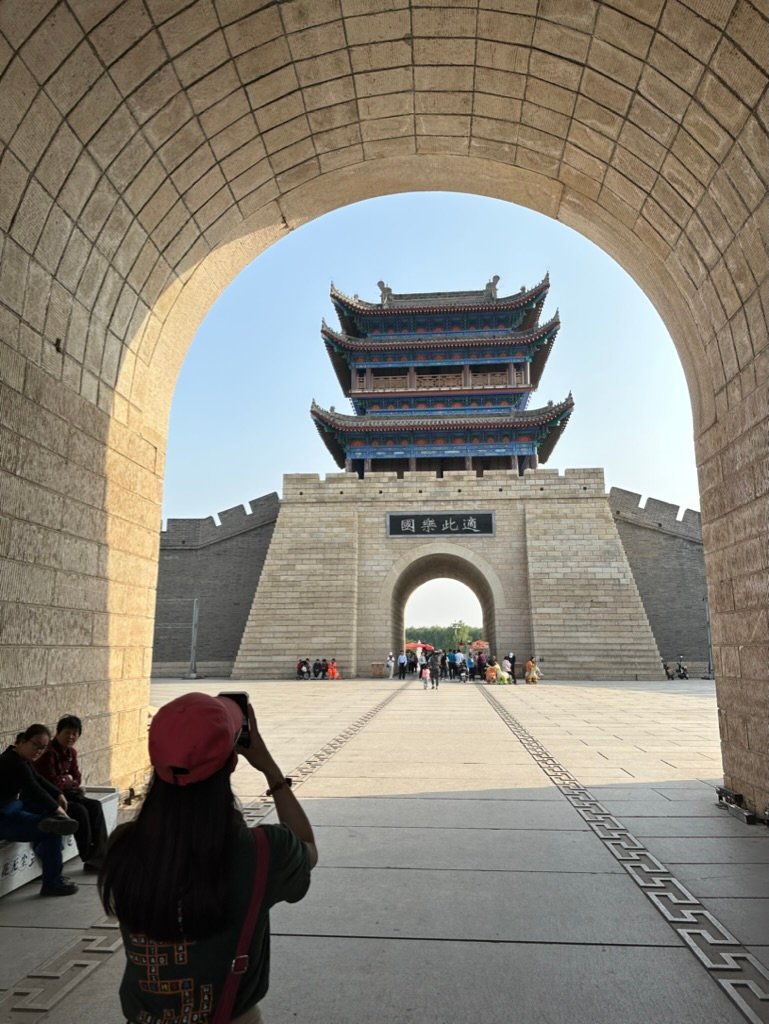
THE FEELING OF BEING IN HANCHENG, RATHER THAN JUST VISITING ITS ATTRACTIONS.
That is why Dad prefers spending time in smaller historic cities.
Not every hour needs to be filled with another famous landmark.
Sometimes the best travel memories happen between the attractions.
During an unplanned walk.
While exploring a food street.
Or when Elaine suddenly notices something that sends Dad down yet another historical rabbit hole!
WHAT WE LEARNED — HANCHENG IS NOT JUST AN ANCIENT CITY
Our daytime visits helped us understand Hancheng’s history.
Our evening walks helped us experience its atmosphere.
And together, they gave us a much fuller picture of the city.
DAYTIME HANCHENG:
Historical memory, Confucian learning, traditional architecture and ancient temples.
NIGHTTIME HANCHENG:
Illuminated gateways, food streets, everyday social life and a different rhythm of the city.
That’s why Dad wouldn’t rush through Hancheng.
GIVE THE CITY TIME TO SURPRISE YOU.
And if you’re planning to travel beyond Xi’an, there’s a practical question we should answer next.
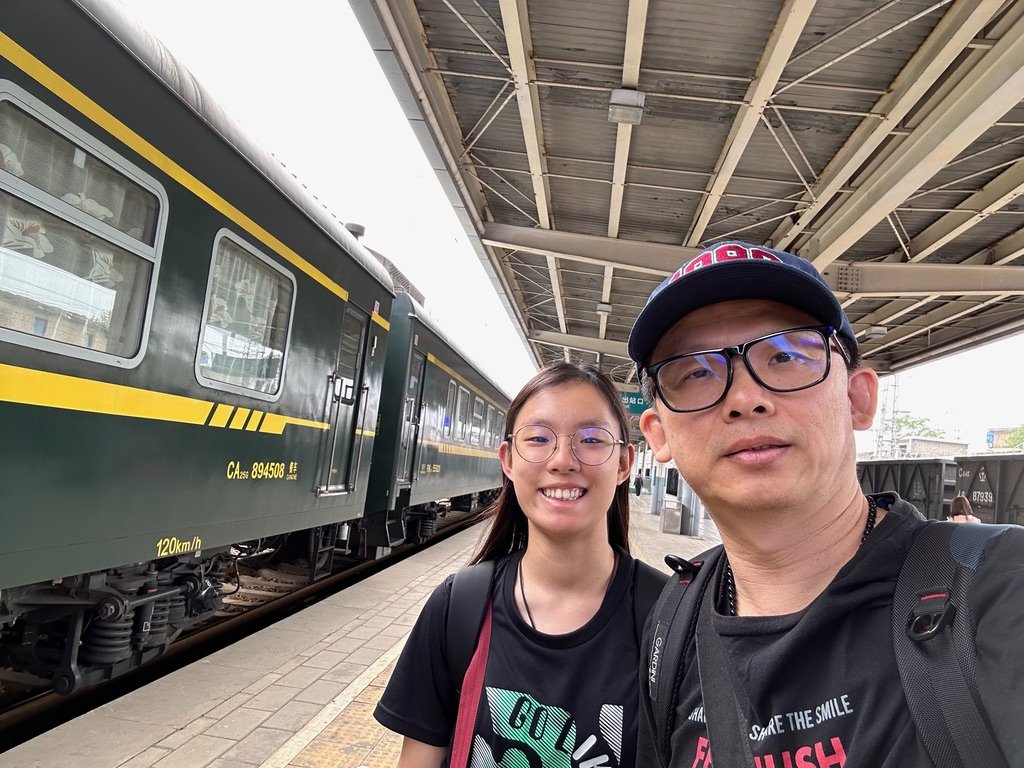
HOW DO YOU GET TO HANCHENG — AND HOW MANY NIGHTS SHOULD YOU STAY?
Dad has a suggestion.
TWO NIGHTS.
Let me explain why.
5. HOW TO VISIT HANCHENG (韩城旅游攻略) — WHY DAD RECOMMENDS TWO NIGHTS
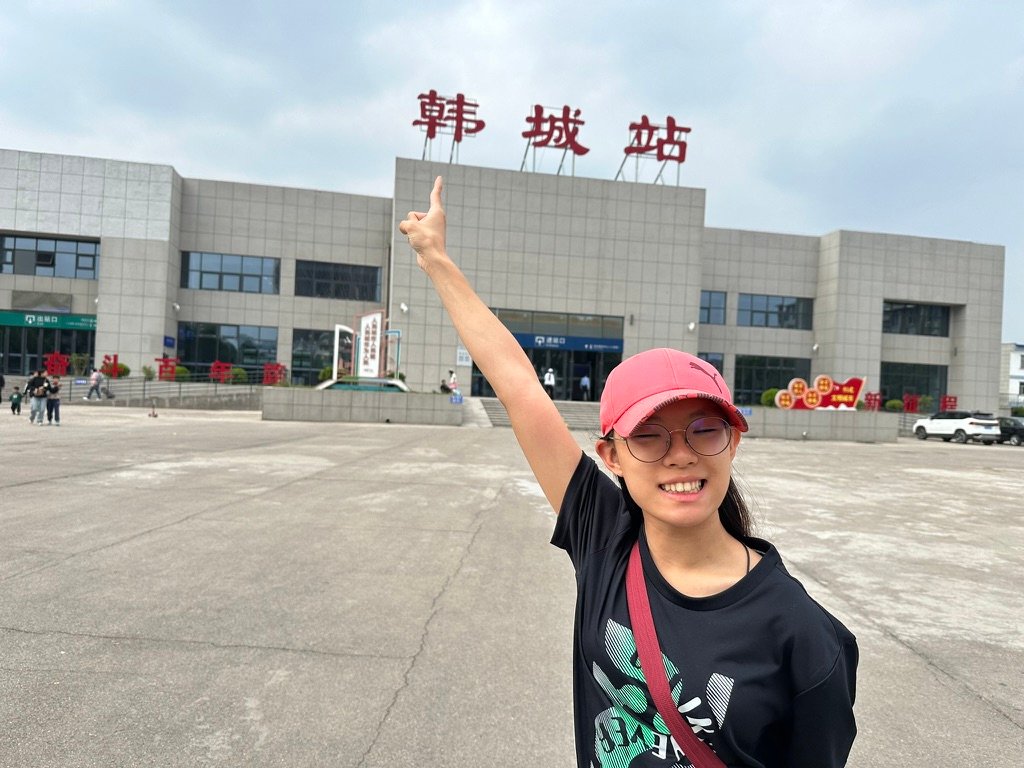
By now, you may be thinking:
“Dad, Hancheng looks interesting. But how do I actually get there?”
Good question!
Unlike Xi’an, Hancheng isn’t one of the destinations that most international travellers automatically include in their China itineraries.
And that’s part of its charm.
But it also means you need to do a little more planning.
The good news?
Hancheng is accessible from Xi’an.
And with a little time, you can enjoy the historical sites, explore the old city, and experience its atmosphere after dark.
Here’s how Dad would approach it.
FIRST — WHERE IS HANCHENG?
Hancheng (韩城, Hánchéng) is in northeastern Shaanxi Province (陕西, Shǎnxī), near the Yellow River (黄河, Huáng Hé) and the provincial boundary with Shanxi (山西, Shānxī).
Yes, those are TWO different provinces!
陕西 (Shǎnxī) — Shaanxi.
山西 (Shānxī) — Shanxi.
Their English spellings look confusingly similar.
But they are different provinces with different historical attractions.
Hancheng is in SHAANXI, the same province as Xi’an.
Across the Yellow River lies SHANXI, another province Dad and Elaine have spent considerable time exploring.
And this geographical position makes Hancheng an interesting stop for travellers who want to explore beyond the usual Xi’an sightseeing circuit.
GETTING FROM XI’AN TO HANCHENG — BY TRAIN
For independent travellers, the railway is one option worth investigating.
The conventional railway station is:
Hancheng Railway Station (韩城站, Hánchéng Zhàn).
From Xi’an, look for available services to 韩城站.
But here’s an important point.
DON’T AUTOMATICALLY ASSUME EVERY TRAIN IN CHINA IS A HIGH-SPEED TRAIN!
Hancheng’s conventional railway services are different from the high-speed routes connecting major cities such as Beijing, Xi’an and Shanghai.
Depending on the service available on your travel date, a journey from Xi’an may take roughly three hours or longer.
Train services, departure stations and journey times can change.
So check the actual timetable before making your plans.
Dad recommends searching the Chinese station names carefully:
西安 (Xī’ān) — Xi’an
韩城 (Hánchéng) — Hancheng
And checking the full station name shown for each available train.
If you’re using China’s official railway booking system, 12306 (铁路12306), verify the departure station, arrival station and train type.
You can also compare available services on an international travel-booking platform.
DAD’S TRAIN TIP:
Don’t book simply because the train says “Xi’an to Hancheng.”
Check the exact stations and arrival time.
And don’t plan a major sightseeing visit immediately after arrival without allowing time to reach your accommodation.
WHAT ABOUT TRAVELING BY CAR?
A private car with a driver can offer more flexibility, particularly if you want to combine several historical sites in one day.
This is worth considering because Hancheng’s attractions are not all located within the ancient city itself.
For example:
Sima Qian Temple and Tomb (司马迁祠墓) is outside the old city.
Da Yu Temple (大禹庙) also requires a separate journey.
Meanwhile, Hancheng Ancient City (韩城古城) is best explored at a slower pace on foot.
So the practical question is not simply:
“Can I get to Hancheng?”
It’s also:
“How will I move between the places I want to visit?”
A local driver or knowledgeable guide may be particularly useful if you want to visit the outlying sites efficiently.
But you don’t necessarily need a guide for every part of the journey.
Which brings us to Dad’s next suggestion.
DAD’S RECOMMENDATION — STAY TWO NIGHTS!
Could you visit Hancheng in one day?
Possibly, if your schedule is tight and you concentrate on a few attractions.
But would Dad recommend it?
NOT IF YOU REALLY WANT TO EXPERIENCE THE CITY!
After everything we’ve shown you, think about what you’d be trying to squeeze into one day.
Sima Qian’s memorial.
Da Yu Temple.
Hancheng Ancient City.
Wenmiao.
Dongying Temple.
City God Temple.
And the evening food street.
That’s a lot!
And you would spend much of your time worrying about the clock.
So here’s Dad’s preferred approach.
TWO NIGHTS.
Not because Hancheng is full of famous tourist attractions requiring a week of sightseeing.
But because the city rewards travellers who slow down.
DAY 1 — ARRIVE, SETTLE IN AND EXPLORE THE OLD CITY
Travel from Xi’an to Hancheng.
After arriving, check into your accommodation and give yourself time to settle in.
Then begin exploring:
Hancheng Ancient City (韩城古城).
Walk through the traditional streets.
Visit Hancheng Wenmiao (韩城文庙) if it is open.
Discover Dongying Temple (东营庙).
Look at the old buildings.
Notice the details.
The wooden doors.
The tiled roofs.
The courtyards.
The inscriptions.
Don’t rush.
You’re not simply ticking off another attraction.
You’re discovering how an old Chinese city was organised and how its people expressed their values.
EVENING — STAY IN HANCHENG!
As darkness falls, explore the illuminated streets.
See the exterior of City God Temple (城隍庙).
And head toward Longmen Xinxangli (龙门新巷里) for an evening walk and local food.
This is exactly the sort of experience you’d miss if you hurried back to Xi’an.
DAY 2 — SIMA QIAN, DA YU AND THE BIG HISTORICAL QUESTIONS
Now comes the day for Dad’s historical rabbit holes!
Start with:
Sima Qian Temple and Tomb (司马迁祠墓).
Walk through the memorial complex.
Climb toward the traditional tomb.
Look across the surrounding landscape.
And think about the extraordinary influence of one historian’s writings.
Then continue to:
Da Yu Temple (大禹庙).
Here, the story moves from historical writing into the legendary beginnings of Chinese civilization.
The flood-control traditions.
The Yellow River.
The idea of a ruler serving the people.
And the question of how later historians recorded stories about China’s distant past.
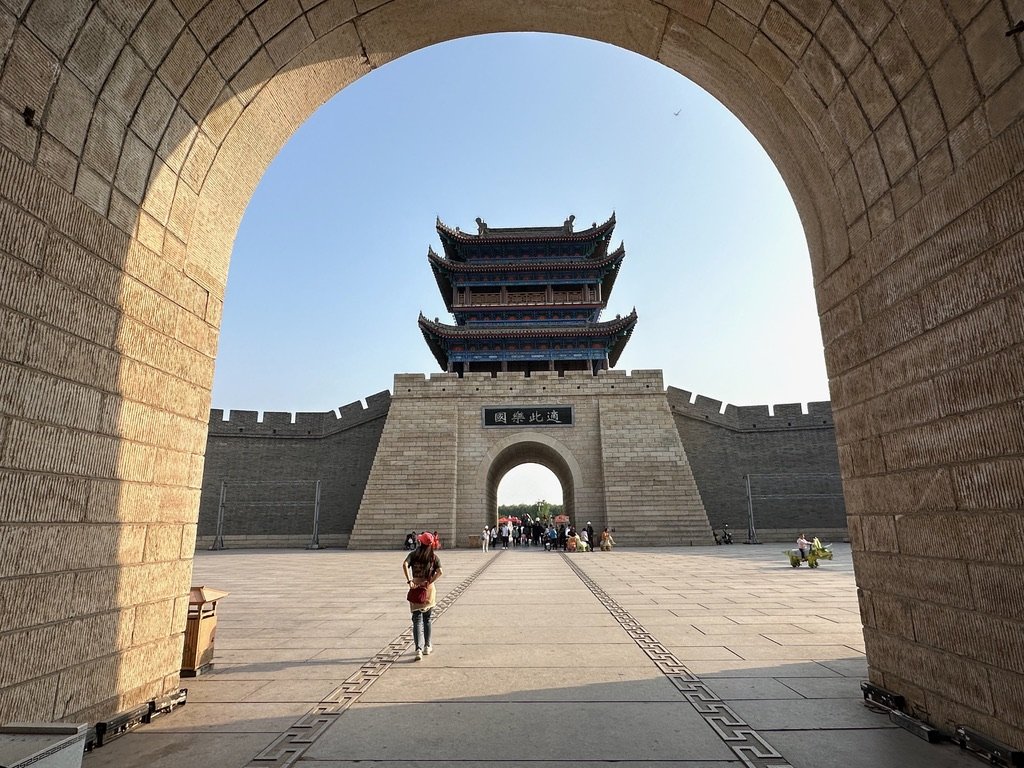
TWO CITES. TWO DIFFERENT QUESTIONS.
Sima Qian:
HOW DO WE KNOW ABOUT ANCIENT CHINA?
Yu the Great:
WHAT DID ANCIENT CHINA BELIEVE ABOUT ITS BEGINNINGS?
Now that’s a satisfying day for a curious traveler!
The precise order should depend on opening hours, road conditions and transport arrangements.
If you hire a driver, discuss both destinations beforehand rather than assuming they’re within walking distance of the old city.
DAY 3 — BREAKFAST, ONE LAST WALK AND DEPARTURE
Here’s another advantage of staying two nights.
You don’t have to rush away at dawn.
Enjoy breakfast.
Take one last walk.
Perhaps return to a street you liked.
Or photograph something you missed the previous day.
Then continue your journey.
Back to Xi’an?
Certainly.
But if you have more time…
WHY NOT GO FURTHER?
BEYOND HANCHENG — CONTINUE EXPLORING CHINA’S HISTORICAL HEARTLAND
Hancheng can also fit into a larger journey through the historical regions surrounding the Yellow River.
One possibility is to continue exploring southern Shanxi.
For example:
Yuncheng (运城, Yùnchéng) — associated with Guan Yu and the historical landscape of southern Shanxi.
Or travel farther toward:
Linfen (临汾, Línfén) — a region rich in traditions about China’s legendary antiquity.
But remember:
Hancheng’s position near the provincial boundary doesn’t automatically mean every onward journey has a convenient direct train.
Some connections may require a road transfer or a change of transport.
Check the actual route before deciding your itinerary.
For travellers who enjoy history, though, the wider region offers an extraordinary opportunity.
Instead of simply reading about China’s ancient past…
YOU CAN TRAVEL THROUGH THE LANDSCAPES WHERE THOSE STORIES WERE REMEMBERED.
INDEPENDENT TRAVEL OR A LOCAL GUIDE?
Dad and Elaine enjoy independent travel.
We like exploring at our own pace.
Stopping when something catches our attention.
And following historical questions wherever they lead.
But Hancheng is also a place where a knowledgeable local guide can add considerable value.
Why?
Because much of what makes Hancheng fascinating isn’t immediately obvious to an international visitor.
You can admire a beautiful temple.
But do you know what 文庙 (Wénmiào) means?
You can photograph a City God Temple.
But do you understand 城隍 (Chénghuáng)?
You can visit Sima Qian’s tomb.
But do you know why his writings matter so much to Chinese history?
And you can see the characters 忠 (zhōng) and 義 (yì) on a temple entrance.
But do you know why those virtues became associated with Guan Yu?
A good guide can help connect what you’re seeing with the history behind it.
DAD’S ADVICE:
If you’re comfortable travelling independently, arrange your transport and enjoy exploring the old city at your own pace.
For the outlying historical sites, consider a local driver or guide if that makes the day easier.
And if you engage a guide, look for someone who understands the history — not simply someone who takes you from one photo stop to another.
PRACTICAL NOTES BEFORE YOU GO
Chinese destination name: 韩城 (Hánchéng)
Province: 陕西 (Shǎnxī) — Shaanxi
Main conventional railway station: 韩城站 (Hánchéng Zhàn)
Historical old city: 韩城古城 (Hánchéng Gǔchéng)
Sima Qian memorial: 司马迁祠墓 (Sīmǎ Qiān Címù)
Da Yu Temple: 大禹庙 (Dà Yǔ Miào)
Confucian Temple: 韩城文庙 (Hánchéng Wénmiào)
Dongying Temple: 东营庙 (Dōngyíng Miào)
City God Temple: 韩城城隍庙 (Hánchéng Chénghuáng Miào)
Night food street: 龙门新巷里 (Lóngmén Xīnxiànglǐ)
Suggested stay: Two nights, allowing one full day for the outlying historical sites and time to explore the ancient city.
Before travelling: Confirm train schedules, local transport, attraction opening hours and any admission requirements.
DAD’S FINAL TRAVEL TIP — DON’T TURN HANCHENG INTO A RACE!
Dad has made this mistake before.
Trying to see too many places.
Moving from attraction to attraction.
Taking photographs.
Then rushing off to the next city.
But Hancheng reminded us of something important.
SLOWER TRAVEL CAN LEAD TO DEEPER DISCOVERIES.
If we’d rushed through Hancheng, we might have seen Sima Qian’s tomb.
Perhaps one or two temples.
And then moved on.
But by giving the city more time, we discovered its evening atmosphere.
Its old streets.
Its local food.
And the connections between historical memory, education, moral values and everyday life.
That’s what made Hancheng memorable for Dad and Elaine.
And it brings us to one final question.
WHAT DID HANCHENG ACTUALLY TEACH US ABOUT CHINA?
Because when we look back at everything we discovered here…
The answer is much bigger than one ancient city.
6. WHAT HANCHENG TAUGHT DAD — CHINA’S HISTORY IS MORE THAN EMPERORS AND DYNASTIES
When Dad first planned our journey to Hancheng (韩城, Hánchéng), we had one main reason for coming.
SIMA QIAN (司马迁, Sīmǎ Qiān).
The historian whose writings kept appearing whenever Dad tried to understand ancient China.
But something unexpected happened.
The longer we explored Hancheng, the more we realised that the city was answering questions we hadn’t even thought to ask.
And that, for Dad, is what makes travelling through China so rewarding.
You arrive looking for one piece of history.
Then you discover another.
And another.
Until suddenly…
THE PIECES BEGIN TO CONNECT!
FIVE DISCOVERIES — ONE BIGGER PICTURE OF CHINA
Think about what we encountered in Hancheng.
1. SIMA QIAN (司马迁) — HOW DOES A CIVILIZATION REMEMBER ITS PAST?
His Records of the Grand Historian (史记, Shǐjì) helped preserve accounts of China’s ancient rulers, wars, political struggles and historical personalities.
His memorial reminded us that history isn’t only about the people who held power.
It’s also about those who recorded what happened.
2. YU THE GREAT (大禹, Dà Yǔ) — WHAT MAKES A GOOD RULER?
The legendary flood-controller represents an enduring ideal of leadership through public service.
Whether every detail of the ancient story is historically verifiable is another matter.
But the values later generations attached to Yu are themselves an important part of Chinese cultural history.
3. HANCHENG WENMIAO (韩城文庙) — WHY DID LEARNING MATTER SO MUCH?
The Confucian temple introduced us to the importance of education, moral cultivation and the classical learning associated with imperial government.
It helped explain why scholarship and public service became so closely connected in traditional Chinese society.
4. DONGYING TEMPLE (东营庙) — WHY DID LOYALTY BECOME A VIRTUE?
Through the worship of Guan Yu (关羽, Guān Yǔ), we encountered the ideals of loyalty (忠, zhōng) and righteousness (义, yì).
A historical general became a powerful cultural symbol.
And his influence continued long after the Three Kingdoms period.
5. CITY GOD TEMPLE (城隍庙) — WHO WATCHED OVER THE COMMUNITY?
The City God tradition revealed another dimension of Chinese urban life.
A community’s sense of order wasn’t expressed only through government offices and written laws.
It was also reflected in religious beliefs, local rituals and ideas about moral responsibility.
Five discoveries.
Five different windows into Chinese civilization.
And all within one journey to Hancheng.
THE BIG QUESTION — WHAT HELD IMPERIAL CHINA TOGETHER?
Now here’s the question that followed Dad home.
China is enormous.
Its history stretches across many centuries.
Different dynasties rose and fell.
Capitals moved.
Borders changed.
Rulers fought wars.
And yet, many important ideas continued to influence later generations.
How?
Not because everything remained unchanged.
It didn’t.
But because institutions, historical writings, education, traditions and cultural memory helped transmit ideas from one generation to another.
Hancheng gave us a chance to see some of those connections.
SIMA QIAN — HISTORICAL MEMORY.
YU THE GREAT — THE IDEAL OF RESPONSIBLE LEADERSHIP.
WENMIAO — EDUCATION AND MORAL CULTIVATION.
DONGYING TEMPLE — LOYALTY AND RIGHTEOUSNESS.
CITY GOD TEMPLE — COMMUNITY AND MORAL ORDER.
These weren’t all created at the same time.
They didn’t all belong to one dynasty.
And they didn’t always mean exactly the same thing to every generation.
But together, they show how China’s historical traditions accumulated, evolved and continued to shape society.
That is a much more interesting story than simply memorising the names of dynasties!
WESTERN HANDRAIL — DON’T JUST LOOK FOR CHINA’S GREAT MONUMENTS
For many first-time international travellers, China begins with famous sights.
The Great Wall (长城, Chángchéng).
The Forbidden City (故宫, Gùgōng).
The Terracotta Army (兵马俑, Bīngmǎyǒng).
And Dad certainly thinks those places are worth seeing!
But if we want to understand China beyond its most famous monuments, we also need to visit places where everyday institutions and traditions become visible.
A county town.
A Confucian temple.
A local shrine.
An old street.
A memorial to a historian.
These places may not have the international fame of the Great Wall.
But they can reveal something equally important.
HOW CHINESE SOCIETY UNDERSTOOD ITSELF.
And that’s why Hancheng deserves a place in our DEEP China journeys.
BAOJI TAUGHT DAD TO GO WEST. HANCHENG TAUGHT HIM TO SLOW DOWN.
In our earlier travels beyond Xi’an, Dad and Elaine explored Baoji (宝鸡, Bǎojī) and the historical landscape associated with the early Zhou dynasty.
Those journeys encouraged us to travel farther west.
To look beyond the familiar Qin and Han stories.
To ask what came before China’s first empire.
But Hancheng taught Dad a different lesson.
YOU DON’T ALWAYS NEED TO TRAVEL FARTHER TO DISCOVER MORE.
Sometimes you need to stay longer.
Walk more slowly.
Look more carefully.
And ask better questions.
Because Hancheng’s greatest surprise wasn’t any single attraction.
It was how much history we could connect within one relatively overlooked city.
And we might never have appreciated that if we’d treated Hancheng as another quick stop on a packed itinerary.
WHAT ELAINE AND DAD WILL REMEMBER
Dad will remember standing at Sima Qian’s hilltop memorial.
Looking out across the countryside.
Thinking about a historian whose writings still influence how we understand ancient China.
He’ll remember the remarkable glazed dragon wall at Wenmiao.
The ancient cypress trees.
The inscriptions celebrating loyalty and righteousness at Dongying Temple.
And the illuminated entrance to the City God Temple.
But there’s another memory.
Elaine walking through Longmen Xinxangli (龙门新巷里, Lóngmén Xīnxiànglǐ).
Red lanterns overhead.
Food stalls glowing under the evening lights.
People enjoying their night out.
A very different China from the one we’d been studying in the temples.
And perhaps that’s the best way to remember Hancheng.
THE CHINA WE READ ABOUT.
And:
THE CHINA WE EXPERIENCE.
Both matter.
DAD’S FINAL STING CHECK — WHY VISIT HANCHENG?
Would Dad recommend Hancheng to every first-time traveller with only a few days in China?
Probably not.
If you have three days in Xi’an, the Terracotta Army and the city’s major attractions may reasonably come first.
But if you’ve already seen Xi’an…
Or you’re curious about Chinese history…
Or you enjoy discovering places that most international visitors overlook…
Then Hancheng deserves serious consideration.
Come for Sima Qian.
Discover Yu the Great.
Explore the old city.
Walk through its temples.
And stay long enough to see Hancheng after dark.
DON’T JUST COLLECT ANOTHER DESTINATION.
DISCOVER ANOTHER LAYER OF CHINA.
That’s what made Hancheng special for Dad and Elaine.
WHERE TO GO NEXT — FOLLOW THE HISTORICAL RABBIT HOLES!
Now that we’ve explored Hancheng, where should curious travellers go next?
Well…
Dad has a few suggestions!
1. FOLLOW SIMA QIAN — HOW DO WE KNOW ANCIENT CHINESE HISTORY?
If Sima Qian has captured your curiosity, explore the man behind the Shiji (史记).
Who was he?
Why did he devote his life to recording China’s past?
And how should modern readers approach his historical accounts?
READ NEXT: DEEP China — Sima Qian: How Do We Know So Much About Ancient China?
2. GO WEST OF XI’AN — DISCOVER CHINA BEFORE QIN
Long before Qin Shi Huang united China, the Zhou dynasty (周朝, Zhōu Cháo) helped shape ideas about kingship, political authority and legitimate rule.
Our journeys around Baoji (宝鸡) and Zhouyuan (周原, Zhōuyuán) explore that earlier world.
This is the place to begin asking:
WHAT CAME BEFORE CHINA’S FIRST EMPIRE?
Explore our West of Xi’an — China Before Qin Michelin History Tasting Journey.
3. CONTINUE BEYOND XI’AN — INTO THE YELLOW RIVER HEARTLAND
Hancheng is only one part of a much larger historical landscape.
Nearby regions of Shaanxi and Shanxi contain places associated with legendary antiquity, early states, imperial history and later cultural traditions.
Our China Before China — Beyond Xi’an Michelin History Tasting Journey connects places such as:
Xi’an (西安)
Hancheng (韩城)
Yuncheng (运城)
Linfen (临汾)
It’s a journey for travellers who want to connect the places they visit with the larger questions of Chinese history.
4. EXPLORE SHANXI — ANOTHER SIDE OF CHINA’S HISTORICAL HEARTLAND
Across the Yellow River lies Shanxi Province (山西, Shānxī).
A region filled with remarkable temples, ancient architecture and historical landscapes.
From Datong (大同, Dàtóng) and the Yungang Grottoes (云冈石窟, Yúngāng Shíkū) to Jinci (晋祠, Jìncí) near Taiyuan, Shanxi offers another fascinating journey through different layers of Chinese history.
Explore our Michelin Chinese HistoryJOURNEY Menu.
See China. Understand It Better.
— Dad & Elaine, ChinaTravelBUG
4. HANCHENG AFTER DARK (夜游韩城) — WHEN THE ANCIENT CITY COMES ALIVE!
Dad thought we had already discovered quite a lot about Hancheng.
Sima Qian.
Yu the Great.
A magnificent Confucian temple.
A temple honouring Guan Yu.
Old streets filled with traces of imperial China.
Not bad for a city that rarely appears on the itineraries of first-time international travellers!
But we weren’t finished.
Because as the sun went down…
HANCHENG CHANGED ITS PERSONALITY!
And this is one reason Dad is so glad we didn’t treat Hancheng as a quick day trip from Xi’an.
We stayed to see what happened after dark.
🎬 WALK WITH DAD & ELAINE — THE CITY GOD TEMPLE AT NIGHT
Our first evening discovery was Hancheng City God Temple (韩城城隍庙, Hánchéng Chénghuáng Miào).
During the day, Hancheng’s historic temples reveal the city’s architecture and cultural traditions.
But at night?
Something quite different.
The entrance to the City God Temple glows under warm illumination.
Traditional rooflines stand out against the dark sky.
Stone lions guard the gateway.
Above the entrance are the Chinese characters:
城隍庙 (Chénghuáng Miào)
City God Temple.
And on the entrance, two inscriptions catch Dad’s attention:
彰善 (zhāng shàn) — To commend goodness.
瘅恶 (dàn è) — To condemn evil.
Now those are interesting words to find on a temple gate!
In our video, Elaine and Dad explore the illuminated exterior and take a closer look at the historic entrance.
The temple itself was closed, so this is an evening exterior visit, not a tour of the interior.
But even from outside, there is plenty to discover.
🎥 WATCH — Dad & Elaine Discover Hancheng City God Temple After Dark
WAIT… WHAT IS A CITY GOD (城隍)?
Here’s something international travellers may not realise.
Traditional Chinese cities didn’t only have government officials.
Many also had a City God (城隍, Chénghuáng).
In Chinese folk religion, the City God was understood as a spiritual guardian of a city and its people.
City God temples were places where communities honoured that protective deity and expressed concerns about justice, morality and the well-being of the local population.
Think about what we’ve already discovered in Hancheng.
At Wenmiao (文庙), we encountered the Confucian ideals of learning and moral cultivation.
At Dongying Temple (东营庙), we encountered loyalty and righteousness through the worship of Guan Yu.
And now, at City God Temple (城隍庙), we encounter another aspect of traditional Chinese life:
SPIRITUAL PROTECTION AND MORAL ACCOUNTABILITY.
Different temples.
Different traditions.
But all part of the cultural world of an imperial Chinese city.
WESTERN HANDRAIL — WHO WATCHED OVER THE CITY?
Imagine living in an old Chinese county town.
You have a magistrate responsible for local administration.
You have Confucian teachings about proper conduct.
You have temples honouring historical figures associated with particular virtues.
And you have a City God believed to watch over the community.
Of course, a City God was not a government official in the ordinary administrative sense.
The distinction matters.
One belonged to the institutions of imperial government.
The other belonged to the religious and spiritual life of the community.
But together, they help us understand how traditional Chinese people imagined order, justice and responsibility.
And those two inscriptions on the temple gate suddenly make more sense.
彰善 — COMMEND GOODNESS.
瘅恶 — CONDEMN EVIL.
Even before entering the temple, visitors encounter a moral message.
Not bad for a discovery during an evening stroll!
🎬 FOLLOW ELAINE — THE FOOD STREET THAT BROUGHT HANCHENG TO LIFE!
Now, Dad enjoys history.
You know that already!
But after a day of temples, ancient buildings and historical rabbit holes…
Elaine had another priority.
FOOD! 😂
And Hancheng had just the place.
Welcome to Longmen Xinxangli (龙门新巷里, Lóngmén Xīnxiànglǐ).
As we approached the entrance, we found a brightly illuminated archway.
Red lanterns.
Colourful signs.
Visitors strolling beneath the lights.
And the unmistakable atmosphere of a Chinese evening food street.
Look at the entrance decorations.
You’ll notice the dragon-gate and carp imagery.
That connects with the familiar Chinese expression:
鲤鱼跃龙门 (lǐ yú yuè lóngmén)
The Carp Leaps Over the Dragon Gate.
A symbol of overcoming obstacles and achieving success.
But tonight, Elaine wasn’t studying Chinese symbolism.
She was looking at the food stalls!
🎥 WATCH — Elaine Explores Hancheng’s Lively Night Food Street
WHAT CAN YOU EAT IN HANCHENG?
As we walked along the food street, we encountered stalls offering local snacks, noodles and drinks.
Among the foods associated with this part of Shaanxi are:
饸饹面 (hélè miàn) — Noodles traditionally made by pressing dough through a special noodle-making tool.
辣子蒜羊血 (làzi suàn yángxuè) — A strongly flavoured local dish made with sheep’s blood, chilli and garlic.
凉皮 (liángpí) — Cold, slippery noodle-like sheets, commonly served with seasonings and sauce.
酸梅汤 (suānméi tāng) — A sweet-and-sour plum drink, often enjoyed chilled.
Not everything will be familiar to first-time Western travellers.
And that’s part of the fun.
You don’t have to try every dish.
But you can walk around, see what people are eating, and discover how different local food can be from the Chinese dishes you know back home.
A useful phrase when looking at a stall is:
这是什么?(Zhè shì shénme?)
What is this?
And if something looks tempting:
我要这个。(Wǒ yào zhège.)
I’d like this one.
Simple Chinese.
Very useful when exploring a food street!
TWO VERY DIFFERENT HANCHENGS — IN ONE EVENING
Now think about our evening.
First, we stood outside the illuminated City God Temple (城隍庙).
A historic place connected with traditional beliefs about morality and spiritual protection.
Then, not long afterward, we were exploring a lively modern food street.
Bright signs.
Red lanterns.
People chatting.
Vendors preparing food.
Families and friends enjoying their evening.
And Elaine discovering another side of China.
This is something Dad loves about travelling beyond the famous tourist attractions.
You can encounter different layers of Chinese life within a short walk.
THE HISTORIC CITY.
THE LIVING CITY.
Not separated into two different destinations.
But existing side by side.
DAD’S QUESTION — WHY RUSH BACK TO XI’AN?
Imagine visiting Hancheng only as a day trip.
You arrive.
Visit Sima Qian’s memorial.
Explore one or two temples.
And hurry back to the railway station.
You might have a perfectly enjoyable day.
But what would you miss?
The old buildings under evening lights.
The City God Temple after dark.
The atmosphere of the streets.
The food stalls.
The chance to wander without constantly checking the time.
And perhaps most importantly:
THE FEELING OF BEING IN HANCHENG, RATHER THAN JUST VISITING ITS ATTRACTIONS.
That is why Dad prefers spending time in smaller historic cities.
Not every hour needs to be filled with another famous landmark.
Sometimes the best travel memories happen between the attractions.
During an unplanned walk.
While exploring a food street.
Or when Elaine suddenly notices something that sends Dad down yet another historical rabbit hole!
WHAT WE LEARNED — HANCHENG IS NOT JUST AN ANCIENT CITY
Our daytime visits helped us understand Hancheng’s history.
Our evening walks helped us experience its atmosphere.
And together, they gave us a much fuller picture of the city.
DAYTIME HANCHENG:
Historical memory, Confucian learning, traditional architecture and ancient temples.
NIGHTTIME HANCHENG:
Illuminated gateways, food streets, everyday social life and a different rhythm of the city.
That’s why Dad wouldn’t rush through Hancheng.
GIVE THE CITY TIME TO SURPRISE YOU.
And if you’re planning to travel beyond Xi’an, there’s a practical question we should answer next.
HOW DO YOU GET TO HANCHENG — AND HOW MANY NIGHTS SHOULD YOU STAY?
Dad has a suggestion.
TWO NIGHTS.
Let me explain why.
5. HOW TO VISIT HANCHENG (韩城旅游攻略) — WHY DAD RECOMMENDS TWO NIGHTS
By now, you may be thinking:
“Dad, Hancheng looks interesting. But how do I actually get there?”
Good question!
Unlike Xi’an, Hancheng isn’t one of the destinations that most international travellers automatically include in their China itineraries.
And that’s part of its charm.
But it also means you need to do a little more planning.
The good news?
Hancheng is accessible from Xi’an.
And with a little time, you can enjoy the historical sites, explore the old city, and experience its atmosphere after dark.
Here’s how Dad would approach it.
FIRST — WHERE IS HANCHENG?
Hancheng (韩城, Hánchéng) is in northeastern Shaanxi Province (陕西, Shǎnxī), near the Yellow River (黄河, Huáng Hé) and the provincial boundary with Shanxi (山西, Shānxī).
Yes, those are TWO different provinces!
陕西 (Shǎnxī) — Shaanxi.
山西 (Shānxī) — Shanxi.
Their English spellings look confusingly similar.
But they are different provinces with different historical attractions.
Hancheng is in SHAANXI, the same province as Xi’an.
Across the Yellow River lies SHANXI, another province Dad and Elaine have spent considerable time exploring.
And this geographical position makes Hancheng an interesting stop for travellers who want to explore beyond the usual Xi’an sightseeing circuit.
GETTING FROM XI’AN TO HANCHENG — BY TRAIN
For independent travellers, the railway is one option worth investigating.
The conventional railway station is:
Hancheng Railway Station (韩城站, Hánchéng Zhàn).
From Xi’an, look for available services to 韩城站.
But here’s an important point.
DON’T AUTOMATICALLY ASSUME EVERY TRAIN IN CHINA IS A HIGH-SPEED TRAIN!
Hancheng’s conventional railway services are different from the high-speed routes connecting major cities such as Beijing, Xi’an and Shanghai.
Depending on the service available on your travel date, a journey from Xi’an may take roughly three hours or longer.
Train services, departure stations and journey times can change.
So check the actual timetable before making your plans.
Dad recommends searching the Chinese station names carefully:
西安 (Xī’ān) — Xi’an
韩城 (Hánchéng) — Hancheng
And checking the full station name shown for each available train.
If you’re using China’s official railway booking system, 12306 (铁路12306), verify the departure station, arrival station and train type.
You can also compare available services on an international travel-booking platform.
DAD’S TRAIN TIP:
Don’t book simply because the train says “Xi’an to Hancheng.”
Check the exact stations and arrival time.
And don’t plan a major sightseeing visit immediately after arrival without allowing time to reach your accommodation.
WHAT ABOUT TRAVELLING BY CAR?
A private car with a driver can offer more flexibility, particularly if you want to combine several historical sites in one day.
This is worth considering because Hancheng’s attractions are not all located within the ancient city itself.
For example:
Sima Qian Temple and Tomb (司马迁祠墓) is outside the old city.
Da Yu Temple (大禹庙) also requires a separate journey.
Meanwhile, Hancheng Ancient City (韩城古城) is best explored at a slower pace on foot.
So the practical question is not simply:
“Can I get to Hancheng?”
It’s also:
“How will I move between the places I want to visit?”
A local driver or knowledgeable guide may be particularly useful if you want to visit the outlying sites efficiently.
But you don’t necessarily need a guide for every part of the journey.
Which brings us to Dad’s next suggestion.
DAD’S RECOMMENDATION — STAY TWO NIGHTS!
Could you visit Hancheng in one day?
Possibly, if your schedule is tight and you concentrate on a few attractions.
But would Dad recommend it?
NOT IF YOU REALLY WANT TO EXPERIENCE THE CITY!
After everything we’ve shown you, think about what you’d be trying to squeeze into one day.
Sima Qian’s memorial.
Da Yu Temple.
Hancheng Ancient City.
Wenmiao.
Dongying Temple.
City God Temple.
And the evening food street.
That’s a lot!
And you would spend much of your time worrying about the clock.
So here’s Dad’s preferred approach.
TWO NIGHTS.
Not because Hancheng is full of famous tourist attractions requiring a week of sightseeing.
But because the city rewards travellers who slow down.
DAY 1 — ARRIVE, SETTLE IN AND EXPLORE THE OLD CITY
Travel from Xi’an to Hancheng.
After arriving, check into your accommodation and give yourself time to settle in.
Then begin exploring:
Hancheng Ancient City (韩城古城).
Walk through the traditional streets.
Visit Hancheng Wenmiao (韩城文庙) if it is open.
Discover Dongying Temple (东营庙).
Look at the old buildings.
Notice the details.
The wooden doors.
The tiled roofs.
The courtyards.
The inscriptions.
Don’t rush.
You’re not simply ticking off another attraction.
You’re discovering how an old Chinese city was organised and how its people expressed their values.
EVENING — STAY IN HANCHENG!
As darkness falls, explore the illuminated streets.
See the exterior of City God Temple (城隍庙).
And head toward Longmen Xinxangli (龙门新巷里) for an evening walk and local food.
This is exactly the sort of experience you’d miss if you hurried back to Xi’an.
DAY 2 — SIMA QIAN, DA YU AND THE BIG HISTORICAL QUESTIONS
Now comes the day for Dad’s historical rabbit holes!
Start with:
Sima Qian Temple and Tomb (司马迁祠墓).
Walk through the memorial complex.
Climb toward the traditional tomb.
Look across the surrounding landscape.
And think about the extraordinary influence of one historian’s writings.
Then continue to:
Da Yu Temple (大禹庙).
Here, the story moves from historical writing into the legendary beginnings of Chinese civilization.
The flood-control traditions.
The Yellow River.
The idea of a ruler serving the people.
And the question of how later historians recorded stories about China’s distant past.
TWO SITES. TWO DIFFERENT QUESTIONS.
Sima Qian:
HOW DO WE KNOW ABOUT ANCIENT CHINA?
Yu the Great:
WHAT DID ANCIENT CHINA BELIEVE ABOUT ITS BEGINNINGS?
Now that’s a satisfying day for a curious traveller!
The precise order should depend on opening hours, road conditions and transport arrangements.
If you hire a driver, discuss both destinations beforehand rather than assuming they’re within walking distance of the old city.
DAY 3 — BREAKFAST, ONE LAST WALK AND DEPARTURE
Here’s another advantage of staying two nights.
You don’t have to rush away at dawn.
Enjoy breakfast.
Take one last walk.
Perhaps return to a street you liked.
Or photograph something you missed the previous day.
Then continue your journey.
Back to Xi’an?
Certainly.
But if you have more time…
WHY NOT GO FURTHER?
BEYOND HANCHENG — CONTINUE EXPLORING CHINA’S HISTORICAL HEARTLAND
Hancheng can also fit into a larger journey through the historical regions surrounding the Yellow River.
One possibility is to continue exploring southern Shanxi.
For example:
Yuncheng (运城, Yùnchéng) — associated with Guan Yu and the historical landscape of southern Shanxi.
Or travel farther toward:
Linfen (临汾, Línfén) — a region rich in traditions about China’s legendary antiquity.
But remember:
Hancheng’s position near the provincial boundary doesn’t automatically mean every onward journey has a convenient direct train.
Some connections may require a road transfer or a change of transport.
Check the actual route before deciding your itinerary.
For travellers who enjoy history, though, the wider region offers an extraordinary opportunity.
Instead of simply reading about China’s ancient past…
YOU CAN TRAVEL THROUGH THE LANDSCAPES WHERE THOSE STORIES WERE REMEMBERED.
INDEPENDENT TRAVEL OR A LOCAL GUIDE?
Dad and Elaine enjoy independent travel.
We like exploring at our own pace.
Stopping when something catches our attention.
And following historical questions wherever they lead.
But Hancheng is also a place where a knowledgeable local guide can add considerable value.
Why?
Because much of what makes Hancheng fascinating isn’t immediately obvious to an international visitor.
You can admire a beautiful temple.
But do you know what 文庙 (Wénmiào) means?
You can photograph a City God Temple.
But do you understand 城隍 (Chénghuáng)?
You can visit Sima Qian’s tomb.
But do you know why his writings matter so much to Chinese history?
And you can see the characters 忠 (zhōng) and 義 (yì) on a temple entrance.
But do you know why those virtues became associated with Guan Yu?
A good guide can help connect what you’re seeing with the history behind it.
DAD’S ADVICE:
If you’re comfortable travelling independently, arrange your transport and enjoy exploring the old city at your own pace.
For the outlying historical sites, consider a local driver or guide if that makes the day easier.
And if you engage a guide, look for someone who understands the history — not simply someone who takes you from one photo stop to another.
PRACTICAL NOTES BEFORE YOU GO
Chinese destination name: 韩城 (Hánchéng)
Province: 陕西 (Shǎnxī) — Shaanxi
Main conventional railway station: 韩城站 (Hánchéng Zhàn)
Historical old city: 韩城古城 (Hánchéng Gǔchéng)
Sima Qian memorial: 司马迁祠墓 (Sīmǎ Qiān Címù)
Da Yu Temple: 大禹庙 (Dà Yǔ Miào)
Confucian Temple: 韩城文庙 (Hánchéng Wénmiào)
Dongying Temple: 东营庙 (Dōngyíng Miào)
City God Temple: 韩城城隍庙 (Hánchéng Chénghuáng Miào)
Night food street: 龙门新巷里 (Lóngmén Xīnxiànglǐ)
Suggested stay: Two nights, allowing one full day for the outlying historical sites and time to explore the ancient city.
Before travelling: Confirm train schedules, local transport, attraction opening hours and any admission requirements.
DAD’S FINAL TRAVEL TIP — DON’T TURN HANCHENG INTO A RACE!
Dad has made this mistake before.
Trying to see too many places.
Moving from attraction to attraction.
Taking photographs.
Then rushing off to the next city.
But Hancheng reminded us of something important.
SLOWER TRAVEL CAN LEAD TO DEEPER DISCOVERIES.
If we’d rushed through Hancheng, we might have seen Sima Qian’s tomb.
Perhaps one or two temples.
And then moved on.
But by giving the city more time, we discovered its evening atmosphere.
Its old streets.
Its local food.
And the connections between historical memory, education, moral values and everyday life.
That’s what made Hancheng memorable for Dad and Elaine.
And it brings us to one final question.
WHAT DID HANCHENG ACTUALLY TEACH US ABOUT CHINA?
Because when we look back at everything we discovered here…
The answer is much bigger than one ancient city.
6. WHAT HANCHENG TAUGHT DAD — CHINA’S HISTORY IS MORE THAN EMPERORS AND DYNASTIES
When Dad first planned our journey to Hancheng (韩城, Hánchéng), we had one main reason for coming.
SIMA QIAN (司马迁, Sīmǎ Qiān).
The historian whose writings kept appearing whenever Dad tried to understand ancient China.
But something unexpected happened.
The longer we explored Hancheng, the more we realised that the city was answering questions we hadn’t even thought to ask.
And that, for Dad, is what makes travelling through China so rewarding.
You arrive looking for one piece of history.
Then you discover another.
And another.
Until suddenly…
THE PIECES BEGIN TO CONNECT!
FIVE DISCOVERIES — ONE BIGGER PICTURE OF CHINA
Think about what we encountered in Hancheng.
1. SIMA QIAN (司马迁) — HOW DOES A CIVILIZATION REMEMBER ITS PAST?
His Records of the Grand Historian (史记, Shǐjì) helped preserve accounts of China’s ancient rulers, wars, political struggles and historical personalities.
His memorial reminded us that history isn’t only about the people who held power.
It’s also about those who recorded what happened.
2. YU THE GREAT (大禹, Dà Yǔ) — WHAT MAKES A GOOD RULER?
The legendary flood-controller represents an enduring ideal of leadership through public service.
Whether every detail of the ancient story is historically verifiable is another matter.
But the values later generations attached to Yu are themselves an important part of Chinese cultural history.
3. HANCHENG WENMIAO (韩城文庙) — WHY DID LEARNING MATTER SO MUCH?
The Confucian temple introduced us to the importance of education, moral cultivation and the classical learning associated with imperial government.
It helped explain why scholarship and public service became so closely connected in traditional Chinese society.
4. DONGYING TEMPLE (东营庙) — WHY DID LOYALTY BECOME A VIRTUE?
Through the worship of Guan Yu (关羽, Guān Yǔ), we encountered the ideals of loyalty (忠, zhōng) and righteousness (义, yì).
A historical general became a powerful cultural symbol.
And his influence continued long after the Three Kingdoms period.
5. CITY GOD TEMPLE (城隍庙) — WHO WATCHED OVER THE COMMUNITY?
The City God tradition revealed another dimension of Chinese urban life.
A community’s sense of order wasn’t expressed only through government offices and written laws.
It was also reflected in religious beliefs, local rituals and ideas about moral responsibility.
Five discoveries.
Five different windows into Chinese civilization.
And all within one journey to Hancheng.
THE BIG QUESTION — WHAT HELD IMPERIAL CHINA TOGETHER?
Now here’s the question that followed Dad home.
China is enormous.
Its history stretches across many centuries.
Different dynasties rose and fell.
Capitals moved.
Borders changed.
Rulers fought wars.
And yet, many important ideas continued to influence later generations.
How?
Not because everything remained unchanged.
It didn’t.
But because institutions, historical writings, education, traditions and cultural memory helped transmit ideas from one generation to another.
Hancheng gave us a chance to see some of those connections.
SIMA QIAN — HISTORICAL MEMORY.
YU THE GREAT — THE IDEAL OF RESPONSIBLE LEADERSHIP.
WENMIAO — EDUCATION AND MORAL CULTIVATION.
DONGYING TEMPLE — LOYALTY AND RIGHTEOUSNESS.
CITY GOD TEMPLE — COMMUNITY AND MORAL ORDER.
These weren’t all created at the same time.
They didn’t all belong to one dynasty.
And they didn’t always mean exactly the same thing to every generation.
But together, they show how China’s historical traditions accumulated, evolved and continued to shape society.
That is a much more interesting story than simply memorising the names of dynasties!
WESTERN HANDRAIL — DON’T JUST LOOK FOR CHINA’S GREAT MONUMENTS
For many first-time international travellers, China begins with famous sights.
The Great Wall (长城, Chángchéng).
The Forbidden City (故宫, Gùgōng).
The Terracotta Army (兵马俑, Bīngmǎyǒng).
And Dad certainly thinks those places are worth seeing!
But if we want to understand China beyond its most famous monuments, we also need to visit places where everyday institutions and traditions become visible.
A county town.
A Confucian temple.
A local shrine.
An old street.
A memorial to a historian.
These places may not have the international fame of the Great Wall.
But they can reveal something equally important.
HOW CHINESE SOCIETY UNDERSTOOD ITSELF.
And that’s why Hancheng deserves a place in our DEEP China journeys.
BAOJI TAUGHT DAD TO GO WEST. HANCHENG TAUGHT HIM TO SLOW DOWN.
In our earlier travels beyond Xi’an, Dad and Elaine explored Baoji (宝鸡, Bǎojī) and the historical landscape associated with the early Zhou dynasty.
Those journeys encouraged us to travel farther west.
To look beyond the familiar Qin and Han stories.
To ask what came before China’s first empire.
But Hancheng taught Dad a different lesson.
YOU DON’T ALWAYS NEED TO TRAVEL FARTHER TO DISCOVER MORE.
Sometimes you need to stay longer.
Walk more slowly.
Look more carefully.
And ask better questions.
Because Hancheng’s greatest surprise wasn’t any single attraction.
It was how much history we could connect within one relatively overlooked city.
And we might never have appreciated that if we’d treated Hancheng as another quick stop on a packed itinerary.
WHAT ELAINE AND DAD WILL REMEMBER
Dad will remember standing at Sima Qian’s hilltop memorial.
Looking out across the countryside.
Thinking about a historian whose writings still influence how we understand ancient China.
He’ll remember the remarkable glazed dragon wall at Wenmiao.
The ancient cypress trees.
The inscriptions celebrating loyalty and righteousness at Dongying Temple.
And the illuminated entrance to the City God Temple.
But there’s another memory.
Elaine walking through Longmen Xinxangli (龙门新巷里, Lóngmén Xīnxiànglǐ).
Red lanterns overhead.
Food stalls glowing under the evening lights.
People enjoying their night out.
A very different China from the one we’d been studying in the temples.
And perhaps that’s the best way to remember Hancheng.
THE CHINA WE READ ABOUT.
And:
THE CHINA WE EXPERIENCE.
Both matter.
DAD’S FINAL STING CHECK — WHY VISIT HANCHENG?
Would Dad recommend Hancheng to every first-time traveller with only a few days in China?
Probably not.
If you have three days in Xi’an, the Terracotta Army and the city’s major attractions may reasonably come first.
But if you’ve already seen Xi’an…
Or you’re curious about Chinese history…
Or you enjoy discovering places that most international visitors overlook…
Then Hancheng deserves serious consideration.
Come for Sima Qian.
Discover Yu the Great.
Explore the old city.
Walk through its temples.
And stay long enough to see Hancheng after dark.
DON’T JUST COLLECT ANOTHER DESTINATION.
DISCOVER ANOTHER LAYER OF CHINA.
That’s what made Hancheng special for Dad and Elaine.
WHERE TO GO NEXT — FOLLOW THE HISTORICAL RABBIT HOLES!
Now that we’ve explored Hancheng, where should curious travellers go next?
Well…
Dad has a few suggestions!
1. FOLLOW SIMA QIAN — HOW DO WE KNOW ANCIENT CHINESE HISTORY?
If Sima Qian has captured your curiosity, explore the man behind the Shiji (史记).
Who was he?
Why did he devote his life to recording China’s past?
And how should modern readers approach his historical accounts?
READ NEXT: DEEP China — Sima Qian: How Do We Know So Much About Ancient China?
2. GO WEST OF XI’AN — DISCOVER CHINA BEFORE QIN
Long before Qin Shi Huang united China, the Zhou dynasty (周朝, Zhōu Cháo) helped shape ideas about kingship, political authority and legitimate rule.
Our journeys around Baoji (宝鸡) and Zhouyuan (周原, Zhōuyuán) explore that earlier world.
This is the place to begin asking:
WHAT CAME BEFORE CHINA’S FIRST EMPIRE?
Explore our West of Xi’an — China Before Qin Michelin History Tasting Journey.
3. CONTINUE BEYOND XI’AN — INTO THE YELLOW RIVER HEARTLAND
Hancheng is only one part of a much larger historical landscape.
Nearby regions of Shaanxi and Shanxi contain places associated with legendary antiquity, early states, imperial history and later cultural traditions.
Our China Before China — Beyond Xi’an Michelin History Tasting Journey connects places such as:
Xi’an (西安)
Hancheng (韩城)
Yuncheng (运城)
Linfen (临汾)
It’s a journey for travellers who want to connect the places they visit with the larger questions of Chinese history.
4. EXPLORE SHANXI — ANOTHER SIDE OF CHINA’S HISTORICAL HEARTLAND
Across the Yellow River lies Shanxi Province (山西, Shānxī).
A region filled with remarkable temples, ancient architecture and historical landscapes.
From Datong (大同, Dàtóng) and the Yungang Grottoes (云冈石窟, Yúngāng Shíkū) to Jinci (晋祠, Jìncí) near Taiyuan, Shanxi offers another fascinating journey through different layers of Chinese history.
Explore our Shanxi History Tasting Menu.
ONE LAST THOUGHT FROM DAD
We started this journey with a question about one historian.
WHY DID SIMA QIAN MATTER SO MUCH?
We ended it with a much bigger question.
HOW DID CHINA REMEMBER, TRANSMIT AND REINTERPRET ITS PAST?
Hancheng didn’t give us one simple answer.
Instead, it gave us places to explore.
Stories to question.
Connections to make.
And a deeper appreciation of the many layers that make Chinese history so fascinating.
That’s what DEEP China is all about.
SEE → ASK → CONNECT → UNDERSTAND → FOLLOW.
And that’s why Dad and Elaine keep travelling.
Not simply to see more of China.
But to understand it better.
See China. Understand It Better.
— Dad & Elaine, ChinaTravelBUG