Yanmenguan 雁门关 The Wild Goose Gate and the Real Story of China’s Great Wall – DEEP China Series
byKC2
-
Section 1 — Why China Kept Building Walls
Most international travelers meet the Great Wall near Beijing. Elaine and I went farther west, to Yanmenguan in Shanxi — one of China’s great northern mountain passes. Standing there made me ask a much bigger question: why did Chinese states and dynasties keep building walls along the northern frontier for more than two thousand years?
Everyone knows:
The Great Wall of China — 长城 (Chángchéng)
And most first-time international travelers eventually learn another name:
Qin Shi Huang — 秦始皇
So a very understandable mental picture develops:
Qin Shi Huang unified China.
↓
Qin Shi Huang built the Great Wall.
↓
Today we visit that wall near Beijing.
🎥 Dad at Yanmenguan — Why This Pass Mattered
Standing at Yanmenguan, Dad explains the first thing international travelers need to understand:
this wasn’t simply a scenic section of old wall.
IT WAS A STRATEGIC MOUNTAIN PASS.
The route through these mountains connected the agricultural heartlands of northern China with regions toward the northern steppe.
That made Yanmenguan what Chinese often call:
兵家必争之地
bīngjiā bì zhēng zhī dì
a strategic place that competing armies would fight to control.
Dad also points us toward King Wuling of Zhao (赵武灵王, Zhào Wǔlíng Wáng) and the much older frontier story behind the Great Wall.
And that’s where our rabbit begins.
🐇
Simple.
Convenient.
And…
not really the full story. 😂
When Elaine and I visited:
雁门关 — Yànménguān
Yanmenguan — the Wild Goose Gate Pass
in northern Shanxi, the Great Wall began making much more sense to me.
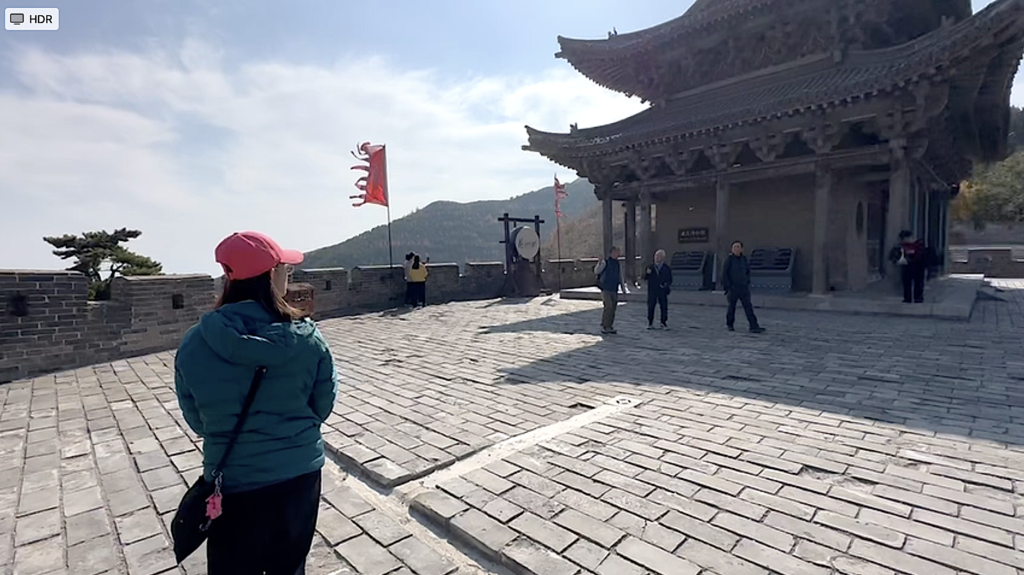
🎥 Walk Through Yanmen Pass
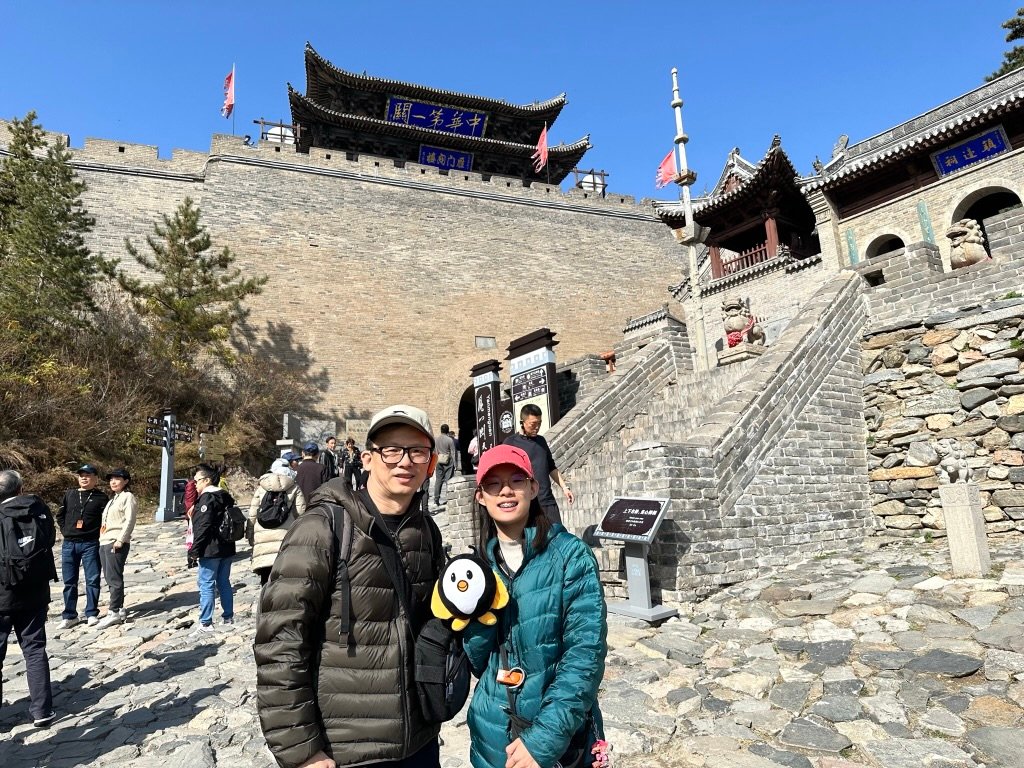
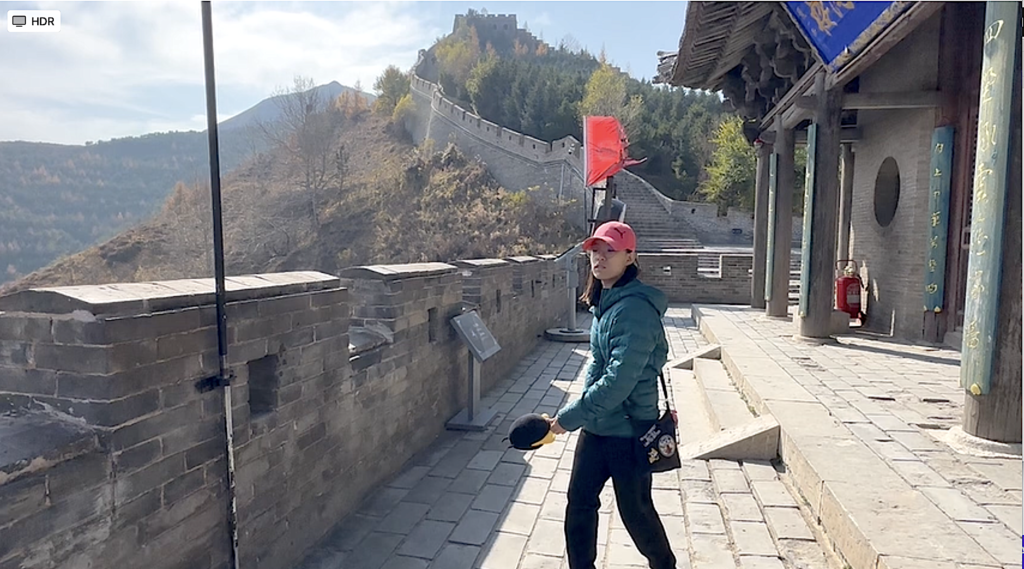
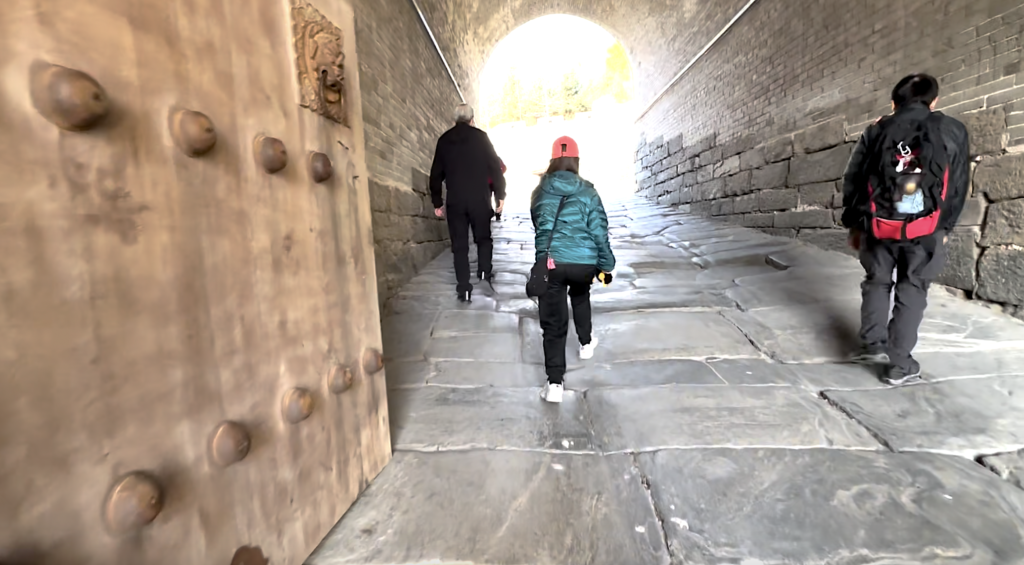
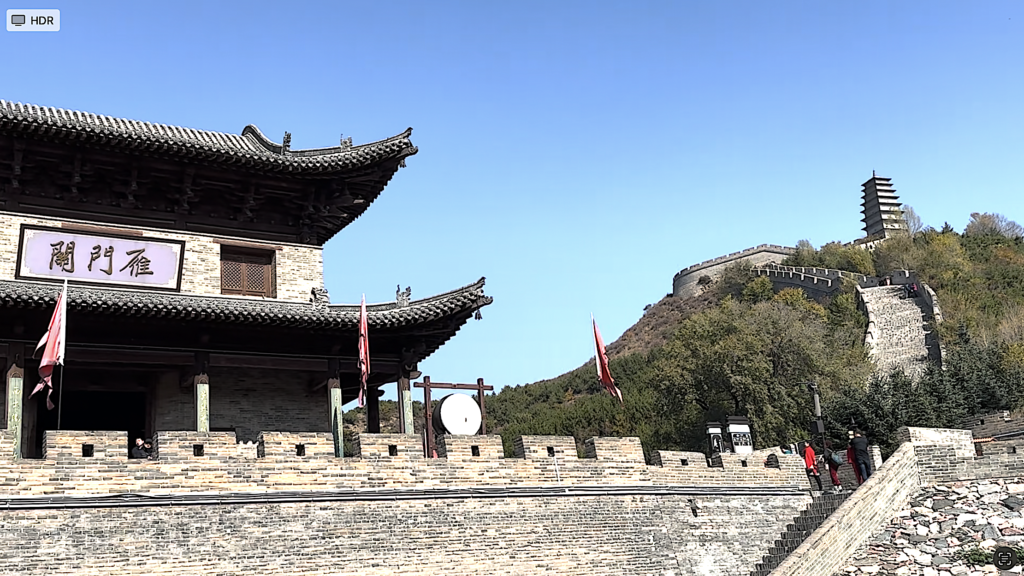
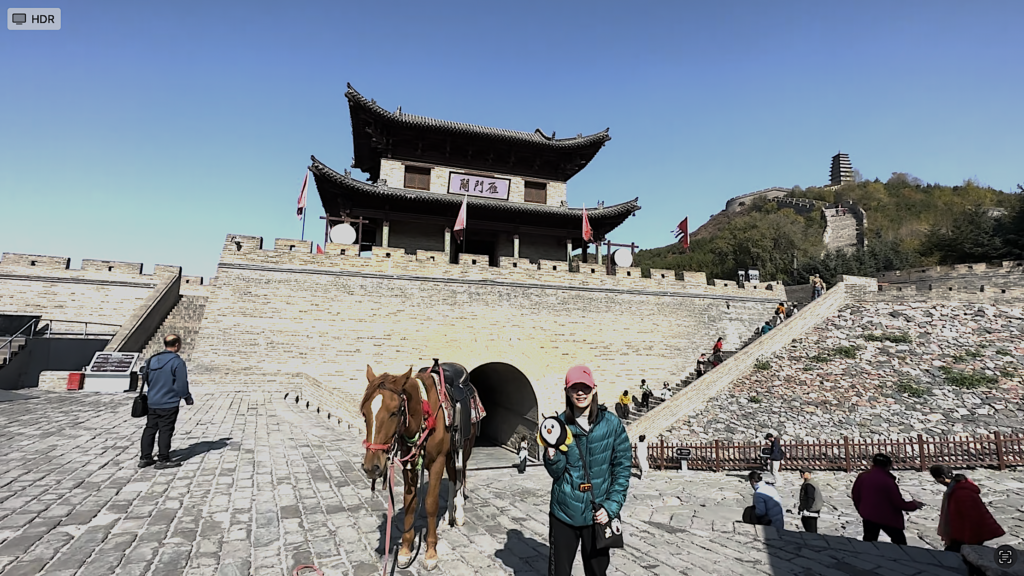
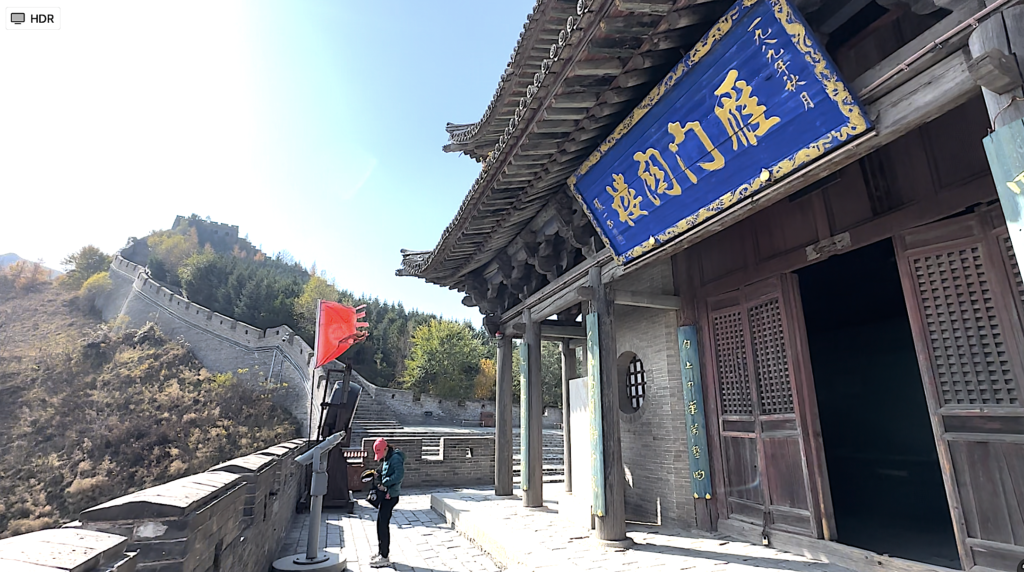
Dad & Elaine approached Yanmenguan along the old stone road between massive grey-brick walls.
Ahead is the fortified gateway.
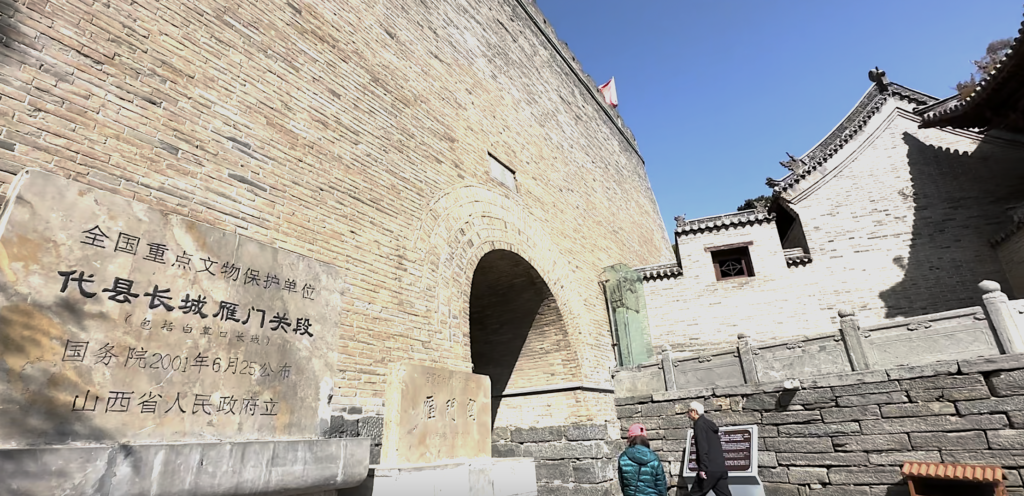
Beside the road, a marker identifies this as:
长城 — 雁门关段
Great Wall — Yanmen Pass Section
And that’s the first thing international travelers should notice.
This isn’t simply:
A WALL.
It is:
A GATEWAY THROUGH THE MOUNTAINS.
People, armies, horses, goods and information moving through this landscape had to deal with places like this.
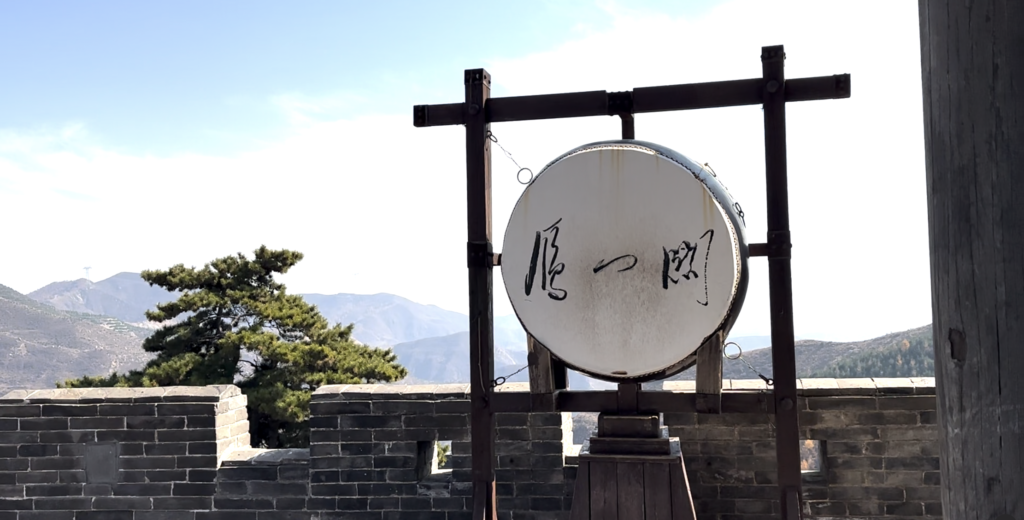
Even the couplet beside the gate emphasizes Yanmenguan’s strategic importance:
三边衔要无双地 九塞尊崇第一关
— praising Yanmen as an exceptionally important strategic stronghold and foremost among the great frontier passes.
🔥
Now Dad’s Great Wall question changes.
Instead of asking only:
“Why did China build such a long wall?”
ask:
“WHAT WAS THE WALL SYSTEM TRYING TO CONTROL?”
🐇
Because Yanmenguan isn’t simply:
“another section of the Great Wall.”
It sits inside a landscape where generations of Chinese states and dynasties confronted one of the most persistent geographical and strategic realities in Chinese history:
the northern frontier.
And once you understand that frontier…
you begin understanding why the Wall kept coming back.
🕰️ First: There Was Never Just ONE Great Wall
This is the first misconception we need to throw out.
😂
The Great Wall wasn’t built once.
Different states and dynasties built:
walls,
fortifications,
passes,
beacon towers,
and defensive systems
at different times and in different places.
Let’s put the basic story on our timeline.
WARRING STATES
475–221 BCE
📍 Zhao, Qin and Yan build northern frontier walls
↓
QIN
221–206 BCE
📍 Qin connects and extends earlier northern defenses after unification
↓
HAN
206 BCE–220 CE
📍 frontier defenses expand dramatically during struggles with the Xiongnu
↓
NORTHERN DYNASTIES / SUI
Different northern regimes build and rebuild frontier defenses
↓
TANG
618–907
A powerful empire often relies less heavily on a continuous northern wall strategy
↓
MING
1368–1644
📍 enormous rebuilding and strengthening
↓
TODAY
📍 Dad and Elaine arrive at Yanmenguan.
😂
UNESCO‘s documentation records Great Wall remains from the Spring and Autumn/Warring States periods, followed by Qin, Han and later dynasties. The famous brick-and-stone sections many international travelers see around Beijing today are largely associated with much later Ming construction and rebuilding.
So:
Qin Shi Huang did NOT build the Great Wall you photograph at Mutianyu today.
Now the Great Wall becomes much easier to understand.
It isn’t simply one enormous masonry fence.
It was part of a much larger system involving:
terrain,
fortified passes,
watchtowers,
garrisons,
roads,
signals,
and walls.
And Yanmenguan helps make that visible.
Yanmen Pass (雁门关, Yànménguān), Shanxi. The stone plaque identifies this section of the Great Wall in Dai County (代县长城雁门关段) as a Major Historical and Cultural Site Protected at the National Level, designated by China’s State Council in 2001. Photo by Dad.
Why Is It Called 雁门关?
Let’s decode the name.
雁 — yàn
wild goose
门 — mén
gate
关 — guān
pass / strategic gate
So:
雁门关
Wild Goose Gate Pass
It’s a beautiful name.
But the most important character for understanding Chinese history is:
关
When you encounter names such as:
山海关 — Shanhaiguan
嘉峪关 — Jiayuguan
潼关 — Tongguan
or:
雁门关 — Yanmenguan
you’re often dealing with a strategic pass controlling movement through difficult terrain.
That matters.
A wall is useful.
But if mountains naturally funnel armies, horses, traders and travelers through particular corridors…
control the corridor.
That’s what makes a 关 so important.
🍚 Western Readers Already Understand This
Think of famous mountain passes and fortified chokepoints elsewhere in world history.
You don’t defend every kilometer of landscape equally.
Geography does part of the work.
Mountains constrain movement.
Valleys channel it.
Passes become strategic.
Different civilization.
Different military system.
But the logic is familiar.
And standing at Yanmenguan, you can see the geography.
He looked at the military strengths of peoples along Zhao’s northern frontier.
Their clothing was better suited to riding.
Their mounted archery was effective.
So he did something controversial:
he learned from them.
Zhao adopted new clothing and cavalry practices.
And Zhao became stronger.
But King Wuling didn’t stop at:
“Let’s learn how they fight.”
He also pushed Zhao’s power northward.
And then…
he built frontier walls.
🌶️
King Wuling Was Building Walls BEFORE Qin Shi Huang
This is the part Western travelers rarely hear.
Historical records associate King Wuling of Zhao with northern expansion against groups such as the Linhu (林胡) and Loufan (楼烦).
After expanding Zhao’s territory northward, he established commanderies including:
云中 — Yunzhong
雁门 — Yanmen
and:
代 — Dai
and constructed a northern defensive wall.
Chinese historical records cited by modern local historical authorities explicitly describe King Wuling as defeating Linhu and Loufan and building a long wall along Zhao’s northern frontier.
we were already standing inside the prehistory of the Great Wall story.
😳
We just didn’t fully realize it at the time.
🐇
There we go again.
🌶️ Why Build a Wall If You’ve Just Learned Cavalry?
Excellent question.
King Wuling’s Zhao did both.
ADAPT OFFENSIVELY
Learn mounted warfare.
Build cavalry.
Adopt useful practices from northern peoples.
↓
DEFEND TERRITORIAL GAINS
Establish commanderies.
Control strategic territory.
Build frontier defenses.
That’s much more sophisticated than:
“Chinese people were scared, so they built a wall.”
The wall was one tool inside a larger frontier strategy.
And that distinction will matter enormously when we get to Han and Ming.
🌶️ The Big Geography: Farming Lands Meet the Steppe
Now we reach Dad’s big question:
Why does this frontier keep appearing in Chinese history?
Look north from the agricultural heartlands of northern China.
Eventually the ecological landscape changes.
Broadly speaking, much of the Central Plains supported intensive settled agriculture.
Farther north and northwest were extensive grassland and steppe environments where mobile pastoral economies could flourish.
Different environments encouraged different ways of life.
Very broadly:
AGRARIAN SOCIETIES
fixed fields
cities
stored grain
dense settlements
tax systems
walls and fortifications
versus:
MOBILE PASTORAL SOCIETIES
herds
mobility
horses
seasonal movement
highly mobile mounted warfare
That difference created both:
COMPLEMENTARITY
and:
CONFLICT.
🔥
This Wasn’t Simply “Chinese vs Barbarians”
This is where we need to be careful.
Old Chinese texts often used terms that modern readers may translate as “barbarian.”
But if we reproduce that worldview uncritically, we miss most of the interesting history.
Northern peoples weren’t simply:
random outsiders attacking civilization.
They had their own societies, political structures, economies and military strengths.
And the frontier wasn’t permanently occupied by two fixed teams called:
CHINA
versus:
NOMADS.
😂
Groups moved.
States expanded.
People intermarried.
Trade flourished.
Alliances changed.
Northern peoples entered and ruled parts of northern China.
Some dynasties ruling China itself came from peoples whose origins lay beyond earlier Central Plains political traditions.
The frontier was not simply a line separating two civilizations.
It was also a zone where civilizations interacted and changed each other.
UNESCO today explicitly recognizes the Great Wall not only as a defensive system, but as evidence of the long interaction between agricultural and nomadic civilizations.
That is a much better way to understand it.
But Dad’s DEFEND DEFEND Insight Still Matters 🌶️
Now put yourself in the position of a settled agrarian state.
You have:
farmland,
villages,
cities,
grain stores,
tax-paying populations
and infrastructure that cannot simply pack itself onto horses and move away.
A highly mobile cavalry force can strike quickly.
Raid.
Take livestock or goods.
Then retreat.
What do you do?
You can build cavalry of your own.
King Wuling did.
You can launch offensive campaigns.
Han did.
You can negotiate.
Trade.
Arrange diplomatic relationships.
Sometimes marriage alliances.
But geography keeps presenting the same defensive problem:
your society is fixed to the land.
So walls, forts and strategic passes become extremely attractive.
Not because Chinese rulers had some mysterious cultural obsession with masonry.
😂
Because:
settled societies have things that need defending.
Fields cannot gallop away.
Cities cannot migrate south for winter.
Grain stores cannot outrun cavalry.
🌶️🌶️🌶️
Now the Great Wall starts making intuitive sense.
🍚 Imagine Protecting a House From Someone Who Doesn’t Need a House
That’s an oversimplification — but useful for beginners.
One side’s economic and political system depends heavily on:
fixed infrastructure.
The other can possess much greater operational mobility.
That creates an asymmetry.
The wall helps the fixed side:
channel movement,
slow incursions,
signal warnings,
protect strategic corridors,
and buy time for defenders to respond.
The wall isn’t supposed to make invasion metaphysically impossible.
😂
It’s part of a defense system.
That is a much better way to think about the Great Wall.
And Yanmenguan Is Where This Becomes Physical
Standing at Yanmenguan, you aren’t merely looking at:
“Old Chinese wall.”
Look at the mountains.
Look at the pass.
Imagine mounted forces trying to move between northern steppe regions and the agricultural territories farther south.
Now ask:
Where would YOU put the defensive gate?
💡
Suddenly:
雁门关
makes sense.
The landscape explains the military history.
And the military history explains why generation after generation kept returning to this frontier.
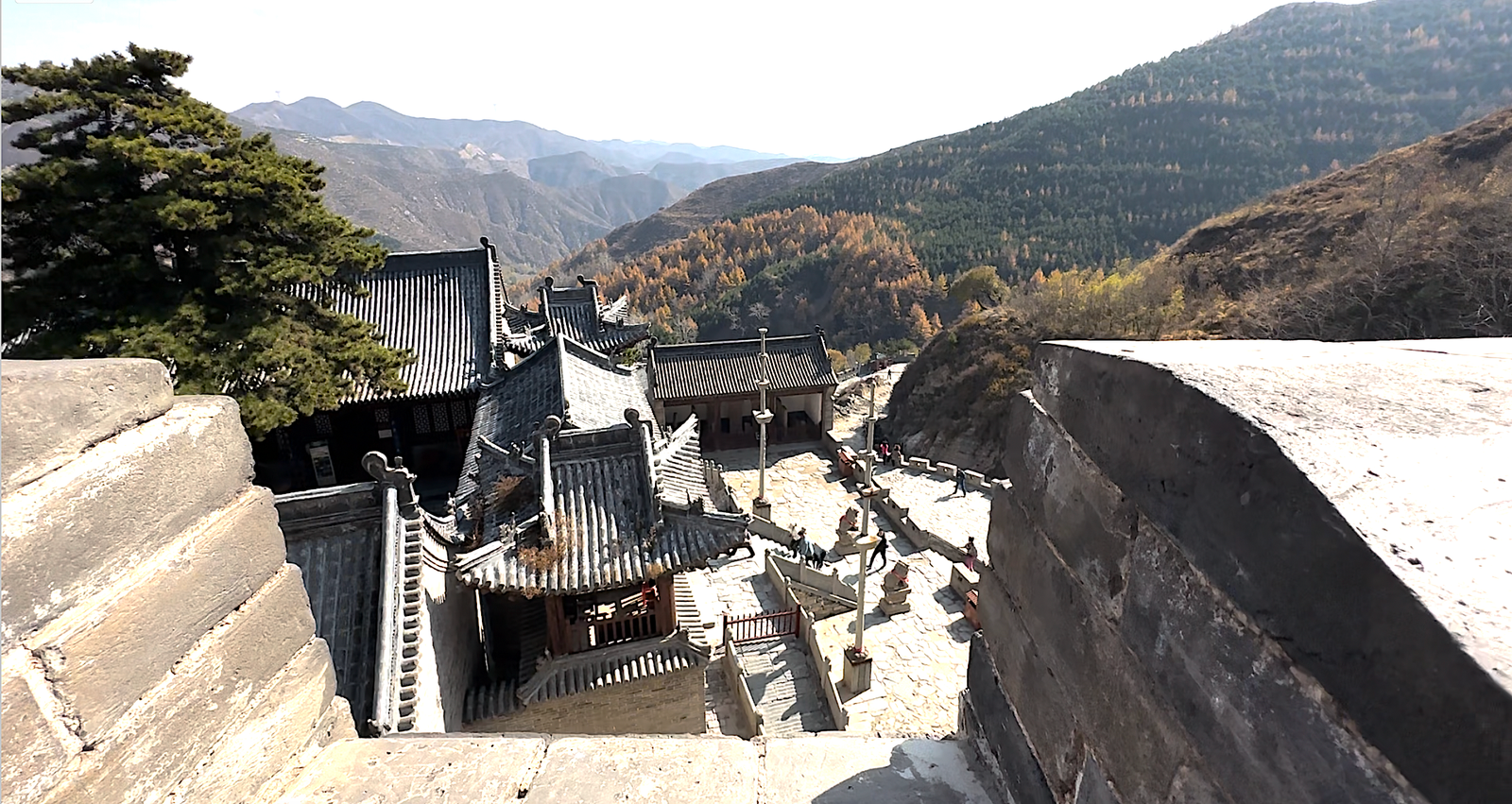
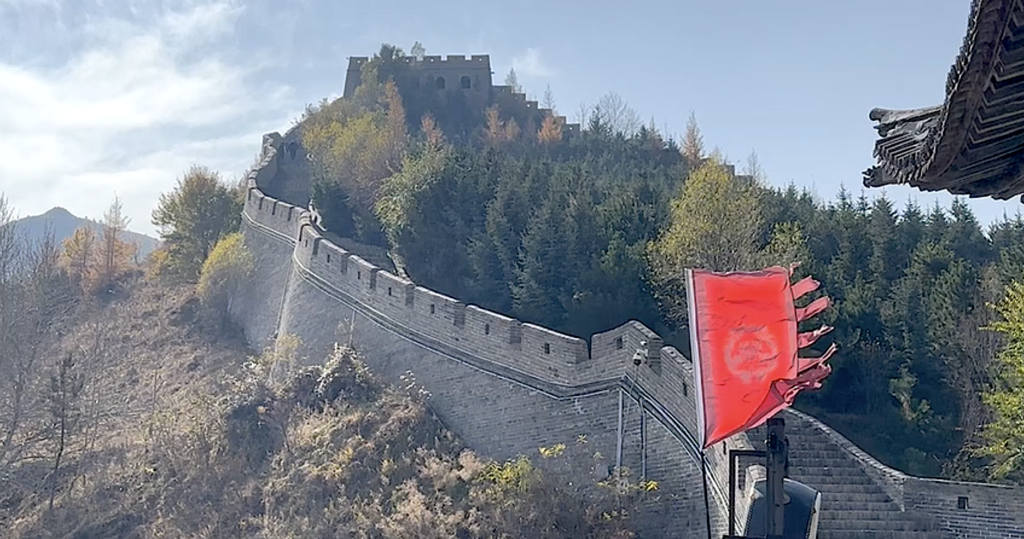
🎥 Now Look at Yanmenguan From Above
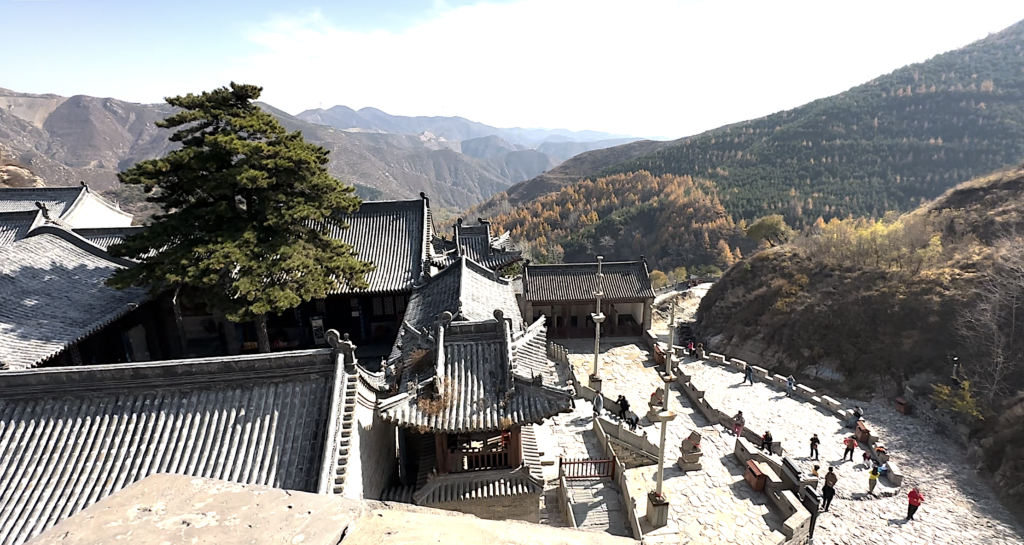
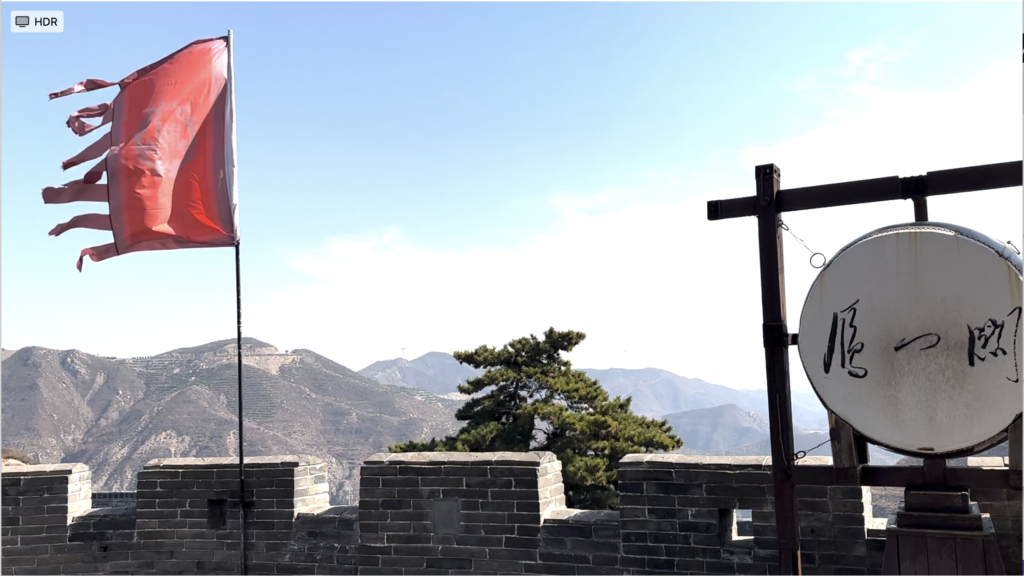
From higher on the fortifications, Dad’s Great Wall rabbit becomes much easier to see.
The wall climbs the mountain ridge.
Below sits the fortified pass and its courtyards.
A watchtower stands high above.
And the mountains naturally channel movement through the landscape.
🔥
Now don’t look at Yanmenguan as:
WALL + OLD BUILDINGS.
Look at:
MOUNTAIN + PASS + WALL + GATE + WATCHTOWER.
Together they form:
A DEFENSIVE SYSTEM.
And suddenly Dad’s question becomes very practical:
If an army had to move through these mountains… where would YOU put the gate?
😂
🐇 And We’re Only at the Beginning
Because Zhao’s frontier walls are just the opening chapter.
Then comes:
QIN
which connects and extends northern defenses.
Then:
HAN
and one of the great confrontations of ancient Eurasian history:
Han vs Xiongnu.
Remember our Linfen article?
卫青 — Wei Qing
霍去病 — Huo Qubing
💡💡💡
They’re coming back.
And now you finally understand why their wars mattered geographically.
Then later:
Northern dynasties.
Tang.
Song and its northern neighbors.
Mongols.
Ming.
And eventually the massive brick-and-stone Great Wall landscape international travelers recognize today.
🌶️🌶️🌶️
The Great Wall isn’t one story.
It’s a recurring answer to a recurring frontier question.
And Yanmenguan gives us the perfect place to start telling it.
Section 2 — Han vs Xiongnu: Why Walls Alone Were Never Enough
Standing at Yanmenguan (雁门关), walls make perfect sense.
Mountains constrain movement.
The pass controls a strategic corridor.
Fortifications strengthen the defender.
Watchtowers provide warning.
Garrisons respond.
But Chinese rulers repeatedly discovered something important:
A wall can help defend a frontier.
It cannot solve the frontier.
🌶️
Because on the other side wasn’t simply:
“an invading army.”
There were peoples with their own societies, economies, leaders, alliances and political interests.
Sometimes they fought Chinese states.
Sometimes they traded with them.
Sometimes they negotiated.
Sometimes they entered alliances.
Sometimes they became enemies of each other.
And sometimes Chinese rulers concluded:
The wall isn’t enough. We have to go out and fight.
That brings us to one of the great confrontations of ancient Chinese history:
📍 Qin unifies China 📍 earlier frontier walls connected and extended
↓
HAN
206 BCE–220 CE
📍 HAN–XIONGNU FRONTIER — WE ARE HERE
↓
THREE KINGDOMS 220–280 CE
The northern-frontier problem didn’t disappear when Qin unified China.
Quite the opposite.
A unified Chinese empire now faced powerful political forces beyond its northern frontier on an enormous geographical scale.
And among the most formidable were:
匈奴 — Xiōngnú
the Xiongnu
🍚 Western Readers: Were the Xiongnu “the Huns”?
This is a famous question.
And the safest answer is:
Don’t simply equate them.
Scholars have long debated possible historical relationships between the Xiongnu known from East Asian sources and groups later called Huns farther west.
There may have been connections of some kind across the enormous Eurasian steppe world.
But:
Xiongnu = Attila’s Huns
is much too simple.
Different sources.
Different periods.
Different geography.
Different political formations.
So for our Deep China journey, remember them simply as:
a powerful confederation that became one of Han China’s most important northern rivals.
That’s enough to understand Yanmenguan.
🌶️ The Xiongnu Had Something Agrarian Empires Feared: Mobility
Return to Dad’s big geographical insight.
A settled agrarian empire has:
cities,
farmland,
villages,
grain stores,
roads,
and large populations fixed to particular places.
The Xiongnu world relied much more heavily on:
horses,
pastoral mobility,
and highly mobile mounted warfare.
That created a military problem.
A cavalry force could move rapidly.
Strike.
Withdraw.
Reappear somewhere else.
A wall could:
channel movement,
protect strategic corridors,
provide observation points,
and:
slow an incursion.
But the wall couldn’t chase anyone.
😂
Eventually Han rulers began asking:
Do we stay behind the defenses — or take the war north?
Before War, There Was Diplomacy
This is important.
The Han response to the Xiongnu wasn’t simply:
ATTACK!
Early Han rulers also relied on:
和亲 — héqīn
usually translated rather awkwardly as:
“peace through marriage”
or marriage alliance diplomacy.
The basic idea involved establishing political relationships with powerful frontier rulers through marriage arrangements, accompanied by gifts and other diplomatic exchanges.
It could help stabilize relations.
It could buy time.
It could reduce immediate conflict.
And it reflected a reality both sides understood:
permanent warfare was enormously expensive.
But 和亲 also involved something easy to overlook when reading grand strategy.
Human beings.
And sometimes:
women whose own lives became instruments of diplomacy.
🌶️
Remember that.
We’re coming back to it in Section 3.
Then Came Emperor Wu
Eventually Han policy changed dramatically under:
汉武帝 — Hàn Wǔdì
Emperor Wu of Han
Reigned:
141–87 BCE
We’ve already met him in two other Deep China rabbit holes.
At Linfen, through:
卫青 — Wei Qing
and:
霍去病 — Huo Qubing
At Hancheng, through:
司马迁 — Sima Qian
See what’s happening?
💡
The same historical world keeps reappearing in different places.
Now Yanmenguan helps us understand the geographical problem behind those famous Han campaigns.
🌶️ Emperor Wu Decides Defense Isn’t Enough
Under Emperor Wu, Han adopted a much more aggressive strategy against the Xiongnu.
Instead of relying primarily on:
walls,
frontier defense
and:
diplomatic accommodation,
Han armies increasingly launched major offensive campaigns beyond the traditional agricultural heartlands.
But this created another problem.
How does an agrarian empire fight a highly mobile mounted opponent?
Answer:
it needs mobility too.
Remember King Wuling of Zhao?
🐇
胡服骑射
Learn cavalry.
Adapt.
Use horses.
The lesson from centuries earlier hadn’t disappeared.
Han invested enormously in cavalry warfare.
And two names became legendary.
Wei Qing 卫青
卫青 — Wèi Qīng
rose from relatively humble circumstances to become one of the great generals of Emperor Wu’s reign.
He led major campaigns against the Xiongnu and achieved important victories on the northern frontier.
His military career helped shift Han strategy away from simply absorbing attacks toward striking Xiongnu forces farther north.
And remember:
Dad and Elaine found Wei Qing’s story back in Linfen.
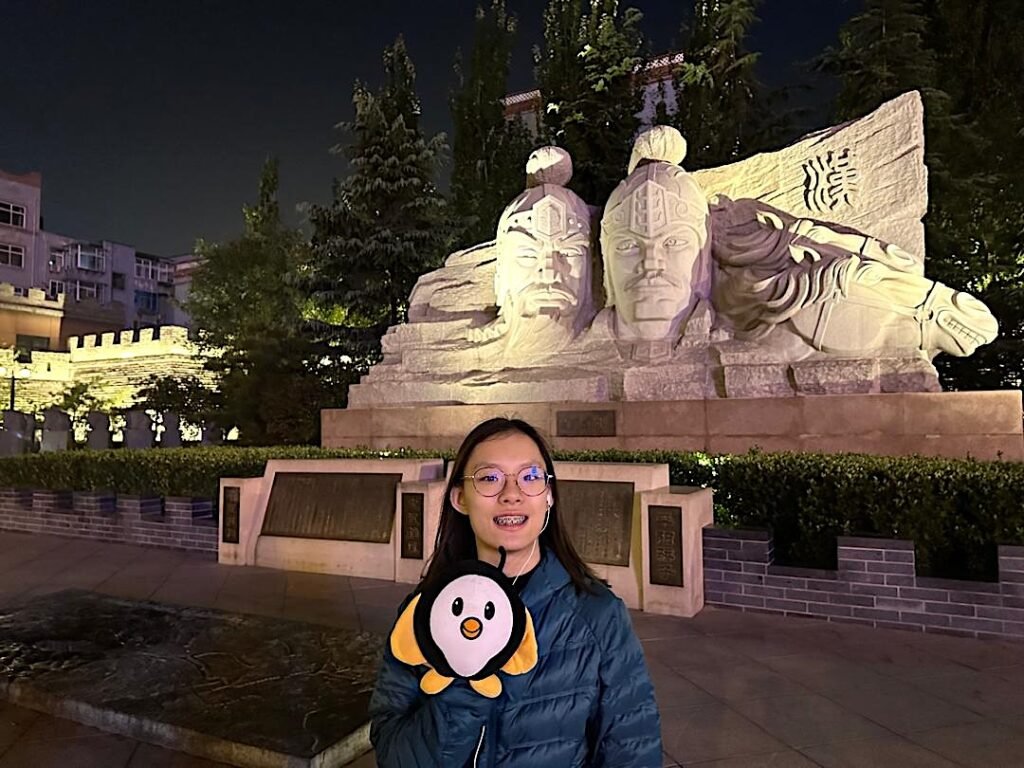
Elaine in Linfen (临汾, Línfén), Shanxi, with statues of Wei Qing (卫青) and Huo Qubing (霍去病) behind her—two celebrated generals of the Western Han dynasty (西汉) under Emperor Wu of Han (汉武帝, Hàn Wǔdì), whose campaigns against the Xiongnu transformed China’s northern frontier. Photo by Dad.
Now Yanmenguan explains why a Han general from that historical world mattered.
The rabbit holes are connecting again.
Then Comes Huo Qubing — at Seventeen 😳
Wei Qing’s nephew was:
霍去病 — Huò Qùbìng
One of the most extraordinary young military figures in Chinese history.
He first distinguished himself while still a teenager.
His campaigns became famous for:
speed,
deep cavalry penetration,
and aggressive operations against Xiongnu forces.
He died incredibly young — around:
23 years old.
Yet his military reputation became enormous.
For Chinese readers, Wei Qing and Huo Qubing are household historical names.
For Western travelers, Yanmenguan gives you the geography that helps explain:
Why were these generals fighting in the first place?
🍚 A Familiar Military Handrail: Walls and Mobile Armies Solve Different Problems
You don’t need to understand ancient military theory.
Think simply:
FORTIFICATION
helps you:
hold
observe
channel
delay
↓
CAVALRY
helps you:
move
pursue
intercept
strike
So Han needed both.
The frontier wall wasn’t useless because Han launched offensive campaigns.
And cavalry didn’t make fortifications unnecessary.
They solved different problems.
That is why reducing the Great Wall to:
“China was afraid of invasion.”
misses so much of the story.
It was part of a much broader frontier strategy.
🌶️ But War Had an Enormous Cost
Now we need another correction to the heroic-general story.
Wei Qing wins.
Huo Qubing wins.
Han power expands.
Great.
But wars on this scale require:
horses,
food,
weapons,
transport,
soldiers,
taxes,
and enormous logistical effort.
Military glory isn’t free.
The Han state’s sustained campaigns placed significant demands on imperial finances and society.
And even major victories did not make the northern frontier disappear.
Because geography didn’t disappear.
The steppe didn’t disappear.
The Xiongnu didn’t simply cease existing after one campaign.
The fundamental question remained:
How should an agrarian empire live beside powerful mobile societies to its north?
DEFEND DEFEND — But Also ATTACK, TRADE and NEGOTIATE
This is where Dad’s original insight becomes richer.
If you’re responsible for a settled agrarian civilization, defense matters enormously.
DEFEND
the farmland.
DEFEND
the cities.
DEFEND
the population.
DEFEND
the strategic passes.
🔥
Hence walls.
Hence Yanmenguan.
But Chinese history repeatedly shows that walls were never the only answer.
There was also:
ATTACK
Wei Qing.
Huo Qubing.
↓
TRADE
because agricultural and pastoral economies could want things from each other.
↓
NEGOTIATE
because endless warfare exhausted everybody.
↓
MARRIAGE DIPLOMACY
because relationships between ruling elites could become instruments of peace.
And that last strategy gives us one of the most famous women in China’s frontier history.
🐇 A Woman Is About to Walk Through the Frontier
Her name was:
王昭君 — Wáng Zhāojūn
Wang Zhaojun
And her story takes place later in the Han dynasty.
She wasn’t a general.
She didn’t command cavalry.
She didn’t build a wall.
She crossed the frontier for a completely different reason.
Marriage.
And later Chinese cultural memory turned her into one of the great symbols of peace between Han China and the Xiongnu.
But if we describe her merely as:
“a beautiful woman who married a Xiongnu ruler”
we miss the human story completely.
Because behind the diplomacy was:
a woman leaving the world she knew and traveling beyond the frontier, probably knowing she would never return to her old life.
🌶️🌶️🌶️
That is personal sacrifice on a scale political history often hides.
And it gives us the other half of the Great Wall story.
Walls ask:
How do we keep danger out?
Wang Zhaojun’s story asks:
Can a human relationship help create peace across the frontier instead?
That’s where we’re going next.
Section 3 — Wang Zhaojun: The Woman Who Crossed the Frontier for Peace
After walls, cavalry, Wei Qing and Huo Qubing, it would be easy to tell China’s northern-frontier story entirely through:
war.
Generals.
Armies.
Horses.
Fortifications.
Victories.
Defeats.
But there was another way rulers tried to manage this difficult frontier:
diplomacy.
And sometimes diplomacy came with an enormous human price.
One of the most famous people associated with that story is:
王昭君 — Wáng Zhāojūn
Wang Zhaojun
She didn’t command an army.
She didn’t build a wall.
She didn’t defeat the Xiongnu.
Instead, she left Han China and married a Xiongnu ruler.
Later generations remembered her as a woman whose journey across the frontier helped symbolize peace between two very different political worlds.
And behind that grand historical story was something much simpler:
a young woman leaving everything familiar behind.
🌶️
🕰️ Where Are We?
Let’s put Wang Zhaojun into the timeline.
EMPEROR WU OF HAN
141–87 BCE
📍 Wei Qing 📍 Huo Qubing 📍 major Han–Xiongnu wars
↓
LATER WESTERN HAN
↓
33 BCE
📍 WANG ZHAOJUN GOES TO THE XIONGNU
↓
WESTERN HAN ENDS
9 CE
Notice the difference.
Wei Qing and Huo Qubing belong to the period of enormous Han military offensives against the Xiongnu.
Wang Zhaojun’s famous journey comes roughly a century later, during a very different political situation.
So don’t imagine:
“War failed, therefore the emperor immediately sent Wang Zhaojun.”
Chinese frontier history wasn’t that neat.
😂
But placing these stories together gives us two very different ways states dealt with the same enormous problem:
WAR
and:
DIPLOMACY.
Who Was Wang Zhaojun?
Wang Zhaojun is traditionally remembered as a woman from the Han imperial palace during the reign of:
汉元帝 — Emperor Yuan of Han
She became one of the most famous women in Chinese cultural memory.
Later tradition even included her among China’s celebrated:
四大美女 — Four Great Beauties
But if we focus only on:
“Wang Zhaojun was very beautiful”
we reduce an extraordinary historical story to a beauty contest.
😂
What makes her important to our Yanmenguan story is what happened in:
33 BCE.
A Xiongnu Ruler Comes to the Han Court
At this time, the Xiongnu political world had experienced internal divisions.
One Xiongnu ruler:
呼韩邪单于 — Hūhányé Chányú
Huhanye Chanyu
had established a relationship with the Han court.
He came to the Han capital and sought a marriage connection.
Wang Zhaojun became the woman sent to marry him.
And so she left.
From the Han imperial world…
toward the northern frontier.
🍚 Western Readers: This Wasn’t a Romantic Destination Wedding
😂
When we read:
“Han woman marries Xiongnu ruler”
it’s easy to compress the whole event into one diplomatic sentence.
But stop thinking like a historian for a moment.
Think like a traveler.
Imagine leaving:
your home,
your language environment,
the social world you understand,
the landscapes you know,
and the political center of one civilization…
to travel far beyond the frontier and join the ruling household of another society.
No high-speed train home.
No FaceTime with Dad.
No:
“I’ll try Inner Mongolia for six months and see whether I like it.”
😂
Her decision took her into a completely different world.
That is where the political story becomes personal.
🌶️ The Wall Looks Different When You Imagine Crossing It
At Yanmenguan, we naturally look at the fortifications from the defender’s perspective.
Who might come through this pass?
How do we stop them?
Where do we station soldiers?
Where do we build walls?
Then Wang Zhaojun forces us to turn around.
Imagine looking north.
And going through.
Not as an invading cavalryman.
Not as a general.
But as a woman whose marriage was tied to relations between two political powers.
Suddenly:
the frontier isn’t merely something to defend.
It’s something human beings crossed.
🔥
That changes the Great Wall story.
Was Wang Zhaojun Really a “Diplomat”?
Not in the modern sense.
She wasn’t an ambassador carrying diplomatic credentials and negotiating a treaty across a conference table.
So calling her:
“China’s ancient female diplomat”
would be catchy…
but historically too modern.
A better way to understand her is:
Wang Zhaojun became one of Chinese history’s great symbols of frontier diplomacy and peace through marriage.
Her own marriage became part of the political relationship between Han and the Xiongnu.
And later generations gave that story enormous symbolic meaning.
🌶️ The Personal Sacrifice Behind 和亲
We’ve already encountered:
和亲 — héqīn
marriage-alliance diplomacy
On a strategic map, it looks very tidy.
HAN
🤝
XIONGNU
Marriage.
Peace.
Relations improve.
Excellent.
But maps hide people.
For the woman involved:
和亲
could mean:
leave your old life.
cross the frontier.
join a different political and cultural world.
build a new family there.
live with consequences you didn’t entirely control.
That’s why Wang Zhaojun deserves her own section.
Political peace can have a very personal cost.
🐇 But Did She Volunteer?
Here’s where history becomes interesting.
Later versions of Wang Zhaojun’s story contain many famous details.
One particularly popular tradition says palace women were painted by court artists so the emperor could choose among them.
Wang Zhaojun supposedly refused to bribe the painter:
毛延寿 — Máo Yánshòu
who then portrayed her unfavorably.
As a result, the emperor failed to recognize her beauty until she was selected to leave with the Xiongnu ruler.
Then he saw her…
and regretted letting her go.
🌶️
Great story.
There’s only one problem.
We need to distinguish the historical core from later storytelling.
The famous portrait-and-bribery episode comes from later tradition rather than the earliest account of the marriage itself.
So enjoy it.
It’s part of Wang Zhaojun’s cultural afterlife.
But don’t automatically treat every dramatic detail as contemporary Han evidence.
Same Deep China rule:
history ≠ later tradition ≠ literature.
And Then the Poets Got Hold of Her
Once Wang Zhaojun became a cultural symbol, writers and artists kept retelling her story.
Imagine the ingredients:
A beautiful young woman.
The imperial palace.
A distant frontier.
A political marriage.
Leaving home.
Autumn landscapes.
Wild geese.
Homesickness.
Peace between peoples.
😭
Chinese poets and dramatists had enough material for centuries.
Her historical life gradually became surrounded by layers of:
poetry,
drama,
painting,
legend
and political symbolism.
So again we have two timelines.
🕰️ Wang Zhaojun’s Two Lives
HISTORICAL WANG ZHAOJUN
Han palace
↓
Marriage to Huhanye Chanyu
↓
Crosses into the Xiongnu world
↓
Lives her life there
Then:
CULTURAL WANG ZHAOJUN
Historical memory
↓
Poetry
↓
Drama
↓
Painting
↓
Legends
↓
Symbol of homesickness and sacrifice
↓
Symbol of Han–Xiongnu peace
↓
TODAY
🔥
Just like Guan Yu, the historical person’s cultural life became far longer than the biological one.
🍚 Is There a Western Equivalent?
Not really.
And we shouldn’t force one.
Western and Mediterranean history certainly contain royal women whose marriages were used to create political alliances.
Dynastic marriage was hardly unique to China.
A European reader may think of princesses sent across borders to marry rulers they had never previously known, their personal lives becoming part of international politics.
That’s the useful handrail.
But Wang Zhaojun’s exact story — a Han palace woman crossing into the Xiongnu world and later becoming such a powerful cultural symbol of frontier peace — belongs to its own historical context.
Let Wang Zhaojun be Wang Zhaojun.
🌶️ And Her Story Complicates Dad’s Agrarian vs Nomadic Thesis
This is important.
We’ve been explaining the northern frontier partly through:
settled agrarian societies
and:
mobile pastoral societies.
That ecological difference helps explain recurring strategic tension.
But if we stop there, we create two sealed boxes:
THE FARMERS
versus:
THE NOMADS.
History was never that simple.
Wang Zhaojun physically crosses between those worlds.
Her marriage creates family ties.
People move.
Goods move.
Languages meet.
Customs interact.
Political relationships change.
So the frontier wasn’t merely:
a WALL.
It was also:
a BRIDGE.
🔥🔥🔥
That is one of the most important ideas in this entire article.
The Great Wall Was Both Barrier and Meeting Place
A frontier wall says:
Control movement.
A gate says:
Movement still happens here.
💡
Think about that.
Why build a:
关 — pass/gate
if nobody ever crosses?
Soldiers crossed.
Envoys crossed.
Merchants crossed.
Migrants crossed.
Messengers crossed.
Armies crossed.
And people like Wang Zhaojun crossed.
The Great Wall frontier wasn’t a hermetically sealed border.
It regulated a zone of interaction.
That makes Yanmenguan much more interesting than:
“Big old wall keeps outsiders out.”
🌶️ War and Diplomacy Require Different Kinds of Courage
States manage difficult frontiers through more than one kind of action.
Sometimes:
fight.
Sometimes:
defend.
Sometimes:
negotiate.
Sometimes:
trade.
And sometimes an individual human being carries part of the burden of diplomacy.
What Did Wang Zhaojun Actually Achieve?
This is another place to avoid exaggeration.
We shouldn’t write:
“Wang Zhaojun single-handedly created 50 years of peace between China and the Xiongnu.”
History is more complicated.
Han–Xiongnu relations at this time reflected broader political developments, including internal Xiongnu divisions and an existing relationship between Huhanye Chanyu and the Han court.
Wang Zhaojun’s marriage formed part of that diplomatic relationship.
Later cultural memory elevated her role into a powerful symbol of:
peace and friendship across the frontier.
The distinction matters.
The historical woman deserves better than turning her into either:
“helpless victim”
or:
“woman who personally solved geopolitics.”
😂
Her story is powerful enough without either exaggeration.
🌶️ What Happened After Huhanye Died?
This is where the personal sacrifice becomes even clearer.
After Huhanye Chanyu died, Wang Zhaojun remained within the Xiongnu political world.
According to the customary practices of that society, she subsequently married his successor, who was Huhanye’s son by another wife.
To later Han Chinese moral sensibilities, this could feel deeply uncomfortable.
Tradition says Wang Zhaojun sought permission to return but remained and followed Xiongnu custom.
Again, the precise details come to us through historical traditions that need careful handling.
But the broader point is powerful:
crossing the frontier meant entering another society with different customs.
She didn’t simply remain a Han palace woman living in a northern hotel.
😂
Her life had fundamentally changed.
🍚 And This Helps Us Understand Cultural Difference Without Ranking It
This is another Deep China lesson.
A custom can feel shocking when viewed entirely through the moral expectations of another society.
But historians need to ask:
What did this practice mean within THAT society?
The Xiongnu had their own kinship and succession practices.
Han society had its own.
Wang Zhaojun’s story brings those different social worlds into direct contact.
That’s much more educational than simply labeling one side:
civilized
and the other:
barbarian.
🔥
Why Did Later Chinese People Love Her Story So Much?
Because it contains several powerful themes at once.
SACRIFICE
She leaves home.
LOYALTY
She fulfills a political role.
HOMESICKNESS
A familiar literary theme.
CULTURAL CROSSING
She lives beyond the frontier.
PEACE
Her marriage becomes associated with improved relations.
BEAUTY
Later tradition amplifies this enormously.
And perhaps most importantly:
the individual pays a price for something larger than herself.
That’s an extraordinarily powerful narrative.
🐇 And Then Comes “Falling Geese”
Wang Zhaojun became associated with one of the famous poetic descriptions attached to China’s Four Great Beauties:
落雁 — luòyàn
“falling geese”
Later legend tells that as Zhaojun traveled north, her beauty caused wild geese to forget to flap their wings and fall from the sky.
😂
Historical fact?
Obviously not.
Beautiful cultural imagery?
Absolutely.
And notice where we are:
雁门关
Wild Goose Gate.
王昭君
Falling Geese.
😳🐇
No, we’re not claiming the two names derive from each other.
They don’t.
But for our Yanmenguan article…
Dad is definitely allowed to enjoy the coincidence.
😂
Standing at Yanmenguan, Think About BOTH Directions
When you visit, don’t only stand on the wall and imagine:
“Enemy coming from there.”
Turn around.
Look north.
And imagine:
traders,
envoys,
families,
soldiers,
messengers,
and women such as Wang Zhaojun
moving through the enormous frontier world.
That single mental shift changes the Great Wall.
From barrier
to:
contact zone.
🔥
Dad’s Great Wall Theory Gets an Upgrade
We began with:
Agrarian societies had to DEFEND, DEFEND, DEFEND.
I still think that’s an important part of the Great Wall story.
Settled societies had:
fields,
cities,
grain,
population centers
that required protection.
So walls made strategic sense.
But now our Deep China journey has given us the fuller equation:
DEFEND
walls and passes
ADAPT
King Wuling’s cavalry reforms
ATTACK
Wei Qing and Huo Qubing
TRADE
economic exchange
NEGOTIATE
political relationships
CONNECT
people such as Wang Zhaojun crossing between worlds
=
THE REAL NORTHERN FRONTIER STORY
🌶️🔥
Much better than:
China built a wall because foreigners kept attacking.
History is richer than that.
🐞 Sting Check
You started at Yanmenguan thinking:
“Great Wall.”
Now you know:
the wall existed before Qin.
King Wuling of Zhao built northern defenses.
Agrarian and pastoral societies had different strategic strengths.
Han fought the Xiongnu.
Wei Qing and Huo Qubing carried war north.
And Wang Zhaojun carried diplomacy across the frontier.
Now you’re perhaps wondering:
“Okay… what happened when northern peoples actually conquered and ruled northern China?”
😬
Oh no.
🐇🐇🐇
That rabbit hole leads to:
Northern Wei.
Liao.
Jin.
Yuan.
And eventually…
another enormous question:
Who exactly counts as ‘China’ in Chinese history?
🌶️🌶️🌶️
Dad…
we’re stopping.
😂
Because Section 4 still needs to bring us back to Yanmenguan itself:
how to go, what to see, how long to stay, and why the Great Wall you meet here feels completely different after knowing these stories.
Section 4 — How to Visit Yanmenguan: From Beijing, Xi’an or as Part of a Shanxi Journey
After Zhao’s walls, Han cavalry, the Xiongnu, Wei Qing, Huo Qubing and Wang Zhaojun…
we finally return to the actual mountain pass.
😂
And ChinaTravelBUG owes you the practical answer:
Okay Dad. How do I actually get to Yanmenguan 雁门关 ?
The first thing to understand is:
Yanmenguan 雁门关is in northern Shanxi Province.
It lies in Dai County (代县), north of the provincial capital:
So for most international travelers, I’d think of:
TAIYUAN
as the practical gateway.
And that gives you two very good approaches.
From the north:
Beijing → Taiyuan → Yanmenguan
Or from the southwest:
Xi’an → Taiyuan → Yanmenguan
Better still:
make Yanmenguan part of a wider Shanxi journey.
Because once you’ve come this far…
Dad has several more rabbit holes waiting.
😂🐇
🚄 Option 1 — Beijing → Taiyuan
This is surprisingly easy.
High-speed trains connect Beijing with:
Taiyuan South — 太原南站
Current G-train services can make the journey in roughly:
2½–3 hours
with some faster services around 2 hours 20 minutes.
Current second-class fares vary by train, broadly around:
RMB 186–280
with some D-train options priced differently.
So you can leave Beijing in the morning…
and be in Shanxi before lunch.
That’s considerably easier than the words:
“ancient northern frontier pass”
might make you imagine.
😂
🚄 Option 2 — Xi’an → Taiyuan
Coming from Xi’an?
Also straightforward.
Fast D/G trains connect:
Xi’an North — 西安北站
with:
Taiyuan South — 太原南站
Current services generally take around:
2¾–3½ hours
depending on the train.
Second-class fares vary by service, broadly around:
RMB 145–200+
as a planning range.
That makes Yanmenguan possible as part of a much bigger northern-China historical journey:
Xi’an → Shanxi → Beijing
or the reverse.
And that route is historically delicious.
🌶️
🚐 NEW in 2026: Taiyuan → Yanmenguan Direct Tourist Bus
This is particularly useful for international travelers.
Since June 8, 2026, Shanxi has operated a direct tourist transport service linking Taiyuan with:
Yanmenguan Scenic Area — 雁门关景区
The service picks up passengers at:
Taiyuan Wusu International Airport
Taiyuan South Railway Station
and:
Taiyuan Railway Station
before traveling directly to Yanmenguan’s north gate.
Current journey time:
about 2½ hours
Current one-way fare:
RMB 99
excluding Yanmenguan admission.
That is a significant improvement.
Previously, international travelers commonly needed to reach Dai County first and then arrange a taxi onward to the pass.
Now:
Taiyuan → Yanmenguan directly
is much simpler.
Current Direct-Bus Times
As launched in June 2026, departures from Taiyuan are scheduled at:
8:00 am
9:30 am
3:00 pm
with return departures from Yanmenguan at:
2:30 pm
and:
4:30 pm
The vehicles are currently described as eight-seat business vehicles.
Because this service is new, check the latest timetable before relying on it.
Seasonal demand and operating arrangements can change.
🎫 Yanmenguan Tickets and Opening Hours
As a current planning guide, Yanmenguan admission is listed at:
April–October: RMB 90
November–March: RMB 60
with opening hours around:
8:00 am–6:30 pm
Current visitor information also lists a short sightseeing-bus option inside the scenic area for around RMB 5 one way.
Again, verify current arrangements before making a special journey.
How Much Time Does Yanmenguan Need?
I would give the actual scenic area:
at least half a day
and preferably:
4–6 hours
if you genuinely want to understand the landscape rather than:
Wall.
📸
Gate.
📸
Lunch.
Bus.
😂
Remember what you’ve just learned.
You’re trying to look at:
the mountains,
the pass,
the defensive geography,
the walls,
the gates,
and the historical relationship between:
terrain + mobility + defense.
Give yourself time to walk.
Don’t Just Photograph the Wall
When you arrive, try something.
Stop.
Look outward.
Ask:
Where would mounted forces move?
Then:
Where would I place defenders?
Then:
Why HERE?
Suddenly the geography begins explaining the architecture.
That’s when Yanmenguan becomes more than:
“another Great Wall section.”
🔥
And Look for the OTHER Frontier
Remember Wang Zhaojun.
Remember trade.
Remember diplomacy.
Remember that:
关
means a controlled pass.
So don’t only look for:
walls
and:
military defenses.
Yanmenguan also preserves memories of frontier exchange and trade. Later Ming and Qing frontier-market activity took place around the pass, reminding us that the frontier was not only where people fought—it was also where people met and traded.
That’s the full story we’ve been building.
Barrier AND bridge.
Should You Visit Yanmenguan From Beijing in One Day?
No.
😂
Please don’t.
Technically, China’s trains and the new tourist transport make all sorts of heroic scheduling imaginable.
But:
Beijing → Taiyuan
↓
Taiyuan → Yanmenguan
↓
visit
↓
reverse everything
is not how we’d recommend experiencing Deep China.
Stay in Shanxi.
This is where the bigger journey becomes interesting.
🐇 Turn Yanmenguan Into a Shanxi Deep China Journey
If you’ve come from Beijing or Xi’an, don’t think:
“I traveled to Shanxi to see Yanmenguan.”
Think:
“What else does Shanxi help me understand about China?”
We’re a father and daughter exploring China through real journeys, real traveler questions, and the little things that make us stop and ask, “Why?”
ChinaTravelBUG.com helps you travel China — and understand it better.
Come for practical answers to plan your trip. Follow our journeys to see what traveling in China is really like. And when something makes you curious, look a little deeper into the culture, history and everyday life behind what you see.
Along the way, we share our firsthand experiences, answers to real traveler questions, and insights from licensed local guides.
Come with us — SEE China. ASK questions. UNDERSTAND it better.