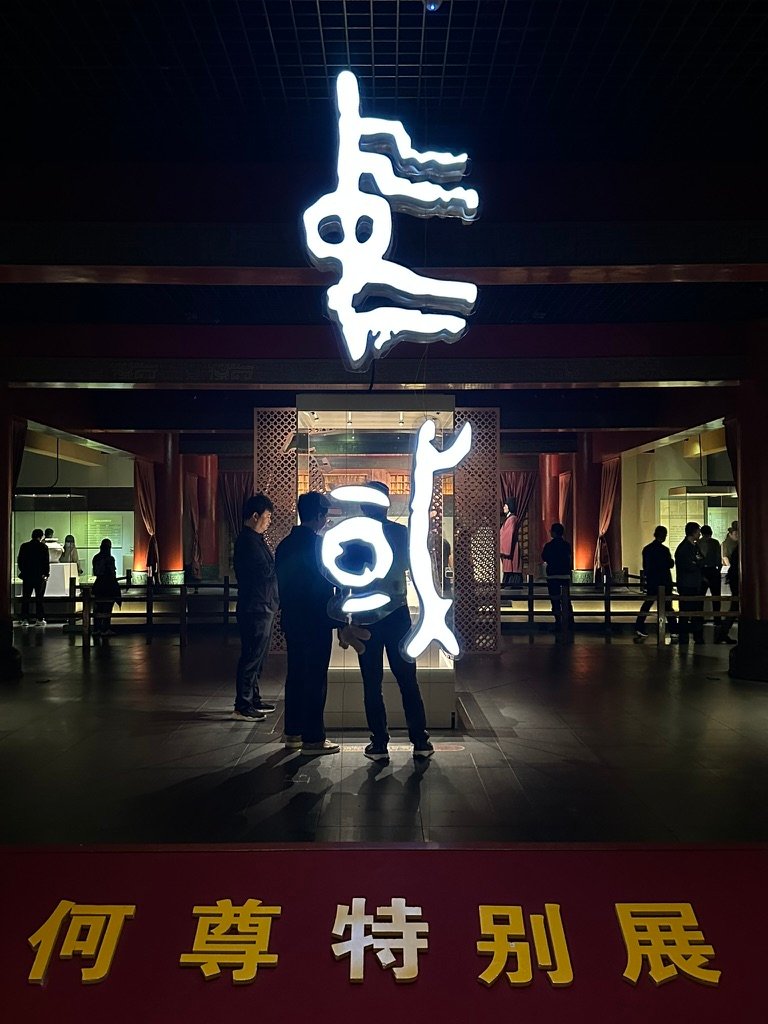
One Bronze. Two Familiar Characters. One Very Long Rabbit Hole.
If you’re learning Mandarin, there are two Chinese characters you probably recognize very quickly:
中国 — Zhōngguó
China
Easy.
中 — zhōng
middle / center
国 — guó
country / state
Put them together:
中国 = China.
Lesson finished.
Right?
😂
Not quite.
Because in a museum in Baoji, Dad & Elaine encountered an ancient bronze vessel with those same two characters hidden inside it:
中国
And the bronze is more than:
3,000 years old.
😳
Now we have a problem.
Because the modern country we call China did not exist 3,000 years ago in the political form we know today.
So what did:
中国
mean then?
🐇
Welcome to:
He Zun (何尊, Hé Zūn).
🏺 First: What Is He Zun?
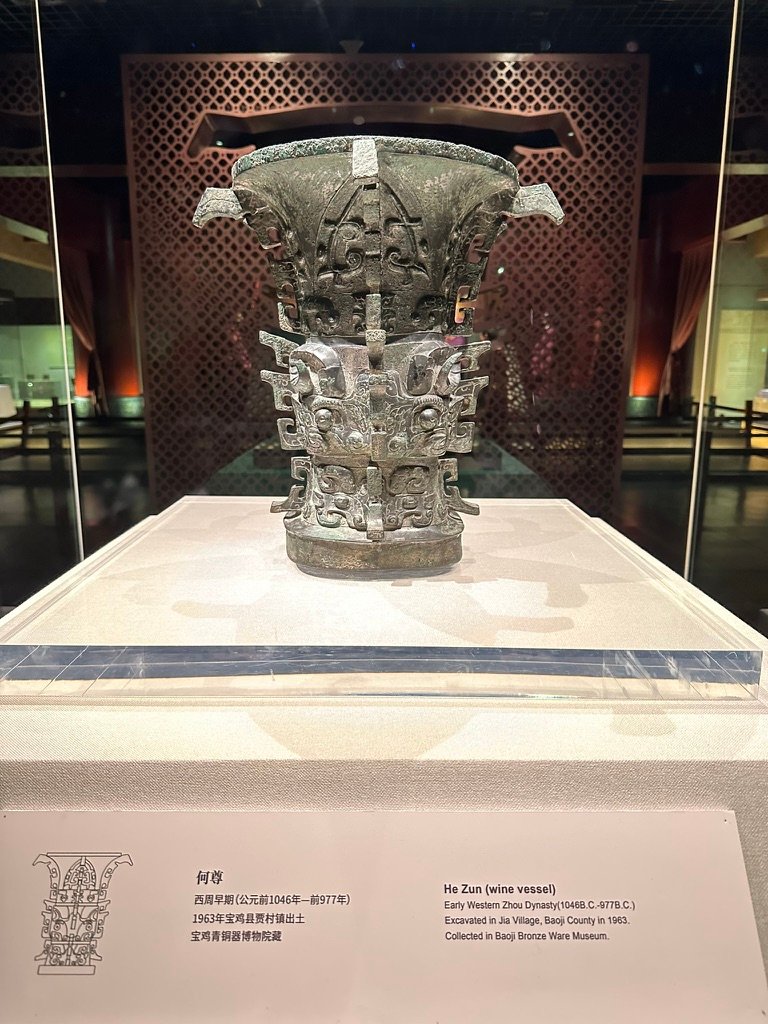
He Zun is an early:
Western Zhou (西周, Xī Zhōu)
ritual bronze dating to roughly the:
11th century BCE.
It was discovered in:
Baoji (宝鸡, Bǎojī)
in Shaanxi Province (陕西省, Shǎnxī Shěng).
Today it is one of the great treasures associated with the:
Baoji Bronze Ware Museum (宝鸡青铜器博物院, Bǎojī Qīngtóngqì Bówùyuàn).
The:
尊 — zūn
is a type of ritual wine vessel.
Beautiful?
Yes.
Historically important?
Very.
But Dad’s favorite part isn’t really the outside.
😂
It’s:
INSIDE.
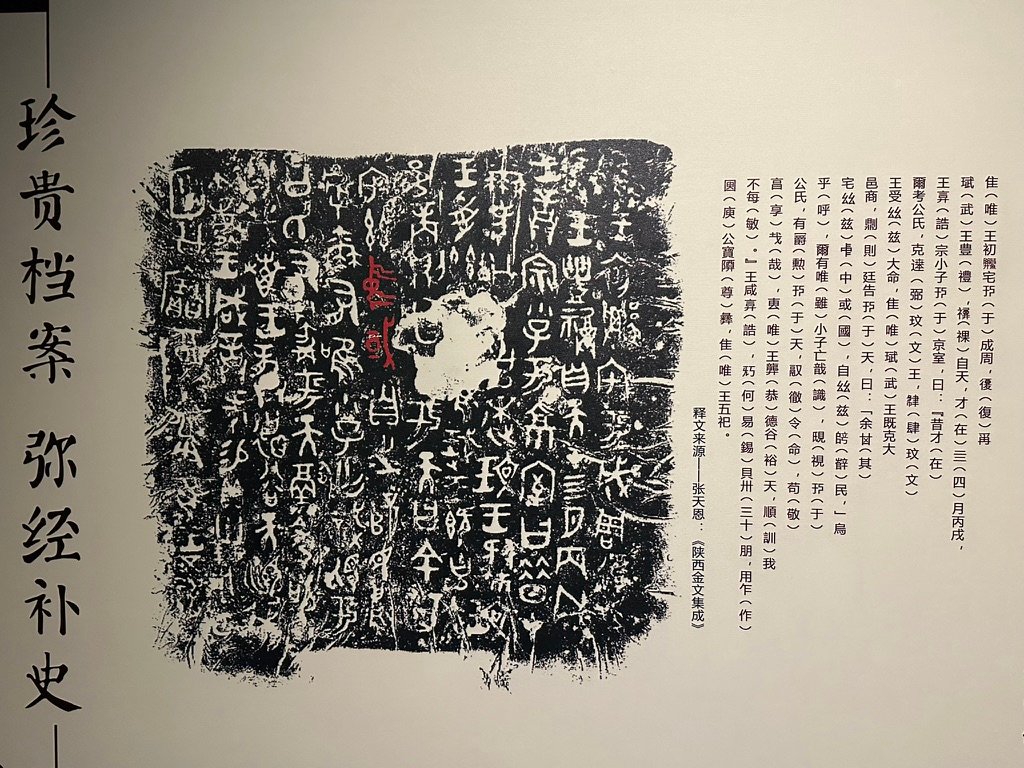
👀 Look Inside the Bronze
Inside He Zun is an inscription of:
122 characters
of which:
119 remain legible.
This kind of bronze inscription is called:
铭文 — míngwén
inscription
and the writing belongs to the world of:
金文 — jīnwén
bronze script
These inscriptions are enormously valuable because they can preserve words connected directly with:
royal commands,
appointments,
ritual events,
political relationships
and:
historical memory
from the Zhou world itself.
In this case, the inscription concerns events during the reign of:
King Cheng of Zhou (周成王, Zhōu Chéngwáng).
And buried inside those ancient characters is a phrase that makes modern Chinese readers stop:
宅兹中国
😳
There they are.
中国.
🐇 Wait — Does a 3,000-Year-Old Bronze Really Say “China”?
Yes.
The characters:
中国
appear in the He Zun inscription.
And He Zun is widely celebrated because this is the earliest known written occurrence of the two characters 中国 together found in an archaeological inscription.
🔥
But now comes the important Deep China warning:
中国 DID NOT MEAN THE MODERN NATION-STATE “CHINA” HERE.
Please don’t read a 3,000-year-old inscription using only a modern Mandarin dictionary.
😂
Words travel through history too.
And their meanings can change.

Western Handrail: Imagine Finding the Word “America” 2,000 Years Ago
Suppose archaeologists discovered an ancient inscription containing a word that looks exactly like:
AMERICA.
Your first reaction might be:
“Whoa! The United States existed 2,000 years ago?”
😂
Obviously not.
You would immediately ask:
What did that word mean in THAT historical context?
That’s roughly the mental adjustment we need with:
中国.
The characters are familiar.
The political world behind them is not.
🔥
So instead of asking:
“Did China already exist exactly as today’s China 3,000 years ago?”
ask:
“What did 中国 mean to the people who put those characters into this bronze?”
Now we’re doing history.
🔎 So What Did 中国 Mean Here?
The phrase in the inscription is:
宅兹中国 — zhái zī Zhōngguó
Translating a 3,000-year-old bronze inscription word-for-word into modern English is specialist territory.
So Dad isn’t going to pretend we’re reading a restaurant menu.
😂
But in this early Zhou context:
中国
points toward the:
CENTRAL REGION / CENTRAL POLITICAL AREA
of the Zhou world.
It did NOT yet mean:
the modern sovereign country called China with today’s borders.
That distinction is crucial.
The political geography of the early Zhou was very different.
And once we understand that…
He Zun becomes even more interesting.
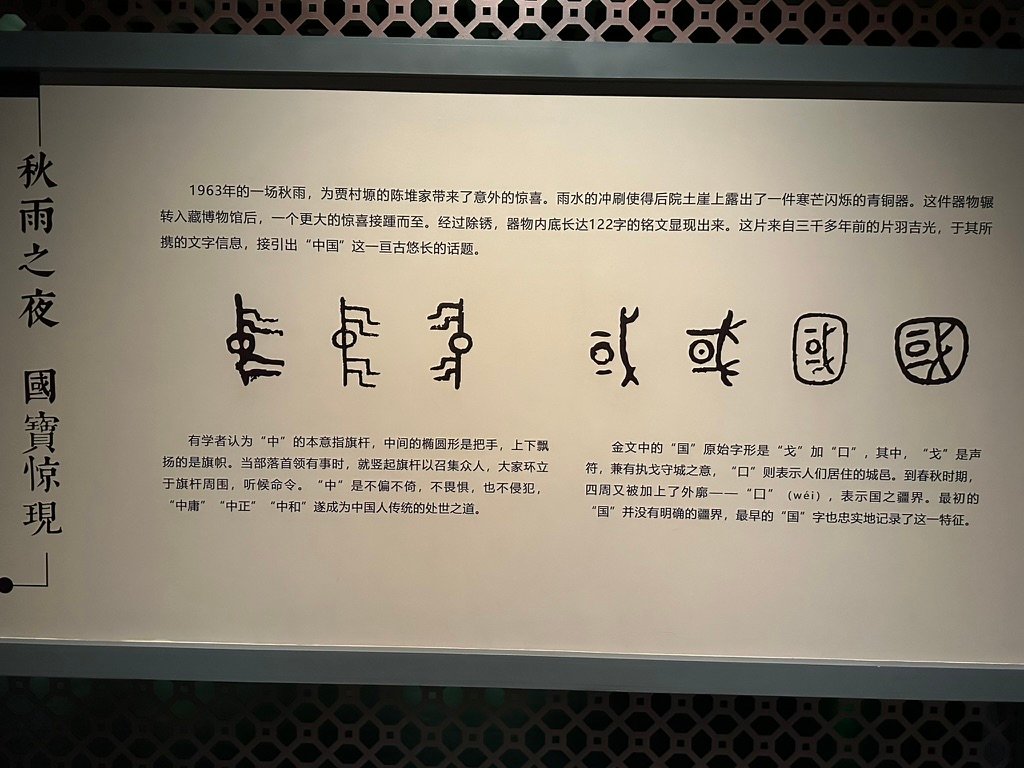
🧭 中 Doesn’t Automatically Mean “Middle Kingdom”
Western travelers often hear:
“China means the Middle Kingdom.”
That’s a useful beginner shorthand.
But He Zun shows why we should be careful.
中 — zhōng
can carry ideas of:
middle,
center
or:
centrality.
And:
国 — guó
didn’t necessarily mean a modern nation-state either.
So early:
中国
is better understood through its:
HISTORICAL POLITICAL GEOGRAPHY
than through the modern English phrase:
“Middle Kingdom.”
🔥
Same characters.
Different political world.
🐇 Wait — What About 国?
Modern Mandarin learners quickly learn:
国 — guó
country
Very useful today.
Potentially misleading 3,000 years ago.
😂
In ancient contexts, 国 could refer to political domains or states that don’t map neatly onto our modern idea of a nation-state.
Later in Chinese history we’ll encounter:
齐国 — Qí Guó
State of Qi
赵国 — Zhào Guó
State of Zhao
秦国 — Qín Guó
State of Qin
These were not:
modern countries with passports, embassies and Olympic teams.
😂
They belonged to a very different political system.
And this little character:
国
eventually opens enormous rabbit holes toward:
天下 — tiānxià
华夏 — Huáxià
and:
中华 — Zhōnghuá.
But…
NOT TODAY.
😂🐇
Back to the bronze.
🧠 Why He Zun Is So Important
He Zun doesn’t prove:
“Modern China existed unchanged for 3,000 years.”
That’s not what the artifact tells us.
What it gives us is something subtler and much more interesting:
a very early snapshot of how political space was being described.
And it gives us physical evidence that the character combination:
中国
was already being used more than:
3,000 years ago.
The characters survived.
Their meanings:
EVOLVED.
🔥
That is much more interesting than pretending words never change.
Another Western Handrail: London Is Still London — But “England” Kept Changing
Think about European history.
A place name or political term can survive for centuries while:
borders change,
rulers change,
institutions change,
territories expand or contract
and:
the meaning of political identity evolves.
“England” in the medieval period isn’t politically identical to the modern United Kingdom.
“Rome” can mean:
a city,
a republic,
an empire,
a civilization
or:
a religious center
depending on the sentence and the century.
🔥
Same word.
Different historical context.
That’s the habit we need when reading:
中国
on He Zun.
🧑🏫 Dad’s Artifact Method
This is why Dad loves starting with:
ONE OBJECT.
Instead of trying to explain the whole Zhou dynasty first, begin with:
HE ZUN.
Then ask:
1. WHEN?
Early Western Zhou.
2. WHERE?
Baoji — in the Zhou historical heartland.
3. WHAT IS IT?
A ritual bronze vessel.
4. WHAT’S ON IT?
A bronze inscription.
5. WHAT CATCHES OUR EYE?
中国.
6. WHAT DID IT MEAN?
Ah.
🐇
Now we have to understand:
King Cheng,
the Zhou conquest,
the new eastern political center,
Luoyi,
and:
early Zhou political geography.
One object has become:
a time machine.
🔥

Halfway Sting Check
You started with:
中国 = China.
Easy.
Now He Zun has made those two familiar characters slightly dangerous.
😂
You know:
中国 appears on a bronze more than 3,000 years old.
But you also know:
中国 did NOT mean today’s modern nation-state in exactly the same way.
So our next question becomes:
What political world produced those words?
And that takes us behind the inscription…
to:
King Cheng of Zhou
a newly conquered realm
and:
the building of a new eastern center.
🐇🔥
Section 2 — The World Behind 宅兹中国
Now we know that He Zun contains:
宅兹中国
zhái zī Zhōngguó
and that:
中国
did NOT yet mean the modern nation-state called China.
So what DID it mean?
To understand that, we need to leave the bronze for a moment…
and enter the political world that produced it.
🐇
Put He Zun on the Zhou Coat Rack
We are in the:
early Western Zhou (西周, Xī Zhōu)
roughly three thousand years ago.
The Zhou had recently defeated the:
Shang dynasty (商朝, Shāng Cháo).
That victory created an obvious problem.
Winning the war was one thing.
GOVERNING WHAT YOU HAD JUST WON WAS ANOTHER.
🔥
The Zhou political heartland lay farther west, around areas Dad & Elaine later visited near:
Qishan (岐山, Qíshān)
and:
Zhouyuan (周原, Zhōuyuán)
in Shaanxi Province (陕西省, Shǎnxī Shěng).
But the territory formerly controlled by Shang extended much farther east.
So the new Zhou rulers faced a very practical political question:
How do we control this much larger realm?
👑 Enter King Cheng of Zhou
He Zun belongs to the reign of:
King Cheng of Zhou (周成王, Zhōu Chéngwáng).
He was the son of:
King Wu of Zhou (周武王, Zhōu Wǔwáng),
the ruler associated with Zhou’s conquest of Shang.
King Cheng inherited:
a victory
but also:
a governing problem.
😂
The new dynasty needed to stabilize its authority over the former Shang territories and strengthen its presence farther east.
That leads us toward:
Luoyi (洛邑, Luòyì)
in the area of modern:
Luoyang (洛阳, Luòyáng).
🐇
Why Build an Eastern Center?
Think geographically.
The Zhou homeland was:
WEST.
Much of the newly conquered political world lay:
EAST.
Trying to govern everything only from the western heartland created obvious problems of:
distance,
communication,
military control,
administration
and:
political presence.
So establishing a major eastern center around Luoyi made enormous strategic sense.
🔥
And now the He Zun inscription starts becoming much easier to understand.
Western Handrail: The New Owners Need an Eastern Headquarters
Dad’s corporate brain immediately sees a handrail.
😂
Imagine a company headquartered in the west suddenly acquires an enormous operation in the east.
The CEO could say:
“Excellent. Acquisition completed.”
But then somebody asks:
“Who’s actually going to manage the eastern operation?”
😬
You might need:
AN EASTERN HEADQUARTERS.
Not because the western headquarters disappeared.
But because the organization had become:
BIGGER THAN BEFORE.
That’s roughly the handrail.
Zhou had conquered Shang territory.
Now it needed political infrastructure capable of helping govern the enlarged realm.
Luoyi became part of that solution.
🏗️ And This Is Where He Zun Becomes Historical Evidence
The inscription inside He Zun refers to King Cheng and the establishment of the new eastern center.
And within that context appears:
宅兹中国
A cautious beginner’s sense is:
to establish/dwell here in the central region.
Don’t treat that as a perfect word-for-word modern translation.
Ancient bronze inscriptions are specialist territory.
But the important idea is clear enough for our journey:
中国 referred here to a CENTRAL POLITICAL REGION.
🔥
Not:
“the People’s Republic of China.”
Not:
the borders on today’s map.
Not even:
a unified empire.
That political world hadn’t arrived yet.
🧭 Center of WHAT?
This is the question that makes the phrase interesting.
If:
中国
means something like:
central region / central political area
in this context…
then:
central relative to what?
😳
Now we are thinking like historical geographers.
The Zhou rulers had expanded eastward into the former Shang political world.
The region around Luoyi occupied an important position within that enlarged political landscape.
So:
“CENTER”
wasn’t merely a compass point.
It could express:
POLITICAL CENTRALITY.
Western Handrail: Washington, Rome — or “The Center”
Modern travelers are accustomed to drawing:
BORDERS.
This side:
Country A.
That side:
Country B.
Ancient political geography could work differently.
Think instead about the importance of:
CENTERS.
Rome wasn’t important because somebody had drawn the borders of the Roman Empire permanently around it.
It mattered because:
political authority radiated from a center.
Likewise, Washington today is geographically just one city.
Politically:
“Washington”
can mean the federal government itself.
🔥
That’s a useful handrail for He Zun.
When the inscription points toward:
中国
we should think less:
“modern country with fixed borders”
and more:
“the central political space from which order is being organized.”
Not an exact equivalence.
Just a bridge for the Western brain.
😳 And This Makes Luoyang Much More Interesting
Modern travelers know:
Luoyang (洛阳)
as one of China’s great historic cities.
Longmen Grottoes.
Ancient capitals.
Peonies.
Tang history.
Plenty of reasons to visit.
😂
But He Zun sends us much farther backward.
Toward:
LUOYI 洛邑
and the early Zhou attempt to establish an important eastern political center.
Suddenly Luoyang isn’t merely:
“another ancient capital.”
It becomes part of the answer to:
How did Zhou try to govern the world it had conquered?
🔥
And this rabbit becomes even more interesting later.
Because when Western Zhou collapses in:
771 BCE,
the Zhou court moves east.
Then:
Luoyi
becomes the royal center of:
Eastern Zhou (东周, Dōng Zhōu).
😳
So the eastern center mentioned in the early Zhou story eventually becomes central to:
the next great chapter of Zhou history.
🐇 Dad Hasn’t Finished This Rabbit Yet
Dad & Elaine have already visited:
Qishan 岐山
Zhouyuan 周原
and:
Baoji 宝鸡.
Those places help us understand the:
WESTERN ZHOU HEARTLAND.
But He Zun points east toward:
Luoyang 洛阳.
And Dad & Elaine still need to follow that rabbit properly.
😂🐇
So the travel map becomes:
QISHAN / ZHOUYUAN
Zhou heartland
↓
BAOJI
He Zun
↓
宅兹中国
↓
LUOYI
↓
LUOYANG
🔥
Another train ticket may eventually be required.
🧠 But Don’t Make 中国 Stand Still
This is perhaps the most important lesson from He Zun.
The characters:
中国
survived.
But their meaning did not remain frozen inside this bronze forever.
Across later centuries, China’s political geography changed enormously.
States rose.
States disappeared.
Empires formed.
Empires fragmented.
Territories changed.
Ideas of political and cultural identity evolved.
And:
中国
evolved with them.
🔥
So He Zun gives us:
A SNAPSHOT.
Not:
A PERMANENT DICTIONARY DEFINITION.
That’s a very useful habit when reading ancient history.
Western Handrail: Don’t Translate History Backward
Imagine reading a document from:
the Roman Republic
and automatically interpreting every political word according to:
modern Italy.
You’d get into trouble very quickly.
😂
Or reading:
“Britain”
in a Roman-era source and assuming it meant exactly:
the modern United Kingdom.
Same problem.
Historical words belong first to:
THEIR OWN TIME.
Only afterward should we ask how their meanings developed into the words we use today.
That is exactly what He Zun asks us to do with:
中国.
🔥 So What Does He Zun Actually Give Us?
Not proof that:
“Modern China already existed unchanged 3,000 years ago.”
And not proof that:
“中国 has always meant exactly the same thing.”
Instead, it gives us something historically much more valuable:
A CONTEMPORARY EARLY-ZHOU INSCRIPTION
showing:
中国
being used within the political geography of that world.
And because the inscription is:
CAST INTO BRONZE,
we’re not relying only on a text copied and recopied centuries later.
The object itself survived.
😳
That’s why archaeologists and historians care so much about:
铭文 — míngwén.
Sometimes:
the artifact speaks.

Sting Check
One bronze has now given us:
HE ZUN 何尊
↓
KING CHENG 周成王
↓
ZHOU CONQUERS SHANG
↓
A BIGGER REALM NEEDS AN EASTERN CENTER
↓
LUOYI 洛邑
↓
宅兹中国
↓
中国 = CENTRAL POLITICAL REGION IN THIS EARLY-ZHOU CONTEXT
🔥
And suddenly those two familiar Chinese characters:
中国
feel much older…
and much more complicated.
Good.
😂
That’s exactly what we wanted.
But there is still one important difference between:
reading about He Zun
and:
standing in front of it.
Dad votes for the second.
🐇
Next: Section 3 — Go to Baoji and Meet He Zun
Section 3 — Go to Baoji and Meet He Zun
After all that:
中国
King Cheng
Luoyi
and:
early Zhou political geography…
Dad has one final recommendation.
😂
GO SEE THE BRONZE.
Because He Zun works particularly well as a Deep China artifact when you encounter it in:
Baoji (宝鸡, Bǎojī)
close to the historical landscape from which the early Zhou story emerged.
🚄 Getting to Baoji
For most international travelers, the easiest starting point is:
Xi’an (西安, Xī’ān).
High-speed trains connect:
Xi’an North Railway Station (西安北站)
with:
Baoji South Railway Station (宝鸡南站).
The journey is generally around:
one hour
depending on the train.
From Baoji South, a taxi or DiDi (滴滴) can take you toward:
Baoji Bronze Ware Museum
宝鸡青铜器博物院
🔥
That makes Baoji very possible as:
a day trip from Xi’an.
But Dad has another suggestion.
If Chinese history is the reason you’re coming:
DON’T RUSH BACK TOO QUICKLY.
🏺 First Problem: Bronze Fatigue
Walk into a major Chinese bronze museum and you may encounter:
鼎
簋
尊
爵
觥
卣
and approximately…
8,742 things that look like ancient pots.
😭😂
Dad understands.
You do NOT need to identify every vessel type.
You do NOT need to memorize every archaeological period.
You do NOT need to read every museum label.
Instead, choose:
ONE OBJECT.
For this visit:
HE ZUN 何尊.
👀 Dad’s Museum Survival Rule
When you find He Zun:
STOP.
Don’t photograph it in seven seconds and immediately move to the next display.
😂
Look at:
the shape.
Then:
the surface decoration.
Then remember:
the really important part is INSIDE.
Because the historical treasure isn’t merely the bronze vessel.
It’s:
the inscription.
🔎 Look for the 铭文
Remember:
铭文 — míngwén
inscription
Inside He Zun are the ancient characters that turned this bronze into one of China’s most famous historical artifacts.
Among them:
宅兹中国
🔥
That is the moment Dad wants the reader to have.
You learned:
中国 = China
in modern Mandarin.
Then you stand in front of a bronze more than 3,000 years old…
and discover:
中国
inside it.
Same characters.
Different historical world.
That’s:
time travel without a license.
😂
😵 Don’t Expect to Read It Yourself
Even if you read modern Chinese, don’t feel bad if the inscription looks:
completely impossible.
😂
This is:
金文 — jīnwén
bronze script
from the ancient Zhou world.
The forms of many characters look very different from modern printed Chinese.
So this is NOT an HSK reading test.
Dad’s advice:
LOOK AT THE ORIGINAL
↓
LOOK AT THE TRANSCRIPTION
↓
READ THE MUSEUM EXPLANATION
↓
then:
FIND 中国.
🔥
That little recognition moment is enough.
📸 Dad’s Museum Rule No. 2: Photograph the LABEL
This is something Dad learned the hard way.
😂
You see an amazing object.
Take twelve photographs.
Go home.
Six months later:
“Elaine… what exactly was this?”
😭
So now Dad photographs:
THE OBJECT
and:
THE EXPLANATION BOARD.
If there is:
a date,
excavation location,
transcription,
translation
or:
historical explanation,
photograph that too.
🔥
Those boring-looking information boards can become enormously useful later.
Sometimes:
the photograph gives you the memory.
the label gives you the rabbit hole.
🐇
🧠 Don’t Stop at 中国
Once you’ve found the famous two characters, ask:
What ELSE does this inscription tell us?
Now He Zun becomes more than:
“the bronze with 中国 on it.”
It points toward:
King Cheng of Zhou
↓
the newly conquered eastern territories
↓
the construction of an eastern political center
↓
Luoyi
↓
early Zhou political geography.
🔥
That’s when an artifact becomes:
HISTORY.
Western Handrail: Don’t Visit the Rosetta Stone Just to Find One Word
Imagine standing in front of the:
Rosetta Stone
and saying:
“Great. I found the Greek writing. Next exhibit!”
😂
You would miss why the object matters.
Same with He Zun.
Finding:
中国
is the hook.
But the real reward is understanding:
WHY those characters appear there.
The famous word gets you through the door.
The historical context is what makes the visit worthwhile.
🐇 Then Leave the Museum — Because Zhou Is Outside Too
This is where Baoji becomes much more interesting.
He Zun isn’t an isolated object that somehow landed in a museum.
You’re traveling through a region deeply connected with:
the early Zhou world.
Dad & Elaine also followed the rabbit toward:
Qishan 岐山
and:
Zhouyuan 周原.
Now the museum artifact has:
A LANDSCAPE.
🔥
That’s one reason Dad prefers:
OBJECT FIRST → LANDSCAPE SECOND.
See He Zun.
Understand:
early Zhou.
Then go looking for:
where that Zhou story came from.
🚗 This Is Where a Local Guide Can Be Worth It
Baoji itself is straightforward enough.
But once you start connecting:
Baoji → Qishan → Zhouyuan
the journey becomes more spread out.
For international travelers who want to understand the history rather than simply reach the sites, Dad would consider:
a private car + knowledgeable English-speaking local guide.
Not because independent travel is impossible.
But because at archaeological and historical sites:
interpretation matters.
A good guide can help turn:
“old bronze”
into:
royal command + political geography + Zhou history.
And:
“archaeological ruins”
into:
a landscape you can place on the timeline.
🔥
Ask specifically for someone interested in:
Western Zhou history + archaeology + bronze inscriptions.
That’s very different from simply requesting:
“English-speaking sightseeing guide.”
🛏️ Dad’s Preference: Stay in Baoji
Could you visit Baoji from Xi’an and return the same day?
YES.
Would Dad always do that?
NO.
😂
If you’re genuinely interested in the Zhou story, staying overnight gives you room to:
DAY 1
Baoji Bronze Ware Museum
He Zun
understand the artifact
then:
DAY 2
Qishan / Zhouyuan
follow the historical landscape
🔥
That is much more Deep China than:
Train in → photograph bronze → train out.
Or as Dad calls that:
historical cardio.
😂
⚠️ One Practical Warning: Check Whether He Zun Is on Display
This matters.
Major museum treasures can sometimes be:
temporarily removed,
loaned for exhibitions,
under conservation
or:
otherwise unavailable.
So if seeing:
He Zun itself
is the main reason for your trip, check the museum’s latest official information before traveling.
Don’t take a high-speed train across Shaanxi and arrive saying:
“ChatGPT promised me the bronze.”
😭😂
Exhibition arrangements can change.
Always verify.
🐇 And Then He Zun Gives You TWO Directions
Once you’ve seen the bronze, you can follow the rabbit:
WEST / LOCAL
toward:
Qishan 岐山
and:
Zhouyuan 周原
to explore the early Zhou heartland.
Or follow it:
EAST
toward:
Luoyang 洛阳
and the historical world of:
Luoyi 洛邑.
🔥
One bronze.
Two directions.
And several future train tickets.
😂🐇
🐞 Final Sting
You came to Baoji looking for:
TWO CHARACTERS.
中国.
Instead, He Zun gave you:
a king,
a conquest,
an eastern capital,
a political center,
an ancient inscription
and:
a word whose meaning kept evolving for three thousand years.
🔥
That’s why Dad likes artifacts.
A good artifact doesn’t merely answer:
“What is this?”
It makes you ask:
“What world produced this?”
And once you ask that…
the rabbit starts running.
🐇
🐞 ChinaTravelBUG’s Take
If you’re visiting Xi’an for the first time, absolutely see:
the Terracotta Warriors.
They are extraordinary.
But if Chinese history has already started stinging you…
take another train.
Go to:
Baoji.
Find:
He Zun.
Look inside.
Find:
中国.
Then remember:
THE CHARACTERS ARE FAMILIAR.
THE MEANING HAS A HISTORY.
That one realization can change the way you read Chinese historical sites everywhere else.
And that’s exactly what Deep China is trying to do.
See the place. Ask the bigger question. Understand China better.
🐞🐇🔥
🐇 NEXT RABBIT
If He Zun has made you wonder:
“Okay… but who exactly were these Zhou people, and why did their world matter so much?”
continue with: