Beyond Xi’an: Qishan (岐山) & Zhouyuan (周原) — Walking Through the Homeland of the Zhou
Xi’an (西安, Xī’ān) gives most international travelers their first great encounter with ancient China.
The:
Terracotta Warriors (兵马俑, Bīngmǎyǒng),
Qin Dynasty (秦朝, Qín Cháo),
and:
Qin Shi Huang (秦始皇, Qín Shǐ Huáng)
are difficult to miss.
But Dad & Elaine kept asking the question that causes so much trouble on ChinaTravelBUG:
“WHAT CAME BEFORE QIN?”
😂🐇
That question took us west.
First to:
Baoji (宝鸡, Bǎojī).
Then farther into:
Qishan (岐山, Qíshān)
and:
Zhouyuan (周原, Zhōuyuán).
And somewhere along the way…
the Zhou stopped feeling like another dynasty on a timeline.
They acquired:
A LANDSCAPE.
🚡 First — Come Up Fenghuangshan (凤凰山) With Us
Before another:
king,
bronze,
or:
date…
come with us.
😂
Dad & Elaine took the:
Zhouyuan Cableway (周原索道, Zhōuyuán Suǒdào)
up:
Fenghuangshan (凤凰山, Fènghuáng Shān)
Phoenix Mountain.
Below the cable car were:
fields,
trees,
tracks,
and:
the countryside of Qishan.
And yes…
Elaine was sitting inside the cabin looking out too.
🎥 Dad & Elaine riding the Zhouyuan Cableway up Fenghuangshan (凤凰山, Fènghuáng Shān).
This wasn’t just transportation.
We were climbing high enough to begin seeing:
THE LAND.
🎥 Then Look Across Zhouyuan (周原, Zhōuyuán)
At the top…
the landscape opens.
Now look.
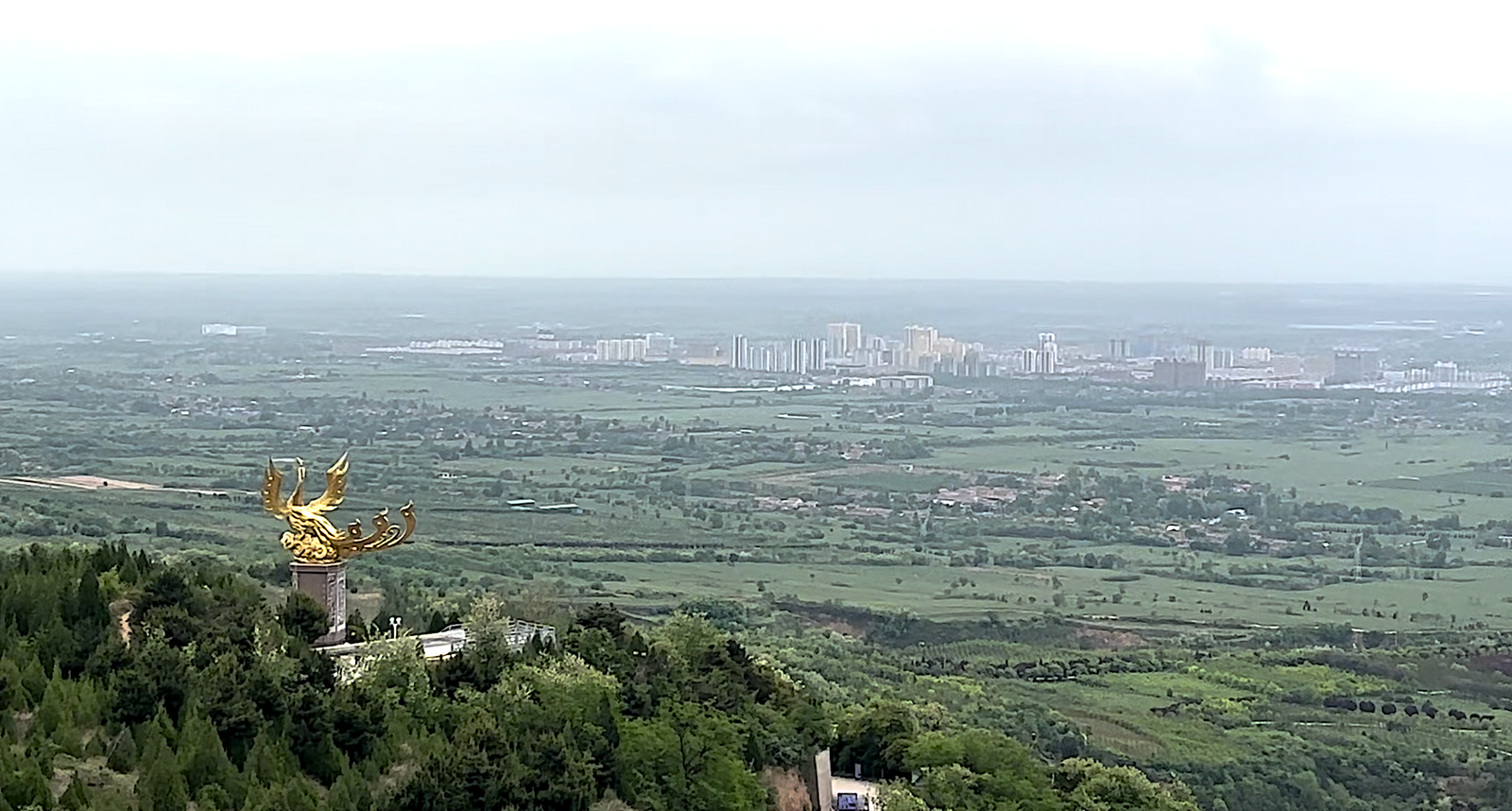
From Fenghuangshan, Dad & Elaine could see across the broad:
Zhouyuan (周原, Zhōuyuán) Plain.
Farmland.
Villages.
Roads.
Modern Qishan in the distance.
And an enormous landscape stretching toward the horizon.
This was when something clicked for Dad.
BAOJI GAVE US THE OBJECTS.
ZHOUYUAN GAVE THEM A PLACE.
🔥
🏺 Because Our Zhou Rabbit Had Actually Started in Baoji
Before coming here, Dad & Elaine had visited:
Baoji Bronze Ware Museum (宝鸡青铜器博物院, Bǎojī Qīngtóngqì Bówùyuàn).
There we encountered the early Zhou world through:
bronze ritual vessels,
inscriptions,
archaeological finds,
and:
names Dad was still trying to hang on his Coat Rack.
😂
One bronze opened an especially large rabbit:
He Zun (何尊, Hé Zūn).
Its inscription contains the ancient characters:
中国 (Zhōngguó).
Not “China” in exactly the modern sense.
That’s precisely what makes it interesting.
🏺 Before Zhouyuan — Follow Dad & Elaine to Baoji (宝鸡, Bǎojī) and Into the China Before Qin Shi Huang →
And if He Zun has already stung you:
🐇 He Zun (何尊, Hé Zūn) — The 3,000-Year-Old Bronze That Bears the Characters 中国 (Zhōngguó) →
But after looking into all those museum cases…
Dad had another question:
“WHERE DID THIS WORLD ACTUALLY HAPPEN?”
That’s why we came to:
Zhouyuan (周原, Zhōuyuán).
🗺️ Zhouyuan (周原, Zhōuyuán) Isn’t Just One Attraction
This is important for international travelers.
When Dad says:
Zhouyuan (周原, Zhōuyuán),
don’t imagine one ancient city surrounded by a wall.
Think:
A HISTORICAL LANDSCAPE.
The wider area around:
Qishan (岐山, Qíshān)
and:
Fufeng (扶风, Fúfēng)
is deeply associated with the world from which Zhou emerged.
Dad & Elaine weren’t simply moving:
Attraction A → Attraction B → Attraction C.
We were moving through a landscape where:
archaeology,
bronzes,
mountains,
museums,
later temples,
and:
cultural memory
keep pointing back toward Zhou.
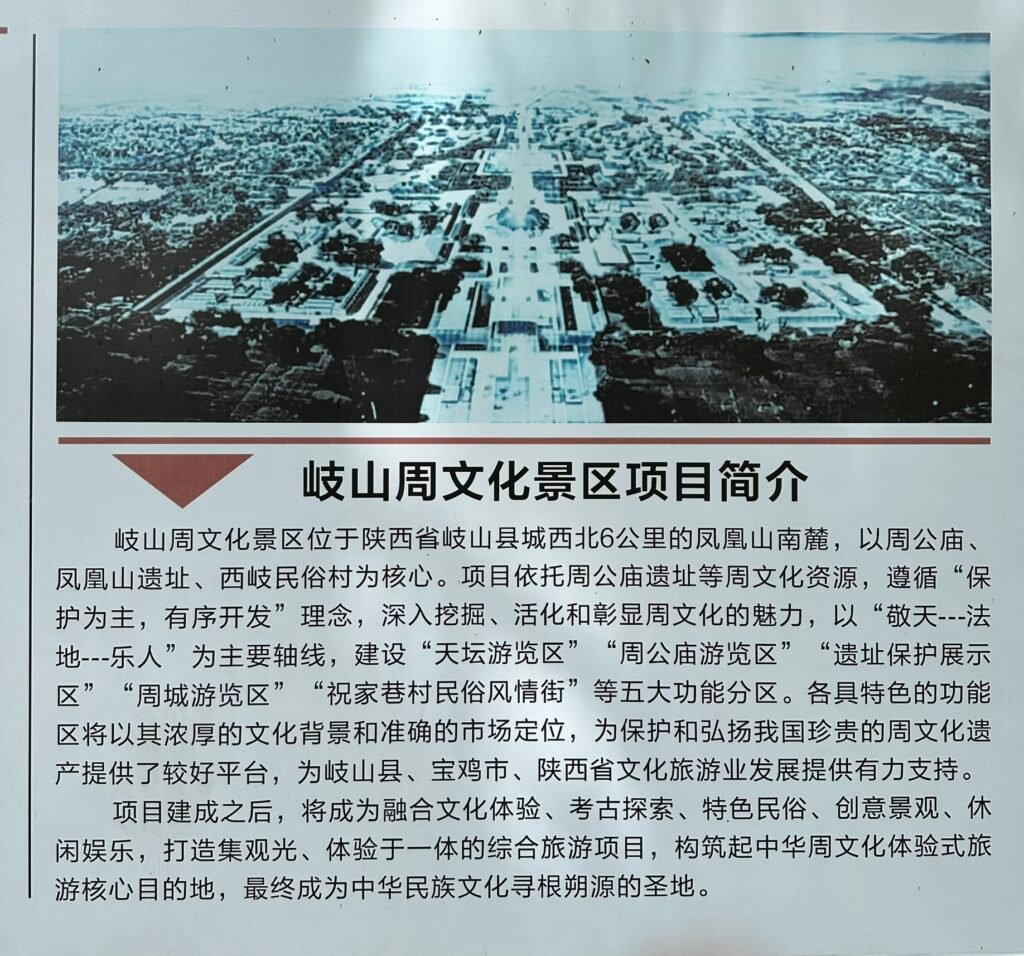
The Qishan Zhou Cultural Scenic Area (岐山周文化景区, Qíshān Zhōu Wénhuà Jǐngqū) information board places the scenic area at the southern foot of Fenghuangshan (凤凰山, Fènghuáng Shān), about 6.5 km northwest of Qishan county town. It identifies Zhougong Temple (周公庙, Zhōugōng Miào), the Fenghuangshan archaeological area and other Zhou cultural resources as parts of the wider cultural landscape.
Dad finally understood:
WE WEREN’T VISITING ONE RUIN.
We were trying to read:
A WHOLE LANDSCAPE.
🚡 The Cableway Helps Join the Pieces
Remember the cable car Dad & Elaine took at the beginning?
The information board gives the:
Zhouyuan Cableway (周原索道, Zhōuyuán Suǒdào)
a total horizontal length of about:
2,550 METERS
and an elevation difference of about:
262 METERS.
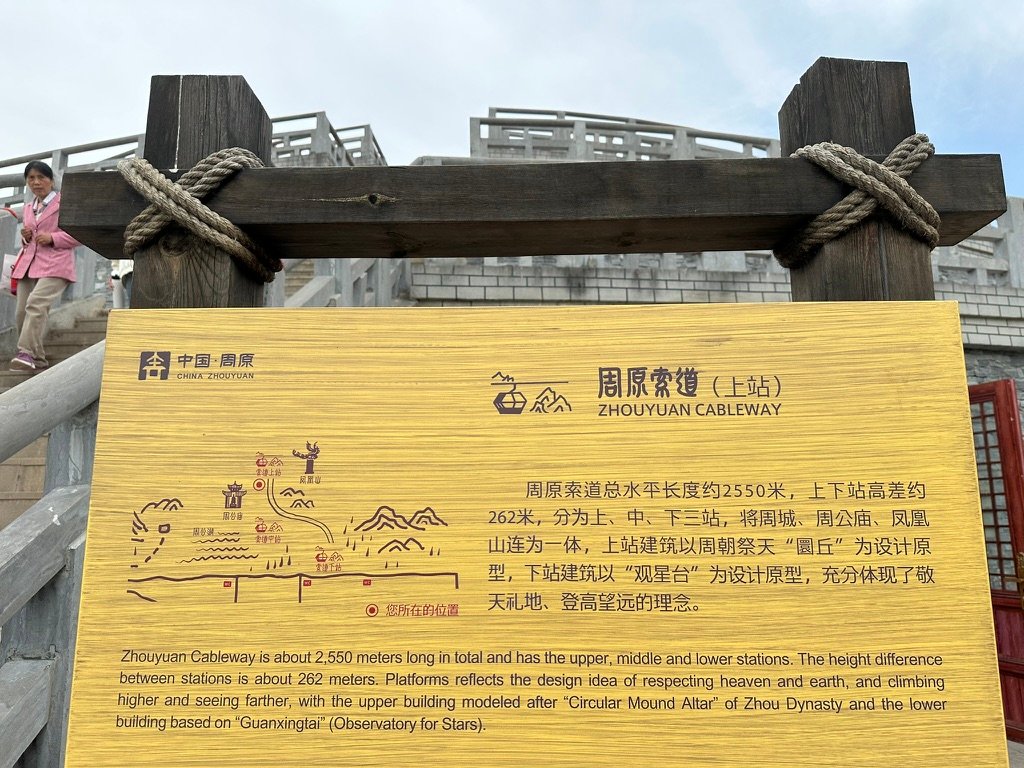
The board describes the route as connecting:
Zhou City (周城, Zhōuchéng),
Zhougong Temple (周公庙, Zhōugōng Miào),
and:
Fenghuangshan (凤凰山, Fènghuáng Shān).
For international travelers, that tells you something useful.
This isn’t one compact museum courtyard.
You’re moving through:
A CULTURAL LANDSCAPE.
🐦 Why Is There a Giant Phoenix Up Here?
From Fenghuangshan, Dad photographed the golden phoenix overlooking the plain.
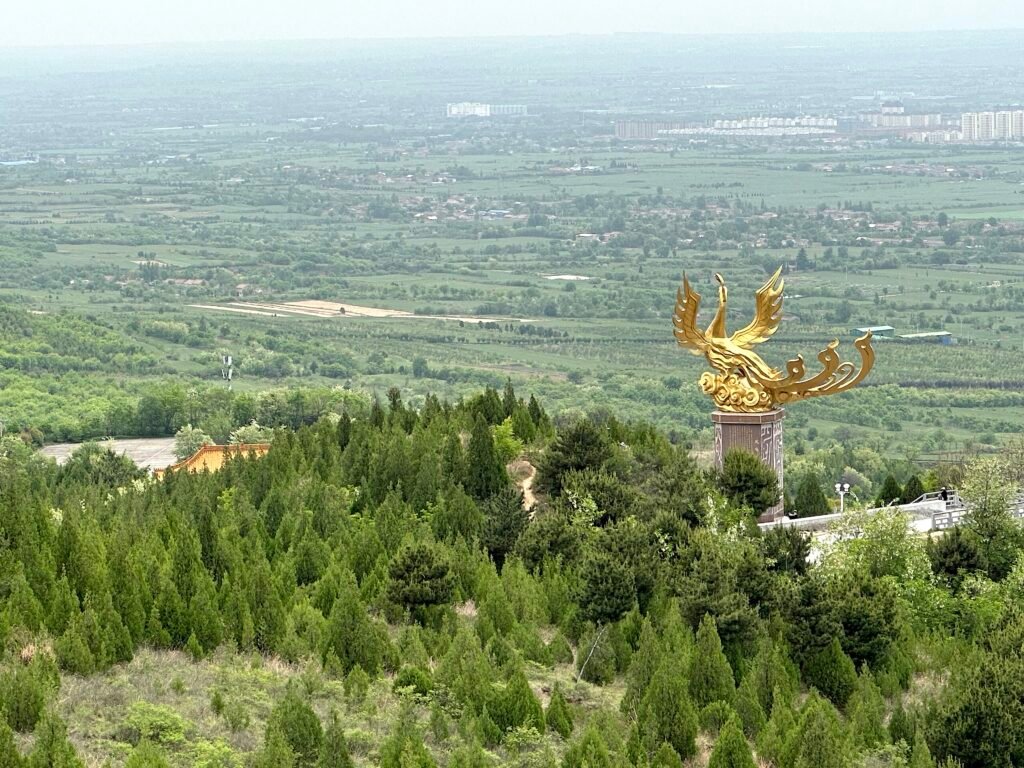
Looking across the Zhouyuan (周原, Zhōuyuán) landscape from Fenghuangshan (凤凰山, Fènghuáng Shān). The golden phoenix reflects cultural traditions connecting Qishan with the auspicious rise of Zhou.
And of course Dad asked:
“Why a phoenix?”
😂
One famous expression associated with Qishan is:
凤鸣岐山 (Fèng Míng Qíshān)
“The phoenix cries at Qishan.”
The phoenix became associated in later tradition with the auspicious rise of Zhou.
But Dad keeps the evidence brake on.
CULTURAL TRADITION
is not automatically:
ARCHAEOLOGICAL EVIDENCE.
Both help us understand Zhouyuan.
They simply answer different questions.
Where Are We? — Dad’s Tiny Zhou Coat Rack
No monster timeline.
😂
Keep only this:
SHANG DYNASTY (商朝, Shāng Cháo)
↓
Zhou grows as a regional power.
↓
KING WEN OF ZHOU (周文王, Zhōu Wénwáng)
↓
KING WU OF ZHOU (周武王, Zhōu Wǔwáng)
↓
Zhou defeats Shang, traditionally dated around:
1046 BCE
↓
WESTERN ZHOU (西周, Xī Zhōu)
begins.
Enough.
If you want Dad’s bigger Coat Rack:
🧠 Why the Zhou Dynasty (周朝, Zhōu Cháo) Matters So Much to Chinese History →
This article has a different job.
WE’RE STAYING ON THE GROUND.
Dad’s First Zhouyuan Sting
At:
Baoji (宝鸡, Bǎojī),
Dad had been looking at:
OBJECTS.
At:
Zhouyuan (周原, Zhōuyuán),
we started looking at:
PLACE.
And once we did that…
the names began appearing everywhere:
King Wen of Zhou (周文王, Zhōu Wénwáng),
King Wu of Zhou (周武王, Zhōu Wǔwáng),
Duke of Zhou (周公, Zhōugōng),
and:
Jiang Taigong (姜太公, Jiāng Tàigōng).
Dad’s Coat Rack was filling up quickly.
😂
But we’re not putting every one of them into the same article.
Zhougong already took Dad into a very deep rabbit.
🐇 Duke of Zhou (周公, Zhōugōng) — The Man China Kept Looking Back To
Here we’re following:
THE PLACE.
Because before Dad could understand all these people…
he needed to understand:
WHERE THEY BELONGED.
And next we went inside the:
Zhou Culture Museum (周文化博物馆, Zhōu Wénhuà Bówùguǎn).
There, Dad discovered something else.
Zhouyuan wasn’t only trying to preserve ancient objects.
It was trying to help visitors:
IMAGINE HOW THE ZHOU WORLD WORKED.
🏛️ Section 2 — From Landscape to Museum: Trying to Imagine the Zhou World
After looking across:
Zhouyuan (周原, Zhōuyuán)
from Fenghuangshan (凤凰山, Fènghuáng Shān)…
Dad & Elaine went inside the:
Zhou Culture Museum (周文化博物馆, Zhōu Wénhuà Bówùguǎn).
The mountain had given us:
LANDSCAPE.
The museum tried to give that landscape:
A TIMELINE.
And Dad needed it.
😂
🎥 Wait — Zhou Lasted HOW Long?
Before Dad starts listing kings…
don’t worry.
He isn’t going to.
😂
Just watch the timeline move.
The display:
周王世系表
Zhōu Wáng Shìxì Biǎo
Zhou Royal Lineage / Kings Timeline
runs across centuries of Zhou rulers.
It begins with:
King Wu of Zhou (周武王, Zhōu Wǔwáng)
and continues through:
Western Zhou (西周, Xī Zhōu)
↓
Eastern Zhou (东周, Dōng Zhōu)
↓
Spring and Autumn Period (春秋时期, Chūnqiū Shíqī)
↓
Warring States Period (战国时期, Zhànguó Shíqī).
And eventually reaches:
King Nan of Zhou (周赧王, Zhōu Nǎnwáng)
in the 3rd century BCE.
😳
That’s the point Dad wants you to notice.
Not:
“Please memorize 30 Zhou kings.”
Please don’t.
😂
The point is:
ZHOU WASN’T ONE SHORT HISTORICAL MOMENT.
The political world changed enormously across those centuries.
Royal Zhou power weakened.
Regional states became increasingly important.
And eventually those states produced the world of:
Jin (晋国, Jìnguó),
Qi (齐国, Qíguó),
Qin (秦国, Qínguó),
Zhao (赵国, Zhàoguó),
and others that Dad & Elaine would later encounter in completely different parts of China.
🔥
One timeline.
Lots of future rabbits.
🧠 Need the Bigger Coat Rack? Why the Zhou Dynasty (周朝, Zhōu Cháo) Matters So Much to Chinese History →
Dad has already cooked that entire pot of rice.
😂🍳
Here, remember only:
WESTERN ZHOU
↓
EASTERN ZHOU
↓
SPRING AND AUTUMN
↓
WARRING STATES.
Enough.
Now Dad wants to show you something much easier to look at:
A BUILDING.
🏯 Then We Walked Into a Mingtang (明堂, Míngtáng)
This was much easier for Dad than another paragraph.
😂
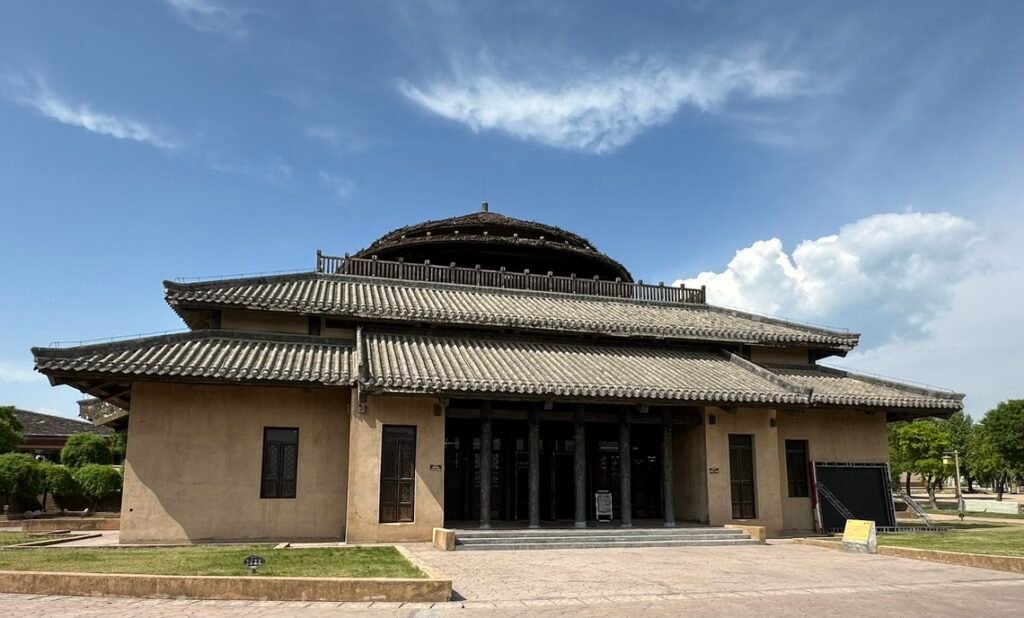
Outside stood a large reconstructed building representing:
Mingtang (明堂, Míngtáng).
Important:
THIS IS A MODERN RECONSTRUCTION.
It is not an original Western Zhou building surviving for 3,000 years.
The reconstruction is intended to help visitors visualize an architectural and ritual concept associated with the Zhou world.
And that makes it useful.
Because:
bronzes,
inscriptions,
and:
archaeological foundations
can be difficult for a first-time visitor to turn into:
A LIVED WORLD.
A reconstruction gives your imagination somewhere to start.
🧭 So What Was a Mingtang (明堂, Míngtáng)?
The concept of:
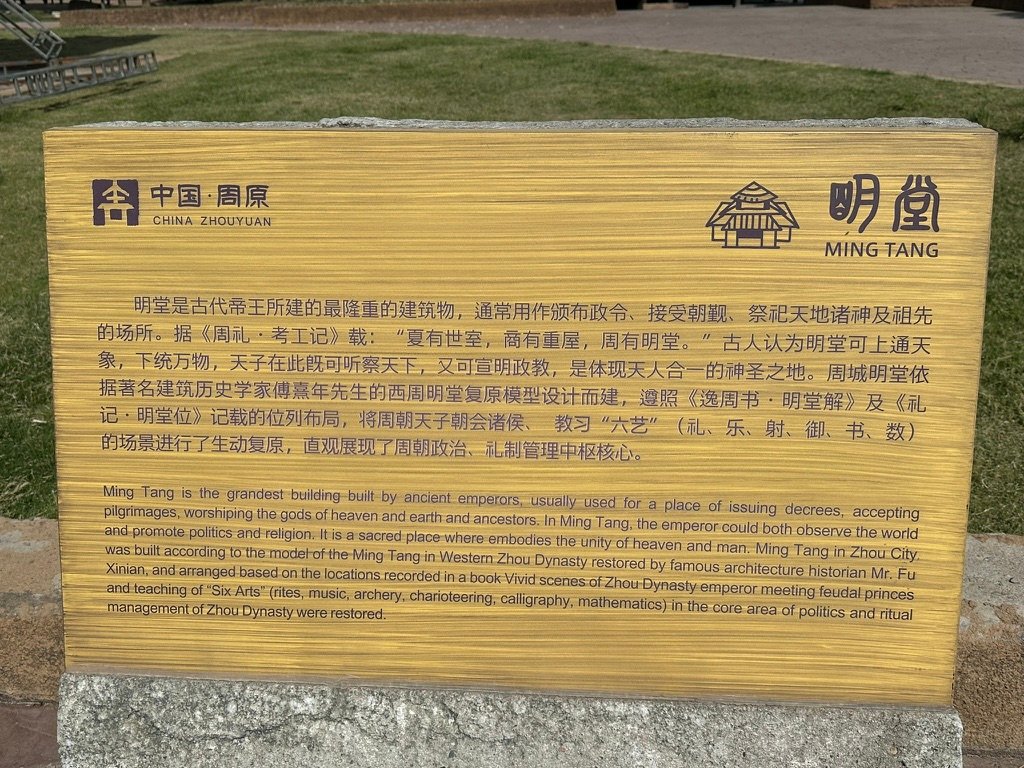
Mingtang (明堂, Míngtáng)
became associated in Chinese tradition with:
royal ritual,
political ceremony,
cosmological order,
and:
the relationship between ruler, space and Heaven.
Dad’s beginner handrail:
THIS WASN’T SIMPLY “A NICE OLD BUILDING.”
Architecture could help express:
POLITICAL ORDER.
Where people stood.
How space was organized.
Where rituals happened.
How the ruler positioned himself within a larger moral and cosmological world.
🔥
Now architecture is talking about government again.
🥁 Then the Museum Lets You Touch the Idea
This is where Dad thinks the visitor experience becomes more fun.
Not everything is:
glass case → label → glass case → label.
😂
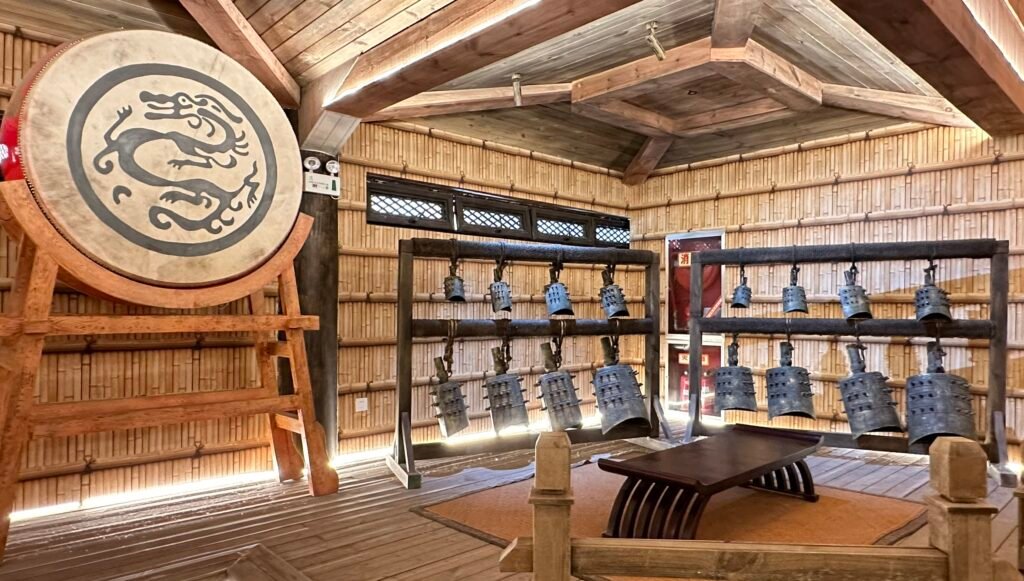
There are displays and reconstructions that help visitors engage with:
bells,
drums,
writing,
and:
ritual culture.
Remember what Dad learned while following:
Duke of Zhou (周公, Zhōugōng)?
礼乐 (Lǐyuè)
rites and music
weren’t merely:
etiquette + entertainment.
They belonged to ideas about:
ceremony,
hierarchy,
social relationships,
and:
order.
Now the museum gives visitors something physical to connect with that idea.
😂 Dad Became an Ancient Zhou Official for Five Minutes
Then came:
BAMBOO SLIPS.
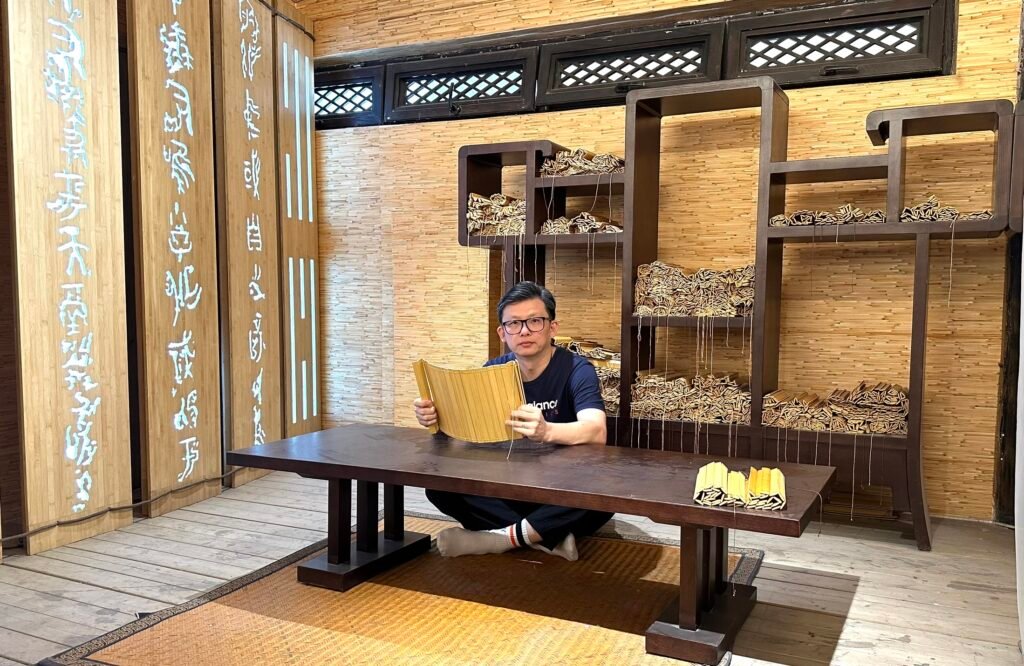
This is one of Dad’s favorite kinds of museum moment.
Not because Dad suddenly became:
A WESTERN ZHOU OFFICIAL.
😂
But because physical things help the brain.
Writing before paper.
Texts carried on different materials.
Administrative records.
Ritual texts.
Orders.
Memory.
Suddenly:
“ancient Chinese writing”
isn’t just characters floating on a museum wall.
It needed:
SOMETHING TO BE WRITTEN ON.
⚠️ But Reconstructions Need an Evidence Brake Too
Dad likes reconstructions.
They help international travelers:
SEE.
But don’t confuse:
a modern reconstruction
with:
an excavated original building.
And don’t assume every reconstructed detail is archaeologically certain.
The useful question is:
“WHAT IS THIS RECONSTRUCTION TRYING TO HELP ME UNDERSTAND?”
At Zhouyuan, the answer is often:
HOW THE ZHOU WORLD MAY HAVE ORGANIZED SPACE, RITUAL AND POLITICAL LIFE.
That’s enough.
Dad’s Museum Sting
The:
Baoji Bronze Ware Museum (宝鸡青铜器博物院, Bǎojī Qīngtóngqì Bówùyuàn)
gave Dad:
OBJECTS.
The:
Fenghuangshan (凤凰山, Fènghuáng Shān)
view gave Dad:
LANDSCAPE.
And the:
Zhou Culture Museum (周文化博物馆, Zhōu Wénhuà Bówùguǎn)
gave Dad:
AN IMAGINED WORLD TO PUT BETWEEN THEM.
🔥
But outside the reconstructions…
archaeologists had been finding something much more important.
Not an imagined Zhou world.
THE PHYSICAL REMAINS OF ONE.
Foundations.
Workshops.
Tombs.
Bronzes.
And even:
ORACLE BONES.
😳
Dad knew oracle bones from:
Anyang (安阳, Ānyáng).
So what were they doing:
HERE?
That’s next.
🐢 Section 3 — Wait… Oracle Bones Here Too?
Dad thought he already had a hook for:
oracle bones (甲骨, Jiǎgǔ).
That hook was:
Anyang (安阳, Ānyáng).
More specifically:
Yinxu (殷墟, Yīnxū)
— the great late:
Shang Dynasty (商朝, Shāng Cháo)
archaeological site.
Dad & Elaine had gone there.
We had seen how inscriptions on:
turtle plastrons,
and:
animal bones
could preserve questions asked more than 3,000 years ago.
So in Dad’s brain:
ORACLE BONES = SHANG = ANYANG.
Nice.
Neat.
Wrongly too neat.
😂
Because then Zhouyuan gave Dad another surprise.
ORACLE BONES APPEARED HERE TOO.
🐢 First Meet China’s Oracle-Bone World at Anyang (安阳, Ānyáng) →
Dad doesn’t need to re-explain the entire oracle-bone story here.
That rabbit belongs in Anyang (安阳, Ānyáng) and Yinxu (殷墟, Yīnxū).
The important point at Zhouyuan (周原, Zhōuyuán) is different:
POLITICAL CHANGE DOESN’T MEAN CULTURE RESETS TO ZERO.
🔥
The:
Shang Dynasty (商朝, Shāng Cháo)
falls.
The:
Zhou Dynasty (周朝, Zhōu Cháo)
rises.
But people don’t wake up the next morning and say:
“New dynasty. Delete everything.”
😂
Practices,
beliefs,
rituals,
technologies,
writing,
and:
ways of understanding the world
can continue, change and be adapted.
Dad’s handrail:
DYNASTIC TRANSITIONS ARE NOT LIGHT SWITCHES.
⛏️ Then Archaeology Makes Zhouyuan Much More Than a Legend
This is where Dad wants to separate:
CULTURAL MEMORY
from:
PHYSICAL EVIDENCE.
The Zhou homeland has accumulated many later stories.
Phoenixes.
Ancestors.
Kings.
Sages.
Temples.
Wonderful.
But archaeology asks a different question:
“WHAT IS ACTUALLY IN THE GROUND?”
And around:
Zhouyuan (周原, Zhōuyuán)
archaeologists have uncovered important remains associated with the pre-dynastic and early Zhou world.
These include evidence such as:
building foundations,
burials,
workshops,
bronzes,
pottery,
and:
inscribed oracle bones.
🔥
Now the landscape Dad saw from:
Fenghuangshan (凤凰山, Fènghuáng Shān)
isn’t interesting only because later tradition says:
“Zhou came from here.”
The ground itself contains evidence of an important early Zhou cultural and political landscape.
🏔️ Fenghuangshan (凤凰山, Fènghuáng Shān) Has Another Story Under the Scenery
Remember the mountain Dad & Elaine went up in Section 1?
Beautiful view.
Golden phoenix.
Cable car.
😂
But there is another:
Fenghuangshan (凤凰山, Fènghuáng Shān)
story.
ARCHAEOLOGY.
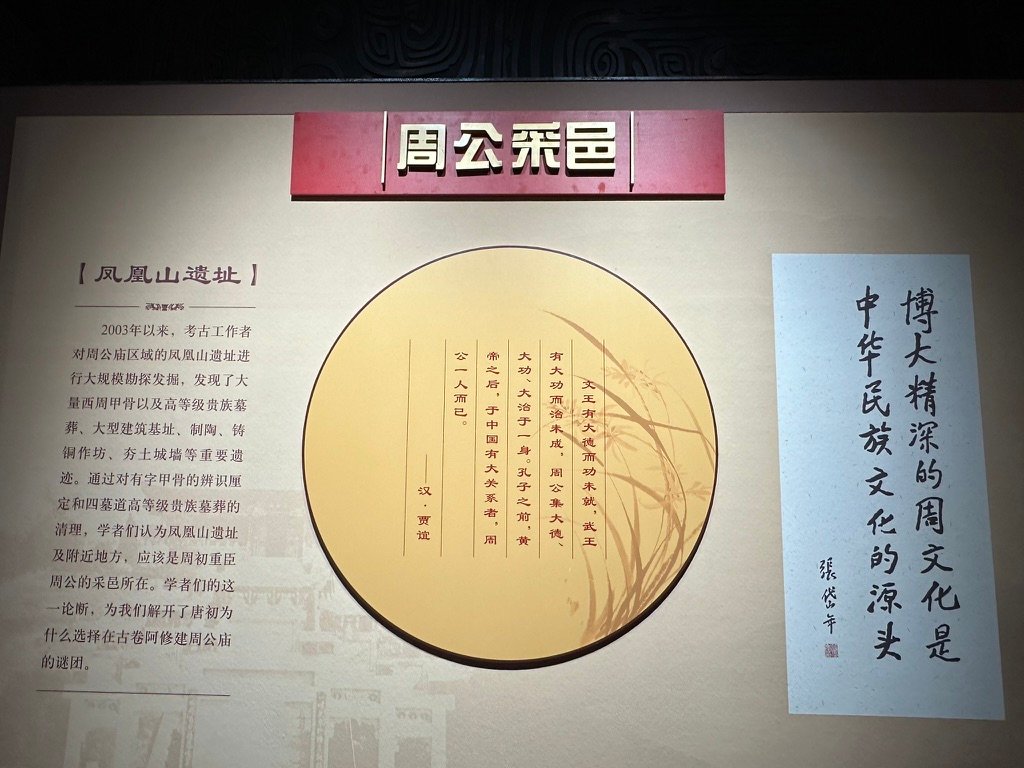
Dad photographed this information board in the Zhougong Temple (周公庙) . It discusses archaeological discoveries around Fenghuangshan (凤凰山, Fènghuáng Shān), including high-status burials, architectural remains, workshops and oracle-bone material. The exhibition connects this archaeological landscape with traditions surrounding Duke of Zhou (周公, Zhōugōng).
And here Dad applies the brake again.
The archaeology can establish:
AN IMPORTANT EARLY ZHOU LANDSCAPE.
Identifying a particular archaeological complex directly with:
ONE NAMED HISTORICAL PERSON
requires more caution.
That’s the difference between:
archaeology,
historical interpretation,
and:
cultural memory.
🧠 Dad Likes the Story Better This Way
Because now we don’t need to choose between:
“The ancient stories are all literally true.”
and:
“They’re only legends, so ignore them.”
Too simple.
😂
Instead:
TRADITION
tells us how later generations remembered the Zhou past.
TEXTS
preserve narratives and ideas.
BRONZE INSCRIPTIONS
give us voices much closer to the early Zhou world.
ARCHAEOLOGY
gives us physical remains.
LANDSCAPE
shows us where all these questions belong.
🔥
Put them together carefully.
That’s DEEP China.
Dad’s Archaeology Sting
Dad arrived in Zhouyuan asking:
“Where did Zhou come from?”
But archaeology changes the question.
Now Dad asks:
“HOW MUCH OF THE WORLD BEHIND THE ZHOU STORIES CAN WE ACTUALLY SEE IN THE GROUND?”
That’s much more interesting.
And it also explains why Dad doesn’t want this article turning into biographies of:
King Wen of Zhou (周文王, Zhōu Wénwáng),
Duke of Zhou (周公, Zhōugōng),
or:
Jiang Taigong (姜太公, Jiāng Tàigōng).
Those are separate rabbits.
Here the star is:
ZHOUYUAN (周原, Zhōuyuán).
The place.
The evidence.
The landscape.
And next…
Dad & Elaine went looking at one of the people whose memory is rooted deeply in this Zhou world:
Duke of Zhou (周公, Zhōugōng).
But this time we’re not putting his whole life into this article.
😂
We’re opening the door…
and sending you through it.
🏯 Section 4 — Then Zhougong (周公, Zhōugōng) Stepped Out of the Timeline
By now Dad & Elaine had encountered Zhou through:
landscape,
archaeology,
bronzes,
museums,
and:
timelines.
Then we arrived at:
Zhougong Temple (周公庙, Zhōugōng Miào)
in Qishan (岐山, Qíshān).
And suddenly one name stopped being another hook on Dad’s Coat Rack.
Duke of Zhou (周公, Zhōugōng).
👑 Who Was Duke of Zhou (周公, Zhōugōng)?
Very short version.
😂
His personal name was:
Ji Dan (姬旦, Jī Dàn).
He was a son of:
King Wen of Zhou (周文王, Zhōu Wénwáng)
and younger brother of:
King Wu of Zhou (周武王, Zhōu Wǔwáng).
After Zhou defeated:
Shang (商, Shāng)
and King Wu of Zhou (周武王, Zhōu Wǔwáng) died, Zhougong became a central figure during the dangerous early years of the new:
Western Zhou (西周, Xī Zhōu).
That’s enough biography here.
Because Dad has already cooked the whole Zhougong dish separately.
😂🍳
🐇 [Who Was Duke of Zhou (周公, Zhōugōng) — And Why Did China Keep Looking Back to Him? →]
[INSERT THE NEW LIVE ZHOUGONG ARTICLE URL HERE AFTER PUBLICATION]
There Dad follows:
political crisis,
rebellion,
returning authority to King Cheng of Zhou (周成王, Zhōu Chéngwáng),
virtue (德, Dé),
ritual (礼, Lǐ),
music (乐, Yuè),
integrity (廉, Lián),
and:
the extraordinary cultural memory surrounding Zhougong.
Here at Zhouyuan…
Dad wants to notice something else.
HE BELONGS TO THIS LANDSCAPE.
🏔️ Temple + Archaeology + Landscape
The importance of Zhougong Temple (周公庙, Zhōugōng Miào) isn’t that the surviving temple buildings themselves date back 3,000 years.
They don’t.
The value is the relationship among:
later commemoration,
early Zhou traditions,
archaeological discoveries,
and:
the surrounding Zhouyuan landscape.
That’s why Dad keeps separating:
TEMPLE
from:
ARCHAEOLOGICAL SITE
from:
HISTORICAL MEMORY.
They overlap.
But they aren’t the same thing.
🔥
🧑🌾 And Zhougong Wasn’t the Only Name We Found Here
This is where Dad’s Zhou kitchen started becoming dangerous again.
😂🍳
Around this wider Zhou cultural landscape, we also encountered names such as:
Shao Gong (召公, Shào Gōng)
and:
Jiang Taigong (姜太公, Jiāng Tàigōng).
Important people.
Big rabbits.
But:
NOT TODAY.
😂
Jiang Taigong in particular would eventually lead Dad & Elaine far away from:
Qishan (岐山, Qíshān)
toward another ancient state:
Qi (齐国, Qíguó).
And Dad & Elaine later went looking for that world in:
Linzi (临淄, Línzī)
and:
Zibo (淄博, Zībó)
in Shandong Province (山东省, Shāndōng Shěng).
🐇 Follow Dad & Elaine to Zibo (淄博, Zībó) — We Went Looking for Ancient Qi (齐国, Qíguó) and Fell Into Another Chinese History Rabbit Hole →
🔥
But that deserves its own story.
🧠 This Is Why Zhouyuan (周原, Zhōuyuán) Matters
Dad finally understood why this journey felt different from visiting one famous monument.
At Zhouyuan:
THE RABBITS START HERE.
😂🐇
King Wen of Zhou (周文王, Zhōu Wénwáng)
→ the rise of Zhou
King Wu of Zhou (周武王, Zhōu Wǔwáng)
→ conquest of Shang
Duke of Zhou (周公, Zhōugōng)
→ consolidation + cultural memory
Jiang Taigong (姜太公, Jiāng Tàigōng)
→ eventually State of Qi (齐国, Qíguó)
Tang Shuyu (唐叔虞, Táng Shūyú)
→ eventually State of Jin (晋国, Jìnguó)
And suddenly places Dad & Elaine visited years apart start joining together.
🐇 Follow Another Zhou Rabbit to Jinci (晋祠, Jìncí) — Where the Story of Jin (晋, Jìn) Begins →
At Jinci (晋祠, Jìncí) outside:
Taiyuan (太原, Tàiyuán),
Dad finally understood how:
Tang Shuyu (唐叔虞, Táng Shūyú)
and the early Zhou political world eventually connect to:
Jin (晋, Jìn).
Different province.
Different journey.
Same Coat Rack.
🔥
🐞 Dad’s Zhouyuan Sting
That’s the real value of:
Zhouyuan (周原, Zhōuyuán).
It isn’t simply:
“the place where Zhou came from.”
It is where many later Chinese history rabbits begin to acquire:
A COMMON ROOT.
Baoji gave Dad:
OBJECTS.
Fenghuangshan gave Dad:
LANDSCAPE.
Archaeology gave Dad:
EVIDENCE.
Zhougong Temple gave Dad:
PEOPLE + MEMORY.
And once those pieces were hanging together…
China started becoming:
CONNECTED.
🐇🔥
But Dad still owes international travelers one very practical question:
IS ZHOUYUAN ACTUALLY WORTH ADDING TO A TRIP BEYOND XI’AN?
That’s next.
🧳 Is Zhouyuan (周原, Zhōuyuán) Worth Adding to Your China Trip?
Dad’s answer:
YES — FOR THE RIGHT TRAVELER.
But Dad wouldn’t recommend Zhouyuan (周原, Zhōuyuán) in the same way he recommends:
Terracotta Warriors (兵马俑, Bīngmǎyǒng)
to a first-time visitor to:
Xi’an (西安, Xī’ān).
This is different.
Come here if you enjoy:
archaeology,
Chinese history,
museums,
ancient civilizations,
cultural landscapes,
and:
asking what came before the famous things.
😂🐇
If you want:
one spectacular attraction → one famous photograph → back to the hotel…
there are easier choices.
But if:
“WHAT CAME BEFORE QIN?”
has started bothering you too…
then Baoji (宝鸡, Bǎojī) + Qishan (岐山, Qíshān) + Zhouyuan (周原, Zhōuyuán) make a fascinating journey beyond Xi’an.
🚄 First — Get Yourself to Baoji (宝鸡, Bǎojī)
For international travelers, Dad would think of:
Baoji (宝鸡, Bǎojī)
as the practical base for this journey.
From:
Xi’an (西安, Xī’ān)
rail makes Baoji much easier to reach than the words:
“ancient Zhou homeland”
might make you imagine.
😂
Dad & Elaine actually came from:
Xianyang (咸阳, Xiányáng)
on Elaine’s first:
green train (绿皮火车, Lǜpí Huǒchē).
And then discovered…
WE HAD NO SEATS.
😂
🚆 Elaine’s First Green Train in China — Then We Discovered We Had No Seats →
You absolutely do not need to copy Dad & Elaine’s transport adventure.
😂
Choose the rail service that works best for your itinerary.
The important thing is:
GET TO BAOJI.
Then slow down.
🏺 Start With Baoji (宝鸡, Bǎojī) — Into the China Before Qin Shi Huang (秦始皇, Qín Shǐ Huáng) →
Dad strongly likes doing:
Baoji Bronze Ware Museum (宝鸡青铜器博物院, Bǎojī Qīngtóngqì Bówùyuàn)
before going deeper into the Zhou landscape.
Why?
Because the museum gives you:
bronzes,
inscriptions,
names,
and:
questions.
Then Zhouyuan (周原, Zhōuyuán) gives those questions:
GEOGRAPHY.
🔥
Museum first.
Landscape second.
That sequence worked beautifully for Dad & Elaine.
🚗 Then Go From Baoji (宝鸡, Bǎojī) Into Qishan (岐山, Qíshān) & Zhouyuan (周原, Zhōuyuán)
This is where Dad would strongly consider:
a local driver,
private car,
or:
knowledgeable local guide.
Why?
Because this isn’t one compact attraction.
You’re connecting a wider landscape involving places such as:
Qishan (岐山, Qíshān),
Zhouyuan (周原, Zhōuyuán),
Fenghuangshan (凤凰山, Fènghuáng Shān),
Zhou Culture Museum (周文化博物馆, Zhōu Wénhuà Bówùguǎn),
and:
Zhougong Temple (周公庙, Zhōugōng Miào).
Dad’s rule here:
DON’T COLLECT PINS.
😂
Give yourself time to understand why the places connect.
🛏️ How Much Time?
Dad would think:
2 NIGHTS = WORKABLE
3 NIGHTS = MUCH NICER
if you genuinely enjoy this kind of travel.
A simple approach:
Day 1 — Baoji (宝鸡, Bǎojī)
Baoji Bronze Ware Museum + local exploration.
Day 2 — Qishan (岐山, Qíshān) + Zhouyuan (周原, Zhōuyuán)
Fenghuangshan + Zhou cultural landscape + museum + selected sites.
Day 3 — Slow Down
Zhougong Temple, additional archaeology/cultural sites, or whatever rabbit caught you hardest.
😂🐇
You don’t need every site.
SEE LESS.
CONNECT MORE.
🧭 Dad’s “Don’t Miss the Point” List
If you’re short on mental energy, remember only five things.
🏺 Baoji Bronze Ware Museum (宝鸡青铜器博物院, Bǎojī Qīngtóngqì Bówùyuàn)
See the objects.
🏔️ Fenghuangshan (凤凰山, Fènghuáng Shān)
Look across the landscape.
🏛️ Zhou Culture Museum (周文化博物馆, Zhōu Wénhuà Bówùguǎn)
Install the Coat Rack.
⛏️ Zhouyuan archaeology
Ask what physical evidence survives.
🏯 Zhougong Temple (周公庙, Zhōugōng Miào)
See how one major figure from the early Zhou world continued to be remembered.
That’s enough.
🔥
🍜 And Then… Dad & Elaine Got Hungry
After a full day around:
Zhouyuan (周原, Zhōuyuán)
we were on the tour bus heading back toward:
Xi’an (西安, Xī’ān).
By the time we reached the outskirts of Xi’an…
Dad & Elaine had a much more immediate historical problem.
WE WERE HUNGRY.
😂
So we got off the tour bus early…
and went looking for food.
No famous restaurant.
No reservation.
No carefully researched:
“Top 10 Xi’an Foods You Must Try.”
We simply found a local noodle shop.
And this arrived.
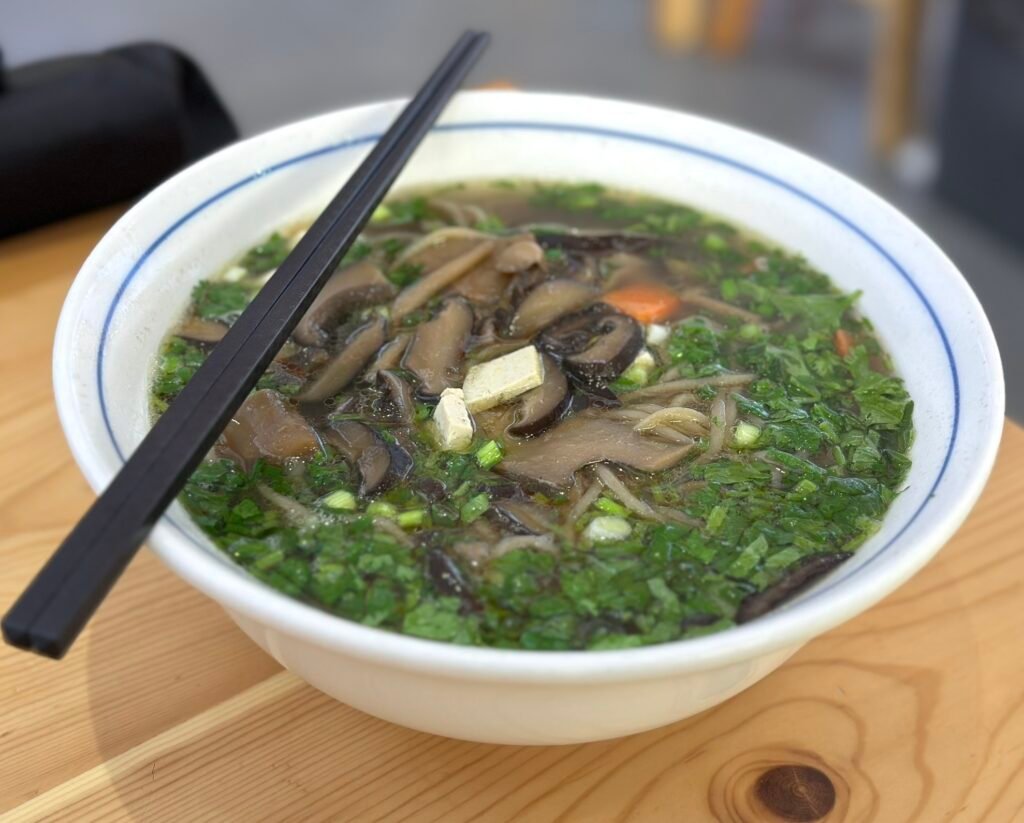
淳化荞面饸饹
Chúnhuà Qiáomiàn Hélè
Chunhua Buckwheat Hele Noodles
A hot bowl of buckwheat noodles with vegetables, mushrooms and broth.
After Zhouyuan…
it was exactly what Dad & Elaine needed.
😂
🐇 Of Course Even the Noodles Had a History Rabbit
Then Dad noticed the information board in the shop.
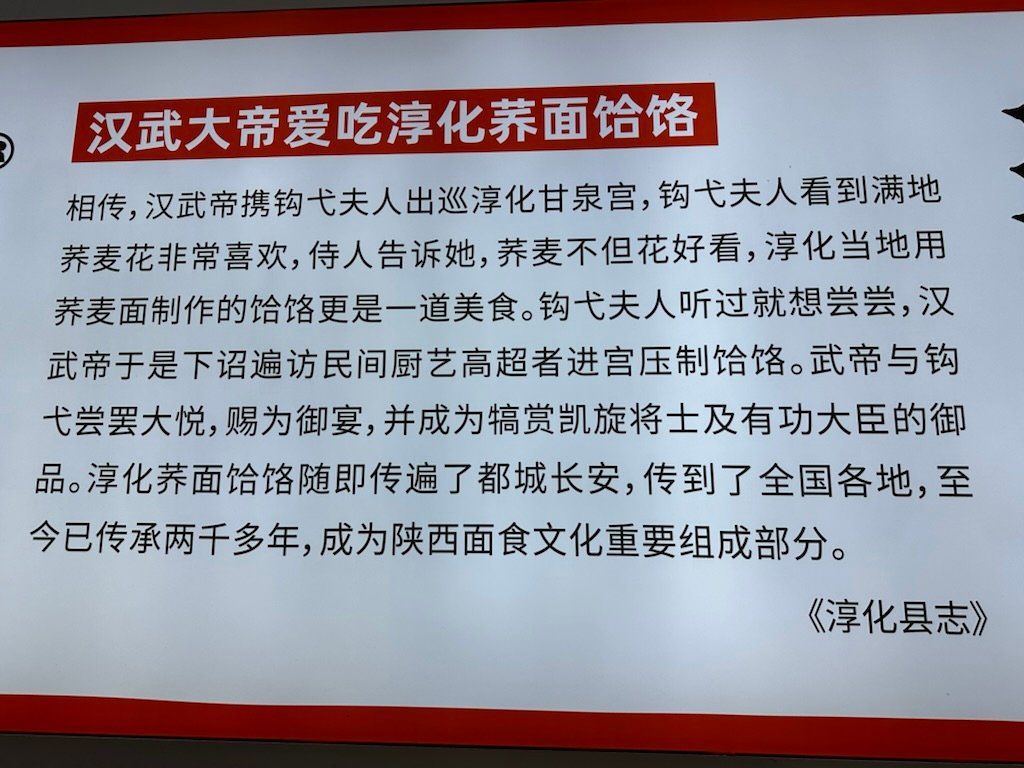
The board tells a local story connecting Chunhua buckwheat hele noodles with:
Emperor Wu of Han (汉武帝, Hàn Wǔdì).
According to the tradition presented there, Emperor Wu encountered the buckwheat noodles during a journey to Chunhua (淳化, Chúnhuà), enjoyed them, and they later became associated with Shaanxi’s noodle culture.
Dad’s evidence brake:
NICE STORY.
But treat it as:
LOCAL FOOD TRADITION,
not automatically as verified Han Dynasty history.
😂
Still…
there was something wonderfully ChinaTravelBUG about the moment.
We had spent the day following:
ZHOU — more than 3,000 years ago.
Then we got hungry…
walked into an ordinary noodle shop…
and:
HAN DYNASTY WALKED IN TOO.
🐇🐇🐇
Sometimes in China…
HISTORY DOESN’T STAY INSIDE THE MUSEUM.
Sometimes…
YOU EAT IT.
😂🍜
ChinaTravelBUG’s Take
Dad & Elaine didn’t come to Zhouyuan (周原, Zhōuyuán) because there was one:
“MUST-SEE attraction.”
We came because:
Baoji (宝鸡, Bǎojī)
had given us objects…
and Dad wanted to know:
“WHERE DID THESE PEOPLE LIVE?”
Then we went up:
Fenghuangshan (凤凰山, Fènghuáng Shān)
and looked across the plain.
Suddenly:
bronzes,
inscriptions,
kings,
oracle bones,
archaeology,
and:
later cultural memory
had somewhere to belong.
A LANDSCAPE.
🔥
That’s why Dad thinks Zhouyuan (周原, Zhōuyuán) is worth the effort for curious international travelers.
Not because everything here is visually spectacular.
Not because every archaeological question has a neat answer.
And certainly not because Dad expects you to remember every Zhou king.
😂
Come because this is one of those places where:
CHINA BEFORE “CHINA”
starts becoming easier to imagine.
🧠 Put the Journey on Dad’s Bigger Coat Rack — Why the Zhou Dynasty (周朝, Zhōu Cháo) Matters So Much to Chinese History →
And if one particular bronze caught you:
🏺 He Zun (何尊, Hé Zūn) — The 3,000-Year-Old Bronze That Bears 中国 (Zhōngguó) →
Or if one particular man caught you:
🐇 Duke of Zhou (周公, Zhōugōng) — Why Did China Keep Looking Back to Him?
Different rabbit.
Same kitchen.
😂🍳
But for this journey, Dad’s handrail is much simpler:
BAOJI GAVE US THE OBJECTS.
ZHOUYUAN GAVE THEM A LANDSCAPE.
🐇🔥
See China. Understand It Better.