The International Travelers Barely Know
Ask a first-time international traveler to name an ancient Chinese dynasty and you’ll probably hear:
Qin dynasty (秦朝, Qíncháo)
→ Qin Shi Huang (秦始皇, Qín Shǐhuáng) and the Terracotta Warriors (兵马俑, Bīngmǎyǒng).
Han dynasty (汉朝, Hàncháo)
→ one of China’s great imperial dynasties.
Tang dynasty (唐朝, Tángcháo)
→ Chang’an (长安, Cháng’ān), the Silk Roads and cosmopolitan China.
Ming dynasty (明朝, Míngcháo)
→ the Forbidden City (故宫, Gùgōng) and much of the Great Wall (长城, Chángchéng) travelers recognize today.
But:
Zhou dynasty?
周朝, Zhōucháo?
For many international travelers:
Zhou who?
😂
Dad was once much the same.
Then Dad & Elaine started traveling beyond the familiar historical stops.
In Baoji (宝鸡, Bǎojī), we encountered extraordinary Zhou bronze vessels (周代青铜器, Zhōudài Qīngtóngqì).
One of them was He Zun (何尊, Hé Zūn) — an early Western Zhou (西周, Xī Zhōu) bronze whose inscription contains the ancient characters:
中国
Zhōngguó
The same characters used for “China” today — although their meaning in that early Zhou context was very different from the modern nation-state.
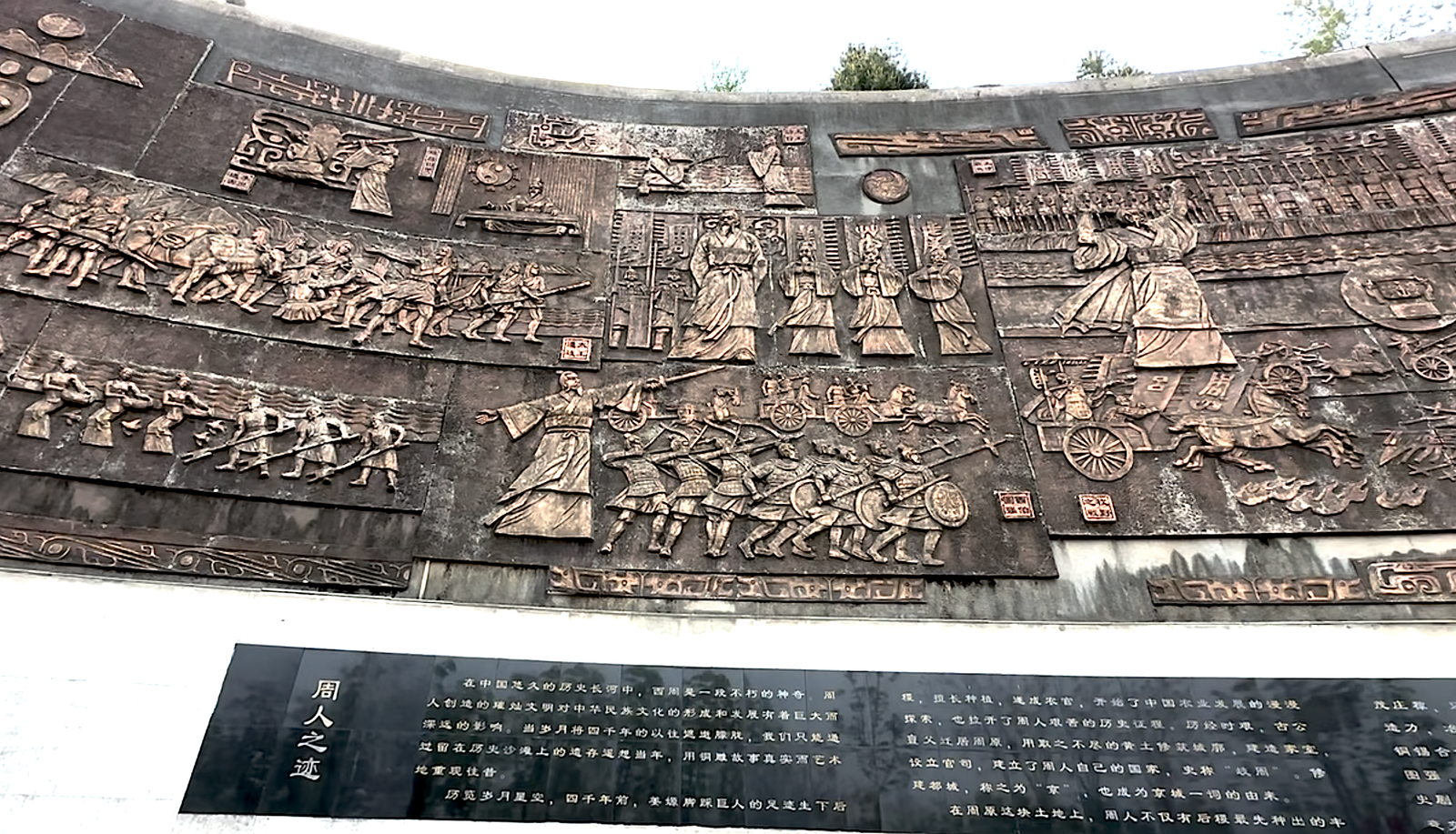
Then we traveled into Qishan (岐山, Qíshān) and Zhouyuan (周原, Zhōuyuán).
Suddenly Zhou wasn’t just another name on a dynasty chart.
We were walking through landscapes associated with the early Zhou people (周人, Zhōurén) themselves.
And then one man kept appearing:
Duke of Zhou
周公, Zhōugōng
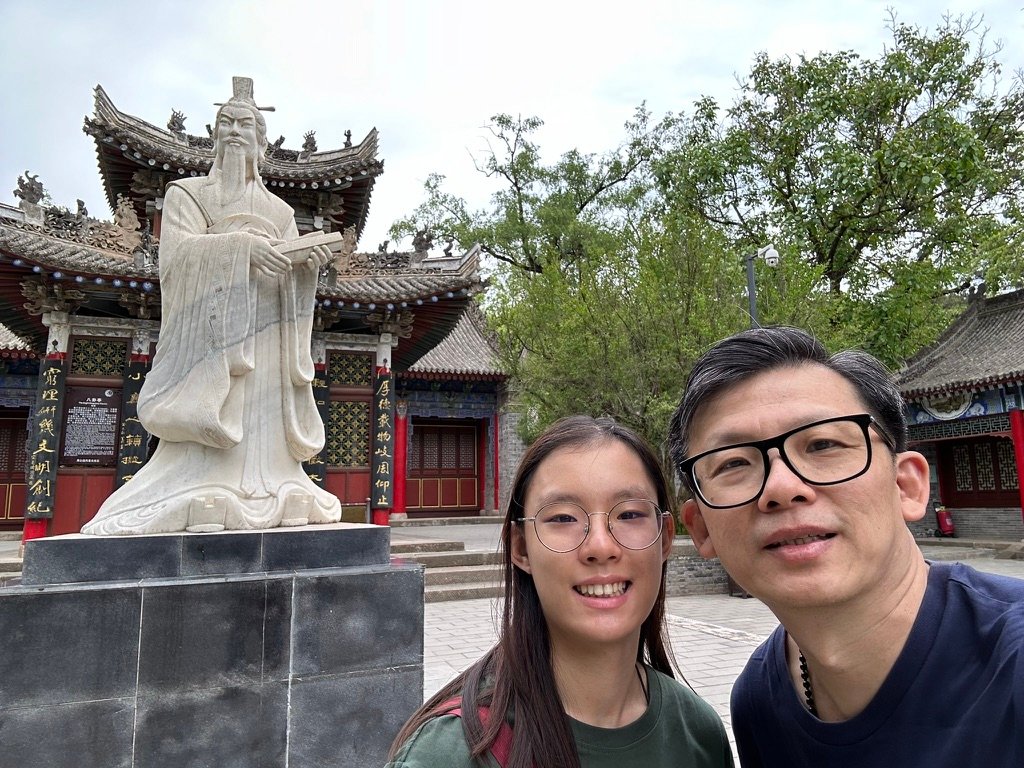
A figure later Chinese tradition repeatedly looked back to when thinking about government, ritual (礼, lǐ), family, music, virtue and social order.
→ Meet the Duke of Zhou (周公, Zhōugōng) — the man China kept looking back to
And another idea kept following us:
Heaven
天, Tiān
and the enormously influential political idea associated with Zhou:
Mandate of Heaven
天命, Tiānmìng
→ Why Does Chinese History Keep Talking About Heaven (天, Tiān)?
At some point Dad realized:
Zhou is everywhere.
Not because modern China is somehow still living in the Zhou dynasty.
It isn’t.
And not because everything important in Chinese civilization began with Zhou.
It didn’t.
The Shang dynasty (商朝, Shāngcháo) already had cities, kingship, bronze technology, warfare, ritual and a sophisticated writing tradition before Zhou.
But Zhou matters for a different reason.
Over its long history, the Zhou world developed, transmitted or became strongly associated with ideas about:
political legitimacy
family and lineage
ritual and appropriate behavior
education
social hierarchy
government
written culture
and:
HOW A LARGE SOCIETY SHOULD HOLD TOGETHER.
Later Chinese thinkers and dynasties did not simply copy Zhou.
They argued with it.
Reinterpreted it.
Rebuilt it.
Sometimes rejected parts of it.
And sometimes looked backward to an idealized Zhou when trying to imagine what good government and an orderly society should look like.
That is why understanding Zhou gives an international traveler something much more valuable than another dynasty to memorize.
It gives you a historical handrail for understanding China.
Not only the China that came after Zhou.
But, carefully used, some of the questions and cultural patterns you may still encounter while traveling through:
China today.
And perhaps even better questions for thinking about:
China tomorrow.
Dad’s First Sting
Don’t ask:
“What happened during the Zhou dynasty?”
That’s a history textbook question.
For this DEEP China journey, Dad wants to ask something bigger:
What did Zhou leave behind that proved so powerful that later China kept returning to it?
That’s our rabbit hole.
🐇
Where Are We? — Put Zhou on the World Timeline
Before we go deeper, let’s hang up our ChinaTravelBUG timeline coat rack.
Shang dynasty (商朝, Shāngcháo)
c. 1600–1046 BCE
↓
Western Zhou (西周, Xī Zhōu)
c. 1046–771 BCE
↓
Eastern Zhou (东周, Dōng Zhōu)
770–256 BCE
The Eastern Zhou contains two famous periods:
Spring and Autumn period (春秋时期, Chūnqiū Shíqī)
770–476 BCE
↓
Warring States period (战国时期, Zhànguó Shíqī)
475–221 BCE
↓
Qin dynasty (秦朝, Qíncháo)
221–206 BCE
Qin Shi Huang (秦始皇, Qín Shǐhuáng) unified the competing states in 221 BCE and became China’s First Emperor.
Now look again at Zhou:
c. 1046–256 BCE
Almost:
800 YEARS.

Western Handrail — What Was Happening in the West?
Ancient Chinese dates can become a blur very quickly.
So let’s put Zhou beside a few familiar Western landmarks.
When the Western Zhou (西周, Xī Zhōu) began around 1046 BCE:
Ancient Egypt (古埃及, Gǔ Āijí) was already thousands of years old.
The traditional founding of Rome (罗马, Luómǎ) — 753 BCE — was still almost 300 years away.
Then keep the Zhou clock running.
c. 1046 BCE
Western Zhou (西周, Xī Zhōu) begins
↓
8th century BCE
Homeric Greece — the Iliad and Odyssey are traditionally associated with this broad period.
↓
753 BCE
Traditional founding of Rome (罗马, Luómǎ)
By then, Zhou had already existed for nearly 300 years.
↓
5th century BCE
Classical Athens — Socrates (c. 470–399 BCE)
There is still a:
Zhou king (周天子, Zhōu Tiānzǐ).
↓
4th century BCE
Plato (c. 428–348 BCE)
Aristotle (384–322 BCE)
Alexander the Great (356–323 BCE)
Still:
Zhou.
↓
256 BCE
The Zhou royal house finally ends.
That’s the scale we’re dealing with.
From centuries before the traditional founding of Rome…
through the world of Classical Greece…
past Alexander the Great…
Zhou was still there.
😳
But There’s a Catch
Don’t picture one powerful Zhou government controlling the same territory continuously for almost 800 years.
It didn’t.
The Western Zhou (西周, Xī Zhōu) and later Eastern Zhou (东周, Dōng Zhōu) were very different political worlds.
Over time, regional states became increasingly powerful.
During the Spring and Autumn period (春秋时期, Chūnqiū Shíqī) and especially the Warring States period (战国时期, Zhànguó Shíqī), those states competed, fought, expanded and developed increasingly sophisticated governments of their own.
The Zhou king’s direct political power shrank dramatically.
And yet:
THE ZHOU DYNASTY SURVIVED.
How?
That’s such a good question that it deserves its own DEEP China article:
→ How Did the Zhou Dynasty (周朝, Zhōucháo) Last Nearly 800 Years?
For this article, however, Dad wants to ask an even bigger question.
Because eventually Zhou did disappear.
The Zhou royal house ended in 256 BCE.
But many ideas associated with the Zhou world did not disappear with it.
Later Chinese thinkers and dynasties would keep returning to questions about:
government
family
ritual
education
social order
and:
WHO HAS THE RIGHT TO RULE?
And that brings us to one of Zhou’s most influential answers:
天命 (Tiānmìng)
The Mandate of Heaven.
🔑 KEY 1 — 天命 (Tiānmìng): Who Has the Right to Rule?
The Zhou (周, Zhōu) had a problem.
They had defeated the:
Shang dynasty (商朝, Shāngcháo).
Winning a war explains:
WHO WON.
It doesn’t automatically explain:
WHY THE WINNER DESERVES TO RULE.
🔥
One enormously influential Zhou answer became:
天命
Tiānmìng
“Mandate of Heaven”
天 (Tiān)
→ Heaven
命 (Mìng)
→ command / mandate / destiny, depending on context
The powerful idea was that political authority could be connected with:
Heaven (天, Tiān).
But here comes the chili:
THE MANDATE COULD BE LOST.
😂
A ruling house that governed disastrously could later be understood as having lost its moral claim to rule.
So the Zhou conquest of Shang could become more than:
“We defeated them.”
It could become:
“The previous ruling house had lost the right to rule.”
That idea would echo through later Chinese dynastic history for centuries.

Western Handrail — Divine Right of Kings?
European readers may think of:
Divine Right of Kings.
Both traditions connected political authority with a higher power.
But don’t force them together.
A crucial feature of the Chinese:
天命 (Tiānmìng)
was that the mandate could:
MOVE.
One ruling house could lose it.
Another could claim it.
That gave later Chinese historians a powerful language for explaining:
DYNASTIC CHANGE.
🐇 Why This Matters Far Beyond Zhou
Shang (商)
↓
Zhou (周)
↓
Qin (秦)
↓
Han (汉)
↓
Tang (唐)
↓
Song (宋)
↓
Yuan (元)
↓
Ming (明)
↓
Qing (清).
Different ruling houses.
Different political systems.
Different peoples and historical circumstances.
But the question kept returning:
What makes rule legitimate?
That’s why 天命 isn’t just an obscure Western Zhou idea.
It became part of China’s much longer political vocabulary.
Dad & Elaine followed that rabbit hole all the way forward to Beijing’s:
Temple of Heaven (天坛, Tiāntán).
A Ming- and Qing-era emperor standing there as:
Son of Heaven (天子, Tiānzǐ)
makes much more sense once you know the political rabbit hole began more than 2,000 years earlier.
→ GO DEEPER: Why Does Chinese History Keep Talking About Heaven (天, Tiān)?
That dedicated DEEP China article follows the whole journey:
Zhou legitimacy
↓
Mandate of Heaven
↓
dynastic change
↓
Son of Heaven
↓
Temple of Heaven.
So we won’t cook the whole Heaven dish again here.
😂
For our Zhou coat rack, remember only:
天命 (Tiānmìng)
gave later China an enduring question:
WHO DESERVES TO RULE?
But Zhou wasn’t concerned only with:
rulers.
It also developed an enormously influential vocabulary for asking:
HOW SHOULD PEOPLE BEHAVE TOWARD ONE ANOTHER?
And that brings us to:
礼 (Lǐ).
🐇
🔑 KEY 2 — 礼 (Lǐ): How Should People Behave Toward One Another?
The Zhou dynasty (周朝, Zhōucháo) wasn’t concerned only with:
WHO SHOULD RULE.
It also wrestled with:
HOW SHOULD PEOPLE LIVE TOGETHER?
One enormously important word is:
礼
Lǐ
ritual · propriety · appropriate conduct
“Ritual” alone is too narrow.
礼 (Lǐ) could help structure:
ruler and minister
parent and child
elder and younger
host and guest
marriage
mourning
ancestral ceremonies
and:
political hierarchy.
In simple terms:
Who should do what, toward whom, and when?
🔥
🎵 And It Wasn’t Just 礼 — There Was 乐
Later tradition strongly associated the:
Duke of Zhou (周公, Zhōugōng)
with:
制礼作乐
Zhì Lǐ Zuò Yuè
“establishing rites and ordering music”
乐 (Yuè)
→ music
But don’t imagine:
ancient government + background playlist.
😂
Ritual and music could make social order:
VISIBLE AND PERFORMED.
People didn’t merely hear that relationships had structure.
They:
stood in particular places
performed ceremonies
used objects appropriate to rank
followed expected forms of conduct
and participated in:
shared ritual and music.
That’s one way abstract social order becomes:
SOMETHING PEOPLE ACTUALLY DO.
→ GO DEEPER: Duke of Zhou (周公, Zhōugōng) — The Man China Kept Looking Back To

Western Handrail — More Than “Etiquette”
Don’t think:
which fork should I use?
😂
Think bigger.
Every society develops expectations about:
respect
rank
ceremony
public behavior
and:
social roles.
The Zhou contribution was part of a much longer Chinese tradition of thinking seriously about how those relationships should be ordered.
And centuries later, another man became fascinated with this Zhou world:
Confucius (孔子, Kǒngzǐ).
He lived during the:
Eastern Zhou (东周, Dōng Zhōu)
in the State of Lu (鲁国, Lǔ Guó).
And Confucius repeatedly looked backward toward an idealized Zhou ritual order.
Now Dad’s travel map begins connecting:
Qishan (岐山, Qíshān)
→ Duke of Zhou (周公, Zhōugōng)
↓
State of Lu (鲁国, Lǔ Guó)
↓
Qufu (曲阜, Qūfù)
→ Confucius (孔子, Kǒngzǐ)
↓
礼 (Lǐ).
🔥
That’s why Zhou didn’t disappear intellectually when Zhou political power disappeared.
Later thinkers kept:
remembering it
reinterpreting it
and:
arguing about what proper order should look like.
And that conversation would travel through later Chinese history.
👀 Traveler’s Handrail
This is where Zhou can eventually help you look at China differently.
When traveling in China, you may notice attention to:
roles
relationships
seniority
appropriate forms of address
ceremonial behavior
and:
who is host and who is guest.
Don’t conclude:
“That’s because of Zhou.”
Too simple.
😂
But knowing the long history of:
礼 (Lǐ)
gives you a better question:
“What relationship do people think they are in — and what behavior does that relationship call for?”
That question can be surprisingly useful in China.
And it takes us naturally to another Zhou idea:
FAMILY AND LINEAGE.
🐇
🔑 KEY 3 — 宗法 (Zōngfǎ): Family Was Bigger Than Family
Another important Zhou idea was:
宗法
Zōngfǎ
lineage / clan order
For Zhou elites, family wasn’t simply:
Mum + Dad + children.
😂
Political and social relationships could be organized through:
ancestry
lineage
generation
seniority
inheritance
and:
kinship.
In other words:
FAMILY COULD ALSO BE POLITICAL STRUCTURE.
Dad’s Handrail — Think Family Tree + Organization Chart
Imagine laying:
a family tree
over:
a political organization chart.
That’s a useful starting point.
The Zhou king (周天子, Zhōu Tiānzǐ) stood within a wider network of regional rulers, elite lineages and ancestral relationships.
Not every political relationship was literally family.
The real Zhou world was messier than the neat diagrams we see in museums.
But lineage mattered enormously.
👀 Why This Matters Later
The Zhou political system disappeared.
The importance of:
FAMILY + ANCESTORS + LINEAGE
did not.
Later Chinese society repeatedly developed and transformed these ideas.
So when travelers encounter:
祠堂 (Cítáng)
→ ancestral hall
族谱 (Zúpǔ)
→ clan/family genealogy
祖先 (Zǔxiān)
→ ancestors
or strong attention to generations and seniority…
don’t say:
“That’s Zhou.”
😂
Instead ask:
How deep are the historical roots of family and lineage in Chinese society?
Very deep.
And Zhou gives us one important early layer.
But family relationships alone couldn’t govern a large territory.
The Zhou needed another solution:
分封 (Fēnfēng)
distributing authority across regions.
🐇
🔑 KEY 4 — 分封 (Fēnfēng): How Do You Govern a Huge Territory?
The early Zhou dynasty (周朝, Zhōucháo) faced a practical problem:
China was BIG.
No phones.
No trains.
No instant communication.
😂
The Zhou could not govern every distant community directly from the royal center.
One solution was:
分封
Fēnfēng
enfeoffment / delegated regional rule
Authority was distributed among regional rulers, including royal relatives, allies and important elites.
They governed territories, maintained forces and owed obligations to the:
Zhou king (周天子, Zhōu Tiānzǐ).
Think:
CENTER
↓
NETWORK OF REGIONAL STATES
rather than:
CENTER CONTROLS EVERYTHING.

Western Handrail
It may remind Western readers of:
feudalism.
Useful handrail.
But don’t push it too far.
Zhou 分封 (Fēnfēng) developed in its own Chinese political, kinship and ritual context.
The important idea is:
DELEGATE POWER TO EXTEND POWER.
And it worked.
Perhaps:
TOO WELL.
😂
Over generations, some regional states became increasingly powerful.
Eventually names such as:
Qi (齐国, Qí Guó)
Chu (楚国, Chǔ Guó)
Zhao (赵国, Zhào Guó)
Wei (魏国, Wèi Guó)
Qin (秦国, Qín Guó)
would dominate the political landscape.
The Zhou king became weaker.
Yet:
ZHOU SURVIVED.
😳
That paradox deserves its own DEEP China question:
How Did the Zhou Dynasty (周朝, Zhōucháo) Last Nearly 800 Years?
For this article, remember something simpler:
Zhou created a political world in which:
REGIONAL STATES MATTERED.
And those states eventually lead us directly toward:
QIN.
But political networks don’t survive through territory alone.
They need people who understand:
HOW THE SYSTEM WORKS.
That brings us to:
教育 (Jiàoyù)
education.
🐇
🔑 KEY 5 — 教育 (Jiàoyù): Teach the Next Generation the System
A political system lasts longer when every generation doesn’t have to reinvent it.
😂
The Zhou world placed importance on educating elites.
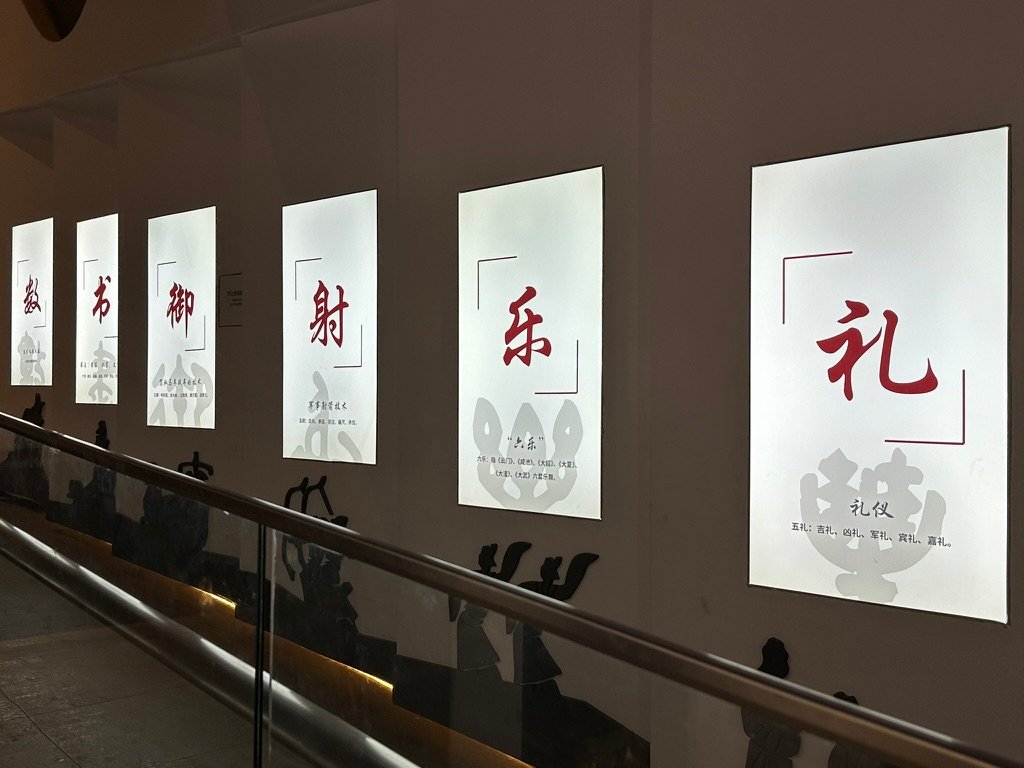
Later tradition associated Zhou education with the:
六艺
Liùyì
Six Arts
礼 (Lǐ) — ritual and proper conduct
乐 (Yuè) — music
射 (Shè) — archery
御 (Yù) — chariot driving
书 (Shū) — writing
数 (Shù) — calculation
Look at that combination:
BEHAVIOR + CULTURE + WARFARE + TRANSPORT + WRITING + NUMBERS.
This wasn’t simply:
“Go to school and pass an exam.”
It was about producing people capable of functioning within an elite political and social world.
Dad’s Handrail
Kings die.
Officials die.
Teachers die.
But a society can keep going when:
THE NEXT GENERATION LEARNS THE RULES.
🔥
Later Chinese education changed enormously, especially through Confucian traditions and eventually the imperial examination system.
So don’t draw a straight line from:
Six Arts → modern Chinese school.
But Zhou gives us an early window into something that would become enormously important in later Chinese history:
EDUCATION AS CULTIVATION.
Not simply:
“What do you know?”
but also:
“What kind of person should an educated person become?”
That question would become especially important with:
Confucius (孔子, Kǒngzǐ).
But before we get there, Dad found another way Zhou preserved its world:
WRITE THINGS DOWN.
🐇
🔑 KEY 6 — 金文 (Jīnwén): When Bronze Became an Archive
The Zhou dynasty (周朝, Zhōucháo) did not invent Chinese writing.
Before Zhou, the:
Shang dynasty (商朝, Shāngcháo)
already had a mature writing system.
At Yinxu (殷墟, Yīnxū) in Anyang (安阳, Ānyáng), Dad & Elaine saw:
甲骨文
Jiǎgǔwén
oracle-bone inscriptions.
Then the writing rabbit changed material.
😂
BONE
↓
BRONZE.
In the Zhou world, inscriptions on bronze became especially important:
金文
Jīnwén
bronze inscriptions.
They could preserve:
royal appointments
military campaigns
rewards
dates
ancestors
and:
family histories.
So some Zhou bronzes aren’t merely:
ARTIFACTS.
They’re:
ARCHIVES CAST IN METAL.
🔥
🐇 From Oracle Bone to Your Phone
Dad & Elaine followed this writing story at:
National Museum of Chinese Writing
(中国文字博物馆, Zhōngguó Wénzì Bówùguǎn)
in Anyang (安阳, Ānyáng).
The museum gives international travelers a wonderful coat rack:
prehistoric symbols
↓
甲骨文 (Jiǎgǔwén)
oracle-bone writing
↓
金文 (Jīnwén)
bronze inscriptions
↓
changing scripts
↓
Qin dynasty (秦朝, Qíncháo)
greater standardization
↓
later Chinese writing
↓
THE CHARACTERS ON YOUR PHONE.
📱😂
→ GO DEEPER: National Museum of Chinese Writing (中国文字博物馆) — Is It Worth Visiting in Anyang?
Dad’s Handrail — Writing Preserves Memory
This is where Zhou bronzes become much more interesting.
He Zun (何尊, Hé Zūn)
→ preserves 中国 (Zhōngguó)
Lai Ding (逨鼎, Lái Dǐng)
→ preserves one official’s career
Lai Pan (逨盘, Lái Pán)
→ preserves generations of one family’s history.
→ GO DEEPER: He Zun (何尊, Hé Zūn) — The 3,000-Year-Old Bronze That Bears 中国 (Zhōngguó)
Without writing:
beautiful bronze.
With writing:
THE BRONZE STARTS TALKING.
😂
And that ability to preserve:
names
commands
families
events
and:
memory
would become enormously important to later Chinese civilization.
But Zhou’s influence didn’t travel forward only through:
WORDS.
It also traveled through people who kept looking:
BACKWARD TO ZHOU.
And one of the most influential was:
Confucius (孔子, Kǒngzǐ).
🐇
🔑 KEY 7 — Confucius (孔子, Kǒngzǐ): The Man Who Helped Carry Zhou Forward
The Zhou dynasty (周朝, Zhōucháo) eventually disappeared.
But before it did, one man looked backward and saw something worth preserving:
Confucius
孔子, Kǒngzǐ
551–479 BCE
Confucius lived during the:
Eastern Zhou (东周, Dōng Zhōu)
in the:
State of Lu (鲁国, Lǔ Guó)
around today’s Qufu (曲阜, Qūfù) in Shandong Province (山东省, Shāndōng Shěng).
And this is crucial:
Confucius did not invent everything from scratch.
He repeatedly looked backward toward an idealized Zhou world.
Especially toward:
Duke of Zhou (周公, Zhōugōng).
🐇 Zhou → Confucius → Later China
Ideas about:
礼 (Lǐ)
→ ritual and appropriate conduct
孝 (Xiào)
→ filial devotion
教育 (Jiàoyù)
→ education
德 (Dé)
→ virtue / moral character
君子 (Jūnzǐ)
→ cultivated or exemplary person
were developed and reinterpreted through the Confucian tradition.
That matters enormously.
Because later Chinese dynasties increasingly made Confucian learning, texts and ritual part of:
education
government
elite culture
and eventually:
the imperial examination tradition.
So one important bridge looks like:
ZHOU
↓
CONFUCIUS
↓
CONFUCIAN TRADITIONS
↓
IMPERIAL CHINA.
🔥
Not an unchanged straight line.
A long process of:
REINTERPRETATION.

Western Handrail — Confucius Looked Backward Too
Think of later European thinkers repeatedly returning to:
ancient Greece
and:
ancient Rome
for ideas about politics, philosophy, education and society.
They weren’t trying to become ancient Romans again.
😂
They were asking:
What from that older world is still worth thinking about?
Confucius did something comparable with Zhou.
He looked backward to find models for:
good government
proper relationships
ritual
and:
human cultivation.
That’s one reason Zhou ideas could travel far beyond the Zhou dynasty itself.
👀 And Dad & Elaine Went Looking for That Connection
At Qufu (曲阜, Qūfù), Confucius stops being:
“that famous Chinese philosopher.”
He becomes part of a much longer historical chain.
Zhou (周)
↓
Duke of Zhou (周公, Zhōugōng)
↓
State of Lu (鲁国, Lǔ Guó)
↓
Confucius (孔子, Kǒngzǐ)
↓
later Confucian China.
And suddenly another piece of Chinese history clicks into place.
The Zhou dynasty mattered not only because of what happened:
DURING ZHOU.
It mattered because later generations kept deciding that parts of Zhou were worth:
REMEMBERING.
REINTERPRETING.
TEACHING.
🔥
And then another dynasty arrived and changed the rules dramatically:
Qin dynasty (秦朝, Qíncháo).
Qin didn’t simply continue the Zhou political system.
It tore apart major parts of the old political order and built something much more centralized.
And yet…
even Qin couldn’t make Zhou disappear from Chinese history.
🐇
🔑 KEY 8 — Zhou → Qin → Han: China Keeps Rewriting the Recipe
If Zhou mattered so much, why didn’t later China simply copy it?
Because history doesn’t work like that.
😂
The:
Qin dynasty (秦朝, Qíncháo)
221–206 BCE
fundamentally changed the political architecture.
Qin Shi Huang (秦始皇, Qín Shǐhuáng) defeated the competing states and built a much more:
CENTRALIZED STATE.
Then came:
Han dynasty (汉朝, Hàncháo)
206 BCE–220 CE
Han inherited much from Qin’s imperial machinery while Confucian traditions — themselves deeply engaged with the Zhou intellectual inheritance — became increasingly influential over time.
So later imperial China wasn’t:
ZHOU 2.0.
😂
It became something new.
Dad’s Political Science Handrail
Here’s the coat rack:
ZHOU (周)
→ legitimacy · ritual · relationships · education · political order
↓
QIN (秦)
→ centralization · standardized imperial government
↓
HAN (汉)
→ imperial institutions + increasingly influential Confucian traditions
↓
LATER DYNASTIES
→ reinterpret, combine and rebuild again.
🔥
Dad’s simplest handrail:
Qin changed how China was governed.
Zhou helped shape many of the questions Chinese government and society kept asking.
And that’s why the Zhou story didn’t end when the:
Zhou dynasty (周朝, Zhōucháo)
ended in:
256 BCE.
Its political system disappeared.
But parts of its intellectual and cultural inheritance kept traveling.
🐇
⭐ So Why Does the Zhou Dynasty Matter So Much?
Dad started with a simple question:
Why does Zhou (周, Zhōu) keep appearing everywhere?
Now we have our coat rack.
The Zhou dynasty (周朝, Zhōucháo) mattered not because later China simply copied it.
It didn’t.
Zhou mattered because it helped establish, develop or transmit ideas that later generations kept returning to.
🧥 Dad’s Final Zhou Coat Rack
天命 (Tiānmìng)
Mandate of Heaven
→ Who deserves to rule?
↓
礼 (Lǐ)
ritual · propriety · appropriate conduct
→ How should people behave toward one another?
↓
宗法 (Zōngfǎ)
lineage and clan order
→ How do family, ancestry and hierarchy organize relationships?
↓
分封 (Fēnfēng)
delegated regional authority
→ How do you govern beyond the center?
↓
教育 (Jiàoyù)
education
→ How do you teach the next generation to continue the system?
↓
金文 (Jīnwén)
bronze inscriptions
→ How do you preserve commands, people, families and memory?
↓
Confucius (孔子, Kǒngzǐ)
→ How can an older Zhou ideal be reinterpreted for later generations?
🔥
Look carefully.
These aren’t simply:
ANCIENT ZHOU ANSWERS.
They’re:
BIG QUESTIONS.
How should society hold together?
What makes government legitimate?
What do people owe one another?
What role should family play?
What should an educated person become?
How should political authority be organized?
How does one generation pass its world to the next?
Zhou did not give China one permanent answer to those questions.
It helped make the questions enormously important.

Western Handrail — Greece Didn’t Disappear Either
Ancient Greece eventually disappeared as an independent classical political world.
But Greek ideas didn’t disappear with it.
Later societies kept returning to:
Greek philosophy
political thought
literature
art
and:
ideas about citizenship and government.
They reinterpreted them.
Argued with them.
Used them differently.
Nobody would say:
“Modern Europe is ancient Greece.”
😂
But understanding ancient Greece helps us understand some of the intellectual foundations later European societies inherited.
That’s a useful handrail for Zhou.
The:
Zhou dynasty (周朝, Zhōucháo)
ended in:
256 BCE.
But later China kept:
remembering Zhou
studying Zhou
idealizing parts of Zhou
criticizing Zhou
and:
reinterpreting Zhou.
That’s a much more interesting kind of survival than:
simply lasting 800 years.
🐇 Two Questions Escaped This Article
And Dad isn’t going to squeeze them back in.
😂
Because each deserves its own DEEP China journey.
QUESTION 1
How Did the Zhou Dynasty (周朝, Zhōucháo) Last Nearly 800 Years?
That’s where we’ll investigate:
分封制 (Fēnfēngzhì)
→ delegated regional rule
宗法制 (Zōngfǎzhì)
→ lineage organization
礼乐 (Lǐyuè)
→ ritual and music
教育 (Jiàoyù)
→ education
官制 (Guānzhì)
→ government institutions
车马 (Chēmǎ)
→ transport and military mobility
and the great paradox:
How could the Zhou king become weaker…
while Zhou continued?
🐇
QUESTION 2
Can Understanding Zhou Help You Understand China Today?
That’s a different journey.
Not:
“Modern China is still Zhou.”
It isn’t.
Instead we’ll ask whether knowing this much older historical layer helps international travelers better understand later Chinese conversations about:
family
education
relationships
ritual
authority
order
and:
how a huge society holds together.
That’s where DEEP China leaves the museum…
and walks back onto the street.
ChinaTravelBUG’s Take
Dad & Elaine first went looking for Zhou in:
bronze vessels
ancient inscriptions
museums
and:
Zhouyuan (周原, Zhōuyuán).
But Zhou’s real importance isn’t sitting inside a glass case.
It’s what happened:
AFTER ZHOU.
Qin (秦) changed the political system.
Han (汉) rebuilt again.
Confucius (孔子, Kǒngzǐ) and later Confucian traditions reinterpreted the older world.
Successive dynasties kept changing China.
Yet some questions kept returning.
And that’s why Dad thinks international travelers should know Zhou.
Not so you can memorize:
1046–256 BCE.
😂
But because once you understand some of the questions Zhou China was already asking…
later Chinese history begins fitting together.
And once later Chinese history begins fitting together…
you have a better chance of understanding:
CHINA.
Not as one unchanging 5,000-year-old civilization.
But as a society that has spent thousands of years:
inheriting
arguing
changing
rebuilding
and:
remembering.
🔥
That’s why:
ZHOU MATTERS.
SEE → ASK → CONNECT → UNDERSTAND → FOLLOW
See China. Understand It Better.
China Usually Has Another Way.
🐇 Zhou Leaves Us With Two Bigger Questions
Now Dad understands:
WHY ZHOU MATTERS.
But two rabbit holes escaped.
😂
→ NEXT: HOW Did the Zhou Dynasty (周朝, Zhōucháo) Last Nearly 800 Years?
The Zhou king became weaker.
Regional states became stronger.
Yet Zhou survived for centuries.
HOW?
🐇
→ THEN: Can Understanding Zhou Help You Understand China Today?
Zhou disappeared politically more than 2,000 years ago.
China changed enormously.
But can understanding ideas such as:
礼 (Lǐ) — appropriate conduct
family and lineage
education
legitimacy
and:
social order
help an international traveler look at China today and suddenly think:
“Ohhh… now I understand.”
That’s where our Zhou journey goes next.
SEE → ASK → CONNECT → UNDERSTAND → FOLLOW
See China. Understand It Better.