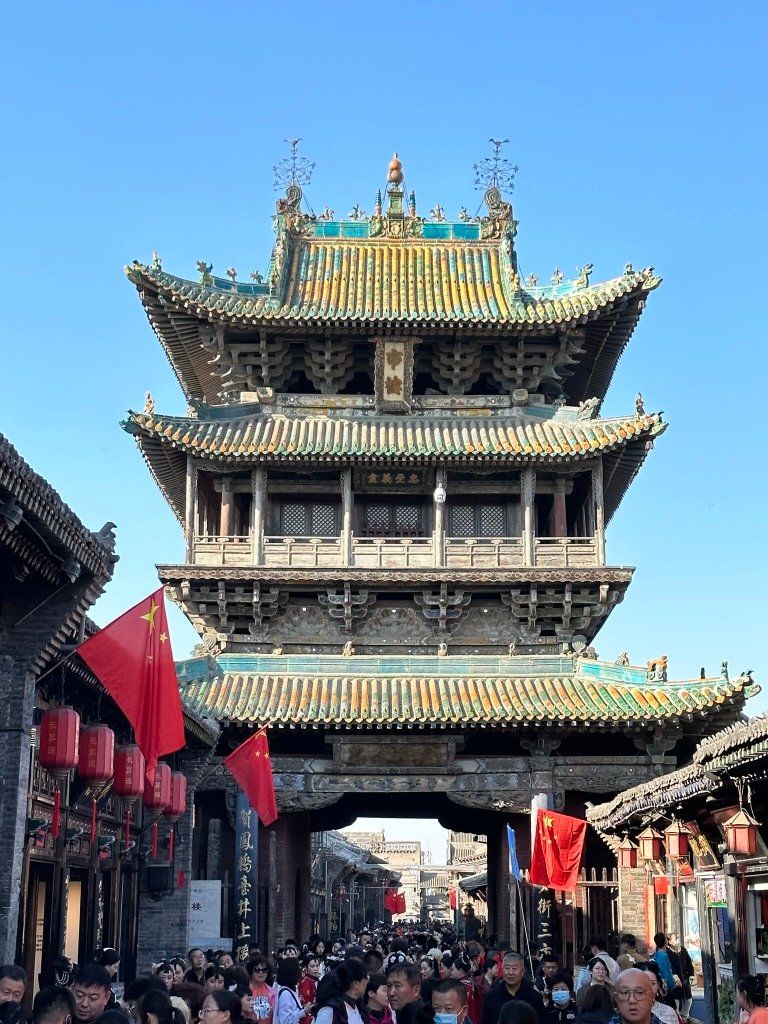
Dad and Elaine came to Pingyao (平遥, Píngyáo) expecting to see one of China’s great ancient walled cities.
And when we arrived…
that was exactly what we saw.
A wall.
A very BIG wall.
😂
But within the next few minutes, Dad began to realize something.
The wall wasn’t really the story.
The city behind it was.
Come in with us.
🧱 Arriving at Pingyao (平遥)
Dad and Elaine arriving outside the Ancient City of Ping Yao (平遥古城, Píngyáo Gǔchéng), Shanxi (山西, Shānxī).
This was our first view.
Grey brick stretching along the road.
Gate towers rising above the walls.
Trees.
Visitors.
Sightseeing vehicles.
And an entire old city somewhere behind those defenses.
For an international traveler arriving for the first time, the visual message is immediate:
We are about to enter somewhere old.
But don’t stop outside.
The really interesting moment comes next.
🚪 Now Walk Through the Gate With Dad and Elaine
Dad and Elaine entering the Ancient City of Ping Yao (平遥古城, Píngyáo Gǔchéng).
Watch this video carefully.
We approach the gate.
We pass beneath the massive brick archway.
And then…
Pingyao (平遥, Píngyáo) opens up.
Streets.
Old buildings.
Shops.
Food.
Visitors.
Bicycles and small vehicles.
People moving around us.
But look again.
Not everybody is sightseeing.
Residents are going IN and OUT through the ancient gate.
People are simply getting on with their day.
That detail changed the experience for Dad.
Because we weren’t walking onto an abandoned historical stage.
We weren’t entering an open-air museum where everybody who belonged there disappeared centuries ago.
Pingyao (平遥, Píngyáo) is still a living city.
People live here.
People work here.
People shop here.
People pass through these ancient gates as part of ordinary modern life.
The wall is historical.
The gate is historical.
The urban fabric is historical.
But life continues inside it.
🐞
And suddenly Dad wasn’t interested only in how old Pingyao (平遥, Píngyáo) was.
He wanted to know:
How did this city actually work?
🐇
That question would eventually lead us from city walls…
to government…
to temples…
to merchants…
and, unexpectedly…
to MONEY.
💰
But before we disappear down Dad’s rabbit hole, there’s a more important question for you.
🌏 Why Should YOU Visit Pingyao (平遥)?
Perhaps you don’t care about ancient Chinese government.
Maybe Chinese financial history doesn’t exactly make you jump out of bed in the morning.
😂
That’s okay.
You don’t need either of those interests to enjoy Pingyao (平遥, Píngyáo).
Come because this is one of those rare places where the city itself is the experience.
You physically pass through a fortified gate.
You walk streets framed by traditional buildings.
You peer into courtyards.
You encounter temples, shops and old institutions.
You climb the wall and look across the urban landscape you have just been walking through.
Then you come back down and wander again.
There isn’t just one superstar monument that you photograph before moving on.
Pingyao (平遥, Píngyáo) rewards curiosity.
A doorway can stop you.
A courtyard can make you look twice.
A shop sign can raise a question.
A side street can pull you away from the main tourist flow.
And because people still live within the old city, historical Pingyao (平遥, Píngyáo) and everyday Pingyao (平遥, Píngyáo) overlap.
That is part of the experience.
🧱 Come to Walk Into a Walled City
Lots of places have old walls.
Pingyao (平遥, Píngyáo) lets you experience the relationship between the wall and the city it enclosed.
Walk through the gate.
Walk the streets.
Then climb the Pingyao City Wall (平遥城墙, Píngyáo Chéngqiáng) and look back across the city.
The wall stops being a standalone monument.
You begin understanding what it surrounded.
🚶 Come Because Pingyao Is Best Experienced at Walking Speed
Some destinations are about reaching the famous object.
Pingyao (平遥, Píngyáo) is also about what happens between the famous objects.
Walk.
Look into courtyards.
Follow old streets.
Watch people.
Stop when something catches your eye.
You don’t need to understand everything.
Actually, Dad thinks it can be more fun when you don’t.
😂
See something.
Ask:
What’s THAT?
🐇
Now the rabbit hole begins.
🌅 Come Because Pingyao Changes With the Hours
Don’t treat Pingyao (平遥, Píngyáo) as:
Arrive → photograph wall → visit attractions → leave.
Give it time.
Stay into the evening.
Wake up inside or near the old city.
Walk again in the morning.
Let the streets change around you.
A place that functions as both heritage destination and living urban space deserves more than a rushed checklist.
Dad will return to this later — including why we think staying overnight in Pingyao (平遥, Píngyáo) is worthwhile.
👀 Come Even If You Know Almost Nothing About Chinese History
This is important.
You do NOT need to know the Chinese dynasties before visiting.
You don’t need to understand Confucianism.
You don’t need to know who the Shanxi merchants (晋商, Jìnshāng) were.
You certainly don’t need to know what a draft bank (票号, piàohào) was.
Dad didn’t arrive carrying all the answers either.
😂
Let the place ask the questions for you.
That is exactly what happened to Dad.
We walked in.
We looked around.
And Pingyao (平遥, Píngyáo) started asking us to understand it.
🏛️ UNESCO WORLD HERITAGE — So What Is the World Protecting Here?
The Ancient City of Ping Yao (平遥古城, Píngyáo Gǔchéng) was inscribed on the UNESCO World Heritage List in 1997.
Whenever Dad visits a UNESCO World Heritage Site, he likes to ask:
Why did the world decide this place deserves special protection?
That’s a much more interesting question than simply collecting another UNESCO badge.
🐞
In Pingyao (平遥, Píngyáo), the answer isn’t one spectacular building.
UNESCO is recognizing the remarkable survival of the CITY.
The Ancient City of Ping Yao (平遥古城, Píngyáo Gǔchéng) is considered an exceptionally well-preserved example of a traditional Han Chinese city.
Its historic fabric helps preserve an unusually complete picture of centuries of urban development — including its streets, residences, shops, temples and civic institutions.
And UNESCO highlights something particularly useful for understanding what Dad and Elaine were about to discover:
Pingyao (平遥, Píngyáo) preserves evidence of cultural, social, economic and religious life together.
Not separately.
Together.
That’s the key.
The wall matters.
But so does what happened inside it.
And there’s another surprise in the UNESCO story.
During the 19th and early 20th centuries, Pingyao (平遥, Píngyáo) became an important financial center.
💰
Now that old courtyard called Rishengchang (日昇昌, Rìshēngchāng) starts becoming much more interesting.
But first…
we need a timeline.
Because Dad knows what happens when an international traveler encounters:
Western Zhou.
Qin.
Ming.
Qing.
19th century.
😂😂😂
Everything becomes:
A very long time ago in China.
So let’s fix that.
⏳ Pingyao in 60 Seconds — The Timeline You Actually Need
You do not need to memorize Chinese dynasties to enjoy Pingyao (平遥, Píngyáo).
Just remember four big steps.
🏹 MORE THAN 2,000 YEARS AGO
There was already a settlement here.
Pingyao’s story begins long before the brick walls you see today.
The area had an urban settlement by at least the Western Zhou Dynasty (西周, Xī Zhōu) period, and traditions of fortification here reach back more than two millennia.
Think:
The place is much older than the wall you photograph today.
🏛️ 221 BC AND IMPERIAL CHINA
Pingyao becomes part of an organized system of local government.
After the Qin Dynasty (秦朝, Qín Cháo) unified China in 221 BC, the imperial county system became fundamental to governing the country.
Pingyao (平遥, Píngyáo) developed as a county seat.
Remember only one word:
GOVERNMENT.
We’ll physically encounter that story later at the Pingyao County Government Office (平遥县衙, Píngyáo Xiànyá).
🧱 1370 — THE WALLS YOU CAME TO SEE
Ming Dynasty (明朝, Míng Cháo).
This is the date most useful to today’s traveler.
In 1370, early in the Ming Dynasty (明朝, Míng Cháo), Pingyao’s defenses were greatly rebuilt and expanded into the formidable masonry-walled city associated with Pingyao (平遥, Píngyáo) today.
So keep this distinction:
Pingyao settlement → much older
The great walled city you experience today → strongly shaped by the Ming period
Easy.
💰 1800s — MONEY CHANGES THE STORY
Qing Dynasty (清朝, Qīng Cháo).
By the 19th century, Pingyao (平遥, Píngyáo) had become an important center of Chinese finance.
Now enter:
Shanxi merchants (晋商, Jìnshāng)
and
draft banks (票号, piàohào).
One of the most famous names associated with this story is:
Rishengchang (日昇昌, Rìshēngchāng).
This is where Dad’s Pingyao story takes a completely unexpected turn.
🌍 1997 — UNESCO
The Ancient City of Ping Yao (平遥古城, Píngyáo Gǔchéng) joins the UNESCO World Heritage List.
And decades later…
Dad and Elaine walk through that gate.
🐞
🧥 Now Dad Needed a Coat Rack
We had seen the wall.
We had walked through the gate.
We had watched residents coming and going.
And we now knew roughly WHEN the different historical layers belonged.
So Dad was finally ready for the bigger question:
HOW DID PINGYAO WORK?
And fortunately, the city itself gave us a Coat Rack.
PINGYAO CITY WALL (平遥城墙, Píngyáo Chéngqiáng)
→ THE CONTAINER
PINGYAO COUNTY GOVERNMENT OFFICE (平遥县衙, Píngyáo Xiànyá)
→ GOVERNMENT
PINGYAO CONFUCIAN TEMPLE (平遥文庙, Píngyáo Wénmiào)
→ EDUCATION + VALUES
PINGYAO CITY GOD TEMPLE (平遥城隍庙, Píngyáo Chénghuáng Miào)
→ BELIEF + RITUAL
RISHENGCHANG (日昇昌, Rìshēngchāng)
→ MERCHANTS + MONEY + TRUST
Suddenly Pingyao (平遥, Píngyáo) wasn’t:
Ancient wall + old buildings + nice photographs.
It was becoming:
A CITY.
And one part of that city was about to send Dad down a particularly deep rabbit hole.
🐇🐇🐇
Rishengchang (日昇昌, Rìshēngchāng).
Because Dad wanted to know:
How did merchants move money across an enormous country before banks, electronic transfers, credit cards or Alipay (支付宝, Zhīfùbǎo)?
Now…
the Pingyao money rabbit hole begins.
💰🐇
💰 SECTION 2 — Dad Falls Into the Pingyao Money Rabbit Hole
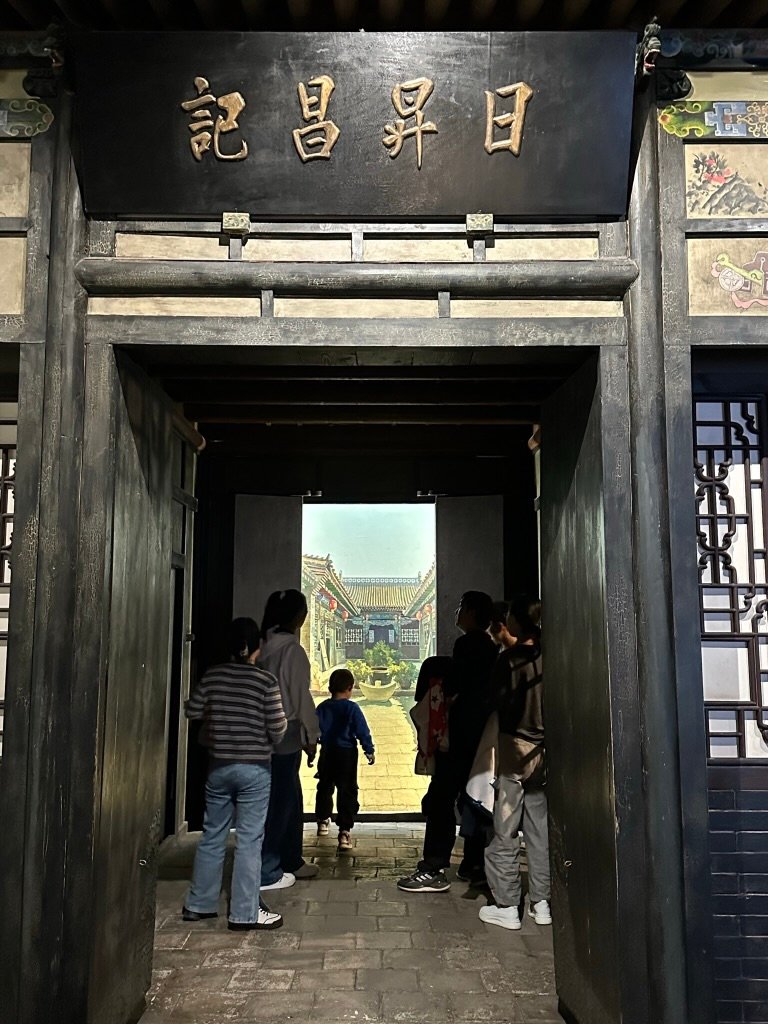
After looking across Pingyao (平遥, Píngyáo) from the Pingyao City Wall (平遥城墙, Píngyáo Chéngqiáng), Dad and Elaine went back down into the streets.
Now the Coat Rack was installed.
The wall was the container.
Inside it were government, education, belief, homes, shops and commerce.
But one part of the city pulled Dad much deeper than expected.
Not a palace.
Not a temple.
Not another tower.
An old commercial courtyard.
Rishengchang (日昇昌, Rìshēngchāng).
At first glance, an international traveler could easily treat it as another historical attraction.
Old rooms.
Old counters.
Old documents.
Courtyards.
Take some photographs.
Read a few signs.
Next.
😂
But Dad had already learned something while traveling through China.
Don’t only ask WHAT an old building is.
Ask:
WHY DID PEOPLE NEED IT?
🐇
That question opened a much bigger Pingyao story.
And it didn’t begin with bankers.
It began with merchants.
🐫 Meet the Shanxi Merchants (晋商, Jìnshāng)
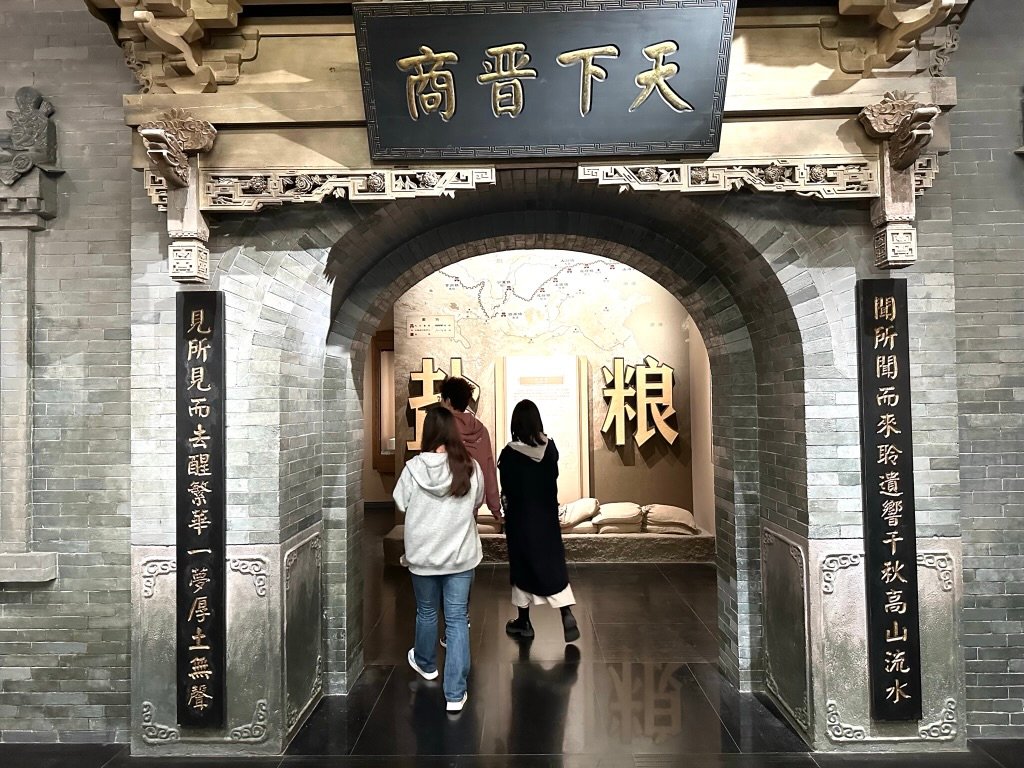
For an international traveler, Shanxi merchants (晋商, Jìnshāng) may mean absolutely nothing.
That’s okay.
😂
Dad’s simple version is:
Think of generations of merchants from Shanxi (山西, Shānxī) who built businesses and trading networks extending far beyond their home towns.
They weren’t one company called “Shanxi Merchants.”
They were merchants and merchant families involved in different businesses across different periods and places.
Their commercial activities became especially influential during the Ming Dynasty (明朝, Míng Cháo) and Qing Dynasty (清朝, Qīng Cháo).
They dealt in commodities including salt, tea, cloth and other goods.
But the particular products aren’t the most important thing for our Pingyao story.
The important word is:
DISTANCE.
🐞
When your business operates only within one town, paying somebody can be relatively straightforward.
But once your commercial world stretches across provinces and major trading centers, everything becomes harder.
Goods have to move.
Information has to move.
People have to move.
And…
MONEY HAS TO MOVE.
That’s where Dad’s rabbit hole really began.
🪙 Imagine Carrying Your Money Across China
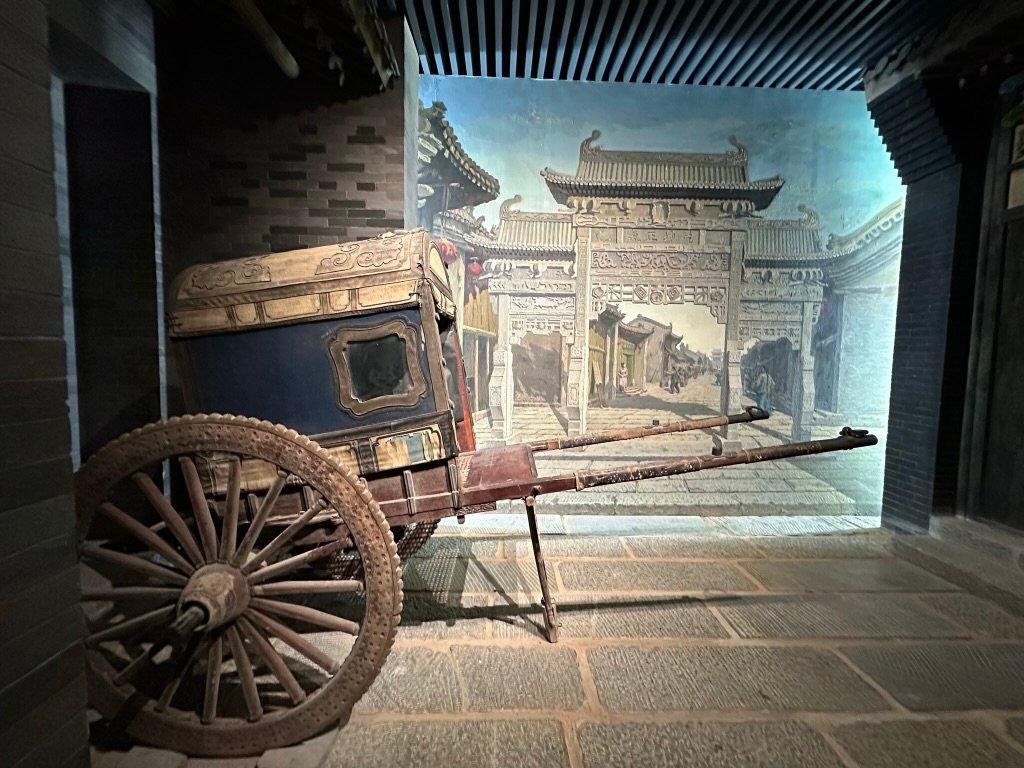
Forget modern banking for a moment.
Imagine you’re a merchant during the Qing Dynasty (清朝, Qīng Cháo).
You’re doing business in one part of China.
But a large payment needs to reach another place hundreds — perhaps thousands — of kilometers away.
Today?
Phone.
Tap.
Transfer.
Done.
😂
But there was no online banking.
No credit card.
No electronic bank transfer.
No QR code.
No Alipay (支付宝, Zhīfùbǎo).
And silver played an important role in large commercial payments.
So one obvious solution was:
Move the silver.
Literally.
Now think about what that means.
Silver is heavy.
Large amounts are difficult to transport.
Long-distance journeys take time.
Transport costs money.
And if everybody knows you’re carrying something extremely valuable…
😳
SECURITY becomes a problem too.
Suddenly this isn’t boring financial history.
It’s a travel problem.
A logistics problem.
A security problem.
And ultimately…
A TRUST PROBLEM.
🐞 Dad’s Very Simple Version
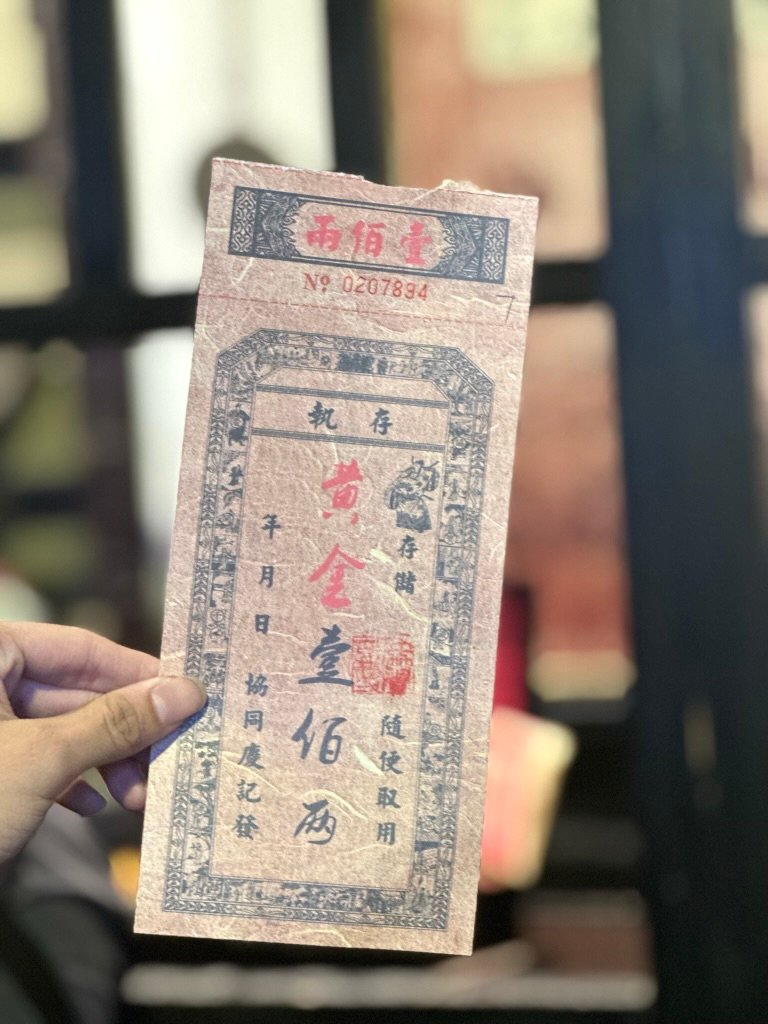
Let’s make this ridiculously simple.
😂
Imagine Dad is a merchant in Pingyao (平遥, Píngyáo).
Dad needs to make a large payment somewhere far away.
OPTION A — MOVE THE SILVER
Get the silver.
Pack it.
Arrange transportation.
Arrange protection.
Travel across a very large country.
Try not to lose it.
Try not to get robbed.
Eventually deliver it.
😅
Or…
OPTION B — MOVE THE VALUE
Deposit funds with a trusted financial business.
Receive the appropriate documentation.
Let records and a financial network connect the transaction between places.
Travel without personally hauling the same amount of silver all the way across China.
At the destination, after the transaction is properly verified, the corresponding funds can be paid.
Dad knows which option he would prefer.
😂
And that brings us to a very important Chinese term.
🏦 Meet the 票号 (Piàohào)
During the Qing Dynasty (清朝, Qīng Cháo), a distinctive type of financial institution developed that became strongly associated with Shanxi (山西, Shānxī) merchants.
It was called:
票号 (piàohào)
For international travelers, you’ll commonly see 票号 (piàohào) translated as:
draft bank
or sometimes simply:
bank.
Dad prefers draft bank as the handrail because it reminds us that these institutions weren’t simply identical to the modern banks we use today.
One of their important functions was remittance (汇兑, huìduì).
In simple terms:
They helped people transfer financial value between distant places.
That meant the customer did not necessarily have to carry the same physical silver for the entire journey.
And THAT is the idea Dad wants you to remember.
Don’t worry about becoming an expert in Qing Dynasty finance.
😂
Just remember:
VALUE COULD TRAVEL WITHOUT THE SAME PILE OF SILVER TRAVELING WITH YOU.
🔥
Now Rishengchang (日昇昌, Rìshēngchāng) becomes much more interesting.
💰 Why Rishengchang (日昇昌) Matters
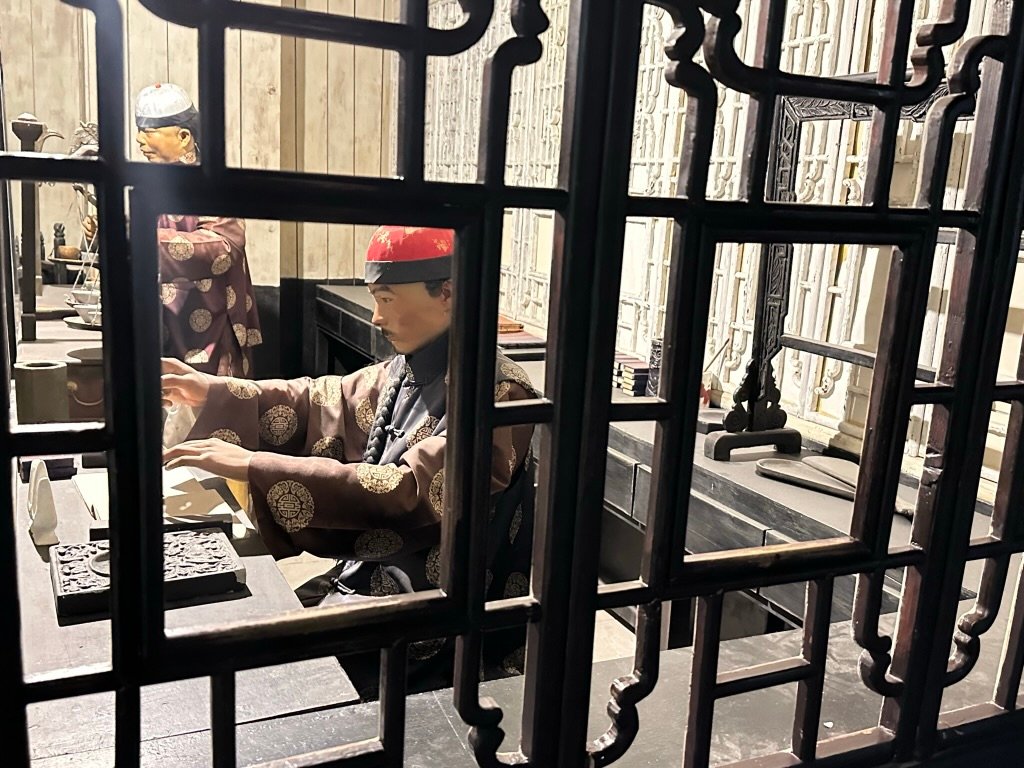
Rishengchang (日昇昌, Rìshēngchāng) emerged in Pingyao (平遥, Píngyáo) in the early 19th century.
It developed from commercial origins associated with Xiyucheng (西裕成, Xīyùchéng) and became a pioneering 票号 (piàohào) specializing in remittance and related financial services.
You will sometimes hear Rishengchang (日昇昌, Rìshēngchāng) described very simply as:
“China’s first bank.”
Dad thinks that’s a useful attention-grabber…
but not the best way to understand it.
We’ll come back to that later.
For now, the important thing is this:
Rishengchang wasn’t important merely because there was a financial business operating inside this particular courtyard.
It was important because financial operations could connect different places.
And that’s when Dad stopped looking only at the building.
🌏 The Courtyard Is What You Can Photograph. The Network Is the Real Story.
Stand inside Rishengchang (日昇昌, Rìshēngchāng).
What can you photograph?
Courtyards.
Rooms.
Counters.
Documents.
Signs.
Old financial objects.
Architecture.
All physical things.
But the really powerful part of the system is much harder to photograph.
THE NETWORK.
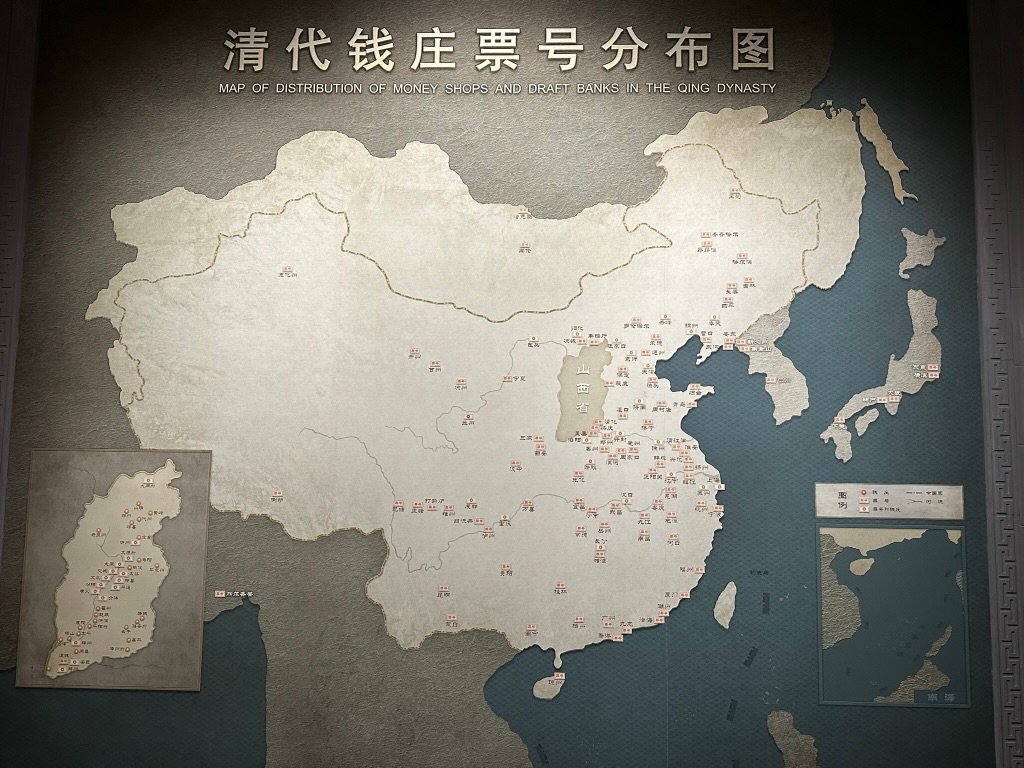
Imagine commercial centers separated by enormous distances.
A merchant here.
A payment needed there.
One financial office recording a transaction.
Another office elsewhere recognizing and settling it.
Documents connecting them.
Accounts connecting them.
Personnel connecting them.
Procedures connecting them.
Trust connecting them.
Suddenly Pingyao (平遥, Píngyáo) doesn’t feel isolated at all.
Quite the opposite.
Today, an international traveler might walk these streets and think:
“Beautiful old town in Shanxi.”
But historical Pingyao was connected to a much wider commercial world.
Goods moved.
Merchants moved.
Information moved.
And financial value could increasingly move through networks too.
🐇
That’s when Dad realized:
The courtyard is what you can photograph.
The network is the real story.
🪙 But Money Was Still Physical
There is one danger in talking about drafts and networks.
We can make historical money sound almost digital.
😂
It wasn’t.
Silver didn’t magically disappear because financial networks existed.
Physical wealth still mattered.
It had to be stored.
Protected.
Guarded.
And in Pingyao (平遥, Píngyáo), Dad got to experience that side of the story too.
He went underground.
🔐 Come Down Into a Pingyao Underground Vault With Dad
Dad descending into a historic underground bank and treasury exhibit inside the Ancient City of Ping Yao (平遥古城, Píngyáo Gǔchéng).
Come down with Dad.
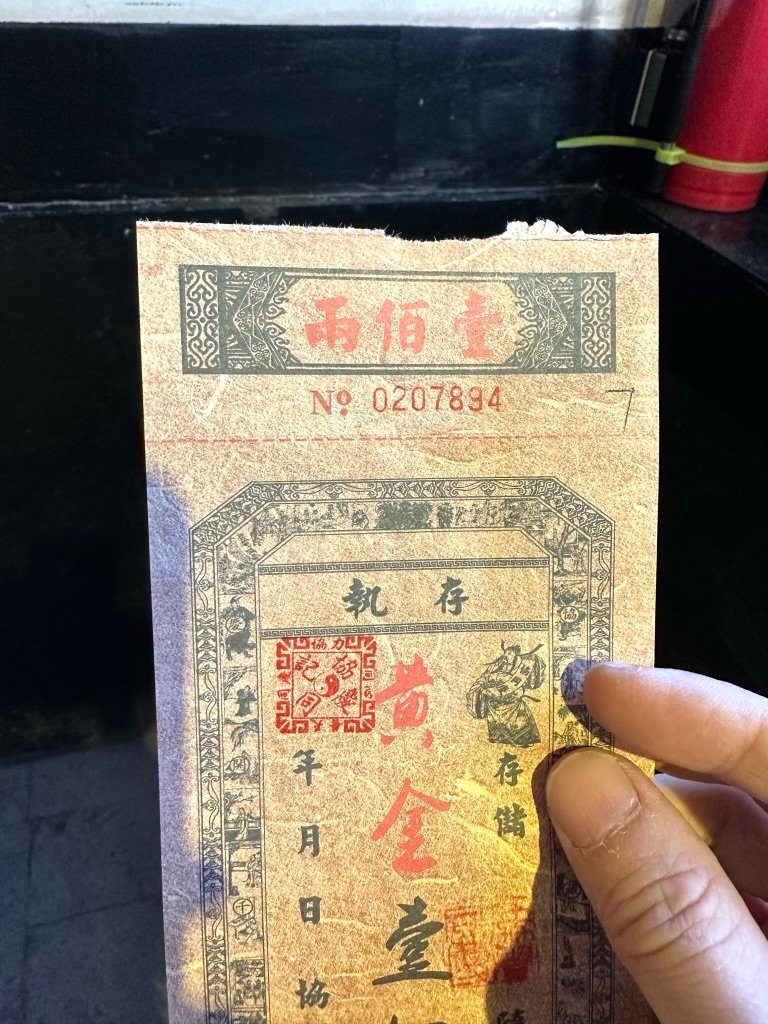
At the beginning of the video, Dad is holding a replica historical bank draft.
Then…
down the stairs we go.
😂
Steep stone steps.
Brick walls.
Underground passages.
Arched corridors.
Heavy doors.
Vault spaces.
Signs relating to wealth and storage.
And exhibits showing how valuable assets were protected.
Suddenly all that talk about historical finance becomes physical.
SILVER.
GOLD.
VAULTS.
GUARDS.
SECURITY.
This wasn’t money existing as numbers glowing on a screen.
Wealth could be heavy.
Tangible.
Stored behind doors.
Worth protecting.
And definitely worth stealing.
😳
👀 Look at What Dad Is Holding
This is one of Dad’s favorite visual contrasts in the whole Pingyao story.
Look at the underground environment.
Physical wealth.
Vaults.
Brick.
Doors.
Security.
Then look at Dad’s hand.
A replica draft.
A piece of paper.
Think about that contrast.
🪙 DOWN BELOW
Physical wealth
Silver.
Gold.
Storage.
Security.
Guards.
📜 IN DAD’S HAND
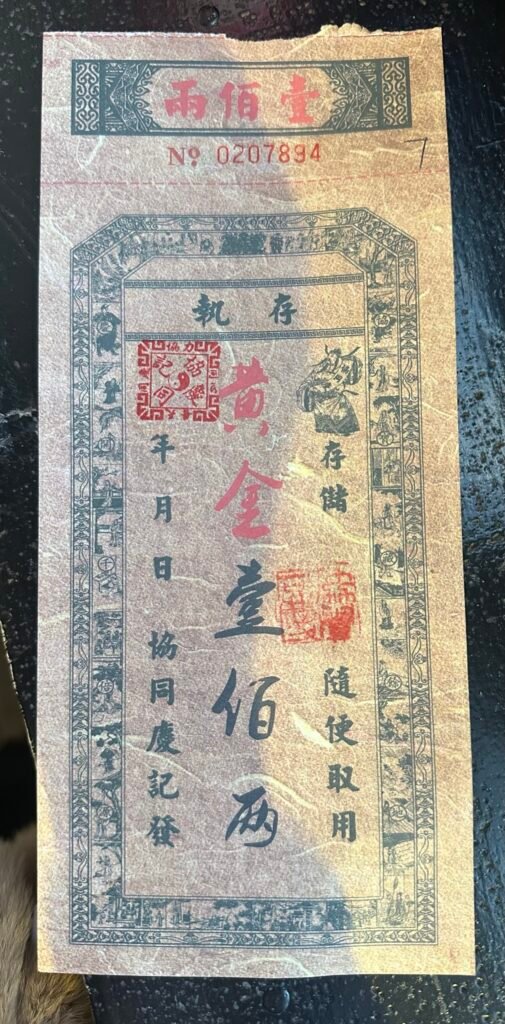
Information representing a financial transaction
A document.
Records.
Verification.
A network.
Trust.
That doesn’t mean the paper somehow replaced all the silver.
It didn’t.
The physical wealth still mattered.
The reserves still mattered.
The financial institutions still needed assets and accounting.
But the network could solve a very important problem:
DISTANCE.
A merchant did not necessarily need to personally carry the same pile of silver from one end of a long journey to the other.
And that is when Dad’s money rabbit hole became much easier to visualize.
🐇
💡 Money Was Physical. Value Could Travel Through a Network.
That’s the big idea.
Don’t think:
Silver disappeared and paper money replaced it.
That’s not what Dad means.
Think instead:
Physical wealth could remain within a financial system while records and drafts helped transfer claims on value across distance.
That’s a much more interesting development.
Because now the real challenge wasn’t simply:
How do we transport silver?
It became:
How do we make people hundreds of kilometers apart trust the same transaction?
And THAT is where things get really interesting.
🤔 Dad Spots a Problem
Let’s return to our imaginary merchant.
He deposits funds at one location.
Documentation is issued.
Records are created.
He travels.
Eventually somebody arrives at another financial office and essentially says:
“I’m here for the money.”
Okay.
😂
How does the other office know the document is genuine?
How does it know the transaction is genuine?
How does it know the person presenting it is entitled to receive the funds?
There was no QR code.
No passport scanner.
No banking app.
No facial recognition.
No SMS.
And definitely…
no six-digit OTP arriving on your phone.
😂😂😂
Yet potentially large amounts of money were involved.
So the system needed something more than paper.
It needed records.
Procedures.
Verification.
Trusted employees.
And methods designed to reduce fraud.
Dad had now reached the next rabbit hole.
🐇🐇🐇
Because moving value across distance was only half the problem.
The other half was:
HOW DO YOU KNOW THE MONEY IS REALLY YOURS?
🔐
And whatever you do…
don’t leave Pingyao (平遥, Píngyáo) thinking they invented the OTP.
😂
🔐 SECTION 3 — How Did They Know the Money Was Really Yours?
Dad had now understood the basic idea.
A merchant didn’t necessarily need to carry the same pile of silver across China.
A draft bank (票号, piàohào) could help move financial value between distant places.
Excellent.
Much safer than Dad traveling across China with boxes of silver.
😂
Except…
there was one rather important problem.
Imagine Dad walks into a branch hundreds of kilometers away carrying a piece of paper.
He puts it on the counter and says:
“Hello. Please give me the money.”
Why should anybody believe him?
🤔
There was no banking app.
No QR code.
No SMS confirmation.
No passport scanner.
No fingerprint reader.
No six-digit OTP.
And potentially a LOT of silver was involved.
So now Dad had a new question:
How did they know the draft was real?
🐇
Welcome to one of Dad’s favorite Pingyao rabbit holes.
📜 First Problem: A Piece of Paper Can Be Copied
Think about the challenge.
A draft might represent a valuable financial transaction.
If somebody could simply copy the document…
change the amount…
alter the date…
forge the writing…
or create a convincing fake…
the whole system would collapse.
Because a financial network only works if people at different locations can trust the information moving through it.
The paper itself wasn’t enough.
The institution needed ways to answer questions like:
Was this draft genuinely issued?
Do the details match the records?
Has somebody altered it?
Is the amount correct?
Is the date correct?
And that brings us to a wonderful Chinese term:
密押 (mìyā)
Think:
SECRET CODE.
🔐
🕵️ Pingyao Had a Financial Code
Historical Shanxi draft banks developed anti-counterfeiting systems using coded Chinese characters.
At Rishengchang (日昇昌, Rìshēngchāng), key information could be encoded using characters whose hidden meanings were understood by the people responsible for handling the drafts.
To everybody else?
They could look like ordinary Chinese characters.
But within the system, particular characters represented information such as:
MONTH
DAY
AMOUNT
UNITS OF SILVER
That meant somebody couldn’t necessarily produce a convincing draft simply by writing:
“Please pay Dad 10,000 taels of silver.”
😂
The visible information and the coded information had to agree.
And the people checking the draft needed to know how to read the code.
🔢 Words Could Become Numbers
This is the clever part.
Instead of writing sensitive numerical information only as obvious numbers, Chinese characters could act as substitutes.
A set of characters might correspond to:
1, 2, 3, 4, 5…
Another set could represent:
months
Another:
days
And another could represent units used to express the amount.
So apparently ordinary phrases could carry another layer of information.
What looked like language could also function as code.
🔥
Dad likes this.
Because suddenly an old bank draft isn’t just an old piece of paper sitting behind museum glass.
It becomes something closer to a puzzle.
You are looking at two things at once:
A financial document
and
a security device.
🧩 Dad’s Simplified Example
Don’t copy this as an actual historical code.
😂
Dad is only showing you the idea.
Imagine the bank secretly decides:
Rabbit = 1
Bug = 2
Elaine = 3
Dad = 4
Then somewhere in a financial document appears:
Rabbit — Dad — Elaine
To you?
A rather strange ChinaTravelBUG sentence.
😂
To somebody who knows the code?
1 — 4 — 3
Now imagine a much more sophisticated system being used to encode important information about a financial transaction.
That’s the basic handrail.
The real historical systems were institution-specific and more carefully controlled.
And there was another clever precaution.
🔄 Don’t Keep the Same Secret Forever
A secret isn’t very useful once everybody knows it.
So the codes weren’t necessarily permanent.
They could be changed.
That matters.
Imagine somebody spends years learning how your system works.
Finally…
“I’ve cracked it!”
🎉
And the bank says:
We’ve changed the code.
😂
That makes counterfeiting considerably harder.
The security of the system depended not simply on having a clever code, but on controlling knowledge of the code.
Which brings us back to something Dad keeps encountering throughout this Pingyao story.
TRUST.
You needed to trust the institution.
The institution needed to trust its branches.
Branches needed reliable records.
Employees needed procedures.
Sensitive information couldn’t simply be shared with everybody.
Suddenly this looks less like one clever invention…
and more like an entire system of trust.
🧠 The Technology Wasn’t Just the Paper
This is important.
It’s tempting to stand in a museum and think:
“Wow. Clever old bank draft.”
But Dad thinks that misses the bigger idea.
The real technology wasn’t simply:
PAPER.
It was:
PAPER
+
RECORDS
+
CODES
+
AUTHENTICATION
+
TRAINED PEOPLE
+
BRANCHES
+
TRUST
That combination allowed information about value to move across distance.
🐞
And once Dad understood that, the old financial buildings of Pingyao (平遥, Píngyáo) became much more interesting.
The impressive thing wasn’t that somebody invented a fancy piece of paper.
The impressive thing was that people in different places could agree to TRUST what that paper represented.
🌏 Imagine the Journey
Now let’s put ourselves back into the historical world.
A merchant is in one city.
A transaction is recorded.
A draft is issued.
Information is encoded.
The merchant travels.
Days pass.
Perhaps weeks.
Eventually the document arrives somewhere far away.
There is no instant message back to Pingyao (平遥, Píngyáo).
No cloud database.
No:
“Your transfer has been successfully received.”
😂
Yet the receiving financial office needs enough information and procedure to decide whether payment should be made.
That is what makes the network so fascinating.
The distance between two branches might be enormous.
But they belonged to the same system of records, procedures and trust.
Now Dad’s favorite sentence from Section 2 becomes even more important:
The courtyard is what you can photograph. The network is the real story.
🪙 Remember Dad Underground?
Think back to Dad walking underground in Pingyao (平遥, Píngyáo).
Vaults.
Doors.
Guards.
Physical wealth.
Silver and gold needed physical protection.
But now we’ve discovered another kind of security.
INFORMATION needed protection too.
🔥
That’s the connection.
Underground security protected physical wealth.
Codes and procedures helped protect financial information and transactions.
One problem was:
How do we stop somebody stealing the silver?
Another was:
How do we stop somebody stealing the VALUE by presenting a fraudulent claim?
Different problems.
Different defenses.
Same underlying issue:
TRUST.
😂 No, Pingyao Did NOT Invent the OTP
This is where Dad has to be careful.
It’s very tempting to say:
“Wow! This was basically ancient two-factor authentication!”
Or:
“Rishengchang invented the OTP!”
No.
😂😂😂
Don’t leave Pingyao (平遥, Píngyáo) telling your friends that.
Modern digital banking operates with completely different technologies, institutions, regulations and security systems.
The comparison is useful only as a handrail.
When your bank asks for additional verification today, the underlying human problem is familiar:
How do we know this transaction is genuine?
Historical draft banks faced their own version of that problem using the tools available to them.
Paper.
Writing.
Records.
Seals.
Codes.
Trusted employees.
Institutional procedures.
Different technology.
Different era.
Same human need to establish trust across distance.
And THAT is the connection worth remembering.
🏦 So Was Rishengchang Really “China’s First Bank”?
Now we arrive at another interesting problem.
Walk around Pingyao (平遥, Píngyáo) and you will inevitably encounter a very attractive description of Rishengchang (日昇昌, Rìshēngchāng):
“China’s First Bank.”
Great headline.
Easy to remember.
Very tourist-friendly.
😂
But…
Dad had just spent all this time understanding 票号 (piàohào).
So another question appeared.
Was Rishengchang really a “bank” in the same sense as the bank you use today?
Hmm.
🐇
Now Dad needed to separate the useful tourist shortcut…
from the more interesting historical story.
Next: Was Rishengchang Really China’s First Bank?
🏦 SECTION 4 — From Underground Vaults to the Bigger Shanxi Story
Dad had now gone quite far down the Pingyao money rabbit hole.
Literally.
😂🐇
We had started with the Pingyao City Wall (平遥城墙, Píngyáo Chéngqiáng).
Then came merchants.
Silver.
Drafts.
Branches.
Secret codes.
Trust.
And eventually…
Dad disappeared underground into a historic vault.
😂
But before we climb back out into the streets of Pingyao (平遥, Píngyáo), there is one last piece Dad wants to connect.
Because this financial story doesn’t belong only to Pingyao.
It belongs to a much bigger Shanxi (山西, Shānxī) story.
And Dad and Elaine had encountered that story somewhere else too.
🏛️ Dad and Elaine Had Seen This Story in Taiyuan Too
When Dad and Elaine traveled through Shanxi Province (山西省, Shānxī Shěng), we used the provincial capital Taiyuan (太原, Tàiyuán) as one of our travel bases.
And while we were there, we visited the Shanxi Museum (山西博物院, Shānxī Bówùyuàn).
This is one reason Dad loves provincial museums.
You visit individual historical places…
then the museum helps you connect them.
🐞
The Shanxi Museum doesn’t tell only the story of ancient bronzes, dynasties and archaeological discoveries.
Its major historical exhibition also includes a section devoted to:
明清晋商
Ming and Qing Shanxi Merchants.
Suddenly the things Dad had been seeing on the ground started joining together.
Pingyao wasn’t some strange little town that happened to produce an interesting financial institution.
The Shanxi merchants (晋商, Jìnshāng) belonged to a much larger commercial story.
Pingyao was one important part of that world.
So were other merchant centers and families across Shanxi.
And the 票号 (piàohào) were part of that larger story of Shanxi commerce, networks and finance.
That’s why Dad likes traveling this way.
PLACE gives you the experience.
MUSEUM gives you the framework.
Then you put the two together.
🔥
💡 Pingyao Makes More Sense When You Understand Shanxi
This is an important shift.
If you visit only Rishengchang (日昇昌, Rìshēngchāng), you might leave thinking:
“Interesting. An old Chinese bank.”
But once Dad and Elaine had traveled around Shanxi…
and later stood among the historical displays in the Shanxi Museum (山西博物院)…
the story became much bigger.
This wasn’t simply:
ONE BANK
in
ONE OLD CITY.
It was part of a wider commercial culture that developed across Shanxi and connected merchants to places far beyond the province.
Goods moved.
People moved.
Information moved.
Money moved.
And financial networks developed partly because all that movement created problems that needed solving.
Which brings Dad back to that famous sign you encounter in Pingyao.
🤔 Was Rishengchang Really “China’s First Bank”?
You will often see Rishengchang (日昇昌, Rìshēngchāng) introduced very simply as:
“CHINA’S FIRST BANK”
Dad understands why.
It’s memorable.
International travelers immediately understand roughly what kind of place they’re visiting.
But after everything we’ve just explored…
we can be more precise.
Rishengchang belonged to the historical world of:
票号 (piàohào)
Often translated into English as draft banks.
These institutions developed within a particular Chinese commercial environment and became especially associated with Shanxi merchants.
Remittance — moving funds between distant places — was central to what made them important.
So Dad treats:
“China’s first bank”
as a useful tourist handrail.
Not the whole historical explanation.
😂
Don’t Imagine HSBC With Qing Dynasty Furniture
That’s Dad’s easiest way to remember the distinction.
Don’t imagine:
modern bank
minus computers
plus courtyard
plus men wearing Qing Dynasty clothes.
😂
A 票号 (piàohào) belonged to its own historical financial world.
Modern commercial banks operate within completely different technologies, regulations, currencies, institutions and financial systems.
Understanding Rishengchang on its own terms is actually much more interesting.
A merchant needed to move value across enormous distances.
Carrying large quantities of silver created problems.
A financial network offered another solution.
Branches needed records.
Drafts needed verification.
Transactions needed authentication.
Employees needed procedures.
And everything ultimately depended upon:
TRUST.
That is the historical achievement Dad wants to understand.
Not whether we can squeeze Rishengchang neatly into our modern definition of a bank.
📱 And Then Dad Makes the Alipay Connection…
Of course he does.
😂
Because Dad is standing in a city famous for an earlier financial world…
while carrying a smartphone in modern China.
Today, Dad can open Alipay (支付宝, Zhīfùbǎo) or WeChat Pay (微信支付, Wēixìn Zhīfù).
Scan.
Tap.
Pay.
Done.
Sometimes without touching physical cash at all.
So Dad’s brain naturally does this:
🪙 SILVER
↓
📜 DRAFT
↓
🏦 BANK
↓
📱 ALIPAY
Looks beautiful.
There’s only one problem.
HISTORY DOESN’T WORK THAT NEATLY.
😂
🚫 Rishengchang Did NOT “Become” Alipay
Dad is NOT saying:
Rishengchang invented modern banking.
And definitely not:
Rishengchang → modern Chinese banks → Alipay.
That would turn a useful comparison into a misleading historical family tree.
These belong to very different eras.
Different technologies.
Different institutions.
Different financial systems.
Different regulatory worlds.
Different ways of representing and settling value.
So why does Dad connect them at all?
Because underneath those enormous differences is a surprisingly persistent human problem.
💰 How Do Humans Move Value Across Distance?
Imagine our Qing Dynasty merchant again.
He has value in one place.
He needs that value somewhere far away.
His problem is:
How do I move it safely?
Now imagine Dad traveling around China today.
Dad wants to pay somebody.
The technology is completely different.
The institutions are completely different.
The speed is almost unimaginable compared with the Qing Dynasty.
But at the broadest level, humans are still solving a familiar problem:
HOW DO WE MOVE VALUE SAFELY BETWEEN PEOPLE AND PLACES?
That’s the connection.
Not technological ancestry.
Not:
“Ancient Alipay!”
😂😂😂
But continuity in the human problem being solved.
🪙 SILVER → 📜 DRAFT → 📱 DIGITAL PAYMENT
Three very different worlds.
🪙 PHYSICAL SILVER
Value could be physically carried.
But large amounts of silver were heavy, costly and risky to transport over long distances.
↓
📜 DRAFT-BANK NETWORK
Documentation, records, branches, verification and institutional trust could help transfer claims on value between places without requiring the customer to personally carry the same silver throughout the journey.
↓
📱 MODERN DIGITAL PAYMENT
Modern financial and communications infrastructure allows payment information to move electronically and transactions to happen extraordinarily quickly.
They are NOT the same systems.
One did not simply turn into the next.
But Dad sees one wonderful question running through all three:
Different systems.
Different technologies.
Different eras.
Same human problem: how do we move value safely across distance?
🐞
That is enough.
Dad has officially gone deep enough.
😂🐇🐇🐇
☀️ Okay, Dad. Come Back Up.
Remember where we left him?
Underground.
Vaults.
Brick corridors.
Heavy doors.
Physical wealth.
Security.
Now let’s come back up.
Past the doors.
Up the stairs.
Back into the sunlight.
And then…
let’s go even higher.
Let’s climb the Pingyao City Wall again.
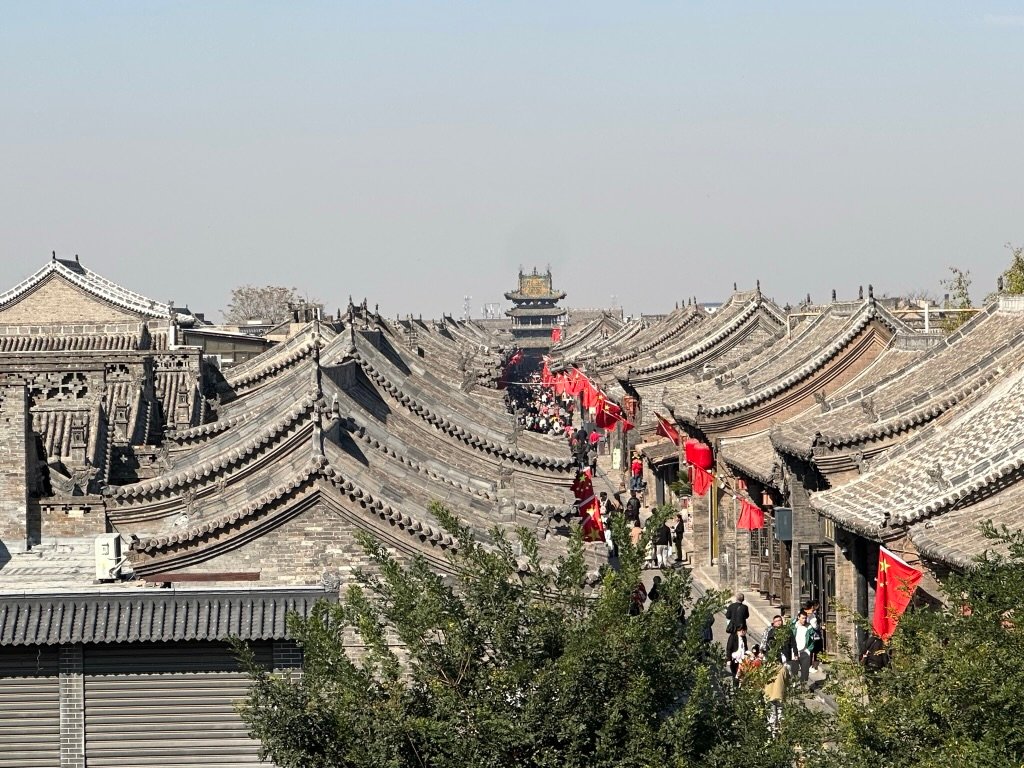
Looking across the Ancient City of Ping Yao (平遥古城, Píngyáo Gǔchéng) from the Pingyao City Wall (平遥城墙, Píngyáo Chéngqiáng).
Look out across those rooftops with Dad and Elaine.
Grey tiles.
Courtyards.
Historic streets.
People moving below.
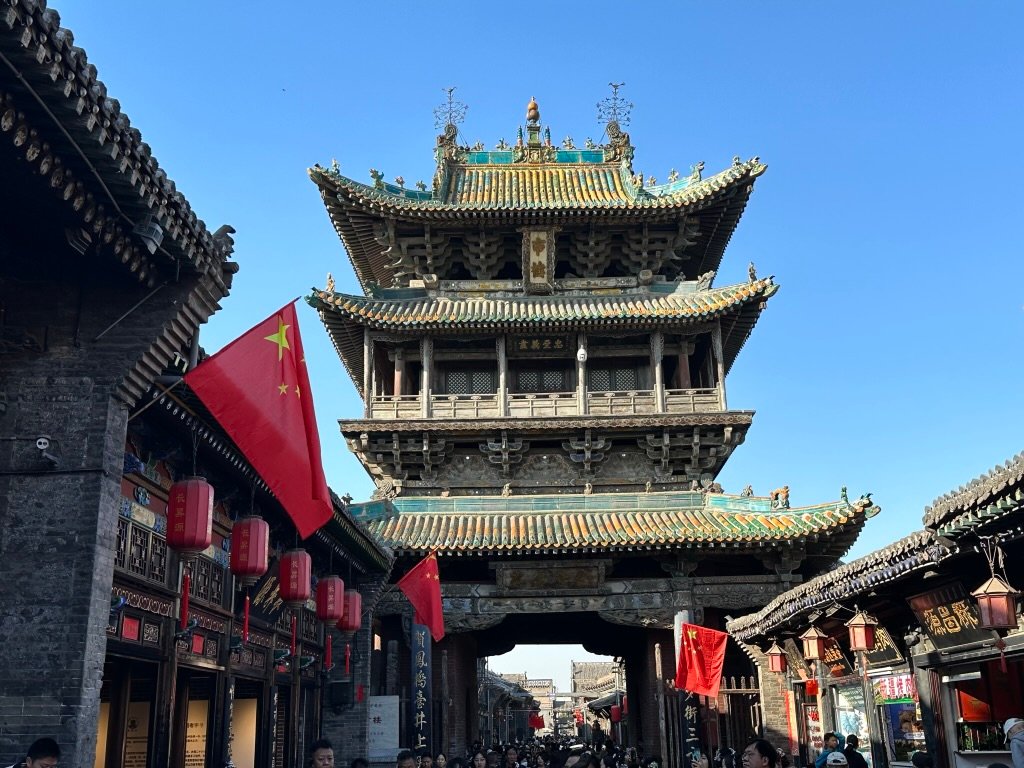
And in the distance, the Market Tower (市楼, Shìlóu) rising above the old commercial streets.
After spending so much time underground thinking about money…
this view is almost a reset button.
Because suddenly you remember:
RISHENGCHANG WAS ONLY ONE PART OF THE CITY.
🔥
👀 From Up Here, Pingyao Becomes a City Again
Look down.
Somewhere among those streets were merchants.
But there were also officials.
Teachers and students.
Temples and worshippers.
Shopkeepers.
Families.
Workers.
Travelers.
Residents.
Courtyards.
Homes.
Government offices.
Religious spaces.
Commercial spaces.
This wasn’t a financial museum surrounded by old buildings.
😂
It was a functioning city.
And remember what Dad and Elaine saw when we first entered through the ancient gate?
People were still going in and out.
Residents still use this historic urban space today.
Modern Pingyao is obviously not Ming or Qing Pingyao.
But it isn’t an abandoned archaeological ruin either.
It remains part of a living city.
That brings us all the way back to Dad’s original question.
Not:
How did Rishengchang work?
We answered that rabbit hole.
🐇
The bigger question was:
HOW DID PINGYAO WORK?
Remember Dad’s Coat Rack?
Pingyao City Wall (平遥城墙)
→ THE CONTAINER
Pingyao County Government Office (平遥县衙)
→ GOVERNMENT
Pingyao Confucian Temple (平遥文庙)
→ EDUCATION + VALUES
Pingyao City God Temple (平遥城隍庙)
→ BELIEF + RITUAL
Rishengchang (日昇昌)
→ MERCHANTS + MONEY + TRUST
We’ve gone very deep into the last one.
Now…
let’s walk the rest of the city.
🐞
Next: Government, Education and Belief — How Pingyao Actually Worked
🏙️ SECTION 5 — Now Walk Pingyao Again
Come down from the wall with Dad and Elaine.
Back into the streets.
After that enormous money rabbit hole, Dad began looking at Pingyao (平遥, Píngyáo) differently.
The old buildings were no longer just:
temple
old courtyard
another temple
another old building
😂
Each one had a job.
So let’s walk.
No history lecture.
Just one question:
WHAT JOB DID THIS PLACE DO?
🏛️ 1. Who Ran the City?
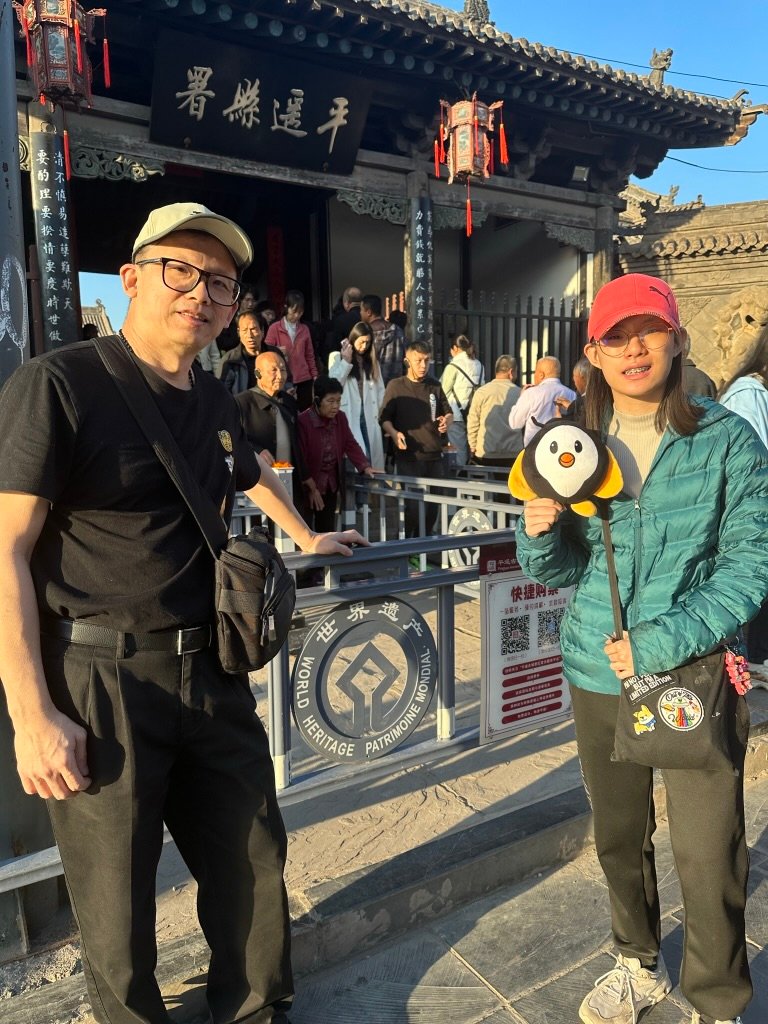
Our first stop:
Pingyao County Government Office (平遥县衙, Píngyáo Xiànyá).
For a Western traveler, think:
local government + courthouse + administrative headquarters.
Not exactly a modern city hall.
But that’s the easiest handrail.
This was where the machinery of local imperial government became real.
Officials worked here.
Cases could be heard here.
Taxes and administrative affairs were handled through government.
Rules had to be enforced.
Records had to be kept.
A city full of merchants, residents and property couldn’t function on commerce alone.
Someone had to govern it.
🐞
Dad’s Coat Rack:
🏛️ COUNTY GOVERNMENT OFFICE = GOVERNMENT
Done.
Keep walking.
📚 2. What Did Society Teach People to Value?
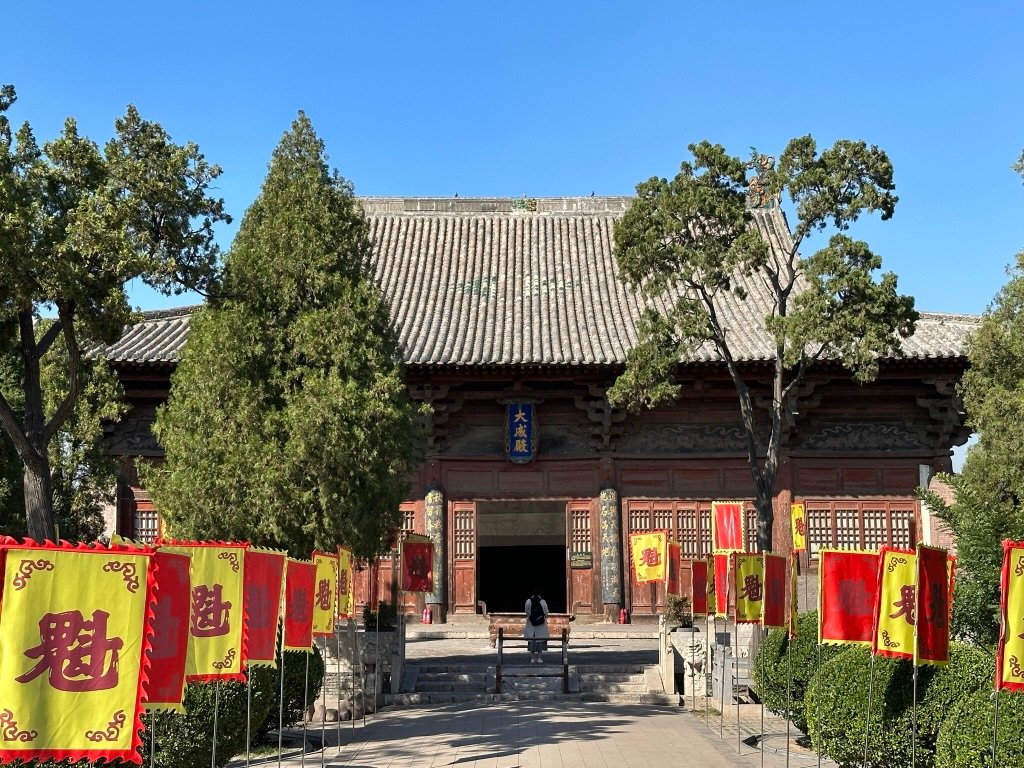
Next:
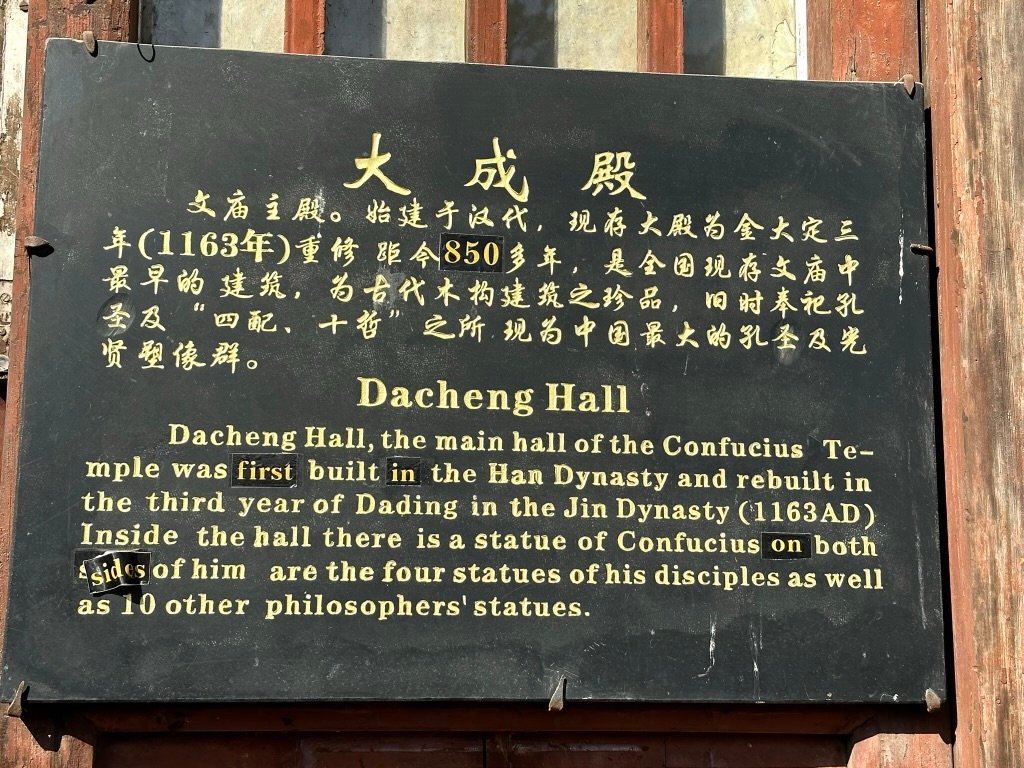
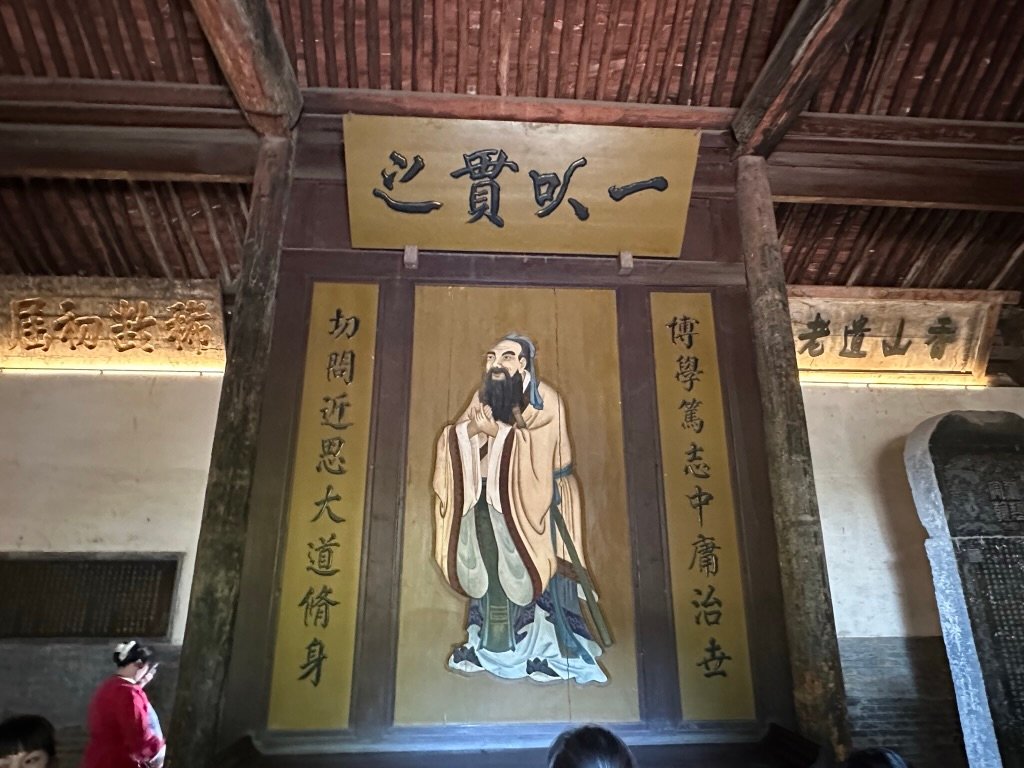
Pingyao Confucian Temple (平遥文庙, Píngyáo Wénmiào).
Western travelers sometimes see the word temple and assume:
religion.
But a Confucian temple points us toward something broader.
Education.
Scholarship.
Social values.
The prestige of learning.
And the enormous importance that imperial China attached to the Confucian intellectual tradition.
You don’t need a crash course in Confucius.
😂
Just remember:
A functioning city doesn’t only tell people what they CAN do.
It also teaches ideas about how people SHOULD behave.
🐞
Dad’s Coat Rack:
📚 CONFUCIAN TEMPLE = EDUCATION + VALUES
Next.
🛕 3. And What About the Gods?
Now walk into a very different world.
Pingyao City God Temple (平遥城隍庙, Píngyáo Chénghuáng Miào).
This one is fun for international travelers because the concept may be unfamiliar.
Traditional Chinese cities could have a City God (城隍, Chénghuáng) associated with the protection and spiritual order of the city.
Think about the contrast.
A few streets away:
🏛️ County Government Office
Human officials.
Here:
🛕 City God Temple
The spiritual world.
😂
Dad loves this pairing.
One helps you see how the city was administered.
The other helps you see how people understood protection, morality, ritual and forces beyond ordinary government.
Different jobs.
Same city.
🐞
Dad’s Coat Rack:
🛕 CITY GOD TEMPLE = BELIEF + RITUAL
And now something interesting happens.
🧥 Dad’s Coat Rack Is Full
Remember what we started with?
🧱 CITY WALL
The container
🏛️ COUNTY GOVERNMENT OFFICE
Government
📚 CONFUCIAN TEMPLE
Education + values
🛕 CITY GOD TEMPLE
Belief + ritual
💰 RISHENGCHANG
Merchants + money + trust
That’s enough.
Seriously.
😂
You don’t need another 27 historical attractions.
Because now you have a framework.
And once you have the framework…
STOP COLLECTING ATTRACTIONS.
🚶 Now Just Walk
This may actually be Dad’s favorite part of Pingyao (平遥, Píngyáo).
Put the checklist away.
Walk.
Look at the doors.
The courtyards.
The shopfronts.
The rooflines.
The narrow lanes.
The old commercial streets.
Look up.
Look through open doorways.
Watch people moving around you.
Remember the residents Dad and Elaine saw passing through the ancient gate?
This is still a living place.
And now, when you pass another old building, you don’t immediately need to know:
What attraction is this?
Instead ask:
What JOB might this place have played in the city?
Home?
Shop?
Temple?
Business?
Government?
Education?
Storage?
Something else?
🐇
Suddenly you’re not collecting monuments.
You’re reconstructing a city.
🐞 This Is Why Dad Uses the Coat Rack
The Coat Rack isn’t there to make you memorize Chinese history.
Quite the opposite.
It gives you permission to stop memorizing.
😂
You’ve already got the big picture.
Let everything else you discover hang somewhere on it.
And if something doesn’t fit?
Excellent.
That’s probably another rabbit hole.
🐇
But you don’t have to follow every rabbit.
Sometimes…
just enjoy Pingyao.
Walk slowly.
Get lost for a while.
Take photographs.
Have something to eat.
Watch the streets change as the day moves on.
Because after all the history, Dad thinks this is important too:
Pingyao is a place to EXPERIENCE, not an exam to pass.
And if your itinerary allows it…
don’t rush back to the railway station.
🌙
Stay after the day-trippers begin to leave.
Because an ancient city feels very different when you give it more than a few hours.
🍜 SECTION 5 — Enough Banking. Let’s Taste Shanxi. 😂
Okay.
Dad has spent enough time talking about:
silver…
drafts…
secret codes…
financial networks…
and underground vaults.
🐇🐇🐇
Time to do something much simpler.
WALK. EAT. DRINK.
Because traveling through Shanxi (山西, Shānxī) isn’t only about understanding history.
Sometimes…
you can drink it.
Sometimes…
you can pour it over your noodles.
😂
And Dad did both.
🍶 First: Something to Keep Dad Warm
While traveling through Shanxi (山西, Shānxī), Dad visited a shop selling one of the province’s most famous products:
Fenjiu (汾酒, Fénjiǔ)
If you’re an international traveler and have never heard of Fenjiu…
this isn’t just some random local alcohol Dad discovered in a shop.
😂
Fenjiu is one of China’s historic great baijiu (白酒, báijiǔ) names.
At China’s first National Liquor Appraisal in 1952, four baijiu were recognized as China Famous Liquor (中国名酒):
🍶 Moutai (茅台, Máotái) — Guizhou (贵州, Guìzhōu)
🍶 Fenjiu (汾酒, Fénjiǔ) — Shanxi (山西, Shānxī)
🍶 Luzhou Laojiao (泸州老窖, Lúzhōu Lǎojiào) — Sichuan (四川, Sìchuān)
🍶 Xifengjiu (西凤酒, Xīfèngjiǔ) — Shaanxi (陕西, Shǎnxī)
They became remembered as the original:
四大名酒 — China’s Four Famous Baijiu
So when Dad walked into a Fenjiu shop in Shanxi…
he wasn’t merely trying a local drink.
He was tasting one of the historic names of Chinese baijiu.
🐞
Fenjiu is particularly associated with the light-aroma style (清香型, qīngxiāng xíng) of baijiu.
And the shop had some rather beautiful bottles.
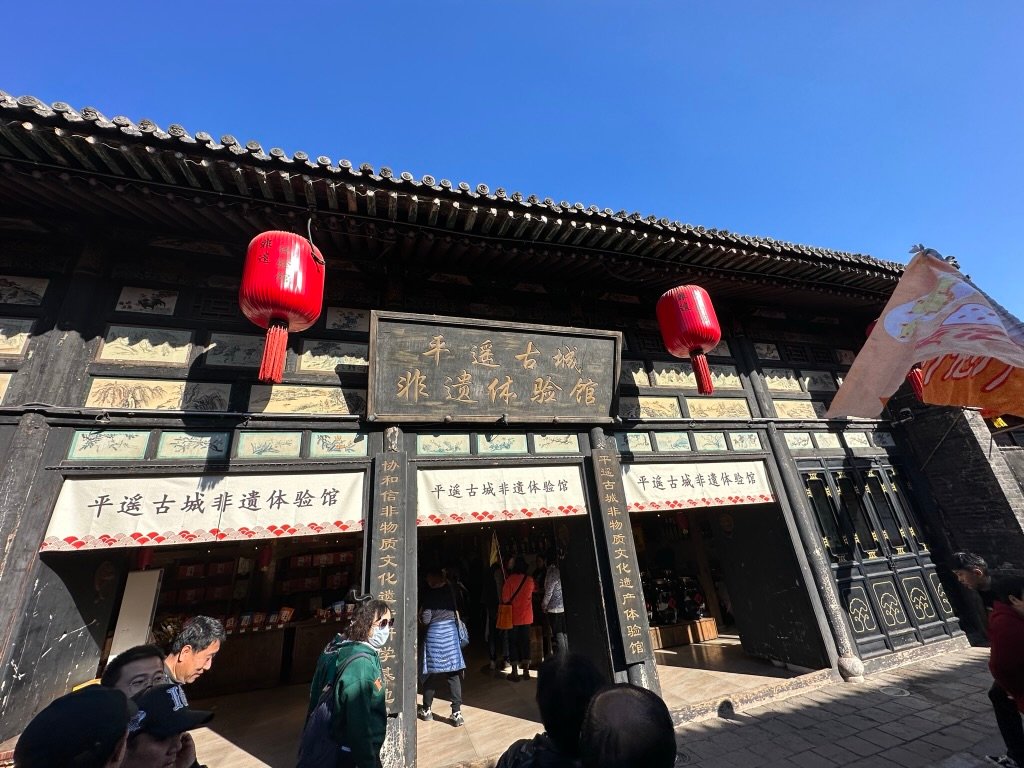
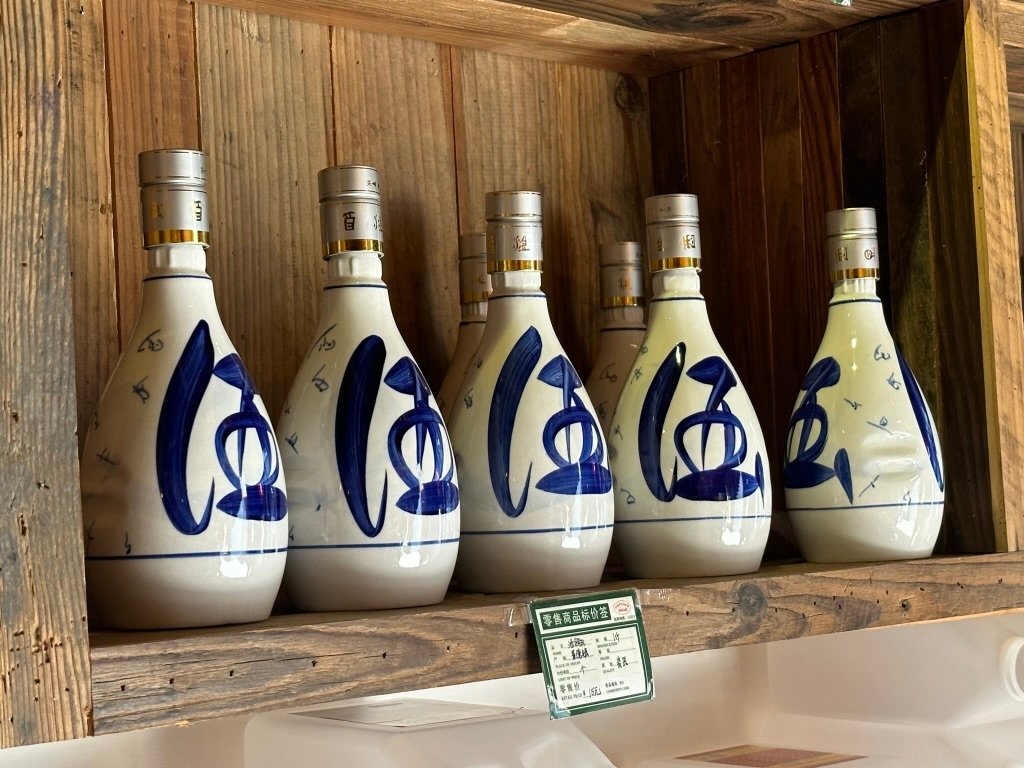
Look at them.
Beautiful ceramic bottles.
Very elegant.
Very gift-worthy.
Very tempting.
But Dad didn’t buy the beautiful bottle.
😂
Dad bought 散装 (sǎnzhuāng) — sold loose and packed into an ordinary bottle.
Why?
Dad wasn’t looking for the packaging.
He wanted the Fenjiu.
At the local price.
🐞
And Dad went for the 25-year one.
Nothing glamorous about the bottle he carried away.
But as Dad and Elaine continued traveling through Shanxi and the autumn temperatures began dropping…
Dad became rather happy to have it.
😂🍶
A little Fenjiu at the end of a cold Shanxi day became part of the journey.
And suddenly this wasn’t only:
“We tried a famous Chinese spirit.”
It became:
“This is what Dad drank as we traveled through Shanxi.”
That’s the kind of souvenir Dad likes.
Not something that sits on a shelf.
Something that becomes part of the journey.
🥢 Then Came Shanxi’s Other Famous Bottle
This one wasn’t alcohol.
VINEGAR.
😂
If you’re wondering how vinegar could possibly become a travel experience…
come with Dad and Elaine to the commercial area outside the Qiao Family Compound (乔家大院, Qiáojiā Dàyuàn).
Because this wasn’t:
“Here is some vinegar. Put it on your noodles.”
We were invited to taste it.
And not just any vinegar.
25-YEAR-OLD VINEGAR.
😳
🥃 Elaine Tries 25-Year-Old Shanxi Vinegar
At the shop, the staff poured Elaine a tiny sample of 25-year-aged Shanxi vinegar.
And Elaine became the tester.
😂
The staff showed us what made this older vinegar different.
Look at the color.
Look at the thickness.
Smell it.
Then…
taste it carefully.
Very carefully.
😂
The staff even warned Elaine to touch just a little to the tip of her tongue first because of the acidity.
This is one of those travel moments Dad loves.
We hadn’t arrived expecting a vinegar-tasting session.
But suddenly Dad and Elaine were standing in Shanxi discussing the age, aroma, color and texture of…
vinegar.
😂
Five-year.
Eight-year.
Ten-year.
Twenty-five-year.
For an international traveler accustomed to thinking of vinegar as simply something sitting beside the cooking oil…
this is quite a change of perspective.
🤔 Wait… People DRINK This?
That surprised Dad too.
During the tasting, the staff explained that this particular 25-year product wasn’t intended simply as an everyday cooking vinegar.
She described it as something people could drink directly in small quantities.
That’s what you’re watching Elaine taste in the video.
🐞
One important distinction:
Dad is sharing what the shop staff told us during our visit.
We’re not making medical or health claims about drinking vinegar.
For us, the interesting part was cultural.
Shanxi takes its vinegar seriously.
Very seriously.
😂
🏺 And Then Dad Found a VINEGAR FOUNTAIN
Yes.
We’re still talking about vinegar.
😂😂😂
Outside the shop was something Dad had definitely never encountered before.
A VINEGAR FOUNTAIN.
Dark vinegar circulates through the display…
and you can SMELL it.
In the video, Dad immediately reacts:
“My goodness, I can smell the vinegar! The fragrant smell.”
Inside, we’d tasted different ages.
Outside, vinegar had practically become part of the attraction.
Around us were bottles, jars and containers of different sizes and prices.
Everyday vinegar.
Aged vinegar.
Gift packaging.
Cheap bottles.
Expensive bottles.
Dad had somehow fallen into another Shanxi rabbit hole.
🐇
Thankfully this one tasted good.
😂
🥢 And Vinegar Kept Following Us Through Shanxi
Here’s why this little detour belongs in our Pingyao story.
The two videos above were filmed outside the Qiao Family Compound (乔家大院, Qiáojiā Dàyuàn).
But that wasn’t the end of Dad’s vinegar story.
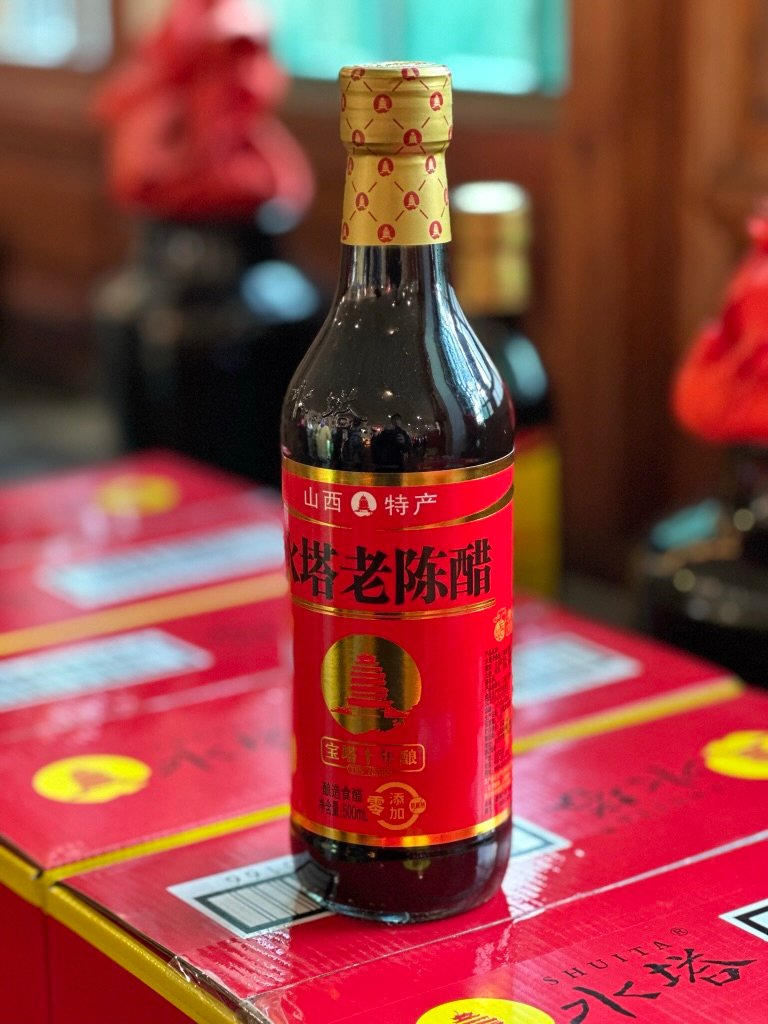
Dad encountered Shanxi aged vinegar (山西老陈醋, Shānxī Lǎochéncù) again in Pingyao (平遥, Píngyáo).
By then, Dad understood.
This wasn’t merely something being sold at one tourist attraction.
It was one of the flavors of Shanxi.
So Dad bought a small bottle.
Nothing fancy.
Nothing expensive.
Just a practical little bottle.
Why?
Because Dad was still eating noodles.
😂😂😂
And that little bottle continued traveling with us.
Next town.
Another bowl of noodles.
Dad’s bottle comes out.
A little Shanxi vinegar goes in.
Eat.
Continue traveling.
Simple.
But years later, these are often the details Dad remembers.
Not only:
“We visited an important historical site.”
But:
“That was the journey when Dad carried Shanxi vinegar around China for his noodles.”
😂
That’s travel too.
🐞 Two Bottles. One Shanxi Journey.
By now Dad was carrying two rather different tastes of Shanxi.
🍶 Fenjiu (汾酒, Fénjiǔ)
One of the historic Four Famous Baijiu (四大名酒) recognized at China’s first National Liquor Appraisal in 1952.
Dad bought the 25-year 散装 (sǎnzhuāng) version at local price rather than paying for the beautiful ceramic bottle.
As the Shanxi autumn became colder…
Dad enjoyed it during the rest of the journey.
😂🍶
And then:
🥢 Shanxi Aged Vinegar (山西老陈醋, Shānxī Lǎochéncù)
Dad bought a small bottle in Pingyao and carried that onward too.
Not for drinking.
For the noodles.
😂
One helped warm Dad after a cold day.
The other went into dinner.
And somehow…
those two little bottles became part of Dad and Elaine’s Shanxi journey.
🚶 This Is the Pingyao Dad Wants You to Experience
That’s why Dad doesn’t want you racing around Pingyao ticking boxes.
City Wall.
✓
Rishengchang.
✓
County Government Office.
✓
Confucian Temple.
✓
City God Temple.
✓
Done.
❌
Slow down.
Walk into shops.
Try something.
Smell something.
Taste something.
Watch what people are buying.
Look at what’s sitting on restaurant tables.
Notice what’s hanging outside the doors.
You don’t need to understand everything.
And you certainly don’t need to buy everything.
😂
But allow the ordinary things to become part of your journey.
Because DEEP China isn’t only found inside famous historical buildings.
Sometimes…
it’s in a museum.
Sometimes…
it’s underground in an old bank vault.
Sometimes…
it’s in a tiny cup of 25-year-old vinegar that Elaine is approaching VERY cautiously.
😂
And sometimes…
it’s simply what Dad pours into his next bowl of noodles.
🐞
🧥 Stop Collecting Attractions
Remember Dad’s Coat Rack?
You’ve already got the big picture.
🧱 CITY WALL
→ the container
🏛️ COUNTY GOVERNMENT OFFICE
→ government
📚 CONFUCIAN TEMPLE
→ education + values
🛕 CITY GOD TEMPLE
→ belief + ritual
💰 RISHENGCHANG
→ merchants + money + trust
Excellent.
The Coat Rack is already installed.
Now let Pingyao fill it.
Walk the streets.
Look through doorways.
Explore the courtyards.
Eat the noodles.
Smell the vinegar.
Try the local flavors.
Watch ordinary life happening around you.
You don’t need another 27 historical attractions.
😂
Because Pingyao isn’t an exam.
It’s a city to experience.
And once you stop trying to collect every attraction…
you may actually start noticing the city between them.
Then Dad Saw the Pattern Again in Hancheng
Pingyao wasn’t the only old city where Dad began seeing these pieces come together.
Later, in Hancheng Ancient City (韩城古城, Hánchéng Gǔchéng) in neighboring Shaanxi Province, Dad and Elaine encountered some surprisingly familiar pieces:
📚 Wen Temple (文庙, Wénmiào)
→ education + Confucian values
🛕 City God Temple (城隍庙, Chénghuáng Miào)
→ belief + ritual
🏛️ local government structures
→ administration + authority
🏘️ old streets, shops and courtyards
→ commerce + everyday life
Different city.
Different history.
Different scale.
But Dad suddenly had a familiar Coat Rack.
That is why learning to read Pingyao is useful beyond Pingyao.
Once you begin recognizing government + education + belief + commerce + everyday life, another Chinese old city can start making more sense too.
To Dad, Hancheng Ancient City felt like a smaller, quieter cousin of Pingyao — but it opened completely different historical rabbit holes, especially Sima Qian (司马迁, Sīmǎ Qiān) and Da Yu (大禹, Dà Yǔ).
👉 Walk through Hancheng Ancient City with Dad and Elaine
🐇 And this is when Dad began realizing:
THE COAT RACK TRAVELS WITH YOU.
Once you learn how to look at one old Chinese city…
you start seeing patterns in the next one.
🌙 Dad’s Pingyao Travel Regret: We Should Have Stayed Overnight
Now for something Dad would do differently.
Dad and Elaine visited Pingyao (平遥, Píngyáo) as part of a day tour.
So when the tour ended…
we left.
At the time, that seemed perfectly reasonable.
Today?
Dad would stay overnight.
😂
This is one of those little travel regrets.
Dad has another one:
Handan (邯郸, Hándān).
Same lesson.
Sometimes Dad plans a place as:
“We can see this in a day.”
Then he gets there…
starts following rabbit holes…
and realizes:
“Oops. We should have slept here.”
😂🐇
Pingyao is one of those places.
🌙 Why Stay Overnight?
Not because you need another twelve attractions.
Quite the opposite.
You need time to stop chasing attractions.
Stay after the day-trip schedule is finished.
Walk without worrying about the departure time.
Eat dinner inside the old city.
Watch the streets change as evening arrives.
Then wake up inside Pingyao the next morning.
That is a different relationship with a historical city from:
arrive → sightseeing → photographs → leave.
Dad and Elaine didn’t experience that.
And Dad wishes we had.
🐞
So Dad’s recommendation is simple:
If your itinerary allows it, give Pingyao at least one night.
Not because Dad did.
Because Dad didn’t.
And next time…
he would.
🏨 Where to Stay in Pingyao
If you’re staying overnight, Dad would look inside the ancient city or close enough to enter it easily on foot.
The point isn’t simply finding a bed.
It’s being able to experience Pingyao when you are no longer watching the clock for your day-tour departure.
👉 Check Pingyao hotels and current prices on Trip.com
ChinaTravelBUG may earn a commission if you book through our Trip.com link, at no extra cost to you.
And remember Dad’s hotel rule:
Value for money ≠ cheapest hotel.
In a place like Pingyao, location can become part of the experience.
🌙🐞
Sometimes the best improvement to an itinerary isn’t adding another attraction.
It’s adding one night.
🚄 But Was Our Pingyao Day Trip a Mistake?
No.
That’s important.
Dad and Elaine’s day trip to Pingyao (平遥, Píngyáo) worked.
We returned to our travel base in Taiyuan (太原, Tàiyuán), the capital of Shanxi Province (山西省, Shānxī Shěng).
And Dad had deliberately chosen to stay right in the middle of Taiyuan’s commercial area.
That meant coming back from a day tour wasn’t a problem.
Food?
Everywhere.
Drinks?
No problem.
Shopping?
Definitely no problem.
😂
Taiyuan was doing exactly what Dad wanted a travel base to do.
We could explore Shanxi during the day…
then return to a modern provincial capital at night.
So Dad’s lesson isn’t:
“Don’t visit Pingyao as a day trip.”
A day trip can work very well.
Dad did it.
The regret is simply this:
We experienced Pingyao during the day. We didn’t experience what happened after we left.
That’s why, if Dad planned the journey again and had enough time, he would seriously consider giving Pingyao one night.
🐞
🧥 Meanwhile… Dad Had Another Problem in Taiyuan
China journeys have a habit of changing.
😂
Our next ground-tour itinerary had changed.
And there was now going to be an overnight stay on Wutaishan (五台山, Wǔtái Shān).
Dad checked what that meant for the temperature.
😳
Much colder.
The autumn clothes Dad had brought were suddenly looking…
rather optimistic.
😂
Fortunately, we were staying in the middle of Taiyuan’s commercial district.
So Dad did what travelers do.
He went shopping.
And bought an autumn jacket at Uniqlo.
Problem solved.
🧥😂
Nothing historically profound about that.
But this is exactly why Dad likes using a city such as Taiyuan (太原, Tàiyuán) as a travel base.
You get the practical advantages of a major modern city:
food.
restaurants.
shops.
transport.
last-minute supplies.
And in Dad’s case…
emergency warmer clothing.
😂
Then the next morning, you can head back out into DEEP China.
🐞 Taiyuan Wasn’t Just Somewhere We Slept
This is another useful lesson from our Shanxi journey.
A travel base can do two jobs.
JOB 1 — Make the journey easier
Come back.
Eat.
Drink.
Shop.
Sleep.
Reset.
Go again.
JOB 2 — Help you understand where you’re traveling
Remember the Shanxi Museum (山西博物院, Shānxī Bówùyuàn)?
That was where Dad and Elaine could connect individual places with the bigger Shanxi story — including the world of the Shanxi merchants (晋商, Jìnshāng) we encountered so deeply in Pingyao.
So Taiyuan wasn’t merely:
the city where our hotel happened to be.
It became the hub connecting different pieces of Shanxi.
One day…
Pingyao (平遥).
Another direction…
Wutaishan (五台山).
Elsewhere…
completely different layers of Shanxi history.
And every time we came back…
food, lights, shops and modern city life.
That’s a travel rhythm Dad likes.
🌙 So: Day Trip or Overnight in Pingyao?
Dad’s answer after actually doing the day trip:
DAY TRIP
Absolutely workable, especially if Taiyuan is your base and your itinerary is tight.
You can see the major historical pieces and return to the conveniences of the provincial capital.
ONE NIGHT
Dad’s choice next time, if the itinerary allows.
Not because you need to squeeze in more attractions.
Because staying overnight gives you something Dad missed:
TIME.
Time to wander after the day’s sightseeing.
Time to eat without watching the tour schedule.
Time to see Pingyao change after dark.
Time to wake up inside the ancient city.
That’s Dad’s little Pingyao travel regret.
Just like Handan (邯郸, Hándān).
😂
Sometimes the lesson you bring home isn’t:
“I shouldn’t have gone.”
It’s:
“I should have stayed.”
So What Did Pingyao Teach Dad?
Dad and Elaine came to Pingyao (平遥, Píngyáo) expecting an ancient walled city.
We left seeing something more interesting.
🏛️ County Government Office → government
📚 Confucian Temple → education + values
🛕 City God Temple → belief + ritual
💰 Rishengchang → merchants + money + trust
🧱 City Wall → the urban world that held these pieces together
So when you visit Pingyao, walk the wall.
Take the photographs.
Enjoy the old streets.
But then ask:
HOW DID THIS PLACE ACTUALLY WORK?
Once you do that, Pingyao stops being a collection of old buildings.
It becomes a city again.
🍽️ Pingyao Is Only One Course in Shanxi
And this is where Dad’s rabbit hole continues.
Pingyao gave us:
government + merchants + banking + everyday imperial China.
But travel farther through Shanxi (山西, Shānxī) and the historical flavor keeps changing:
Datong (大同) → frontier China
Yungang Grottoes (云冈石窟) → Buddhism and cultural exchange
Yanmen Pass (雁门关) → frontiers and movement
Jinci (晋祠) → Zhou, Jin and historical memory
Pingyao (平遥) → government, merchants and money
Linfen (临汾) → Yao, Taosi and archaeology
Yuncheng (运城) → origins, salt and cultural memory
That’s why Dad and Elaine turned our journey into:
👉 Shanxi (山西, Shānxī) — Michelin History Tasting JOURNEY
ONE PROVINCE. MULTIPLE CHINAS.
🐞
ChinaTravelBUG — See China. Understand It Better.