One Province. Multiple Chinas.
Datong (大同, Dàtóng) → Yungang Grottoes (云冈石窟, Yúngāng Shíkū) → Hanging Temple (悬空寺, Xuánkōng Sì) / Yingxian Wooden Pagoda (应县木塔, Yìngxiàn Mùtǎ) → Yanmen Pass (雁门关, Yànménguān) → Taiyuan (太原, Tàiyuán) → Jinci (晋祠, Jìncí) → Pingyao (平遥, Píngyáo) → Linfen (临汾, Línfén) → Yuncheng (运城, Yùnchéng)
Travel China. Let the places teach you Chinese history.
Most travelers planning a trip through:
Shanxi (山西, Shānxī)
start with a list.
Yungang Grottoes (云冈石窟, Yúngāng Shíkū).
Hanging Temple (悬空寺, Xuánkōng Sì).
Yingxian Wooden Pagoda (应县木塔, Yìngxiàn Mùtǎ).
Pingyao Ancient City (平遥古城, Píngyáo Gǔchéng).
Maybe:
Mount Wutai (五台山, Wǔtái Shān).
All excellent.
But after Dad & Elaine traveled through Shanxi (山西, Shānxī), Dad began seeing the province differently.
Not:
ATTRACTION
↓
ATTRACTION
↓
ATTRACTION
Instead:
HISTORICAL LAYER
↓
HISTORICAL LAYER
↓
HISTORICAL LAYER
🔥
Travel from northern Shanxi (山西, Shānxī) toward the south and different Chinas begin appearing.
A:
FRONTIER CHINA
↓
a:
BUDDHIST CHINA
↓
a China ruled by the Northern Wei dynasty (北魏, Běi Wèi) and its Xianbei (鲜卑, Xiānbēi) rulers
↓
a China of extraordinary timber architecture
↓
a China of walls, mountain passes and moving frontiers
↓
a China of local government, merchants and money
↓
and eventually…
a China where history begins dissolving into:
LEGEND + ARCHAEOLOGY + CULTURAL MEMORY.
😬
Same province.
Different periods.
Different peoples.
Different ideas.
Different Chinas.
That’s why Shanxi (山西, Shānxī) deserves:
a Michelin History Tasting JOURNEY.
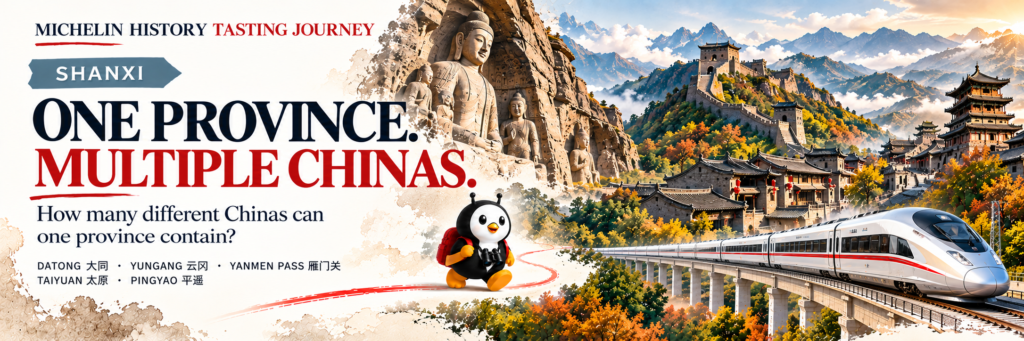
🍽️ THE MENU — One Province. Multiple Chinas.
You don’t need to know much about Datong (大同, Dàtóng), Jinci (晋祠, Jìncí) or Linfen (临汾, Línfén) before starting.
That’s the point.
Don’t try to memorise the whole history of Shanxi (山西, Shānxī).
At every stop, Dad wants you to carry:
ONE QUESTION.
🥂 DATONG (大同, Dàtóng)
FRONTIER · IDENTITY · NORTHERN WEI
Where exactly did “China” end?
Meet Pingcheng (平城, Píngchéng), capital of the Northern Wei dynasty (北魏, Běi Wèi).
Then ask what happens when people once beyond an older frontier become rulers of northern China.
↓
🍲 YUNGANG GROTTOES (云冈石窟, Yúngāng Shíkū)
BUDDHISM · CULTURAL EXCHANGE · ADAPTATION
How does something “foreign” become part of China?
Buddhism (佛教, Fójiào) came from outside China.
At Yungang Grottoes (云冈石窟, Yúngāng Shíkū), watch what happens after it arrives.
↓
🏯 HANGING TEMPLE (悬空寺, Xuánkōng Sì) + YINGXIAN WOODEN PAGODA (应县木塔, Yìngxiàn Mùtǎ)
ARCHITECTURE · ENGINEERING · SURVIVAL
How are these buildings still standing?
Stop looking only at beautiful roofs.
Look underneath.
Look at timber.
Look at:
dougong (斗拱, Dǒugǒng).
Chinese architecture becomes engineering.
↓
🥘 YANMEN PASS (雁门关, Yànménguān)
GREAT WALL · FRONTIER · MOVEMENT
Was the Great Wall really a simple line separating China from everybody else?
Don’t just look at the wall.
Look at:
mountains
valleys
passes
and:
routes of movement.
The frontier wasn’t simply a barrier.
It was also a contact zone.
↓
☕ TAIYUAN (太原, Tàiyuán)
RESET · MUSEUM · CHANGE OF FLAVOR
How do all these Shanxi stories connect?
Eat.
Sleep.
😂
If time allows, visit the:
Shanxi Museum (山西博物院, Shānxī Bówùyuàn).
Then prepare to leave:
FRONTIER SHANXI
and enter:
THE HISTORICAL HEART OF SHANXI.
↓
🍚 JINCI (晋祠, Jìncí)
ZHOU · JIN · ANCESTRY · MEMORY
Why is Shanxi abbreviated 晋 (Jìn)?
That one character opens the door to:
State of Jin (晋国, Jìn Guó)
and further backwards toward the:
Zhou dynasty (周朝, Zhōucháo).
↓
🍜 PINGYAO (平遥, Píngyáo)
COUNTY GOVERNMENT · MERCHANTS · BANKING
How did imperial China actually work below the emperor?
Look beyond the walls and lanterns.
Find the:
county government office (县衙, Xiànyá)
and:
draft banking houses (票号, Piàohào).
Now imperial China becomes:
government + money + institutions + everyday life.
↓
🍷 LINFEN (临汾, Línfén)
YAO · TAOSI · ARCHAEOLOGY · ORIGINS
How far back can Chinese history really go?
Meet:
Yao (尧, Yáo)
and:
Taosi (陶寺, Táosì).
But don’t automatically combine them.
One belongs to transmitted historical and cultural tradition.
The other belongs to archaeology (考古, Kǎogǔ).
Ask:
What kind of evidence am I looking at?
↓
🍛 YUNCHENG (运城, Yùnchéng)
SHUN · YU · SALT · GUAN YU · CULTURAL MEMORY
How many layers of China’s origin stories can one region hold?
By now the timeline is wonderfully messy.
😂
Shun (舜, Shùn).
Yu the Great (大禹, Dà Yǔ).
Guan Yu (关羽, Guān Yǔ).
Yuncheng Salt Lake (运城盐湖, Yùnchéng Yánhú).
Different periods.
Different kinds of memory.
Same region.
⭐ NOW LOOK AT THE WHOLE MENU
DATONG (大同, Dàtóng)
Where does China end?
↓
YUNGANG (云冈, Yúngāng)
How does something foreign become Chinese?
↓
HANGING TEMPLE (悬空寺, Xuánkōng Sì) + YINGXIAN (应县, Yìngxiàn)
How did these buildings survive?
↓
YANMEN PASS (雁门关, Yànménguān)
Was the frontier really a line?
↓
TAIYUAN (太原, Tàiyuán)
How do the layers connect?
↓
JINCI (晋祠, Jìncí)
Why does Shanxi still call itself 晋 (Jìn)?
↓
PINGYAO (平遥, Píngyáo)
How did imperial China actually work?
↓
LINFEN (临汾, Línfén)
How far back can we follow China?
↓
YUNCHENG (运城, Yùnchéng)
How many origin stories can one region contain?
FRONTIER
↓
EXCHANGE
↓
ARCHITECTURE
↓
BORDERLAND
↓
JIN
↓
IMPERIAL LIFE
↓
ARCHAEOLOGY
↓
ORIGINS
That’s the menu.
And that’s why:
ONE PROVINCE CAN CONTAIN MULTIPLE CHINAS.
Ready?
Napkin on.
😂🍽️
🥂 APÉRITIF — Datong (大同, Dàtóng)
THE DISH: China’s Northern Frontier
FLAVOR: Northern Wei dynasty (北魏, Běi Wèi) · Xianbei (鲜卑, Xiānbēi) · Frontier · Steppe · Exchange · Identity
⭐ THE BIG QUESTION
Where exactly did “China” end?
🥂 APÉRITIF — Datong (大同, Dàtóng)
THE DISH: China’s Northern Frontier
FLAVOR: Northern Wei dynasty (北魏, Běi Wèi) · Xianbei (鲜卑, Xiānbēi) · Frontier · Steppe · Exchange · Identity
⭐ THE BIG QUESTION
Where exactly did “China” end?
Start at:
Datong (大同, Dàtóng)
in northern Shanxi (山西, Shānxī).
If your mental picture of Chinese history is:
Chinese dynasties inside
foreign peoples outside
Datong (大同, Dàtóng) is going to make life difficult.
😂
This region repeatedly connected agricultural societies of the Central Plains (中原, Zhōngyuán) with pastoral peoples, trade routes and political powers farther north.
Then came the:
Northern Wei dynasty (北魏, Běi Wèi).
Its ruling house emerged from the:
Xianbei (鲜卑, Xiānbēi)
world.
And Datong (大同, Dàtóng) — then:
Pingcheng (平城, Píngchéng)
— became their capital.
So Dad’s first question is deliberately uncomfortable:
If people once beyond an older frontier become rulers of northern China, are they now part of Chinese history?
Of course.
But:
HOW?
🐇
→ GO MICHELIN: Who Is “Chinese”? — When People Beyond the Frontier Became China’s Rulers
That’s the apéritif.
Now go to the place where the answer was carved into stone.
🍲 COURSE I — Yungang Grottoes (云冈石窟, Yúngāng Shíkū)
THE DISH: When Buddhism Met the Northern Wei (北魏, Běi Wèi)
FLAVOR: Buddhism (佛教, Fójiào) · Northern Wei (北魏, Běi Wèi) · Xianbei (鲜卑, Xiānbēi) · Cultural Exchange · Identity · Art
⭐ THE BIG QUESTION
How does something “foreign” become part of China?
At:
Yungang Grottoes (云冈石窟, Yúngāng Shíkū)
don’t see:
Buddha 1.
Buddha 2.
Buddha 3.
😂
Buddhism (佛教, Fójiào) did not originate in China.
It traveled through networks connecting India (印度, Yìndù), Central Asia (中亚, Zhōngyà) and China.
Then it changed.
👀 TASTING NOTE — Look at the Faces
Look at:
faces
robes
body forms
decorative motifs
and the differences between caves.
Ask:
What reflects influences arriving from farther west?
What becomes increasingly connected with Chinese artistic traditions?
And who commissioned these enormous caves?
Now Yungang (云冈, Yúngāng) becomes evidence of:
CULTURAL TRANSMISSION
+
ADAPTATION
—not simply importation.
→ PAIR WITH: Yungang Grottoes (云冈石窟, Yúngāng Shíkū) — When the Northern Wei (北魏, Běi Wèi) Carved a New China Into Stone
🐇 And the Rabbit Keeps Moving
India (印度, Yìndù)
↓
Central Asia (中亚, Zhōngyà)
↓
China (中国, Zhōngguó)
↓
later into different traditions across Korea (韩国, Hánguó), Japan (日本, Rìběn) and Vietnam (越南, Yuènán).
The rabbit enters China.
Changes.
Then keeps moving.
😂🌏
→ GO MICHELIN: How “Foreign” Was Ancient China?
⭐ WHAT THIS COURSE ADDS
DATONG (大同, Dàtóng) gave us:
FRONTIER + IDENTITY
Yungang Grottoes (云冈石窟, Yúngāng Shíkū) adds:
EXCHANGE + ADAPTATION
Already:
“Chinese”
is becoming much harder to define neatly.
Good.
😂
Now leave the stone caves.
Our next course asks us to look at something completely different:
WOOD.
And ask:
How are these buildings still standing?
🏯 COURSE II — Hanging Temple (悬空寺, Xuánkōng Sì) + Yingxian Wooden Pagoda (应县木塔, Yìngxiàn Mùtǎ)
THE DISH: Two Impossible Survivors
FLAVOR: Architecture (建筑, Jiànzhù) · Timber (木构, Mùgòu) · Engineering · Dougong (斗拱, Dǒugǒng) · Religion · Survival
⭐ THE BIG QUESTION
How are these buildings still standing?
After Yungang Grottoes (云冈石窟, Yúngāng Shíkū), our next course changes material completely.
From:
STONE
to:
WOOD.
And Dad & Elaine encountered two buildings that almost seem unreasonable.
😂
First — Hanging Temple (悬空寺, Xuánkōng Sì)
It appears to cling to the side of a cliff near:
Mount Heng (恒山, Héngshān).
Don’t just photograph it.
Look underneath.
Look at:
cliff placement
timber structure
support
and the relationship between:
BUILDING + LANDSCAPE.
Then ask:
Why build a religious complex THERE?
Then — Yingxian Wooden Pagoda (应县木塔, Yìngxiàn Mùtǎ)
This one seems to defy something else:
TIME.
The pagoda introduces another historical layer:
Liao dynasty (辽朝, Liáo Cháo)
and:
Khitan people (契丹, Qìdān).
Look closely at the timber structure and especially:
斗拱
Dǒugǒng
interlocking bracket sets
Suddenly Chinese architecture stops being:
“pretty curved roofs.”
😂
You start seeing:
ENGINEERING.
→ PAIR WITH: Hanging Temple (悬空寺, Xuánkōng Sì) & Yingxian Wooden Pagoda (应县木塔, Yìngxiàn Mùtǎ) — Two Impossible Survivors of Northern Shanxi
⭐ WHAT THIS COURSE ADDS
DATONG (大同, Dàtóng)
→ Frontier + identity
YUNGANG (云冈, Yúngāng)
→ Cultural exchange + adaptation
HANGING TEMPLE (悬空寺, Xuánkōng Sì) + YINGXIAN (应县, Yìngxiàn)
→ Architecture + engineering + survival
Three courses.
Three different Chinas.
Now Dad wants you to stop looking at buildings altogether.
Look at:
THE LANDSCAPE.
Mountains.
Valleys.
Roads.
Passes.
Because our next question is:
Was the Great Wall really a simple line separating China from everybody else?
Next:
Yanmen Pass (雁门关, Yànménguān).
🐇
🥘 COURSE III — Yanmen Pass (雁门关, Yànménguān)
THE DISH: The Northern Frontier
FLAVOR: Great Wall (长城, Chángchéng) · Geography · Warfare · Exchange · Frontier
⭐ THE BIG QUESTION
Was the Great Wall really a simple line separating China from everybody else?
At Yanmen Pass (雁门关, Yànménguān), learn one character:
关 — Guān
pass / strategic gateway
Then stop staring only at:
the wall.
Look at the:
mountains · valleys · roads · passes · lines of movement
and ask:
Why defend THIS particular place?
That’s when the Great Wall (长城, Chángchéng) begins making more sense.
🐎 A Frontier Is Also a Contact Zone
Across these northern landscapes moved:
soldiers · traders · envoys · pastoral peoples · settlers · ideas
Sometimes:
war.
Sometimes:
trade.
Sometimes:
migration and diplomacy.
The frontier wasn’t simply:
China here. Everybody else there.
It was also a place where different worlds repeatedly met.
→ PAIR WITH: Taiyuan (太原, Tàiyuán) — Gateway to Deep Shanxi (山西, Shānxī), including Dad & Elaine’s Yanmen Pass journey
⭐ WHAT THIS COURSE ADDS
DATONG (大同, Dàtóng)
→ Identity
YUNGANG (云冈, Yúngāng)
→ Exchange
HANGING TEMPLE (悬空寺, Xuánkōng Sì) + YINGXIAN (应县, Yìngxiàn)
→ Engineering
YANMEN PASS (雁门关, Yànménguān)
→ Geography + frontier
Now:
☕ INTERMEZZO — Taiyuan (太原, Tàiyuán)
Eat.
Sleep.
😂
Visit the Shanxi Museum (山西博物院, Shānxī Bówùyuàn) if time allows.
Then prepare to leave:
FRONTIER SHANXI
and enter:
THE HISTORICAL HEART OF SHANXI.
→ Taiyuan (太原, Tàiyuán) — The Gateway to Deep Shanxi (山西, Shānxī)
Next:
Jinci (晋祠, Jìncí)
and one deceptively simple question:
Why is Shanxi (山西, Shānxī) abbreviated 晋 (Jìn)?
🐇
🍚 COURSE IV — Jinci (晋祠, Jìncí)
THE DISH: The Memory of Jin (晋, Jìn)
FLAVOR: Western Zhou (西周, Xī Zhōu) · Tang Shuyu (唐叔虞, Táng Shūyú) · State of Jin (晋国, Jìn Guó) · Ancestry · Memory
⭐ THE BIG QUESTION
Why is Shanxi (山西, Shānxī) abbreviated 晋 (Jìn)?
Near Taiyuan (太原, Tàiyuán), Dad & Elaine reached:
Jinci (晋祠, Jìncí).
Learn just one character:
晋 — Jìn
You’ll still see it today as the standard abbreviation for Shanxi (山西, Shānxī).
But why?
🐇
The rabbit takes us backwards to:
State of Jin (晋国, Jìn Guó)
↓
Tang Shuyu (唐叔虞, Táng Shūyú)
↓
the early Western Zhou dynasty (西周, Xī Zhōu).
According to the traditional account, Tang Shuyu (唐叔虞, Táng Shūyú) was enfeoffed in Tang (唐, Táng). His son Xie (燮, Xiè) later changed the state’s name to Jin (晋, Jìn).
Suddenly:
晋 (Jìn) on a modern Shanxi license plate has a very long memory.
→ PAIR WITH: Jinci (晋祠, Jìncí) — Where the Story of Jin (晋, Jìn) Begins
👀 TASTING NOTE — Jinci Isn’t One Moment
Don’t rush around looking for one famous object.
Look for:
water · ancient trees · historic halls · shrines · sculpture
Jinci (晋祠, Jìncí) accumulated different layers across centuries.
That’s the point.
MEMORY ACCUMULATING.
And our old friend Duke of Zhou (周公, Zhōugōng) gives Dad another rabbit hole into the same early Zhou political world.
→ GO DEEPER: Duke of Zhou (周公, Zhōugōng) — The Man China Kept Looking Back To
⭐ WHAT THIS COURSE ADDS
Northern Shanxi gave us:
FRONTIER → EXCHANGE → ARCHITECTURE → BORDERLAND
Jinci (晋祠, Jìncí) changes the flavor:
POLITICAL MEMORY.
And next we jump forward dramatically.
From ancient Jin (晋, Jìn)…
to merchants, banking and county government.
Next:
Pingyao (平遥, Píngyáo)
and the question:
How did imperial China actually work below the emperor?
🐇
🍜 COURSE V — Pingyao (平遥, Píngyáo)
THE DISH: Everyday Imperial China
FLAVOR: County Government (县衙, Xiànyá) · Shanxi Merchants (晋商, Jìnshāng) · Draft Banks (票号, Piàohào) · Commerce · Everyday Life
⭐ THE BIG QUESTION
How did imperial China actually work below the emperor?
Pingyao Ancient City (平遥古城, Píngyáo Gǔchéng) is wonderfully photogenic.
Walls.
Courtyards.
Old streets.
Red lanterns.
But don’t stop there.
Look for the institutions.
🏛️ First, Follow the Government
Visit the historical:
县衙 — Xiànyá
County government office
Most people in imperial China weren’t dealing directly with the emperor.
Government reached ordinary communities through layers of local administration.
At Pingyao (平遥, Píngyáo), that machinery becomes visible.
💰 Then Follow the Money
Now look for:
票号 — Piàohào
Draft / remittance banking houses
and:
晋商 — Jìnshāng
Shanxi merchants
Suddenly our history isn’t:
emperors + battles + dynasties.
It’s:
money + merchants + contracts + administration + institutions.
That’s another China.
→ GO DEEPER: Travelling Through China’s UNESCO Cultural Heritage Sites — Pingyao (平遥, Píngyáo) and the Merchants Who Connected China
⭐ WHAT THIS COURSE ADDS
JINCI (晋祠, Jìncí)
→ Political memory
PINGYAO (平遥, Píngyáo)
→ Everyday imperial machinery
Now we’re going to make a much bigger jump.
From imperial institutions…
back thousands of years toward:
Yao (尧, Yáo)
and:
Taosi (陶寺, Táosì).
Next:
Linfen (临汾, Línfén)
and the question:
How far back can Chinese history really go?
🐇
🍷 COURSE VI — Linfen (临汾, Línfén)
THE DISH: Before Imperial China
FLAVOR: Yao (尧, Yáo) · Taosi (陶寺, Táosì) · Archaeology (考古, Kǎogǔ) · Cultural Memory · Origins
⭐ THE BIG QUESTION
How far back can Chinese history really go?
After Pingyao (平遥, Píngyáo), Dad & Elaine jumped dramatically backwards.
To:
Linfen (临汾, Línfén).
Here, two different historical languages meet.
Yao (尧, Yáo)
→ transmitted tradition and cultural memory
Taosi (陶寺, Táosì)
→ archaeology (考古, Kǎogǔ) and material evidence
The important rule:
Don’t automatically combine them.
Taosi (陶寺, Táosì) is a real archaeological culture dating broadly to around 2300–1900 BCE.
Yao (尧, Yáo) belongs to ancient traditions recorded and developed across later generations.
They can illuminate one another.
But:
tradition ≠ archaeological proof.
→ PAIR WITH: Beyond Xi’an — We Went to Linfen (临汾, Línfén) Looking for the China Before China
👀 TASTING NOTE — Ask What Kind of Evidence You’re Looking At
Carry two terms:
传说 — Chuánshuō
transmitted tradition / legend
考古 — Kǎogǔ
archaeology
This distinction becomes especially important when exploring China’s earliest history.
At Taosi (陶寺, Táosì), Dad & Elaine encountered evidence of a complex society more than 4,000 years ago — including the fascinating:
Taosi Ancient Observatory (陶寺古观象台, Táosì Gǔ Guānxiàngtái). :contentReference[oaicite:0]{index=0}
And suddenly:
Qin Shi Huang (秦始皇, Qín Shǐhuáng)
doesn’t feel particularly early anymore.
😂
⭐ WHAT THIS COURSE ADDS
PINGYAO (平遥, Píngyáo)
→ Imperial institutions
LINFEN (临汾, Línfén)
→ Archaeology + cultural memory
Now we’re approaching the deepest end of the menu.
Next:
Yuncheng (运城, Yùnchéng)
where Shun (舜, Shùn), Yu the Great (大禹, Dà Yǔ), salt and Guan Yu (关羽, Guān Yǔ) remind us that one region can contain completely different layers of Chinese memory.
🐇
🍛 COURSE VII — Yuncheng (运城, Yùnchéng)
THE DISH: The Southern Shanxi Finale
FLAVOR: Shun (舜, Shùn) · Guan Yu (关羽, Guān Yǔ) · Salt · Cultural Memory · Origins
⭐ THE BIG QUESTION
How many historical layers can one region hold?
Continue south to:
Yuncheng (运城, Yùnchéng).
Here the menu becomes wonderfully messy.
😂
Dad & Elaine visited the:
Shun Emperor Mausoleum (舜帝陵, Shùndì Líng)
associated with:
Shun (舜, Shùn),
one of the ancient sage-rulers remembered in Chinese tradition.
Then Yuncheng (运城, Yùnchéng) gives us someone from a completely different historical world:
Guan Yu (关羽, Guān Yǔ).
Later generations transformed Guan Yu (关羽, Guān Yǔ) from a historical military figure into a powerful cultural symbol associated particularly with:
loyalty (忠, Zhōng)
and:
righteousness (义, Yì).
→ FOLLOW THE RABBIT: Dad & Elaine’s Yuncheng (运城, Yùnchéng) journey — Shun (舜, Shùn), Guan Yu (关羽, Guān Yǔ) and ideas about the “good man”
👀 TASTING NOTE — Don’t Force Yuncheng Into One Period
Yuncheng (运城, Yùnchéng) also brings in:
Yuncheng Salt Lake (运城盐湖, Yùnchéng Yánhú)
and another layer of economic history.
So don’t ask:
“Which single period does Yuncheng represent?”
It doesn’t.
That’s the lesson.
SHUN (舜, Shùn)
→ ancient cultural memory
GUAN YU (关羽, Guān Yǔ)
→ later historical figure + cultural transformation
SALT
→ geography + economy
Different layers.
Same region.
⭐ WHAT THIS COURSE ADDS
LINFEN (临汾, Línfén)
→ Archaeology + origins
YUNCHENG (运城, Yùnchéng)
→ Memory + historical layers
And that’s where our journey through Shanxi (山西, Shānxī) ends.
We started at the northern frontier.
We finish among some of China’s oldest remembered origin stories.
Now look back.
Because dessert is ready.
🍮
🍰 DESSERT — One Province. Multiple Chinas.
We started in northern Shanxi (山西, Shānxī) and kept traveling south.
Look at what one province just served us:
DATONG (大同, Dàtóng)
→ FRONTIER CHINA
YUNGANG GROTTOES (云冈石窟, Yúngāng Shíkū)
→ BUDDHIST + CROSS-CULTURAL CHINA
HANGING TEMPLE (悬空寺, Xuánkōng Sì) + YINGXIAN WOODEN PAGODA (应县木塔, Yìngxiàn Mùtǎ)
→ ARCHITECTURAL CHINA
YANMEN PASS (雁门关, Yànménguān)
→ BORDERLAND CHINA
JINCI (晋祠, Jìncí)
→ THE MEMORY OF JIN (晋, Jìn)
PINGYAO (平遥, Píngyáo)
→ EVERYDAY IMPERIAL CHINA
LINFEN (临汾, Línfén)
→ ARCHAEOLOGY + ORIGINS
YUNCHENG (运城, Yùnchéng)
→ CULTURAL MEMORY + HISTORICAL LAYERS
⭐ THE CHEF’S FINAL QUESTION
So which one is the “real China”?
All of them.
That’s the point.
China wasn’t one unchanging civilisation moving neatly from dynasty to dynasty.
Frontiers moved.
Peoples mixed.
Religions travelled.
Political systems changed.
Ideas were borrowed and transformed.
Cities rose and fell.
Later generations remembered earlier worlds in new ways.
And Shanxi (山西, Shānxī) lets you travel through many of those layers in one province.
That’s why Dad doesn’t want you to leave remembering only:
“Yungang was beautiful.”
or:
“Pingyao was atmospheric.”
Carry something bigger home:
China has had many Chinas.
And Shanxi (山西, Shānxī) is one of the best places Dad & Elaine have found to see them stacked on top of one another.
🐇
🐇 WANT TO KEEP GOING?
The deepest southern part of this journey opens naturally into another Michelin menu:
Linfen (临汾, Línfén)
→ Yao (尧, Yáo) + Taosi (陶寺, Táosì)
Yuncheng (运城, Yùnchéng)
→ Shun (舜, Shùn) + Yu the Great (大禹, Dà Yǔ)
If those questions caught you, continue with:
The China Before China — Xi’an (西安, Xī’ān) → Hancheng (韩城, Hánchéng) → Yuncheng (运城, Yùnchéng) → Linfen (临汾, Línfén) → Xi’an (西安, Xī’ān).
SEE → ASK → CONNECT → UNDERSTAND → FOLLOW
You don’t need to remember every dynasty.
Remember the layers.
Then, at the next temple, cave, wall or museum…
ask:
Which China am I looking at now?
🐇
China Usually Has Another Way.
🧾 HOW TO ORDER THIS MENU
This is not a weekend dash.
Shanxi (山西, Shānxī) is long, the historical layers are deep, and several of the best places sit away from the high-speed rail (高速铁路, Gāosù Tiělù).
For the full tasting journey, Dad would allow roughly:
8–10 DAYS
The route:
Datong (大同, Dàtóng)
↓
Yungang Grottoes (云冈石窟, Yúngāng Shíkū)
↓
Hanging Temple (悬空寺, Xuánkōng Sì) + Yingxian Wooden Pagoda (应县木塔, Yìngxiàn Mùtǎ)
↓
Yanmen Pass (雁门关, Yànménguān)
↓
Taiyuan (太原, Tàiyuán) + Jinci (晋祠, Jìncí)
↓
Pingyao (平遥, Píngyáo)
↓
Linfen (临汾, Línfén)
↓
Yuncheng (运城, Yùnchéng)
DAYS 1–2 — Datong (大同, Dàtóng)
Use Datong (大同, Dàtóng) as your northern base.
Give one full day to:
Yungang Grottoes (云冈石窟, Yúngāng Shíkū).
Don’t rush it.
This is your:
FRONTIER + NORTHERN WEI (北魏, Běi Wèi) + BUDDHISM (佛教, Fójiào)
course.
→ Yungang Grottoes (云冈石窟, Yúngāng Shíkū) — When the Northern Wei (北魏, Běi Wèi) Carved a New China Into Stone
🛏️ Sleep: Datong (大同, Dàtóng)
DAY 3 — Hanging Temple (悬空寺, Xuánkōng Sì) + Yingxian Wooden Pagoda (应县木塔, Yìngxiàn Mùtǎ)
These two make a natural road journey.
Dad would arrange a car / driver rather than trying to turn the day into a public-transport puzzle.
Your question:
How are these buildings still standing?
Look for:
timber construction
dougong (斗拱, Dǒugǒng)
cliff + architecture
and centuries of survival.
→ Hanging Temple (悬空寺, Xuánkōng Sì) & Yingxian Wooden Pagoda (应县木塔, Yìngxiàn Mùtǎ) — Two Impossible Survivors
DAY 4 — Yanmen Pass (雁门关, Yànménguān) → Taiyuan (太原, Tàiyuán)
Now follow the geography south.
At Yanmen Pass (雁门关, Yànménguān), carry one question:
Why defend THIS place?
Mountains.
Valleys.
Passes.
Movement.
Then continue to:
Taiyuan (太原, Tàiyuán).
Eat.
Sleep.
😂
→ Taiyuan (太原, Tàiyuán) — Gateway to Deep Shanxi (山西, Shānxī)
🛏️ Sleep: Taiyuan (太原, Tàiyuán)
DAY 5 — Taiyuan (太原, Tàiyuán) + Jinci (晋祠, Jìncí)
If you enjoy museums, start with:
Shanxi Museum (山西博物院, Shānxī Bówùyuàn).
Then go to:
Jinci (晋祠, Jìncí).
Carry one character:
晋 — Jìn
Now ask:
Why does modern Shanxi (山西, Shānxī) still use this ancient name?
This is where the journey changes from the northern frontier toward Shanxi’s deeper political memory.
DAYS 6–7 — Pingyao (平遥, Píngyáo)
Slow down.
Walk.
Stay overnight.
Don’t see only:
walls + lanterns + old streets.
Look for:
county government (县衙, Xiànyá)
and:
draft banks (票号, Piàohào).
Carry the question:
How did imperial China actually work below the emperor?
This is one place where staying overnight helps you experience the old city after the day-trip crowds thin.
DAY 8 — Linfen (临汾, Línfén)
Now jump backwards.
A long way.
😂
Use Linfen Museum (临汾博物馆, Línfén Bówùguǎn) as your coat rack.
Then follow:
Yao (尧, Yáo)
and:
Taosi (陶寺, Táosì).
Carry two terms:
传说 (Chuánshuō) — transmitted tradition
考古 (Kǎogǔ) — archaeology
And don’t automatically mix them together.
→ Beyond Xi’an — We Went to Linfen (临汾, Línfén) Looking for the China Before China
🛏️ Sleep: Linfen (临汾, Línfén)
DAYS 9–10 — Yuncheng (运城, Yùnchéng)
Finish in southern Shanxi (山西, Shānxī).
Here the layers multiply again:
Shun (舜, Shùn)
Yu the Great (大禹, Dà Yǔ)
Guan Yu (关羽, Guān Yǔ)
Yuncheng Salt Lake (运城盐湖, Yùnchéng Yánhú).
Don’t force them into one period.
That’s the final lesson.
One place can contain many histories.
⭐ DON’T HAVE 8–10 DAYS?
Order à la carte.
😂
4–5 DAYS — NORTHERN SHANXI
Datong (大同, Dàtóng)
→ Yungang (云冈, Yúngāng)
→ Hanging Temple (悬空寺, Xuánkōng Sì)
→ Yingxian (应县, Yìngxiàn)
→ Yanmen Pass (雁门关, Yànménguān)
→ Taiyuan (太原, Tàiyuán)
Taste:
FRONTIER → BUDDHISM → ARCHITECTURE → BORDERLAND
6–7 DAYS — THE CLASSIC SHANXI MENU
Add:
Jinci (晋祠, Jìncí)
Pingyao (平遥, Píngyáo)
Now you get:
JIN + IMPERIAL LIFE
8–10 DAYS — ORDER EVERYTHING
Continue south to:
Linfen (临汾, Línfén)
Yuncheng (运城, Yùnchéng)
Now the menu reaches:
ARCHAEOLOGY + ORIGINS + CULTURAL MEMORY
🔥
🧑🍳 DAD’S RECOMMENDATION
If you have only enough time for the classic northern sights, don’t feel you’re getting half a meal.
Datong (大同, Dàtóng) → Yungang (云冈, Yúngāng) → Hanging Temple (悬空寺, Xuánkōng Sì) → Yingxian (应县, Yìngxiàn) → Yanmen Pass (雁门关, Yànménguān) → Taiyuan (太原, Tàiyuán) → Pingyao (平遥, Píngyáo)
is already an extraordinary journey.
But if you have more time…
keep going south.
Because eventually Shanxi (山西, Shānxī) stops asking:
“Which dynasty are we looking at?”
and starts asking:
“How far back can we actually follow China?”
That’s when another Michelin History Tasting JOURNEY begins.
🐇
SEE → ASK → CONNECT → UNDERSTAND → FOLLOW
Don’t collect Shanxi attractions.
Collect layers.
Then, at every cave, temple, wall, old city or archaeological site, ask:
Which China am I looking at now?
China Usually Has Another Way.