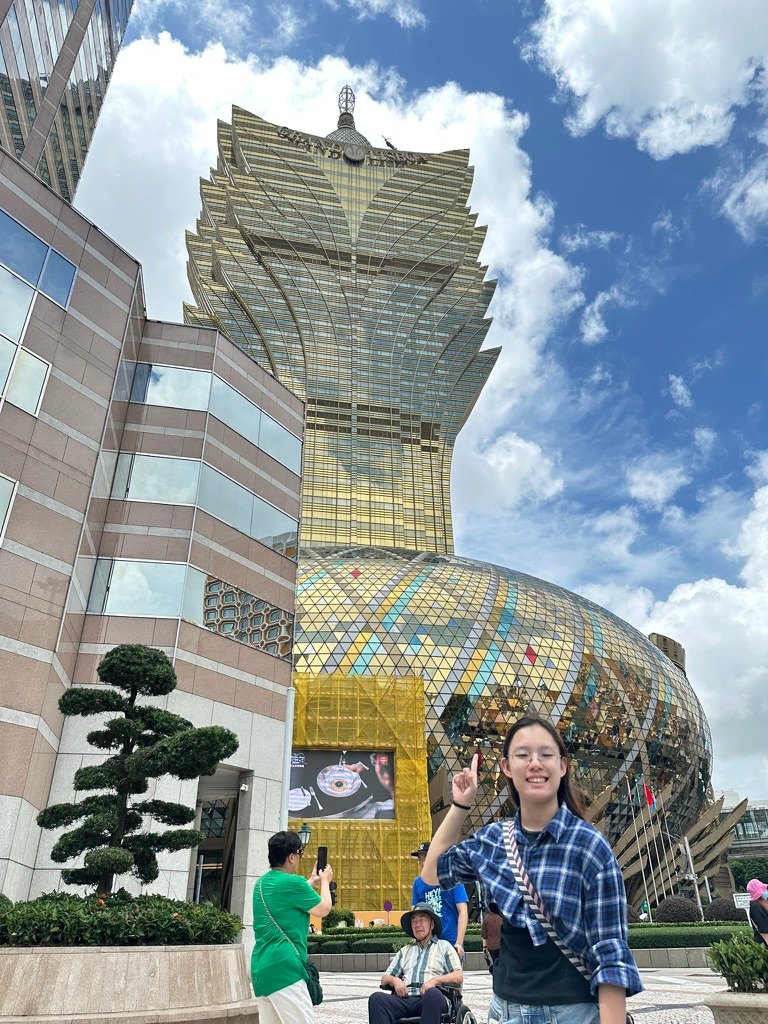
😂 WELCOME TO MACAU.
Crowds.
Chinese signs.
Portuguese-style paving.
Pastry shops.
Souvenir shops.
Food everywhere.
And Elaine walking straight into the middle of it.
We were on Rua de São Paulo (大三巴街), heading toward the Ruins of St. Paul’s (大三巴牌坊).
Then Elaine stopped.
A vendor cut her a piece of bakkwa — sweet dried meat jerky.
Sample accepted.
Taste test completed.
Elaine smiled.
And off we went again.
😂
Somewhere ahead was one of Macau’s most famous UNESCO landmarks.
But Dad had already discovered the first rule of Macau:
THE WALK BETWEEN THE ATTRACTIONS IS PART OF THE ATTRACTION.
🐞
And two other missions were already quietly underway.
🔥 THE WOK WAS HEATING.
There was a Macau pork chop bun — 豬扒包 waiting somewhere in this journey.
And…
🥧 THE OVEN WAS HEATING.
There was a Macau Portuguese egg tart — 葡撻 waiting too.
Not just any random tart stop.
Later, Dad and Elaine would go 打卡 — clock in at a place central to the story of Macau’s famous Portuguese egg tart.
But not yet.
😂
First, Dad had a more fundamental problem.
WHAT EXACTLY IS MACAU?
Dad thought he knew.
China.
Next to Guangdong.
Formerly administered by Portugal.
Casinos.
St. Paul’s.
Portuguese egg tarts.
Easy.
Then we arrived.
And Dad’s mental map started wobbling.
😂
What language do people actually speak here?
Why are the Chinese characters Traditional Chinese — like Hong Kong and Taiwan — rather than the Simplified Chinese Dad was used to seeing while traveling through Mainland China?
Why is Portuguese appearing on signs?
Macau has its own currency?
Can we use our Hong Kong dollars?
What about the Internet?
And if Guangdong is literally next door…
why does Macau sometimes feel Chinese…
sometimes Cantonese…
sometimes Portuguese…
sometimes a little like Hong Kong…
and sometimes like nowhere else Dad had visited?
Dad needed a new way to think about this place.
🪩 THE MACAU CULTURAL KALEIDOSCOPE
Turn it slightly…
Chinese Macau.
Turn again…
Cantonese Macau.
Again…
Portuguese Macau.
Again…
Macanese Macau.
Again…
international Macau.
Again…
UNESCO Macau.
Again…
casino-resort Macau.
And later…
apparently even ANCIENT ROME Macau.
😂
Sometimes several of these Macaus appear within the same hour.
So this isn’t another:
10 Things to Do in Macau
article.
This is Dad and Elaine’s first journey through Macau.
What we saw.
What we ate.
What confused Dad.
What surprised us.
And how traveling through the city gradually helped Dad answer one deceptively simple question:
WAIT… WHAT EXACTLY IS MACAU?
Let’s rewind to where our Macau journey actually began.
⛴️ SECTION 0 — We Came From Hong Kong
Dad and Elaine traveled Hong Kong → Macau by ferry.
After exploring Macau, we returned Macau → Hong Kong by bus across the Hong Kong–Zhuhai–Macau Bridge (港珠澳大橋).
We’ve already written the detailed step-by-step guide based on exactly what we did.
So we’re not going to repeat the terminals, tickets, immigration and transport details here.
👉 Hong Kong to Macau: Ferry There, HZMB Bus Back — Our Step-by-Step Guide
Planning to take the ferry?
👉 Check Hong Kong–Macau ferry tickets on Trip.com
ChinaTravelBUG may earn a commission if you book through our Trip.com links, at no extra cost to you.
Ferry done.
Immigration done.
Dad and Elaine were officially in Macau.
And almost immediately…
Dad started looking for clues.
😂
🧭 SECTION 0.25 — Dad’s First Macau Experience: LOOK AT THE SIGNS!
Before Dad went looking for St. Paul’s…
Dad went looking for a signboard.
😂
Seriously.
When Dad arrives somewhere unfamiliar, the signs tell him a lot.
What language is being used?
What writing system?
What places are important enough to translate?
And Elaine found us a good one.
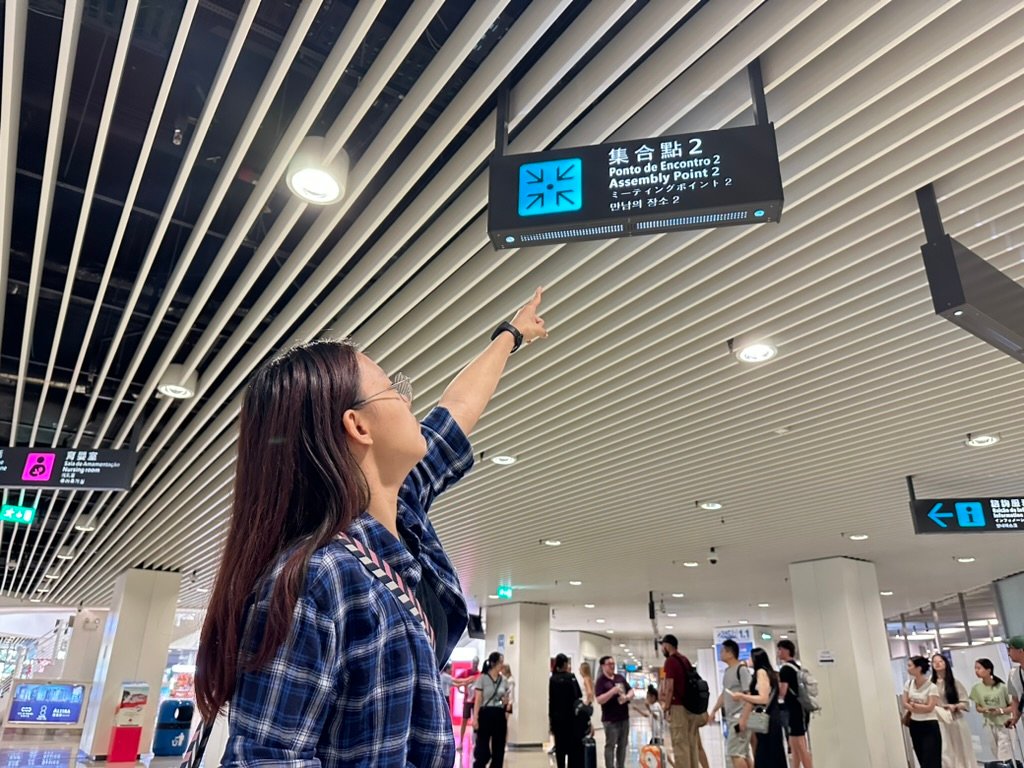
Chinese.
English.
Japanese.
Korean.
But Dad noticed something else first.
繁體中文 — TRADITIONAL CHINESE.
Macau generally uses Traditional Chinese characters — the writing system you’ll also commonly encounter in Hong Kong and Taiwan.
That’s different from Mainland China, where Simplified Chinese characters are normally used.
Wait.
🐇
Because geographically…
Mainland China couldn’t be much closer.
🗺️ Guangdong Is RIGHT THERE
Macau sits on the western side of the Pearl River Delta, immediately beside Zhuhai (珠海) in Guangdong (廣東).
This isn’t some distant offshore island disconnected from Mainland China.
The Macau Peninsula actually meets the Mainland at its northern border.
Cross through the Border Gate (關閘) and you’re entering the Gongbei (拱北) area of Zhuhai.
Across the water is Hengqin (橫琴) — also part of Zhuhai — with another major crossing connecting it with Macau.
So Dad’s mental map said:
Guangdong → right next door.
Which immediately created another question.
SO WHAT LANGUAGE DO PEOPLE SPEAK?
😂
🗣️ Cantonese? Mandarin? Portuguese? English?
Dad’s apparently simple question didn’t have a one-word answer.
Chinese and Portuguese are Macau’s official languages.
In everyday life, Cantonese is the most widely spoken Chinese variety.
That makes geographical sense.
Macau sits right beside Cantonese-speaking Guangdong.
Mandarin is also widely understood, while English is commonly encountered in tourism and commerce.
And Portuguese?
Just keep looking.
Street names.
Government signs.
Historic buildings.
Churches.
Public spaces.
Portuguese keeps appearing.
Dad hadn’t even started sightseeing…
and already needed one of his mind maps.
😂
So… Is Macau Chinese?
Yes.
Macau is the Macao Special Administrative Region of the People’s Republic of China.
But Dad quickly discovered that simply saying:
“Macau is Chinese.”
doesn’t explain what an international traveler actually experiences here.
Geography?
Guangdong is next door.
Writing?
Traditional Chinese.
Everyday speech?
Mostly Cantonese.
Official languages?
Chinese and Portuguese.
International tourism?
English enters the picture too.
Then Dad started looking around.
Chinese culture.
Portuguese names.
Cantonese voices.
International visitors.
And we hadn’t even reached the historic center yet.
THE KALEIDOSCOPE WAS ALREADY TURNING.
🐇
💰 Wait… Macau Has Its OWN Money?
Yep.
😂
Macau’s official currency is the:
MACANESE PATACA — MOP.
Dad and Elaine had just arrived from Hong Kong.
We still had Hong Kong dollars.
So Dad’s next highly sophisticated cultural question was:
CAN I JUST USE MY HKD?
😂
Generally, yes.
Hong Kong dollars are commonly accepted in Macau.
That makes a Hong Kong → Macau excursion considerably easier.
Dad wasn’t interested in turning currency exchange into our first tourist attraction.
We just needed enough usable money for the day.
Fortunately…
the ferry terminal made that easy.
📱 And the Internet?
Dad’s solution:
INTERNATIONAL ROAMING.
😂
That was it.
No new SIM.
No complicated setup.
Dad simply used international roaming while we were in Macau.
Macau also has public Wi-Fi services in supported locations, but roaming meant one less thing for Dad to think about.
And Dad’s brain was already processing:
Traditional Chinese + Cantonese + Portuguese + MOP + HKD + Guangdong next door.
😂
Enough.
Time for food.
🍜 SECTION 0.5 — Fill the Stomach. Fill the Wallet.
Before leaving the Outer Harbour Ferry Terminal (外港客運碼頭), Dad has one piece of advice.
DON’T RUSH OUT.
Especially if you’re traveling with children.
You’ve crossed the water.
You’ve gone through immigration.
Everybody has been carrying bags.
Somebody is probably hungry.
Deal with that first.
😂
🍔 Need Something Easy? It’s Here.
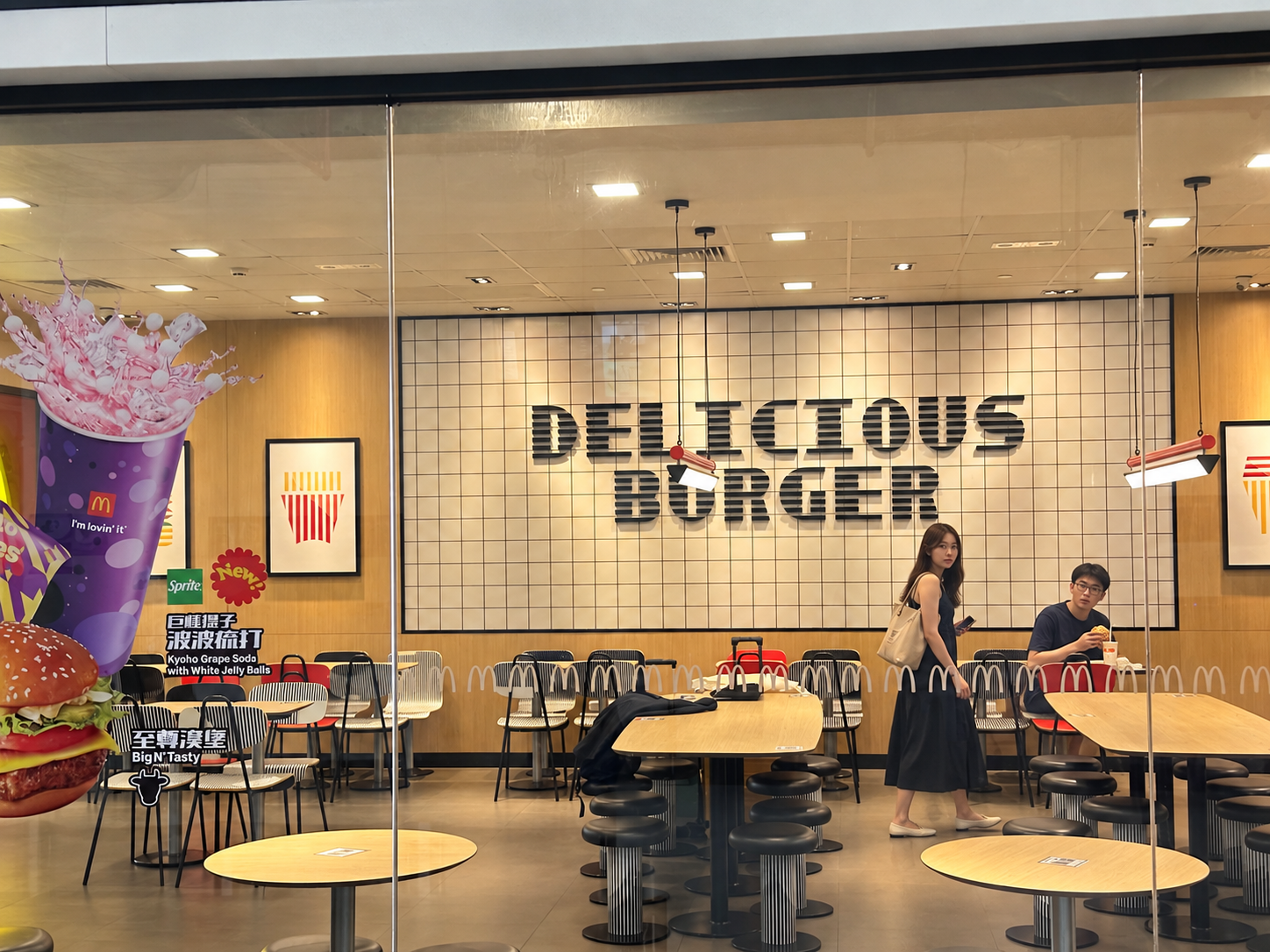
Sometimes good family travel isn’t about finding the most authentic meal imaginable.
Sometimes good family travel is:
Everybody hungry? Feed everybody.
There is fast food inside the terminal, including McDonald’s.
Simple.
Familiar.
Useful.
Particularly when someone has reached:
“DAD, I DON’T CARE ABOUT UNESCO. I’M HUNGRY.”
😂
But don’t assume fast food is your only choice.
🍜 Go Upstairs
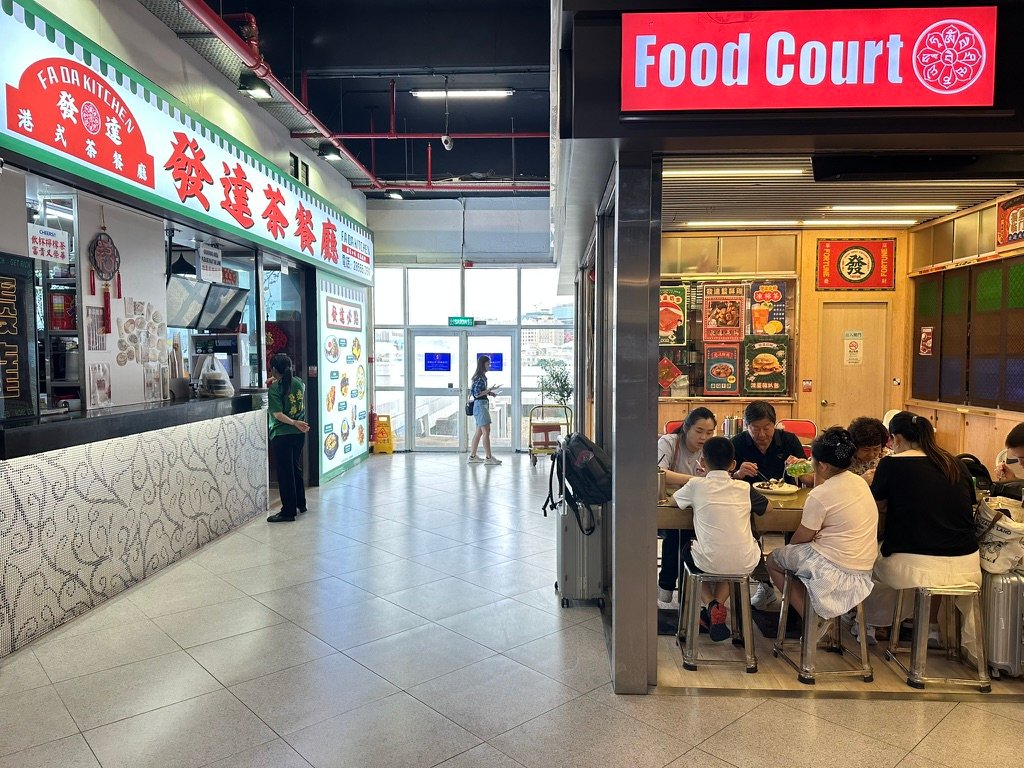
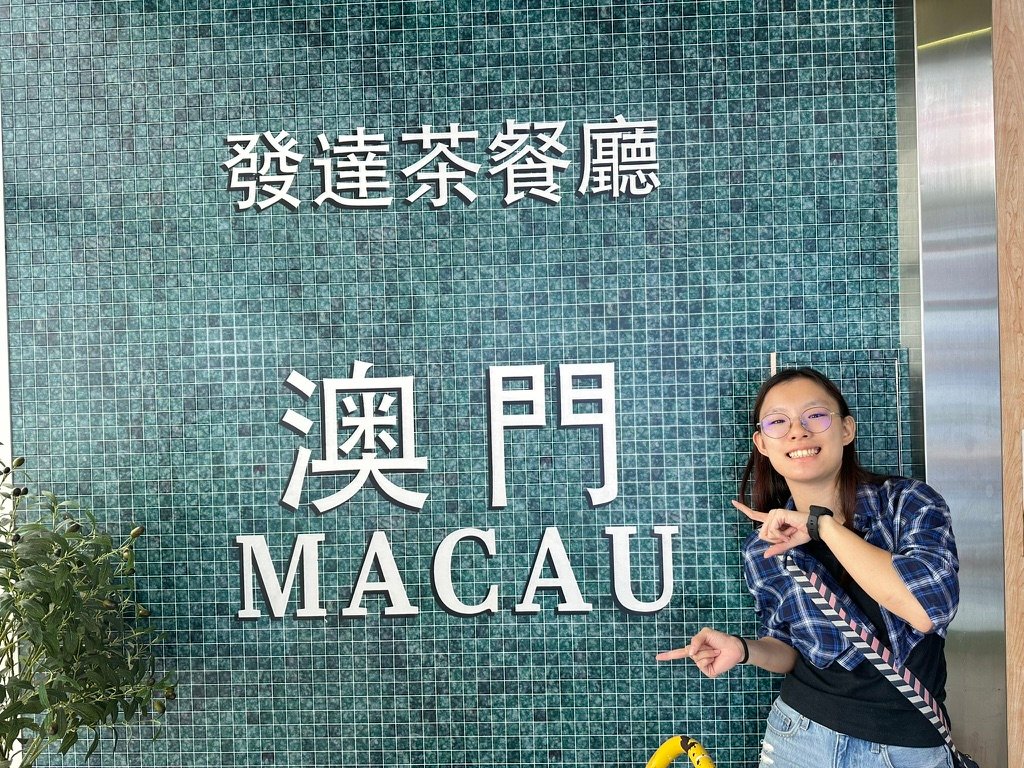
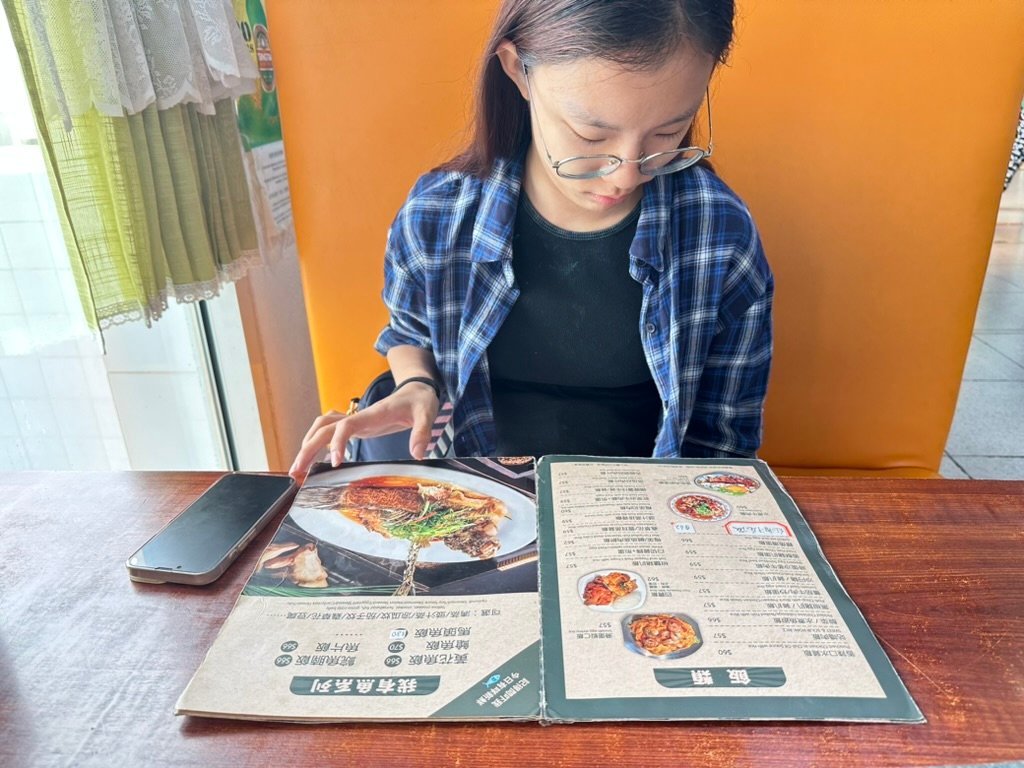
We also found Chinese food and Hong Kong-style cha chaan teng (茶餐廳) options.
And look at the space.
For a family, this can be a very comfortable place to pause before attacking Macau.
Sit down.
Eat.
Use the restroom.
Reorganize the bags.
Check the itinerary.
Dad has learned something from traveling with Elaine:
HUNGRY TRAVELERS MAKE BAD ITINERARY DECISIONS.
😂
💰 Then Fill the Wallet
[INSERT PHOTO: ELAINE AT BANK OF CHINA ATM]
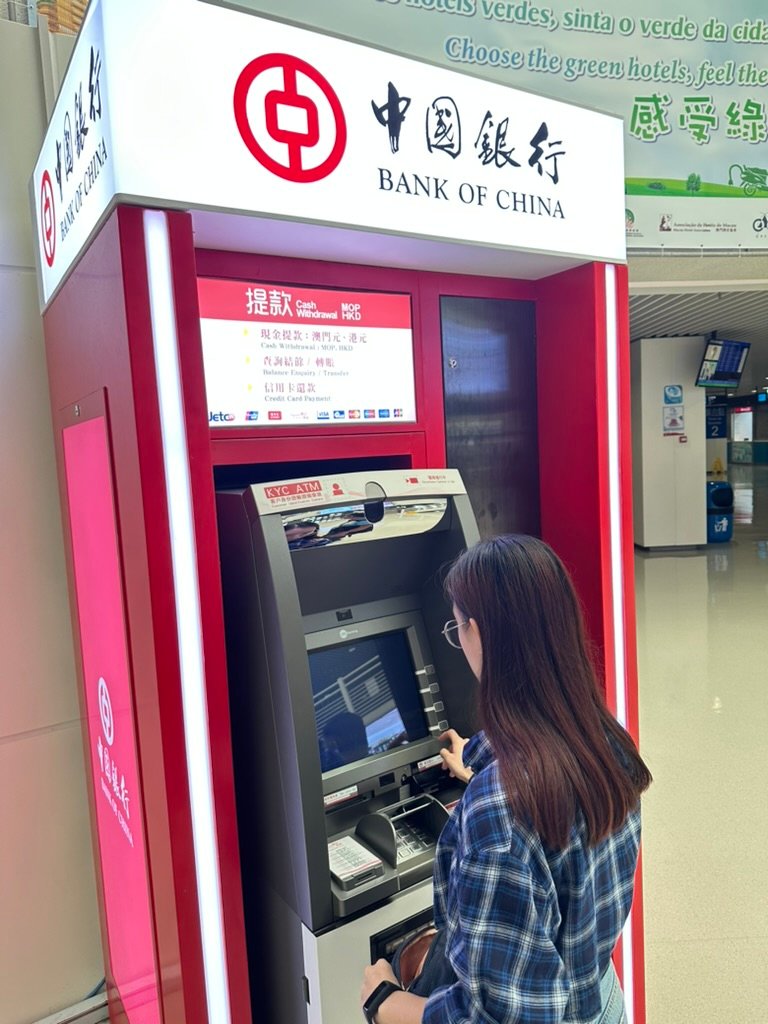
Remember Dad’s currency question?
Here’s where we dealt with it.
Dad and Elaine found a Bank of China ATM inside the ferry terminal displaying withdrawal options for both MOP and HKD.
Macau’s official currency is the Macanese pataca (MOP), while Hong Kong dollars are commonly accepted.
Currency-exchange services are also available at Macau’s ferry terminals.
Dad’s approach was simple.
Don’t make money more complicated than it needs to be.
Get enough usable cash.
Feed everybody.
Use the restroom.
Check the bags.
Internet working?
Yes.
Elaine ready?
Yes.
Dad?
Still wondering what exactly Macau was.
😂
Now…
LET’S GO FIND OUT.
⛪ STOP 1 — Walk Into UNESCO Macau
Remember the street from the video at the beginning?
We’re back there.
RUA DE SÃO PAULO (大三巴街).
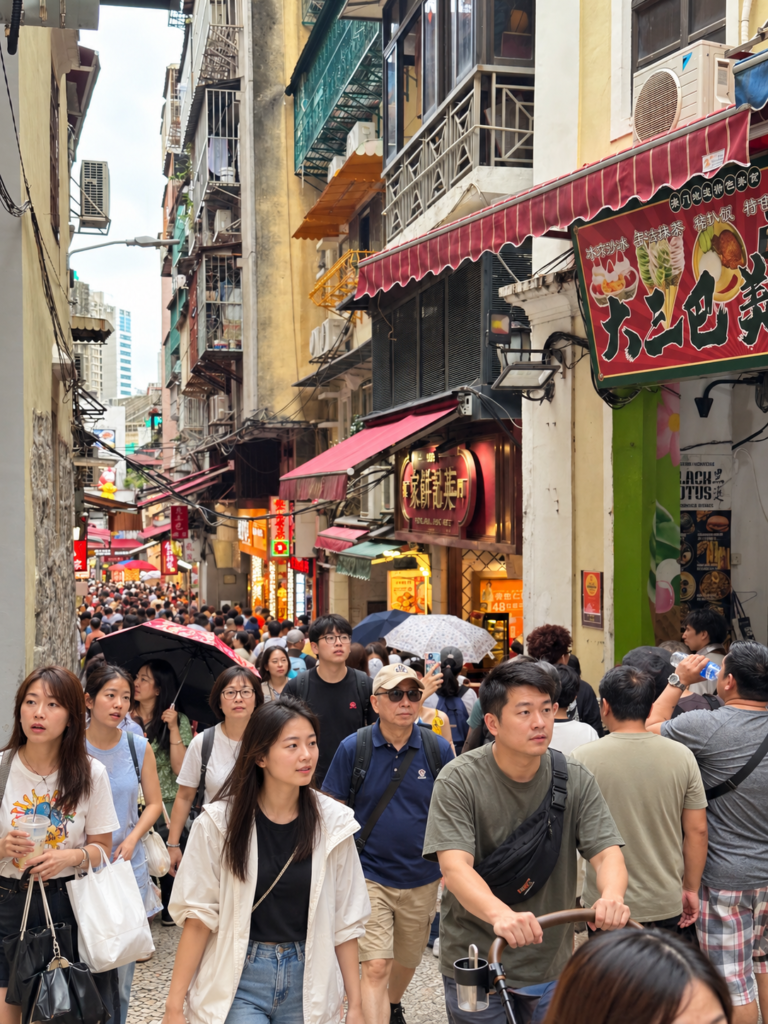
This is why Dad wanted you to see the video before reading anything else.
Don’t begin St. Paul’s with a history lesson.
WALK TOWARD IT.
People everywhere.
Pastry shops.
Souvenirs.
Chinese signs.
Portuguese names.
Food samples.
Bakkwa.
Elaine eating again.
😂
The street gets busier.
Everybody seems to be moving toward the same place.
And then…
you see it.
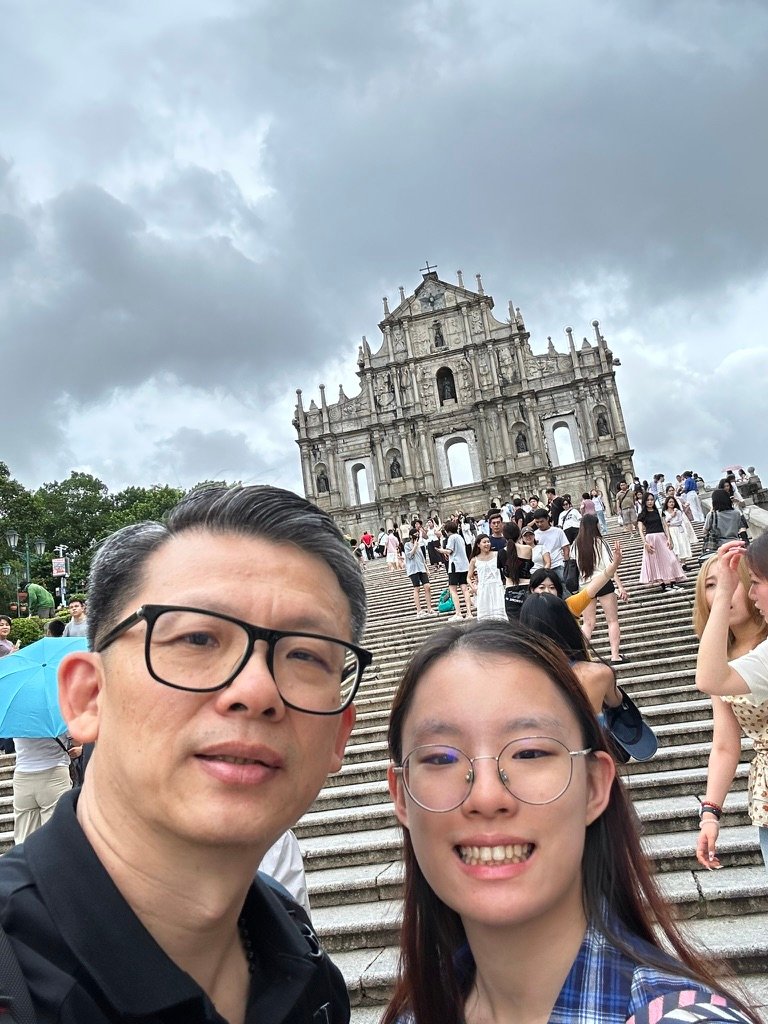
THE RUINS OF ST. PAUL’S (大三巴牌坊).
Okay.
NOW take the photograph.
😂
Dad and Elaine certainly did.
But don’t take the photo…
turn around…
and leave.
Because you’re not simply looking at Macau’s most famous backdrop.
You’re looking at one of the best places to begin answering Dad’s question:
WAIT… WHAT EXACTLY IS MACAU?
🐇
👀 First Question: What Am I Actually Looking At?
Here’s the surprising part.
ST. PAUL’S WASN’T BUILT AS A RUIN.
😂
What survives today is principally the monumental stone façade of the Church of Mater Dei, together with the great staircase and archaeological remains behind it.
The church was constructed in the early 17th century.
Beside it stood St. Paul’s College, established by the Jesuits.
Then, in 1835, fire destroyed the church and college.
Much of the complex disappeared.
The great façade survived.
So when Dad and Elaine stood at the bottom of those famous steps…
we were essentially looking at:
THE FRONT OF A BUILDING THAT ISN’T THERE ANYMORE.
😂
That alone makes St. Paul’s more interesting.
But it still doesn’t explain why this enormous Catholic complex existed in Macau in the first place.
For that…
we need Dad’s:
🐇 TWO-MINUTE MACAU HISTORY.
Don’t worry.
No examination afterwards.
😂
🇨🇳🇵🇹 How Did Portugal End Up Here?
Long before the casinos and giant resorts, Macau was part of the maritime world of southern China.
Then Portuguese traders arrived in the 16th century.
By the mid-1500s, Portuguese merchants had established themselves in Macau with the agreement of Chinese authorities.
And look at Macau’s location.
China behind it.
The sea in front.
Maritime routes stretching outward toward Japan, Southeast Asia, India and Europe.
Macau developed into an important trading port connecting different parts of this enormous network.
Goods moved.
People moved.
Ideas moved.
Religions moved.
Languages met.
And missionaries came too.
Including the Jesuits.
That brings us straight back to St. Paul’s.
St. Paul’s Was More Than a Church
Beside the church stood St. Paul’s College.
This wasn’t simply a small religious school tucked behind a church.
It became an important Jesuit center for missionary learning and cultural exchange in East Asia.
Languages were studied.
Books circulated.
Printing took place.
Missionaries prepared for work across the region.
Imagine this hill roughly four centuries ago.
No souvenir shops.
No selfie sticks.
No Elaine eating bakkwa down the street.
😂
Instead:
A church.
A college.
Students.
Missionaries.
Books.
Printing.
Merchants and ships moving through Macau below.
Macau wasn’t sitting at the edge of the world.
MACAU WAS CONNECTING WORLDS.
🐇
And now…
look at Dad’s photograph again.
🔎 LOOK CLOSER AT THE FAÇADE
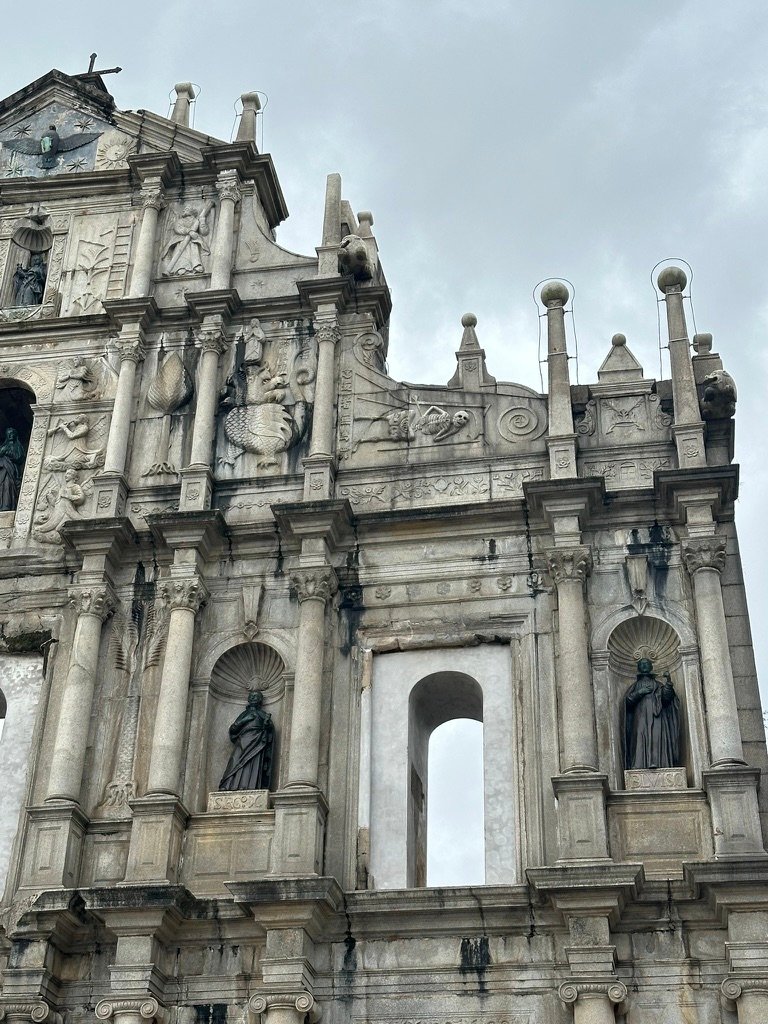
From a distance, the façade can look like an impressive piece of European church architecture.
Move closer.
Things become more interesting.
Christian saints.
Biblical imagery.
Angels.
Latin inscriptions.
European architectural forms.
But keep looking.
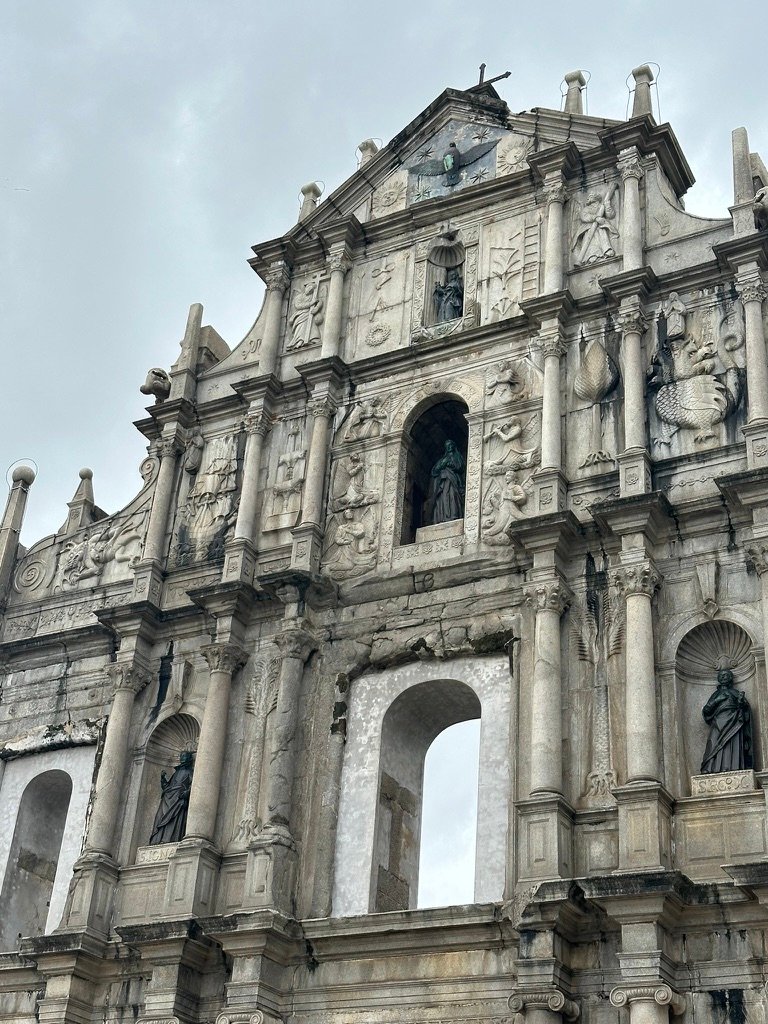
Look closely at the Ruins of St. Paul’s (大三巴牌坊). Among the Christian imagery are Chinese inscriptions, including 聖母踏龍頭 (“The Holy Mother treads on the dragon’s head”) and 鬼怪誘人為惡 (“Evil spirits tempt people to do evil”). We checked this against documentation from the Macao Cultural Affairs Bureau, which describes these Chinese inscriptions and the façade’s remarkable blending of European Christian and Chinese imagery. Macau’s cultural layers are literally carved into the same stone façade.
Chinese characters.
Asian decorative elements.
Plants.
Mythical creatures.
Religious imagery from another cultural world.
They’re sharing the same stone façade.
And THAT is when St. Paul’s begins to make sense.
It’s not merely a European building that happened to be constructed in China.
Its façade itself carries evidence of the cultural encounters taking place in Macau.
Remember Dad’s questions after arriving?
Traditional Chinese?
Cantonese?
Portuguese?
China?
Europe?
LOOK AT THE FAÇADE.
Part of the answer has been sitting in stone for centuries.
🐇
🏛️ NOW UNESCO MAKES SENSE
The Historic Centre of Macao was inscribed on the UNESCO World Heritage List in 2005.
And St. Paul’s is only one piece of it.
The World Heritage property brings together 22 principal buildings and public spaces.
Chinese temples.
Catholic churches.
Fortifications.
Historic streets.
Public squares.
Chinese buildings.
Portuguese buildings.
Places where different cultural influences sometimes sit almost side by side.
UNESCO’s story isn’t simply:
“Macau has some beautiful old buildings.”
The much bigger story is the long encounter between China and the West that took place here.
And that encounter wasn’t limited to architecture.
It involved trade.
Religion.
Technology.
Education.
Food.
Language.
Communities.
Everyday life.
Suddenly Dad’s confusing first hour in Macau was beginning to make more sense.
Traditional Chinese.
Cantonese.
Portuguese.
MOP.
HKD.
Chinese streets.
European-looking buildings.
THE CULTURAL KALEIDOSCOPE WASN’T RANDOM.
IT WAS HISTORY.
🐇
🗓️ Macau History in 30 Seconds
If you’re a first-time visitor, you don’t need to memorize hundreds of years of history.
Just hang these five dates somewhere in your head:
Mid-1500s
Portuguese merchants establish themselves in Macau with the agreement of Chinese authorities.
⬇️
Early 1600s
The Church of Mater Dei and St. Paul’s complex develop on this hill as Macau grows as a major meeting point between different worlds.
⬇️
1835
Fire destroys the church and college.
The famous façade survives.
⬇️
1999
Portugal’s administration ends and China resumes the exercise of sovereignty over Macau.
Macau becomes the Macao Special Administrative Region of the People’s Republic of China.
⬇️
2005
The Historic Centre of Macao becomes a UNESCO World Heritage Site.
That’s enough history for now.
😂
Dad’s Tip: Take the Photo. Then Put the Phone Down.
Of course you should take the classic St. Paul’s photograph.
We did.
😂
But afterwards…
walk closer.
Look upward.
Look for the Chinese characters.
Look at the Christian figures.
Look at the creatures and plants carved into the stone.
Then walk through the openings where the church doors once stood.
St. Paul’s changes when you know what you’re looking at.
It stops being:
“That famous Macau ruin.”
And becomes:
“Ahhh… now I understand why something like this exists in Macau.”
And Dad’s original question —
WAIT… WHAT EXACTLY IS MACAU?
— was beginning to get an answer.
🚶 STOP 2 — Don’t Rush From St. Paul’s to Senado Square
After St. Paul’s, it would be very easy to do this:
Photo taken. ✅
St. Paul’s done. ✅
Next attraction.
Don’t.
🐞
Because some of the Macau Dad and Elaine enjoyed most wasn’t inside an attraction at all.
It was in the streets between them.
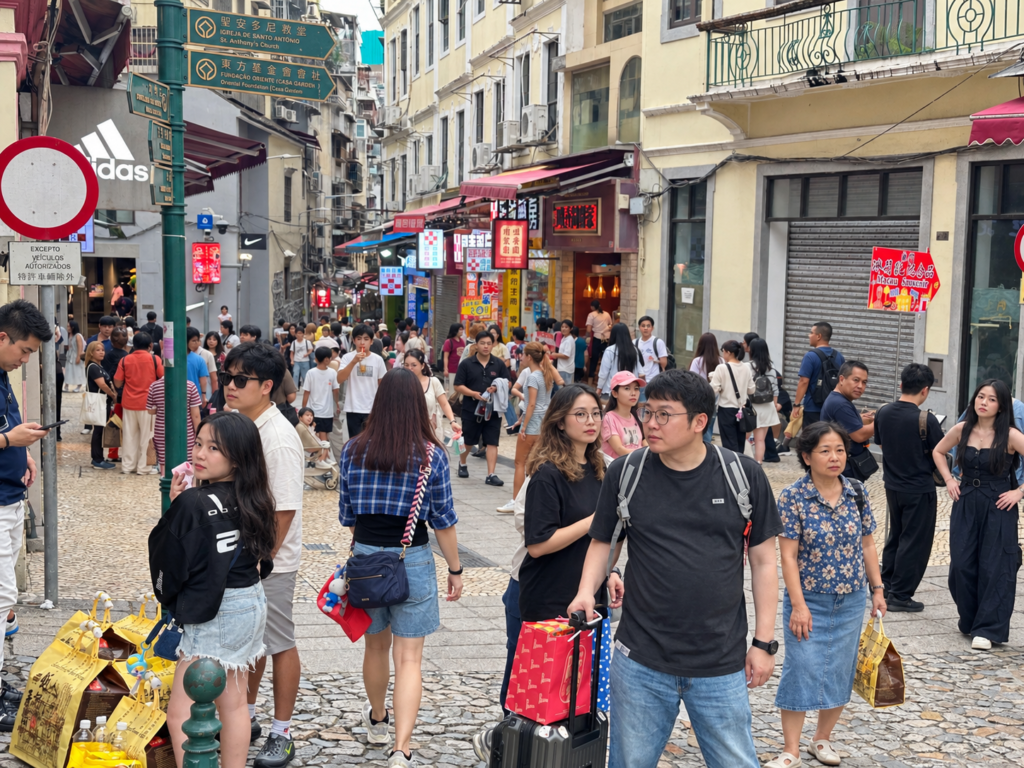
Walk.
Slow down.
Look around.
Old balconies.
Window cages.
Air-conditioners.
Chinese restaurants.
Pharmacies.
Food signs.
People everywhere.
This didn’t feel like a historic district preserved behind museum glass.
PEOPLE WERE STILL LIVING, EATING, SHOPPING AND WORKING INSIDE IT.
And that made it much more interesting.
🪧 Dad Found a Signpost That Almost Explained Macau
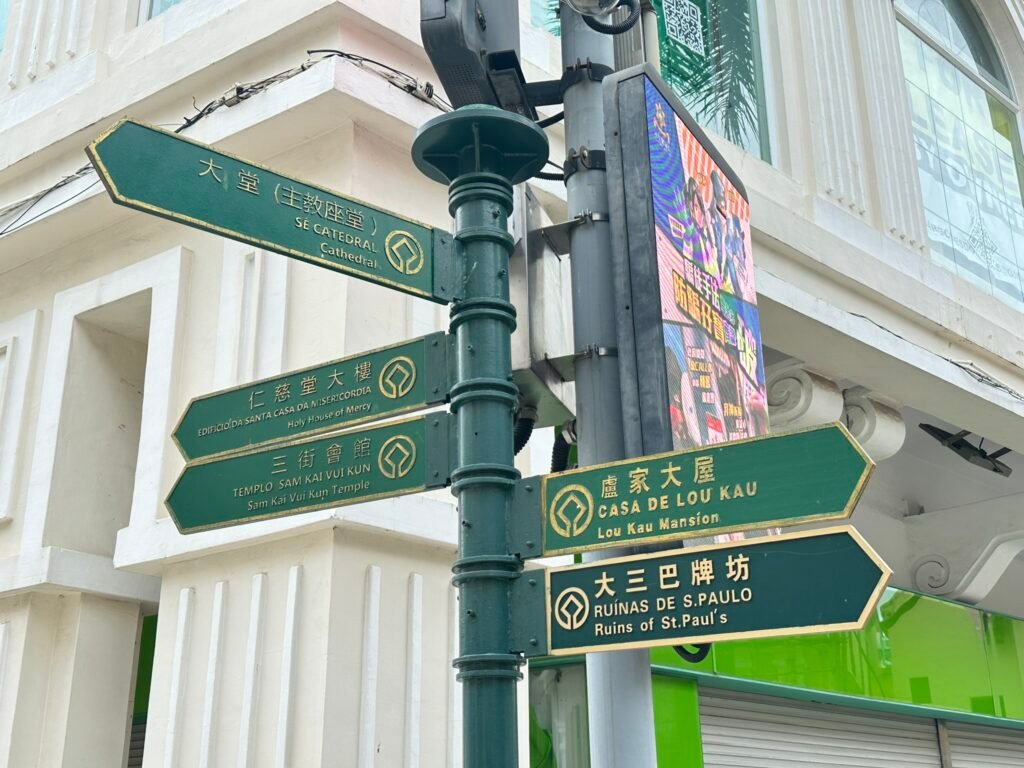
Dad likes signboards.
😂
And this one was particularly good.
Look where it points.
Cathedral.
Holy House of Mercy.
Sam Kai Vui Kun Temple.
Lou Kau Mansion.
Ruins of St. Paul’s.
A Catholic cathedral.
A historic charitable institution.
A Chinese temple.
A Chinese merchant’s mansion.
St. Paul’s.
All within the same walkable historic center.
Dad didn’t need another long history lesson.
THE SIGNPOST WAS THE HISTORY LESSON.
🐇
This wasn’t a neat little “Portuguese Macau” sitting separately from “Chinese Macau.”
Different communities, religions, institutions and ways of life had developed beside one another over centuries.
And Dad and Elaine were walking through the result.
🏮 Then Macau Turned Chinese Again
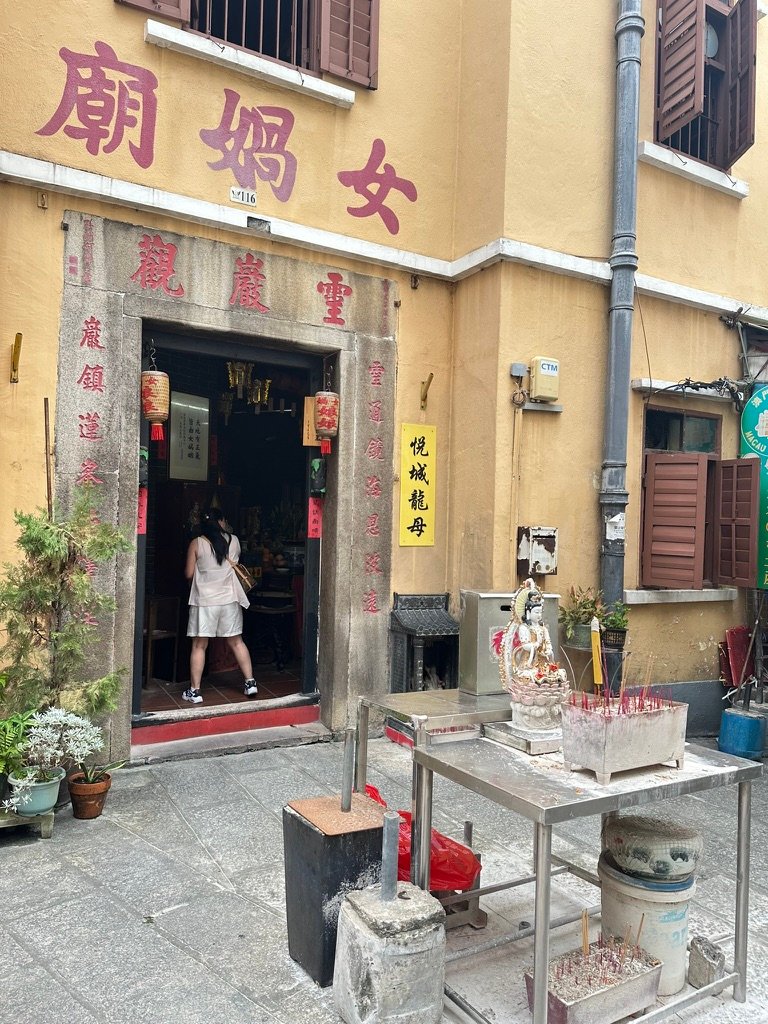
Another turn.
Another layer.
Suddenly Dad was looking into a small Chinese temple.
Incense.
Chinese characters.
A Guanyin figure outside.
Traditional religious practice continuing quietly amid the surrounding streets.
A few minutes earlier we’d been standing beneath the enormous Catholic façade of St. Paul’s.
Now this.
😂
TURN THE KALEIDOSCOPE.
That’s Macau.
😂 Meanwhile… Elaine Had Her Own Research Program
Dad was studying:
Churches.
Temples.
Architecture.
Street signs.
Four hundred years of Macau history.
Elaine?
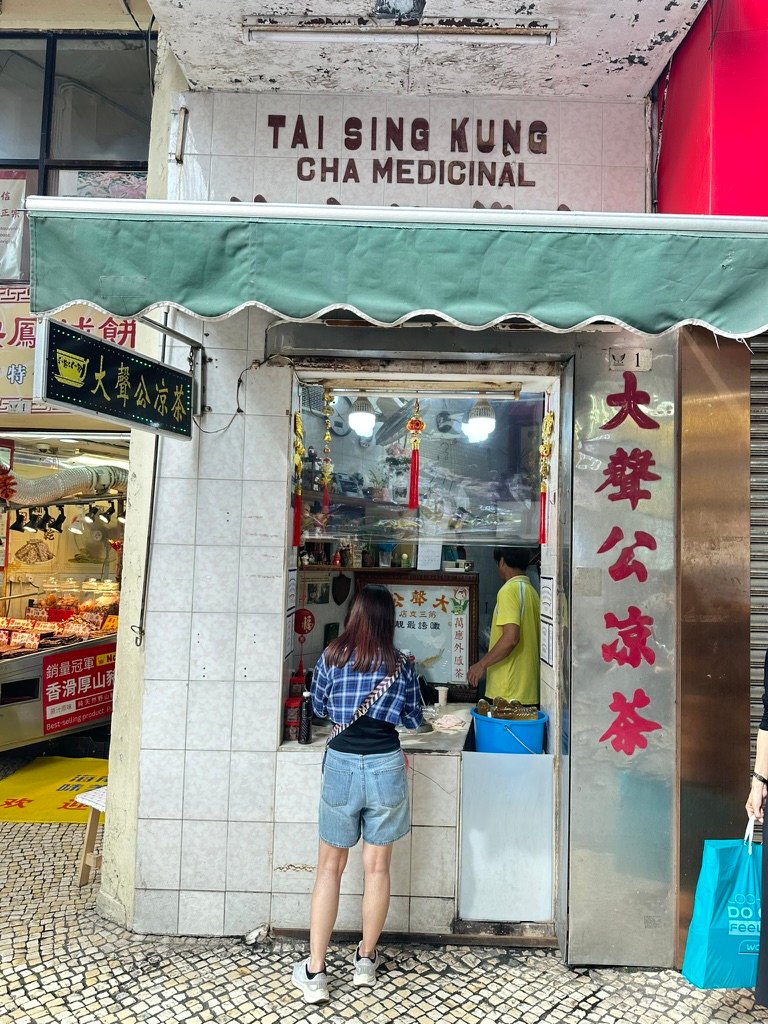
Elaine found a drink.
😂
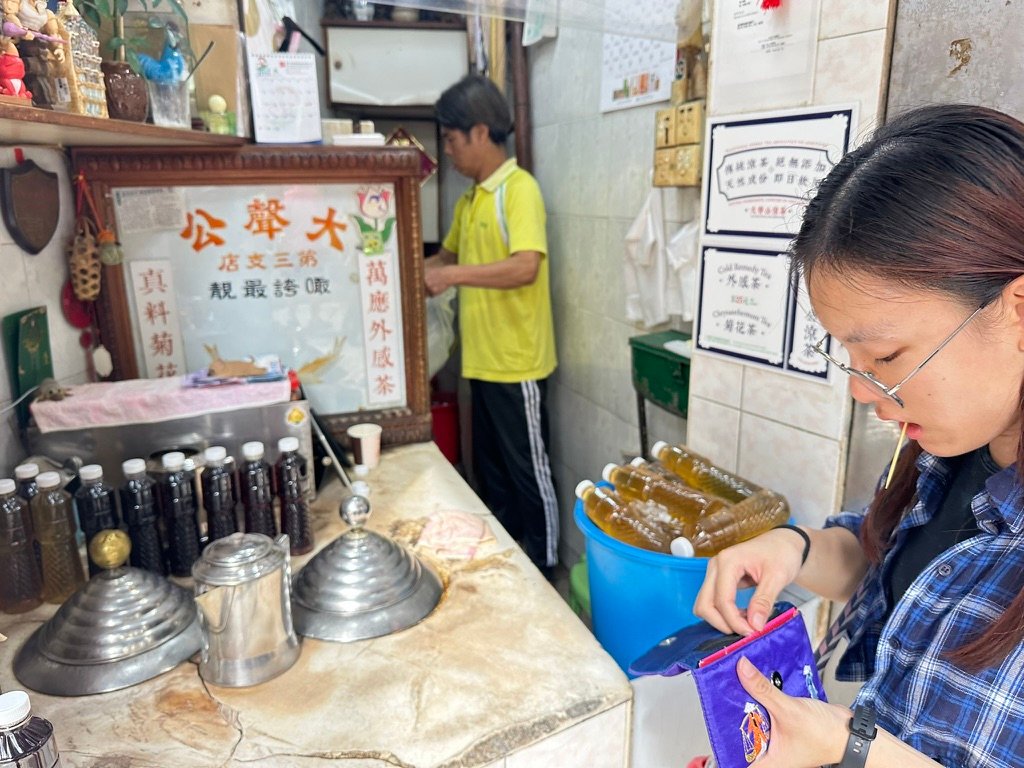
A tiny traditional Chinese herbal-tea shop tucked into the streets of historic Macau.
Bottles lined up on the counter.
Metal tea containers.
A shopkeeper behind them.
Elaine deciding what to try.
Dad realized this was another reason not to rush.
The famous monuments help explain Macau’s history.
THE LITTLE SHOPS SHOW YOU MACAU BEING LIVED.
Stop.
Drink something.
Look inside.
See what people are buying.
Then continue walking.
⛪ Another Corner. Another Macau.
Then this appeared.
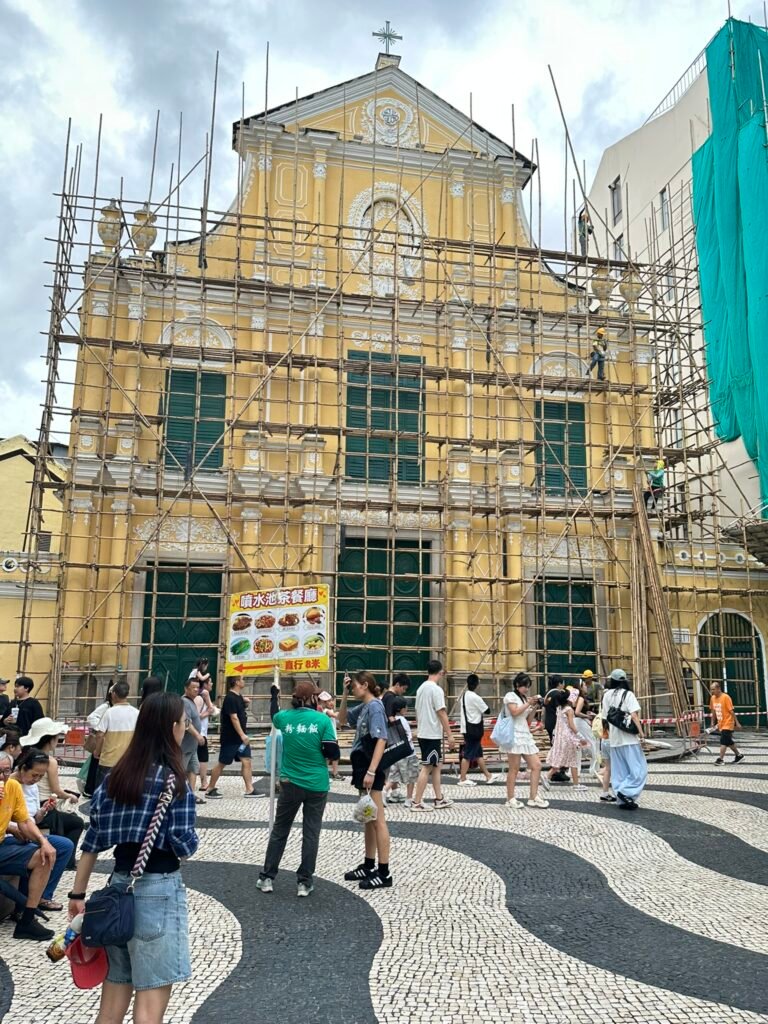
This is St. Dominic’s Church (玫瑰堂 / 板樟堂).
Founded in 1587, it is another component of the UNESCO-listed Historic Centre of Macao.
When Dad and Elaine visited, the church was undergoing restoration.
Which gave us this extraordinary sight:
A centuries-old Catholic church.
Wrapped in bamboo scaffolding.
Chinese shops nearby.
Tourists walking past.
Modern Macau carrying on around it.
😂
OLD MACAU ISN’T FROZEN.
It’s still being maintained, used and lived around.
👀 Look Down. Look Up. Look Around.
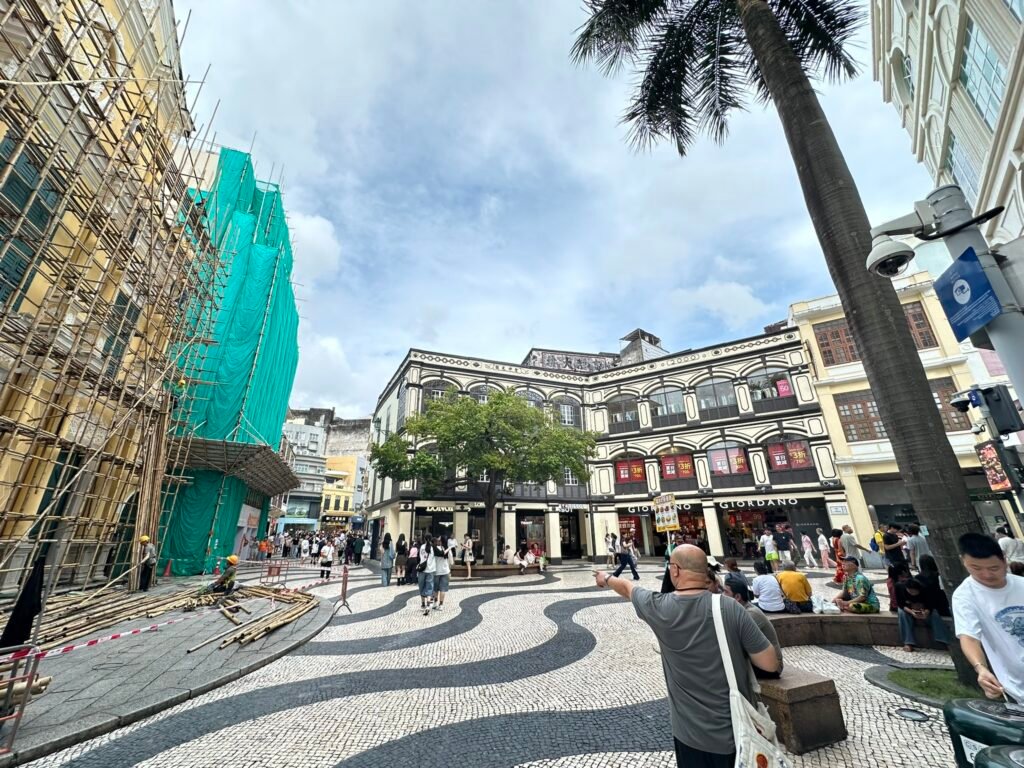
Look down.
Black-and-white wave-pattern paving.
Look up.
Pastel façades.
Green shutters.
Balconies.
Then look around.
Chinese pharmacies.
Banks.
International shops.
Families.
Tourists.
Cantonese voices.
Food.
Lots of food.
😂
One useful detail:
The distinctive wave-pattern paving around Senado Square (議事亭前地) today isn’t itself centuries old. The square received its present Portuguese-style mosaic paving treatment in the 1990s.
Another reminder that Dad was slowly learning:
NOT EVERYTHING THAT LOOKS OLD IN MACAU IS OLD.
Macau keeps adding new layers to old ones.
🔥 Uh-Oh. Elaine Found the Food Signs.
Dad was still looking at architecture.
Elaine was reading menus.
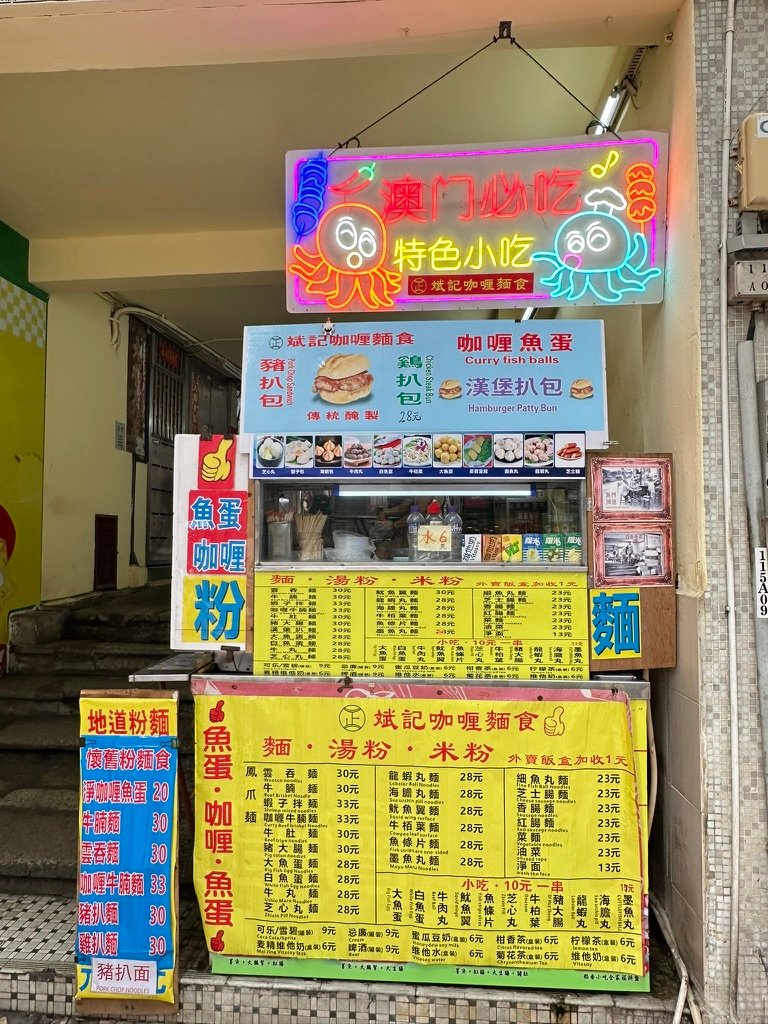
😂
Fish balls.
Curry.
Noodles.
Snacks.
And then Dad spotted something important.
豬扒包 — PORK CHOP BUN.
There it was.
Macau’s famous pork chop bun had officially entered the journey.
Remember the Wok?
🔥 IT WAS GETTING HOTTER.
But not yet.
We kept walking.
🏛️ And Then the Streets Opened Into Senado Square
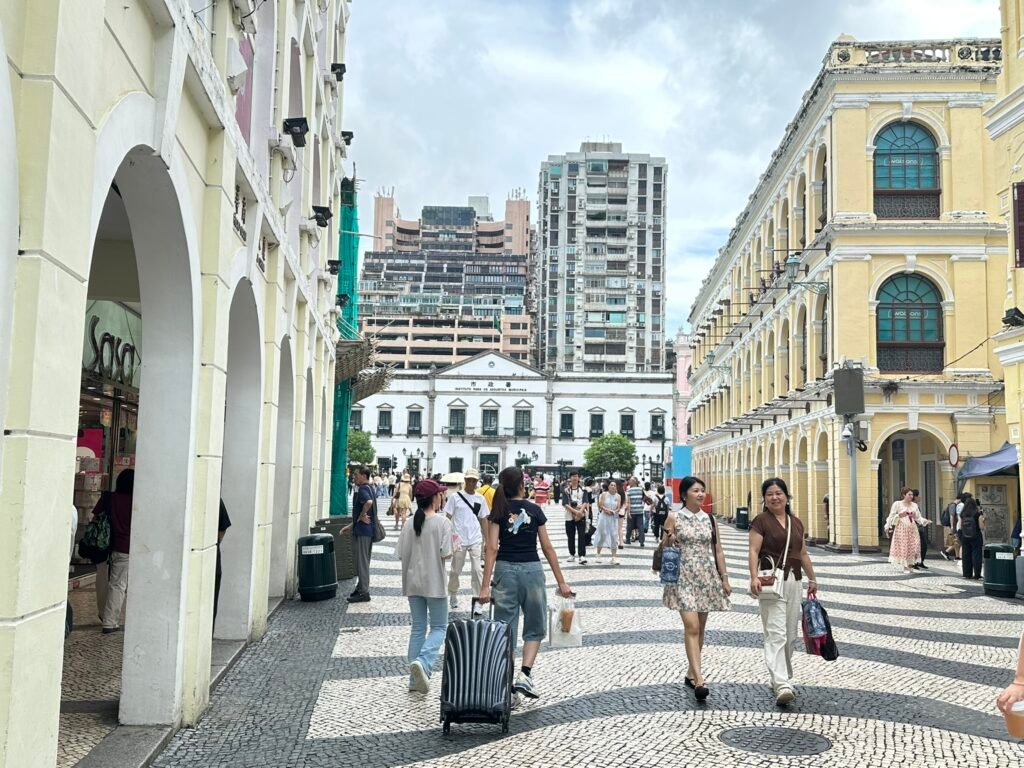
Suddenly…
space.
SENADO SQUARE (議事亭前地).
For centuries, this has been one of Macau’s principal civic spaces.
At the far end of Dad’s photograph is the former Leal Senado Building, originally built in 1784 as Macau’s municipal chamber.
But Dad wasn’t looking only at individual historic buildings anymore.
He was beginning to look at the whole scene.
Historic façades.
Black-and-white paving.
Chinese shops.
Families.
Tourists.
People pulling luggage.
Modern apartment towers rising behind everything.
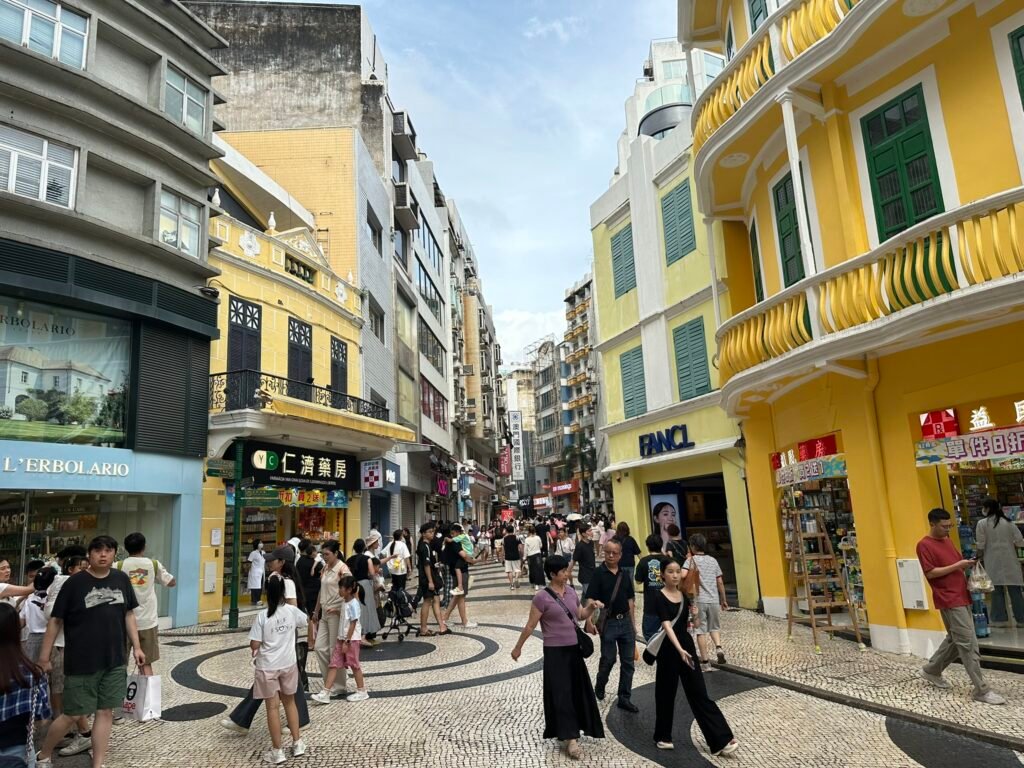
There it was again.
The Macau Cultural Kaleidoscope.
Except by now…
DAD DIDN’T NEED TO EXPLAIN IT.
We could see it.
🐇
At St. Paul’s, Dad had learned some of Macau’s history.
Walking through these streets…
Dad could see what centuries of that history had left behind.
Not one Macau.
MANY LAYERS OF MACAU.
Occupying the same few streets.
🛍️ And Elaine Wasn’t Finished
Of course she wasn’t.
😂
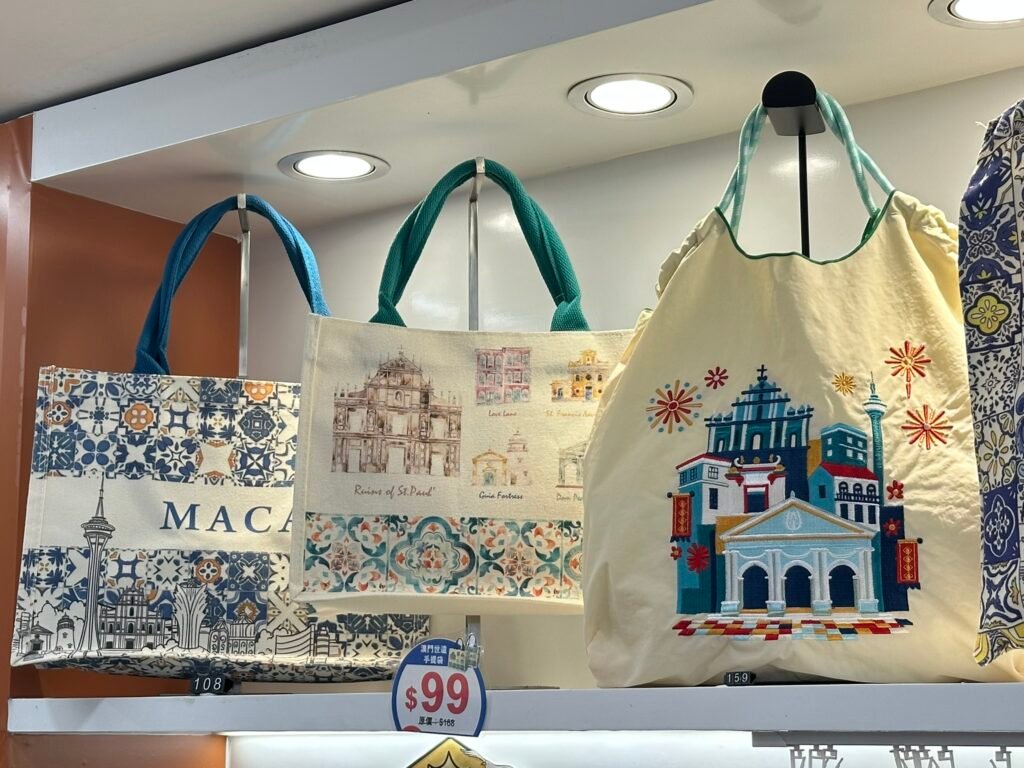
The city we’d just walked through was now appearing on souvenirs.
St. Paul’s.
Churches.
Portuguese-style decorative patterns.
Macau landmarks.
Chinese imagery.
Modern Macau.
Elaine started investigating.
[INSERT PHOTO: ELAINE HOLDING SOUVENIR]
Dad’s travel method:
SEE → ASK → CONNECT → UNDERSTAND → FOLLOW.
Elaine’s travel method:
SEE → LIKE → PICK UP → SHOW DAD.
😂
Apparently both work.
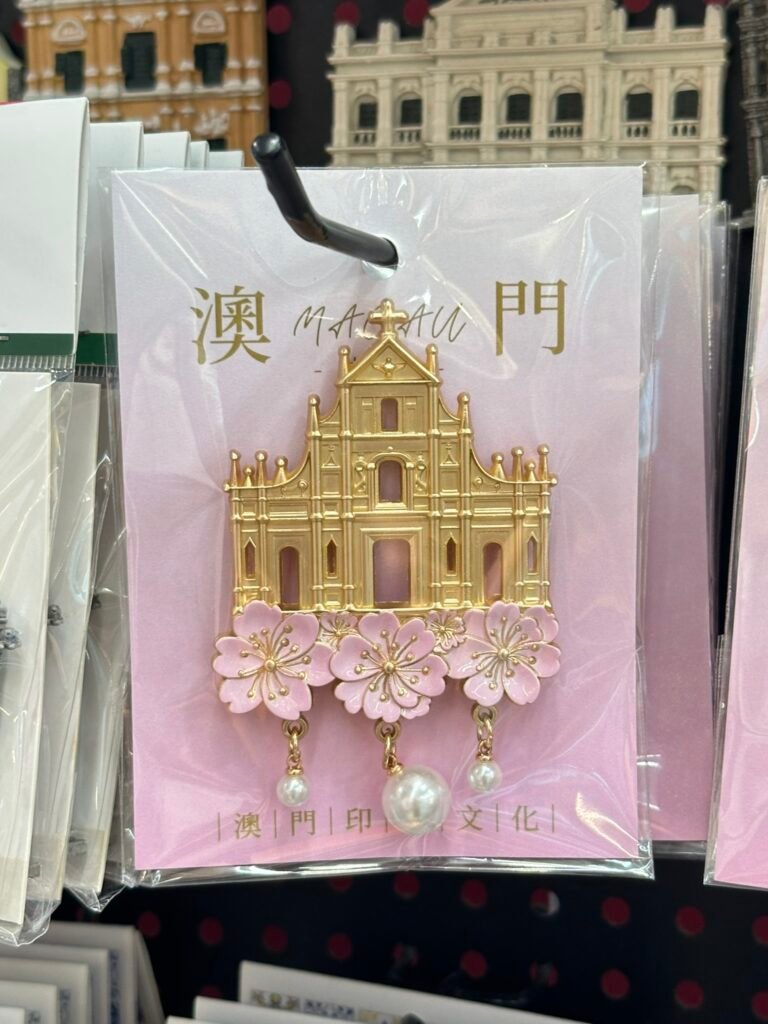
And even here…
look carefully.
St. Paul’s.
European-looking buildings.
Chinese imagery.
Macau Tower.
Food.
Decorative patterns associated with Portuguese Macau.
The souvenir rack was selling miniature versions of the same Macau Dad had been trying to understand all morning.
MANY MACAUS.
ONE CITY.
🐇
Dad’s Tip: Walk This Part of Macau
If you’re visiting St. Paul’s and Senado Square, don’t think of them as two separate attractions.
WALK BETWEEN THEM.
Slowly.
Follow a sign that looks interesting.
Turn into a lane.
Look into a temple.
Buy a drink.
Read a menu.
Browse a shop.
Look down.
Look up.
And occasionally…
TURN AROUND.
😂
Dad began this walk trying to understand Macau through history.
Elaine experienced it through drinks, food and shopping.
Somewhere between the two approaches…
we found the Macau we had actually come to see.
Not just monuments.
Not just casinos.
A LIVING CITY WITH CENTURIES OF HISTORY STILL SHOWING THROUGH.
🐇 Then Elaine Led Dad Down Another Street…
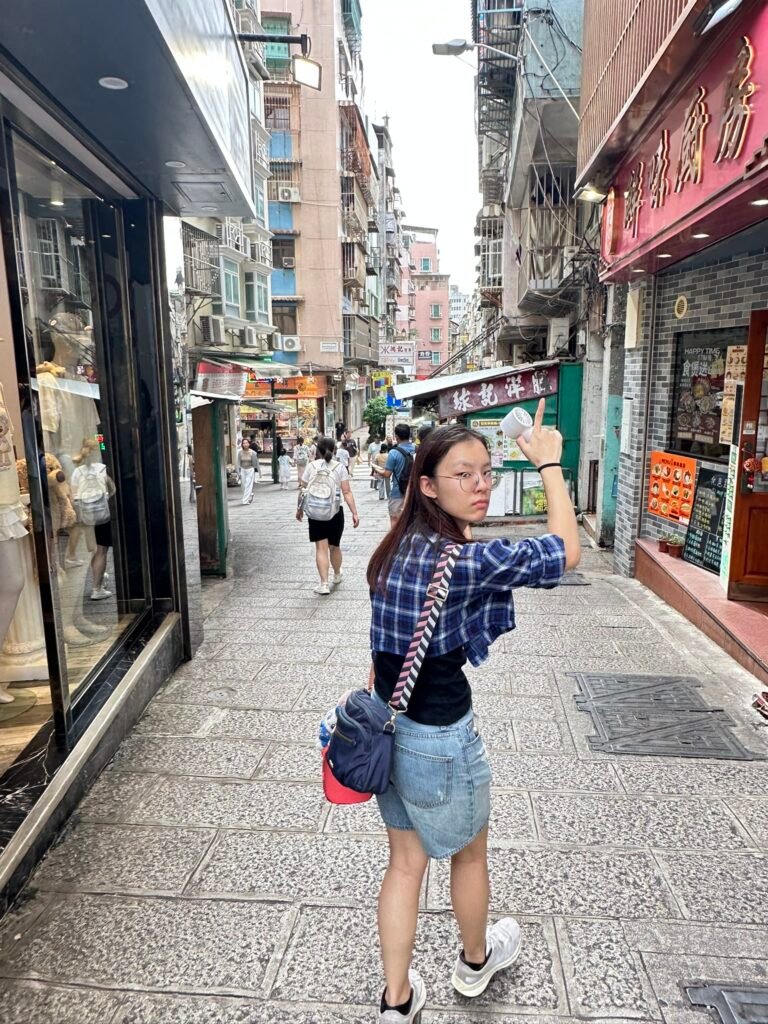
And Macau changed again.
No grand church.
No UNESCO monument filling the frame.
No elegant square.
Just Elaine pointing…
and Dad following.
😂
We walked into narrower streets where Macau suddenly felt much more Chinese.
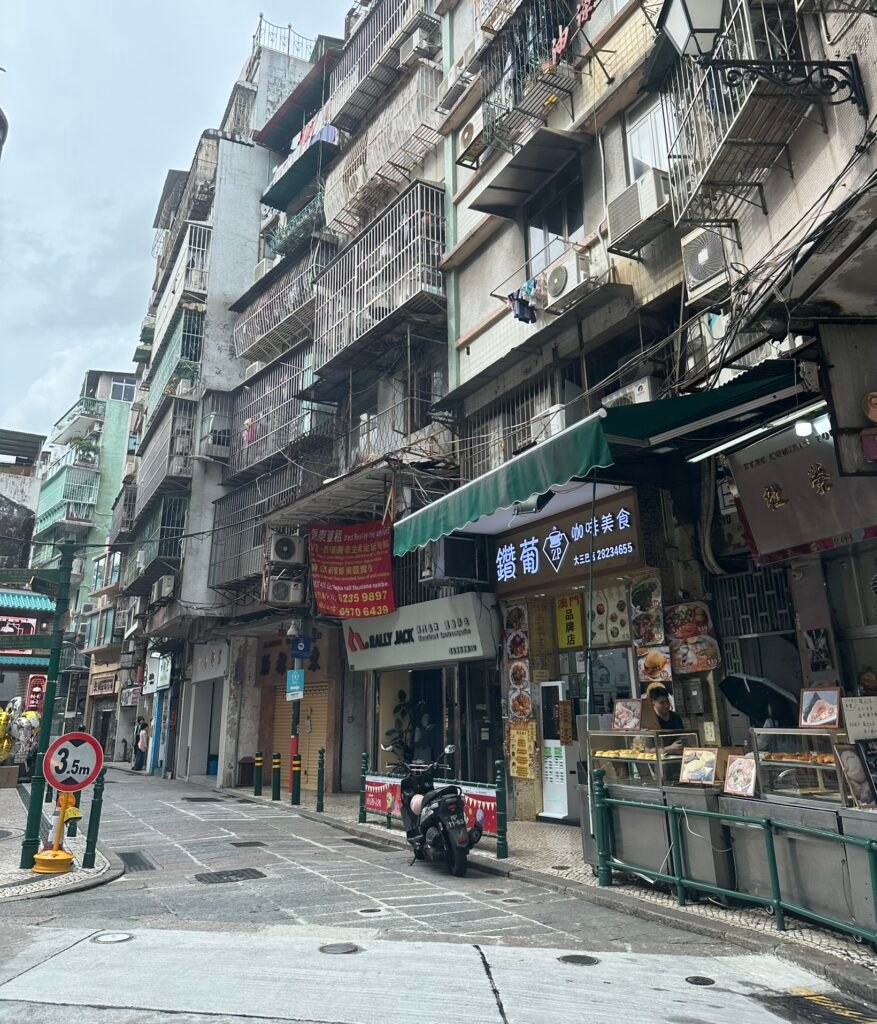
Look up.
Window cages.
Laundry.
Air-conditioners.
Old apartment buildings.
Scooters below.
Small restaurants at street level.
People going about an ordinary day.
This was a very different Macau from St. Paul’s.
But it wasn’t somewhere else.
IT WAS AMONG THE SAME STREETS WE WERE ALREADY WALKING.
🐞
And then Dad saw another sign.
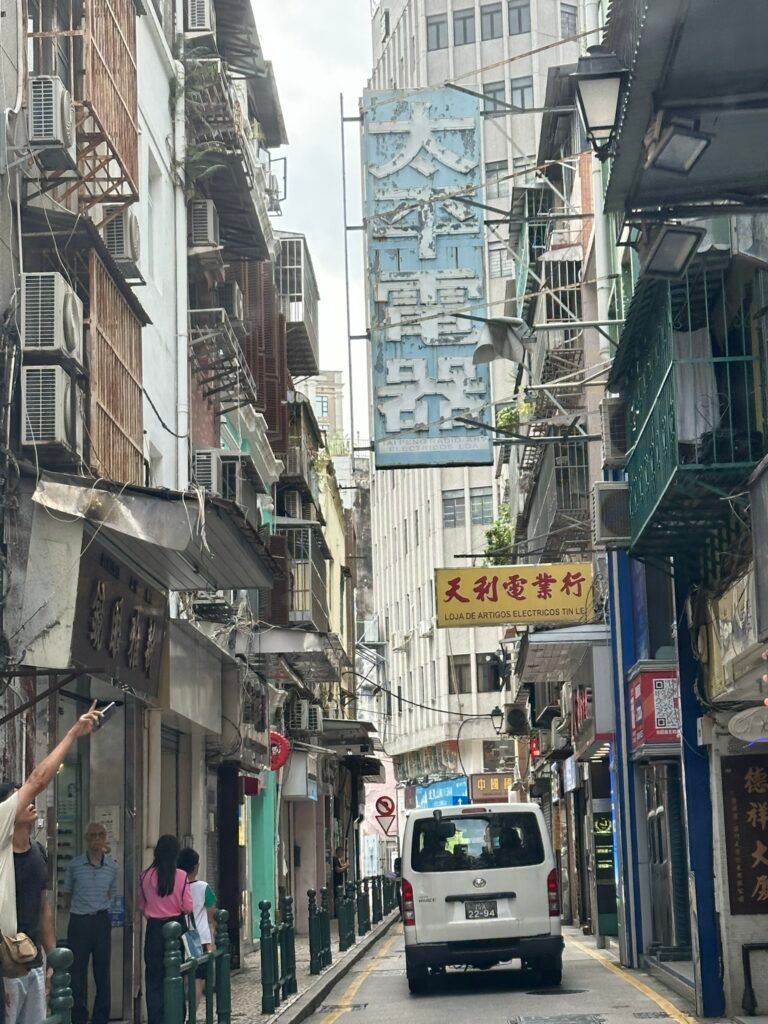
Traditional Chinese characters above.
Portuguese underneath.
天利電業行
LOJA DE ARTIGOS ELÉCTRICOS TIN LEI
Dad stopped.
😂
There it was again.
Chinese Macau.
Portuguese Macau.
Not separated neatly into two tourist zones.
Sometimes…
THEY WERE ON THE SAME SHOP SIGN.
This is why Dad’s first question —
“Wait… what exactly IS Macau?”
— was becoming harder to answer with a single label.
And much more interesting to explore.
🐇
🛕 STOP 3 — A-Ma Temple: Wait… Did Macau Get Its Name From Here?
After the Ruins of St. Paul’s.
After the crowded streets.
After Elaine’s drink hunting, food hunting and souvenir hunting.
Macau changed again.
🐞
We headed toward Barra (媽閣).
And suddenly the Macau around us began to look very different.
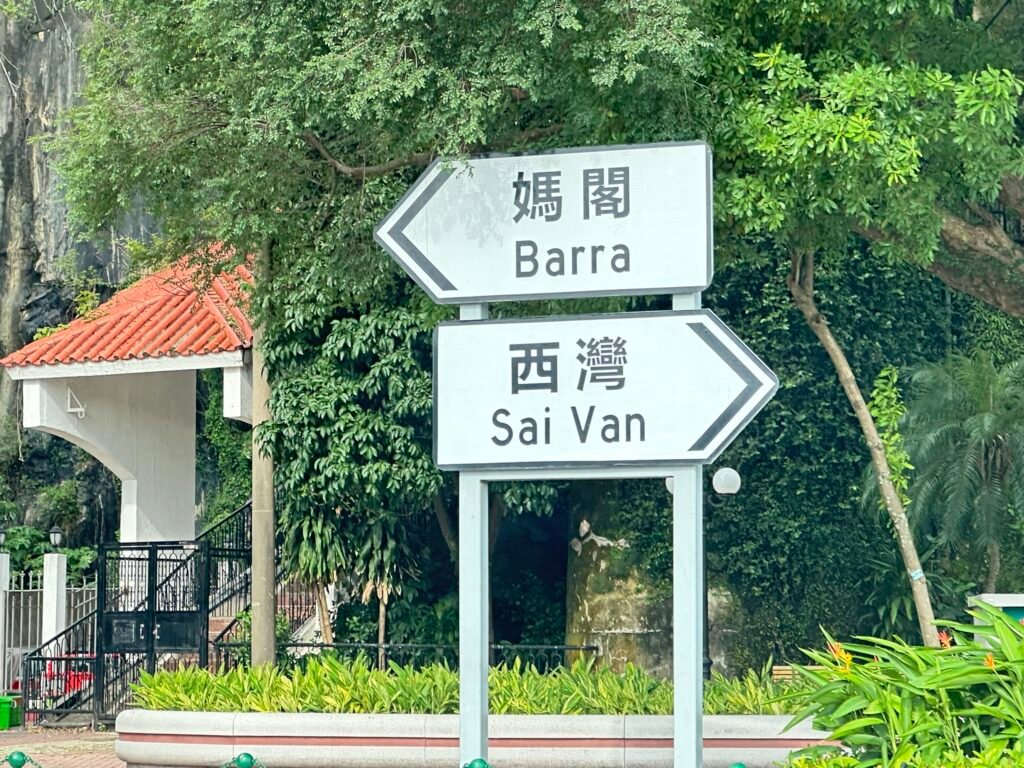
Then Dad and Elaine arrived here.
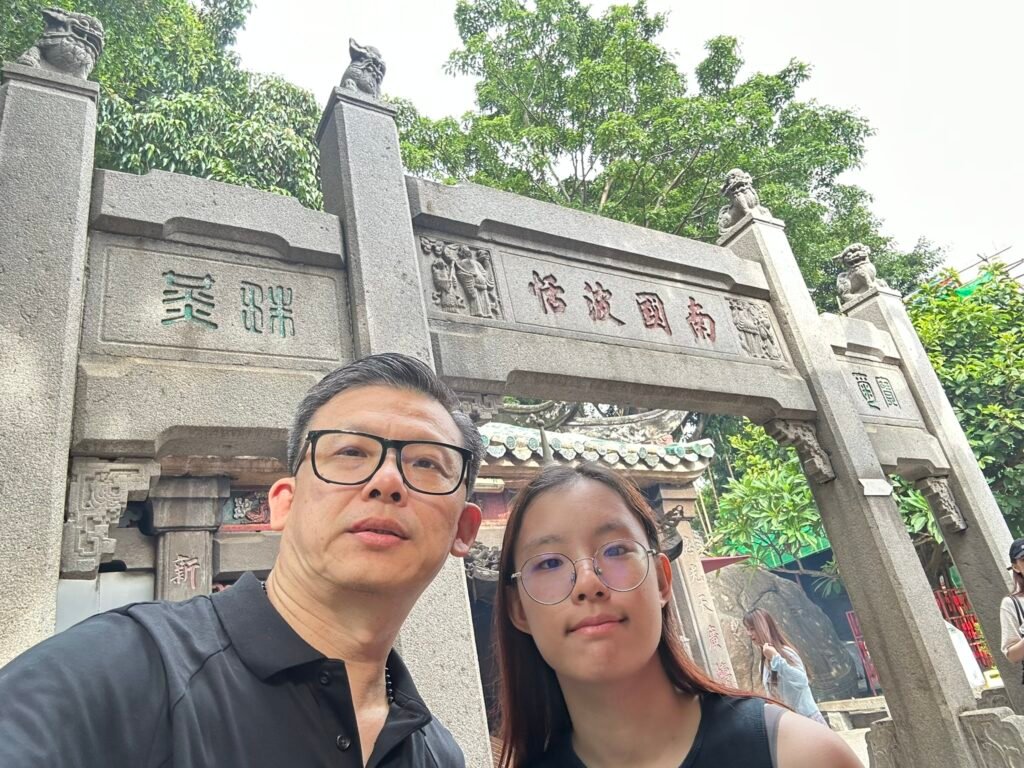
A-MA TEMPLE (媽閣廟).
Smoke from incense drifted through the trees.
Coiled incense hung beside the temple.
Chinese stonework.
Red lanterns.
A hillside rising behind it.
And beside us was a sign carrying a rather important logo:
WORLD HERITAGE.
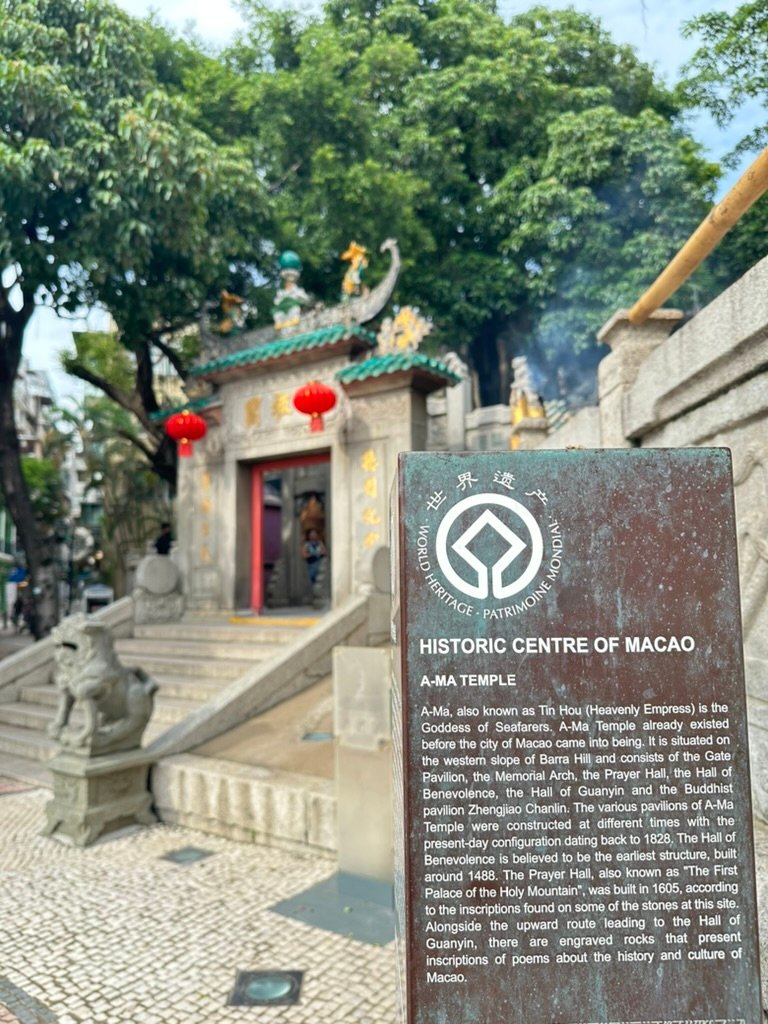
Remember what Dad had started calling the Macau Cultural Kaleidoscope?
Turn it again.
At St. Paul’s, we had been looking at Macau’s encounter with European Christianity.
Here…
we were standing inside a much older Chinese story.
🤯 This Temple Was Here BEFORE Portuguese Macau
This is what makes A-Ma Temple (媽閣廟) much more interesting than simply another temple to photograph.
The temple already existed before the city of Macau came into being.
Its different pavilions were constructed over time, and the oldest surviving structure is believed to date to 1488.
Think about that.
Dad and Elaine had spent part of the day looking at Portuguese-influenced streets and churches.
But here was a Chinese temple whose story reaches back to before Portuguese settlement in Macau began in the 16th century.
Suddenly Macau’s history wasn’t:
PORTUGUESE CAME → MACAU HAPPENED.
Not even close.
There was already a Chinese maritime world here.
And A-Ma was part of it.
🐇 THEN DAD FELL INTO ANOTHER RABBIT HOLE.
Why is it called…
MACAU?
😂
The official Macao World Heritage information explains that the name Macao is believed to have developed from the Chinese “A-Ma-Gau” — meaning the Bay of A-Ma — where the temple stands.
So one explanation for the name of Macau itself leads us…
right back here.
To A-Ma.
To the sea.
And to the people who were living, sailing and worshipping here before Portuguese Macau developed.
🐞
That’s not a bad rabbit hole for one temple.
🌊 A Temple for People Looking Toward the Sea
A-Ma is also known as Tin Hau (天后), the Goddess of Seafarers.
That makes the location particularly meaningful.
Macau grew as a maritime trading place.
Ships arrived.
Merchants arrived.
Different peoples arrived.
Different religions arrived.
Different languages arrived.
And centuries later, Dad and Elaine arrived too.
😂
The temple complex itself contains several spaces associated with different traditions and deities — including the Prayer Hall, Hall of Benevolence, Hall of Guanyin and a Buddhist pavilion.
Chinese folk belief.
Taoist influences.
Buddhist influences.
Different traditions existing within one temple complex.
Even here…
THE KALEIDOSCOPE KEEPS TURNING.
😂 And Then Dad Turned Around…
After A-Ma Temple (媽閣廟), Dad thought we’d just had a very Chinese Macau moment.
Incense.
Red lanterns.
Chinese temple roofs.
A-Ma.
Centuries of maritime belief.
Then we walked next door.
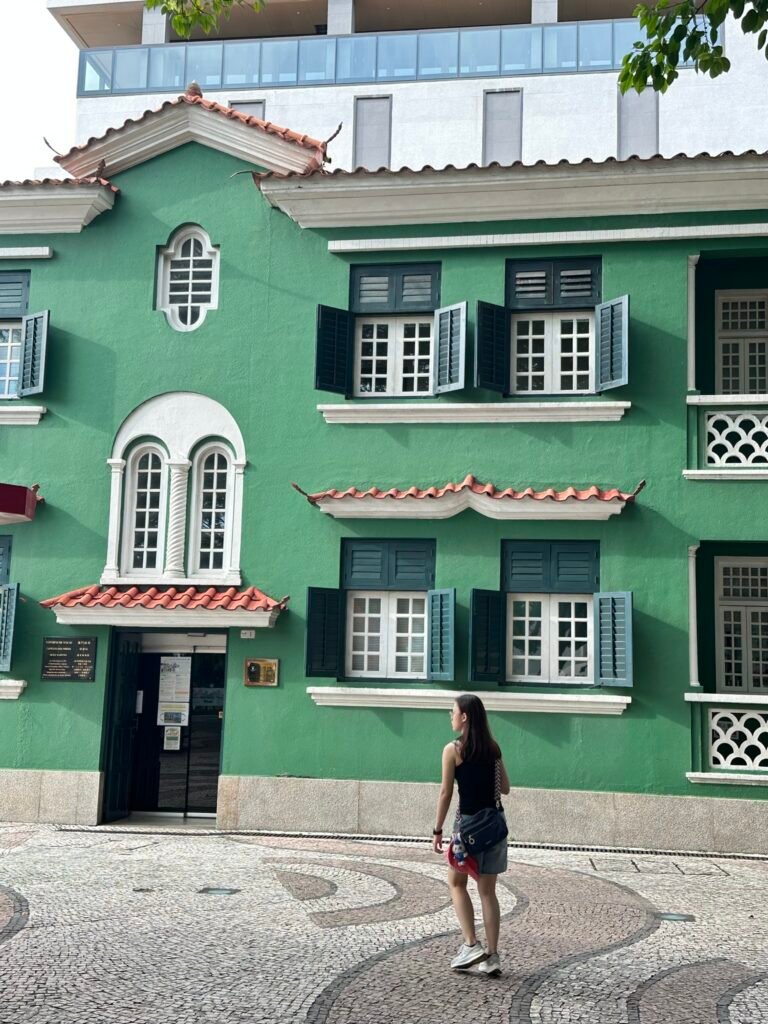
Wait.
😂
Green walls.
White trim.
Shuttered windows.
Terracotta roof tiles.
A completely different architectural language.
And Elaine standing right in the middle of it.
Then Dad looked at the plaque.
[INSERT CLOSE-UP PHOTO: MARITIME MUSEUM PLAQUE]
Portuguese on the left.
Traditional Chinese on the right.
MUSEU MARÍTIMO.
海事博物館.
The building is associated with Macau’s Maritime Museum.
And there it was again.
The thing Dad had started calling:
THE MACAU CULTURAL KALEIDOSCOPE.
🐞
Turn one way:
A-Ma Temple.
Turn slightly:
Portuguese-influenced architecture.
Look at the plaque:
Portuguese + Chinese.
And all of this was practically beside each other.
Dad was beginning to understand that Macau didn’t always require us to travel kilometers to find another cultural layer.
SOMETIMES WE JUST HAD TO TURN AROUND.
😂
And here the maritime connection made the pairing even better.
A-Ma was worshipped as a protector of seafarers.
Macau grew through the sea.
And beside the temple today sits a museum devoted to Macau’s maritime story.
Temple.
Sea.
Trade.
Portuguese arrival.
Macau.
They weren’t separate rabbit holes anymore.
They were beginning to connect.
🐇
That is exactly what Dad means by the Macau Cultural Kaleidoscope:
Move a little.
Look again.
The pieces rearrange.
And suddenly you’re seeing another Macau.
Dad’s Macau Lesson
A-Ma Temple helped Dad understand something that St. Paul’s alone couldn’t.
Macau isn’t interesting simply because it has Chinese things and Portuguese things.
It’s interesting because the layers sit beside each other.
Sometimes on the same street.
Sometimes within the same UNESCO World Heritage story.
And sometimes centuries apart.
UNESCO describes the Historic Centre of Macao as evidence of one of the earliest and longest-lasting encounters between China and the West.
Dad was beginning to see what that actually means.
Not from a textbook.
By moving through the city.
St. Paul’s → Chinese streets → local food → A-Ma Temple.
Different Macau.
Same Macau.
DAD’S MACAU CULTURAL KALEIDOSCOPE. 🐞
And we weren’t finished turning it yet.
Because later…
Macau was going to change completely again.
😂
😂 STOP 4 — Wait… Did Dad Accidentally Take Elaine to ROME?
By now, Dad thought he was getting pretty good at Macau.
😂
We had seen:
St. Paul’s.
Portuguese-influenced streets.
Chinese temples.
Traditional shops.
Senado Square.
A-Ma Temple.
Maritime Macau.
Dad had even developed a theory.
THE MACAU CULTURAL KALEIDOSCOPE.
Very clever.
Very intellectual.
Very ChinaTravelBUG.
🐞
Dad was feeling quite pleased with himself.
Then…
Macau did this.
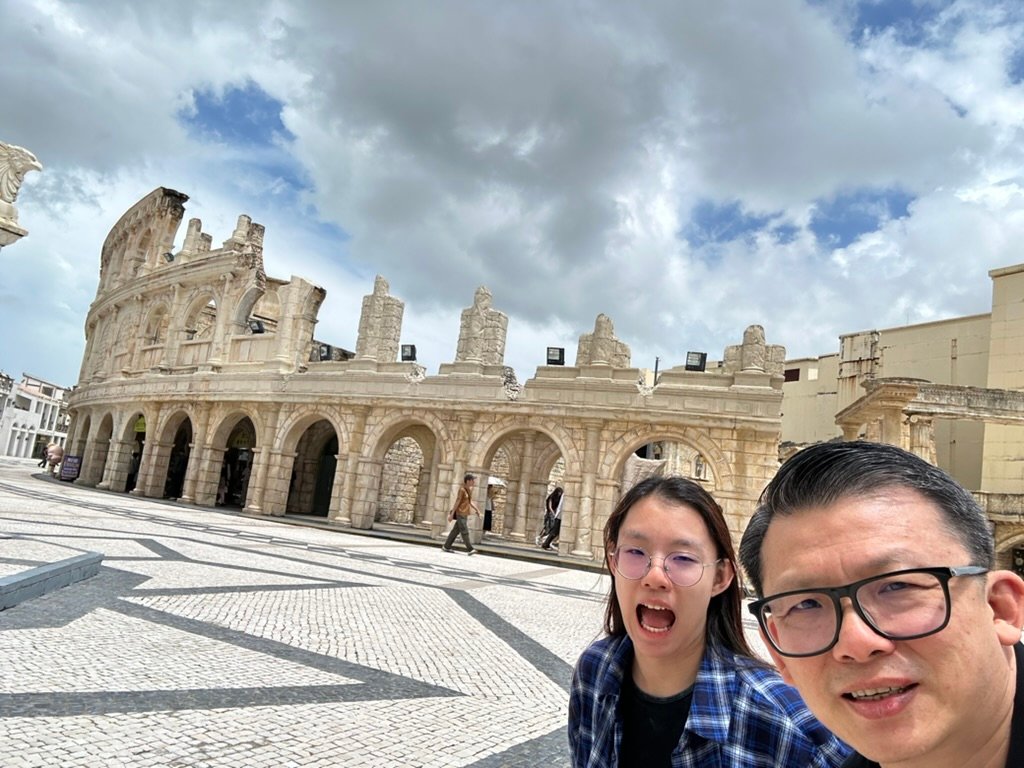
Dad:
WAIT.
😂
Did we take a wrong turn?
Because suddenly…
ROME.
Columns.
Arches.
Stone walls.
Roman-looking ruins.
A Colosseum-style backdrop.
Elaine seemed completely unconcerned.
Dad had questions.
Lots of questions.
😂
🇮🇹 Dad’s Macau Cultural Kaleidoscope Had Gone Completely Off the Rails
A few moments ago:
🛕 A-Ma Temple.
Before that:
⛪ St. Paul’s.
Before that:
🏮 Chinese streets.
And now:
🏛️ ANCIENT ROME?!
😂😂😂
Had Dad misunderstood Macau completely?
Was there some forgotten Roman chapter of Macau history?
Did Julius Caesar make a secret day trip here?
NO.
😂
This is Macau Fisherman’s Wharf (澳門漁人碼頭).
And unlike the genuine historical buildings we’d been exploring earlier…
THIS IS MODERN THEMED ARCHITECTURE.
The Roman-looking structures are part of a modern entertainment and commercial development.
In other words:
Dad had spent the morning trying to distinguish genuine layers of Macau history…
and Macau suddenly gave him a giant Roman-themed plot twist.
😂
Dad’s Important Traveler Tip: Old-Looking Doesn’t Always Mean Old
This is actually worth knowing.
If you’ve just visited the Historic Centre of Macao, don’t mentally put Fisherman’s Wharf into the same historical category.
St. Paul’s?
Real historic Macau.
A-Ma Temple?
Real historic Macau.
Senado Square and the surrounding heritage buildings?
Real historic Macau.
Roman-looking Fisherman’s Wharf?
VERY FUN.
VERY PHOTOGENIC.
VERY NOT ANCIENT ROME.
😂
And that’s perfectly okay.
Once Dad understood what he was looking at, we could simply enjoy it for what it was.
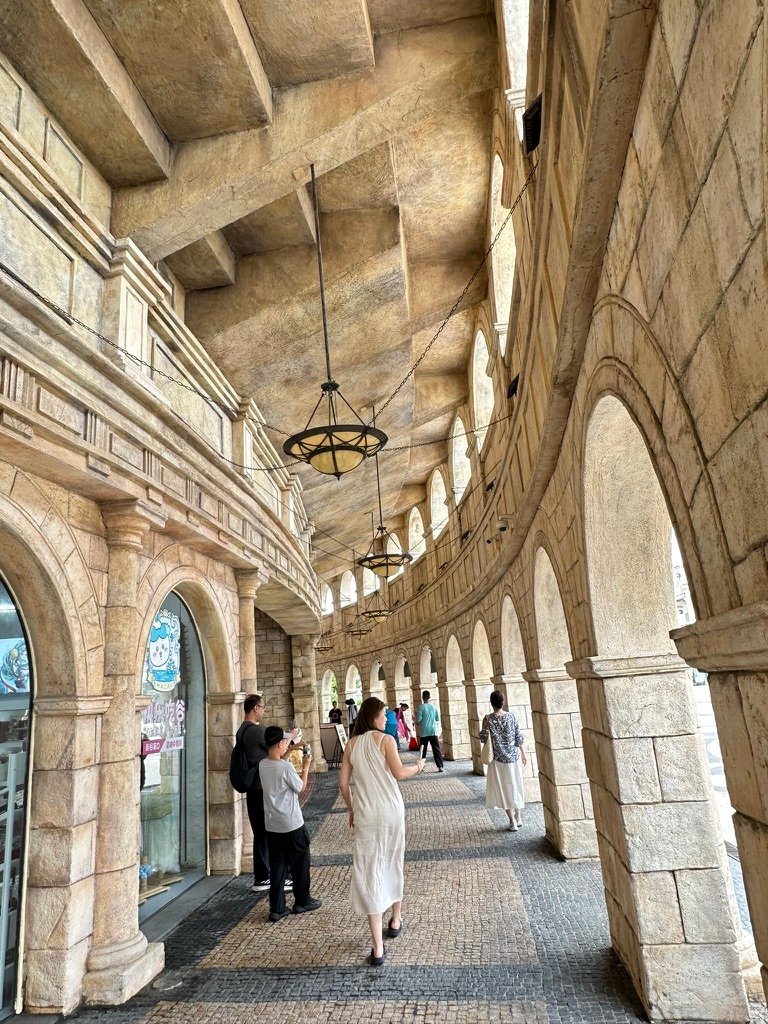
No history exam required.
Walk around.
Take ridiculous photos.
Pretend you’ve arrived in Europe.
Let Elaine explore.
And enjoy another completely different face of Macau.
😂 And Then Macau Made It Even Weirder
Just when Dad thought the cultural mix couldn’t possibly become more complicated…
Elaine found this.
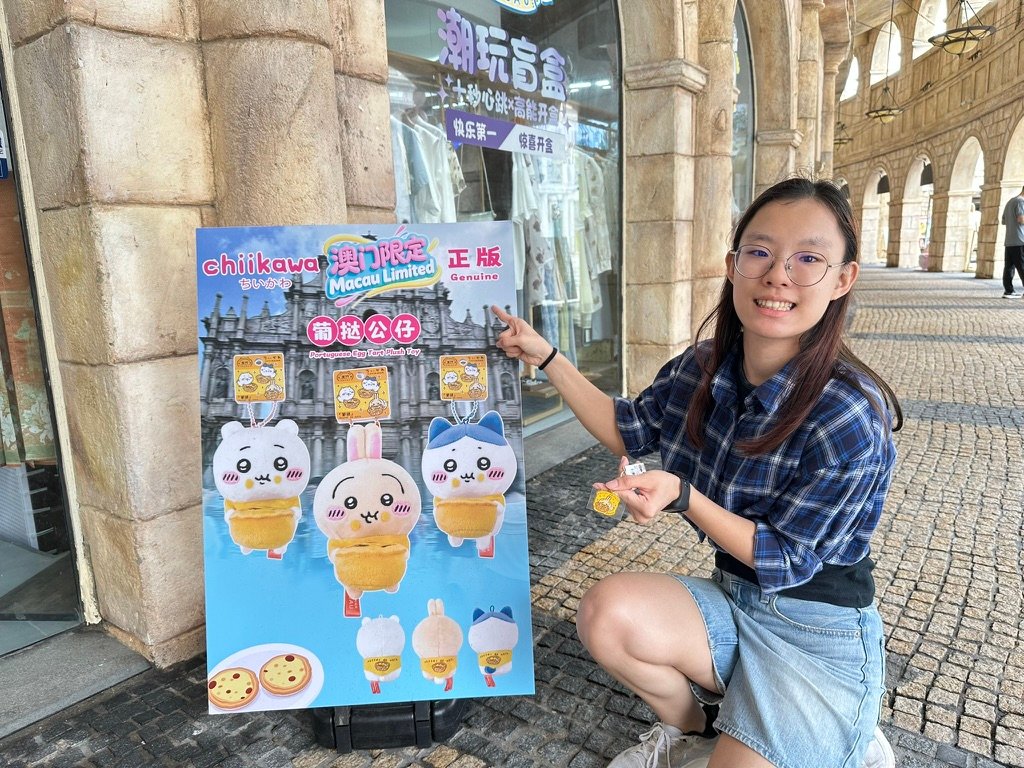
Let’s review.
We were in:
Macau.
Inside:
Roman-themed architecture.
Looking at:
Japanese Chiikawa characters.
Connected to:
🥧 MACAU PORTUGUESE EGG TARTS.
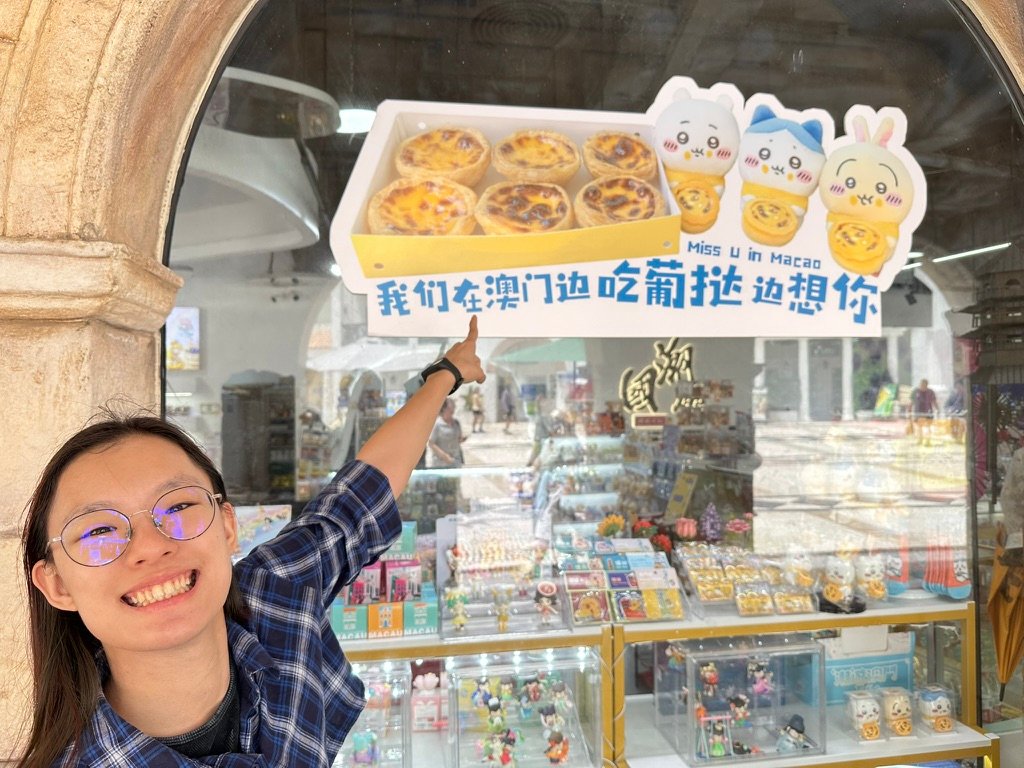
Dad gave up.
😂😂😂
THE KALEIDOSCOPE HAD WON.
Chinese Macau.
Portuguese Macau.
Historic Macau.
Modern Macau.
Fake Rome.
Japanese characters.
Portuguese egg tarts.
All before dinner.
🐇
Try putting THAT into one cultural box.
🥧 WAIT… DID SOMEBODY SAY EGG TART?
Oh yes.
Remember the Oven?
😂
Way back in the streets near St. Paul’s…
🥧 THE OVEN WAS HEATING.
And now Macau was teasing us again.
Even the souvenirs were reminding Dad about Portuguese egg tarts.
But we still hadn’t reached the real payoff.
Not yet.
Dad and Elaine still had somewhere important to go.
Because later…
we were going to 打卡 — clock in at a place central to Macau’s Portuguese egg-tart story.
🥧🔥
The Oven was getting VERY hot.
What Fisherman’s Wharf Taught Dad
Strangely enough, fake Rome helped Dad understand real Macau a little better.
Macau isn’t interesting only because of what happened centuries ago.
It’s also a place that keeps reinventing itself.
Historic temples.
Catholic churches.
Chinese neighborhoods.
Portuguese-influenced streets.
Casinos and resorts.
Entertainment developments.
International pop culture.
And apparently…
ROME.
😂
Dad’s Macau Cultural Kaleidoscope wasn’t just about history anymore.
Every time we thought we’d figured out what Macau looked like…
someone turned the tube again.
🐞
And after fake Rome?
Dad thought Macau couldn’t possibly surprise us again.
That was a mistake.
😂
🦁 STOP 5 — Wait… There’s a Museum Inside MGM?
After fake Rome, Dad thought Macau had probably used up its surprises.
Wrong again.
😂
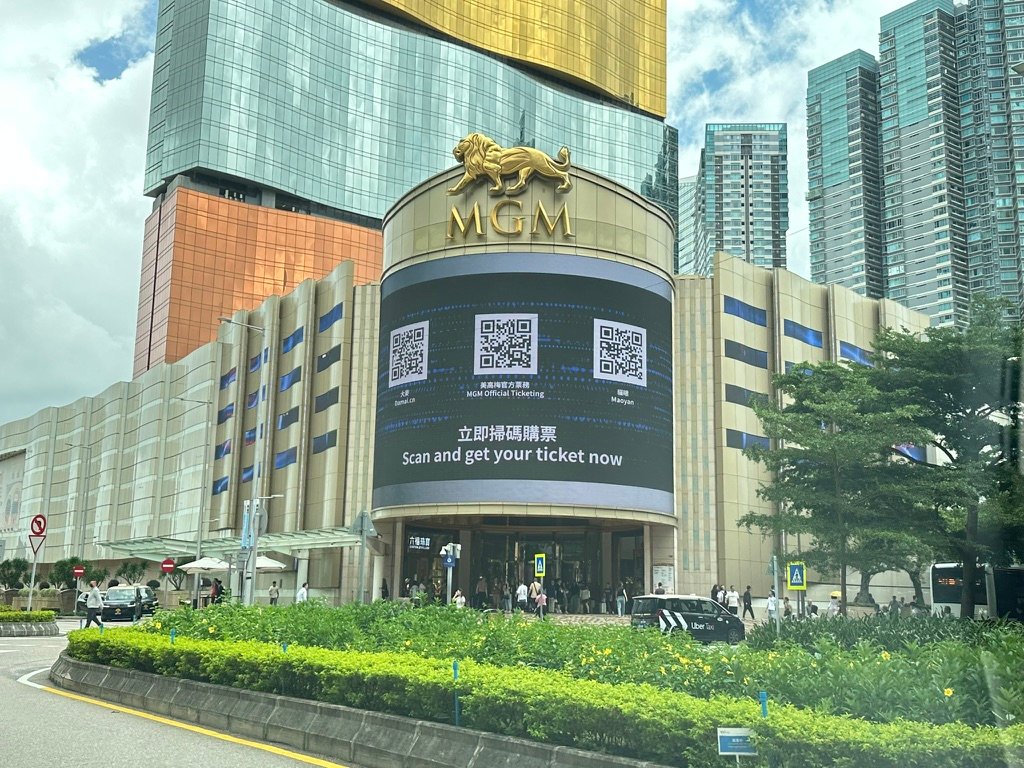
We entered MGM Macau.
Very grand.
Very polished.
Very Macau.
And then Dad discovered something he wasn’t expecting.
A MUSEUM.
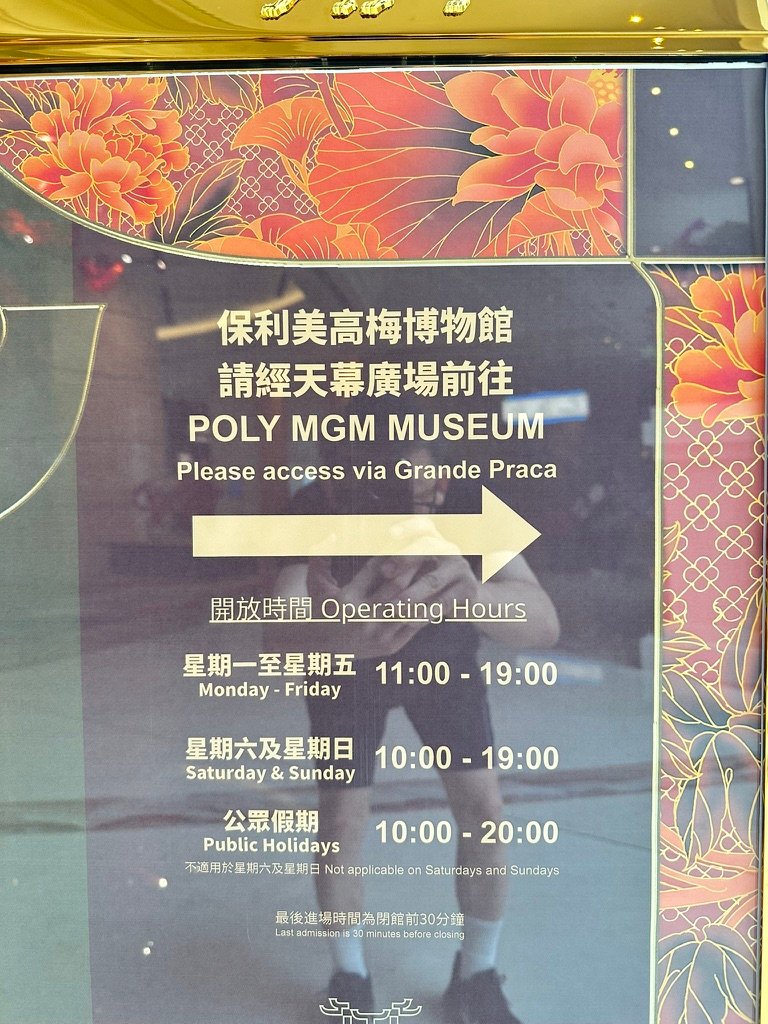
The Poly MGM Museum.
And when Dad and Elaine visited, the exhibition was about the Silk Roads.
🐇
Uh-oh.
Dad likes history.
Elaine knows what happens next.
😂
[INSERT PHOTO: ELAINE WITH LION SCULPTURE]
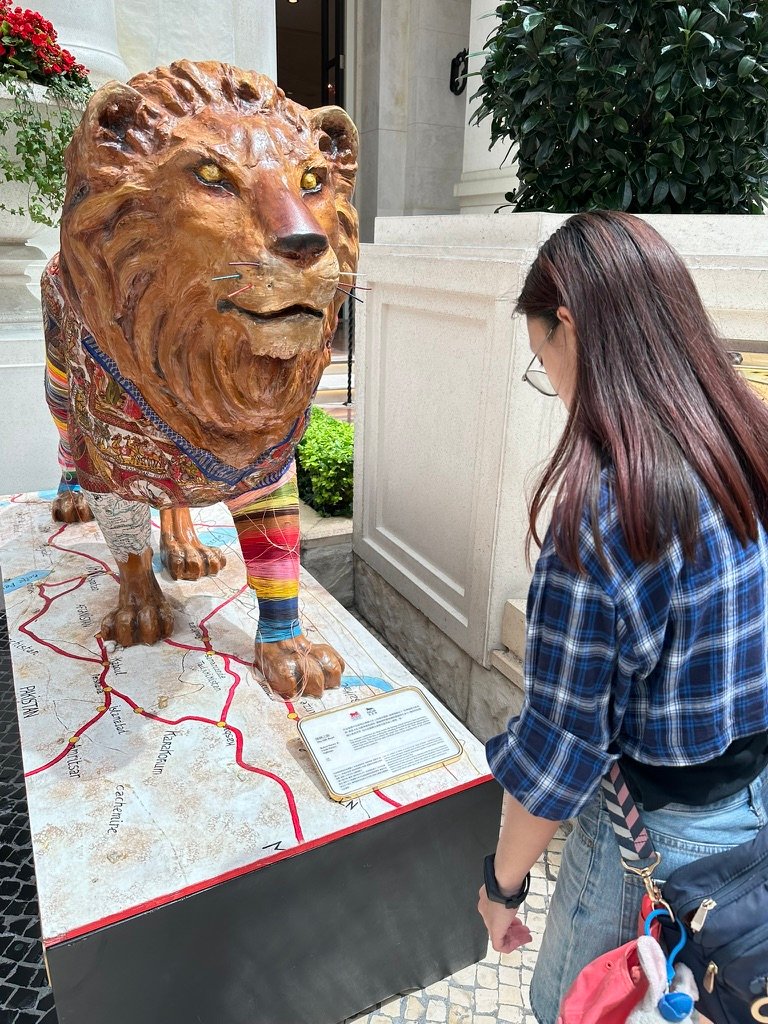
One lion became a question.
The question became a museum label.
The museum label became another rabbit hole.
China.
Art.
Trade.
Cultural exchange.
The Silk Roads.
SEE → ASK → CONNECT → UNDERSTAND → FOLLOW.
There goes Dad again.
🎟️ Dad’s Tip: Check What’s Showing
The exhibition Dad and Elaine saw was temporary, so don’t visit expecting exactly the same thing.
Check the Poly MGM Museum’s current exhibition before you go.
Admission was free when we visited.
And even outside the exhibition, MGM’s Grande Praça was worth looking around.
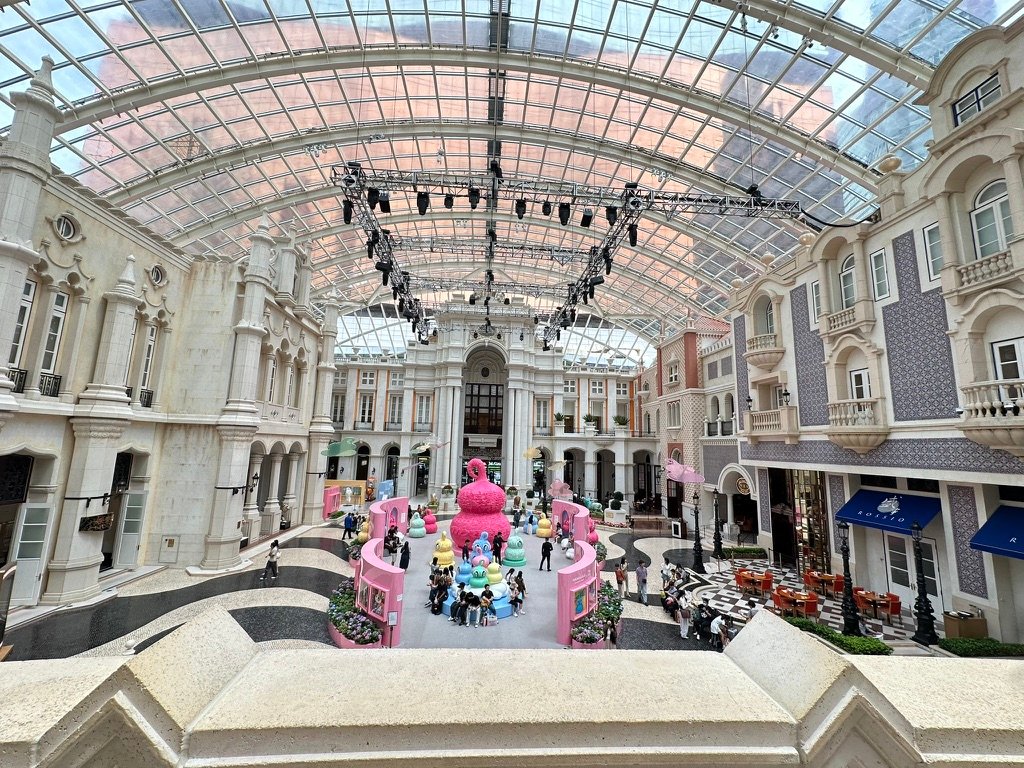
European-inspired façades.
A huge glass ceiling.
Decorative paving.
And after genuine historic Macau…
yet another modern interpretation of Europe.
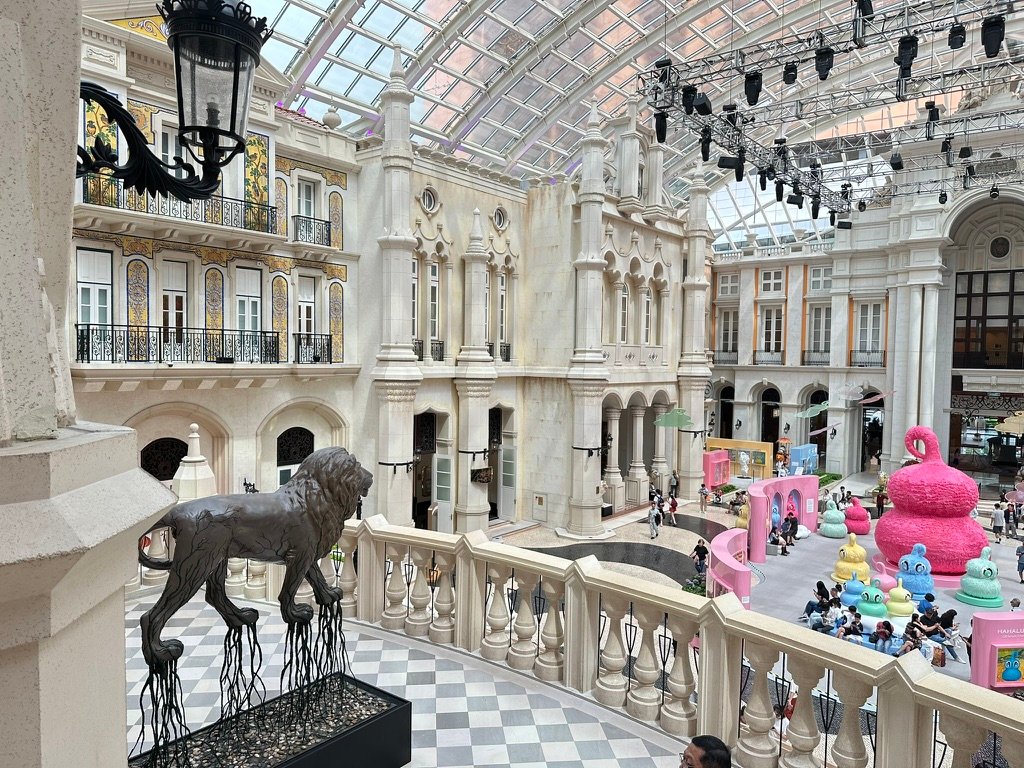
😂
Dad’s Macau Cultural Kaleidoscope turned again.
But this time Dad exercised enormous discipline.
No more rabbit holes.
Because there was a much more urgent matter.
🥧
Remember the Oven?
It had been heating…
and heating…
and heating…
THE OVEN WAS FINALLY HOT ENOUGH.
🔥🥧😂
🥧 STOP 6 — THE OVEN IS OPEN. Mission Accomplished.
Enough history.
Enough temples.
Enough churches.
Enough fake Rome.
Enough Dad rabbit holes.
😂
Elaine had been waiting long enough.
🥧 THE OVEN WAS READY.
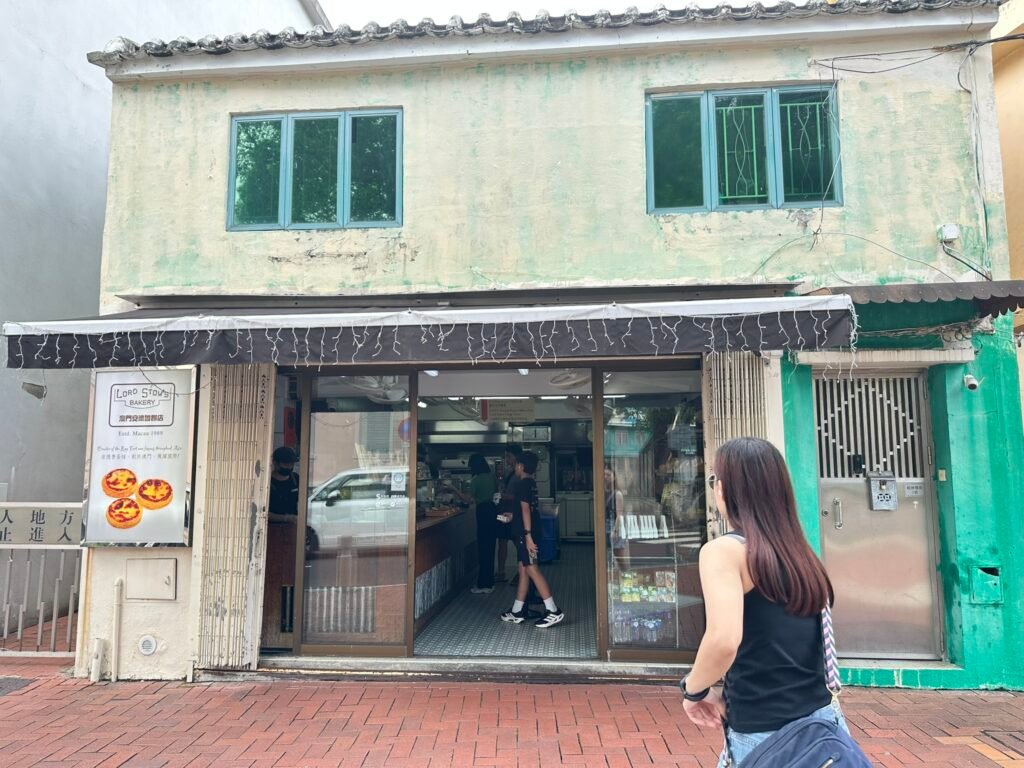
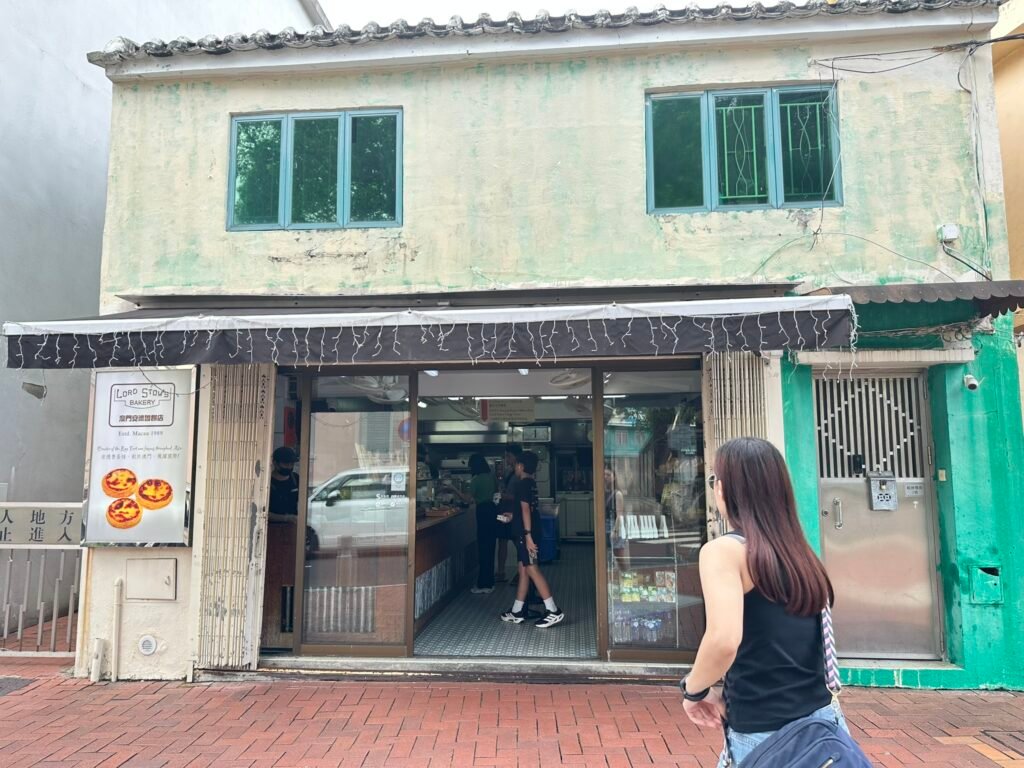
We had arrived at Lord Stow’s Bakery.
Not a fancy resort.
Not a giant shopping mall.
Just a little bakery in Macau.
But this was one place Elaine and Dad wanted to 打卡 — clock in.
🥧 Why Lord Stow’s?
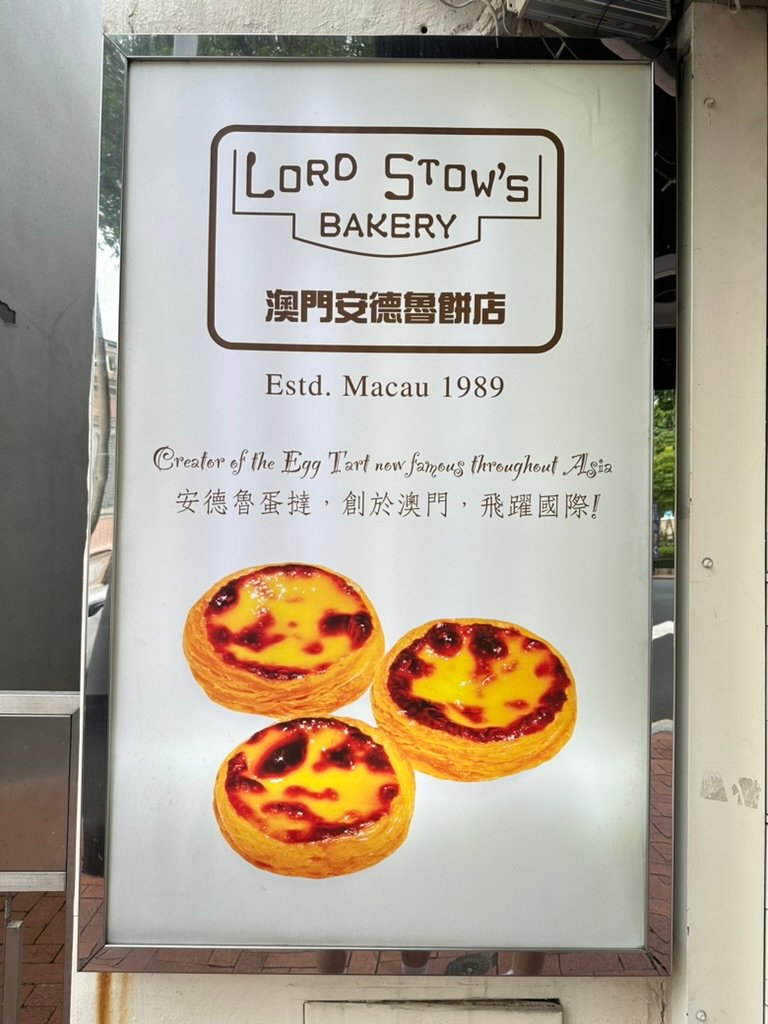
Look at the sign:
Estd. Macau 1989
And underneath:
Creator of the Egg Tart now famous throughout Asia
This is where the modern Macau-style Portuguese egg tart story took off.
Lord Stow’s Bakery was founded by Englishman Andrew Stow in Macau in 1989, and his version of the Portuguese-inspired egg tart became one of Macau’s most recognizable foods.
So after spending the day asking…
What exactly is Macau?
…perhaps this little tart was another answer.
Portuguese inspiration.
Reworked in Macau.
Then famous across Asia.
😂
THE MACAU CULTURAL KALEIDOSCOPE…
IN PASTRY FORM.
😂 Elaine Took Over
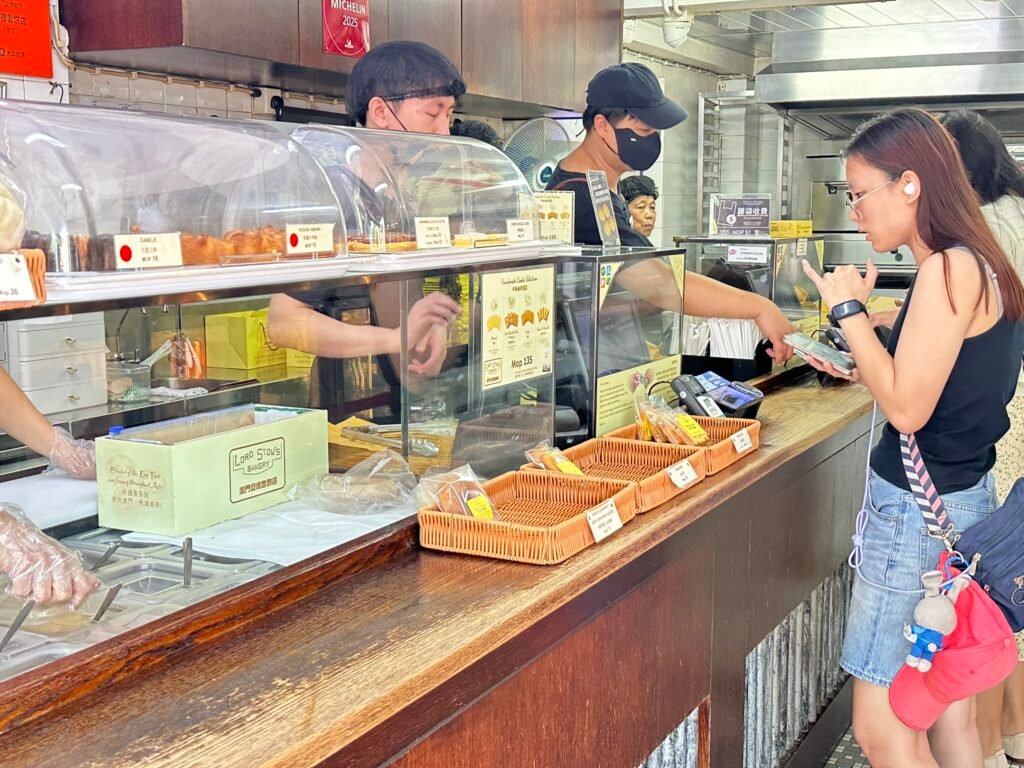
Dad’s history lesson was officially suspended.
Elaine had more important business.
🥧🥧🥧
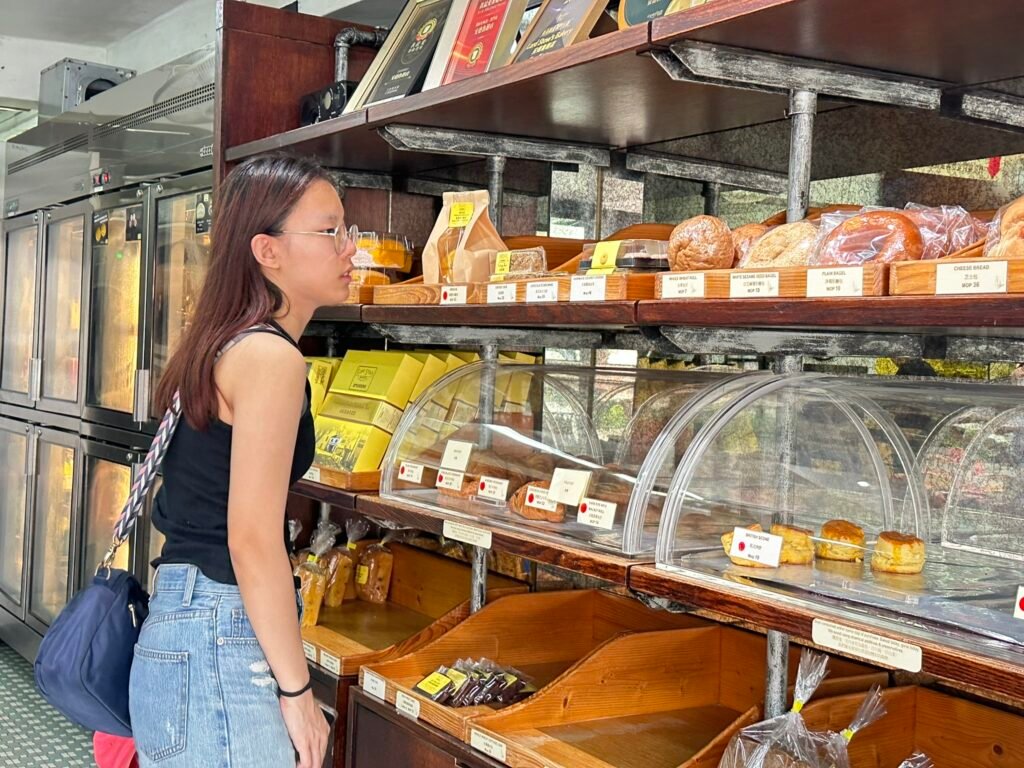
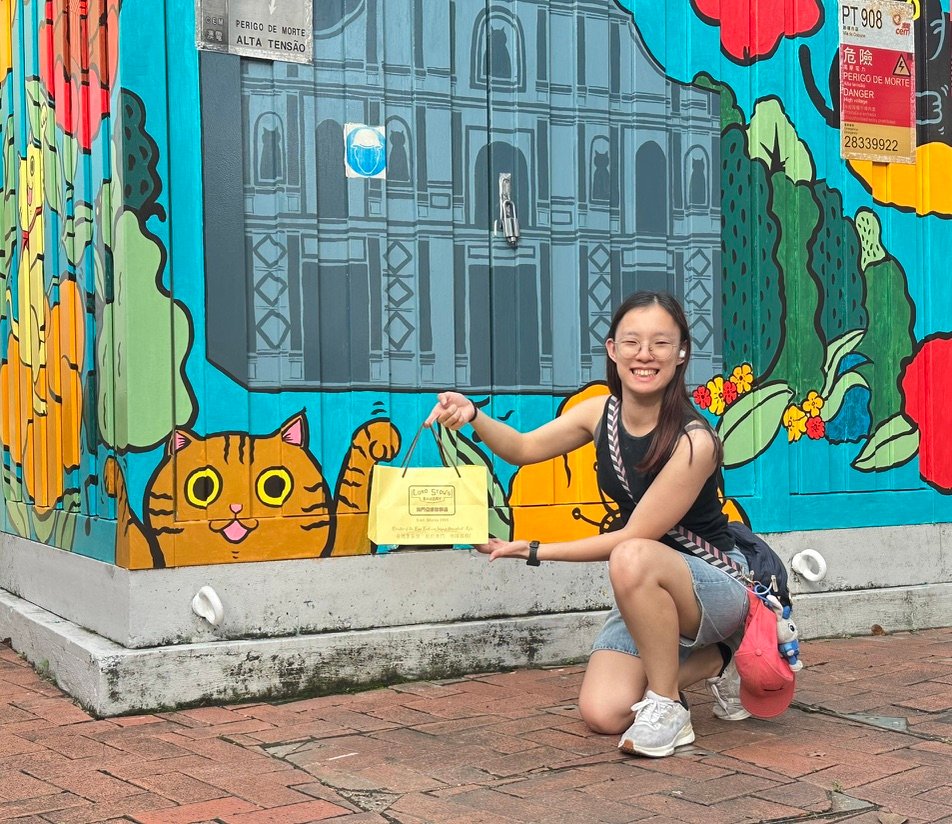
Order placed.
Bag acquired.
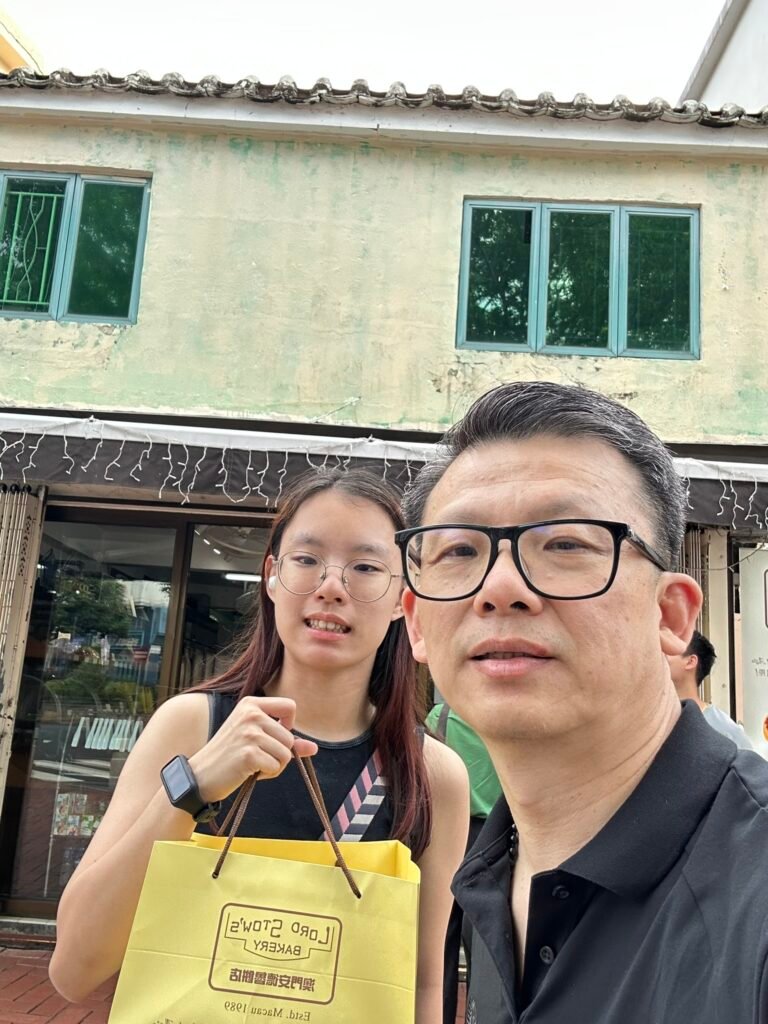
打卡成功.
Mission accomplished.
😂
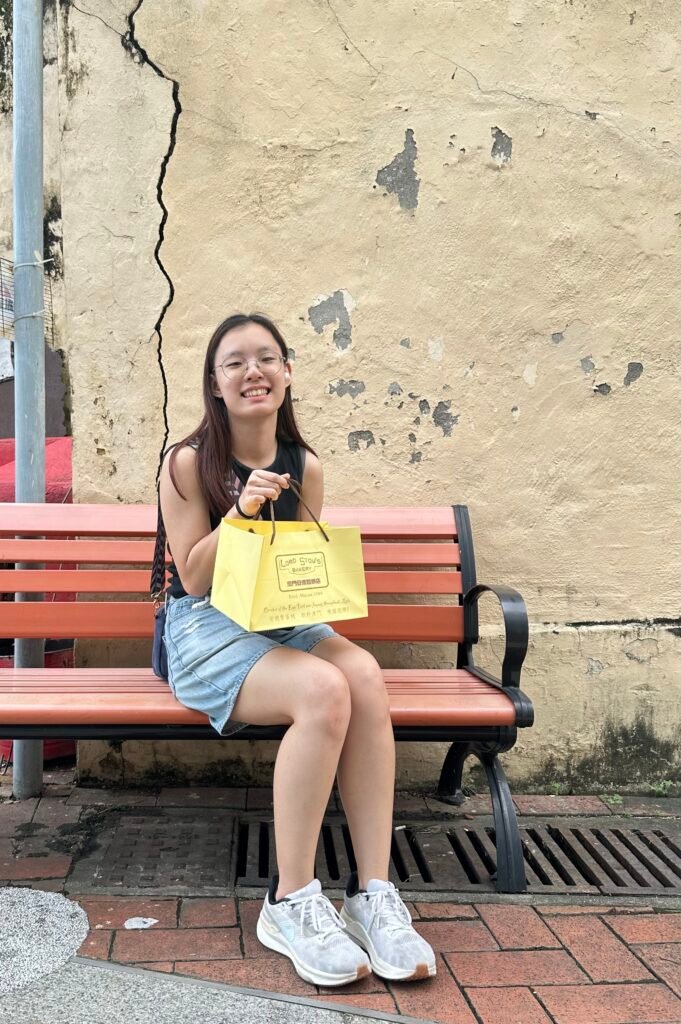
Look at that smile.
This may have been the happiest historical research of the entire day.
And then…
the box opened.
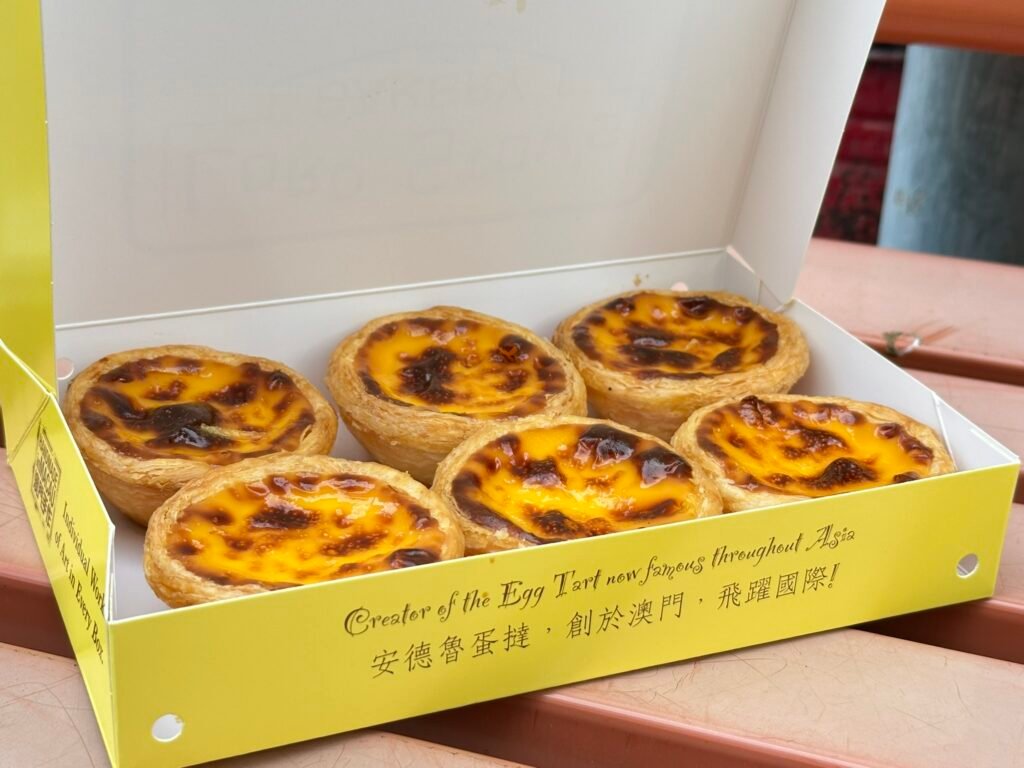
🔥🥧 BOOM.
Flaky pastry.
Golden custard.
Those dark caramelized patches on top.
Six of them.
After teasing this poor Oven for half the article…
THE OVEN DELIVERED.
😂😂😂
Dad had spent the day trying to understand Macau through:
churches,
temples,
streets,
languages,
architecture,
maritime history,
museums,
and cultural exchange.
Elaine found another method.
EAT THE EGG TART.
Sometimes…
Elaine’s method is better.
😂🐞
And finally…
Dad conducted the most important research of the day.
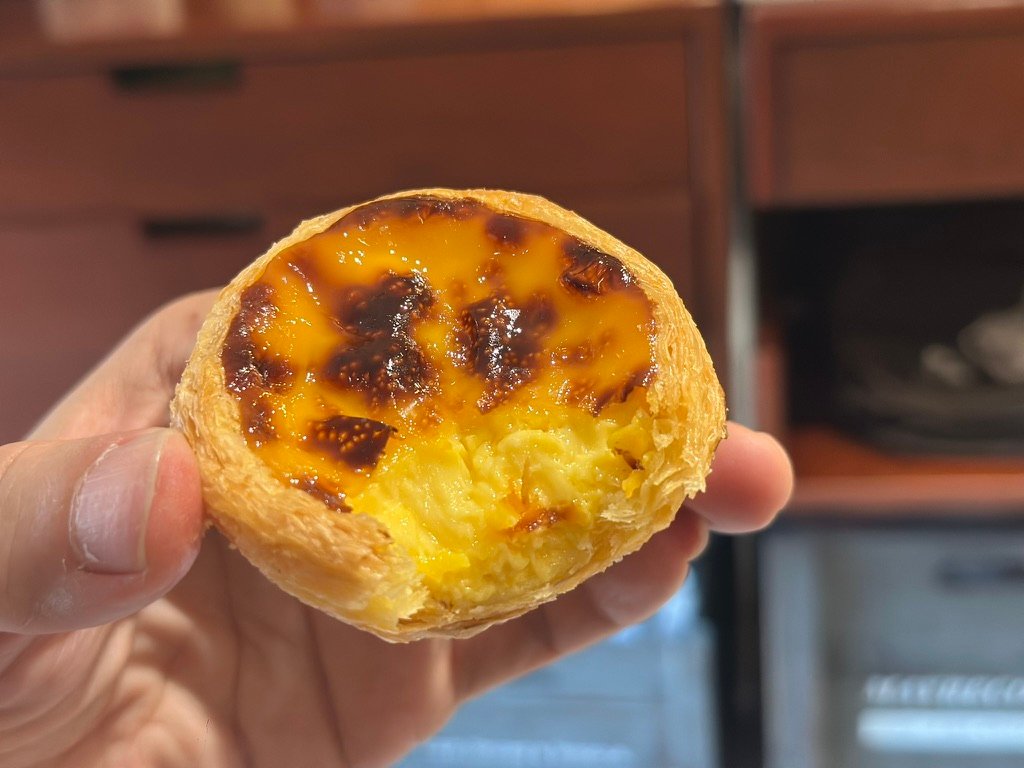
😂
Crisp, flaky pastry.
Warm, creamy egg custard.
Caramelized, almost blistered patches across the top.
One bite missing.
Elaine had been waiting for this moment.
She took a bite.
Then came the verdict:
“值回票价!” 😂
Zhí huí piào jià — “Worth the ticket!”
Dad laughed.
Because he’d heard himself make almost exactly the same kind of declaration on another China journey — after visiting a museum in Jinan (济南, Jǐnán).
👉 Why We Stopped in Jinan Before Traveling Deeper Into Shandong
Different city.
Different experience.
This time, however, Elaine wasn’t reviewing a museum.
She was reviewing…
AN EGG TART. 😂🥧
And apparently the journey to Coloane had passed the test.
🥧 THE OVEN WAS WORTH THE WAIT.
After churches, temples, UNESCO history, Chinese streets, Portuguese influences, fake Rome and one unexpected museum…
Macau finally became very simple.
TAKE A BITE.
😂🐞
Sometimes the best way to understand a place…
is to eat it.
Mission accomplished.
🌈 STOP 6 — We Came for an Egg Tart. Then Coloane Happened.
The Oven was finally close.
🥧
Dad and Elaine had come to Coloane Village (路環村) for one very important reason:
Lord Stow’s Bakery.
Macau Portuguese egg tarts.
Mission almost accomplished.
Then we started walking.
[INSERT PHOTO: CHAPEL OF ST. FRANCIS XAVIER]
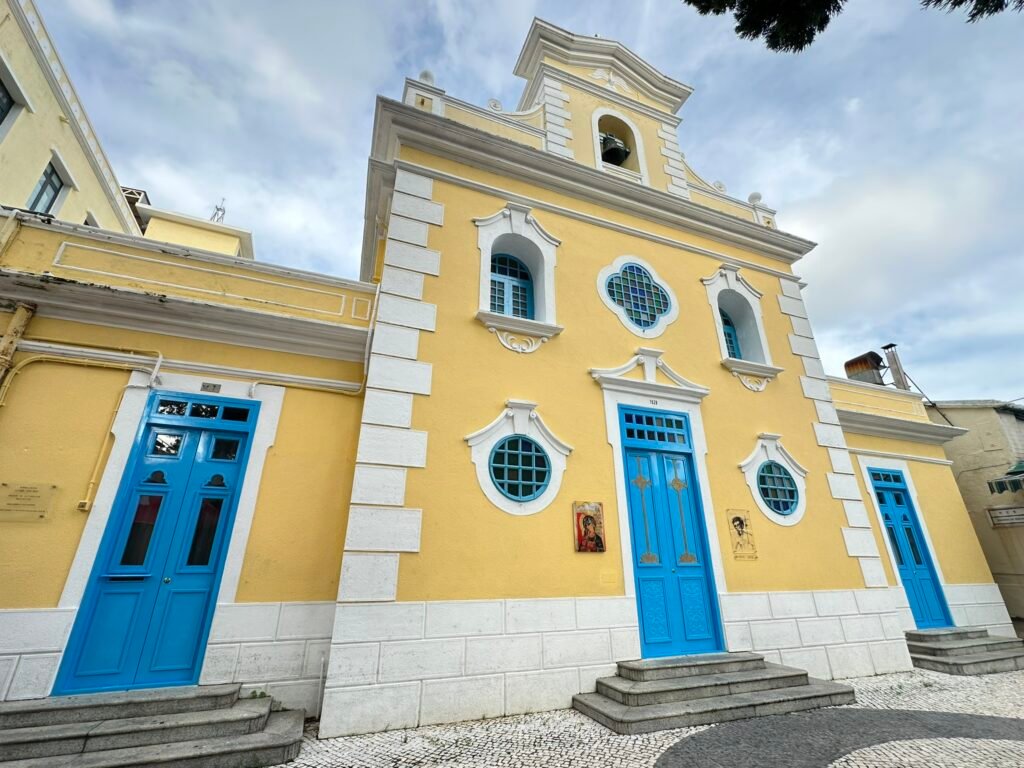
Wait.
Look at this place.
😂
Yellow walls.
Bright blue doors.
Portuguese street names.
Chinese characters.
Little lanes.
Temples.
Churches.
Cafés.
Old houses.
Plants spilling onto the pavement.
And suddenly Dad realized:
THE EGG TART WAS SITTING INSIDE ANOTHER MACAU STORY.
🐇
⛪ A Church… and Then Look at the Signpost
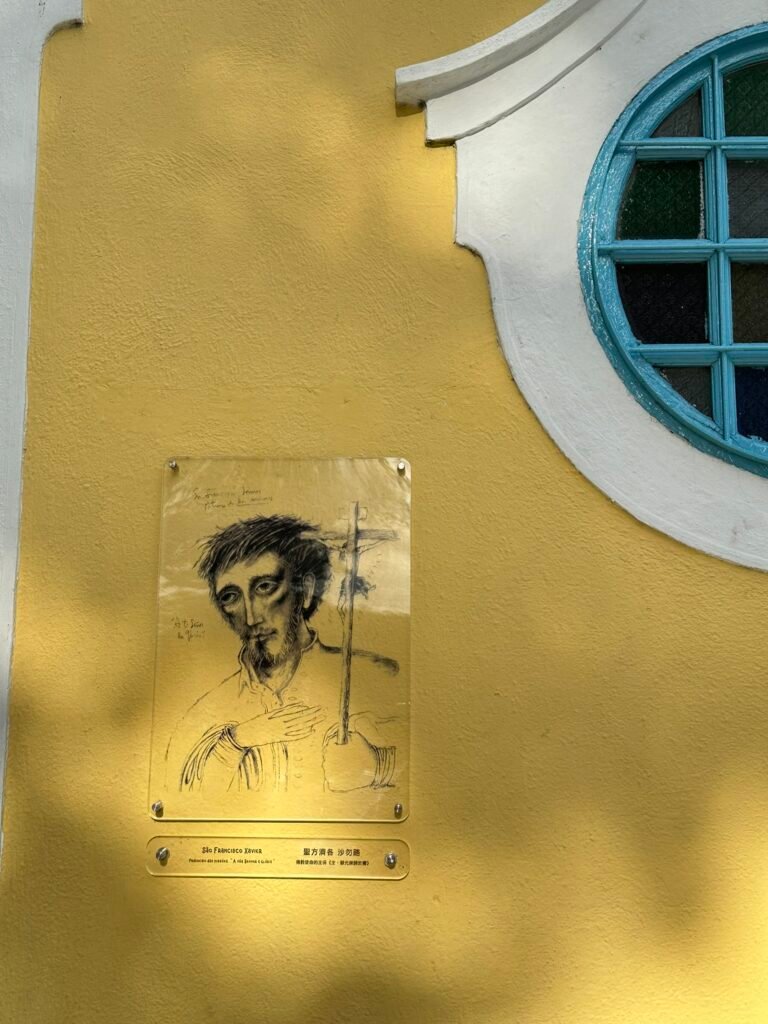
This is the Chapel of St. Francis Xavier, built in 1928.
Beautiful.
But then Dad saw this.
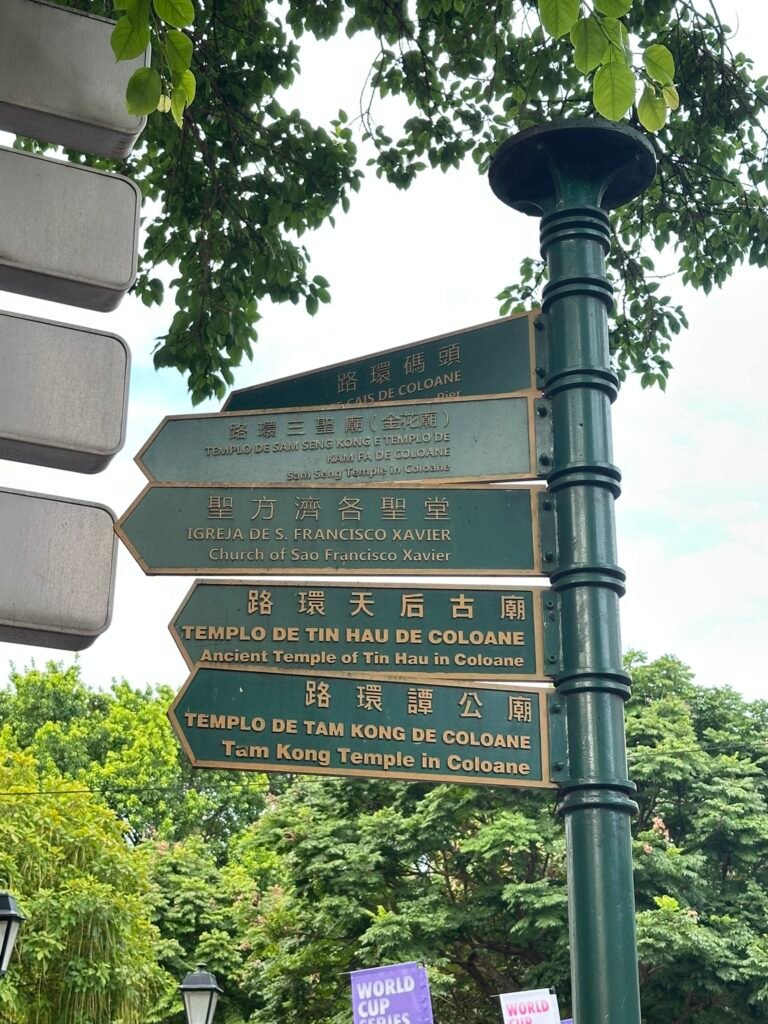
One direction:
Church of St. Francis Xavier.
Another:
Sam Seng Temple.
Another:
Ancient Temple of Tin Hau.
Another:
Tam Kong Temple.
😂
There it was again.
The Macau Cultural Kaleidoscope.
Except this time it wasn’t inside a museum.
IT WAS ON A STREET SIGN.
Coloane was once a fishing community, and some of these temples reach much further back than the church.
The Ancient Temple of Tin Hau, dedicated to the goddess long associated with seafarers, dates to around 1763.
This wasn’t simply a pretty village.
The streets were quietly telling us how people here had lived.
🚶 Then We Did the Best Thing You Can Do in Coloane
Nothing.
😂
Well…
nothing organized.
We walked
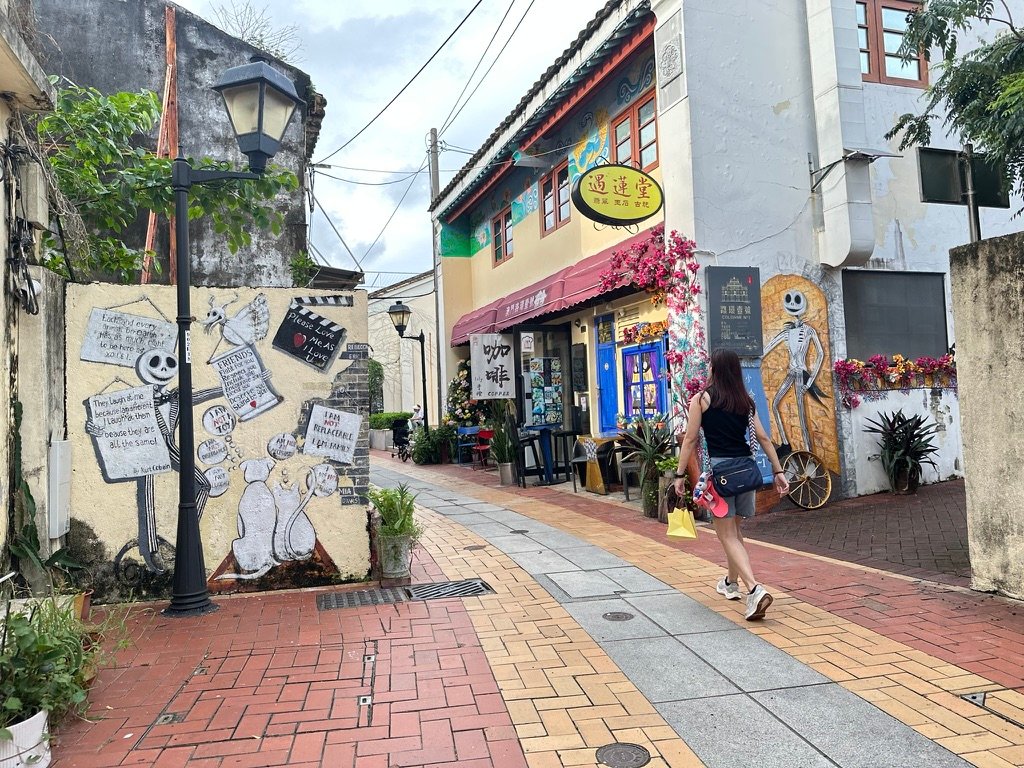
No attraction checklist.
No rushing to the next famous landmark.
Just turn into another lane.
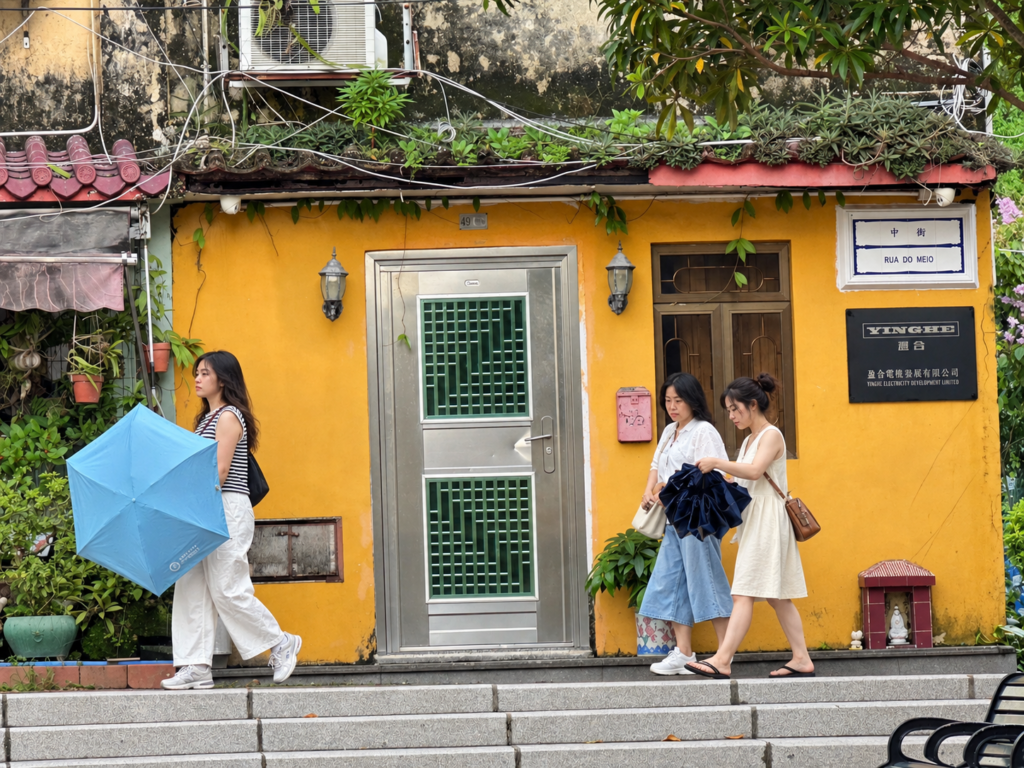
Look at the houses.
Look at the doors.
Look at the tiny Chinese shrines beside them.
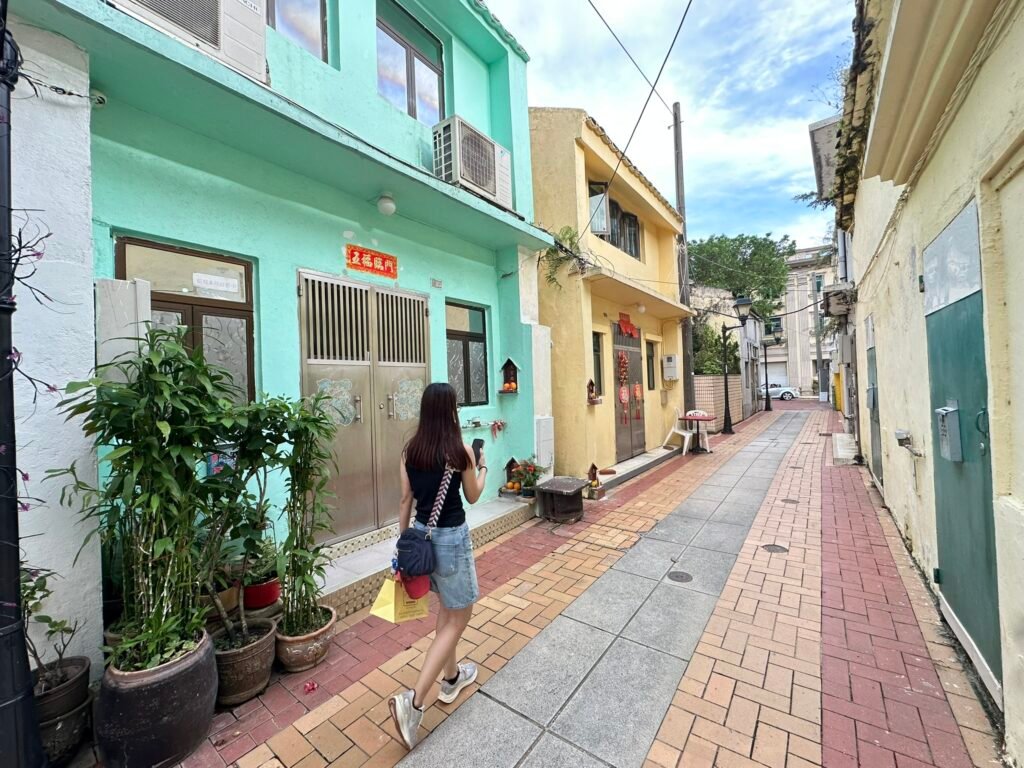
Look up.
Look down.
Get slightly distracted.
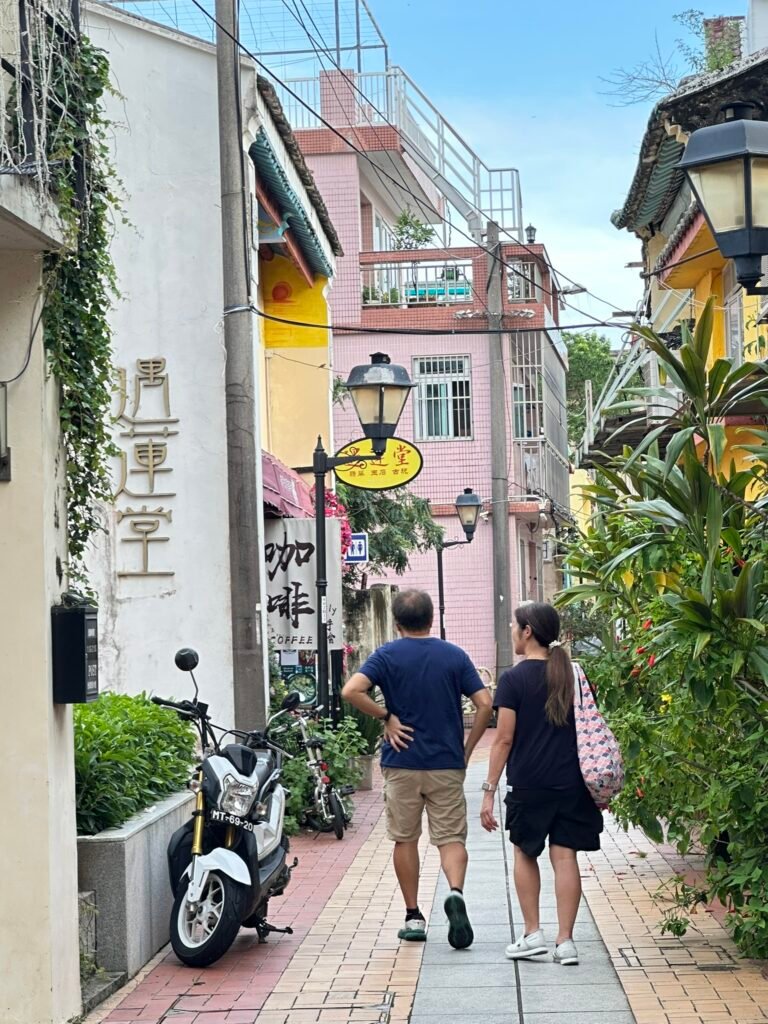
And perhaps stop for coffee.
Although Elaine already had another mission.
🥧
🥧 Because Somewhere Inside These Streets…
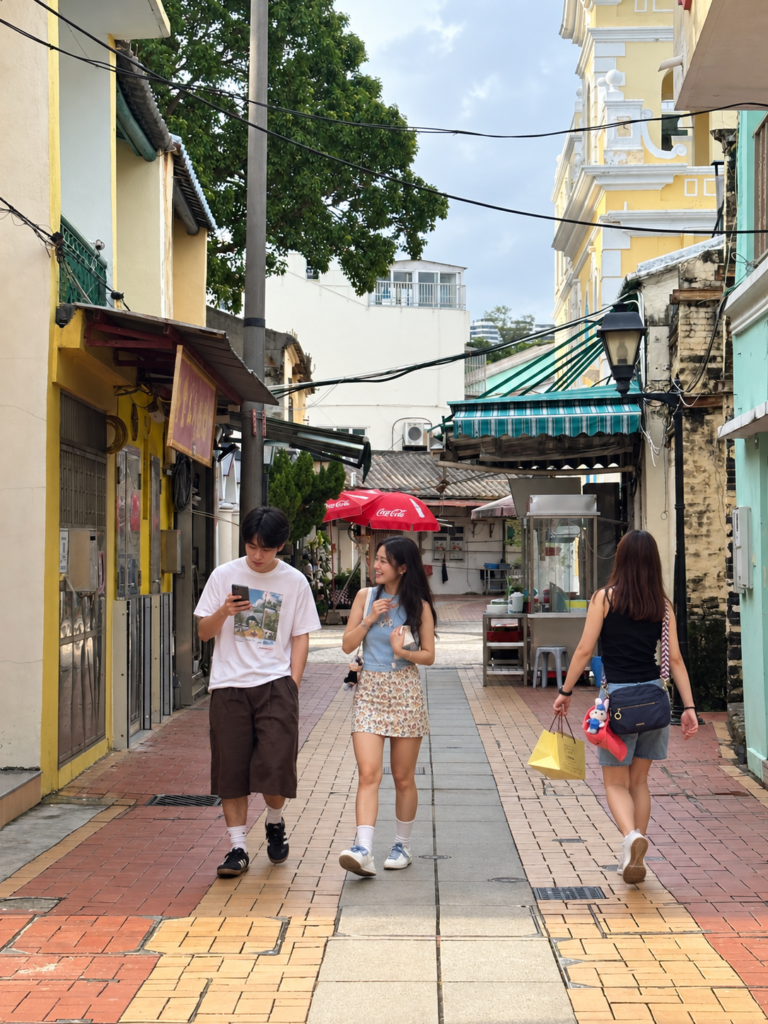
…was the reason we’d come.
The original Lord Stow’s Bakery.
Established in Coloane in 1989.
The shop that helped turn the Macau Portuguese egg tart into one of the city’s most recognizable foods.
And now Dad understood why coming all the way to Coloane had been worth it.
You could probably find an egg tart somewhere more convenient.
But then you would miss this.
The lanes.
The church.
The temples.
The old fishing-village atmosphere.
The ordinary homes.
The little cafés.
And Elaine wandering through it all carrying that increasingly important yellow bag.
😂
DON’T JUST COME TO COLOANE FOR THE EGG TART.
COME FOR COLOANE.
Then…
eat the egg tart.
🥧🔥
And finally…
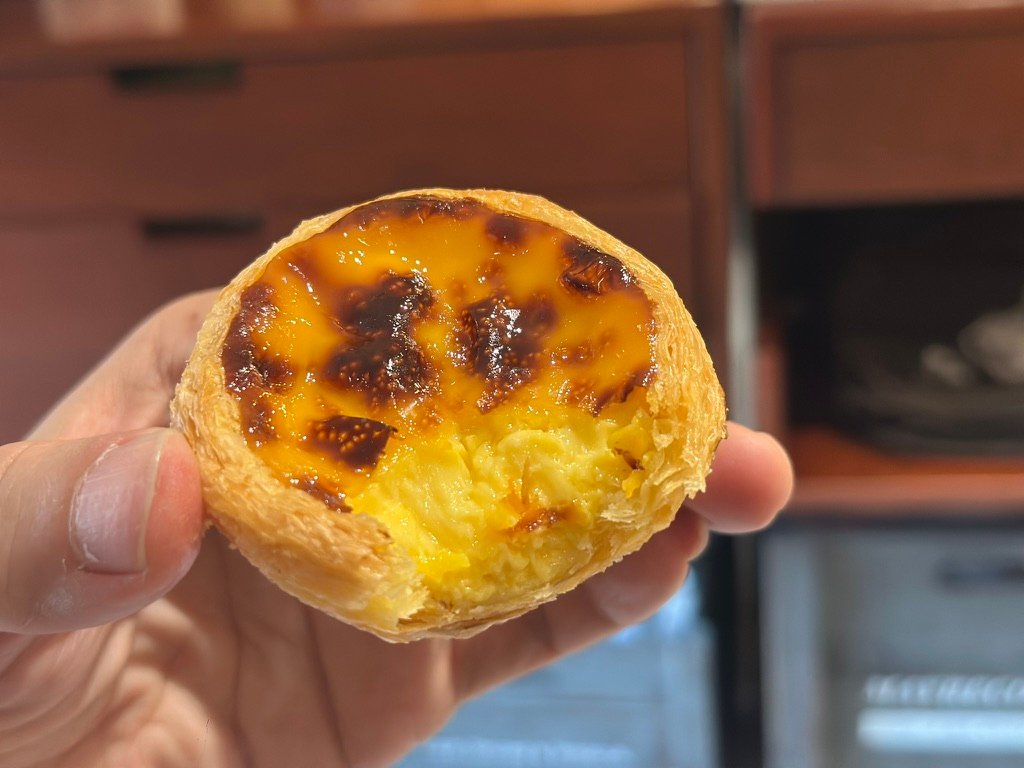
🥧 THE OVEN WAS WORTH THE WAIT.
Mission accomplished.
📱 Then Elaine Got a Tip-Off From Hong Kong…
Just when Dad thought our Coloane food mission was complete…
Elaine’s sister messaged from Hong Kong.
Apparently, there was another snack in Coloane that we had to try.
😂
So Elaine went looking for it.
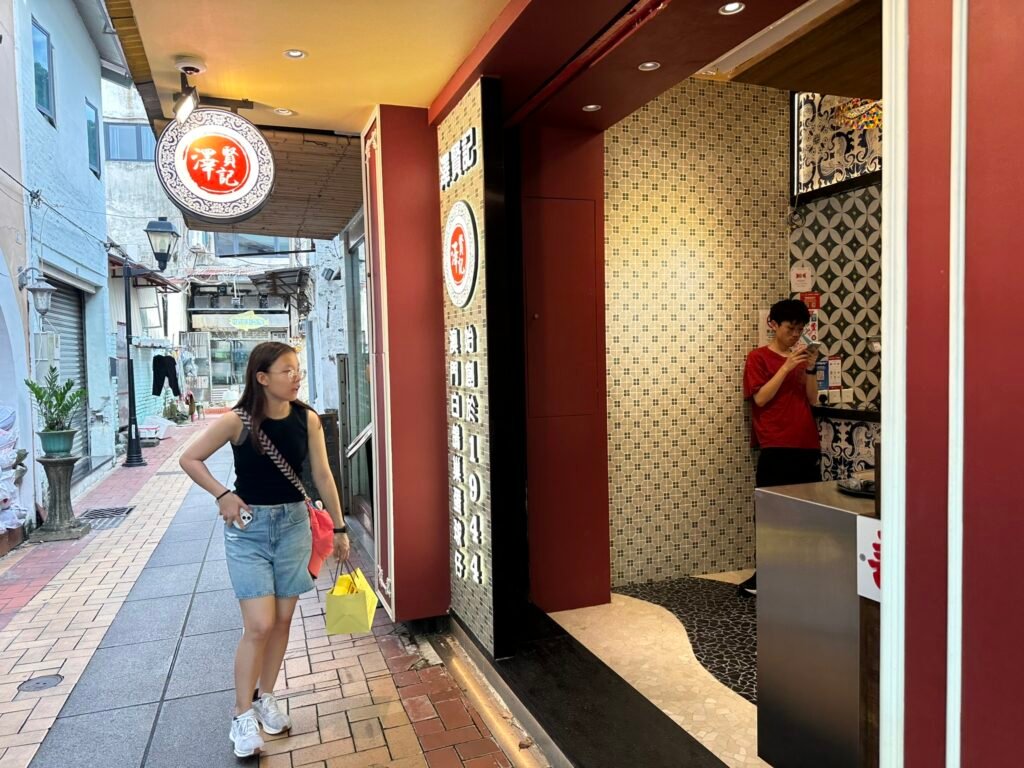
And found Chak In Kei (澤賢記) on Rua dos Negociantes (客商街).
Wait… 30 Minutes for an Egg Waffle?
Elaine placed the order.
Then came the surprise.
About 30 minutes.
Dad looked at Elaine.
Elaine looked at Dad.
😂
For an egg waffle?
Why so long?
We had time to spare, so instead of standing around waiting, we wandered a few doors along the same street.
And found this.
☕ 33. 45. Coffee?
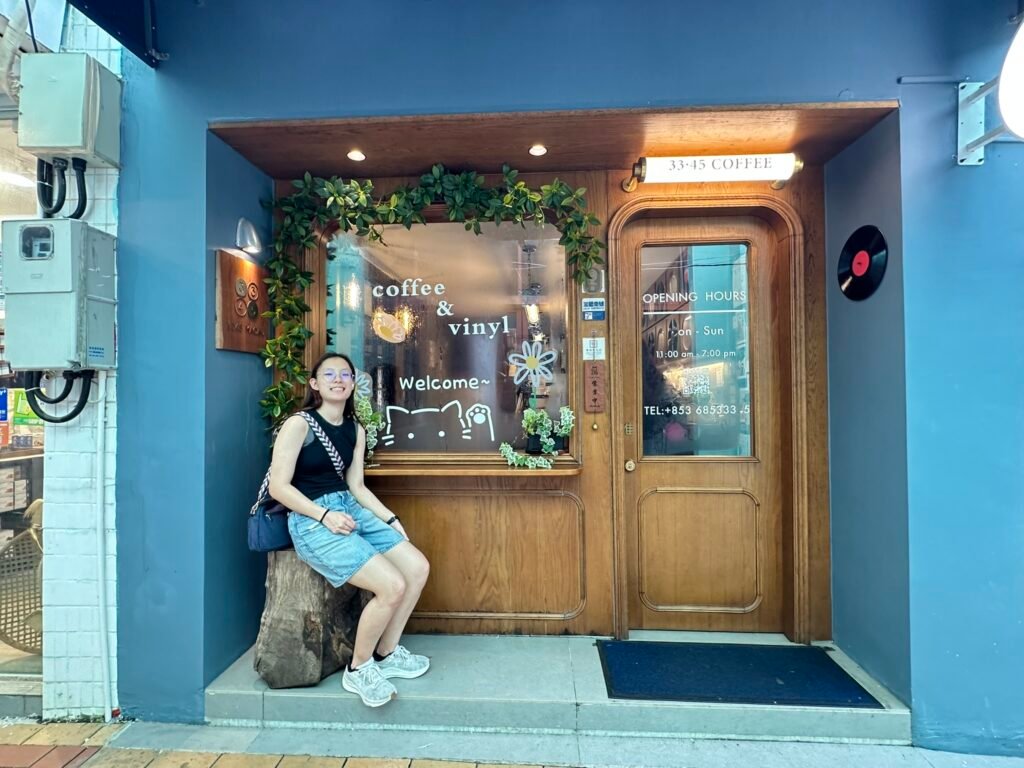
3345 Coffee & Vinyl (叁叁肆伍).
A small specialty coffee shop with another surprise inside.
They roast their own coffee beans.
So while Elaine’s mysterious snack was being prepared, Dad and Elaine sat down for a proper gourmet coffee.
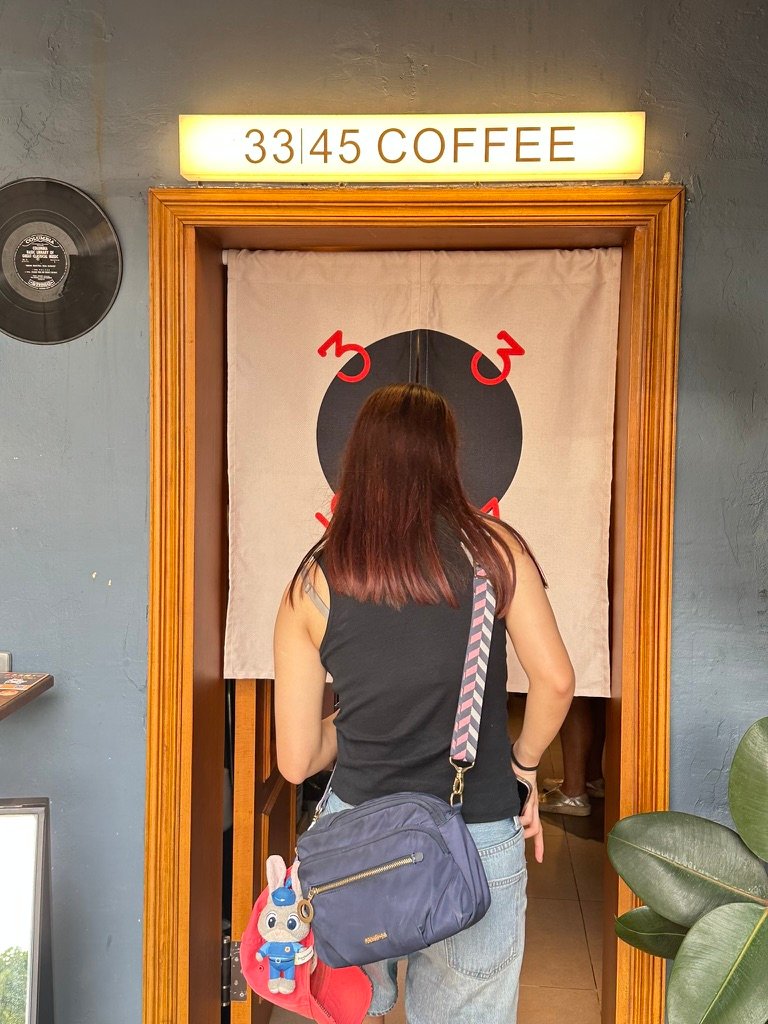
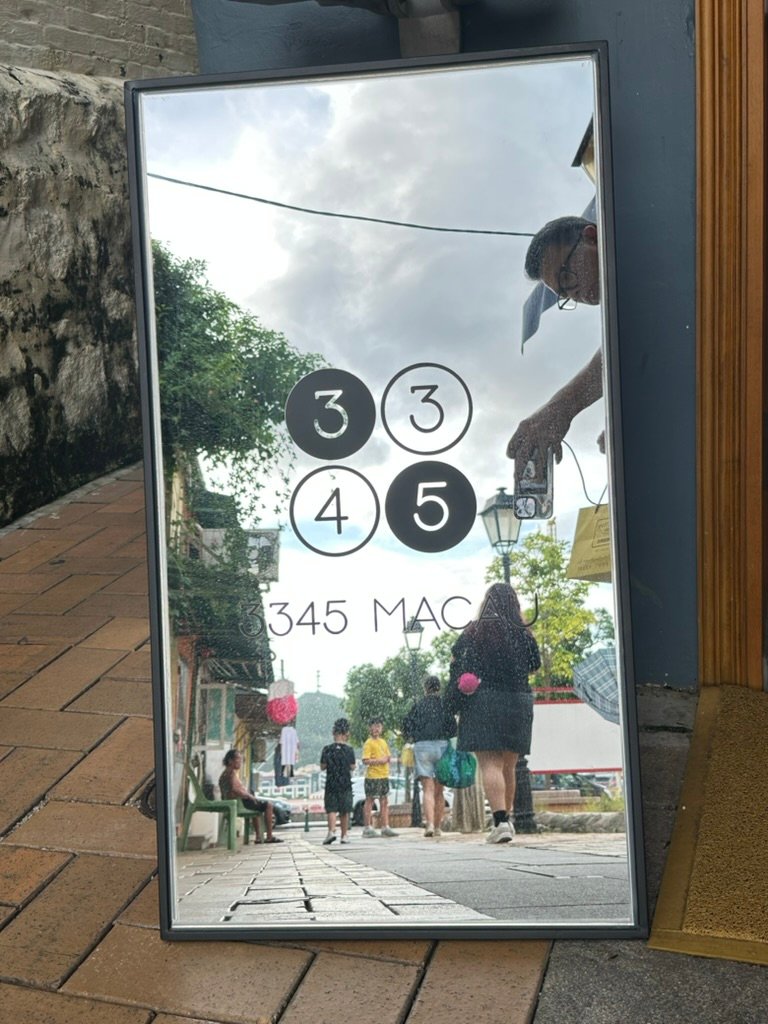
And suddenly…
the 30-minute wait didn’t feel like waiting at all.
We slowed down.
Had coffee.
Looked around.
Enjoyed the street.
No attraction to rush toward.
No box on the itinerary to tick.
Just Coloane Village.
ChinaTravelBUG Dad Tip
If you’re staying several days in Macau, consider giving half a day to Coloane.
Don’t come only to photograph a church, buy an egg tart and leave.
Walk the lanes.
Have an egg tart.
Stop for coffee.
Try something you’ve never heard of.
Sit down.
Look around.
Let the next discovery find you.
THIS IS A GOOD PLACE TO SLOW TRAVEL.
Macau can be intense — casinos, resorts, crowds, attractions and things to tick off.
Coloane can be the opposite.
Give yourself permission to waste a little time here.
It may turn out not to be wasted at all.
😂 Meanwhile… What Was Taking So Long?
Eventually Dad’s curiosity won.
Thirty minutes for an egg waffle?
Come on.
🐇
So Dad went back to Chak In Kei and peeped through the window.
And then he understood.
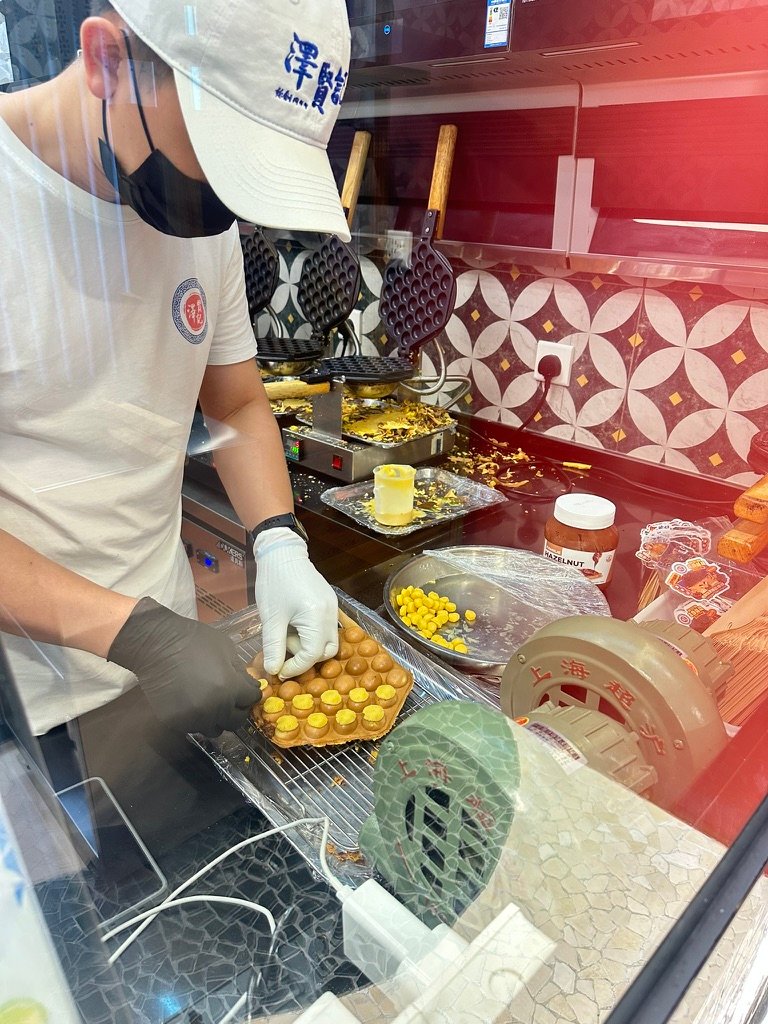
They were doing it by hand.
One…
little…
waffle bubble…
at a time.
😂😂😂
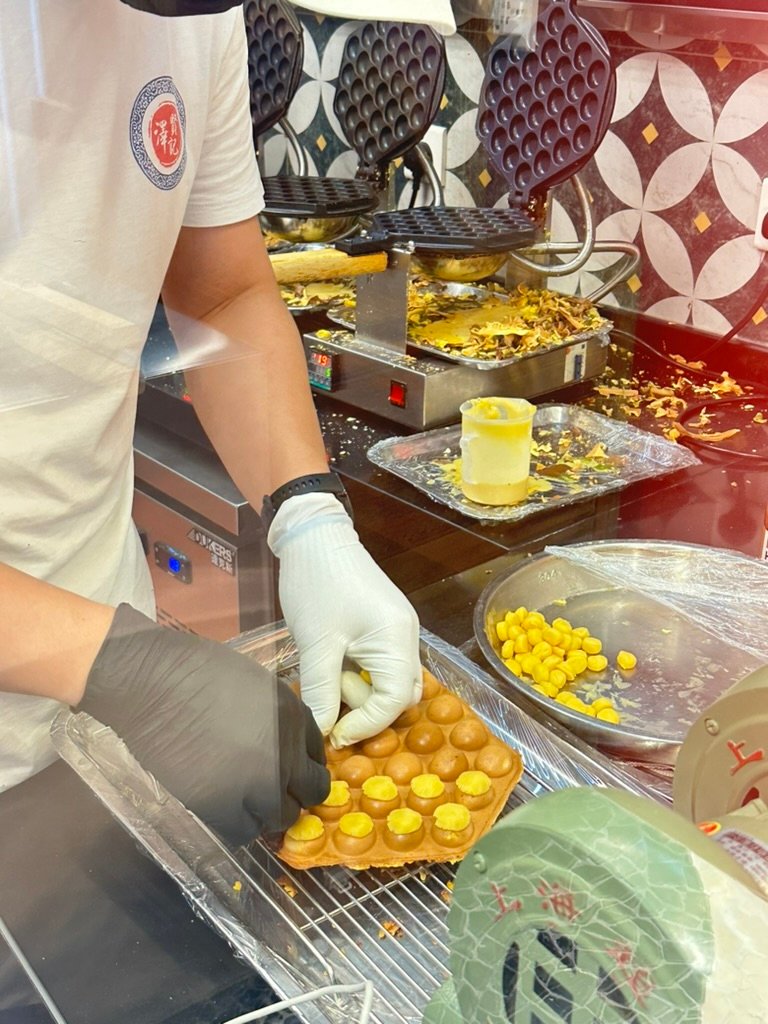
This wasn’t an ordinary egg waffle being pulled from an iron and thrown into a paper bag.
The individual bubbles were being carefully filled.
Suddenly that 30-minute wait made a lot more sense.
🍍🥧 What Exactly Did Elaine Order?
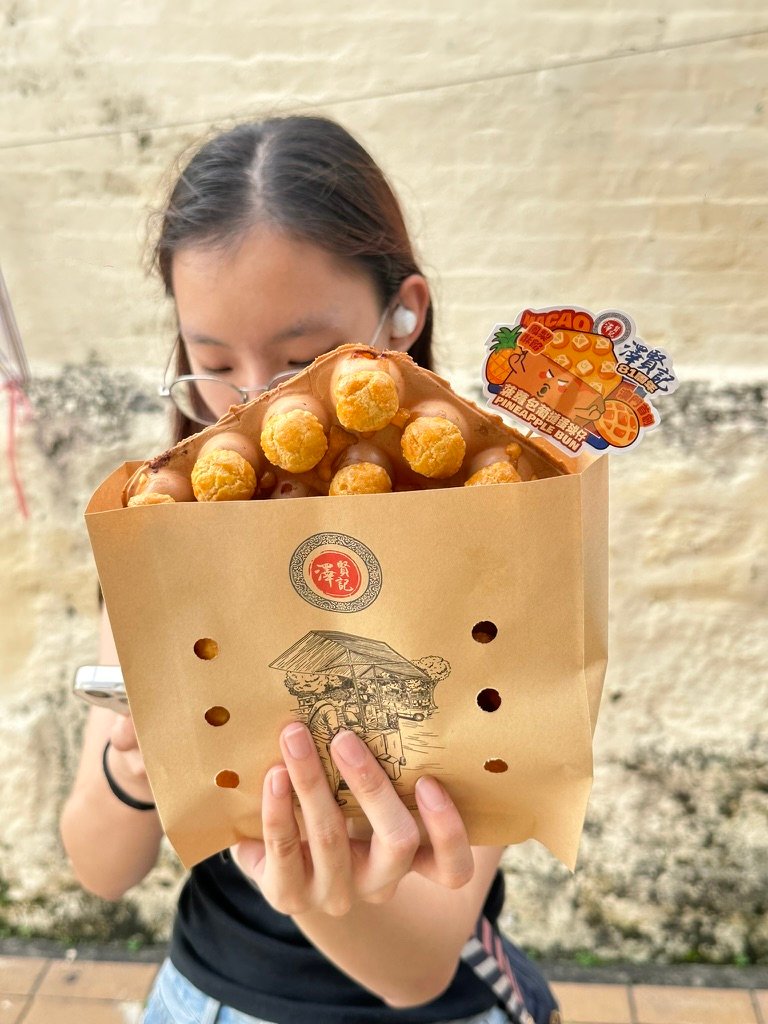
This was Chak In Kei’s wonderfully over-the-top creation:
菠蘿包葡撻雞蛋仔
Think of three food ideas colliding:
🧇 egg waffle
🍍 pineapple-bun-inspired flavor
🥧 Portuguese egg-tart filling
…in one snack.
Dad had spent the day trying to understand Macau through churches, temples, streets and history.
Apparently Elaine had found another method.
EAT MACAU. 😂
And somehow this ridiculous little snack fitted the city perfectly.
Chinese food culture.
Portuguese influence.
Local reinvention.
Something familiar becoming something else.
Dad’s Macau Cultural Kaleidoscope had become edible.
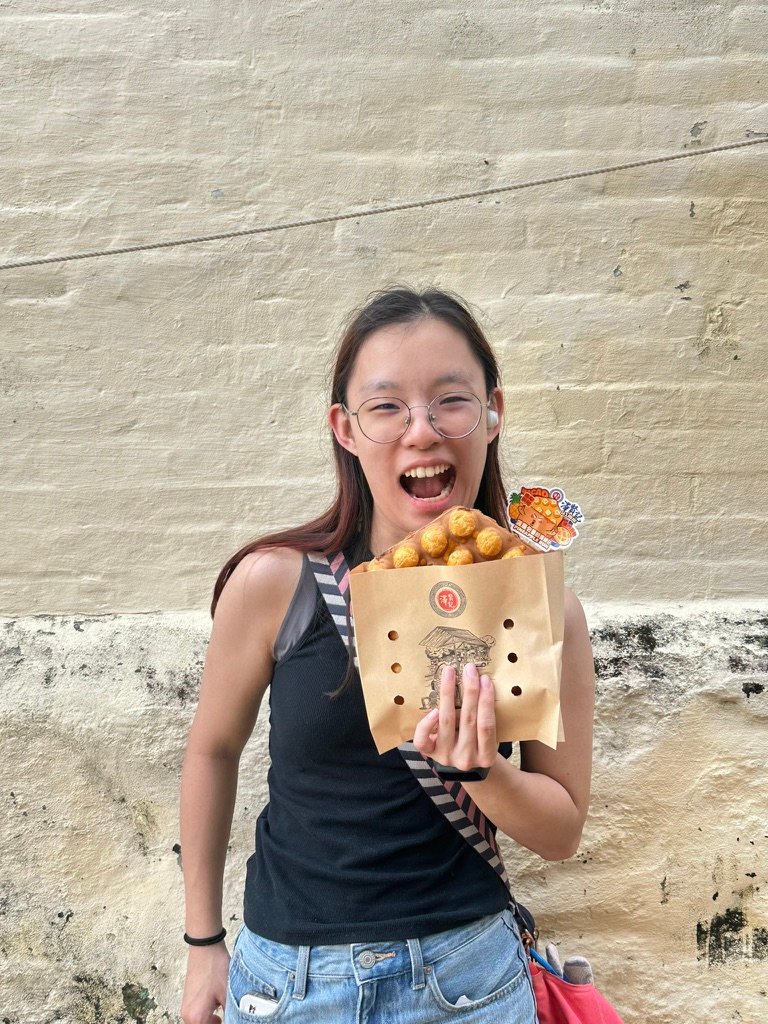
And Elaine?
Her face supplied the review.
😂😂😂
SISTER’S TIP-OFF: SUCCESS.
The Coloane Lesson Dad Didn’t Expect
We originally came to Coloane because there were famous things we wanted to find.
But the longer we stayed, the less the individual attractions seemed to matter.
A church led to a lane.
A lane led to a snack.
A 30-minute wait led to freshly roasted coffee.
Coffee gave us time to stop walking.
And stopping gave us time to notice Coloane itself.
That may be the better reason to come.
Don’t just visit Coloane.
Give Coloane some time.
If Macau is only a day trip, you may have to keep moving.
But if you’re staying in Macau for several days?
Dad would happily spend half a day here simply unwinding.
Walk.
Eat.
Drink coffee.
Explore a lane because it looks interesting.
Sit somewhere because you feel like sitting.
And don’t worry if you’re not accomplishing very much.
😂
SOMETIMES SLOW TRAVEL IS THE ATTRACTION.
🔥 STOP 7 — WAIT. What About the Wok?
Mission accomplished.
The Oven had delivered.
🥧
Dad could have stopped there.
Elaine could have stopped there.
A sensible traveler probably would have stopped there.
😂
But there was one unfinished piece of business.
Remember this?
🔥 THE WOK WAS HEATING.
Way back near St. Paul’s, we’d spotted another Macau classic:
豬扒包 — pork chop bun.
And Dad had made the mistake of mentioning it.
So…
we went looking early dinner.
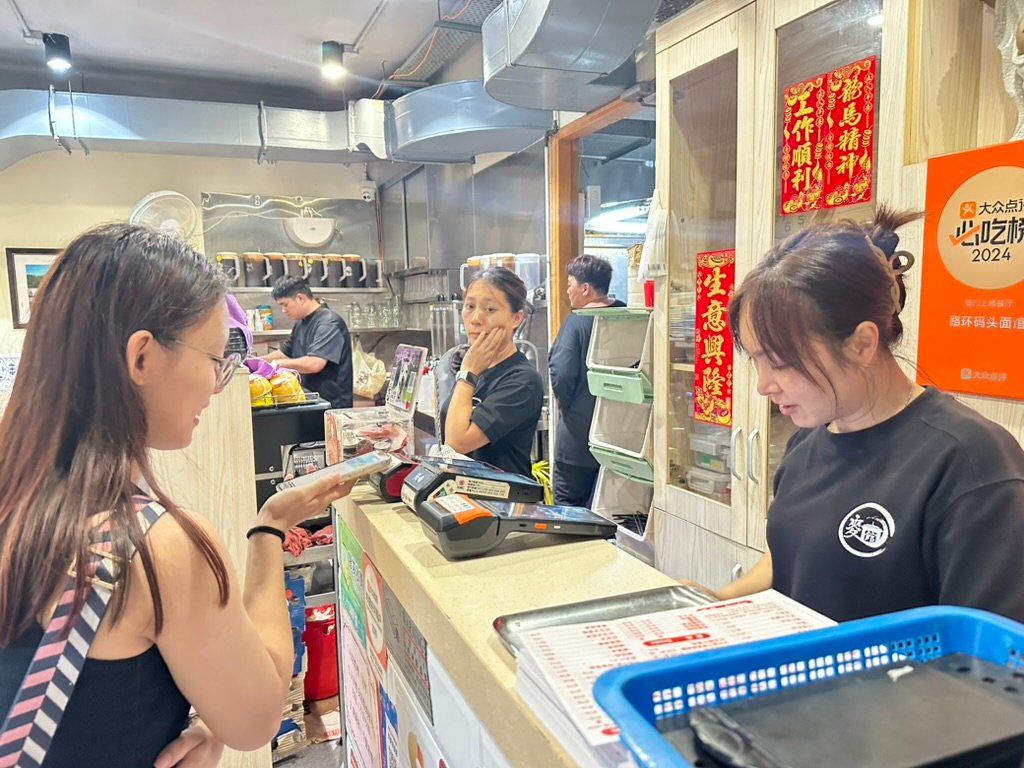
We ended up at 路環碼頭麵館, a local noodle shop in Coloane.
No grand resort restaurant.
No fake Rome.
No museum.
Just a busy little neighborhood restaurant.
Perfect.
😂 And There It Was
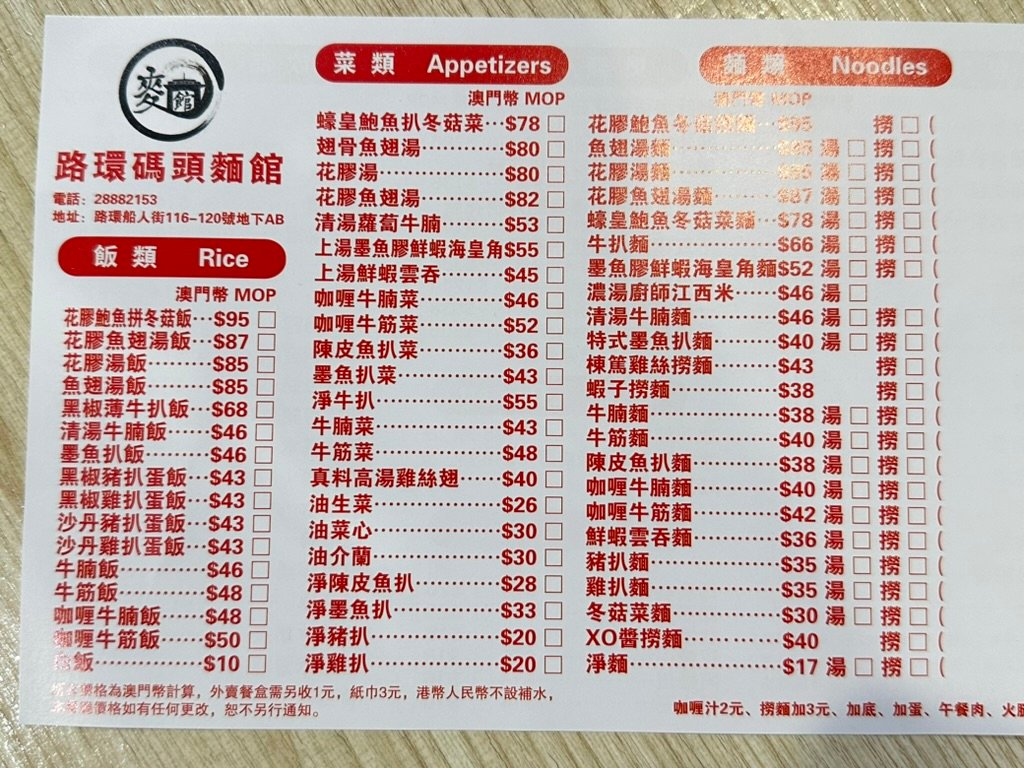
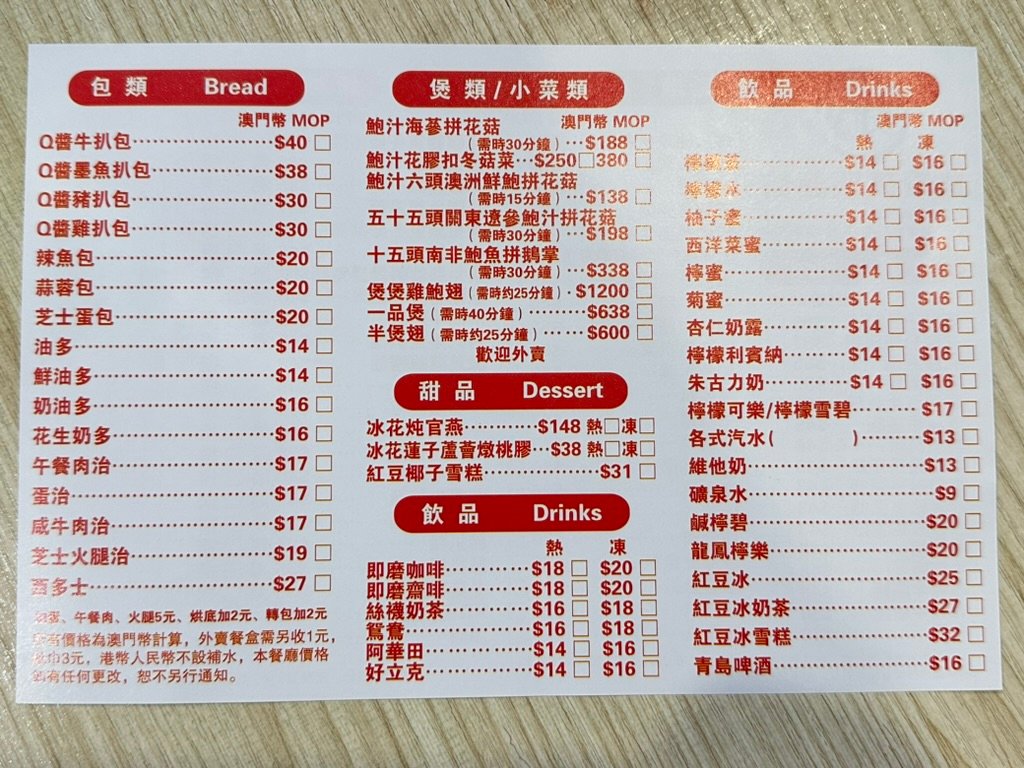
Dad looked at the menu.
Noodles.
Rice.
Fish balls.
Beef brisket.
Abalone dishes.
Coffee.
Milk tea.
And then…
醬豬扒包 — MOP 30.
😂🔥
THE WOK HAD FINALLY ARRIVED.
Macau pork chop bun.
Another famous Macau food hiding inside an ordinary-looking local menu.
And look at the table.
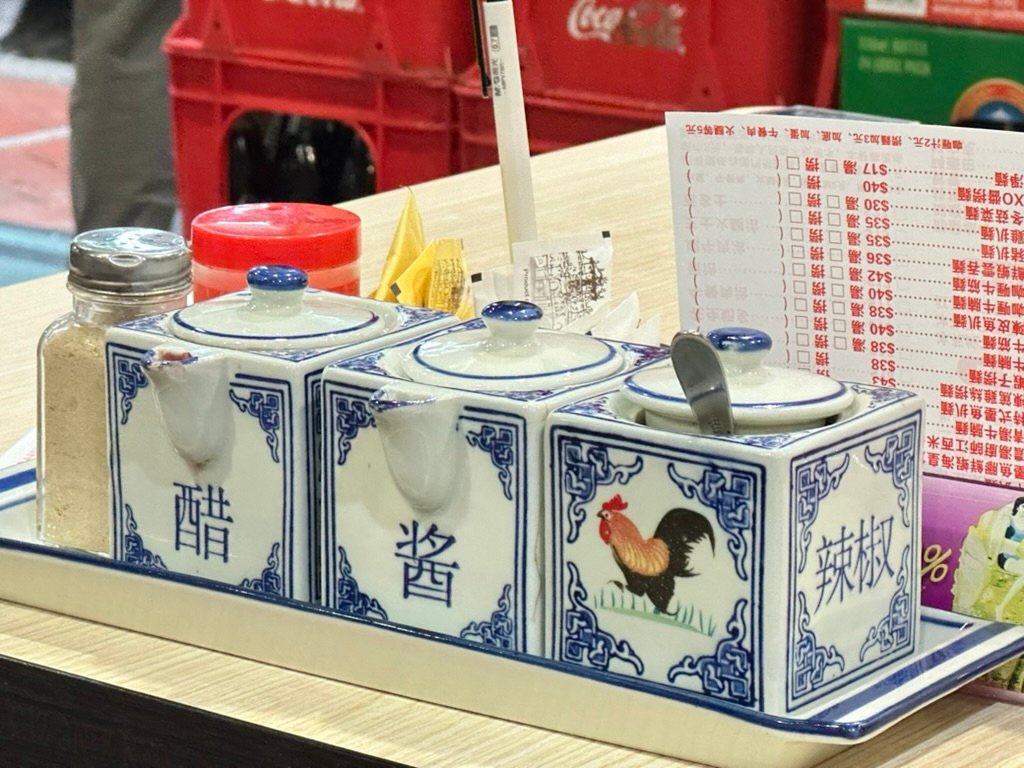
醋 — vinegar.
醬 — sauce.
辣椒 — chili.
No elaborate food styling required.
We had gone from Portuguese-inspired egg tarts…
straight back into a very Chinese-looking neighborhood noodle shop.
🥧 → 🍜
Dad’s Macau Cultural Kaleidoscope had turned again.
Dad’s Coloane Lesson
This was why Dad was now very glad we hadn’t treated Coloane as:
“Go to Lord Stow’s. Buy egg tart. Leave.”
That would have missed the point.
Walk the lanes.
See the church.
Notice the temples.
Look at the houses.
Buy the egg tarts.
Then find somewhere local to eat.
Because by now Dad had learned something about Macau:
THE FOOD IS PART OF THE KALEIDOSCOPE TOO.
Portuguese inspiration.
Chinese cooking.
Macau inventions.
Neighborhood noodle shops.
🥧 The Oven.
🔥 The Wok.
Two running missions.
BOTH ACCOMPLISHED.
🇫🇷🇬🇧🇮🇹 FINAL STOP — Wait… How Many Countries Did Elaine Visit Today? 😂
After St. Paul’s.
After Senado Square.
After A-Ma Temple.
After the old streets.
After pork chop buns, egg tarts, pineapple buns and a slow coffee break in Coloane…
Dad thought Macau had probably finished surprising us.
😂
Macau had other ideas.
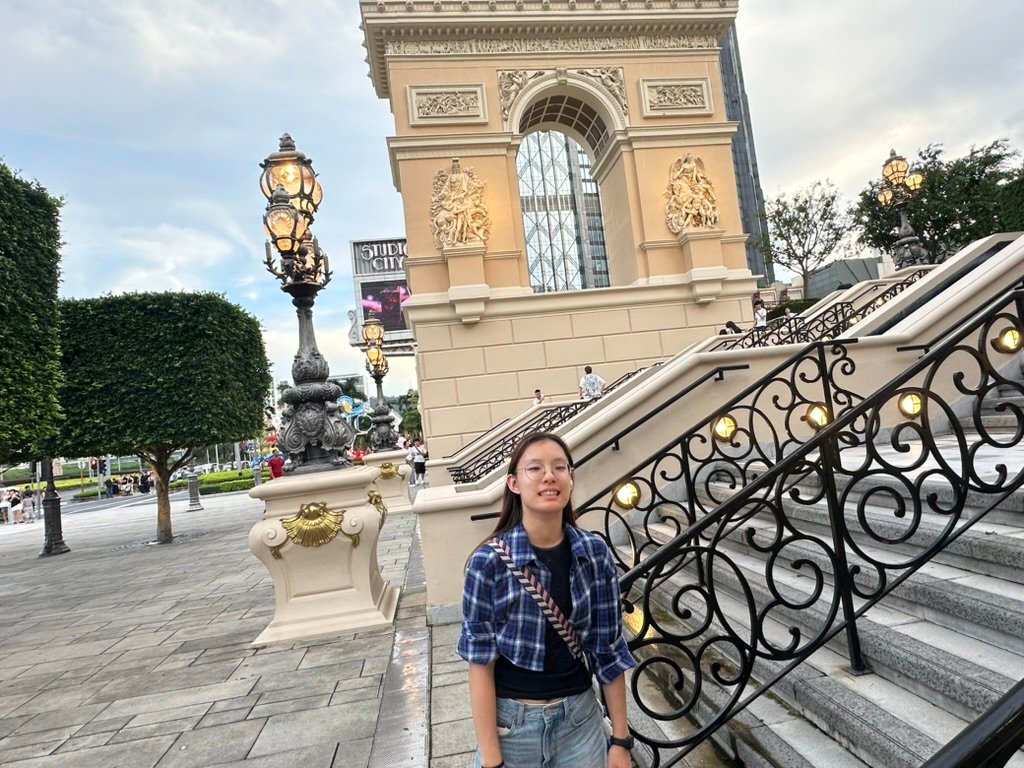
For much of the day, we had been exploring places where Macau’s history was real.
Churches.
Temples.
Chinese shops.
Portuguese street names.
Old neighborhoods.
Buildings carrying centuries of stories.
Then we reached Cotai.
And suddenly…
BONJOUR. 😂
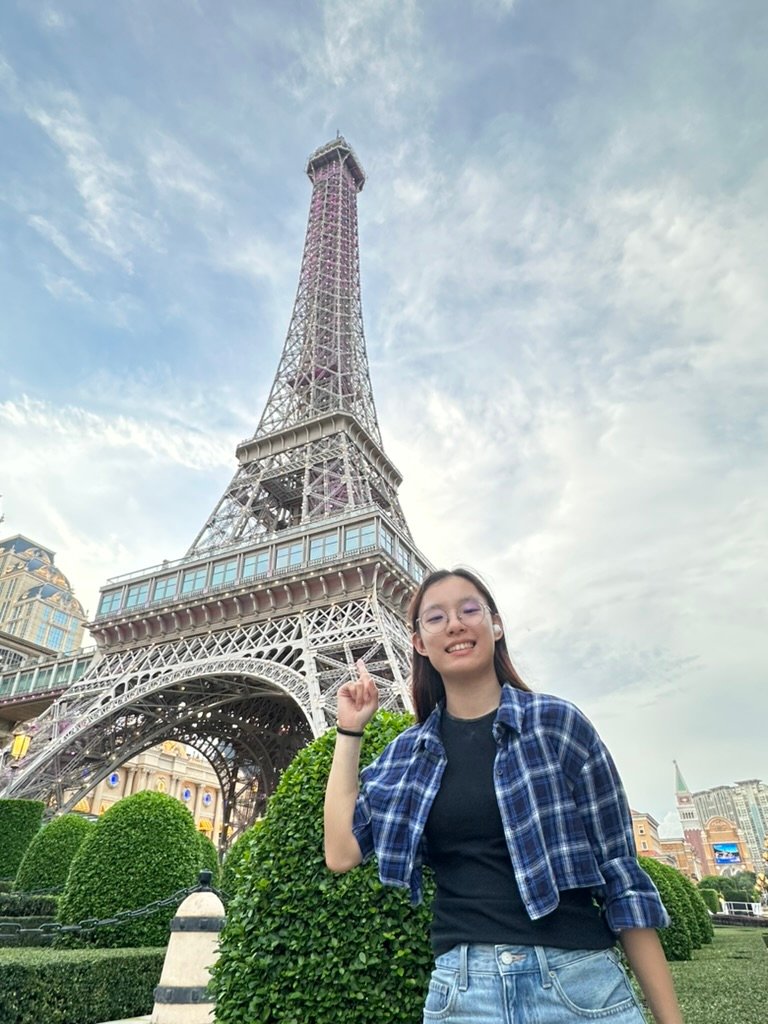
Elaine had apparently arrived in Paris.
Except we hadn’t left Macau.
Behind her rose the Eiffel Tower of The Parisian Macao (澳門巴黎人).
This wasn’t another piece of historic Portuguese Macau.
It wasn’t a centuries-old European monument.
It was something completely different:
MACAU CREATING A WORLD OF ITS OWN.
😂 Then London Appeared
We kept walking.
And another familiar landmark appeared.
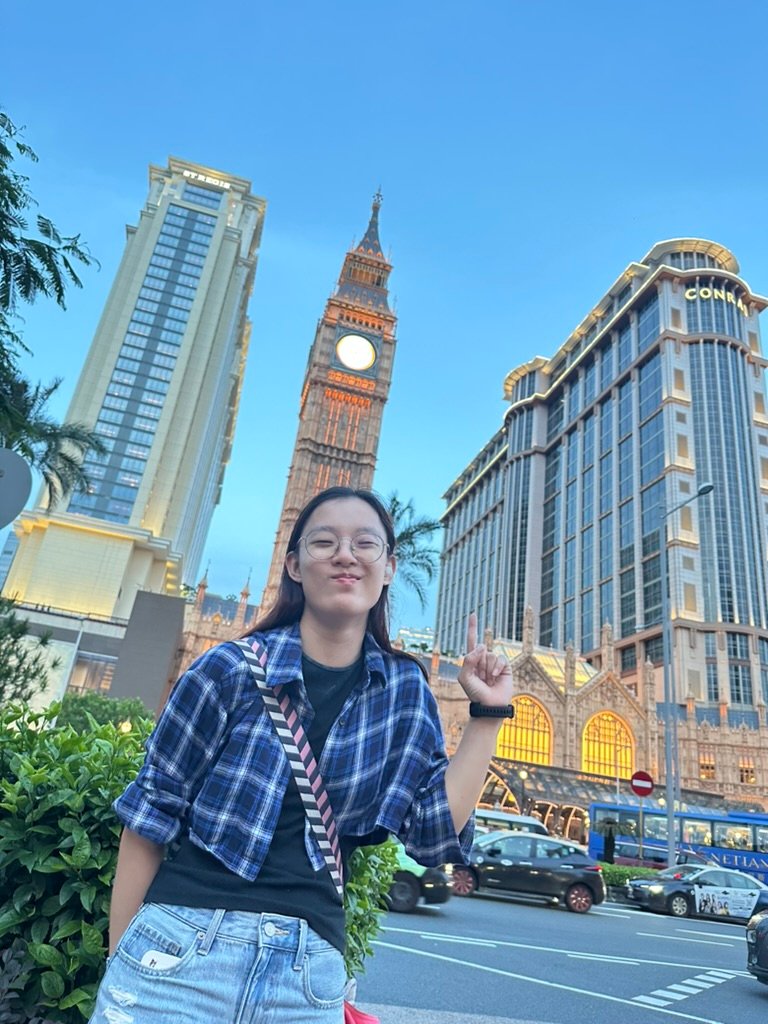
Big Ben?
London?
Nope.
Still Macau. 😂
This was The Londoner Macao (澳門倫敦人).
By this point Dad’s Macau Cultural Kaleidoscope was spinning rather quickly.
Earlier:
🛕 Chinese temple.
⛪ Catholic church.
🇵🇹 Portuguese street names.
🥖 Pork chop bun.
🥧 Portuguese egg tart.
☕ Slow coffee in Coloane.
Now:
🇫🇷 Paris.
🇬🇧 London.
And we weren’t finished.
🇮🇹 Venice Was Apparently Next
Then Dad saw this.
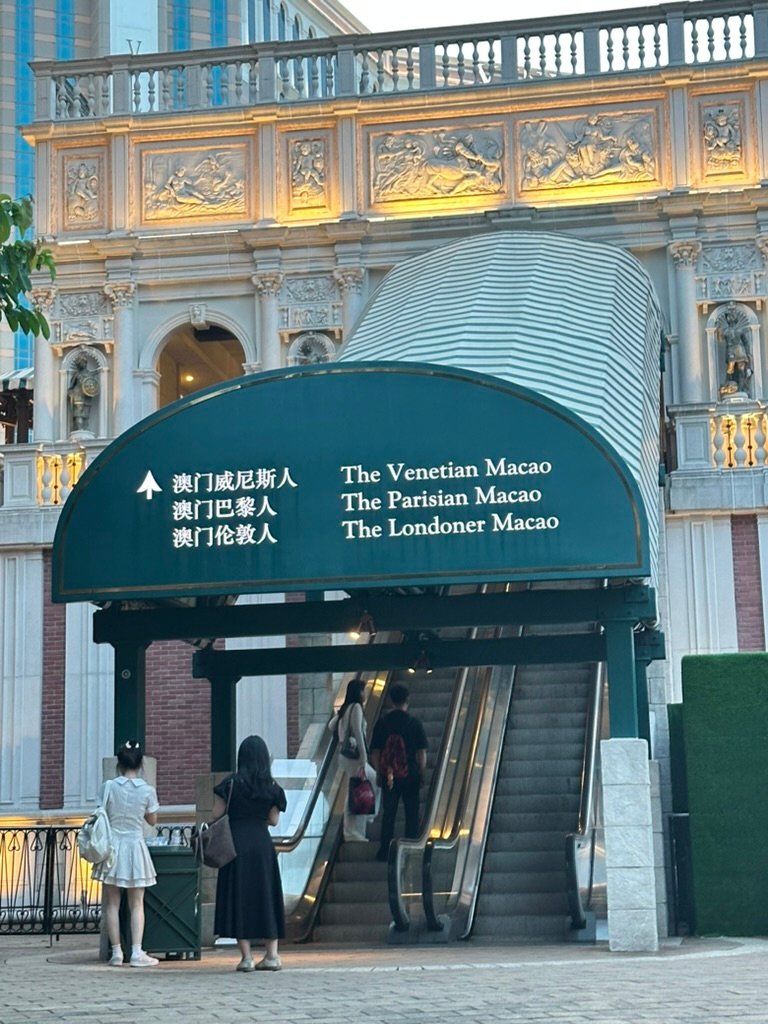
The sign almost summarized Cotai better than Dad could:
The Venetian Macao (澳門威尼斯人)
The Parisian Macao (澳門巴黎人)
The Londoner Macao (澳門倫敦人)
😂😂😂
WELCOME TO COTAI.
Here was another Macau.
Not the Macau of ancient temples.
Not the Macau of Jesuits and Portuguese merchants.
Not the Macau of little neighborhood restaurants and hand-filled snacks.
This was modern resort Macau — enormous integrated resorts creating elaborate fantasy environments inspired by some of the world’s most recognizable cities.
And whether or not casinos are your thing, Cotai is worth understanding because it represents another part of what Macau has become.
Dad’s Important Distinction
This is why Dad is glad we explored Macau in the order we did.
If your first experience of Macau is only Cotai, you might come away thinking:
Macau = casinos + giant resorts + replicas of Europe.
But spend time in the Historic Centre.
Walk the streets around St. Paul’s.
Stand inside A-Ma Temple.
Look at the Chinese and Portuguese words sharing the same signs.
Eat in an ordinary neighborhood restaurant.
Slow down in Coloane.
Then come to Cotai.
Suddenly the giant Eiffel Tower means something different.
It isn’t Macau’s history.
It is another layer of Macau today.
And that difference matters.
🔄 One Day. Many Macaus.
Dad had arrived that morning with a very simple question:
WHAT EXACTLY IS MACAU?
By evening, the question hadn’t produced one neat answer.
It had produced a kaleidoscope.
Turn it one way:
🛕 Chinese maritime history.
Turn it again:
⛪ Portuguese and Catholic heritage.
Again:
🏘️ Old Chinese neighborhoods and everyday local life.
Again:
🥖 Pork chop buns.
🥧 Portuguese egg tarts.
Again:
🌊 Coloane and slow travel.
And then…
🇫🇷 Paris.
🇬🇧 London.
🇮🇹 Venice.
😂
Perhaps that was the answer.
MACAU ISN’T ONE THING.
You don’t really understand it by ticking off one famous landmark.
You begin to understand it by noticing how all these layers somehow occupy the same tiny place.
SEE → ASK → CONNECT → UNDERSTAND → FOLLOW.
That was exactly what Macau had made us do.
🚌 BUT DAD STILL HAD ONE MORE THING ON HIS MACAU LIST…
Our day wasn’t quite finished.
It was time to head back to Hong Kong (香港).
But Dad had deliberately planned something different for the return journey.
We had arrived in Macau by ferry.
We were going back by bus.
Why?
Because Dad wanted to cross something he had been looking forward to seeing for himself:
🌉 THE HONG KONG–ZHUHAI–MACAO BRIDGE.
The Hong Kong–Zhuhai–Macao Bridge (港珠澳大橋).
A physical transport link connecting Hong Kong (香港), Zhuhai (珠海) and Macau (澳門) across the Pearl River estuary — and one of the major pieces of transport infrastructure tying together the wider Guangdong–Hong Kong–Macao Greater Bay Area (粵港澳大灣區).
For most travelers heading back to Hong Kong, it might simply be transportation.
For Dad?
😂
ONE LAST RABBIT HOLE.
And this time…
the rabbit hole was 55 kilometers long.
🌉 THE BRIDGE STORY ACTUALLY STARTED BEFORE WE REACHED THE BRIDGE
Dad already had cousins living in Hong Kong (香港).
While we were there, we were making plans to meet.
Then one of Dad’s cousins mentioned something rather casually.
Their daughter had a school graduation ceremony one evening.
Would Dad and Elaine like to come?
Sure.
Where?
MACAU. 😳
Dad’s brain stopped for a moment.
Macau (澳門)?
As in…
another Special Administrative Region?
Across the Pearl River Estuary?
The Macau we were planning an entire day excursion to?
Dad’s cousin didn’t seem particularly concerned.
The journey was basically:
Hong Kong → bridge → Macau.
Around an hour-plus, depending on the starting point, transport and border procedures.
😂
DAD’S CPU STARTED WORKING OVERTIME.
🧠 Wait… A Hong Kong School Graduation in Macau?
This was the moment something clicked.
Dad had been thinking like a traveler.
Hong Kong = one destination.
Macau = another destination.
You take a ferry between them.
You cross immigration.
You plan a Macau day trip.
They feel like separate places.
Dad’s cousin was thinking differently.
There was an event in Macau.
So…
go to Macau.
That casual attitude was perhaps more revealing than any economic statistic Dad could have read.
Because infrastructure doesn’t only change maps.
INFRASTRUCTURE CHANGES WHAT PEOPLE CONSIDER “NEARBY.”
🌉 Then Dad Finally Saw the Bridge
Later, after our Macau adventure, Dad and Elaine were heading back to Hong Kong.
This time we didn’t take the ferry.
Dad specifically wanted the bus.
Because he wanted to cross the Hong Kong–Zhuhai–Macao Bridge (港珠澳大橋) himself.
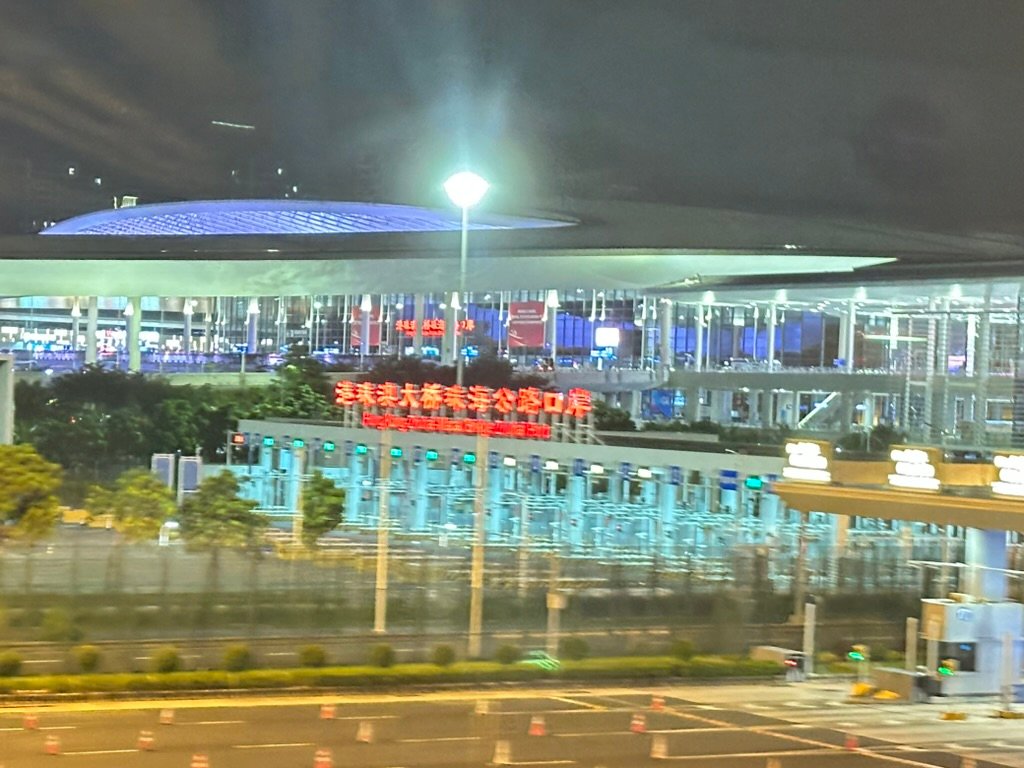
The bridge opened to traffic in October 2018.
At approximately 55 kilometers for the entire bridge-and-tunnel system, it is the world’s longest bridge-cum-tunnel sea crossing.
But those weren’t the numbers Dad was thinking about.
He was thinking about his cousin.
“THE GRADUATION IS IN MACAU.”
😂
Suddenly the bridge wasn’t an engineering statistic anymore.
It was personal.
⏱️ What Changed?
Before the bridge, Hong Kong and Macau were already connected.
People flew.
People took ferries.
And there were longer land routes around the Pearl River Delta.
So the bridge did not suddenly connect two places that had previously been isolated.
What changed was something subtler — and economically very important.
IT CREATED A DIRECT ROAD CONNECTION.
The official bridge information puts the journey between the Hong Kong Port and the Macau/Zhuhai ports at roughly 40 minutes.
For travelers going between city locations, the total journey is naturally longer because you still need to reach the ports, complete border formalities and continue to your final destination.
Macau’s tourism authorities give roughly 1 hour 45 minutes as an example for a direct coach journey between Hong Kong city center and Macau.
And suddenly Dad understood his cousin’s “hour-plus.”
Macau wasn’t becoming part of Hong Kong.
The border hadn’t disappeared.
The different systems hadn’t disappeared.
THE FRICTION OF DISTANCE HAD CHANGED.
🐇 DAD’S POLITICAL SCIENCE RABBIT HOLE
This is where Dad’s old Political Science brain woke up.
Because one of the most interesting effects of infrastructure isn’t necessarily what governments build.
It is what people begin doing after governments build it.
A Hong Kong family attending an evening event in Macau.
A tourist sleeping in Hong Kong and visiting Macau.
A businessperson crossing the estuary for meetings.
Goods moving toward an airport or container terminal.
Workers, customers, tourists, businesses and capital moving through a region differently.
The bridge doesn’t erase borders.
It changes the cost — in time and inconvenience — of crossing space.
And once that happens repeatedly…
economic geography can begin to change.
💡 THE REAL PRODUCT OF THE BRIDGE ISN’T CONCRETE
Dad looked out of the bus window.
Concrete.
Steel.
Artificial islands.
An undersea tunnel.
Extraordinary engineering.
But economically, perhaps the most valuable thing the bridge produces is invisible.
TIME.
Consider one official example.
Before the bridge, the road journey between Zhuhai (珠海) and Hong Kong International Airport (香港國際機場) was estimated at around four hours.
With the bridge:
ABOUT 45 MINUTES.
For Zhuhai to Hong Kong’s Kwai Tsing Container Terminal, the estimate fell from roughly 3.5 hours to about 75 minutes.
That changes calculations.
Not just Dad’s CPU calculations. 😂
Business calculations.
Logistics calculations.
Tourism calculations.
Family calculations.
“Is that too far?”
can gradually become:
“Why don’t we just go?”
🌏 NOW THE GREATER BAY AREA MADE MORE SENSE
And this is where an international traveler can begin understanding something much bigger than the bridge.
The Guangdong–Hong Kong–Macao Greater Bay Area (粵港澳大灣區) — the GBA — brings together Hong Kong, Macau and nine Guangdong cities.
But putting eleven places inside an economic-development plan doesn’t automatically make them one integrated economic region.
They still have different strengths.
Different institutions.
Different borders and administrative arrangements.
Hong Kong is not Shenzhen.
Macau is not Zhuhai.
Guangzhou is not Hong Kong.
And that’s precisely what makes the idea interesting.
The challenge isn’t simply:
MAKE THEM THE SAME.
It is:
MAKE THEM EASIER TO CONNECT.
🌉 A BRIDGE CAN CHANGE THE MENTAL MAP
That evening invitation from Dad’s cousin suddenly seemed much more important.
Before this trip, Dad’s mental map looked something like:
Hong Kong
⬇️
travel to another destination
⬇️
Macau
But for people actually living in this increasingly connected region, the mental map can start looking different:
Hong Kong ↔ Macau ↔ Zhuhai ↔ Shenzhen ↔ Guangzhou…
Not borderless.
Not one city.
Not one legal or administrative system.
But increasingly connected.
And that is a crucial distinction.
ECONOMIC INTEGRATION DOESN’T REQUIRE PLACES TO BECOME IDENTICAL.
It requires the movement between them to become easier enough that people and businesses begin behaving differently.
Dad’s cousin had already demonstrated that without giving Dad a single economics lecture.
😂
More on China’s Greater Bay Area (GBA), Read Dad’s article below:
DEEP China: What Exactly Is China’s Greater Bay Area — And Why Does It Matter?
🚌 AND NOW DAD AND ELAINE WERE DOING IT TOO
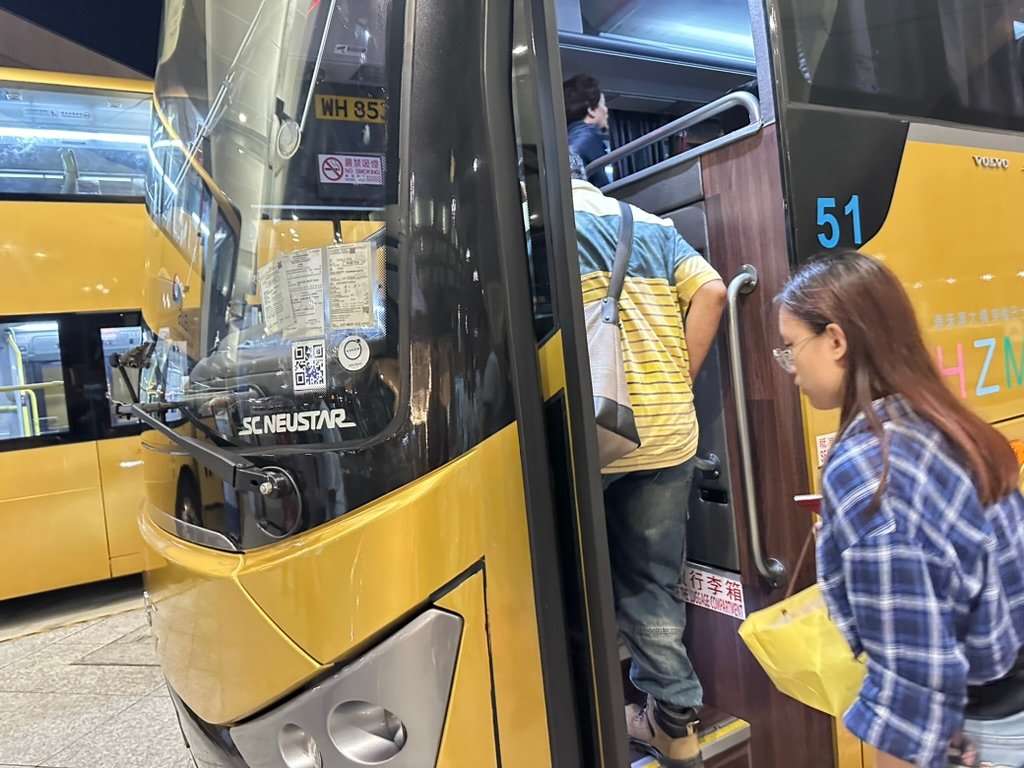
That morning:
Hong Kong → Macau by ferry.
That evening:
Macau → Hong Kong by road.
We completed the necessary border formalities.
Got onto the bus.
And headed across the Pearl River Estuary.
What had once been an abstract concept called the Greater Bay Area was now outside our window.
Dad wasn’t reading about regional connectivity.
WE WERE TRAVELING THROUGH IT.
THE CHINATRAVELBUG LESSON
This is exactly why Dad loves travel.
Sometimes you understand a place through a monument.
Sometimes through food.
Sometimes through a museum.
And occasionally…
your cousin invites you to a school graduation.
😂
That invitation made Dad ask:
Why would a Hong Kong family hold an event in Macau?
The answer led to a bridge.
The bridge led to transportation.
Transportation led to economic geography.
Economic geography led to the Greater Bay Area.
And suddenly:
A FAMILY INVITATION BECAME A POLITICAL SCIENCE LESSON.
That is the ChinaTravelBUG way of traveling.
SEE → ASK → CONNECT → UNDERSTAND → FOLLOW.
And somewhere in the middle of the Hong Kong–Zhuhai–Macao Bridge, Dad’s CPU finally finished computing.
😂
🚌 AND THEN DAD’S PLAN FELL INTO PLACE
Understanding the bridge was one thing.
Actually using it as an ordinary traveler was another.
And this was where Dad became impressed for a completely different reason.
It was easy.
Travel Tip: The Venetian Has a Free Shuttle to the HZMB Macao Port
If you’re finishing your day around The Venetian Macao, you don’t necessarily need to take a taxi to start your journey back to Hong Kong.
The Venetian operates a free shuttle to the HZMB Macao Port (港珠澳大橋澳門口岸) — where you can continue your journey toward Hong Kong by cross-border bus.
The important part?
LOOK FOR THE CORRECT SHUTTLE SIGN. 😂
The Venetian has several shuttle routes, so don’t simply jump onto the first bus you see.
Look specifically for:
港珠澳大橋澳門口岸
HZMB Macao Port
That’s exactly what we did.
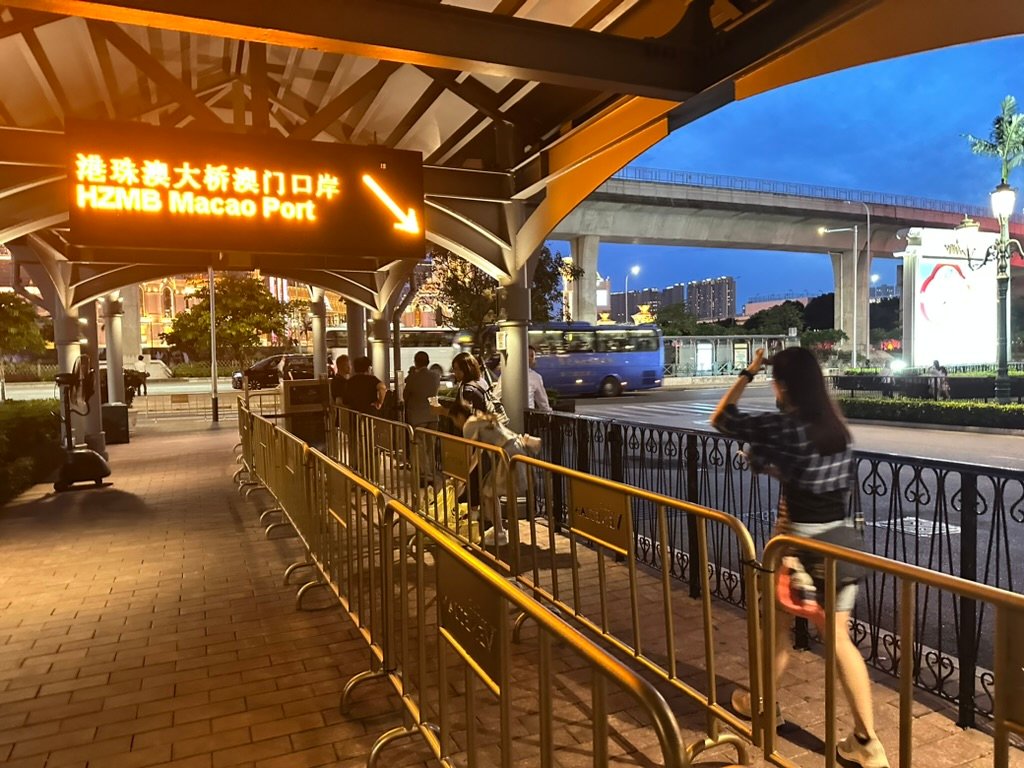
No taxi.
No complicated transfer.
Just find the correct sign, wait for the shuttle, and let the free bus take you to the Macao side of the Hong Kong–Zhuhai–Macao Bridge.
🌉 Step 1 — Find the HZMB Macau Port
After our last stop in Cotai, we headed for the HZMB Macao Port (港珠澳大橋澳門口岸
We took The Venetian free shuttle to the HZMB Macao Port. (SEE the Travel Tip above)
There it was in bright lights:
HZMB MACAO PORT.
No mystery.
No complicated expedition.
Just follow the signs.
We had arrived in Macau by ferry that morning.
Now we were about to leave by road.
🎫 Step 2 — Buy the Bridge Shuttle Bus Ticket
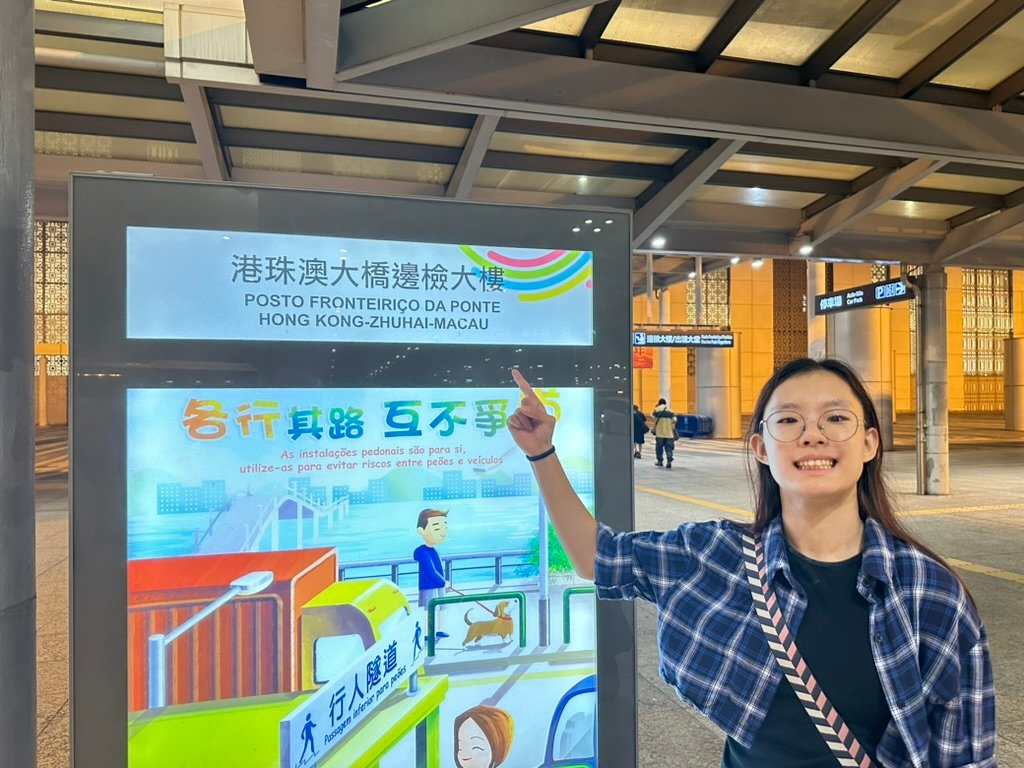
Inside the border facility, the whole operation felt much more organized than Dad had imagined.
Macau departure formalities.
Clear directions.
Separate flows toward Zhuhai (珠海) and Hong Kong (香港).
And ticket machines for the Hong Kong–Zhuhai–Macao Bridge Shuttle Bus.
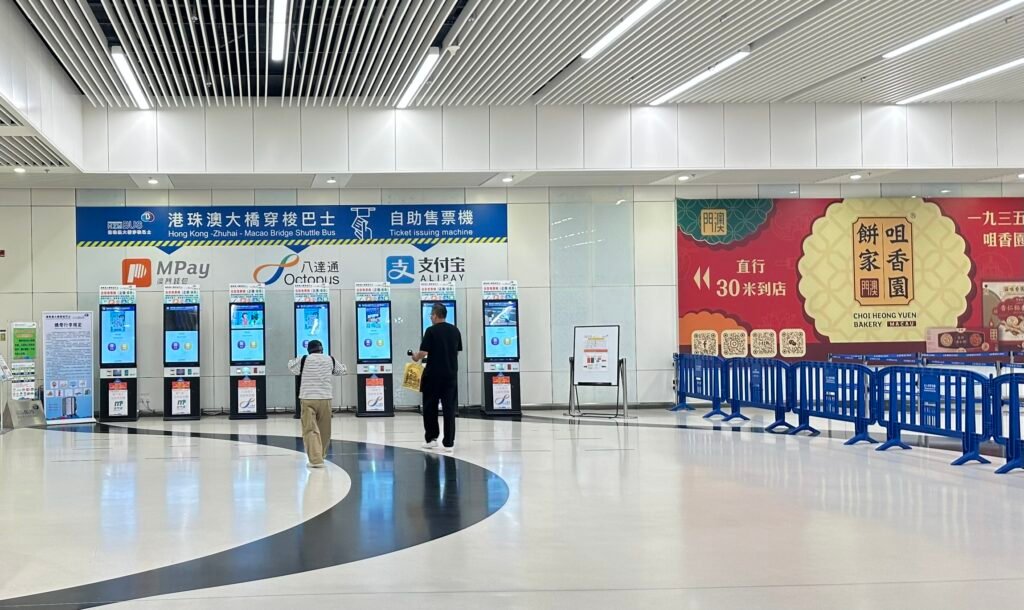
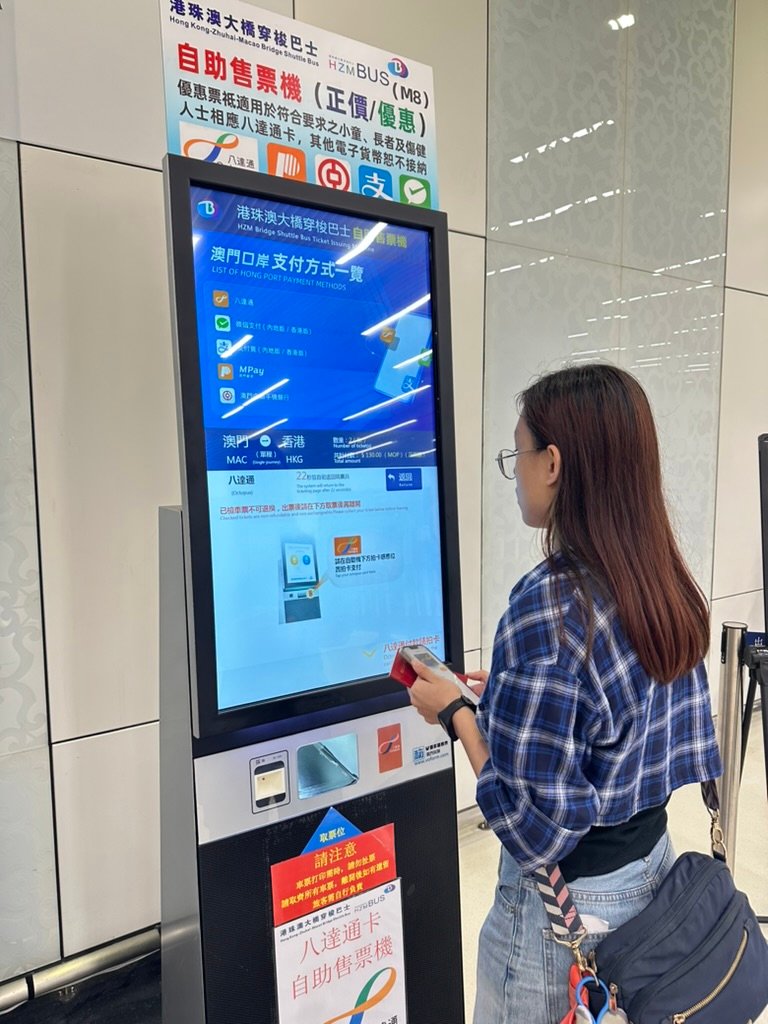
Elaine handled the machine.
😂
Dad documented the process.
The official bridge service operates between the Macau and Hong Kong ports around the clock, with ticket machines and counters at the passenger facilities.
For an international traveler, this is worth knowing:
you don’t need a private driver just to cross the bridge.
The shuttle bus is a normal public cross-boundary transport option.
⚠️ ONE TRAP: DON’T FOLLOW THE WRONG COLOR 😂
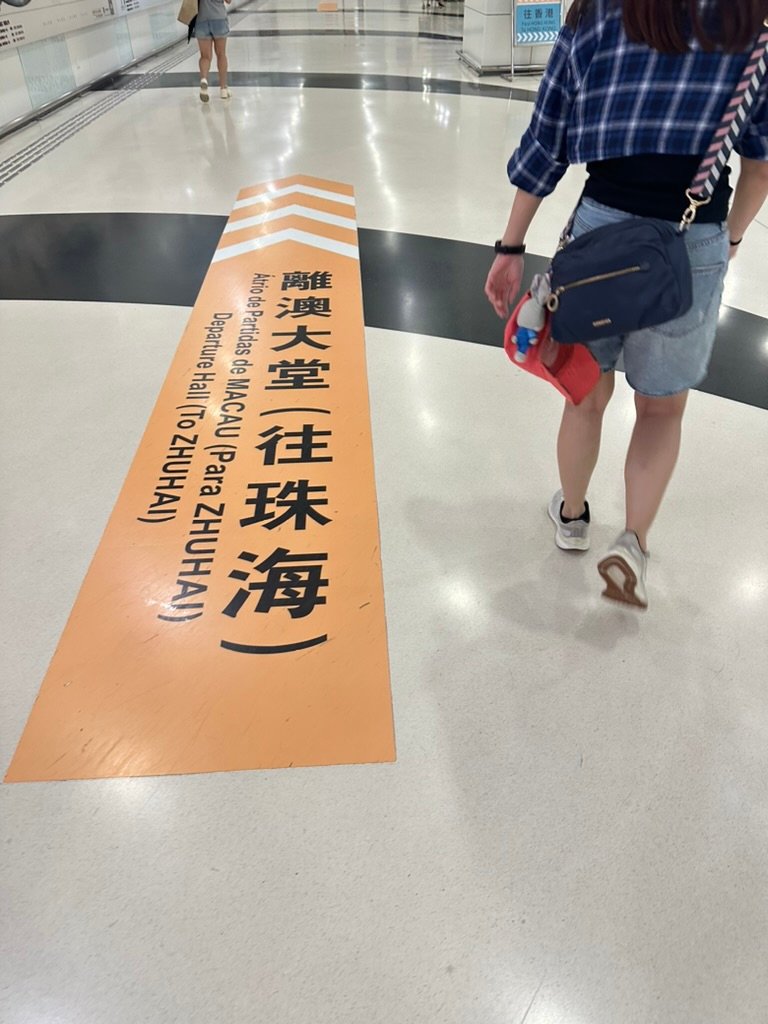
Dad saw the big arrow on the floor and started following it.
Elaine noticed something.
“Dad! That’s Zhuhai!”
😂😂😂
Dad stopped.
She was right.
The orange route was taking passengers toward Zhuhai (珠海).
We wanted Hong Kong (香港).
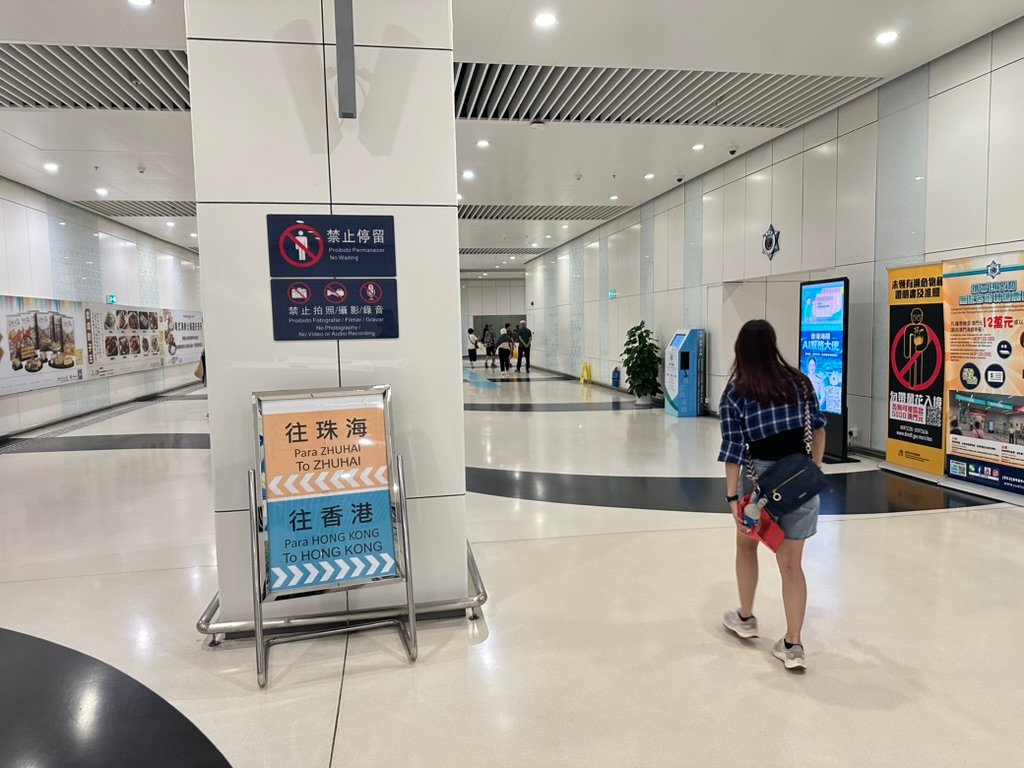
So…
ORANGE → ZHUHAI.
BLUE → HONG KONG.
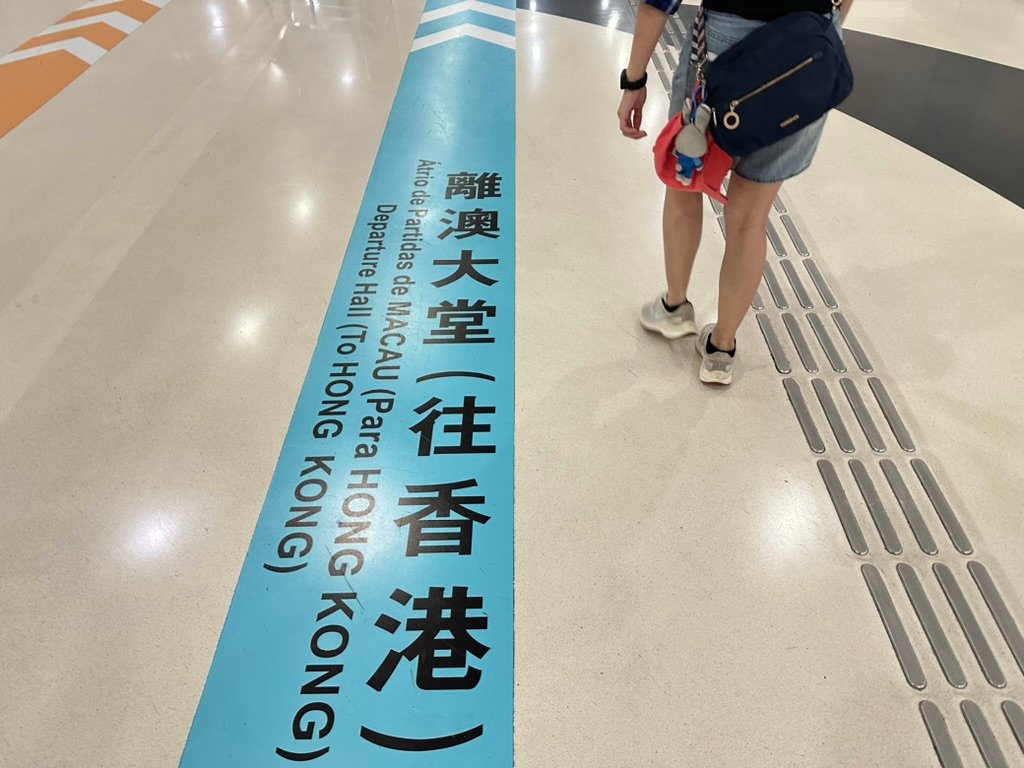
Elaine followed blue.
Dad followed Elaine.
😂
10-Second Zhuhai Lesson
If you’ve never heard of Zhuhai (珠海), this sign is actually telling a much bigger story.
Zhuhai is a Mainland Chinese city in Guangdong Province (廣東省), immediately beside Macau. It became one of China’s first Special Economic Zones in 1980 and today has about 2.5 million people, with substantial manufacturing, technology and service industries.
And look at the name of the bridge again:
HONG KONG — ZHUHAI — MACAO BRIDGE.
Not Hong Kong–Macau Bridge.
Zhuhai is the third city in the name.
That matters.
The bridge was designed to create a new road connection between the eastern and western sides of the Pearl River Estuary — linking Hong Kong (香港), Zhuhai (珠海) and Macau (澳門) and shortening journeys between Hong Kong and the western Pearl River Delta. The full bridge-and-tunnel system stretches about 55 km, while the approximately 42 km between the Hong Kong Port and the Zhuhai/Macau ports takes about 40 minutes by road.
Before the bridge, official estimates put the journey from Hong Kong International Airport to Zhuhai at around four hours.
With the bridge?
About 45 minutes.
That is the economic significance hiding underneath Elaine’s simple warning.
The bridge doesn’t just help tourists make a Macau day trip.
It helps move people, goods and economic activity between cities that sit on opposite sides of the Pearl River Estuary. Hong Kong’s own Greater Bay Area material describes the bridge as reducing transport time and costs and improving access between Hong Kong and the western Pearl River Delta.
And that is part of the larger idea behind the Guangdong–Hong Kong–Macao Greater Bay Area (粵港澳大灣區):
Hong Kong.
Macau.
Zhuhai.
Shenzhen.
Guangzhou.
And the other major cities around the Pearl River Delta becoming better connected while remaining distinct cities and jurisdictions.
Dad’s Political Science CPU started warming up again.
🔥😂
But Elaine had a more immediate concern.
Wrong color, Dad.
Fair point.
Political Science lesson over.
FOLLOW THE BLUE LINE. 😂
And off we went toward Hong Kong.
🚌 Step 3 — Get On the Bus
The shuttle bus to Hong Kong.
Bags on.
Elaine aboard.
Dad’s long-awaited bridge crossing was finally happening.
🌉 WE WERE ON THE HONG KONG–ZHUHAI–MACAO BRIDGE
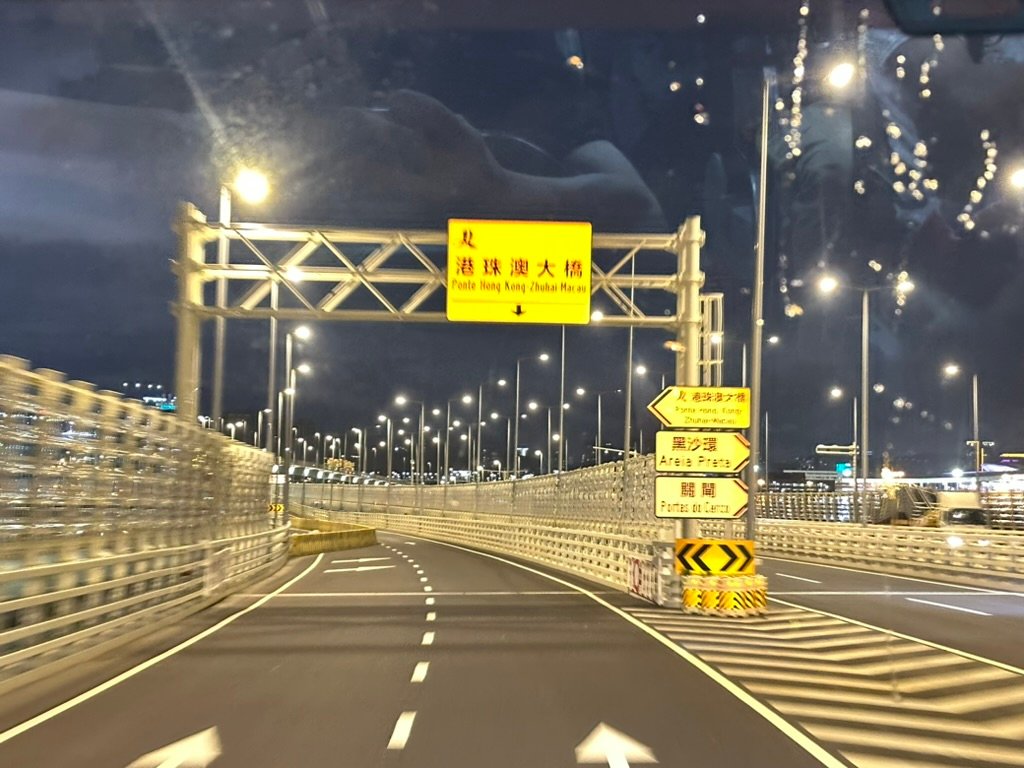
At night, you don’t necessarily get the spectacular postcard panorama Dad had imagined.
Instead there were lights.
Road.
Sea somewhere beyond the darkness.
And signs confirming that we were actually on it.
😂
But perhaps that was better.
Because this wasn’t a sightseeing ride.
People were simply…
going somewhere.
And that was precisely the point.
📱 Dad Opened Google Maps
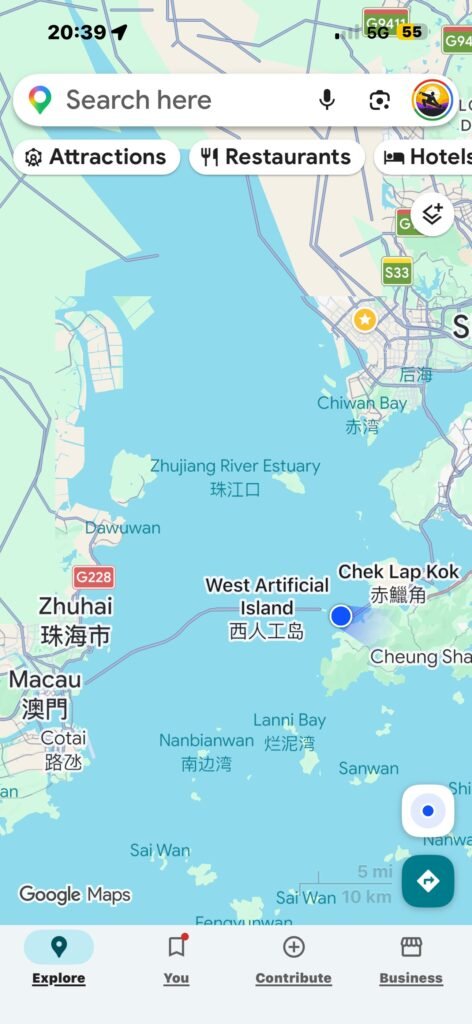
Dad couldn’t resist.
😂
Google Maps came out.
There was Macau behind us.
Zhuhai beside it.
The Pearl River Estuary beneath us.
Hong Kong ahead.
And our little blue dot moving across the water.
The bridge’s entire system stretches about 55 kilometers, while the road distance between the Hong Kong Port and the Zhuhai/Macau ports is roughly 42 kilometers.
Official bridge information puts that port-to-port drive at around 40 minutes.
That matched what Dad was experiencing.
Macau was disappearing behind us surprisingly quickly.
😂 THEN THE BRIDGE DISAPPEARED
[INSERT PHOTO: BUS ENTERING UNDERSEA TUNNEL]
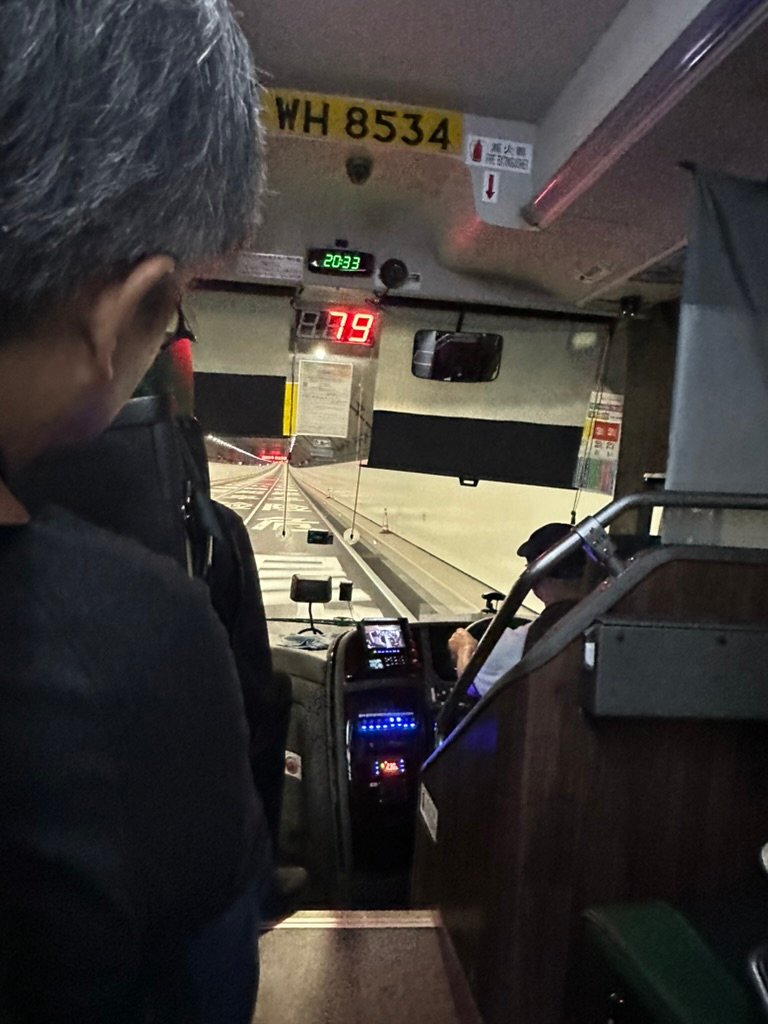
And then…
we went underground.
Wait.
A bridge…
with a tunnel?
😂
The HZMB isn’t simply one enormously long bridge.
It is a bridge–island–tunnel system.
Part of the crossing dives into an undersea tunnel so major shipping channels across the Pearl River Estuary can remain open.
So Dad’s Political Science field trip briefly became an engineering field trip.
🐇
Then the bus emerged again and continued toward Hong Kong.
🇭🇰 Step 4 — Welcome Back to Hong Kong
Eventually we reached the HZMB Hong Kong Port (港珠澳大橋香港口岸) at Chek Lap Kok (赤鱲角).
This is where Dad’s transport plan had one final test.
We still weren’t at our hotel.
Our hotel was in Sheung Wan (上環).
Would this become another complicated transfer?
Nope.
😂
After Hong Kong arrival formalities, we walked out to the public transport area.
And found exactly what Dad had planned for.
A11.
🚌 Macau → Bridge → A11 → Sheung Wan
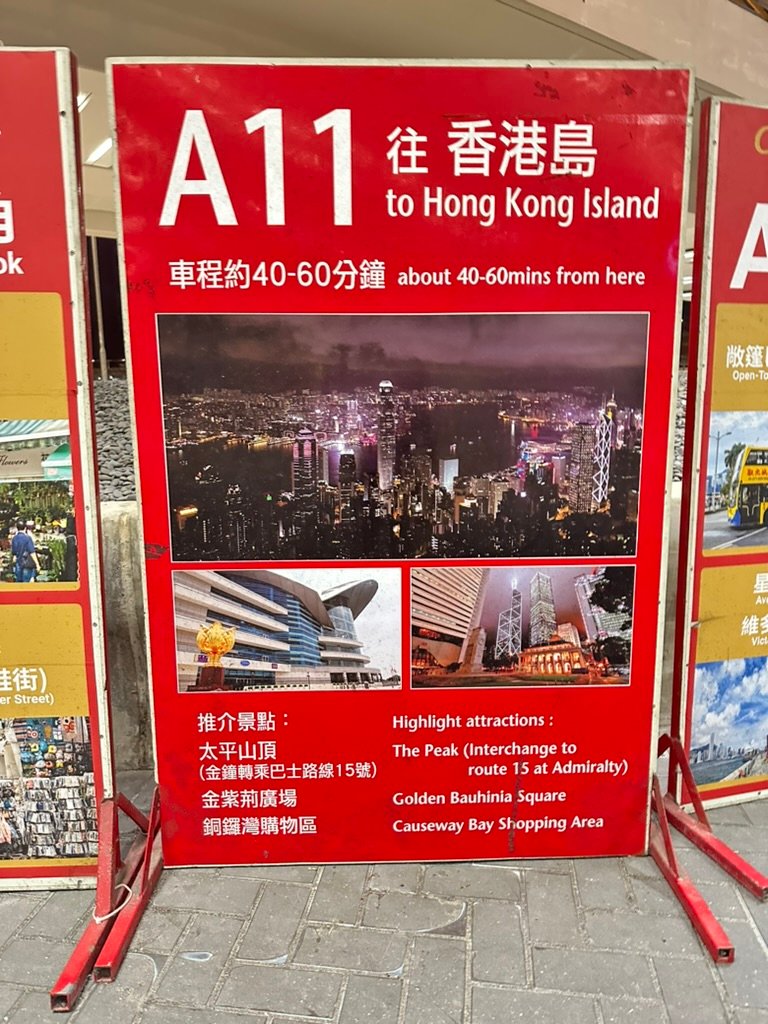
The Citybus A11 connects the HZMB Hong Kong Port with Hong Kong Island, serving areas including:
Sheung Wan (上環)
Central (中環)
Wan Chai (灣仔)
Causeway Bay (銅鑼灣)
North Point (北角)
Our destination?
SHEUNG WAN.
😂
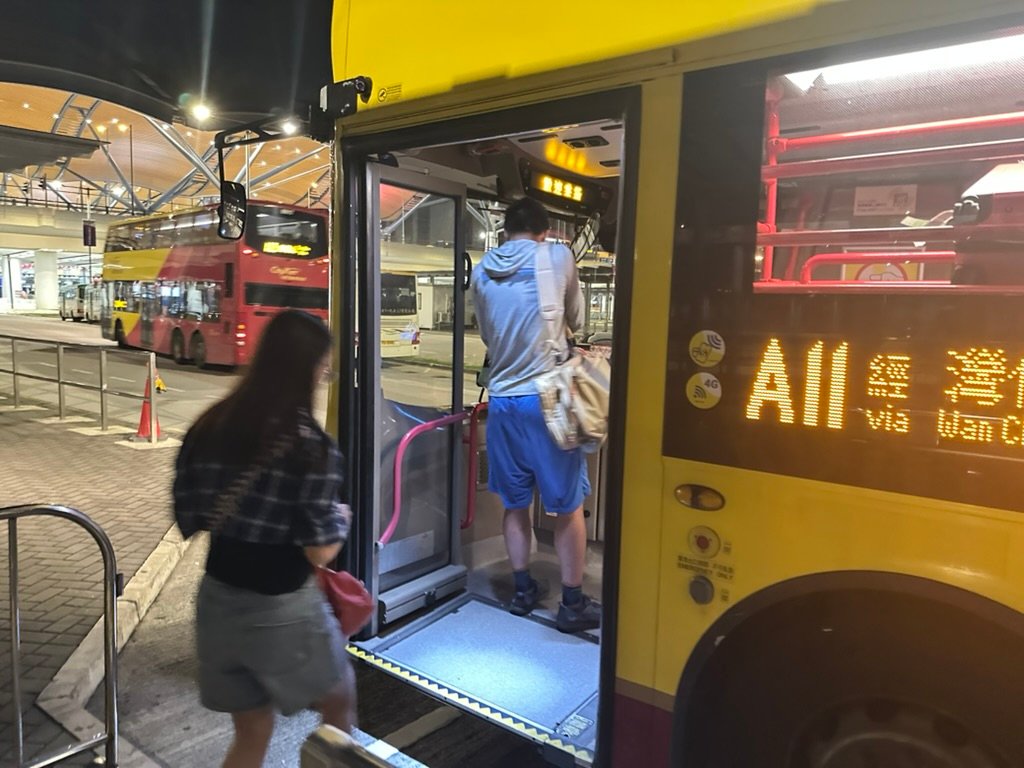
Dad’s little transport experiment was working.
Macau hotel area →
HZMB Macao Port →
bridge shuttle bus →
HZMB Hong Kong Port →
A11 →
Sheung Wan.
No taxi.
No private transfer.
No returning to the ferry terminal.
Just public transport.
🚌 Another 40-Plus Minutes…
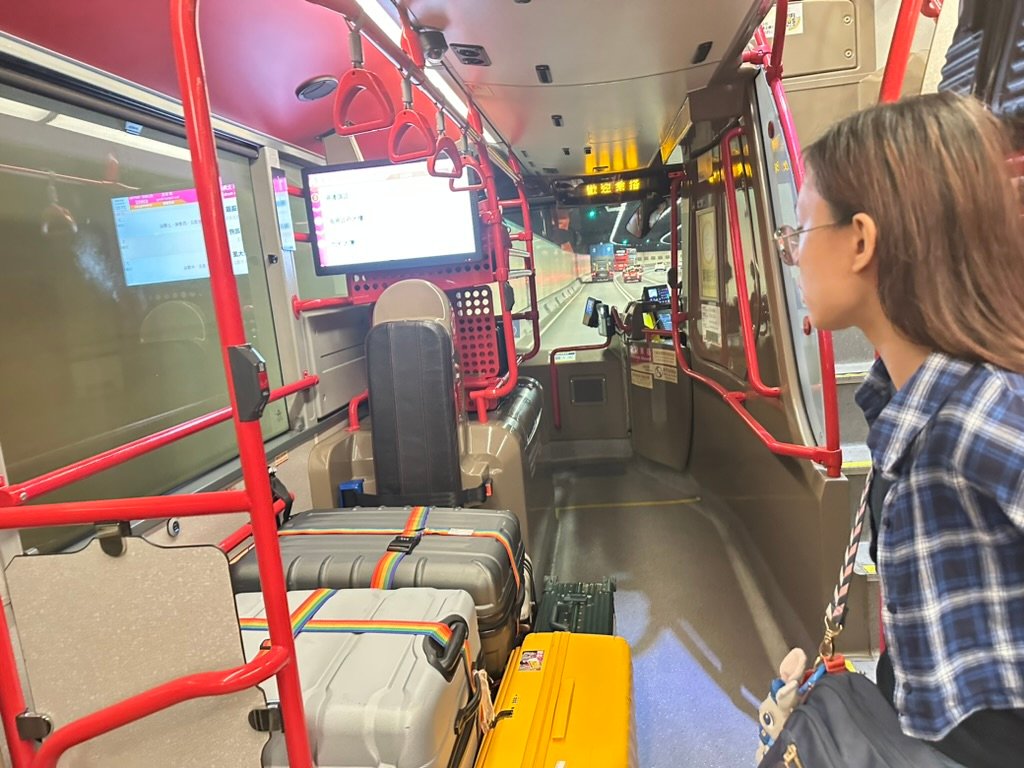
We loaded our bags.
Found our seats.
And settled in for the final ride into Hong Kong.
Roughly another 40-plus minutes in our experience and the skyscrapers of Hong Kong Island began replacing the infrastructure of Chek Lap Kok.
After an entire day exploring Macau…
Dad’s plan had fallen into place almost seamlessly.
🏨 BACK TO SHEUNG WAN 上環
And eventually…
we were back near our hotel in Sheung Wan (上環).
The same neighborhood where Dad and Elaine had been staying at ibis Hong Kong Central & Sheung Wan.
That made Dad appreciate our hotel location all over again.
Macau didn’t end with an expensive taxi ride across Hong Kong.
The A11 brought us back into the same part of Hong Kong Island where we were staying.
One of Dad’s Favorite Hotels
For Dad, value for money isn’t simply finding the cheapest room.
It is also asking:
Does the location make the journey easier?
Tonight, it did.
👉 Check ibis Hong Kong Central & Sheung Wan on Trip.com
ChinaTravelBUG may earn a commission if you book through our Trip.com links, at no extra cost to you.
🧠 AND THEN DAD REALIZED SOMETHING
Earlier, Dad’s cousin had casually talked about traveling from Hong Kong to Macau for their daughter’s graduation.
Dad’s CPU had struggled with the idea.
😂
Macau?
For an evening event?
From Hong Kong?
Now Dad and Elaine had actually made the journey themselves.
And suddenly…
IT DIDN’T SOUND CRAZY ANYMORE.
Macau hadn’t physically moved.
Hong Kong hadn’t physically moved.
The Pearl River Estuary was still there.
The borders were still there.
The different administrative systems were still there.
But infrastructure had changed something very important.
THE MEANING OF DISTANCE.
🌉 The Bridge Changed Dad’s Mental Map
Before this trip, Dad’s mental map looked something like:
Hong Kong
↓
Take a trip somewhere else
↓
Macau
After crossing the bridge, it began looking more like:
Hong Kong ↔ Macau ↔ Zhuhai
And beyond them:
Shenzhen.
Guangzhou.
Dongguan.
Foshan.
The wider Guangdong–Hong Kong–Macao Greater Bay Area (粵港澳大灣區).
Not one city.
Not one borderless region.
Not one legal or administrative system.
But increasingly…
CONNECTED.
And that is where Dad’s old Political Science brain became interested.
Infrastructure doesn’t merely move vehicles.
It can change how people think about where they can work, meet, trade, study, visit and spend their time.
Dad’s cousin hadn’t explained any of that.
They had simply invited us to a graduation in Macau.
😂
Sometimes ordinary behavior tells you more about economic integration than an economic report.
🐞 ONE DAY IN MACAU. ONE MUCH BIGGER LESSON.
That morning Dad and Elaine crossed from Hong Kong to Macau by ferry.
We walked through Macau’s Chinese history.
Portuguese history.
Catholic churches.
Chinese temples.
Old streets.
Food shops.
Coloane.
Cotai.
Paris.
London.
😂
And that evening…
we crossed back to Hong Kong over one of the world’s great pieces of transport infrastructure.
The trip had begun with Dad asking:
WHAT EXACTLY IS MACAU?
By the end of the day, the question had changed.
HOW DOES MACAU CONNECT TO THE WORLD AROUND IT?
And perhaps that was the better question.
Because Macau makes more sense when you don’t look at it in isolation.
Look toward Hong Kong.
Look toward Zhuhai.
Look toward Guangdong.
Look across the Pearl River Estuary.
And suddenly a much larger China story appears.
Dad’s cousin understood it before Dad did.
😂
For them:
Hong Kong → Macau for an evening graduation.
For Dad:
🐇 ANOTHER RABBIT HOLE.
But after crossing the bridge himself…
Dad’s CPU finally completed the calculation.
MACAU HADN’T MOVED CLOSER TO HONG KONG.
TIME HAD MADE IT FEEL CLOSER.
SEE → ASK → CONNECT → UNDERSTAND → FOLLOW.
🐞 ChinaTravelBUG — See China. Understand It Better.