What the Terracotta Army Reveals About Qin Shi Huang — and the China He Created
Most first-time travelers to:
Xi’an (西安, Xī’ān)
come for one place.
The Terracotta Warriors (兵马俑, Bīngmǎyǒng).
We did too.
😂
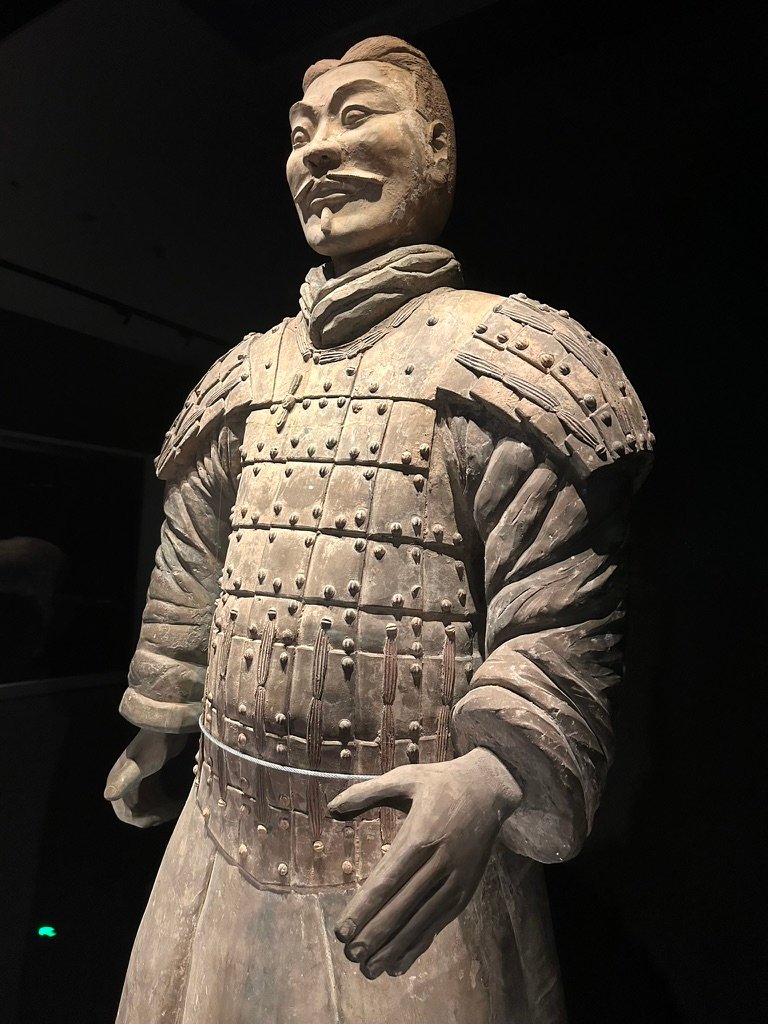
Rows upon rows of life-sized clay soldiers.
Infantry.
Archers.
Officers.
Horses.
Chariots.
One enormous underground army associated with:
Qin Shi Huang (秦始皇, Qín Shǐhuáng)
— China’s:
First Emperor (始皇帝, Shǐ Huángdì).
You’ve seen the photographs.
But when Dad & Elaine visited the Terracotta Army in Xi’an, one of the most interesting things wasn’t another warrior.
It was:
a hole in the ground.
🔥
🪣 Look for the Well
Inside the archaeological area, you’ll find a small sign:
Site of the Well (秦俑井址, Qínyǒng Jǐngzhǐ).
It doesn’t look remotely as impressive as:
Pit 1 (一号坑, Yīhào Kēng).
No thousands of warriors.
No dramatic army formation.
No giant exhibition hall.
Most visitors could walk straight past it.
Don’t.
🐇
Because this little spot takes us back to:
March 1974.
Local farmers in:
Xiyang Village (西杨村, Xīyáng Cūn)
in:
Lintong (临潼, Líntóng),
east of Xi’an, were digging a well.
They weren’t searching for:
Qin Shi Huang.
They weren’t conducting an archaeological excavation.
They needed:
water (水, shuǐ).
😂
Instead, they encountered fragments of terracotta figures.
Archaeologists were called in.
The discoveries that followed revealed:
the Terracotta Army (兵马俑)
associated with the enormous mausoleum complex of China’s First Emperor.
🔥
Sometimes one of the world’s greatest archaeological discoveries begins because:
somebody needed a well.
📸 Dad & Elaine Were Standing Beside the Discovery Story
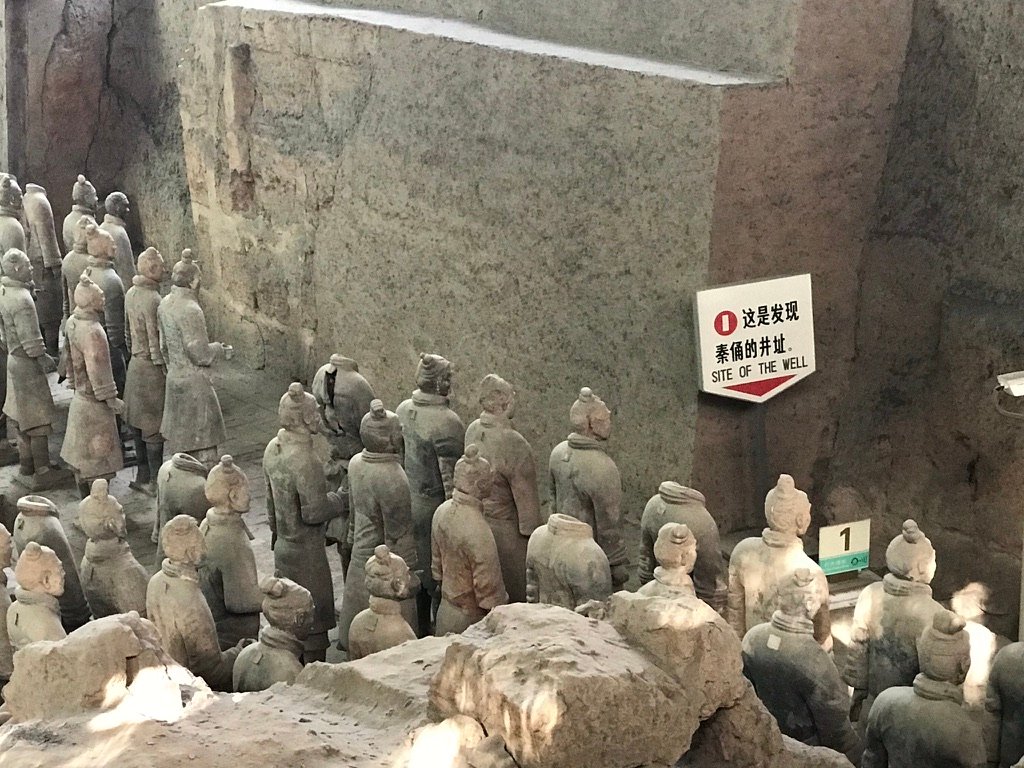
📍 Emperor Qinshihuang’s Mausoleum Site Museum, Lintong — Dad’s photo
Look at Dad’s photograph.
The warriors are immediately more exciting.
Naturally.
😂
But look at the sign:
这是发现秦俑的井址
Zhè shì fāxiàn Qínyǒng de jǐngzhǐ.
Very roughly:
This is the site of the well where the Qin terracotta figures were discovered.
🔥

Beginner Chinese bonus:
井 — jǐng — well
址 — zhǐ — site
发现 — fāxiàn — discover
秦俑 — Qínyǒng — Qin terracotta figures
A few Chinese characters.
One enormous historical rabbit hole.
🌏 And Yes — This Is UNESCO
The:
Mausoleum of the First Qin Emperor (秦始皇陵, Qín Shǐhuáng Líng)
was inscribed on the:
UNESCO World Heritage List in 1987.
And here’s an important distinction.
The UNESCO site isn’t simply:
“the building containing the Terracotta Warriors.”
🔥
The famous army pits belong to a much larger:
imperial mausoleum complex (陵墓建筑群, língmù jiànzhùqún).
UNESCO describes an enormous archaeological landscape containing the emperor’s burial mound and a vast range of associated remains and pits.
So:
Terracotta Warriors ≠ the whole site.

📍 Qin-Han Museum, near Xi’an Airport — Dad’s photo
They’re the superstar.
😂
But they’re only part of the story.
🏺 Now Walk Into Pit 1
Then you reach:
Pit 1 (一号坑, Yīhào Kēng).
And…
😳
Okay.
This is why everybody comes.
The huge roofed archaeological pit stretches out below you.
Rows of:
terracotta warriors (兵马俑)
stand in formation.
Behind them:
more soldiers.
Then more.
Then more.
🔥
Pit 1 itself covers roughly:
14,260 square meters
and the museum estimates that it originally contained around:
6,000 terracotta warriors and horses.
This is not:
“some statues found beside an emperor’s tomb.”
You’re looking at:
an enormous archaeological project.
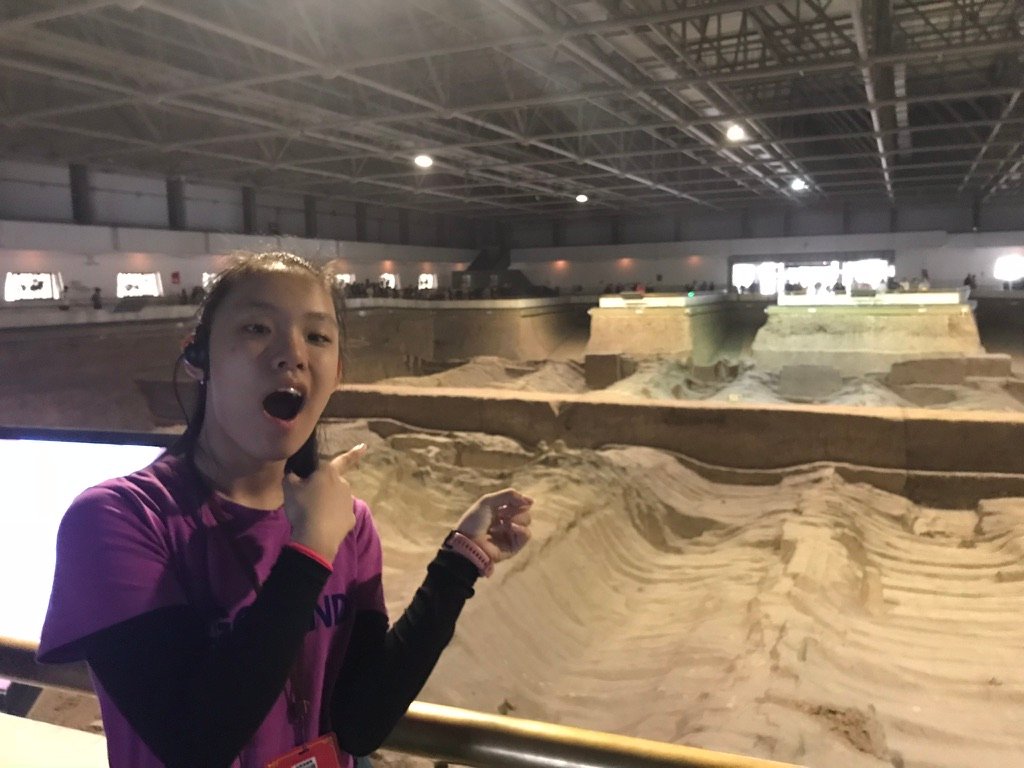
📸 And Then There’s Elaine
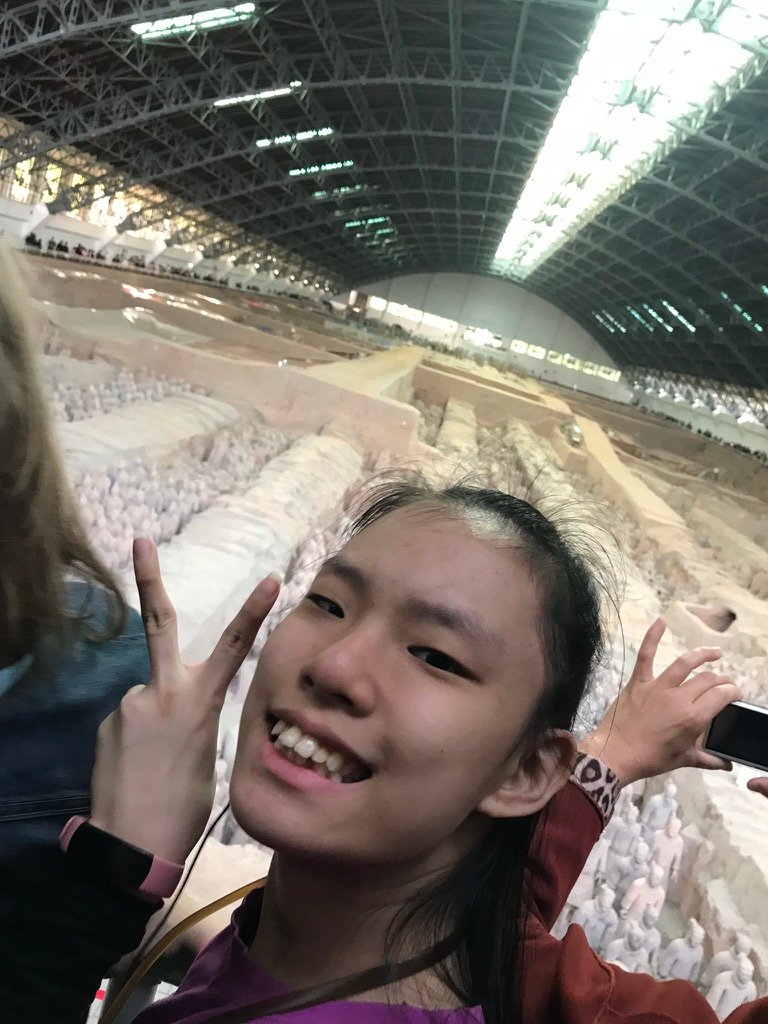
😂
There she is.
Young Elaine.
Peace sign.
Terracotta Army behind her.
Probably not thinking:
“Father, this monumental funerary complex raises fascinating questions about Qin imperial state capacity.”
😭😂
She came to see:
the Terracotta Warriors.
And that’s perfectly fine.
Because that’s how many Deep China rabbit holes begin.
You visit:
the famous place first.
Then years later…
you start asking:
WHY?
🐇 Why Are Thousands of Soldiers Underground?
Now we’re asking the right question.
The Terracotta Warriors form part of the enormous funerary landscape created for:
Qin Shi Huang.
Construction of his mausoleum began after he became:
King of Qin (秦王, Qín Wáng)
in:
246 BCE.
Then in:
221 BCE
something extraordinary happened.
The:
State of Qin (秦国, Qín Guó)
completed its conquest of the rival Warring States.
The king adopted a new title:
First Emperor (始皇帝, Shǐ Huángdì).
🔥
And suddenly our Terracotta Warriors visit has opened the first Big Question:
What did Qin Shi Huang actually “unify”?
🐇
Careful.
Dad isn’t answering that here.
😂
That’s the Michelin restaurant next door.
For now, remember only:
These warriors belonged to the burial complex of the ruler who transformed the political order of ancient China in 221 BCE.
That makes them much more interesting than:
8,000 impressive clay statues.
⚠️ About That Famous “8,000 Warriors” Number
You’ll constantly see:
“8,000 Terracotta Warriors.”
Useful shorthand.
But don’t imagine archaeologists have simply excavated, restored and lined up exactly 8,000 complete soldiers for us to count.
😂
The archaeological site is still a:
research and conservation project (考古与保护, kǎogǔ yǔ bǎohù).
Figures have been found in different conditions.
Some were broken.
Some have been reconstructed.
Some areas remain under investigation.
And the larger mausoleum complex contains far more than soldiers.
🔥
So don’t spend your visit asking:
“Where are all 8,000?”
Look at:
how they’re being uncovered.
📸 Look at the Archaeology, Not Just the Army
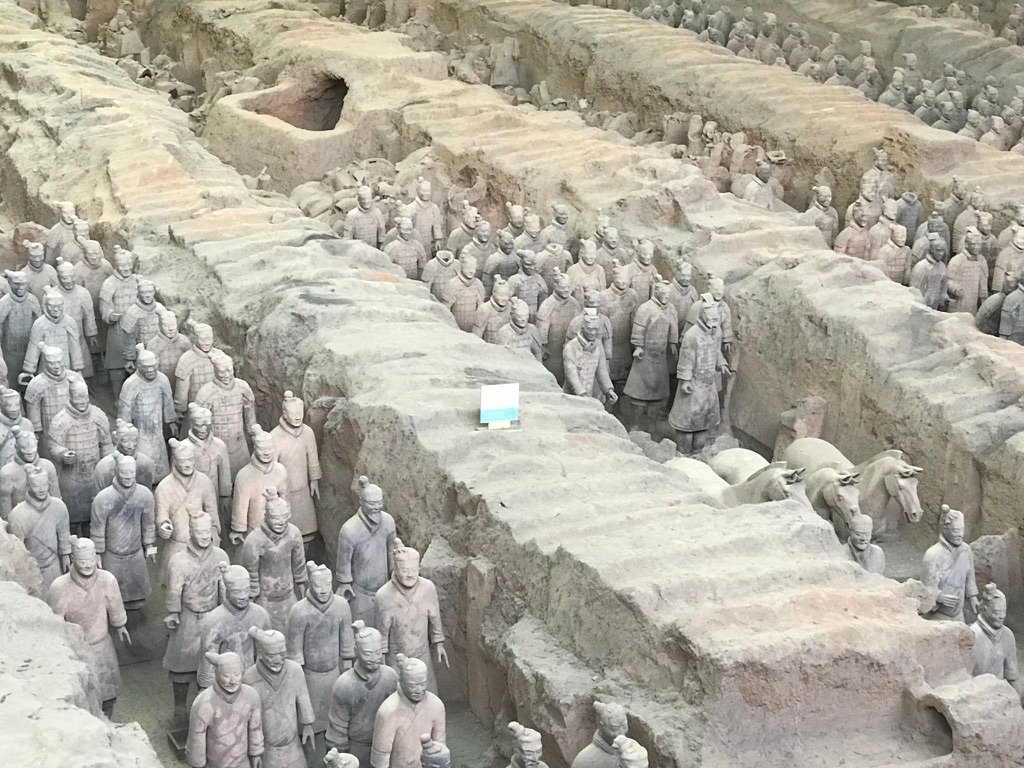
📍 Emperor Qinshihuang’s Mausoleum Site Museum, Lintong — Dad’s photo
This is one of Dad’s photographs I especially like.
Not the postcard view.
Look at the:
earth walls,
excavation trenches,
broken and restored figures
and:
archaeological context.
🔥
Remember:
The warriors weren’t discovered standing inside:
a museum.
The museum exists because:
archaeology uncovered them here.
That’s a completely different way to look at the place.
🐎 And Don’t Ignore the Horses
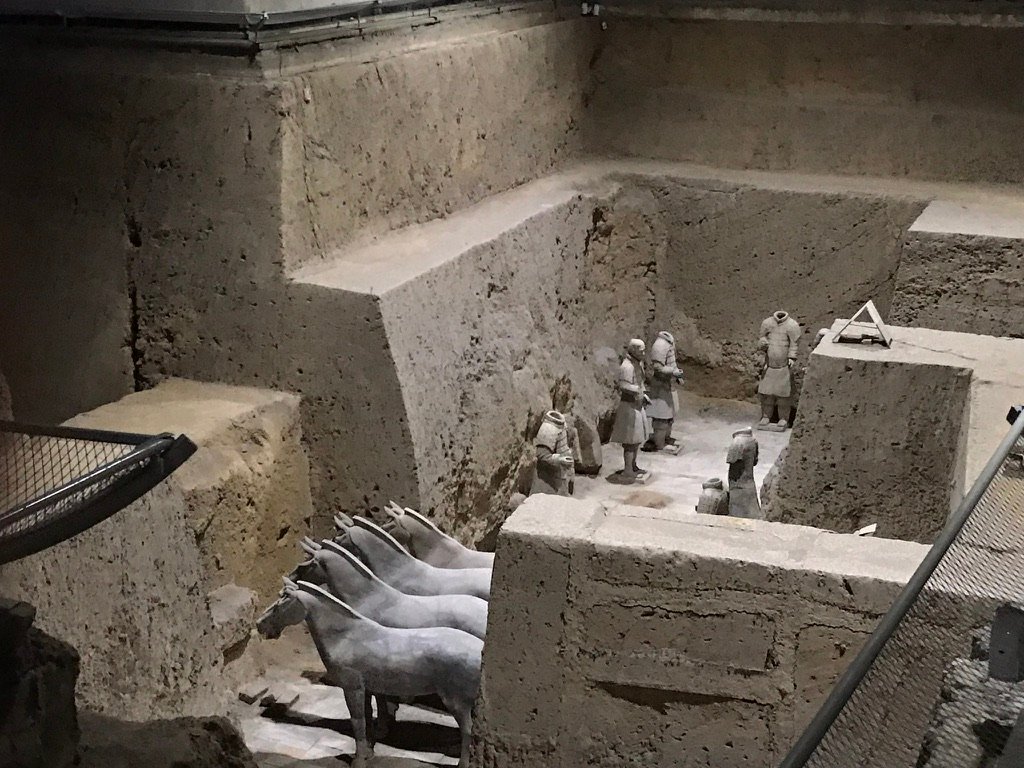
📍 Emperor Qinshihuang’s Mausoleum Site Museum, Lintong — Dad’s photo
Beginner Chinese:
horse (马, mǎ)
Again.
😂
If you’ve been reading Deep China long enough, you’ll know that:
the horse keeps coming back.
Frontier warfare.
Cavalry.
Warring States competition.
Silk Roads.
Imperial armies.
And here:
terracotta horses (陶马, táomǎ).
The underground formations include:
infantry,
archers,
officers,
chariots
and:
horses.
🔥
Don’t simply count statues.
Look at:
organization.

🌶️ That’s the First Sting
You arrived thinking:
“I’m going to see the Terracotta Warriors.”
Excellent.
Then:
warrior
↓
formation
↓
army
↓
Qin
↓
Qin Shi Huang
↓
First Emperor
↓
221 BCE
↓
unification (统一, tǒngyī).
🐇
Uh-oh.
Now the famous attraction has created a question.
That’s exactly where ChinaTravelBUG wants you.
😂🔥
🐞 Deep China Moment
Don’t leave Pit 1 remembering only:
“There were thousands of them.”
Remember the little:
well (井, jǐng)
too.
Farmers came looking for water.
They uncovered fragments.
Archaeologists followed the evidence.
And beneath the fields outside modern Xi’an emerged part of an enormous underground world created more than:
2,200 years ago.
🔥
The Terracotta Warriors are spectacular.
But the deeper story isn’t simply:
what was found.
It’s:
what those discoveries can tell us about Qin Shi Huang and the political world he created.
And that’s where we’re going next.
Section 2 — Don’t Just Count the Warriors. Look at the Empire Behind Them.
After seeing:
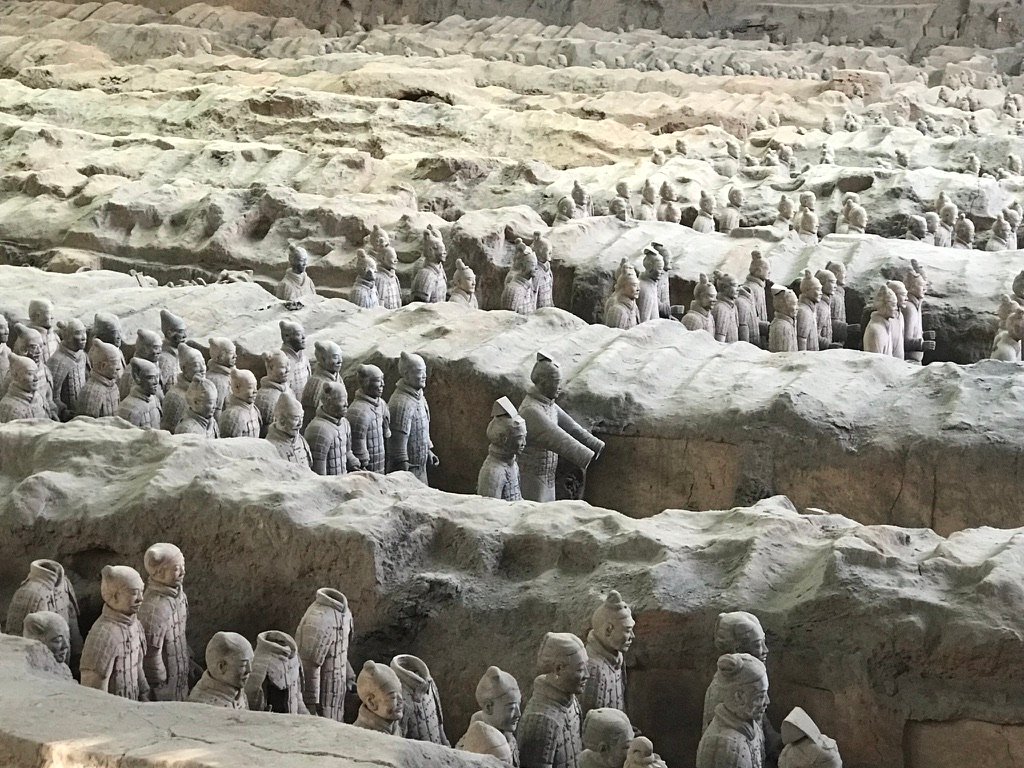
📍 Emperor Qinshihuang’s Mausoleum Site Museum, Lintong — Dad’s photo
Pit 1 (一号坑, Yīhào Kēng),
it’s very easy to leave thinking:
“Wow. Qin Shi Huang had a HUGE army.”
😂
True.
But that’s only the surface.
The more interesting question is:
What kind of state could organize something on this scale?
Because the:
Terracotta Army (兵马俑, Bīngmǎyǒng)
didn’t appear because one talented sculptor spent a quiet weekend making soldiers.
😭😂
Behind what you see were:
craftsmen (工匠, gōngjiàng),
workshops (作坊, zuōfang),
clay (陶土, táotǔ),
weapons (兵器, bīngqì),
transport (运输, yùnshū),
food supplies (粮食, liángshi),
labor (劳役, láoyì)
and:
administration (行政, xíngzhèng).
🔥
Now the warriors stop being merely:
ART.
They become evidence of:
STATE POWER.
🐇 First: The Terracotta Army Is NOT Qin Shi Huang’s Tomb
This is an important distinction for first-time visitors.
The famous warrior pits are part of the much larger:
Mausoleum of the First Qin Emperor (秦始皇陵, Qín Shǐhuáng Líng).
The emperor’s burial mound lies elsewhere within this enormous archaeological landscape.
And the central burial chamber itself:
has not been excavated.
🔥
So when travelers say:
“I’m going to see Qin Shi Huang’s tomb.”
what they’re usually going to see is the museum and archaeological sites associated with:
the First Emperor’s mausoleum complex.
The Terracotta Warriors are the superstar.
😂
But they’re only:
one part of the underground story.
🌏 Think Bigger Than Three Pits
Most visitors quickly learn:
Pit 1 (一号坑, Yīhào Kēng)
Pit 2 (二号坑, Èrhào Kēng)
and:
Pit 3 (三号坑, Sānhào Kēng).
Useful.
But don’t let:
three pits
become your mental picture of the whole mausoleum.
The wider archaeological complex contains many associated pits and remains.
Archaeologists have uncovered evidence including:
terracotta soldiers (兵俑, bīngyǒng),
terracotta horses (陶马, táomǎ),
chariots (战车, zhànchē),
bronze weapons (青铜兵器, qīngtóng bīngqì)
and other figures and objects connected with the imperial funerary landscape.
🔥
The deeper you look, the less this resembles:
“an army beside an emperor’s tomb.”
It begins to resemble:
an enormous imperial world constructed underground.
🐎 Pit 1 Is Only Part of the Story
Pit 1

📍 Emperor Qinshihuang’s Mausoleum Site Museum, Lintong — Dad’s photo
gives you the:
WOW.
Rows of warriors.
Huge formations.
The photograph everybody wants.
😂
But:
Pit 2
contains a more varied mixture of military formations, including infantry, archers, cavalry and chariots.

📍 Qin-Han Museum, near Xi’an Airport — Dad’s photo
🐞 Photo Note: Meet the Qin Cavalry Horse
This 陶鞍马 (táo ānmǎ) — pottery saddled horse comes from Pit 2 of the Terracotta Army (兵马俑二号坑) near Xi’an.
Pit 2 is especially interesting because it reveals a more varied Qin fighting force than the massed infantry most visitors associate with the Terracotta Army: archers, chariots, cavalry and mixed formations.
The pottery cavalry horses were found together with cavalrymen, giving archaeologists remarkable physical evidence of how mounted troops formed part of Qin military organization more than 2,200 years ago.
🔥 Don’t just look at the Terracotta Warriors.
Look at the horses too.
They help turn Qin Shi Huang’s buried army from a collection of famous statues into something much more interesting:
a model of how the Qin army actually fought.
Photo by Dad at The Qin-Han Museum near Xi’an Airport.
The much smaller:
Pit 3
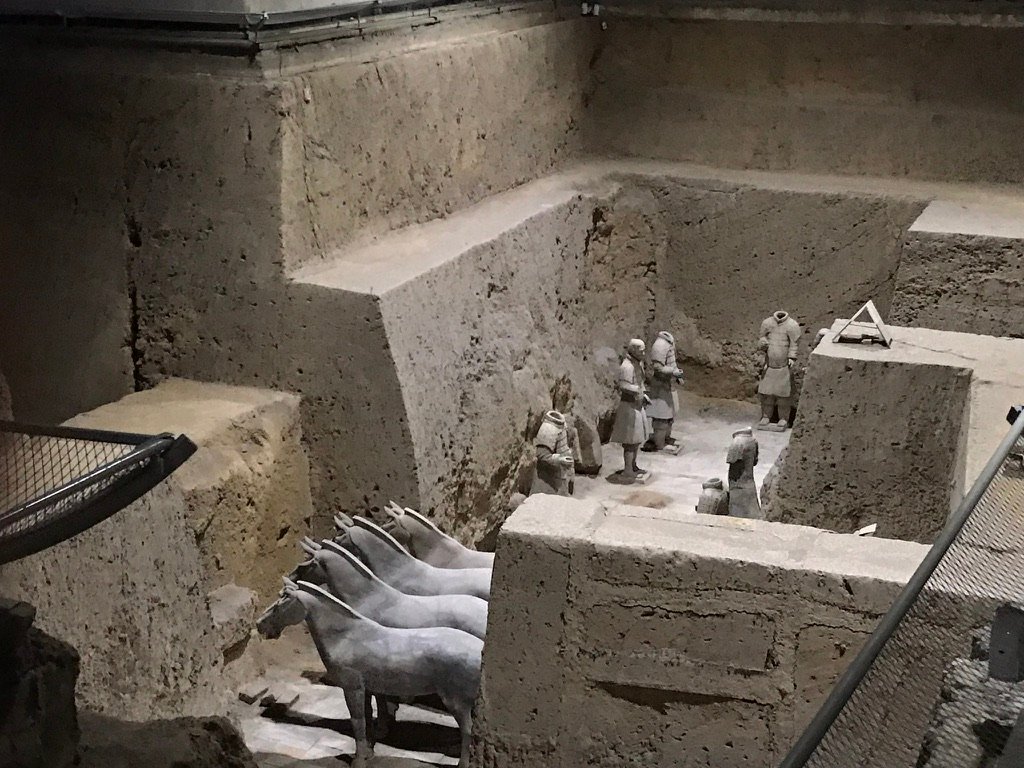
is generally interpreted as a command-related component of the Terracotta Army complex.
🔥
So don’t judge the pits only by:
“Which one has the most warriors?”
Look instead for:
ORGANIZATION.
Different troops.
Different equipment.
Different formations.
Different functions.
Now we’re looking at:
an army
rather than:
a collection of statues.
📸 Look at Dad’s Horses Again
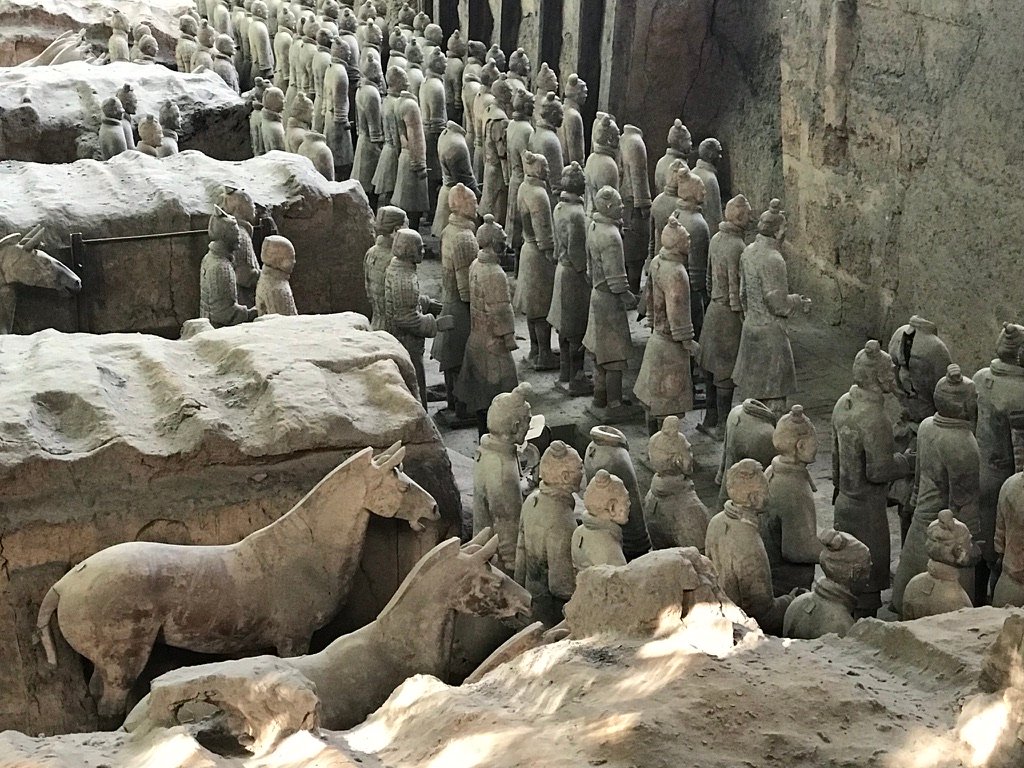
This photograph is useful precisely because it isn’t the classic Pit 1 panorama.
Look at:
horses (马, mǎ)
beside:
warriors (兵俑, bīngyǒng).
Then think:
army (军队, jūnduì).
🔥
An army requires:
different units,
different weapons,
command,
transport
and:
logistics (后勤, hòuqín).
The archaeological pit begins looking less like an art gallery…
and more like:
military organization preserved in clay.
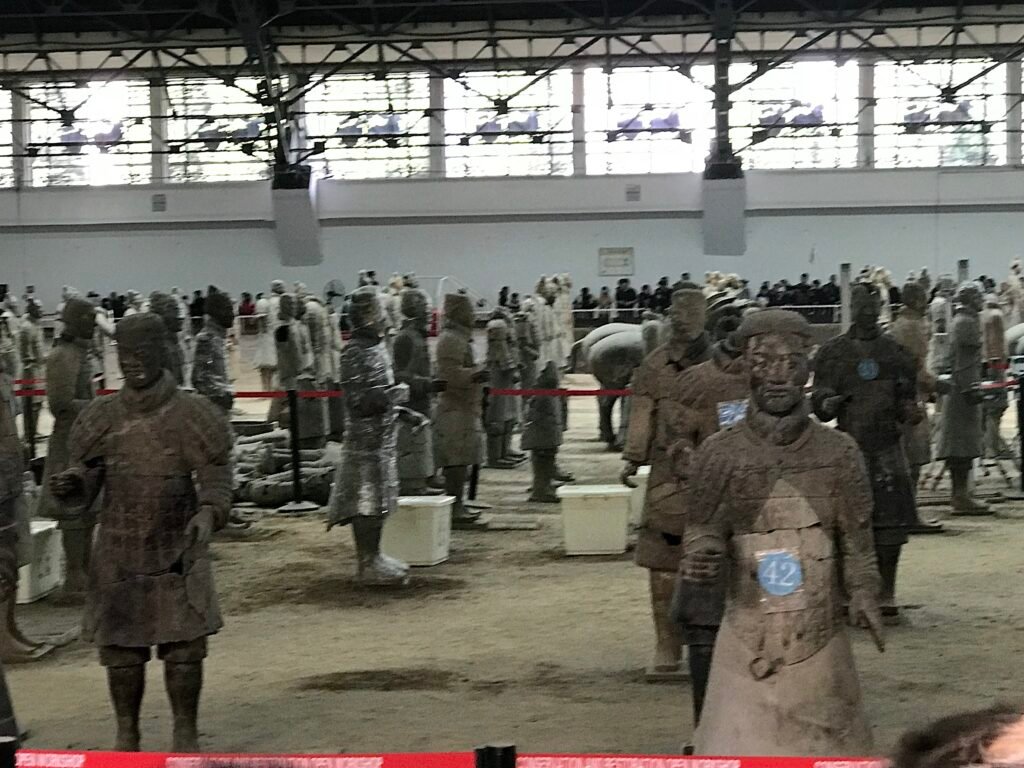
🌶️ Were All the Warriors Individual Portraits?
You’ve probably heard:
“Every Terracotta Warrior has a completely unique face.”
Careful.
The figures certainly display:
remarkable variation.
Different:
faces,
hairstyles,
headgear,
clothing,
ranks
and:
details.
🔥
But we don’t need to claim that each figure is a literal portrait of:
one identifiable Qin soldier.
The more interesting story is how organized production could create:
large numbers of figures
while still producing:
substantial visual variation.
That’s impressive enough.

📍 Shaanxi History Museum, Xi’an — Dad’s photo
🏭 Ancient Mass Production?
Careful with the modern phrase.
😂
But it gives us a useful handrail.
Evidence from the Terracotta Army points toward highly organized production involving:
workshops (作坊, zuōfang)
and:
craftsmen (工匠, gōngjiàng).
Different components could be produced through organized processes, assembled and finished with additional details.
🔥
Think:
STANDARDIZATION
+
SPECIALIZATION
+
CRAFTSMANSHIP.
Now remember what we’ve already learned about:
Qin (秦).
🐇
A state famous for:
administration,
organization,
standardization
and:
mobilizing enormous resources.
Suddenly the archaeological site and the history start talking to each other.
🎨 Surprise: They Weren’t Originally Grey
This is one of the best details to carry into your visit.
Today the Terracotta Warriors appear mostly:
grey-brown.
So that’s how we imagine them.
But many were originally:
painted in color.
😳🔥
Their surfaces could include pigments showing details of:
clothing,
armor,
faces
and:
other features.
Much of this color deteriorated after excavation and exposure.
So when you’re looking across those familiar grey ranks…
try mentally adding:
COLOR.
The Terracotta Army originally looked very different from the army tourists recognize today.
🐇 Why Not Just Excavate Everything?
Now comes a question many visitors naturally ask:
If Qin Shi Huang’s main burial chamber is still underground, why don’t archaeologists open it?
😂
Because:
archaeology (考古学, kǎogǔxué)
isn’t:
treasure hunting (寻宝, xúnbǎo).
Excavation exposes ancient material to a completely different environment.
Air.
Humidity.
Temperature.
Light.
Microorganisms.
🔥
And once something has been excavated:
you can’t recreate 2,200 years underground.
The conservation problems encountered with the Terracotta Warriors—including deterioration of surviving painted surfaces—help explain why modern archaeology can sometimes choose:
NOT TO DIG YET.
Sometimes leaving something underground is:
part of protecting it.
👑 The Emperor Is Still Under His Mound
The central burial chamber of:
Qin Shi Huang
has not been excavated.
And this is where ancient history gives us one of the site’s greatest mysteries.
The Han dynasty historian:
Sima Qian (司马迁, Sīmǎ Qiān)
writing roughly a century after Qin Shi Huang’s death, described an extraordinary underground burial world.
His account famously mentions:
mercury (水银, shuǐyín)
used to represent rivers and seas.
😳
Modern scientific studies have detected unusually elevated mercury levels around the burial mound.
Interesting?
VERY.
Proof that archaeologists have found Sima Qian’s underground mercury rivers?
NO.
😂
The burial chamber remains unopened.
Deep China rule:
ancient account + scientific clue ≠ permission to turn possibility into fact.

🍚 Western Handrail: Think Beyond Tutankhamun
Western travelers may naturally think about:
Tutankhamun’s tomb
in Egypt.
Useful handrail.
Both archaeological stories transformed the modern world’s imagination of ancient civilizations.
But don’t push the comparison too far.
🔥
Qin Shi Huang’s mausoleum is not simply:
one chamber full of spectacular burial goods.
The Terracotta Army belongs to an enormous funerary landscape containing multiple archaeological components.
So use Egypt to orient yourself.
Then:
let Qin be Qin.
🐇 Why Would an Emperor Need an Underground Army?
Now we’re approaching the deeper question.
The Terracotta Warriors belong to:
a funerary context (丧葬体系, sāngzàng tǐxì).
They formed part of the enormous burial landscape created around:
the First Emperor.
It’s reasonable to understand this within ancient practices and ideas surrounding:
death (死亡, sǐwáng),
burial (墓葬, mùzàng)
and:
the world after death.
But we should avoid pretending we know Qin Shi Huang’s exact thoughts.
😂
Don’t confidently announce:
“He believed these exact clay soldiers would literally come alive and fight for him.”
The evidence doesn’t give us his personal instruction manual for the afterlife.
A better way to put it is:
The Terracotta Army formed part of a vast funerary program that reproduced elements of imperial power around the First Emperor in death.
🔥
Much safer.
And actually much more interesting.
🌶️ Look at the Whole Mausoleum Differently
Above ground:
Qin Shi Huang
was:
ruler,
commander,
emperor (皇帝, huángdì)
and:
center of an enormous political system.
Around his burial landscape we find archaeological representations connected with:
soldiers,
horses,
chariots,
official functions
and:
imperial activity.
🔥
The mausoleum begins to look like much more than:
a grave.
It looks like an attempt to surround the dead emperor with:
an imperial world.
Now the Terracotta Warriors become much bigger than:
“Qin Shi Huang wanted thousands of statues.”
🐇 And Here Comes the Big Question
Look again at:
Pit 1.
Thousands of figures.
Weapons.
Horses.
Workshops.
Materials.
Labor.
Organization.
Then ask:
How could ONE ruler command resources on this scale?
🔥
Now:
Terracotta Warriors
↓
Qin Shi Huang
↓
First Emperor (始皇帝)
↓
Qin state (秦国)
↓
Warring States (战国)
↓
221 BCE
↓
unification (统一, tǒngyī).
🐇🐇🐇
There it is.
The famous attraction has opened the Big Question naturally.
No history lecture required.
🐞 Deep China Moment
A textbook can tell you:
“Qin created a powerful centralized imperial state.”
Fine.
Then you stand above:
Pit 1.
😳
And suddenly words like:
organization
mobilization
administration
and:
state power
aren’t abstract anymore.
You can:
see their footprint.
🔥
That’s why Dad’s excavation photographs matter.
Don’t photograph only:
the perfect army panorama.
Look at:
the earth,
the trenches,
the broken figures,
the restored figures
and:
the horses.
Because you’re not looking at:
an ancient museum display.
You’re looking at:
archaeology revealing an empire.

🐞 The Sting
You arrived thinking:
“I want to see the Terracotta Warriors.”
Now:
warriors (兵俑)
↓
horses (陶马)
↓
army (军队)
↓
workshops (作坊)
↓
craftsmen (工匠)
↓
organization
↓
resources
↓
state power
↓
Qin Shi Huang
↓
221 BCE.
🔥
And now you’ve acquired the question we wanted:
What kind of political world could create THIS?
Perfect.
Don’t answer it here.
😂
That’s what the:
Deep China — Big Questions
are waiting for.
First, though, Section 3 will help you:
visit the Terracotta Warriors properly
— what to see, how much time to allow, and how to avoid walking through one of China’s greatest archaeological sites thinking only:
“Wow. Lots of soldiers.”
🐇🔥
Section 3 — How to Visit the Terracotta Warriors — and Actually Understand What You’re Looking At
By now Dad has probably made your simple visit to the:
Terracotta Warriors (兵马俑, Bīngmǎyǒng)
far more complicated than necessary.
😂
You came to see:
clay soldiers.
Now you’re thinking about:
Qin Shi Huang (秦始皇),
archaeology (考古学, kǎogǔxué),
workshops (作坊, zuōfang),
state power,
burial practices,
and:
221 BCE.
Excellent.
🐞
But let’s return to the travel question:
How do you actually visit the Terracotta Warriors from Xi’an?
📍 Where Are the Terracotta Warriors?
The Terracotta Warriors are NOT in central Xi’an.
They are in:
Lintong District (临潼区, Líntóng Qū)
east of central:
Xi’an (西安, Xī’ān).
The museum’s full name is:
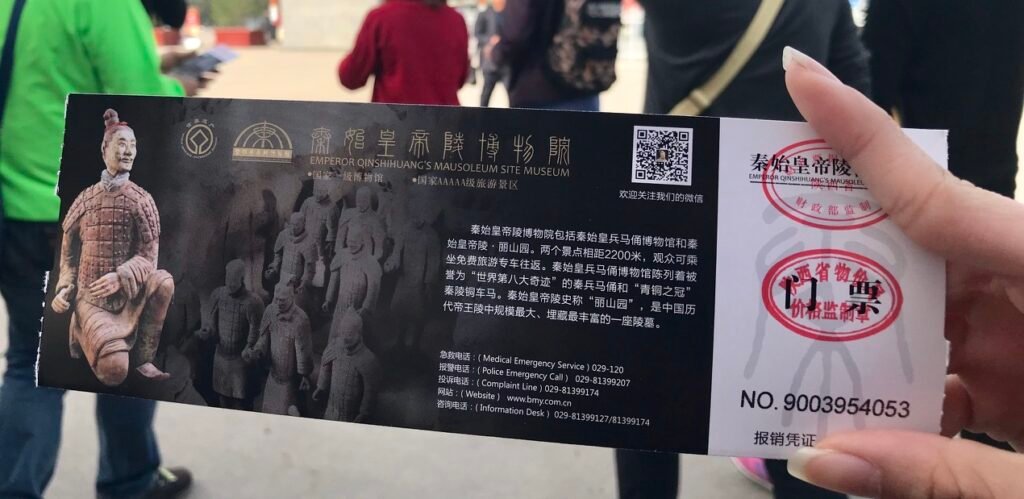
Emperor Qinshihuang’s Mausoleum Site Museum
(秦始皇帝陵博物院, Qín Shǐhuángdì Líng Bówùyuàn).
This includes the famous Terracotta Warriors museum area and the wider mausoleum site associated with:
Qin Shi Huang (秦始皇).
🔥
For a first-time visitor, treat this as:
a substantial half-day excursion
rather than:
“something I’ll squeeze in between lunch and the city wall.”
😂
🚗 How Long From Xi’an?
From central Xi’an, allow roughly:
1–1.5 hours each way by road
depending on:
where your hotel is,
traffic,
and:
time of day.
Road conditions and congestion can change, so don’t build your day around an unrealistically precise travel time.
🔥
If you’re staying around the:
Bell Tower (钟楼, Zhōnglóu)
or central Xi’an, the Terracotta Warriors are far enough away that:
planning the transport properly matters.
🚇 Can You Go by Public Transport?
Yes.
Xi’an’s expanding metro and local public-transport network makes independent travel increasingly practical, although the exact best connection can change as routes and services develop.
For independent travelers, the usual choices are some combination of:
metro (地铁, dìtiě)
+
bus / local transfer (公交车, gōngjiāochē)
or other local transport for the final approach.
🔥
This can be inexpensive.
But it also means:
transfers,
navigation,
more travel time
and:
working out the final connection.
If you’re comfortable navigating China independently:
perfectly doable.
If this is your first China trip and you want the easiest day:
there’s another option.
🚕 Taxi / Didi: The Easy Independent Option
A:
taxi (出租车, chūzūchē)
or:
Didi (滴滴, Dīdī)
can take you directly from your Xi’an hotel toward the Terracotta Warriors.
🔥
This is particularly convenient if:
two or more people are traveling together,
you don’t want public-transport transfers,
or:
you want to leave early.
Travel time still depends heavily on traffic.
And remember:
getting there is only half the problem.
The bigger question is:
Will you understand what you’re seeing when you arrive?
🐇
🧑🏫 This Is One Place Where Dad Recommends a Good Private Guide
Normally Dad is perfectly happy wandering around a museum reading signs.
😂
But the Terracotta Warriors are different.
You can certainly visit independently.
But a:
good licensed local guide (持证导游, chízhèng dǎoyóu)
can add enormous value here.
Why?
Because otherwise:
Pit 1:
lots of soldiers.
Pit 2:
fewer soldiers.
Pit 3:
even fewer soldiers.
Exit.
😭😂
You have just crossed one of the world’s great archaeological sites off your bucket list…
without really understanding it.
🌶️ What a GOOD Guide Should Explain
Not simply:
“This warrior is 1.8 meters tall.”
You can read that yourself.
😂
A good guide should help connect:
what you SEE
with:
why it MATTERS.
For example:
Why are the soldiers arranged this way?
What are archaeologists actually excavating?
How were the figures produced?
What happened to their original colors?
How do the pits relate to the larger mausoleum?
What do the weapons and horses tell us?
What can we responsibly say about Qin burial beliefs?
and:
What does this extraordinary project tell us about Qin state power?
🔥
That’s when the site becomes:
history
rather than:
photography.
🗺️ Better Still: Let the Guide Arrange the Day
If you’re using a private guide, Dad’s preference is simple:
let the guide arrange the itinerary and transport.
Especially for a first visit.
A knowledgeable Xi’an guide can coordinate:
hotel pickup,
transport to Lintong,
ticket timing,
museum visit,
the sequence of the pits
and:
return to Xi’an.
🔥
That saves Dad from spending the night before the visit doing:
metro → transfer → bus → which entrance → where’s my passport → why is Elaine hungry?
😭😂
Sometimes paying for:
less friction
is money well spent.
⏰ How Much Time Should You Allow?
For the museum itself, Dad would allow roughly:
3–4 hours
for a meaningful first visit.
Some travelers will move faster.
History and archaeology lovers can easily stay longer.
Then add:
travel time from Xi’an.
So realistically:
allow at least half a day.
🔥
If you combine the Terracotta Warriors with other Lintong attractions, it can become:
a full-day outing.
Don’t overpack the itinerary simply because several attractions appear close together on Google Maps.
🌅 Go Earlier If You Can
The Terracotta Warriors are:
one of China’s most famous attractions.
Translation:
people.
Lots of people.
😂
Crowds can be particularly heavy during:
weekends,
school holidays,
summer travel periods
and:
Chinese public holidays (法定节假日, fǎdìng jiéjiàrì).
If possible:
go earlier in the day.
And during major Chinese holidays, expect a very different crowd experience.
🎟️ Book Before You Go
This is not the sort of attraction where Dad recommends:
“We’ll just turn up and see what happens.”
😂
Ticketing procedures, reservation requirements and opening arrangements can change.
So before your visit:
check the official Emperor Qinshihuang’s Mausoleum Site Museum information
for the current:
ticket price,
reservation procedure,
opening hours
and:
entry requirements.
🔥
Bring the:
passport (护照, hùzhào)
used for the booking.
For international travelers in China, your passport is frequently your:
ticket + identification + travel survival document.
Don’t leave it at the hotel.
👀 Dad’s Suggested Viewing Order
Don’t rush immediately to:
Pit 1
take 36 photographs…
and emotionally finish the visit.
😂
A guide may recommend a different sequence depending on crowds, but whichever order you use, make sure you understand all three main pits.
Pit 1 (一号坑)
The spectacular scale.
Look for:
formation + excavation + restoration.
Pit 2 (二号坑)
Look for:
different troop types + military organization.
Pit 3 (三号坑)
Smaller.
Think:
command.
🔥
And don’t ignore the exhibitions containing important finds from the wider mausoleum complex.
The attraction is:
bigger than the postcard view.
📸 Take THREE Different Photographs
Dad’s challenge.
😂
Don’t return with:
57 versions of Pit 1.
Take:
1. The Army
Your classic Terracotta Warriors photograph.
2. The Archaeology
Broken figures.
Excavation areas.
Restoration.
Earth.
The well site.
3. The Detail
Horse.
Hairstyle.
Armor.
Rank.
Face.
Weapon-related display.
🔥
Then your photographs tell:
three different stories.
Army.
Archaeology.
People.
🪣 And Please Find the Well
Remember Section 1:
Site of the Well (秦俑井址, Qínyǒng Jǐngzhǐ).
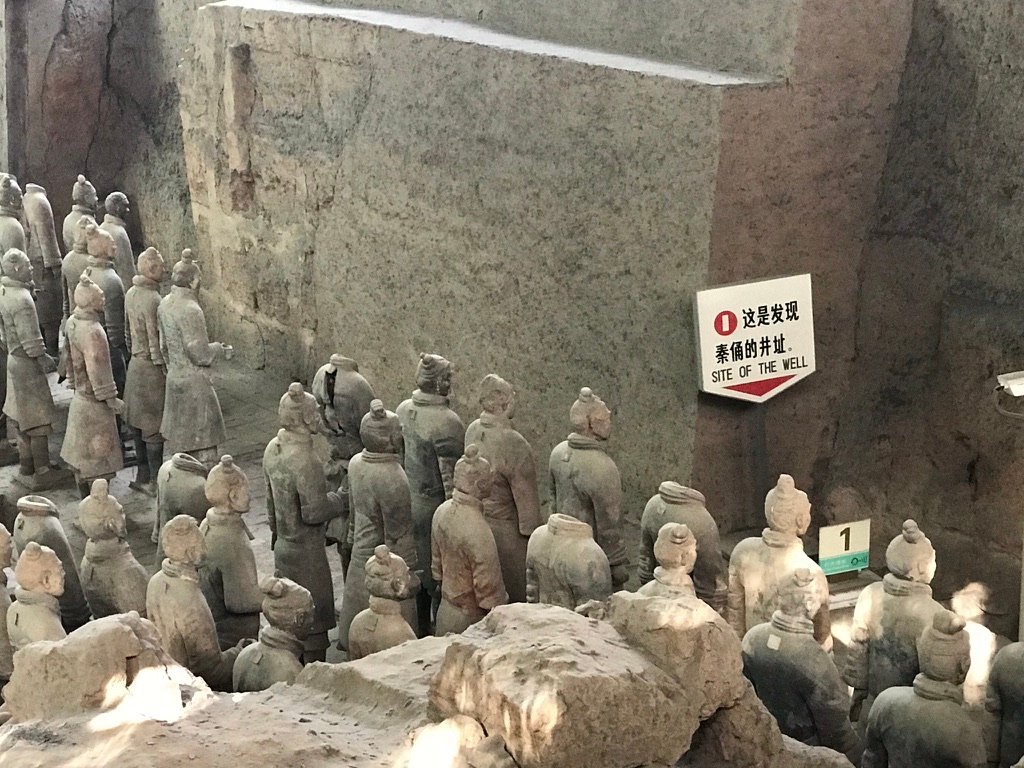
It’s easy to overlook beside thousands of warriors.
But Dad thinks you should stop.
Look.
Remember:
1974.
Farmers.
Well.
Terracotta fragments.
Archaeologists.
↓
One of the greatest archaeological discoveries of the twentieth century.
🔥
Sometimes the smallest thing at a famous attraction tells the best story.

🐞 Now You’re Ready for the Sting
Once you’ve seen the warriors properly, Dad wants you to leave with:
three questions.
Not 300 facts.
Just three.
🐇 QUESTION 1
You heard:
“Qin Shi Huang unified China.”
But:
What exactly did Qin Shi Huang “unify”?
Before:
221 BCE
there were competing:
Warring States (战国, Zhànguó).
So what did “China” actually look like before Qin?
🐇
🐇 QUESTION 2
Qin created this extraordinary political and archaeological world.
Then:
Qin dynasty (秦朝)
lasted only:
about 15 years.
😭😂
So:
Why did such a short-lived dynasty change Chinese history for more than 2,000 years?
🐇🐇
🐇 QUESTION 3
And if Qin Shi Huang:
“unified China”
then:
what existed BEFORE Qin?
Zhou?
Shang?
Xia?
Erlitou?
Taosi?
😬
Now you’ve fallen in.
🐇🐇🐇🐇🐇

🌶️ Ready for the Rabbit Hole?
If the Terracotta Warriors have stung you, don’t stop here.
READ NEXT: What Did Qin Shi Huang Actually “Unify”?
You already know the famous sentence.
Now discover what the political world looked like before:
221 BCE.
THEN: Qin Lasted Only 15 Years — So Why Did It Change China for More Than 2,000 Years?
The Qin dynasty disappeared almost immediately.
The imperial breakthrough:
didn’t.
THEN: Before China — When Does Chinese Civilization Actually Begin?
Qin leads backward to:
Zhou (周).
Zhou leads to:
Shang (商).
Then archaeology pulls us toward:
Erlitou (二里头)
Taosi (陶寺)
and much farther back.
🐇
One famous attraction.
Three Big Questions.
Several future China trips.
🔥
🐞 ChinaTravelBUG’s Take
Absolutely go to Xi’an for:
the Terracotta Warriors.
They’re famous for a reason.
Take the photograph.
Take the selfie.
Stand above Pit 1 and say:
WOW.
😂
But before you leave, look again at:
the well,
the excavation,
the horses,
the broken figures
and:
the earth beneath them.
Then ask:
“What kind of world could create this?”
That’s where the Terracotta Warriors stop being:
a bucket-list attraction
and become:
a doorway into Chinese history.
🐞
And if that question sends you from:
Xi’an
to:
Baoji (宝鸡)
then:
Anyang (安阳)
then:
Taosi (陶寺)
and one day:
Erlitou (二里头)…
don’t blame Dad.
😂
You’ve been stung.
See the place. Ask the bigger question. Understand China better.