
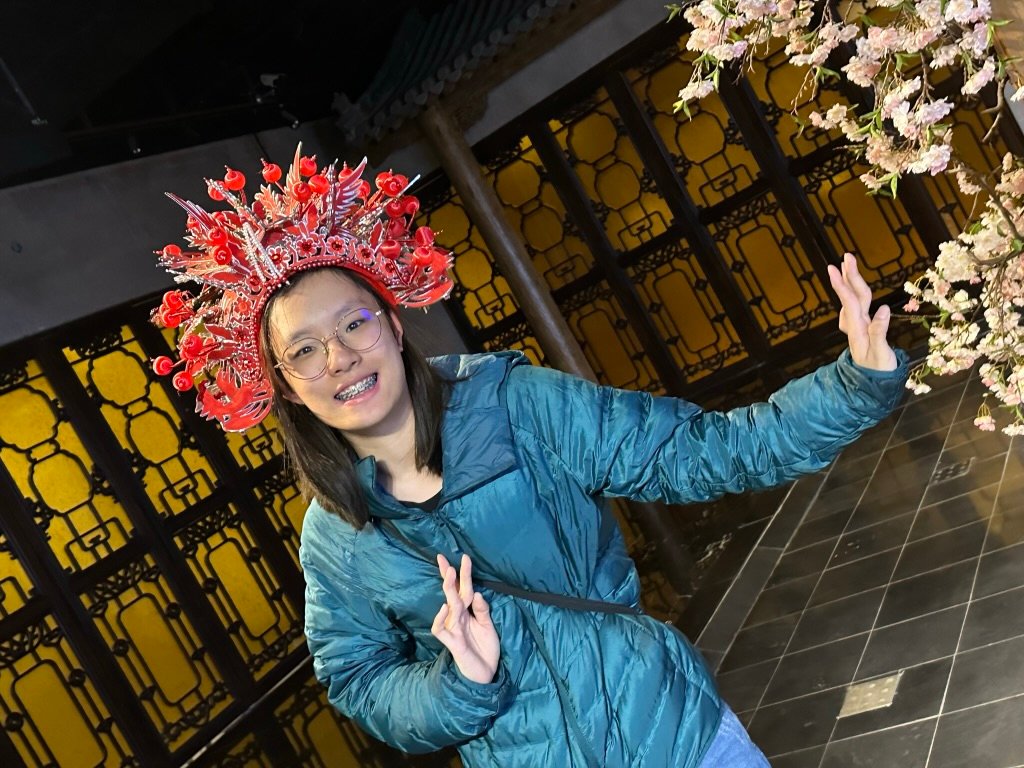
What We Experienced in Beijing: At Tianleyuan Grand Theatre near Qianmen, Elaine went from seeing Beijing Opera in books and videos to wearing the headdress, learning the gestures and experiencing one of China’s great performing traditions for herself. Some travel stories actually begin years before the trip. This one began in Shenzhen in 2018. Dad and Elaine were at Shenzhen Book City (深圳书城, Shēnzhèn Shūchéng) — a place Elaine would grow particularly fond of and eventually return to again in 2026. Dad bought her books. Among them were books about Mei Lanfang (梅兰芳, Méi Lánfāng) and Beijing Opera (京剧, Jīngjù), together with a Beijing Opera video album. Elaine posed for a photograph with them. At the time, Beijing Opera was something she could read about. Something she could watch. Years later, Dad and Elaine were walking through Old Beijing. And suddenly… it wasn’t in a book anymore. We Found Beijing Opera Near Qianmen We were in the historic Qianmen (前门, Qiánmén) area when we came to Tianleyuan Grand Theatre (天乐园大戏楼). This was already the sort of Beijing Dad wanted Elaine to experience. Not only the Forbidden City. Not only museums. Not only the big attractions where you stand in front of something famous and take a photograph. Dad wanted Elaine to encounter the culture that grew out of those centuries of Chinese history. And Beijing Opera was waiting for us. 🎥 Come Inside Tianleyuan With Us The first thing you’ll notice is that there is plenty to explore even before the performance begins. Costumes. Opera characters. Historic photographs. Stage props. Elaborate headdresses. Souvenirs. Displays explaining the theater’s history. And on the wall… a timeline. Then We Saw Mei Lanfang 梅兰芳 Again Look carefully at the history displayed behind the opera souvenirs. There is a name international visitors interested in Beijing Opera will encounter again and again: Mei Lanfang (梅兰芳, Méi Lánfāng) Mei Lanfang became one of the most celebrated performers in the history of Beijing Opera, particularly famous for performing dan (旦, dàn) — female roles traditionally performed on the opera stage. And according to the theater’s own historical display, Mei Lanfang performed here when he was still young. For Dad, that created a lovely connection. Remember that photograph from Shenzhen? One of the books Dad bought Elaine years earlier was about Mei Lanfang and Beijing Opera. Now Elaine was standing inside a Beijing theater connected with the history she’d previously encountered through those books. This is why Dad likes educational travel. Sometimes you don’t need to say: “Elaine, today we are going to study Chinese culture.” 😂 You simply put the earlier pieces in place. Then one day… the connections appear by themselves. But We Didn’t Come Just to Look at a Museum Tianleyuan 天乐园大戏楼 wasn’t only telling us what Beijing Opera used to be. There was a performance. The screen showed the program: 《亮相》 — Liàngxiàng with classic Beijing Opera highlights. The advertised excerpts included familiar pieces such as: 《贵妃醉酒》 — The Drunken Concubine 《霸王别姬》 — Farewell My Concubine 《三岔口》 — At the Crossroads and other famous scenes. There were several ticket categories. Dad chose the most affordable one. ¥180. There’s something useful for first-time China travelers hidden in this very ordinary screenshot too. Dad paid using Alipay (支付宝, Zhīfùbǎo), with a linked international Visa card. No cash. No complicated ticket counter negotiation. Payment successful. ¥180. Sometimes our travel photographs aren’t glamorous. But they’re useful. 😂 Then Someone Put This on Elaine’s Head And this is where the story became much more fun. Elaine wasn’t sitting quietly reading about Beijing Opera anymore. She was wearing an elaborate opera-style headdress. Then someone started showing her what to do with her hands. 🎥 Elaine Tries Beijing Opera Watch her hands. The instructor demonstrates the stylized position. Elaine watches. Tries it. Adjusts. Then tries again. And at the end… that smile. 😂❤️ Even the Hands Have a Language One of the things that can surprise a first-time international audience is how stylized Beijing Opera is. The performer doesn’t simply walk, turn, point or gesture in the same way we might in everyday life. Movement itself becomes part of the performance language. Elaine was being shown the graceful hand positioning often associated with orchid fingers (兰花指, lánhuāzhǐ). A tiny movement of the fingers may look simple when an experienced performer does it. Then you try. 😂 Suddenly it isn’t quite so simple. And that’s why Dad liked this little hands-on experience. Elaine could have watched a performer make the gesture from her seat. Instead, for a few moments, she had to think about: Where does my hand go? What do I do with my fingers? How do I hold my arm? Watching had become doing. Dad Paid ¥180. Was It Worth It? For us? Yes. Not because Dad suddenly became a Beijing Opera expert. And not because Elaine left Tianleyuan ready to perform professionally. 😂 It was worth it because the experience gave something we had previously encountered through books and videos a physical memory. Years earlier: Mei Lanfang 梅兰芳 was a face on Elaine’s book. Now: she was standing inside a theater associated with Beijing Opera history. Years earlier: opera costumes were pictures. Now: she could stand beside them. Years earlier: Beijing Opera was something to watch. Now: someone was correcting the position of her fingers. That’s a very different kind of learning. And Then Dad Started Looking at the History This is where ChinaTravelBUG usually gets into trouble. 😂🐇 Because once you look past the costumes and colorful faces, Beijing Opera starts opening doors into much bigger questions. Why are the faces painted different colors? Why were male performers famous for playing female roles? Who was Mei Lanfang 梅兰芳? Why do certain gestures mean particular things? Why does a character sometimes seem to travel enormous distances on a nearly empty stage? And how did 京剧 (Jīngjù) become so closely associated with Beijing? We won’t answer all of those here. This is Follow Our Stories, not Dad’s 5,000-word Beijing Opera
A Fat Cat, a Skinny Dog and an Ordinary Morning in a Beijing Hutong
Daily Life in Old Beijing: Dad went for a morning walk and found cats on rooftops, a little dog, a caged songbird, potted plants — and a reminder that Beijing’s hutongs are still people’s homes. Not every travel story needs a famous attraction. Sometimes you just need a fat cat. 😂 Dad was walking through a Beijing hutong (胡同, hútòng) one morning when a fluffy white cat wandered past. Nothing unusual about that. Then Dad looked up. Sitting above the lane, comfortably occupying the roof ledge of a traditional courtyard residence, was another cat. A considerably larger cat. A very well-fed cat. And suddenly Dad wasn’t going anywhere. Meet the Hutong Cat 🎥 Come Meet Him With Dad Watch what happens. The big tabby sits above the street as though the hutong belongs to him. A local woman comes outside and talks to Dad. She calls to the cat. Dad talks with her. The cat walks along the roof tiles. Eventually it leans down far enough for Dad to give it a little pat. And somewhere in the middle of all this… a small dog appears. 😂 No ticket. No attraction. No itinerary. Just an ordinary morning encounter in Beijing. And we loved it. Dad Started Noticing Something About Hutong Pets Dad had already noticed cats elsewhere during our stay. Even one of the hutong lodgings we stayed in had three resident cats around the lobby. Then there was this enormous tabby. A little dog coming out from the courtyard. Another white cat wandering down the lane. These weren’t animals put there for tourists. They were simply part of the neighborhood. And that’s one reason we like this video so much. It doesn’t show you how Beijing’s hutongs look. For a couple of minutes, it shows you something about how they feel. Quiet enough to hear the birds. A neighbor chatting outside. Someone calling her cat. A dog barking. Dad having a conversation with somebody he’d never met before. This is the sort of thing that disappears if your entire Beijing itinerary is: car → attraction → car → attraction → hotel. Then Look at This Door There’s plenty in this photograph that might attract an international traveler’s camera. The old wooden door. The traditional metal ring knocker. The red Spring Festival couplets (春联, chūnlián). The large gold Chinese characters. The courtyard visible through the open doorway. But Dad’s photograph contains something much more important. Look at the white piece of paper attached to the door. It says: 私人住宅 请勿打扰 Sīrén zhùzhái — private residence. Qǐng wù dǎrǎo — please do not disturb. That may be one of the most useful pieces of Chinese an international traveler can encounter while exploring Beijing’s hutongs. Because this isn’t a museum entrance. Somebody lives here. An Open Door Isn’t an Invitation This is worth remembering when you explore Beijing’s hutongs. Some courtyard entrances are beautiful. A door may even be standing open. And through it you may glimpse plants, carvings, traditional architecture or an interesting courtyard. It’s tempting to step inside for a photograph. Don’t assume you can. A siheyuan (四合院, sìhéyuàn) may be historic and beautiful… but it can also be someone’s home. The sign Dad photographed couldn’t make that clearer: 私人住宅,请勿打扰。Private residence. Please do not disturb. Enjoy the doorway. Take a photograph from the public lane where appropriate. Then keep walking. Respecting the people who live in the hutong is part of experiencing it properly. Then Dad Heard a Bird On another quiet stretch of the hutong, Dad noticed something else outside a residence. Not a cat this time. Listen. 🎥 A Songbird Outside a Hutong Home Behind the red window grille hangs a traditional round birdcage. Inside: a little songbird. And beneath it are potted plants. Then, while Dad’s camera is looking at all this, somebody rides past on a bicycle. That’s it. 😂 Again, absolutely nothing worthy of a “Top 10 Things to See in Beijing” list. And yet it’s one of those tiny scenes that tells us why walking through a living hutong is different from visiting a monument. Birds, Plants, Cats… and a Front Window Keeping songbirds has a long tradition in China, and you’ll still occasionally encounter birdcages around parks, neighborhoods and homes. Potted plants are another little piece of the scene. Neither needs a huge cultural explanation here. That’s not what Dad was doing that morning. He simply noticed how people had personalized the small spaces around their homes. A birdcage here. Plants there. A cat occupying the roof as though he had paid for it. 😂 These little details turn a row of gray-brick buildings into a neighborhood. A School, a Potsticker Shop and an Ordinary Morning in a Beijing Hutong Daily Life in Old Beijing: Dad’s morning walk through the Dashilan hutong area showed us something simple but important — schools, homes and small businesses all share the same neighborhood. Sometimes a short walk explains a place better than a long guidebook. Dad was walking through the Dashilan (大栅栏, Dàshílàn) area of Old Beijing one morning. Nothing dramatic was happening. And that was exactly the point. 🎥 Walk Through the Hutong With Dad At the beginning of the video, Dad points toward a primary school: Kangleli Primary School (康乐里小学). Then the camera moves. A cyclist passes. Someone walks by. Traditional gray-brick courtyard homes line the street. Old vines twist over the walls and roofs. And a little farther along… a small potsticker shop appears. All within the same few seconds. This Is What Made Dad Stop and Think For international travelers, Beijing’s hutongs are often introduced as: historic lanes or traditional courtyard neighborhoods. That’s true. But Dad’s video shows something more useful. This wasn’t simply a street of preserved old houses. There was a school. There were homes. There were small businesses. People were walking and cycling through the neighborhood. In other words: this was a functioning community. A School Inside the Hutong The Kangleli Primary School (康乐里小学) sits right inside the
We Didn’t Just Visit a Beijing Hutong — We Stayed in One
Where We Stayed in Beijing: Dad chose a traditional Chinese-style lodging near Qianmen so Elaine could experience Old Beijing beyond the famous sights. There are plenty of modern hotels in Beijing. We could have stayed in one. Instead, Dad chose something rather different for Elaine. A traditional Chinese-themed lodging tucked into the hutong (胡同, hútòng) area near Qianmen (前门, Qiánmén), right in the historic center of Beijing. Why? Because this Beijing trip wasn’t only a holiday for us. For Elaine, it was also an opportunity to experience China’s history and culture outside a textbook. Dad didn’t want her simply to visit Old Beijing for two hours. We wanted to know what it felt like to stay there. We’d Just Arrived in Beijing This was Dad shortly after we checked in. 🎥 Dad Shows You Where We Stayed Our lodging was in the old-city area close to Qianmen Street (前门大街, Qiánmén Dàjiē), one of the best-known historic commercial streets in central Beijing. Dad described the place in the video as something between a small hotel, lodging house and homestay-style property. And that’s probably a better way of thinking about it than imagining a conventional international hotel. The attraction wasn’t a swimming pool. It wasn’t a huge breakfast buffet. It certainly wasn’t a marble hotel lobby. 😂 The attraction was the experience. Then We Walked Inside This is what greeted us. Red. Green. Lanterns hanging overhead. Traditional-style wooden windows. Chinese decorative details. A long red carpet running through the middle. And rooms facing inward toward the central space. For a first-time international traveler, it certainly doesn’t feel like walking into another anonymous chain hotel. And that was precisely why Dad had chosen it. Look Up One of our favorite things about this place was that there was always something to look at. Red lanterns hung from the upper levels. Decorative woodwork ran along the balconies. A large traditional-style lantern dominated the space overhead. Even walking from the entrance to our room felt different from walking down the corridor of an ordinary hotel. 🎥 Going Upstairs This wasn’t a historical courtyard residence preserved exactly as it would have appeared centuries ago. Nor were we pretending that sleeping here meant we were experiencing precisely how Beijing families traditionally lived. It was accommodation designed with a strong traditional Chinese and courtyard-style atmosphere. But for Elaine, that distinction didn’t make the experience meaningless. Quite the opposite. It gave us questions to ask. What Is a Siheyuan 四合院? One Chinese word is particularly useful when exploring Old Beijing: 四合院 — sìhéyuàn A siheyuan (四合院) is a traditional Chinese courtyard residence, especially associated with historic Beijing. 四 (sì) means four. 合 (hé) carries the idea of joining or enclosing. 院 (yuàn) means courtyard. Traditionally, buildings were arranged around a central courtyard, creating an inward-facing residential space. And many of Beijing’s famous hutongs (胡同) developed as lanes running between these courtyard compounds. So there’s a useful distinction for first-time visitors: 胡同 (hútòng) → the lane or alley 四合院 (sìhéyuàn) → the courtyard residence behind the walls Our lodging gave Elaine a much more tangible sense of this courtyard idea than simply reading those words in a guidebook. The Lobby Had Another Surprise Then we explored the common area. 🎥 Look Around the Lobby With Us Again, don’t rush through the video. Look around. The red lanterns. Wooden furniture. Chinese decorative elements. Plants. The courtyard-like arrangement. And toward one side… Guan Yu 关羽 Wait… Why Is Guan Yu 关羽 in Our Hotel? While looking around the common area, Dad noticed something else. A shrine dedicated to: Guan Yu (关羽, Guān Yǔ) International travelers may know Guan Yu as a famous general from the turbulent years at the end of the Han Dynasty and the beginning of the Three Kingdoms (三国, Sānguó) period. But in China, Guan Yu became much more than a historical military figure. Over the centuries, he became particularly associated with: 忠 (zhōng) — loyalty and 义 (yì) — righteousness That’s one reason you may encounter Guan Yu shrines in Chinese businesses, restaurants, hotels and other places. And there was another connection that made Dad smile. We had actually traveled to Yuncheng (运城, Yùnchéng) in Shanxi — the region where Guan Yu was born. So there we were in a hutong hotel in Beijing… and another place from our travels through China had suddenly followed us into the lobby. 😂 🐇 Curious about Guan Yu? His story takes us far beyond this little shrine in Beijing — back to Yuncheng, where we followed Guan Yu, the legendary Emperor Shun, and China’s much older ideas about what makes a “good man.” Follow our journey to Yuncheng: Shun, Guan Yu and China’s Ideas of the Good Man → And Then We Stepped Outside This was perhaps the most important part. Our experience didn’t stop at the front door. We were staying close to Qianmen Street, in the historic heart of Beijing. That meant when we went outside, we could continue exploring on foot. Old commercial streets. Hutong lanes. Traditional doors. Local shops. Restaurants. Everyday neighborhood life. And that made the accommodation part of the journey rather than simply somewhere we returned to at night. That’s something Dad increasingly appreciates when choosing where we stay in China. Sometimes the best hotel isn’t necessarily the most luxurious one. It’s the one that puts you inside the story you’re trying to experience. 👧 Why Dad Chose This for Elaine This is probably the most important part of this story. Dad mentioned it briefly in the video. This trip was also part of Elaine’s own educational journey through Beijing. We could take her to the Forbidden City. We could take her to museums. We could explain emperors, dynasties and traditional architecture. All useful. But Dad also wanted Elaine to experience China by being inside it. Walk through a hutong. Notice how people live. Look at the doors. Eat the local food. Hear the street in the morning. And for a few nights… sleep
We Found the Hustle and Bustle of Old Beijing — Still Alive Today
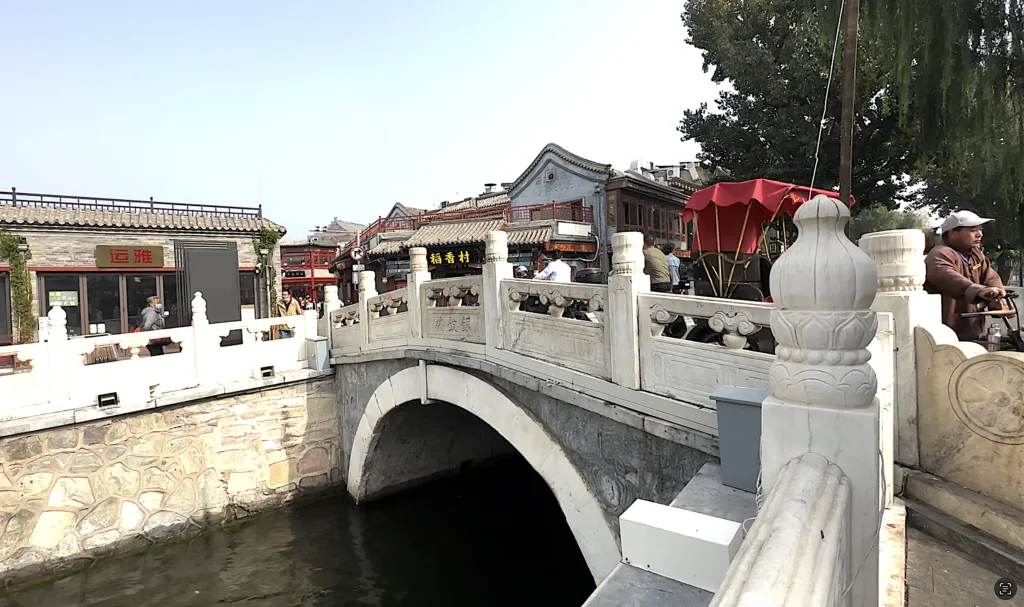
In the City: Standing near Yinding Bridge in Shichahai, Dad found one of those places where historic Beijing and the modern city seem to occupy the same streets. When we say Old Beijing, it’s easy to imagine somewhere quiet. Gray hutong walls. Traditional courtyard houses. An old bicycle. Perhaps an elderly resident sitting outside his front door. But then Dad walked into this part of Beijing. And it wasn’t quiet at all. 😂 People everywhere. Shops. Restaurants. Visitors. Noise. Movement. A commercial street doing exactly what commercial streets are supposed to do: buzzing with life. And right nearby was a little bridge with a much bigger story. Come Stand Here With Dad Dad was near Yinding Bridge (银锭桥, Yíndìng Qiáo) in the historic Shichahai (什刹海, Shíchàhǎi) area. Listen to the video rather than just watching it. The voices. The movement. The shops. The people passing. This wasn’t Dad standing in front of a preserved historic building and explaining what used to happen here. Beijing was happening around him. That’s what made us curious. Why Is There a Bridge in the Middle of Old Beijing? Yinding Bridge 银锭桥 crosses the narrow waterway between Qianhai (前海) and Houhai (后海), two of the lakes that form part of the Shichahai water system. And water is an important part of this story. Historic Beijing wasn’t connected only by roads and hutong lanes. Its waterways were also tied into the movement of goods and supplies associated with the Grand Canal (大运河, Dàyùnhé) system. That helped make the Shichahai area an important part of the commercial life of old Beijing. Suddenly the shops and crowds around Dad weren’t quite so surprising. People have been coming through this part of Beijing for a very long time. Look at What’s Happening Around the Bridge Today Dad says something in the video that captures why we stopped here: “Soak yourself into the atmosphere of the hustle and bustle, the sights, the sounds, of old Beijing.” That’s really the experience. Don’t come here expecting a silent historic exhibit. Around Shichahai today you’ll find restaurants, cafés, shops and other businesses mixed into an area of old lanes, waterways and traditional Beijing neighborhoods. Some parts are highly commercial. Some lanes nearby become much quieter. And that’s exactly why we enjoyed walking here. Turn one way: crowds and commerce. Turn another: hutongs and courtyard doors. Walk a little farther: someone repairing a house, a scooter passing, residents going about their morning. Old Beijing isn’t presented to you in one neat package. You walk through different versions of it. Then Our Photos Connected the Pieces There are two photographs from this part of our Beijing journey that we appreciate much more now than when we first took them. Photo 1: A Small Bridge With a Much Bigger Story At first glance, this looks like a pleasant little stone bridge. But look at everything around it. There’s water underneath. Traditional-style buildings and shops beyond it. People crossing. Businesses operating. The whole area is busy. That’s important because Shichahai (什刹海, Shíchàhǎi) wasn’t historically isolated from the economic life of Beijing. Its waterways were connected with the water-transport system associated with the Grand Canal (大运河, Dàyùnhé), which brought enormous quantities of grain and other goods toward the imperial capital. So when Dad stood here talking about the hustle and bustle of Old Beijing, the water behind him wasn’t merely scenery. Water helped make this part of Beijing important in the first place. Of course, today’s restaurants, shops and visitors are not the same commerce that existed centuries ago. But we liked the continuity. A place shaped by movement and activity in Old Beijing is still full of movement and activity today. Photo 2: Dad & Elaine Standing Beside the Grand Canal This second photograph helps explain why Dad became so interested in that little waterway near Yinding Bridge. Look behind us. The sign says: 全国重点文物保护单位National Key Cultural Relics Protection Unit and, in much larger characters: 大运河 Dàyùnhé — the Grand Canal. For a first-time international traveler, those three Chinese characters are worth remembering: 大 (dà) — great运 (yùn) — transport河 (hé) — river/canal The Grand Canal is easy to think of as something you visit somewhere else in China. Perhaps Hangzhou. Suzhou. Or another famous canal city. But here we were… in Beijing. That was the connection that made us look at Shichahai differently. The waterways we were seeing weren’t simply decorative lakes and canals surrounded by attractive hutongs. They belonged to a much larger story about how the imperial capital was supplied and connected with the rest of China. 🐇 One Photograph Leads to Another Question And this is where a simple city walk starts becoming very ChinaTravelBUG. We came here to experience Beijing’s hutongs. We found Yinding Bridge. Dad noticed the busy commercial streets. Then we noticed the water. Then came the Grand Canal sign. And suddenly the question became much bigger: Why did Beijing need this enormous canal system in the first place? That’s a rabbit hole for another ChinaTravelBUG story. For this walk, it’s enough to know one thing: when you’re standing around Shichahai, don’t look only at the old buildings. Look at the water too. It helps explain why this part of Old Beijing mattered. Was Old Beijing Busy Like This Too? Not in exactly the same way, of course. The businesses have changed. The customers have changed. Tourism has changed the area enormously. Modern Beijing surrounds it. So we wouldn’t say that what Dad saw was “exactly the same” as commercial life hundreds of years ago. But there’s a connection that we find much more interesting. This is still a place of movement and activity. The historic waterways helped connect this area with the life and commerce of the old capital. Today, people are still coming here. For completely different reasons perhaps. To eat. To shop. To walk around Houhai. To photograph the hutongs. To meet friends. Or, like Dad… simply to stand there for a while and watch Beijing
🏘️ Beijing Hutongs Aren’t Just Tourist Attractions — People Still Live Here
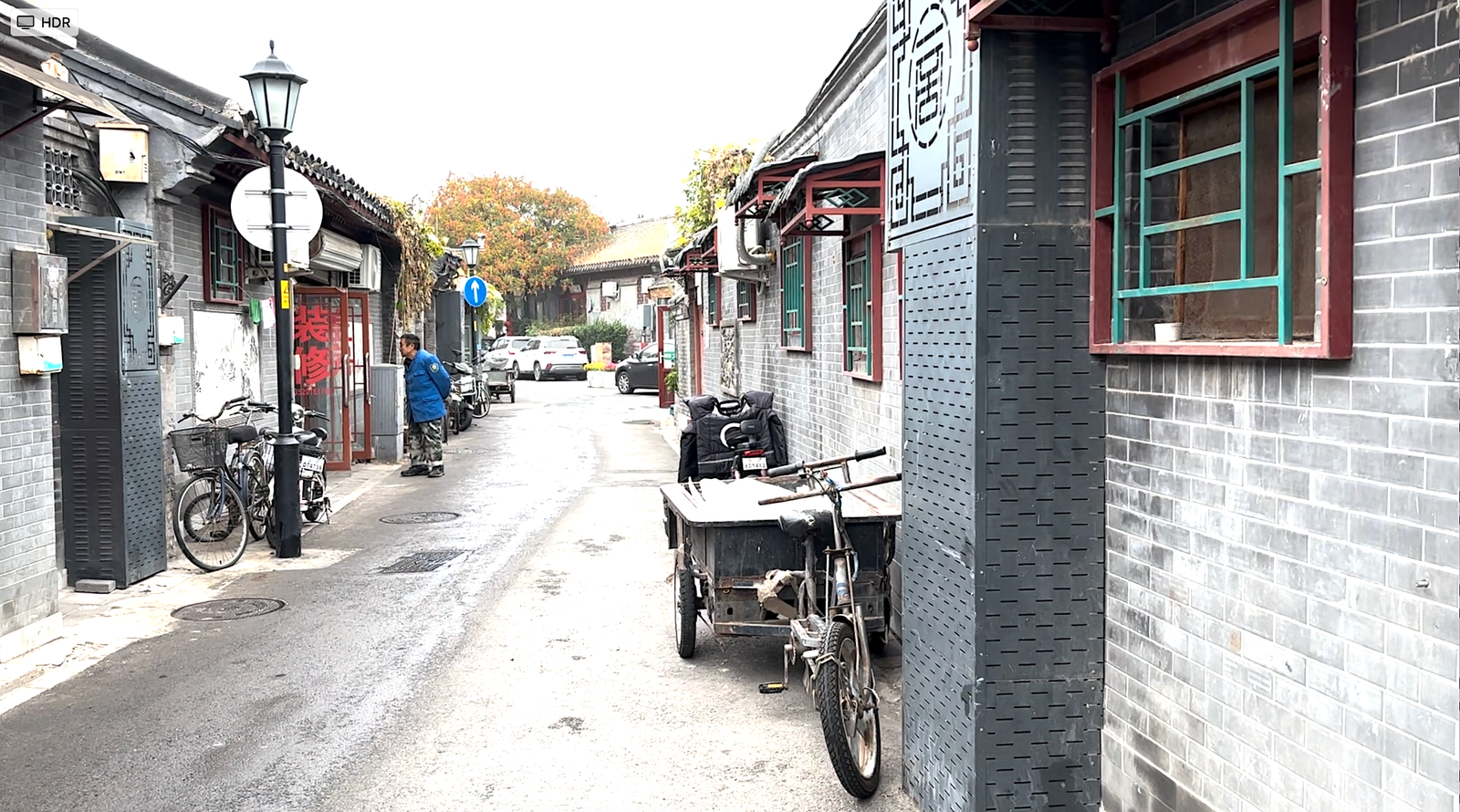
Daily Life in a Beijing Hutong: We walked beyond the postcard image and found public toilets, neighborhood services, shops, scooters, construction — and an ordinary weekday morning unfolding around us. Before visiting Beijing, it’s easy to imagine a hutong (胡同, hútòng) as something from old China. Gray walls. Narrow lanes. Red doors. Traditional courtyard houses (四合院, sìhéyuàn). Perhaps a bicycle passing by at exactly the right moment for your photograph. 😂 But when Dad walked through Beijing’s hutongs, something else became obvious. This isn’t just somewhere tourists come to see old Beijing. People still live here. And once we started looking at the hutong as a living neighborhood, rather than simply an attraction, we began noticing things that probably don’t appear on many Beijing must-see lists. Including… public toilets. Wait… Why Are There So Many Public Toilets? Dad noticed them while walking. Not one enormous tourist restroom complex. Smaller public toilets scattered through the hutong area. 🎥 Dad Explains What He Noticed There is a historical reason this matters. Many of Beijing’s older hutong homes were built long before modern indoor plumbing and sanitation became normal. Some traditional courtyard residences were subsequently subdivided among multiple households, and some older homes did not have their own private toilets. Shared and public toilets therefore became part of everyday neighborhood infrastructure. Of course, Beijing’s hutongs have changed enormously and conditions vary from home to home. But for a first-time international traveler, those public toilets reveal something important: A hutong isn’t simply old architecture preserved for us to photograph. It has had to function as a place where real people live. So What Exactly Is a Hutong? Dad explains it while we’re walking: 🎥 Inside a Beijing Hutong The word hutong (胡同, hútòng) generally refers to the lanes and alleys traditionally associated with Beijing’s courtyard neighborhoods. And that’s an important distinction. A hutong is the lane. The traditional courtyard residence you see behind many of those walls is a siheyuan (四合院, sìhéyuàn). For an international traveler, remembering just those two Chinese words is enough: 胡同 (hútòng) → the lane or alley 四合院 (sìhéyuàn) → the traditional courtyard residence Once you understand that, the neighborhood starts making much more sense. You’re not simply walking between rows of “old Chinese houses.” You’re moving through a network of lanes connecting homes, businesses and community services. Dad Even Found Firefighting Facilities This was one of those little details that caught Dad’s attention. In the video, Dad points out firefighting facilities within the hutong neighborhood. At first, that doesn’t sound terribly exciting. Until you look around. Narrow lanes. Closely packed buildings. Traditional structures. Limited access in some places. Then suddenly a neighborhood fire facility doesn’t seem like a random object at all. It reminds us again: people actually live here. A real neighborhood needs practical services. Fire protection. Sanitation. Deliveries. Repairs. Shops. Transport. The things that make everyday urban life possible don’t disappear just because the surroundings happen to be historic. Then the Hutong Changed Again Walk a little farther and another version of hutong life appears. Shops. Food and drink. Boutique accommodation. Chinese art. Stationery. Brushes. Dad found himself on a more commercial stretch. 🎥 A Commercial Street Inside the Hutong Area It was still morning, so things were relatively quiet. And that’s actually useful for seeing what has happened to parts of Beijing’s hutong areas. Some lanes remain predominantly residential. Others have become increasingly commercial. You may find cafés and restaurants beside traditional buildings. Boutique hotels tucked behind old-style entrances. Small shops selling things that appeal to both local customers and visitors. Old Beijing and modern Beijing aren’t neatly separated here. They occupy the same streets. But Our Favorite Video May Be the One Where Dad Says Nothing No explanation this time. Just watch. 🎥 A Typical Weekday Morning in a Beijing Hutong Turn the sound on. Scooters pass. Someone is working. You hear construction. Voices drift through the street. People come and go. Nothing dramatic happens. And that’s precisely why we like this video. This isn’t the Beijing of the Forbidden City. It isn’t the Great Wall. Nobody is performing “traditional Beijing life” for Dad’s camera. It’s simply a weekday morning. For a few seconds, you’re standing there with us. Look Beyond the Gray Walls Once we started thinking about the hutong as a living community, little things we’d seen during our walk began connecting. The public toilet wasn’t just a toilet. It told us something about the history and practical realities of older housing. The fire facilities weren’t random street furniture. They were part of keeping a dense old neighborhood functioning. The shops and boutique hotels showed how some hutong streets are adapting to modern Beijing and tourism. The scooters, repairs and construction sounds reminded us that this isn’t a frozen historic district. People are still using these streets. That’s the Beijing we find particularly interesting. Not: Old Beijing OR modern Beijing. But: Old Beijing continuing to live inside modern Beijing. Should a First-Time Beijing Traveler Visit a Hutong? We think so. But don’t go only because you want photographs of gray walls and red doors. And don’t expect every lane to look like a perfectly restored heritage attraction. Walk slowly. Look at the houses. Look at what’s happening outside them. Notice where people park their scooters. Notice the small shops. Notice the neighborhood facilities. Listen. And occasionally… look for the public toilet. 😂 Not because the toilet itself is a major Beijing attraction. Because once you start asking why it’s there, you begin understanding the neighborhood differently. ChinaTravelBUG’s Take Before walking these lanes, it would have been easy to describe Beijing’s hutongs with a few familiar words: historic. traditional. picturesque. All true. But incomplete. What Dad’s camera kept showing us was something much simpler: The hutong is alive. Someone is repairing something. Someone rides past on a scooter. A shop is opening for the morning. A public toilet serves the neighborhood. Firefighting equipment sits ready. Construction makes noise somewhere down the lane. And
What Dad Noticed About the Front Doors in Beijing’s Hutongs
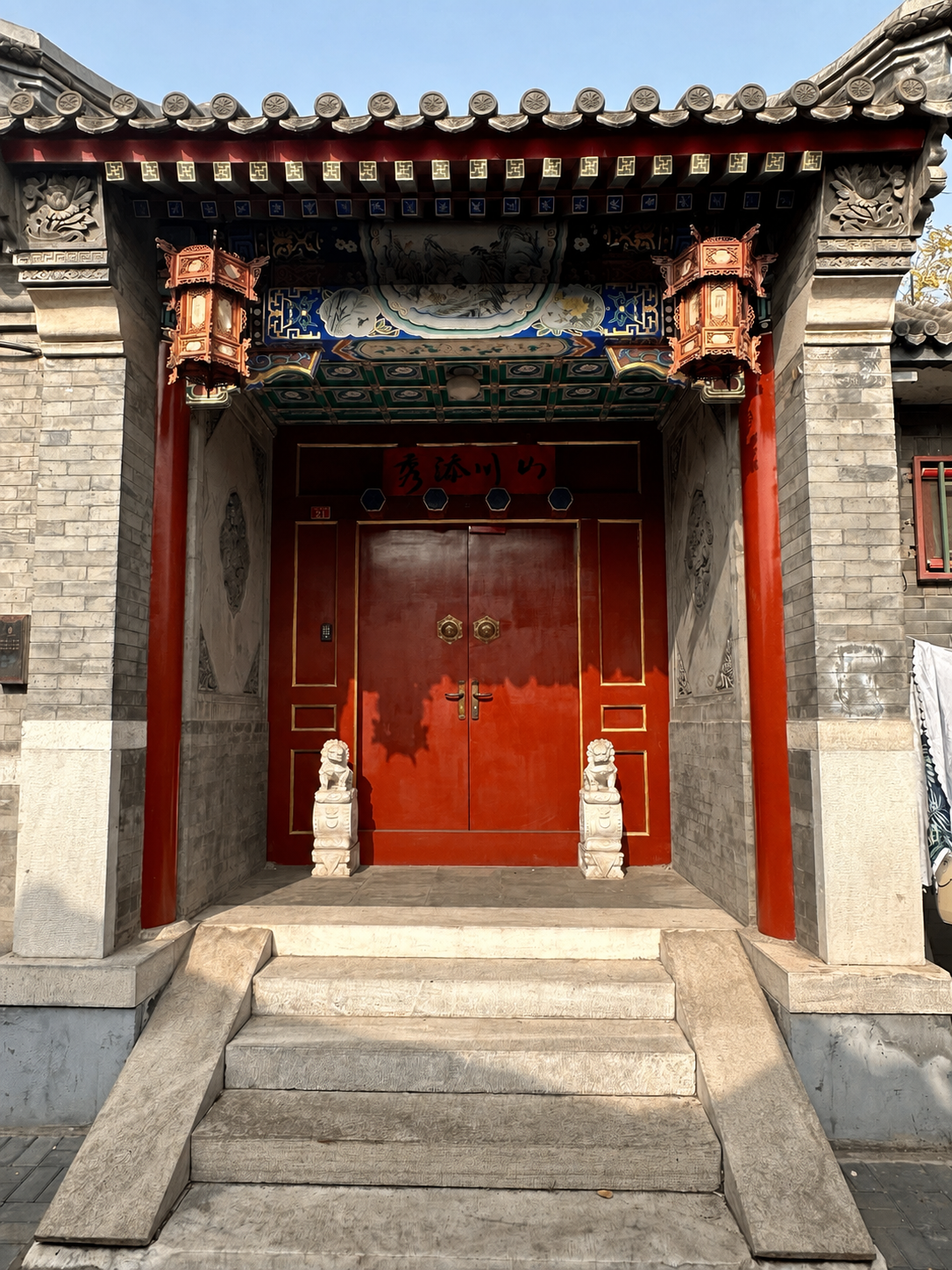
Traditional Beijing hutong doors: A repairman working outside a courtyard house made Dad stop and look more closely at the stone carvings, door knockers and lucky symbols around these old entrances. We were walking through one of Beijing’s hutongs (胡同, hútòng) when something very ordinary made Dad stop. A repairman was working at the front of a house. There was no famous attraction here. No entrance ticket. No tour guide explaining what we were looking at. Just someone doing a job outside his door. Dad stopped to watch. And that was when we started looking at the door itself. It Started With This Repairman This is what Dad saw. It wasn’t the sort of thing we would normally put on a Beijing itinerary. But that’s exactly why we enjoy walking through the hutongs. When you’re not rushing from one attraction to another, ordinary things have a chance to catch your attention. And this one did. Because once Dad looked beyond the repairman, there seemed to be an awful lot happening around that front door. 👀 Look at the Door Again At first glance: Beautiful old Beijing door. But stay for another few seconds. There are the large red wooden doors. Two metal ring knockers. Stonework at the bottom. Small stone animals guarding the entrance. Carvings around the doorway. And beautifully painted architectural details overhead. This wasn’t simply a door in a wall. It was the entrance to a traditional Beijing courtyard residence (四合院, sìhéyuàn). And suddenly we had a question: Why are there so many things around a traditional Beijing front door? That’s where curiosity took us. What Are Those Stones Beside the Door? One of the easiest details to miss is sitting right at the bottom. Traditional Beijing courtyard entrances can have stone elements known as mendun (门墩, méndūn). They weren’t originally placed there simply as decoration. They had a practical architectural connection to the gateway and its heavy wooden doors. But look more closely and they can also be decorated with carvings and auspicious designs. Animals. Flowers. Patterns. Symbols carrying hopes for things such as good fortune and protection. So when you’re walking through a Beijing hutong, don’t look only at the doors. Look down. Those old stones beside them may be telling part of the story too. 🦁 And What Are Those Little Animals? Now look at Dad’s photograph again. There are two small stone creatures beside the entrance. Guardian animals and auspicious creatures have a long presence in traditional Chinese architecture. You’ll see the most spectacular examples outside palaces, temples and important buildings. But residential entrances can contain their own smaller carved animals and symbolic designs. We shouldn’t look at every animal outside every Beijing house and assume it has exactly the same meaning. That’s where it’s easy to turn a fascinating subject into an oversimplified one. For us, the important discovery was simpler: they weren’t necessarily there just because somebody thought they looked nice. There could be meaning behind what we were seeing. And that made us look at the next door differently. Then We Found Another Door Very different. Less elaborate. More obviously lived-in. But now that we’d started looking, Dad’s camera picked up the details immediately. Two wooden doors. Two metal door rings (门环, ménhuán). Stonework beside the entrance. Red decorations. And right in the middle of each door: 福 福 (fú) means good fortune, blessing or happiness. It’s one of the Chinese characters international travelers are most likely to encounter on doors, particularly around Chinese New Year. Once you recognize 福, you’ll probably start spotting it all over China. What Are Those Red Strips Around the Door? Look at the red strips running down the sides of the entrance. These are Spring Festival couplets (春联, chūnlián). They traditionally carry auspicious words and wishes for the coming year. And this is where the second photograph becomes particularly interesting. The stonework and wooden doorway belong to the architecture. The red couplets and 福 characters were added by the people using the home. One is part of the physical house. The other tells us something about the traditions still being practiced by the people living behind that door. This isn’t simply an exhibit of “old Beijing.” It’s somebody’s front door. Even the Door Knockers Deserve Another Look There was one more detail Dad’s photographs kept capturing. Those metal rings. In Chinese they’re called 门环 (ménhuán) — door rings. They’re practical, of course. But on traditional Chinese doors, even practical objects can become decorative features. Look at the metalwork surrounding the rings. Then compare the knockers on one doorway with another. It’s another tiny detail that’s very easy to walk past. Until somebody makes you notice it. Then you start seeing them everywhere. 😂 The Door Hadn’t Changed. The Way We Looked at It Had. That’s the part of this little walk we remember. We hadn’t suddenly become experts on traditional Chinese architecture. Nor could we look at every carving and confidently explain exactly what it meant. But after stopping at that first doorway, something had changed. At the beginning: Nice old Beijing door. Photo. Keep walking. Afterwards: What’s carved into that stone? Why are there animals there? What does that 福 mean? What’s written on those red couplets? Why do the door knockers look like that? The doors hadn’t changed. We had simply started looking more closely. ChinaTravelBUG’s Take When international travelers hear Beijing hutongs, it’s natural to think about the narrow lanes and traditional siheyuan (四合院) courtyard houses. Those are the big things. But travel gets more interesting when the small things start interrupting you. For Dad, it was a repairman working outside a house. He made us stop. Stopping made us look at the door. The door made us notice the stones. Then the animals. Then the knockers. Then the Chinese characters. One completely ordinary moment had opened another little window into Beijing. That’s exactly what Where Curiosity Took Us is about. SEE → ASK → CONNECT → UNDERSTAND We didn’t set
We Found an Old Beijing Hidden Under Wangfujing
What We Found in Beijing: Heping Guoju (和平菓局) Dad went wandering around Wangfujing while Elaine visited the National Museum — and discovered an entire version of 1980s Beijing hiding underneath a department store. 🚶 Dad Went Downstairs… and Found Old Beijing This was another discovery from the afternoon when Elaine managed to get a free ticket to the National Museum of China — and Dad didn’t. 😂 Instead of waiting around, I walked over toward Wangfujing (王府井, Wángfǔjǐng). Eventually I entered the Beijing Department Store. Then I went down to B2. And suddenly, modern Wangfujing disappeared. Welcome to Heping Guoju (和平菓局). 🎥 Come Downstairs With Dad 👀 Wait… What’s This Doing Under a Department Store? Heping Guoju recreates the atmosphere of 1980s Beijing. Instead of another modern shopping floor, we found narrow hutong-style lanes, vintage brick walls, old grocery stores, retro photo booths and all sorts of little details designed to make you stop and look. And then there was this: an old green train carriage. 🎥 Walking Through Heping Guoju This is the fun of the place. You don’t really come here to stand in front of one famous object. You wander. Turn a corner. Look into an old shop. Notice something from another era. Take photographs. Then turn another corner. For Dad, who had only come to Wangfujing because he couldn’t get into the National Museum with Elaine, this was a pretty good Plan B. 😂 🍜 And Then Dad Got Hungry Of course, all that wandering eventually led to another question: What should Dad eat? Since I was surrounded by an imitation of old Beijing, there was one rather appropriate answer. Old Beijing Zhajiangmian (老北京炸酱面, Lǎo Běijīng Zhájiàngmiàn). That bowl became a separate little ChinaTravelBUG story of its own. Dad Missed the Museum — So He Ate Beijing Instead 🎥 One More Look Around 📍 If You Want to Find It Heping Guoju (和平菓局)B2 Floor, Beijing Department StoreWangfujing Street, Beijing 🚇 Getting There Take Beijing Subway Line 1 to Wangfujing Station and walk from Exit A. 👥 Dad’s Practical Tip If you have a choice, try a weekday morning or afternoon. Weekends can become extremely crowded, and Heping Guoju is much more enjoyable when you have room to wander around and actually notice the little details. 🐞 What We Remember Dad hadn’t planned to visit Heping Guoju. In fact, Dad hadn’t planned to spend the afternoon in Wangfujing at all. Elaine got the National Museum ticket. Dad didn’t. That small disappointment sent me walking. The walk took me into a department store. The department store took me downstairs. And downstairs… Dad somehow ended up in 1980s Beijing. 😂 That’s one of the things we’ve learned from traveling around China: China Usually Has Another Way. Sometimes you just have to go downstairs to find it. 🐞
🍜 Dad Missed the Museum — So He Ate Beijing Instead
What We Ate in Beijing: Old Beijing Zhajiangmian (老北京炸酱面, Lǎo Běijīng Zhájiàngmiàn) Elaine got a ticket to the National Museum of China. Dad didn’t. So while she explored the museum, Dad walked to Wangfujing — and ended up eating one of Beijing’s signature noodle dishes. Elaine Got In. Dad Didn’t. 😂 This wasn’t supposed to be a food story. Elaine and I wanted to visit the National Museum of China (中国国家博物馆, Zhōngguó Guójiā Bówùguǎn) together. Admission was free, but you still needed to secure a ticket online. We tried. Elaine managed to get one for herself. Dad didn’t. So Elaine went into the museum. Dad was left outside. I could have waited around until she finished, but that seemed a terrible waste of a few hours in central Beijing. So I started walking. 🚶 From the National Museum to Wangfujing I headed toward Wangfujing (王府井, Wángfǔjǐng). There wasn’t really a Plan B. That was the nice part. I wasn’t rushing between attractions or trying to tick another famous Beijing sight off a list. I simply had time to spare while waiting for Elaine. Eventually I reached the Beijing Department Store on Wangfujing Street. Then I discovered something downstairs. On the B2 floor was Heping Guoju (和平菓局), a recreated old-Beijing world tucked underneath the modern department store. 🎥 Come Downstairs With Dad I had only come to Wangfujing because I couldn’t get into the National Museum. Now I was wandering through this unexpected little world beneath one of Beijing’s best-known shopping streets. That became another story of its own. But Dad was also getting hungry. And if you’re unexpectedly wandering around Beijing… you might as well eat Beijing. 🍜 What Dad Ate: Old Beijing Zhajiangmian I ordered Old Beijing Zhajiangmian (老北京炸酱面, Lǎo Běijīng Zhájiàngmiàn). Then this arrived. Look at it before we mix everything up. The first thing that caught my eye was that enormous dollop of dark, glossy sauce sitting right in the middle. Around it were different vegetables and toppings — cucumber, greens, bean sprouts, soybeans and those striking pink strips. And underneath everything: the noodles. This is one of those dishes where the photograph before eating is useful. Because what happens next isn’t particularly photogenic. 😂 🥢 Now Mix It Zhajiangmian (炸酱面) is essentially noodles served with a thick, savory fermented-bean-based sauce and accompanying vegetables. But don’t eat each little pile separately. Mix it. The dark sauce gets worked through the noodles, the vegetables get tossed in, and that beautifully arranged bowl rapidly becomes… well… a bowl of mixed-up noodles. 😂 But that’s when it becomes good. You get the richness and saltiness of the sauce together with the freshness and crunch of the vegetables and the noodles underneath. Simple food. Filling food. And very much a food associated with Beijing. 🎥 Dad’s Unexpected Afternoon at Heping Guoju 👀 Why This Bowl Felt So Right There was something particularly satisfying about eating Old Beijing zhajiangmian that afternoon. Think about how the day had unfolded. Elaine was inside one of China’s great museums looking at national treasures. Dad couldn’t get in. So Dad walked away from the museum, wandered through central Beijing, went downstairs beneath a department store… …and sat down with a bowl of noodles. 😂 But the more we’ve traveled around China, the more I’ve come to appreciate these moments. The famous sights tell you one part of a city. Everyday food tells you another. You can learn about Beijing through emperors, palaces, temples and museums. But Beijing is also something people eat. And sometimes understanding a place begins with something as ordinary as wondering: What are the locals putting on their noodles? 🐞 China Usually Has Another Way There is another reason I remember this lunch. It happened because something went wrong. Had Dad managed to get that National Museum ticket, I would have spent the afternoon inside with Elaine. No walk to Wangfujing. No unexpected wandering around Heping Guoju. And probably no zhajiangmian. That’s become one of our recurring lessons traveling around China. Plans change. Tickets disappear. You miss something. And occasionally the thing you do instead becomes a story worth remembering. That’s why we keep saying: China Usually Has Another Way. That afternoon, Elaine got the museum. Dad got the noodles. I think we both did rather well. ❤️ 📍 If You Want to Find Dad’s Bowl Heping Guoju (和平菓局)B2 Floor, Beijing Department Store255 Wangfujing StreetDongcheng District, Beijing 🍜 What Dad Ordered Old Beijing Zhajiangmian老北京炸酱面Lǎo Běijīng Zhájiàngmiàn And if yours arrives looking as neatly arranged as Dad’s did: Take the photograph first. Then destroy the evidence. Mix everything together. 😂🍜 ❤️ What We Remember The funny thing is, the National Museum ticket was the disappointment that started this story. But that’s not what I remember most. I remember Elaine heading into the museum without me. I remember deciding that Dad wasn’t going to spend the next few hours sitting around. I remember walking toward Wangfujing. And I remember this bowl. A dark mound of sauce. Fresh vegetables around it. Noodles underneath. And Dad thinking: Well, I’m in Beijing. Let’s eat Beijing. Sometimes the best travel meal isn’t the restaurant you researched for weeks. It’s the bowl you found because your original plan didn’t work. 🐞🍜