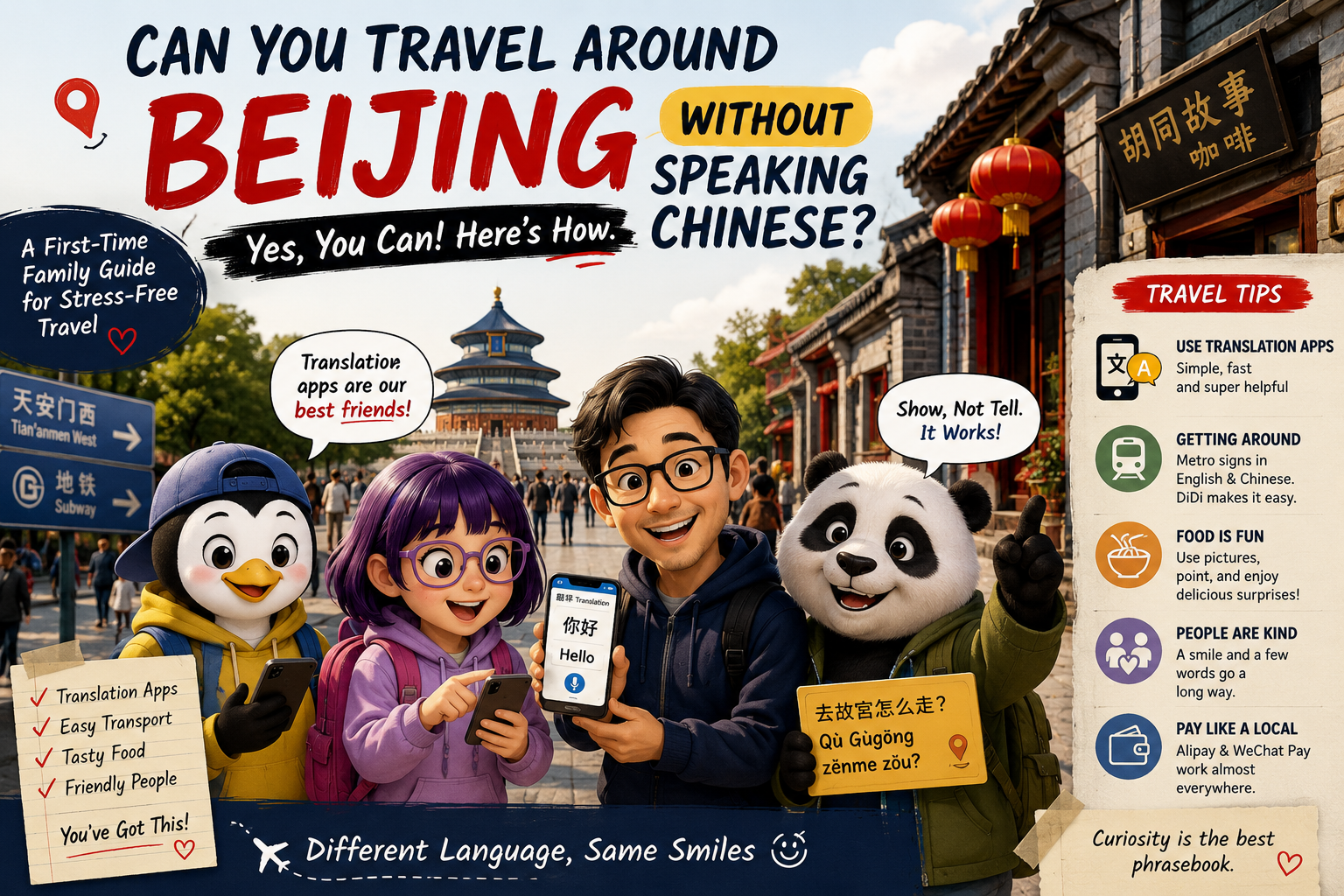
“Dad… What If Nobody Understands Us?”
One evening, while planning future China adventures, Elaine was scrolling through a travel community when she stopped.
“Dad, someone just asked…”
“Is it possible for a non-Chinese speaker to navigate the city?”
Before I could answer, Cheers pulled a tiny Chinese phrasebook from his backpack.
He looked worried.
“I only know one Chinese sentence.”
The Beijing Panda smiled.
“Which one?”
Cheers stood proudly.
“你好!” (Nǐ hǎo — Hello!)
The Panda laughed.
“That’s already enough to make someone smile.”
Elaine looked at me.
“Were you worried about that before our first trip?”
I nodded.
Honestly?
Yes.
Probably every first-time visitor wonders exactly the same thing.
The good news is that travelling around Beijing—and most of China’s major cities—is much easier than many Western travellers imagine.
The Short Answer
Yes.
Thousands of international visitors travel independently around Beijing, Shanghai, Xi’an, Chengdu and many other Chinese cities every year without speaking Mandarin.
Will you occasionally run into language barriers?
Of course.
But today’s China is also one of the world’s most digital societies.
Translation apps.
Digital payments.
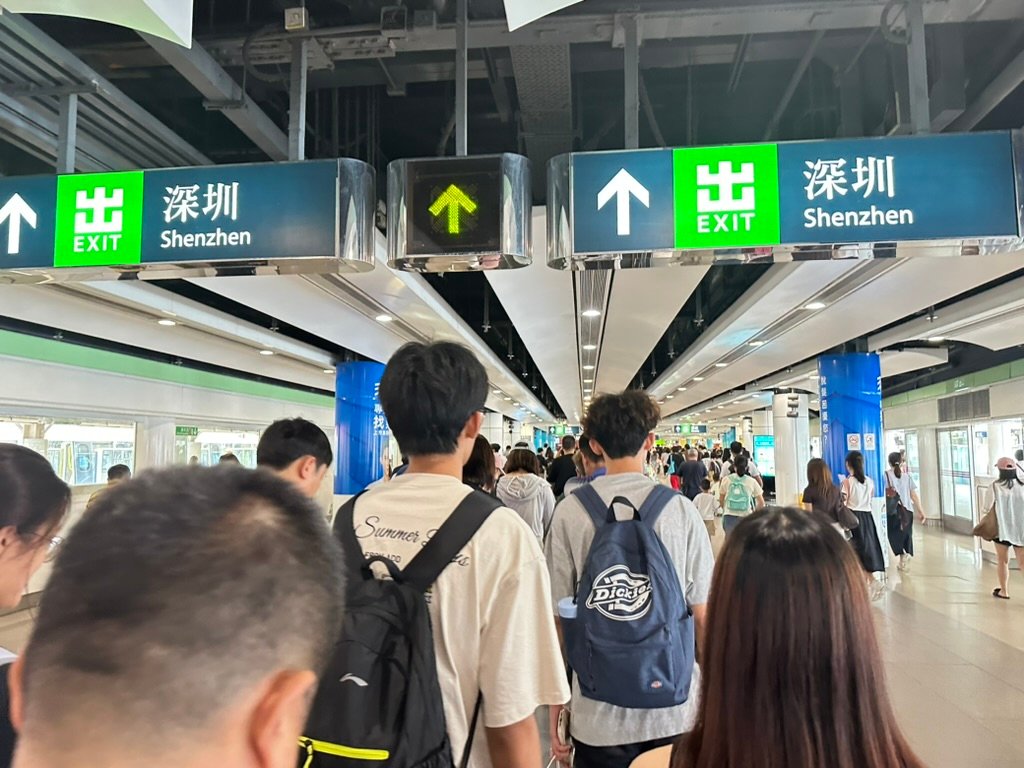
Bilingual transport signs.
Online maps.
These tools make independent travel much easier than many first-time visitors expect.
Beijing Panda Says…
“You don’t need perfect Chinese.”
“You need curiosity—and a charged phone.”
Cheers quickly checked his battery.
“Uh-oh…”
Dad quietly handed him a power bank.
“Now you’re ready.”
Why Beijing Is Easier Than You Think
Before visiting China, many people imagine they’ll constantly struggle to communicate.
That wasn’t our experience.
Beijing is one of China’s most international cities, and many parts of its transport system and tourist infrastructure are designed to help overseas visitors.
You’ll usually find:
- Beijing Subway station names displayed in both Chinese and English
- bilingual announcements at airports and many railway stations
- English signage at many major attractions
- international hotels with English-speaking staff
- younger Chinese who have learnt English at school, even if they may feel shy about speaking it
Sometimes the conversation wasn’t in English.
Sometimes it wasn’t in Chinese either.
It was simply smiles, gestures and people genuinely trying to help.
Your Smartphone Becomes Your Interpreter
Cheers proudly opened his little phrasebook again.
The Beijing Panda gently placed a smartphone on top of it.
“Welcome to modern China.”
During our trips, we quickly realised that our phone became one of the most useful travel companions.
Translation apps helped us:
- order meals
- ask for directions
- communicate with hotel staff
- shop at local markets
- understand signs and menus
One trick worked especially well.
Instead of trying to pronounce a destination, we simply showed people the destination written in Chinese.
The difference was remarkable.
Taxi drivers understood immediately.
Hotel staff pointed us in the right direction.
Even friendly locals often smiled and nodded.
Getting Around Beijing
One surprise for us was how straightforward Beijing’s transport system became once we understood the basics.
You can comfortably explore the city using:
🚇 The Beijing Subway
Clean, affordable and easy to navigate, with station names shown in both Chinese and English.
🚖 DiDi
China’s version of Uber.
When you book through the DiDi app or via Alipay, your destination is sent directly to the driver—so there’s usually very little conversation required.
🚄 High-Speed Rail
Travelling to nearby cities like Tianjin is simple once your ticket is booked using your passport.
🚶 Walking
Some of our favourite discoveries happened simply by wandering through hutongs and lakeside neighbourhoods.
Ordering Food Isn’t As Difficult As You Think
Cheers stared at a menu covered entirely in Chinese characters.
“Dad…”
“I can’t read any of this.”
The Beijing Panda smiled.
“Can you see the pictures?”
Many restaurants—especially those in shopping centres, tourist districts and popular neighbourhoods—have:
- picture menus
- QR-code ordering
- photographs of dishes
- bilingual menus
Smaller neighbourhood restaurants may only have Chinese menus.
That’s where a translation app—or simply pointing at a delicious-looking dish—often works surprisingly well.
Some of our best meals happened that way.
Will People Speak English?
This is probably the biggest misconception.
Many Chinese people have studied English at school.
However, not everyone feels confident speaking it with foreign visitors.
That doesn’t mean they’re unwilling to help.
Quite the opposite.
We often found that people tried their best using gestures, translation apps or by finding someone nearby who spoke a little English.
One afternoon, a shop assistant couldn’t explain the way to a bus stop.
Instead, she walked outside and pointed us in the right direction.
Sometimes kindness doesn’t need a shared language.
Cheers’ China Survival Kit
Before every ChinaTravelBUG adventure, Cheers checks his backpack.
✔ Passport
✔ Alipay ready
✔ Translation app
✔ Power bank
✔ Hotel address saved in Chinese
✔ Offline copies of important information
✔ A smile
The Beijing Panda nodded.
“Don’t forget the last one.”
Beijing Panda’s Local Tip
Learn just five Chinese phrases.
- 你好 (Nǐ hǎo) — Hello
- 谢谢 (Xièxie) — Thank you
- 请 (Qǐng) — Please
- 不好意思 (Bù hǎo yì si) — Excuse me / Sorry
- 再见 (Zàijiàn) — Goodbye
Will your pronunciation be perfect?
Probably not.
Will people appreciate the effort?
Almost always.
Elaine’s Discovery
Before our first journey, Elaine imagined that not speaking Mandarin would make everything difficult.
Instead, she discovered something unexpected.
Communication wasn’t always about words.
A metro employee pointed to the correct platform.
A grandmother smiled and gestured towards an empty seat.
A restaurant owner proudly showed us how to mix the dipping sauce.
Those little moments reminded us that travel is about connecting with people—not performing perfect conversations.
Dad’s Reflection
Later that evening, Cheers asked me,
“Dad… should I learn Chinese before our next trip?”
I smiled.
“If you can learn a few words, wonderful.”
“But don’t wait until you’re fluent before visiting China.”
Technology can translate words.
Only curiosity can translate cultures.
That has become one of the biggest lessons we’ve learnt through our travels.
Final Thoughts
If you’re worried that not speaking Chinese will stop you from enjoying Beijing…
Don’t let it.
Be prepared.
Download the right apps.
Save important addresses in Chinese.
Learn a few simple phrases.
Smile often.
Be patient—with yourself as much as with others.
You won’t understand every conversation.
You may occasionally take the wrong metro exit or order something unexpected for lunch.
We certainly did.
But those moments often become the stories you laugh about long after the journey ends.
As we boarded our flight home, Cheers proudly announced,
“Dad! I know seven Chinese words now!”
The Beijing Panda grinned.
“That’s seven more opportunities to make a friend.”
At ChinaTravelBug, that’s what we believe travel is really about.
Not speaking perfect Chinese.
Not ticking off attractions.
But discovering that kindness, curiosity and shared experiences often communicate far better than words ever can.
Continue Planning Your First China Adventure
If you’re planning your first visit, these guides will help you travel with confidence:
First-Time Travelling to China? The Complete Travel Checklist
Can Foreign Tourists Use Alipay in China?