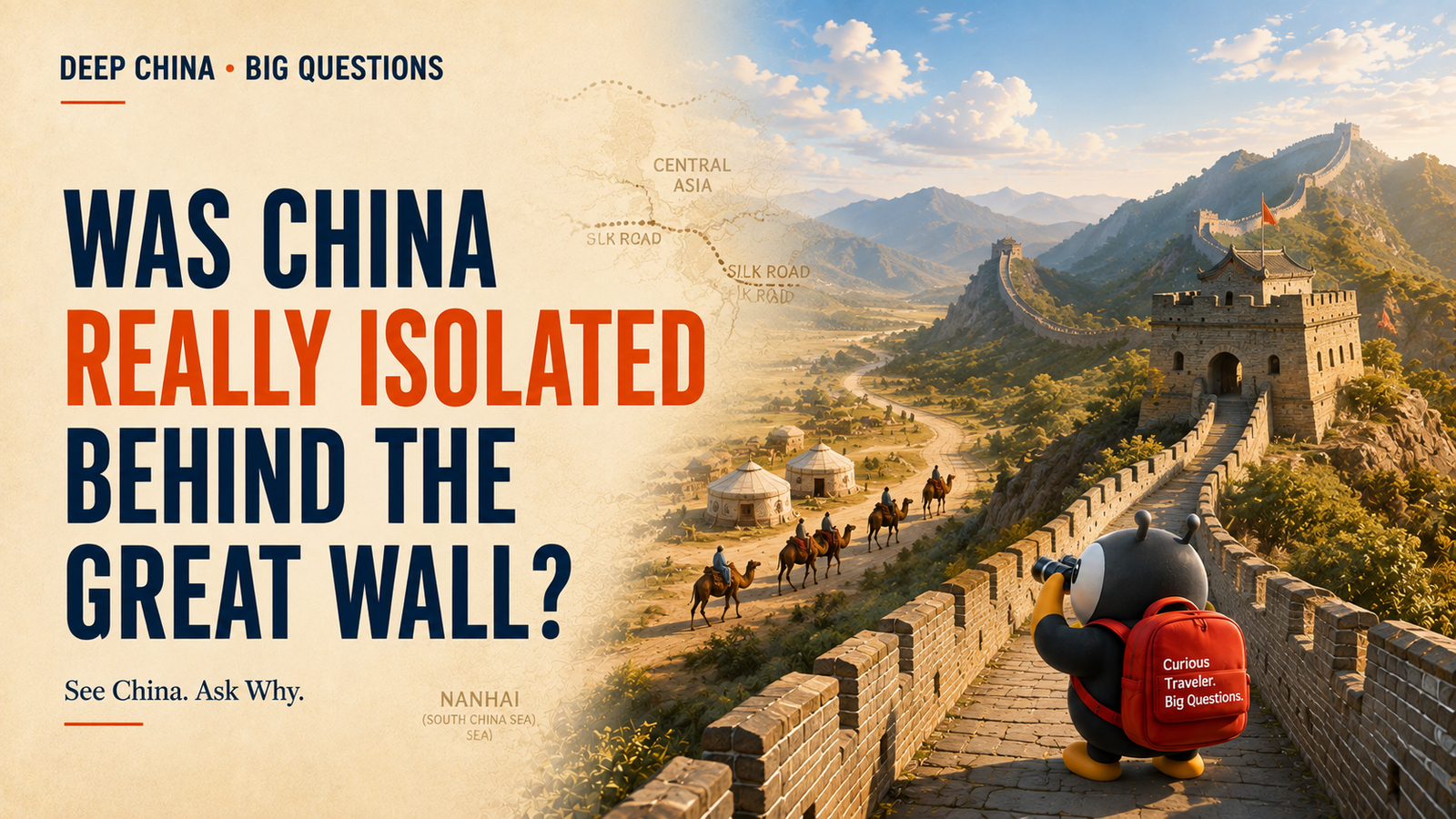
Section 1 — The Great Wall Looks Like a Barrier. Chinese History Was Much More Porous.
You’re standing on the:
Great Wall (长城, Chángchéng)
outside:
Beijing (北京, Běijīng).
Mountains stretch into the distance.
Watchtowers sit along the ridges.
A huge stone wall separates one side from the other.
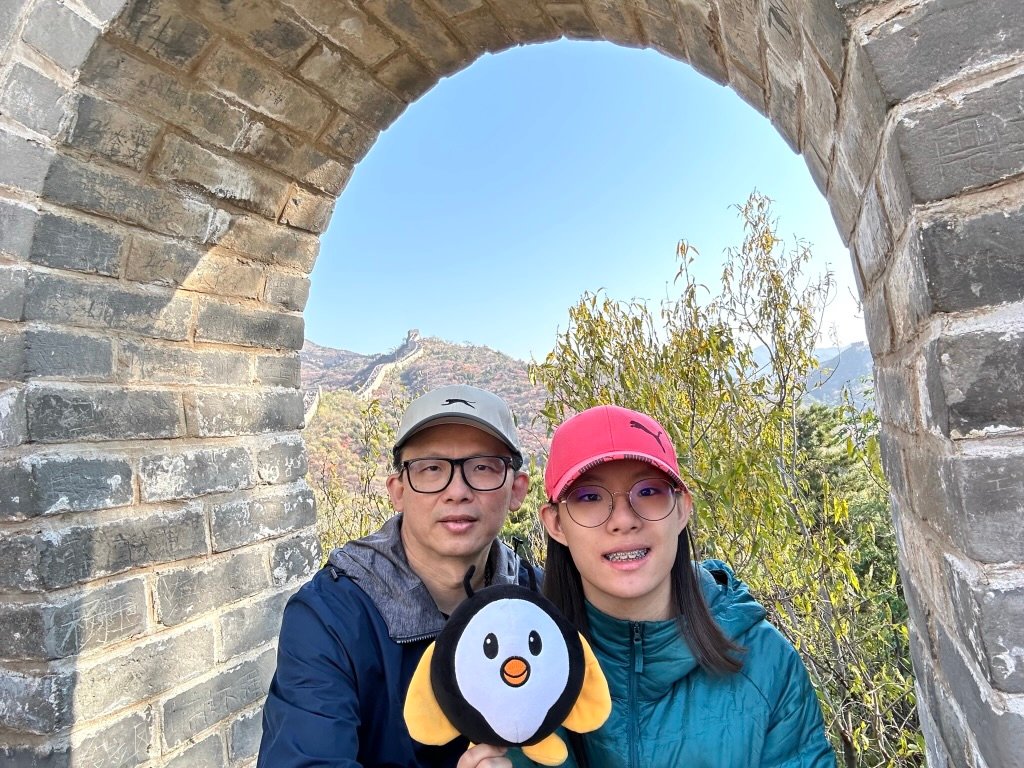
And it’s very easy for a first-time traveler to absorb one powerful visual message:
CHINA WAS BEHIND THE WALL.
↓
THE OUTSIDE WORLD WAS OVER THERE.
😂
Wall.
Barrier.
Separation.
Isolation.
Except…
Chinese history doesn’t behave nearly as neatly as the photograph suggests.
Because for thousands of years:
people crossed.
goods crossed.
armies crossed.
religions crossed.
technologies crossed.
ideas crossed.
🔥
And sometimes the people who crossed China’s frontiers eventually:
ruled China.
So perhaps the better question isn’t:
“Did the Great Wall isolate China?”
It’s:
“How connected was China to the worlds beyond the Wall?”
🐇
First: A Wall Doesn’t Mean a Closed Country
We learned in Michelin Course1 that the Great Wall wasn’t one wall constructed once.
It was a changing system of:
walls,
passes (关, guān),
fortresses (堡, bǎo),
watchtowers,
beacon towers (烽火台, fēnghuǒtái),
and:
military routes
developed across different historical periods.
Its purpose included:
defense.
Absolutely.
But defense doesn’t automatically mean:
isolation.
Think about a gate in a city wall.
The gate can:
close,
but it can also:
open.
🔥
The important question becomes:
Who is allowed through, when, and under what conditions?
Now we’re looking at the frontier differently.
🍚 Western Handrail: Think Customs Gate, Not Prison Wall
Imagine a fortified medieval European city.
Walls protect it.
Guards watch the gates.
But through those gates still pass:
merchants,
travelers,
messengers,
soldiers,
animals,
food,
and:
information.
The existence of the wall doesn’t mean:
“Nobody ever comes in.”
😂
It means:
movement can be controlled.
That’s a much better handrail for understanding parts of China’s northern frontier.
UNESCO Gives Us an Important Clue
The:
Great Wall (长城, Chángchéng)
has been a:
UNESCO World Heritage Site
since:
1987.
UNESCO describes the Great Wall as evidence not only of conflict, but also of:
exchange
between agricultural and nomadic civilizations.
That second word matters.
🔥
Because once we start looking for:
exchange (交流, jiāoliú)
the wall stops looking like the edge of an isolated civilization.
It starts looking like part of:
a frontier network.
🐇 So What Was Crossing the Frontier?
Let’s begin with the obvious:
goods (货物, huòwù).
Different ecological worlds produce different things.
Settled agricultural regions could produce:
grain,
textiles,
manufactured goods,
tea in later periods,
and many other products.
Pastoral regions supplied things such as:
horses (马, mǎ),
livestock,
animal products
and goods moving through wider Inner Asian networks.
That creates:
trade (贸易, màoyì).
And trade creates another problem for our:
“China was sealed behind the wall”
theory.
😂
🐎 Horses Matter More Than Most Tourists Realize
Here’s a wonderful beginner’s historical key:
horse (马, mǎ).
If you’re studying Chinese frontier history, don’t underestimate the horse.
Powerful cavalry required:
good horses.
And the grassland worlds north and northwest of agricultural China were famous sources of horses.
Chinese states repeatedly wanted access to them.
Why?
Because the same mounted military capabilities that made northern powers dangerous were also capabilities Chinese armies wanted.
🔥
Remember:
King Wuling of Zhao (赵武灵王, Zhào Wǔlíng Wáng)
and:
mounted archery (骑射, qíshè)?
He didn’t look north and say:
“Foreign. Ignore.”
He looked north and thought:
“That’s useful.”
😂
Frontiers produce borrowing.
🌶️ Conflict and Exchange Can Happen at the Same Time
This is one of the most useful ideas in the entire article.
Modern readers sometimes imagine:
WAR
or:
TRADE.
Choose one.
History doesn’t cooperate.
😂
Two political powers can:
fight this year,
negotiate next year,
trade throughout,
exchange envoys,
arrange marriages,
then:
fight again.
So:
conflict ≠ no exchange.
Sometimes conflict actually makes particular resources and trade relationships even more strategically important.
🔥
Yanmenguan Makes More Sense Again
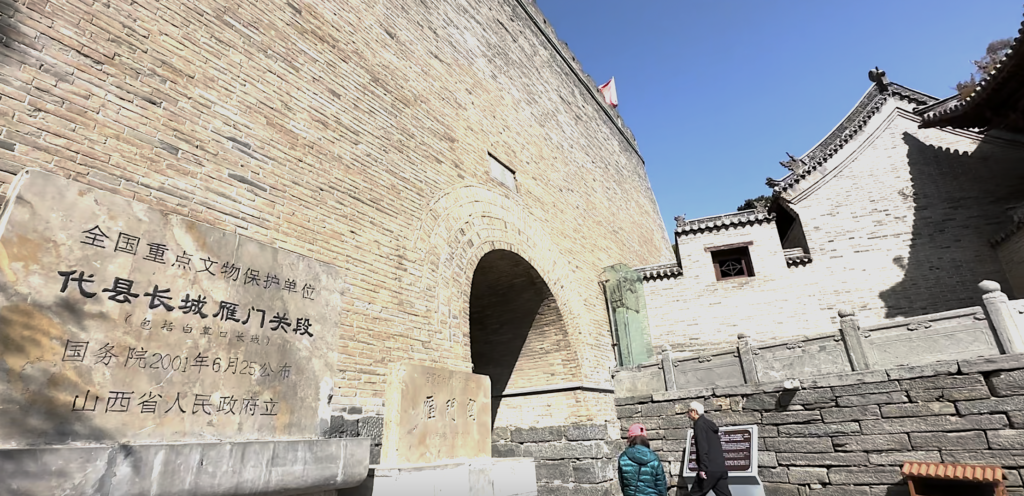
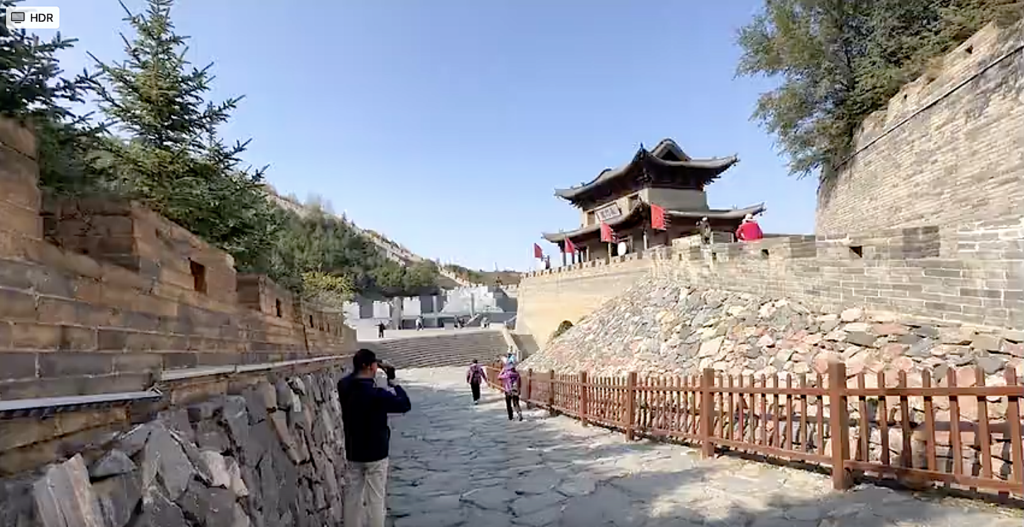
Dad & Elaine visited:
Yanmenguan Pass (雁门关, Yànménguān)
in:
Shanxi (山西, Shānxī).
[INSERT DAD & ELAINE YANMENGUAN PHOTO]
Article 1 used Yanmenguan to explain:
frontier defense.
Now look at it differently.
A:
pass (关, guān)
is important precisely because people naturally move through particular openings in difficult terrain.
Military forces can pass.
But so can:
officials,
messengers,
travelers,
goods
and:
information.
🔥
A strategic pass therefore isn’t simply:
a place that stops movement.
It can also be:
a place that channels movement.
That’s a very different mental picture.
🐇 Remember Wang Zhaojun?
During the Han dynasty (汉朝, Hàn Cháo), relations with the:
Xiongnu (匈奴, Xiōngnú)
weren’t only military.
They also involved:
diplomacy (外交, wàijiāo),
trade (贸易, màoyì),
and:
marriage diplomacy (和亲, héqīn).
One of the most famous cultural stories is that of:
Wang Zhaojun (王昭君, Wáng Zhāojūn)
who married the Xiongnu ruler:
Huhanye Chanyu (呼韩邪单于, Hūhányé Chányú).
Her story became associated with:
Zhaojun Going Beyond the Frontier (昭君出塞, Zhāojūn Chūsài).
Look at the Chinese phrase:
出塞 — chūsài
出 (chū) = go out
塞 (sài) = frontier fortress / strategic border area.
🔥
The phrase itself reminds us:
people crossed the frontier.
But China’s Connections Went Much Farther Than the Northern Wall
Now we need to zoom out.
Because the Great Wall is only one part of China’s external connections.
For that, first-time travelers should think about another city they’re very likely to visit:
Xi’an (西安, Xī’ān).
Its famous earlier name was:
Chang’an (长安, Cháng’ān).
And Chang’an gives us a completely different picture of ancient China.
Not:
WALL.
But:
ROUTES.
🐇🐇🐇
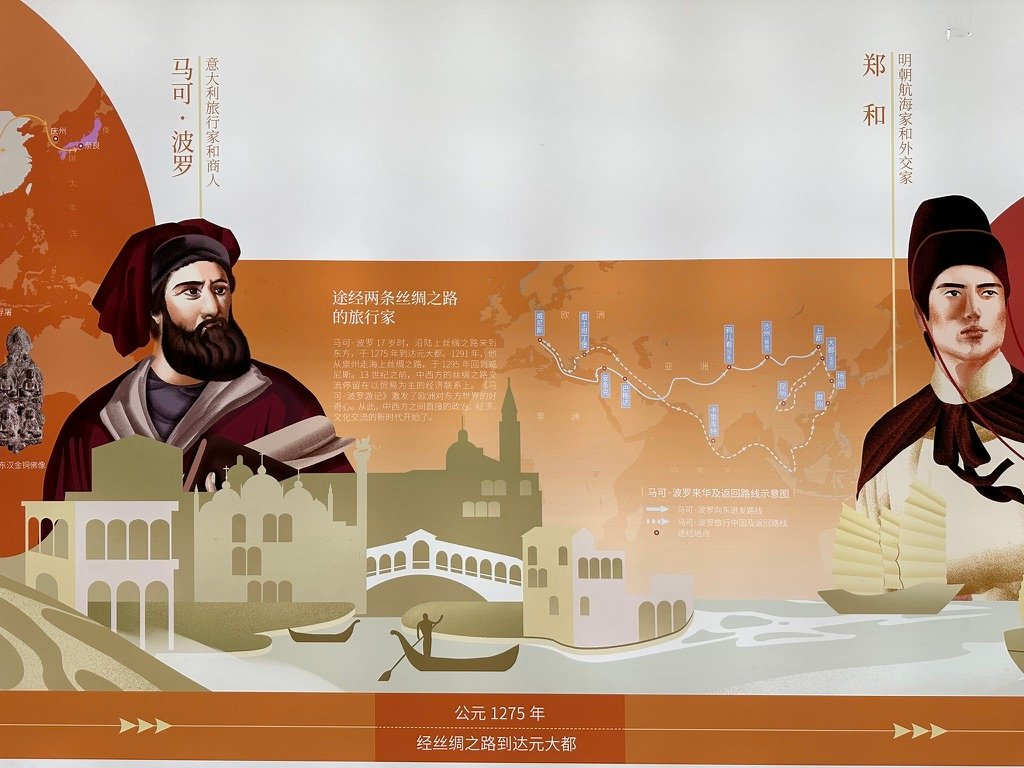
Marco Polo (马可·波罗) and Zheng He (郑和) — two travelers from opposite directions whose journeys illustrate how China was connected to a much wider world. This museum display traces Marco Polo’s 13th-century journey along Silk Road routes to the Yuan capital, while Zheng He represents the great Ming maritime voyages that later connected China across the Indian Ocean. Photo by Dad at the Qin and Han Museum (秦汉馆), Xi’an.
Enter the Silk Roads
The term:
Silk Roads (丝绸之路, Sīchóu Zhī Lù)
describes networks of routes connecting different parts of Eurasia.
Not one road.
Not one caravan.
Not one continuous ancient motorway from Xi’an to Rome.
😂
Networks.
Branches.
Intermediaries.
Different periods.
Different political powers.
And through those networks moved much more than:
silk (丝绸, sīchóu).
What Traveled?
goods
↓
people
↓
languages
↓
art
↓
technology
↓
religions
↓
ideas.
🔥🔥🔥
Now our first-time traveler has a problem.
They started Section 1 thinking:
China was isolated behind the Great Wall.
But now:
Chang’an
is connected to wider Eurasian networks.
Hmm.
😂
🌏 The Silk Roads Are UNESCO Heritage Too
The UNESCO-listed:
Silk Roads: Chang’an–Tianshan Corridor
extends roughly:
5,000 kilometers
from the Chang’an/Luoyang region toward Central Asia.
UNESCO emphasizes the movement and exchange of:
trade,
religious beliefs,
scientific knowledge,
technological innovation,
cultural practices
and:
art.
🔥
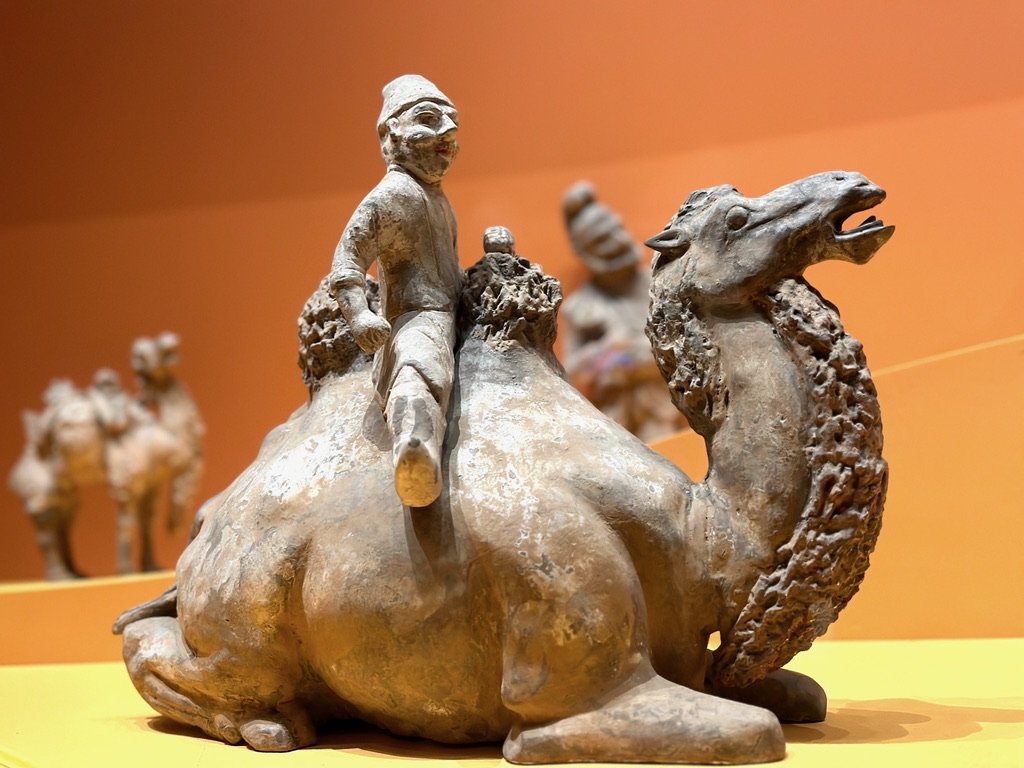
A camel rider figurine at Xi’an Museum (西安博物院) evokes the people, animals, and caravans that moved along the Silk Road (丝绸之路, Sīchóu Zhīlù). Camels helped carry goods and ideas across the deserts and trade routes linking Chang’an (长安, Cháng’ān)—today’s Xi’an—with Central Asia and lands far beyond. Photo by Dad / ChinaTravelBUG.
And among the physical remains associated with these networks are:
cities,
temples,
paths,
posthouses,
passes,
beacon towers,
fortifications
and even:
sections of the Great Wall.
😳
Wait.
The:
GREAT WALL
and:
SILK ROADS
can appear inside the same historical landscape?
Exactly.
🔑 This Is the Key
Western popular imagination often gives us two separate Chinas:
China #1
Great Wall.
Closed.
Defensive.
Suspicious of outsiders.
China #2
Silk Road.
Trade.
Cosmopolitan.
Connected.
😂
But history can contain:
BOTH
at the same time.
A state can:
defend particular frontiers
while also:
trade across them.
It can:
fight one political power
while welcoming merchants from somewhere else.
It can:
control movement
without eliminating movement.
🔥
That’s the more useful picture.
🐇 And Then Something Much Bigger Crosses Into China
Not a horse.
Not silk.
Not an army.
An:
IDEA.
More specifically:
Buddhism (佛教, Fójiào).
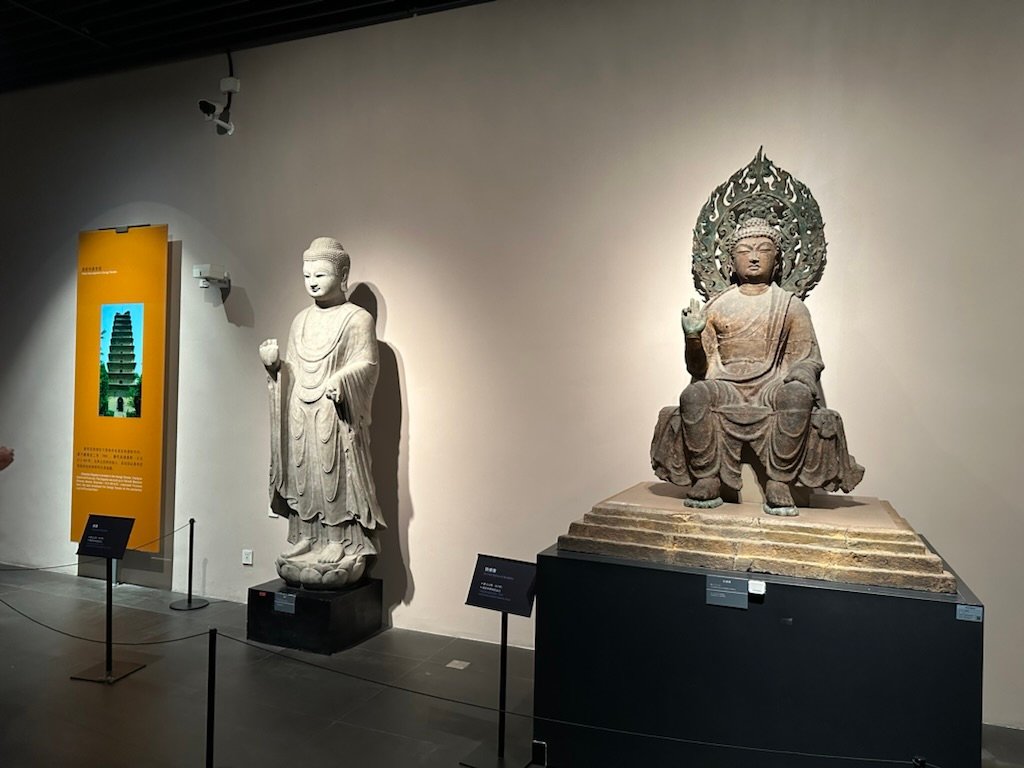
Buddhist sculptures at Xi’an Museum (西安博物院) offer a reminder that the Silk Road (丝绸之路, Sīchóu Zhīlù) carried far more than silk and merchandise. Buddhism traveled from India through Central Asia into China, bringing religious ideas, artistic traditions, texts, and imagery that were gradually adapted into distinctly Chinese forms. Photo by Dad / ChinaTravelBUG.
Buddhism originated in:
India (印度, Yìndù)
and reached China through complex networks of travelers, monks, texts and routes across Asia.
😳
Think about what that means.
One of the most important religious and cultural traditions in Chinese history:
didn’t originate in China.
🔥
Yet over centuries Buddhism became deeply embedded in Chinese civilization.
So much for:
“sealed behind the wall.”
😂
And Dad & Elaine Have Already Followed That Rabbit Hole
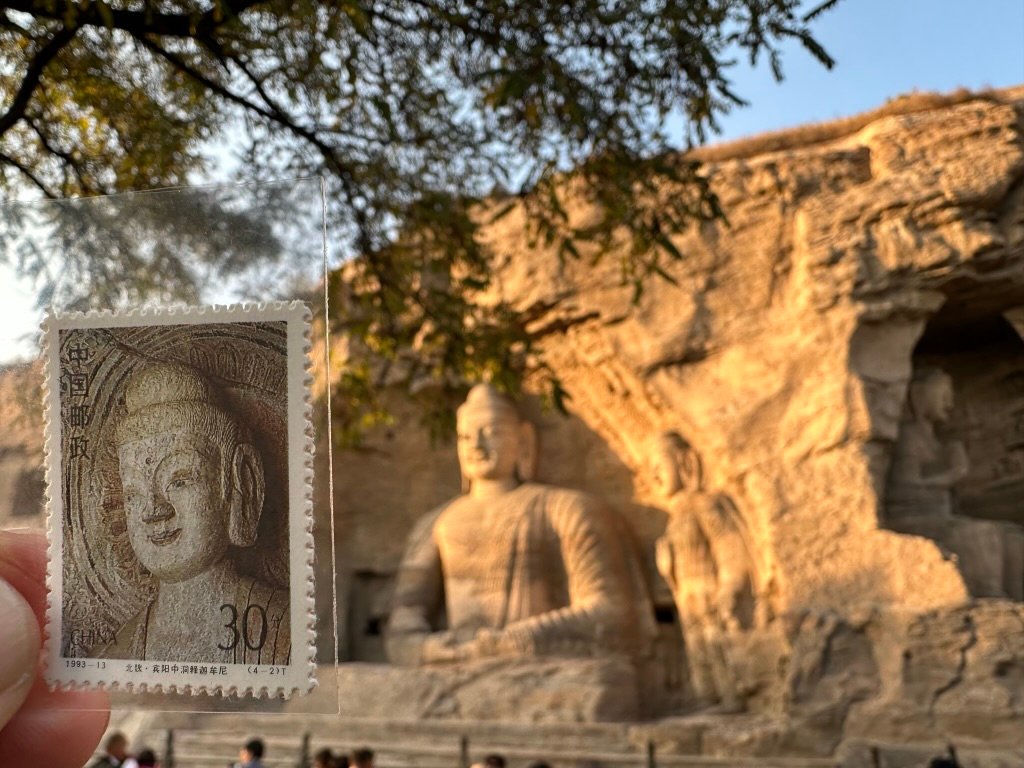
We visited:
Yungang Grottoes (云冈石窟, Yúngāng Shíkū)
near:
Datong (大同, Dàtóng).
[INSERT YUNGANG PHOTO]
There, monumental Buddhist art created under the:
Northern Wei dynasty (北魏, Běi Wèi)
shows us a cultural world shaped by:
Indian Buddhist origins,
Central Asian connections,
northern Chinese political power
and:
Chinese artistic development.
🔥
Now ask:
Is this foreign culture?
Or:
Chinese culture?
The better answer may be:
That’s the wrong question.
Because cultures change partly by absorbing, adapting and transforming things that arrive from elsewhere.
🐇
🍚 Western Handrail: Pizza Problem
😂
Dangerous analogy.
But useful.
Tomatoes originated in the Americas.
Does that mean tomato-based Italian cuisine is:
“not really Italian”?
Of course not.
Cultures adopt.
Adapt.
Transform.
Eventually something that arrived from elsewhere becomes inseparable from local culture.
Buddhism is obviously vastly more historically significant than pizza.
😂
But the handrail works.
From Yungang to Mount Wutai
Then Dad & Elaine visited:
Mount Wutai (五台山, Wǔtái Shān).
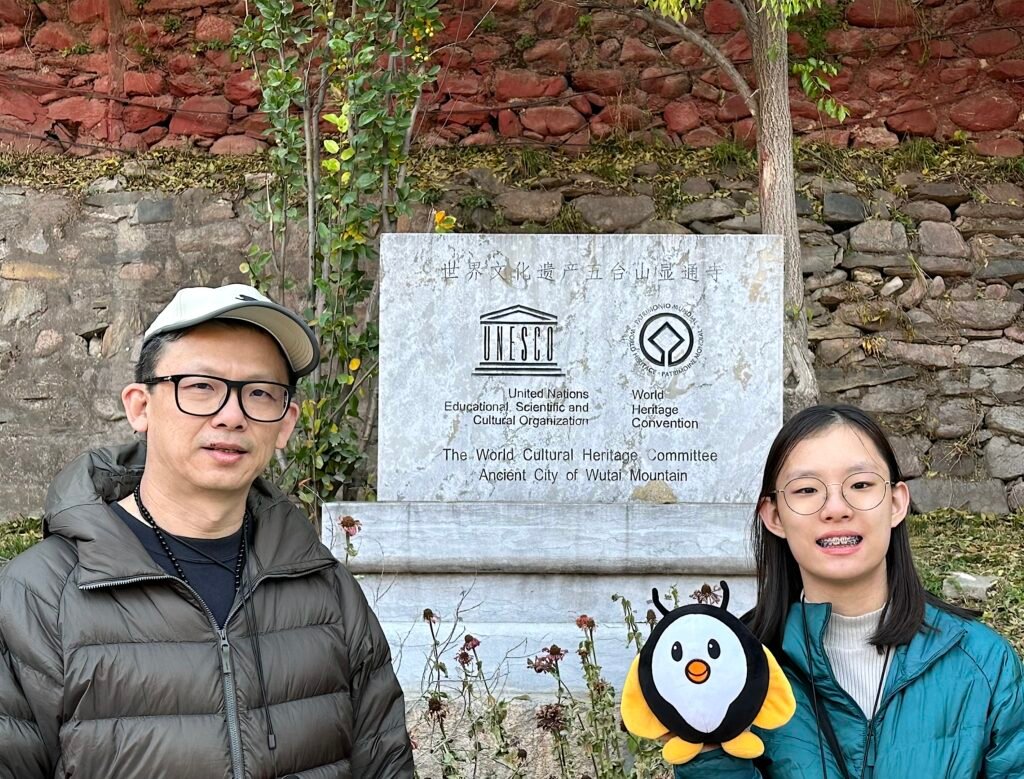
And the rabbit hole grew again.
At Mount Wutai we encountered:
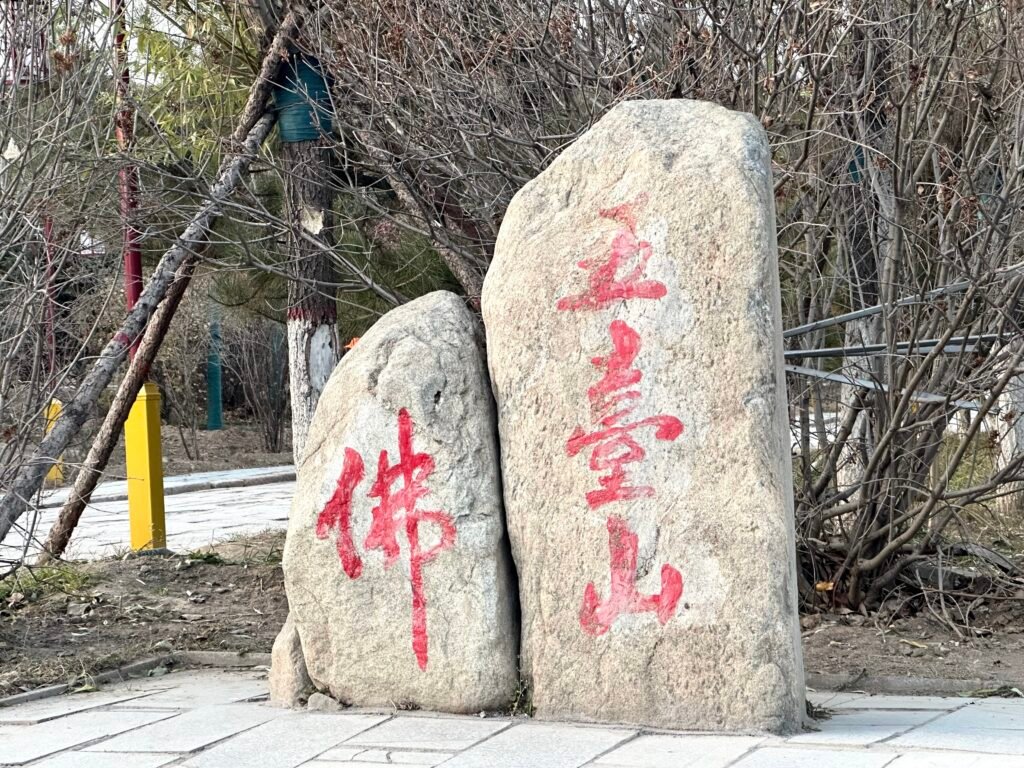
Han Chinese Buddhism (汉传佛教, Hànchuán Fójiào)
and:
Tibetan Buddhism (藏传佛教, Zàngchuán Fójiào).
We encountered connections with:
Tibet (西藏, Xīzàng),
Mongolia (蒙古, Měnggǔ),
and even the Japanese monk:
Ennin (圆仁 / 円仁)
who traveled to Mount Wutai during the Tang dynasty.
🔥🔥🔥
A sacred mountain in Shanxi becomes part of:
an international Buddhist network.
Again:
not isolated.
🐞 Halfway Sting Check
You began at the Great Wall thinking:
“China was behind the wall.”
Now you’ve acquired:
frontier passes
↓
trade
↓
horses
↓
diplomacy
↓
Wang Zhaojun
↓
Chang’an
↓
Silk Roads
↓
Central Asia
↓
Buddhism
↓
India
↓
Yungang
↓
Mount Wutai
↓
Tibet + Mongolia + Japan
😬
And we haven’t even finished the article.
😂
The wall is still there.
But the idea of an:
isolated China
is beginning to look much harder to defend.
🔥
Section 2 — Walk Through Xi’an and Meet a China Connected to the World
Section 1 began at:
the Great Wall (长城, Chángchéng)
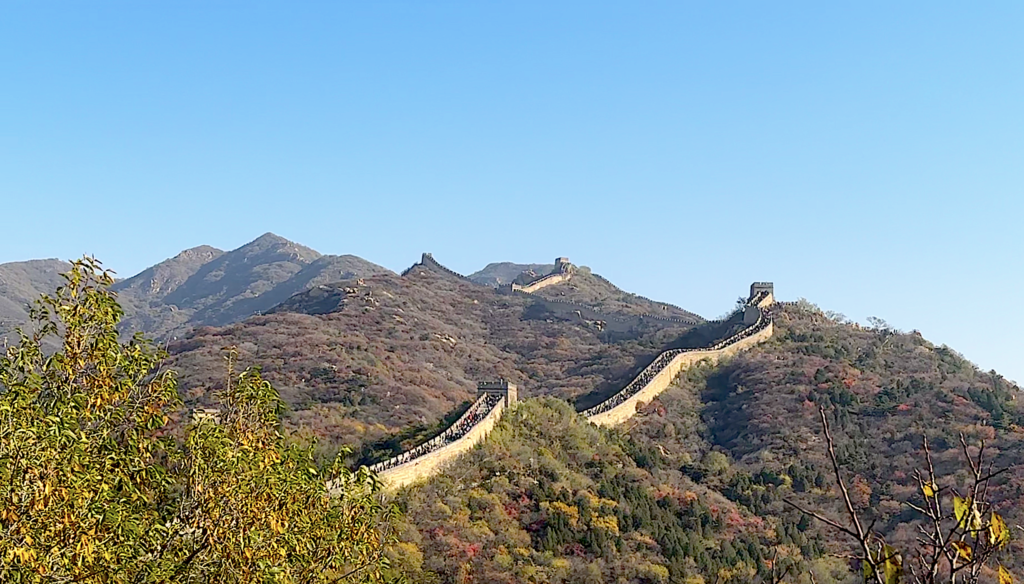
outside Beijing.
The wall looked like separation.
Then we discovered:
trade (贸易, màoyì),
diplomacy (外交, wàijiāo),
migration (迁徙, qiānxǐ),
marriage diplomacy (和亲, héqīn),
and:
cultural exchange (文化交流, wénhuà jiāoliú)
moving across China’s frontiers.
Then we followed something even bigger into China:
Buddhism (佛教, Fójiào).
Now let’s travel to another place almost every first-time China traveler knows:
Xi’an (西安, Xī’ān).
Elaine and I have visited Xi’an many times.
And if Beijing’s Great Wall can accidentally make China look isolated…
ancient Xi’an tells almost the opposite story.
🔥
First: Xi’an Was Chang’an
Modern:
Xi’an (西安, Xī’ān)
was known during several important historical periods by other names.
For our story, remember:
Chang’an (长安, Cháng’ān).
Chang’an was the imperial capital during major periods including the:
Han dynasty (汉朝, Hàn Cháo)
and:
Tang dynasty (唐朝, Táng Cháo).
And during the Tang in particular:
Chang’an became one of the great cities of the medieval world.
Now imagine arriving there during the:
Tang dynasty (唐朝, Táng Cháo)
618–907.
You would not have entered a culturally sealed city.
Quite the opposite.
🌏 Chang’an Looked West
The wider networks we now call the:
Silk Roads (丝绸之路, Sīchóu Zhī Lù)
connected Chang’an and other Chinese centers through Central Asia to much wider Eurasian worlds.
And remember:
Silk Roads = NETWORKS.
Not:
one road beginning at Xi’an City Wall and ending in Rome.
😂
Different routes.
Different periods.
Different intermediaries.
Goods might pass through many hands before reaching their final destination.
And what traveled wasn’t only:
silk (丝绸, sīchóu).
What Came INTO China?
Among the many things moving through these networks were:
horses (马, mǎ),
precious goods,
glassware,
foods,
musical traditions,
artistic styles,
religious ideas
and:
people.
🔥
Merchants.
Diplomats.
Monks.
Envoys.
Artisans.
Travelers.
Different peoples from Central and Western Asia were present in Tang China.
So when Western travelers hear:
“Chang’an was cosmopolitan.”
don’t let that remain a tourism slogan.
It means:
people from different cultural worlds were physically present in the capital.
🐇 Look at the Faces in Tang Art
This is where museums become extremely useful.
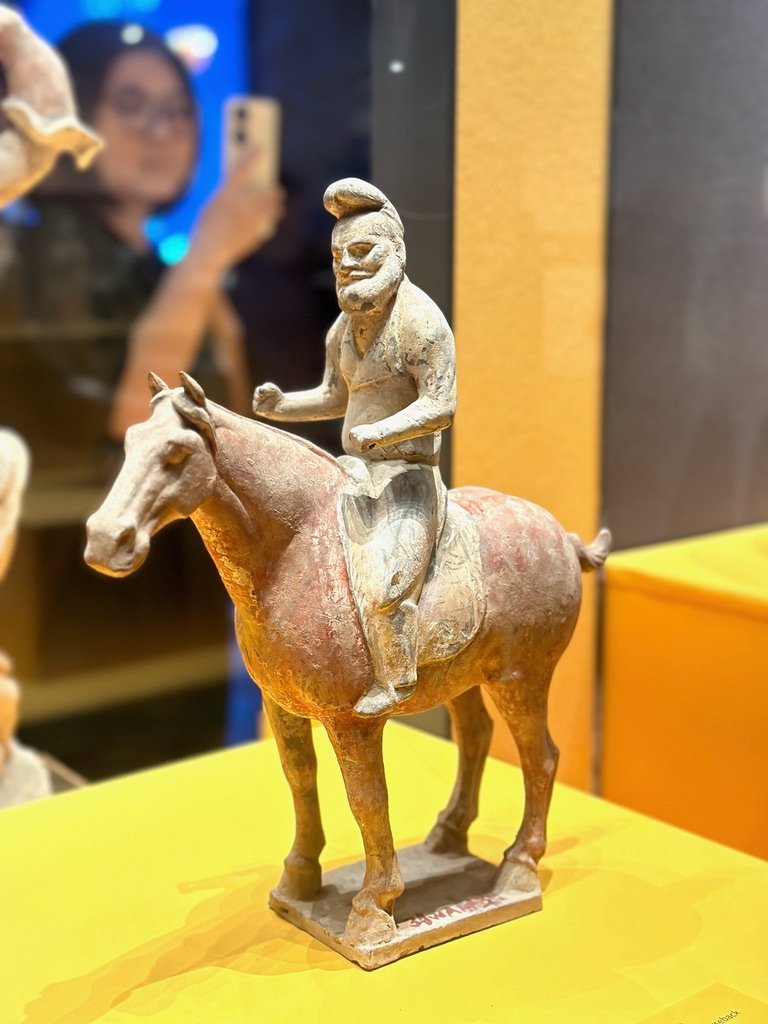
Tang-dynasty figure of a foreign rider, photographed by Dad at Xi’an Museum — look at the face, clothing and horse, and Tang China suddenly feels much less isolated.
When you visit museums containing:
Tang dynasty (唐朝)
art and funerary objects, look carefully at figures depicted as:
foreign merchants,
musicians,
horsemen
and:
travelers.
You may encounter representations conventionally associated with:
Hu people (胡人, Húrén).
But be careful with this term.
Hu (胡, Hú) was used in different historical contexts for various non-Han peoples, particularly those associated with northern and western regions.
It does NOT mean:
one ethnicity called “the Hu.”
😂
Historical labels can be messy too.
🍚 Museum Handrail: Don’t Just Look at the Pretty Horse
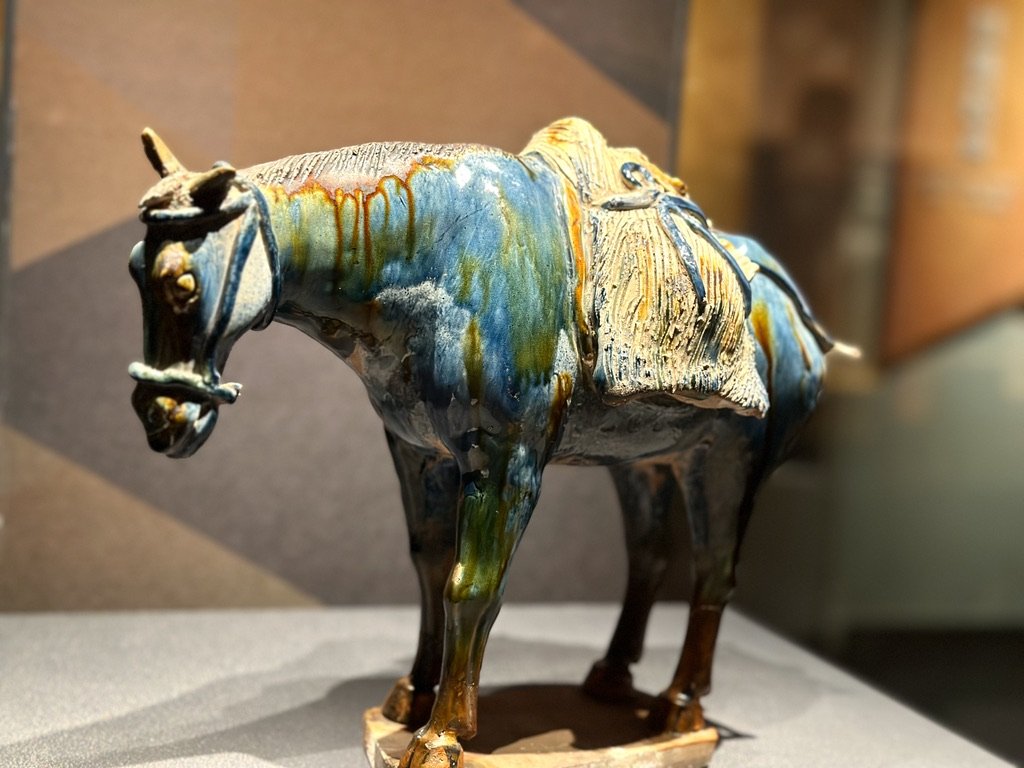
Tang-dynasty glazed ceramic horse, photographed at Xi’an Museum — even the horse hints at a China deeply connected to the wider Eurasian world.
Tang museum:
Beautiful ceramic horse.
Dad:
HORSE!
😂
Deep China asks:
Why are horses so prominent?
Then:
horse
↓
Central Asian connections
↓
cavalry
↓
trade
↓
elite culture
↓
Silk Roads.
🐇
One object can open an entire historical network.
That’s why Dad photographs museum labels.
Or at least…
he is supposed to.
😭😂
🌶️ The Silk Roads Didn’t Only Bring Things. They Brought Gods.
This is where the story gets particularly spicy.
Buddhism was not the only religious tradition present in Tang China.
Through wider Eurasian connections, China encountered communities and traditions associated with:
Zoroastrianism (祆教, Xiānjiào)
Manichaeism (摩尼教, Móníjiào)
and:
Church of the East Christianity (景教, Jǐngjiào).
😳
Christianity?
In Tang China?
Yes.
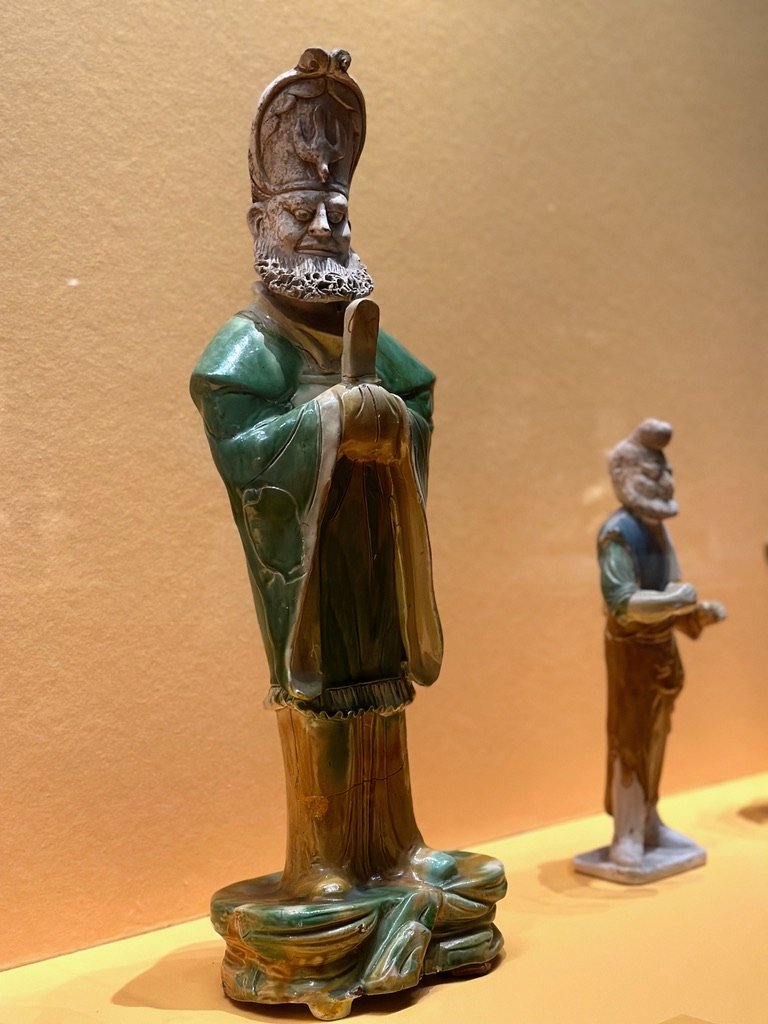
Tang-dynasty glazed figure of a foreigner, photographed by Dad at Xi’an Museum — a glimpse of cosmopolitan Chang’an and its connections with the wider world.
🐇 Christianity in Xi’an — More Than 1,200 Years Ago
One of the most extraordinary pieces of evidence is associated with Xi’an:
the Xi’an Stele / Nestorian Stele (大秦景教流行中国碑, Dàqín Jǐngjiào Liúxíng Zhōngguó Bēi).
The famous stone monument was erected in:
781 CE
during the Tang dynasty.
Its inscription records the presence and history of the Christian tradition known in Chinese sources as:
Jingjiao (景教, Jǐngjiào)
in Tang China.
🔥🔥🔥
For many Western first-time travelers, this is genuinely surprising.
More than twelve centuries ago:
a Christian community existed in Tang China.
That does NOT mean Tang China was predominantly Christian.
Obviously.
😂
The point is:
ideas and religious communities were moving across Eurasia.
Wait — 大秦?
The Chinese name of the stele contains:
Daqin (大秦, Dàqín).
Another rabbit hole.
🐇
In different Chinese historical contexts, Daqin was used for lands far to the west, originally associated with the Roman world and later appearing in changing geographical usage.
So even the Chinese vocabulary on the monument points toward:
a much wider geographical imagination.
🔥
Again:
China wasn’t living in a sealed room.
🐇 And Buddhism Had Already Traveled Much Farther
Now return to:
Buddhism (佛教, Fójiào).
Buddhism originated in India.
It traveled through different routes and communities into China.
Chinese monks also traveled in the opposite direction.
One of the most famous was:
Xuanzang (玄奘, Xuánzàng)
602–664.
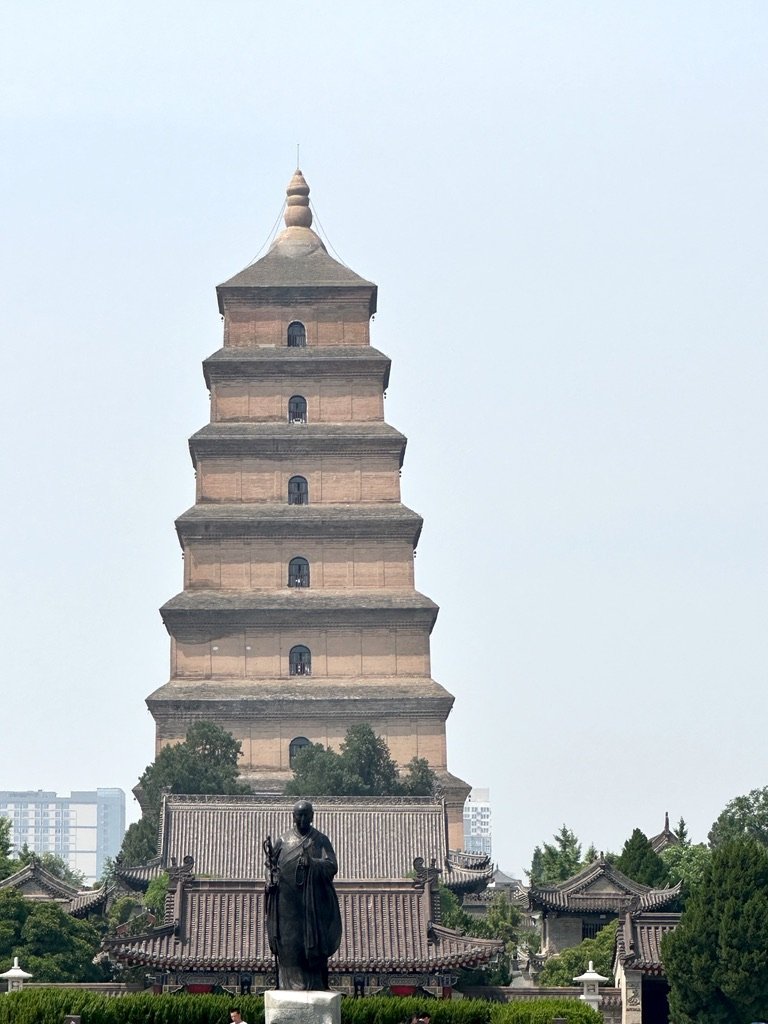
Xuanzang (玄奘, Xuánzàng) and the Giant Wild Goose Pagoda (大雁塔, Dàyàn Tǎ) are inseparable parts of Tang-dynasty Xi’an’s Silk Road story. After returning to Chang’an in 645 CE from his journey to India, Xuanzang devoted himself to translating the Buddhist scriptures he had brought back. The pagoda was first built in 652 CE at the Great Ci’en Temple (大慈恩寺, Dàcí’ēn Sì), where Xuanzang worked, to house Buddhist texts and sacred objects associated with his journey. Photo by Dad in Xi’an.
Western travelers may recognize his story indirectly through the later literary tradition of:
Journey to the West (西游记, Xīyóu Jì).
But the historical Xuanzang was a real Buddhist monk and scholar.
He traveled from Tang China through Central Asia to:
India (印度, Yìndù)
seeking Buddhist texts and learning.
Then he returned to China.
🔥
Think about the direction:
CHINA → CENTRAL ASIA → INDIA
and then:
INDIA → CENTRAL ASIA → CHINA
through texts, knowledge and translation.
That’s not isolation.
That’s intellectual exchange.
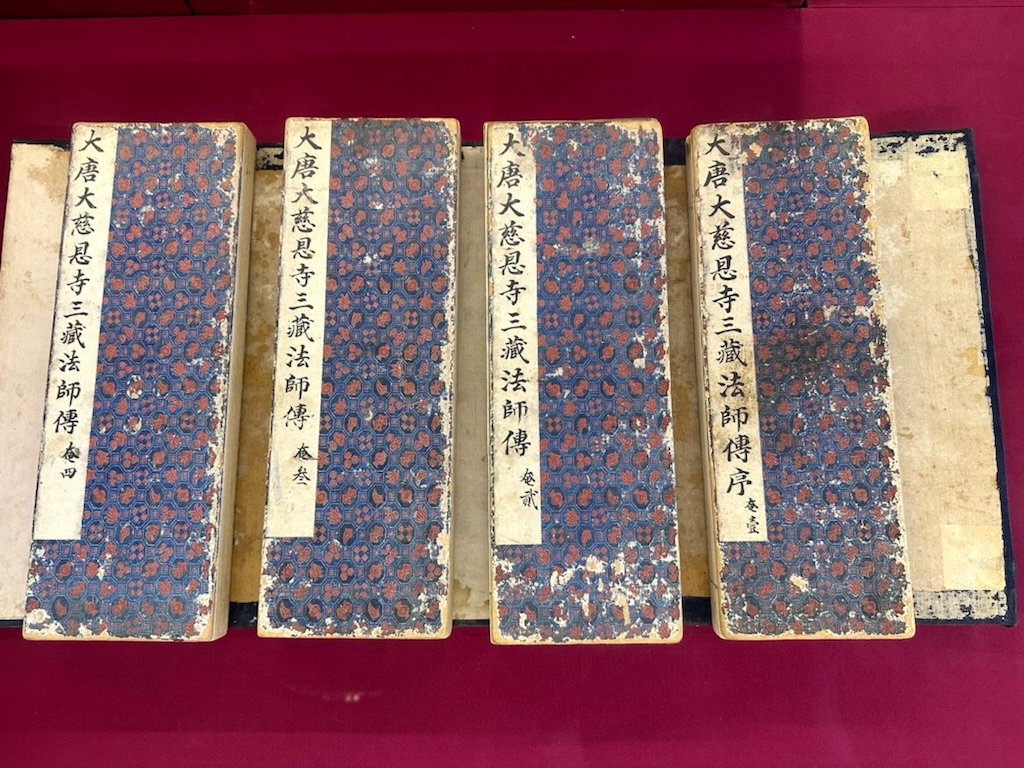
Buddhist texts did not simply arrive in China unchanged. Scriptures brought from India and Central Asia had to be translated into Chinese, interpreted, and gradually absorbed into Chinese intellectual and religious life. The monk Xuanzang (玄奘, Xuánzàng), who returned to Chang’an (长安) from India in 645 CE with hundreds of Buddhist texts, became one of China’s greatest translators; his translation work was closely associated with the Great Ci’en Temple (大慈恩寺, Dàcí’ēn Sì) and the Giant Wild Goose Pagoda (大雁塔, Dàyàn Tǎ). Photo by Dad at the Giant Wild Goose Pagoda, Xi’an.
📚 Translation Changes Civilization
When Buddhist texts arrived in China, they didn’t magically become Chinese.
People had to:
translate (翻译, fānyì)
them.
Think about how difficult that is.
How do you translate a religious or philosophical concept when the target language may not have an exact equivalent?
🐇
Translators make choices.
New vocabulary develops.
Existing Chinese concepts are used in new ways.
Over centuries:
Buddhism changes in China.
And:
Chinese culture changes through Buddhism.
🔥
Again:
not simply:
foreign thing arrives → copied unchanged.
It becomes:
adaptation.
And Xi’an Gives You a Place to Remember Xuanzang
One of Xi’an’s most famous landmarks is:
Big Wild Goose Pagoda (大雁塔, Dàyàn Tǎ).
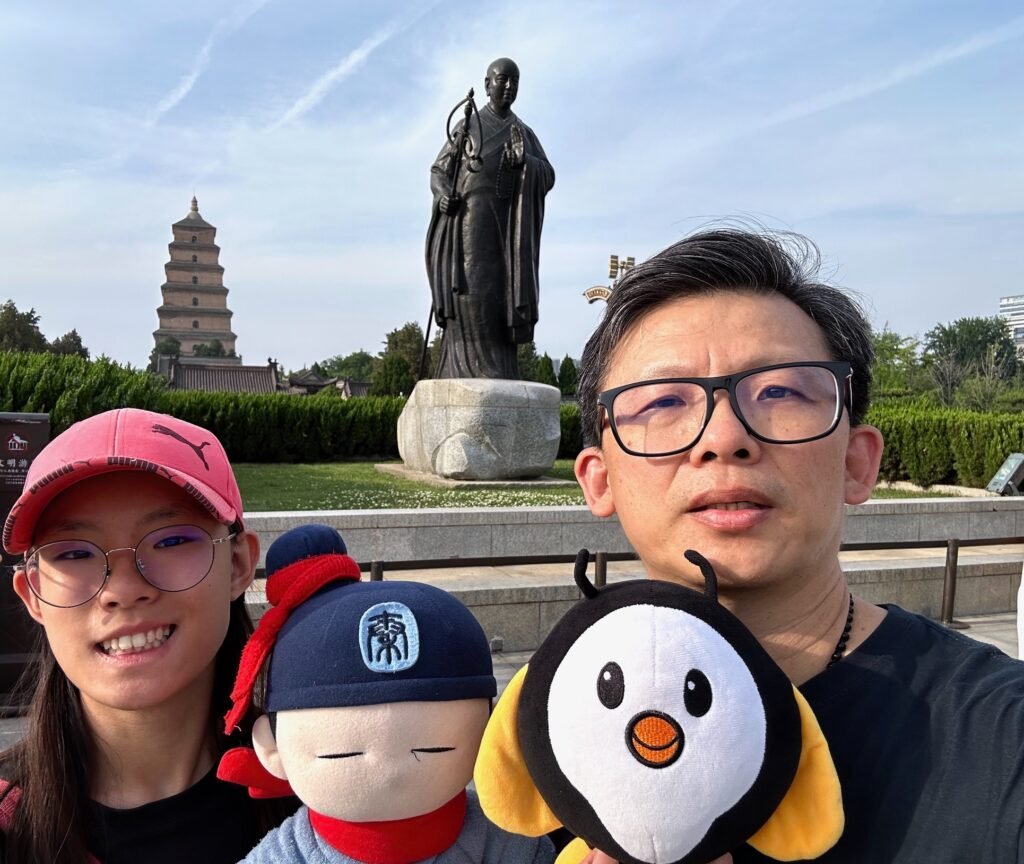
The pagoda is closely associated with the Buddhist world of Tang Chang’an and with Xuanzang’s translation activities.
So a first-time traveler can stand there and think:
“Nice pagoda.”
Or:
“This building belongs to a story connecting Xi’an with India and Central Asia through Buddhism.”
🔥
Same place.
Different understanding.
That’s the entire point of this series.
Read more on Dad & Elaine’s journey in Xi’an:
A Peaceful Stroll Through History: Visiting Xi’an’s Giant Wild Goose Pagoda and Its Sacred Legacy
🐇 And Then Dad & Elaine Followed Buddhism North
From Xi’an, our own Deep China rabbit holes eventually took us to:
Yungang Grottoes (云冈石窟, Yúngāng Shíkū)
in Shanxi.
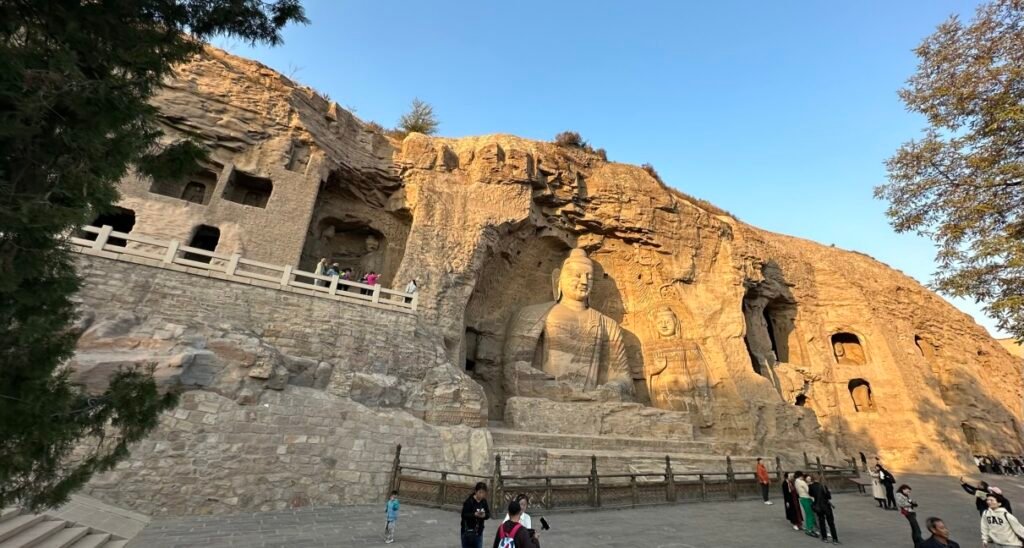
The Yungang Grottoes (云冈石窟, Yúngāng Shíkū) near Datong show how Buddhism became intertwined with political power in northern China. Created largely under the Northern Wei (北魏, Běi Wèi), whose rulers were Xianbei (鲜卑), these monumental Buddhist carvings reveal a China shaped not by isolation, but by the meeting and transformation of peoples, religions, and artistic traditions. Photo by Dad / ChinaTravelBUG.
There we encountered:
Buddhism,
Xianbei rulers,
Northern Wei political power,
and artistic influences shaped by wider Buddhist networks.
Then:
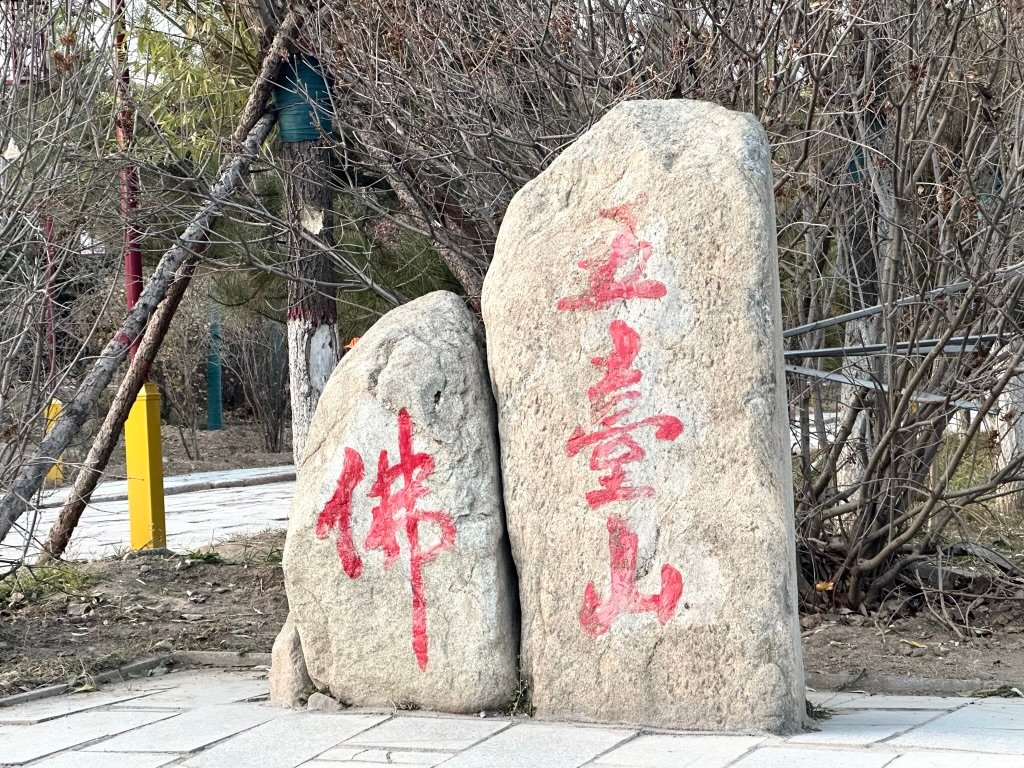
Mount Wutai (五台山, Wǔtái Shān) shows another side of how Buddhism evolved after reaching China. For centuries, this sacred mountain has brought different Buddhist traditions into the same religious landscape—including Han Chinese Buddhism (汉传佛教) and Tibetan Buddhism (藏传佛教). It is a reminder that ideas entering China were not simply received: they interacted with different peoples, traditions, and periods of Chinese history. Photo by Dad / ChinaTravelBUG.
Mount Wutai (五台山, Wǔtái Shān)
gave us:
Han Chinese Buddhism (汉传佛教, Hànchuán Fójiào),
Tibetan Buddhism (藏传佛教, Zàngchuán Fójiào),
and connections reaching toward:
Tibet,
Mongolia
and:
Japan.
🐇🐇🐇
The rabbit hole doesn’t stop at the Great Wall.
It crosses it.
😂
🌶️ But Don’t Turn Tang Chang’an Into a Modern Multicultural City
Another important warning.
It’s tempting to write:
“Tang Chang’an was just like modern New York!”
No.
😂
Different political system.
Different legal status.
Different concepts of identity.
Different social structures.
Different world.
“Cosmopolitan” is useful if we mean:
a major city containing people, goods and cultural influences from different regions.
It should NOT make us imagine:
21st-century multiculturalism wearing Tang robes.
Historical handrails help.
They shouldn’t replace history.
🔑 Chinese Culture Wasn’t Weakened by Every Foreign Influence
This is perhaps the most important idea in Section 2.
Sometimes people imagine cultures like glasses of water.
Add something foreign…
and somehow the original culture becomes:
less pure.
History doesn’t work very well that way.
Chinese civilization repeatedly:
absorbed,
translated,
adapted,
reinterpreted
and:
transformed
ideas arriving from elsewhere.
Buddhism is the obvious example.
Origin outside China.
↓
enters China.
↓
translated.
↓
adapted.
↓
develops Chinese schools and traditions.
↓
becomes deeply embedded in Chinese:
religion,
art,
architecture,
literature
and:
philosophy.
🔥
Something can come from elsewhere…
and eventually become inseparable from Chinese culture.
🍚 The Food on Your Xi’an Table May Tell the Same Story
Even everyday culture reminds us that China has never existed in complete isolation.
Various foods and crops entered China through long-distance contacts over different historical periods.
And Xi’an’s food culture still carries strong connections with:
northwestern China,
Muslim communities,
wheat-based food traditions
and:
long histories of movement and exchange.
You don’t need to turn lunch into an archaeological lecture.
😂
But perhaps when you’re eating in:
Xi’an (西安)
remember:
culture travels through stomachs too.
🔥
🌶️ Now Put Beijing and Xi’an Side by Side
This is the key image.
BEIJING
You stand on:
the Great Wall.
You see:
DEFENSE.
↓
XI’AN / CHANG’AN
You think about:
the Silk Roads.
You see:
CONNECTION.
↓
Which one represents Chinese history?
BOTH.
🔥🔥🔥
That’s the answer.
China could:
defend frontiers
and:
participate in international exchange.
It could:
fight northern powers
and:
trade with them.
It could:
build walls
and:
welcome foreign merchants.
It could:
receive religions from abroad
and:
transform them into deeply Chinese traditions.
These aren’t contradictions.
They’re history.
🐞 Sting Check
You began this article standing on the Great Wall thinking:
“China was isolated behind this.”
Now you’ve traveled through:
Great Wall (长城)
↓
Yanmenguan (雁门关)
↓
trade (贸易)
↓
horses (马)
↓
Chang’an (长安)
↓
Silk Roads (丝绸之路)
↓
Central Asia
↓
Buddhism (佛教)
↓
India
↓
Xuanzang (玄奘)
↓
Big Wild Goose Pagoda (大雁塔)
↓
Christianity / Jingjiao (景教)
↓
Xi’an Stele (大秦景教流行中国碑)
↓
Yungang Grottoes (云冈石窟)
↓
Mount Wutai (五台山)
↓
Tibet + Mongolia + Japan
😬
That’s a lot of traffic for an:
“isolated civilization.”
😂
The Bigger Lesson
The Great Wall is real.
Conflict was real.
Frontier defense was real.
So were:
connection
exchange
movement
and:
adaptation.
🔥
The better historical picture isn’t:
China was always open.
That’s obviously too simple.
And it isn’t:
China was always closed.
Also too simple.
Instead:
China’s relationship with the outside world changed constantly — but interaction never disappeared simply because walls existed.
That’s the coat rack.
And once you understand that…
Xi’an begins looking very different.
🔥🐇🐞
Section 3 — Go Back to Beijing and Xi’an. Now Look Again.
So what should a first-time traveler remember from all this?
Not:
“I need to memorize every Silk Road religion before visiting Xi’an.”
😂
No.
Remember one simple idea:
WALLS AND ROADS EXISTED AT THE SAME TIME.
China defended frontiers.
China also exchanged:
people,
goods,
religions,
technology,
art
and:
ideas
with the wider world.
Once you understand that, two of China’s most famous first-trip destinations begin telling one connected story.
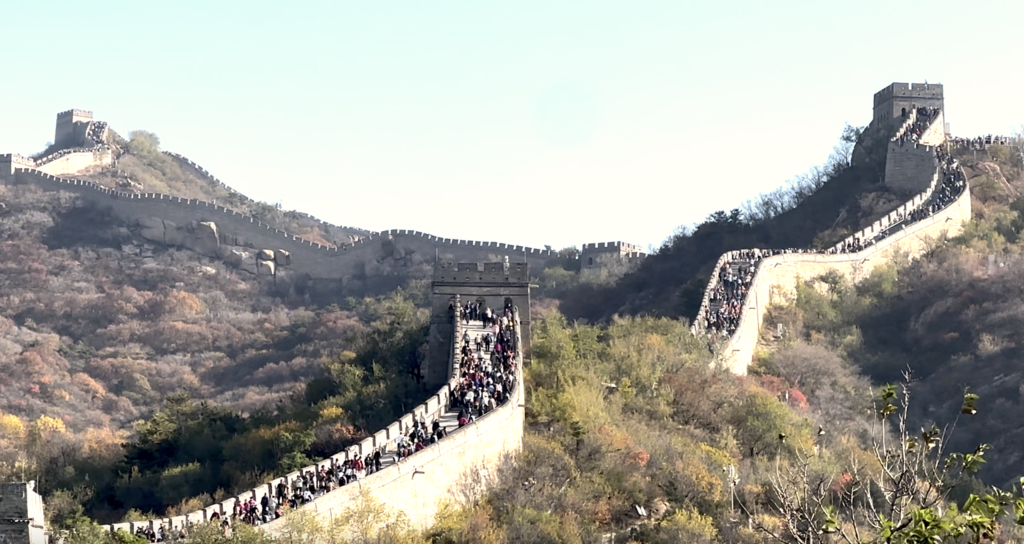
1. At the Great Wall: Look Beyond the Wall
When you visit:
Badaling (八达岭, Bādálǐng)
Mutianyu (慕田峪, Mùtiányù)
or another Great Wall section outside Beijing, enjoy it first.
Take the photograph.
Climb the watchtower.
Look across the mountains.
Then ask:
“What was happening on BOTH sides of this wall?”
🔥
Not merely:
“Who was China keeping out?”
That small change in question opens:
trade (贸易, màoyì),
diplomacy (外交, wàijiāo),
migration (迁徙, qiānxǐ),
warfare (战争, zhànzhēng)
and:
cultural exchange (文化交流, wénhuà jiāoliú).
The wall marked a frontier.
It did not mark the end of human contact.
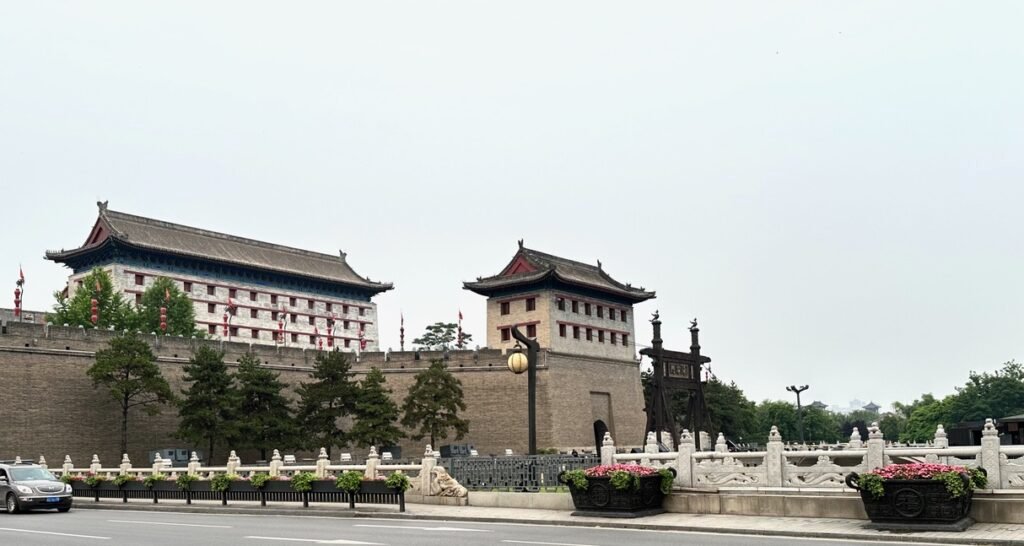
Xi’an City Wall (西安城墙, Xī’ān Chéngqiáng) surrounds a city whose history was shaped as much by movement and exchange as by defense. As Chang’an (长安), Xi’an stood at the eastern end of the Silk Road, where merchants, diplomats, monks, religions, technologies, and ideas from across Eurasia entered and interacted with China. Photo by Dad / ChinaTravelBUG.
2. In Xi’an: Look for the World That Came to China
Then travel to:
Xi’an (西安, Xī’ān)
and remember its great historical identity as:
Chang’an (长安, Cháng’ān).
Now don’t see only:
city walls,
pagodas,
palaces
and:
Terracotta Warriors.
Look for evidence of:
connection.
At the:
Big Wild Goose Pagoda (大雁塔, Dàyàn Tǎ)
remember:
Xuanzang (玄奘, Xuánzàng)
↓
Central Asia
↓
India
↓
Buddhist texts
↓
translation
↓
China.
🔥
When you encounter Tang art showing foreign merchants, musicians or horsemen, don’t treat them as decorative curiosities.
Ask:
“Who were these people—and why were they in Chang’an?”
🐇
That’s how Xi’an starts opening.
3. Then Look at Chinese Buddhism Differently
If you visit a Buddhist temple elsewhere in China after reading this article, remember:
Buddhism (佛教, Fójiào)
didn’t originate in China.
Yet today nobody can seriously tell the story of Chinese:
art,
religion,
philosophy,
architecture
or:
literature
without Buddhism.
🔥
That’s an extraordinary example of cultural transformation.
Something travels into China.
China changes it.
It changes China.
And centuries later…
it feels inseparable from Chinese civilization.
🐇 If You’ve Been Stung…
This is where the first trip begins creating the second.
You visited:
the Great Wall.
Then learned about:
Yanmenguan Pass (雁门关, Yànménguān).
🐇
You visited:
Xi’an.
Then Buddhism led you toward:
Yungang Grottoes (云冈石窟, Yúngāng Shíkū).
🐇🐇
Yungang introduced:
Northern Wei (北魏, Běi Wèi)
and:
Xianbei (鲜卑, Xiānbēi).
🐇🐇🐇
Then perhaps you reach:
Mount Wutai (五台山, Wǔtái Shān)
and discover connections with:
Tibet,
Mongolia
and:
Japan.
And suddenly:
“I’ve already seen China.”
becomes:
“Oh dear. I’ve barely started.”
😂🔥
Exactly.
ChinaTravelBUG’s Take
The Great Wall and the Silk Roads are sometimes presented as opposite symbols.
One says:
KEEP OUT.
The other says:
COME THROUGH.
Real history is more interesting.
Chinese states could:
defend,
trade,
fight,
negotiate,
borrow,
adapt
and:
exchange
at the same time.
So when you’re standing on the Great Wall outside Beijing, don’t imagine an isolated civilization hiding behind stone.
And when you’re walking through Xi’an, don’t imagine Chinese civilization developing alone.
Instead, remember:
China was distinctive without being disconnected.
🔥
Its frontiers could divide.
Its roads could connect.
And sometimes the same frontier did:
both.
🐞 Final Sting
Perhaps this was your first trip to China.
You came for:
Beijing + Xi’an.
You saw:
the Terracotta Warriors
and:
Excellent.
But now the famous places have started pointing somewhere else.
Great Wall
↓
Yanmenguan
↓
Yungang
↓
Mount Wutai
↓
another question
↓
another place
↓
another trip.
🐇🐇🐇
That’s the danger of understanding China a little better.
One answer creates another question.
And one China trip…
may create the reason for the next.
🐞🔥
See the place. Ask the bigger question. Understand China better.
🐇 Go Deeper: The Next Big Question
People, goods and ideas kept crossing China’s frontiers. But inside such an enormous country, another problem remained: how could one emperor actually govern it all?
Read next: Michelin Course 3: How Did One Emperor Govern Such a Huge Country? →