Five Terraces, One Bodhisattva — and a Mountain That Became More Than Geography
Dad & Elaine arrived at Mount Wutai (五台山, Wǔtái Shān) in Shanxi Province (山西省, Shānxī Shěng) after traveling through several very different historical worlds.
At:
Yanmenguan Pass (雁门关, Yànménguān)
we were thinking about:
northern frontiers,
armies,
walls,
and:
who controlled the road between the Central Plain and the northern steppe.
At:
Yungang Grottoes (云冈石窟, Yúngāng Shíkū)
we met:
Xianbei people (鲜卑, Xiānbēi),
Northern Wei Dynasty (北魏, Běi Wèi),
and a Buddhism already moving through much wider Asian networks.
At:
Hanging Temple (悬空寺, Xuánkōng Sì)
religion somehow ended up attached to the side of a cliff.
😂
And at:
Yingxian Wooden Pagoda (应县木塔, Yìngxiàn Mùtǎ)
the world of the:
Liao Dynasty (辽朝, Liáo Cháo)
and:
Khitan people (契丹, Qìdān)
unexpectedly led Dad into another rabbit hole.
Then our journey reached:
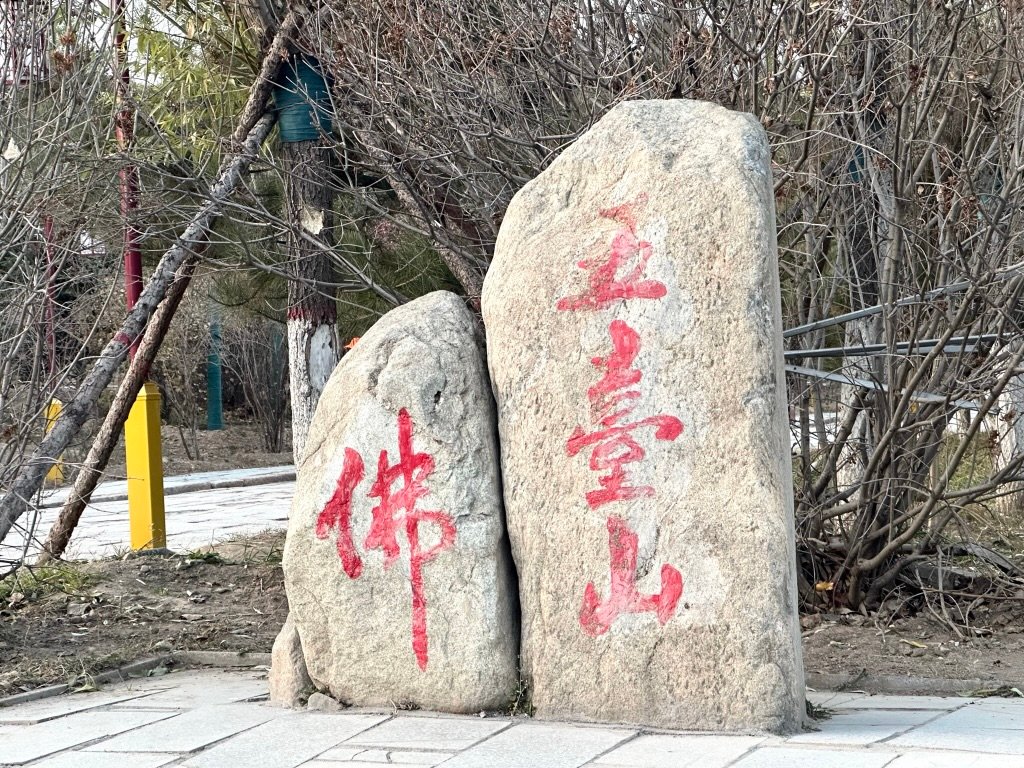
MOUNT WUTAI (五台山, Wǔtái Shān).
This felt different.
Because here…
THE MOUNTAIN ITSELF IS SACRED.
🎬 Welcome to Sacred Mount Wutai (五台山)
Before Dad & Elaine begin exploring why this mountain in Shanxi became sacred across the Buddhist world…
Come and see Mount Wutai for yourself.
Look at the mountains.
The green valleys.
The traditional Buddhist monasteries.
The temple courtyards, where pilgrims and visitors have gathered for generations.
And rising above the rooftops — the magnificent Great White Stupa (大白塔, Dà Bái Tǎ).
But here is Dad’s question.
China has thousands of mountains. Why did THIS particular mountain become one of the most sacred places in the Buddhist world?
And why have pilgrims travelled here from far beyond China?
That’s the story Dad & Elaine came to discover.
🐇
🔥
🎬 Walk With Dad & Elaine — Discover Sacred Mount Wutai (五台山)
Before we explore why Mount Wutai became sacred across the Buddhist world, come and see the mountain for yourself.
From its temple courtyards and traditional Buddhist architecture to the iconic Great White Stupa (大白塔, Dà Bái Tǎ), Mount Wutai is more than a mountain landscape.
It is a living place of pilgrimage, where Han Chinese and Tibetan Buddhist traditions have met for centuries.
Watch the video, then join Dad & Elaine as we follow a much bigger question:
How did a mountain in Shanxi become sacred to Buddhists far beyond China?
🌏 UNESCO World Heritage Site — But Not Just Because of Old Temples
Mount Wutai (五台山, Wǔtái Shān) is a:
UNESCO WORLD HERITAGE SITE.
But this isn’t simply:
“UNESCO protected a collection of old Buddhist buildings.”
The importance of Mount Wutai (五台山, Wǔtái Shān) lies in the relationship between:
mountain landscape,
temples,
monasteries,
pilgrimage,
Buddhist belief,
architecture,
imperial patronage,
and:
living religious practice.
That is why Dad prefers to think of Mount Wutai (五台山, Wǔtái Shān) as a:
Buddhist sacred landscape (佛教圣地, Fójiào Shèngdì).
Not simply:
“a mountain with many temples.”
That difference matters.
🐇 Travelling Through China’s UNESCO Cultural Heritage Sites: Stories Behind the Wonders →
That live CTB journey places Mount Wutai (五台山, Wǔtái Shān) under one idea:
BELIEF.
And that is exactly the right handrail.
🎬 SEE — The Beauty of Sacred Mount Wutai (五台山)
Before we continue exploring the history of Mount Wutai (五台山, Wǔtái Shān), take a moment to enjoy its extraordinary mountain scenery.
Look beyond the temples.
The green mountain ridges.
The valleys stretching into the distance.
The stone stairways climbing toward ancient monasteries.
And the traditional temple courtyards, where incense, architecture and the surrounding landscape come together.
For centuries, Buddhist pilgrims have travelled to Mount Wutai to honour Manjusri (文殊菩萨, Wénshū Púsà), the Bodhisattva of Wisdom.
But standing among these mountains, Dad began to understand something else.
Mount Wutai is not simply a collection of Buddhist temples.
The mountain landscape itself is part of the pilgrimage experience.
And that raises a fascinating DEEP China question:
Why did this particular mountain in Shanxi become sacred to Buddhists across Asia?
🐇
🕰️ First — Put Mount Wutai (五台山, Wǔtái Shān) on Dad’s Coat Rack
You do not need every dynasty yet.
Keep only the big historical hooks.
BUDDHISM ENTERS CHINA
↓
NORTHERN WEI DYNASTY (北魏, Běi Wèi)
386–534 CE
Major Buddhist patronage develops in northern China.
This is the broader world that also gave us:
Yungang Grottoes (云冈石窟, Yúngāng Shíkū).
↓
TANG DYNASTY (唐朝, Táng Cháo)
618–907 CE
🔥 Mount Wutai (五台山, Wǔtái Shān) becomes one of the great Buddhist pilgrimage centers of East Asia.
↓
YUAN DYNASTY (元朝, Yuán Cháo)
1271–1368
Connections with:
Tibetan Buddhism (藏传佛教, Zàngchuán Fójiào)
become increasingly important.
↓
QING DYNASTY (清朝, Qīng Cháo)
1644–1912
Imperial patronage strengthens the mountain’s connections with:
Tibet (西藏, Xīzàng)
and:
Mongolia (蒙古, Měnggǔ).
↓
TODAY
Monks still live here.
Pilgrims still come.
Worshippers still pray.
And Dad & Elaine arrive.
😂
That gives us the first big idea:
Mount Wutai (五台山, Wǔtái Shān) does not belong to one dynasty.
Its sacred importance accumulated over many centuries.
🎬 SEE — Discover the Buddhist Heritage of Mount Wutai (五台山)
Mount Wutai (五台山, Wǔtái Shān) is more than a beautiful mountain.
It is a living Buddhist heritage landscape, where ancient monasteries, sacred architecture and centuries of pilgrimage come together.
Come and explore its historic temple courtyards, the magnificent Great White Stupa (大白塔, Dà Bái Tǎ), and the Buddhist traditions that have made this mountain sacred far beyond China.
Look closely at the architecture, religious imagery and sacred spaces.
Here, Han Chinese and Tibetan Buddhist traditions have met across centuries.
And that brings us back to Dad’s DEEP China question:
How did a mountain in Shanxi become a spiritual destination for Buddhists across Asia?
🏔️ Why Is It Called “Five-Terrace Mountain”?
The Chinese name is wonderfully literal.
Mount Wutai (五台山, Wǔtái Shān)
means:
Five-Terrace Mountain.
The sacred landscape is organized around five major terraces:
East Terrace (东台, Dōngtái)
West Terrace (西台, Xītái)
South Terrace (南台, Nántái)
North Terrace (北台, Běitái)
Central Terrace (中台, Zhōngtái).
Together they are:
Five Terraces (五台, Wǔtái).
Simple enough.
But geography doesn’t explain why monks and pilgrims traveled enormous distances to come here.
For that, Dad wants you to remember:
ONE FIGURE.
🧠 One Figure to Remember: Manjusri Bodhisattva (文殊菩萨, Wénshū Púsà)
If you’re new to Buddhism…
don’t panic.
😂
You do not need to memorize an entire Buddhist pantheon before visiting Mount Wutai (五台山, Wǔtái Shān).
Keep one simple association:
MANJUSRI BODHISATTVA (文殊菩萨, Wénshū Púsà)
=
WISDOM (智慧, Zhìhuì).
🔥
Within:
Mahayana Buddhism (大乘佛教, Dàchéng Fójiào)
Manjusri Bodhisattva (文殊菩萨, Wénshū Púsà) is especially associated with:
wisdom,
insight,
and:
understanding.
Over time, Mount Wutai (五台山, Wǔtái Shān) became identified as the sacred domain of:
Manjusri Bodhisattva (文殊菩萨, Wénshū Púsà)
— the:
Manjusri Bodhimanda (文殊菩萨道场, Wénshū Púsà Dàochǎng).
That is the key that unlocks the mountain.
🏔️ Dad’s Important Mountain Handrail — China Has More Than One “Sacred Mountain” System
This is where international travelers can get confused.
China has several famous sacred-mountain traditions.
And they are not the same list.
😂
For Buddhism, Mount Wutai (五台山, Wǔtái Shān) belongs to:
THE FOUR SACRED BUDDHIST MOUNTAINS OF CHINA (中国佛教四大名山, Zhōngguó Fójiào Sì Dà Míngshān).
Each became especially associated with a major bodhisattva.
MOUNT WUTAI (五台山, Wǔtái Shān)
Shanxi Province (山西省, Shānxī Shěng)
Manjusri Bodhisattva (文殊菩萨, Wénshū Púsà)
WISDOM
↓
MOUNT EMEI (峨眉山, Éméi Shān)
Sichuan Province (四川省, Sìchuān Shěng)
Samantabhadra Bodhisattva (普贤菩萨, Pǔxián Púsà)
↓
MOUNT JIUHUA (九华山, Jiǔhuá Shān)
Anhui Province (安徽省, Ānhuī Shěng)
Kṣitigarbha Bodhisattva (地藏菩萨, Dìzàng Púsà)
↓
MOUNT PUTUO (普陀山, Pǔtuó Shān)
Zhejiang Province (浙江省, Zhèjiāng Shěng)
Guanyin Bodhisattva (观音菩萨, Guānyīn Púsà)
🔥
Now Dad’s traveler handrail becomes easy:
FOUR BUDDHIST MOUNTAINS.
FOUR BODHISATTVA ASSOCIATIONS.
You don’t need to memorize everything.
For this article, remember only:
MOUNT WUTAI (五台山, Wǔtái Shān)
=
MANJUSRI BODHISATTVA (文殊菩萨, Wénshū Púsà)
=
WISDOM (智慧, Zhìhuì).
That is enough.
😄 “But Dad — What About Mount Tai (泰山, Tàishān)?”
Exactly.
Dad asked the same kind of question.
😂
Mount Tai (泰山, Tàishān) is absolutely one of China’s great sacred mountains.
But it belongs to a different tradition.
Mount Tai (泰山, Tàishān) in Shandong Province (山东省, Shāndōng Shěng) is the eastern member of:
Five Great Mountains (五岳, Wǔyuè).
Its historical significance is strongly associated with:
Heaven (天, Tiān),
imperial legitimacy,
emperors,
and:
Fengshan rites (封禅, Fēngshàn).
So:
MOUNT WUTAI (五台山, Wǔtái Shān)
helps us understand:
BUDDHIST SACRED GEOGRAPHY.
While:
MOUNT TAI (泰山, Tàishān)
helps us understand:
HEAVEN + IMPERIAL RITUAL + POLITICAL LEGITIMACY.
🔥
Two sacred mountains.
Two very different historical questions.
This is exactly the kind of distinction that helps Dad’s Coat Rack work.
🐇 DEEP China: The Shandong History Tasting Menu — Learn Chinese History by Traveling Through It →
At Mount Tai (泰山, Tàishān), CTB asks:
Why did Chinese emperors need Heaven (天, Tiān)?
At Mount Wutai (五台山, Wǔtái Shān), our question is:
How did a mountain become the sacred domain of Manjusri Bodhisattva (文殊菩萨, Wénshū Púsà)?
Beautifully different rabbits.
🐇🐇
And if the word Heaven (天, Tiān) has already caught you:
🐇 DEEP China: Why Does Chinese History Keep Talking About Heaven (天, Tiān)? →
🍚 Western Handrail — Sacred Geography
International travelers already understand the broad idea that certain places become inseparable from religious traditions.
Think of:
Jerusalem.
Santiago de Compostela.
Mount Athos.
Different religions.
Different histories.
Definitely not equivalents.
But the handrail helps.
A place can become sacred because generations of believers connect:
geography
with:
religious memory,
sacred texts,
pilgrimage,
worship,
and:
repeated practice.
That’s what happened at Mount Wutai (五台山, Wǔtái Shān).
So when you arrive…
you’re not simply entering:
“a scenic mountain area containing temples.”
You’re entering a landscape that generations of Buddhists believed was especially connected with:
Manjusri Bodhisattva (文殊菩萨, Wénshū Púsà).
🔥
🐇 Why This Mountain?
Now comes Dad’s rabbit hole.
Buddhist texts circulating in China described a sacred mountain connected with:
Manjusri Bodhisattva (文殊菩萨, Wénshū Púsà).
Over time, Chinese Buddhist traditions increasingly identified that sacred geography with:
Mount Wutai (五台山, Wǔtái Shān).
And once that identification became established…
something powerful happened.
People didn’t simply want to:
read about Manjusri Bodhisattva (文殊菩萨, Wénshū Púsà).
They wanted to:
GO THERE.
🔥
Now the mountain begins attracting:
temples (寺庙, Sìmiào),
monasteries (寺院, Sìyuàn),
monks (僧人, Sēngrén),
pilgrimage (朝圣, Cháoshèng),
and:
pilgrims and worshippers (香客, Xiāngkè).
Then add:
stories of sacred encounters,
religious texts,
imperial patronage,
ritual,
and:
centuries of memory.
Now geography becomes:
SACRED GEOGRAPHY.
🚶 Travel Itself Becomes Part of the Story
Dad likes this part because it changes how a traveler looks at the mountain.
A pilgrimage isn’t simply:
religion + transportation.
😂
The journey itself can carry meaning.
Pilgrims leave ordinary life.
They travel long distances.
They encounter:
mountains,
cold,
weather,
difficult roads,
physical effort,
and:
fatigue.
They pray.
Visit temples.
Make offerings.
Study.
Meet monks.
Encounter other pilgrims.
The journey and the sacred destination become connected.
So the better traveler question at Mount Wutai (五台山, Wǔtái Shān) is not only:
“Which temples should I see?”
It is:
“WHY HAVE PEOPLE BEEN TRAVELING HERE FOR MORE THAN A THOUSAND YEARS?”
🔥
Sting Check
Remember only this much for now:
FIVE TERRACES (五台, Wǔtái)
↓
MANJUSRI BODHISATTVA (文殊菩萨, Wénshū Púsà)
↓
WISDOM (智慧, Zhìhuì)
↓
SACRED GEOGRAPHY
↓
PILGRIMAGE (朝圣, Cháoshèng)
Once those pieces fit together…
Mount Wutai (五台山, Wǔtái Shān) stops looking like:
“many Buddhist temples scattered around a mountain.”
It becomes:
A LIVING SACRED LANDSCAPE.
And now we’re ready for the more surprising part.
Because the reputation of Mount Wutai (五台山, Wǔtái Shān) did not remain inside:
Shanxi Province (山西省, Shānxī Shěng).
It didn’t even remain inside China.
More than 1,100 years before Dad & Elaine arrived…
a foreign Buddhist traveler from Japan was already making his way toward the same mountain.
His name was:
Ennin (圆仁 / 円仁, Ennin).
🐇🔥
And that’s where Mount Wutai (五台山, Wǔtái Shān) becomes an international story.
🌏 How Mount Wutai (五台山, Wǔtái Shān) Became an International Sacred Mountain
Now Dad’s question changes.
We already know why:
Mount Wutai (五台山, Wǔtái Shān)
became sacred.
The mountain became especially associated with:
Manjusri Bodhisattva (文殊菩萨, Wénshū Púsà)
and:
Wisdom (智慧, Zhìhuì).
But that doesn’t yet explain something much bigger.
HOW DID PEOPLE FAR BEYOND SHANXI PROVINCE (山西省, Shānxī Shěng) HEAR ABOUT IT?
And even more interesting:
WHY WOULD THEY TRAVEL ALL THE WAY HERE?
🔥
That’s where Mount Wutai (五台山, Wǔtái Shān) stops being only a Chinese Buddhist story.
It becomes an Asian one.
🏯 The Tang Dynasty (唐朝, Táng Cháo) Changes the Scale
By the:
Tang Dynasty (唐朝, Táng Cháo)
618–907 CE
Mount Wutai (五台山, Wǔtái Shān) had become one of the great centers associated with:
Manjusri Bodhisattva (文殊菩萨, Wénshū Púsà).
Temples and monasteries developed.
Pilgrims came.
Monks studied.
Religious stories circulated.
And the reputation of the mountain traveled much farther than the pilgrims themselves.
This matters because the Tang Dynasty (唐朝, Táng Cháo) was deeply connected to wider Asian worlds.
People, texts, ideas, goods and religious traditions moved across:
Central Asia,
the Korean Peninsula,
Japan,
India,
and other regions.
Buddhism was part of those networks.
And Mount Wutai (五台山, Wǔtái Shān) became part of them too.
👣 Then a Japanese Monk Arrives
This is where Dad thinks the story becomes wonderfully human.
More than:
1,100 YEARS
before Dad & Elaine arrived at Mount Wutai (五台山, Wǔtái Shān)…
another international traveler was trying to get there.
His name was:
Ennin (圆仁 / 円仁, Ennin).
He was a Japanese Buddhist monk who traveled in China during the:
Tang Dynasty (唐朝, Táng Cháo).
And he left an extraordinarily valuable record of his travels.
🔥
Now Dad had somebody he could relate to.
A foreign traveler.
Going around China.
Trying to understand what he was seeing.
Taking notes.
Encountering transport problems.
Meeting people.
Visiting religious sites.
😂
Dad’s handrail:
MEDIEVAL TRAVEL BLOGGER.
Okay…
a highly educated Buddhist monk keeping an important historical travel record.
But let Dad have his handrail.
😂
📖 Ennin (圆仁 / 円仁, Ennin) Gives Us an Eyewitness Window
This is why Ennin (圆仁 / 円仁, Ennin) matters so much.
When Ennin (圆仁 / 円仁, Ennin) visited Mount Wutai (五台山, Wǔtái Shān) during the Tang Dynasty (唐朝, Táng Cháo), he recorded aspects of:
monasteries,
religious practices,
travel,
landscapes,
monks,
and:
pilgrimage.
So Dad doesn’t have to imagine only:
“Mount Wutai (五台山, Wǔtái Shān) must have been important during the Tang Dynasty (唐朝, Táng Cháo).”
We have the record of a foreign Buddhist traveler who actually went there.
🔥
That’s powerful.
Western Handrail — Imagine Reading a Traveler From 1,100 Years Ago
Dad loves this comparison.
Imagine an international traveler visiting Mount Wutai (五台山, Wǔtái Shān) today.
They write:
“We arrived.”
“We climbed.”
“We visited the temples.”
“We met monks.”
“This is what pilgrims were doing.”
Now imagine somebody finding that account in:
THE YEAR 3100.
😂
Suddenly your travel diary isn’t merely:
“what I did on holiday.”
It becomes:
HISTORICAL EVIDENCE.
That is part of what makes the record of Ennin (圆仁 / 円仁, Ennin) so fascinating.
Why Japan Matters to the Mount Wutai (五台山, Wǔtái Shān) Story
Ennin (圆仁 / 円仁, Ennin) wasn’t simply a tourist from Japan.
He was part of a much larger history of Buddhist transmission and exchange between:
China
and:
Japan.
Japanese monks traveled to Tang Dynasty (唐朝, Táng Cháo) China seeking:
Buddhist teachings,
texts,
ritual knowledge,
teachers,
and:
sacred places.
So when Ennin (圆仁 / 円仁, Ennin) reached Mount Wutai (五台山, Wǔtái Shān)…
the mountain’s sacred reputation was already traveling across the sea.
🔥
Now Dad’s Coat Rack becomes:
MOUNT WUTAI (五台山, Wǔtái Shān)
↓
MANJUSRI BODHISATTVA (文殊菩萨, Wénshū Púsà)
↓
TANG DYNASTY (唐朝, Táng Cháo)
↓
ENNIN (圆仁 / 円仁, Ennin)
↓
JAPAN.
That’s our first international bridge.
🐇 But Japan Wasn’t the Only Bridge
This is where the story gets even bigger.
Over the centuries, Mount Wutai (五台山, Wǔtái Shān) became important within Buddhist networks extending toward:
Tibet (西藏, Xīzàng)
and:
Mongolia (蒙古, Měnggǔ).
Now Dad needs another handrail.
Because an international traveler arriving at Mount Wutai (五台山, Wǔtái Shān) may notice something surprising.
Some temples look and feel like the Han Chinese Buddhist tradition (汉传佛教, Hànchuán Fójiào).
Others reveal connections with:
Tibetan Buddhism (藏传佛教, Zàngchuán Fójiào).
And both belong to the story of:
Mount Wutai (五台山, Wǔtái Shān).
🔥
🧠 Don’t Think “One Mountain = One Buddhism”
This is important.
Dad doesn’t want an international traveler thinking:
“Buddhism is Buddhism. Why do these temples look different?”
😂
Buddhism developed through many historical traditions.
At Mount Wutai (五台山, Wǔtái Shān), the landscape came to include important expressions of both:
Han Chinese Buddhism (汉传佛教, Hànchuán Fójiào)
and:
Tibetan Buddhism (藏传佛教, Zàngchuán Fójiào).
Different:
artistic traditions,
ritual traditions,
monastic connections,
and:
historical networks
can therefore become visible within the same sacred landscape.
But the shared thread remains:
MANJUSRI BODHISATTVA (文殊菩萨, Wénshū Púsà).
🔥
That is why Dad keeps bringing you back to one figure.
👑 The Yuan Dynasty (元朝, Yuán Cháo) Adds Another Layer
Now move forward to the:
Yuan Dynasty (元朝, Yuán Cháo)
1271–1368
The political world has changed dramatically.
The Yuan Dynasty (元朝, Yuán Cháo) was established by the Mongol ruling house.
Connections between the imperial court and:
Tibetan Buddhism (藏传佛教, Zàngchuán Fójiào)
became particularly important.
Within that broader world, Mount Wutai (五台山, Wǔtái Shān) continued to function as a major sacred Buddhist center.
Now the mountain sits inside overlapping networks connecting:
Chinese Buddhist traditions,
Tibetan Buddhist traditions,
Mongol imperial power,
and:
pilgrimage.
The sacred landscape is becoming more layered.
👑 Then the Qing Dynasty (清朝, Qīng Cháo) Makes the Network Even More Visible
Now jump forward again.
Qing Dynasty (清朝, Qīng Cháo)
1644–1912
This is another important layer.
The Qing Dynasty (清朝, Qīng Cháo) rulers were:
Manchu people (满族, Mǎnzú).
Their empire governed an enormous multiethnic realm.
Relations involving:
Tibet (西藏, Xīzàng),
Mongolia (蒙古, Měnggǔ),
Tibetan Buddhism (藏传佛教, Zàngchuán Fójiào),
and:
imperial political authority
were deeply important.
And Mount Wutai (五台山, Wǔtái Shān) occupied a particularly useful and sacred position within those relationships.
🔥
🐇 Why Would Qing Emperors (清朝皇帝, Qīng Cháo Huángdì) Care About a Buddhist Mountain?
Excellent question.
😂
Because sacred geography can also intersect with:
politics,
imperial patronage,
diplomacy,
identity,
and:
relationships between peoples.
The Qing emperors (清朝皇帝, Qīng Cháo Huángdì) patronized Mount Wutai (五台山, Wǔtái Shān).
Imperial visits and support strengthened the mountain’s prestige.
And its importance to Buddhist communities in:
Mongolia (蒙古, Měnggǔ)
and:
Tibet (西藏, Xīzàng)
gave the sacred landscape a significance extending far beyond Shanxi Province (山西省, Shānxī Shěng).
So Dad’s political-science brain starts buzzing.
😂
Because now:
RELIGION
meets:
GEOGRAPHY
meets:
IMPERIAL POLITICS.
🔥
That’s very DEEP China.
Dad’s Political Science Handrail — Sacred Places Can Connect Different Worlds
Don’t reduce this to:
“The emperor used religion for politics.”
Too simple.
And don’t reduce it to:
“Politics had nothing to do with religion.”
Also too simple.
😂
Sacred places can carry several meanings simultaneously.
Mount Wutai (五台山, Wǔtái Shān) could be:
a place of genuine Buddhist devotion,
a pilgrimage destination,
a monastic center,
a sacred landscape associated with Manjusri Bodhisattva (文殊菩萨, Wénshū Púsà),
and:
a place where imperial patronage helped connect different Buddhist and political worlds.
Those meanings can coexist.
That’s much more interesting than choosing only one.
🌏 Now the H1 Finally Makes Sense
Remember the title of this article?
Why This Mountain in Shanxi (山西省, Shānxī Shěng) Became Sacred Across the Buddhist World
Now look at Dad’s Coat Rack.
MOUNT WUTAI (五台山, Wǔtái Shān)
↓
MANJUSRI BODHISATTVA (文殊菩萨, Wénshū Púsà)
↓
TANG DYNASTY (唐朝, Táng Cháo)
↓
ENNIN (圆仁 / 円仁, Ennin)
↓
JAPAN
↓
TIBET (西藏, Xīzàng)
↓
MONGOLIA (蒙古, Měnggǔ)
↓
YUAN DYNASTY (元朝, Yuán Cháo)
↓
QING DYNASTY (清朝, Qīng Cháo)
↓
TODAY.
🔥
Now Mount Wutai (五台山, Wǔtái Shān) no longer looks like:
“an old Buddhist mountain in northern China.”
It becomes:
A CROSSROADS OF ASIAN BUDDHIST HISTORY.
Final Sting
You came in knowing:
Mount Wutai (五台山, Wǔtái Shān) is a famous Buddhist mountain.
Now hang these coats:
Manjusri Bodhisattva (文殊菩萨, Wénshū Púsà)
→ Wisdom (智慧, Zhìhuì)
Tang Dynasty (唐朝, Táng Cháo)
→ major pilgrimage center
Ennin (圆仁 / 円仁, Ennin)
→ Japan
Tibetan Buddhism (藏传佛教, Zàngchuán Fójiào)
→ another Buddhist layer
Mongolia (蒙古, Měnggǔ)
→ wider pilgrimage and religious connections
Qing Dynasty (清朝, Qīng Cháo)
→ imperial patronage + multiethnic Buddhist world
That’s enough.
Don’t memorize fifty temples yet.
😂
Because now we’re finally ready to walk into them.
🏯 NEXT: Don’t Collect Temples
This is where Dad thinks many international visitors make a mistake.
They arrive at Mount Wutai (五台山, Wǔtái Shān).
They see:
Temple 1.
Temple 2.
Temple 3.
Temple 4.
Temple 5.
Then:
“Dad…
they are all starting to look like temples.”
😂
Exactly.
So in the next section, we’re going to do something different.
We’re going to give each temple:
ONE QUESTION.
Xiantong Temple (显通寺, Xiǎntōng Sì)
→ How old is the Buddhist presence here?
Tayuan Temple (塔院寺, Tǎyuàn Sì)
→ Why does the White Stupa (白塔, Báitǎ) look so different?
Pusa Ding (菩萨顶, Púsà Dǐng)
→ Where does the Tibetan Buddhist (藏传佛教, Zàngchuán Fójiào) layer become visible?
Shuxiang Temple (殊像寺, Shūxiàng Sì)
→ How do we recognize Manjusri Bodhisattva (文殊菩萨, Wénshū Púsà)?
Four temples.
Four questions.
Much easier than:
TEMPLE BINGO.
😂🔥
🏯 Don’t Collect Temples at Mount Wutai (五台山, Wǔtái Shān)
Now Dad & Elaine are finally walking through the sacred landscape.
And this is where international travelers can run into:
TEMPLE FATIGUE.
😂
You enter one temple.
Beautiful.
Then another.
Also beautiful.
Then another.
Courtyard.
Incense.
Buddhist statues.
Red walls.
Prayer halls.
Another gate.
Another staircase.
And eventually your brain says:
“Dad…
which temple are we in again?”
😂
Completely understandable.
So Dad has a better method.
DON’T COLLECT TEMPLES.
Give each temple:
ONE QUESTION.
Then the architecture, statues and history have somewhere to hang.
📍 First — Taihuai Town (台怀镇, Táihuái Zhèn)
For most first-time visitors, the practical heart of the Mount Wutai (五台山, Wǔtái Shān) experience is:
Taihuai Town (台怀镇, Táihuái Zhèn).
This is where many of the best-known temples are concentrated.
And once you’re here, something becomes obvious.
This isn’t:
one monastery sitting alone on a mountain.
It’s an entire sacred landscape containing:
temples (寺庙, Sìmiào),
monasteries (寺院, Sìyuàn),
monks (僧人, Sēngrén),
pilgrims and worshippers (香客, Xiāngkè),
incense (香, Xiāng),
stupas (佛塔, Fótǎ),
prayer,
ritual,
and:
ordinary visitors like Dad & Elaine trying to understand what we’re looking at.
😂
So for a first visit, Dad would not try to “complete” Mount Wutai (五台山, Wǔtái Shān).
Impossible.
Instead:
CHOOSE A FEW DOORS.
🚪 DOOR 1 — Xiantong Temple (显通寺, Xiǎntōng Sì)
Question: How Deep Does the Buddhist History of Mount Wutai (五台山, Wǔtái Shān) Go?
Start with:
Xiantong Temple (显通寺, Xiǎntōng Sì).
Xiantong Temple (显通寺, Xiǎntōng Sì) is one of the most historically important temples at Mount Wutai (五台山, Wǔtái Shān).
Its history is traditionally traced back very early in the development of Buddhism in China, although the buildings visitors see today reflect rebuilding and reconstruction across later periods.
That distinction matters.
An ancient temple institution does not mean:
“Every building in front of me has been standing unchanged for nearly 2,000 years.”
😂
Temples live.
They burn.
They deteriorate.
They are repaired.
They are rebuilt.
Dynasties change.
Patrons change.
Architectural forms change.
But the religious institution and sacred association can continue.
🔥
So Dad’s question at Xiantong Temple (显通寺, Xiǎntōng Sì) is:
“HOW LONG HAVE PEOPLE BEEN COMING HERE TO PRACTICE BUDDHISM?”
Not:
“Which building is oldest?”
That one question changes the visit.
🧠 Dad’s Evidence Handrail — “Founded” Is Not the Same as “This Building Is That Old”
This is useful at Chinese temples generally.
A sign may say:
“Founded during…”
That can refer to:
the establishment of the temple,
not necessarily:
the construction date of every surviving hall.
So when Dad sees:
始建 (Shǐjiàn)
it means:
originally founded / first constructed.
But the building you’re looking at may have been:
rebuilt (重建, Chóngjiàn),
repaired (修缮, Xiūshàn),
or:
reconstructed during a later dynasty.
🔥
That one Chinese word can save international travelers a lot of historical confusion.
🚪 DOOR 2 — Tayuan Temple (塔院寺, Tǎyuàn Sì)
Question: Why Does That Giant White Stupa Look So Different?
You probably won’t need Dad to point this one out.
😂
At:
Tayuan Temple (塔院寺, Tǎyuàn Sì)
rises one of the most recognizable visual symbols of Mount Wutai (五台山, Wǔtái Shān):
Great White Stupa (大白塔, Dà Báitǎ).
Tall.
White.
Immediately distinctive.
And visually very different from the timber halls many international travelers associate with Chinese Buddhist temples.
So instead of simply taking the photograph…
ask:
“WHY DOES THIS LOOK DIFFERENT?”
🐇
Now architecture opens another historical door.
🛕 What Is a Stupa (佛塔, Fótǎ)?
The Buddhist:
stupa (佛塔, Fótǎ)
has a history that ultimately reaches back to Buddhism in ancient India.
As Buddhism traveled across Asia, stupa forms were:
adapted,
translated,
rebuilt,
and expressed through different architectural traditions.
So when Dad looks at the:
Great White Stupa (大白塔, Dà Báitǎ)
at Tayuan Temple (塔院寺, Tǎyuàn Sì)…
he isn’t simply seeing:
“a strangely shaped Chinese tower.”
😂
He is looking at another clue to the movement of:
BUDDHISM ACROSS ASIA.
That is exactly the larger story of Mount Wutai (五台山, Wǔtái Shān).
🚪 DOOR 3 — Pusa Ding (菩萨顶, Púsà Dǐng)
Question: Where Does the Tibetan Buddhist (藏传佛教, Zàngchuán Fójiào) Layer Become Visible?
Now remember Section 2.
Dad said Mount Wutai (五台山, Wǔtái Shān) eventually connected Buddhist worlds involving:
Han Chinese Buddhism (汉传佛教, Hànchuán Fójiào),
Tibetan Buddhism (藏传佛教, Zàngchuán Fójiào),
Tibet (西藏, Xīzàng),
Mongolia (蒙古, Měnggǔ),
and:
imperial patronage during the Qing Dynasty (清朝, Qīng Cháo).
At:
Pusa Ding (菩萨顶, Púsà Dǐng)
that history starts becoming visible.
🔥
Pusa Ding (菩萨顶, Púsà Dǐng) became particularly important within the Tibetan Buddhist tradition (藏传佛教, Zàngchuán Fójiào) at Mount Wutai (五台山, Wǔtái Shān).
It also received significant imperial attention, especially during the:
Qing Dynasty (清朝, Qīng Cháo).
Now Dad’s international-network Coat Rack suddenly has:
A BUILDING.
👑 Look Up — Imperial Patronage Leaves Clues
At sites associated with strong imperial patronage, architecture itself can contain clues.
You may notice:
yellow glazed roof tiles (黄琉璃瓦, Huáng Liúlíwǎ).
Yellow tiles carried strong imperial associations in historical China.
So Dad doesn’t merely photograph the roof.
He asks:
Why is this temple using imperial architectural language?
🐇
Now:
Buddhism
connects with:
imperial patronage.
And:
sacred geography
connects with:
politics.
Exactly the intersection Dad’s Political Science brain enjoys far too much.
😂
🚪 DOOR 4 — Shuxiang Temple (殊像寺, Shūxiàng Sì)
Question: How Do I Recognize Manjusri Bodhisattva (文殊菩萨, Wénshū Púsà)?
Finally, return to the one figure Dad told you to remember from the beginning:
Manjusri Bodhisattva (文殊菩萨, Wénshū Púsà).
At:
Shuxiang Temple (殊像寺, Shūxiàng Sì)
the connection with Manjusri Bodhisattva (文殊菩萨, Wénshū Púsà) becomes especially important.
Now Dad wants you to stop doing:
“Beautiful statue.”
photograph.
next.
😂
Instead ask:
“HOW DO I KNOW THIS IS MANJUSRI BODHISATTVA (文殊菩萨, Wénshū Púsà)?”
That question teaches you to look.
🦁 Look for the Lion
One of the most useful visual clues associated with:
Manjusri Bodhisattva (文殊菩萨, Wénshū Púsà)
is:
the lion (狮子, Shīzi).
In Buddhist iconography, Manjusri Bodhisattva (文殊菩萨, Wénshū Púsà) is often depicted riding or associated with a lion.
So Dad’s beginner’s visual handrail becomes:
MANJUSRI BODHISATTVA (文殊菩萨, Wénshū Púsà)
↓
WISDOM (智慧, Zhìhuì)
↓
LION (狮子, Shīzi).
🔥
Suddenly you’re not merely looking at another Buddhist statue.
You’re learning to read the visual language.
👀 Dad’s Traveler Trick — Look Before Reading the Label
Try this.
When you enter a hall…
don’t immediately search for English.
Look first.
Can you see:
a lion (狮子, Shīzi)?
Can you identify:
Manjusri Bodhisattva (文殊菩萨, Wénshū Púsà)?
Can you recognize:
a stupa (佛塔, Fótǎ)?
Can you see:
Tibetan Buddhist (藏传佛教, Zàngchuán Fójiào) artistic influences?
Can you spot:
yellow glazed roof tiles (黄琉璃瓦, Huáng Liúlíwǎ)?
Then read the explanation.
That turns:
SEEING
into:
ASKING
into:
CONNECTING.
🔥
And that’s much closer to how Dad wants to travel.
🙏 Important: Temple (寺庙, Sìmiào) ≠ Museum (博物馆, Bówùguǎn)
This may be the most important practical lesson in this entire section.
At Mount Wutai (五台山, Wǔtái Shān), many temples are:
LIVING RELIGIOUS PLACES.
Monks live and practice here.
Pilgrims worship here.
People make offerings.
People pray.
People perform religious acts that are meaningful to them.
So please don’t treat:
temples (寺庙, Sìmiào)
as:
museums (博物馆, Bówùguǎn)
with incense.
😂
❤️ Dad’s Simple Temple Etiquette
You don’t need to be Buddhist.
You don’t need to understand every ritual.
Just remember:
keep your voice appropriate,
don’t block worshippers,
don’t interrupt religious activity for photographs,
respect signs restricting photography,
don’t touch sacred images or ritual objects,
and:
remember that somebody else’s worship is not your tourist performance.
Simple.
Respectful.
Enough.
📸 “Can I Take a Photo?”
Useful Chinese:
可以拍照吗?
Kěyǐ pāizhào ma?
May I take a photo?
And if you see:
禁止拍照 (Jìnzhǐ Pāizhào)
that means:
NO PHOTOGRAPHY.
Dad’s advice:
Don’t negotiate with the sign.
😂
🧠 Four Temples. Four Questions.
Now look how much easier Mount Wutai (五台山, Wǔtái Shān) becomes.
Xiantong Temple (显通寺, Xiǎntōng Sì)
How deep does the Buddhist history go?
↓
Tayuan Temple (塔院寺, Tǎyuàn Sì)
Why does the Great White Stupa (大白塔, Dà Báitǎ) look different?
↓
Pusa Ding (菩萨顶, Púsà Dǐng)
Where does the Tibetan Buddhist tradition (藏传佛教, Zàngchuán Fójiào) become visible?
↓
Shuxiang Temple (殊像寺, Shūxiàng Sì)
How do I recognize Manjusri Bodhisattva (文殊菩萨, Wénshū Púsà)?
That’s enough.
🔥
Four temples.
Four questions.
Now the temples stop blending into one another.
Dad’s Rule: Understanding Beats Temple Counting
If you visit:
12 temples
and remember:
“There were lots of temples…”
Dad thinks we’ve failed.
😂
If you visit:
4 temples
and remember:
Manjusri Bodhisattva (文殊菩萨, Wénshū Púsà) = Wisdom (智慧, Zhìhuì).
Great White Stupa (大白塔, Dà Báitǎ) = Buddhism traveled and architectural forms traveled too.
Pusa Ding (菩萨顶, Púsà Dǐng) = Tibetan Buddhist (藏传佛教, Zàngchuán Fójiào) + imperial layer.
Xiantong Temple (显通寺, Xiǎntōng Sì) = centuries of Buddhist continuity.
then:
MUCH BETTER.
🔥
But Dad has deliberately kept you inside:
Taihuai Town (台怀镇, Táihuái Zhèn).
And Mount Wutai (五台山, Wǔtái Shān) is much bigger than:
Taihuai Town (台怀镇, Táihuái Zhèn).
Remember the:
Five Terraces (五台, Wǔtái)?
And remember Dad promised an architecture rabbit?
There are two names international travelers interested in ancient Chinese wooden architecture should know:
Foguang Temple (佛光寺, Fóguāng Sì)
and:
Nanchan Temple (南禅寺, Nánchán Sì).
🐇🔥
That’s where we’re going next.
🏔️ Mount Wutai (五台山, Wǔtái Shān) Is Much Bigger Than Taihuai Town (台怀镇, Táihuái Zhèn)
After walking around:
Xiantong Temple (显通寺, Xiǎntōng Sì),
Tayuan Temple (塔院寺, Tǎyuàn Sì),
Pusa Ding (菩萨顶, Púsà Dǐng),
and:
Shuxiang Temple (殊像寺, Shūxiàng Sì)…
an international traveler could easily think:
“Okay. I understand Mount Wutai (五台山, Wǔtái Shān).”
😂
Not quite.
You’ve understood an important part of:
Taihuai Town (台怀镇, Táihuái Zhèn).
But remember the name:
MOUNT WUTAI (五台山, Wǔtái Shān)
means:
FIVE-TERRACE MOUNTAIN.
The sacred landscape is much larger.
And that’s where Dad wants to reopen the geography.
🏔️ Remember the Five Terraces (五台, Wǔtái)?
The five major terraces are:
East Terrace (东台, Dōngtái)
West Terrace (西台, Xītái)
South Terrace (南台, Nántái)
North Terrace (北台, Běitái)
and:
Central Terrace (中台, Zhōngtái).
These aren’t simply five scenic viewpoints added for tourists.
They belong to the sacred geography of:
Mount Wutai (五台山, Wǔtái Shān).
And each terrace has religious associations connected with:
Manjusri Bodhisattva (文殊菩萨, Wénshū Púsà).
🔥
So if the central temples give you:
SACRED ARCHITECTURE,
the wider terraces give you:
SACRED LANDSCAPE.
🚶 Pilgrimage Changes When You Leave the Temple Cluster
This is where Dad’s earlier pilgrimage handrail becomes physical.
Inside Taihuai Town (台怀镇, Táihuái Zhèn), you can move relatively easily between major temples.
But the wider Mount Wutai (五台山, Wǔtái Shān) landscape involves:
distance,
elevation,
weather,
roads,
walking,
and:
physical effort.
Suddenly the journey itself matters again.
For pilgrims, visiting the sacred terraces can form part of a much deeper religious journey.
And there is a Chinese term worth recognizing:
Chaotai (朝台, Cháotái)
— pilgrimage to the terraces of Mount Wutai (五台山, Wǔtái Shān).
🔥
Now the name:
Five Terraces (五台, Wǔtái)
isn’t merely geography.
It becomes:
SOMETHING PEOPLE JOURNEY TOWARD.
🧠 Dad’s Traveler Handrail — You Do NOT Need to Complete All Five Terraces (五台, Wǔtái)
This is important.
😂
International travelers sometimes hear:
“There are five terraces.”
And immediately think:
“Excellent. We must collect all five.”
No.
This isn’t Pokémon.
😂
You can have an excellent first visit to Mount Wutai (五台山, Wǔtái Shān) without completing a full Chaotai pilgrimage (朝台, Cháotái).
Your decision should depend on:
time,
weather,
fitness,
transport,
altitude,
and:
why you’re visiting.
If your main interest is:
Buddhist history,
temples,
architecture,
and:
understanding the sacred landscape,
then a well-designed visit around Taihuai Town (台怀镇, Táihuái Zhèn) plus selected wider sites may be much more satisfying than racing around trying to tick off:
FIVE OUT OF FIVE.
🔥
🌦️ The Mountain Gets a Vote
Dad wants this sentence in the article.
THE MOUNTAIN GETS A VOTE.
😂
Mount Wutai (五台山, Wǔtái Shān) is a high mountain environment.
Conditions can change.
The higher terraces can be:
colder,
windier,
cloudier,
and:
more exposed
than Taihuai Town (台怀镇, Táihuái Zhèn).
So even if your itinerary says:
“Today we conquer all Five Terraces (五台, Wǔtái).”
the weather may reply:
“No, you don’t.”
😂
Respect that.
The sacred landscape isn’t a theme park operating under controlled indoor conditions.
🏯 Then Dad Found Another Rabbit — Ancient Wooden Architecture
Now comes the architecture chili.
🌶️
If you’re fascinated by:
old timber buildings,
brackets,
roof structures,
Tang Dynasty (唐朝, Táng Cháo) architecture,
and:
how wooden buildings survive for more than a thousand years…
then the wider Mount Wutai (五台山, Wǔtái Shān) region opens another extraordinary door.
Two names matter:
Foguang Temple (佛光寺, Fóguāng Sì)
and:
Nanchan Temple (南禅寺, Nánchán Sì).
These are not simply:
“two more temples to add to Dad’s temple bingo.”
😂
They matter for a completely different reason.
ARCHITECTURE.
🏯 Foguang Temple (佛光寺, Fóguāng Sì)
At:
Foguang Temple (佛光寺, Fóguāng Sì)
one building is particularly famous:
East Main Hall (东大殿, Dōng Dàdiàn).
The surviving hall dates to:
857 CE
during the:
Tang Dynasty (唐朝, Táng Cháo).
😳
Stop there.
Think about that.
A major wooden building from the:
TANG DYNASTY (唐朝, Táng Cháo).
Still standing.
🔥
For international travelers who associate the Tang Dynasty (唐朝, Táng Cháo) mainly with:
Xi’an (西安, Xī’ān),
poetry,
Silk Road connections,
and:
imperial history…
Foguang Temple (佛光寺, Fóguāng Sì) gives you something very different.
SURVIVING TANG WOOD.
😳 Why Is That Such a Big Deal?
Because wood is vulnerable.
It burns.
It rots.
It gets rebuilt.
Buildings are altered.
Wars happen.
Dynasties change.
So when Dad tells you:
“This temple tradition is ancient,”
that doesn’t necessarily mean:
“the timber building you’re standing in is equally ancient.”
Remember our earlier:
founded (始建, Shǐjiàn)
versus:
rebuilt (重建, Chóngjiàn)
handrail?
Here it becomes extremely important.
At Foguang Temple (佛光寺, Fóguāng Sì), surviving Tang-period architecture makes the site exceptional.
👩🏫 And Foguang Temple (佛光寺, Fóguāng Sì) Has Another Wonderful Story
This is another rabbit Dad loves.
In the 20th century, pioneering Chinese architectural historians:
Liang Sicheng (梁思成, Liáng Sīchéng)
and:
Lin Huiyin (林徽因, Lín Huīyīn)
investigated Foguang Temple (佛光寺, Fóguāng Sì).
Their work helped establish the significance of the surviving:
East Main Hall (东大殿, Dōng Dàdiàn)
as a major Tang Dynasty (唐朝, Táng Cháo) wooden structure.
🔥
So now Foguang Temple (佛光寺, Fóguāng Sì) gives Dad several layers at once:
Buddhism,
Tang Dynasty (唐朝, Táng Cháo),
architecture,
archaeology and architectural history,
and:
modern Chinese scholarship.
One temple.
Many doors.
🏯 Then Comes Nanchan Temple (南禅寺, Nánchán Sì)
And now Dad gives architecture lovers another name:
Nanchan Temple (南禅寺, Nánchán Sì).
Its:
Great Buddha Hall (大佛殿, Dàfó Diàn)
is traditionally dated to:
782 CE
during the:
Tang Dynasty (唐朝, Táng Cháo).
🔥
That makes it one of the oldest surviving timber buildings in China.
Again:
don’t simply ask:
“Is this temple pretty?”
Ask:
“HOW DID THIS WOODEN BUILDING SURVIVE?”
Now the building itself becomes historical evidence.
Western Handrail — Imagine Finding a Major Wooden Church From the 700s
This is only a handrail.
Different architecture.
Different religion.
Different building traditions.
But imagine traveling in Europe and being told:
“This major wooden religious building has substantial fabric dating from the 8th century.”
You’d probably stop.
😂
That’s the mental adjustment Dad wants for:
Nanchan Temple (南禅寺, Nánchán Sì)
and:
Foguang Temple (佛光寺, Fóguāng Sì).
Don’t let the fact that China contains many old-looking temples make you underestimate:
HOW RARE VERY EARLY SURVIVING TIMBER ARCHITECTURE IS.
🔥
🧠 Now Compare Three Different Mount Wutai (五台山, Wǔtái Shān) Experiences
This is where the whole landscape becomes easier to understand.
TAIHUAI TOWN (台怀镇, Táihuái Zhèn)
gives you:
living temples,
pilgrimage,
monks,
worship,
Han Chinese Buddhism (汉传佛教, Hànchuán Fójiào),
Tibetan Buddhism (藏传佛教, Zàngchuán Fójiào),
and:
Manjusri Bodhisattva (文殊菩萨, Wénshū Púsà).
↓
FIVE TERRACES (五台, Wǔtái)
give you:
sacred geography,
pilgrimage landscape,
elevation,
journey,
and:
Chaotai pilgrimage (朝台, Cháotái).
↓
FOGUANG TEMPLE (佛光寺, Fóguāng Sì) + NANCHAN TEMPLE (南禅寺, Nánchán Sì)
give you:
ancient timber architecture,
Tang Dynasty (唐朝, Táng Cháo),
and:
another way of reading Buddhist history through buildings.
🔥
Same wider sacred landscape.
Three very different experiences.
⚠️ Don’t Casually Add Foguang Temple (佛光寺, Fóguāng Sì) and Nanchan Temple (南禅寺, Nánchán Sì) to an Already Full Day
This is the practical warning.
😂
These are not:
“Oh, while we’re walking between Tayuan Temple (塔院寺, Tǎyuàn Sì) and Pusa Ding (菩萨顶, Púsà Dǐng), let’s quickly pop over.”
They require:
SEPARATE PLANNING.
The wider Mount Wutai (五台山, Wǔtái Shān) region is large.
Road travel takes time.
Vehicle arrangements matter.
Weather matters.
And Dad does not recommend designing a day that looks like:
7 temples
+
5 terraces
+
Foguang Temple (佛光寺, Fóguāng Sì)
+
Nanchan Temple (南禅寺, Nánchán Sì)
+
sunset
+
dinner.
😂😂😂
That is not DEEP China.
That is:
DEEP EXHAUSTION.
Dad’s Rule — Choose Your Mount Wutai (五台山, Wǔtái Shān)
For a first visit, ask:
WHAT DO I MOST WANT TO UNDERSTAND?
If your answer is:
Buddhism + living pilgrimage
focus on:
Taihuai Town (台怀镇, Táihuái Zhèn).
If your answer is:
sacred geography + pilgrimage journey
consider selected:
Five Terraces (五台, Wǔtái).
If your answer is:
ancient Chinese wooden architecture
make room for:
Foguang Temple (佛光寺, Fóguāng Sì)
and:
Nanchan Temple (南禅寺, Nánchán Sì).
And if your answer is:
“Dad, I want everything.”
😂
Then Dad’s answer is:
STAY LONGER.
🔥
🧳 And Now We Can Finally Plan the Trip Properly
This is why Dad didn’t want to start the article with:
“Mount Wutai (五台山, Wǔtái Shān) — Top 10 Things to Do.”
😂
Because first you need to understand:
why the mountain is sacred,
why Manjusri Bodhisattva (文殊菩萨, Wénshū Púsà) matters,
why Ennin (圆仁 / 円仁, Ennin) came from Japan,
why Tibetan Buddhism (藏传佛教, Zàngchuán Fójiào) appears here,
why Qing Dynasty (清朝, Qīng Cháo) emperors cared,
why the Five Terraces (五台, Wǔtái) matter,
and:
why Foguang Temple (佛光寺, Fóguāng Sì) and Nanchan Temple (南禅寺, Nánchán Sì) are not simply “two more temples.”
Now the practical questions become much easier.
Where should you stay?
How many nights?
Should you come from:
Taiyuan (太原, Tàiyuán)
or:
Datong (大同, Dàtóng)?
Do you need a guide?
Can you visit independently?
Should you attempt:
Chaotai pilgrimage (朝台, Cháotái)?
How cold does it get?
And which temples should a first-time international traveler actually choose?
That’s next.
🐇🔥
🧳 How to Visit Mount Wutai (五台山, Wǔtái Shān)
Okay.
We’ve done:
Manjusri Bodhisattva (文殊菩萨, Wénshū Púsà)
Wisdom (智慧, Zhìhuì)
Five Terraces (五台, Wǔtái)
Ennin (圆仁 / 円仁, Ennin)
Han Chinese Buddhism (汉传佛教, Hànchuán Fójiào)
Tibetan Buddhism (藏传佛教, Zàngchuán Fójiào)
Qing Dynasty (清朝, Qīng Cháo) imperial patronage
ancient wooden architecture
and somehow Dad has taken you from Shanxi Province (山西省, Shānxī Shěng) to Japan, Tibet (西藏, Xīzàng) and Mongolia (蒙古, Měnggǔ).
😂
Now the traveler’s question:
“Dad. How do I actually visit Mount Wutai (五台山, Wǔtái Shān)?”
Good question.
Because Mount Wutai (五台山, Wǔtái Shān) is one of those places where:
GOOD PLANNING REALLY MATTERS.
📍 Where Is Mount Wutai (五台山, Wǔtái Shān)?
Mount Wutai (五台山, Wǔtái Shān) is in:
Xinzhou (忻州, Xīnzhōu)
in northeastern:
Shanxi Province (山西省, Shānxī Shěng).
For most first-time international travelers, the practical visitor base is:
Taihuai Town (台怀镇, Táihuái Zhèn).
That’s where many of the famous central temples are clustered.
So when planning accommodation, don’t simply search:
“Mount Wutai hotel.”
Look carefully at:
where the hotel actually is,
how far it is from Taihuai Town (台怀镇, Táihuái Zhèn),
and:
how you’ll move around the scenic area.
The wider Mount Wutai (五台山, Wǔtái Shān) landscape is enormous.
🚄 How Do International Travelers Get There?
There are several approaches.
For many travelers building a Shanxi Province (山西省, Shānxī Shěng) itinerary, the most logical gateway cities are:
TAIYUAN (太原, Tàiyuán)
or:
DATONG (大同, Dàtóng).
Which one makes sense depends on the rest of your route.
If you’re coming through central Shanxi Province (山西省, Shānxī Shěng):
Taiyuan (太原, Tàiyuán)
may fit naturally.
If you’re already exploring northern Shanxi Province (山西省, Shānxī Shěng) around:
Datong (大同, Dàtóng),
Yungang Grottoes (云冈石窟, Yúngāng Shíkū),
Hanging Temple (悬空寺, Xuánkōng Sì),
and:
Yingxian Wooden Pagoda (应县木塔, Yìngxiàn Mùtǎ),
then continuing toward Mount Wutai (五台山, Wǔtái Shān) can form a wonderful historical route.
That’s much closer to how Dad likes traveling.
Not:
attraction → airport → attraction → airport.
But:
LET THE PLACES CONNECT.
🔥
🗺️ Dad’s Shanxi Province (山西省, Shānxī Shěng) Handrail
Look at the historical journey:
DATONG (大同, Dàtóng)
↓
YUNGANG GROTTOES (云冈石窟, Yúngāng Shíkū)
Northern Wei Dynasty (北魏, Běi Wèi) + Buddhism
↓
HANGING TEMPLE (悬空寺, Xuánkōng Sì)
religion + landscape
↓
YINGXIAN WOODEN PAGODA (应县木塔, Yìngxiàn Mùtǎ)
Liao Dynasty (辽朝, Liáo Cháo) + Khitan people (契丹, Qìdān)
↓
MOUNT WUTAI (五台山, Wǔtái Shān)
Manjusri Bodhisattva (文殊菩萨, Wénshū Púsà) + pilgrimage
Now you’re not simply moving through:
Shanxi Province (山西省, Shānxī Shěng).
You’re moving through:
LAYERS OF CHINESE HISTORY.
🐇 DEEP China: The Shanxi History Tasting Menu — Travel Through Layers of Chinese History →
🚗 Why Dad Strongly Likes a Local Driver or Guide Here
Dad travels independently a lot.
But Mount Wutai (五台山, Wǔtái Shān) is one place where Dad sees real value in:
A GOOD LOCAL GUIDE + TRANSPORT.
Why?
Because this isn’t one compact attraction.
You have:
Taihuai Town (台怀镇, Táihuái Zhèn),
widely scattered temples,
Five Terraces (五台, Wǔtái),
changing vehicle-access arrangements,
mountain roads,
weather,
walking,
and potentially:
Foguang Temple (佛光寺, Fóguāng Sì)
and:
Nanchan Temple (南禅寺, Nánchán Sì)
outside the central first-timer temple circuit.
A knowledgeable local guide can help you decide:
WHAT NOT TO SEE.
😂
That’s important.
Because the biggest danger at Mount Wutai (五台山, Wǔtái Shān) isn’t:
“There isn’t enough to do.”
It’s:
TRYING TO DO EVERYTHING.
🧠 Dad’s Test for a Good Mount Wutai (五台山, Wǔtái Shān) Guide
Don’t only ask:
“How many temples can you take me to?”
Ask something like:
“Who was Ennin (圆仁 / 円仁, Ennin), and why did he come to Mount Wutai (五台山, Wǔtái Shān)?”
😂
Dad is serious.
A guide who can connect:
Tang Dynasty (唐朝, Táng Cháo)
↓
Mount Wutai (五台山, Wǔtái Shān)
↓
Ennin (圆仁 / 円仁, Ennin)
↓
Japan
↓
international Buddhist pilgrimage
is giving you more than:
“This temple was rebuilt in 1487. Next.”
🔥
That’s the kind of guide Dad wants.
⏰ How Long Should You Stay?
Dad would not recommend treating Mount Wutai (五台山, Wǔtái Shān) as:
“arrive at 11 AM, photograph four temples, leave at 4 PM.”
😂
For a first-time international traveler:
2 NIGHTS
is a much more comfortable starting point.
That gives you:
arrival without panic,
one meaningful full day,
and:
time to understand rather than merely collect.
If you want:
more temples,
selected Five Terraces (五台, Wǔtái),
Chaotai pilgrimage (朝台, Cháotái),
Foguang Temple (佛光寺, Fóguāng Sì),
Nanchan Temple (南禅寺, Nánchán Sì),
or simply:
slower travel…
consider:
3 NIGHTS OR MORE.
🔥
🏨 Where Should You Stay?
For a first visit, Dad would generally prioritize accommodation around:
Taihuai Town (台怀镇, Táihuái Zhèn).
Why?
Because you’re close to the main temple concentration.
That makes it easier to visit:
Xiantong Temple (显通寺, Xiǎntōng Sì),
Tayuan Temple (塔院寺, Tǎyuàn Sì),
Pusa Ding (菩萨顶, Púsà Dǐng),
and:
Shuxiang Temple (殊像寺, Shūxiàng Sì)
without turning every temple into a transport project.
When booking, Dad would check:
exact location,
whether the property accepts international guests,
vehicle access,
heating if traveling in colder periods,
and:
distance from the central temple area.
Don’t choose accommodation because:
“It says Mount Wutai (五台山, Wǔtái Shān) in the title.”
The mountain is big.
😂
🌦️ Weather — Take It Seriously
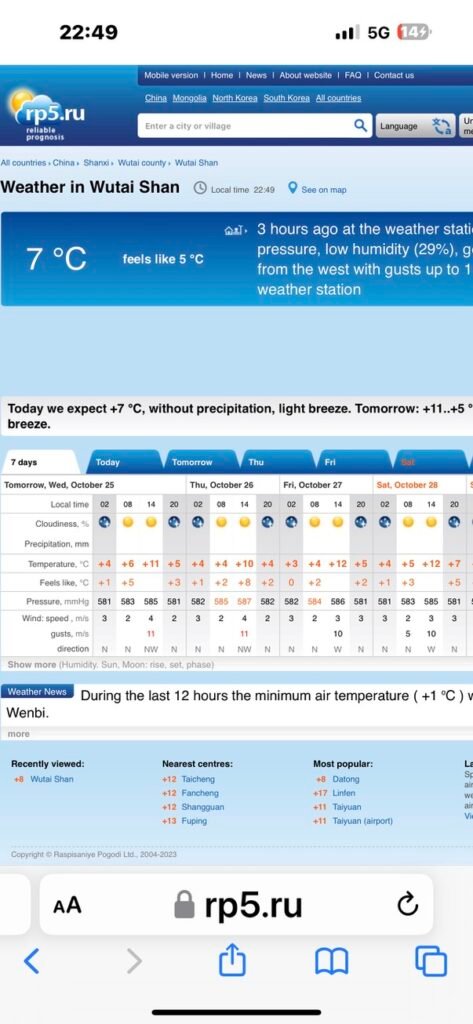
Remember Dad’s rule:
THE MOUNTAIN GETS A VOTE.
😂
Because of the elevation, Mount Wutai (五台山, Wǔtái Shān) can feel significantly cooler than lower-elevation cities.
Conditions can change quickly.
The higher:
Five Terraces (五台, Wǔtái)
can be particularly exposed.
So even in a season when nearby cities feel comfortable, carry:
an extra layer,
wind protection,
suitable shoes,
water,
and:
some flexibility.
If you’re heading onto higher terraces:
CHECK THE CONDITIONS.
Don’t argue with the mountain.
😂
🚶 How Much Walking?
Potentially quite a lot.
There are:
stairs,
slopes,
temple courtyards,
uphill approaches,
and:
walking between sites.
So Dad would again plan:
ENERGY
not merely:
TIME.
This matters particularly if you’re traveling with:
children,
elderly parents,
or:
anyone with limited mobility.
A beautifully designed 12-temple itinerary is useless if everybody hates Dad by Temple Number 6.
😂
📅 Dad’s Comfortable First Visit
If Dad were introducing an international traveler to Mount Wutai (五台山, Wǔtái Shān) for the first time…
I’d keep it simple.
DAY 1 — ARRIVE
Reach:
Taihuai Town (台怀镇, Táihuái Zhèn).
Check in.
Walk around.
Get your bearings.
Don’t immediately begin:
OPERATION 47 TEMPLES.
😂
Notice:
monks (僧人, Sēngrén),
pilgrims and worshippers (香客, Xiāngkè),
incense (香, Xiāng),
temple bells,
the surrounding mountains,
and:
how religious life exists alongside tourism.
Remember:
TEMPLE (寺庙, Sìmiào) ≠ MUSEUM (博物馆, Bówùguǎn).
DAY 2 — FOUR QUESTIONS
Visit selected central temples.
Xiantong Temple (显通寺, Xiǎntōng Sì)
How deep does the Buddhist history go?
Tayuan Temple (塔院寺, Tǎyuàn Sì)
Why does the Great White Stupa (大白塔, Dà Báitǎ) look different?
Pusa Ding (菩萨顶, Púsà Dǐng)
Where does the Tibetan Buddhist (藏传佛教, Zàngchuán Fójiào) layer become visible?
Shuxiang Temple (殊像寺, Shūxiàng Sì)
How do I recognize Manjusri Bodhisattva (文殊菩萨, Wénshū Púsà)?
Four temples.
Four questions.
ENOUGH.
😂🔥
DAY 3 — CHOOSE YOUR RABBIT
If you have another day…
don’t automatically add another eight temples.
Choose your rabbit.
🏔️ Sacred geography?
Explore selected:
Five Terraces (五台, Wǔtái).
🏯 Ancient wooden architecture?
Plan:
Foguang Temple (佛光寺, Fóguāng Sì)
and/or:
Nanchan Temple (南禅寺, Nánchán Sì).
🙏 Living Buddhist practice?
Slow down around:
Taihuai Town (台怀镇, Táihuái Zhèn)
and observe the pilgrimage landscape.
Different traveler.
Different Mount Wutai (五台山, Wǔtái Shān).
That’s the point.
🗣️ Useful Chinese for International Travelers
五台山
Wǔtái Shān
Mount Wutai
台怀镇
Táihuái Zhèn
Taihuai Town
文殊菩萨
Wénshū Púsà
Manjusri Bodhisattva
寺庙
Sìmiào
Temple
朝圣
Cháoshèng
Pilgrimage
朝台
Cháotái
Pilgrimage to the terraces
And:
请问,殊像寺怎么走?
Qǐngwèn, Shūxiàng Sì zěnme zǒu?
Excuse me, how do I get to Shuxiang Temple?
Another useful one:
今天可以上五台吗?
Jīntiān kěyǐ shàng Wǔtái ma?
Can we go up to the Five Terraces today?
Useful when weather or access is uncertain.
🎟️ Check Current Access Before You Go
This is important.
Visitor arrangements around Mount Wutai (五台山, Wǔtái Shān) can involve:
scenic-area entry,
vehicle controls,
shuttle arrangements,
temple opening hours,
terrace access,
and:
weather-related restrictions.
These can change.
So Dad does not want to hard-code:
“Bus 3 leaves at exactly 08:17 from this gate forever.”
😂
Shortly before traveling, verify:
current opening arrangements,
transport inside the scenic area,
vehicle restrictions,
weather,
and:
any reservation requirements.
Especially if your plan includes the higher:
Five Terraces (五台, Wǔtái).
🤔 Who Will LOVE Mount Wutai (五台山, Wǔtái Shān)?
Dad would strongly recommend it if you’re interested in:
Buddhism,
religion,
Chinese history,
pilgrimage,
sacred landscapes,
ancient architecture,
UNESCO World Heritage Sites,
or:
the connections between China and the wider Asian world.
It is particularly rewarding if you enjoy asking:
“Why is this place important?”
rather than only:
“What should I photograph?”
🔥
😴 Who Might Skip It?
Dad is equally happy to say this.
If this is your first trip to China and you have:
very limited time,
little interest in religious history,
little interest in temples,
or:
an already exhausting itinerary…
you don’t need to force Mount Wutai (五台山, Wǔtái Shān) into the trip.
China is enormous.
An excellent destination does not automatically belong in every excellent itinerary.
But if:
Yungang Grottoes (云冈石窟, Yúngāng Shíkū)
has already made you ask how Buddhism became Chinese…
then Mount Wutai (五台山, Wǔtái Shān) is a wonderful next chapter.
At:
Yungang Grottoes (云冈石窟, Yúngāng Shíkū)
Dad sees Buddhism being translated into a monumental northern Chinese landscape.
At:
Mount Wutai (五台山, Wǔtái Shān)
Dad sees Buddhist belief becoming:
SACRED GEOGRAPHY + PILGRIMAGE + LIVING PRACTICE.
🔥
🐇 And This Is Why Shanxi Province (山西省, Shānxī Shěng) Kept Trapping Dad
😂
Every time Dad thought:
“Okay. Now I understand this part of Chinese history.”
Shanxi Province (山西省, Shānxī Shěng) opened another door.
Yanmenguan Pass (雁门关, Yànménguān)
→ frontier
Yungang Grottoes (云冈石窟, Yúngāng Shíkū)
→ Buddhism + Northern Wei Dynasty (北魏, Běi Wèi)
Hanging Temple (悬空寺, Xuánkōng Sì)
→ belief + landscape
Yingxian Wooden Pagoda (应县木塔, Yìngxiàn Mùtǎ)
→ Liao Dynasty (辽朝, Liáo Cháo) + Khitan people (契丹, Qìdān)
Mount Wutai (五台山, Wǔtái Shān)
→ pilgrimage + Manjusri Bodhisattva (文殊菩萨, Wénshū Púsà)
Foguang Temple (佛光寺, Fóguāng Sì)
→ Tang Dynasty (唐朝, Táng Cháo) timber architecture
Nanchan Temple (南禅寺, Nánchán Sì)
→ even earlier surviving Tang Dynasty (唐朝, Táng Cháo) timber architecture
That’s not a checklist.
It’s a province teaching history.
🐇 DEEP China: The Shanxi History Tasting Menu — Travel Through Layers of Chinese History
🌏 One Mountain — Many Buddhist Worlds
And now Dad comes back to the question that started this article.
Why did:
Mount Wutai (五台山, Wǔtái Shān)
become sacred across the Buddhist world?
Not because it had the most temples.
Its importance accumulated:
pilgrim by pilgrim,
dynasty by dynasty,
century by century.
🧠 Put the Story Together
MANJUSRI BODHISATTVA (文殊菩萨, Wénshū Púsà)
Wisdom (智慧, Zhìhuì)
↓
FIVE TERRACES (五台, Wǔtái)
sacred geography
↓
PILGRIMAGE (朝圣, Cháoshèng)
people actually journey here
↓
TANG DYNASTY (唐朝, Táng Cháo)
major Buddhist pilgrimage center
↓
ENNIN (圆仁 / 円仁, Ennin)
Japan
↓
TIBETAN BUDDHISM (藏传佛教, Zàngchuán Fójiào)
Tibet (西藏, Xīzàng) + Mongolia (蒙古, Měnggǔ)
↓
QING DYNASTY (清朝, Qīng Cháo)
imperial patronage
↓
TODAY
monks + pilgrims + worshippers + travelers
🔥
That’s the answer.
❤️ Dad Came Looking at Temples
Before coming to Mount Wutai (五台山, Wǔtái Shān), it is easy to see:
Temple A.
Temple B.
Temple C.
Another Buddha.
Another courtyard.
😂
But once Dad understood:
Manjusri Bodhisattva (文殊菩萨, Wénshū Púsà),
Wisdom (智慧, Zhìhuì),
Five Terraces (五台, Wǔtái),
pilgrimage (朝圣, Cháoshèng),
Ennin (圆仁 / 円仁, Ennin),
and:
Tibetan Buddhism (藏传佛教, Zàngchuán Fójiào)…
the temples stopped looking like:
A COLLECTION OF BUILDINGS.
They became evidence of:
PEOPLE RETURNING TO THE SAME SACRED LANDSCAPE FOR CENTURIES.
🔥
ChinaTravelBUG’s Take
Dad came looking at:
TEMPLES.
What Mount Wutai (五台山, Wǔtái Shān) taught Dad & Elaine was something much bigger.
Sacred places are not built only from:
stone,
timber,
stupas,
statues,
and temples.
They are also built from:
BELIEF.
From people:
traveling,
praying,
remembering,
telling stories,
and:
returning.
For more than a thousand years.
Manjusri Bodhisattva (文殊菩萨, Wénshū Púsà) was the thread.
Wisdom (智慧, Zhìhuì) was the association.
The Five Terraces (五台, Wǔtái) gave that belief a landscape.
And generations of pilgrims made that landscape live.
So when you reach Mount Wutai (五台山, Wǔtái Shān), don’t ask only:
“How many temples can I visit?”
Ask:
“Why did people from so many different places and times keep coming back to this mountain?”
Once you ask that…
you stop collecting temples.
YOU START SEEING A SACRED LANDSCAPE.
🔥🐇
See China. Understand It Better.