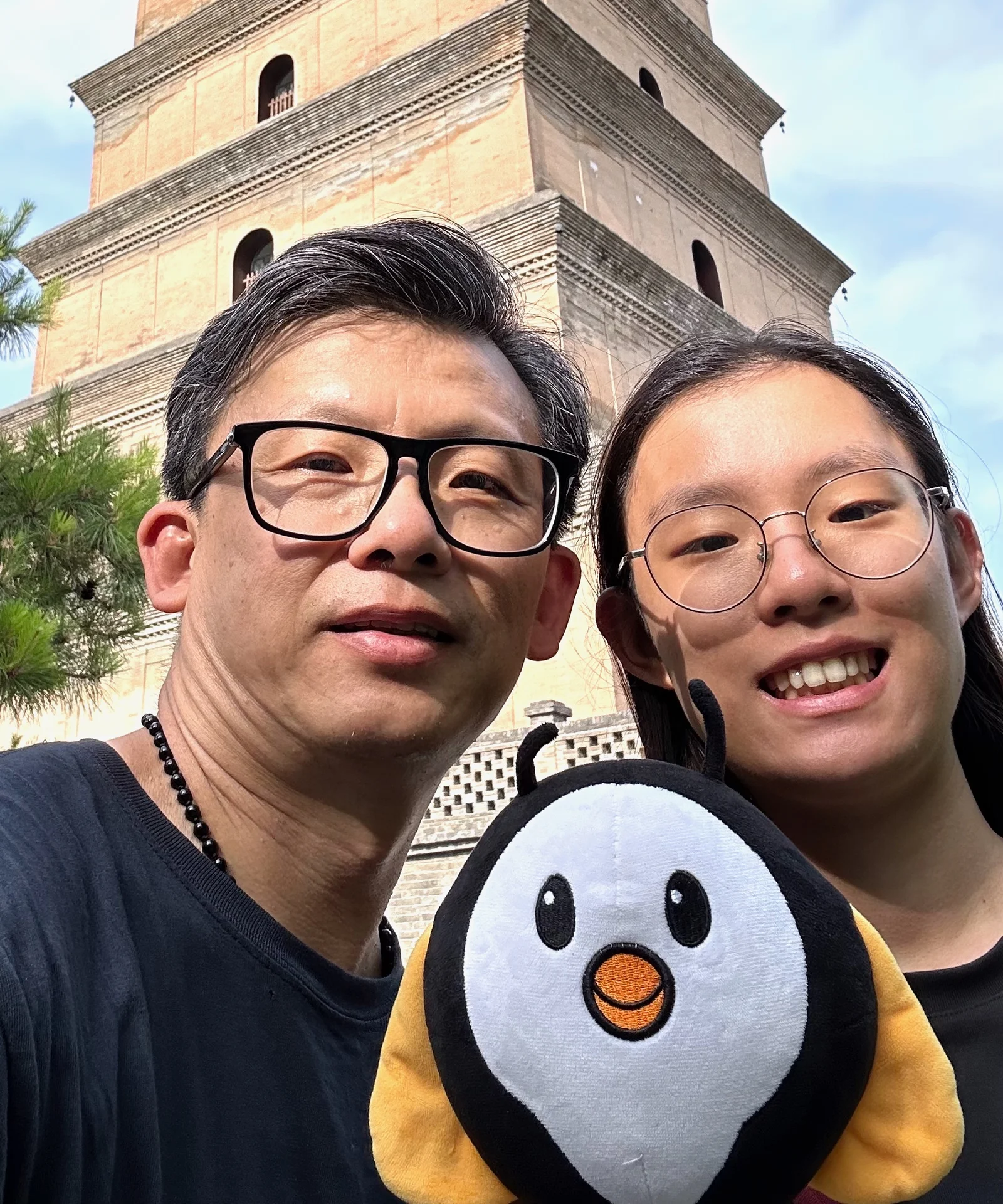
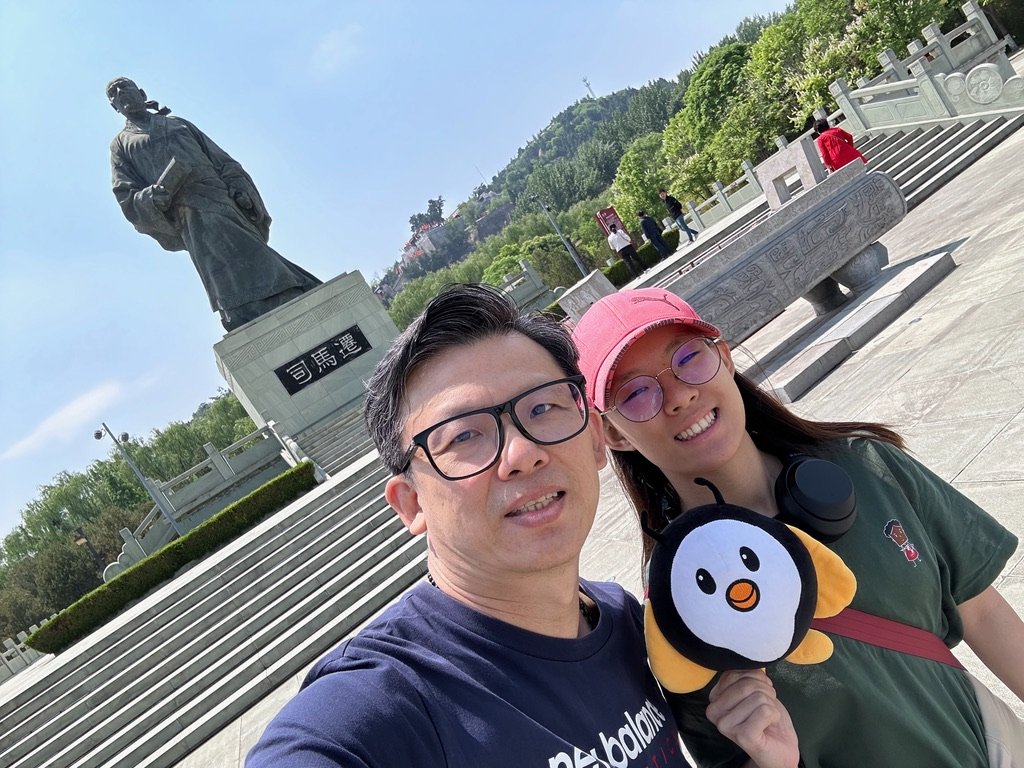
Elaine was climbing again.
😂
Up stone steps.
Through old gateways.
Higher and higher above the landscape outside:
Hancheng (韩城, Hánchéng), Shaanxi.
Our destination was:
Sima Qian Temple and Tomb
司马迁祠墓
Sīmǎ Qiān Címù
Dad had dragged Elaine here for one man.
A historian who died more than:
2,000 YEARS AGO.
🐇
🎥 Come Up the Hill With Elaine
Elaine climbs the steep stone steps toward the Sima Qian shrine complex in Hancheng. At the top, she passes beneath the gateway marked:
太史祠 — Tàishǐ Cí
Shrine of the Grand Historian.
It is a wonderfully appropriate entrance.
Because the man remembered here became China’s:
GRAND HISTORIAN.
Elaine kept going.
Another old stone pathway.
Another gateway.
And above it were four characters:
高山仰止 — gāo shān yǎng zhǐ
Literally evoking the idea of looking up toward a lofty mountain — an old expression of admiration for towering virtue or achievement.
For someone walking toward Sima Qian’s tomb…
Dad couldn’t think of a much better inscription.
🎥 Higher Up — And Then the View Opens
Elaine walks through the 高山仰止 gateway and continues up the historic stone path toward the tomb.
Then, near the top…
the landscape suddenly opens.
Below us was the long ceremonial axis of the Sima Qian complex.
Trees.
Statues.
Traditional buildings.
The surrounding Hancheng landscape.
And somewhere up here was the man Dad had been chasing through Chinese history for years.
😂🐇
🎥 Finally — Sima Qian’s Tomb
Elaine continues through the upper precinct until we finally reach:
司马迁墓 — Sīmǎ Qiān Mù
Tomb of Sima Qian.
The tomb sits high above the surrounding landscape, enclosed by old walls and shaded by trees.
Elaine walks around the tomb, stops to read the information board, then goes to the outer wall to look across the country below.
Dad’s reaction?
FINALLY.
😂
We caught him.
📸 Dad’s Photo — The Tomb of Sima Qian
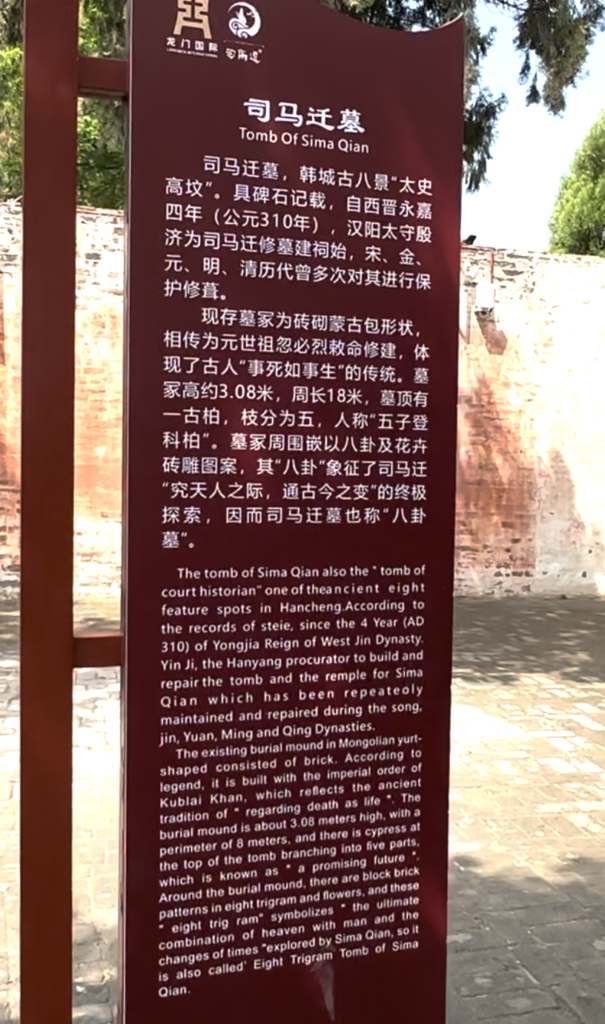
📸 Dad’s Photo — Sima Qian Temple and Tomb, Hancheng: The site information board identifies this as the Tomb of Sima Qian (司马迁墓) and records a long history of later repair and preservation. The board says rebuilding of the tomb and temple began under Yin Ji, the Hanyang prefect, in 310 CE, with further maintenance during the Song, Jin, Yuan, Ming and Qing periods. Whatever questions we may have about the physical tomb across two millennia, one thing is very clear: later generations kept coming back to remember Sima Qian.
But Why Did Dad Bring Elaine All the Way Here?
This is where our travel story becomes a:
DEEP CHINA RABBIT.
😂🐇
Because the more Dad and Elaine traveled around China…
the more we kept meeting people who had been dead for:
2,000 years,
2,500 years,
sometimes:
MORE THAN 3,000 YEARS.
At Yinxu:
SHANG KINGS.
At Baoji:
ZHOU KINGS.
At Xi’an:
QIN SHI HUANG.
At Qufu:
CONFUCIUS.
And everywhere we went, somebody seemed able to tell us:
who ruled,
who fought whom,
who succeeded whom,
which state conquered which state,
who advised which king,
who betrayed whom,
who died,
and sometimes even:
WHAT SOMEBODY SAID.
😳
Eventually Dad had to ask:
HOW DO WE KNOW ALL THIS?
And again and again…
one name appeared:
Sima Qian (司马迁, Sīmǎ Qiān).
The man whose tomb Elaine had just climbed all those steps to reach.
🔥
🐇 What This Story Shows
Sima Qian lived during the:
Han dynasty (汉朝, Hàn Cháo)
more than two thousand years ago.
His great work:
《史记》 — Shǐjì
Records of the Grand Historian
attempted something astonishing.
To organize an enormous sweep of China’s remembered past:
legendary ancient rulers,
Xia traditions,
Shang,
Zhou,
Spring and Autumn,
Warring States,
Qin,
and finally:
HIS OWN HAN-DYNASTY WORLD.
But there’s a problem.
Sima Qian did NOT live during:
SHANG.
He did NOT live during early:
ZHOU.
And although Qin was much closer to his own lifetime, he certainly wasn’t standing beside:
QIN SHI HUANG
watching the First Emperor unify China.
So Dad’s question becomes even better:
HOW DID SIMA QIAN KNOW?
And then:
HOW DO WE KNOW WHETHER HE WAS RIGHT?
🔥🔥🔥
Now our Hancheng travel rabbit becomes a historical detective story.

🧭 Where Are We?
c. 13th–11th centuries BCE
Late Shang dynasty world at Yinxu.
↓
c. 1046 BCE
Traditional date for the Zhou conquest of Shang.
↓
221 BCE
Qin Shi Huang completes the conquest of the rival states.
↓
206 BCE
The Qin dynasty collapses.
↓
c. 145 BCE – Traditional approximate birth date of Sima Qian.
😳
Look at the gap.
When Sima Qian wrote about late Shang…
he was describing a world roughly:
A THOUSAND YEARS BEFORE HIM.
So…
HOW DID HE KNOW?
🐇
Section 2 — The Father, the Emperor and the Book Sima Qian Had to Finish
So who exactly was the man whose tomb Elaine had just climbed all those steps to reach?
Sima Qian (司马迁, Sīmǎ Qiān)
was born around:
145 BCE
during the:
Han dynasty (汉朝, Hàn Cháo).
He is traditionally associated with the area around modern:
Hancheng (韩城, Hánchéng)
in today’s Shaanxi Province.
But to understand why Sima Qian became so important to Chinese history…
we need to meet:
HIS FATHER.
🐇
Sima Tan 司马谈 — His Father Worked for the Han Emperor
Sima Qian’s father was:
Sima Tan (司马谈, Sīmǎ Tán).
He wasn’t simply a private scholar sitting at home collecting old stories.
He served at the imperial court of:
Emperor Wu of Han
汉武帝 — Hàn Wǔdì
one of the most powerful emperors of the Han dynasty.
Sima Tan held the court office:
太史令 — Tàishǐ Lìng
often translated into English as:
Grand Historian
or:
Grand Astrologer.
That translation needs a little handrail.
😂
Don’t imagine:
“Official historian whose only job was writing history books.”
The position belonged to the machinery of the:
IMPERIAL COURT.
Its responsibilities were connected with matters including:
astronomical observation,
calendrical calculations,
ritual timing,
official records,
and the preservation of historical knowledge.
🔥
So Sima Tan occupied an unusual position.
He worked:
INSIDE THE HAN IMPERIAL SYSTEM.
And he had access to the textual and historical world of the court.
That becomes very important when we ask:
Where did Sima Qian get his information?
Dad’s Political Science Handrail — He Was Inside the State
This matters.
Imagine trying to write the history of a country today.
Would you rather have access only to:
stories people tell you,
or also to:
GOVERNMENT RECORDS?
Archives.
Official documents.
Genealogies.
Calendrical records.
Earlier texts.
Court traditions.
Information preserved by the state.
🔥
Sima Tan worked inside that world.
And eventually:
SO DID HIS SON.
But Father and Son Shared Something Bigger Than a Government Job
Sima Tan was also deeply interested in understanding and organizing the past.
He had begun an ambitious historical project.
Not merely:
“What happened during Emperor Wu’s reign?”
But something much larger:
HOW DID THE PRESENT CHINESE WORLD GET HERE?
Ancient rulers.
Earlier dynasties.
States.
Political changes.
Ideas.
Institutions.
People.
The accumulated past that eventually produced:
THE HAN WORLD.
But Sima Tan would not live long enough to finish that work.
110 BCE — A Father Is Dying
In:
110 BCE,
Emperor Wu was preparing for the famous imperial:
Feng and Shan sacrifices (封禅, Fēngshàn)
associated with:
Mount Tai (泰山, Tài Shān).
Sima Tan, despite holding the office of Taishi Ling, was unable to accompany the emperor.
He became seriously ill.
Sima Qian hurried to his father.
And according to Sima Qian’s later account, his dying father entrusted him with something enormously important:
CONTINUE THE WORK.
🔥
This wasn’t simply:
“Son, take my office.”
It was:
Don’t let the historical project die with me.
That distinction matters.
Did Sima Qian Inherit His Father’s Job?
NOT AUTOMATICALLY LIKE A FAMILY BUSINESS.
😂
Sima Qian later:
SUCCEEDED HIS FATHER
in the imperial office of:
太史令 — Tàishǐ Lìng.
So father and son ultimately held the:
SAME COURT POSITION.
Both served within the Han imperial system.
Both were connected with the court of:
Emperor Wu.
But Dad would avoid saying:
“Sima Qian inherited his father’s government job.”
That makes it sound hereditary.
Better:
HE SUCCEEDED HIS FATHER IN THE OFFICE.
🔥
What Sima Qian truly inherited from his father was something less official and much more personal:
THE UNFINISHED HISTORICAL MISSION.
Sima Qian Now Had Three Powerful Things
This is where the pieces begin fitting together.
Sima Qian had:
1. His father’s historical project
Sima Tan had already gathered knowledge and begun thinking about how the past should be preserved.
↓
2. Access through the Han imperial court
After succeeding his father as:
太史令,
Sima Qian worked within the imperial system and could draw upon materials available in that environment.
↓
3. His own travels
And this third part is especially interesting for Dad.
Because Sima Qian didn’t only:
READ ABOUT PLACES.
He:
WENT TO PLACES.
🔥
The Historian Was Also a Traveler
As a young man, Sima Qian travelled widely.
He visited places associated with:
ancient states,
historical events,
famous people,
old traditions,
ritual landscapes,
and inherited stories.
Of course:
VISITING A PLACE DOESN’T MAKE EVERY STORY TRUE.
😂
But travel gave him another kind of historical input.
Documents tell you one thing.
Local traditions may tell you another.
Landscapes raise different questions.
Old monuments preserve different memories.
And Dad understands that rather well.
Because that’s exactly how ChinaTravelBUG keeps getting into trouble.
😂🐇
Read about Shang.
↓
Go to Yinxu.
↓
Find oracle bones.
↓
Ask about Zhou.
↓
Go to Baoji.
↓
Find He Zun.
↓
Ask about Sima Qian.
↓
Go to Hancheng.
↓
Climb another hill.
😭
Then Sima Qian Became the Court Official His Father Had Been
After Sima Tan’s death, Sima Qian eventually succeeded him as:
太史令 — Tàishǐ Lìng.
Now notice the situation.
Sima Qian is:
INSIDE THE HAN COURT.
He is serving under:
Emperor Wu of Han.
He has:
his father’s unfinished work,
his own travels,
earlier historical texts and traditions,
and access to the documentary world associated with the imperial court.
🔥
Now Dad can begin to understand how one man could attempt something as ambitious as:
《史记》 — Shǐjì
Records of the Grand Historian.
But working for an emperor also carries a danger.
Especially when:
YOU DISAGREE WITH THE EMPEROR.
😬
And that is exactly what happened.
Enter Li Ling 李陵
In:
99 BCE,
the Han general:
Li Ling (李陵, Lǐ Líng)
fought against the:
Xiongnu (匈奴, Xiōngnú).
His force became isolated and overwhelmed.
After fierce fighting, Li Ling eventually:
SURRENDERED.
At Emperor Wu’s court, the reaction was severe.
Officials condemned him.
Then Sima Qian did something extraordinarily dangerous for a man whose career depended on:
THE EMPEROR.
He spoke in Li Ling’s defense.
🔥
Sima Qian argued, in essence, that Li Ling’s actions should be understood in the context of his circumstances and previous service.
Emperor Wu was:
NOT PLEASED.
The Emperor’s Historian Becomes the Emperor’s Prisoner
This is the brutal twist.
The same imperial system that had given Sima Qian:
position,
access,
records,
and the environment in which he could pursue history…
could also:
DESTROY HIM.
He was arrested.
Convicted.
And faced severe punishment.
Sima Qian ultimately endured:
CASTRATION.
For a man of his social and cultural world, the punishment brought enormous:
HUMILIATION.
And now he faced a choice.
He could:
DIE.
Or endure the disgrace…
and:
LIVE.
Why Was Surviving Such a Difficult Choice?
We have to be careful here.
Don’t judge Sima Qian’s decision entirely through:
MODERN VALUES.
In his world, ideas surrounding:
honor,
family reputation,
bodily integrity,
social status,
and shame
carried enormous weight.
Castration wasn’t merely:
PHYSICAL PUNISHMENT.
For a man of Sima Qian’s standing, surviving it carried profound:
SOCIAL HUMILIATION.
So Dad’s question becomes:
WHY DID HE LIVE?
Because His Father’s Work Was Still Unfinished
🔥
Now return to that deathbed scene.
Sima Tan.
His son.
The unfinished history.
The obligation to preserve the past.
Sima Qian had already spent years:
travelling,
collecting,
reading,
organizing,
and writing.
The project wasn’t:
FINISHED.
He later reflected on his suffering and decision to survive in the famous:
《报任安书》 — Bào Rèn’ān Shū
Letter to Ren An.
Dad’s simple handrail is:
HE HAD SOMETHING LEFT TO FINISH.
🔥🔥🔥
What Would You Choose?
Dad doesn’t want to turn this into easy:
HERO WORSHIP.
We weren’t there.
We don’t know what it felt like.
Would you accept:
public disgrace,
social humiliation,
the destruction of your status,
and a punishment that would mark the rest of your life…
because:
YOUR FATHER’S BOOK WASN’T FINISHED?
😳
That’s no longer an abstract history question.
That’s a human one.
He Finished It
Sima Qian survived.
He continued working.
And the enormous historical project associated with father and son became:
《史记》 — Shǐjì
Records of the Grand Historian.
130 CHAPTERS.
🔥
A history stretching from ancient remembered rulers and traditions through:
Shang,
Zhou,
Spring and Autumn,
Warring States,
Qin,
and into:
THE HAN WORLD SIMA QIAN HIMSELF SERVED.
And now Dad understands something about the man whose tomb Elaine climbed to see.
He wasn’t simply:
“A HISTORIAN.”
He was:
the son of a Han imperial court official,
then a Han imperial court official himself,
a servant of Emperor Wu,
a traveler,
a collector of historical knowledge,
a man punished by the emperor he served,
and:
THE SON WHO REFUSED TO LET HIS FATHER’S HISTORICAL PROJECT DIE.
🔥
More than two thousand years later…
Dad and Elaine climbed a hill in Hancheng because:
HE FINISHED IT.
🐇
But What Exactly Did He Build?
People sometimes say:
“Sima Qian wrote China’s history.”
True…
but not enough.
😂
The Shiji isn’t simply one enormous chronological story.
Sima Qian organized history through:
rulers,
timelines,
institutions,
states and great families,
and individual lives.
It is almost like entering the past through:
FIVE DIFFERENT DOORS.
🐇
Section 3 — One Man Tried to Organize More Than 2,000 Years of China’s Past
Sima Qian survived.
He continued the historical project begun by his father.
And eventually there was:
《史记》 — Shǐjì
Records of the Grand Historian
A work of:
130 CHAPTERS.
But before Dad explains how Sima Qian organized it…
stop.
Because international travelers need to understand:
HOW MUCH HISTORY ARE WE TALKING ABOUT?
😳
🧭 Sima Qian’s Enormous Timeline
The Shiji does not begin with:
QIN SHI HUANG.
It doesn’t begin with:
CONFUCIUS.
It doesn’t even begin with:
SHANG.
Sima Qian reaches much further back into China’s traditional remembered past.
His narrative begins with:
Yellow Emperor — 黄帝 (Huángdì)
traditionally placed in the:
3rd millennium BCE.
Then it moves through the legendary and early dynastic traditions associated with:
Yao (尧)
↓
Shun (舜)
↓
Xia dynasty (夏朝)
↓
Shang dynasty (商朝)
↓
Zhou dynasty (周朝)
↓
Spring and Autumn period (春秋时期)
↓
Warring States period (战国时期)
↓
Qin dynasty (秦朝)
↓
and finally:
Han dynasty (汉朝)
— Sima Qian’s own world.
🔥
🗓️ Where Are We? — The Shiji in One Traveler’s Timeline
Don’t memorize this.
Dad certainly doesn’t expect Elaine to.
😂
Just use it as a handrail:
| Period | Rough Traveler’s Date | What to Remember |
|---|---|---|
| Yellow Emperor 黄帝 | traditionally c. 27th century BCE | legendary culture hero / ancestral ruler |
| Yao & Shun 尧舜 | traditionally 3rd millennium BCE | legendary sage rulers |
| Xia 夏 | traditionally c. 2070–1600 BCE | traditional first dynasty; archaeology/history relationship remains debated |
| Shang 商 | c. 1600–1046 BCE | bronze world; late Shang oracle bones at Yinxu |
| Zhou 周 | c. 1046–256 BCE | King Wen, King Wu; long Zhou political world |
| Spring & Autumn 春秋 | 770–476 BCE | competing states; Confucius |
| Warring States 战国 | 475–221 BCE | major states compete for supremacy |
| Qin 秦 | 221–206 BCE | Qin Shi Huang unifies the rival states |
| Han 汉 | 206 BCE–220 CE | the imperial world in which Sima Qian lived |
Sima Qian died long before the Han dynasty itself ended.
His historical narrative reaches into the reign of:
Emperor Wu of Han
汉武帝 — Hàn Wǔdì
the emperor Sima Qian himself served.
So conceptually, Sima Qian was trying to organize a remembered past stretching from the legendary Yellow Emperor…
all the way to:
HIS OWN TIME.
😳 More Than 2,000 Years of Remembered History
If we use the traditional chronology for the Yellow Emperor…
Sima Qian was dealing with a sweep of roughly:
2,500 YEARS.
🔥🔥🔥
But Dad needs to put a large:
⚠️ EVIDENCE SIGN
beside that number.
The earliest part of this timeline is NOT the same kind of history as:
HAN.
Or:
QIN.
Or even late:
SHANG.
The Yellow Emperor belongs to:
LEGENDARY / TRADITIONAL ANTIQUITY.
Yao and Shun are remembered through ancient textual traditions.
The historicity and chronology associated with Xia remain subjects of archaeological and scholarly debate.
Then by late Shang:
SOMETHING CHANGES.
At Yinxu we have:
oracle-bone inscriptions,
archaeology,
royal names,
bronzes,
tombs,
and evidence produced inside the Shang world itself.
🔥
So don’t imagine the Shiji gives us:
2,500 YEARS OF EQUALLY DOCUMENTED HISTORY.
It doesn’t.
It gives us an extraordinary attempt to connect:
LEGENDARY MEMORY
↓
EARLY DYNASTIC TRADITION
↓
INCREASINGLY DOCUMENTED HISTORY
↓
SIMA QIAN’S OWN HAN WORLD.
That distinction is extremely important.

Western Handrail — Imagine One Book From King Arthur to Your Own Government
Here’s Dad’s handrail for an international reader.
Imagine a historian writing around:
100 BCE.
But his book tries to connect everything from something like:
KING ARTHUR-TYPE LEGENDARY ANTIQUITY
through:
ancient kingdoms,
wars,
changing states,
political institutions,
great families,
famous thinkers,
emperors,
and eventually:
THE GOVERNMENT HE PERSONALLY WORKS FOR.
Not an exact historical comparison.
Don’t push it.
😂
The handrail is simply about:
SCALE.
Sima Qian wasn’t writing:
“A History of Emperor Wu.”
He was trying to answer something closer to:
HOW DID OUR PRESENT WORLD COME TO BE?
🔥
Another Western Handrail — Herodotus + Livy + Plutarch + An Almanac?
Even that doesn’t quite capture the Shiji.
Imagine combining parts of:
HERODOTUS
for sweeping historical narrative,
with something resembling:
LIVY
for political history,
plus:
PLUTARCH
for memorable human lives,
then adding:
chronological tables,
institutional essays,
economics,
ritual,
astronomy,
calendars,
rivers
and genealogy.
😂
Now we’re getting closer to understanding why:
130 CHAPTERS
doesn’t mean:
130 CHAPTERS OF ONE LONG STORY.
Sima Qian organized this enormous historical world through:
FIVE DIFFERENT DOORS.
🚪 Door 1 — 本纪: Who Ruled?
本纪 — běnjì
Basic Annals
12 chapters.
This gives the Shiji its central political spine.
Major rulers.
Reigns.
Succession.
Political events.
Dynastic change.
Dad’s traveler question:
👑 WHO WAS IN CHARGE?
Western Handrail — The Kings-and-Emperors Shelf
Think:
Alexander the Great.
Julius Caesar.
Augustus.
Charlemagne.
Henry VIII.
Napoleon.
Rulers give historians convenient chronological anchors.
But knowing the ruler doesn’t mean you understand the whole civilization.
So Door 1 gives us:
THE SPINE.
Not:
THE WHOLE BODY.
🚪 Door 2 — 表: What Was Happening at the Same Time?
表 — biǎo
Chronological Tables
10 chapters.
Dad’s first reaction:
“Sima Qian invented Excel?”
😂
Not quite.
But the problem is familiar.
During periods such as:
Spring and Autumn
and:
Warring States,
many political states existed simultaneously.
Qin is doing one thing.
Qi another.
Chu another.
Zhao another.
Someone forms an alliance.
Someone attacks.
Someone changes sides.
😭
So Sima Qian creates ways of seeing:
MEANWHILE…
🪜 Western Handrail — Europe in 1500
What happened in Europe in 1500?
You cannot answer simply:
“The king did X.”
Which king?
😂
England?
France?
Spain?
The Holy Roman Empire?
Italian states?
Different political worlds were operating:
AT THE SAME TIME.
That’s the handrail.
The 表 (biǎo) let readers compare parallel historical sequences.
For travelers, this is useful too.
You visit Shaanxi:
QIN.
Then Shandong:
QI.
Then Henan:
another ancient state.
They’re not random disconnected ruins.
They were sometimes:
NEIGHBORS, RIVALS AND CONTEMPORARIES.
🔥
🚪 Door 3 — 书: How Did the System Work?
书 — shū
Treatises
8 chapters.
This is Dad’s Political Science door.
😂
Forget the emperor for a moment.
How did civilization actually:
FUNCTION?
Sima Qian includes discussions involving subjects such as:
ritual,
music,
calendars,
astronomy,
sacrifices,
rivers,
and economics.
Western Handrail — Rome Is More Than Caesar
If you say:
“I understand Rome because I know Julius Caesar.”
Dad says:
NOPE.
😂
What about:
roads?
grain?
taxes?
religion?
law?
money?
water?
trade?
government?
administration?
Knowing:
WHO RULED
is different from understanding:
HOW THE SYSTEM WORKED.
That’s Door 3.
And this is why Dad keeps getting distracted inside Chinese museums.
😂
A standardized weight isn’t boring.
A bamboo government document isn’t boring.
An ancient canal isn’t boring.
They are clues to:
HOW THE MACHINE WORKED.
🔥
🚪 Door 4 — 世家: Who Else Had Power?
世家 — shìjiā
Hereditary Houses
30 chapters.
This becomes especially useful in the long:
ZHOU WORLD.
Because China was not always a centralized empire governed in the way international travelers may associate with later dynasties.
Different:
states,
ruling houses,
lineages,
and regional powers
mattered enormously.
Western Handrail — Game of Thrones, for 30 Seconds 😂
No dragons.
No White Walkers.
No plot comparison.
Just:
GREAT HOUSES.
Different ruling families hold territories.
They:
form alliances,
marry,
fight,
inherit,
rise,
fall.
Power does not exist in only:
ONE PALACE.
That’s enough.
Now:
GET OFF THE WESTEROS BRIDGE.
😂
Ancient Zhou political organization was obviously not Game of Thrones.
But now an international traveler can understand why the histories of:
Qi,
Lu,
Jin,
Qin,
Chu
and other states matter.
When Dad travels through China and these names keep appearing…
they’re not:
RANDOM OLD KINGDOMS.
They’re pieces of:
THE SAME HISTORICAL WORLD.
🚪 Door 5 — 列传: What Did People Do?
Finally:
列传 — lièzhuàn
Biographies / Arrayed Traditions
70 chapters.
The biggest section.
And suddenly history becomes:
HUMAN.
Generals.
Officials.
Thinkers.
Diplomats.
Strategists.
Assassins.
Merchants.
Advisers.
People who succeeded.
People who failed.
People who made very questionable decisions.
😂
Western Handrail — History Beyond Kings and Presidents
Imagine understanding World War II using only biographies of:
Churchill,
Roosevelt,
Hitler,
Stalin.
You would miss enormous parts of the story.
Sometimes the person who reveals an age isn’t:
THE RULER.
It’s:
the general,
the diplomat,
the adviser,
the merchant,
the thinker,
the rebel,
or:
THE MAN PUNISHED BY THE EMPEROR.
😬
Sima Qian knew something about that last category personally.
Perhaps that helps explain why people and their choices matter so much in his history.
Dad’s Five-Door Cheat Sheet
International travelers do NOT need to memorize five Chinese historiographical terms.
😂
Remember this:
| Sima Qian’s Door | Dad’s Traveler Question |
|---|---|
| 本纪 — Basic Annals | 👑 Who ruled? |
| 表 — Tables | 🕰️ What was happening at the same time? |
| 书 — Treatises | ⚙️ How did the system work? |
| 世家 — Hereditary Houses | 🏰 Who else had power? |
| 列传 — Biographies | 👥 What did people do? |
🔥
And Dad suddenly realizes:
THESE ARE ALSO GREAT QUESTIONS FOR TRAVELING THROUGH CHINA.
At the Terracotta Army:
Who ruled?
At a Warring States museum:
What were the other states doing?
At the Qin-Han Museum:
How did the system work?
At Qufu:
Who was Confucius and what did he do?
At an ancient capital:
Who else held power here?
Sima Qian accidentally gave Dad:
A TRAVEL METHOD.
😂🐇
But There Is One Enormous Problem
Remember the timeline at the beginning?
Sima Qian is writing in:
HAN.
Qin is already in the past.
Confucius lived roughly four centuries before him.
Early Zhou was many centuries before him.
Late Shang Yinxu was roughly:
A THOUSAND YEARS BEFORE HIM.
And the Yellow Emperor?
Much further back in:
LEGENDARY ANTIQUITY.
😳
So a beautifully structured 130-chapter history does NOT automatically answer:
IS IT TRUE?
Western Handrail — A Medieval Historian Writing About Ancient Rome
Imagine finding an extraordinary book written around:
1200 CE
describing:
ancient Rome,
its rulers,
wars,
families,
institutions,
and famous people.
Would historians throw it away?
OF COURSE NOT.
It could be enormously valuable.
Would they say:
“Book found. Everything confirmed.”
ALSO NO.
😂
They would compare it with:
contemporary inscriptions,
coins,
archaeology,
buildings,
burials,
documents,
and earlier manuscripts.
🔥
And that gives Dad the better question.
Not:
“DO WE TRUST SIMA QIAN?”
But:
“WHAT CAN WE CHECK?”
🐇 And Dad Has Actually Met Some of the Other Witnesses
Sima Qian writes about:
SHANG.
Dad asks:
What do inscriptions produced during Shang say?
→ Oracle bones at Yinxu.
🐇
He writes about:
ZHOU.
Dad asks:
What did Zhou people themselves cast into bronze?
→ He Zun in Baoji.
🐇
He writes about:
QIN.
Dad asks:
What happens when archaeologists uncover actual Qin documents and material evidence?
🐇
Later texts preserve ancient works.
Dad asks:
What happens when archaeologists dig an older manuscript out of a tomb?
→ Bamboo slips.
🔥🔥🔥
Suddenly Dad & Elaine’s travels through:
Anyang,
Baoji,
Xi’an,
Shandong
and Hancheng
start looking less like:
RANDOM HISTORY TRIPS.
😂
They look like:
DIFFERENT WITNESSES TO CHINESE HISTORY.
And now we can finally ask the question Dad has been waiting for:
WHEN THE GROUND STARTS TALKING…
HOW WELL DOES SIMA QIAN HOLD UP?
🐇🔥
Section 4 — Don’t Just Trust Sima Qian: Ask the Other Witnesses
Now Dad has:
A 130-CHAPTER HISTORY.
A historian who worked inside the Han imperial court.
Access to earlier records and traditions.
A man who travelled.
A man who inherited his father’s historical project.
And a work attempting to connect roughly:
2,500 YEARS OF REMEMBERED PAST
from the legendary Yellow Emperor to Sima Qian’s own Han world.
Impressive.
But Dad still has one annoying question.
😂
HOW DO WE KNOW SIMA QIAN GOT IT RIGHT?
And this is where Dad & Elaine’s travels around China become surprisingly useful.
Because sometimes…
THE GROUND TALKS BACK.
🔥
Western Handrail — Don’t Put the Historian on Trial
International readers sometimes approach an ancient historian with a very modern question:
Can I trust him?
Yes?
No?
Reliable?
Unreliable?
Dad thinks that’s the wrong courtroom.
😂
Imagine reading:
HERODOTUS
about the ancient Greek and Persian worlds.
Or:
LIVY
about early Rome.
Historians don’t simply stamp:
TRUE ✅
or:
FALSE ❌
on the entire author.
They ask:
What sources might he have had?
How close was he to the events?
What was he trying to explain?
Where might later tradition have entered?
And most importantly:
WHAT OTHER EVIDENCE SURVIVES?
Inscriptions.
Coins.
Burials.
Buildings.
Documents.
Archaeology.
Contemporary records.
🔥
So don’t put Sima Qian on trial.
Put him:
BESIDE THE OTHER WITNESSES.
Then listen.
Witness 1 — The Shang Speak for Themselves
Sima Qian wrote about:
SHANG.
He preserved:
rulers,
genealogies,
political traditions,
and stories about a dynasty that had ended roughly:
A THOUSAND YEARS BEFORE HIM.
😳
That’s a very long gap.
So Dad asks:
Can anybody from Shang speak for themselves?
YES.
At:
Yinxu (殷墟, Yīnxū)
near Anyang, archaeologists uncovered enormous quantities of:
甲骨文 — jiǎgǔwén
oracle-bone inscriptions.
These weren’t written by Sima Qian.
They weren’t written by a Han historian remembering Shang.
They were produced:
INSIDE THE SHANG WORLD.
🔥🔥🔥
Dad’s Photo — Meet Another Witness
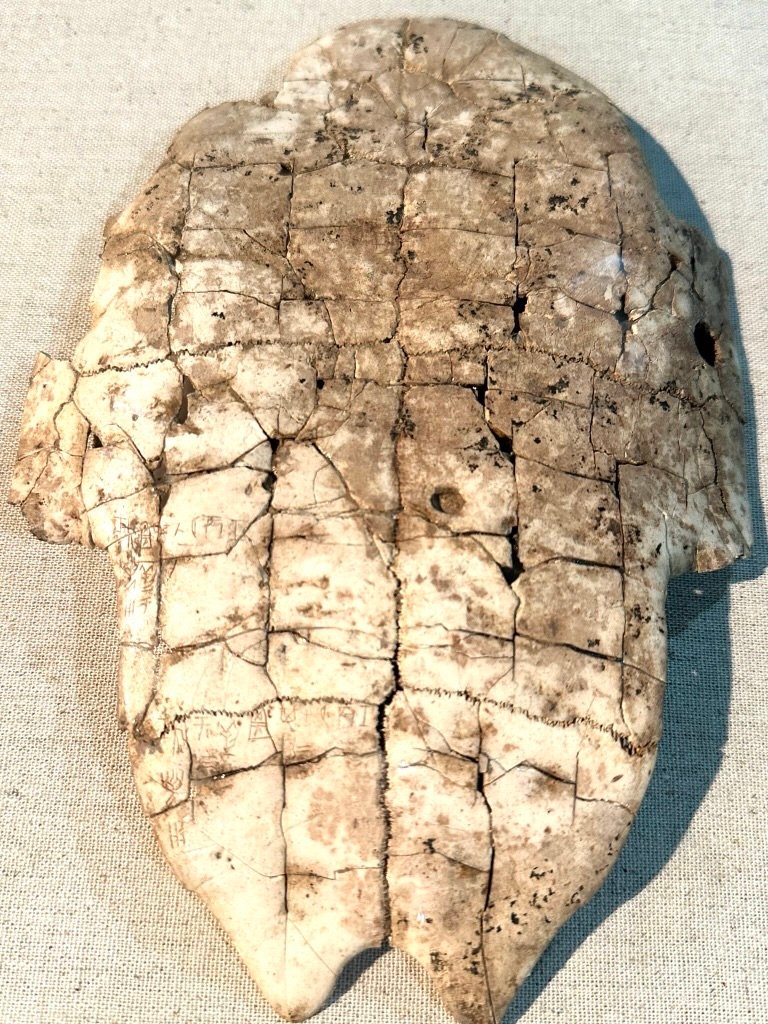
Dad’s Photo — Anyang, Henan: This Shang oracle shell carries writing produced more than 3,000 years ago. Oracle-bone inscriptions preserve names, divinations and concerns from the Shang world itself. For Dad, that makes them an extraordinary historical witness: we can compare later historical traditions with words written much closer to the people and events being described.
And some of those inscriptions preserve:
ROYAL NAMES.
😳
Now something remarkable becomes possible.
Names preserved in later historical traditions can be compared with names appearing in:
SHANG-PERIOD INSCRIPTIONS.
That does NOT mean:
“Everything Sima Qian wrote about Shang is therefore proven.”
No.
😂
But it tells us something enormously important:
SOME VERY OLD HISTORICAL MEMORY REALLY DID SURVIVE.
🔥
👉 Go to Yinxu — Where the Shang Dynasty Speaks in Its Own Words
🏛️ Witness 1½ — How Did We Even Find the Oracle Bones?
Dad being Dad…
one witness creates another question.
😂🐇
If the Shang wrote these things more than 3,000 years ago:
HOW DID MODERN PEOPLE LEARN TO READ THEM?
That’s another fascinating Anyang story.
The oracle bones disappeared underground.
Millennia passed.
Then around:
1899
scholars began recognizing the marks on these bones as:
ANCIENT WRITING.
Collectors gathered them.
Researchers studied them.
Their source was traced to:
ANYANG.
And beginning in:
1928,
scientific archaeological excavation at Yinxu began placing large quantities of oracle bones back into:
ARCHAEOLOGICAL CONTEXT.
🔥
Dad followed this story at the:
National Museum of Chinese Writing
中国文字博物馆
Zhōngguó Wénzì Bówùguǎn
in Anyang.
That’s important because historical evidence doesn’t magically arrive with a label saying:
HELLO. I AM PROOF.
😂
Evidence has its own history of:
discovery,
excavation,
decipherment,
interpretation,
and debate.
Western Handrail — Imagine Finding Pharaoh’s Own Paperwork
Suppose a historian writing centuries later gives you a list of ancient Egyptian rulers.
Useful.
Then archaeologists discover:
inscriptions,
royal names,
administrative documents,
tombs,
and monuments
created in:
THE PHARAOHS’ OWN TIME.
😳
Now you have:
TWO DIFFERENT KINDS OF WITNESS.
The later historian.
And the contemporary evidence.
They may:
agree,
disagree,
fill gaps,
or create entirely new questions.
That’s roughly the excitement Dad wants international readers to feel at:
YINXU.
Not:
“Cool. Old bones.”
😭
But:
“THE SHANG LEFT THEIR OWN WORDS.”
Witness 2 — Zhou Writes in Bronze
Now move forward.
Shang falls.
Zhou rises.
Sima Qian tells us about:
THE ZHOU WORLD.
Again Dad asks:
Do Zhou people leave words of their own?
Oh yes.
😂
One of Dad’s favorite examples is:
He Zun (何尊, Hé Zūn)
a Western Zhou ritual bronze associated with the reign of:
King Cheng of Zhou (周成王).
Inside the vessel is an inscription more than:
3,000 YEARS OLD.
And two characters inside that inscription look very familiar:
中国.
😳🔥
📸 Dad’s Photo — He Zun
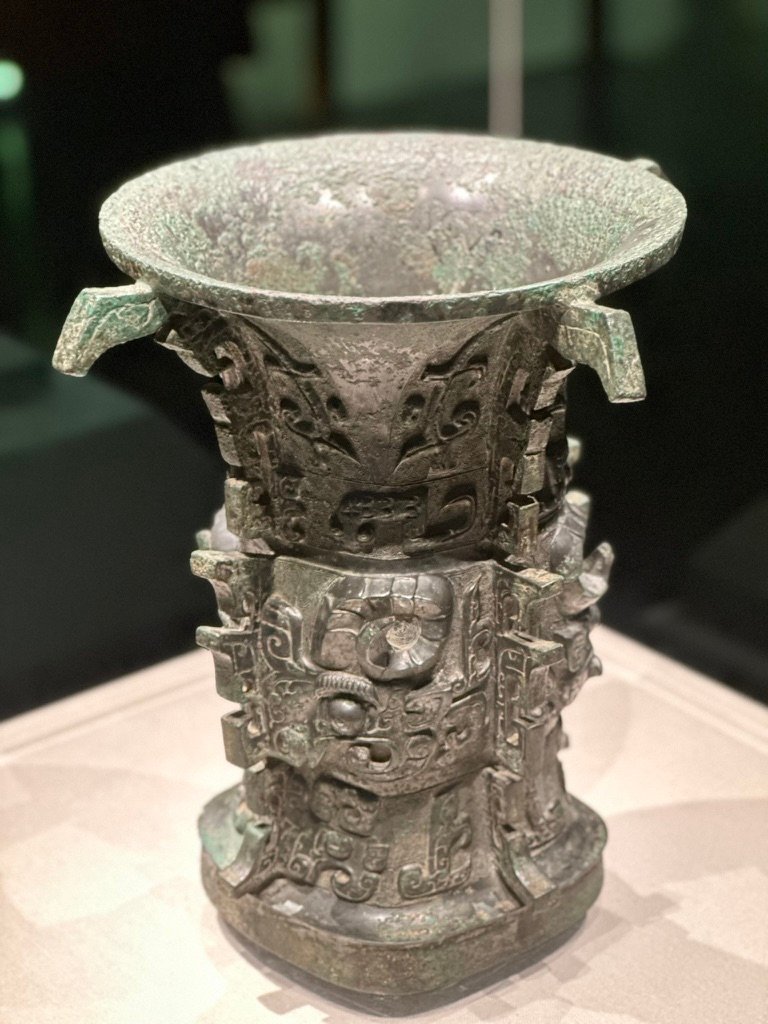
Dad’s Photo — Baoji, Shaanxi: He Zun is much more than the famous early bronze bearing the characters 中国. Its inscription belongs to the political world of the early Western Zhou. For Dad, objects like this are another historical witness: instead of asking only what later historians said about Zhou, we can also ask what people in the Zhou world inscribed themselves.
Important:
中国
on He Zun did NOT simply mean the modern People’s Republic of China.
😂
Different time.
Different political world.
Different context.
That’s exactly why contemporary inscriptions matter.
They force us to ask:
WHAT DID THESE WORDS MEAN THEN?
👉 Follow He Zun — The 3,000-Year-Old Bronze That Bears the Characters 中国
Witness 3 — Zhouyuan: Don’t Treat Dynasties Like Light Switches
Dad & Elaine followed the Zhou rabbit further to:
Zhouyuan (周原, Zhōuyuán)
and:
Qishan (岐山, Qíshān).
This is the homeland associated with the rise of the Zhou before the conquest of Shang.
And Dad encountered something particularly interesting there.
ORACLE BONES.
😳
Wait.
Aren’t oracle bones:
SHANG?
Mostly, that’s where international travelers first encounter them.
Especially at:
ANYANG.
But oracle bones have also been discovered in the Zhouyuan region.
That gives Dad another historical handrail.
Western Handrail — Rome Didn’t Disappear on Friday Afternoon
Historians can give you a convenient date:
476 CE
for the end of the Western Roman Empire.
But people didn’t wake up the next morning and say:
“Excellent. Roman civilization ended yesterday. Please throw everything away.”
😂
Languages continued.
Institutions changed gradually.
Technologies survived.
Religious practices developed.
People adapted.
Political transitions are not always:
LIGHT SWITCHES.
Shang loses.
CLICK.
Everything Shang disappears.
CLICK.
Everything becomes completely Zhou.
No.
Practices can:
continue,
change,
be borrowed,
and be adapted.
🔥
That is why an oracle bone in the Zhouyuan world is so interesting.
It reminds us that:
DYNASTY CHANGE ≠ CIVILIZATION RESET.
👉 Go Beyond Xi’an to Qishan & Zhouyuan — Walk Through the Homeland of the Zhou
Witness 4 — What About King Wen?
Now Dad gets into dangerous rabbit territory.
😂
Sima Qian’s historical world includes:
King Wen of Zhou (周文王)
one of the foundational figures in Zhou tradition.
Later generations know him as:
wise ruler,
father of King Wu,
important figure in the rise of Zhou,
and a major figure associated with the tradition of the:
《周易》 — Zhōuyì.
But before Zhou defeated Shang…
King Wen — Ji Chang — was remembered as:
A PRISONER OF SHANG.
😳
Dad & Elaine followed that story to:
Youlicheng (羑里城, Yǒulǐchéng)
near Anyang.
Now here’s the important historical-thinking lesson.
Youlicheng today contains:
memorial structures,
later inscriptions,
imperial commemorations,
and traditions associated with King Wen.
These are valuable evidence for:
HOW LATER CHINA REMEMBERED KING WEN.
They are not automatically:
ARCHAEOLOGICAL PROOF OF EVERY DETAIL IN THE ANCIENT STORY.
🔥
Different witness.
Different question.
👉 DEEP China: Youlicheng — When the Future Zhou King Was a Prisoner of Shang
Western Handrail — A Memorial Isn’t the Same as an Excavation
Imagine visiting a medieval monument commemorating:
KING ARTHUR.
The monument itself may tell you something important about:
HOW LATER GENERATIONS REMEMBERED ARTHUR.
It does not automatically prove:
“Arthur definitely stood on this exact stone on Tuesday.”
😂
Same historical discipline.
At Youlicheng:
MEMORY
is itself evidence.
But evidence for:
WHAT?
That’s always the question.
🔥
🏛️ Witness 5 — Qin Leaves a LOT More Than Terracotta Warriors
Now Dad reaches:
QIN.
And suddenly the evidence becomes richer.
Sima Qian gives us one of the great narratives of:
Qin Shi Huang (秦始皇)
the First Emperor.
Conquest.
Unification.
Government.
Imperial tours.
The mausoleum.
The emperor’s search for immortality.
And his death.
But archaeology gives us another enormous body of evidence.
Everyone knows:
THE TERRACOTTA ARMY.
🔥
But Dad wants international travelers to look beyond the warriors.
Qin also left:
inscriptions,
weights,
coins,
administrative materials,
laws,
documents,
standardized objects,
roads and infrastructure,
and an enormous archaeological landscape.
Now we can compare:
THE HISTORICAL NARRATIVE
with:
THE MATERIAL WORLD OF QIN.
Western Handrail — Imagine Reading Augustus, Then Walking Into Pompeii
Texts tell you about Rome.
Then archaeology gives you:
roads,
houses,
graffiti,
coins,
shops,
temples,
bodies,
food,
and ordinary objects.
Suddenly:
THE TEXT HAS A PHYSICAL WORLD.
🔥
That’s the handrail Dad would use for Qin.
Sima Qian tells stories.
Archaeology gives those stories:
THINGS.
🏛️ Dad & Elaine’s Qin-Han Handrail
This is why Dad thinks the:
Qin-Han Museum
陕西历史博物馆秦汉馆
near Xi’an Xianyang International Airport is so useful.
It doesn’t merely show:
ANOTHER TERRACOTTA WARRIOR.
It helps international travelers understand how Qin unification and Han consolidation involved:
government,
standardization,
administration,
weights and measures,
economy,
culture,
and the institutions needed to hold a huge territory together.
🔥
👉 Qin-Han Museum — Where Ancient China Comes Alive
Witness 6 — What Happens When We Dig Up Actual Documents?
This may be Dad’s favorite kind of evidence.
😂
Not:
a giant palace.
Not:
a golden treasure.
Not even:
a terracotta warrior.
A:
BORING GOVERNMENT DOCUMENT.
🔥🔥🔥
Why?
Because government documents can show us:
HOW THE STATE ACTUALLY WORKED.
Excavated Qin and Han documents written on:
BAMBOO SLIPS
have preserved material connected with:
law,
administration,
official procedures,
records,
and everyday government.
Suddenly claims about:
IMPERIAL ADMINISTRATION
can be compared with paperwork produced by:
THE ADMINISTRATION ITSELF.
😳
Western Handrail — Historians LOVE Boring Receipts
Imagine archaeologists discover:
JULIUS CAESAR’S GOLDEN CROWN.
Wonderful.
Museum centerpiece.
Crowds.
Instagram.
😂
Now imagine they discover:
tax records,
army pay accounts,
shipping lists,
court documents,
grain records,
local government paperwork.
Less glamorous.
But for understanding:
HOW ROME ACTUALLY FUNCTIONED?
Jackpot.
🔥
That’s why Dad has learned not to walk too quickly past:
BAMBOO SLIPS.
Witness 7 — Sometimes the Ground Gives Us Another Version of a Book
Dad encountered another wonderful example in:
Shandong.
At:
Yinqueshan (银雀山, Yínquèshān),
archaeologists discovered Han-dynasty bamboo manuscripts.
Among the texts were materials associated with:
《孙子兵法》
Sunzi’s Art of War
and:
《孙膑兵法》
Sun Bin’s military writings.
😳
Now think about the historical problem.
A text may survive because later generations:
COPY IT.
Copy.
Copy.
Copy.
For centuries.
But then archaeology sometimes gives us:
AN EARLIER PHYSICAL VERSION.
🔥
Now scholars can compare:
transmitted text
with:
excavated manuscript.
Again:
ANOTHER WITNESS.
Western Handrail — Imagine Finding an Ancient Copy of Homer
Suppose The Iliad survives through a long manuscript tradition.
Then archaeologists uncover a much earlier physical copy.
😳
Suddenly scholars can ask:
What’s the same?
What’s different?
What changed?
What was already there?
That’s the excitement of:
EXCAVATED TEXTS.
They don’t automatically solve every problem.
But they give us another point of comparison.
So… Was Sima Qian Right?
Dad’s answer:
SOMETIMES REMARKABLY SO.
But that’s still too simple.
😂
Archaeology has sometimes supported elements preserved in later historical traditions.
Sometimes it:
adds detail.
Sometimes it:
changes our interpretation.
Sometimes it:
creates problems.
Sometimes the surviving evidence simply cannot answer the question.
And for the earliest legendary periods…
the gap between:
TRADITION
and:
DEMONSTRABLE HISTORY
can remain very large.
🔥
That’s why Dad doesn’t want:
“Sima Qian was right.”
or:
“Sima Qian was wrong.”
He wants:
WHICH CLAIM?
WHICH PERIOD?
WHICH SOURCE?
WHICH OTHER WITNESS?
That’s how history gets interesting.
Dad’s Evidence Ladder
Here’s the handrail Dad now carries through Chinese historical sites:
1. Later historical tradition
What does:
SIMA QIAN
say?
↓
2. Contemporary writing
Do we have:
oracle bones,
bronze inscriptions,
or documents
from closer to the period?
↓
3. Archaeology
What do:
sites,
tombs,
buildings,
objects,
and burials
tell us?
↓
4. Excavated texts
Have manuscripts survived underground?
↓
5. Later memory
How did later generations:
commemorate,
reinterpret,
and preserve
the story?
🔥
None of these automatically wins.
They:
TALK TO EACH OTHER.
😳 And Dad Suddenly Realized What Our China Trips Had Become
Yinxu wasn’t simply:
AN ATTRACTION.
It was:
A WITNESS.
He Zun wasn’t simply:
A BEAUTIFUL BRONZE.
It was:
A WITNESS.
The Qin-Han Museum wasn’t simply:
ANOTHER MUSEUM.
It contained:
WITNESSES.
Bamboo slips weren’t:
BORING OLD STICKS.
😂
They were:
WITNESSES.
Even later memorial sites such as Youlicheng could tell us something different:
HOW CHINA REMEMBERED ITS OWN PAST.
🔥🔥🔥
And suddenly Dad understood why he keeps photographing:
the artifact,
the inscription,
the museum label,
and even:
THE BORING INFORMATION BOARD.
😂
Because each might become:
ANOTHER WITNESS.
🔥
That is one of the biggest things Dad has learned from travelling through historical China.
Don’t photograph only:
the beautiful temple,
the giant statue,
the dramatic tomb,
or Elaine standing beside something.
😂
Photograph:
THE LABEL.
Photograph:
THE DATE.
Photograph:
THE INSCRIPTION.
Photograph:
THE EXPLANATION.
Because six months later…
Dad may suddenly realize:
WAIT. THAT OBJECT CAN ANSWER ANOTHER QUESTION.
🐇
So Can We Trust Sima Qian?
After following all these witnesses, Dad would actually change the question.
Don’t start with:
“DO I TRUST SIMA QIAN?”
Start with:
WHAT IS SIMA QIAN TELLING US?
Then ask:
WHAT OTHER EVIDENCE CAN WE COMPARE IT WITH?
🔥
Sometimes archaeology:
SUPPORTS
parts of the historical tradition.
Sometimes it:
ADDS DETAIL.
Sometimes it:
COMPLICATES
the story.
Sometimes it forces historians to:
RECONSIDER
what later texts preserved.
And sometimes…
there simply isn’t enough evidence to know.
That’s history.
😂
Western Handrail — Don’t Think Judge. Think Detective.
Dad thinks this is the easiest way for an international traveler to understand it.
Don’t imagine Sima Qian standing in court while we decide:
TRUE or FALSE?
Think:
DETECTIVE.
Sima Qian gives us:
ONE MAJOR WITNESS.
Then another witness enters.
An oracle bone.
Then:
a bronze inscription.
Then:
a bamboo manuscript.
Then:
an excavated tomb.
Then:
an administrative document.
Each witness may know:
SOMETHING DIFFERENT.
🔥
The historian’s job is to ask:
Where did this evidence come from?
When was it produced?
What does it actually say?
What might it not tell us?
Does another source agree?
Where do they disagree?
Now ancient history becomes:
AN INVESTIGATION.
🐇
Witness 1 — Shang Speaks for Itself at Yinxu
Sima Qian wrote about the:
SHANG DYNASTY.
But he lived roughly:
A THOUSAND YEARS LATER.
Then archaeologists began excavating:
Yinxu (殷墟, Yīnxū)
at Anyang.
And out of the ground came:
甲骨文 — jiǎgǔwén
oracle-bone inscriptions.
These were not Han historians remembering Shang.
They were inscriptions produced:
INSIDE THE SHANG WORLD.
😳
They preserve things such as:
royal names,
ancestors,
rituals,
warfare,
harvests,
hunting,
and divination.
Now historians could compare parts of the much later historical tradition with:
CONTEMPORARY SHANG WRITING.
🔥
👉 Go to Yinxu — Where Oracle Bones Let Us Hear China 3,000 Years Ago
Witness 2 — How Did We Even Rediscover Those Shang Voices?
Dad followed the oracle-bone rabbit next to:
National Museum of Chinese Writing
中国文字博物馆
Zhōngguó Wénzì Bówùguǎn
in Anyang.
There we discovered another part of the detective story.
Oracle-bone inscriptions were recognized by modern scholars only around the end of the:
19TH CENTURY.
Scholars collected them.
Studied them.
Traced them to Anyang.
Then scientific excavations at Yinxu beginning in:
1928
started recovering oracle bones in archaeological context.
🔥
So the museum doesn’t merely show:
WHAT THE SHANG WROTE.
It also helps explain:
HOW MODERN PEOPLE LEARNED TO HEAR THEM AGAIN.
👉 National Museum of Chinese Writing — Follow the Story of Chinese Characters in Anyang
Witness 3 — Zhou Leaves Words in Bronze
Then Dad travelled into the:
ZHOU WORLD.
At Baoji we encountered:
He Zun (何尊, Hé Zūn).
Inside this Western Zhou bronze vessel is an inscription more than:
3,000 YEARS OLD.
And among its characters appear:
中国.
😳
But Dad’s important lesson wasn’t simply:
“Wow! 中国!”
😂
The important thing is that this is:
ZHOU-PERIOD WRITING.
It gives historians another voice produced much closer to the world Sima Qian would describe centuries later.
Later text:
MEETS
ancient inscription.
🔥
👉 DEEP China: He Zun — The 3,000-Year-Old Bronze That Bears the Characters 中国
Witness 4 — Qin Leaves Paperwork
Then comes:
QIN.
Sima Qian’s account of Qin Shi Huang became enormously influential.
But archaeology gives us something else:
Qin tombs,
inscriptions,
weights and measures,
administrative objects,
and:
EXCAVATED WRITTEN DOCUMENTS.
🔥
Those documents matter because they don’t simply tell us:
“Qin was centralized.”
They can show parts of:
GOVERNMENT ACTUALLY WORKING.
Rules.
Records.
Administration.
Standardization.
The machinery underneath:
UNIFICATION.
Dad & Elaine followed that much bigger Qin-to-Han story at the:
Qin-Han Museum.
👉 Qin-Han Museum — Where Ancient China Comes Alive
Witness 5 — Sometimes an Ancient Book Comes Out of the Ground
This one Dad loves.
😂
Imagine historians know an ancient text because later generations:
copied it,
printed it,
commented on it,
and passed it down.
Then archaeologists open an ancient tomb…
and find:
AN OLD MANUSCRIPT.
😳
Now you can compare:
TRANSMITTED TEXT
with:
EXCAVATED TEXT.
This happened spectacularly with bamboo manuscripts discovered at places such as:
Yinqueshan (银雀山, Yínquèshān)
in Shandong.
Among the texts found there were versions connected with:
《孙子兵法》
Sunzi’s Art of War
and the long-lost:
《孙膑兵法》
Sun Bin’s military writings.
🔥
That’s another kind of witness.
Not:
“Did Sima Qian get everything right?”
But:
What happens when a text preserved by later tradition meets a much older manuscript recovered archaeologically?
🐇 And What About Youlicheng?
Youlicheng (羑里城, Yǒulǐchéng) gives us a different kind of evidence.
Tradition associates the site with:
Ji Chang (姬昌, Jī Chāng)
the future:
King Wen of Zhou (周文王).
And later tradition connected his confinement there with the development of the:
Zhouyi (周易)
and ultimately the Book of Changes tradition.
But Dad needs to be careful.
A later memorial landscape is not the same thing as:
A CONTEMPORARY SHANG ORACLE BONE.
🔥
It tells us something different.
It can show us:
HOW LATER CHINA REMEMBERED THE PAST.
That’s valuable too.
Just don’t confuse:
MEMORY
with:
CONTEMPORARY EVIDENCE.
👉 DEEP China: Youlicheng — When the Future Zhou King Was a Prisoner of Shang
🔥 Now Dad Finally Gets It
Sima Qian is not:
THE ANSWER.
He is one of our greatest:
WITNESSES.
Then we add:
oracle bones,
bronze inscriptions,
bamboo manuscripts,
administrative documents,
archaeological sites,
tombs,
objects,
and later cultural memory.
Different evidence answers:
DIFFERENT QUESTIONS.
🔥🔥🔥
So when Dad asks:
How do we know so much about ancient China?
the answer isn’t:
ONE BOOK.
It isn’t:
ONE HISTORIAN.
And it isn’t:
ONE ARCHAEOLOGICAL DISCOVERY.
It is:
WITNESSES TALKING TO WITNESSES.
Western Handrail — The Rosetta Stone Didn’t Explain All of Egypt
Think about ancient Egypt.
The:
Rosetta Stone
was enormously important.
But nobody would say:
“Excellent. Rosetta Stone found. We now know everything about ancient Egypt.”
😂
Historians combine:
inscriptions,
papyri,
tombs,
temples,
archaeology,
administrative records,
art,
objects,
and later texts.
Same basic principle here.
Sima Qian matters enormously.
But he becomes even more powerful when:
OTHER EVIDENCE CAN TALK BACK TO HIM.
🔥
This Changed How Dad Travels
This may be the most practical lesson Sima Qian gave Dad.
Now when Dad sees an ancient object…
he doesn’t only ask:
“Is it beautiful?”
He asks:
WHAT CAN THIS TELL ME?
An oracle bone.
A bronze inscription.
A bamboo slip.
A Qin measuring vessel.
A stone stele.
Even:
THE BORING INFORMATION BOARD.
😂
Photograph it.
Because six months later…
another rabbit may appear.
And suddenly that photograph becomes:
ANOTHER WITNESS.
🐇🔥
So Where Does That Leave Sima Qian?
After all this detective work…
Dad respects him:
MORE.
Not less.
Because Sima Qian wasn’t writing with:
modern archaeology,
radiocarbon dating,
digital databases,
excavated oracle-bone archives,
or 2,000 additional years of archaeological discoveries.
He worked with:
the records available to him,
earlier texts,
court materials,
historical traditions,
travel,
oral and local memory,
and his own judgment.
And somehow he constructed a historical framework so influential that:
TWO THOUSAND YEARS LATER
we are still:
reading it,
questioning it,
testing it,
and comparing it with things dug out of the ground.
😳
That is extraordinary.
But Dad Has One Final Rabbit
After following Sima Qian through:
texts,
oracle bones,
bronzes,
bamboo manuscripts,
Qin evidence,
museums,
and archaeological sites…
Dad eventually went looking for:
THE MAN HIMSELF.
And that took Dad & Elaine back to:
HANCHENG.
To the hill.
To the shrine.
To the tomb.
To the place where this article began.
🐇
And now…
after everything we’ve learned…
that climb means something very different.
Final Section — Back on the Hill With Sima Qian
Now Dad understood why coming to:
Hancheng (韩城, Hánchéng)
mattered.
At the beginning of this article, Elaine climbed the stone steps toward:
司马迁祠墓
Sīmǎ Qiān Címù — Sima Qian Temple and Tomb.
We had physically found:
THE HISTORIAN.
But after following his story…
Dad realized Sima Qian had been travelling with us for years.
😂
At Yinxu, we met Shang kings he later wrote about.
At Baoji, Zhou bronzes gave us voices from a world he tried to reconstruct.
At Xi’an, Qin archaeology gave physical evidence for an empire whose rise and fall he recorded.
And in Hancheng…
we finally met the man who tried to:
CONNECT ALL THOSE WORLDS.
Dad’s Photo — The Tomb of Sima Qian
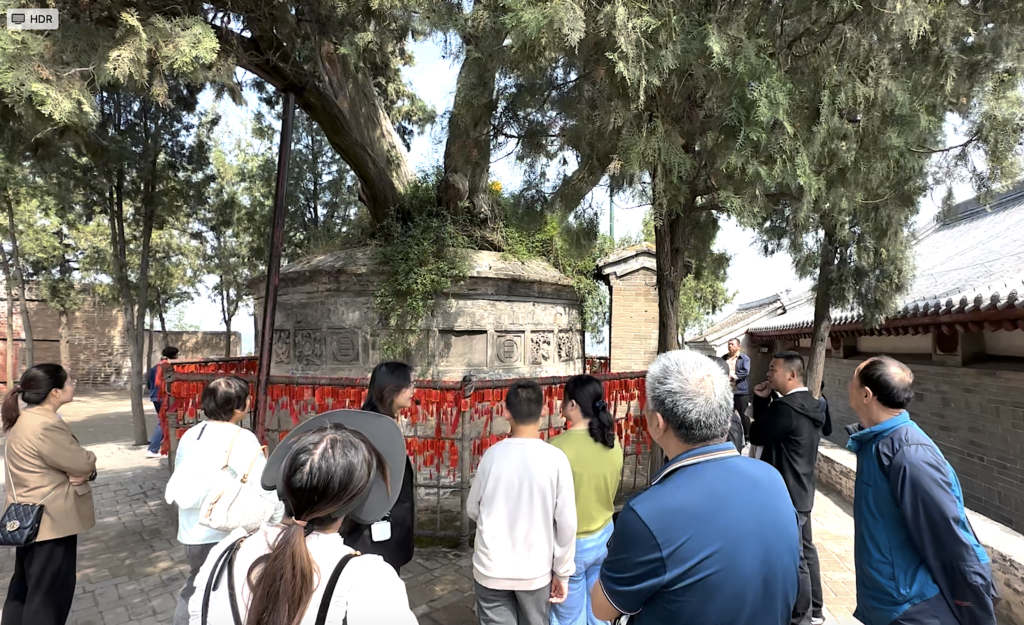
📸 Dad’s Photo — Sima Qian Temple and Tomb, Hancheng: The site board records a long history of rebuilding and preservation, beginning with work in 310 CE and continuing through later dynasties. More than two thousand years after Sima Qian lived, Dad & Elaine were still climbing the hill to find him. That tells us something about how deeply China continued to remember its Grand Historian.
🔥 So How Do We Know So Much About Ancient China?
Not because:
SIMA QIAN SAID SO.
And not because:
ARCHAEOLOGY REPLACED HIM.
We know through:
DIFFERENT WITNESSES.
Sima Qian’s Shiji.
Oracle bones.
Bronze inscriptions.
Bamboo manuscripts.
Government documents.
Tombs.
Archaeological sites.
Later texts and traditions.
Each tells us something.
Each has limits.
And when they can be compared…
THE PAST BECOMES CLEARER.
🔥
Dad’s Final Handrail
Think:
DETECTIVE — NOT JUDGE.
Don’t ask only:
“Is this ancient story true?”
Ask:
“Where did this story come from?”
“How old is the source?”
“What other evidence survives?”
“Do the witnesses agree?”
That question has completely changed the way Dad travels through historical China.
🐇
Dad’s Take
Sima Qian didn’t give us a time machine.
He gave later generations something perhaps more important:
A FRAMEWORK FOR REMEMBERING.
Then archaeology gave us new witnesses with which to:
test it,
challenge it,
add to it,
and understand it better.
Dad came to Hancheng looking for:
A HISTORIAN.
He left thinking about:
HOW A CIVILIZATION REMEMBERS ITS PAST.
🔥
SEE → ASK → CONNECT → UNDERSTAND → FOLLOW
ChinaTravelBUG — See China. Understand It Better.
Want to Follow Dad & Elaine to Sima Qian?
Sima Qian’s shrine and tomb are not in central Xi’an.
They are near:
Hancheng (韩城, Hánchéng)
in:
Shaanxi Province (陕西省, Shǎnxī Shěng).
The site is known as:
司马迁祠墓
Sīmǎ Qiān Címù
Sima Qian Temple and Tomb
For international travelers, Dad would treat this as part of a:
HANCHENG JOURNEY
rather than travelling all this way only to see one tomb.
📍 Where Is the Sima Qian Temple and Tomb?
The historic complex lies outside central Hancheng, in the area traditionally associated with Sima Qian’s birthplace and family homeland.
For DiDi or a Chinese map app, Dad would show the driver:
司马迁祠
or:
司马迁祠墓
Don’t worry about trying to pronounce everything perfectly.
😂
Showing the Chinese characters is usually much easier.
⛰️ Be Prepared to Walk UP
Remember Elaine in the videos?
😂
This is not a:
STEP OUT OF THE CAR → SEE TOMB → LEAVE
attraction.
The experience is part of the reason Dad likes it.
You climb:
stone steps,
old pathways,
gate after gate,
and gradually rise above the surrounding landscape.
Eventually you reach:
太史祠
Shrine of the Grand Historian
and continue toward Sima Qian’s tomb.
Dad would allow roughly:
2–3 HOURS
if you want to explore without rushing, read the information boards and enjoy the views.
Wear comfortable shoes.
Elaine has already tested the stairs for you.
😂
Getting to Hancheng
This is where Dad gives one important warning:
DON’T ASSUME HANCHENG FITS INTO A NORMAL XI’AN DAY TRIP.
Hancheng sits northeast of Xi’an and takes more effort to reach than the major attractions immediately around Xi’an.
When Dad & Elaine travelled there, Hancheng became an:
OVERNIGHT STOP.
And Dad thinks that actually makes more sense.
Because once you’re there…
there is much more historical China to follow.
Use that article for Dad & Elaine’s actual route and Hancheng experience.
Don’t Visit Hancheng for Sima Qian Alone
This is the important CTB point.
Hancheng becomes much more interesting when you connect:
THE HISTORIAN
with:
THE HISTORY HE WAS TRYING TO PRESERVE.
Dad would combine Sima Qian with other historical stops around Hancheng.
1. Sima Qian Temple and Tomb — 司马迁祠墓
Start with the man behind:
《史记》 — Shǐjì.
Walk the hill Elaine climbed.
See the shrine.
Reach the tomb.
And think about the man who tried to organize more than two thousand years of China’s remembered past.
2. Hancheng Ancient City — 韩城古城
Then return to the living historic city.
Old streets.
Courtyards.
Temples.
Local life.
Instead of:
“We came, saw Sima Qian and left.”
you begin experiencing:
HANCHENG AS A PLACE.
That makes the journey much more worthwhile.
3. Great Yu Temple — 大禹庙
And then Dad’s rabbit goes much further backwards.
😂
Yu the Great — 大禹 (Dà Yǔ)
belongs to China’s very early remembered past and is traditionally associated with:
flood control,
the founding traditions of Xia,
and the beginnings of dynastic history.
Which is wonderfully appropriate after reading this article.
Why?
Because Sima Qian himself had to deal with this difficult boundary between:
ANCIENT TRADITION
and:
HISTORY WE CAN INDEPENDENTLY TEST.
🔥
So within the same Hancheng journey, Dad can move from:
SIMA QIAN
back toward:
THE ANCIENT WORLD HE WROTE ABOUT.
🐇 Dad’s Bigger Historical Route
And if this article has really infected you with Dad’s historical rabbit…
😂
Hancheng doesn’t have to stand alone.
Think of a much bigger route through northern China:
ANYANG
Yinxu + National Museum of Chinese Writing
Meet the late Shang world and its contemporary writing.
↓
YOULICHENG
King Wen tradition
Follow the transition from the Shang world toward Zhou.
↓
BAOJI
Zhouyuan + He Zun
Meet the early Zhou world through archaeology and bronze inscriptions.
↓
HANCHENG
Sima Qian
Meet the historian who later tried to connect these ancient worlds into history.
↓
XI’AN / XIANYANG
Qin-Han world
Continue into the imperial China in which Sima Qian himself eventually lived.
🔥🔥🔥
Now you’re no longer simply:
VISITING HISTORICAL ATTRACTIONS.
You’re travelling through:
THE MAKING OF CHINESE HISTORY.
Dad’s Practical Take
Would Dad travel all the way from Xi’an simply to tick:
Sima Qian’s Tomb ✓
off a list?
NO.
Would Dad include Hancheng as an overnight historical stop for someone genuinely curious about ancient China?
YES.
Especially if you’ve already visited:
Xi’an,
the Terracotta Army,
Yinxu,
or other major historical sites
and you’re beginning to ask:
What happened before all this?
and:
How do we actually know?
That’s when Hancheng becomes interesting.
🐇 Continue the Journey
Want the Shang evidence?
👉 Yinxu — Where Oracle Bones Let Us Hear China 3,000 Years Ago
Want the Shang → Zhou rabbit?
👉 Youlicheng — When the Future Zhou King Was a Prisoner of Shang
Want a voice from the Zhou world itself?
👉 He Zun — The 3,000-Year-Old Bronze Bearing 中国
Want to continue into Qin and Han?
👉 Qin-Han Museum — Where Ancient China Comes Alive
See the place. Ask the question. Follow the evidence.
ChinaTravelBUG — See China. Understand It Better.