You’ve Seen the Terracotta Warriors. Now Take the Train West and Find Out What Came Before.
For most first-time international travelers:
Xi’an (西安, Xī’ān)
is already one of the great stops on a China itinerary.
And rightly so.
You come for:
Qin Shi Huang (秦始皇, Qín Shǐhuáng)
and:
the Terracotta Warriors (兵马俑, Bīngmǎyǒng).
You stand in front of that extraordinary underground army and meet the ruler who completed the conquest of the rival states in:
221 BCE.
🔥
For many visitors, this becomes the beginning of the story:
QIN SHI HUANG
↓
UNIFICATION
↓
EMPIRE
But Dad has a slightly dangerous suggestion.
😂
When you finish meeting China’s First Emperor…
TAKE ANOTHER TRAIN.
Not another flight.
Not a five-hour expedition into the countryside.
Not a heroic Deep China logistical exercise.
Just take the high-speed rail west from Xi’an.
In roughly:
ONE HOUR
you can be in:
Baoji (宝鸡, Bǎojī).
And Baoji asks one irresistible question:
You’ve seen the man who unified the states. Would you like to see the world that came before him?
🐇🔥

🎬 Western Handrail: You’ve Seen the Blockbuster. Now Watch the Prequel.
Think of:
QIN SHI HUANG
as the historical blockbuster.
😂
Huge armies.
Enormous tomb.
Terracotta Warriors.
Conquest.
Unification.
The First Emperor.
Baoji gives you:
THE PREQUEL.
Because Qin Shi Huang did not suddenly appear in 221 BCE and create Chinese history from nothing.
Long before Qin…
there was:
Zhou (周).
And during the long Zhou world came:
changing political systems,
powerful regional states,
Confucius,
competing schools of thought,
centuries of warfare
and eventually:
the rise of Qin.
🔥
So traveling from Xi’an to Baoji isn’t adding:
another random Chinese city.
You’re pressing:
REWIND.
🧥 Just Enough Timeline — No Historical Indigestion
Dad promises not to give you 3,000 years of dates before you’ve even boarded the train.
😂
Keep only this:
SHANG 商
↓
ZHOU 周
from c. 1046 BCE
↓
SPRING AND AUTUMN 春秋
↓
WARRING STATES 战国
↓
QIN 秦
↓
221 BCE
Qin Shi Huang completes the conquest of the rival states
That’s enough.
Xi’an gives us the dramatic end of this long political transformation.
Baoji sends us backward toward:
ZHOU.
And suddenly Qin has:
A BEFORE.
Another Western Handrail: Imagine Visiting Imperial Rome — Then Going Back to the World Before It
This is only a handrail, not a historical equivalence.
But imagine visiting:
Rome.
You see:
emperors,
monuments,
imperial power
and:
the spectacular remains of an empire.
Then someone tells you:
“An easy train ride can help you understand an older political world that makes the later imperial story much easier to understand.”
If history interests you…
WOULDN’T YOU GO?
😂
That’s roughly Dad’s pitch for Baoji.
Xi’an gives you:
THE IMPERIAL CLIMAX.
Baoji helps you investigate:
THE OLDER WORLD BEHIND IT.
Different civilization.
Different historical development.
Same travel instinct:
DON’T ONLY LOOK AT THE CLIMAX.
ASK WHAT CAME BEFORE.
🔥
🏺 Baoji’s Secret Weapon: Bronze
There is one small problem with selling Baoji after the Terracotta Warriors.
😂
Xi’an gives you:
THOUSANDS OF LIFE-SIZED SOLDIERS.
Baoji may initially give you:
a bronze pot.
Then:
another bronze pot.
Then:
another bronze pot.
😭
Stay with us.
Because some of these:
青铜器 — qīngtóngqì
bronze vessels and artifacts
carry something extraordinary:
WORDS.
Bronze inscriptions can preserve:
royal commands,
appointments,
rewards,
ancestors,
military affairs
and:
political relationships
from more than three thousand years ago.
Suddenly:
THE POT TALKS!
😂🔥
And Baoji has one bronze with two characters that make modern Chinese visitors stop.
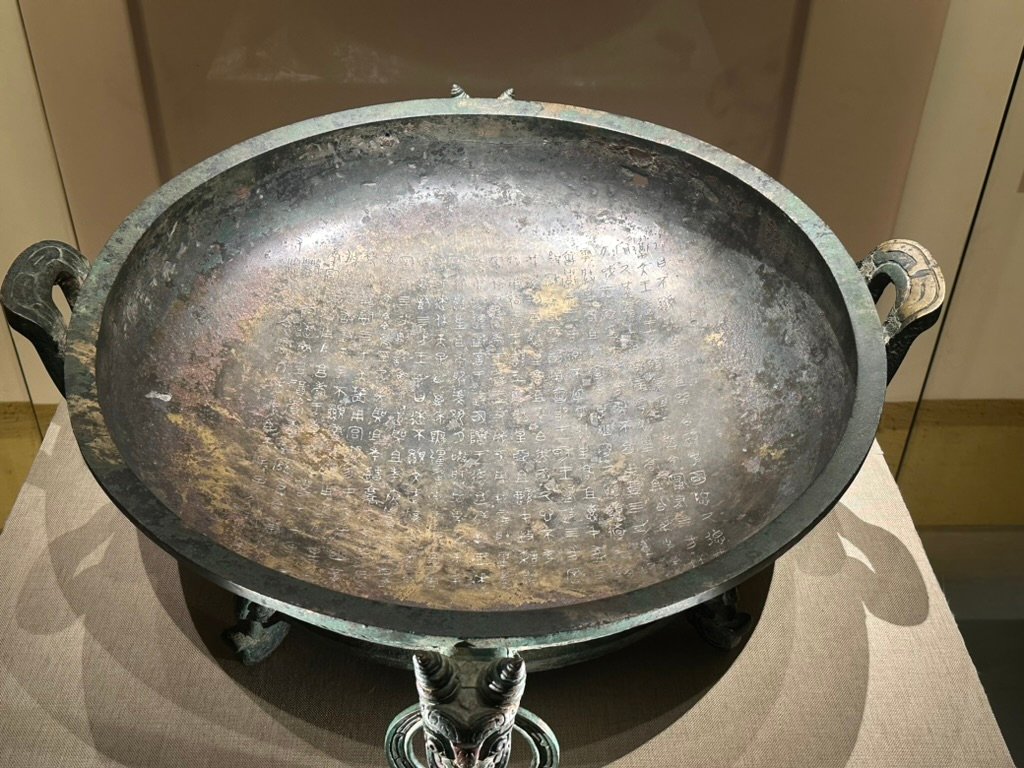
😳 Meet He Zun 何尊
At the:
Baoji Bronze Ware Museum
宝鸡青铜器博物院
Bǎojī Qīngtóngqì Bówùyuàn
is one of the great treasures of early Chinese history:
He Zun (何尊, Hé Zūn).
It is an early:
Western Zhou (西周, Xī Zhōu)
ritual bronze.
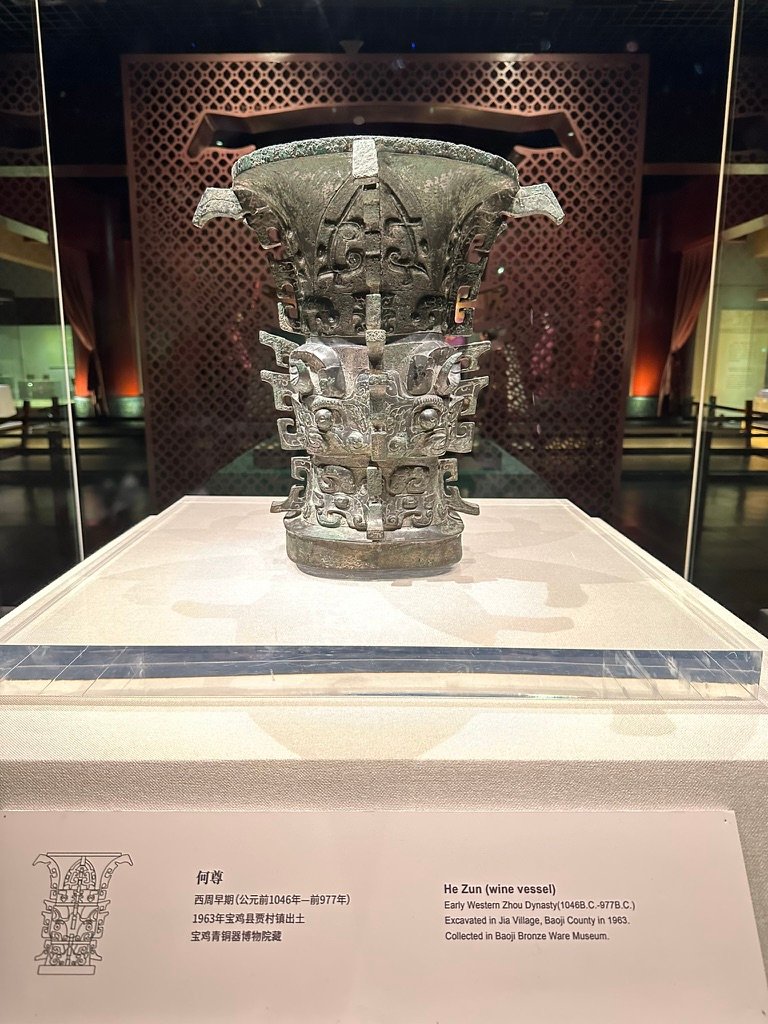
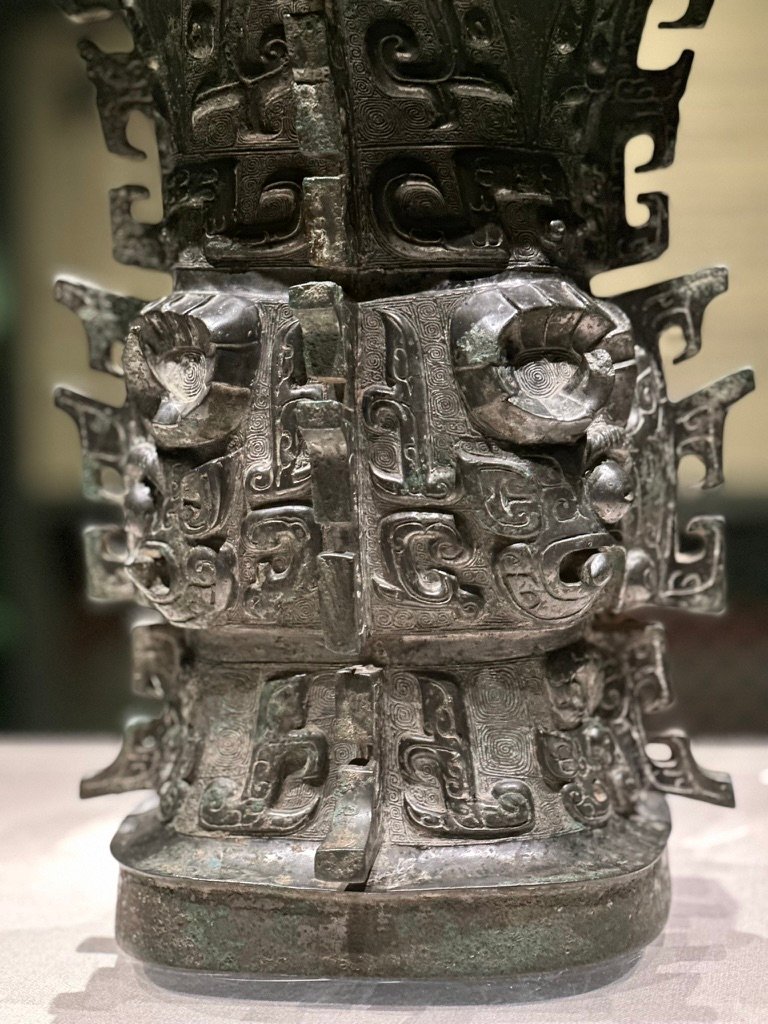
From the outside:
beautiful.
Ancient.
Important.
But Dad wants you to look:
INSIDE.
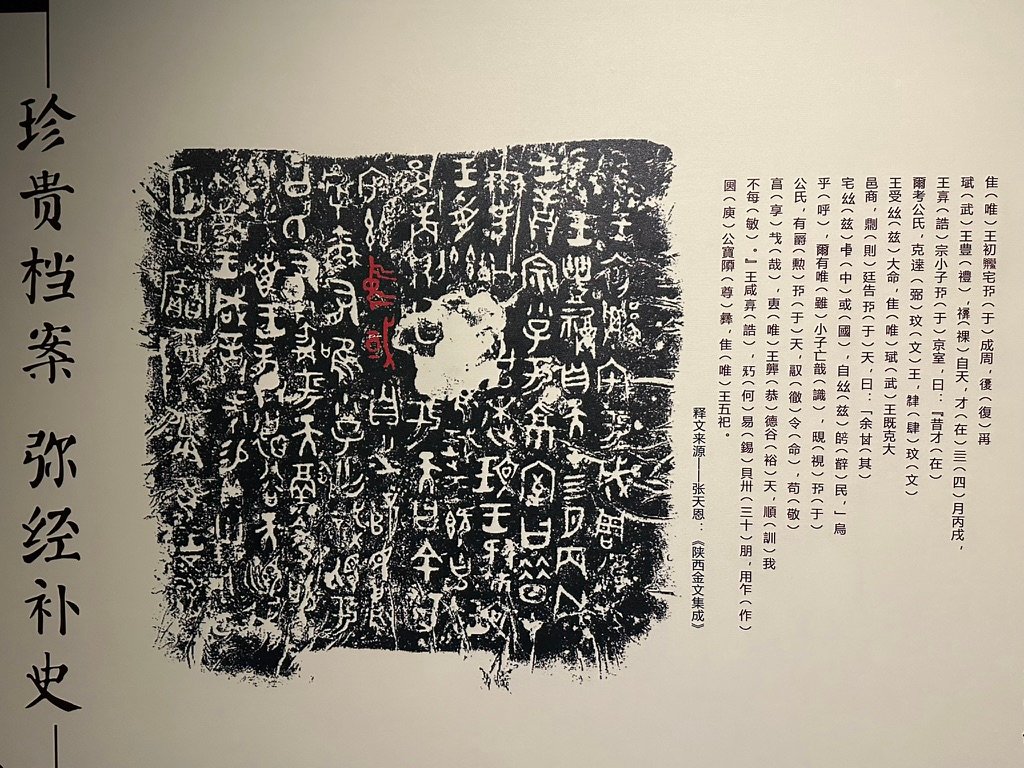
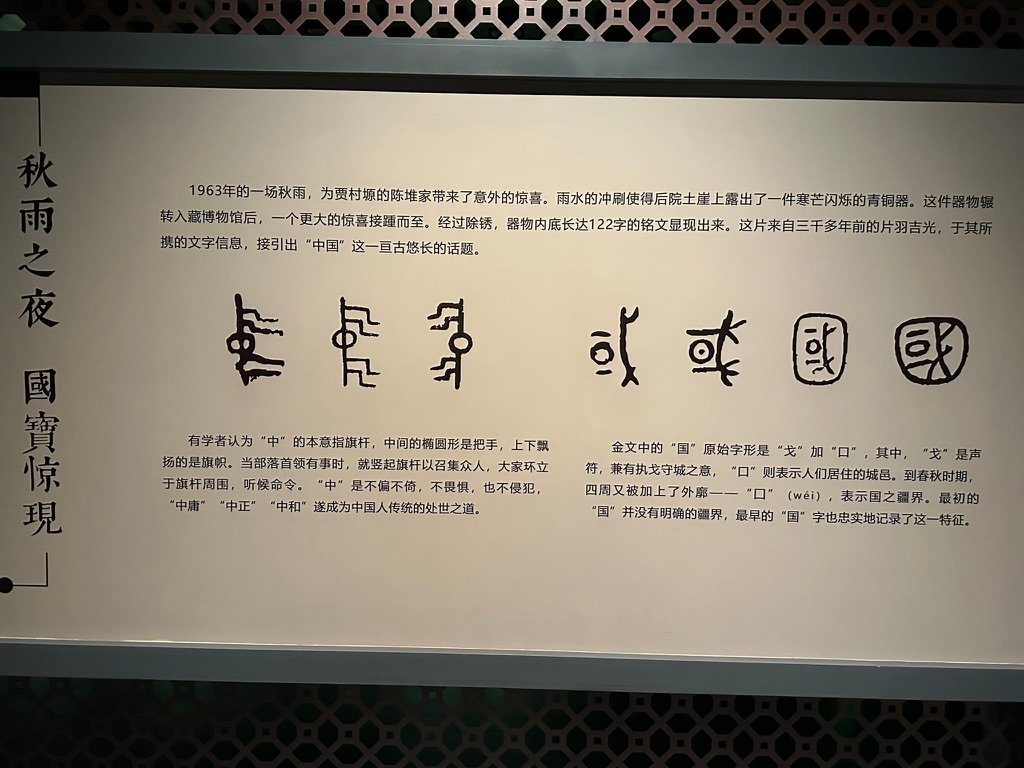
Because inside is a bronze inscription containing two characters almost every Mandarin beginner recognizes:
中国
😳
ZHŌNGGUÓ.
The characters used today for:
CHINA.
And they were cast into bronze more than:
3,000 YEARS AGO.
At this point…
Dad’s rabbit wakes up.
🐇🔥
🧠 Wait — Did 中国 Mean Modern “China” 3,000 Years Ago?
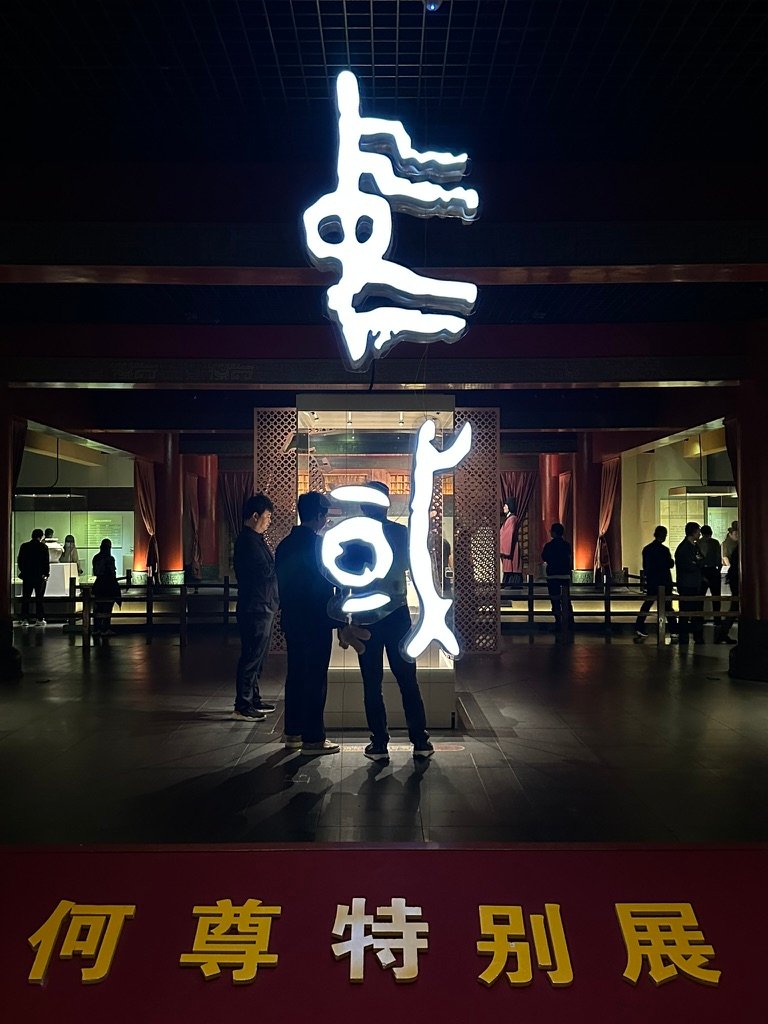
No.
And that’s exactly why He Zun is so interesting.
😂
The characters are familiar.
But their historical meaning was different.
In this early Zhou context:
中国
points toward a:
central political region / central realm
rather than the modern nation-state shown on today’s map.
So He Zun does NOT prove:
“Modern China existed unchanged 3,000 years ago.”
History is much more interesting than that.
Instead, it allows us to see:
A FAMILIAR WORD AT A VERY EARLY STAGE OF ITS HISTORY.
Same characters.
Different political world.
Changing meaning.
🔥
And now one bronze has already opened another door:
Who were these Zhou people?
🐇 He Zun Is Only the Beginning
This is where Baoji becomes dangerous.
😂
You arrive thinking:
“I’ll see the famous bronze.”
Then the bronze asks:
Who were the Zhou?
That sends you toward:
Qishan (岐山, Qíshān)
and:
Zhouyuan (周原, Zhōuyuán).
Then somebody mentions:
Duke of Zhou (周公, Zhōugōng).
That sends you toward:
Zhougong Temple (周公庙).
Then Zhou ritual ideas start leading toward:
Confucius 孔子.
Then the weakening Zhou political order leads toward:
Spring and Autumn.
Then:
Warring States.
Then:
QIN.
😭😂🐇
And suddenly we’re back where we started:
XI’AN.
Except now…
QIN SHI HUANG MAKES MORE SENSE.
🧭 Baoji Doesn’t Compete With Xi’an
This is the most important point.
Dad isn’t suggesting:
Skip Xi’an and go to Baoji instead.
Absolutely not.
SEE XI’AN.
See the Terracotta Warriors.
Meet Qin Shi Huang.
Walk the city.
Enjoy the food.
Then, if Chinese history has started getting under your skin…
GO WEST.
🔥
Because:
Xi’an gives you Qin.
Baoji gives you the before.
Baoji doesn’t compete with Xi’an.
BAOJI MAKES XI’AN BETTER!
🤔 So Why Don’t More First-Time Travelers Go?
Probably because:
XI’AN SHOUTS.
😂
Terracotta Warriors!
City Wall!
Big Wild Goose Pagoda!
Tang Dynasty!
Muslim Quarter!
Baoji whispers:
“Would you like to know what happened before all that?”
And the wonderful thing is:
IT’S EASY.
You don’t need to redesign your entire China itinerary.
You don’t need another domestic flight.
You don’t need to disappear into rural China for a week.
From Xi’an:
roughly one hour by high-speed rail.
That changes the decision.
🎒 Dad’s Rule: You Don’t Need to Become a Zhou Expert
Please don’t misunderstand this article.
😂
Dad is NOT suggesting every first-time Western traveler spend five days studying:
Western Zhou bronze inscriptions.
If your China trip is already:
Beijing → Xi’an → Chengdu → Shanghai,
you have plenty to digest.
But if you have:
ONE EXTRA NIGHT
or:
TWO EXTRA DAYS
and you’ve started wondering:
“What came before Qin?”
Baoji becomes very tempting.
Because the decision isn’t:
“Xi’an OR Baoji?”
It’s:
“Xi’an… AND THEN ONE HOUR WEST?”
🔥
That is a very different proposition.
Sting Check
Xi’an gives you:
QIN SHI HUANG.
Baoji gives you:
THE BEFORE.
Xi’an gives you:
TERRACOTTA WARRIORS.
Baoji gives you:
BRONZES + INSCRIPTIONS.
Xi’an gives you:
221 BCE.
Baoji sends you backward toward:
ZHOU.
🔥
And suddenly:
QIN ISN’T THE BEGINNING ANYMORE.
It becomes:
THE RESULT OF A MUCH LONGER STORY.
That’s why Dad & Elaine went west.
And once Baoji opened the door…
we found several rabbits waiting on the other side.
🐇🐇🐇
Section 2 — Four Doors Baoji Opens Into Chinese History
So you’ve taken the train west.
You’ve reached:
Baoji (宝鸡, Bǎojī).
Now what?
This is where Dad thinks Baoji becomes much more interesting than:
“a city with a very good bronze museum.”
😂
Baoji is a:
HISTORICAL GATEWAY.
Stand here and several different doors into Chinese history begin opening.
You don’t have to walk through all of them.
But knowing they’re there changes the journey.
🚪 DOOR 1 — He Zun 何尊: Two Characters That Refuse to Stay Simple
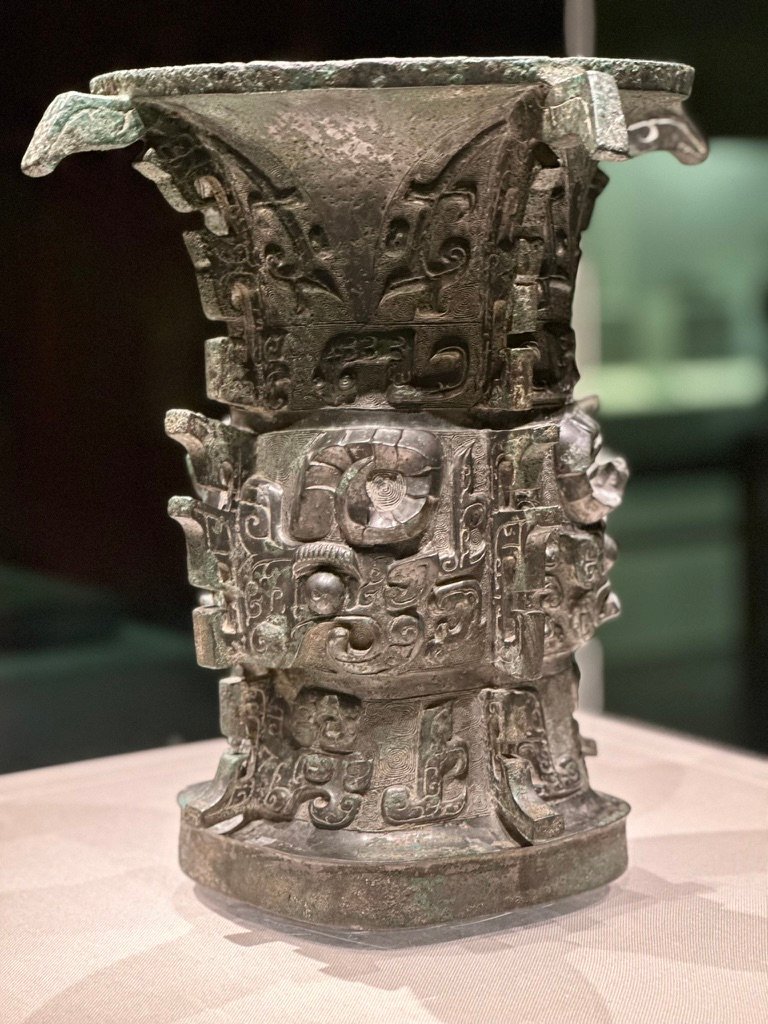
Let’s start with the object that can hook even somebody who knows almost nothing about Zhou history:
He Zun (何尊, Hé Zūn).
Inside this early Western Zhou bronze is an inscription containing:
中国 — Zhōngguó
the same two characters used today for:
China.
😳
But as we learned in Section 1:
same characters ≠ same historical meaning.
In He Zun’s early Zhou context, 中国 referred to a central political region rather than the modern nation-state.
And that tiny distinction opens an enormous question:
How does the meaning of “China” itself change through history?
🔥
Suddenly a bronze vessel isn’t merely:
an archaeological object.
It’s a doorway into:
language,
political geography,
identity
and:
3,000 years of changing meaning.
🐇
Follow this rabbit:
Deep China: He Zun 何尊 — The 3,000-Year-Old Bronze That Bears the Characters 中国
🚪 DOOR 2 — Zhouyuan 周原: Leave the Museum and Find the World Behind the Bronze
He Zun creates another obvious question:
Who were these Zhou people?
Now we need to leave the museum.
😂
Travel outward toward:
Qishan (岐山, Qíshān)
and:
Zhouyuan (周原, Zhōuyuán).
This wider landscape takes us toward the homeland associated with the Zhou before and during the early:
Western Zhou (西周, Xī Zhōu).
And this is where Dad’s favorite transition happens:
OBJECT → LANDSCAPE.
At Baoji:
you see the bronze.
At Zhouyuan:
you begin seeing the world behind the bronze.
🔥
Archaeology in the region has uncovered:
settlement remains,
burials,
bronzes,
oracle bones
and:
inscriptions
connected with the ancient Zhou world.
Suddenly:
“Zhou dynasty, 1046 BCE…”
isn’t merely a line in a textbook.
It has:
a geography.

Western Handrail: Pompeii Without the One Frozen City
Western travelers sometimes understand ancient history through places like:
Pompeii.
You walk through physical space and suddenly:
people,
buildings,
objects
and:
history
belong together.
Zhouyuan isn’t China’s Pompeii.
There is no single city frozen dramatically in one moment, and the archaeology is completely different.
But the useful travel instinct is similar:
DON’T ONLY LOOK AT ANCIENT OBJECTS IN ISOLATION.
Ask:
Where did the people who made them actually live?
That’s what Zhouyuan adds to Baoji.
🐇 And Zhouyuan Introduces Another Man: 周公
Once you’re in the Zhou landscape, one name becomes difficult to avoid:
Duke of Zhou (周公, Zhōugōng).
He was the younger brother of:
King Wu of Zhou (周武王)
and uncle of the young:
King Cheng of Zhou (周成王).
Later tradition remembered the Duke of Zhou as a major figure associated with:
stabilizing early Zhou rule,
political order,
ritual
and:
good government.
Near Qishan, Dad & Elaine visited:
Zhougong Temple (周公庙, Zhōugōng Miào).
And years later…
we found:
ANOTHER ZHOUGONG TEMPLE
in:
Qufu 曲阜.
😂🐇
That rabbit eventually runs toward:
Lu 鲁
↓
Confucius 孔子
↓
礼 — lǐ
ritual / propriety / appropriate conduct
One journey in Shaanxi eventually started explaining another journey in Shandong.
That’s Deep China getting into trouble again.
🚪 DOOR 3 — The Bigger Question: Why Did Zhou Matter So Much?
At some point Dad realized we were accumulating:
Zhou bronzes,
Zhou archaeological sites,
Zhougong temples,
King Wen,
King Wu,
King Cheng,
礼
and:
天命.
😭😂
Time for the coat rack.
Because Zhou isn’t important simply because:
“It was a very long dynasty.”
The Zhou world helps us understand how Chinese history eventually gets from:
SHANG
to:
CONFUCIUS
to:
SPRING AND AUTUMN
to:
WARRING STATES
and finally:
QIN.
🔥
It also gives us some enormously influential ideas.
Among them:
天命 — Tiānmìng
Mandate of Heaven
and:
礼 — lǐ
ritual / propriety / social order
You do NOT need to learn all of this while standing in the Baoji museum.
Please don’t.
😂
That’s exactly how historical indigestion begins.
Instead:
SEE THE OBJECT FIRST.
Let it create the question.
Then, if you’re curious:
FOLLOW THE BIGGER QUESTION.
Go Michelin:
Deep China: Why the Zhou Dynasty 周朝 Matters So Much to Chinese History
Western Handrail: Baoji Is the Footnote That Changes the Main Story
Here’s another way to think about it.
Sometimes you’re reading a history book and encounter a footnote.
You follow it…
and suddenly realize:
the footnote changes how you understand the whole chapter.
😂
Baoji can do that to Xi’an.
You already know the headline:
QIN SHI HUANG UNIFIES THE STATES — 221 BCE.
Baoji makes you ask:
Which states?
Where did that political world come from?
Why were there competing states in the first place?
What ideas had already developed before Qin won?
🔥
Baoji doesn’t replace the Xi’an story.
IT DEEPENS IT.
🚪 DOOR 4 — Wuzhangyuan 五丈原: Same Region, Completely Different Century
And because Chinese history refuses to behave itself…
😂
the Baoji region contains another famous historical rabbit:
Wuzhangyuan (五丈原, Wǔzhàngyuán).
But now:
STOP THE TIMELINE.
We are jumping roughly:
1,200 YEARS FORWARD.
From:
early Zhou
to:
234 CE
and the:
Three Kingdoms period (三国时期, Sānguó Shíqī).
This is the world of:
Zhuge Liang (诸葛亮, Zhūgě Liàng).
🪶 Why Does Wuzhangyuan 五丈原 Matter?
Zhuge Liang is one of the most famous strategists and statesmen in Chinese cultural memory.
During his northern campaigns for the state of:
Shu Han (蜀汉),
he confronted the rival state of:
Cao Wei (曹魏).
In:
234 CE,
during the campaign around Wuzhangyuan, Zhuge Liang became seriously ill and died.
🔥
So suddenly our Baoji-area map contains:
ZHOU
more than 3,000 years ago
and:
THREE KINGDOMS
more than 1,200 years later
within the same wider journey.
😂

Western Handrail: Same Landscape, Different Historical Movie
Think of visiting somewhere in Europe where:
Roman ruins
sit near:
medieval battlefields
and:
later historical monuments.
Same geography.
Completely different historical chapters.
That’s the useful handrail for Baoji.
The land doesn’t belong to:
ONE PERIOD.
Different generations keep using:
the same mountains,
the same valleys,
the same routes
and:
the same strategic geography.
So Wuzhangyuan isn’t part of the Zhou story.
It’s:
ANOTHER STORY LIVING IN THE SAME REGION.
🐇
🧠 This Is Why Dad Calls Baoji a Gateway
Look at what one easy train ride from Xi’an has opened:
BAOJI 宝鸡
↓
🏺 He Zun 何尊
中国 + bronze inscriptions
↓
🏞️ Zhouyuan 周原
the Zhou homeland
↓
👑 Duke of Zhou 周公
political order + ritual
↓
🧠 Why Zhou Matters
the coat rack leading toward Confucius, Warring States and Qin
↓
🪶 Wuzhangyuan 五丈原
jump forward to Zhuge Liang and Three Kingdoms
😭😂
This is why Dad doesn’t think Baoji needs to compete with Xi’an for:
“MORE ATTRACTIONS.”
Its strength is different.
BAOJI OPENS DOORS.
🎒 Which Door Should a First-Time Traveler Choose?
Dad’s answer:
DON’T CHOOSE ALL FOUR.
😂
If you have only:
ONE DAY
focus on:
Baoji + the Bronze Ware Museum.
Meet:
He Zun.
Understand why Baoji matters.
Return to Xi’an.
Excellent.
If you have:
TWO DAYS
add:
Qishan / Zhouyuan.
Now you’ve gone from:
OBJECT → LANDSCAPE.
🔥
If you have more time and already love Chinese history…
then the rabbits can negotiate among themselves.
😂🐇
Sting Check
Baoji started as:
“an easy city about an hour west of Xi’an.”
Now it has become:
A SET OF DOORS.
One door asks:
What did 中国 mean 3,000 years ago?
Another:
Who were the Zhou before Qin?
Another:
Why did Zhou ideas matter for later Chinese history?
And another suddenly asks:
Why did Zhuge Liang die near here 1,200 years later?
😭
You don’t have to follow every rabbit.
The important thing is:
BAOJI GIVES YOU THE CHOICE.
And now we need to solve the practical question:
How much time should a first-time Xi’an traveler actually give Baoji?
Section 3 — How to Add Baoji to Your Xi’an Trip Without Historical Indigestion
By now Dad has probably created a small problem.
😂
You came to Xi’an planning:
Terracotta Warriors.
City Wall.
Big Wild Goose Pagoda.
Maybe:
Muslim Quarter.
And now Dad is saying:
“Take another train west.”
Don’t worry.
Baoji is not asking you to redesign your entire China itinerary.
That’s precisely why Dad likes it.
BAOJI IS EASY.
🚄 Xi’an → Baoji: Roughly One Hour
From:
Xi’an North Railway Station (西安北站, Xī’ān Běizhàn)
take a high-speed train to:
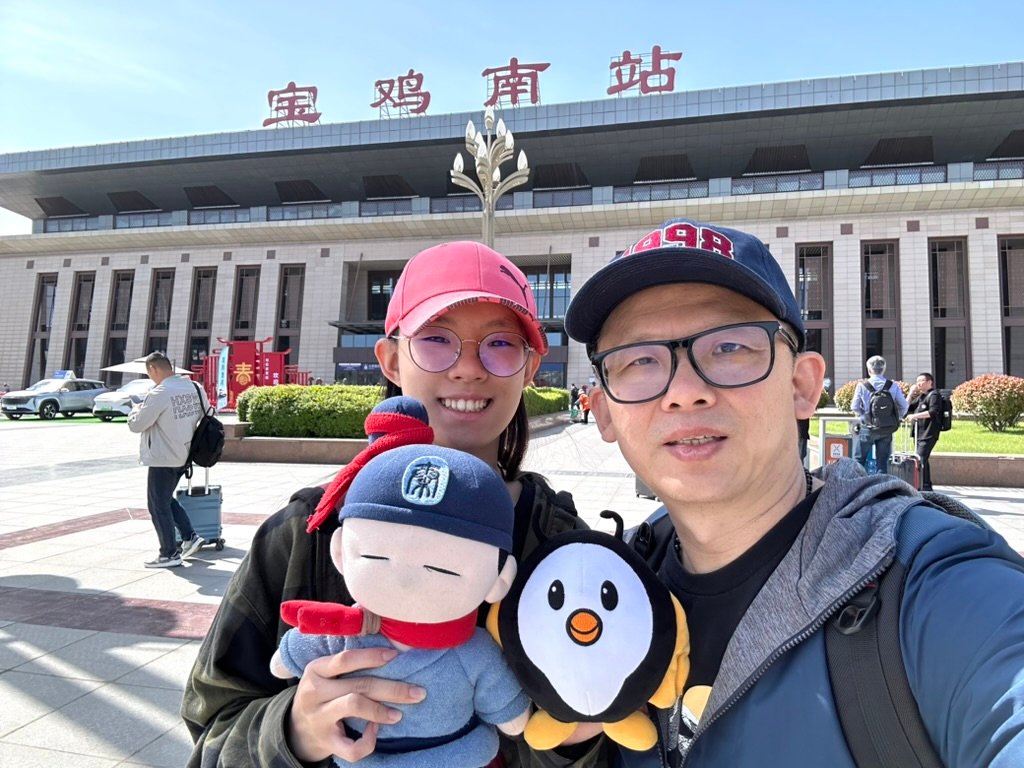
Baoji South Railway Station (宝鸡南站, Bǎojī Nánzhàn).
Depending on the service, the journey is generally around:
50 MINUTES TO 1 HOUR 15 MINUTES.
For rough planning, second-class fares are often around:
RMB 50–60.
Schedules and fares change, so check current trains before traveling.
But the important point is:
THIS IS NOT A MAJOR EXPEDITION.
You’re already in Xi’an.
Get on a train.
About an hour later…
3,000 YEARS AGO IS WAITING.
😂🔥

Western Handrail: Think “History Excursion,” Not “Another City”
This is probably the easiest way for a first-time Western traveler to think about Baoji.
Don’t think:
“Oh no. Another destination to squeeze into China.”
Think:
A HISTORY EXCURSION FROM XI’AN.
The same way you might stay in a major European city and take an easy train to an important historical place nearby.
No domestic flight.
No complicated transfer.
No week-long detour.
Baoji can simply become:
THE DAY YOU REWIND XI’AN.
🔥
🏺 OPTION 1 — One Day: Taste Baoji
If your Xi’an schedule is tight, this works.
MORNING
Take the high-speed train:
XI’AN → BAOJI
Then head to:
Baoji Bronze Ware Museum
宝鸡青铜器博物院
Give yourself around:
2–3 HOURS.
And please don’t attempt to memorize every bronze.
😂
Dad has one mission for you:
FIND HE ZUN 何尊.
Look at the vessel.
Look at the inscription.
Find the museum explanation of:
中国.
Then choose a few other bronzes whose inscriptions or stories genuinely catch your attention.
That’s enough.
DEPTH BEATS COLLECTION.
🍜 Then Eat Something
This is still a travel article.
😂
Take a break.
Eat.
Baoji sits in western Shaanxi and has its own local food traditions.
Let the bronzes digest.
Both:
historically
and:
literally.
Then, if you only have one day:
RETURN TO XI’AN.
Done.
You haven’t “completed Baoji.”
You’ve done something more useful:
YOU’VE ADDED A BEFORE TO XI’AN.
🔥
🛏️ OPTION 2 — Dad’s Preference: Stay One Night
If He Zun and the bronzes give you the sting…
🐞
don’t rush back.
Stay:
ONE NIGHT IN BAOJI.
Now the journey becomes much richer.
DAY 1
Xi’an → Baoji
↓
Baoji Bronze Ware Museum
↓
He Zun + selected Zhou bronzes
↓
Stay Baoji
DAY 2
Head toward:
Qishan (岐山, Qíshān)
and:
Zhouyuan (周原, Zhōuyuán).
Now you’ve followed Dad’s preferred sequence:
OBJECT
↓
QUESTION
↓
LANDSCAPE.
🔥
Day 1:
“Here is the bronze.”
Day 2:
“Here is the world behind it.”
🚗 For Qishan & Zhouyuan, Consider a Private Guide
Baoji city itself is relatively straightforward.
The wider:
Qishan / Zhouyuan
journey is different.
Historical and archaeological sites are spread across the area, and their importance isn’t always visually obvious to a first-time international visitor.
Dad would consider:
PRIVATE CAR + KNOWLEDGEABLE ENGLISH-SPEAKING GUIDE.
Why both?
A driver answers:
WHERE?
A good historical guide answers:
WHY?
🔥
And for Deep China:
WHY IS USUALLY THE BETTER QUESTION.
🧠 Ask for the Right Kind of Guide
Don’t merely request:
“English-speaking Baoji guide.”
Dad would say:
“We’re especially interested in Western Zhou history, archaeology, bronze inscriptions, Qishan and Zhouyuan. We’d like a guide who can explain the historical context.”
That tells the company immediately:
WE’RE NOT JUST COLLECTING ATTRACTIONS.
We want to understand what we’re looking at.
⚠️ Don’t Just Tell the Driver “周原”
😂
This is important.
Zhouyuan 周原
is a broader historical and archaeological landscape, not simply one neat attraction with one universally obvious entrance.
Before traveling, confirm:
EXACT SITE
+
CHINESE NAME
+
MAP PIN
+
CURRENT ACCESS
Archaeological exhibitions and accessible areas can change.
Dad’s practical rule:
SAVE THE CHINESE NAME BEFORE YOU LEAVE THE HOTEL.
It can save a surprising amount of:
“No, no… not THIS 周原.”
😭😂
⏱️ So How Much Time Should You Give Baoji?
Dad’s simple answer:
If you’re curious:
ONE DAY
Baoji Bronze Ware Museum.
Meet He Zun.
Return to Xi’an.
Excellent.
If you’ve been stung:
TWO DAYS / ONE OR TWO NIGHTS
Baoji museum.
Then Qishan / Zhouyuan.
Much better.
If you’ve fallen down the rabbit hole:
THREE DAYS
Now you can slow down, explore the Zhou landscape properly and perhaps add another historical rabbit such as:
Wuzhangyuan (五丈原, Wǔzhàngyuán).
But Dad would NOT automatically recommend three days to every first-time traveler.
Remember:
SEE LESS. CONNECT MORE.
One Important Check Before You Go
If:
He Zun itself
is the main reason for your Baoji trip, check the museum’s latest official information before traveling.
Major treasures can sometimes be:
loaned to exhibitions,
under conservation
or:
temporarily removed from display.
So don’t arrive at the museum saying:
“Dad from ChinaTravelBUG promised me He Zun.”
😭😂
Verify current display arrangements first.
📸 Dad’s Museum Rule: Photograph the Explanation
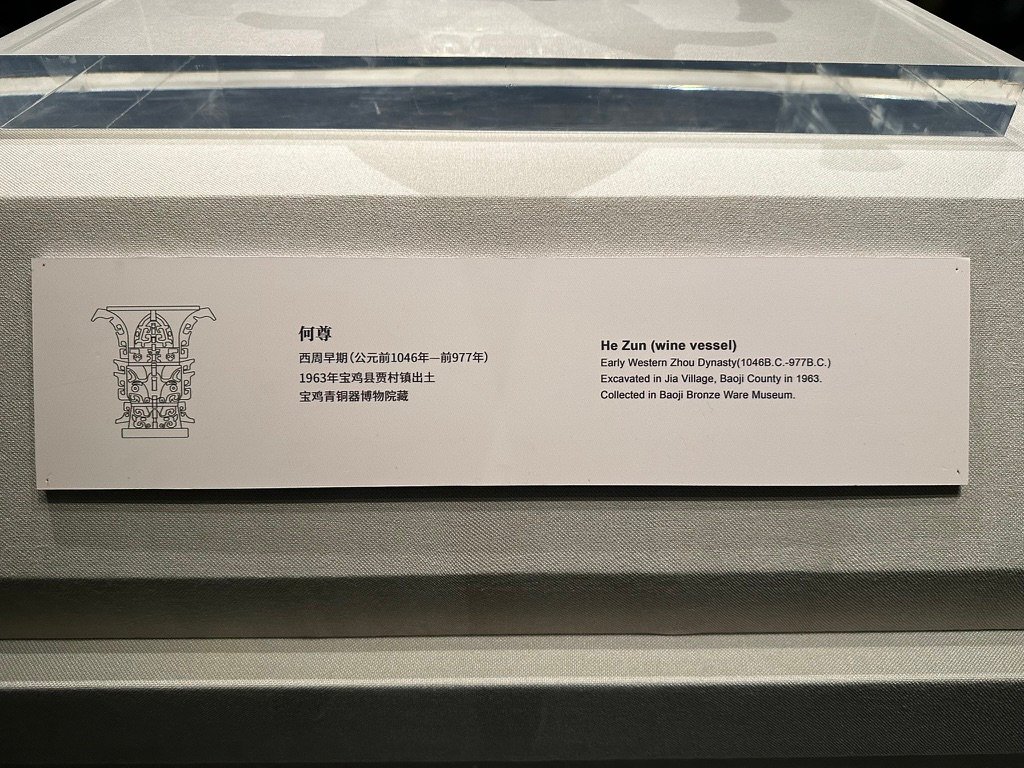
This sounds trivial.
It isn’t.
😂
Photograph:
the object,
its Chinese name,
the date,
the excavation location,
the inscription
and:
the information board.
Because sometimes the rabbit doesn’t appear while you’re standing in the museum.
It appears:
TWO YEARS LATER.
Another trip.
Another temple.
Another bronze.
Another Chinese character.
And suddenly:
CLICK.
🔥
The boring information-board photograph becomes the missing piece.
🚄 Then Go Back to Xi’an
And this is where Baoji earns its place in the itinerary.
Return to:
Xi’an.
Look again at your photographs of:
the Terracotta Warriors.
Same soldiers.
Same Qin Shi Huang.
Same:
221 BCE.
But something has changed.
YOUR COAT RACK.
😂
Because now you know that before Qin unified the rival states there had already been centuries of:
Zhou political development,
regional states,
ritual systems,
bronze inscriptions,
competing ideas,
warfare
and:
state-building.
Qin no longer looks like:
THE BEGINNING.
It looks like:
THE CLIMAX OF A MUCH LONGER STORY.
🔥
🎬 Western Handrail: Watch the Blockbuster Again After the Prequel
Remember our prequel?
😂
Sometimes you watch a great movie.
Later you watch the prequel.
Then you return to the original…
and suddenly:
YOU NOTICE DIFFERENT THINGS.
That’s what Baoji can do to Xi’an.
The Terracotta Warriors don’t physically change.
YOUR UNDERSTANDING DOES.
And that is exactly why Dad thinks the extra train ride is worth it.

Final Sting
Dad isn’t asking every first-time China traveler to become:
a Western Zhou specialist.
😂
He’s asking something much simpler.
If you’re already in:
XI’AN
and Chinese history has started making you curious…
look west.
Roughly one hour away sits:
BAOJI 宝鸡.
There you can encounter:
3,000-year-old bronzes,
ancient inscriptions,
He Zun 何尊,
and:
the doorway into the Zhou world.
Then, if the rabbit bites:
🐇
continue toward:
QISHAN 岐山
and:
ZHOUYUAN 周原.
🔥 Baoji Doesn’t Compete With Xi’an
That’s the point Dad wants to leave you with.
XI’AN GIVES YOU QIN.
BAOJI GIVES YOU THE BEFORE.
See both…
and something wonderful happens:
SAME TERRACOTTA WARRIORS.
SAME QIN SHI HUANG.
DIFFERENT UNDERSTANDING.
🔥
For Dad?
THAT’S WORTH ONE HOUR ON A TRAIN.
😂🚄
See the place. Ask the bigger question. Understand China better.
🐇 WHERE TO FOLLOW NEXT
🏺 FOLLOW THE OBJECT
He Zun 何尊 — The 3,000-Year-Old Bronze That Bears the Characters 中国
🏞️ FOLLOW THE LANDSCAPE
Qishan 岐山 & Zhouyuan 周原 — Walking Through the Homeland of the Zhou
⭐ GO MICHELIN
Why the Zhou Dynasty 周朝 Matters So Much to Chinese History