DEEP China: Jinci (晋祠, Jìncí) — Where the Story of Jin (晋, Jìn) Begins
A 3,000-Year Story, Nearly 1,000-Year-Old Art and Architecture — and the Missing Link Elaine Had to Explain to Dad
Travel around:
Shanxi Province (山西省, Shānxī Shěng)
and you’ll keep seeing one Chinese character:
晋
Jìn
Look at a Shanxi license plate.
There it is.
Dad knew:
Jin (晋, Jìn)
is the official abbreviation for:
Shanxi Province (山西省, Shānxī Shěng).
Fine.
But Dad being Dad…
😂
eventually asked:
“WHY JIN (晋, Jìn)?”
Why does modern Shanxi Province (山西省, Shānxī Shěng) still carry an ancient name?
That little question eventually brought Dad & Elaine to:
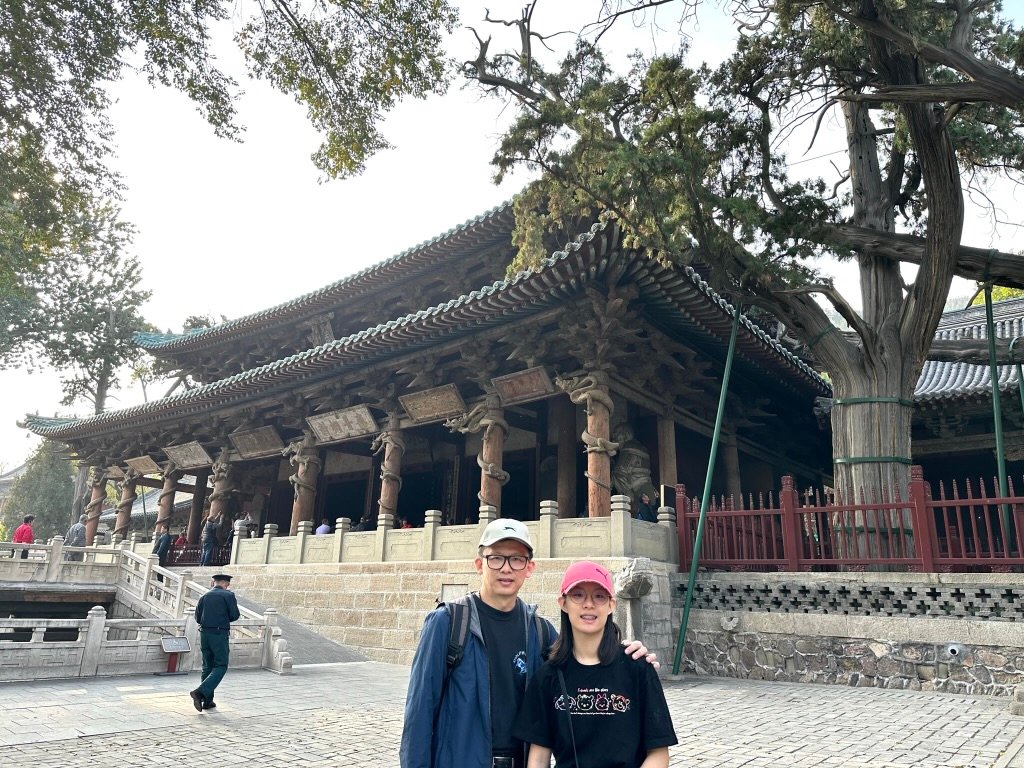
Jinci (晋祠, Jìncí)
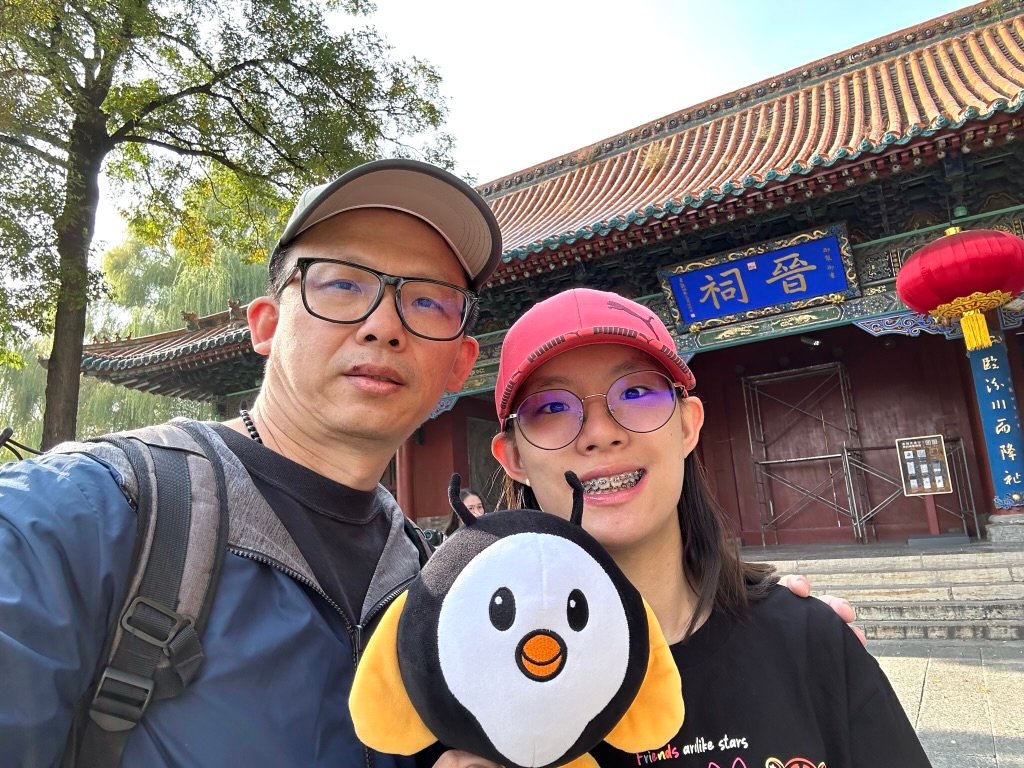
outside:
Taiyuan (太原, Tàiyuán).
And once we arrived…
the rabbit became much bigger than Dad expected.
🐇🔥
🎥 First — Walk Into Jinci (晋祠, Jìncí) With Us
Before Dad throws:
Western Zhou (西周, Xī Zhōu),
Tang Shuyu (唐叔虞, Táng Shūyú),
and:
State of Jin (晋国, Jìnguó)
at you…
😂
come inside first.
Elaine walks through the landscaped approach into Jinci (晋祠, Jìncí).
Trees.
Lawns.
Traditional covered corridors.
Courtyards.
Then we encounter the huge:
Emperor’s Rise from Jinyang Sculpture (龙兴晋阳雕塑, Lóngxīng Jìnyáng Diāosù).
At the center on horseback is:
Emperor Taizong of Tang (唐太宗, Táng Tàizōng)
— Li Shimin (李世民, Lǐ Shìmín) —
surrounded by ministers and generals.
The sculpture commemorates another important historical layer connecting:
Jinyang (晋阳, Jìnyáng),
Taiyuan (太原, Tàiyuán)
and:
Tang Dynasty (唐朝, Táng Cháo) history.
But here’s Dad’s first warning.
😂
THIS IS NOT THE “TANG” WE NEED TO EXPLAIN JIN (晋, Jìn).
The story behind Jinci (晋祠, Jìncí) takes us much farther back.
And that’s one of the pleasures of this place:
ONE PLACE.
MANY HISTORICAL TIMES.
❤️ You Don’t Need to Love Ancient Chinese History to Love Jinci (晋祠, Jìncí)
Dad needs to say this before disappearing into the:
Western Zhou (西周, Xī Zhōu).
😂
If ancient states, kings and royal lineages make your eyes glaze over:
DON’T SKIP JINCI (晋祠, Jìncí).
History is only one door.
You can also come for:
🎨 ART
🏯 WOODEN ARCHITECTURE
🌳 ANCIENT TREES
💧 WATER + GARDEN CULTURE
And some of what survives here is extraordinary.
🎨 Come for Nearly 1,000-Year-Old Human Faces
Inside the:
Hall of the Holy Mother (圣母殿, Shèngmǔ Diàn)
are the famous:
Song Dynasty painted attendant sculptures (宋代侍女彩塑, Sòngdài Shìnǚ Cǎisù).
Before Dad explains them…
WATCH THEIR FACES.
Our local guide points out one particularly famous figure.
She is popularly known as:
Double-Faced Beauty (双面佳人, Shuāngmiàn Jiārén).
From one angle, the guide asks us to notice a face that appears:
shy,
gentle,
and:
almost smiling.
From another angle, the guide points to an expression interpreted as:
sadness,
swollen eyes,
and:
tears.
The guide also connects the expressive quality of the figure with:
Mei Lanfang (梅兰芳, Méi Lánfāng)
— one of the great masters of Chinese opera.
🔥
Whether you’re interested in the Western Zhou (西周, Xī Zhōu) or not…
LOOK AT HER FACE.
Then look at the women around her.
Different ages.
Different postures.
Different expressions.
Different personalities seem to emerge.
These sculptures are roughly:
900–1,000 YEARS OLD.
And Dad remembers looking at them and thinking:
“THESE WOMEN LOOK LIKE PEOPLE.”
We’ll come back to them properly.
They deserve their own section.
🏯 Come for Wooden Architecture Approaching 1,000 Years Old
Now step back from the sculptures.
Look at the building containing them:
Hall of the Holy Mother (圣母殿, Shèngmǔ Diàn).
And before Dad explains the architecture…
LOOK UP.
In this short video, look for:
coiled dragon columns (盘龙柱, Pánlóng Zhù),
dougong brackets (斗拱, Dǒugǒng),
deep roof eaves,
timber construction,
carving,
and:
extraordinary craftsmanship.
The surviving Hall of the Holy Mother (圣母殿, Shèngmǔ Diàn) belongs to the:
Northern Song Dynasty (北宋, Běi Sòng)
architectural layer.
Its history reaches back roughly:
A THOUSAND YEARS.
😳
Think about that.
Wood burns.
Wood rots.
Wood gets repaired.
Buildings disappear.
Dynasties disappear.
Yet here you are…
looking at major timber architecture whose history approaches:
1,000 YEARS.
🔥
🌳 Then Look Beside the Hall — A Tree Said to Be Around 3,000 Years Old
The same video begins with something even older.
Zhou Cypress (周柏, Zhōubǎi).
This extraordinary ancient cypress is traditionally associated with the:
Zhou Dynasty (周朝, Zhōu Cháo)
and is commonly said to be around:
3,000 YEARS OLD.
😳
Dad loves this.
Because suddenly:
Western Zhou (西周, Xī Zhōu)
isn’t merely another date on a timeline.
There is a living tree in front of you whose traditional story reaches back toward that ancient world.
Don’t rush past it.
Look at the trunk.
Look at the way it leans.
Look at the ancient branches.
Then think about how many:
rulers,
dynasties,
wars,
restorations,
worshippers,
and:
generations of visitors
have come and gone while this tree remained part of:
Jinci (晋祠, Jìncí).
🔥
💧 Come for Water, Bridges and Garden Culture
Then follow the water.
Look for:
Never-Aging Spring (难老泉, Nánlǎo Quán),
Fish Pond Flying Bridge (鱼沼飞梁, Yúzhǎo Fēiliáng),
water channels,
stone bridges,
ancient trees,
courtyards,
pavilions,
and:
the relationship between architecture and landscape.
This is important culturally.
Don’t photograph only:
THE BUILDING.
Look at what the building is talking to.
Water.
Trees.
Courtyard.
Bridge.
Landscape.
🔥
Jinci (晋祠, Jìncí) is often described as China’s earliest surviving:
royal sacrificial garden complex (皇家祭祀园林, Huángjiā Jìsì Yuánlín).
So even before Dad explains:
Tang Shuyu (唐叔虞, Táng Shūyú)
and:
State of Jin (晋国, Jìnguó)…
you already have plenty of reasons to come.
🧠 Four Doors Into Jinci (晋祠, Jìncí)
Choose whichever one catches you.
🏺 HISTORY
roughly 3,000 years of memory
🎨 ART
extraordinary Song Dynasty painted sculpture
🏯 ARCHITECTURE
major Northern Song Dynasty timber craftsmanship
🌳 CULTURE + LANDSCAPE
ancient trees + springs + bridges + garden traditions
Different traveler?
Different door.
That’s why Dad thinks Jinci (晋祠, Jìncí) deserves far more attention from international travelers visiting:
Taiyuan (太原, Tàiyuán).
You don’t have to understand 3,000 years of Chinese history before you arrive.
COME AND LOOK FIRST.
Then start asking:
Who were these women?
How did this wooden hall survive?
Can that tree really be that old?
Why is water so important here?
And finally…
“WHY IS THIS PLACE CALLED JINCI (晋祠, Jìncí) — AND WHY IS SHANXI (山西省, Shānxī Shěng) STILL CALLED JIN (晋, Jìn)?”
🐇🔥
That’s where Dad’s history rabbit begins.
And this time…
Elaine had to help Dad connect it.
🏛️ Before Jinci (晋祠, Jìncí), Dad & Elaine Had Already Met Jin (晋, Jìn) at the Museum
The history rabbit didn’t actually begin when we walked into:
Jinci (晋祠, Jìncí).
Before coming here, Dad & Elaine had spent time at:
Shanxi Museum (山西博物院, Shānxī Bówùyuàn)
in:
Taiyuan (太原, Tàiyuán).
And if you’re trying to understand Shanxi Province (山西省, Shānxī Shěng) rather than simply travel through it…
Dad thinks this museum is enormously useful.
Because inside, one historical name keeps appearing:
STATE OF JIN (晋国, Jìnguó).
🔥
Suddenly the:
晋 (Jìn)
Dad kept seeing on modern Shanxi Province (山西省, Shānxī Shěng) license plates wasn’t merely an administrative abbreviation.
There was a whole ancient political world behind it.
🐦 Then We Met the Bird-Shaped Zun Vessel (鸟尊, Niǎo Zūn)
Among the objects that helped make that world physical was the famous:
Bird-Shaped Zun Vessel (鸟尊, Niǎo Zūn).
This beautiful bronze ritual vessel is associated with the early history of:
State of Jin (晋国, Jìnguó)
and the world connected with:
Tang Shuyu (唐叔虞, Táng Shūyú).
Dad loved it.
But Dad also had a problem.
😂
By now Dad had:
Western Zhou (西周, Xī Zhōu),
Tang Shuyu (唐叔虞, Táng Shūyú),
State of Jin (晋国, Jìnguó),
Bird-Shaped Zun Vessel (鸟尊, Niǎo Zūn),
Jinci (晋祠, Jìncí),
and:
Jin (晋, Jìn) on the license plates.
All the pieces were there.
But they were sitting on:
DIFFERENT HOOKS IN DAD’S BRAIN.
😂
😳 Then Elaine Connected Them
This is one of Dad’s favorite parts of the story.
Normally Dad is the one building Coat Racks for Elaine.
This time…
ELAINE BUILT ONE FOR DAD.
❤️
She connected:
WESTERN ZHOU (西周, Xī Zhōu)
↓
KING WU OF ZHOU (周武王, Zhōu Wǔwáng)
↓
KING CHENG OF ZHOU (周成王, Zhōu Chéngwáng)
↓
TANG SHUYU (唐叔虞, Táng Shūyú)
↓
STATE OF TANG (唐国, Tángguó)
↓
STATE OF JIN (晋国, Jìnguó)
↓
JINCI (晋祠, Jìncí)
↓
SHANXI PROVINCE (山西省, Shānxī Shěng) = JIN (晋, Jìn)
And Dad went:
“AHHHHH!”
😂🔥
That was the missing connection.
👑 So Who Was Tang Shuyu (唐叔虞, Táng Shūyú)?
Now put him properly onto Dad’s Coat Rack.
Tang Shuyu (唐叔虞, Táng Shūyú) belonged to the royal family of the early:
Western Zhou (西周, Xī Zhōu).
He was a younger brother of:
King Cheng of Zhou (周成王, Zhōu Chéngwáng)
and a son of:
King Wu of Zhou (周武王, Zhōu Wǔwáng).
King Wu of Zhou (周武王, Zhōu Wǔwáng) was the ruler associated with the Zhou conquest of the:
Shang Dynasty (商朝, Shāng Cháo).
🔥
So Tang Shuyu (唐叔虞, Táng Shūyú) isn’t floating separately somewhere in:
“ancient Shanxi history.”
He belongs directly inside the early:
WESTERN ZHOU (西周, Xī Zhōu) WORLD.
That’s the first connection Dad had been missing.
🧠 Why Was Tang Shuyu (唐叔虞, Táng Shūyú) Given a Territory?
Now we need just a little:
Western Zhou (西周, Xī Zhōu)
politics.
Not too much.
Dad promises.
😂
The early Western Zhou (西周, Xī Zhōu) political order involved members of the royal lineage and other important elites being established in regional territories.
One useful term is:
enfeoffment system (分封制, Fēnfēngzhì).
Don’t turn it into a European feudalism comparison and assume everything worked identically.
Different world.
Different institutions.
Dad’s simple handrail is enough:
THE ZHOU ROYAL HOUSE DID NOT GOVERN EVERY PLACE DIRECTLY FROM ONE CENTRAL OFFICE.
Regional rulers and lineages became important parts of the political order.
And that’s the world into which:
Tang Shuyu (唐叔虞, Táng Shūyú)
fits.
🐇 DEEP China: Why the Zhou Dynasty (周朝, Zhōu Cháo) Matters So Much to Chinese History →
That article carries the heavier load:
Duke of Zhou (周公, Zhōu Gōng),
enfeoffment system (分封制, Fēnfēngzhì),
regional states (诸侯国, Zhūhóuguó),
Western Zhou (西周, Xī Zhōu),
and eventually:
Eastern Zhou (东周, Dōng Zhōu).
For this article, Dad only needs you to remember:
TANG SHUYU (唐叔虞, Táng Shūyú) BELONGS INSIDE THE WESTERN ZHOU (西周, Xī Zhōu) STORY.
🔥
⚠️ Dad’s Beginner Survival Tip — This Tang (唐, Táng) Is NOT the Tang Dynasty (唐朝, Táng Cháo)
Remember the first video in Section 1A?
We saw:
Emperor Taizong of Tang (唐太宗, Táng Tàizōng)
— Li Shimin (李世民, Lǐ Shìmín) —
from the:
Tang Dynasty (唐朝, Táng Cháo).
Now temporarily put him on another hook.
😂
Because:
STATE OF TANG (唐国, Tángguó)
in the Tang Shuyu (唐叔虞, Táng Shūyú) story is NOT:
TANG DYNASTY (唐朝, Táng Cháo).
The:
State of Tang (唐国, Tángguó)
belongs to the early:
Western Zhou (西周, Xī Zhōu)
world.
The:
Tang Dynasty (唐朝, Táng Cháo)
comes roughly:
1,600 YEARS LATER.
😂
Same:
Tang (唐, Táng).
Completely different historical coat.
This is exactly why Dad likes giving international readers:
ENGLISH + CHINESE CHARACTERS + PINYIN.
Sometimes the characters help untangle the history.
🐇 So How Does Tang (唐, Táng) Become Jin (晋, Jìn)?
Now we reach the connection Dad couldn’t see.
Tang Shuyu (唐叔虞, Táng Shūyú) was enfeoffed in a territory known as:
State of Tang (唐国, Tángguó).
The polity associated with his lineage later became known as:
State of Jin (晋国, Jìnguó).
🔥
Now the whole chain works:
WESTERN ZHOU (西周, Xī Zhōu)
creates the political setting.
↓
TANG SHUYU (唐叔虞, Táng Shūyú)
belongs to the Zhou royal family.
↓
He becomes associated with:
STATE OF TANG (唐国, Tángguó).
↓
That lineage and polity becomes:
STATE OF JIN (晋国, Jìnguó).
↓
The memory of Tang Shuyu (唐叔虞, Táng Shūyú) becomes attached to:
JINCI (晋祠, Jìncí).
↓
And roughly 3,000 years later:
SHANXI PROVINCE (山西省, Shānxī Shěng)
still uses:
晋 (Jìn)
as its official abbreviation.
🔥🔥🔥
Now Dad finally understood the license plates.
🏛️ Museum First → Place Second
And this became one of Dad’s favorite ways to travel through:
Shanxi Province (山西省, Shānxī Shěng).
At:
Shanxi Museum (山西博物院, Shānxī Bówùyuàn)
you encounter:
objects,
names,
chronology,
and:
historical questions.
Then you leave the museum…
and go looking for:
THE PLACES.
🔥
For the story of:
State of Jin (晋国, Jìnguó)
one of those places is:
Jinci (晋祠, Jìncí).
Dad’s handrail:
THE MUSEUM GIVES YOU THE QUESTION.
THE PLACE GIVES THE QUESTION A LANDSCAPE.
🐇 Beyond Beijing or Xi’an: Taiyuan (太原, Tàiyuán) — The Gateway to Deep Shanxi →
If you’re beginning a deeper journey through:
Shanxi Province (山西省, Shānxī Shěng)
Dad strongly likes visiting:
Shanxi Museum (山西博物院, Shānxī Bówùyuàn)
early.
It installs the Coat Rack.
Then the province starts filling it.
🔥 So Why Does Jinci (晋祠, Jìncí) Matter?
Now we can answer this properly.
Not:
“Because it’s old.”
Lots of places in China are old.
😂
Jinci (晋祠, Jìncí) matters because it brings several extraordinary layers together in one place.
1. Jinci (晋祠, Jìncí) Makes Jin (晋, Jìn) Physical
The:
Western Zhou (西周, Xī Zhōu)
↓
Tang Shuyu (唐叔虞, Táng Shūyú)
↓
State of Tang (唐国, Tángguó)
↓
State of Jin (晋国, Jìnguó)
story finally has:
A PLACE.
And the ancient:
Jin (晋, Jìn)
identity survived so powerfully that modern:
Shanxi Province (山西省, Shānxī Shěng)
still carries:
晋 (Jìn).
2. Jinci (晋祠, Jìncí) Preserves a Remarkable Historical Garden Landscape
This isn’t one isolated ancestral hall.
Jinci (晋祠, Jìncí) brings together:
ancestral commemoration,
architecture,
sculpture,
springs,
flowing water,
bridges,
ancient trees,
and:
garden landscape.
It is often described as China’s earliest surviving:
royal sacrificial garden complex (皇家祭祀园林, Huángjiā Jìsì Yuánlín).
🔥
That’s why Dad doesn’t want you rushing:
Building → photo → next building.
Walk the landscape.
Follow the water.
Look at the trees.
Look at what the architecture is talking to.
3. Jinci (晋祠, Jìncí) Lets You Stand Beside Deep Time
The:
Zhou Cypress (周柏, Zhōubǎi)
is traditionally associated with the:
Zhou Dynasty (周朝, Zhōu Cháo)
and commonly said to be around:
3,000 YEARS OLD.
Then only a short distance away…
you can encounter:
Northern Song Dynasty (北宋, Běi Sòng)
architecture approaching:
1,000 YEARS OLD.
And inside it:
Song Dynasty painted attendant sculptures (宋代侍女彩塑, Sòngdài Shìnǚ Cǎisù)
also roughly:
900–1,000 YEARS OLD.
🔥
Different historical clocks.
Same place.
🧠 That’s the Real Jinci (晋祠, Jìncí) Handrail
Dad doesn’t want you remembering Jinci as:
“the place associated with Tang Shuyu.”
Too small.
Remember:
3,000-YEAR POLITICAL MEMORY
+
ANCIENT LIVING TREE
+
NEARLY 1,000-YEAR-OLD WOODEN ARCHITECTURE
+
NEARLY 1,000-YEAR-OLD SCULPTURE
+
WATER + GARDEN + CULTURE
🔥
That’s why Jinci (晋祠, Jìncí) deserves a place on an international traveler’s:
Taiyuan (太原, Tàiyuán)
itinerary.
And it also explains why Dad places Jinci (晋祠, Jìncí) so early in the wider history of Shanxi Province (山西省, Shānxī Shěng):
🐇 DEEP China: The Shanxi History Tasting Menu — Travel Through Layers of Chinese History →
There, Dad’s shorthand for Jinci (晋祠, Jìncí) is:
THE MEMORY OF JIN.
And now you know why.
🎨 But Dad Isn’t Taking You to Another King Next
Enough:
kings,
states,
royal lineages,
and:
political systems.
😂
Remember those women from Section 1A?
Dad wants to go back inside:
Hall of the Holy Mother (圣母殿, Shèngmǔ Diàn).
This time…
don’t think about:
Western Zhou (西周, Xī Zhōu).
Don’t think about:
State of Jin (晋国, Jìnguó).
Don’t even think about:
3,000 years.
Just:
LOOK AT THEIR FACES.
Because some of the most memorable history at Jinci (晋祠, Jìncí) isn’t about rulers at all.
It’s about what:
ART
can make us feel about people who lived almost a thousand years ago.
🎨🔥
🎨 Look at Their Faces — The Song Dynasty (宋朝, Sòng Cháo) Women of Jinci (晋祠, Jìncí)
Now forget:
kings,
states,
and:
political timelines.
For a moment.
😂
Go back inside:
Hall of the Holy Mother (圣母殿, Shèngmǔ Diàn).
And before reading another label…
LOOK AT THEIR FACES.
Our local guide points Dad & Elaine toward one particularly famous figure.
But before we explain her…
pull back and look at the whole group.
Rows of life-sized:
Song Dynasty painted attendant sculptures (宋代侍女彩塑, Sòngdài Shìnǚ Cǎisù).
Different clothing.
Different headdresses.
Different objects in their hands.
Different postures.
And most strikingly:
DIFFERENT FACES.
🔥
These figures are roughly:
900–1,000 YEARS OLD.
But Dad doesn’t want you to stop at:
“Wow. Very old.”
Look closer.
👩 They Don’t Look Like Dozens of Copies of the Same Woman
Some appear:
younger.
Others:
older.
Some seem:
composed.
Others:
serious.
Their:
faces,
hairstyles,
clothing,
gestures,
and:
body language
differ.
We shouldn’t invent individual biographies for them.
But artistically, their characterization feels remarkably individual.
Dad’s reaction was simple:
“THESE WOMEN LOOK LIKE PEOPLE.”
🔥
You don’t need to understand the:
Northern Song Dynasty (北宋, Běi Sòng)
before a human face can make you stop.
😳 Then Our Guide Showed Us the Double-Faced Beauty (双面佳人, Shuāngmiàn Jiārén)
Now return to the first video.
Our guide points out one particularly famous figure popularly known as:
Double-Faced Beauty (双面佳人, Shuāngmiàn Jiārén).
She asks us to change our viewing angle.
From one side, the expression appears:
bashful,
gentle,
and:
almost smiling.
Then look from another angle.
The guide asks us to notice an expression interpreted as:
sadness,
reddened or swollen eyes,
and:
the suggestion of tears.
One sculpture.
Two emotional impressions.
😳
Suddenly Dad isn’t looking at:
“an old clay statue.”
He’s looking at:
EXPRESSION.
And that is where our guide said a name Dad & Elaine already knew.
🎭 Mei Lanfang (梅兰芳, Méi Lánfāng) Really Did Come Here
The name was:
Mei Lanfang (梅兰芳, Méi Lánfāng).
And this isn’t simply a colorful guide story.
Mei Lanfang (梅兰芳, Méi Lánfāng) — one of the most celebrated artists in the history of:
Beijing Opera (京剧, Jīngjù)
— visited Jinci (晋祠, Jìncí) and studied the expressive qualities of these sculptures.
He was particularly famous for performing:
Dan roles (旦角, Dànjué)
— female roles in Chinese opera.
What fascinated Dad is that Mei Lanfang (梅兰芳, Méi Lánfāng) reportedly paid close attention to the sculptures’:
expressions,
gestures,
postures,
and:
physical characterization.
He is also associated with a famous appreciation of the Jinci figures:
一颦一笑,似诉生平
Yì pín yí xiào, sì sù shēngpíng.
Loosely:
A frown, a smile — as though each tells a life story.
🔥
Now Dad understood why our guide mentioned him.
🧠 Important — Song Dynasty Sculpture (宋代彩塑, Sòngdài Cǎisù) Is NOT Beijing Opera (京剧, Jīngjù)
Keep the historical Coat Rack straight.
😂
These:
Song Dynasty painted attendant sculptures (宋代侍女彩塑, Sòngdài Shìnǚ Cǎisù)
are many centuries older than:
Beijing Opera (京剧, Jīngjù).
So Dad is not drawing this line:
SONG SCULPTURE
↓
BEIJING OPERA
❌
There is no need to invent that historical connection.
The real connection is much more interesting:
SONG DYNASTY ARTISTS (宋代艺术家, Sòngdài Yìshùjiā)
created extraordinarily expressive human figures.
↓
Centuries later:
MEI LANFANG (梅兰芳, Méi Lánfāng)
— a master of performance, gesture and expression —
came here and studied them.
🔥
That’s an:
ARTISTIC CONNECTION ACROSS CENTURIES.
Not a direct historical lineage.
❤️ And Mei Lanfang (梅兰芳, Méi Lánfāng) Was Already Part of Dad & Elaine’s Story
This made the moment even better for us.
The name:
Mei Lanfang (梅兰芳, Méi Lánfāng)
wasn’t new to Dad & Elaine.
Years earlier, Dad had bought Elaine books about:
Beijing Opera (京剧, Jīngjù)
and:
Mei Lanfang (梅兰芳, Méi Lánfāng).
Years later, in:
Beijing (北京, Běijīng)
Elaine actually stepped into that cultural world herself — trying an opera-style headdress and gestures before watching a performance at:
Tianleyuan Grand Theatre (天乐园大戏楼, Tiānlèyuán Dàxìlóu).
🐇 Dad Bought Elaine Books About Beijing Opera (京剧, Jīngjù). Years Later, She Stepped Into It. →
And now…
in Jinci (晋祠, Jìncí)…
our guide suddenly said:
Mei Lanfang (梅兰芳, Méi Lánfāng).
😂🐇
Another Coat Rack hook.
One journey unexpectedly illuminating another.
👗 Don’t Look Only at Their Faces
Now watch the second video again.
Look at:
robes,
long sleeves,
sashes,
headdresses,
hairstyles,
objects held in their hands,
and:
how each figure occupies space.
These details help create:
ROLE + CHARACTER.
The women aren’t simply identical decorative figures arranged along a wall.
The ensemble presents attendants performing different functions within the courtly world surrounding:
Holy Mother (圣母, Shèngmǔ).
So these sculptures also open a cultural doorway into:
COURTLY LIFE AS REPRESENTED THROUGH SONG DYNASTY (宋朝, Sòng Cháo) ART.
Not a photograph.
Not a documentary record.
But a world modeled in clay.
🎨 And Remember — These Are Painted Sculptures (彩塑, Cǎisù)
The full term matters:
painted sculpture (彩塑, Cǎisù).
Not merely:
sculpture (塑像, Sùxiàng).
The figures were modeled and painted.
Centuries have changed what survives.
But the remaining color reminds us of something international travelers can easily forget:
HISTORICAL CHINESE VISUAL CULTURE WAS NOT A GRAY WORLD.
😂
Color.
Clothing.
Expression.
Gesture.
Form.
They worked together.
❤️ History Usually Gives Dad Kings — Art Gives Him Faces
This may be Dad’s favorite lesson inside:
Hall of the Holy Mother (圣母殿, Shèngmǔ Diàn).
History books keep giving Dad:
kings,
emperors,
generals,
ministers,
wars,
and:
dynasties.
Then art suddenly makes Dad stop in front of:
AN UNNAMED WOMAN.
We may not know her life.
We shouldn’t invent it.
But nearly a thousand years later…
her expression can still make:
US
stop.
🔥
That’s why the:
Song Dynasty painted attendant sculptures (宋代侍女彩塑, Sòngdài Shìnǚ Cǎisù)
aren’t a side attraction at:
Jinci (晋祠, Jìncí).
For travelers interested in:
art,
culture,
sculpture,
clothing,
human expression,
or:
Chinese aesthetics…
THEY ARE ONE OF THE MAIN REASONS TO COME.
🐞 Dad’s Art Sting
At Jinci (晋祠, Jìncí):
DON’T JUST COUNT HOW OLD THE SCULPTURES ARE.
Look at:
expression,
gesture,
clothing,
posture,
color,
and:
personality.
Then ask:
“HOW DID A SONG DYNASTY (宋朝, Sòng Cháo) SCULPTOR MAKE CLAY FEEL THIS HUMAN?”
🔥
And when you’re finished looking at their faces…
step outside.
Now:
LOOK UP.
Because the building protecting these women is itself approaching:
1,000 YEARS OLD.
And leaning beside it is a tree traditionally said to be around:
3,000 YEARS OLD.
🏯🌳
That’s our next door.
🏯 Look Up — The Hall Protecting Those Women Is Nearly 1,000 Years Old
After looking at the faces inside:
Hall of the Holy Mother (圣母殿, Shèngmǔ Diàn)
step outside.
Then:
LOOK UP.
The surviving hall belongs to the:
Northern Song Dynasty (北宋, Běi Sòng)
architectural layer.
Its history reaches back roughly:
1,000 YEARS.
🔥
For international travelers, don’t just think:
“Beautiful Chinese roof.”
Look at:
timber,
deep eaves,
columns,
carved decoration,
and:
how the structure actually holds itself together.
🐉 Look at the Coiled Dragon Columns (盘龙柱, Pánlóng Zhù)
At the front of the:
Hall of the Holy Mother (圣母殿, Shèngmǔ Diàn)
look for the extraordinary:
coiled dragon columns (盘龙柱, Pánlóng Zhù).
Dragons twist around the wooden columns.
Claws.
Bodies.
Heads.
Movement carved into timber.
🔥
These aren’t merely structural supports.
Architecture becomes:
SCULPTURE + SYMBOL + CRAFTSMANSHIP.
🪵 Then Look at the Dougong (斗拱, Dǒugǒng)
Look higher.
Under the roof you’ll see:
dougong brackets (斗拱, Dǒugǒng).
Interlocking timber bracket sets help transfer the weight of the roof through the wooden structure.
Dad’s beginner handrail:
Don’t just admire the roof.
LOOK AT WHAT IS HOLDING IT UP.
😂
Once you learn to recognize dougong (斗拱, Dǒugǒng), you’ll start spotting it across historic Chinese architecture.
Another Coat Rack hook.
🌳 Then Look Beside It — The Zhou Cypress (周柏, Zhōubǎi)
And right beside all this Song-era architecture…
Dad’s clock breaks again.
😂
Zhou Cypress (周柏, Zhōubǎi)
is traditionally associated with the:
Zhou Dynasty (周朝, Zhōu Cháo)
and commonly said to be around:
3,000 YEARS OLD.
😳
Don’t simply photograph it.
Stand there for a moment.
The:
Western Zhou (西周, Xī Zhōu),
State of Jin (晋国, Jìnguó),
Han Dynasty (汉朝, Hàn Cháo),
Tang Dynasty (唐朝, Táng Cháo),
Song Dynasty (宋朝, Sòng Cháo)
and countless generations of people…
all belong to historical worlds that came and went while this tree remained part of the landscape.
🔥
That’s deep time you can stand beside.
💧 Then Follow the Water
Now stop looking upward.
Look around you.
One of the pleasures of Jinci (晋祠, Jìncí) is the relationship between:
architecture,
springs,
channels,
bridges,
trees,
and:
courtyards.
Look for:
Never-Aging Spring (难老泉, Nánlǎo Quán)
and:
Fish Pond Flying Bridge (鱼沼飞梁, Yúzhǎo Fēiliáng).
The wonderful name:
Flying Bridge (飞梁, Fēiliáng)
already tells Dad:
rabbit.
😂🐇
The bridge and water landscape are part of what makes Jinci (晋祠, Jìncí) feel very different from simply walking through a sequence of temple halls.
🧠 Don’t Photograph Only the Building
This is Dad’s cultural handrail for Jinci (晋祠, Jìncí):
LOOK AT WHAT THE BUILDING IS TALKING TO.
The hall talks to:
courtyard.
The courtyard talks to:
trees.
The trees talk to:
water.
The water moves beneath:
bridges.
And the whole thing becomes:
LANDSCAPE.
🔥
That’s why describing Jinci (晋祠, Jìncí) only as:
“an ancient temple”
doesn’t really do it justice.
History lives here through:
WOOD + WATER + TREES + ART + MEMORY.
🐞 Dad’s Architecture Sting
At Jinci (晋祠, Jìncí):
Look at the women.
→ Song Dynasty painted sculpture (宋代彩塑, Sòngdài Cǎisù)
Look up.
→ Northern Song Dynasty (北宋, Běi Sòng) timber architecture
Look underneath.
→ dougong (斗拱, Dǒugǒng)
Look at the columns.
→ coiled dragons (盘龙, Pánlóng)
Look beside the hall.
→ Zhou Cypress (周柏, Zhōubǎi)
Follow the water.
→ Never-Aging Spring (难老泉, Nánlǎo Quán)
🔥
You can enjoy all of this without memorizing a single battle.
But Dad still owes you one historical payoff.
What happened to the:
State of Jin (晋国, Jìnguó)
after the world of:
Tang Shuyu (唐叔虞, Táng Shūyú)?
Because eventually Jin broke apart…
and three new states emerged.
One of them leads Dad & Elaine directly to:
Handan (邯郸, Hándān).
🐇
That’s next.
🐇 What Happened to the State of Jin (晋国, Jìnguó)?
Now Dad owes you one final piece of the political story.
The:
State of Jin (晋国, Jìnguó)
didn’t simply disappear one morning.
Over time, powerful aristocratic families gained increasing control.
Eventually, three major families divided the old Jin political world.
Chinese history remembers this as:
Three Families Partition Jin (三家分晋, Sānjiā Fēn Jìn).
🔥
Out of that division emerged three major states:
State of Han (韩国, Hánguó)
State of Zhao (赵国, Zhàoguó)
State of Wei (魏国, Wèiguó).
And now Dad’s Coat Rack moves toward the:
Warring States Period (战国时期, Zhànguó Shíqī).
🪜 The Only Timeline You Need
Don’t memorize another 20 rulers.
😂
Keep this:
WESTERN ZHOU (西周, Xī Zhōu)
↓
TANG SHUYU (唐叔虞, Táng Shūyú)
↓
STATE OF JIN (晋国, Jìnguó)
↓
THREE FAMILIES PARTITION JIN (三家分晋, Sānjiā Fēn Jìn)
↓
HAN (韩国, Hánguó) + ZHAO (赵国, Zhàoguó) + WEI (魏国, Wèiguó)
↓
WARRING STATES PERIOD (战国时期, Zhànguó Shíqī)
↓
eventually…
QIN UNIFICATION (秦统一, Qín Tǒngyī).
🔥
And suddenly Jinci (晋祠, Jìncí) isn’t only explaining why:
Shanxi Province (山西省, Shānxī Shěng)
still uses:
晋 (Jìn).
It is opening the door toward one of the great turning points in ancient Chinese history.
😂 Beginner Survival Tip — Han (韩, Hán) Is NOT Han (汉, Hàn)
Please keep the Chinese characters.
They save lives.
Well…
historical lives.
😂
State of Han (韩国, Hánguó)
was one of the three states that emerged from the partition of:
State of Jin (晋国, Jìnguó).
It is NOT:
Han Dynasty (汉朝, Hàn Cháo).
And:
South Korea (韩国, Hánguó)
uses the same modern Chinese characters as the ancient State of Han (韩国, Hánguó)…
but is obviously a completely different historical and geographical subject.
😂
So:
Han (韩, Hán) ≠ Han (汉, Hàn).
This is why CTB keeps the Chinese characters.
🐎 One of Those Three States Takes Dad to Handan (邯郸, Hándān)
Now Dad’s favorite part:
PLACES START CONNECTING.
One successor to State of Jin (晋国, Jìnguó) was:
State of Zhao (赵国, Zhàoguó).
And the later capital of State of Zhao (赵国, Zhàoguó) was:
Handan (邯郸, Hándān)
in modern:
Hebei Province (河北省, Héběi Shěng).
Dad & Elaine went there too.
🔥
Suddenly:
Jinci (晋祠, Jìncí)
isn’t an isolated historical attraction outside Taiyuan (太原, Tàiyuán).
It connects to another place we physically visited.
🐇 Discover Handan (邯郸, Hándān) — Capital of the State of Zhao (赵国, Zhàoguó) →
At Jinci (晋祠, Jìncí):
Dad learns where Jin (晋, Jìn) came from.
At Handan (邯郸, Hándān):
Dad follows one of the political descendants of State of Jin (晋国, Jìnguó).
Same Coat Rack.
Different city.
🐇🔥
🐎 And Zhao (赵国, Zhàoguó) Opens Another Rabbit
In State of Zhao (赵国, Zhàoguó), one ruler Dad finds particularly fascinating is:
King Wuling of Zhao (赵武灵王, Zhào Wǔlíng Wáng).
His reforms are famously associated with:
wearing Hu-style clothing and practicing mounted archery (胡服骑射, Húfú Qíshè).
Now Dad’s historical map starts moving north.
Toward:
frontier warfare,
cavalry,
northern peoples,
and eventually:
Yanmenguan Pass (雁门关, Yànménguān)
in Shanxi Province (山西省, Shānxī Shěng).
That’s another rabbit entirely.
😂
The important point here is simply:
ONE PLACE LEADS TO ANOTHER.
Jinci (晋祠, Jìncí)
↓
State of Jin (晋国, Jìnguó)
↓
State of Zhao (赵国, Zhàoguó)
↓
Handan (邯郸, Hándān)
↓
King Wuling of Zhao (赵武灵王, Zhào Wǔlíng Wáng)
↓
the northern frontier.
🔥
That’s how Dad’s DEEP China map grows.
🧠 Don’t Make Jinci (晋祠, Jìncí) Carry the Whole Warring States Period (战国时期, Zhànguó Shíqī)
And this is where Dad stops.
😂
We don’t need:
every battle,
every ruler,
every alliance,
and:
every state
inside an article about Jinci (晋祠, Jìncí).
The important takeaway is:
THE STATE OF JIN (晋国, Jìnguó) DID NOT SIMPLY VANISH — ITS BREAKUP HELPED CREATE THE POLITICAL WORLD OF THE WARRING STATES PERIOD (战国时期, Zhànguó Shíqī).
And that world eventually leads toward:
Qin Shi Huang (秦始皇, Qín Shǐ Huáng)
and:
Qin unification (秦统一, Qín Tǒngyī).
If that rabbit interests you:
🐇 DEEP China: Why the Zhou Dynasty (周朝, Zhōu Cháo) Matters So Much to Chinese History →
That live CTB article carries the bigger political story.
🐞 Dad’s Jinci (晋祠, Jìncí) History Sting
Remember:
TANG SHUYU (唐叔虞, Táng Shūyú)
↓
STATE OF JIN (晋国, Jìnguó)
↓
THREE FAMILIES PARTITION JIN (三家分晋, Sānjiā Fēn Jìn)
↓
HAN (韩国, Hánguó) + ZHAO (赵国, Zhàoguó) + WEI (魏国, Wèiguó)
↓
WARRING STATES PERIOD (战国时期, Zhànguó Shíqī).
Enough.
🔥
Now put the history book away.
Dad owes the traveler something practical:
Where exactly is Jinci (晋祠, Jìncí)?
How do you get there from Taiyuan (太原, Tàiyuán)?
How much time should you allow?
Should you visit Shanxi Museum (山西博物院, Shānxī Bówùyuàn) first?
And most importantly:
WHAT SHOULD YOU MAKE SURE YOU DON’T WALK PAST WITHOUT NOTICING?
That’s next.
🧳 How to Visit Jinci (晋祠, Jìncí) — And Why Taiyuan (太原, Tàiyuán) Makes a Great Shanxi Base
First…
international travelers need the map.
😂
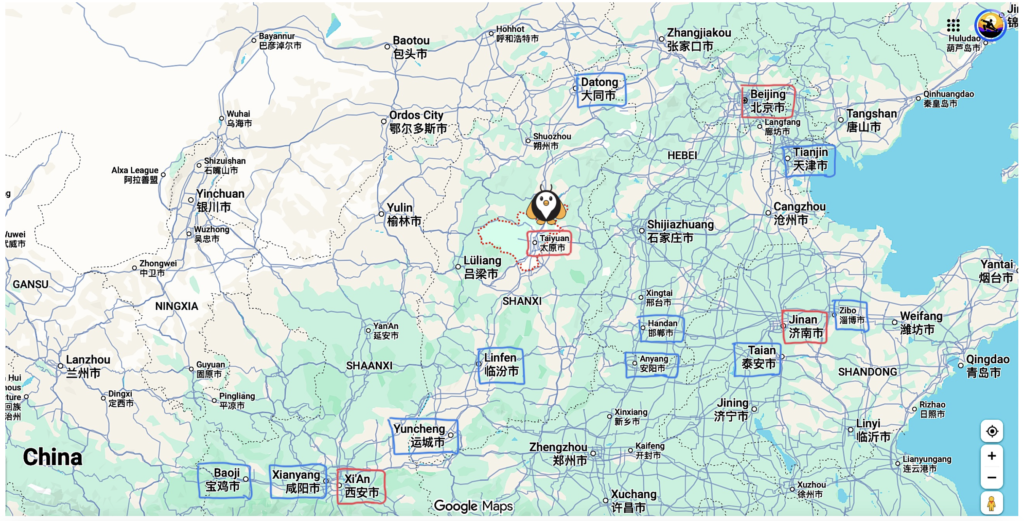
Jinci (晋祠, Jìncí)
is not in Beijing (北京, Běijīng).
It isn’t in Xi’an (西安, Xī’ān).
It sits just outside:
Taiyuan (太原, Tàiyuán)
— the capital of:
Shanxi Province (山西省, Shānxī Shěng).
And Dad thinks that’s actually good news.
Because instead of traveling to Taiyuan (太原, Tàiyuán) only for Jinci (晋祠, Jìncí)…
USE TAIYUAN (太原, Tàiyuán) AS A BASE.
🔥
That’s what Dad & Elaine did.
And suddenly a whole section of Shanxi Province (山西省, Shānxī Shěng) opens around you.
🚄 First — How Do You Get to Taiyuan (太原, Tàiyuán)?
For most international travelers already moving around China, high-speed rail is the easiest way to think about it.
Search for trains to:
Taiyuan South Railway Station (太原南站, Tàiyuán Nánzhàn).
This is the city’s major high-speed rail station.
Depending on your China itinerary, Taiyuan (太原, Tàiyuán) can fit naturally between major travel regions such as:
Beijing (北京, Běijīng)
and:
Xi’an (西安, Xī’ān).
So don’t automatically think:
“Shanxi requires a separate expedition.”
😂
Look at the rail map first.
Taiyuan (太原, Tàiyuán) can become your gateway.
🐇 Beyond Beijing or Xi’an: Taiyuan (太原, Tàiyuán) — The Gateway to Deep Shanxi →
🏨 Why Dad Used Taiyuan (太原, Tàiyuán) as a Base
This is the important part.
Taiyuan (太原, Tàiyuán) itself gives you:
Shanxi Museum (山西博物院, Shānxī Bówùyuàn),
Jinci (晋祠, Jìncí),
food,
hotels,
rail connections,
and:
a convenient place to reorganize before heading deeper into Shanxi.
Dad & Elaine could leave luggage at our Taiyuan (太原, Tàiyuán) hotel…
then make different historical rabbits around the province.
🔥
That’s much easier than changing hotels every night.
🏛️ DAY 1 — Jinci (晋祠, Jìncí) + Shanxi Museum (山西博物院, Shānxī Bówùyuàn)
This is Dad’s favorite pairing.
MORNING / EARLIER PART OF THE DAY
Visit:
Shanxi Museum (山西博物院, Shānxī Bówùyuàn).
Install the Coat Rack.
Look for:
State of Jin (晋国, Jìnguó),
Tang Shuyu (唐叔虞, Táng Shūyú),
and:
Bird-Shaped Zun Vessel (鸟尊, Niǎo Zūn).
Then go to:
Jinci (晋祠, Jìncí).
Now the museum objects become:
PLACE.
🔥
At Jinci (晋祠, Jìncí), allow time for:
Hall of the Holy Mother (圣母殿, Shèngmǔ Diàn),
Song Dynasty painted attendant sculptures (宋代侍女彩塑, Sòngdài Shìnǚ Cǎisù),
Zhou Cypress (周柏, Zhōubǎi),
Fish Pond Flying Bridge (鱼沼飞梁, Yúzhǎo Fēiliáng),
and:
Never-Aging Spring (难老泉, Nánlǎo Quán).
That’s already an excellent Taiyuan (太原, Tàiyuán) history-and-culture day.
🍶 Add a Shanxi Vinegar (山西老陈醋, Shānxī Lǎo Chéncù) Experience
And please don’t make Taiyuan (太原, Tàiyuán) only:
museum + ancient buildings.
😂
One of Shanxi Province’s (山西省, Shānxī Shěng) most famous food traditions is:
Shanxi Mature Vinegar (山西老陈醋, Shānxī Lǎo Chéncù).
Dad & Elaine also visited a vinegar factory.
That gives travelers another doorway into Shanxi:
TASTE.
See how vinegar is:
produced,
aged,
stored,
and:
used.
Then go eat noodles.
😂
Now your Shanxi Coat Rack has:
HISTORY + ART + ARCHITECTURE + FOOD CULTURE.
🏘️ DAY / OVERNIGHT TRIP — Pingyao (平遥, Píngyáo)
From Taiyuan (太原, Tàiyuán), another obvious rabbit is:
Ancient City of Pingyao (平遥古城, Píngyáo Gǔchéng).
High-speed rail makes it practical as a:
day trip
or, better:
ONE-NIGHT TRIP.
Dad prefers the overnight option if you have time.
Why?
Because after many day visitors leave…
Pingyao (平遥, Píngyáo) changes.
And after our rebuilt DEEP China article, don’t go only for:
“the old wall.”
Look for:
government,
Confucian education,
City God worship,
Shanxi merchants (晋商, Jìnshāng),
and:
draft banks (票号, Piàohào).
Now Taiyuan (太原, Tàiyuán) has already given you:
Jin political memory
and:
merchant China.
🚌 THEN DO WHAT DAD & ELAINE DID — GO NORTH
This was where our Taiyuan (太原, Tàiyuán) base became especially useful.
Dad & Elaine joined a:
3-DAY / 2-NIGHT NORTHERN SHANXI LOOP
from Taiyuan (太原, Tàiyuán).
And that loop opened completely different historical worlds.
We went toward:
Yanmenguan Pass (雁门关, Yànménguān)
→ frontier China
Mount Wutai (五台山, Wǔtái Shān)
→ Buddhist sacred geography + pilgrimage
Yingxian Wooden Pagoda (应县木塔, Yìngxiàn Mùtǎ)
→ ancient timber architecture + Liao Dynasty (辽朝, Liáo Cháo)
Hanging Temple (悬空寺, Xuánkōng Sì)
→ religion + cliffside architecture
and:
Yungang Grottoes (云冈石窟, Yúngāng Shíkū)
→ Buddhism + Northern Wei Dynasty (北魏, Běi Wèi).
🔥
Think about that.
One Taiyuan (太原, Tàiyuán) base helped Dad & Elaine reach:
WESTERN ZHOU
STATE OF JIN
BUDDHISM
FRONTIER HISTORY
NON-HAN DYNASTIES
ANCIENT WOODEN ARCHITECTURE
WALLED CITIES
MERCHANT CHINA.
Now you understand why Dad kept falling into Shanxi rabbit holes.
😂🐇🐇🐇
🧠 Don’t Copy Dad’s Route Blindly
This is important.
Dad isn’t saying:
“Everybody must do exactly 3D2N in exactly this order.”
No.
Distances in Shanxi Province (山西省, Shānxī Shěng) are substantial.
Some attractions need more time than others.
And Mount Wutai (五台山, Wǔtái Shān) alone can justify a slower stay.
So use Dad’s journey as:
A ROUTE IDEA.
Not:
A COMMANDMENT.
😂
If you’re particularly interested in Buddhism, give Mount Wutai (五台山, Wǔtái Shān) more time.
If architecture is your obsession, slow down around:
Yingxian Wooden Pagoda (应县木塔, Yìngxiàn Mùtǎ)
and the wider ancient-architecture landscape.
If you’re interested in history:
KEEP ASKING QUESTIONS.
🗺️ Dad’s Simple Taiyuan (太原, Tàiyuán) Base Plan
For an international traveler with roughly a week to explore this part of China:
TAIYUAN (太原, Tàiyuán)
base
↓
SHANXI MUSEUM (山西博物院, Shānxī Bówùyuàn) + JINCI (晋祠, Jìncí)
1 day
↓
PINGYAO (平遥, Píngyáo)
day trip or 1 night
↓
SHANXI VINEGAR (山西老陈醋, Shānxī Lǎo Chéncù)
food culture
↓
NORTHERN SHANXI LOOP
3D2N or slower
↓
Yanmenguan Pass (雁门关, Yànménguān)
Mount Wutai (五台山, Wǔtái Shān)
Yingxian Wooden Pagoda (应县木塔, Yìngxiàn Mùtǎ)
Hanging Temple (悬空寺, Xuánkōng Sì)
Yungang Grottoes (云冈石窟, Yúngāng Shíkū).
🔥
Now:
Taiyuan (太原, Tàiyuán)
stops looking like:
“a city international travelers skip.”
It becomes:
THE DOORWAY TO DEEP SHANXI.
🐇 Want Dad’s Bigger Shanxi Map?
This entire route is exactly why Dad built:
🐇 DEEP China: The Shanxi History Tasting Menu — Travel Through Layers of Chinese History →
Don’t use it as:
“Top 10 attractions in Shanxi.”
Use it as:
A MENU OF HISTORICAL LAYERS.
Then choose the courses that interest you.
😂🔥