Section 1 — Beyond the Great Wall: When the People From the Northern Frontier Became the Rulers
At Yanmenguan (雁门关), Elaine and I stood on China’s northern frontier and asked why Chinese states and dynasties kept building walls. Then, farther north near Datong (大同), we visited Yungang Grottoes (云冈石窟) — and encountered the other half of the story. What happened when peoples from beyond the old Central Plains political world didn’t merely cross the frontier, but became rulers of northern China themselves?
The answer takes us to:
云冈石窟 — Yúngāng Shíkū
Yungang Grottoes
near:
大同 — Dàtóng
Datong, Shanxi
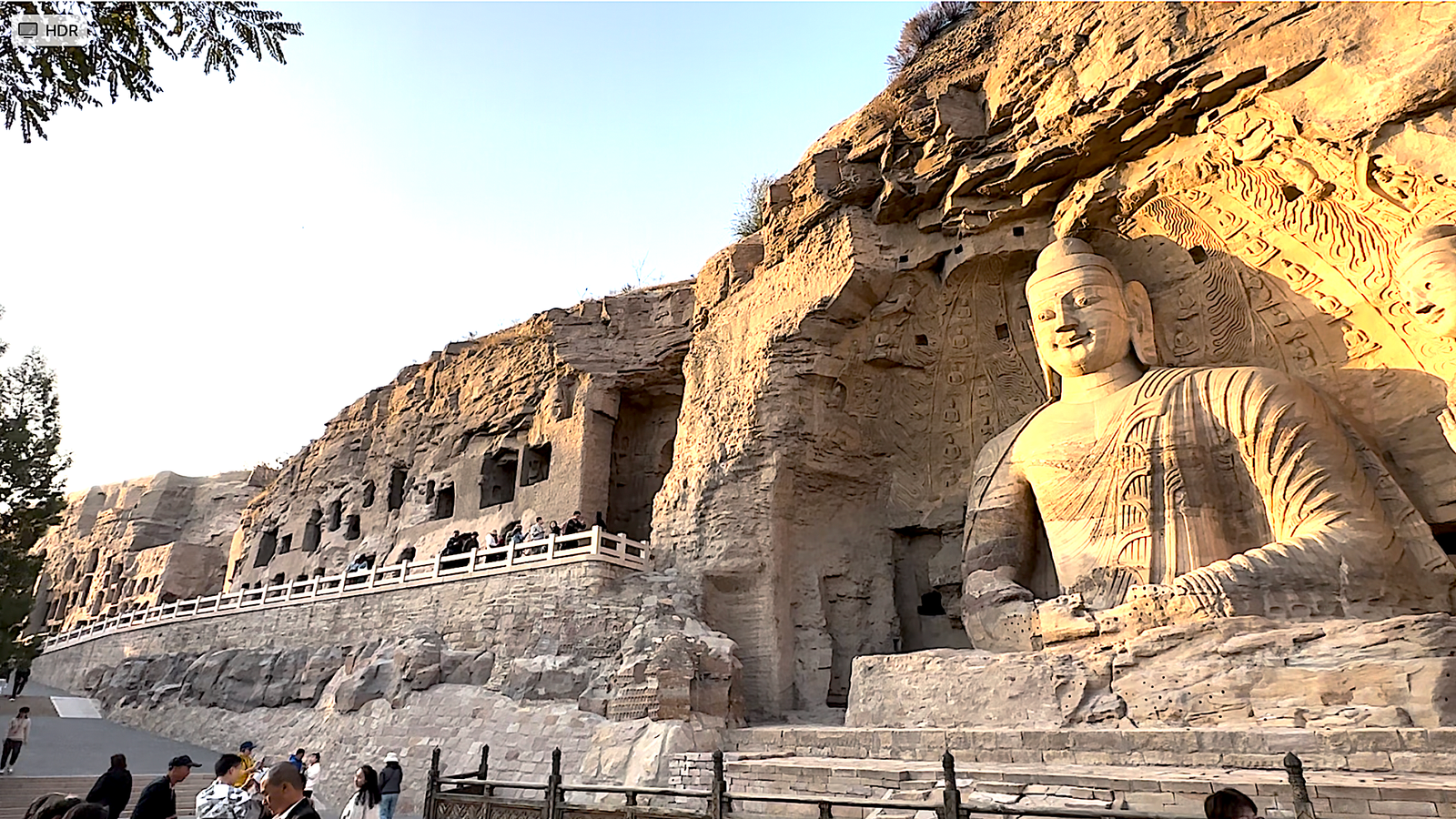
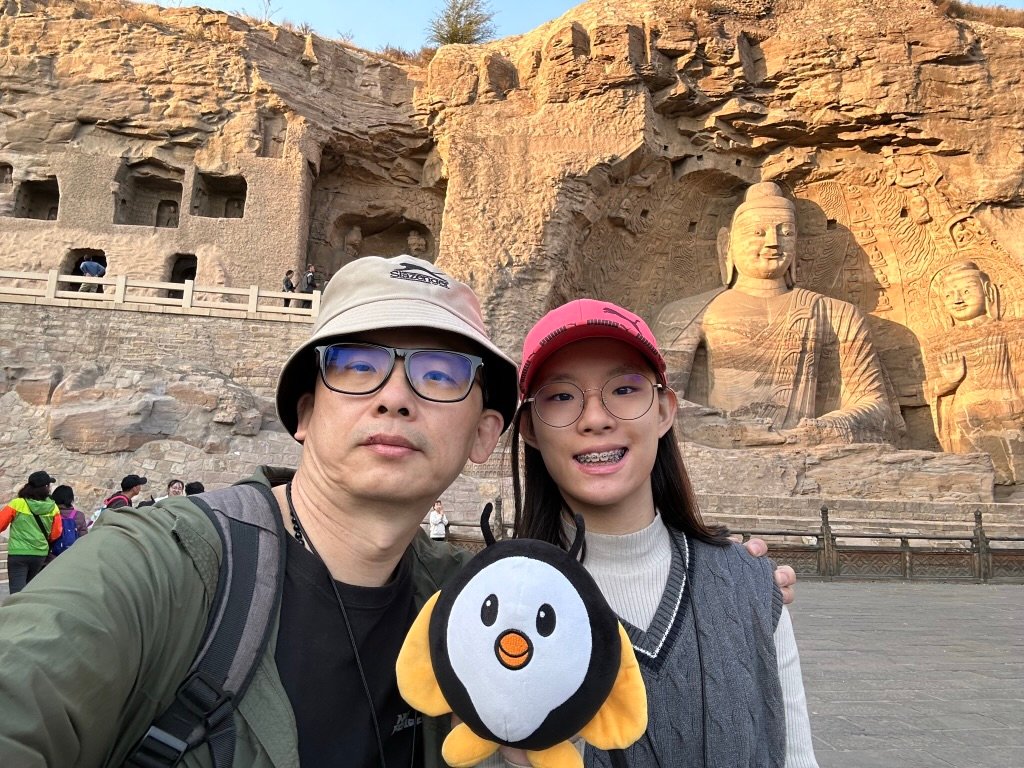
Elaine and I went there and stood before enormous Buddhist figures carved directly into the sandstone cliffs.
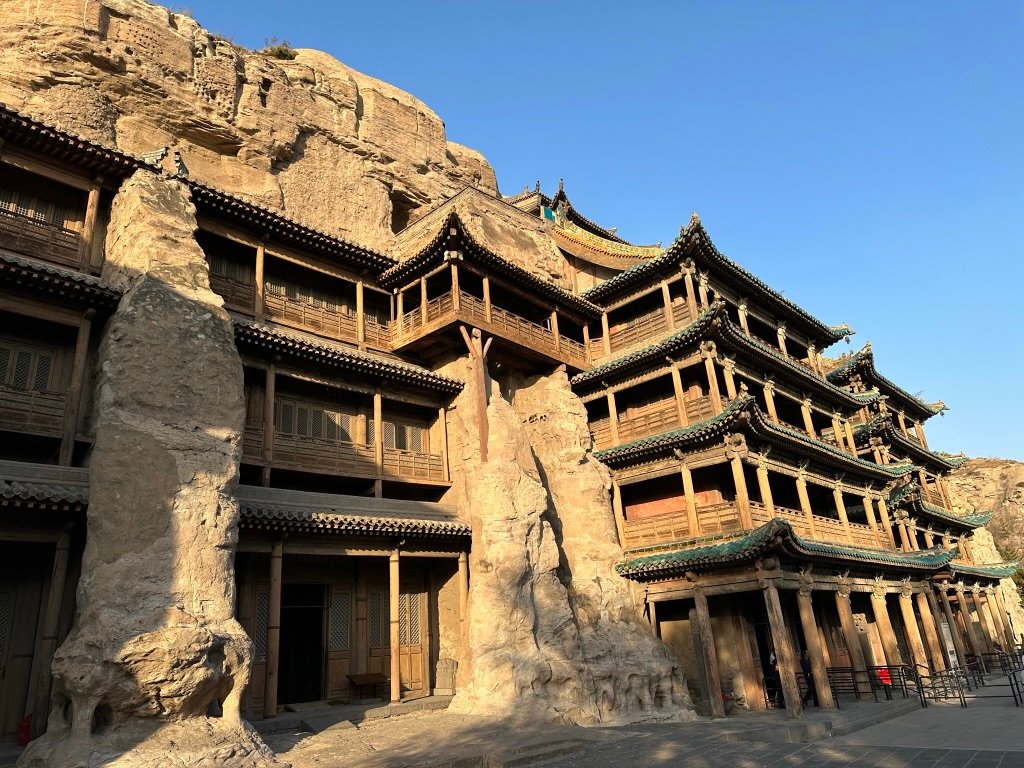
Some are monumental.
Some are tiny.
Some caves contain walls covered with:
佛像 — fóxiàng, Buddha images
菩萨 — púsà, bodhisattvas
and intricate carvings.
And if you arrive without much historical context, the obvious reaction is:
“Wow. Ancient Chinese Buddhist caves.”
Correct.
But incomplete.
😂
Because Yungang opens one of the most important rabbit holes in our entire Shanxi journey:
Who built these caves — and who exactly were the Northern Wei?
🐇
🕰️ Where Are We in Chinese History?
First, the coat rack.
We’ve recently traveled through:
HAN — 汉
206 BCE–220 CE
↓
THREE KINGDOMS — 三国
220–280
📍 Guan Yu 关羽
📍 Zhuge Liang 诸葛亮
↓
WESTERN JIN — 西晋
265–316
↓
A LONG PERIOD OF POLITICAL DIVISION
Different regimes rule different parts of China.
↓
NORTHERN WEI — 北魏
386–534
📍 YUNGANG — OUR STORY IS HERE
↓
SUI — 隋
581–618
↓
TANG — 唐
618–907
This is important.
We’re no longer in the unified Han empire.
And we’re not yet in the great unified Tang empire.
We’re inside a much more complicated period when northern and southern China were governed by different regimes.
For international beginners, this period can look terrifying.
😭
Northern Wei.
Eastern Wei.
Western Wei.
Northern Qi.
Northern Zhou.
Liu Song.
Southern Qi.
Liang.
Chen…
Dad:
“Elaine, come back!”
😂
Don’t memorize them.
For this article, keep only:
北魏 — Běi Wèi
Northern Wei
and one people:
鲜卑 — Xiānbēi
Xianbei
More specifically:
拓跋 — Tuòbá
Tuoba
That’s enough to unlock Yungang.
🐇 Wait — Who Were the Xianbei?
This is where our:
雁门关 — Yanmenguan
article becomes important again.
At Yanmenguan we explored the long interaction between:
农耕社会 — nónggēng shèhuì
settled agrarian societies
and:
游牧 / pastoral-mobile societies
peoples associated with the northern grassland and frontier worlds.
We deliberately rejected the cartoon version:
CHINESE inside wall.
BARBARIANS outside wall.
😂
Because history was far more complicated.
People:
traded,
fought,
migrated,
intermarried,
formed alliances,
changed political identities
and learned from one another.
Now at Yungang…
we encounter just how important that lesson is.
The Tuoba Xianbei Didn’t Simply Attack China
🌶️
The:
拓跋鲜卑 — Tuòbá Xiānbēi
were a branch of the wider Xianbei peoples.
Over time, the Tuoba established political power across northern China.
Their ruling house created the dynasty we know as:
北魏 — Northern Wei
And eventually Northern Wei controlled a huge part of northern China.
Now stop.
Because this completely changes our Great Wall mental picture.
At Yanmenguan we asked:
How does a settled state defend itself against powerful peoples from the northern frontier?
At Yungang the question becomes:
What happens when one of those northern peoples becomes the state?
🔥🔥🔥
That’s a much more interesting Chinese-history question.
🍚 Western Handrail: Frontiers Are Not Permanent Civilization Lines
Western and Eurasian history gives us plenty of examples of peoples moving across frontiers and eventually becoming rulers within the political worlds they once confronted.
Think broadly about the transformations around the late Roman world.
Groups once described by Roman writers as outsiders could:
enter imperial territory,
serve militarily,
establish kingdoms,
adopt existing institutions,
convert religions
and create new political cultures.
Not equivalent histories.
But it’s a useful handrail.
A frontier is not necessarily:
a permanent ethnic wall.
People cross it.
And when they do…
both sides can change.
🔥
Then the Tuoba Choose a Capital
Northern Wei established its important early imperial capital at:
平城 — Píngchéng
And where was Pingcheng?
Around modern:
大同 — Datong.
💡
Now Yungang’s location begins making sense.
We’re not looking at giant Buddhist caves randomly carved into a mountain in northern Shanxi.
We’re near the political center of an expanding Northern Wei state.
And during the fifth century:
佛教 — Fójiào
Buddhism
became enormously important under Northern Wei imperial patronage.
🐇 But Buddhism Didn’t Begin in China
Exactly.
Another rabbit.
😂
Buddhism originated in:
古印度 — ancient India
centuries earlier.
It traveled through:
Central Asia,
trade routes,
monastic networks,
travelers,
translators
and religious communities
into China.
Chinese travelers today may think of:
佛教
as deeply embedded in Chinese culture.
It is.
But historically:
Buddhism came into China from outside.
And then China transformed it.
🔥
That’s another enormously important historical pattern.
India → Central Asia → China
Don’t imagine one monk walking directly from India to Datong carrying a Buddha statue.
😂
The transmission of Buddhism was a long, complicated process.
Ideas, texts and artistic traditions traveled across interconnected Eurasian routes.
Important Buddhist centers developed in places such as:
敦煌 — Dūnhuáng
龟兹 — Qiūcí / Kucha
and other parts of Central Asia and western China.
Monks translated:
佛经 — fó jīng
Buddhist sutras
into Chinese.
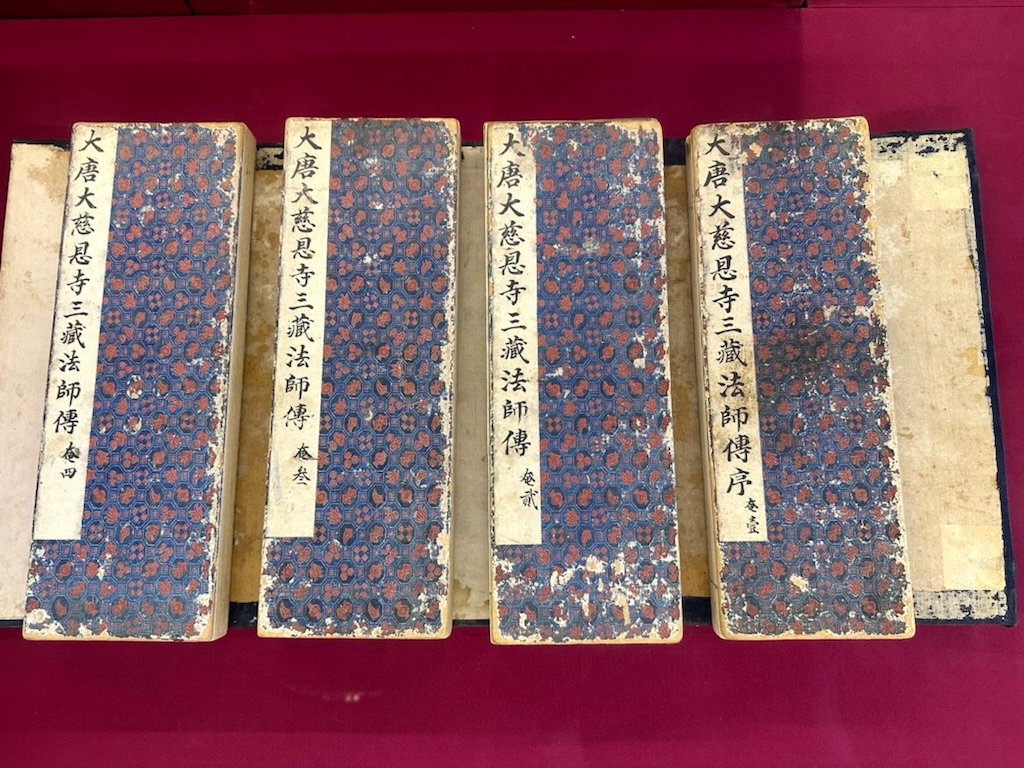
Buddhist sutras (佛经, fó jīng) preserved at the Giant Wild Goose Pagoda (大雁塔, Dàyàn Tǎ) in Xi’an, where Xuanzang (玄奘) and his team translated Buddhist texts brought from India during the Tang dynasty. Photo by Dad.
Religious concepts had to be expressed through Chinese language.
Artistic forms traveled too.
And over centuries, Buddhism became increasingly rooted within Chinese society.
Now Yungang sits inside that enormous cultural journey.
🌶️ So Who Carved Yungang?
Not:
“the ancient Chinese.”
😂
That’s too vague to teach us anything.
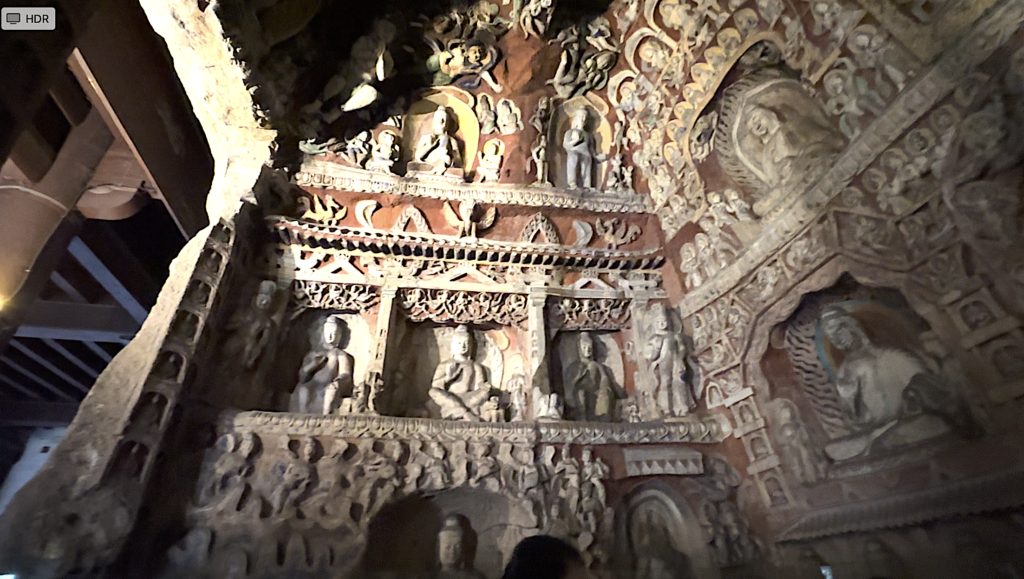
The great early phase of Yungang’s construction was closely connected with:
北魏皇室 — Běi Wèi huángshì
the Northern Wei imperial court
during the fifth century.
And the dynasty itself was ruled by:
拓跋鲜卑
a ruling house with origins in the northern Xianbei world.
Meanwhile the religion being monumentalized was:
佛教
which had come into China through trans-Asian cultural transmission.
And the artistic traditions visible at Yungang reflect interactions involving:
Chinese,
Central Asian
and broader Buddhist artistic worlds.
😳
Now ask:
Is Yungang Chinese?
Of course.
It is one of China’s great historical monuments.
But its story also tells us something deeper:
Chinese civilization repeatedly grew by absorbing, transforming and being transformed by peoples and ideas that crossed its frontiers.
🔥🔥🔥
That is the chilli.
Yungang Is a UNESCO World Heritage Site
In:
2001
the:
云冈石窟
were inscribed on the:
UNESCO World Heritage List.
UNESCO recognizes Yungang as an outstanding achievement of Buddhist cave art in China, with major caves dating especially to the fifth and sixth centuries.
The site contains:
252 grottoes and niches
and:
more than 51,000 statues
across the complex.
😳
So when Elaine and I arrived…
there was no possibility of:
“Let’s understand every Buddha.”
😂
Same museum rule.
Pick a few.
Ask questions.
Let them open doors.
Start With the Five Great Caves
One of the most important early chapters of Yungang involves the monk:
昙曜 — Tányào
Tanyao
and the famous:
昙曜五窟 — Tányào Wǔ Kū
Five Caves of Tanyao
generally identified with:
Caves 16–20
These monumental caves belong to the great early phase of Northern Wei Buddhist patronage.
And their enormous Buddha figures make an immediate statement.
Not:
“small private shrine.”
This is:
IMPERIAL-SCALE BUDDHISM.
🔥
👑 Buddha and Emperor
Here’s where religion and politics begin interacting.
Scholars have long discussed the relationship between the monumental Buddha imagery of the Tanyao caves and Northern Wei imperial rulership.
The great Buddha figures were not simply religious decoration.
Imperial patronage of Buddhism could help connect:
religious authority
with:
political authority.
And for a ruling house governing populations with different cultural backgrounds, a major religious tradition could also become part of building a broader imperial order.
🌶️
Now Yungang isn’t only:
Buddhist art.
It’s also:
statecraft.
🐇 Why Would Xianbei Rulers Patronize Buddhism?
Excellent question.
Think about Northern Wei’s challenge.
The Tuoba ruling house had origins in a northern frontier society.
Now it governed large populations across northern China.
How do rulers create legitimacy?
How do they build institutions?
How do they relate to different populations and cultural traditions?
How do they express imperial power?
Religion can become part of that answer.
Buddhism offered:
religious authority,
monastic institutions,
universal teachings,
artistic symbolism
and networks extending far beyond one ethnic or regional identity.
🔥
That makes it particularly interesting in a multiethnic empire.
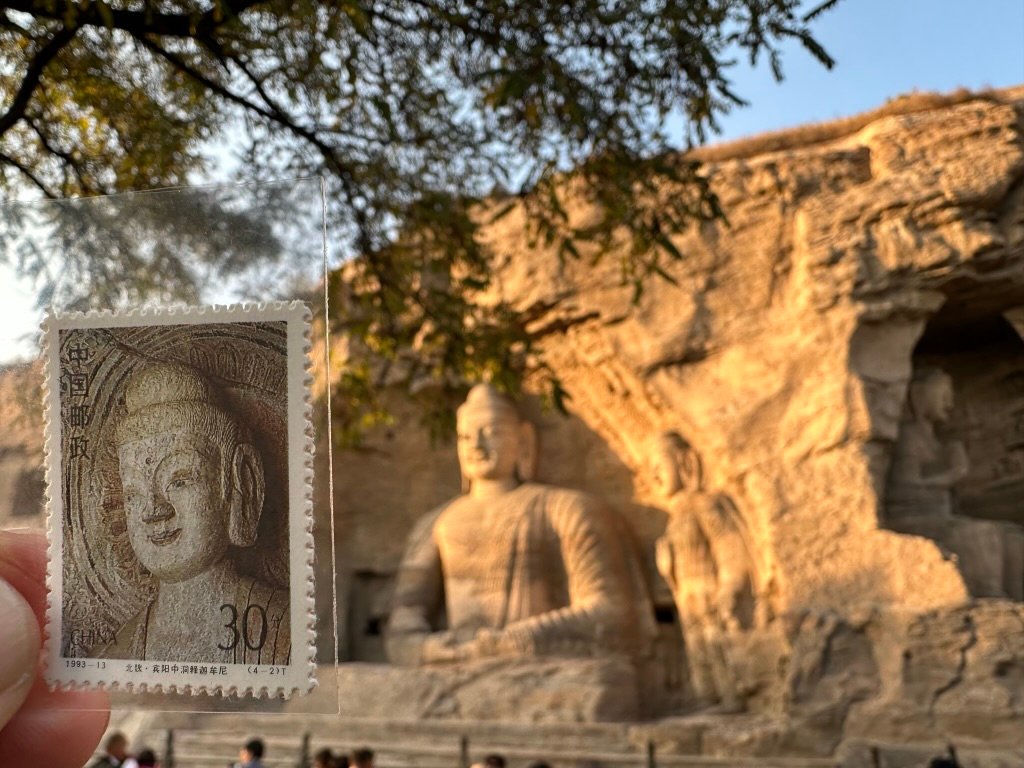
Dad’s Stamp Meets the Buddha 😂
And yes…
Dad again brought a postage stamp showing the famous image.
😂
Artifact / monument:
thousands of years of history
Dad:
“Wait, I have the stamp!”
📸
But that photograph actually works beautifully for Deep China.
Because the Buddha image has become recognizable enough to appear on modern cultural imagery.
The ancient monument has entered:
modern Chinese cultural memory.
Another layer.
🕰️ One Buddha, Several Worlds
Stand in front of a monumental Yungang Buddha and imagine the layers.
INDIA
Buddhism originates.
↓
CENTRAL ASIA
ideas and artistic traditions travel.
↓
CHINA
Buddhism is translated and transformed.
↓
XIANBEI / TUOBA
a northern ruling people establishes Northern Wei.
↓
PINGCHENG / DATONG
imperial capital.
↓
YUNGANG
Buddhas carved into stone.
↓
TODAY
Dad holds up a postage stamp.
😂🔥
One image.
A huge civilizational journey.
🌶️ And This Is Why “Sinicization” Is Too Simple by Itself
You’ll often encounter a narrative saying Northern Wei rulers became:
汉化 — Hànhuà
“Sinicized”
meaning they increasingly adopted institutions, customs and cultural practices associated with the Han Chinese political-cultural world.
There is truth in that broad process.
Later Northern Wei reforms—especially after the capital moved to:
洛阳 — Luòyáng
—would push major cultural and political changes.
But if we imagine:
Xianbei culture disappears → everybody simply becomes Han Chinese
we’ve made the history too neat.
😂
Cultural transformation can move in:
both directions.
Different peoples interact.
Institutions mix.
Marriage patterns change.
Languages influence one another.
Religious traditions cross boundaries.
Political identities evolve.
The resulting society isn’t necessarily identical to either starting point.
🔥
Yungang helps us see that process in stone.
🐇 Luoyang?!
Yes.
Again.
😂
Remember:
何尊 — He Zun
and the early Zhou eastern center around:
洛邑 — Luoyi
in the Luoyang region?
Centuries later:
Northern Wei
moves its capital from:
Pingcheng / Datong
to:
Luoyang
in:
494 CE.
😳
And what major Buddhist cave complex develops near Luoyang?
龙门石窟 — Lóngmén Shíkū
Longmen Grottoes
🐇🐇🐇
There it is.
Yungang has just produced another destination.
Yungang → Longmen
This is a fantastic historical-artistic journey:
YUNGANG 云冈
Northern Wei
↓
capital at Pingcheng
↓
capital moves south to:
LUOYANG 洛阳
↓
LONGMEN 龙门
Buddhist cave art develops in a new political and cultural environment.
🔥
So if you’ve visited both Yungang and Longmen, don’t treat them as:
“two famous Chinese Buddha caves.”
They’re connected by:
Northern Wei history.
That is exactly the kind of key Deep China wants to give you.
🐞 Sting Check
You arrived thinking:
“Yungang = famous ancient Buddhist grottoes.”
Now you’ve acquired:
鲜卑 — Xianbei
↓
拓跋 — Tuoba
↓
北魏 — Northern Wei
↓
平城 — Pingcheng / Datong
↓
佛教 — Buddhism
↓
India
↓
Central Asia
↓
China
↓
昙曜五窟 — Five Caves of Tanyao
↓
imperial patronage
↓
洛阳 — Luoyang
↓
龙门石窟 — Longmen Grottoes
😬
You came to look at a Buddha.
Now we’re discussing:
how peoples, religions and political identities transformed northern China.
You’ve been properly stung.
🐇🐞
And This Is the Answer Yanmenguan Was Waiting For
At:
雁门关
we ended with a dangerous question:
What happened when northern peoples didn’t remain outside the frontier?
Yungang gives us one answer.
They could:
enter,
settle,
rule,
build states,
adopt new traditions,
transform existing ones
and eventually become inseparable from the historical story of China itself.
🔥
The Great Wall story was never:
inside vs outside forever.
And Yungang proves why that mental model is too small.
Next: Why Do the Buddhas Look Like THAT?
Now we’ve met:
Northern Wei
and:
Xianbei.
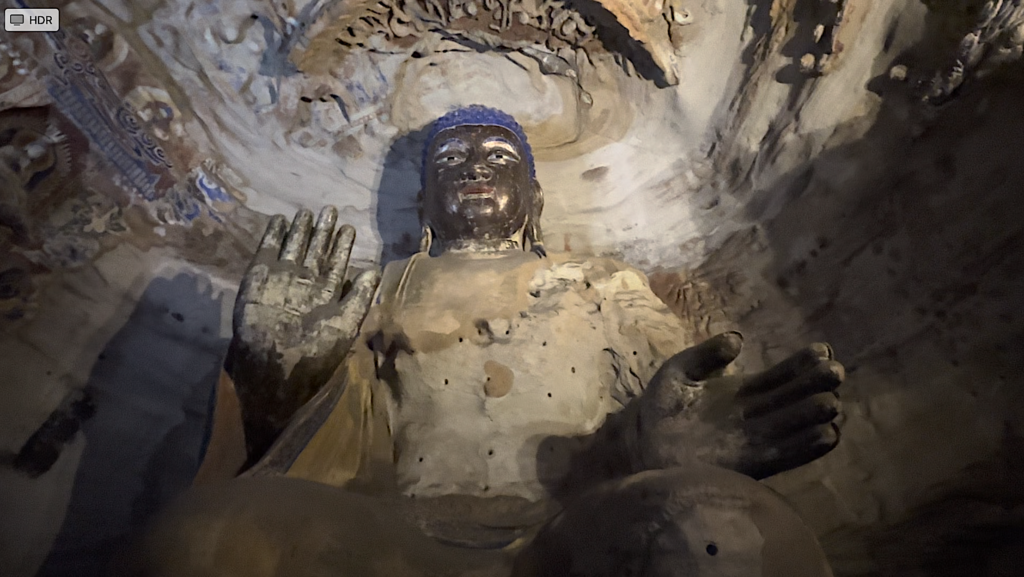
But we haven’t properly looked at the art.
Why do some Yungang figures and decorative motifs remind scholars of artistic traditions far beyond China?
How did Buddhist imagery travel?
What happened when those artistic traditions encountered Chinese craftsmen and imperial patrons?
And how did Yungang itself change as Northern Wei society changed?
That’s where the next section goes.
Section 2 — From India to Datong: How Buddhism and Art Traveled Across Asia and Became Yungang
Standing before the giant Buddhas of:
云冈石窟 — Yúngāng Shíkū
Yungang Grottoes
it’s tempting to think:
“This is ancient Chinese Buddhist art.”
True.
But look more carefully and another question appears:
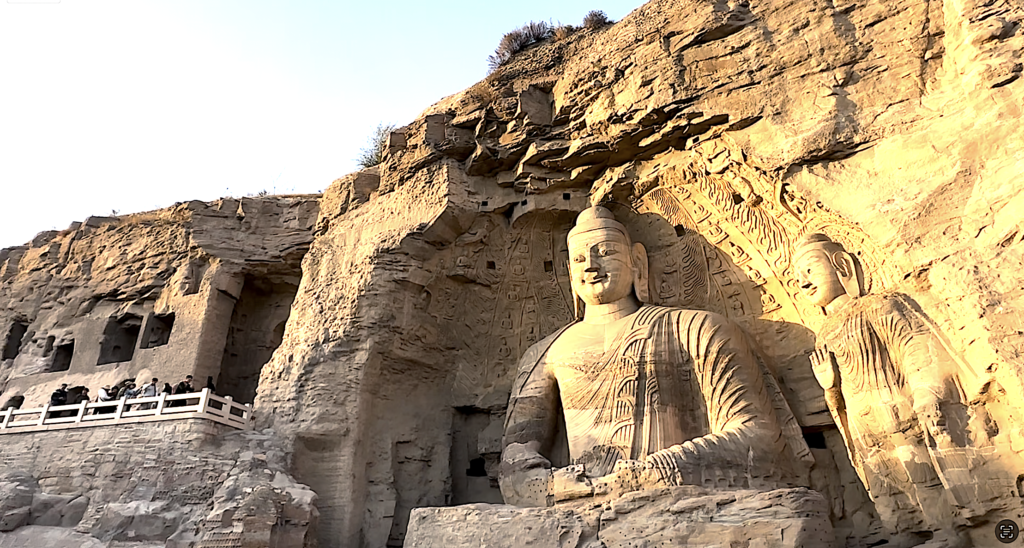
How did Buddhism — a religion born in ancient India — end up carved on such an enormous scale into a cliff outside Datong?
🐇
To answer that, we need to travel much farther than Shanxi.
Not physically.
Thankfully.
😂
Historically.
Because Yungang belongs to a much larger story of:
文化交流 — wénhuà jiāoliú
cultural exchange
across Asia.
And this is one of the most important lessons Yungang can give an international traveler:
Ancient China was never culturally sealed off from the rest of Eurasia.
Ideas came in.
People came in.
Artistic traditions came in.
And once they arrived…
China transformed them.
🔥
🕰️ Buddhism Was Already Old Before Yungang
Let’s put this on the timeline.
ANCIENT INDIA
Buddhism emerges around the middle of the first millennium BCE.
↓
CENTRAL ASIA
Buddhist communities and traditions spread along interconnected trade and travel routes.
↓
HAN CHINA — 汉
Buddhism begins becoming increasingly visible in China during the first centuries CE.
↓
CENTURIES OF TRANSLATION AND ADAPTATION
佛经 — fó jīng
Buddhist texts are translated.
Monasteries develop.
Chinese Buddhist communities grow.
↓
NORTHERN WEI — 北魏
386–534
↓
YUNGANG
major carving begins in the fifth century.
So when Northern Wei began creating Yungang:
Buddhism was foreign in origin, but it was no longer completely new to China.
It had already been traveling, translating and adapting for centuries.
🍚 Western Handrail: Religions Change as They Travel
Western readers already understand this phenomenon.
A religion may begin in one geographical and cultural environment…
then travel into another.
Its core teachings may remain recognizable.
But:
languages change,
art changes,
institutions change,
architecture changes,
and local traditions influence how people understand and express it.
Christianity in:
first-century Judea
doesn’t look culturally identical to Christianity in:
medieval Ethiopia,
Byzantium,
Renaissance Italy
or:
modern Latin America.
Same broad religious tradition.
Very different cultural expressions.
That’s the useful handrail.
Now apply the same basic idea to:
佛教 — Buddhism
as it traveled from India through Central Asia into China.
🐇 But How Did Buddhist Ideas Actually Travel?
Not through one thing called:
“The Silk Road Express.”
😂
The term:
丝绸之路 — Sīchóu Zhīlù
Silk Road
can create an overly simple mental picture:
one road
↓
China
↓
Central Asia
↓
Rome.
Reality was much messier and more interesting.
There were multiple:
routes,
oases,
kingdoms,
merchants,
pilgrims,
monks,
diplomats
and communities connecting different parts of Eurasia.
Buddhism traveled through these human networks.
Meet the Translators
This is one part of Buddhist history travelers can easily overlook.
A religion carried through texts encounters a basic problem when it crosses language boundaries:
How do you translate the ideas?
😬
Buddhist texts originally existed in Indian languages and later circulated in various linguistic forms across Central Asia.
To become deeply rooted in China, Buddhist teachings had to become understandable in:
汉语 — Hànyǔ
Chinese.
That required generations of:
译经 — yìjīng
sutra translation
and translators who had to solve extremely difficult problems.
How do you express an Indian philosophical concept when Chinese has no exact equivalent?
Do you invent terminology?
Borrow an existing Chinese term?
Transliterate the sound?
Explain it?
🐇
Translation wasn’t simply:
word A = word B.
It helped create Chinese Buddhism.
🔥
Even “Buddha” Had to Become Chinese
Today Chinese readers see:
佛 — fó
and immediately understand the Buddhist association.
But even that familiar character belongs to a long history of translating and transliterating foreign religious terminology.
Similarly:
菩萨 — púsà
bodhisattva
comes from the transliteration and adaptation of an Indic Buddhist term.
Now think about that.
Words that today feel completely at home in Chinese religious vocabulary…
once arrived from somewhere else.
🔥
Language itself preserves cultural contact.
Then Art Has to Travel Too
Now imagine another problem.
Someone tells you:
“Carve the Buddha.”
Okay.
What does the Buddha look like?
😂
Early Buddhist artistic traditions developed visual conventions for representing:
Buddhas,
bodhisattvas,
halos,
robes,
lotus imagery,
narrative scenes
and other religious subjects.
As Buddhism traveled across Asia, these visual traditions traveled too.
But they didn’t remain frozen.
Artists adapted them.
Local styles entered.
Patrons wanted different things.
Materials changed.
Political contexts changed.
And by the time we reach Yungang:
several artistic worlds are meeting.
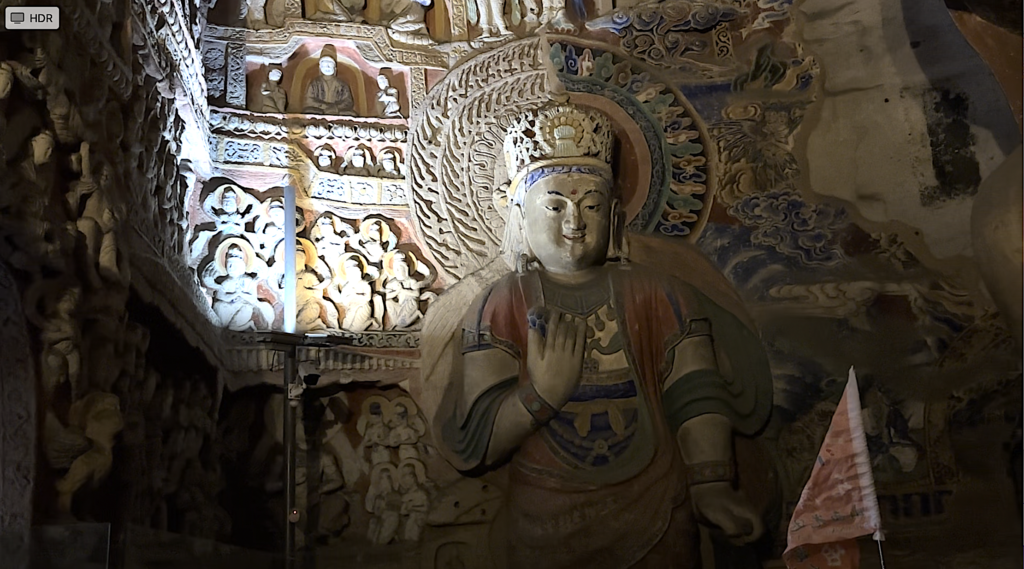
🌶️ Look at Yungang as a Meeting Place
At Yungang, scholars have identified artistic influences and connections associated with:
Indian Buddhist traditions,
Central Asian Buddhist art,
and:
Chinese artistic development.
This doesn’t mean you should stand in front of every statue saying:
“That eyebrow is 17% Central Asian.”
😭😂
That’s not the point.
The bigger lesson is:
Yungang was created inside a world of long-distance cultural transmission.
The caves are Chinese.
But the artistic story that produced them crosses borders.
🗿 Start With the Giant Buddhas
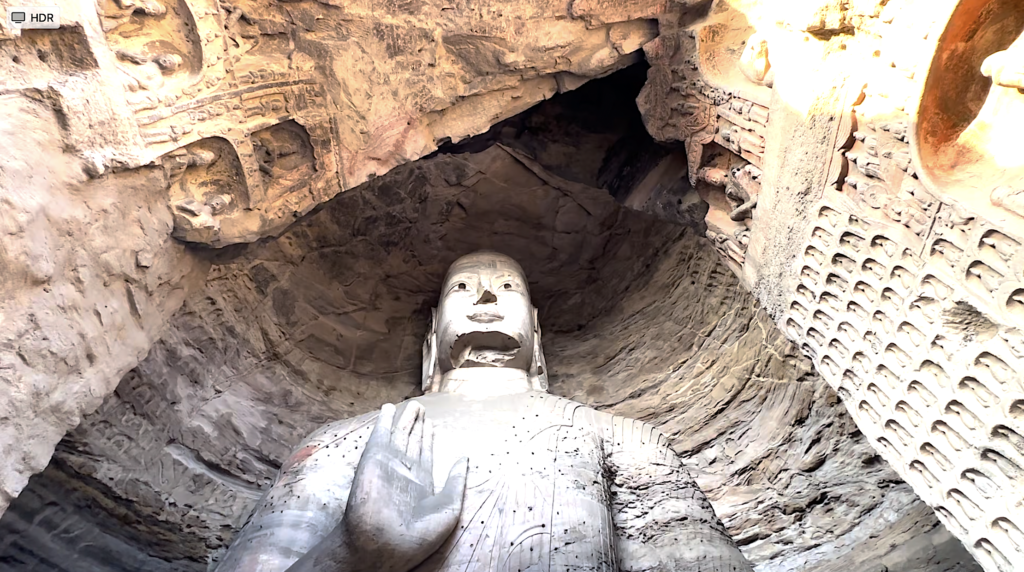
Some of the most powerful figures at Yungang are enormous.
The monumental Buddhas associated particularly with the:
昙曜五窟 — Tányào Wǔ Kū
Five Caves of Tanyao
immediately communicate:
scale.
A small devotional image can express personal faith.
A giant Buddha carved through imperial patronage says something else too:
POWER.
🔥
Religious power.
Political power.
Imperial resources.
Organized labor.
Artistic expertise.
And the ability of a state to turn a cliff face into a monumental religious landscape.
🌶️ Religion and Politics Were Sitting Together
Remember who sponsored this great phase of Yungang?
北魏皇室 — the Northern Wei imperial court.
So we should ask:
Why would emperors invest enormous resources in Buddhist monuments?
Partly:
信仰 — xìnyǎng
religious belief.
But imperial patronage can also communicate:
合法性 — héfǎxìng
legitimacy
权威 — quánwēi
authority
and:
秩序 — zhìxù
order.
A monumental Buddha can be a religious image…
while the act of commissioning it also tells people something about the ruler who made the monument possible.
The two meanings can coexist.
👑 Were Some Buddhas Connected Symbolically With Emperors?
This is one of the fascinating scholarly discussions around the early Yungang caves.
Historical sources associate Tanyao with the revival and promotion of Buddhism under Northern Wei after an earlier period of persecution.
The monumental Buddhas of the early caves have been interpreted as carrying connections between:
佛 — Buddha
and:
皇帝 — huángdì
emperor.
We should be careful not to reduce every Buddha to:
“This is secretly Emperor X.”
😂
But the broader relationship between:
imperial authority
and:
Buddhist sacred imagery
is important to understanding why Yungang was built on such an extraordinary scale.
🐇 Wait — Buddhism Was Persecuted?
Yes.
This is another reminder that history isn’t:
Buddhism arrives → everybody loves Buddhism → giant caves.
😂
Northern Wei itself experienced periods of both:
imperial support
and:
suppression
of Buddhism.
Under:
太武帝 — Tàiwǔ Dì
Emperor Taiwu
Buddhism faced severe persecution in the mid-fifth century.
Later, under:
文成帝 — Wénchéng Dì
Emperor Wencheng
Buddhist patronage revived.
And the monk:
昙曜 — Tányào
became closely associated with the great early phase of Yungang construction.
Now the giant caves also tell a story about:
religion surviving political change.
🔥
And Then Yungang Starts Changing
This is where looking at different caves becomes especially interesting.
Yungang wasn’t carved in one afternoon.
😂
Construction developed over decades.
And during those decades:
Northern Wei society itself was changing.
The Tuoba rulers increasingly interacted with:
Han Chinese elites,
Chinese political institutions,
Buddhist communities
and populations across northern China.
So the artistic language of Yungang changes too.
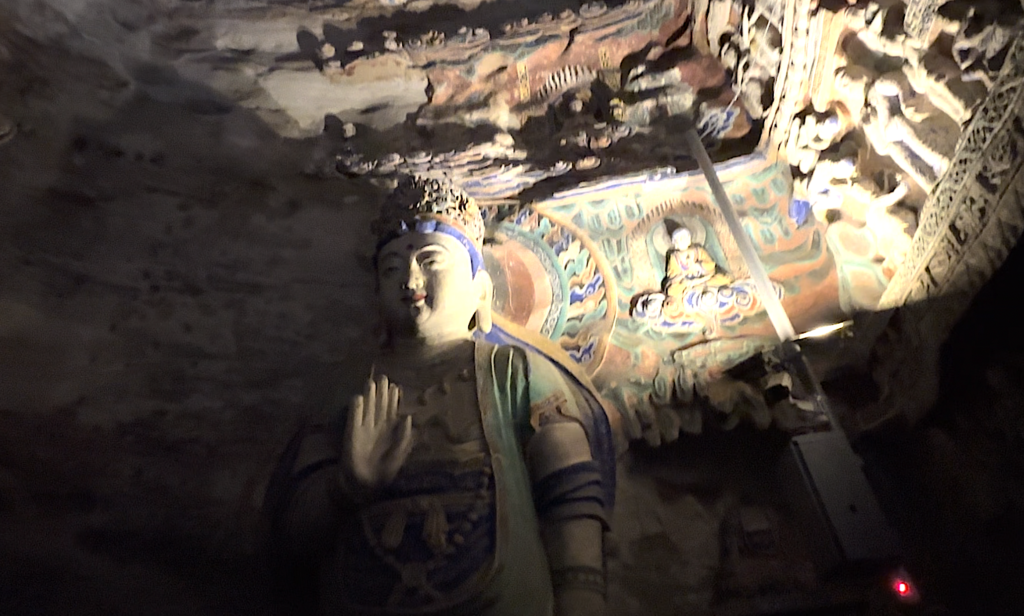
Early Yungang vs Later Yungang
Very broadly—and without turning Dad into an art-history professor—
the earlier monumental caves emphasize:
massive, powerful Buddha figures
and artistic elements reflecting strong connections with Buddhist traditions transmitted through Central Asia.
Later phases show increasingly elaborate:
Chinese architectural motifs,
costume,
decorative forms
and stylistic developments associated with the changing Northern Wei cultural environment.
🔥
The stone itself records transformation.
That’s what makes Yungang extraordinary.
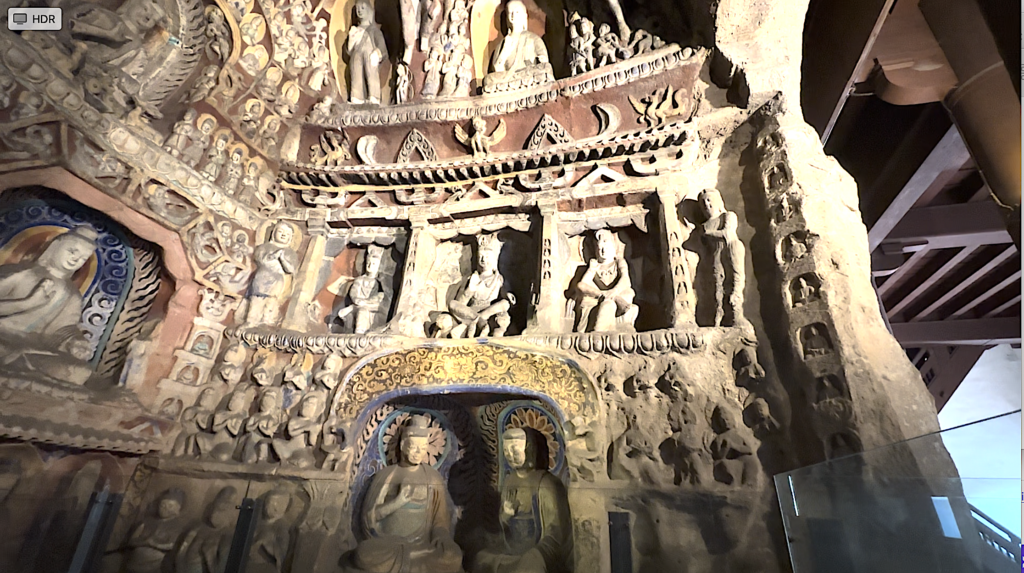
🍚 You Can Literally Watch Culture Mix
Imagine walking from one part of the complex to another and seeing artistic conventions change.
Not because:
“foreign style stopped Tuesday; Chinese style began Wednesday.”
😂
Culture doesn’t work like that.
Instead:
ideas overlap.
Artists learn.
Patrons change.
Political priorities shift.
Local traditions enter.
New visual languages emerge.
So rather than asking:
“Is this foreign or Chinese?”
a better question is:
“What happened when these traditions met?”
🌶️🌶️🌶️
That question is much more useful throughout Chinese history.
🐇 Because What Does “Chinese” Mean Anyway?
Uh-oh.
Here comes the dangerous rabbit hole.
😂
Suppose:
a religion originates in India.
↓
travels through Central Asia.
↓
is patronized by Xianbei rulers.
↓
carved by people living in northern China.
↓
incorporates multiple artistic traditions.
↓
becomes one of China’s greatest cultural monuments.
So:
Is it Chinese?
Of course.
But not because it was culturally isolated.
It’s Chinese partly because China itself has repeatedly been shaped through:
交流 — jiāoliú
exchange
融合 — rónghé
integration / blending
and:
吸收 — xīshōu
absorption.
🔥
That is a much richer idea of civilization.
This Is Where the Great Wall Story Turns Inside Out
At:
雁门关 — Yanmenguan
we looked outward.
The wall.
The frontier.
The problem of defense.
Agrarian and mobile pastoral worlds.
Then at:
云冈
we look inward.
The Tuoba Xianbei have become rulers of northern China.
Buddhism has crossed enormous distances.
Artistic traditions have crossed enormous distances.
And all of them are becoming part of a new political-cultural world.
So our two destinations teach opposite but complementary lessons:
YANMENGUAN
How do societies manage frontiers?
↓
YUNGANG
What happens when the frontier moves through society itself?
🔥🔥🔥
That’s a serious Deep China connection.
And Then Northern Wei Moves South
In:
494 CE
Northern Wei Emperor Xiaowen:
孝文帝 — Xiàowén Dì
moved the capital from:
平城 — Píngchéng
Datong
to:
洛阳 — Luòyáng
This was part of a much larger program of political and cultural transformation.
And once the court moves…
our Buddhist-art rabbit moves too.
🐇
Yungang → Longmen
Near Luoyang lies:
龙门石窟 — Lóngmén Shíkū
Longmen Grottoes
another UNESCO World Heritage Site and one of China’s greatest Buddhist cave complexes.
Now the connection becomes:
云冈石窟
Northern Wei capital at Pingcheng
↓
494 CE
capital moves to Luoyang
↓
龙门石窟
major Buddhist cave activity develops there.
🔥
So if you’ve visited:
Yungang
and:
Longmen
you haven’t merely collected:
Buddha Cave #1
and:
Buddha Cave #2.
😂
You’ve followed the movement of:
a dynasty.
🐇 And Luoyang Has Appeared AGAIN
Dad’s historical map is getting ridiculous.
😂
Remember:
何尊 — He Zun
from Baoji?
Its inscription brought us into the early Zhou story of the eastern center around:
洛邑 — Luoyi
in the Luoyang region.
Then centuries later:
Northern Wei
moves its capital to:
Luoyang.
Same geographical region.
Completely different dynasty.
Completely different story.
Again:
places accumulate history.
🔥
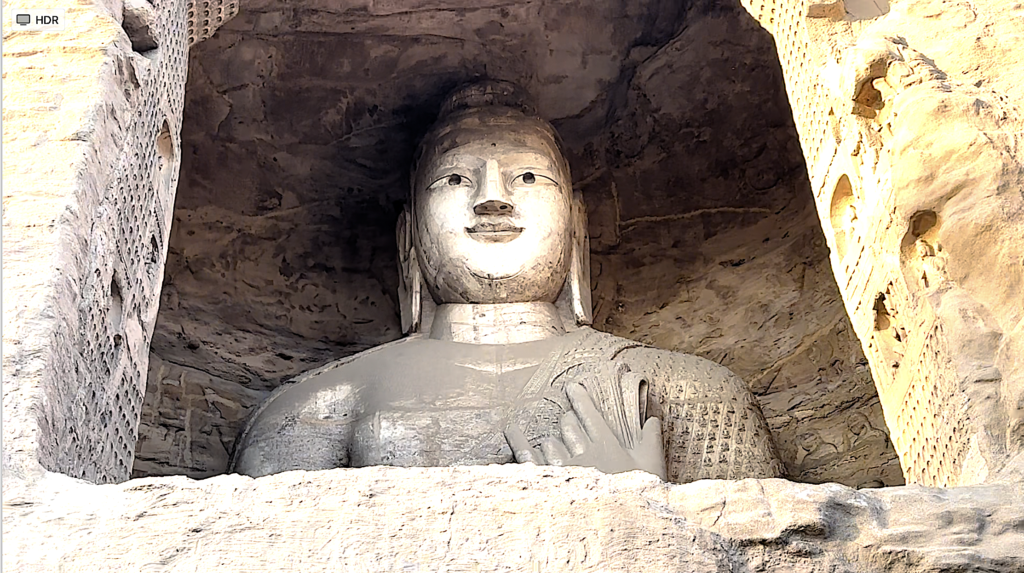
What Should You Actually Look For at Yungang?
Don’t try to identify every artistic influence.
Please.
😂
Instead, use four questions:
1. HOW BIG?
Look at scale.
What does monumental size communicate?
↓
2. WHO PAID FOR THIS?
Imperial patronage.
Northern Wei.
↓
3. WHERE DID THE RELIGION COME FROM?
India → Central Asia → China.
↓
4. WHAT CHANGED AS IT TRAVELED?
Art.
Language.
Political meaning.
Cultural expression.
That’s enough to make the visit dramatically richer.
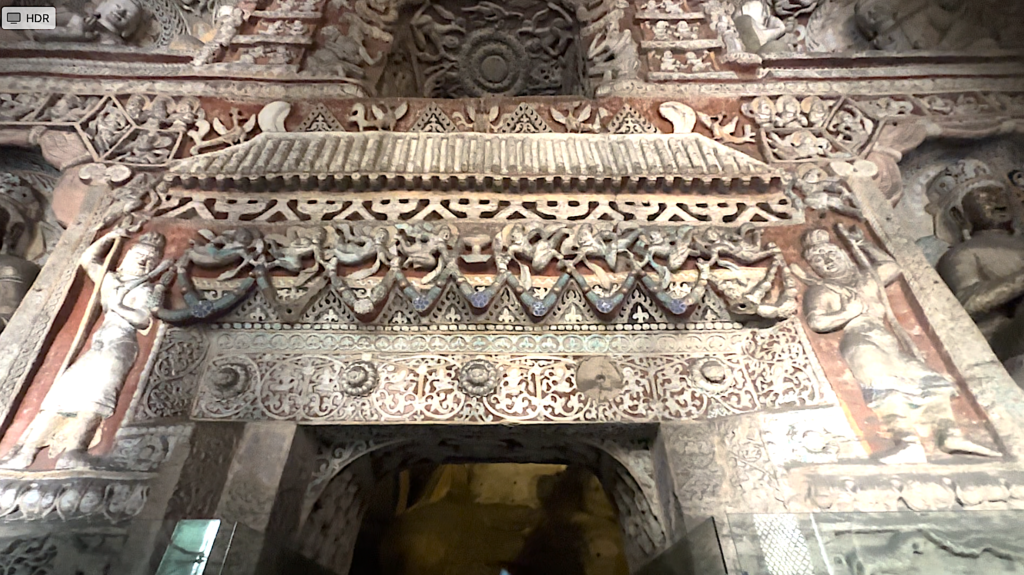
📸 And Look at Details, Not Only Giant Buddhas
The monumental figures naturally dominate photographs.
But spend time looking at:
small niches,
musicians,
flying celestial figures,
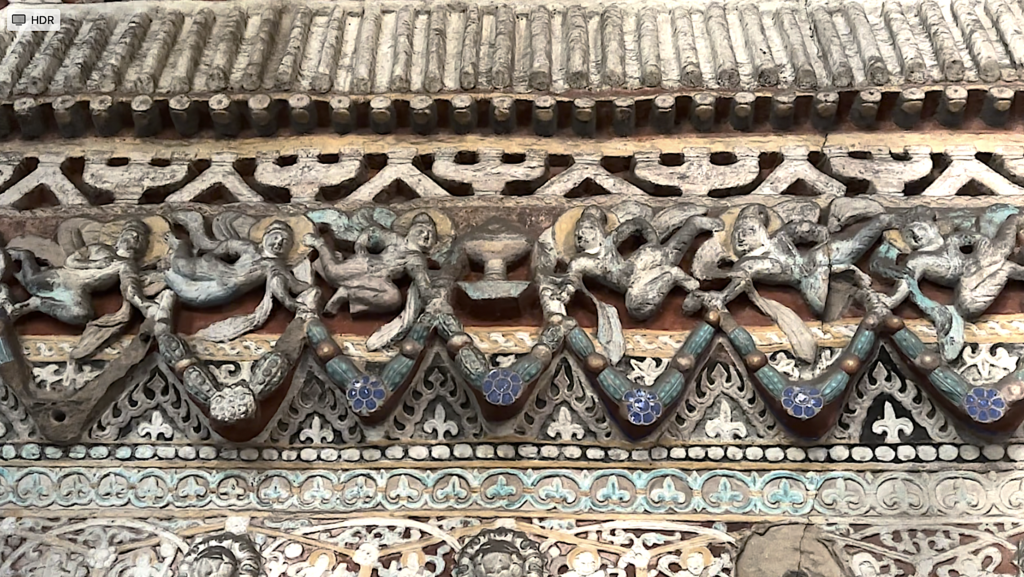
decorative patterns,
clothing,
halos,
architectural forms
and:
repeated tiny Buddha images.
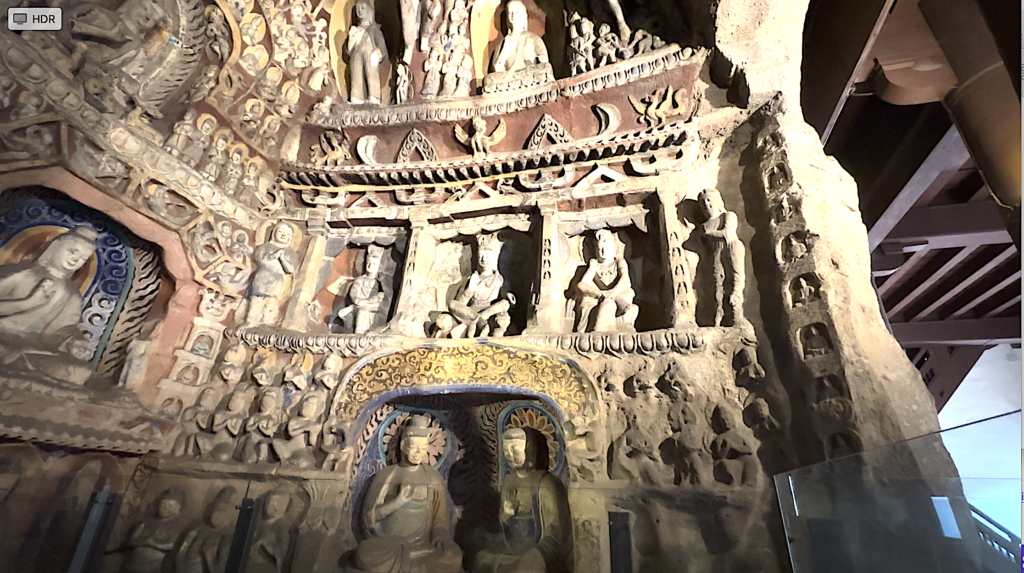
The smaller carvings often make the site feel even more overwhelming.
Because you suddenly realize:
Someone carved all of this.
😳
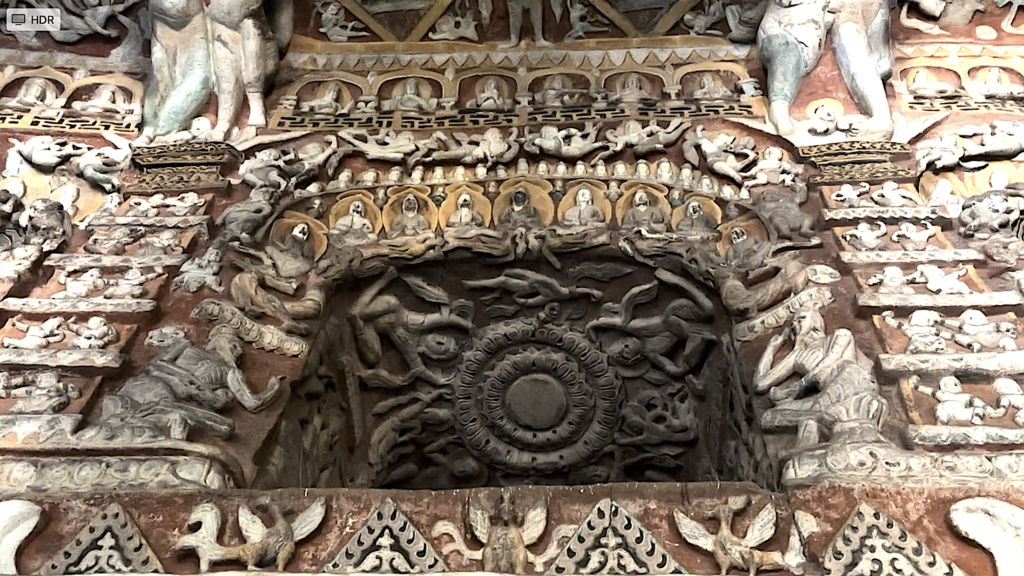
🎵 Look for Musicians
This is another wonderful cultural clue.
Yungang includes representations of:
伎乐 — jìyuè
musicians and performers
with instruments and artistic forms that can help scholars investigate cultural connections across ancient Asia.
Now Buddhism isn’t traveling alone.
With religious culture can travel:
music,
instruments,
clothing,
decorative motifs
and:
artistic ideas.
🔥
A cave wall becomes evidence of cultural contact.
🐞 Sting Check
You began this section asking:
“How did Buddhism get from India to Datong?”
Now you’ve acquired:
佛经翻译 — Buddhist translation
↓
Central Asian networks
↓
Northern Wei imperial patronage
↓
昙曜 — Tanyao
↓
giant Buddhas
↓
religion + political authority
↓
cultural exchange
↓
changing Yungang artistic styles
↓
孝文帝 — Emperor Xiaowen
↓
洛阳 — Luoyang
↓
龙门石窟 — Longmen
😬
And now the question has changed.
You no longer ask:
“Is Yungang foreign-influenced or Chinese?”
You ask:
“How did all these influences become part of Chinese civilization?”
🔥
That’s the better question.
Next: How to Go — Datong and the Northern Shanxi Route
Now we need to return to travel.
Because Yungang is actually surprisingly easy to visit once you’re based in:
大同 — Dàtóng.
And Datong itself fits beautifully into our wider Shanxi journey.
In Section 3 we’ll cover:
Beijing → Datong
or:
Taiyuan → Datong
then:
Datong → Yungang
how much time to allow,
and how to connect Yungang with:
悬空寺 — Hanging Temple
and:
应县木塔 — Yingxian Wooden Pagoda
without turning northern Shanxi into another Dad-designed endurance test.
😂🐇
Section 3 — How to Go: Beijing or Taiyuan → Datong → Yungang, and How to Build a Northern Shanxi Journey
After:
鲜卑 — Xiānbēi
↓
拓跋 — Tuòbá
↓
北魏 — Northern Wei
↓
佛教 — Buddhism
↓
India → Central Asia → China
↓
and more than 51,000 Buddhist statues…
😂
we finally arrive at the practical question:
Okay Dad. How do I actually get to Yungang?
Fortunately, this one is much easier than the history.
The practical base is:
大同 — Dàtóng
Datong
in northern Shanxi.
And Datong is now very easy to reach by high-speed rail from either:
北京 — Běijīng
Beijing
or:
太原 — Tàiyuán
Taiyuan.
Once you’re in Datong:
云冈石窟 — Yúngāng Shíkū
Yungang Grottoes
is an easy excursion from the city.
So despite all our talk about:
Xianbei,
Northern Wei,
Buddhist transmission
and:
fifth-century imperial politics…
you do NOT need an archaeological expedition team.
😂
🚄 Option 1 — Beijing → Datong
This is probably the easiest route for many international travelers.
High-speed trains connect Beijing with:
大同南站 — Dàtóng Nánzhàn
Datong South Railway Station
Current fast services generally take around:
1 hour 40 minutes–2½ hours
depending on the train.
Second-class fares are commonly around:
RMB 143–170
as a planning guide.
That’s remarkably convenient.
Breakfast in Beijing.
↓
🚄
Two hours or so later:
Datong.
↓
And suddenly you’re in the historical world of:
北魏.
🔥
For travelers already visiting Beijing, this makes Datong one of the most attractive gateways into Deep Shanxi.
🚄 Option 2 — Taiyuan → Datong
If you’re following our Shanxi journey from south to north, this route is even more logical.
Fast trains connect:
太原南站 — Tàiyuán Nánzhàn
with:
大同南站 — Dàtóng Nánzhàn
Current D/G services generally take roughly:
1½–2½ hours
depending on the service.
Second-class fares are commonly around:
RMB 98–134
as a planning guide.
So our journey can become:
TAIYUAN 太原
Shanxi Museum
Jinci
↓
PINGYAO 平遥
晋商
票号
↓
return north / continue through Shanxi
↓
DATONG 大同
Northern Wei
Yungang
🔥
Same province.
Completely different historical worlds.
🚕 Datong → Yungang Grottoes
Once you’re based in Datong, getting to Yungang is straightforward.
The grottoes lie roughly:
15–20 km west of central Datong
depending on your starting point.
For most international travelers, the simplest option is:
DiDi / taxi
Allow roughly:
20–30 minutes
from central Datong under normal traffic conditions.
Save:
云冈石窟景区
Yúngāng Shíkū Jǐngqū
Yungang Grottoes Scenic Area
on your phone.
🚌 Public Transport Is Possible Too
Datong has become increasingly convenient for independent international travelers.
From the transport hub beside:
大同南站 — Datong South Railway Station
there is a:
云冈石窟旅游专线
Yungang Grottoes Tourist Shuttle
providing direct access toward the grottoes.
Another public-transport option uses:
68路公交车 — Bus 68
with a transfer to:
3路公交车 — Bus 3
for Yungang.
So:
budget traveler?
Public transport is possible.
two or three people / family?
Dad would probably just call a DiDi.
😂
Remember our rule:
Spend your historical energy understanding Northern Wei — not understanding why Bus 68 has just disappeared from your map.
Should You Visit Yungang Directly From Beijing as a Day Trip?
Technically?
Possible.
Would I recommend it?
Not really.
😂
You could take an early Beijing → Datong high-speed train, go to Yungang, then return to Beijing that evening.
But you’d be turning one of China’s great Buddhist heritage sites into:
train → Buddha → train.
😭
Stay in:
大同
at least one night.
Preferably:
2 nights
if you’re combining Yungang with Datong itself.
And if you’re adding the Hanging Temple and Yingxian Wooden Pagoda:
3 nights or more
starts making much more sense.
🏛️ Don’t Treat Datong as Merely the Hotel Beside Yungang
This is important.
Remember the Northern Wei capital?
平城 — Píngchéng
was centered around the area of modern Datong.
So Datong itself belongs to the historical story we’re learning.
Later dynasties also left major layers here.
The city contains important sites such as:
华严寺 — Huáyán Sì
Huayan Temple
善化寺 — Shànhuà Sì
Shanhua Temple
and the famous:
九龙壁 — Jiǔlóng Bì
Nine-Dragon Wall
So don’t think:
“Datong = somewhere to sleep before Yungang.”
The city deserves time.
How Much Time Does Yungang Need?
Could you walk quickly through the main caves in:
2 hours?
Probably.
Should you?
Please don’t.
😂
I’d allow:
at least 3–4 hours
and preferably:
half a day
if Buddhist art, history or photography interests you.
Remember what you’re trying to notice:
SCALE
the giant Buddhas
↓
DETAIL
thousands of smaller carvings
↓
CHANGE
earlier and later artistic styles
↓
CONNECTION
India → Central Asia → China
↓
POLITICS
Northern Wei imperial patronage.
That’s a lot more interesting than:
Cave 16. Photo.
Cave 17. Photo.
Cave 18. Photo.
😭
🧭 Dad’s Yungang Method: Don’t Try to “Complete” 51,000 Statues
Obviously.
😂
Start with:
昙曜五窟 — Tányào Wǔ Kū
Five Caves of Tanyao
generally identified as:
Caves 16–20
These give you a powerful doorway into the early monumental phase of Yungang.
Then explore beyond them.
But instead of trying to remember every cave number, keep four questions:
Who commissioned this?
Where did the artistic ideas come from?
What was changing in Northern Wei society?
What details look different from one cave to another?
That’s enough.
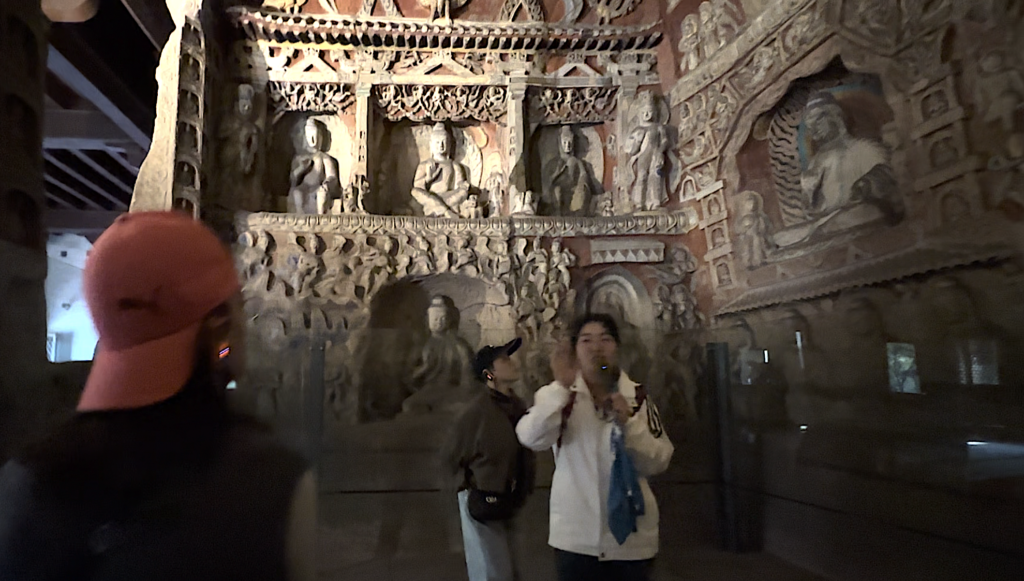
📸 Photograph the Details — If Photography Is Permitted
The giant Buddhas naturally dominate
But some of the best historical clues can be smaller:
飞天 — fēitiān
flying celestial figures
伎乐 — jìyuè
musicians and performers
lotus patterns
clothing
halos
architectural motifs
tiny Buddha niches.
And, apparently:
Dad’s postage stamp.
😂
That one stays.
⚠️ Check Current Cave Access Before You Go
This is important at ancient cave sites.
Individual grottoes may occasionally have:
temporary closures,
conservation restrictions,
maintenance work
or changes to visitor circulation.
So if there is a particular cave or Buddha you especially want to see:
check current access shortly before visiting.
The monument has survived roughly 1,500 years.
Conservation comes before Dad’s photograph.
😂
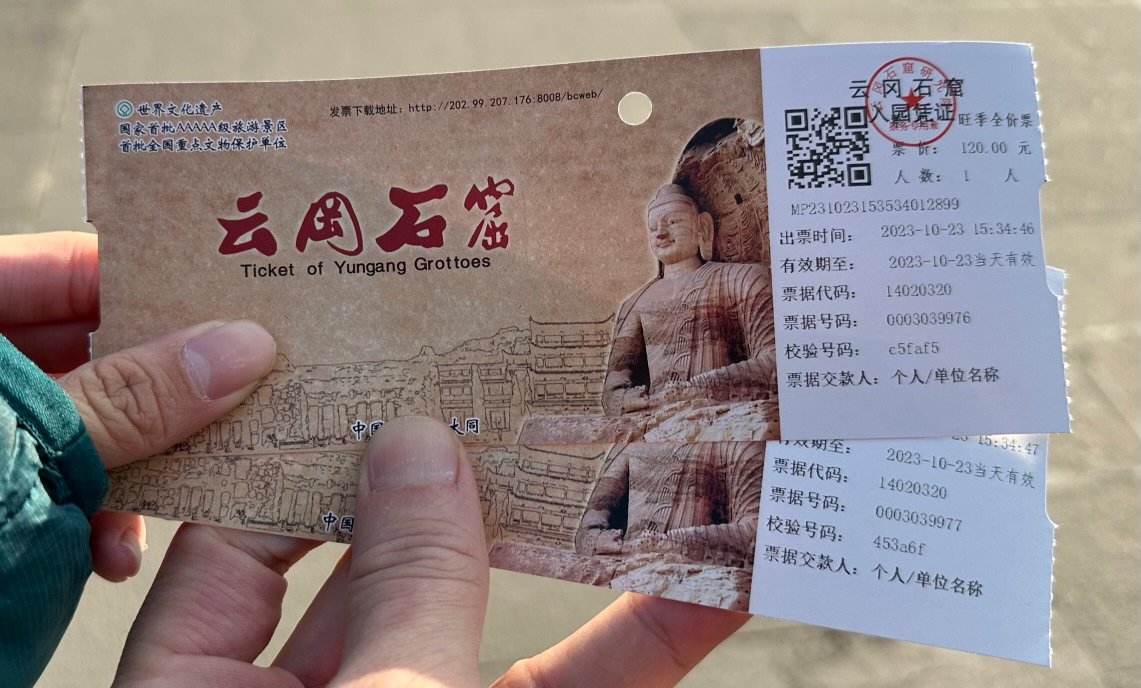
🎫 Tickets and Opening Hours
Ticket prices, opening hours and reservation procedures can change by season and visitor policy.
Before traveling, check current information for:
云冈石窟景区
rather than relying on an old screenshot or travel blog.
If you’re traveling during:
中国法定节假日
Chinese public holidays
or peak summer periods, advance planning becomes more important.
And give yourself time.
Yungang isn’t somewhere we’d want to visit while constantly checking:
“Can we still catch the 15:07 train?”
😭
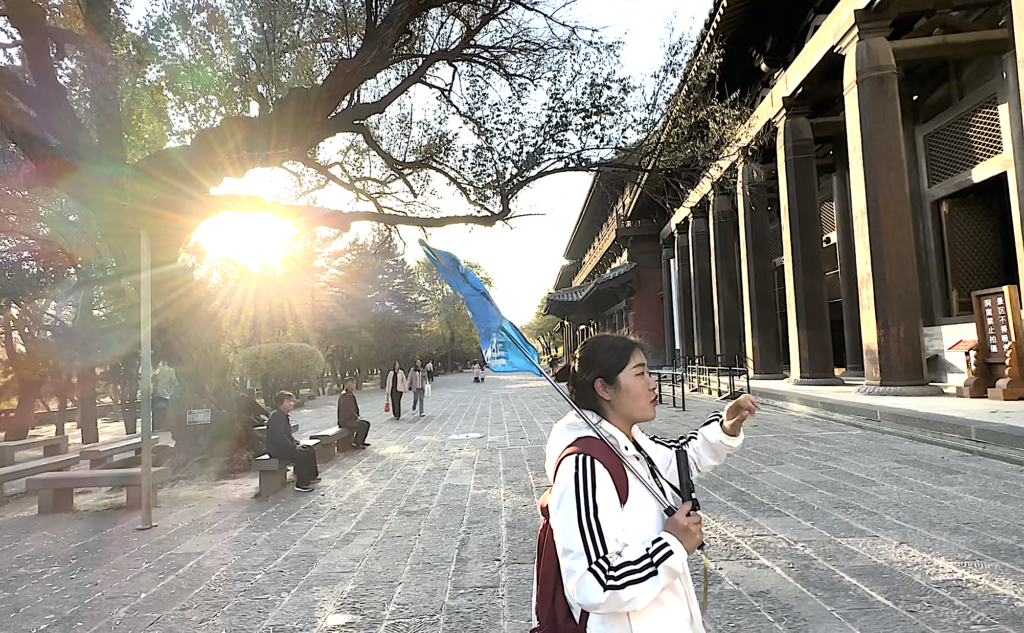
🌦️ Remember: Part of the Experience Is Outdoors
The grottoes extend along the cliff face.
You’ll be walking outside between cave areas.
So check:
天气 — tiānqì
weather
and prepare for:
heat,
cold,
wind
or strong sun depending on the season.
Northern Shanxi can feel very different from Xi’an or southern China.
Comfortable shoes help.
Water helps.
And Dad’s historical lecture does not provide shade.
😂
🐇 Now the Important Question: What Else Should You Combine With Yungang?
This is where northern Shanxi becomes exceptionally attractive.
You have:
云冈石窟 — Yungang
↓
大同 — Datong
↓
悬空寺 — Hanging Temple
↓
应县木塔 — Yingxian Wooden Pagoda
And historically these places begin talking to each other.
🔥
But we need to be careful.
They’re not all from the same dynasty.
Yungang Gives Us 北魏
云冈
↓
北魏 — Northern Wei
↓
鲜卑 — Xianbei
↓
Buddhism
↓
fifth century.
Then:
悬空寺 — Xuánkōng Sì
Hanging Temple
takes us into another extraordinary northern-Shanxi religious and architectural landscape, with its origins traditionally associated with the Northern Wei period and substantial later rebuilding.
Then:
应县木塔 — Yìngxiàn Mùtǎ
Yingxian Wooden Pagoda
jumps us forward to:
辽 — Liáo
Liao Dynasty
and:
契丹 — Qìdān
Khitan
😳
Same broader journey.
Different northern ruling peoples.
Different centuries.
🌶️ This Is the Northern Shanxi Story Getting Bigger
Remember what Yanmenguan taught us?
雁门关
Agrarian world
↔
northern pastoral/mobile world.
Frontier.
Defense.
Exchange.
Then:
YUNGANG
Xianbei rulers establish Northern Wei.
↓
Then:
YINGXIAN
Khitan rulers establish Liao.
🔥🔥🔥
Now the reader begins seeing a much more sophisticated picture of northern Chinese history.
The frontier isn’t simply:
“Chinese dynasties defend themselves against people outside.”
Sometimes those northern peoples:
become rulers.
They establish states.
Build capitals.
Patronize religions.
Construct monuments.
Govern Chinese populations.
Adopt institutions.
Create new cultural combinations.
And eventually become part of:
中国历史 — Zhōngguó lìshǐ
Chinese history itself.
That’s the deeper northern-Shanxi rabbit hole.
A Comfortable 3-Day Datong Plan
If Yungang is your main reason for coming, I’d suggest something like:
Day 1 — Arrive in Datong
🚄 Beijing or Taiyuan → Datong
↓
Check in.
↓
Explore:
大同古城 — Dàtóng Gǔchéng
Datong Ancient City
Perhaps:
华严寺
善化寺
or:
九龙壁
depending on your interests.
↓
Datong overnight.
Day 2 — Yungang
Morning:
云冈石窟
Allow half a day.
↓
Return to Datong.
↓
Slow afternoon/evening.
Let:
Xianbei + Northern Wei + Buddhism
settle.
😂
No additional dynasty required.
Day 3 — Choose Your Architectural Rabbit Hole
Consider a day trip toward:
悬空寺 — Hanging Temple
and:
应县木塔 — Yingxian Wooden Pagoda
depending on transport, current access and how much you want to fit into one day.
For a family or small group:
包车 — bāochē
private car with driver
can make this much easier.
These sites aren’t sitting beside one another on a metro line.
😂
Or Make Datong the End of a Shanxi Journey
This is the route I particularly like:
TAIYUAN 太原
Shanxi Museum
Jinci
↓
PINGYAO 平遥
晋商
票号
↓
back north
↓
YANMENGUAN 雁门关
Great Wall
northern frontier
↓
YINGXIAN 应县
Wooden Pagoda
Liao / Khitan
↓
HUNYUAN 浑源
Hanging Temple
↓
DATONG 大同
Yungang
Northern Wei / Xianbei
↓
BEIJING 北京
🔥🔥🔥
Now look at what the journey has done.
It hasn’t merely taken you through Shanxi.
It has taken you through:
Zhou-related history
↓
Ming-Qing commercial China
↓
frontier history
↓
Liao
↓
Northern Wei
↓
Buddhist cultural exchange.
That’s Deep China.
Or Do It in Reverse From Beijing
Equally good:
BEIJING
↓
DATONG
Yungang
↓
HANGING TEMPLE
↓
YINGXIAN
↓
YANMENGUAN
↓
TAIYUAN
↓
PINGYAO
↓
perhaps:
LINFEN / TAOSI
and eventually even:
XI’AN.
😳
Now Beijing → Xi’an isn’t merely a train journey.
You’ve turned northern China into a historical corridor.
Who Should Visit Yungang?
I’d strongly recommend Yungang if:
- you’re spending time in Datong;
- Buddhist art interests you;
- you’ve visited Longmen Grottoes and want to understand the Northern Wei connection;
- you’ve read our Yanmenguan article and want to follow the northern-frontier story further;
- you want to understand the Xianbei and Northern Wei;
- Silk Road and trans-Asian cultural exchange interest you;
- or you simply want to see one of China’s great UNESCO Buddhist monuments.
And unlike some Deep China rabbit holes…
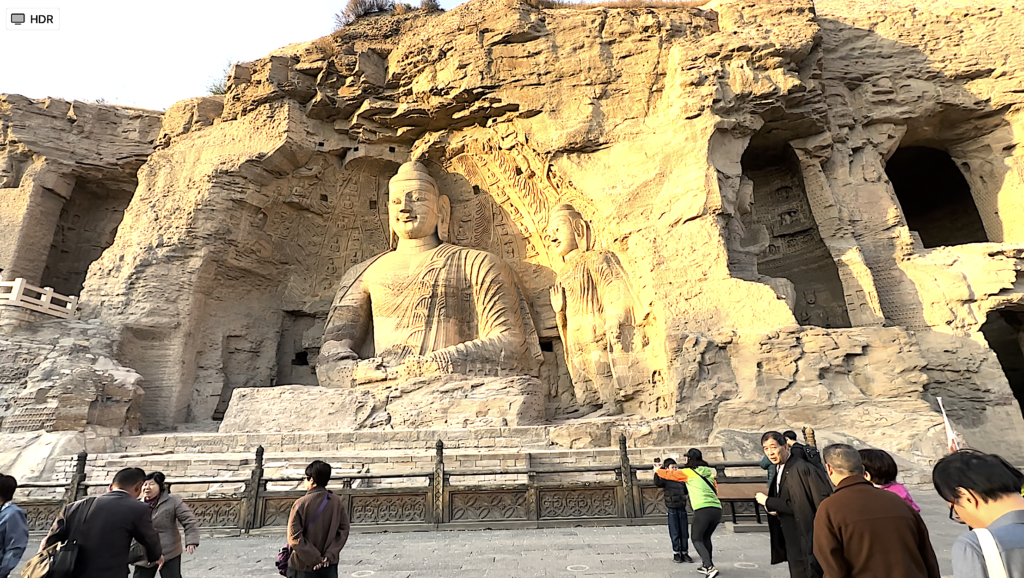
Yungang is visually spectacular even if you know absolutely nothing beforehand.
That’s important.
The history adds depth.
The Buddhas already provide the wow.
🐞 Final Sting Check
You came to Yungang thinking:
“Ancient Buddhist caves near Datong.”
Now you’ve acquired:
鲜卑
↓
拓跋
↓
北魏
↓
平城 / 大同
↓
佛教
↓
India → Central Asia → China
↓
昙曜五窟
↓
imperial patronage
↓
洛阳
↓
龙门石窟
And Yanmenguan’s frontier story has changed too.
The people beyond yesterday’s frontier can become tomorrow’s rulers.
🔥
That’s a very different way of understanding Chinese history.
ChinaTravelBUG’s Take
Yungang is one of those rare Deep China destinations that works perfectly at two levels.
At the simplest level:
Go because it’s spectacular.
Huge Buddhas.
Thousands of carvings.
A UNESCO World Heritage Site.
An extraordinary cliff filled with Buddhist art.
That’s enough.
But if you add one historical key:
北魏 — Northern Wei
the whole site changes.
Now you see:
Xianbei rulers,
Buddhism arriving through wider Asian networks,
imperial patronage,
changing artistic traditions
and a society transforming itself.
Then connect Yungang backward to:
雁门关
and forward toward:
洛阳 / 龙门石窟
and suddenly one cave complex becomes part of a much larger story about:
how China itself kept changing.
Same stone.
More context.
Completely different experience.
🐇🐞
See China. Understand It Better.