Section 1 — One Hangs From a Cliff. The Other Has Stood in Wood for Nearly 1,000 Years.
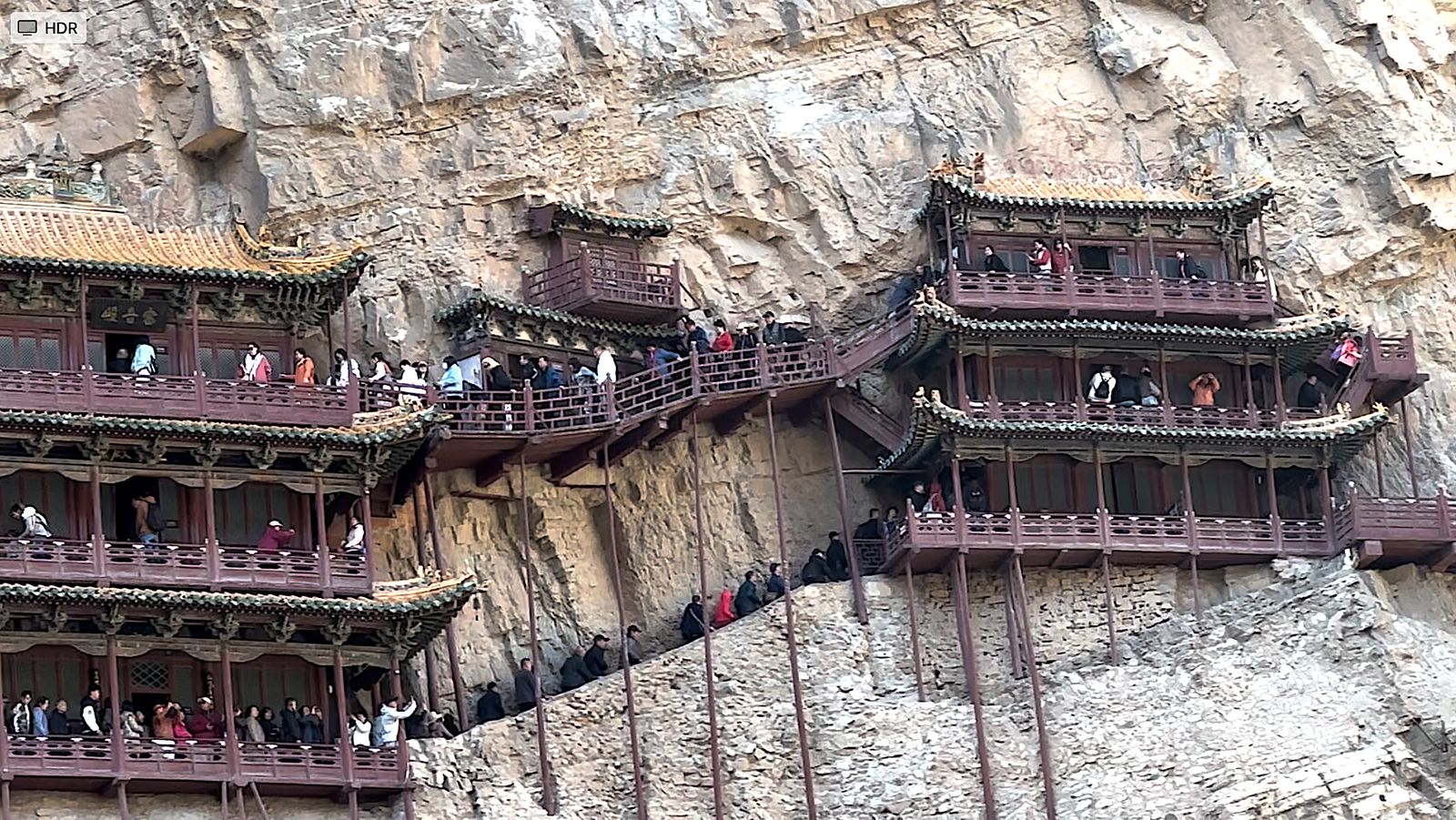
After Yungang Grottoes introduced Elaine and me to the Northern Wei and the Xianbei world of northern China, we continued through northern Shanxi and encountered two buildings that almost seem determined to defy common sense: the Hanging Temple (悬空寺), clinging to a cliff near Mount Heng, and the Yingxian Wooden Pagoda (应县木塔), a towering timber structure built during the Liao dynasty.
At first glance, these two places have an obvious connection:
“How on earth is that still standing?”
😂
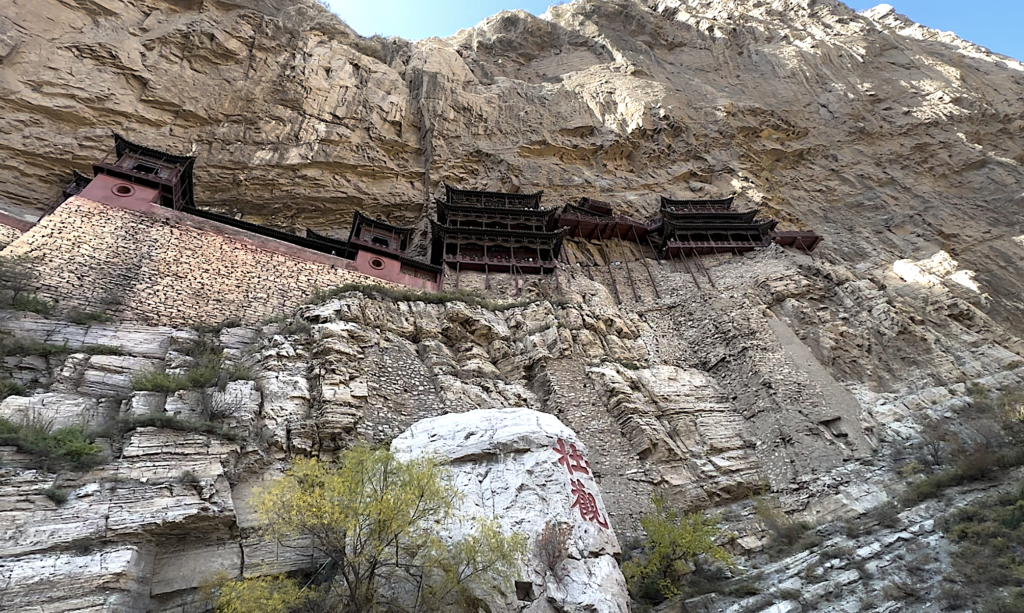
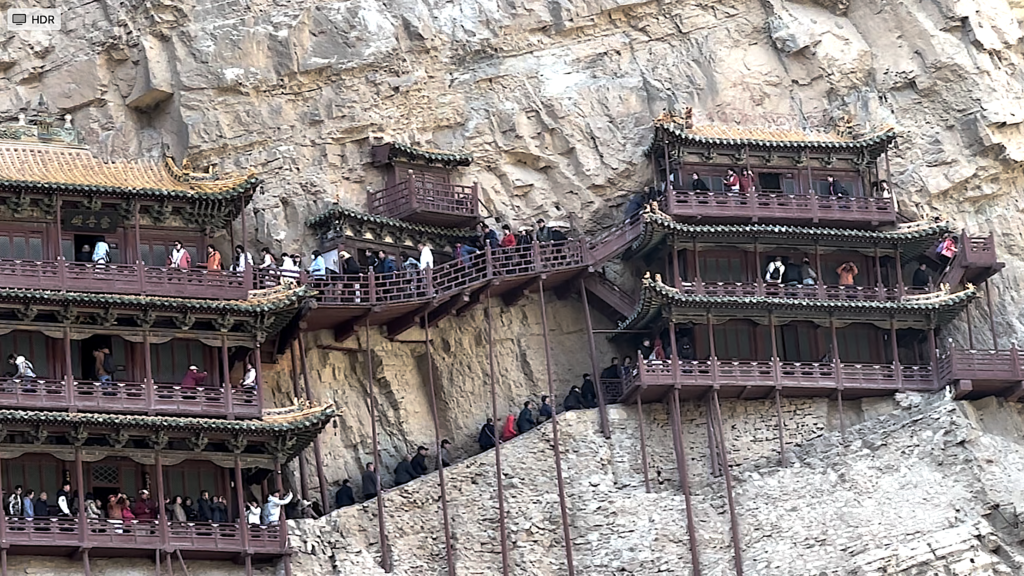
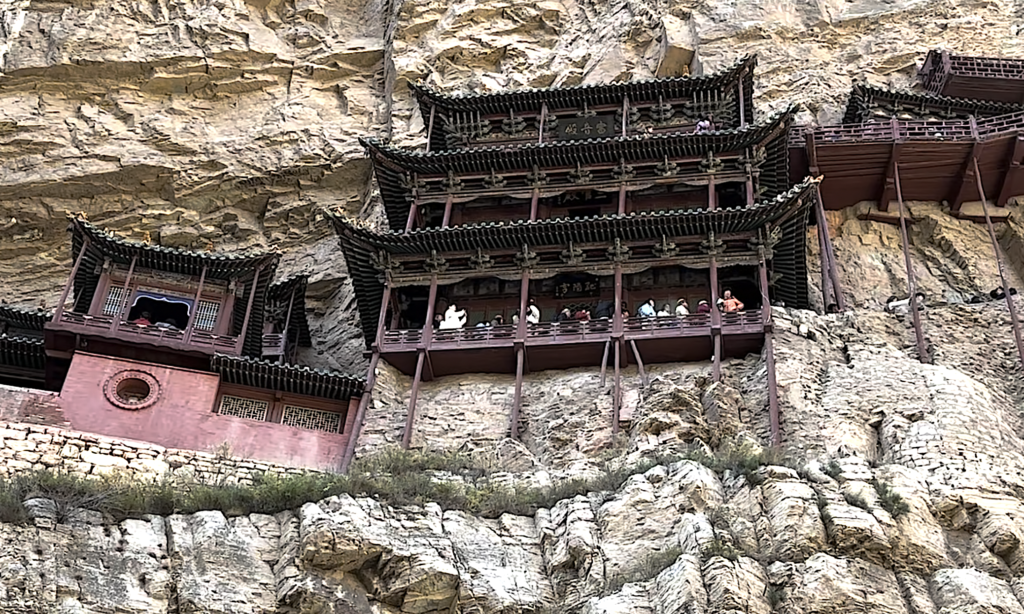
Hanging Temple (悬空寺, Xuánkōng Sì), built into the cliffs near Mount Heng (恒山) in Hunyuan, northern Shanxi. The site’s origins are traditionally associated with the Northern Wei era, although the structures seen today reflect centuries of rebuilding and restoration. Photo by Dad.
One appears attached to the side of a mountain.
The other is a giant wooden tower approaching a thousand years old.
Both are in northern:
山西 — Shānxī
Shanxi
And both are extraordinary.
But historically?
They don’t belong to the same moment at all.
That’s where our timeline needs to come out immediately.
🕰️ Where Are We in Chinese History?
Keep this coat rack beside you:
HAN — 汉
206 BCE–220 CE
↓
THREE KINGDOMS — 三国
220–280 CE
↓
PERIOD OF DIVISION
Different regimes rule northern and southern China.
↓
NORTHERN WEI — 北魏
386–534 CE
📍 鲜卑 — Xiānbēi
📍 拓跋 — Tuòbá ruling house
📍 平城 — Píngchéng, around modern Datong
📍 云冈石窟 — Yungang Grottoes
↓
Traditional origins of the Hanging Temple are associated with this broader period
悬空寺 — Xuánkōng Sì
Hanging Temple
↓
SUI — 隋
581–618
↓
TANG — 唐
618–907
↓
LIAO — 辽
907–1125
📍 契丹 — Qìdān / Khitan
应县木塔 — Yìngxiàn Mùtǎ
built in 1056
↓
SONG — 宋
960–1279
⚠️ Notice something important: Song and Liao overlap.
↓
JIN — 金
1115–1234
↓
YUAN — 元
1271–1368
↓
MING — 明
1368–1644
↓
QING — 清
1644–1912
↓
TODAY
Dad and Elaine arrive.
😂
That timeline already gives us two important historical keys.
🔑 Historical Key #1 — The Hanging Temple Is Not Simply a Northern Wei Building Frozen in Time
The origins of:
悬空寺 — Xuánkōng Sì
Hanging Temple
are traditionally traced to the:
北魏 — Northern Wei
period.
But be careful.
The buildings visitors see today reflect:
centuries of rebuilding, repair and restoration.
So don’t stand underneath the temple thinking:
“Everything I’m looking at has been hanging exactly like this since the fifth century.”
😂
That’s not how historical architecture usually works.
We’ve encountered this lesson before at:
晋祠 — Jìncí
The historical association of a site can be extremely old…
while the structures physically standing there may belong to later periods.
The trick is:
separate the layers first.
Then:
connect them.
🔥
🔑 Historical Key #2 — Liao 辽 and Song 宋 Existed at the SAME TIME
This one is particularly important for international beginners.
You may have learned the Chinese dynasty sequence as:
Tang → Song → Yuan
Useful.
But incomplete.
😂
Look again:
辽 — Liao
907–1125
and:
宋 — Song
960–1279
They:
OVERLAP.
😳
For more than 160 years.
So when Yingxian Wooden Pagoda was built in:
1056
there absolutely was a Song dynasty.
But Yingxian wasn’t ruled by Song.
It belonged to:
辽朝 — Liáo Cháo
the Liao dynasty
ruled by:
契丹 — Qìdān
the Khitan.
🔥
That’s another major upgrade to our Chinese-history coat rack.

🍚 Western Handrail: “China” Wasn’t Always One Political State
Western readers are perfectly comfortable with medieval Europe containing:
England,
France,
the Byzantine Empire,
the Holy Roman Empire
and many other political entities at the same time.
Nobody expects one government to control everything called:
Europe.
That’s a useful handrail here.
At many points in Chinese history, multiple powerful states existed simultaneously across territories we now associate with China and its surrounding regions.
Different rulers.
Different capitals.
Different peoples.
Different political traditions.
And yet all became part of the historical story through which we understand China today.
Northern Shanxi is a particularly good place to see this.
First Stop: 悬空寺 — The Hanging Temple
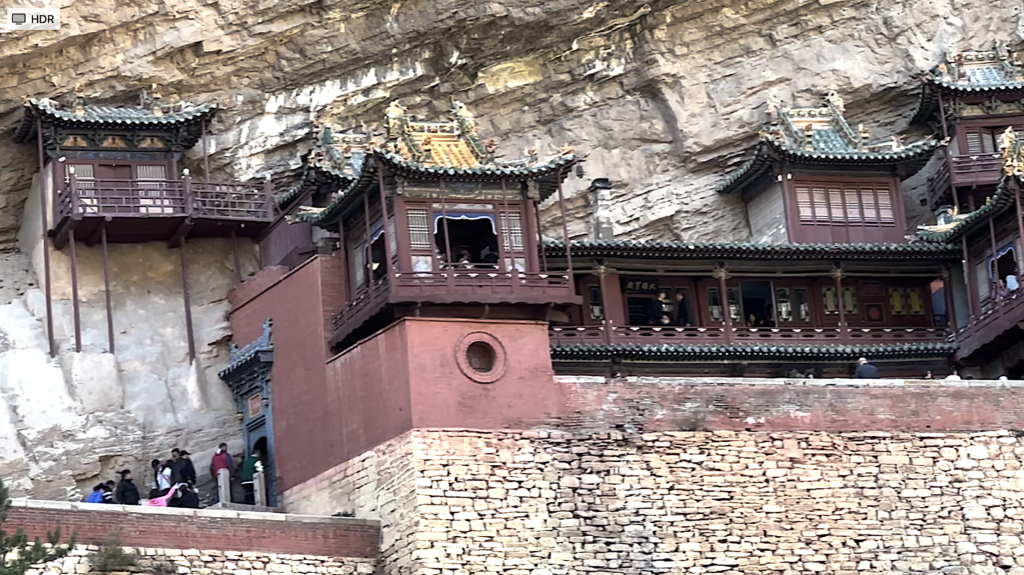
Elaine and I visited:
悬空寺 — Xuánkōng Sì
Hanging Temple
near:
恒山 — Héng Shān
Mount Heng
in:
浑源 — Húnyuán
Hunyuan County
And your first reaction requires absolutely no Chinese history.
You look up.
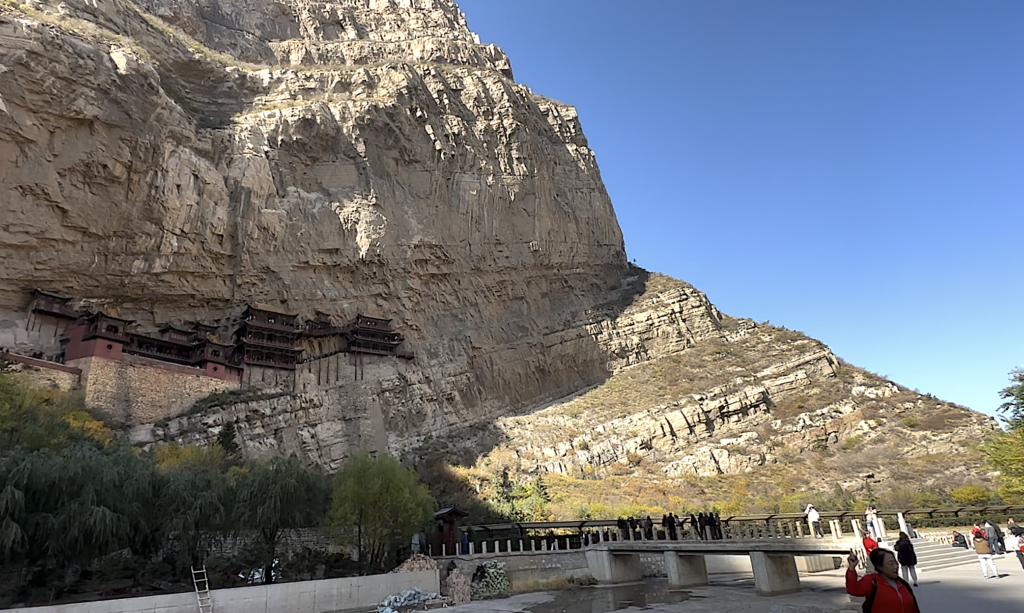
Looking up at the elevated halls and narrow walkways of Hanging Temple (悬空寺). You don’t need much historical background to understand why our first question was: “Who decided to build a temple THERE?” Photo by Dad. 😂
Then:
“WHO decided to build a temple THERE?”
😂
The buildings appear to cling to the cliff.
Wooden halls.
Narrow walkways.
Columns.
Rock.
And a rather noticeable amount of:
nothing underneath you.
😬😂
For anybody uncomfortable with heights…
Dad apologizes in advance.
Why Build a Temple on a Cliff?
Now the rabbit appears.
🐇
The unusual location gives the temple:
dramatic isolation,
shelter from parts of the surrounding mountain environment,
and:
a powerful relationship with the sacred landscape.
Mountain environments have long carried religious significance in China.
But Hanging Temple becomes particularly interesting because its later religious-cultural landscape is associated not only with:
佛教 — Fójiào
Buddhism
but also:
道教 — Dàojiào
Daoism
and:
儒家 — Rújiā
Confucian tradition.
😳
Three major traditions.
One cliff.
🐇 Buddha + Laozi + Confucius?
Yes.
The Hanging Temple is famous for bringing together figures associated with:
释迦牟尼 — Shìjiāmóuní
Shakyamuni Buddha
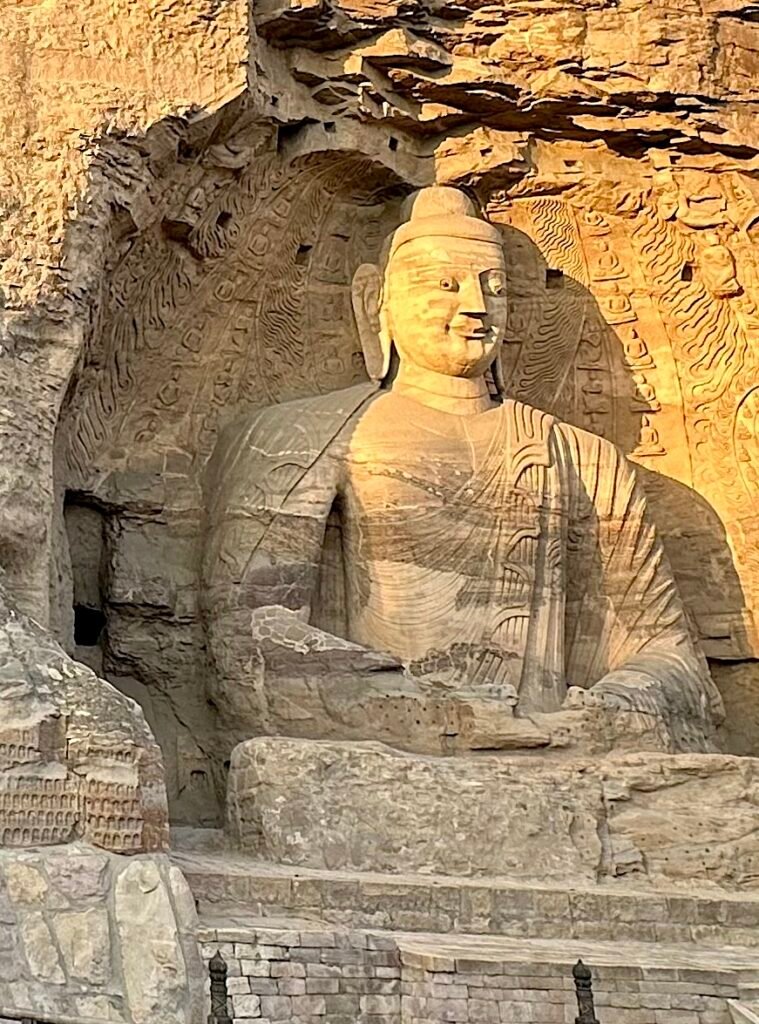
Dad took this photo at Yungang Grottoes 云冈石窟, Shanxi 山西 Province.
老子 — Lǎozǐ
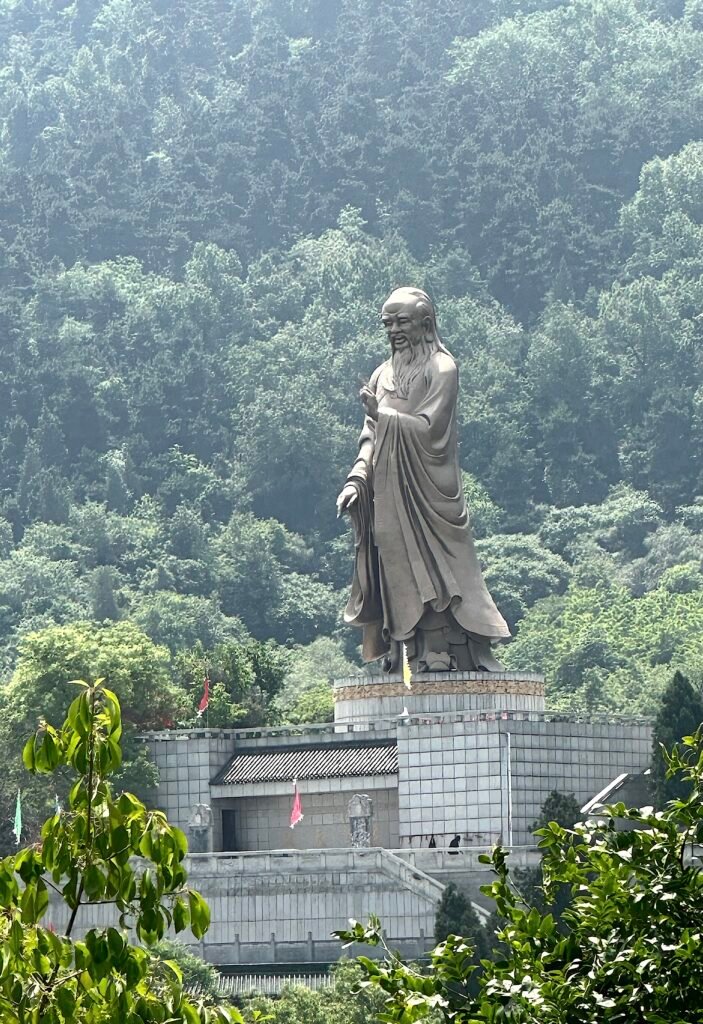
Photo taken by Dad at Zhongnan Mountain 终南山 in Shaanxi 陕西 Province.
and:
孔子 — Kǒngzǐ
Confucius
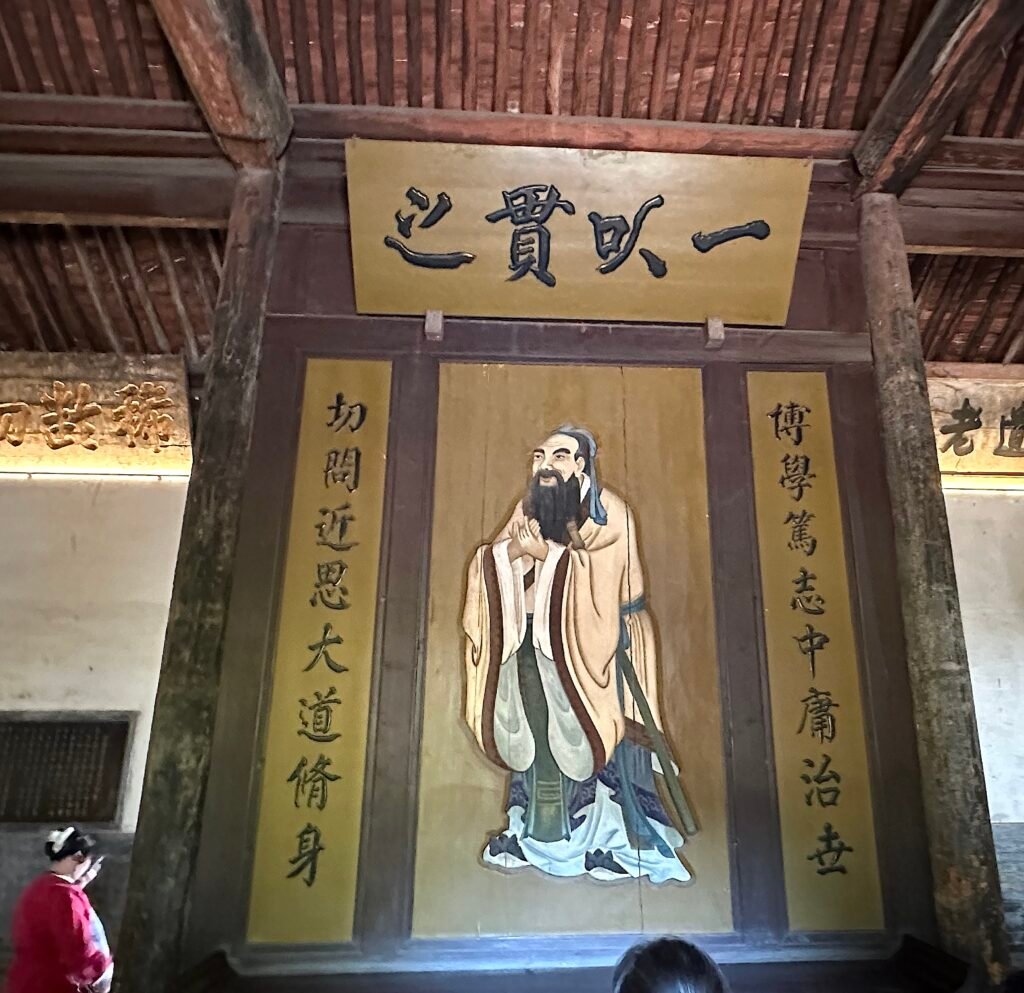
Photo taken by Dad at Pingyao‘s Temple of Confucius, in Shanxi 山西 Province.
within its religious-cultural setting.
Don’t imagine:
“Buddhism, Daoism and Confucianism held a meeting and agreed to share a temple.”
😂
The site’s religious identity developed over centuries.
But the coexistence of these traditions gives international travelers a useful doorway into something important about Chinese cultural history:
religious and philosophical traditions did not always exist inside completely separate boxes.
They could:
coexist,
overlap,
borrow,
adapt
and occupy the same cultural landscape.
🔥
🍚 Don’t Force Chinese Religion Into Western Boxes
A Western visitor may naturally ask:
“So is Hanging Temple Buddhist, Daoist or Confucian?”
It’s a reasonable question.
But Chinese religious history doesn’t always fit neatly into categories that resemble modern Western religious denominations.
Chinese communities could engage with:
Buddhist practices,
Daoist traditions,
Confucian ethical ideas,
ancestor rituals
and:
local religious customs
without necessarily experiencing those things as mutually exclusive in the way an outsider might expect.
The Hanging Temple makes that complexity wonderfully visible.
🐇 And Laozi Has Followed Us From Zhongnan Shan
Remember our journey around:
终南山 — Zhōngnán Shān
and:
楼观台 — Lóuguāntái
where we followed traditions associated with:
老子
and:
《道德经》 — Dàodéjīng?
Now Laozi has reappeared…
on a cliff in Shanxi.
😂
And:
孔子 — Confucius
has followed us from:
曲阜 — Qūfù
too.
That’s another lesson.
Historical people don’t remain trapped in:
“their hometown attraction.”
Their ideas and cultural afterlives travel.
🌶️ Then We Continue to Yingxian — and Change Dynasty Completely
After the Hanging Temple, another extraordinary northern-Shanxi monument waits at:
应县 — Yìngxiàn
Ying County
It is formally called:
佛宫寺释迦塔 — Fógōng Sì Shìjiā Tǎ
Sakyamuni Pagoda of Fogong Temple
But almost everyone simply calls it:
应县木塔 — Yìngxiàn Mùtǎ
Yingxian Wooden Pagoda
And once you see it…
you understand why.
😂
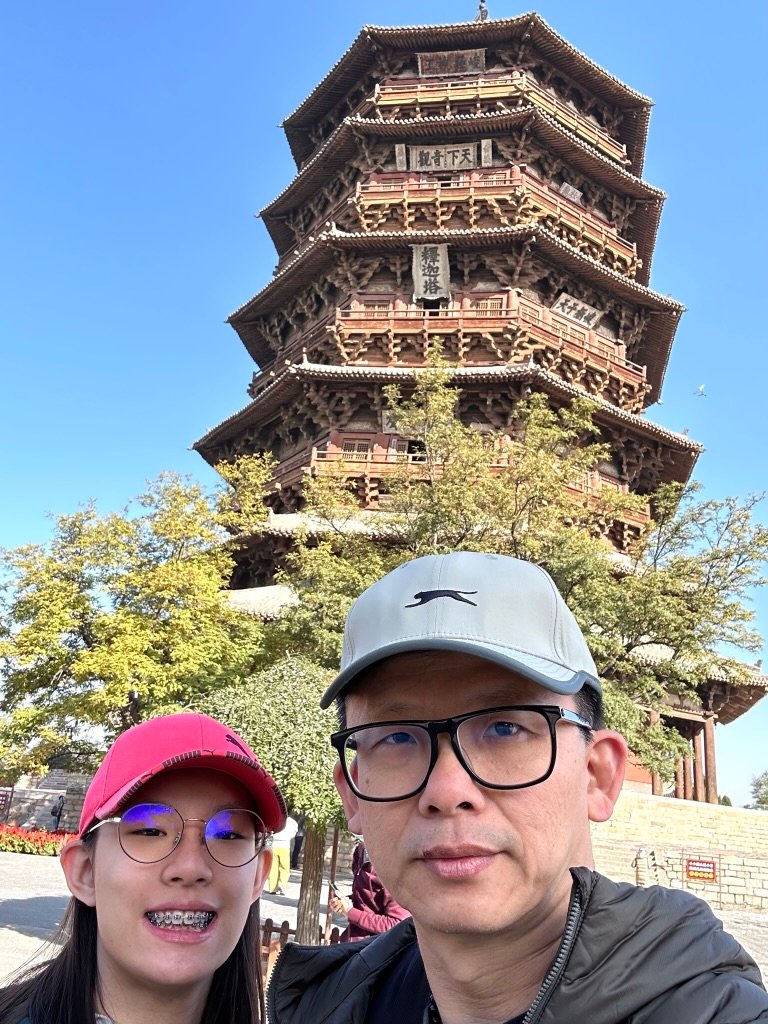
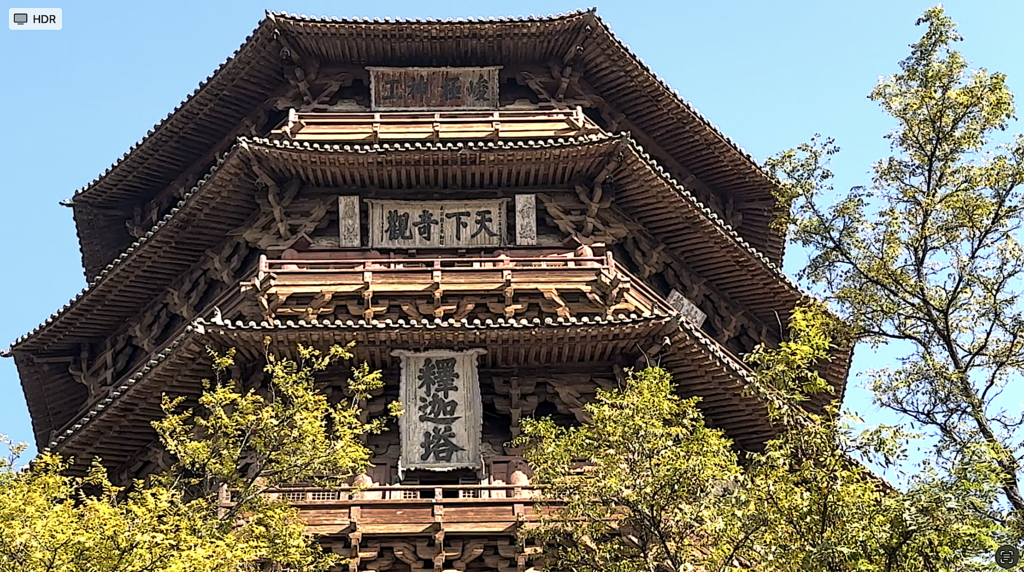
Wood.
Lots of wood.
Rising roughly:
67 meters
into the sky.
Built in:
1056 CE.
😳
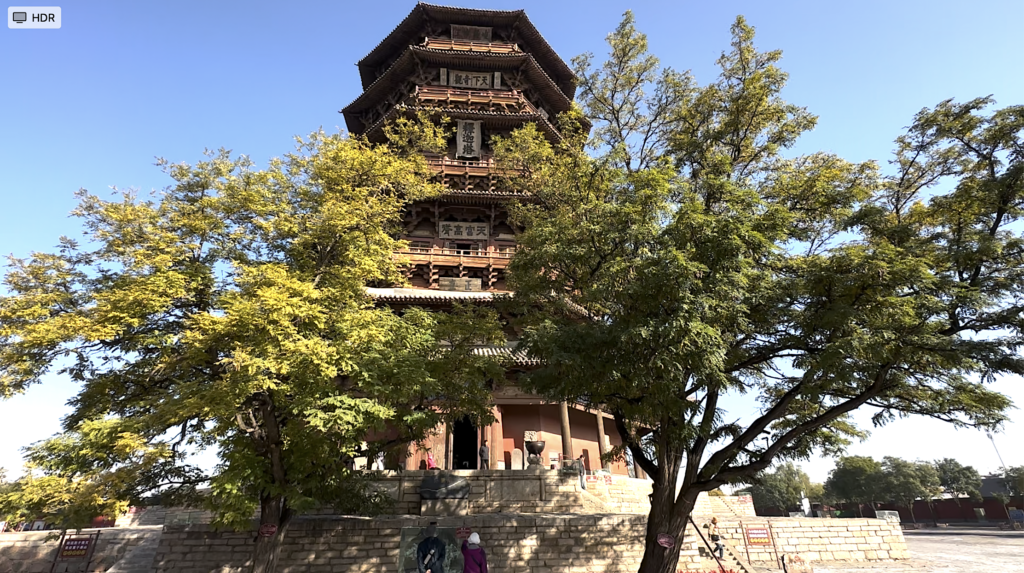
Yingxian Wooden Pagoda (应县木塔, Yìngxiàn Mùtǎ), built in 1056 during the Liao dynasty (辽朝) under Khitan (契丹) rule. Nearly a thousand years later, this extraordinary timber structure is still standing. Photo by Dad.
Nearly 1,000 Years Old — and Still Standing
Stop there for a moment.
1056.
Think about what this building has lived through.
Different dynasties.
Political upheaval.
Wars.
Earthquakes.
Weather.
Centuries of repair and conservation.
And the great timber structure is still standing.
🔥
You don’t need Dad to explain:
辽朝政治史
before appreciating that.
😂
The architecture supplies its own:
WOW.
Then history gives us the:
WHY.
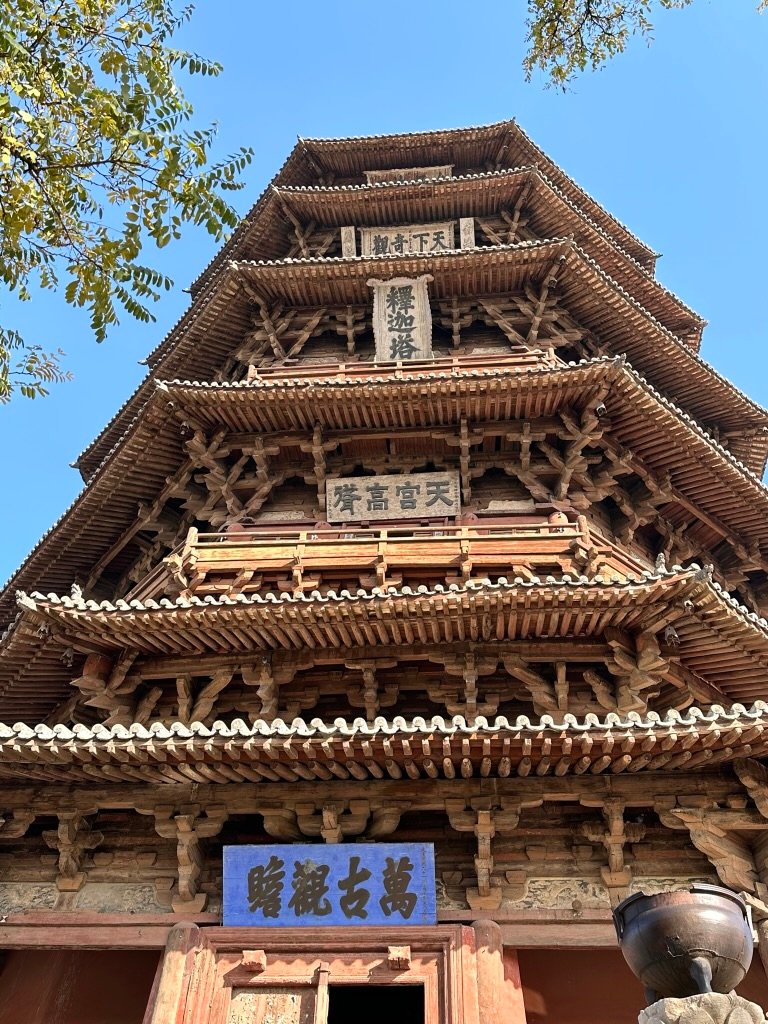
🔨 “Built Without Nails”?
This is one of those phrases travelers frequently hear about traditional Chinese architecture:
“No nails!”
Very catchy.
Needs qualification.
😂
Traditional Chinese timber architecture relies heavily on sophisticated systems of:
榫卯 — sǔnmǎo
mortise-and-tenon joinery
and:
斗拱 — dǒugǒng
interlocking bracket sets
rather than relying on modern-style metal fasteners as the primary structural principle.
🐞 Photo Note: No Nails!
Dad had already photographed 斗拱 (dǒugǒng) at Jinci晋祠‘s Hall of the Holy Mother (圣母殿).
These ingenious interlocking wooden brackets fit together without nails, transferring the heavy roof load through the timber frame.
🔥 At Yingxian Wooden Pagoda, this ancient engineering principle is taken to an extraordinary scale.
Photo by Dad at Jinci 晋祠, Shanxi 山西 Province.
So the impressive thing isn’t:
“Ancient Chinese builders hated nails.”
😂
It’s:
They developed an extraordinarily sophisticated structural system based on interlocking timber components.
Much better.
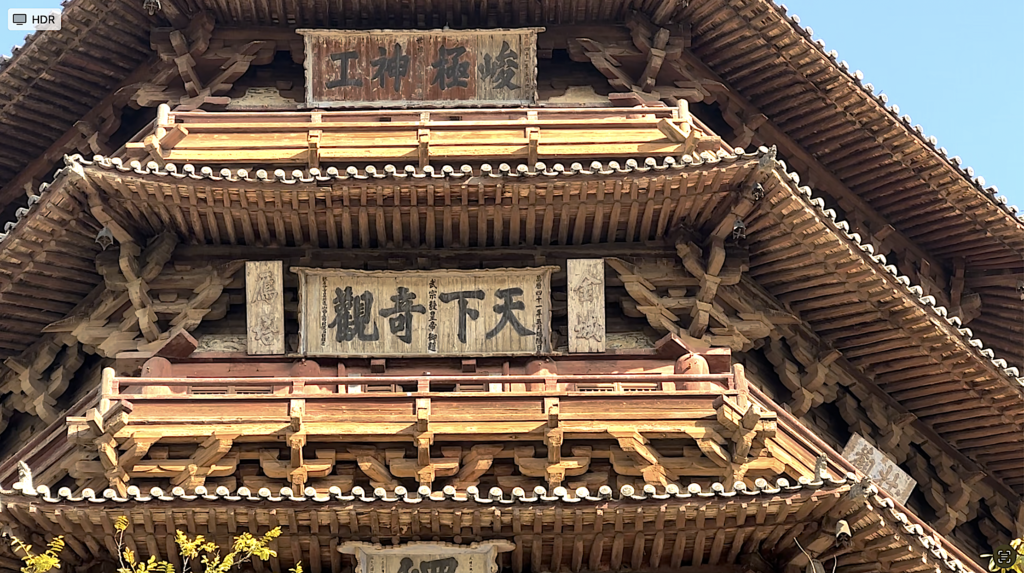
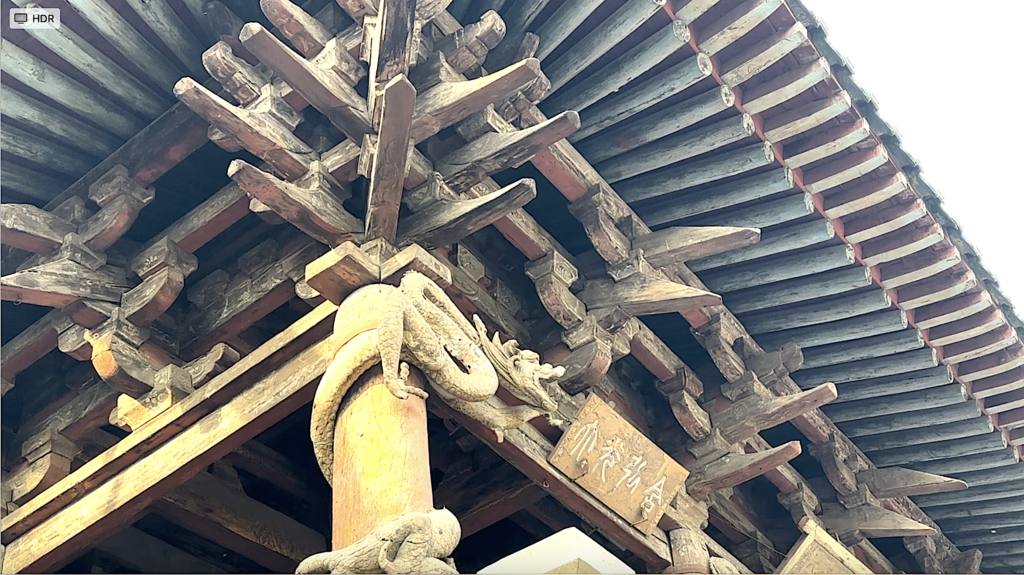
Look beneath the roof: the interlocking bracket sets are called 斗拱 (dǒugǒng), one of the key structural features of traditional Chinese timber architecture. Photo by Dad at Yingxian Wooden Pagoda.
🔑 Remember 斗拱 — Dougong
If you’re traveling around historical China, this is one Chinese architectural term worth keeping:
斗拱 — dǒugǒng
Look underneath the roofs of traditional buildings.
You’ll begin noticing elaborate bracket systems between:
columns,
beams
and:
roof structures.
They help distribute structural loads.
They can also be extraordinarily beautiful.
At Yingxian Wooden Pagoda:
斗拱
isn’t simply decoration.
It is part of the engineering story.
🔥
🐞 Photo Note: The Secret INSIDE the Wooden Pagoda
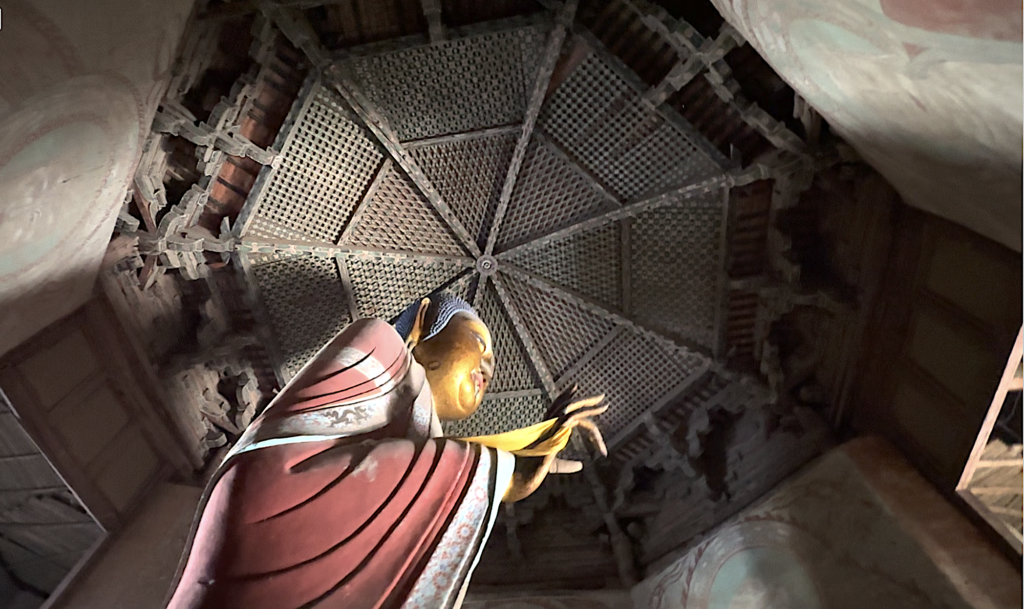
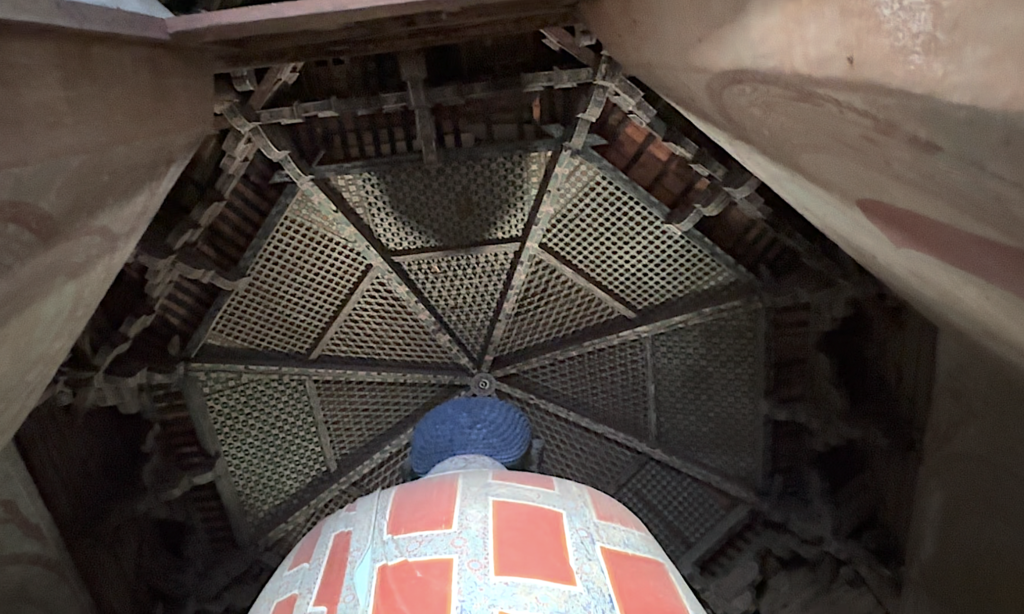
Everyone comes to Yingxian Wooden Pagoda (应县木塔) to see the extraordinary wooden architecture.
Dad did too.
Then we walked inside and looked up.
Whoa.
At the center of the first floor sits an enormous 11-meter-high painted and gilded clay statue of Shakyamuni Buddha (释迦牟尼佛), seated on a 2.13-meter-high triple lotus/Sumeru pedestal. The figure is richly painted and gilded, with a golden face and body, blue curled hair and remarkably detailed robes.
And look above the Buddha in Dad’s photograph.
That extraordinary geometric ceiling is the 藻井 (zǎojǐng) — an elaborate coffered ceiling rising above the sacred image. Around the central chamber are monumental painted Buddhas; together with the central Shakyamuni, they form a Seven Buddhas (过去七佛) scheme. Some of the surrounding painted figures reach about 8 meters high.
This matters even more today because ordinary visitors are no longer permitted to climb the upper floors for conservation reasons. Visitors can enter and experience the first level — which means the giant Buddha isn’t a consolation prize for not climbing.
It is one of the great reasons to go inside.
And perhaps that’s Yingxian’s best-kept secret.
From outside, you think:
“How did they build this enormous wooden tower without nails?”
Then you step inside, look upward between the giant Buddha and the ancient timber structure, and realize:
“Wait… there’s an 11-meter Buddha in here too?!” 😂
The building gets all the fame.
The Buddha deserves some of it.
Photo by Dad inside Yingxian Wooden Pagoda, Shanxi Province
🍚 Western Handrail: A Medieval Timber High-Rise
Not literally a modern skyscraper.
😂
But as a handrail:
imagine standing before a multi-story wooden tower constructed in:
1056
that has survived for nearly a millennium.
No reinforced concrete frame.
No steel skyscraper skeleton.
Instead:
timber engineering.
That alone makes Yingxian one of the most extraordinary architectural stops in northern China.
But Dad Will Explain the Dynasty Anyway 😂
Because:
1056
puts us inside:
辽 — Liáo
Liao Dynasty
And now we meet:
契丹 — Qìdān
the Khitan
The Khitan established the Liao dynasty and ruled extensive territories across northern China and Inner Asia.
And once again…
our simple Great Wall picture breaks.
🌶️ Yanmenguan → Yungang → Yingxian
Look at the progression:
雁门关 — Yanmenguan
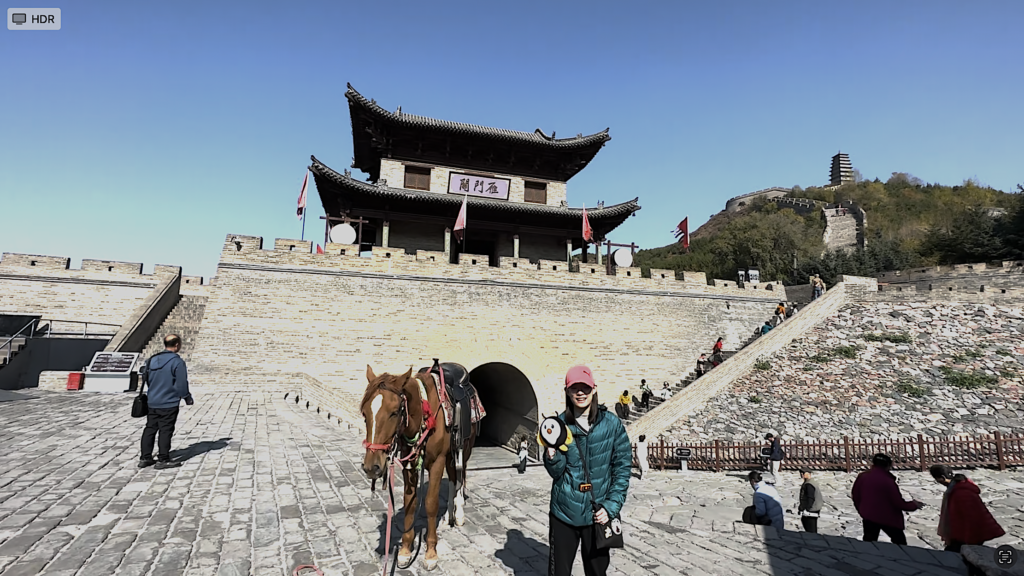
frontier.
Agrarian states.
Northern pastoral/mobile peoples.
↓
云冈石窟 — Yungang
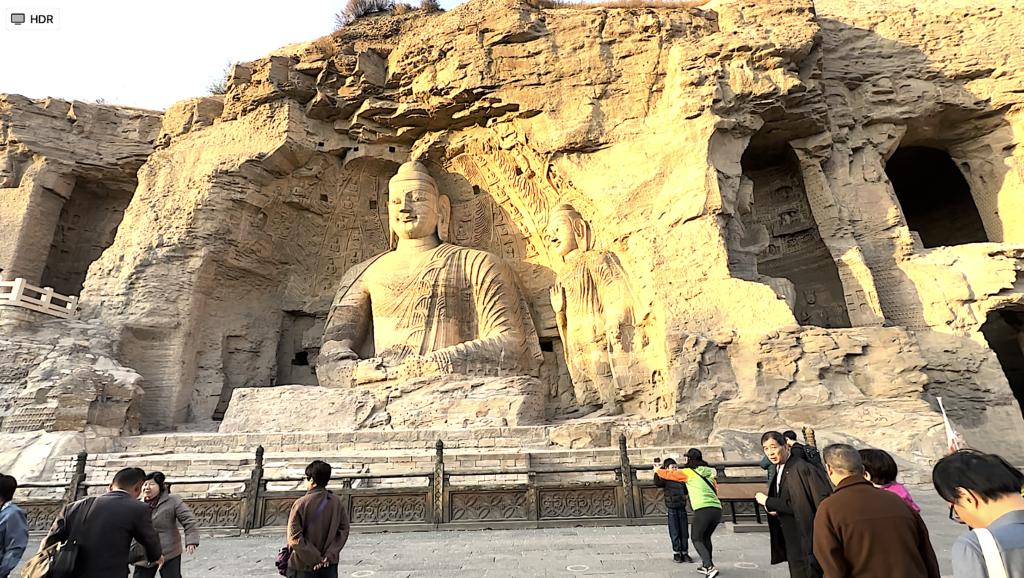
鲜卑 — Xianbei
↓
Xianbei rulers establish:
北魏 — Northern Wei
↓
应县木塔 — Yingxian Wooden Pagoda
契丹 — Khitan
↓
Khitan rulers establish:
辽 — Liao
🔥🔥🔥
The northern peoples aren’t remaining permanently:
“outside China.”
They become:
rulers,
state builders,
patrons of Buddhism,
builders of monuments
and part of the political-cultural history of northern China.
That is one of the biggest lessons in our Shanxi journey.
🐇 And Then “Khitan” Gives Western Readers a Surprise
The name:
契丹 — Khitan
traveled westward through Eurasian languages.
And from forms derived from:
Khitan
came the historical Western name:
Cathay.
😳
Yes.
CATHAY.
The old European geographical term associated particularly with northern China has linguistic roots connected with:
the Khitan.
Now suddenly:
应县木塔
↓
辽
↓
契丹
↓
CATHAY
🔥
Western readers have just entered the story.
🐇 Marco Polo’s World Isn’t Very Far Away Now
Medieval European travelers and geographical traditions encountered forms of:
Cathay
through long chains of Eurasian contact.
So a people many modern Western travelers have never heard of:
契丹
left a linguistic footprint that traveled thousands of kilometers.
That is a beautiful reminder:
medieval China was connected to a much larger Eurasian world.
And our wooden pagoda has somehow opened that door.
😂🐇
Buddhism Connects the Two Sites Too
Remember the formal name of Yingxian Wooden Pagoda:
释迦塔 — Shìjiā Tǎ
Sakyamuni Pagoda
It is a:
佛塔 — fótǎ
Buddhist pagoda.
Now look at our route again.
云冈
Buddhism under Northern Wei / Xianbei patronage.
↓
悬空寺
Buddhism alongside Daoist and Confucian traditions.
↓
应县木塔
Buddhist architecture under Liao / Khitan rule.
🔥
Buddhism has become one of the threads tying together different peoples and dynasties across northern Shanxi.
Remember where Buddhism originally came from?
古印度 — ancient India.
Now centuries later, different northern dynasties are making it part of their own political and cultural worlds.
That’s a remarkable journey.
🕰️ Put the Two Buildings Together One More Time
Don’t remember:
“two old Shanxi buildings.”
Remember:
悬空寺 — HANGING TEMPLE
historical origins traditionally associated with the Northern Wei era
↓
centuries of rebuilding and development
↓
应县木塔 — YINGXIAN WOODEN PAGODA
LIAO DYNASTY
1056 CE
↓
KHITAN
↓
CATHAY
🔥
Geographically close.
Historically layered.
That’s why they make such a good Deep China pair.

🐞 Sting Check
You started this article thinking:
“One temple hangs from a cliff and one pagoda is really old.”
Now you’ve acquired:
悬空寺
↓
北魏
↓
Buddhism + Daoism + Confucian traditions
↓
应县木塔
↓
斗拱
↓
榫卯
↓
辽
↓
契丹
↓
Cathay
and:
Liao and Song existed at the same time.
😬
You came for architecture.
Now you’re asking:
“So who exactly were the Khitan, and why did Europeans end up calling China Cathay?”
There it is.
🐇
You’ve been stung by a wooden pagoda.
😂🐞
Why These Two Places Belong Together
The Hanging Temple and Yingxian Wooden Pagoda don’t belong together because:
they were built by the same dynasty.
They weren’t.
They belong together because they help international travelers see something much bigger about:
northern China.
Different peoples.
Different dynasties.
Different religious traditions.
Different architectural solutions.
All occupying the same broad historical landscape across different centuries.
And when we connect them with:
云冈石窟
and:
雁门关
northern Shanxi stops looking like a collection of spectacular attractions.
It starts becoming:
a journey through the changing frontier of Chinese civilization.
🔥
But to understand that properly while you’re actually there, we have one practical recommendation:
Don’t only hire a driver.
If your budget allows, find:
a knowledgeable local guide who is genuinely good in Shanxi history.
Because the buildings will give you the:
WOW.
A good guide can give you the:
WHY.
And that’s exactly where Section 2 begins:
Section 2 — How to Go: Datong → Hanging Temple → Yingxian Wooden Pagoda — and Why We Recommend a Private Historical Guide With Vehicle
After:
北魏 — Northern Wei
↓
悬空寺 — Hanging Temple
↓
佛教 + 道教 + 儒家
↓
辽 — Liao
↓
契丹 — Khitan
↓
应县木塔 — Yingxian Wooden Pagoda
↓
and somehow:
Cathay
😂
we finally arrive at the practical question:
Okay Dad. How do I actually visit these places?
For most international travelers, the logical base is:
大同 — Dàtóng
Datong
And for this particular journey, ChinaTravelBUG has a fairly clear recommendation:

Hire a private local tour guide with a vehicle — and make sure the guide is genuinely good in local Shanxi history.
Not simply:
a driver who takes you from Attraction A to Attraction B.
And not simply:
a guide who has memorized the standard attraction script.
😂
For this journey, good historical interpretation can make an enormous difference.
🚗 Why We Recommend a Private Tour Guide With Vehicle
The basic route is:
大同 — DATONG
↓
浑源 — HUNYUAN
悬空寺 — Hanging Temple
↓
应县 — YINGXIAN
应县木塔 — Wooden Pagoda
↓
return to:
大同
Geographically, this is manageable.
Historically?
You’re jumping between very different worlds.
At the Hanging Temple, questions can involve:
北魏 — Běi Wèi
Northern Wei
鲜卑 — Xiānbēi
Xianbei
佛教 — Fójiào
Buddhism
道教 — Dàojiào
Daoism
and:
儒家 — Rújiā
Confucian tradition.
Then you drive to Yingxian…
and suddenly you’re centuries later inside:
辽 — Liáo
Liao dynasty
契丹 — Qìdān
Khitan
and:
中国木构建筑 — Zhōngguó mùgòu jiànzhù
traditional Chinese timber architecture.
That’s a lot to extract from attraction signboards.
🔥
The Buildings Give You the WOW. A Good Guide Gives You the WHY.
At:
悬空寺
you don’t need a guide to tell you:
“This is unusual.”
😂
Your eyes have already worked that out.
But a good local historical guide can help you ask better questions:
Why was a religious complex developed on this cliff?
What parts of the site’s story go back toward Northern Wei, and what was rebuilt later?
Why do Buddhist, Daoist and Confucian traditions appear together?
How does this site fit into the wider history around Datong?
Then at:
应县木塔
the useful explanation isn’t merely:
“This pagoda was built in 1056.”
It’s:
“1056 puts us inside the Liao dynasty, ruled by the Khitan — while the Song dynasty existed farther south at the same time.”
💡
One sentence like that can completely reorganize an international traveler’s Chinese-history timeline.
🌶️ Look for a Guide Who Knows LOCAL History
This matters.
We recommend looking specifically for someone knowledgeable about:
山西历史 — Shānxī lìshǐ
Shanxi history
and preferably:
大同历史 — Dàtóng lìshǐ
Datong’s local history
rather than simply a general tour escort.
A good guide doesn’t need to bury you under:
dates,
emperors
and:
architectural terminology.
The best guide can explain:
WHERE are we?
↓
WHEN are we?
↓
WHO ruled here?
↓
WHY was this built?
↓
HOW does this connect with Yungang and the northern frontier?
🔥
That’s exactly the Deep China method.
🐇 Ask Your Guide Questions
Don’t simply follow the umbrella.
😂
Ask:
“Who were the Xianbei 鲜卑?”
“Who were the Khitan 契丹?”
“Was this area controlled by Song?”
“Why were Liao and Song existing at the same time?”
“What here is original and what was rebuilt later?”
“Why was Buddhism important to these northern rulers?”
“What should I notice in the 斗拱?”
“How does this connect with 云冈石窟?”
A genuinely knowledgeable guide should be able to turn those questions into:
stories
rather than lectures.
And if one answer produces another rabbit hole…
🐇
good.
📍 First Stop: Datong → Hanging Temple
From:
大同 — Dàtóng
head toward:
浑源县 — Húnyuán Xiàn
Hunyuan County
for:
悬空寺 — Xuánkōng Sì
Hanging Temple
near:
恒山 — Héng Shān
Mount Heng
Allow roughly:
1½–2 hours by road
as a planning guide, depending on your starting point, traffic and road conditions.
With a private guide and vehicle, you don’t need to worry about coordinating county buses or transfers.
And your guide can begin installing the historical context during the drive.
That’s useful travel time.
🕰️ History Lesson in the Car — Keep It Simple
Before reaching Hanging Temple, you only need:
北魏 — Northern Wei
386–534
↓
鲜卑 / 拓跋
Xianbei / Tuoba rulers
↓
平城 — Píngchéng
Northern Wei capital around modern Datong
↓
云冈石窟
Buddhist imperial monument
↓
悬空寺
traditional origins associated with the Northern Wei era, with substantial later rebuilding.
🔥
That’s enough.
Don’t let the guide start with:
“In the third year of Emperor Something’s reign…”
😭
Coat rack first.
Details later.
🧗 Hanging Temple: You Don’t Have to Go Up
This is important.
You can enjoy:
悬空寺
from below.
And the view itself is extraordinary.
Subject to current visitor controls, you may also be able to:
登临 — dēnglín
enter and climb through the elevated complex.
But parts of the route can involve:
stairs,
narrow passages,
elevated walkways
and:
heights.
So if you have:
mobility limitations,
balance problems
or:
a strong fear of heights,
don’t force it.
Deep China does not require Dad to prove his bravery on a wooden walkway.
😂
🎫 Let the Guide Help With Current Access
Because the Hanging Temple has limited physical capacity, access to the elevated structure can be controlled.
Ticketing and reservation procedures may change.
That’s another reason a private local guide can be useful.
Before the day begins, ask them to confirm:
门票 — ménpiào
tickets
预约 — yùyuē
reservations
and:
登临
elevated access
for your actual travel date.
Then Dad doesn’t need to solve Chinese ticketing at 7:15 in the morning.
😂
🌦️ Weather Can Change the Plan
This is an outdoor mountain site.
Check:
天气预报 — tiānqì yùbào
weather forecast.
Strong wind.
Rain.
Snow.
Ice.
Extreme temperatures.
All can affect the experience.
A good local guide should also be able to advise whether conditions make the upper route sensible that day.
Remember:
The itinerary does not outrank the weather.
If conditions are poor:
change the plan.
🚗 Then: Hanging Temple → Yingxian
After the Hanging Temple, continue toward:
应县 — Yìngxiàn
Ying County
for:
应县木塔 — Yìngxiàn Mùtǎ
Yingxian Wooden Pagoda
Allow roughly:
1–1½ hours by road
as a planning estimate.
And now your guide needs to do something very important:
RESET THE TIMELINE.
😂
🕰️ Change Dynasty Before You Get Out of the Car
Leaving the Hanging Temple:
NORTHERN WEI 北魏
386–534
↓
several centuries pass…
↓
LIAO 辽
907–1125
↓
1056 CE
↓
应县木塔
🔥
Geographically:
not very far.
Historically:
a huge jump.
This is exactly where having a knowledgeable guide beside you is useful.
Otherwise both places can easily become:
“very old northern Chinese buildings.”
They’re not from the same historical world.
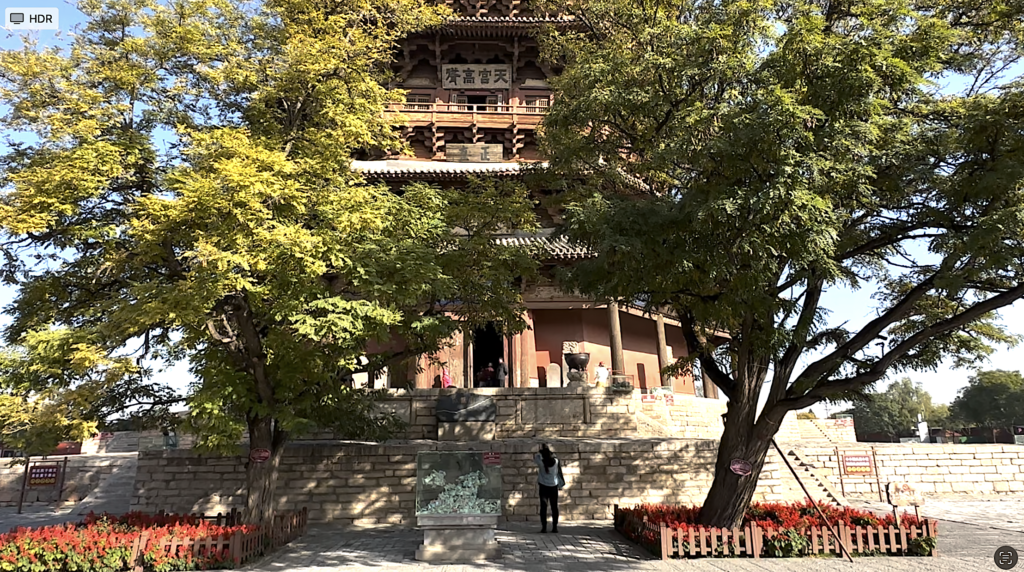
🪵 At Yingxian: Stand Back First
The formal name is:
佛宫寺释迦塔 — Fógōng Sì Shìjiā Tǎ
Sakyamuni Pagoda of Fogong Temple
but most travelers simply use:
应县木塔.
When you arrive…
don’t rush straight toward the entrance.
Stand back.
Look.
Remember:
1056 CE.
Wood.
Nearly one thousand years.
Still standing.
🔥
Let the building give you the:
WOW
first.
Then let the guide explain the:
WHY.
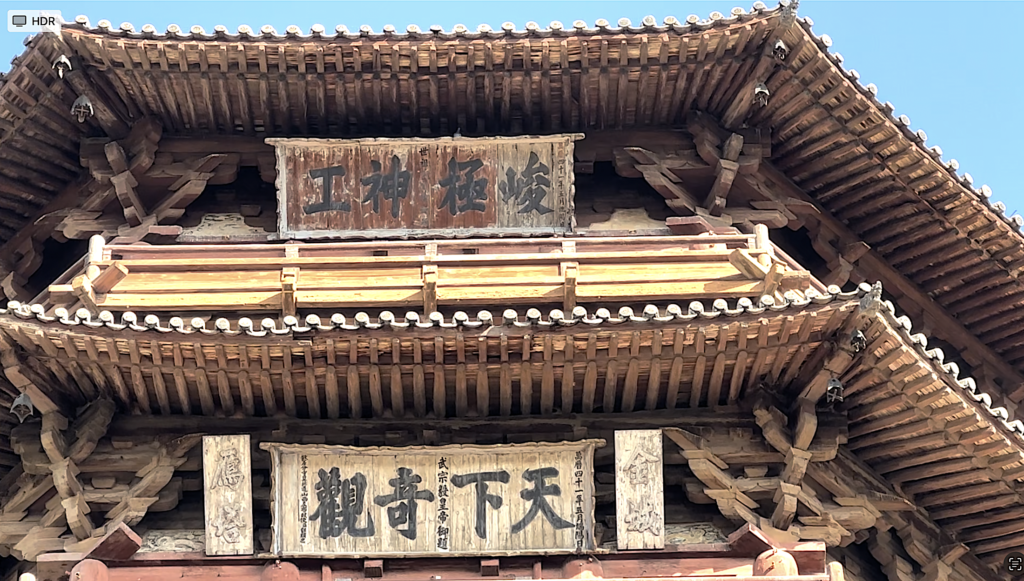
Traditional Chinese timber construction relies heavily on interlocking wooden components, including 榫卯 (sǔnmǎo, mortise-and-tenon joinery), rather than modern structural fastening systems. Photo by Dad at Yingxian Wooden Pagoda.
🔨 Ask the Guide to Show You 斗拱 and 榫卯
Two Chinese architectural terms are worth learning here:
斗拱 — dǒugǒng
interlocking bracket sets
and:
榫卯 — sǔnmǎo
mortise-and-tenon joinery.
Ask your guide to point them out physically.
That is far better than Dad showing Elaine a diagram at dinner.
😂
Look at:
柱 — zhù
columns
梁 — liáng
beams
and:
斗拱
bracket systems.
Then ask:
“How is the weight actually being transferred?”
Now architecture becomes engineering.
🔥
🌶️ Then Ask the Most Important Historical Question
“Who ruled here in 1056?”
Answer:
辽朝 — Liáo Cháo
Liao dynasty
ruled by:
契丹 — Qìdān
the Khitan.
And at the same time:
宋朝 — Sòng Cháo
Song dynasty
existed farther south.
💡
This is why:
Tang → Song → Yuan
isn’t enough.
Chinese political history sometimes has:
multiple states existing simultaneously.
Yingxian makes that fact tangible.
🐇 Ask About “Cathay”
This is one rabbit hole worth deliberately opening with your guide.
Ask:
“Is Khitan related to the Western word Cathay?”
Yes.
Forms derived from the name:
Khitan
traveled westward through Eurasian languages and eventually contributed to:
Cathay
the historical European term associated particularly with northern China.
😳
Now:
应县
↓
Liao
↓
Khitan
↓
Cathay
Western readers are suddenly inside the story.
🔥
⏰ How Long at Yingxian Wooden Pagoda?
Allow around:
1½–2 hours
for a comfortable visit.
Longer if you’re particularly interested in:
architecture,
Buddhist history,
photography
or:
engineering.
Don’t turn it into:
Photo → old tower → leave.
😂
Walk around it.
Look upward.
Let your guide point out the structure.
Then remember:
1056 + LIAO + KHITAN.
That’s enough for the historical coat rack.
⚠️ Don’t Plan Around Climbing the Pagoda
Because of:
文物保护 — wénwù bǎohù
cultural-heritage conservation
visitor access to upper levels has been heavily restricted.
Current access policies can change.
So don’t build the trip around:
“We must climb to the top.”
The reason you’re here is to:
see and understand the building.
If interior access matters to you, ask your guide to verify the latest arrangements before the visit.
Can You Do Both in One Day?
Yes.
And with:
a private local historical guide + vehicle
we think this is an excellent pairing.
A comfortable day might look approximately like:
Morning
大同 → 悬空寺
Visit Hanging Temple relatively early.
↓
Midday
Drive toward:
应县
Lunch.
↓
Afternoon
应县木塔
Take your time.
↓
Late Afternoon / Evening
Return toward:
大同.
Exact timing depends on:
weather,
traffic,
ticket arrangements,
crowds
and:
how many questions Dad asks the guide.
😂
Don’t turn it into a military operation.
Better Still: Give Northern Shanxi Three Days
Our preferred rhythm is:
DAY 1 — DATONG 大同
Arrive from:
Beijing
or:
Taiyuan.
Explore Datong.
Perhaps:
华严寺 — Huáyán Sì
善化寺 — Shànhuà Sì
or:
大同古城 — Dàtóng Gǔchéng.
↓
Datong overnight.
DAY 2 — YUNGANG 云冈石窟
北魏
↓
鲜卑
↓
佛教
↓
India → Central Asia → China.
Spend half a day or more.
Return to Datong.
Let the history settle.
No additional dynasty required.
😂
DAY 3 — PRIVATE HISTORICAL GUIDE + VEHICLE
大同
↓
悬空寺
Northern Wei-associated historical layer.
↓
应县木塔
Liao / Khitan.
↓
大同
🔥
Now the three days tell a connected story rather than becoming three disconnected attractions.
Or Continue South Through Shanxi
If you’re traveling onward:
DATONG 大同
↓
悬空寺
↓
应县木塔
↓
雁门关 — Yanmenguan
↓
太原 — Taiyuan
🔥
Now look at the historical progression:
YUNGANG
Northern Wei / Xianbei
↓
HANGING TEMPLE
religious and architectural layers
↓
YINGXIAN
Liao / Khitan
↓
YANMENGUAN
frontier history across multiple eras
↓
TAIYUAN
gateway to the wider Shanxi story.
That’s not merely:
交通 — jiāotōng
transport.
It’s:
a historical journey.
Who Should Definitely Consider a Local Historical Guide?
We don’t recommend hiring a guide everywhere simply because:
“That’s what tourists do.”
No.
But we’d particularly recommend one here if:
- Northern Wei is completely new to you;
- you’ve never heard of the Xianbei or Khitan;
- you want to understand what parts of the architecture belong to which historical periods;
- Chinese Buddhism interests you;
- traditional timber architecture interests you;
- you’re traveling as a family or small group;
- or you’ve visited Yungang and want all three places to connect historically.
In those situations:
good interpretation materially improves the trip.
That’s when the additional cost makes sense.

🐞 Final Sting Check
You began with:
“Can I visit Hanging Temple and Yingxian Wooden Pagoda from Datong?”
Yes.
But now the route has become:
大同
↓
北魏
↓
悬空寺
↓
Buddhism + Daoism + Confucian traditions
↓
centuries pass
↓
辽
↓
契丹
↓
应县木塔
↓
斗拱 + 榫卯
↓
Cathay
😬
That’s a lot of history for one day’s drive.
Which is precisely why, for this particular Deep China journey, our recommendation is:
get a good local historical guide with a private vehicle.
The architecture will give you the:
WOW.
The guide should give you the:
WHY.
And when both work together…
you don’t simply return to Datong with photographs.
You return understanding northern China a little better.
🐇🐞
See China. Understand It Better.