Five Places. Five Questions. One Connected Journey Beyond Beijing (北京, Běijīng).
Beijing (北京, Běijīng) → Jinan (济南, Jǐnán) → Mount Tai (泰山, Tàishān) → Qufu (曲阜, Qūfù) → Linzi (临淄, Línzī) / Zibo (淄博, Zībó) → Dezhou (德州, Dézhōu) → Beijing (北京, Běijīng)
Most China itineraries tell you:
WHERE TO GO.
This journey asks something different:
WHAT SHOULD YOU TRY TO UNDERSTAND WHEN YOU GET THERE?
Dad originally started taking Elaine to historical places because he wanted her to learn Chinese history differently.
Not:
Xia dynasty (夏朝, Xiàcháo) → Shang dynasty (商朝, Shāngcháo) → Zhou dynasty (周朝, Zhōucháo) → Qin dynasty (秦朝, Qíncháo) → Han dynasty (汉朝, Hàncháo)…
Memorize.
Exam.
Forget.
😂
Instead:
SEE → ASK → CONNECT → UNDERSTAND → FOLLOW
See the actual place.
Carry one question with you.
Then let that question lead to the next place.
That’s our:
Michelin History Tasting JOURNEY.
And Shandong (山东, Shāndōng) gives us a particularly good menu.
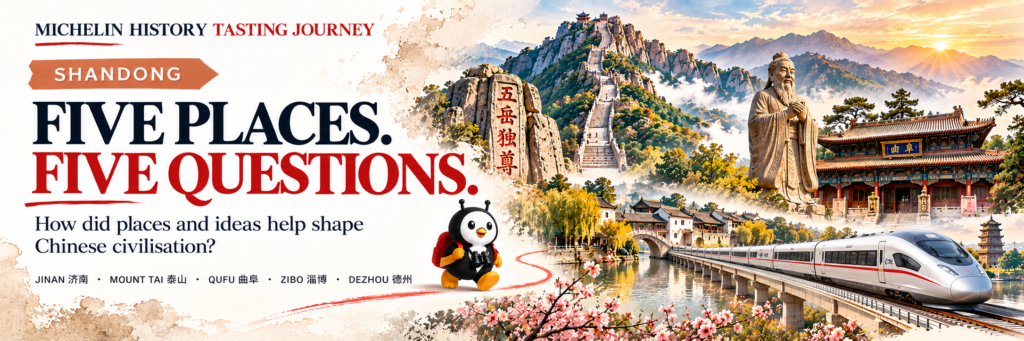
🍽️ THE MENU — Five Places. Five Questions.
You don’t need to know anything about Jinan (济南, Jǐnán), Qufu (曲阜, Qūfù) or Linzi (临淄, Línzī) before you start.
That’s the point.
Each stop gives you one question to carry into the place.
🥂 JINAN (济南, Jǐnán)
PREHISTORY · ARCHAEOLOGY · EVIDENCE
Where do we begin?
Start with the famous springs of Jinan (济南, Jǐnán).
Then enter the Shandong Museum (山东博物馆, Shāndōng Bówùguǎn) and travel much further backwards — toward Longshan culture (龙山文化, Lóngshān Wénhuà), archaeology (考古, Kǎogǔ) and some of the earliest layers of the story.
First taste: How do we know anything about a past before written history becomes plentiful?
↓
⛰️ MOUNT TAI (泰山, Tàishān)
HEAVEN · RITUAL · LEGITIMACY
Why did Chinese emperors need Heaven (天, Tiān)?
International travelers may see:
famous mountain + lots of stairs + sunrise.
😂
But carry one character up Mount Tai (泰山, Tàishān):
天 — Tiān
Heaven / sky
Then the mountain begins opening doors into Son of Heaven (天子, Tiānzǐ), Mandate of Heaven (天命, Tiānmìng) and the Fengshan sacrifices (封禅, Fēngshàn).
The scenery hasn’t changed.
Your understanding of it has.
↓
🥢 QUFU (曲阜, Qūfù)
CONFUCIUS · RITUAL · LEARNING
How did one teacher shape Chinese civilisation?
Meet:
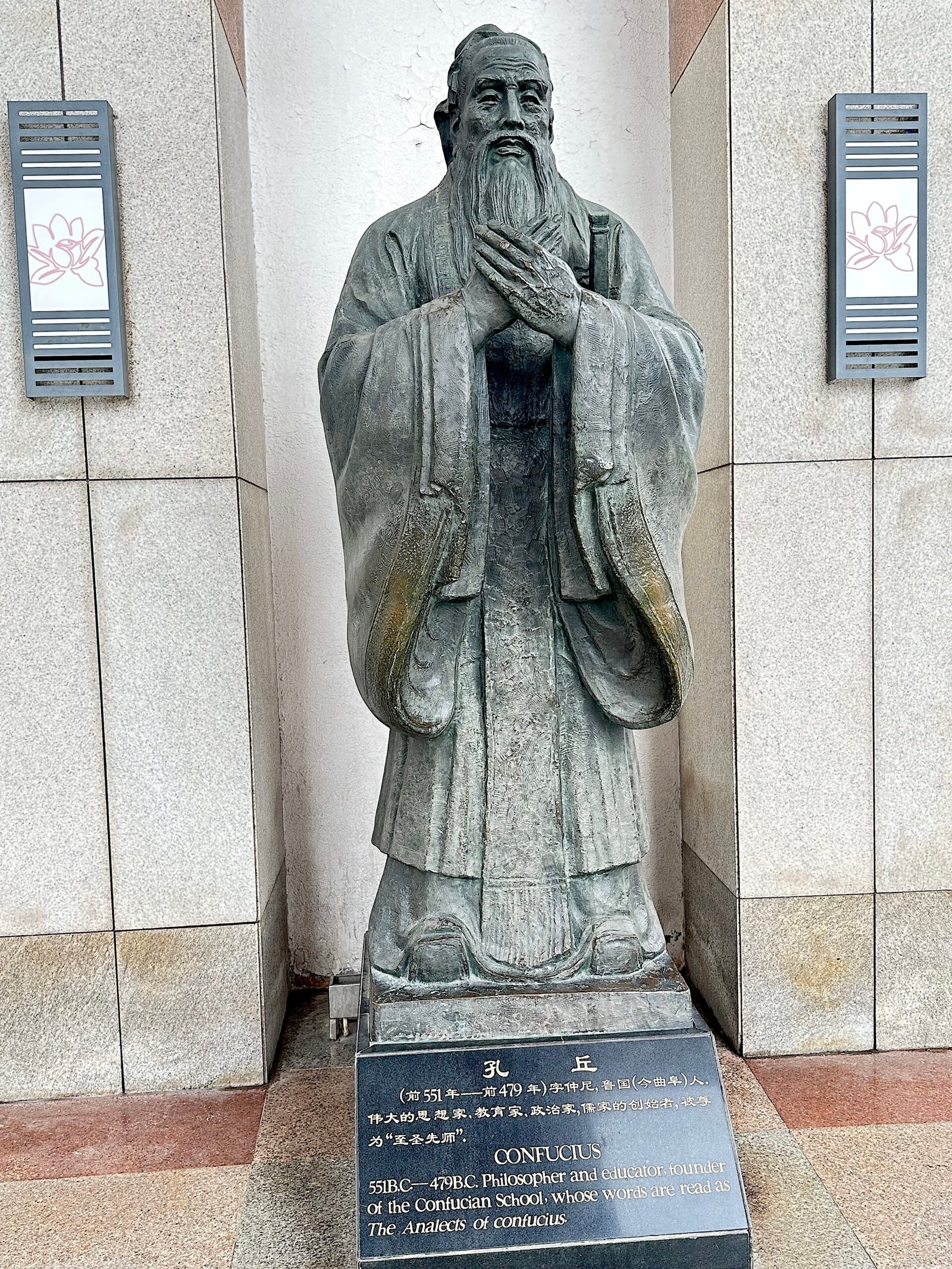
Confucius (孔子, Kǒngzǐ).
But don’t stop at:
“Who was Confucius?”
Look at the Temple of Confucius (孔庙, Kǒngmiào), Kong Family Mansion (孔府, Kǒngfǔ) and Cemetery of Confucius (孔林, Kǒnglín).
Then ask the more interesting question:
How did ideas associated with one teacher survive for centuries and become embedded in education, ritual (礼, Lǐ), government and society?
↓
🍷 LINZI (临淄, Línzī) / ZIBO (淄博, Zībó)
STATE OF QI · WARRING STATES · COMPETING IDEAS
What did China look like before it was one China?
Now things get interesting.
😬
Linzi (临淄, Línzī) was the capital of the State of Qi (齐国, Qí Guó), one of the major powers of the Warring States period (战国时期, Zhànguó Shíqī).
Carry another Chinese character:
国 — Guó
state / country / polity
Before Qin Shi Huang (秦始皇, Qín Shǐhuáng) unified the competing states in 221 BCE, there wasn’t simply one political unit called “China” waiting quietly for him.
There were competing states.
Competing rulers.
Competing armies.
And competing answers to:
How should society be governed?
Stand in Linzi (临淄, Línzī) and the familiar sentence:
“Qin Shi Huang unified China.”
suddenly becomes a much bigger question.
🐇
↓
🍛 DEZHOU (德州, Dézhōu)
GRAND CANAL · EMPIRE · DIPLOMACY · WORLD
How did imperial China connect itself — and connect with the wider world?
Our final course looks in two directions.
INWARD
The Grand Canal (大运河, Dàyùnhé) helps explain how an enormous empire moved grain, supplies and resources toward its political centres.
OUTWARD
Then visit the:
Sulu Royal Tomb (苏禄王墓, Sūlù Wáng Mù).
And ask:
Why is a ruler from maritime Southeast Asia buried in Shandong (山东, Shāndōng)?
😳
Suddenly we’re following the Ming dynasty (明朝, Míngcháo), Yongle Emperor (永乐帝, Yǒnglè Dì), diplomacy (外交, Wàijiāo), Zheng He (郑和, Zhèng Hé) and Southeast Asia (东南亚, Dōngnányà).
Our Shandong rabbit has escaped China.
🐇🌏
⭐ NOW LOOK AT THE WHOLE MENU
JINAN (济南, Jǐnán)
Where do we begin?
↓
MOUNT TAI (泰山, Tàishān)
Why did emperors need Heaven (天, Tiān)?
↓
QUFU (曲阜, Qūfù)
How did one teacher shape Chinese civilisation?
↓
LINZI (临淄, Línzī) / ZIBO (淄博, Zībó)
What did China look like before it was one China?
↓
DEZHOU (德州, Dézhōu)
How did imperial China connect itself — and connect with the wider world?
BEGINNINGS
↓
HEAVEN
↓
IDEAS
↓
COMPETING STATES
↓
EMPIRE MEETS WORLD
That’s why this isn’t:
“Five Things to Do in Shandong.”
It’s a journey through different layers of Chinese history — using places you can actually visit.
Each destination serves one course.
Each course gives you one question.
And each question opens another rabbit hole.
🐇
Ready?
Napkin on.
😂🍽️
🥂 AMUSE-BOUCHE — JINAN (济南, Jǐnán)
THE DISH: WHERE DO WE BEGIN?
FLAVOR: Springs · Longshan culture (龙山文化, Lóngshān Wénhuà) · Archaeology (考古, Kǎogǔ) · Qi and Lu (齐鲁, Qílǔ) · Bamboo Slips (竹简, Zhújiǎn)
TASTING NOTE:
Start with the water. Then let the museum change the journey.
🥂 COURSE I — Jinan (济南, Jǐnán)
THE DISH: Where Do We Begin?
FLAVOR: Springs (泉, Quán) · Longshan culture (龙山文化, Lóngshān Wénhuà) · Archaeology (考古, Kǎogǔ) · Qi and Lu (齐鲁, Qílǔ) · Bamboo Slips (竹简, Zhújiǎn)
⭐ THE BIG QUESTION
How do we begin understanding a place with thousands of years of history?
Our first stop is:
Jinan (济南, Jǐnán)
capital of:
Shandong Province (山东省, Shāndōng Shěng).
Most travelers who know Jinan (济南, Jǐnán) know it for:
泉 — Quán
spring
Jinan (济南, Jǐnán) is famously:
泉城 — Quánchéng
City of Springs
So begin with the easy course.
Go to:
Baotu Spring (趵突泉, Bàotū Quán).
Water.
Willows.
Old buildings.
Stone inscriptions.
People enjoying the parks.
Experience the city first.
Then Dad does what Dad usually does.
😂
Go to the museum.
→ Beyond Beijing: Go to Jinan (济南, Jǐnán) — Where the Springs Open the Door to Shandong History
🏺 Then the Museum Changes the Journey
At the:
Shandong Museum (山东博物馆, Shāndōng Bówùguǎn)
the timeline suddenly becomes much longer.
One object Dad wants international travelers to look for is the:
蛋壳黑陶高柄杯
Dànké Hēitáo Gāobǐng Bēi
Eggshell Black Pottery High-Handled Cup
from:
Longshan culture (龙山文化, Lóngshān Wénhuà).
Look at it carefully.
Thin.
Dark.
Elegant.
Sophisticated.
And very old.
Suddenly we’re moving backwards beyond:
Qin dynasty (秦朝, Qíncháo)
beyond:
Zhou dynasty (周朝, Zhōucháo)
and toward:
prehistoric China.
For an international traveler, don’t worry about memorizing every archaeological culture.
Take away one idea:
Complex societies existed in this region long before China became a unified empire.
🐇
And now the first Michelin rabbit appears.
When does Chinese civilisation actually begin?
→ GO MICHELIN: Before China — When Does Chinese Civilization Actually Begin?
🍴 TASTING NOTE — What Kind of Evidence Are You Looking At?
This is a useful habit for the entire journey.
Inside a museum, you’ll encounter different kinds of evidence:
pottery (陶器, Táoqì)
bronzes (青铜器, Qīngtóngqì)
bronze inscriptions (青铜器铭文, Qīngtóngqì Míngwén)
bamboo slips (竹简, Zhújiǎn)
tombs (墓葬, Mùzàng)
and eventually:
written historical texts (历史文献, Lìshǐ Wénxiàn).
They don’t all tell us exactly the same thing.
So instead of asking only:
“How old is this?”
Dad increasingly asks:
What does this object actually allow us to know?
That’s a much better DEEP China question.
🐇 Then Two Characters Point to Our Next Destinations
Keep walking through the museum and another useful expression appears:
齐鲁 — Qílǔ
These are two ancient states:
Qi (齐国, Qí Guó)
and:
Lu (鲁国, Lǔ Guó).
Why should a traveler care?
Because the museum has just quietly given us directions.
😂
齐 — Qí
↓
Linzi (临淄, Línzī)
↓
ancient capital of the State of Qi (齐国, Qí Guó)
and:
鲁 — Lǔ
↓
Qufu (曲阜, Qūfù)
↓
the world associated with Confucius (孔子, Kǒngzǐ) and the State of Lu (鲁国, Lǔ Guó).
🔥
We haven’t even left the museum.
And it is already telling us:
where to travel next.
That’s exactly how this Michelin History Tasting JOURNEY is supposed to work.
OBJECT
↓
QUESTION
↓
CONNECTION
↓
NEXT PLACE
🐇
DAD’S 值回票价 MOMENT
Then Dad & Elaine reached something Dad really wanted to see:
Yinqueshan Han Tomb Bamboo Slips
(银雀山汉墓竹简, Yínquèshān Hànmù Zhújiǎn)
These bamboo slips (竹简, Zhújiǎn), discovered in tombs from the:
Western Han dynasty (西汉, Xī Hàn)
include ancient texts associated with:
《孙子兵法》
Sūnzǐ Bīngfǎ
The Art of War
and:
《孙膑兵法》
Sūn Bìn Bīngfǎ
Sun Bin’s Military Methods
Dad looked at Elaine.
“值回票价了!”
Zhí huí piàojià le!
😂
Literally:
“Worth the ticket price!”
Except Dad wasn’t talking about the museum ticket.
He meant:
the flight
the high-speed rail
the hotel
the whole journey to Shandong (山东, Shāndōng).
Seeing those bamboo slips with our own eyes had already made the trip worthwhile.
Find Your Own 值回票价 Object
This became one of Dad’s favorite museum games.
Don’t try to remember:
EVERYTHING.
Find:
ONE OBJECT
that makes you stop.
Look twice.
Read the label.
Then ask:
Why does THIS matter?
Maybe it’s:
eggshell black pottery (蛋壳黑陶, Dànké Hēitáo).
Maybe:
bamboo slips (竹简, Zhújiǎn).
Maybe:
bronze inscriptions (青铜器铭文, Qīngtóngqì Míngwén).
Your object may be completely different from Dad’s.
Good.
That’s your rabbit.
🐇
⭐ GO MICHELIN
So what did Jinan (济南, Jǐnán) actually give us?
Not one emperor.
Not one dynasty.
Not one neat historical story.
It gave us our:
COAT RACK.
SPRINGS (泉, Quán)
→ begin with the living city
↓
LONGSHAN CULTURE (龙山文化, Lóngshān Wénhuà)
→ go back into prehistory
↓
ARCHAEOLOGY (考古, Kǎogǔ)
→ ask what the evidence actually tells us
↓
QI AND LU (齐鲁, Qílǔ)
→ discover where the journey goes next
↓
BAMBOO SLIPS (竹简, Zhújiǎn)
→ encounter ancient texts as physical objects
🔥
That’s a very good first course.
But our next stop changes the flavor completely.
We’re leaving the museum.
We’re going up a mountain.
And Dad wants you to carry just:
ONE CHARACTER.
天
Tiān
Heaven / sky
Because once you understand why Chinese rulers kept talking about:
Heaven (天, Tiān)
a famous mountain stops being:
“Beautiful scenery + lots of stairs.”
😂
It becomes part of the political story of China.
Next stop:
Mount Tai (泰山, Tàishān).
🐇
⛰️ COURSE II — Mount Tai (泰山, Tàishān)
THE DISH: Why Did Chinese Emperors Need Heaven?
FLAVOR: Mount Tai (泰山, Tàishān) · Heaven (天, Tiān) · Son of Heaven (天子, Tiānzǐ) · Mandate of Heaven (天命, Tiānmìng) · Fengshan (封禅, Fēngshàn) · Legitimacy (正统性, Zhèngtǒngxìng)
⭐ THE BIG QUESTION
Why did Chinese emperors need Heaven (天, Tiān)?
After museums and archaeology in Jinan (济南, Jǐnán), Dad & Elaine moved to somewhere completely different:
Mount Tai (泰山, Tàishān).
For many travelers, Mount Tai (泰山, Tàishān) is straightforward.
Famous mountain.
UNESCO World Heritage Site.
Stone steps.
Temples.
Sunrise.
Beautiful views.
And potentially:
very tired legs.
😂
But Dad wants international travelers to carry just one Chinese character up the mountain:
天
Tiān
Heaven / sky
Because once you start noticing Heaven (天, Tiān), Mount Tai (泰山, Tàishān) becomes much more than scenery.
🍴 TASTING NOTE — Don’t Just Ask Why the Mountain Is Famous
Ask:
Why did rulers come here?
For centuries, Mount Tai (泰山, Tàishān) was associated with imperial ritual and political legitimacy.
Chinese emperors were not simply:
powerful men sitting on thrones.
The emperor was traditionally described as:
天子
Tiānzǐ
Son of Heaven
That title immediately creates another question.
If the emperor is the Son of Heaven (天子, Tiānzǐ)…
what exactly is Heaven (天, Tiān)?
And what does Heaven have to do with political power?
🐇
→ Why Does Chinese History Keep Talking About Heaven (天, Tiān)?
From Heaven (天, Tiān) to the Right to Rule
One of the most important ideas in Chinese political tradition is:
天命
Tiānmìng
Mandate of Heaven
The idea became especially important in explanations of the transition from the:
Shang dynasty (商朝, Shāngcháo)
to the:
Zhou dynasty (周朝, Zhōucháo).
Very simply:
a ruler could possess the right to rule.
But that right wasn’t necessarily unconditional forever.
A ruling house that governed badly could be understood as having lost:
the Mandate of Heaven (天命, Tiānmìng).
A new ruling house could then claim legitimate authority.
So political power wasn’t explained only by:
“We won the war.”
There was another question:
“Why do we deserve to rule?”
That’s where Heaven (天, Tiān) enters the political story.
🐇 And Now Mount Tai Makes More Sense
Chinese rulers didn’t climb Mount Tai (泰山, Tàishān) simply because they enjoyed mountain scenery.
😂
The mountain became closely associated with imperial ritual, including the famous:
封禅
Fēngshàn
Fengshan sacrifices
These ceremonies became associated with exceptional claims of successful and legitimate rule.
Not every emperor performed them.
That is important.
The ritual’s prestige came partly from its rarity.
So when you stand on Mount Tai (泰山, Tàishān), you’re standing in a landscape where:
mountain
became:
sacred mountain
which became connected with:
Heaven (天, Tiān)
which became connected with:
imperial legitimacy.
Suddenly geography has become political philosophy.
🔥
A Western Handrail
International travelers sometimes see the word Heaven (天, Tiān) and immediately translate it into:
“God.”
Be careful.
They are not interchangeable concepts.
For this journey, you don’t need a philosophy degree.
Just remember:
Heaven (天, Tiān) became deeply connected with ideas about cosmic order, legitimate rulership and the emperor’s place within that order.
So when you encounter:
Son of Heaven (天子, Tiānzǐ)
or:
Mandate of Heaven (天命, Tiānmìng)
don’t read them as decorative ancient titles.
They are clues to how political authority was understood.
⭐ GO MICHELIN — Look for Four Characters
While walking Mount Tai (泰山, Tàishān), you may encounter one of its most famous inscriptions:
五岳独尊
Wǔyuè Dúzūn
Literally:
“Supreme among the Five Great Mountains.”
The Five Great Mountains (五岳, Wǔyuè) occupy a special place in China’s sacred geography.
Mount Tai (泰山, Tàishān), the eastern mountain, became the most politically prestigious of them.
So don’t just photograph:
五岳独尊 (Wǔyuè Dúzūn).
Ask:
Why did mountains matter to government?
That’s the Michelin question.
What Mount Tai (泰山, Tàishān) Adds to Our Menu
Remember where we started.
JINAN (济南, Jǐnán)
Objects.
Pottery.
Bamboo slips.
Archaeology (考古, Kǎogǔ).
Evidence we can physically examine.
↓
MOUNT TAI (泰山, Tàishān)
Heaven (天, Tiān).
Ritual (礼, Lǐ).
Mandate (天命, Tiānmìng).
Legitimacy (正统性, Zhèngtǒngxìng).
Ideas people used to explain political order.
That’s an important shift.
History isn’t made only from things archaeologists dig out of the ground.
It’s also made from:
ideas people believed
rituals they performed
and:
institutions they built around those ideas.
And our next stop is where one man’s ideas eventually became extraordinarily influential.
🚄 PALATE CLEANSER
Leave the mountain.
Get on the train.
Rest the legs.
😂
We’re heading to:
Qufu (曲阜, Qūfù)
home of:
Confucius (孔子, Kǒngzǐ).
And Dad doesn’t want to ask:
“Who was Confucius?”
That’s too easy.
The much more interesting question is:
How did one teacher shape Chinese civilisation?
🐇
🥢 COURSE III — Qufu (曲阜, Qūfù)
THE DISH: How Did One Teacher Shape Chinese Civilisation?
FLAVOR: Confucius (孔子, Kǒngzǐ) · State of Lu (鲁国, Lǔ Guó) · Ritual (礼, Lǐ) · Benevolence (仁, Rén) · Learning (学, Xué) · Imperial Institutions
⭐ THE BIG QUESTION
How did one teacher become so important to Chinese civilisation?
Our third stop is:
Qufu (曲阜, Qūfù)
in the ancient homeland of the:
State of Lu (鲁国, Lǔ Guó).
And waiting for us here is probably the most internationally recognisable person on this entire Shandong (山东, Shāndōng) journey:
Confucius (孔子, Kǒngzǐ).
But Dad doesn’t want to spend this course asking:
“Who was Confucius?”
You can read a biography anywhere.
The more interesting travel question is:
What happened to his ideas after he died?
🍴 TASTING NOTE — Don’t Look for Just One Man
Confucius (孔子, Kǒngzǐ) lived during the:
Spring and Autumn period (春秋时期, Chūnqiū Shíqī)
more than two thousand years ago.
Among the ideas associated with the Confucian tradition are concepts such as:
仁 — Rén
benevolence / humaneness
礼 — Lǐ
ritual / proper conduct
孝 — Xiào
filial respect
学 — Xué
learning
But here’s the important part for travelers:
Confucius (孔子, Kǒngzǐ) did not personally create the enormous institutional world you see in Qufu (曲阜, Qūfù) today.
That developed over generations.
And centuries.
That’s what makes Qufu (曲阜, Qūfù) fascinating.
The Three Confucian Sites
Qufu (曲阜, Qūfù) gives you three major places to read together:
Temple of Confucius (孔庙, Kǒngmiào)
↓
Kong Family Mansion (孔府, Kǒngfǔ)
↓
Cemetery of Confucius (孔林, Kǒnglín)
Don’t treat them simply as:
Temple → Mansion → Cemetery → Done.
😂
Each shows a different layer of the story.
The Temple of Confucius (孔庙, Kǒngmiào) shows commemoration and ritual.
The Kong Family Mansion (孔府, Kǒngfǔ) shows the extraordinary institutional position eventually occupied by Confucius’s descendants.
The Cemetery of Confucius (孔林, Kǒnglín) turns one man’s family lineage into a physical landscape stretching across generations.
Together they ask:
How does a person’s memory become an institution?
🐇
From Teacher to State Tradition
This is where the story becomes much bigger than Qufu (曲阜, Qūfù).
Different rulers and dynasties repeatedly promoted, interpreted and institutionalised Confucian traditions.
Confucian texts became increasingly important in education.
Ritual (礼, Lǐ) became intertwined with government.
Later imperial examinations (科举, Kējǔ) helped make mastery of Confucian texts an important route into official life.
So Confucius (孔子, Kǒngzǐ) survived not simply because people remembered an ancient teacher.
His ideas became connected with:
education
family relationships
ritual
government
official culture
and ideas about how an ordered society should function.
That’s a very different kind of historical influence.
🌏 A Western Handrail
Think about how an ancient thinker such as:
Socrates
or:
Aristotle
could influence later intellectual traditions long after his own lifetime.
Now add something else:
Imagine later governments building institutions around the study and interpretation of those ideas for centuries.
That’s closer to the scale of the question Qufu (曲阜, Qūfù) asks us to consider.
But don’t force the comparison too far.
Confucius (孔子, Kǒngzǐ) belongs to a very different historical and political tradition.
The comparison is only a handrail.
⭐ GO MICHELIN — The Really Interesting Question
Here’s where Dad wants you to go one level deeper.
Chinese history wasn’t ruled continuously by one ethnic group or one political house.
Different dynasties came and went.
Some rulers came from peoples whose origins lay beyond earlier Chinese political centres.
Yet Confucian institutions repeatedly survived, adapted and were reused.
So ask:
Why would later rulers keep Confucius?
Because ideas can do political work.
They can help rulers explain:
order
hierarchy
education
proper behaviour
and:
legitimate government.
Now Qufu (曲阜, Qūfù) isn’t merely:
“the birthplace of Confucius.”
It becomes a place to ask how ideas survive political change.
🐇
Look Back at Our Menu
JINAN (济南, Jǐnán)
ARCHAEOLOGY
What physical evidence survives?
↓
MOUNT TAI (泰山, Tàishān)
HEAVEN (天, Tiān)
How was political legitimacy understood?
↓
QUFU (曲阜, Qūfù)
IDEAS + INSTITUTIONS
How can ideas outlive the person who taught them?
🔥
Three courses.
Three completely different ways of understanding Chinese history.
And now we’re about to complicate everything.
Because international travelers often hear:
“Ancient China believed…”
But ancient China wasn’t one room where everybody agreed.
😂
There were competing states.
Competing rulers.
Competing thinkers.
Competing answers to:
How should people be governed?
To see that China, we’re leaving the State of Lu (鲁国, Lǔ Guó) and heading toward its powerful neighbour:
State of Qi (齐国, Qí Guó).
Its great capital was:
Linzi (临淄, Línzī).
Today, that’s part of:
Zibo (淄博, Zībó).
And our next question may be the most important one on this entire menu:
What did China look like before it was one China?
🐇
🍷 COURSE IV — Linzi (临淄, Línzī) / Zibo (淄博, Zībó)
THE DISH: China Before It Was One China
FLAVOR: State of Qi (齐国, Qí Guó) · Warring States period (战国时期, Zhànguó Shíqī) · Linzi (临淄, Línzī) · Jixia Academy (稷下学宫, Jìxià Xuégōng) · Competing States · Competing Ideas
⭐ THE BIG QUESTION
What did China look like before it was one China?
This is where Dad wants international travelers to temporarily forget the modern map.
Today you travel around:
China (中国, Zhōngguó).
One country.
Provinces.
High-speed trains.
One national map.
Now travel backwards more than 2,000 years.
The political landscape looked very different.
There wasn’t one unified empire stretching across the territory we associate with China today.
There were:
STATES.
And one of the most powerful was:
State of Qi (齐国, Qí Guó).
Its great capital was:
Linzi (临淄, Línzī),
today part of Zibo (淄博, Zībó) in Shandong (山东, Shāndōng).
🍴 TASTING NOTE — 国 (Guó) Didn’t Always Mean What You Think
Here’s one Chinese character worth carrying around Linzi (临淄, Línzī):
国
Guó
Today you’ll see it in:
China (中国, Zhōngguó)
country (国家, Guójiā)
and:
foreigner (外国人, Wàiguórén).
But when we’re talking about the Warring States period (战国时期, Zhànguó Shíqī), translating guó (国, Guó) simply as a modern “country” can be misleading.
Think instead:
state
political realm
ruler
territory
army
institutions
and:
rival interests.
So:
State of Qi (齐国, Qí Guó)
wasn’t a province obediently waiting for Qin Shi Huang (秦始皇, Qín Shǐhuáng) to arrive.
😂
It was a major political power in its own right.
Qi (齐, Qí) and Lu (鲁, Lǔ) — Remember Them?
Back in the Shandong Museum (山东博物馆, Shāndōng Bówùguǎn) in Jinan (济南, Jǐnán), Dad asked you to remember:
齐鲁
Qílǔ
Now the coat rack pays off.
We have just come from:
Qufu (曲阜, Qūfù)
↓
State of Lu (鲁国, Lǔ Guó)
↓
Confucius (孔子, Kǒngzǐ)
Now we’re entering:
Linzi (临淄, Línzī)
↓
State of Qi (齐国, Qí Guó)
Two neighbouring states.
Different political histories.
Different intellectual environments.
Same modern province:
Shandong (山东, Shāndōng).
🔥
That’s why traveling through history works.
A museum introduced us to two characters.
Now we’ve physically traveled between them.
🏛️ Linzi (临淄, Línzī) Wasn’t Some Small Ancient Town
This is another mental adjustment international travelers need.
When we say:
“ancient state”
it’s easy to imagine something small and primitive.
Linzi (临淄, Línzī) became one of the great urban centres of ancient China.
The State of Qi (齐国, Qí Guó) was wealthy, powerful and strategically important.
And its political world wasn’t only about armies.
It also became associated with something extraordinary:
Jixia Academy (稷下学宫, Jìxià Xuégōng).
🐇 Wait — Ancient China Had Competing Ideas Too?
The Jixia Academy (稷下学宫, Jìxià Xuégōng) became associated with scholars and intellectual debate during the Warring States period (战国时期, Zhànguó Shíqī).
This was the wider age remembered for the:
Hundred Schools of Thought (百家争鸣, Bǎijiā Zhēngmíng).
Don’t take “Hundred” too literally.
The important idea is:
intellectual competition.
Different thinkers offered different answers to questions such as:
What makes a good ruler?
How should society be organised?
What is human nature?
Should government rely on virtue?
Ritual (礼, Lǐ)?
Law (法, Fǎ)?
Administrative technique?
Military power?
Ancient China wasn’t one giant classroom where everybody sat quietly listening to Confucius (孔子, Kǒngzǐ).
😂
There were arguments.
Lots of them.
A Western Handrail
If you’re used to thinking about ancient Greece as a world containing:
Athens.
Sparta.
Thebes.
Different political systems.
Different thinkers.
Different rivalries.
That can provide a useful handrail.
Don’t force the comparison too far.
But it helps break one misleading assumption:
Ancient China = one emperor + one government + one set of ideas.
Not during the Warring States period (战国时期, Zhànguó Shíqī).
This was a competitive political world.
And that competition matters enormously for understanding what happened next.
Then Qin (秦, Qín) Changed Everything
Now the sentence international travelers already know becomes much richer:
“Qin Shi Huang (秦始皇, Qín Shǐhuáng) unified China in 221 BCE.”
Before this course, that might sound like:
China existed → Qin unified it.
Now look again.
By the late Warring States period (战国时期, Zhànguó Shíqī), seven major powers are conventionally remembered as the:
Seven Warring States
(战国七雄, Zhànguó Qīxióng)
Qin (秦国, Qín Guó)
Chu (楚国, Chǔ Guó)
Qi (齐国, Qí Guó)
Yan (燕国, Yān Guó)
Han (韩国, Hán Guó)
Zhao (赵国, Zhào Guó)
Wei (魏国, Wèi Guó)
And yes:
Han (韩国, Hán Guó) here is 韩 (Hán) — the ancient State of Han.
Not:
Han dynasty (汉朝, Hàncháo) — 汉 (Hàn).
Different character.
Different tone.
Different Han.
😂
Eventually Qin (秦国, Qín Guó) defeated the others.
In 221 BCE, Qin Shi Huang (秦始皇, Qín Shǐhuáng) became the ruler of the first unified imperial dynasty:
Qin dynasty (秦朝, Qíncháo).
Now “unification” means something.
⭐ GO MICHELIN
Stand in Linzi (临淄, Línzī) and ask:
What disappeared when Qin (秦, Qín) unified the competing states?
Political independence disappeared.
Separate royal houses disappeared.
Different state institutions were absorbed into a new imperial order.
But ideas didn’t simply vanish.
People didn’t forget everything that came before.
And the new empire inherited a world that had already spent centuries experimenting with:
government
warfare
administration
philosophy
ritual (礼, Lǐ)
and:
law (法, Fǎ).
So Qin (秦, Qín) didn’t create Chinese civilisation from nothing.
It inherited, conquered and reorganised an already extraordinarily complicated world.
🔥
That’s the flavor of Linzi (临淄, Línzī).
Look Back at the Menu Again
JINAN (济南, Jǐnán)
EVIDENCE
How do we know?
↓
MOUNT TAI (泰山, Tàishān)
HEAVEN (天, Tiān)
Who has the right to rule?
↓
QUFU (曲阜, Qūfù)
IDEAS + INSTITUTIONS
How can ideas survive their teacher?
↓
LINZI (临淄, Línzī)
COMPETING STATES + COMPETING IDEAS
What did China look like before it was one China?
🔥
Now we have something that looks much more like a political history of Chinese civilisation.
But one final question remains.
Once you have an enormous empire…
how do you hold it together?
Roads help.
Armies help.
Officials help.
But China also built something extraordinary:
Grand Canal (大运河, Dàyùnhé).
And at our final stop, Dezhou (德州, Dézhōu), that story takes an unexpected turn.
Because Dad & Elaine went looking at imperial infrastructure…
and found a royal tomb connected to:
Southeast Asia (东南亚, Dōngnányà).
😳
Our Shandong rabbit is about to leave China.
🐇🌏
🍛 COURSE V — Dezhou (德州, Dézhōu)
THE DISH: Empire Meets the Wider World
FLAVOR: Grand Canal (大运河, Dàyùnhé) · Ming dynasty (明朝, Míngcháo) · Yongle Emperor (永乐帝, Yǒnglè Dì) · Sulu (苏禄, Sūlù) · Diplomacy (外交, Wàijiāo) · Southeast Asia (东南亚, Dōngnányà)
⭐ THE BIG QUESTION
How did imperial China connect itself — and connect with the wider world?
Our final Shandong (山东, Shāndōng) course is:
Dezhou (德州, Dézhōu).
Most international travelers probably wouldn’t put Dezhou (德州, Dézhōu) on a first China itinerary.
Dad did.
😂
Because Dezhou gives us a beautiful final pairing.
One story looks:
INWARD.
The other looks:
OUTWARD.
And together they help us understand how an empire connects.
🍴 TASTING I — INWARD: The Grand Canal (大运河, Dàyùnhé)
Look at a map of imperial China and one problem becomes obvious.
It’s enormous.
How do you move:
grain
supplies
officials
messages
and:
people
across such distances?
One answer was:
Grand Canal (大运河, Dàyùnhé).
The Grand Canal (大运河, Dàyùnhé) developed over many centuries, eventually creating an extraordinary north-south transport artery.
For later imperial governments, particularly when political capitals lay in northern China, moving grain and other resources from economically productive regions farther south became enormously important.
And Dezhou (德州, Dézhōu) sat along this great transport world.
So don’t think of the Grand Canal (大运河, Dàyùnhé) as:
“pretty old canal.”
😂
Think:
infrastructure.
An empire needs ideas.
It needs legitimacy.
It needs officials.
But eventually…
somebody still has to move the rice.
Western Handrail — Infrastructure Is Political
Think about the role of:
Roman roads
or later:
railway networks
in connecting large political territories.
The technology is different.
The historical context is different.
But the handrail helps.
Infrastructure doesn’t merely move things.
It can help a state:
govern
supply
communicate
and:
hold distant regions together.
Now our Michelin menu has moved from:
ideas
to:
logistics.
But Dezhou (德州, Dézhōu) has another story.
And this one surprised Dad much more.
🐇
🌏 TASTING II — OUTWARD: Why Is a Sulu King Buried Here?
Dad & Elaine went to the:
Sulu Royal Tomb
(苏禄王墓, Sūlù Wáng Mù)
in Dezhou (德州, Dézhōu).
And here’s the question international travelers should carry through the gate:
What is a ruler from maritime Southeast Asia doing buried in Shandong (山东, Shāndōng)?
😳
Now our rabbit hole leaves China.
From Shandong (山东, Shāndōng) to Sulu (苏禄, Sūlù)
The Sultanate of Sulu (苏禄苏丹国, Sūlù Sūdānguó) was centred in maritime Southeast Asia, in the region of today’s southern Philippines and surrounding islands.
During the:
Ming dynasty (明朝, Míngcháo),
delegations from Sulu (苏禄, Sūlù) travelled to China.
One particularly famous mission occurred during the reign of:
Yongle Emperor (永乐帝, Yǒnglè Dì).
On the return journey, one of the Sulu rulers died in Dezhou (德州, Dézhōu).
He was buried there.
And his tomb remained.
Suddenly this quiet place in Shandong (山东, Shāndōng) opens a door into:
maritime Southeast Asia (东南亚, Dōngnányà)
Ming diplomacy (明朝外交, Míngcháo Wàijiāo)
tribute relations (朝贡关系, Cháogòng Guānxì)
and China’s connections beyond its borders.
That’s a very different China from the one we met at:
Qufu (曲阜, Qūfù)
or:
Linzi (临淄, Línzī).
Same journey.
Another layer.
🐇 And Our Old Friend Zheng He (郑和, Zhèng Hé) Is Nearby
The reign of the Yongle Emperor (永乐帝, Yǒnglè Dì) also gives us one of the most famous figures in Chinese maritime history:
Zheng He (郑和, Zhèng Hé).
His great voyages took Ming fleets through maritime Southeast Asia (东南亚, Dōngnányà) and across the Indian Ocean.
We don’t need to turn the Sulu Royal Tomb (苏禄王墓, Sūlù Wáng Mù) into a Zheng He (郑和, Zhèng Hé) story.
But the connection gives international travelers a useful handrail.
The early Ming dynasty (明朝, Míngcháo) was not simply looking inward.
There were diplomatic networks.
Maritime connections.
Foreign envoys.
Trade.
Movement.
And encounters between different political worlds.
Dezhou (德州, Dézhōu) gives us a surprisingly human piece of that larger picture:
a foreign ruler who traveled to China — and never made it home.
⭐ GO MICHELIN — Look in Both Directions
Now put Dezhou’s two stories beside each other.
INWARD
Grand Canal (大运河, Dàyùnhé)
How does an empire connect its own territory?
↓
OUTWARD
Sulu Royal Tomb (苏禄王墓, Sūlù Wáng Mù)
How does an empire connect with people beyond it?
🔥
That’s why Dezhou (德州, Dézhōu) earns its place on this tasting journey.
Not because it has a blockbuster attraction.
But because it gives us the final question the menu needed.
🍰 DESSERT — Look What Shandong (山东, Shāndōng) Just Served Us
We started in Jinan (济南, Jǐnán) with:
EVIDENCE
Pottery.
Archaeology (考古, Kǎogǔ).
Bamboo slips (竹简, Zhújiǎn).
↓
At Mount Tai (泰山, Tàishān):
HEAVEN (天, Tiān)
Sacred landscape.
Ritual.
Political legitimacy.
↓
At Qufu (曲阜, Qūfù):
IDEAS
Confucius (孔子, Kǒngzǐ).
Ritual (礼, Lǐ).
Learning (学, Xué).
Institutions.
↓
At Linzi (临淄, Línzī):
COMPETITION
State of Qi (齐国, Qí Guó).
Warring States period (战国时期, Zhànguó Shíqī).
Competing rulers.
Competing ideas.
↓
And finally at Dezhou (德州, Dézhōu):
CONNECTION
Grand Canal (大运河, Dàyùnhé).
Empire.
Diplomacy (外交, Wàijiāo).
Southeast Asia (东南亚, Dōngnányà).
🌏
So What Did We Actually Learn?
Maybe the biggest lesson is that there was never one simple thing called:
“Ancient China.”
There were:
different periods
different states
different peoples
different political systems
different ideas
different centres of power
and different relationships with the outside world.
That’s why Dad increasingly dislikes sentences beginning:
“The ancient Chinese believed…”
😂
Which ancient Chinese?
When?
Where?
Under which state or dynasty?
According to which evidence?
Those questions make Chinese history messier.
But they also make it much more interesting.
⭐ THE CHEF’S FINAL QUESTION
We began this journey asking five questions.
Now Dad has one more:
Which question changed the way you see China?
Was it:
Where do we begin?
Why did emperors need Heaven (天, Tiān)?
How did one teacher shape Chinese civilisation?
What did China look like before it was one China?
or:
How did imperial China connect itself — and connect with the wider world?
You don’t need to remember every date.
You don’t need to remember every emperor.
If one question follows you home…
the meal worked.
😂🍽️
🧾 HOW TO ORDER THIS MENU
You don’t have to reproduce every stop exactly as Dad & Elaine did.
But the journey works beautifully as:
Beijing (北京, Běijīng)
↓
Jinan (济南, Jǐnán)
↓
Mount Tai (泰山, Tàishān)
↓
Qufu (曲阜, Qūfù)
↓
Linzi (临淄, Línzī) / Zibo (淄博, Zībó)
↓
Dezhou (德州, Dézhōu)
↓
Beijing (北京, Běijīng)
The point isn’t to tick five boxes.
Travel in this order and let each place prepare you for the next question.
PLACE
↓
QUESTION
↓
CONNECTION
↓
NEXT PLACE
🐇
That’s the Shandong (山东, Shāndōng) Michelin History Tasting JOURNEY.
SEE → ASK → CONNECT → UNDERSTAND → FOLLOW
Travel China. Let the places teach you Chinese history.
See China. Understand It Better.
China Usually Has Another Way.
🧾 HOW TO ORDER THIS MENU
So you’ve tasted the history.
Now:
Can you actually travel it?
Yes.
And that’s one of the reasons Dad likes this Shandong (山东, Shāndōng) journey so much.
The route forms a natural loop from:
Beijing (北京, Běijīng)
and much of it works beautifully by China’s:
high-speed rail (高速铁路, Gāosù Tiělù).
Our full menu is:
Beijing (北京, Běijīng)
↓
Jinan (济南, Jǐnán)
↓
Mount Tai (泰山, Tàishān)
↓
Qufu (曲阜, Qūfù)
↓
Linzi (临淄, Línzī) / Zibo (淄博, Zībó)
↓
Dezhou (德州, Dézhōu)
↓
Beijing (北京, Běijīng)
You don’t need a tour bus following you for a week.
You don’t need to change hotels every six hours.
And you definitely don’t need to eat all five courses in one day.
😂
How Many Days?
Dad would allow roughly:
6–8 days
for the full menu.
Not because the distances are enormous.
They’re not.
The danger is the opposite.
China’s trains make it tempting to move too quickly.
Remember Dad’s rule:
Possible ≠ Enjoyable.
The point of a Michelin History Tasting JOURNEY isn’t to collect five railway stations.
It’s to give each question enough time to sink in.
🥂 DAY 1–2 — Jinan (济南, Jǐnán)
THE COURSE: Where Do We Begin?
Travel from:
Beijing South Railway Station (北京南站, Běijīng Nánzhàn)
to:
Jinan (济南, Jǐnán).
Use Jinan (济南, Jǐnán) as the coat rack for the whole journey.
Start outside.
See the springs.
Walk around:
Baotu Spring (趵突泉, Bàotū Quán).
Then go to:
Shandong Museum (山东博物馆, Shāndōng Bówùguǎn).
Look for:
Longshan culture (龙山文化, Lóngshān Wénhuà)
eggshell black pottery (蛋壳黑陶, Dànké Hēitáo)
Qi and Lu (齐鲁, Qílǔ)
and Dad’s:
值回票价 (Zhí huí piàojià)
moment —
the:
Yinqueshan Han Tomb Bamboo Slips (银雀山汉墓竹简, Yínquèshān Hànmù Zhújiǎn).
⭐ Carry this question:
Where do we begin?
🛏️ Sleep: Jinan (济南, Jǐnán)
⛰️ DAY 3 — Mount Tai (泰山, Tàishān)
THE COURSE: Why Did Emperors Need Heaven?
Move south toward:
Tai’an (泰安, Tài’ān)
for:
Mount Tai (泰山, Tàishān).
This is not just the scenic course.
Carry one character:
天
Tiān
Heaven / sky
As you climb — or use the easier transport options available for part of the mountain — look for the connections between:
Mount Tai (泰山, Tàishān)
↓
Heaven (天, Tiān)
↓
Son of Heaven (天子, Tiānzǐ)
↓
Mandate of Heaven (天命, Tiānmìng)
↓
political legitimacy (政治合法性, Zhèngzhì Héfǎxìng).
⭐ Carry this question:
Why did Chinese emperors need Heaven (天, Tiān)?
Depending on your pace, either stay around:
Tai’an (泰安, Tài’ān)
or continue toward the next course.
🥢 DAY 4 — Qufu (曲阜, Qūfù)
THE COURSE: How Did One Teacher Shape Chinese Civilisation?
Now go to the hometown of:
Confucius (孔子, Kǒngzǐ).
Give yourself time for the:
Temple of Confucius (孔庙, Kǒngmiào)
Kong Family Mansion (孔府, Kǒngfǔ)
and:
Cemetery of Confucius (孔林, Kǒnglín).
But don’t turn the day into:
temple → photo → mansion → photo → cemetery → photo.
😂
Carry one concept:
礼
Lǐ
ritual / proper conduct
Then ask how ideas associated with one teacher eventually became connected with:
education
government
family
ritual (礼, Lǐ)
and institutions lasting for centuries.
⭐ Carry this question:
How did one teacher shape Chinese civilisation?
🛏️ Sleep: Qufu (曲阜, Qūfù) or continue according to your train plan.
🍷 DAY 5 — Linzi (临淄, Línzī) / Zibo (淄博, Zībó)
THE COURSE: China Before It Was One China
Now we change direction.
Head toward:
Zibo (淄博, Zībó)
and the historical area of:
Linzi (临淄, Línzī).
This was the great capital of:
State of Qi (齐国, Qí Guó).
Here, Dad wants you to temporarily forget the modern map of China.
Carry one character:
国
Guó
state / political realm
Think about:
State of Qi (齐国, Qí Guó)
State of Lu (鲁国, Lǔ Guó)
the:
Warring States period (战国时期, Zhànguó Shíqī)
and the world before:
Qin Shi Huang (秦始皇, Qín Shǐhuáng)
unified the competing states in:
221 BCE.
⭐ Carry this question:
What did China look like before it was one China?
This is one course where having a driver / local transport plan can make the archaeological and historical sites around Linzi (临淄, Línzī) easier to combine.
🛏️ Sleep: Zibo (淄博, Zībó)
🍛 DAY 6 — Dezhou (德州, Dézhōu)
THE COURSE: Empire Meets the Wider World
Now head toward:
Dezhou (德州, Dézhōu).
This final course asks you to look in two directions.
INWARD
Follow the story of the:
Grand Canal (大运河, Dàyùnhé).
Ask how imperial governments moved resources and connected enormous territories.
OUTWARD
Visit the:
Sulu Royal Tomb (苏禄王墓, Sūlù Wáng Mù).
Then ask:
Why is a ruler from maritime Southeast Asia buried in Shandong (山东, Shāndōng)?
Suddenly the menu has moved into:
Ming dynasty (明朝, Míngcháo)
Yongle Emperor (永乐帝, Yǒnglè Dì)
diplomacy (外交, Wàijiāo)
and:
Southeast Asia (东南亚, Dōngnányà).
⭐ Carry this question:
How did imperial China connect itself — and connect with the wider world?
Then:
🚄
return to:
Beijing (北京, Běijīng).
Menu complete.
🍽️
⭐ Don’t Have 6–8 Days?
Then don’t order the whole menu.
Order:
À LA CARTE.
😂
2–3 DAYS — THE BEGINNER’S TASTING
Beijing (北京, Běijīng)
→ Jinan (济南, Jǐnán)
→ Mount Tai (泰山, Tàishān)
→ Beijing (北京, Běijīng)
Taste:
archaeology + Heaven.
3–4 DAYS — THE IDEAS MENU
Beijing (北京, Běijīng)
→ Jinan (济南, Jǐnán)
→ Mount Tai (泰山, Tàishān)
→ Qufu (曲阜, Qūfù)
Taste:
evidence → Heaven → Confucius.
For many first-time travelers, this is probably the easiest introduction to the Shandong (山东, Shāndōng) journey.
5–6 DAYS — GO DEEPER
Add:
Linzi (临淄, Línzī) / Zibo (淄博, Zībó).
Now you get:
Confucius (孔子, Kǒngzǐ)
beside:
competing states + competing ideas.
This is where the journey becomes properly:
DEEP China.
6–8 DAYS — ORDER EVERYTHING
Add:
Dezhou (德州, Dézhōu)
and close the loop back to:
Beijing (北京, Běijīng).
Now the complete tasting becomes:
EVIDENCE
↓
HEAVEN
↓
IDEAS
↓
COMPETING STATES
↓
EMPIRE MEETS WORLD
🔥
🧑🍳 DAD’S RECOMMENDATION
If you have the time:
Don’t skip Linzi (临淄, Línzī).
Mount Tai (泰山, Tàishān) and Qufu (曲阜, Qūfù) are easier for international travelers to understand immediately.
Linzi (临淄, Línzī) does something different.
It breaks the mental picture of:
“Ancient China = one China.”
And once that mental picture breaks…
Qin unification (秦统一, Qín Tǒngyī) suddenly becomes much easier to understand.
That’s exactly what a Michelin History Tasting JOURNEY should do.
Not merely show you more places.
Change how you understand the places you’ve already seen.
🐇
SEE → ASK → CONNECT → UNDERSTAND → FOLLOW
You don’t need to memorize the whole menu.
Carry one question from each place.
Then let the next place answer part of it…
and give you another question.
That’s the journey.