Before There Were Chinese Characters, Humans Were Already Trying to Make Marks Carry Meaning
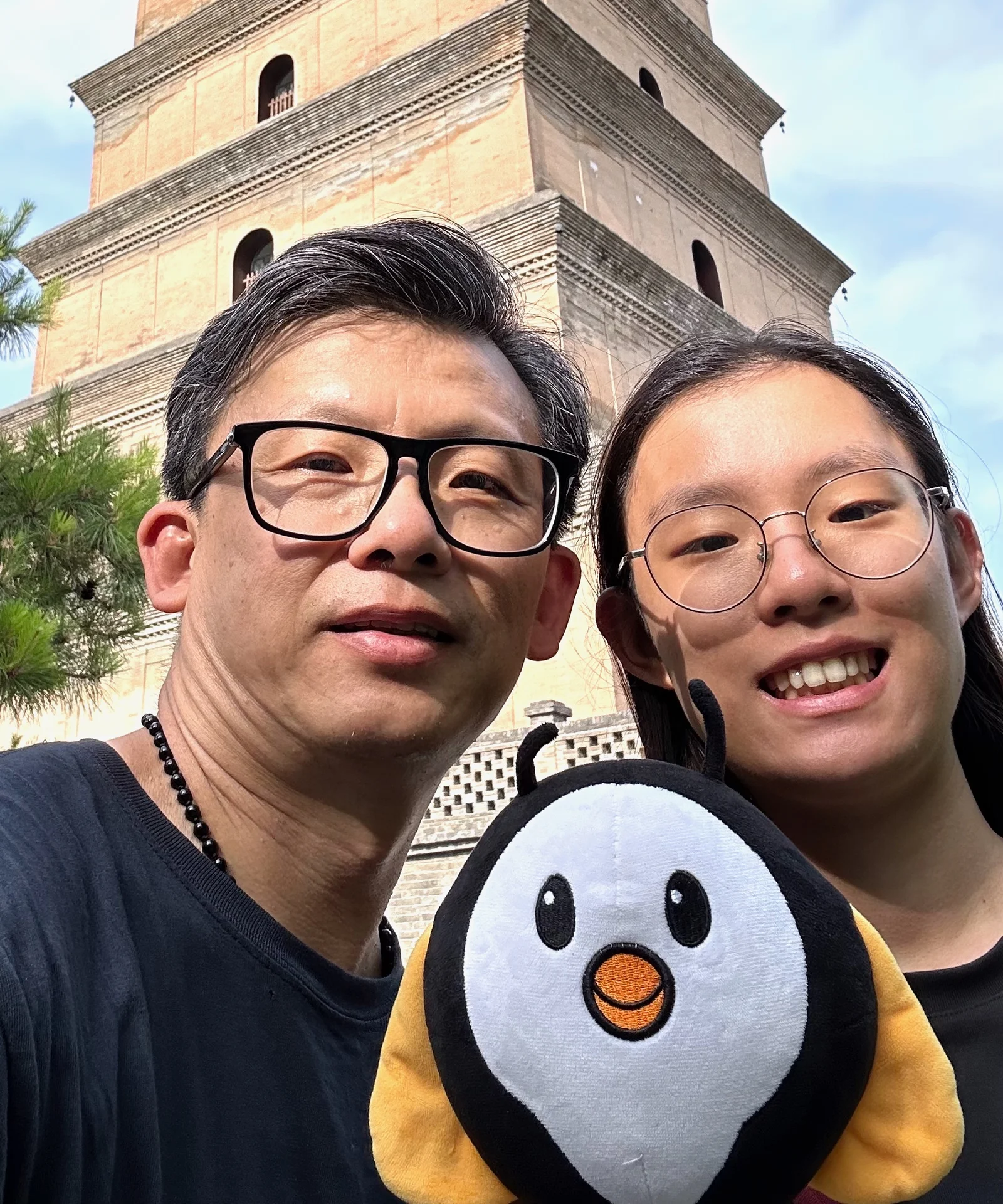
At Yinxu (殷墟, Yīnxū), Dad & Elaine stood looking at:
甲骨文 — jiǎgǔwén
oracle-bone inscriptions
More than:
3,000 YEARS OLD.
Some looked completely mysterious.
Then Dad noticed something.
A few ancient forms seemed almost…
VISUAL.
Sun.
Moon.
Mountain.
Tree.
Person.
😳
And that created another rabbit.
Before humans could write words, did they first learn to make marks mean something?
Now we need to travel even further backward.
Before:
甲骨文.
Before:
Shang.
Before anything we can confidently call a mature Chinese writing system.
Back toward:
符号 — fúhào
signs and symbols.
🐇🔥
✍️ Before Writing — There Were Marks
Humans have been making meaningful marks for an extremely long time.
Lines.
Shapes.
Patterns.
Pictures.
Tallies.
Symbols.
Some may identify.
Some may count.
Some may mark ownership.
Some may carry ritual meaning.
Some may simply decorate.
And that distinction matters.
Because:
A SYMBOL IS NOT AUTOMATICALLY WRITING.
🔥
Writing has to do something more remarkable.
It has to become capable of representing:
LANGUAGE.
That is a huge leap.
🪜 Western Handrail: A ❤️ Means Something — But It Isn’t a Sentence
Think about the symbols on your phone.
❤️
You know what it means.
🚫
You understand that too.
🚻
Probably no translation required.
😂
These symbols communicate.
But they do not by themselves form a complete writing system capable of recording:
“Dad and Elaine will take the 8:42 train to Anyang tomorrow morning.”
That’s the distinction.
SYMBOLS CAN CARRY MEANING.
A:
WRITING SYSTEM
can encode language with vastly greater flexibility.
Keep that handrail.
We’ll need it.
🪨 China Has Symbols Older Than the Oracle Bones
Archaeologists have found prehistoric signs and markings at sites in China dating thousands of years before the late-Shang oracle bones.
One famous example comes from:
Jiahu (贾湖, Jiǎhú)
in Henan Province (河南省, Hénán Shěng).
Some signs there were incised onto objects including turtle shells in the:
7th millennium BCE.
😳
That’s enormously earlier than Yinxu.
But Dad immediately puts up the evidence warning.
DO NOT CALL THEM “CHINESE WRITING” AS THOUGH THE QUESTION IS SETTLED.
Scholars debate what such prehistoric signs represented and how—or whether—they relate to the much later development of Chinese writing.
So:
PREHISTORIC SYMBOL
does NOT automatically equal:
EARLY CHINESE CHARACTER.
🔥
There are enormous gaps in the evidence.
And sometimes:
“WE DON’T KNOW YET”
is the most historically responsible answer.
🧠 But the Question Is Fascinating
Even if we cannot draw a straight archaeological line from every prehistoric sign to later Chinese writing, those early marks tell us something very human.
People were already discovering that:
A MARK CAN CARRY MEANING BEYOND THE MOMENT IT IS MADE.
Think about how powerful that is.
A spoken sound disappears.
A MARK CAN WAIT.
😳
The person who made it can leave.
The mark remains.
Someone else can encounter it later.
Now humans have begun separating:
MEANING
from:
THE SPEAKER’S PHYSICAL PRESENCE.
That is one of civilization’s great tricks.
🐇 And Ancient China Asked the Same Origin Question
Much later, Chinese civilization also looked backward and wondered:
Where did our signs and writing come from?
There was no archaeology department.
No carbon dating.
No excavated Yinxu research report.
😂
Instead, Chinese cultural tradition preserved powerful origin stories.
And two names become particularly interesting:
伏羲 — Fúxī
and:
仓颉 — Cāngjié.
They do NOT represent the same story.
And neither should be presented as archaeologically verified history.
But together they tell us something fascinating about:
HOW CHINA IMAGINED THE ORIGIN OF MEANINGFUL SIGNS AND WRITING.
☯️ 伏羲 — Fuxi: Making Meaning From Patterns
Fuxi belongs to China’s very deep legendary and cultural traditions.
He is traditionally associated with the:
八卦 — Bāguà
Eight Trigrams
You may have seen them:
☰ ☱ ☲ ☳ ☴ ☵ ☶ ☷
Each is constructed from combinations of:
⚊
unbroken line
and:
⚋
broken line.
These are not Chinese characters spelling ordinary sentences.
They’re part of a:
SYMBOLIC SYSTEM
associated with cosmology, divination and the later:
《易经》 — Yìjīng
Book of Changes / I Ching
tradition.
🔥
For our writing rabbit, the important idea is not:
“Fuxi invented Chinese characters.”
He didn’t, according to the traditional division of these origin stories.
The interesting idea is:
SIMPLE MARKS CAN BE COMBINED TO REPRESENT A SYSTEM OF MEANING.
Now we’re getting somewhere.
🪜 Western Handrail: Think Musical Notation
Here’s a useful Western handrail.
♪ ♩ ♫
Those marks are not little pictures of actual sounds.
😂
But people who share the system understand:
THE MARKS CARRY INFORMATION.
Likewise, the Bagua show us a traditional Chinese imagination of:
simple visual distinctions
being organized into:
a larger symbolic system.
Different purpose.
Different system.
But the beginner’s insight is useful:
MARKS CAN BECOME STRUCTURED MEANING.
⚠️ Deep China Evidence Sign
Now Dad puts this up in enormous letters:
伏羲画八卦
Fuxi creates/draws the Eight Trigrams
belongs to:
CULTURAL TRADITION.
It is NOT the same thing as saying:
“Archaeologists have proven that one historical man named Fuxi invented the Bagua on this date.”
😂
That distinction doesn’t make the tradition worthless.
Quite the opposite.
It lets us ask:
Why did later Chinese civilization explain symbolic order through Fuxi?
That’s a cultural-history question.
And it’s a good one.
✍️ Then Comes 仓颉 — Cangjie
When Chinese tradition asks more directly:
Who invented writing?
another legendary figure appears:
Cangjie (仓颉, Cāngjié).
He is traditionally associated with the age of:
Huangdi (黄帝, Huángdì)
the Yellow Emperor
and remembered as the legendary creator of Chinese characters.
Traditional stories describe Cangjie observing:
the forms of things,
patterns in nature,
birds,
animals
and sometimes:
tracks left behind by them.
🔥
Think about the idea hiding inside the legend.
An animal may disappear.
But:
THE FOOTPRINT REMAINS.
The footprint represents:
SOMETHING THAT IS NO LONGER PHYSICALLY THERE.
😳
That’s a wonderful metaphor for writing.
🪜 Western Handrail: A Footprint Is Information
Imagine walking through snow.
You see:
🐾
The animal is gone.
But the marks tell you:
Something passed here.
Maybe:
what kind of animal,
which direction it traveled
or:
roughly how large it was.
🔥
The mark has become:
INFORMATION ABOUT AN ABSENT THING.
That’s a useful bridge into the Cangjie legend.
Writing eventually performs an even more extraordinary trick:
THE SPEAKER CAN BE ABSENT.
THE WORDS REMAIN.
🌩️ And Chinese Tradition Knew This Was a Huge Deal
Some later legends dramatize Cangjie’s creation of writing in spectacular ways.
Heaven reacts.
Ghosts cry.
Nature itself seems disturbed.
😂
Whether or not we take any of that literally—and we shouldn’t—the storytelling makes a cultural point:
WRITING CHANGES THE HUMAN WORLD.
Once words can be recorded:
memory changes,
government changes,
knowledge changes,
history changes
and:
power changes.
🔥
A ruler can send an order without being physically present.
A dead scholar can speak to someone born centuries later.
Dad can read Sima Qian more than:
2,000 YEARS AFTER SIMA QIAN DIED.
That’s almost supernatural enough already.
😂
⚠️ But Cangjie Did NOT Archaeologically “Invent Chinese” One Afternoon
Important.
仓颉造字 — Cāngjié zào zì
Cangjie creates the characters
is one of China’s great cultural origin traditions.
It should NOT be presented as:
VERIFIED ARCHAEOLOGICAL HISTORY.
Complex writing systems develop across communities and time.
We do not have evidence showing one historical individual suddenly inventing the entire Chinese writing system.
So Dad keeps both ideas:
CANGJIE MATTERS TO CULTURAL MEMORY.
and:
ARCHAEOLOGY TELLS A MORE COMPLEX STORY.
🔥
Both can sit at the same table.
They simply answer different questions.
👀 And Now We Reach 象形文字
This is where the story becomes irresistible for beginners.
One traditional and historical principle associated with character formation is:
象形 — xiàngxíng
representing something through its form
And from that comes the familiar idea of:
象形文字 — xiàngxíng wénzì
pictographic characters / pictographic writing
Break the phrase down:
象 — xiàng
image / resemblance
形 — xíng
form / shape
文字 — wénzì
writing / characters
In other words:
LOOK AT THE THING.
↓
CAPTURE SOMETHING OF ITS SHAPE.
↓
MAKE A SIGN.
🔥
And suddenly some very familiar Chinese characters become fun.
☀️ 日 — Sun
Modern:
日
Ancient forms were much more visibly:
SUN-LIKE.
A roughly rounded form.
Sometimes with a mark inside.
Over centuries:
picture → stylization → character.
🌙 月 — Moon
Modern:
月
Earlier forms could look more obviously:
crescent-like.
Again:
FORM BECOMES SIGN.
⛰️ 山 — Mountain
This is Dad’s favorite beginner example.
山
Look at it.
😂
Peaks.
A central high point.
Side peaks.
You don’t need much imagination.
MOUNTAIN.
🌳 木 — Tree
木
Central trunk.
Branches.
Roots.
🔥
Again, the modern character is highly stylized compared with much earlier forms.
But once someone shows you the visual logic:
YOU CAN’T UNSEE IT.
🚶 人 — Person
人
Earlier forms can suggest the profile or legs of a human figure.
Today:
PERSON.
Simple.
Memorable.
And suddenly Dad understands why pictographs are such a seductive entrance into Chinese characters.
🪜 Western Handrail: “Hieroglyphics!”
This is usually the moment a Western reader says:
“Ah! Like Egyptian hieroglyphs!”
😂
Useful instinct.
For about:
TEN SECONDS.
Both traditions can include signs whose forms have pictorial origins.
That helps a beginner understand:
PICTURE → SYMBOL → WRITTEN SIGN.
But Chinese writing and Egyptian hieroglyphic writing are:
DIFFERENT SYSTEMS
with different structures, histories and developments.
So use Egypt as:
THE BRIDGE.
Then get off the bridge.
🚨 And Here Comes the Biggest Beginner Trap
Dad has now shown you:
日
月
山
木
人
and you’re thinking:
“I understand Chinese! It’s all pictures!”
😭😂
NO.
Chinese writing is NOT simply:
THOUSANDS OF LITTLE DRAWINGS.
Pictographic characters are only one part of the system.
And actually…
this creates an obvious problem.
🤔 How Do You Draw “Yesterday”?
Sun?
Easy.
☀️
Mountain?
Easy.
⛰️
Tree?
Easy.
🌳
But how do you draw:
YESTERDAY?
😂
What about:
JUSTICE?
IF?
BECAUSE?
GOVERNMENT?
HISTORY?
SIMA QIAN?
😭
A mature writing system needs to represent:
LANGUAGE
far beyond things that can simply be pictured.
So Chinese characters developed and used much more sophisticated principles.
Among the most important are:
形声字 — xíngshēngzì
semantic-phonetic compound characters
where one component can suggest something about:
MEANING
and another something about:
SOUND.
🔥
That is one of the great breakthroughs that allows Chinese writing to move far beyond:
PICTURES.
🧠 Symbol → Writing System
Now Dad’s coat rack becomes clearer.
符号
signs / symbols
↓
MEANINGFUL SYMBOLIC SYSTEMS
represented in Chinese cultural memory by stories such as Fuxi and the Bagua
↓
仓颉造字
traditional explanation of the invention of characters
↓
象形
pictographic representation — one character-forming principle
↓
MORE COMPLEX CHARACTER FORMATION
↓
A FULL WRITING SYSTEM
🔥
But remember:
THIS IS NOT A PROVEN ARCHAEOLOGICAL FAMILY TREE.
We have deliberately placed:
TRADITION
beside:
ARCHAEOLOGY
without pretending they are the same thing.
Good.
Now we can finally return to:
YINXU.
🐢 And Then Archaeology Gives Us 甲骨文
At Yinxu, around:
3,000+ YEARS AGO,
we are no longer dealing simply with:
isolated prehistoric signs.
The oracle-bone inscriptions show us:
A MATURE WRITING SYSTEM.
They can record:
names,
dates,
questions,
actions,
ritual matters,
royal ancestors,
warfare,
weather
and:
events.
🔥
This is no longer:
“Maybe this symbol means something.”
People are using writing to encode:
LANGUAGE.
And that’s the threshold that matters.
😳 But Where Did This Mature System Come From?
Excellent question.
We don’t yet possess:
EVERY MISSING STEP.
The mature writing visible in late-Shang oracle bones clearly has a developmental history behind it.
A system this sophisticated did not appear from nowhere.
But archaeology has not yet handed us a neat sequence saying:
SYMBOL A
↓
SYSTEM B
↓
SYSTEM C
↓
ORACLE-BONE WRITING
with every stage filled in.
🔥
Some pages of the story are still missing.
And that’s okay.
Because archaeology isn’t supposed to give us:
THE STORY WE WANT.
It gives us:
THE EVIDENCE THAT SURVIVED.
🏛️ And That’s Why Dad & Elaine Went to Another Museum in Anyang
Yinxu gave us:
THE SHANG VOICE.
But now Dad wanted to follow:
THE WRITING ITSELF.
Fortunately, Anyang has exactly the place for that:
National Museum of Chinese Writing
中国文字博物馆
Zhōngguó Wénzì Bówùguǎn
🔥
And here the rabbit begins running forward.
From:
甲骨文
oracle-bone script
↓
金文
bronze inscriptions
↓
later script traditions
↓
篆书
seal script
↓
隶书
clerical script
↓
楷书
regular script
↓
and eventually…
THE CHARACTERS ELAINE READS ON HER PHONE.
😳📱
🐞 Sting Check
We started before writing.
A MARK.
↓
A SYMBOL.
↓
A SYSTEM OF MEANING.
↓
CULTURAL STORIES ABOUT FUXI AND CANGJIE.
↓
PICTOGRAPHIC PRINCIPLES.
↓
A MATURE WRITING SYSTEM AT YINXU.
🔥
And now Dad has another problem.
Because Chinese history wasn’t populated by people who all:
SPOKE THE SAME WAY.
Even today, travel across China and spoken language can change dramatically.
Historically?
Even more complicated.
And yet people across enormous distances could participate in:
A SHARED WRITTEN TRADITION.
😳
So perhaps Chinese writing wasn’t only:
A BRIDGE ACROSS TIME.
Maybe it also became:
A BRIDGE ACROSS SPEECH.
🔥🔥🔥
That’s our next question.
Next: Section 2 — Different Voices, Shared Writing
Section 2 — Different Voices, Shared Writing
Dad had now followed Chinese writing from:
符号 — fúhào
signs and symbols
through traditional stories of:
伏羲 — Fúxī
and:
仓颉 — Cāngjié
into:
甲骨文 — jiǎgǔwén
oracle-bone inscriptions
and onward through the long development of Chinese characters.
Wonderful.
But then Dad noticed something else.
China is:
HUGE.
😂
And historically, people living hundreds or thousands of kilometers apart did not necessarily:
SPEAK THE SAME WAY.
Even today, travel across China and listen carefully.
The characters on the sign may stay familiar.
The sounds coming out of people’s mouths can change dramatically.
😳
And that gives Chinese writing another historical role.
It didn’t only help people communicate:
ACROSS TIME.
In important contexts, it could also help connect people:
ACROSS DIFFERENT SPEECH COMMUNITIES.
🔥
🗣️ First: “Chinese” Isn’t One Single Way of Speaking
International beginners often learn:
中文 — Zhōngwén
Chinese
or:
普通话 — Pǔtōnghuà
Standard Mandarin
and naturally imagine:
“Chinese people speak Chinese.”
True…
but much too simple.
😂
China has long contained substantial linguistic diversity.
Today, major Sinitic language groups and regional speech traditions include varieties commonly grouped under labels such as:
官话 — Guānhuà
Mandarin varieties
粤语 — Yuèyǔ
Yue / Cantonese
吴语 — Wúyǔ
Wu varieties
闽语 — Mǐnyǔ
Min varieties
客家话 — Kèjiāhuà
Hakka
and others.
Within these broad groups there can be further local variation.
Some spoken varieties are:
NOT MUTUALLY INTELLIGIBLE.
🔥
So the English word:
“dialect”
can sometimes mislead international readers.
In everyday Chinese, the word:
方言 — fāngyán
is commonly translated as “dialect.”
But from a linguistic perspective, some of the varieties grouped under that everyday label differ enough that English speakers may find it more helpful to think:
LANGUAGE FAMILY + REGIONAL LANGUAGES / VARIETIES
rather than:
“same language, slightly different accent.”
😂 This Is NOT Just an Accent Problem
Think:
American English
versus:
British English.
Different accents.
Some vocabulary differences.
Still overwhelmingly mutually intelligible.
That is NOT enough to explain the full range of spoken diversity found across Chinese varieties.
A Mandarin speaker who has never learned Cantonese does not automatically understand a fast Cantonese conversation simply because both speakers are “speaking Chinese.”
🔥
So now Dad has a problem.
How did a civilization spread across such enormous territory maintain shared textual traditions when everyday speech could vary so much?
Enter:
WRITING.
✍️ Same Characters — Different Sounds
Take something extremely familiar:
中国
In Standard Mandarin:
Zhōngguó
A Cantonese speaker pronounces those same written characters very differently.
Other Chinese varieties may pronounce them differently again.
Yet on the page:
中国
remains:
中国.
😳
That is the key insight.
The written form does not require every reader to:
PRONOUNCE IT IDENTICALLY.
And historically, this feature became extremely important.
🪜 Western Handrail: Think About Latin — Then Leave Latin Behind
Western readers have a useful handrail.
Imagine premodern Europe.
People in different regions spoke:
English varieties,
French varieties,
German varieties,
Italian varieties
and many other languages.
They did NOT all speak:
Latin
to their children at home.
😂
Yet educated people across different regions could participate in a wider written intellectual, religious and administrative culture through:
LATIN.
That gives us one useful principle:
THE LANGUAGE YOU SPEAK EVERY DAY
does not have to be exactly the same as:
THE LANGUAGE YOU USE FOR FORMAL WRITING.
🔥
Now:
GET OFF THE LATIN BRIDGE.
Chinese linguistic history is very different.
Literary Chinese was not “Chinese Latin.”
The writing system, political history and relationship between spoken and written forms developed differently.
But the handrail helps Western readers understand one crucial point:
SPEECH AND WRITING DO NOT HAVE TO MAP ONE-TO-ONE.
📜 Enter 文言文
For much of imperial Chinese history, educated writing relied heavily on forms now associated with:
文言文 — wényánwén
Literary Chinese / Classical-style written Chinese
This was not simply:
“Write down exactly whatever you just said at breakfast.”
😂
Formal written language developed conventions of its own and drew heavily upon older textual models.
So imagine two educated people from regions with significantly different local speech.
Their everyday spoken language might differ.
Their pronunciations of a written text might differ.
But they could still participate in:
A SHARED LITERARY AND TEXTUAL TRADITION.
🔥
That is enormously important.
🧠 Dad’s Handrail: You Don’t Have to Sound the Same to Read the Same Text
This is perhaps the simplest way to remember it.
SAME WRITING
does not require:
SAME PRONUNCIATION.
Think of:
3 + 5 = 8
A Malaysian.
A French person.
A Japanese person.
A German.
They may read those symbols aloud using completely different words.
But they can still understand:
THE SAME WRITTEN RELATIONSHIP.
Chinese characters are obviously NOT mathematics.
😂
Don’t push the comparison too far.
But the handrail shows how:
SHARED VISUAL SYMBOLS CAN CROSS DIFFERENCES IN SOUND.
That gives us a clue to one historical strength of character-based writing.
👑 And Then Qin Realized Writing Was Political
Of course Qin appears again.
😂🐇
Before:
221 BCE,
the Warring States world contained different states with their own political institutions and regional writing practices.
Then:
Qin Shi Huang (秦始皇, Qín Shǐhuáng)
completed the conquest of the rival states.
And one famous part of the Qin state-building program was associated with:
书同文 — shū tóng wén
bringing written forms into greater standardization
🔥
This is often simplified into:
“Qin Shi Huang unified the Chinese language.”
Careful.
HE DID NOT MAKE EVERYONE SPEAK THE SAME WAY.
Spoken variation continued.
What Qin could influence much more directly was:
OFFICIAL WRITING.
And for a centralized state…
that matters enormously.
🪜 Western Handrail: Standardize the Forms, Not Everyone’s Mouth
Imagine conquering several territories where officials use different conventions for:
documents,
measurements,
administration
and:
written forms.
You want one government.
But every office keeps doing things differently.
😭
That’s an administrative nightmare.
Standardization helps create:
INTEROPERABILITY.
Dad’s modern word.
😂
The Qin state didn’t need every farmer to suddenly sound identical.
It needed the expanding state to function with more consistent:
ADMINISTRATIVE TOOLS.
Writing was one of them.
🔥
Now Chinese characters aren’t merely:
CULTURE.
They’re also:
POLITICAL TECHNOLOGY.
🏛️ Writing Helps an Empire Travel
Imagine an emperor in the capital issuing an instruction.
The emperor cannot personally visit every county.
The central government cannot conduct every transaction face-to-face.
Remember Hancheng?
We saw the importance of:
县衙 — xiànyá
county government.
Now writing connects another piece.
CENTRAL GOVERNMENT
↓
WRITTEN ORDER
↓
ADMINISTRATIVE SYSTEM
↓
LOCAL OFFICIAL
↓
COUNTY
↓
PEOPLE
🔥
An enormous political system needs ways to make instructions:
TRAVEL WITHOUT THE RULER.
Writing does exactly that.
🪜 Dad’s Political Science Handrail: Writing Is Government at a Distance
This is easy to underestimate because today we’re surrounded by:
email,
WhatsApp,
databases,
PDFs
and:
instant messaging.
😂
But imagine governing without electronic communication.
A spoken command exists only where someone can:
HEAR IT.
A written command can:
TRAVEL.
It can be:
carried,
copied,
stored,
checked
and:
read again.
🔥
That turns writing into something much bigger than:
LITERATURE.
It becomes part of the:
INFRASTRUCTURE OF GOVERNMENT.
🗺️ Different Regions — Same Classics
Writing also did something else.
It allowed people living far apart to encounter:
THE SAME TEXTS.
Confucius lived in:
Lu 鲁
in today’s Shandong.
Centuries later, a scholar living hundreds of kilometers away could read texts associated with the Confucian tradition.
Later generations could read:
《论语》 — Lúnyǔ
Analects
《孟子》 — Mèngzǐ
Mencius
《道德经》 — Dàodéjīng
《史记》 — Shǐjì
and other works regardless of whether their everyday speech sounded like that of the people who first produced or transmitted those texts.
🔥
The text could:
MOVE THROUGH SPACE.
And then:
MOVE THROUGH TIME.
😳 This Creates a Very Strange Kind of Community
Think about it.
A scholar in:
Guangdong
and another in:
Shanxi Province (山西省, Shānxī Shěng)
might speak very differently.
They may pronounce the same written passage differently.
Yet both could participate in a shared world of:
CLASSICS.
HISTORIES.
OFFICIAL WRITING.
EXAMINATION CULTURE.
and:
LITERARY REFERENCES.
🔥
That doesn’t erase regional identity.
It doesn’t erase spoken diversity.
But it creates:
A SHARED TEXTUAL SPACE.
And that is a powerful civilizational tool.
📚 Then the Imperial Examination Makes Writing Even More Powerful
Across later imperial history, especially as the examination system developed and expanded, mastery of written classical traditions became deeply connected with:
EDUCATION
and:
OFFICIAL CAREERS.
A person seeking entry into the scholar-official world had to engage with:
TEXTS.
Read them.
Memorize them.
Interpret them.
Write about them.
🔥
Now the state is not merely:
USING WRITING.
It is helping create an elite culture in which:
STATUS + EDUCATION + GOVERNMENT
are deeply connected with:
THE WRITTEN WORD.
Dad is starting to smell the obsession.
😂🧄
🪜 Western Handrail: Latin + Civil Service Exam? Still Not Quite.
Western readers might now be tempted to combine:
Latin
with:
a competitive civil-service examination
and say:
“Got it!”
😂
Again:
use the handrails.
Don’t confuse them with China.
China’s examination system, classical canon, bureaucratic structure and written tradition developed through their own history.
But the comparison helps us understand why writing could become:
MORE THAN COMMUNICATION.
It could become:
A PATH TO OFFICE.
A MARKER OF EDUCATION.
A CONNECTION TO THE CLASSICS.
A LANGUAGE OF GOVERNMENT.
🔥
Now Dad’s phrase:
“China’s obsession with writing”
doesn’t sound quite so exaggerated.
🖌️ And Then China Turns Writing Into Art
Because apparently writing wasn’t important enough already.
😂
Chinese civilization also turned the written character into one of its highest art forms:
书法 — shūfǎ
calligraphy
Think about that.
Writing is:
COMMUNICATION.
Writing is:
GOVERNMENT.
Writing is:
HISTORICAL RECORD.
Writing is:
EDUCATION.
And writing becomes:
ART.
🔥
Now Dad understands why Chinese historical sites are covered in:
CHARACTERS.
Plaques.
Steles.
Poems.
Imperial inscriptions.
Temple names.
Mountain calligraphy.
Everywhere.
😂 Qianlong Has Entered the Chat
Remember Dad’s photographs at:
Dai Temple (岱庙)
at Mount Tai?
Qianlong visits.
Sees something.
Writes a poem.
Leaves calligraphy.
Carves words onto stone.
😭😂
Of course he does.
Now that behavior fits into a much longer cultural pattern.
To leave:
WRITING
is to leave:
A TRACE OF YOURSELF.
And sometimes that trace survives for centuries.
🪨 Stone Solves Another Problem
Paper burns.
Bamboo decays.
Silk deteriorates.
Books disappear.
So what if you really want words to last?
CARVE THEM INTO STONE.
🔥
China’s enormous tradition of:
碑 — bēi
steles / inscribed monuments
turns writing into:
PHYSICAL MEMORY.
A text can become:
A MONUMENT.
Now Dad’s endless photographs of stones suddenly look slightly less ridiculous.
😂
Slightly.
🐇 But This Raises a Much Bigger Question
We’ve now seen writing helping people communicate:
ACROSS DIFFERENT SPEECH COMMUNITIES.
We’ve seen writing helping government communicate:
ACROSS DISTANCE.
We’ve seen texts traveling:
ACROSS REGIONS.
We’ve seen classical learning connecting:
GENERATIONS.
And we’ve seen words carved into stone because somebody desperately wanted them to:
LAST.
😳
So Dad’s next question becomes unavoidable.
Did China’s long written tradition become one of the mechanisms that allowed Chinese civilization to keep talking to its own past?
Not the only mechanism.
Absolutely not.
But:
ONE IMPORTANT MECHANISM.
🔥
Because political systems can collapse.
Dynasties can disappear.
Borders can change.
Spoken language can evolve.
But if later generations can still:
READ
COPY
PRESERVE
COMMENT
and:
ARGUE WITH
older texts…
then every new generation does not have to begin its cultural memory from:
ZERO.
😳
🐞 Sting Check
Section 1 gave us:
WRITING ACROSS TIME.
Now Section 2 gives us:
WRITING ACROSS SPEECH AND SPACE.
Different voices.
↓
Shared characters and textual conventions.
↓
Government at a distance.
↓
Classics across regions.
↓
Examination culture.
↓
Calligraphy.
↓
Stone inscriptions.
🔥
Chinese people did NOT all:
SPEAK THE SAME WAY.
They never needed to.
A shared written tradition could help create:
A COMMON TEXTUAL WORLD
without eliminating:
LOCAL VOICES.
And now Dad smells something even stronger.
😂🧄🔥
Because China didn’t merely:
WRITE.
It developed an extraordinary habit of:
WRITING THINGS DOWN.
Questions on bones.
Commands on bronze.
Books on bamboo.
Histories.
Government records.
Genealogies.
Local gazetteers.
Steles.
Classics.
Commentaries.
Examinations.
And eventually:
PRINTING.
😳
Maybe the real story isn’t simply:
“Chinese characters survived.”
Maybe it’s:
CHINA KEPT RECORDING ITSELF.
🔥🔥🔥
Next: Section 3 — China’s 3,000-Year Obsession With Writing Things Down
Section 3 — China Keeps Writing Things Down
By now Dad had stopped thinking that the story was simply:
“Chinese characters are very old.”
True.
But not nearly interesting enough.
😂
Because everywhere Dad & Elaine traveled, China seemed to be doing something else.
WRITING THINGS DOWN.
At Yinxu:
WRITE THE QUESTION.
At Baoji:
CAST THE WORDS INTO BRONZE.
At Yinqueshan:
WRITE THE BOOK ON BAMBOO.
At court:
WRITE THE HISTORY.
In government:
KEEP THE RECORDS.
At temples and mountains:
CARVE THE WORDS INTO STONE.
Eventually Dad began wondering:
Does China have a 3,000-year obsession with writing things down?
😂
The more we traveled…
the more that question followed us.
🐢 First: Write the Question
At:
Yinxu (殷墟, Yīnxū),
the Shang royal world gives us:
甲骨文 — jiǎgǔwén
oracle-bone inscriptions
Questions about:
rain,
harvests,
war,
ritual,
illness,
childbirth
and:
ancestors
were recorded.
🔥
Think about what happened.
Someone asked a question more than:
3,000 YEARS AGO.
The speaker died.
The king died.
The Shang dynasty disappeared.
But:
THE WRITTEN QUESTION SURVIVED.
Writing had solved one enormous human problem:
A SPOKEN QUESTION DISAPPEARS.
A WRITTEN QUESTION CAN WAIT.
😳
🏺 Then Zhou Writes Into Bronze
Move forward into the:
Zhou dynasty (周朝, Zhōu Cháo).
At Baoji, Dad & Elaine encountered ritual bronzes carrying:
铭文 — míngwén
inscriptions
These could record:
royal commands,
appointments,
gifts,
military achievements,
ancestors
and:
political relationships.
🔥
Now words weren’t only scratched onto bone.
They could be:
CAST INTO BRONZE.
Dad looks at:
He Zun (何尊, Hé Zūn)
and encounters an inscription from roughly:
3,000 YEARS AGO
containing the characters:
中国.
Whatever later meanings those two characters would acquire, here is something extraordinary:
THE ZHOU WORLD LEFT WORDS OF ITS OWN.
🧠 Dad’s Political Science Handrail: Writing Makes Authority Portable
This matters politically too.
A ruler can speak to:
THE PEOPLE STANDING IN FRONT OF HIM.
But writing can carry:
an appointment,
a command,
a grant
or:
a record
beyond that moment.
🔥
The official leaves.
The king dies.
The political situation changes.
But the inscription can remain.
Writing allows:
AUTHORITY TO LEAVE A RECORD OF ITSELF.
That’s enormously useful for government…
and enormously useful for historians 3,000 years later.
😂
🎋 Then Books Become Portable
Bronze is durable.
It is also not particularly convenient if Elaine wants to carry:
Chapter 1 to Chapter 37
in her backpack.
😂
Long before paper became dominant, texts and records could be written on:
简牍 — jiǎndú
bamboo and wooden slips
Individual slips could be tied together to form longer texts.
Now writing could carry:
administrative records,
letters,
military texts,
calendrical information,
philosophy
and:
books.
🔥
Writing isn’t merely surviving.
It’s becoming:
PORTABLE KNOWLEDGE.
😳 And Dad & Elaine Saw What Happens When a Bamboo Book Waits Underground
At the:
Shandong Museum (山东博物馆, Shāndōng Bówùguǎn),
we encountered the famous:
Yinqueshan Han Tomb Bamboo Slips
银雀山汉墓竹简
Yínquèshān Hànmù Zhújiǎn
These Han-dynasty bamboo slips had been buried for more than:
2,000 YEARS.
Among the texts recovered were versions of:
《孙子兵法》
Sun Tzu’s Art of War
and the long-lost:
《孙膑兵法》
Sun Bin’s Art of War.
🔥🔥🔥
Think about how ridiculous that is.
A book disappears from normal circulation.
Centuries pass.
Then archaeologists dig up a tomb and:
THE BOOK COMES BACK.
😂
Sometimes history literally:
COMES OUT OF THE GROUND.
🪜 Western Handrail: Books Are Fragile Things
Western readers know this problem too.
We can still read works associated with:
Homer,
Plato,
Aristotle
and:
Roman authors.
But not because ancient books possess magical immortality.
😂
Writing materials decay.
Libraries burn.
Wars destroy collections.
Languages change.
Manuscripts disappear.
A text survives because somewhere along the way people:
PRESERVE IT.
COPY IT.
READ IT.
and:
COPY IT AGAIN.
🔥
That is the important handrail.
IMPORTANT BOOKS DON’T SURVIVE JUST BECAUSE THEY’RE IMPORTANT.
Somebody has to keep them alive.
📚 Then China Starts Recording Its Own Past
And now our old friend walks back into the article.
Of course.
😂
Sima Qian (司马迁, Sīmǎ Qiān)
and his:
《史记》 — Shǐjì
Records of the Grand Historian
Sima Qian gathered an enormous historical world into writing:
rulers,
states,
wars,
institutions,
families,
generals,
officials,
rebels
and:
human stories.
🔥
But Sima Qian wasn’t the end of China’s historical-writing habit.
Later dynasties repeatedly compiled histories of earlier dynasties.
Think about what that means culturally.
A political order falls.
A new one emerges.
Then scholars ask:
“What happened before us?”
Records are gathered.
Events arranged.
Institutions described.
People evaluated.
The previous political world becomes:
WRITTEN HISTORY.
Then eventually another dynasty falls…
and somebody starts writing again.
🧠 Writing Gives Institutions Memory
This is easy to overlook.
A government made entirely from human memory has a problem.
Officials:
DIE.
😂
Or retire.
Or get transferred.
Or get fired.
But government still needs to know:
what was ordered,
what was collected,
what was decided,
who owns what,
what happened before
and:
what needs to happen next.
Written records allow:
THE OFFICE
to remember beyond:
THE OFFICIAL.
🔥
That is a huge technological and political advantage.
🏛️ Remember Hancheng’s County Government?
Another rabbit reconnects.
At:
Hancheng Ancient City (韩城古城, Hánchéng Gǔchéng),
we encountered the world of the:
县衙 — xiànyá
county government / magistrate’s office.
The emperor might be hundreds or thousands of kilometers away.
But the county still needed:
tax records,
legal documents,
official correspondence,
administrative instructions
and:
reports.
🔥
An empire doesn’t run only on:
ORDERS.
It runs on:
RECORDS.
Now writing becomes part of:
THE OPERATING SYSTEM OF THE STATE.
🪜 Western Handrail: Before the Database, There Was the Document
Today we’re surrounded by:
emails,
PDFs,
databases,
spreadsheets
and:
cloud storage.
😂
Strip all of that away.
A large state still faces the same basic problem:
How do we store information outside a human brain?
The technology changes.
The problem doesn’t.
🔥
Writing lets information become:
EXTERNAL MEMORY.
A person can forget.
An institution can consult:
THE RECORD.
😳 And This Is Where Dad’s “Obsession” Starts Looking Serious
Look at the journey so far:
SHANG
Write questions on bone.
↓
ZHOU
Record political acts in bronze.
↓
HAN
Carry texts and records on bamboo.
↓
SIMA QIAN
Write the historical past.
↓
IMPERIAL GOVERNMENT
Keep administrative records.
🔥
Different materials.
Different purposes.
Different dynasties.
But the instinct keeps returning:
DON’T JUST SAY IT.
WRITE IT DOWN.
😂
And China wasn’t finished.
Because governments recorded themselves…
but so did:
PLACES.
FAMILIES.
SCHOLARS.
EMPERORS.
and eventually:
MILLIONS OF READERS.
That is where the obsession becomes something even bigger:
A SYSTEM FOR CIVILIZATIONAL MEMORY.
🐞 Sting Check
Section 1 asked:
How did marks become writing?
Section 2 asked:
How could shared writing bridge different voices and enormous distances?
Now Section 3 gives us another answer:
WRITING ALLOWS MEMORY TO LEAVE THE HUMAN BRAIN.
A question can survive its speaker.
A royal command can survive its king.
A book can survive its author.
A record can survive its official.
A history can survive its dynasty.
🔥
And once a civilization develops the habit of:
WRITING THINGS DOWN…
the next problem becomes:
HOW DO YOU KEEP ALL THOSE WORDS ALIVE?
Excellent.
Because China developed another set of obsessions:
COPY THEM.
CATALOGUE THEM.
CARVE THEM.
TEACH THEM.
TEST PEOPLE ON THEM.
and:
PRINT THEM.
😂🔥
Next: Section 4 — How China Made Its Written Memory Survive
Section 4 — How China Kept Its Written Memory Alive
Writing something down solves one problem:
MEMORY CAN OUTLIVE THE SPEAKER.
But Dad immediately sees another problem.
😂
Bamboo rots.
Silk deteriorates.
Paper burns.
Books disappear.
Libraries are destroyed.
Dynasties collapse.
So:
WRITING SOMETHING DOWN IS NOT ENOUGH.
If words are going to cross centuries, somebody has to:
PRESERVE THEM.
COPY THEM.
TEACH THEM.
PRINT THEM.
and sometimes:
CARVE THEM INTO STONE.
🔥
This is where China’s written-word obsession becomes something bigger:
A CULTURE OF PRESERVATION.
🪜 Western Handrail: Aristotle Didn’t Survive Because the Paper Was Good
Western readers already know this principle.
We can still read works associated with:
Homer,
Plato,
Aristotle
and:
Roman authors
because generation after generation:
copied manuscripts,
preserved collections,
translated texts,
taught them
and:
copied them again.
🔥
Ancient books don’t possess magical immortality.
If the last copy disappears:
THE TEXT DISAPPEARS.
So Dad’s rule is:
IMPORTANT TEXTS DON’T SURVIVE JUST BECAUSE THEY’RE IMPORTANT.
PEOPLE HAVE TO KEEP THEM ALIVE.
China faced exactly the same problem.
And developed some remarkable ways of doing it.
🗺️ China Recorded Its Places
One particularly Chinese example is:
地方志 — dìfāngzhì
local gazetteers
Depending on the period and compilation, these could record:
geography,
mountains and rivers,
administrative divisions,
schools,
temples,
officials,
important local people,
customs,
products,
roads
and:
historical sites.
😳
The great histories recorded:
THE DYNASTY.
Gazetteers helped record:
THE LOCALITY.
And later generations could compile them again.
🪜 Western Handrail: A Historical Wikipedia for the County?
Very loose handrail.
😂
Imagine something combining:
LOCAL ENCYCLOPEDIA
+
HISTORY
+
GEOGRAPHY
+
WHO’S WHO
+
ADMINISTRATIVE REFERENCE.
Then imagine later generations updating and recompiling it.
Now multiply that across:
COUNTIES, PREFECTURES AND PROVINCES.
🔥
China wasn’t only writing:
“What happened to the empire?”
It was also repeatedly asking:
“What happened HERE?”
👨👩👧 Families Recorded Themselves Too
Then there are:
族谱 — zúpǔ
and:
家谱 — jiāpǔ
genealogies / family records
Families recorded things such as:
names,
generations,
family branches,
ancestral places
and:
migration traditions.
Again:
EVIDENCE WARNING.
😂
A genealogy is not automatically perfect historical fact.
Later reconstruction, errors and embellishment can occur.
But Dad is interested in the habit:
Who came before us?
↓
WRITE IT DOWN.
↓
PASS IT ON.
Memory becomes:
TEXT.
🪨 And If You Really Want the Words to Last…
Put them into:
STONE.
😂
Dad & Elaine have encountered:
碑 — bēi
steles
and:
碑刻 — bēikè
stone inscriptions
all over China.
Temples.
Tombs.
Mountains.
Ancient cities.
Historic sites.
A temple gets restored?
CARVE IT.
An official writes an important text?
CARVE IT.
An emperor visits?
DEFINITELY CARVE IT.
😭😂
Stone isn’t immortal.
But compared with many writing materials:
IT CAN WAIT A VERY LONG TIME.
⛰️ Mount Tai Is Almost a Written Landscape
Dad understood this especially strongly at:
Mount Tai (泰山, Tàishān).
The mountain isn’t only:
ROCK + TREES + TEMPLES.
Generations of:
emperors,
officials,
scholars
and:
visitors
literally wrote themselves onto the landscape.
🔥
Different centuries occupy:
THE SAME MOUNTAIN.
A poem becomes an inscription.
An imperial visit becomes a stele.
A historical moment becomes:
PHYSICAL WRITING.
That’s memory made visible.
😂 And Of Course Qianlong Is Here
At:
Dai Temple (岱庙, Dài Miào),
Dad & Elaine encountered inscriptions associated with:
the Qianlong Emperor (乾隆帝, Qiánlóng Dì).
Qianlong loved:
collecting,
poetry,
calligraphy,
inscriptions
and:
leaving his marks on China’s cultural inheritance.
😂
See ancient painting?
STAMP IT.
Visit famous mountain?
WRITE SOMETHING.
Find culturally important object?
ENGAGE WITH IT.
From a modern perspective Dad sometimes wants to say:
“Qianlong… leave some empty space!”
😭😂
But historically, his behavior reveals something important.
Writing could say:
I WAS HERE.
But also:
I UNDERSTAND WHAT THIS PLACE MEANS.
and even:
I AM INSERTING MYSELF INTO ITS CULTURAL MEMORY.
🔥
🖌️ Then Writing Becomes Art
China doesn’t stop at preserving words.
It turns the act of writing itself into one of its great art forms:
书法 — shūfǎ
calligraphy
Now writing can simultaneously be:
LANGUAGE
+
HISTORICAL RECORD
+
PERSONAL EXPRESSION
+
ART.
🔥
The words matter.
But so does:
HOW THEY WERE WRITTEN.
A person’s brushwork itself can become something later generations preserve.
No wonder China’s museums, temples and mountains are covered in characters.
😂
📚 Another Way to Preserve a Text: Make People Keep Reading It
This may be even more important than putting it into stone.
A text remains culturally alive when generation after generation:
READS IT.
TEACHES IT.
MEMORIZES IT.
COMMENTS ON IT.
and:
ARGUES ABOUT IT.
🔥
Across imperial history, educated Chinese repeatedly returned to older:
classics,
histories,
poetry
and:
commentaries.
Confucius didn’t remain important because somebody locked the Analects in a cupboard.
😂
Later generations kept:
READING HIM.
And importantly:
DISAGREEING ABOUT WHAT HE MEANT.
🧠 Preservation Doesn’t Mean Everyone Agrees
This is crucial.
A continuous textual tradition does NOT mean:
“Everybody believed exactly the same thing for 2,000 years.”
Quite the opposite.
😂
Texts generate:
COMMENTARIES.
Commentaries generate:
COUNTERARGUMENTS.
Old ideas get:
REINTERPRETED.
New schools emerge.
Later scholars go back to older texts and say:
“No, no, no. You’ve all been reading this wrongly.”
😭😂
That’s still continuity.
In fact:
SOMETIMES CONTINUITY MEANS THE ARGUMENT NEVER ENDS.
🔥
📝 Then China Builds Examinations Around Written Learning
Eventually we reach:
科举 — kējǔ
imperial examination system
Across different periods—with major changes over its long history—written mastery of canonical traditions and composition became deeply connected with entry into the scholar-official world.
Now think about the incentive this creates.
If advancement may depend upon:
READING
and:
WRITING,
families have a powerful reason to invest in:
TEXTUAL EDUCATION.
🔥
Writing isn’t merely:
“something cultured people appreciate.”
For some people it can become:
A ROUTE INTO GOVERNMENT.
😂 Elaine Is Suddenly Grateful
Dad:
“Elaine, your future career depends on years of studying the classics and sitting an imperial examination.”
Elaine:
NO THANK YOU.
😭😂
But the historical consequence matters.
Generation after generation of ambitious students had reasons to enter:
THE SAME TEXTUAL WORLD.
The state itself helped sustain demand for:
READERS
and:
WRITERS.
🪜 Western Handrail: A Classical Tradition With Career Consequences
Western readers might loosely combine several familiar ideas:
classical education,
Latin literacy,
canonical texts
and:
competitive civil service recruitment.
Not equivalent.
Different institutions.
Different history.
But the handrail helps explain something:
OLD TEXTS BECOME MUCH HARDER TO FORGET WHEN SOCIETY KEEPS REWARDING PEOPLE FOR KNOWING THEM.
🔥
China didn’t merely possess a written tradition.
Institutions repeatedly gave people reasons to:
MASTER IT.
🖨️ Then Printing Multiplies Memory
There is still one obvious problem.
Copying books by hand is:
SLOW.
Then printing changes the scale.
China developed major traditions of:
雕版印刷 — diāobǎn yìnshuā
woodblock printing
and later:
活字印刷 — huózì yìnshuā
movable-type printing.
🔥
Now one prepared printing surface can produce:
COPY
after:
COPY
after:
COPY.
Classics.
Histories.
Religious works.
Literature.
Reference books.
Educational materials.
The written conversation becomes:
EASIER TO MULTIPLY.
🪜 Western Handrail: Before Gutenberg
Western readers naturally associate printing with:
Johannes Gutenberg
and 15th-century European movable-type printing.
But China had used woodblock printing:
CENTURIES EARLIER.
One famous surviving example is the dated Chinese edition of the:
Diamond Sutra (《金刚经》, Jīngāng Jīng)
from:
868 CE.
😳
The Chinese and European histories of printing developed differently.
But the basic effect is easy to understand:
PRINTING MULTIPLIES COPIES.
And copies matter because:
ONE COPY CAN DISAPPEAR.
ONE THOUSAND COPIES ARE HARDER TO ERASE.
🔥
🧠 Now Look at the System
Dad started this article thinking about:
CHARACTERS.
Now look where we’ve ended up.
China repeatedly found ways to:
WRITE
↓
RECORD
↓
COPY
↓
CARVE
↓
TEACH
↓
COMMENT
↓
EXAMINE
↓
↓
RECOMPILE
↓
PRESERVE AGAIN.
🔥🔥🔥
That is much bigger than:
A WRITING SYSTEM.
It starts looking like:
A MEMORY SYSTEM.
⚠️ But Don’t Imagine an Unbroken 3,000-Year Library
Very important.
China lost:
ENORMOUS AMOUNTS OF WRITING.
Wars destroyed books.
Libraries burned.
Political upheavals caused losses.
Bamboo rotted.
Paper deteriorated.
Texts disappeared.
Some works survive only because later writers quoted them.
Others are:
GONE.
🔥
There was never one perfect bookshelf running untouched from:
SHANG → TODAY.
That’s not the story.
The story is messier.
And perhaps more impressive.
Because after loss:
PEOPLE KEEP COPYING.
PEOPLE KEEP COMPILING.
PEOPLE KEEP SEARCHING.
and sometimes…
ARCHAEOLOGISTS DIG THE WORDS BACK UP.
😂🔥
Hello again:
Yinqueshan.
🧠 Preservation Is Work
That’s Dad’s takeaway.
Civilizational memory doesn’t survive because:
OLD THINGS EXIST.
It survives because generation after generation does:
WORK.
Copy the manuscript.
Compile the history.
Update the genealogy.
Rewrite the gazetteer.
Carve the inscription.
Teach the classic.
Print the book.
Preserve the archive.
🔥
And then:
PASS IT ON.
🪜 Western Handrail: A Relay Race Across Centuries
Imagine:
A RELAY RACE.
One generation receives:
THE BATON.
It reads it.
Copies it.
Adds commentary.
Maybe argues with it.
Then passes it to:
THE NEXT GENERATION.
🔥
Sometimes the baton gets dropped.
Sometimes part of it disappears.
Sometimes…
3,000 years later…
an archaeologist digs another baton out of the ground.
😂🐢
But enough keeps moving forward that:
THE CONVERSATION CAN CONTINUE.
🐞 Sting Check
Section 3 showed us:
WHY PEOPLE WRITE THINGS DOWN.
Section 4 shows us:
HOW WORDS GET ANOTHER LIFE.
Places record themselves.
Families record themselves.
Words enter stone.
Writing becomes art.
Old texts become education.
Education becomes examination.
Printing multiplies copies.
And later generations:
READ THE OLD WORDS AGAIN.
🔥
Now we’re finally ready for Dad’s biggest question:
Did this extraordinary written culture help Chinese civilization remain in conversation with itself across more than 3,000 years?
The answer is:
YES.
But carefully.
Not because China never changed.
China changed:
ENORMOUSLY.
Not because every book survived.
Many didn’t.
Not because political China remained continuously united.
It didn’t.
The real answer is much more beautiful.
Sometimes:
THE AUTHOR DIED.
THE KING DIED.
THE DYNASTY DIED.
THE READER DIED.
But somewhere…
THE WORDS WAITED.
🔥
Next: Section 5 — The Words Waited: A Bridge Across 3,000 Years
Section 5 — The Words Waited: A Bridge Across 3,000 Years
Dad began this journey looking at:
SCRATCHES ON BONE.
😂
Then those scratches became:
WORDS.
The words became:
RECORDS.
Records became:
BOOKS.
Books became:
HISTORIES.
Histories became:
A WAY FOR ONE GENERATION TO TALK TO ANOTHER.
🔥
And now we can finally return to the big question.
Did China’s extraordinary written tradition help Chinese civilization remain connected with its own past?
Dad’s answer:
YES.
But carefully.
⚠️ First: China Did NOT Remain Unchanged for 3,000 Years
This matters.
There was no single political system running continuously from:
SHANG → TODAY.
😂
China experienced:
dynastic collapse,
civil war,
political fragmentation,
conquest,
foreign-origin ruling dynasties,
social transformation,
religious change,
economic change,
linguistic change
and:
enormous territorial change.
Even Chinese writing itself changed dramatically.
The characters on a Shang oracle bone are NOT simply:
modern Chinese written in a funny old font.
😂
The language changed.
The script changed.
The political world changed.
China changed.
A LOT.
🧠 Continuity Does Not Mean “Nothing Changed”
This is perhaps the most important distinction in the whole article.
CONTINUITY
doesn’t mean:
UNCHANGING.
🔥
A civilization can transform enormously while still carrying parts of its older cultural memory forward.
Old texts can be:
copied,
reinterpreted,
challenged,
reorganized
and:
given completely new meanings.
Sometimes the connection with the past isn’t:
“We still believe exactly what they believed.”
It’s:
“We can still read what they argued about.”
😳
That is a very different kind of continuity.
🪜 Western Handrail: Rome Fell — But Rome Didn’t Completely Disappear
Western readers have a useful handrail.
The:
Western Roman Empire
collapsed.
Yet later European societies continued engaging with:
Latin,
Roman law,
Christian institutions,
classical literature
and:
Roman political ideas.
Centuries later, people were still:
READING ROMANS.
ARGUING ABOUT ROMANS.
IMITATING ROMANS.
REINTERPRETING ROMANS.
🔥
Political continuity had broken.
Cultural memory had not simply vanished.
China’s historical trajectory was very different.
But the handrail gives us one useful principle:
POLITICAL DISCONTINUITY DOES NOT REQUIRE CULTURAL AMNESIA.
😳 And China Had an Extraordinary Written Memory to Work With
Think about what later generations inherited.
Not everything.
Never everything.
But enormous bodies of:
CLASSICS.
HISTORIES.
COMMENTARIES.
INSCRIPTIONS.
OFFICIAL RECORDS.
GENEALOGIES.
LOCAL GAZETTEERS.
POETRY.
PHILOSOPHY.
RITUAL TEXTS.
🔥
That means a later generation could look backward and ask:
What did Zhou mean by 天命?
What did Confucius say about 礼?
What did Sima Qian write about Qin?
How did an earlier dynasty govern?
What happened in this county 300 years ago?
Who were our ancestors?
The past remained:
AVAILABLE FOR ARGUMENT.
🧠 And That May Be More Important Than Agreement
Dad loves this point.
😂
Civilizational continuity doesn’t require everybody to agree with the old books.
Quite the opposite.
One generation says:
“Confucius means THIS.”
Another says:
“No. You’ve misunderstood him.”
Another:
“We need to go back to the earlier texts.”
Another:
“Your commentary is wrong.”
😭😂
And somehow…
CONFUCIUS IS STILL IN THE ROOM.
🔥
That’s the power of a textual tradition.
A dead thinker can remain:
PART OF A LIVING ARGUMENT.
🐇 Look at Our Own Deep China Rabbits
Dad & Elaine have accidentally been doing exactly this.
At:
Yinxu 殷墟
we encountered words from the:
SHANG WORLD.
At:
Baoji 宝鸡
bronze inscriptions brought us into:
ZHOU.
At:
Qufu 曲阜
later generations were still engaging with:
CONFUCIUS
and the Zhou ritual world he admired.
At:
Hancheng 韩城
we met:
SIMA QIAN
whose writing preserved enormous parts of China’s remembered past.
At:
Mount Tai 泰山
emperors and scholars from different centuries literally wrote themselves onto:
THE SAME MOUNTAIN.
🔥
Dad thought we were visiting:
DIFFERENT HISTORICAL SITES.
Slowly he realized:
THE SITES WERE TALKING TO EACH OTHER.
And often…
WRITING WAS THE CONNECTION.
🪜 Western Handrail: Imagine History With No Footnotes
Imagine visiting:
Rome
but nobody could read Latin inscriptions.
Imagine studying medieval Europe with:
no manuscripts.
Imagine trying to understand ancient Greece after every copy of:
Herodotus
and:
Thucydides
had disappeared.
😳
Archaeology would still tell us enormous amounts.
Material culture matters.
But something human would be missing:
THE WORDS.
Writing allows people from the past to leave something archaeology alone cannot always provide:
NAMES.
QUESTIONS.
ARGUMENTS.
ORDERS.
POEMS.
EXPLANATIONS.
and sometimes:
EXCUSES.
😂
That last one is very human.
🔥 And This Is Why “China Kept Writing” Matters
Not because writing prevented:
WAR.
It didn’t.
Not because writing prevented:
DYNASTIC COLLAPSE.
It didn’t.
Not because writing prevented:
INVASION.
It didn’t.
Not because every Chinese person across 3,000 years could read every earlier text.
Obviously not.
😂
Writing did something quieter.
It repeatedly gave later generations:
A WAY BACK.
🔥
A way back to:
older ideas,
older political arguments,
older stories,
older institutions,
older names
and:
older versions of themselves.
They could accept them.
Reject them.
Rewrite them.
Reinterpret them.
But they didn’t always have to begin from:
ZERO.
🧠 Dad’s Political Science Handrail: Civilization Needs Institutional Memory Too
Remember our government analogy?
An institution becomes much more durable when knowledge exists outside:
ONE PERSON’S HEAD.
Civilizations face a similar problem on a much larger scale.
People die.
Governments collapse.
Institutions change.
But records can carry information:
BEYOND ONE LIFETIME.
🔥
So China’s written tradition became one important form of:
CIVILIZATIONAL MEMORY.
Not the only one.
But an extraordinarily powerful one.
🦴 And Then Dad Goes Back to the First Bone
After all this…
go back to:
Yinxu.
A Shang diviner asks a question.
Perhaps about:
RAIN.
The question is inscribed onto:
BONE.
The people involved eventually die.
The Shang dynasty falls.
The bone disappears underground.
Then:
ZHOU.
QIN.
HAN.
TANG.
SONG.
YUAN.
MING.
QING.
Political worlds rise and disappear.
And somewhere underneath all of them:
THE QUESTION WAITS.
😳
❤️ The Words Waited
This may be Dad’s favorite realization from the entire Anyang journey.
The Shang diviner didn’t know:
DAD & ELAINE.
😂
Sima Qian didn’t know us.
The person who cast the inscription inside He Zun didn’t know us.
The people who wrote the Yinqueshan bamboo slips didn’t know us.
Qianlong certainly didn’t know Dad would eventually complain about how many things he stamped and inscribed.
😭😂
Yet they all did something that allowed us to meet them.
THEY LEFT WORDS.
And:
THE WORDS WAITED.
🔥
Waited for:
another reader,
another scholar,
another dynasty,
another archaeologist
or:
another traveler.
Sometimes:
3,000 YEARS LATER.
🪜 Writing’s Strangest Trick
Dad thinks this is the strangest thing writing does.
When you speak:
THE LISTENER MUST EXIST NOW.
When you write:
THE READER CAN EXIST LATER.
😳
Much later.
The writer can be:
ABSENT.
The writer can even be:
DEAD.
Yet the words can still reach someone:
NOT YET BORN WHEN THEY WERE WRITTEN.
That’s almost absurdly powerful.
📱 And Then Dad Looks at Elaine’s Phone
After:
BONE
BRONZE
BAMBOO
SILK
PAPER
STONE
and:
PRINT…
we arrive at:
SCREEN.
😂📱
Elaine checks:
WeChat,
Alipay,
train tickets,
maps,
menus
and:
museum bookings.
Chinese characters everywhere.
Obviously:
ELAINE IS NOT READING SHANG ORACLE-BONE CHINESE ON HER PHONE.
😭😂
The language evolved.
The script evolved.
The characters evolved.
The technology changed beyond anything a Shang diviner could imagine.
But those two moments still belong to one astonishingly long:
HISTORY OF WRITTEN CHINESE.
🔥 Bone → Bronze → Bamboo → Screen
Dad’s final visual:
BONE 骨
↓
BRONZE 青铜
↓
BAMBOO 竹
↓
SILK 帛
↓
PAPER 纸
↓
STONE 碑
↓
PRINT 印刷
↓
SCREEN 屏幕
🔥🔥🔥
The material changes.
The script changes.
The language changes.
The government changes.
The dynasty changes.
The reader changes.
But one human instinct keeps returning:
WRITE IT DOWN.
Because maybe:
SOMEBODY LATER WILL NEED TO KNOW.
🐞 Final Sting — A Civilization in Conversation With Itself
So what did Dad actually learn at:
National Museum of Chinese Writing
中国文字博物馆 (Zhōngguó Wénzì Bówùguǎn)?
Not simply:
“Chinese characters are more than 3,000 years old.”
That’s impressive.
But the bigger lesson is:
WRITING HELPED CHINA REMEMBER.
Across different:
dynasties,
regions,
spoken varieties,
political systems
and:
technologies,
a durable written tradition repeatedly allowed later generations to encounter parts of:
OLDER CHINA.
Not unchanged.
Not perfectly.
Not completely.
But enough to:
READ IT.
QUESTION IT.
ARGUE WITH IT.
REINTERPRET IT.
and:
WRITE AGAIN.
🔥
That isn’t a civilization frozen for 3,000 years.
It is something much more interesting:
A CIVILIZATION IN CONVERSATION WITH ITSELF.
❤️ And Sometimes the Reader Is Us
A question scratched onto bone.
A command cast into bronze.
A book written on bamboo.
A poem carved into stone.
A history copied onto paper.
A character glowing on Elaine’s phone.
Different worlds.
Different people.
Different meanings.
And somehow…
THE CONVERSATION REACHES US.
Dad & Elaine came to Anyang looking at:
OLD CHINESE CHARACTERS.
We left thinking about:
HOW HUMAN BEINGS TALK TO PEOPLE THEY WILL NEVER MEET.
🔥
That’s a much bigger rabbit.
See the place. Ask the bigger question. Understand China better.
🐇 WHERE TO FOLLOW NEXT
🐢 FOLLOW THE EARLIEST VOICES
Beyond Beijing: Go to Yinxu 殷墟 — Where the Shang Dynasty Speaks in Its Own Words
🏺 FOLLOW WRITING INTO BRONZE
Deep China: He Zun 何尊 — The 3,000-Year-Old Bronze That Bears the Characters 中国
🎋 FOLLOW THE BURIED BOOKS
Yinqueshan Bamboo Slips — When Ancient Books Came Out of a Han Tomb
📚 FOLLOW THE HISTORIAN
Deep China: Sima Qian 司马迁 — How Do We Know So Much About Ancient China?
🐇 FOLLOW ANYANG’S NEXT RABBIT
Youlicheng 羑里城 — When the Future Zhou King Was a Prisoner of Shang