Dad & Elaine Went to Zhougong Temple (周公庙, Zhōugōng Miào) — And Found a 3,000-Year Conversation About How to Govern
Dad had already met plenty of:
kings,
emperors,
generals,
and:
conquerors
while traveling around China.
Then in:
Qishan (岐山, Qíshān)
in Shaanxi Province (陕西省, Shǎnxī Shěng)…
Dad & Elaine went looking for a man who wasn’t actually the king.
😂
His name was:
Duke of Zhou (周公, Zhōugōng).
And the deeper Dad went…
the more interesting the question became:
WHY DID CHINA KEEP LOOKING BACK TO THIS MAN FOR THOUSANDS OF YEARS?
🐇🔥
🎥 First — Walk Into Zhougong Temple (周公庙, Zhōugōng Miào) With Us
Before another:
dynasty,
date,
or:
political theory…
come for a walk.
This is Dad & Elaine entering:
Zhougong Temple (周公庙, Zhōugōng Miào)
at Qishan (岐山, Qíshān).
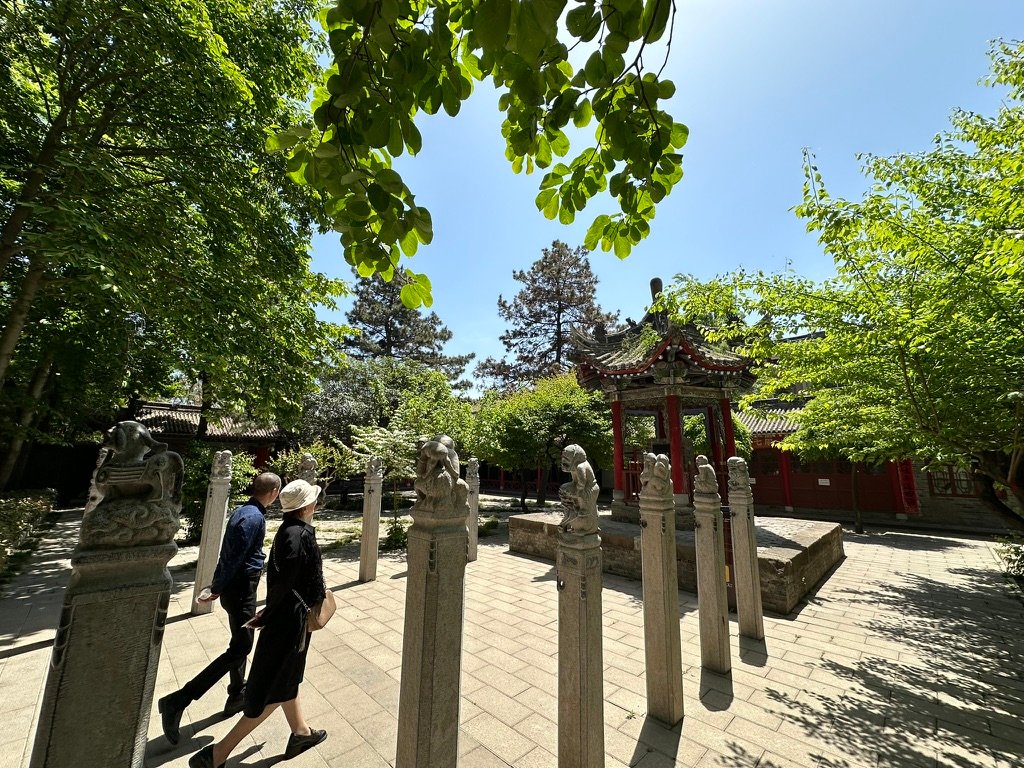
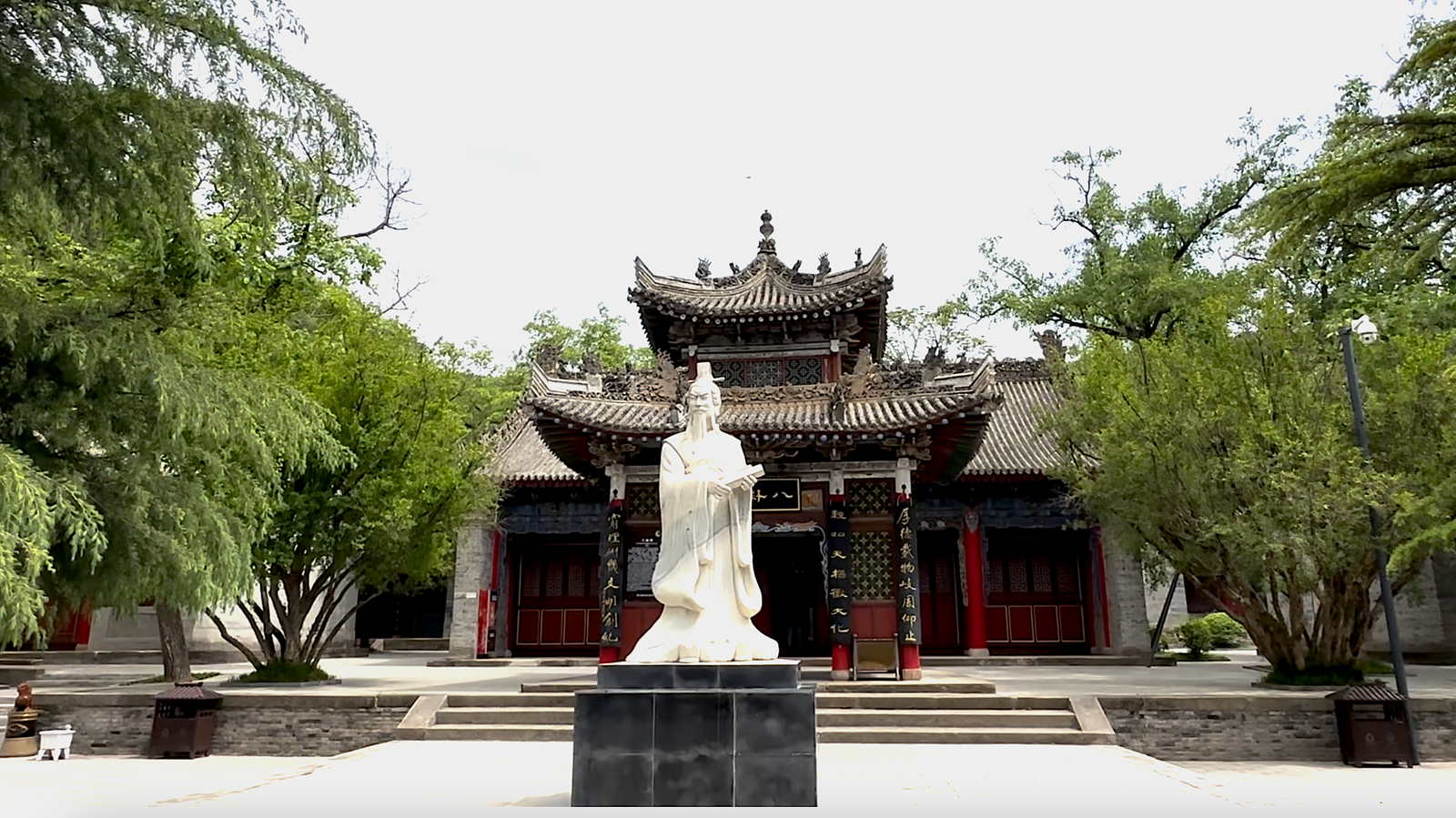
The approach is quiet.
Trees.
Stone paths.
Traditional gates.
Red columns.
Covered corridors.
Then the courtyard opens.
And there he is:
Duke of Zhou (周公, Zhōugōng).
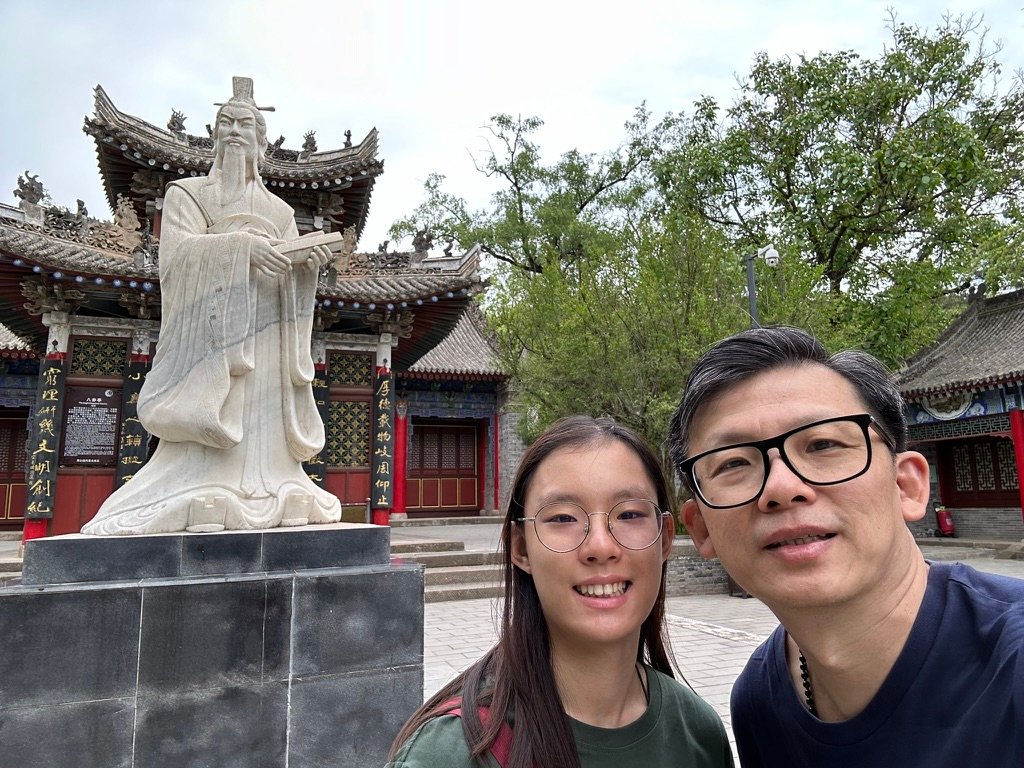
Dad & Elaine at Zhougong Temple (周公庙, Zhōugōng Miào) in Qishan (岐山, Qíshān). The statue of Duke of Zhou (周公, Zhōugōng) stands inside the temple complex associated with his memory.
Dad could have taken the photograph…
said:
“Ancient Chinese statesman.”
and moved on.
😂
But then we went inside.
😳 The Exhibition Calls Him “The Great Sage”
Inside the temple, Dad found an exhibition devoted to Zhougong.
And right at the entrance were the words:
元圣 (Yuánshèng)
The Great Sage
and:
周公史迹展
Zhōugōng Shǐjì Zhǎn
Historical Exhibition of the Duke of Zhou
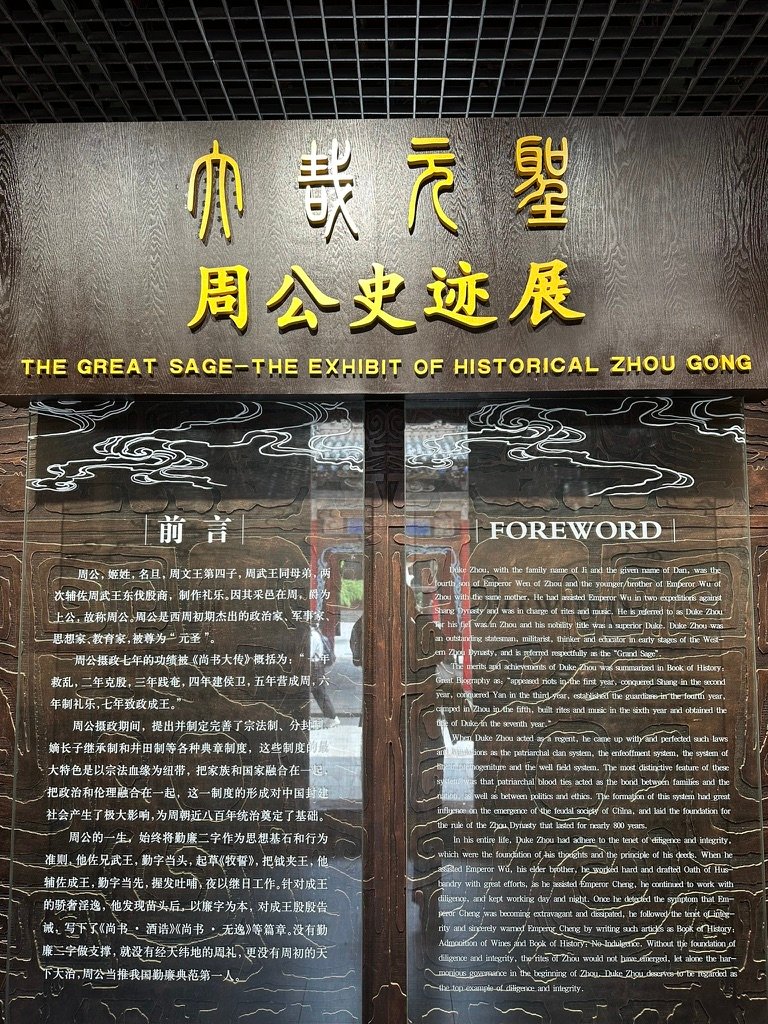
The exhibition at Zhougong Temple (周公庙, Zhōugōng Miào) introduces Duke of Zhou (周公, Zhōugōng) as 元圣 (Yuánshèng) — “The Great Sage.”
That stopped Dad.
Because now the question wasn’t:
“Who was Zhougong?”
It was:
“WHAT DID THIS MAN DO FOR LATER GENERATIONS TO REMEMBER HIM LIKE THAT?”
🔥
That’s the rabbit this article follows.
❤️ Why Should an International Traveler Care?
Because the story of Duke of Zhou (周公, Zhōugōng) isn’t really about memorizing another ancient Chinese name.
His story opens questions that are surprisingly easy to understand today.
What happens:
AFTER YOU WIN A WAR AND REPLACE THE OLD RULERS?
How does a new political order become:
LEGITIMATE?
What happens when:
A YOUNG KING INHERITS THE THRONE?
And what should someone with enormous political power do when that power:
ISN’T ACTUALLY HIS?
Later Chinese tradition would also connect Zhougong with much bigger ideas about:
virtue,
government,
ritual,
music,
family,
and:
social order.
Now Dad’s Political Science brain is awake.
😂
But first…
we need a very small Coat Rack.
Where Are We? — Dad’s Small Coat Rack
Don’t memorize another 30 dates.
Keep only this:
SHANG DYNASTY (商朝, Shāng Cháo)
is ruling.
↓
A regional Zhou power becomes stronger.
↓
KING WEN OF ZHOU (周文王, Zhōu Wénwáng)
helps prepare the rise of Zhou.
↓
His son:
KING WU OF ZHOU (周武王, Zhōu Wǔwáng)
leads the Zhou conquest of:
Shang (商, Shāng).
↓
The decisive conquest is traditionally dated around:
1046 BCE.
↓
ZHOU DYNASTY (周朝, Zhōu Cháo)
begins.
And standing very close to this enormous transition is:
DUKE OF ZHOU (周公, Zhōugōng).
🔥
🐇 Need the Bigger Coat Rack? Why the Zhou Dynasty (周朝, Zhōu Cháo) Matters So Much to Chinese History →
Dad has already built the bigger Zhou story there.
Here we’re following:
ONE MAN.
And one enormous problem.
Because defeating the old dynasty was only:
THE BEGINNING.
The much harder question was:
HOW DO YOU MAKE THE NEW ORDER SURVIVE?
That’s where Zhougong’s story really starts.
👨👦 So Who Was the Duke of Zhou (周公, Zhōugōng)?
The man later remembered as:
Duke of Zhou (周公, Zhōugōng)
was:
Ji Dan (姬旦, Jī Dàn).
He belonged to the Zhou royal family.
He was a son of:
King Wen of Zhou (周文王, Zhōu Wénwáng)
and a younger brother of:
King Wu of Zhou (周武王, Zhōu Wǔwáng).
Then comes the next generation:
King Cheng of Zhou (周成王, Zhōu Chéngwáng)
— King Wu’s son and successor.
Dad’s family Coat Rack:
KING WEN OF ZHOU (周文王, Zhōu Wénwáng)
↓
KING WU OF ZHOU (周武王, Zhōu Wǔwáng)
son
↓
KING CHENG OF ZHOU (周成王, Zhōu Chéngwáng)
grandson
And standing beside that succession:
DUKE OF ZHOU (周公, Zhōugōng)
King Wu’s younger brother
Enough family tree.
😂
⚔️ King Wu of Zhou (周武王, Zhōu Wǔwáng) Won — Then Came the Hard Part
The Zhou forces defeated the:
Shang Dynasty (商朝, Shāng Cháo)
in the conquest traditionally associated with the:
Battle of Muye (牧野之战, Mùyě Zhī Zhàn).
That was an enormous achievement.
But Dad’s Political Science handrail is:
WINNING POWER AND CONSOLIDATING POWER ARE TWO DIFFERENT THINGS.
🔥
The Zhou had defeated the old ruling house.
That did not mean:
former Shang elites disappeared,
regional powers automatically became loyal,
political opposition vanished,
or:
everybody suddenly accepted Zhou rule.
Then another problem arrived.
KING WU OF ZHOU (周武王, Zhōu Wǔwáng) DIED.
His successor:
King Cheng of Zhou (周成王, Zhōu Chéngwáng)
was young.
Now the new Zhou political order was vulnerable.
🏺 Dad Likes It Better When an Object Joins the Story
This transition isn’t known only through stories written centuries later.
One famous early bronze is:
Li Gui (利簋, Lì Guǐ).
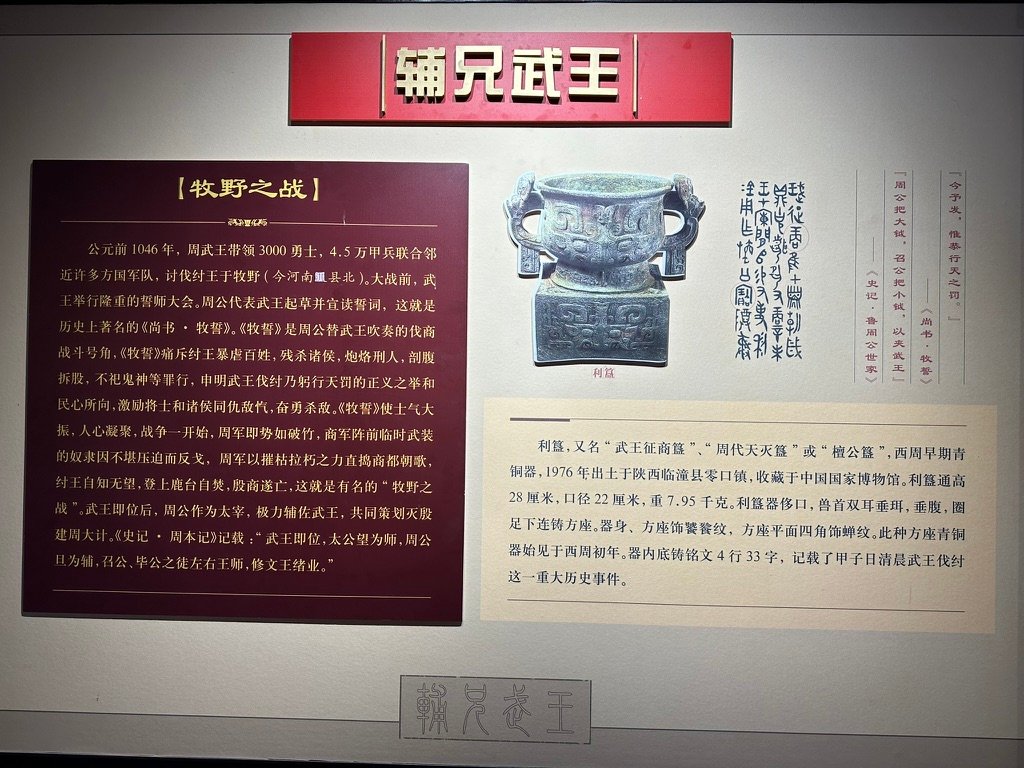
The Zhougong Temple (周公庙, Zhōugōng Miào) exhibition uses the Li Gui (利簋, Lì Guǐ) while explaining King Wu of Zhou’s (周武王, Zhōu Wǔwáng) conquest of Shang (商, Shāng). Its early Western Zhou (西周, Xī Zhōu) inscription gives historians important evidence connected with the conquest.
Dad likes this because it gives us:
TEXT + OBJECT + PLACE.
Later texts preserve historical memory.
Bronze inscriptions give us another kind of evidence.
Archaeology gives us physical remains.
And Zhougong Temple (周公庙, Zhōugōng Miào) shows us how the story continued to be remembered.
Different evidence.
Different jobs.
Don’t throw everything into the same wok.
😂🍳
🏺 Follow the Bronzes to Baoji (宝鸡, Bǎojī) — Into the China Before Qin Shi Huang (秦始皇, Qín Shǐ Huáng) →
Dad & Elaine had already encountered the early Zhou world through:
bronzes,
inscriptions,
and:
museum displays
at Baoji (宝鸡, Bǎojī).
One bronze opened an especially big rabbit:
🐇 He Zun (何尊, Hé Zūn) — The 3,000-Year-Old Bronze That Bears the Characters 中国 (Zhōngguó) →
The museum gave us:
OBJECTS.
Then Dad & Elaine went looking for:
THE LANDSCAPE.
🗺️ Walk Through the Zhou Homeland — Qishan (岐山, Qíshān) & Zhouyuan (周原, Zhōuyuán) →
At:
Qishan (岐山, Qíshān)
and:
Zhouyuan (周原, Zhōuyuán)
the early Zhou story stopped being only something inside a museum case.
Mountains.
Plain.
Archaeological sites.
Temple.
Landscape.
🔥
The objects had somewhere to belong.
😳 Then Duke of Zhou (周公, Zhōugōng) Stepped Into the Crisis
After King Wu of Zhou (周武王, Zhōu Wǔwáng) died, later tradition remembers:
Duke of Zhou (周公, Zhōugōng)
taking a central political role while:
King Cheng of Zhou (周成王, Zhōu Chéngwáng)
was young.
And immediately Dad has a problem.
😂
Think about it.
A young king.
A powerful uncle.
A newly conquered realm.
Political enemies.
Uncertain loyalties.
Now give the uncle:
ENORMOUS POWER.
What could possibly go wrong?
😂🔥
⚠️ And Things DID Go Wrong
The early Zhou faced serious rebellion and resistance.
Later accounts associate this crisis particularly with the:
Rebellion of the Three Guards (三监之乱, Sānjiān Zhī Luàn)
and remaining Shang-aligned forces.
The new dynasty had won the conquest…
but still had to:
MAKE THE VICTORY STICK.
🔥
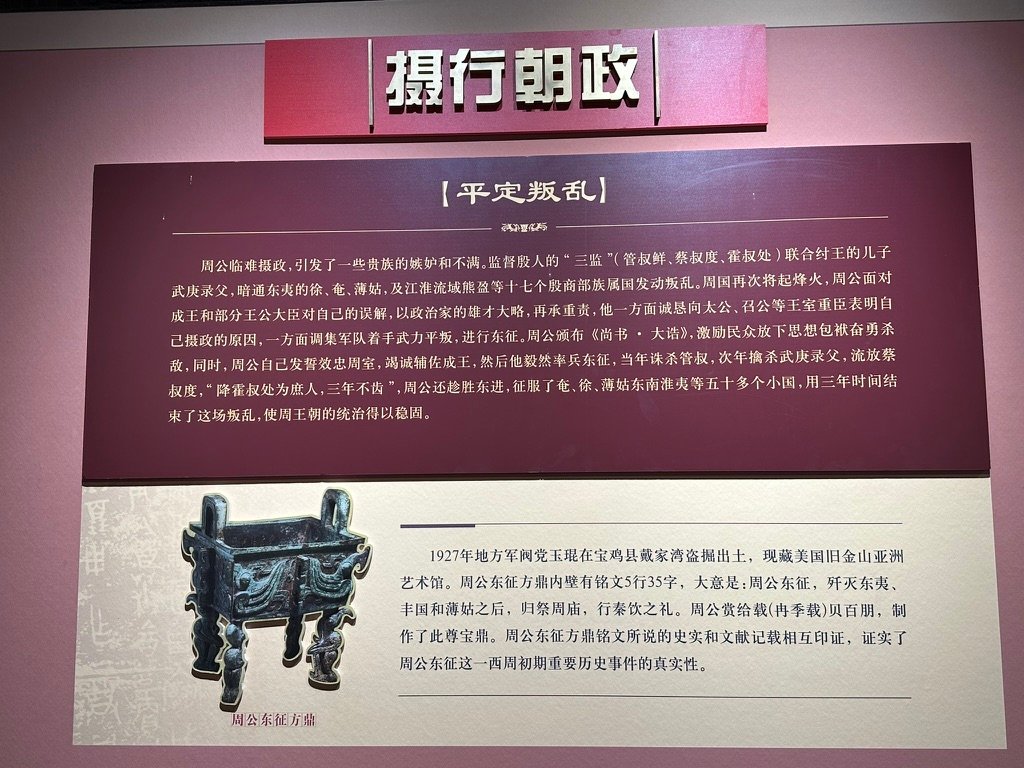
The exhibition at Zhougong Temple (周公庙, Zhōugōng Miào) presents Duke of Zhou (周公, Zhōugōng) as a central figure in the dangerous period after King Wu’s death, when the new Zhou order still had to be consolidated.
Notice Dad’s wording:
“THE EXHIBITION PRESENTS…”
That’s deliberate.
Because Zhougong accumulated an enormous later reputation.
We need to distinguish:
early evidence,
later historical accounts,
and:
later cultural memory.
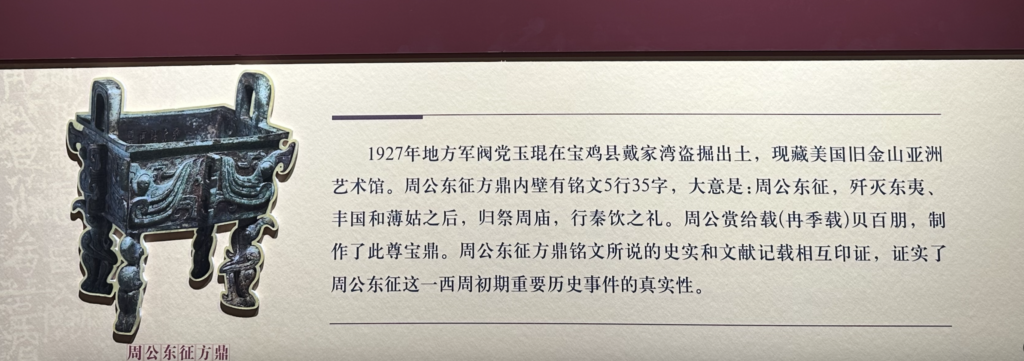
📸 Dad photographed this information board inside Zhougong Temple (周公庙, Zhōugōng Miào). It introduces the Zhougong Eastern Campaign Fangding (周公东征方鼎, Zhōugōng Dōngzhēng Fāngdǐng).
What the board is telling us
According to the exhibition, the bronze was unearthed in 1927 at Dai Family Bay (戴家湾, Dàijiāwān), Baoji County (宝鸡县, Bǎojī Xiàn) by the local warlord Dang Yukun (党玉琨, Dǎng Yùkūn) and is now held by the Asian Art Museum in San Francisco.
The board says the vessel contains an inscription of:
5 lines — 35 characters.
It interprets the inscription as referring to Duke of Zhou’s Eastern Campaign (周公东征, Zhōugōng Dōngzhēng), the defeat of eastern opponents including Dongyi (东夷, Dōngyí), Feng (丰, Fēng) and Pugu (薄姑, Púgū), followed by a return to the Zhou ancestral temple for ritual.
The exhibition argues that the bronze inscription and transmitted historical records corroborate one another, supporting the historicity of Zhougong’s eastern campaign as an important event of the early Western Zhou (西周, Xī Zhōu).
🔥 Dad’s handrail:
TEXT → BRONZE INSCRIPTION → HISTORY
We are no longer looking only at a much later story about Zhougong.
We are looking at an ancient inscribed bronze that the exhibition connects directly with the political struggle to consolidate the new Zhou order.
Evidence brake: that final historical interpretation is the exhibition’s argument. ChinaTravelBUG keeps the distinction between what the ancient inscription itself says, how later texts describe the events, and how modern historians and exhibitions interpret the two together.
🧠 Dad’s Political Science Handrail
This is where Zhougong becomes interesting beyond ancient China.
The problem is universal:
REGIME CHANGE
is not the same as:
POLITICAL CONSOLIDATION.
A new ruler still needs:
authority,
loyal institutions,
regional cooperation,
political legitimacy,
and:
some way of making the new order feel durable.
So Dad’s better question isn’t:
“Was Zhougong a good man?”
Too early.
The better question is:
“WHAT DID THE EARLY ZHOU HAVE TO BUILD AFTER THEY HAD ALREADY WON?”
🔥
That question takes us toward:
regional rule,
political legitimacy,
ritual,
institutions,
and eventually:
the cultural memory surrounding Zhougong.
😳 But Dad Still Has the Obvious Question
According to later tradition, Duke of Zhou (周公, Zhōugōng) held enormous political responsibility during the young king’s reign.
So Dad asks:
“DID HE KEEP THE POWER?”
Because history has plenty of:
regents,
uncles,
generals,
and:
ministers
who discover that temporary power is rather comfortable.
😂
But one of the most important episodes in the later memory of Zhougong is:
还政成王
Huánzhèng Chéngwáng
Returning Government to King Cheng
🔥
HOW TO TAKE RESPONSIBILITY DURING A CRISIS
to:
WHAT LEGITIMATE POWER IS SUPPOSED TO LOOK LIKE.
And that’s next.
👑 Section 2 — He Had Power. Did He Give It Back?
Dad ended the last section with a simple question.
Duke of Zhou (周公, Zhōugōng) had taken enormous responsibility during a dangerous political crisis.
The:
Shang Dynasty (商朝, Shāng Cháo)
had been defeated.
King Wu of Zhou (周武王, Zhōu Wǔwáng)
had died.
The new king:
King Cheng of Zhou (周成王, Zhōu Chéngwáng)
was young.
And Zhougong stood close to the center of power.
So Dad’s question was:
“DID HE GIVE THE POWER BACK?”
According to the later tradition presented at Zhougong Temple (周公庙, Zhōugōng Miào):
YES.
🔄 还政成王 (Huánzhèng Chéngwáng) — Returning Government to King Cheng
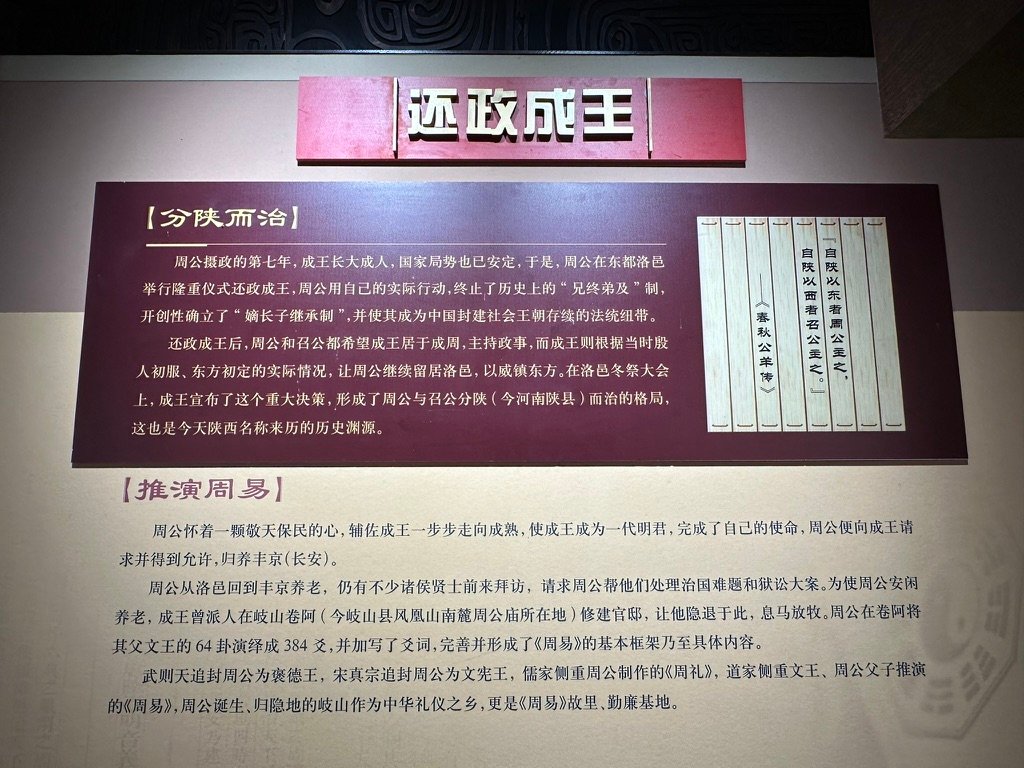
Dad’s photo inside Zhougong Temple (周公庙, Zhōugōng Miào). The exhibition section 还政成王 (Huánzhèng Chéngwáng) presents one of the defining episodes in the later memory of Duke of Zhou (周公, Zhōugōng): returning political authority to King Cheng of Zhou (周成王, Zhōu Chéngwáng).
The exhibition says that after several years of regency, once:
King Cheng of Zhou (周成王, Zhōu Chéngwáng)
had grown older and the political situation had stabilized, Zhougong returned authority to him.
🔥
For later generations, that mattered.
Because Zhougong wasn’t remembered simply as:
a powerful uncle.
He became an example of someone who could:
HOLD POWER
without making that power permanently:
HIS OWN.
🧠 Dad’s Political Science Handrail — Power vs. Legitimacy
This is where Dad thinks international readers can understand Zhougong without knowing much Chinese history.
Imagine a regent saying:
“The king is young. I’ll govern temporarily.”
Fine.
But then:
the regent commands armies,
defeats rebellions,
influences appointments,
helps reorganize territory,
and:
becomes extremely powerful.
Now comes the real test.
WHEN DOES “TEMPORARY” END?
😂
Later Chinese tradition made Zhougong’s willingness to return authority part of his reputation for:
loyalty,
restraint,
and:
legitimate government.
But Dad’s evidence brake stays on.
We are describing:
HOW ZHOUGONG WAS REMEMBERED.
That isn’t automatically the same thing as having a day-by-day political record from around 3,000 years ago.
🗺️ But Stabilizing Zhou Required More Than Returning the Throne
The early Zhou still faced a much bigger practical problem.
How do you govern:
A LARGE TERRITORY
without:
modern communications,
trains,
telephones,
bureaucratic ministries,
or:
Dad’s beloved high-speed rail (高铁, Gāotiě)?
😂
One answer associated with the early Zhou political order was:
封建 (Fēngjiàn)
— establishing regional domains under members of the royal family and other important allies.
This was not the same thing as medieval European feudalism, even though English-language books sometimes use the word “feudal” as a rough translation.
Think instead:
THE ZHOU KING COULD NOT PERSONALLY GOVERN EVERYWHERE.
So political authority was distributed through relationships involving:
kinship,
loyalty,
land,
rank,
and:
obligations to the Zhou king.
🏯 Zhougong’s Political World Spread Outward
This matters enormously for Dad’s DEEP China Coat Rack.
Because once you understand this early Zhou political landscape…
other places Dad & Elaine visited begin clicking into position.
One of those was:
Jin (晋, Jìn).
Later tradition connects the founding of the State of Jin (晋国, Jìnguó) with another member of the Zhou royal family:
Tang Shuyu (唐叔虞, Táng Shūyú)
— a younger brother of:
King Cheng of Zhou (周成王, Zhōu Chéngwáng).
Wait — Why Is He Called Tang Shuyu (唐叔虞, Táng Shūyú) If He Belonged to the Zhou Royal Family?
Dad asked exactly this.
😂
Elaine helped Dad untangle it.
Tang (唐, Táng) WASN’T HIS SURNAME.
Tang Shuyu belonged to the Zhou royal:
Ji clan (姬姓, Jī Xìng).
After he was enfeoffed in a territory called:
Tang (唐, Táng),
he became known as:
Tang Shuyu (唐叔虞, Táng Shūyú)
— essentially, “Shuyu of Tang.”
According to the traditional account, his son:
Xie (燮, Xiè)
later changed the state’s name from:
Tang (唐, Táng)
to:
Jin (晋, Jìn).
🔥
That’s the connection Dad couldn’t see at first:
ZHOU ROYAL FAMILY
↓
TANG SHUYU (唐叔虞, Táng Shūyú)
↓
TANG (唐, Táng)
↓
JIN (晋, Jìn)
↓
JINCI (晋祠, Jìncí)
Then Elaine explained it…
and Dad’s Coat Rack finally clicked.
😂
And Dad & Elaine eventually followed that rabbit all the way to:
Jinci (晋祠, Jìncí)
outside Taiyuan (太原, Tàiyuán).
😂🐇
🐇 Follow the Zhou Political World to Jinci (晋祠, Jìncí) — Where the Story of Jin (晋, Jìn) Begins →
Suddenly:
Qishan,
Zhougong,
King Cheng,
Tang Shuyu,
Jin,
and:
Jinci
aren’t separate history lessons anymore.
They’re connected.
🔥
🏛️ And Zhougong Wasn’t Doing Everything Alone
This is another useful correction.
Dad doesn’t want Zhougong turning into:
Ancient Chinese Superman.
😂
At Zhougong Temple (周公庙, Zhōugōng Miào), Dad also found:
Shao Gong Hall (召公殿, Shàogōng Diàn).
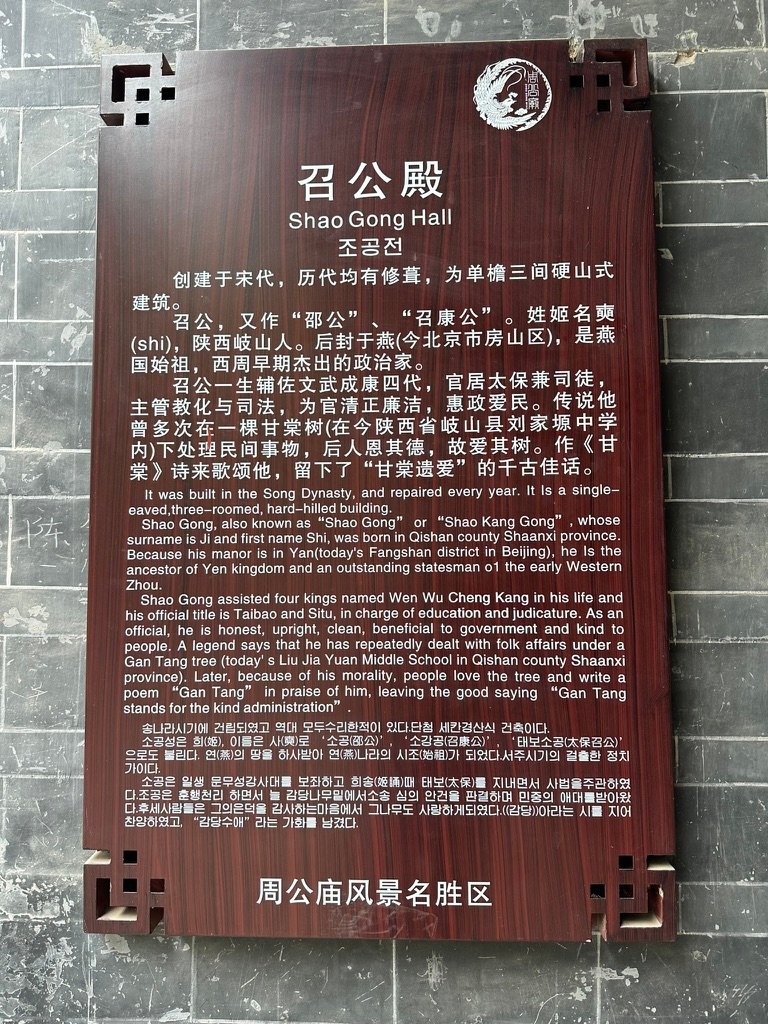
Shao Gong Hall (召公殿, Shàogōng Diàn) inside the Zhougong Temple complex. The information board presents Shao Gong (召公, Shàogōng) as another important statesman of the early Western Zhou (西周, Xī Zhōu).
The point isn’t that Dad now needs another biography.
Please…
NO NEW RABBIT YET.
😂
The point is simpler:
The early Zhou political order wasn’t created by:
ONE MAN.
Zhougong became enormously important in later memory.
But he operated inside a larger world of:
kings,
royal relatives,
military leaders,
regional allies,
and:
other senior statesmen.
That’s a healthier way to understand him.
Dad’s Second Zhougong Sting
So far, Zhougong’s story has moved through:
WAR
↓
POLITICAL CRISIS
↓
REBELLION
↓
CONSOLIDATION
↓
RETURNING AUTHORITY
↓
BUILDING A WIDER POLITICAL ORDER.
But this still doesn’t fully explain why later generations called him:
元圣 (Yuánshèng)
The Great Sage.
Winning rebellions doesn’t explain it.
Returning power doesn’t completely explain it.
Even helping organize a new political order doesn’t completely explain it.
The bigger answer lies in what later Chinese tradition associated with Zhougong:
德 (Dé)
virtue
礼 (Lǐ)
ritual / proper order
乐 (Yuè)
music
and:
廉 (Lián)
integrity in government.
🔥
And Dad photographed an entire exhibition trying to explain exactly that.
That’s where we’re going next.
🧠 Section 3 — Winning Wasn’t Enough. How Should You Govern?
By now Dad understood part of the reason:
Duke of Zhou (周公, Zhōugōng)
became such a powerful figure in later Chinese memory.
But something still didn’t add up.
China has had:
successful generals,
powerful ministers,
regents,
and:
dynasty-builders
by the hundreds.
Most were never called:
元圣 (Yuánshèng)
The Great Sage.
So Dad kept walking through the exhibition.
And another Zhougong began appearing.
Not simply:
ZHOUGONG THE STATESMAN.
But:
ZHOUGONG AS A MODEL OF HOW POWER SHOULD BE USED.
🔥
德治天下 (Dé Zhì Tiānxià) — Govern All Under Heaven Through Virtue
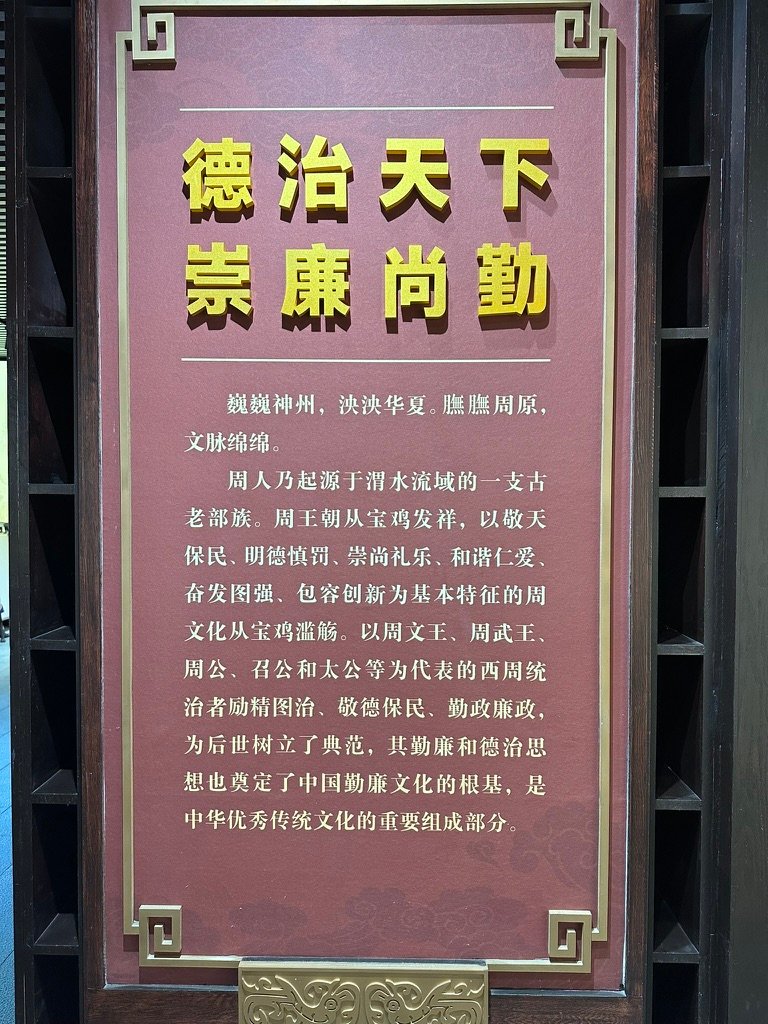
Dad’s photo inside Zhougong Temple (周公庙, Zhōugōng Miào). The exhibition presents 德治天下 (Dé Zhì Tiānxià) — governing All Under Heaven through virtue — as an important part of the political tradition associated with Duke of Zhou (周公, Zhōugōng).
This is where international travelers need a handrail.
The Chinese word:
德 (Dé)
can mean:
virtue,
moral character,
or:
ethical conduct.
And:
天下 (Tiānxià)
literally means:
“All Under Heaven.”
It was an ancient way of imagining the wider political and moral world.
So the basic idea is powerful:
HAVING POWER ISN’T ENOUGH.
HOW YOU USE IT MATTERS.
🔥
👥 以民为本 (Yǐ Mín Wéi Běn) — Take the People as the Foundation
Dad then encountered another recurring idea:
以民为本 (Yǐ Mín Wéi Běn)
roughly:
“Take the people as the foundation.”
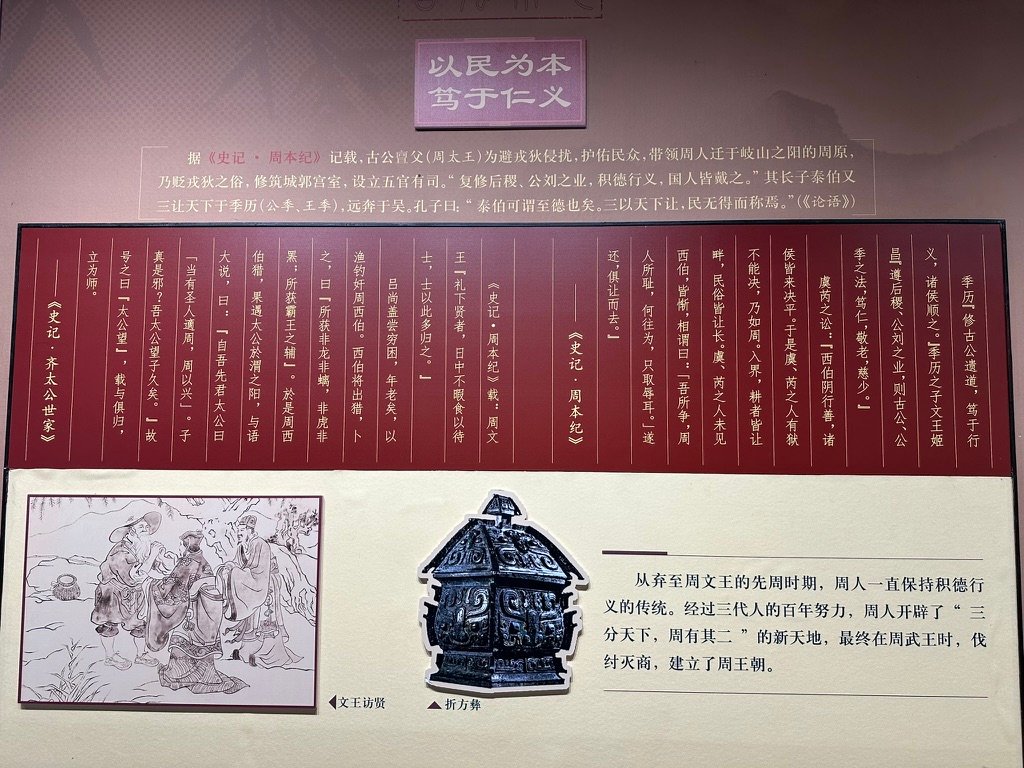
The exhibition connects the Zhou political tradition with concern for the people, agriculture, livelihood and benevolent government.
Now — evidence brake.
Don’t translate this into:
“Ancient Zhou democracy.”
😂
It wasn’t.
The king remained king.
Hierarchy remained hierarchy.
But this is still important.
The language of legitimate rule could involve a ruler’s responsibility toward:
THE PEOPLE BEING RULED.
Dad’s Political Science handrail:
Ancient Chinese political thought was not modern democracy.
But neither was legitimate government always imagined simply as:
“I have power, therefore I am right.”
🔥
That distinction matters.
🎵 制礼作乐 (Zhì Lǐ Zuò Yuè) — Wait… Rites AND Music?
Then Dad reached one of the ideas most strongly associated in later tradition with:
Duke of Zhou (周公, Zhōugōng).
制礼作乐 (Zhì Lǐ Zuò Yuè)
Literally:
establishing rites
and:
making/ordering music.
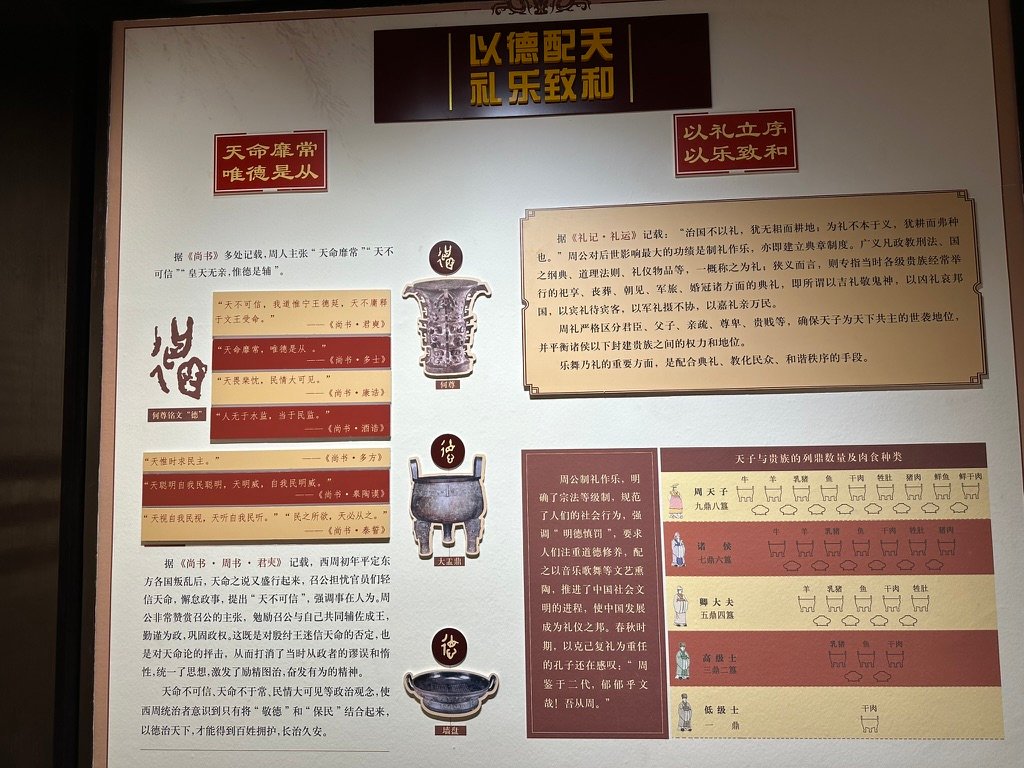
At first an international traveler might understandably think:
“Okay… ceremonies and songs?”
😂
No.
Think bigger.
礼 (Lǐ)
was about:
ritual,
proper conduct,
relationships,
rank,
ceremonies,
and:
social expectations.
And:
乐 (Yuè)
wasn’t simply entertainment.
Music could form part of ritual and political order.
So Dad’s Western handrail is:
THINK SOCIAL ORDER.
Who stands where?
Who owes what to whom?
How should:
ruler and minister,
parent and child,
elder and younger,
different ranks,
and:
different communities
relate to one another?
Ritual makes an abstract hierarchy:
SOMETHING PEOPLE ACTUALLY PERFORM.
🔥
🎼 Why Would Music Matter to Government?
This sounded strange to Dad too.
😂
But think about what ritual music can do.
It creates:
shared ceremonies,
shared symbols,
expected behavior,
emotional unity,
and:
visible order.
So:
礼乐 (Lǐyuè)
rites and music
became much bigger than:
“ancient etiquette.”
They belonged to a way of thinking about:
HOW SOCIETY HOLDS TOGETHER.
And centuries later…
someone Dad & Elaine would eventually follow to:
Qufu (曲阜, Qūfù)
would care enormously about:
礼 (Lǐ).
His name was:
Confucius (孔子, Kǒngzǐ).
🐇
Don’t follow that rabbit yet.
We’ll get there.
🧹 廉能并重,以廉为本 (Lián Néng Bìngzhòng, Yǐ Lián Wéi Běn)
Then Dad found the photograph we nearly lost our minds over.
😂😂😂
This one:
廉能并重
Lián Néng Bìngzhòng
Integrity and ability should both matter
and:
以廉为本
Yǐ Lián Wéi Běn
Take integrity as the foundation
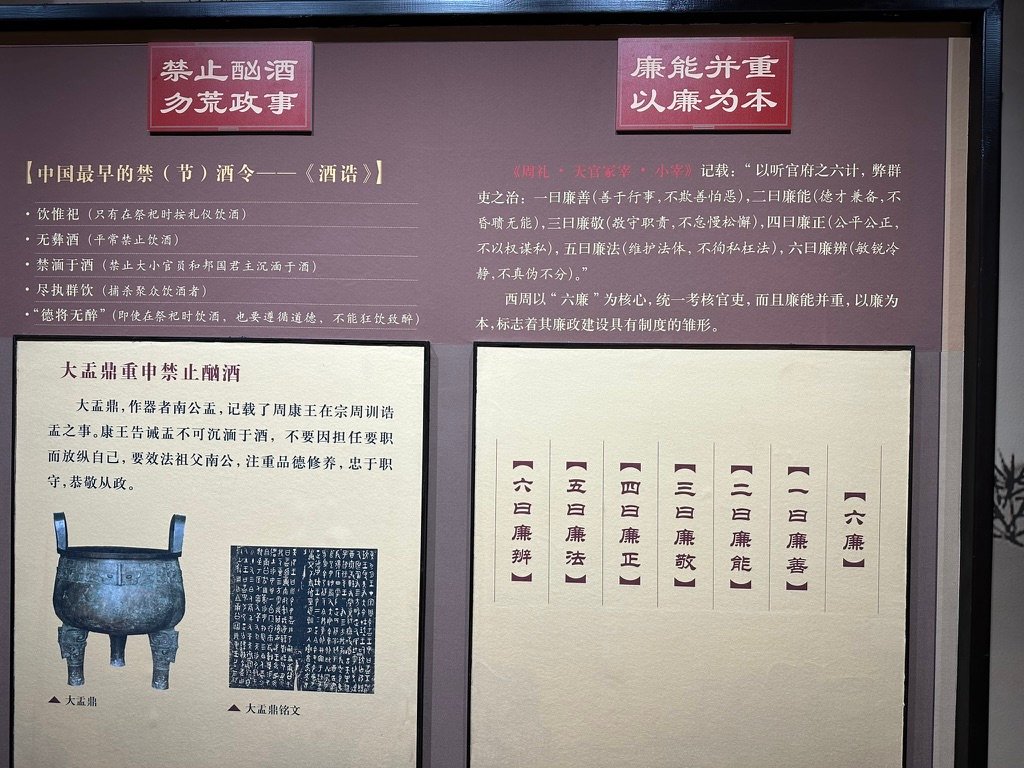
The exhibition presents a set of:
六廉 (Liù Lián)
Six standards of integrity
for evaluating officials.
They are displayed as:
廉善 (Liánshàn)
goodness in conduct
廉能 (Liánnéng)
competence
廉敬 (Liánjìng)
respectfulness / diligence
廉正 (Liánzhèng)
uprightness
廉法 (Liánfǎ)
observance of law
廉辨 (Liánbiàn)
discernment.
🔥
Dad likes this because it raises another very old question that doesn’t feel old at all:
WHAT MAKES SOMEONE FIT TO HOLD PUBLIC OFFICE?
Competence?
Character?
Integrity?
Judgment?
Respect for law?
Apparently Dad’s Political Science class has started again.
😂
🍷 And Look at the Other Half of Dad’s Photo
Don’t miss the left side.
The exhibition discusses restrictions on:
酗酒 (Xùjiǔ)
excessive drinking
and warns against allowing drinking to interfere with:
政事 (Zhèngshì)
affairs of government.
😂
Dad did not expect to walk into a 3,000-year Zhou rabbit and encounter:
“Don’t get drunk and neglect your government job.”
But there it was.
🔥
Again, ChinaTravelBUG‘s evidence brake matters.
Dad isn’t claiming every regulation displayed here can be traced straightforwardly to one historical man named Zhougong.
What matters is:
HOW LATER CHINESE POLITICAL TRADITION REMEMBERED AND USED THE ZHOU WORLD.
⚠️ Dad’s Evidence Brake — Don’t Turn Zhougong Into Superman
This section is important.
Later tradition attributed an enormous amount to:
Duke of Zhou (周公, Zhōugōng).
Political institutions.
Ritual.
Music.
Ethics.
Government.
Ideas about virtue.
Ideas about officials.
And much more.
That does not mean Dad should write:
“Zhougong personally invented all of this.”
Too neat.
Instead ChinaTravelBIUG keeps three Coat Rack hooks:
EARLY EVIDENCE
What bronzes, inscriptions and archaeology can tell us.
LATER TRADITION
What later texts remembered or attributed to Zhougong.
ZHOU GONG TEMPLE TODAY
How the modern exhibition presents his historical and cultural legacy.
🔥
Keeping those separate doesn’t make the story weaker.
It makes it:
MORE INTERESTING.
Because now Dad can ask a much bigger question:
WHY DID GENERATION AFTER GENERATION KEEP USING ZHOUGONG TO THINK ABOUT GOOD GOVERNMENT?
Dad’s Third Zhougong Sting
Now we are getting closer to why:
元圣 (Yuánshèng)
The Great Sage
appears above the exhibition entrance.
Zhougong’s later reputation wasn’t built only around:
WHAT HE DID.
It was also built around:
WHAT HE CAME TO REPRESENT.
德 (Dé)
virtue
民 (Mín)
the people
礼 (Lǐ)
ritual / proper order
乐 (Yuè)
music
廉 (Lián)
integrity.
🔥
And then something even more interesting happened.
Zhougong died.
The:
Western Zhou (西周, Xī Zhōu)
eventually ended.
Centuries passed.
But the ideas associated with this political and ritual world:
DIDN’T DISAPPEAR.
Later thinkers kept:
borrowing them,
arguing with them,
reinterpreting them,
and:
looking backward toward Zhou.
And one man did that so powerfully that Dad & Elaine eventually followed him all the way to:
Qufu (曲阜, Qūfù).
His name was:
Confucius (孔子, Kǒngzǐ).
🐇🔥
That’s next.
🐇 Section 4 — Zhougong Didn’t Stay in Qishan
By now Dad understood something important.
The historical:
Duke of Zhou (周公, Zhōugōng)
belonged to the early:
Western Zhou (西周, Xī Zhōu).
But his story didn’t end in:
Qishan (岐山, Qíshān).
Dad & Elaine later found his name again hundreds of kilometers away in:
Qufu (曲阜, Qūfù)
in Shandong Province (山东省, Shāndōng Shěng).
And this time…
Dad’s Coat Rack clicked.
😂
🏯 Wait — There’s a Zhougong Temple in Qufu Too?
Yes.
Qufu isn’t connected only with:
Confucius (孔子, Kǒngzǐ).
It also has a temple associated with:
Duke of Zhou (周公, Zhōugōng).
Why?
Because after the Zhou conquest, Zhougong was associated with the state of:
Lu (鲁国, Lǔguó).
His son:
Bo Qin (伯禽, Bó Qín)
was sent to govern Lu (鲁, Lǔ).
And its capital was in the area of:
Qufu (曲阜, Qūfù).
🔥
Suddenly Dad’s journey has geography:
QISHAN (岐山, Qíshān)
Zhougong’s early Zhou world
↓
LU (鲁国, Lǔguó)
the state associated with his lineage
↓
QUFU (曲阜, Qūfù)
capital of Lu
↓
centuries later…
CONFUCIUS (孔子, Kǒngzǐ)
was born into that same cultural landscape.
🐇🐇🐇
That’s a much better connection than:
“Confucius admired Zhougong.”
Dad & Elaine actually:
WALKED THE CONNECTION.
🎓 Follow Dad & Elaine to Qufu (曲阜, Qūfù) — Meet Confucius (孔子, Kǒngzǐ) in His Hometown →
In Qishan, Dad was asking:
Who was Zhougong?
In Qufu, the question became:
Why was his political and ritual world still important centuries later?
And that’s where:
Confucius (孔子, Kǒngzǐ)
enters our story.
🧭 Section 5 — How to Follow the Zhougong Rabbit Yourself
Dad wouldn’t suggest traveling all the way to:
Zhougong Temple (周公庙, Zhōugōng Miào)
just to tick:
“Zhougong Temple.”
That’s too small.
The better journey is:
FOLLOW THE ZHOU WORLD.
For Dad & Elaine, the pieces connected like this:
BAOJI (宝鸡, Bǎojī)
↓
QISHAN (岐山, Qíshān)
↓
ZHOUYUAN (周原, Zhōuyuán)
↓
ZHOUGONG TEMPLE (周公庙, Zhōugōng Miào).
That gives an international traveler:
OBJECTS → LANDSCAPE → PEOPLE → IDEAS.
🔥
🏺 Start With Baoji (宝鸡, Bǎojī) — Into the China Before Qin Shi Huang (秦始皇, Qín Shǐ Huáng) →
Dad & Elaine went west beyond:
Xi’an (西安, Xī’ān)
because Baoji (宝鸡, Bǎojī) gives you an excellent doorway into the world that existed long before:
Qin Shi Huang (秦始皇, Qín Shǐ Huáng).
At:
Baoji Bronze Ware Museum (宝鸡青铜器博物院, Bǎojī Qīngtóngqì Bówùyuàn)
you encounter:
bronzes,
inscriptions,
ritual vessels,
and:
the early Zhou world.
Dad’s preferred method:
MUSEUM FIRST.
Then:
LANDSCAPE.
Because once you’ve seen the objects…
you start asking:
“What kind of world produced these?”
🐇 Meet He Zun (何尊, Hé Zūn) — The 3,000-Year-Old Bronze Bearing the Characters 中国 (Zhōngguó) →
One object at the museum can easily sting you.
😂🐞
He Zun (何尊, Hé Zūn).
Inside its inscription appear the ancient characters:
中国 (Zhōngguó).
But don’t immediately translate that as:
“modern China.”
The ancient context is much more interesting.
One bronze.
Two familiar characters.
A completely different political world.
And suddenly Dad has another rabbit.
🗺️ Then Walk Through Qishan (岐山, Qíshān) & Zhouyuan (周原, Zhōuyuán) — Homeland of the Zhou →
Now leave the museum cases behind.
At:
Qishan (岐山, Qíshān)
and:
Zhouyuan (周原, Zhōuyuán)
the Zhou story gets:
GEOGRAPHY.
This is where:
archaeological sites,
ancient settlement landscapes,
Zhou ancestral traditions,
and:
Zhougong Temple (周公庙, Zhōugōng Miào)
begin connecting.
And this is where Dad strongly likes having:
a local driver
or:
a knowledgeable local guide.
The sites are spread out.
This is not:
“ZHOU DYNASTY THEME PARK — METRO EXIT A.”
😂
That’s part of the attraction.
🚆 Dad & Elaine Didn’t Even Take the Fast Train to Baoji 😂
International travelers can investigate the fastest rail option that suits their itinerary.
But Dad & Elaine’s actual journey was rather more memorable.
We started from:
Xianyang Railway Station (咸阳站, Xiányáng Zhàn)
and Elaine took her first:
green train (绿皮火车, Lǜpí Huǒchē).
Then we discovered…
WE HAD NO SEATS.
😂
That’s another story.
🚆 Elaine’s First Green Train in China — Then We Discovered We Had No Seats! →
So no — Dad isn’t saying:
“You must copy our transport.”
😂
The lesson is simpler:
GET TO BAOJI.
Then give yourself enough time to go beyond Baoji into the wider Zhou landscape.
⏰ Don’t Rush This Journey
If you’re seriously interested in:
Chinese history,
archaeology,
bronzes,
or:
early Chinese civilization…
Dad would not turn this into:
Xi’an → museum → Zhougong Temple → back to Xi’an → collapse.
😂
Stay around:
Baoji (宝鸡, Bǎojī).
Use it to connect the museum with:
Qishan (岐山, Qíshān),
Zhouyuan (周原, Zhōuyuán),
and:
Zhougong Temple (周公庙, Zhōugōng Miào).
Dad’s rule:
SEE LESS.
CONNECT MORE.
🔥
🧠 Then Put Everything on the Bigger Zhou Coat Rack →
Once you’ve encountered:
King Wen of Zhou (周文王, Zhōu Wénwáng),
King Wu of Zhou (周武王, Zhōu Wǔwáng),
King Cheng of Zhou (周成王, Zhōu Chéngwáng),
Duke of Zhou (周公, Zhōugōng),
He Zun (何尊, Hé Zūn),
and:
Zhouyuan (周原, Zhōuyuán)…
don’t try to keep every fact floating separately.
Hang them on the bigger:
ZHOU DYNASTY (周朝, Zhōu Cháo)
Coat Rack.
That’s when later Chinese history starts becoming much easier to follow.
🐞 ChinaTravelBUG’s Take
Dad entered:
Zhougong Temple (周公庙, Zhōugōng Miào)
expecting another historical site.
Instead, one man opened several questions.
How does a new political order survive after winning?
What makes power:
LEGITIMATE?
Should someone who governs have:
CHARACTER
as well as:
ABILITY?
Why did later Chinese tradition connect government with:
virtue (德, Dé),
ritual (礼, Lǐ),
music (乐, Yuè),
and:
integrity (廉, Lián)?
Dad doesn’t think every later claim about Zhougong should automatically be treated as literal biography.
Keep separating:
HISTORY
from:
TRADITION
from:
CULTURAL MEMORY.
That’s part of understanding China too.
📸 Then Dad Found Zhougong Again — In Qufu (曲阜, Qūfù)
📸 [INSERT DAD’S PHOTO OF ZHOUGONG TEMPLE (周公庙, Zhōugōng Miào) IN QUFU HERE]
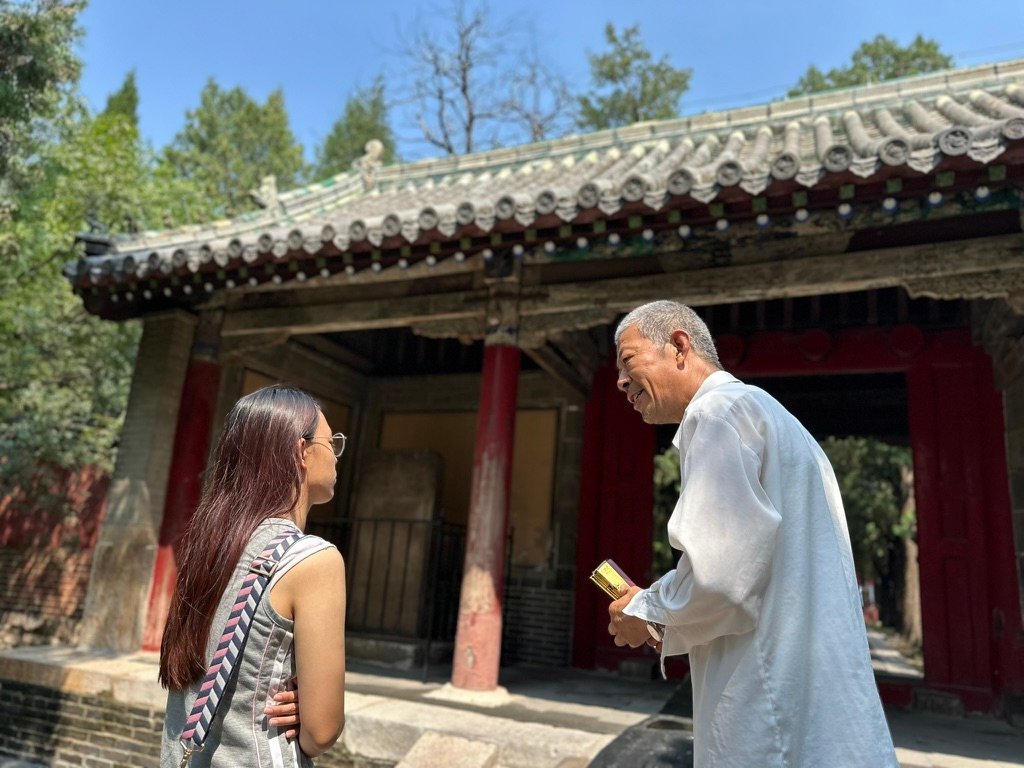
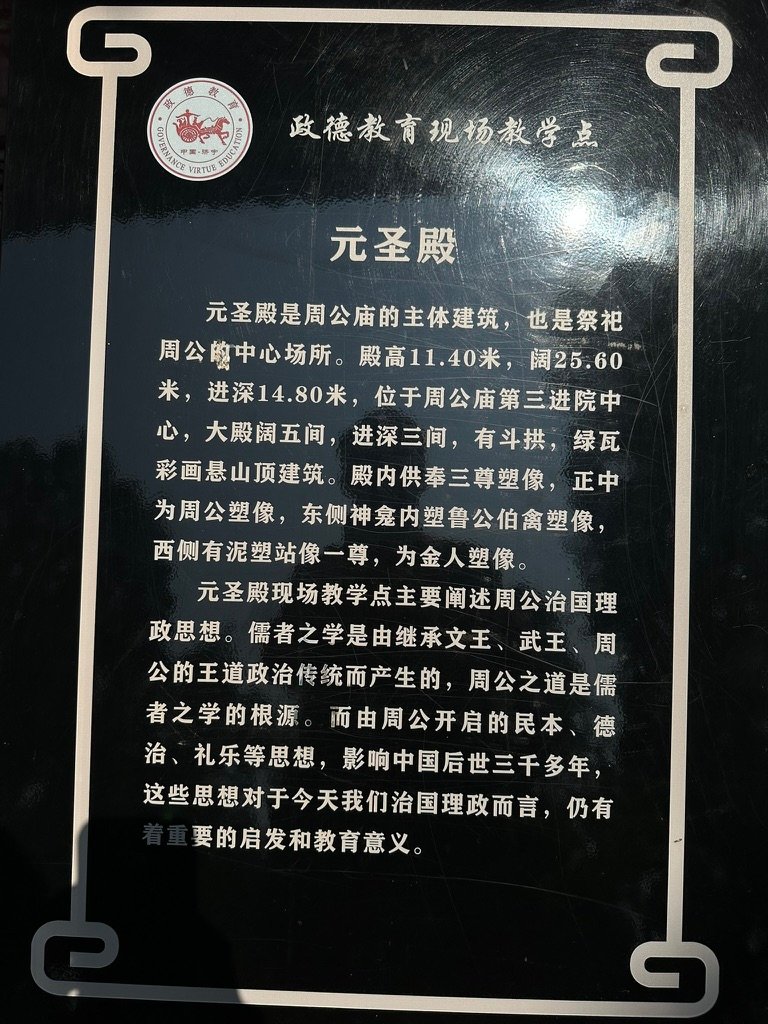
📸 Two moments at Zhougong Temple (周公庙, Zhōugōng Miào) in Qishan (岐山, Qíshān).
In the first photo, Elaine is listening to a local guide outside one of the historic halls. This is how many of Dad’s DEEP China rabbits begin — not with a textbook, but with someone pointing at a place and explaining why it matters.
The second photo is the information board for:
元圣殿 (Yuánshèng Diàn)
Hall of the Great Sage
The board identifies it as the principal building of Zhougong Temple and the central place for honoring Duke of Zhou (周公, Zhōugōng).
More interestingly, the board presents the later Confucian (儒家, Rújiā) tradition as inheriting the political tradition associated with King Wen of Zhou (周文王, Zhōu Wénwáng), King Wu of Zhou (周武王, Zhōu Wǔwáng) and Zhougong.
It highlights ideas associated with Zhougong including:
民本 (Mínběn) — concern for the people as a foundation of government
德治 (Dézhì) — government through virtue
礼乐 (Lǐyuè) — rites and music
🔥
For Dad, this gives us the bridge:
QISHAN — ZHOUGONG
↓
THE ZHOU POLITICAL & RITUAL TRADITION
↓
CONFUCIUS
↓
QUFU
Dad & Elaine would later walk that connection for ourselves.
🎓 Follow Dad & Elaine to Qufu (曲阜, Qūfù) — And Meet Confucius (孔子, Kǒngzǐ) in His Hometown →
Hundreds of kilometers from:
Qishan (岐山, Qíshān)…
there was:
ZHOUGONG AGAIN.
😂🐇
Now the photograph meant more.
The historical Zhougong belonged to the early:
Western Zhou (西周, Xī Zhōu)
world.
But his:
MEMORY KEPT TRAVELING.
And Qufu (曲阜, Qūfù) gives us another important connection.
The State of:
Lu (鲁国, Lǔguó)
was associated with Zhougong’s lineage.
Centuries later, that same cultural landscape became inseparable from:
Confucius (孔子, Kǒngzǐ).
🎓 Follow Dad & Elaine to Qufu (曲阜, Qūfù) — And Meet Confucius (孔子, Kǒngzǐ) in His Hometown →
Dad first encountered Zhougong in:
QISHAN (岐山, Qíshān).
Later we found his memory again in:
QUFU (曲阜, Qūfù).
Different province.
Different historical layer.
Same rabbit.
🐇🔥
Dad went looking for:
A MAN.
What we found was:
A 3,000-YEAR-OLD CONVERSATION.
See China. Understand It Better.