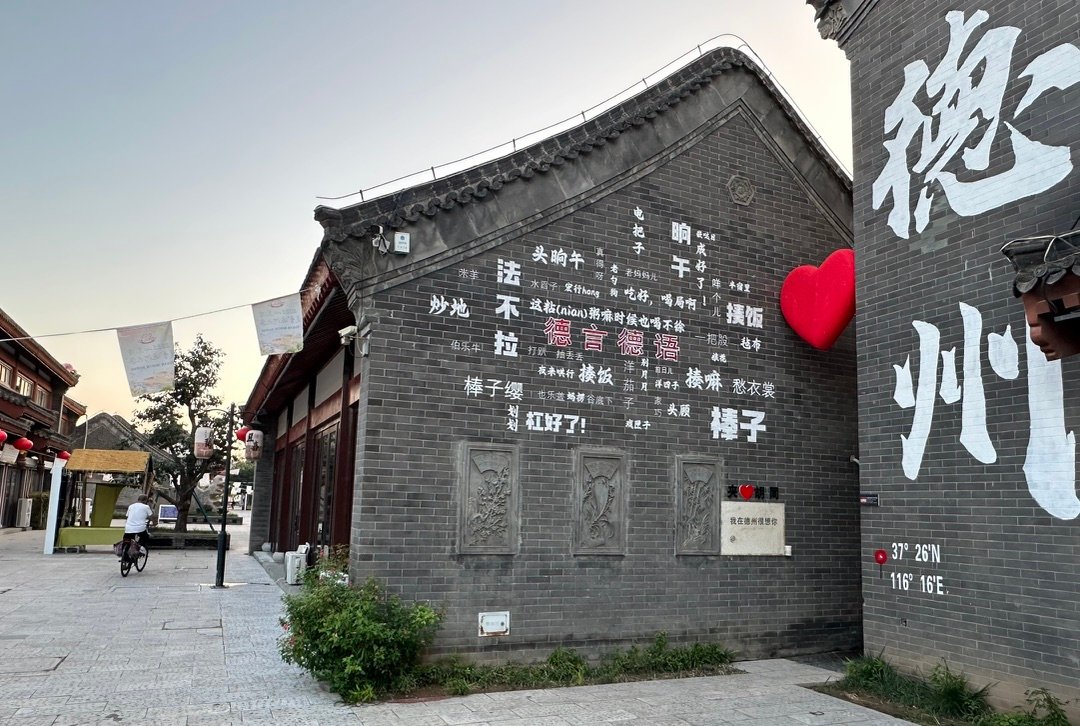
Section 1 — You Came to Dezhou. Look in TWO Directions.
By the time Dad & Elaine reached:
Dezhou (德州, Dézhōu),
our Shandong journey had already become rather complicated.
😂
At:
Mount Tai (泰山, Tàishān)
we asked about:
Heaven (天, tiān)
and imperial legitimacy.
At:
Qufu (曲阜, Qūfù)
we met:
Confucius (孔子, Kǒngzǐ)
and asked how ideas became institutions.
At:
Linzi (临淄, Línzī)
we entered the world of:
Qi (齐国, Qí Guó)
and discovered competing states arguing about how government should work.
Then we reached:
Dezhou.
And suddenly Dad wants you to look:
INWARD
and:
OUTWARD.
😬
Because Dezhou gives us two completely different historical stories.
One is:
Grand Canal (大运河, Dàyùnhé).
The other is:
Sulu Royal Tomb (苏禄王墓, Sūlù Wáng Mù).
One helps explain:
how an empire connected itself.
The other helps explain:
how that empire interacted with other states.
🔥
That’s our Dezhou dish.
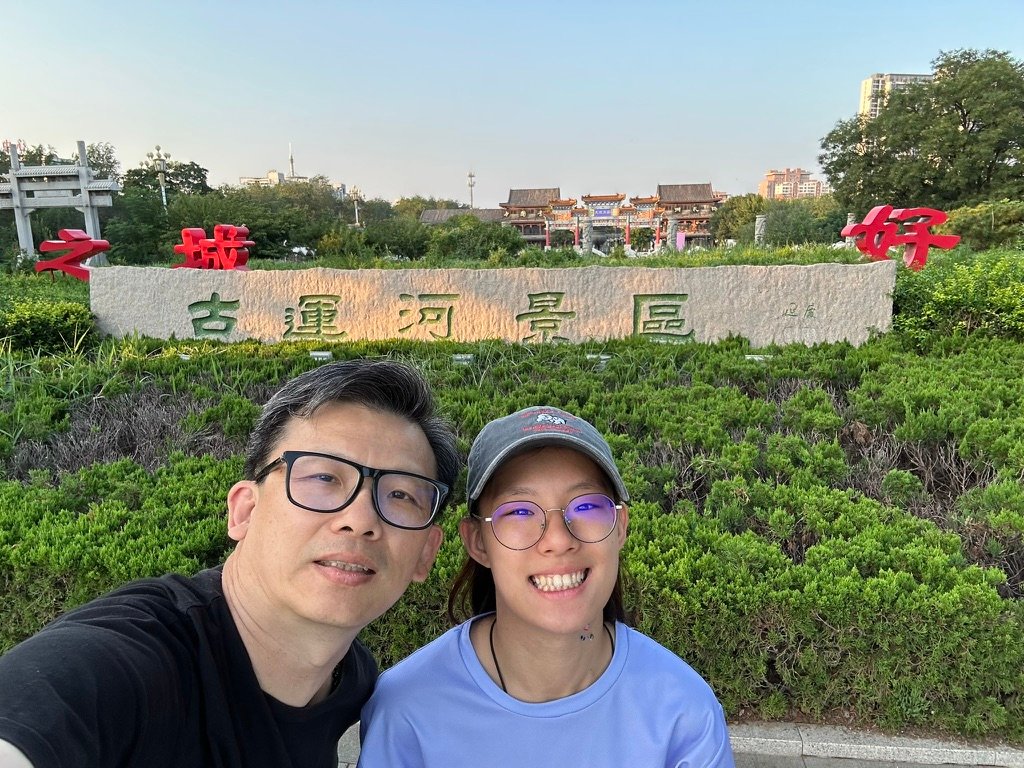
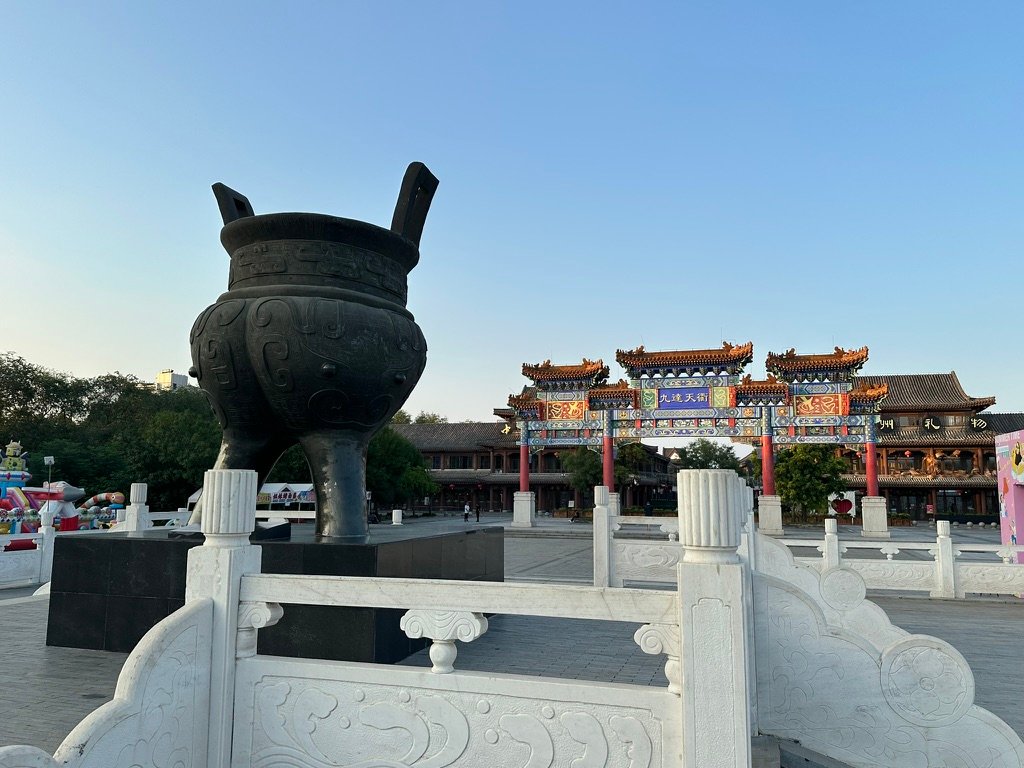
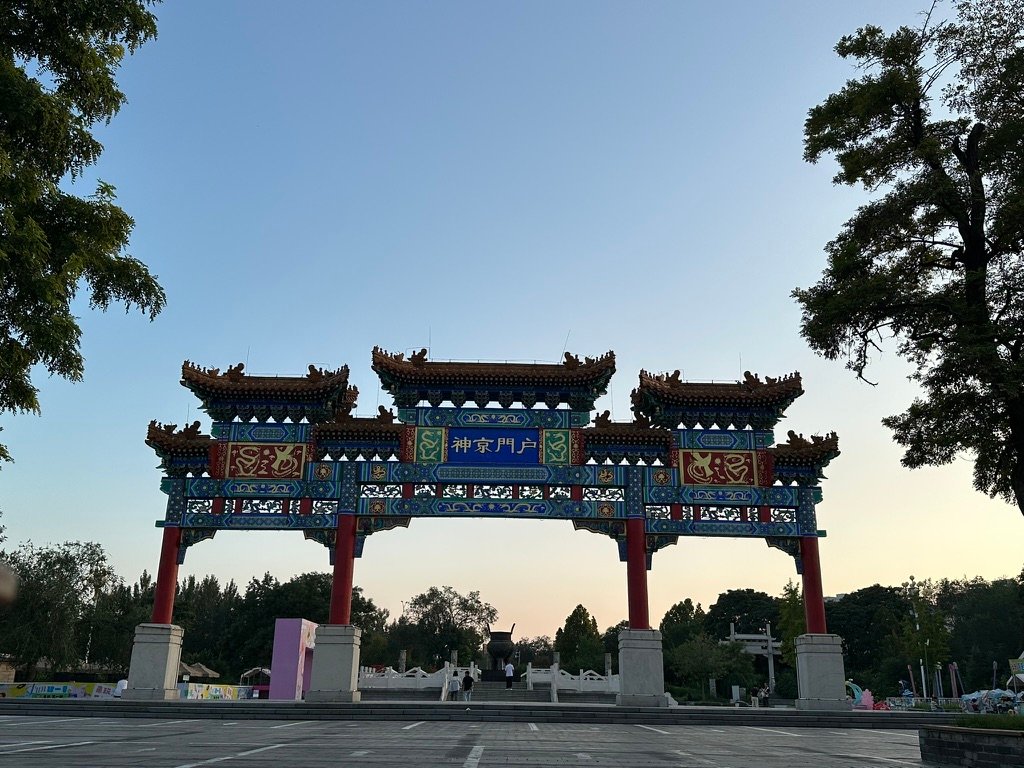
Four characters that explain Dezhou: 九达天衢 (Jiǔ Dá Tiān Qú). The historic phrase celebrates Dezhou as a great transport crossroads—connected by land and water and serving as a gateway toward the imperial capital. Another old title for the city was 神京门户 (Shénjīng Ménhù), “Gateway to the Imperial Capital.” After following Dezhou’s Grand Canal, post roads, merchants and markets, those four characters suddenly make perfect sense. Photo by Dad
🚢 First: Look at the Grand Canal
Beginner Chinese:
大 — dà
big / great
运 — yùn
transport / move
河 — hé
river
Together:
大运河 — Dàyùnhé
Grand Canal
Already, the Chinese name gives you a clue.
This wasn’t merely:
a picturesque canal running through old Chinese towns.
😂
The character:
运 — transport
is sitting right there.
And transport is one of the great reasons the Grand Canal mattered.
🌏 And Yes — the Grand Canal Is UNESCO
The:
Grand Canal of China
was inscribed on the:
UNESCO World Heritage List in 2014.
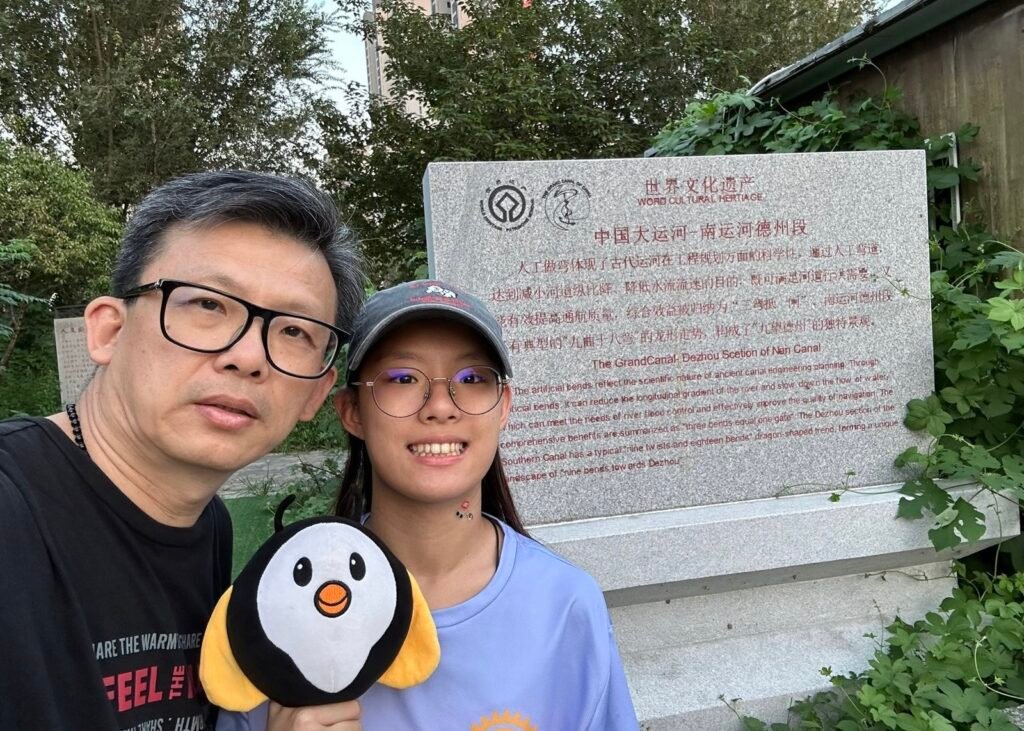
🐞 Photo Note: Why Does the Grand Canal Twist Through Dezhou?
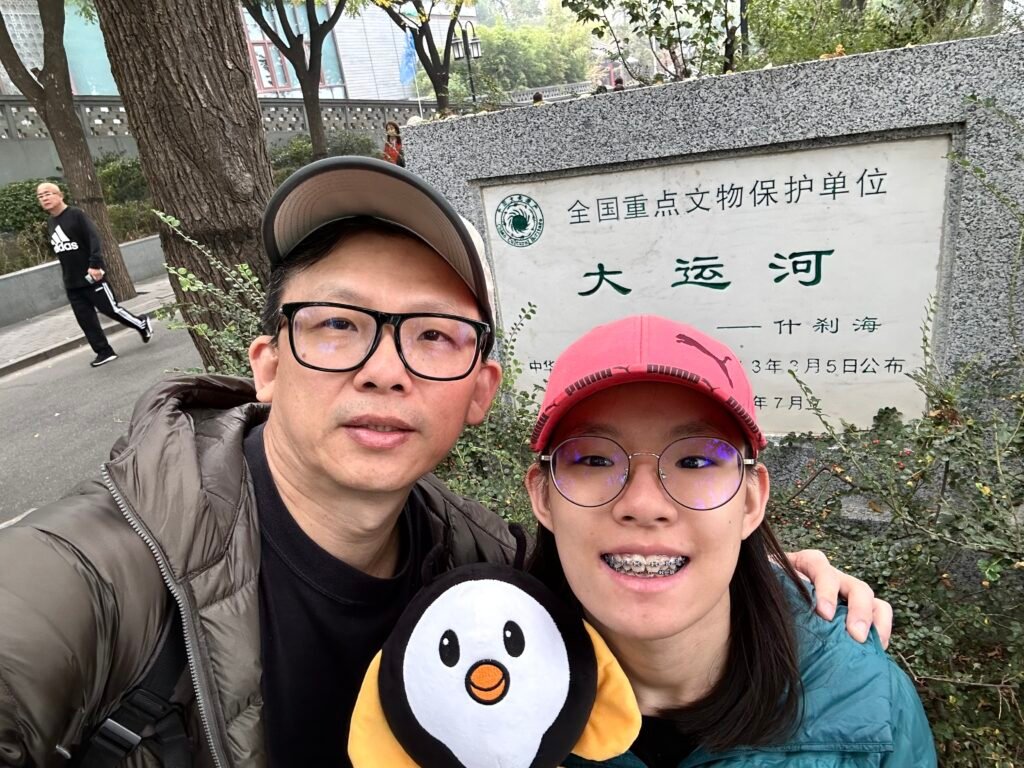
Dad & Elaine beside the World Cultural Heritage marker for the Dezhou section of the Grand Canal (中国大运河·南运河德州段).
The board explains something easy to miss: some canal bends were part of the engineering. By making the waterway wind, engineers could reduce the effective gradient and slow the current, helping navigation and water management.
The clever principle is summarized as:
三弯抵一闸 (sān wān dǐ yī zhá)
“Three bends can do the work of one lock.”
The canal’s famously winding course is also described as 九曲十八弯 (jiǔ qū shíbā wān) — “nine twists and eighteen bends.”
🔥 So when you see the Grand Canal twisting through Dezhou, don’t ask only “Why didn’t they build it straight?”
The bends were part of the technology.
Photo from Dad & Elaine’s Dezhou visit.
Its enormous historical system connected regions stretching from:
Beijing
toward:
eastern and southern China.
And importantly for this article, the UNESCO property includes the:
Cangzhou–Dezhou section
of the historic canal system.
🔥
So Dezhou isn’t simply:
“a city that happened to have an old canal.”
It formed part of one of the great transport networks of imperial China.
🍚 Remember Dad’s Capital Rule?
From our ancient-capitals Michelin course:
CAPITALS EAT.
😂
A capital needs to feed:
the imperial court,
officials (官员, guānyuán),
soldiers (士兵, shìbīng),
workers
and:
ordinary residents (百姓, bǎixìng).
Now think about:
Beijing (北京, Běijīng).
During the:
Ming dynasty (明朝, Míng Cháo)
and:
Qing dynasty (清朝, Qīng Cháo),
Beijing was a huge northern political center.
But many economically productive regions lay:
farther south.
So:
How do you feed northern political power with southern resources?
🐇
Now the Grand Canal becomes much more interesting.
🚤 Learn One Important Word: 漕运
漕运 — cáoyùn
Very roughly:
state-organized transport of grain by waterways
Beginner Chinese:
漕 — cáo
historically associated with transporting grain by water
运 — yùn
transport
Together:
漕运
canal / waterborne grain transport
🔥
Grain could move north through the canal system.
But the canal carried much more than:
food.
Goods moved.
People moved.
Officials moved.
Military resources moved.
Information moved.
The canal helped connect:
different parts of the empire.
Another Easy Chinese Pair: 南北
南 — nán
south
北 — běi
north
Together:
南北 — nánběi
north and south
The Grand Canal helped connect:
南北.
🔥
And that matters politically.
A huge empire isn’t unified simply because:
an emperor colors the whole map the same color.
😂
It has to be:
connected.
Resources need to move.
Orders need to move.
Officials need to move.
Armies need to move.
That is:
STATE CAPACITY
made physical.
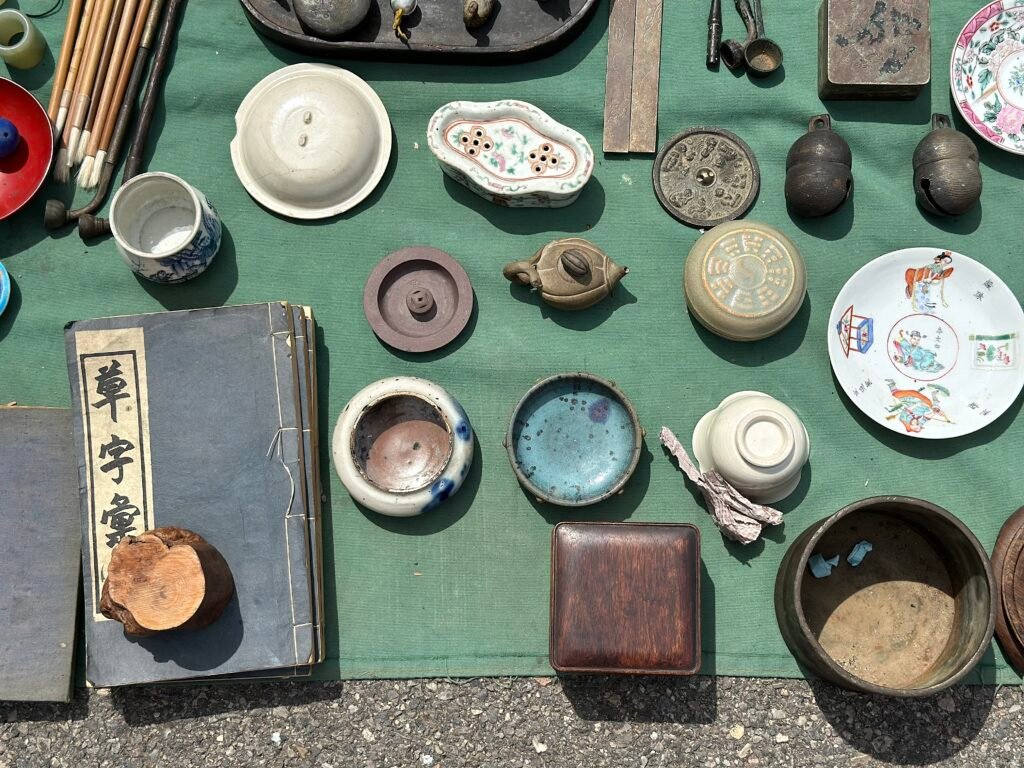
🐇 Then We Found Dezhou’s Antique Market — And the Canal Story Continued
One of our most unexpected Dezhou discoveries wasn’t a museum.
It was spread across the pavement.
古玩市场 — gǔwán shìchǎng
antique and collectibles market
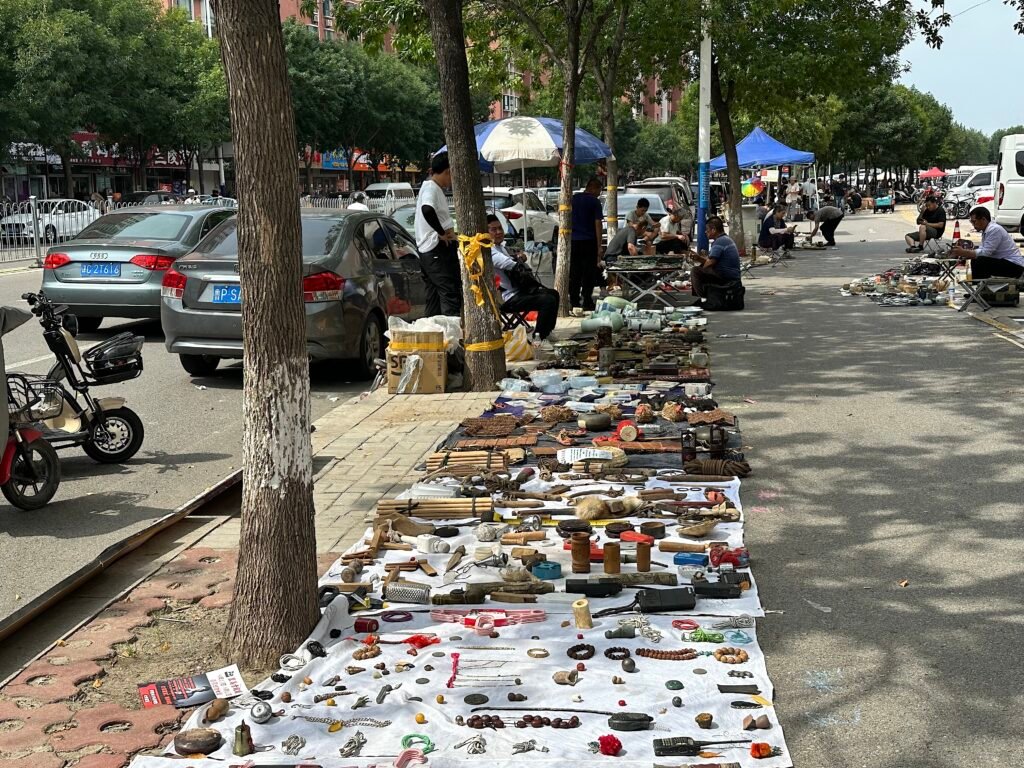
Rows of vendors had laid out old coins, ceramics, jade, beads, books, household objects, religious pieces and all sorts of mysterious things that immediately made Elaine stop walking.
😂
At first, this looked like simply another lively local flea market.
But Dezhou’s antique-trading culture has a deeper historical background.
🛶 Follow the Grand Canal Again
For centuries, Dezhou was an important commercial stop on the Grand Canal (大运河, Dàyùnhé).
Canal traffic didn’t move only grain.
It moved:
merchants, officials, travelers, money, ceramics, textiles, household goods — and objects from different parts of China.
By the Ming and Qing periods, Dezhou had developed into an important trading center along this north–south artery.
Local accounts trace the city’s antique-market tradition back more than 600 years, to the Ming period, when flourishing canal commerce helped goods and collectibles circulate through the city.
So perhaps today’s antique market isn’t as random as it first appears.
The Grand Canal brought things through Dezhou for centuries.
Dezhou became a place where things changed hands.
And some version of that trading instinct is still visible today.
🎒 Elaine’s Open Classroom: History Class on the Pavement
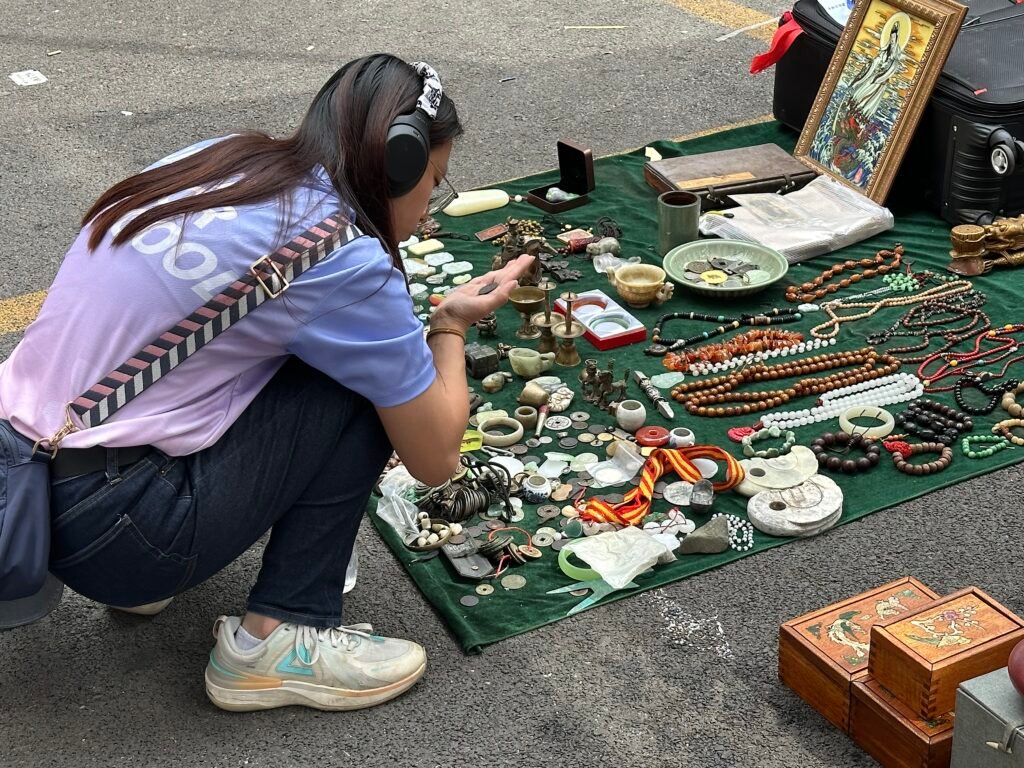
No classroom.
No PowerPoint.
No exam.
Just Dad saying:
“Elaine, see anything interesting?” 😂
At Dezhou’s antique market, Elaine stopped at a pavement stall filled with coins, jade, beads, ceramics and assorted old-looking treasures.
Then she found these.
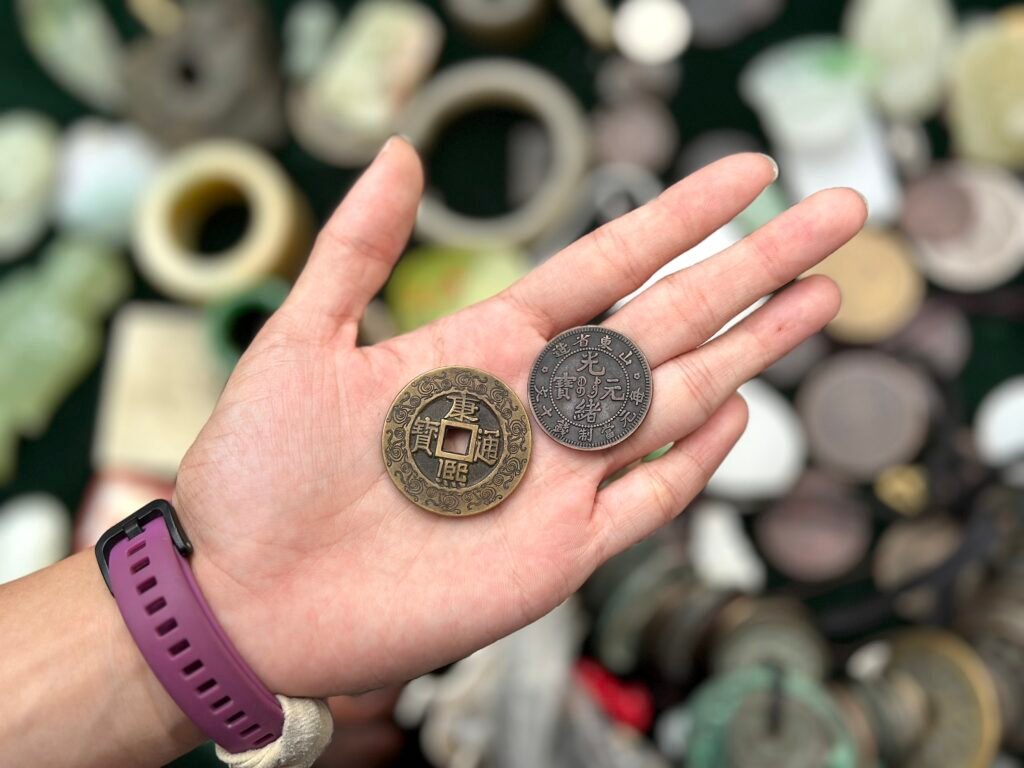
One reads:
康熙通宝 — Kāngxī Tōngbǎo
a type of cash coin issued during the reign of the Kangxi Emperor (1661–1722) of the Qing dynasty.
The other reads:
光绪元宝 — Guāngxù Yuánbǎo
a coin type associated with the Guangxu Emperor (1875–1908).
Suddenly two Qing emperors were sitting in Elaine’s palm. 😂
Were these particular pieces genuine antiques?
Dad has absolutely no idea.
And an antique-market stall is definitely not the place to declare archaeological certainty. Reproductions are common.
But for our open classroom, authenticity wasn’t even the main lesson.
Elaine could look at the Chinese characters → identify an emperor’s reign name → place it roughly on the Qing timeline → ask what changed between Kangxi and Guangxu.
🔥 That’s when a flea market becomes a history lesson.
Kangxi 康熙
→ high Qing imperial power
↓
Guangxu 光绪
→ a very different China confronting enormous internal and external pressures
↓
two little objects
↓
one very large rabbit hole. 🐇
Dad didn’t buy Elaine a textbook.
Dezhou put the lesson on the pavement. 😂
Photos from Dad & Elaine’s Dezhou visit.
🐞 But the Market Taught Us Something About Dezhou
This is why we love these unplanned stops.
The antique market gave us another way to understand the city.
Earlier we had seen:
the Grand Canal
and learned how Dezhou fitted into the enormous transport system connecting northern and southern China.
Here we saw something much more human:
the habit of exchange.
Goods arrive.
People bargain.
Objects acquire new owners.
Stories travel with them.
Centuries later, people are still laying things out in Dezhou and asking:
“Interested?”
🔥
Maybe that’s the better way to remember this market.
Not as:
“a place to buy antiques.”
But as another small echo of Dezhou’s old role as:
A CITY WHERE THINGS CHANGED HANDS.
Sometimes the Grand Canal story isn’t in the water.
Sometimes it’s sitting on a blanket beside the road.
🐇
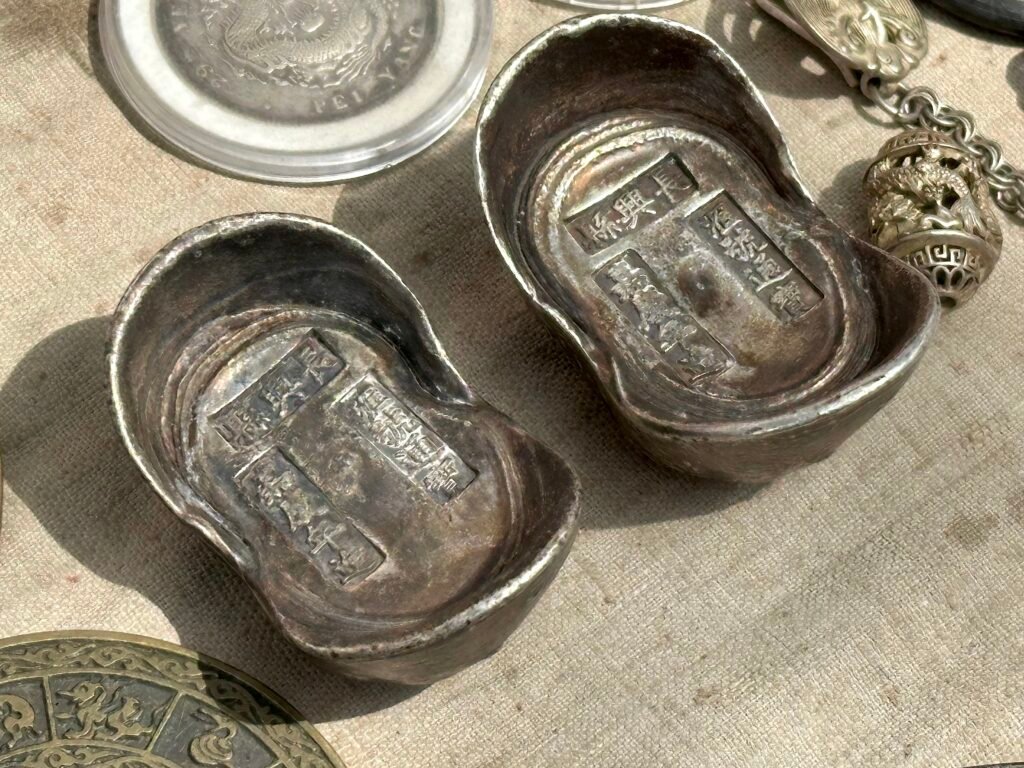
🪙 Open Classroom: The Silver Ingot Comes With Its Own “Label”
At first Elaine sees:
a funny boat-shaped lump of silver.
😂
But read the stamps and it becomes much more interesting.
正興號 identifies a commercial name or issuing/handling house.
足紋銀 tells the user something about the quality or fineness standard of the silver.
And:
庫平十兩
kùpíng shí liǎng
means:
“10 taels, Kuping standard.”
庫平 (kùpíng) was an official Qing weight standard used for government accounts and silver. One Kuping tael was roughly 37.3 grams, so ten taels would correspond to roughly 373 grams if the inscription genuinely represents its intended historical standard. Beijing cultural-heritage research confirms that the Qing used multiple silver weight standards—including 库平—and that stamped silver ingots increasingly carried marks relating to weight and fineness to make them easier to trust and circulate.
🔥 And suddenly the object tells us something important about imperial Chinese money.
There was no barcode.
No central-bank serial number.
No electronic payment confirmation.
Instead, trust could be communicated through:
WHO handled it
→ 正興號
WHAT quality of silver it claimed to be
→ 足紋銀
HOW MUCH it weighed under an accepted standard
→ 庫平十兩
That’s essentially:
merchant + purity + weight
stamped directly into the money.
And that creates a lovely connection back to Dezhou.
A commercial city on the Grand Canal wasn’t sustained only by boats and warehouses.
Merchants also needed ways to answer:
“How much silver is this actually worth — and why should I trust it?”
🐇
So Elaine’s pavement classroom has gone from:
Kangxi cash coin → Guangxu coin → silver ingot
to something much bigger:
How did strangers do business before modern money?
That’s an excellent Deep China rabbit.
One important Dad warning 😂
I would not say these particular ingots are genuine Qing antiques. They’re sitting on an antique-market blanket with no provenance, and these exact kinds of pieces are heavily reproduced.
🐇 Wait… Haven’t We Seen the Next Chapter in Pingyao 平遥古城?
Look again at that silver ingot. Its stamps are trying to answer some basic commercial questions:
How much silver is here?
What standard is being used?
Who handled or vouched for it?
In a trading world where silver moved between merchants and regions, these were not small questions.
And suddenly Dad remembered:
PINGYAO 平遥古城.
😂🐇
At Pingyao (平遥, Píngyáo) in Shanxi, we encountered the next stage of this story: the rise of the famous 票号 (piàohào)remittance houses.
Instead of transporting large quantities of silver physically from one place to another — expensive, cumbersome and potentially dangerous — merchants could increasingly use financial institutions to transfer value through written drafts and branch networks.
The most famous early example was:
日昇昌 — Rìshēngchāng
established in Pingyao in the early nineteenth century and commonly regarded as China’s first 票号.
🔥
Now connect the two journeys:
Dezhou antique market
→ silver ingot
→ weight + fineness + trust
↓
Pingyao
→ merchants + remittances + branch networks
→ moving value without moving the same lump of silver
That’s the rabbit.
Dad thought Elaine was examining an old piece of silver on a pavement in Dezhou.
Instead she had accidentally opened:
THE HISTORY OF CHINESE BANKING.
😂
And suddenly our earlier Pingyao journey makes more sense too.
The 票号 weren’t an isolated curiosity invented in a pretty walled city.
They belonged to a much larger commercial problem:
How do you move money safely across an enormous country where merchants are doing business far from home?
Dezhou shows us the silver.
Pingyao shows us the financial network built around moving value.
🐇🔥
Another journey explains an earlier journey.
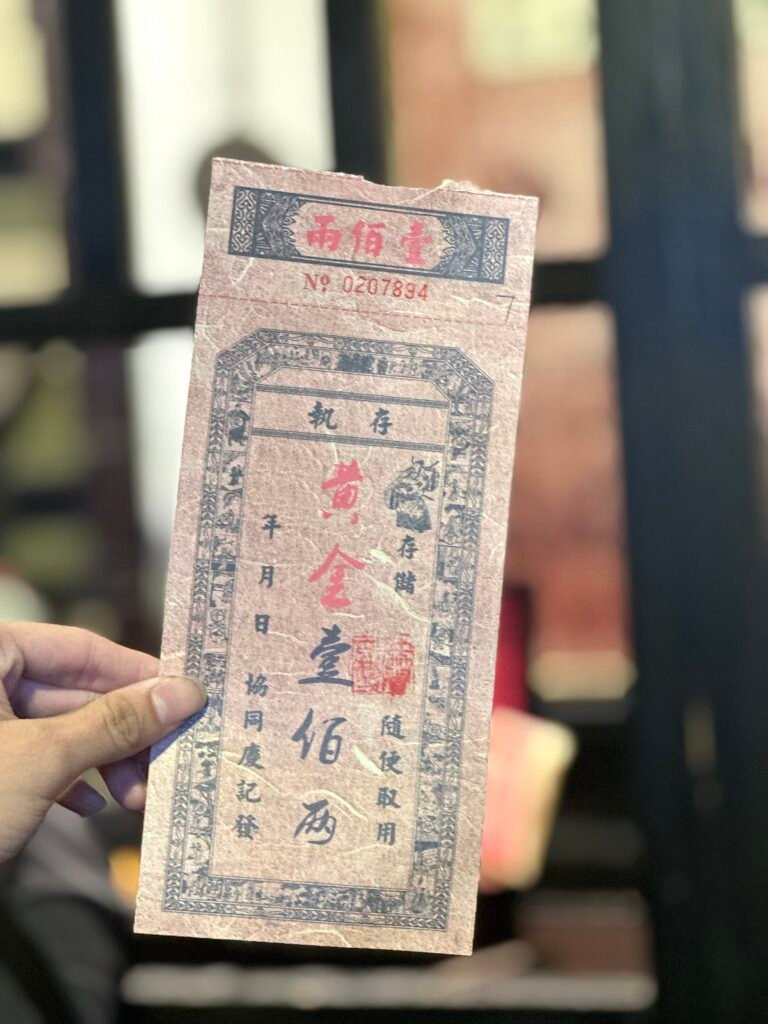
TA-DA! The rabbit reaches Pingyao. 🐇💰 At Pingyao, Dad encountered a reproduction of an old-style financial certificate showing 黄金壹佰两 — “100 taels of gold.” The famous Shanxi 票号 (piàohào) remittance houses helped merchants transfer value through deposits, drafts and branch networks rather than physically hauling precious metal across China. After Elaine later examined a stamped silver ingot in Dezhou, the connection clicked: Dezhou showed us the money; Pingyao showed us how merchants learned to move its value. Photo from Dad & Elaine’s Pingyao journey.
🐇 Then History Appeared on the Antique Blanket
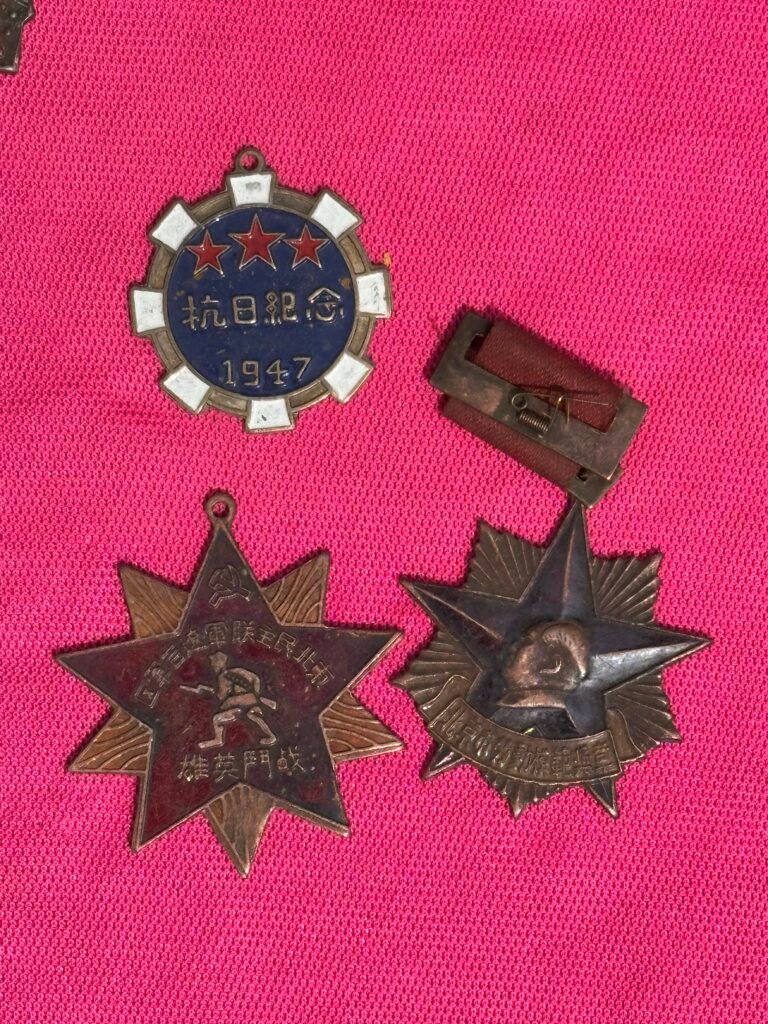
Dad photographed these old-style badges at Dezhou’s antique market in late August 2025.
One immediately caught our attention:
抗日纪念
Kàngrì Jìniàn
“Commemoration of Resistance Against Japan”
and beneath it:
1947
We can’t authenticate an object from a market stall simply by looking at it — it could be original, later reproduction or something else entirely.
But the timing was extraordinary.
Dad & Elaine happened to be in Dezhou just before September 3, 2025, when Beijing held a major national commemoration and military parade marking the 80th anniversary of China’s victory in the War of Resistance Against Japanese Aggression and the wider World Anti-Fascist War.
So while Beijing was preparing to commemorate:
1945 → 2025: 80 YEARS
Dad was standing at an antique market in Shandong looking at an object carrying the words:
抗日纪念.
🔥
That is one of the pleasures of wandering through markets like this.
Sometimes history isn’t behind museum glass.
Sometimes it unexpectedly appears:
on a blanket beside the road.
Photo by Dad at Dezhou’s antique market, 2025.
🐇 Go Back to the Beijing & Forbidden City
🐇 Photo Note: Now Follow the Waterway to Beijing
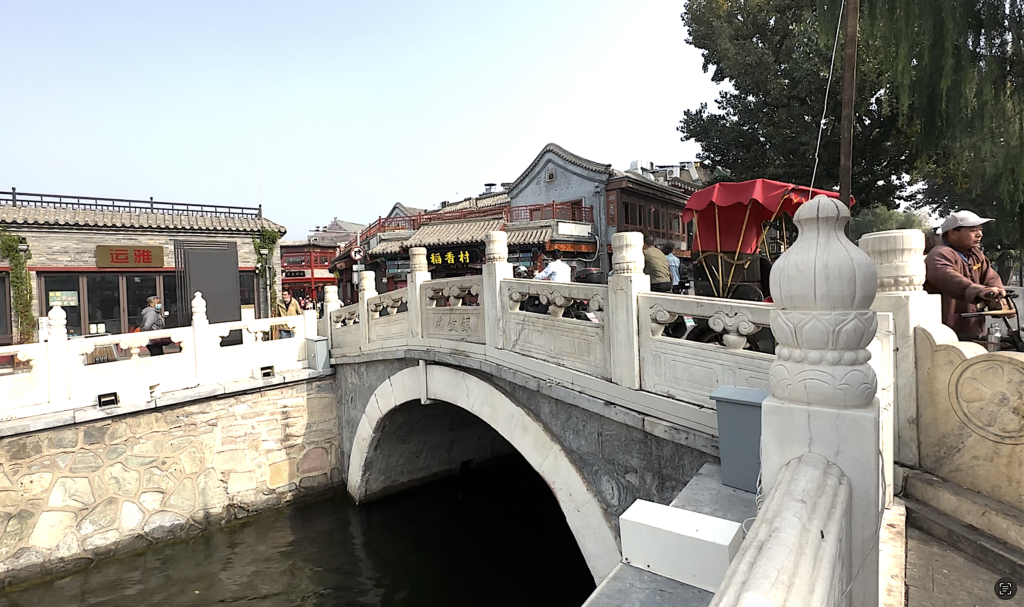
Dad & Elaine later encountered the Grand Canal again at Shichahai (什刹海) in Beijing — part of the historic northern end of the Grand Canal system.
Now connect this photograph back to Dezhou.
For centuries, the Grand Canal was one of imperial China’s great transport arteries. Grain and other supplies moved northward through sections including the 南运河 (Nányùnhé, Southern Canal) at Dezhou, eventually helping provision the imperial capital.
So Dezhou’s canal wasn’t just a local waterway.
It was part of the supply line to Beijing.
That makes the geography click:
Dezhou 德州
↓
Grand Canal
↓
Beijing 北京
↓
a huge capital, imperial government and population that needed to be supplied.
🔥
When you later stand beside the canal landscape at Shichahai, mentally travel south again.
Those engineered bends Dad & Elaine saw in Dezhou — including the clever 三弯抵一闸, “three bends can do the work of one lock” — belonged to the enormous hydraulic and logistical system that helped make an inland imperial capital like Beijing possible.
Another rabbit-hole lesson: sometimes one city explains why another city mattered.
This is why Dezhou belongs in:
Beyond Beijing.
Most first-time travelers stand inside:
Forbidden City (故宫, Gùgōng)
and see:
red walls,
golden roofs,
dragons,
thrones
and:
imperial halls.
🔥
Then come to Dezhou and look at:
the canal.
Now ask:
What infrastructure made that imperial capital possible?
Suddenly:
Forbidden City
and:
Grand Canal
belong to:
the same historical story.
One shows:
POWER.
The other helps explain:
HOW POWER WAS SUPPLIED.
😳
🍗 PALATE CLEANSER: Okay Dad, Enough of Grand Canal. Where’s the Chicken?
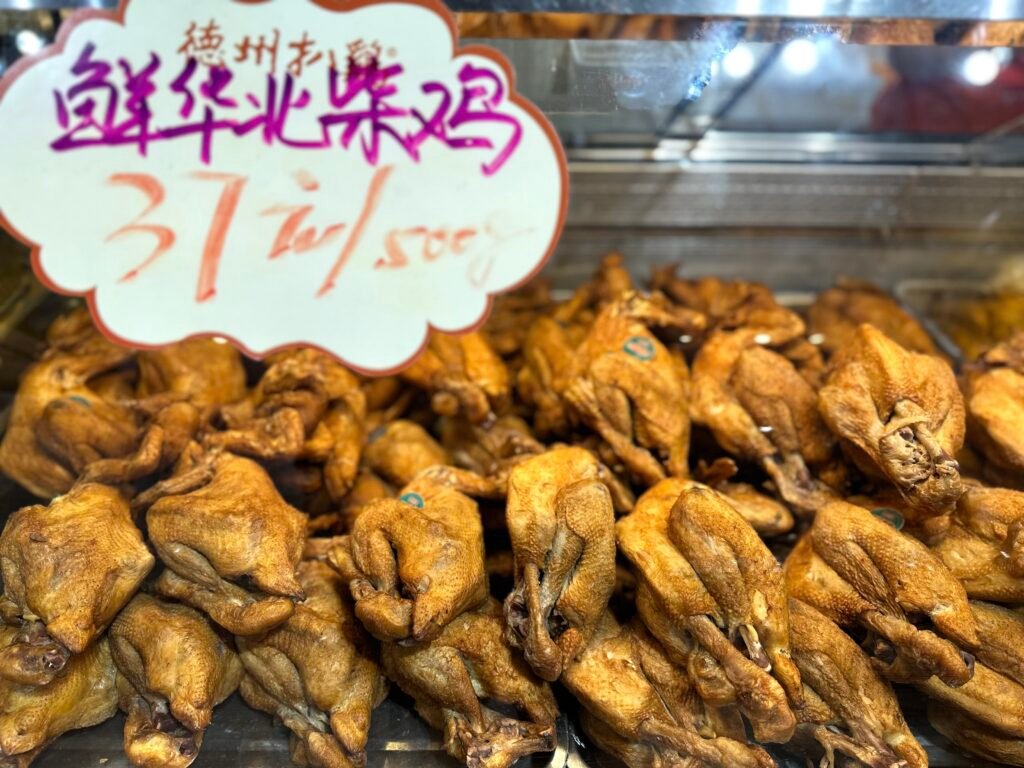
After canals, silver ingots and banking rabbit holes, Dad needed to remember why many Chinese travelers recognize the name Dezhou 德州 immediately:
德州扒鸡 — Dézhōu Pá Jī
Dezhou Braised Chicken
😂
This is one of Dezhou’s signature foods — traditionally braised with spices until the meat becomes exceptionally tender and deeply flavored.
And judging from this shop counter…
Dezhou is not shy about producing them.
Sometimes understanding China requires following:
history → geography → trade → finance.
And sometimes:
just follow your nose. 🍗
Palate cleansed. Rabbit may continue. 🐇
Photo by Dad in Dezhou.
🌶️ Infrastructure Is Political
Dad’s Political Science Handrail is back.
😂
Government isn’t only:
emperors
laws
officials
and:
armies.
It also needs:
交通 — jiāotōng
transport
粮食 — liángshi
grain / food supplies
后勤 — hòuqín
logistics
and:
基础设施 — jīchǔ shèshī
infrastructure.
🔥
Not glamorous.
But without them:
the glamorous palace has a problem.
So Dezhou’s Grand Canal gives us our first big question:
How did imperial China physically hold such an enormous political system together?
Part of the answer is:
INFRASTRUCTURE.
😬 Then Turn Around…
Because Dezhou gives us another story that seems to belong in:
a completely different country.
Not another Chinese emperor.
Not another Confucian temple.
Not another ancient Chinese state.
Instead:
SULU.
😳
As in:
maritime Southeast Asia.
And now our Shandong rabbit:
ESCAPES CHINA.
🐇🌏🔥
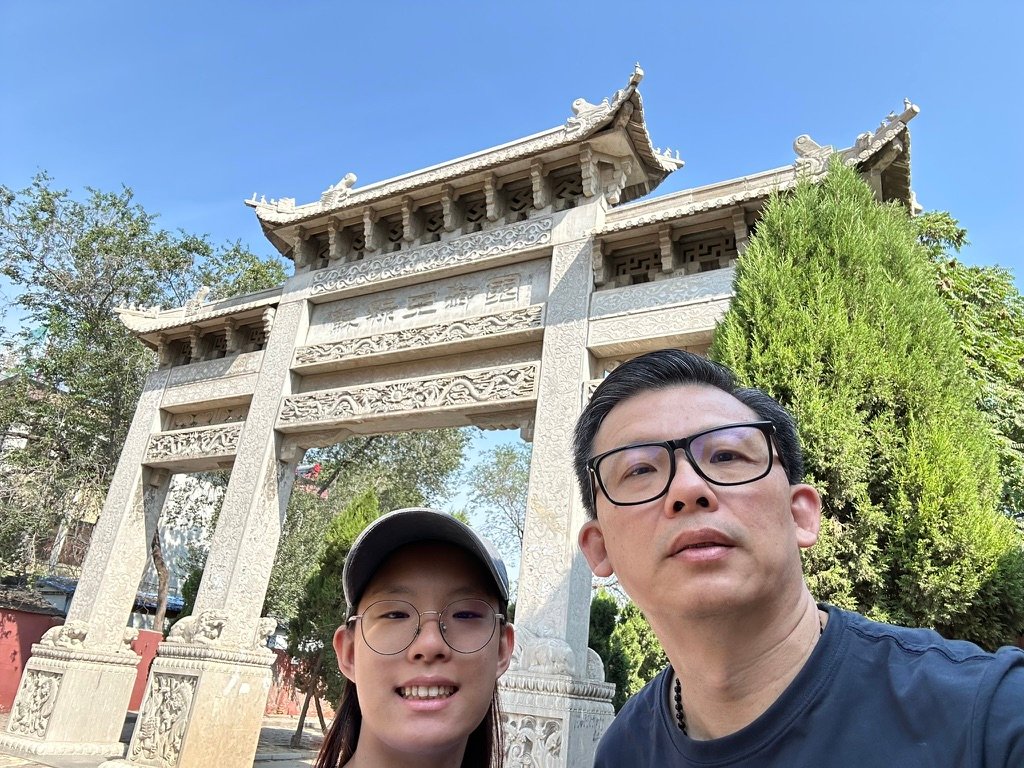
👑 Meet the Sulu Royal Tomb
In Dezhou is the historical:
苏禄王墓 — Sūlù Wáng Mù
Sulu Royal Tomb / Tomb of the King of Sulu
Beginner Chinese:
苏禄 — Sūlù
Sulu
王 — wáng
king
墓 — mù
tomb
So:
苏禄王墓
Sulu King’s Tomb
🔥
Now stop.
Why is a royal tomb associated with:
Sulu
— a maritime polity centered in what is now the southern Philippines —
sitting in:
Shandong, China?
😳
That’s not a side story.
THAT is the Dezhou rabbit hole.
🌏 What Was Sulu Doing in Ming China?
To understand that, we need to enter the:
Ming dynasty (明朝)
and particularly the reign of:
Yongle Emperor (永乐帝, Yǒnglè Dì).
This was an extraordinary period of:
diplomatic missions,
maritime voyages,
trade,
gift exchange
and:
political contact
between the Ming court and many states beyond China.
🔥
Foreign envoys traveled:
TO China.
Ming envoys traveled:
OUTWARD.
Ships crossed:
Southeast Asian waters.
And states around the region participated in complicated networks of:
diplomacy (外交, wàijiāo)
trade (贸易, màoyì)
and:
ritual exchange.
So Ming China wasn’t:
sitting silently behind the Great Wall.
Not remotely.
Useful Chinese: 使节
使节 — shǐjié
envoy / diplomatic representative
And:
使团 — shǐtuán
diplomatic mission / delegation
🔥
Now a foreign ruler traveling toward the Ming court isn’t simply:
“a tourist visiting China.”
😂
He belongs to:
a diplomatic world.
And that distinction matters enormously for understanding:
Sulu.
🌶️ Be Careful With the Word “Tribute”
You’ll frequently encounter:
朝贡 — cháogòng
tribute / tributary presentation
and:
朝贡体系 — cháogòng tǐxì
tributary system
in explanations of Ming foreign relations.
Useful terms.
But don’t let them become:
“China controlled every country that sent tribute.”
NO.
😂
Historical relationships could involve:
ritual hierarchy,
trade opportunities,
diplomatic recognition,
gift exchange,
security interests
and:
local political calculations.
Different states participated for:
different reasons.
So:
RITUAL HIERARCHY
does not automatically mean:
DIRECT POLITICAL CONTROL.
🔥
That distinction will matter enormously in Section 2.
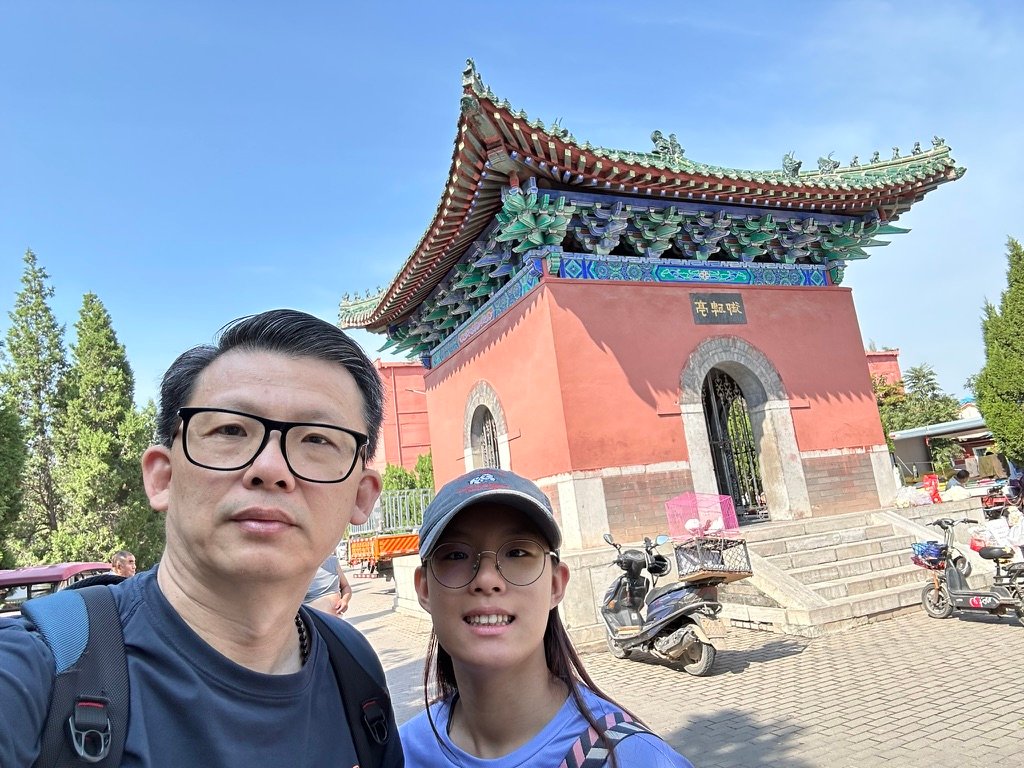
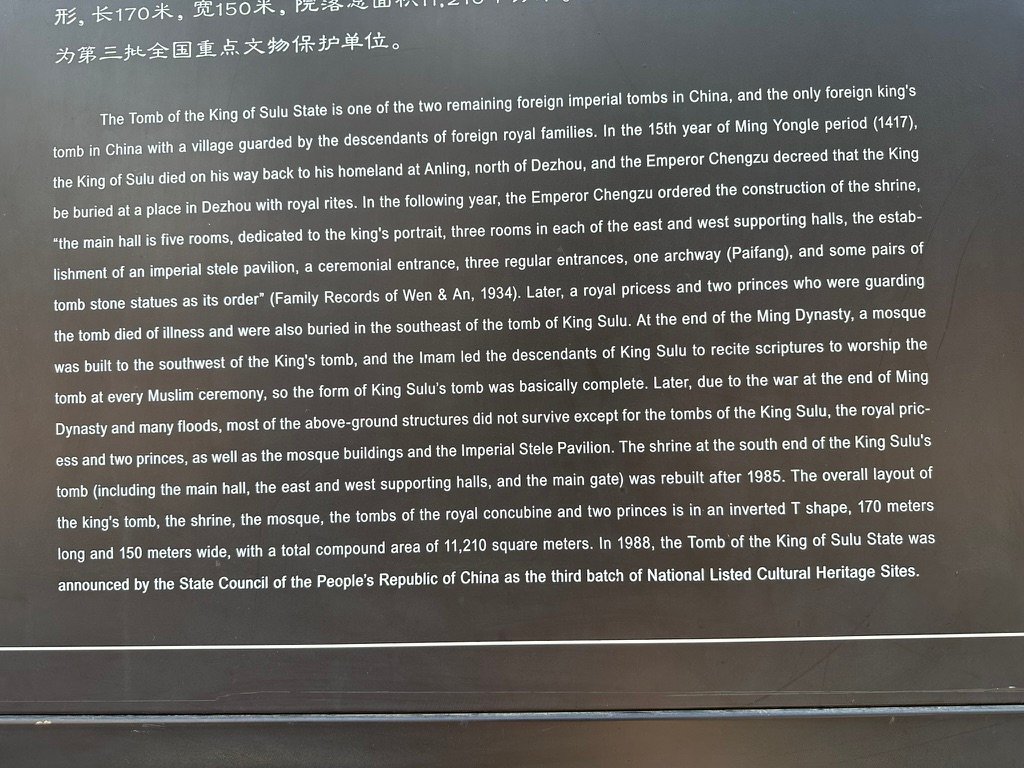
🐞 Photo Note: A Sultan from Southeast Asia Buried in Dezhou
This board tells the remarkable story of the Tomb of the King of Sulu (苏禄王墓).
In 1417, during the Ming dynasty, the King of Sulu—from the Sulu Sultanate in what is now the southern Philippines—died near Dezhou while returning home from a diplomatic mission to China. The Yongle Emperor ordered that he be buried in Dezhou with royal rites.
Some members of his family remained behind to guard the tomb, creating a community of descendants that continued for generations. A mosque was later built nearby, and Islamic rites became part of the site’s commemorative tradition.
The tomb complex suffered from wars and floods, but important elements survived or were reconstructed. In 1988, it was designated a Major Historical and Cultural Site Protected at the National Level.
👑 And Then the Sulu Story Becomes Human
During the Yongle period, rulers from:
Sulu
traveled to Ming China with a substantial entourage.
One of those rulers died in China while returning from the Ming court.
He was buried in:
Dezhou.
😳
And his tomb remained.
Now think about what you’re seeing.
A physical:
Southeast Asian royal footprint
inside:
inland Shandong.
🔥
You came looking for:
Chinese history.
And suddenly Chinese history has led you directly into:
Southeast Asian history.
🐇🌏
🍚 This Is Why Places Beat Textbooks
A textbook might say:
“Ming China maintained diplomatic relations with Southeast Asian polities.”
Fine.
Then Dad & Elaine stand in:
Dezhou
at:
苏禄王墓.
😳
Now:
DIPLOMACY
has:
a person.
A journey.
A death.
A tomb.
A family story.
A physical place.
🔥
That’s Deep China.
🐇 And Then Zheng He Sails Into the Article
Of course he does.
😂
Because once you have:
Yongle
+
Southeast Asia
+
maritime diplomacy,
another enormous name appears:
Zheng He (郑和, Zhèng Hé).
His great voyages carried Ming fleets through:
Southeast Asia
toward:
South Asia
and:
the Indian Ocean world.
🔥
So:
DEZHOU
↓
SULU
↓
MING
↓
YONGLE
↓
ZHENG HE
↓
SOUTHEAST ASIA
↓
INDIAN OCEAN.
🐇🐇🐇🌏
The rabbit has properly escaped China.
🚢 And Another Future Rabbit Is Waiting at Quanzhou
Dad & Elaine haven’t visited:
Quanzhou (泉州, Quánzhōu)
yet.
It’s on our future Deep China list.
🔥
And there we’ll eventually explore another enormous story:
Maritime Silk Roads (海上丝绸之路, Hǎishàng Sīchóu Zhīlù).
Beginner Chinese:
海 — hǎi
sea
海上 — hǎishàng
maritime / on the sea
丝绸之路 — Sīchóu Zhīlù
Silk Road
So:
海上丝绸之路
Maritime Silk Road
🐇🌏
But we’re not cooking Quanzhou yet.
We haven’t brought the photographs home.
🌶️ Now Put Dezhou’s TWO Stories Together
This is the whole plate.
On one side:
大运河 — Grand Canal
↓
漕运 — grain transport
↓
Beijing
↓
imperial administration
↓
INTERNAL CONNECTION.
🔥
On the other:
苏禄王墓 — Sulu Royal Tomb
↓
Ming court
↓
diplomacy
↓
Southeast Asia
↓
EXTERNAL CONNECTION.
😳
One city.
Two networks.
🧠 Dad’s Political Science Coat Rack
A large empire faces at least two very different problems.
PROBLEM 1
How do you connect your own territory?
Canals.
Roads.
Grain.
Officials.
Information.
Military logistics.
↓
STATE CAPACITY.
PROBLEM 2
How do you deal with political communities beyond your territory?
Envoys.
Trade.
Ritual.
Diplomacy.
Recognition.
Military power.
↓
FOREIGN RELATIONS.
🔥
And somehow:
Dezhou
gives the traveler a physical doorway into:
BOTH.

🐞 That’s the First Sting
You came to:
Dezhou (德州)
perhaps wondering:
“What Chinese history is there to see here?”
Then:
Grand Canal 大运河
↓
漕运
↓
grain
↓
Beijing
↓
imperial logistics
↓
state capacity
and then:
Sulu 苏禄
↓
王墓
↓
Ming 明
↓
Yongle 永乐
↓
diplomacy 外交
↓
Zheng He 郑和
↓
Southeast Asia
↓
Maritime Silk Roads 海上丝绸之路.
😬😬😬
And now our question is no longer:
“Why visit Dezhou?”
It’s:
“How did imperial China connect itself — and how did it connect with the wider world?”
🔥🔥🔥
That’s the Michelin doorway.
Section 2 — Why Did a Sulu Ruler Travel to Ming China — and End Up Buried in Dezhou?
Section 1 left us standing in front of something rather unexpected:
Sulu Royal Tomb (苏禄王墓, Sūlù Wáng Mù).
We’re in:
Dezhou (德州, Dézhōu), Shandong.
Not:
Manila.
Not:
Mindanao.
Not:
the Sulu Archipelago.
😂
Yet here lies a ruler associated with:
Sulu (苏禄, Sūlù),
a maritime polity centered in what is now the southern Philippines.
So the obvious Deep China question is:
How did he get HERE?
To answer that, we need to travel back to:
1417
during the reign of:
Yongle Emperor (永乐帝, Yǒnglè Dì)
of the:
Ming dynasty (明朝, Míng Cháo).
🔥
And we need to stop imagining Ming China as:
China + Great Wall + everybody else outside.
The diplomatic world was much more interesting.
🌏 First: Where Was Sulu?
Sulu
was a maritime polity in the island world of:
Southeast Asia (东南亚, Dōngnányà).
Beginner Chinese:
东 — dōng
east
南 — nán
south
亚 — yà
Asia
So:
东南亚
Southeast Asia
🔥
Think:
islands,
sea routes,
regional trade
and:
connections among different maritime communities.
This is a very different geographical world from:
inland Shandong.
Which makes the tomb in Dezhou even more interesting.
👑 What Happened in 1417?
Ming historical records document an extraordinary diplomatic visit.
In:
1417,
three rulers associated with Sulu arrived at the Ming court with a large entourage.
Chinese records identify them using titles conventionally rendered as the:
Eastern King (东王, Dōngwáng),
Western King (西王, Xīwáng)
and:
King of the Cave / Dong King (峒王, Dòngwáng).
🔥
The best known of them in the Dezhou story is the:
Eastern King of Sulu.
His name appears in Chinese historical transcription as:
巴都葛叭答剌
Bādūgě Bādálá
— a Chinese transcription of the ruler’s foreign name.
And here we need our first historical guardrail.
🌶️ Don’t Force a Modern Name Onto a 1417 Source
You’ll find different modern spellings and reconstructions of the Sulu ruler’s name.
That’s normal.
😂
Chinese historical sources were attempting to represent a foreign name using:
Chinese characters (汉字, Hànzì).
So the safest Deep China approach is:
the Eastern King of Sulu, recorded in Ming sources as 巴都葛叭答剌.
We don’t need to pretend one modern Romanized spelling is unquestionably:
THE original form.
That’s research-grade history.
🐇 Why Would THREE Sulu Rulers Go to China?
Now we’re asking the important question.
The visit occurred within the diplomatic framework of the:
Ming court.
Foreign rulers and envoys could travel to the imperial capital, present:
tribute (贡, gòng),
participate in court ceremony,
receive:
gifts (赏赐, shǎngcì),
titles or recognition,
and pursue:
trade,
political relationships
and:
diplomatic interests.
🔥
So don’t reduce the whole journey to:
“They came to submit to China.”
Too crude.
And don’t swing to the opposite extreme:
“It was just an ordinary modern diplomatic visit.”
Also wrong.
The Ming court understood these relationships through:
a hierarchical imperial worldview.
The Sulu rulers had:
their own interests too.
Both sides were participating in the relationship for reasons that made sense:
within their own political worlds.
Learn Two Important Words: 朝贡
朝贡 — cháogòng
Beginner Chinese:
朝 — cháo
court / dynasty in this context
贡 — gòng
tribute / offering
Together:
朝贡
tributary presentation / tribute relationship
🔥
Western history books often turn this into:
“the Chinese tributary system.”
Useful coat rack.
But dangerous if treated as:
one rigid international system operating identically everywhere for 2,000 years.
Historical relationships varied by:
period,
state,
political circumstances
and:
economic interests.
🍚 Western Handrail: Ceremony and Diplomacy Can Coexist
Imagine a diplomatic world in which the host emperor insists:
“I am at the center of the ritual order.”
Foreign representatives participate in that ceremonial language.
But meanwhile:
gifts are exchanged,
trade occurs,
relationships are negotiated
and:
both sides pursue interests.
🔥
That’s much closer to what we need.
RITUAL HIERARCHY
does not automatically equal:
DIRECT RULE.
The Ming emperor did not thereby become the everyday administrator of Sulu.
That’s an important distinction.
👑 And Who Was Sitting on the Ming Throne?
Yongle Emperor (永乐帝).
Remember him?
😂
Our ancient-capitals Michelin course already introduced him.
He was the Ming emperor who moved the principal imperial capital to:
Beijing (北京)
and constructed the great imperial palace we now call:
Forbidden City (故宫).
🔥
And suddenly three completely different attractions connect:
FORBIDDEN CITY
↓
YONGLE
↓
SULU ROYAL TOMB
😳
Same reign.
Different doorway.
🐇 And Yongle Gives Us Zheng He
Now the rabbit starts running.
The Yongle Emperor sponsored the great maritime expeditions associated with:
Zheng He (郑和, Zhèng Hé).
Beginning in:
1405,
Ming fleets traveled through:
Southeast Asia,
the Indian Ocean,
South Asia
and farther west.
🔥
These voyages involved:
diplomacy,
exchange,
trade,
imperial prestige
and at times:
military intervention.
So don’t reduce Zheng He to:
“Chinese explorer discovers foreign countries.”
😂
Those regions already contained sophisticated maritime societies and trade networks.
The Ming fleets entered:
an already-connected maritime world.
Useful Chinese: 下西洋
Zheng He’s voyages are often called:
郑和下西洋
Zhèng Hé Xià Xīyáng
Beginner Chinese:
下 — xià
go down / travel toward, depending on context
西洋 — Xīyáng
“Western Ocean,” a historical geographical term
So:
郑和下西洋
Zheng He’s voyages to the Western Ocean
🔥
And:
西洋
doesn’t simply mean:
“the modern West.”
Historical Chinese geographical vocabulary needs historical context.
Another useful Deep China guardrail.
🌏 Now Put Sulu Inside This Maritime World
Sulu wasn’t floating alone in the ocean waiting for China to notice it.
😂
It existed within:
maritime Southeast Asian networks.
People moved.
Ships moved.
Goods moved.
Political messages moved.
Religions moved.
🔥
So the 1417 mission to the Ming court makes much more sense when placed inside a world already connected through:
sea routes (海路, hǎilù)
and:
maritime trade (海上贸易, hǎishàng màoyì).
Now Dezhou begins pointing toward:
the South China Sea
and:
the Indian Ocean.
🐇🌏
😳 Then the Journey Takes a Tragic Turn
After the court visit, the Sulu delegation began its journey home.
The:
Eastern King
became ill while traveling through:
Dezhou.
He died there in:
1417.
🔥
The Ming court arranged for:
his burial in Dezhou.
And this is why we’re standing here today.
Not because:
a Sulu ruler decided to move permanently to Shandong.
😂
His death occurred:
during the return journey from the Ming court.
That distinction matters.
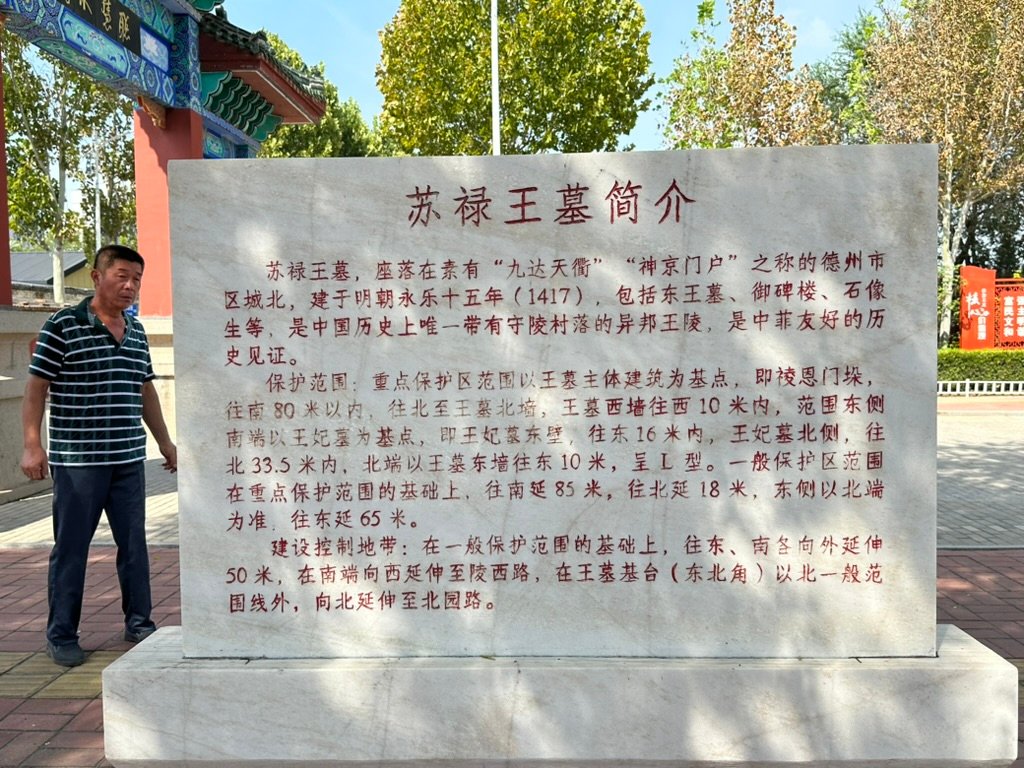
A Southeast Asian king in Dezhou. This marker introduces the Tomb of the King of Sulu (苏禄王墓, Sūlù Wáng Mù), built after the Sulu ruler died near Dezhou in 1417, during the Ming Yongle reign.
The inscription calls the site a rare surviving foreign royal tomb with a community of descendants who remained to guard it, and describes it as historical evidence of long-standing China–Philippines friendship. Another reminder that Dezhou’s position on major transport routes connected it not only with Beijing, but with a much wider world. Photo by Dad.
🪦 And the Ming Court Treated the Burial Seriously
The ruler received an elaborate burial arrangement under Ming imperial authority.
The tomb and associated memorial landscape became evidence of the diplomatic relationship between:
Ming China
and:
Sulu.
🔥
Now our abstract word:
外交 — wàijiāo
foreign relations / diplomacy
has become:
a physical place.
That’s why the tomb matters.
王妃及王子墓 — Tombs of the King’s Consort and Two Princes
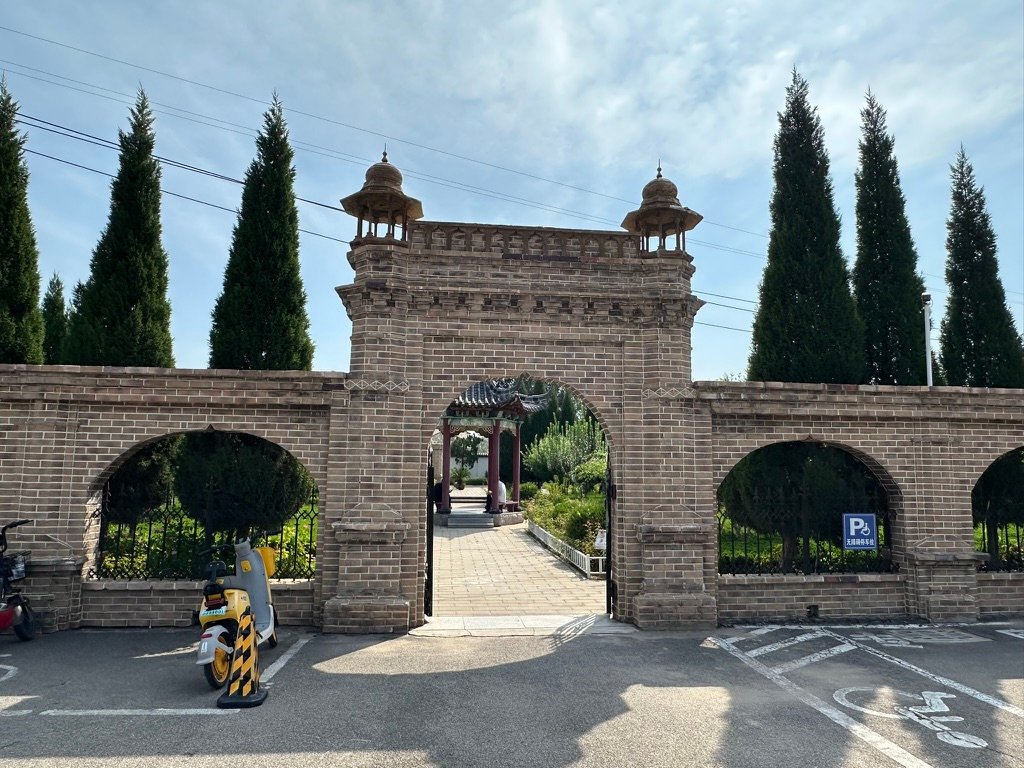
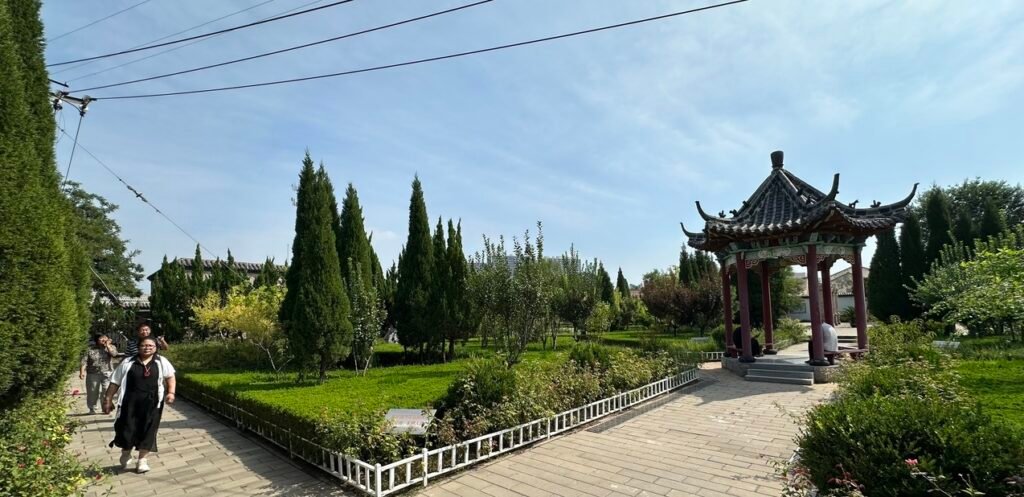
The Dezhou local gazetteer gives the family story. In 1417, the East King of Sulu, usually rendered in Chinese as 巴都葛叭答剌, visited Ming China with the West King and another Sulu ruler as part of a delegation of more than 340 people. After 27 days in Beijing, the East King died from illness while the delegation was traveling home through Dezhou. The Yongle Emperor ordered a royal burial, gave him the posthumous title 恭定王 (Gōngdìng Wáng), and later had an imperial stele and shrine erected.
Here’s where those side tombs become important.
The king’s eldest son returned to Sulu and succeeded him, while his consort 葛木宁 (Gěmùníng), his second son 温哈剌 (Wēnhālà), his third son 安都鲁 (Āndūlǔ), and attendants remained in Dezhou to care for the tomb. The Ming court provided support, including sacrificial land. They ultimately remained in China, and the consort and two princes were buried roughly 100 meters southeast of the king’s tomb.
Even better: the story did not end with those three graves.
Their descendants continued living around the tomb. In 1731, during the Qing dynasty, descendants of the tomb guardians were formally registered in Dezhou. The local historical record says the descendants came to use the surnames 温 (Wēn)and 安 (Ān) — derived from the two princes’ names — and descendants remain associated with the area today.
🐇 And Then Comes an Extraordinary Family Story
The story doesn’t end with the ruler’s death.
Some members of his family and entourage remained in China to:
guard and maintain the tomb.
Over generations, descendants became associated with the Dezhou community around the burial site.
🔥
This is where we need another important guardrail.
Don’t turn this into:
“The whole Sulu royal family became Chinese.”
😂
No.
The historical story involves particular descendants and attendants connected with the tomb.
But it gives us something fascinating:
diplomacy
became:
migration
which became:
local history.
😳
Diplomacy → Family → Community
Look at the chain:
使节 — diplomatic mission
↓
来华 — journey to China
↓
死亡 — death
↓
安葬 — ānzàng
burial
↓
守墓 — shǒumù
guard / tend a tomb
↓
后代 — hòudài
descendants
↓
local community.
🔥
International relations have become:
human history.
That’s the part political maps usually miss.
🌶️ And Religion Makes the Story Even More Interesting
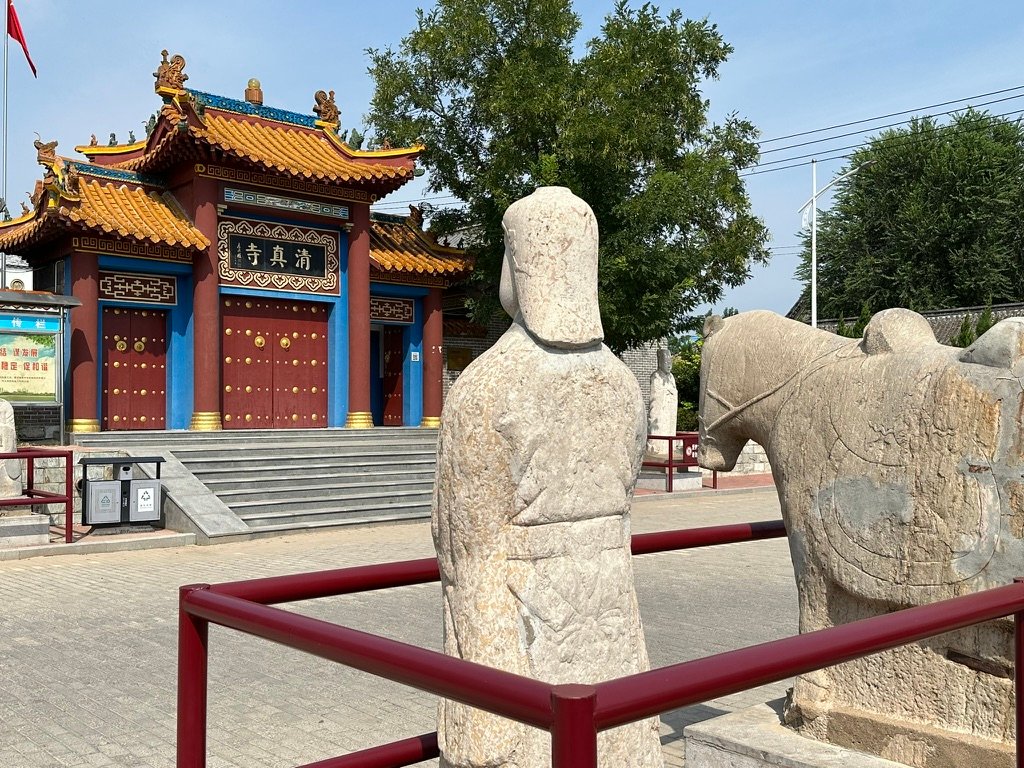
🐞 Photo Note: A Sulu King Given Ming Royal Honors
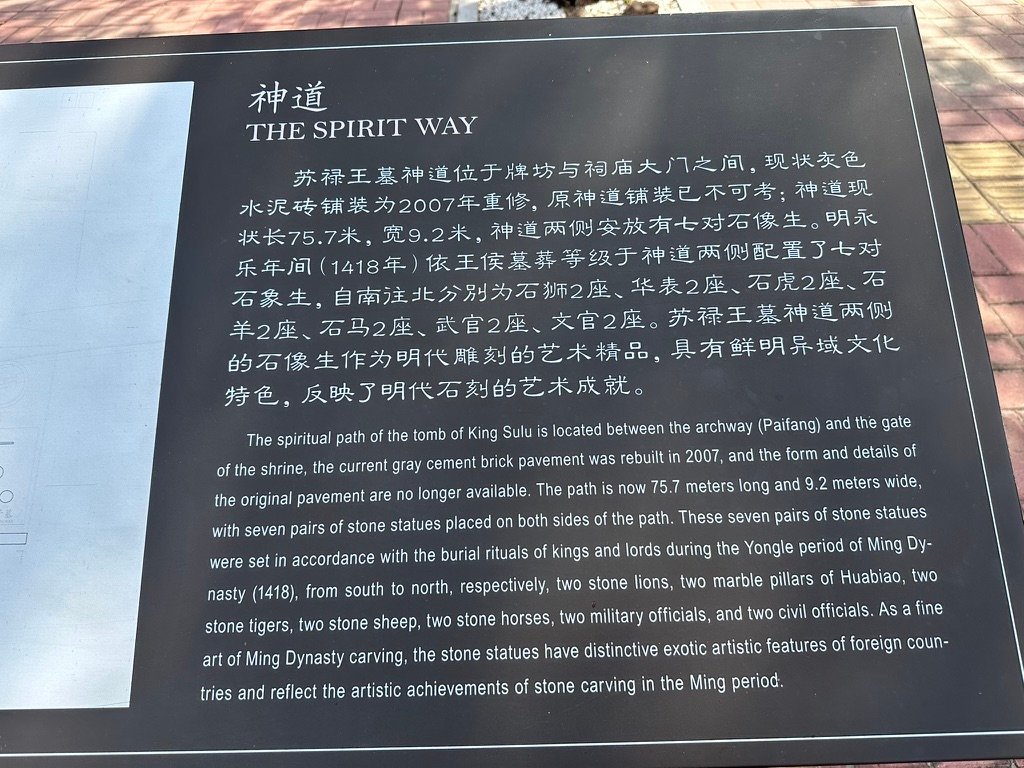
The stone figures Dad photographed beside the Qingzhen Mosque (清真寺) belong to the tomb’s 神道 (shéndào) — “Spirit Way.” According to the site board, in 1418 the Ming court arranged seven pairs of stone guardians according to the burial rites used for kings and lords during the Yongle period: lions, huabiao pillars, tigers, sheep, horses, military officials and civil officials.
That is what makes this place so remarkable. The man buried here was a Muslim ruler from Sulu in Southeast Asia, yet the Yongle court honored him with the ceremonial language of a Ming royal tomb. His descendants remained in Dezhou, and a mosque later became part of the tomb landscape.
Ming imperial ritual + Sulu Muslim heritage — preserved together in Dezhou for more than 600 years.
Photos by Dad.
The Sulu world was connected with:
Islam (伊斯兰教, Yīsīlánjiào).
And descendants associated with the Sulu royal tomb became part of the long history of Muslim communities in China.
🔥
Now another rabbit appears:
Islam in China.
🐇
Xi’an has:
Great Mosque (西安大清真寺).
Quanzhou has important Islamic maritime heritage.
Chinese port cities preserve evidence of Muslim merchants and communities.
And here:
Dezhou
gives us another doorway.
🐇🌏 The Rabbit Didn’t Simply Escape China
Actually…
this rabbit did something stranger.
😂
SULU
↓
🐇🌏
rabbit enters China
↓
MING COURT
↓
DEZHOU
↓
descendants remain
↓
local Chinese history.
So sometimes our rabbit:
ESCAPES CHINA.
Sometimes:
ENTERS CHINA.
And sometimes it:
MOVES BOTH WAYS.
🔥
History doesn’t respect our neat blog categories.
🌶️ Now Compare This With Buddhism
Remember:
Buddhism (佛教, Fójiào).
India
↓
Central Asia
↓
China
↓
translation
↓
adaptation
↓
Chinese Buddhist traditions
↓
Korea / Japan / Vietnam.
🐇🌏
Now compare:
Sulu
↓
Ming China
↓
Dezhou.
Different story.
Same underlying lesson:
China was connected.
People and ideas crossed political boundaries in:
multiple directions.
🐇 And Qufu Gives Us the Reverse Journey
Remember:
Confucius (孔子).
Qufu
↓
Confucian learning
↓
🐇🌏
Vietnam
↓
Hanoi’s:
Temple of Literature.
🔥
So our Shandong journey has accidentally built a:
CROSS-BORDER HISTORY LESSON.
Qufu:
ideas travel OUT.
Dezhou:
people travel IN.
😳
That’s beautiful.
🌏 And Then Quanzhou Will Eventually Complete the Picture
Our future trip to:
Quanzhou (泉州)
will give Dad & Elaine another physical doorway into:
maritime exchange.
There we’ll encounter the historical world of:
foreign merchants,
maritime trade,
religious communities,
ports
and:
long-distance connections.
🔥
Then we can compare:
CHANG’AN 长安
Overland Silk Roads
with:
QUANZHOU 泉州
Maritime Silk Roads.
And:
DEZHOU
sits unexpectedly between these stories as evidence of:
diplomacy reaching inland China.
🐇🌏
🍚 But Don’t Turn Zheng He Into “China Discovered the World”
Another guardrail.
😂
The Indian Ocean before Zheng He was already filled with:
merchants,
ports,
ships,
Muslim trading networks,
South Asian communities,
Southeast Asian states
and:
long-distance exchange.
The Ming voyages were extraordinary.
But Zheng He entered:
an existing maritime system.
🔥
That’s much more historically interesting than:
“China sailed out and discovered everybody.”
👑 So What Was Yongle Trying to Do?
There isn’t one single answer.
The voyages and diplomatic activity served overlapping purposes involving:
imperial prestige,
diplomacy,
trade,
political recognition
and sometimes:
military power.
🔥
That’s why we shouldn’t reduce them to:
peace mission
or:
colonial expansion
or:
trade expedition
alone.
History is messier.
And better.
🧠 Dad’s Political Science Handrail: International Order
Here’s the larger concept.
Every political system develops ideas about:
who belongs where
and:
how states should relate to one another.
The Ming court possessed:
its worldview.
Sulu rulers possessed:
their interests.
Southeast Asian states interacted with:
China,
each other,
Muslim trading networks
and:
other maritime powers.
🔥
So the diplomatic relationship wasn’t:
one actor + passive satellites.
It was:
a network of political actors interacting within unequal but negotiated relationships.
That’s the more useful coat rack.
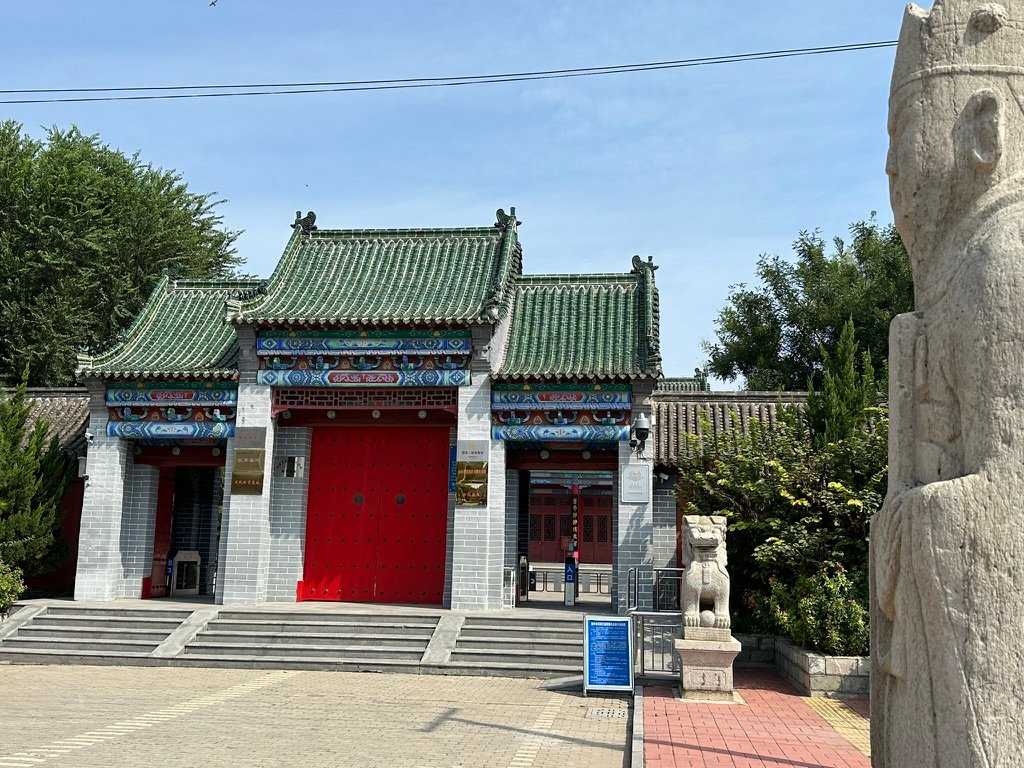
🐞 Now Look at the Tomb Again
Before Section 2:
苏禄王墓
was:
“Interesting. Foreign king buried in China.”
Now:
Sulu
↓
1417
↓
Yongle
↓
Ming court
↓
朝贡
↓
diplomacy
↓
trade
↓
Zheng He
↓
Southeast Asia
↓
death in Dezhou
↓
burial
↓
descendants
↓
Chinese local history.
😬
That is an enormous story hiding inside:
one tomb.
🐞 Halfway Sting Check
You started by asking:
“Why did a Sulu ruler travel to China?”
Now the better question is:
“What kind of international world allowed a ruler from maritime Southeast Asia to travel to the Ming court — and leave a historical footprint in inland Shandong?”
🔥
And that question destroys another beginner misconception:
IMPERIAL CHINA ≠ ISOLATED CHINA.
The Great Wall tells only:
one side
of China’s external relationships.
The sea tells:
another.
And a Sulu tomb in Dezhou gives us:
the human evidence.
🐇🌏🔥
Section 3 — How to Visit Dezhou — and See the Grand Canal, Sulu and Ming China’s Wider World
By now Dad has managed to turn:
Dezhou (德州, Dézhōu)
into a surprisingly international history lesson.
😂
We started with:
Grand Canal (大运河, Dàyùnhé)
and:
grain transport (漕运, cáoyùn).
That took us:
INWARD
toward:
Beijing,
imperial logistics,
state capacity
and:
how a huge empire physically connected itself.
Then:
Sulu Royal Tomb (苏禄王墓, Sūlù Wáng Mù)
sent us:
OUTWARD
toward:
Ming diplomacy,
Southeast Asia,
Zheng He (郑和)
and:
the maritime world.
😬
One city.
Two networks.
So let’s return to the traveler:
How do you actually visit Dezhou — and what should you look for?
🚄 Dezhou Works Beautifully on a Beyond Beijing Route
Dezhou sits in northwestern:
Shandong (山东, Shāndōng)
and is well positioned on the high-speed rail corridor between:
Beijing (北京)
and:
Shandong.
For many travelers, the useful station is:
Dezhou East Railway Station (德州东站, Dézhōu Dōng Zhàn).
Beginner Chinese:
东 — dōng
east
站 — zhàn
station
So:
德州东站
Dezhou East Station
🔥
This makes Dezhou much easier to integrate into a wider Shandong journey than its relative lack of international fame might suggest.
🗺️ Don’t Think of Dezhou as an Isolated Stop
This is important.
Dad wouldn’t necessarily tell a first-time traveler:
“Fly halfway across China specifically for Dezhou.”
😂
Instead, make Dezhou part of:
a historical route.
Our future Shandong Michelin Journey might look something like:
BEIJING 北京
↓
JINAN 济南
↓
MOUNT TAI 泰山
↓
QUFU 曲阜
↓
LINZI / ZIBO 临淄 / 淄博
↓
DEZHOU 德州
↓
BEIJING
🔥
Each stop answers:
a different question.
That’s the point.
🚗 Dad Would Use a Car Once in Dezhou
For the historical sites, Dad prefers:
private car (包车, bāochē)
or:
car + knowledgeable English-speaking guide (英语导游, Yīngyǔ dǎoyóu).
Why?
Because the story isn’t concentrated inside:
one giant attraction.
You’re connecting:
Grand Canal history
with:
the Sulu royal story.
🔥
A car gives you flexibility.
A good guide gives you:
context.
And Dezhou needs context.
🧑🏫 This Is DEFINITELY a History-Guide Destination
Without interpretation:
Grand Canal:
old waterway.
Sulu Royal Tomb:
foreign person’s tomb.
Done.
😭😂
With historical interpretation:
Grand Canal
↓
Beijing
↓
grain
↓
漕运
↓
state capacity
and:
Sulu
↓
1417
↓
Yongle
↓
Ming diplomacy
↓
Zheng He
↓
Southeast Asia.
🔥
Completely different visit.
So Dad would specifically request:
We are interested in Chinese and Southeast Asian history. We would like an experienced English-speaking licensed guide who can explain the Grand Canal and caoyun 漕运, the 1417 Sulu mission, Ming foreign relations, the Yongle period, and the historical context of the Sulu Royal Tomb.
That tells the company:
don’t give us only a general sightseeing script.
😂
🌶️ And Ask the Guide One Important Question
At the Sulu tomb, ask:
“Which parts of this story come directly from Ming historical records, and which parts come from later local tradition?”
🔥
That’s a Deep China question.
Remember:
史料 — shǐliào
historical sources
碑文 — bēiwén
stele inscriptions
传说 — chuánshuō
transmitted story / legend
and:
考证 — kǎozhèng
textual / historical verification or evidential research
They aren’t automatically:
the same thing.
A good guide should be comfortable saying:
“We know this from the historical record.”
versus:
“This is a later tradition associated with the site.”
That distinction increases trust.
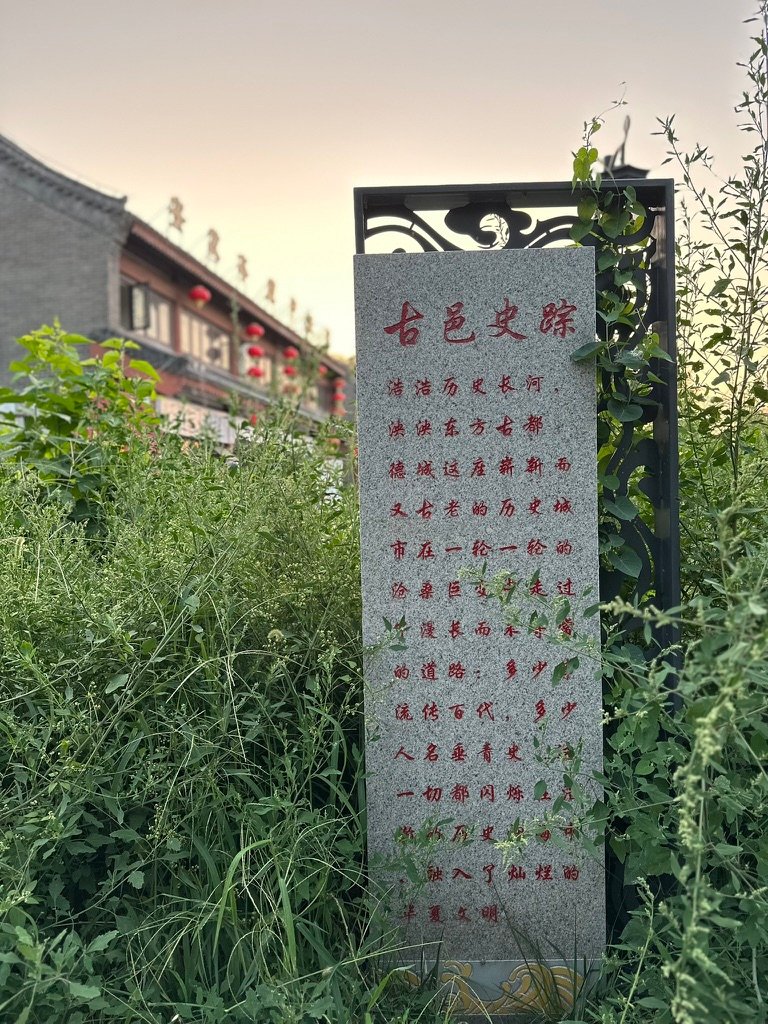
🚢 First Dezhou Story: Follow the Canal
When you reach the historical:
Grand Canal (大运河),
don’t ask only:
“How old is this section?”
Ask:
“What MOVED through here?”
🔥
Look for references to:
漕运 — cáoyùn
state grain transport
粮食 — liángshi
grain / food
船 — chuán
boat / ship
码头 — mǎtóu
wharf / pier
运河 — yùnhé
canal
Now imagine:
southern resources
moving:
north.
Toward:
Beijing.
Suddenly the canal becomes:
the bloodstream of an empire.
🐇 Then Mentally Return to Beijing
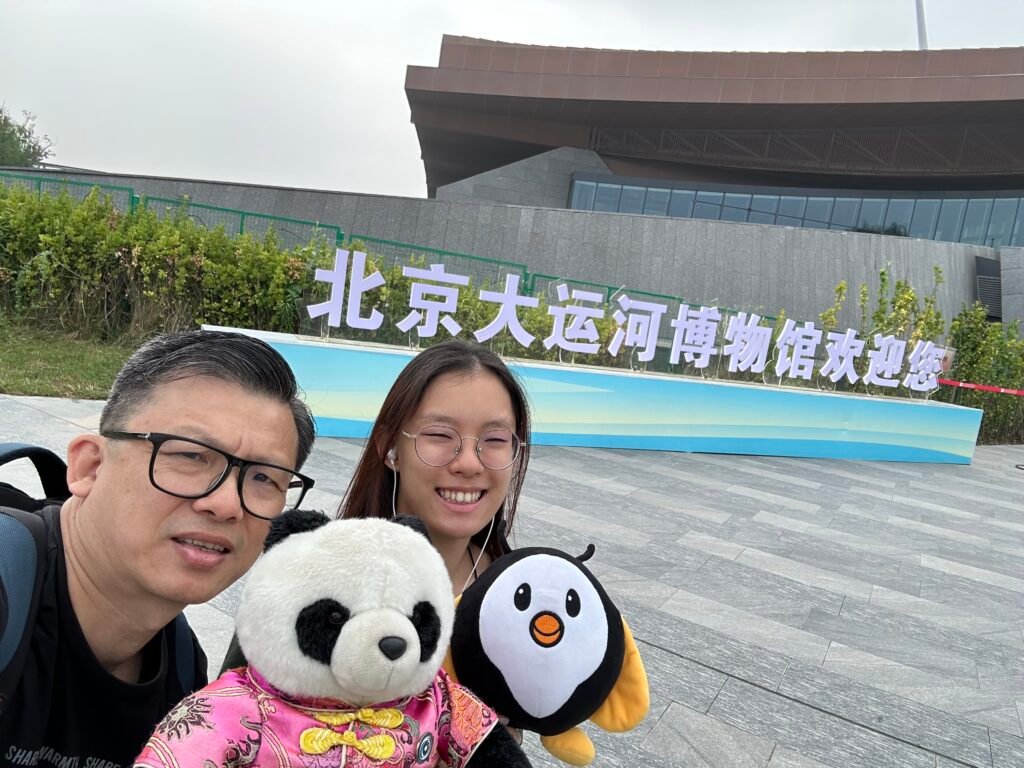
Another city explained Dezhou to us. Dad & Elaine outside the Beijing Grand Canal Museum (北京大运河博物馆). After seeing the Southern Canal in Dezhou, visiting this museum helped us understand the much bigger system: Dezhou was not simply a city beside a canal. It sat on one of the great transport arteries connecting China’s productive regions with the northern capital. Photo from Dad & Elaine’s Beijing journey.
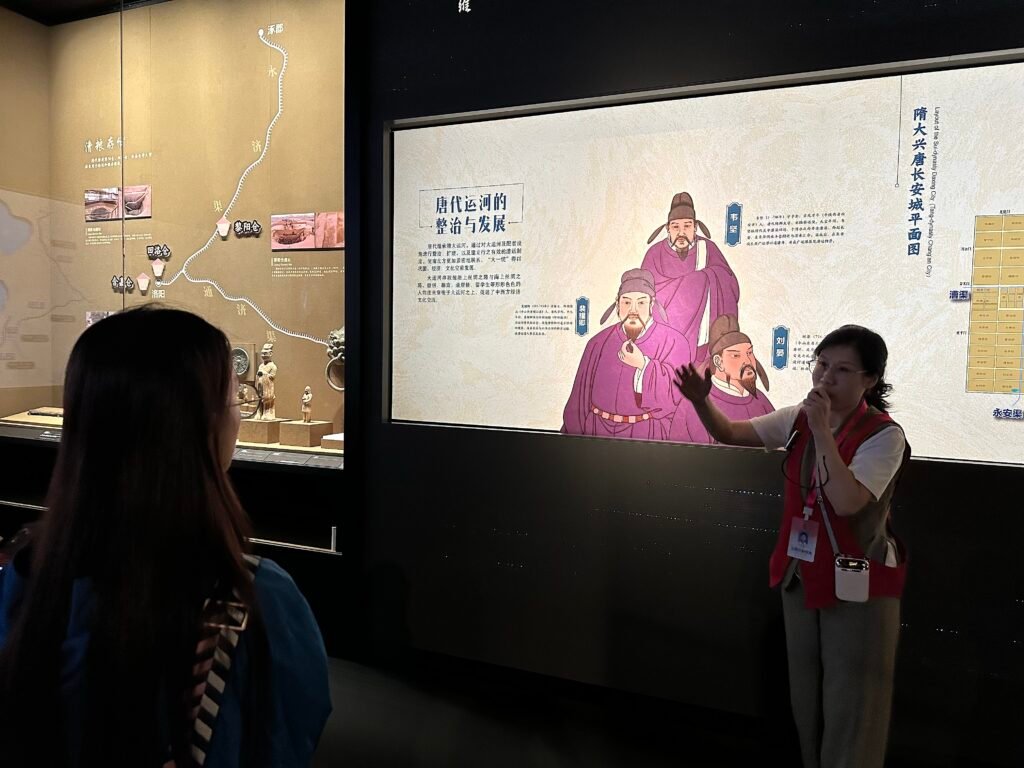
Now the system starts to make sense. Inside the Beijing Grand Canal Museum, Dad & Elaine learned how successive dynasties had to manage, repair and organize this enormous transport network. This display focuses on the Tang dynasty and officials associated with canal and grain-transport administration. Moving grain to the capital wasn’t simply a matter of digging a long ditch — it required water engineering, transport administration, storage, taxation and government coordination.
🔥 That’s the bigger Dezhou lesson: the Grand Canal wasn’t just a waterway. It was infrastructure for governing an empire.
When you eventually return to:
Forbidden City (故宫),
remember:
Dezhou.
😂
Look at the imperial halls and imagine behind them:
farmers,
grain,
boats,
canals,
granaries,
transport workers
and:
administrators.
🔥
The palace shows:
imperial authority.
The canal shows:
what helped sustain it.
That’s why the two articles should link to each other.
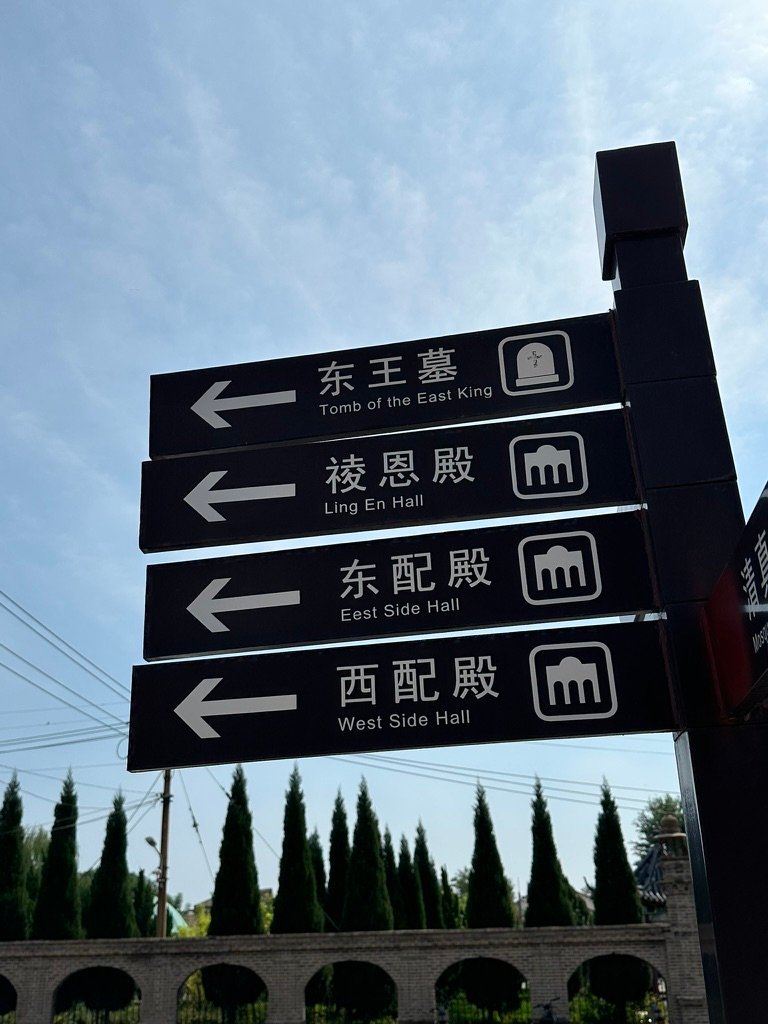
👑 Second Dezhou Story: Go to the Sulu Royal Tomb
Then change historical worlds completely.
Visit:
苏禄王墓 — Sūlù Wáng Mù.
Now your key Chinese words change.
王 — wáng
king
墓 — mù
tomb
使节 — shǐjié
diplomatic envoy
使团 — shǐtuán
diplomatic mission / delegation
外交 — wàijiāo
foreign relations / diplomacy
朝贡 — cháogòng
tributary presentation / tribute relationship
🔥
Now ask:
Why did people travel such enormous distances to the Ming court?
That’s the question the tomb should trigger.
🌏 Don’t Forget Where Sulu Is
Pull out the map.
Seriously.
😂
Look at:
Dezhou
then:
Sulu
in the maritime world of today’s southern Philippines.
😳
The distance is part of the story.
A ruler and entourage traveled through an international network that connected:
maritime Southeast Asia
with:
the Ming imperial court.
That’s much easier to appreciate when you physically see:
how far apart they are.
📸 Dad’s Four-Photo Challenge
Dezhou needs four different photographs.
1. THE CANAL
大运河
Photograph the infrastructure.
Think:
INTERNAL CONNECTION.
2. THE WORDS
Look for:
漕运
or historical interpretation explaining canal transport.
Take enough context that you can later understand what the sign actually says.
3. THE SULU TOMB
苏禄王墓
Not merely:
“Dad standing beside tomb.”
😂
Photograph:
the site,
inscriptions,
historical panels
and:
anything explaining the 1417 mission.
Think:
EXTERNAL CONNECTION.
4. THE EVIDENCE
Find:
碑 — bēi
stele
or:
碑文 — bēiwén
inscription.
🔥
Ask:
Who erected it?
When?
What does it actually record?
Qufu taught us:
read the stones.
That rule follows us to Dezhou too.
Ten Chinese Words Worth Bringing Home
This is a particularly good Deep China language plate.
大运河 — Dàyùnhé
Grand Canal
漕运 — cáoyùn
state-organized grain transport by water
南北 — nánběi
north and south
后勤 — hòuqín
logistics
苏禄 — Sūlù
Sulu
王 — wáng
king
墓 — mù
tomb
使节 — shǐjié
envoy
外交 — wàijiāo
diplomacy / foreign relations
贸易 — màoyì
trade
🔥
And bonus:
海上丝绸之路 — Hǎishàng Sīchóu Zhīlù
Maritime Silk Road.
That final phrase is where the rabbit is heading next.
🐇🌏

🐞 Now You’re Ready for the Sting
Before leaving Dezhou, Dad wants you to carry away:
three questions.
🐇 QUESTION 1 — How Do You Actually Hold an Empire Together?
The answer isn’t simply:
EMPEROR.
It also requires:
INFRASTRUCTURE.
Canals.
Roads.
Grain.
Transport.
Officials.
Communication.
🔥
That’s why:
Grand Canal
belongs in the same story as:
Forbidden City.
And it connects directly with our Michelin question:
Why Did China’s Capital Keep Moving?
Because choosing a capital is one problem.
SUPPLYING IT
is another.
🐇🌏 QUESTION 2 — Was Imperial China Really Isolated?
Look at:
苏禄王墓.
😂
A ruler from maritime Southeast Asia traveled to the:
Ming court
and died in:
Shandong.
Now add:
Zheng He
Southeast Asia
Indian Ocean
foreign envoys
and:
maritime trade.
The answer is becoming obvious:
“ISOLATED CHINA” IS FAR TOO SIMPLE.
🔥
That takes us toward our Big Question:
Was China Really Isolated Behind the Great Wall?
The wall gives you:
the northern frontier.
Dezhou gives you:
a completely different direction.
🐇🌏 QUESTION 3 — Where Does the Maritime Rabbit Go Next?
Dezhou:
Sulu
↓
Ming diplomacy
↓
Zheng He
↓
Southeast Asia
↓
Indian Ocean
↓
southern Chinese ports
↓
Quanzhou (泉州).
😬🐇🌏
Dad & Elaine haven’t followed this rabbit all the way yet.
Quanzhou remains on our:
future Deep China list.
And that’s exactly where we’ll eventually explore:
Maritime Silk Roads.
Not from a textbook.
From the port itself.
🔥
🍽️ Ready to Go Michelin?
Dezhou opens several doors.
GO MICHELIN — Why Did China’s Capital Keep Moving?
The Grand Canal helps explain how:
Beijing
could remain a huge northern imperial capital while drawing resources from:
farther south.
Remember:
CAPITALS EAT.
😂
GO MICHELIN — Was China Really Isolated Behind the Great Wall?
The Sulu tomb gives you the answer in stone.
China’s external history wasn’t only:
horsemen beyond the northern frontier.
There were also:
ships
ports
envoys
merchants
and:
maritime states.
🐇🌏
GO DEEPER — Who Is “Chinese”?
And once people arrive from outside China…
sometimes:
they stay.
😬
Sulu descendants in Dezhou.
Sogdians in Chinese cities.
Muslim communities.
Mongols.
Manchus.
Different historical processes.
Different identities.
One enormous question:
Who becomes part of China’s story?
🐇
🌏 Rabbit Escaped China — and Came Back Again
This deserves our new marker.
🐇🌏 THE RABBIT ESCAPED CHINA!
At Qufu:
Confucian traditions
travel outward toward:
Vietnam, Korea and Japan.
At Dezhou:
a Sulu ruler
travels:
INTO China.
And with Zheng He:
Ming fleets
travel:
OUT again.
😂
So the real historical pattern isn’t:
CHINA → WORLD
or:
WORLD → CHINA.
It’s:
WORLD ↔ CHINA.
🔥🔥🔥
People.
Ideas.
Religions.
Goods.
Institutions.
Diplomats.
Ships.
They moved:
both ways.
🐞 ChinaTravelBUG’s Take
Dezhou probably won’t appear near the top of:
“10 Must-See Places in China.”
😂
That’s precisely why it belongs in:
Deep China.
The:
Grand Canal
teaches you how an empire connected:
itself.
The:
Sulu Royal Tomb
teaches you that the same empire existed inside:
a much wider international world.
🔥
One points:
INWARD.
One points:
OUTWARD.
And together they transform Dezhou from:
“a lesser-known city in Shandong”
into:
a lesson about how empires work.
Supply your capital.
Connect your territory.
Receive envoys.
Negotiate relationships.
Move goods.
Move people.
Move ideas.
😳
Then follow the rabbit toward:
Zheng He 郑和
and eventually:
Quanzhou 泉州.
🐇🌏
Because sometimes the best place for understanding China’s relationship with the outside world isn’t:
on China’s border.
Sometimes…
it’s a royal tomb in:
Dezhou.
🔥🐞🐇🌏
Travel China. Let the places teach you Chinese history.
See the place. Ask the bigger question. Understand China better.